


























Key Takeaways
- Strong Emergency Notification Software Market Growth: The global emergency notification systems market is projected to reach USD 43.4 billion by 2033, growing at a 12.3% CAGR, driven by rising demand for crisis communication, disaster preparedness, and workplace safety solutions.
- AI, Cloud Technology, and Multi-Channel Alerts Drive Innovation: Emergency notification software trends in 2026 highlight increasing adoption of AI-powered automation, cloud-based platforms, IoT integration, SMS alerts, and real-time incident management to improve emergency response efficiency.
- Workplace Safety and Regulatory Compliance Fuel Adoption: With 43% of employees expecting emergency alerts within five minutes, organizations across healthcare, education, government, and manufacturing are prioritizing reliable emergency notification systems, business continuity, and regulatory compliance.
Emergency notification software is transforming crisis communication and workplace safety in 2026. The global emergency notification systems market is projected to reach USD 43.4 billion by 2033, growing at a 12.3% CAGR. Explore 103 key statistics covering market growth, AI adoption, cloud technology, emergency alerts, regulatory compliance, and business continuity trends worldwide.
Emergency notification software has become an essential component of modern workplace safety, crisis communication, disaster preparedness, and business continuity planning. As organizations face increasing cybersecurity threats, extreme weather events, workplace emergencies, and stricter safety regulations, the demand for reliable, real-time emergency communication solutions continues to accelerate. In 2026, businesses, governments, educational institutions, and healthcare providers are investing in advanced emergency notification systems to protect employees, minimize operational disruptions, and coordinate faster responses during critical incidents.
The global emergency notification systems market was valued at approximately USD 15.4 billion in 2024 and is projected to reach USD 43.4 billion by 2033, growing at a compound annual growth rate (CAGR) of 12.3%. Meanwhile, the broader mass notification systems market is forecast to expand from USD 19.85 billion in 2025 to USD 69.30 billion by 2032, reflecting growing investment in emergency preparedness infrastructure. These estimates cover different market definitions, but collectively highlight the expanding commercial importance of emergency notification technology.
Workplace safety concerns are also driving adoption. Research indicates that 43% of employees expect their employers to contact them within five minutes of an emergency, while a 2025 workplace survey found that 39% of respondents identified poor communication as a leading reason they felt unsafe at work. These findings emphasize the importance of timely, accurate, and accessible emergency alerts, particularly for organizations managing geographically dispersed employees, remote teams, and complex operational environments.
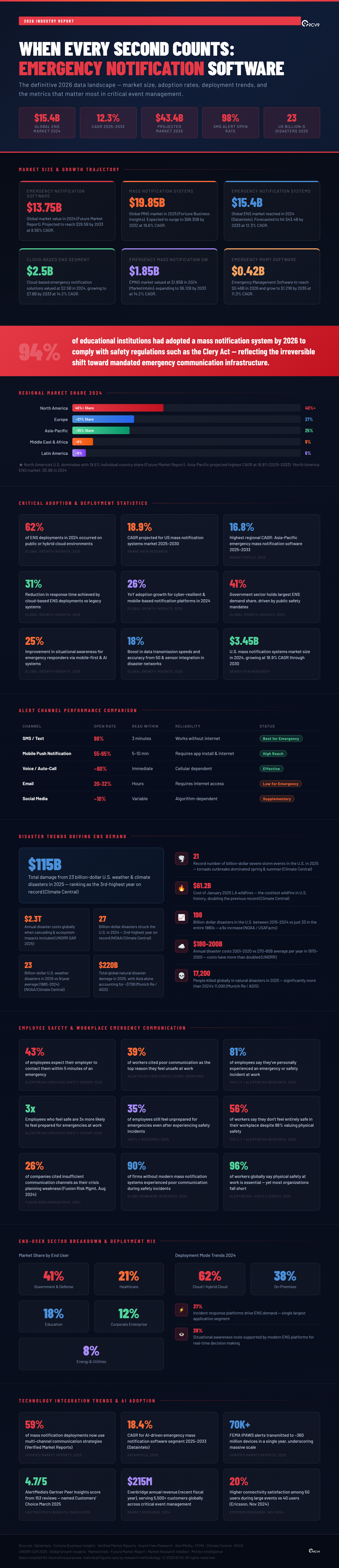
Technological innovation is reshaping the emergency notification software industry in 2026. Cloud-based emergency notification platforms, artificial intelligence (AI), machine learning, Internet of Things (IoT) integrations, and automated incident response workflows are helping organizations improve situational awareness and communication efficiency. Multi-channel emergency notification systems that combine SMS, email, mobile push notifications, voice calls, and desktop alerts are becoming increasingly important for reaching affected individuals quickly. Industry research also points to growing demand for location-based alerts, two-way communication, and automated escalation capabilities.
Regionally, North America remains a leading market, supported by established safety infrastructure, enterprise technology adoption, and regulatory requirements. At the same time, Asia-Pacific is emerging as a major growth opportunity, fueled by rapid urbanization, smart city investments, digital transformation, and increasing awareness of disaster preparedness. Industries including healthcare, education, manufacturing, transportation, financial services, and government are expanding their use of emergency communication platforms to strengthen organizational resilience.
The Top 103 Emergency Notification Software Statistics, Data & Trends in 2026 provides a comprehensive overview of the industry’s market size, growth forecasts, regional market shares, deployment trends, employee safety expectations, communication channel performance, regulatory developments, and emerging technologies. Whether you are a business leader, IT professional, safety manager, emergency management specialist, or software provider, these statistics offer valuable insights into the evolving emergency notification software market and the technologies shaping the future of crisis communication and organizational safety.
Before we venture further into this article, we would like to share who we are and what we do.
About 9cv9
9cv9 is a business tech startup based in Singapore and Asia, with a strong presence all over the world.
With over ten years of startup and business experience, and being highly involved in connecting with thousands of companies and startups, the 9cv9 team has listed some of the top and best companies/tools in this review.
If you like to get your company listed in our top B2B software reviews, check out our world-class 9cv9 Media and PR service and pricing plans here.
Top 103 Emergency Notification Software Statistics, Data & Trends in 2026
1. The global emergency notification systems market reached USD 15.4 billion in 2024.
The global emergency notification systems market was valued at approximately USD 15.4 billion in 2024, reflecting growing investment in crisis communication, public safety infrastructure, and organizational emergency preparedness. Demand continues to expand as businesses and government agencies prioritize reliable emergency communication.
2. The emergency notification systems market is projected to reach USD 43.4 billion by 2033.
The global emergency notification systems market is forecast to grow to USD 43.4 billion by 2033, representing a compound annual growth rate (CAGR) of 12.3% from 2025 to 2033. This growth reflects increasing demand for advanced emergency alert systems and crisis management technology.
3. The global mass notification systems market could reach USD 69.30 billion by 2032.
The mass notification systems market is projected to expand from USD 19.85 billion in 2025 to USD 69.30 billion by 2032, growing at a CAGR of 19.6%. This forecast highlights rising investments in large-scale emergency communication infrastructure across public and private sectors.
4. The emergency notification software market could exceed USD 26.5 billion by 2033.
One industry forecast valued the emergency notification software market at USD 13.75 billion in 2024 and projected it to reach approximately USD 26.50 billion by 2033, with a reported CAGR of 8.56%. Growth is associated with increasing enterprise adoption and emergency preparedness requirements.
5. The emergency notification software market could reach USD 4.07 billion by 2035.
A narrower market estimate valued emergency notification software at USD 1.64 billion in 2025 and projected growth to USD 4.07 billion by 2035, representing a CAGR of approximately 9.5%. Differences between forecasts reflect varying market definitions and research methodologies.
6. The emergency notification software market was valued at USD 11.50 billion in 2023.
Another industry estimate placed the global emergency notification software market at USD 11.50 billion in 2023, with a projected increase to USD 24.35 billion by 2031. The forecast indicates a reported CAGR of 8.2%, supported by increasing demand for automated emergency communication.
7. Cloud-based emergency notification solutions could reach USD 7.8 billion by 2033.
The cloud-based emergency notification solutions market was estimated at approximately USD 2.5 billion in 2024 and is projected to reach USD 7.8 billion by 2033, with a reported CAGR of 14.2%. Cloud adoption is supported by scalability, accessibility, and reduced infrastructure management requirements.
8. Emergency mass notification software could reach USD 6.12 billion by 2033.
The global emergency mass notification software market was valued at approximately USD 1.85 billion in 2024 and is forecast to reach USD 6.12 billion by 2033. The source reports a CAGR of 14.2%, although this growth rate should be checked against the stated market values and forecast period.
9. Emergency notification software could grow to USD 7.2 billion by 2033.
One market projection estimates that emergency notification software will expand from USD 2.5 billion in 2025 to USD 7.2 billion by 2033, representing a reported CAGR of 15%. Increasing demand for real-time alerts, cloud platforms, and automated crisis communication supports the market outlook.
10. The emergency notification software market could reach USD 9.5 billion by 2032.
An alternative market forecast estimated emergency notification software revenue at USD 4.57 billion in 2023 and USD 4.96 billion in 2024, with projected growth to USD 9.5 billion by 2032. The reported CAGR is 8.47%.
11. The emergency management software market could reach USD 1.21 billion by 2035.
The global emergency management software market is projected to increase from USD 420 million in 2025 to USD 460 million in 2026 and USD 520 million in 2027, eventually reaching USD 1.21 billion by 2035. The forecast indicates an approximate CAGR of 11.3%.
12. Emergency mass notification software could reach USD 7.2 billion by 2031.
One market estimate places the emergency mass notification software market at approximately USD 3.5 billion in 2024, with a forecast of USD 7.2 billion by 2031. The accompanying report cites an 8.5% CAGR for 2025–2031, although the stated values and growth rate require reconciliation.
13. The emergency mass notification software market reached an estimated USD 8.2 billion in 2024.
Another market research estimate valued emergency mass notification software at USD 8.2 billion in 2024, with a reported forecast CAGR of 18.4% from 2025 to 2033. This outlook reflects growing demand for large-scale emergency alerts and automated communication infrastructure.
14. The emergency notification solutions market could reach USD 12.5 billion by 2033.
The global emergency notification solutions market is projected to reach approximately USD 12.5 billion by 2033, growing at a reported CAGR of 8.7% from 2025 to 2033. Increasing investment in crisis management, public safety, and emergency response technology is expected to support demand.
Regional Emergency Notification Software Market Statistics
15. North America accounts for more than 40% of the emergency notification software market.
North America holds an estimated market share exceeding 40% in one emergency notification software industry assessment. Regional demand is supported by established communication infrastructure, enterprise safety investments, and regulatory requirements.
16. North America’s emergency notification systems market reached USD 5.9 billion in 2024.
The North American emergency notification systems market was valued at approximately USD 5.9 billion in 2024 and is projected to grow at a CAGR of 10.8% through 2033. Continued investment in emergency preparedness and critical communication infrastructure supports regional growth.
17. Asia-Pacific emergency mass notification software could grow at a 16.8% CAGR.
Asia-Pacific is projected to experience a CAGR of 16.8% from 2025 to 2033 in the emergency mass notification software segment. Rapid urbanization, infrastructure development, and increased disaster preparedness investment are important regional growth factors.
18. Europe’s emergency notification systems market reached USD 4.1 billion in 2024.
Europe represented approximately USD 4.1 billion in emergency notification systems market value in 2024, making it one of the industry’s largest regional markets. Demand is supported by public safety initiatives, enterprise risk management, and emergency communication requirements.
19. Asia-Pacific emergency notification software growth could exceed 12% annually.
The Asia-Pacific emergency notification software market is projected to grow at a CAGR exceeding 12% in one industry forecast. Smart city development, infrastructure modernization, and increasing demand for disaster response systems are contributing factors.
20. The United States represents approximately 19.6% of one global emergency notification software market estimate.
The United States accounts for an estimated 19.6% of the global emergency notification software market under one research provider’s methodology. Demand is associated with enterprise adoption, public safety investment, and technology development.
21. North America held 40.66% of the mass notification systems market in 2024.
North America accounted for approximately 40.66% of the global mass notification systems market in 2024. Government, defense, education, healthcare, and enterprise emergency communication requirements contribute to its significant market position.
22. The Middle East and Africa represented an estimated 9% of emergency management software demand in 2025.
The Middle East and Africa accounted for approximately 9% of the market in a 2025 emergency management software estimate. Regional demand is supported by investment in security infrastructure, disaster management, and smart city initiatives.
Emergency Notification Software Deployment and Technology Statistics
23. Approximately 62% of reported emergency management deployments used public or hybrid cloud environments in 2024.
One industry assessment reported that nearly 62% of emergency management software deployments operated in public or hybrid cloud environments during 2024. Cloud adoption supports scalability, remote access, and integration with other emergency response technologies.
24. Cloud-based emergency management deployments were associated with 31% faster response times.
An industry report claimed that cloud-based emergency management deployments reduced response times by approximately 31% compared with legacy on-premises systems. Actual improvements depend on system architecture, operational processes, connectivity, and incident conditions.
25. Mobile and cyber-resilient emergency management solutions recorded 26% adoption growth.
Mobile-based notification platforms and cyber-resilient emergency management solutions reportedly experienced 26% year-over-year adoption growth in 2024. Demand reflects the increasing importance of mobile accessibility and secure emergency communication.
26. AI-driven emergency management tools were associated with more than 25% better situational awareness.
One industry assessment reported improvements exceeding 25% in situational awareness through mobile-first interfaces and AI-supported decision systems. These technologies help emergency responders access relevant information and coordinate decisions during incidents.
27. 5G and sensor integration reportedly improved emergency monitoring data performance by 18%.
The integration of 5G connectivity and connected sensors into disaster monitoring networks was associated with an estimated 18% improvement in data transmission speed and accuracy. Performance varies according to network conditions and system design.
28. Cloud-based emergency mass notification software is gaining adoption over traditional deployment models.
Cloud-based emergency mass notification software is experiencing increasing demand because of scalable infrastructure, simplified maintenance, and flexible deployment. These benefits make cloud solutions attractive to organizations seeking modern emergency communication capabilities.
29. The U.S. mass notification systems market could grow at an 18.9% CAGR through 2030.
The United States mass notification systems market is projected to grow at a CAGR of 18.9% from 2025 to 2030. Increasing demand for rapid emergency communication, public safety systems, and enterprise preparedness supports this forecast.
30. AI, IoT, and multi-channel communication are major emergency notification technology trends in 2026.
Emergency notification software development increasingly emphasizes AI-powered alert automation, IoT-enabled monitoring, and multi-channel messaging. These technologies support more targeted notifications, improved situational awareness, and coordinated incident management.
Employee Safety and Workplace Emergency Communication Statistics
31. Approximately 43% of employees expect emergency communication within five minutes.
Employee safety research indicates that 43% of workers expect their employers to contact them within five minutes of an emergency. This expectation highlights the importance of rapid alert delivery and well-defined workplace emergency communication procedures.
32. Poor communication was a leading workplace safety concern for 39% of surveyed employees.
A 2025 survey involving more than 3,000 workers found that 39% identified poor communication as a major reason they felt unsafe at work. The finding emphasizes the relationship between communication practices and employee perceptions of workplace safety.
33. Approximately 81% of surveyed employees reported experiencing a workplace emergency or safety incident.
One workplace safety report indicated that nearly 81% of employees had personally experienced an emergency or safety incident at work. The same source reported that approximately 35% of workers felt unprepared for future emergencies.
34. Approximately 96% of workers consider physical workplace safety essential.
Workplace safety research reported that 96% of employees consider physical safety important, while more than 56% do not feel entirely safe at work. These findings suggest an ongoing need for improved safety planning, employee communication, and emergency preparedness.
35. Employees who feel safe are three times more likely to feel prepared for emergencies.
Employee safety research found that workers who feel safe in their workplace are approximately three times more likely to report feeling prepared for emergencies. The association highlights the importance of safety culture, training, and effective communication.
36. Approximately 26% of surveyed companies identified insufficient emergency communication channels.
A 2024 study involving 1,000 companies found that 26% identified insufficient communication channels as a weakness in their crisis planning. The finding suggests that communication infrastructure remains an important area for organizational improvement.
37. Poor emergency communication reportedly affected 90% of organizations lacking modern notification systems.
One industry source claimed that 90% of firms without modern mass notification systems experienced communication difficulties during safety incidents. This figure requires further methodological verification before being treated as a general industry benchmark.
38. A major 2025 employee safety survey included 3,022 workers across the United States and United Kingdom.
The 2025 employee safety research sample included 3,022 full-time workers, comprising 2,022 respondents in the United States and 1,000 in the United Kingdom. The survey provides cross-market insights into workplace safety perceptions and emergency preparedness.
Emergency Alert Channel Performance Statistics
39. SMS open rates are commonly reported at approximately 98%.
Industry sources frequently cite SMS open rates near 98%, with many messages reportedly read within three minutes. However, these figures are general SMS marketing benchmarks rather than independently established performance rates for every emergency notification system.
40. SMS is frequently cited as a high-visibility emergency communication channel.
SMS messaging is often associated with a reported 98% open rate and rapid message visibility. Its accessibility makes it useful for emergency communication, although delivery and engagement depend on mobile network availability and recipient circumstances.
41. One emergency SMS benchmark reports that 65% of recipients read messages within five minutes.
An industry source reported a 55% SMS open rate, a 100% view rate, and 65% readership within five minutes. These figures use different engagement measures and should be interpreted cautiously rather than treated as universal emergency alert performance.
42. Reported SMS open rates commonly range from 95% to 98%.
Several industry sources estimate SMS open rates between 95% and 98%. Text messaging remains an important emergency communication channel because standard SMS does not require mobile internet access, although it still depends on functioning cellular infrastructure.
43. The U.S. AMBER Alert program was credited with helping recover 1,292 children by December 2025.
A December 2025 industry report cited 1,292 child recoveries associated with the AMBER Alert program and an additional 241 rescues involving wireless emergency alerts. These historical figures should be checked against official program records before publication.
44. SMS emergency alerts can operate without Wi-Fi or mobile data connectivity.
SMS messages can be delivered over compatible cellular networks without requiring an active internet connection. This capability makes SMS useful during emergencies, although network outages, congestion, and damaged telecommunications infrastructure can still disrupt delivery.
Natural Disasters and Emergency Notification Demand Statistics
45. The United States experienced 23 billion-dollar weather and climate disasters in 2025.
A climate disaster assessment identified 23 U.S. weather and climate events in 2025 that each caused at least USD 1 billion in damage, with combined estimated losses of USD 115 billion. These figures illustrate the economic significance of disaster preparedness.
46. The January 2025 Los Angeles wildfires caused an estimated USD 61.2 billion in damage.
The January 2025 Los Angeles wildfires were estimated to have caused USD 61.2 billion in damage, making them among the costliest wildfire disasters on record. The event highlights the importance of coordinated emergency warnings and evacuation communication.
47. Severe storms accounted for 21 billion-dollar U.S. disaster events in 2025.
One disaster assessment recorded 21 billion-dollar severe storm events in the United States during 2025. The reported frequency illustrates the importance of severe weather monitoring, emergency alert infrastructure, and community preparedness.
48. The United States averaged 23 billion-dollar weather disasters annually over a recent five-year period.
Historical disaster data indicated an average of approximately nine billion-dollar weather events annually from 1980 to 2024, compared with an average of 23 events per year during the most recent five-year period examined.
49. Nine of the ten U.S. years with the highest recorded natural disaster counts occurred within the preceding decade.
A historical disaster analysis found that nine of the ten years with the highest recorded natural disaster counts occurred during the previous decade. Changes in reporting methods, asset exposure, and inflation adjustments should be considered when interpreting disaster trends.
50. U.S. billion-dollar disasters caused more than USD 2.9 trillion in cumulative losses since 1980.
One historical assessment recorded 402 billion-dollar natural disaster events in the United States since 1980, resulting in more than USD 2.9 trillion in estimated losses and 16,918 deaths through the reporting period.
51. Average annual direct disaster costs increased substantially between 1970 and 2020.
Global disaster research estimated average annual direct disaster costs at USD 70–80 billion during 1970–2000, increasing to approximately USD 180–200 billion during 2001–2020. The figures reflect the growing economic consequences of disasters.
52. Global disaster costs may exceed USD 2.3 trillion annually when indirect impacts are included.
A global disaster risk assessment estimated that total annual disaster costs exceed USD 2.3 trillion when indirect, cascading, and ecosystem-related impacts are considered. This broader estimate extends beyond conventional direct economic damage calculations.
53. Approximately 17,200 people died in natural disasters worldwide in 2025.
A 2026 disaster assessment reported approximately 17,200 natural disaster fatalities worldwide during 2025, compared with around 11,000 in 2024. The reported total remained slightly below the ten-year annual average of approximately 17,800 deaths.
54. Global natural disaster losses exceeded USD 220 billion in 2025.
One global assessment estimated natural disaster losses above USD 220 billion in 2025. Asia accounted for approximately USD 73 billion in losses, with around USD 9 billion insured, highlighting substantial financial exposure to disaster risks.
55. The United States experienced 198 billion-dollar weather disasters between 2015 and 2024.
Historical weather disaster records identified 198 billion-dollar events in the United States between 2015 and 2024, compared with 33 during the 1980s. The comparison illustrates changes in the frequency of costly disasters, although economic exposure also influences the figures.
Emergency Notification Regulations and Public Alert Statistics
56. An estimated 94% of educational institutions had adopted mass notification systems by 2026.
One market research estimate claimed that approximately 94% of educational institutions had implemented mass notification systems by 2026. The figure should be independently verified, particularly because institutional coverage and geographic scope were not clearly specified.
57. FEMA’s IPAWS reportedly distributed more than 70,000 alerts in one year.
An industry source reported that the Integrated Public Alert and Warning System transmitted more than 70,000 alerts reaching approximately 360 million devices during a reporting year. The reporting period and device reach methodology require verification.
58. Federal IPAWS funding figures included USD 11.9 million and USD 54.2 million for FY2025.
A federal budget analysis referenced USD 11.9 million in funding received by FEMA for IPAWS and a broader USD 54.2 million FY2025 investment figure. These amounts represent different budget measures and should not be interpreted as interchangeable.
59. U.S. wireless emergency alert upgrades include location-aware maps and silent alert capabilities.
Federal emergency alert modernization plans referenced location-aware maps targeted for December 2026 and silent alert capabilities targeted for March 2028. Implementation schedules may change depending on regulatory decisions and technical deployment requirements.
60. U.S. emergency alert modernization efforts include multilingual messaging and silent notifications.
Federal communications regulators have considered enhancements to wireless emergency alerts, including multilingual templates and silent notification capabilities. These developments aim to improve accessibility and the usefulness of public emergency warnings.
Emergency Notification Software Industry Adoption Statistics
61. Government applications represent approximately 41% of one emergency management software market estimate.
Government applications accounted for approximately 41% of the emergency management software market in one industry assessment. Public safety requirements, disaster response planning, and emergency operations management support government demand.
62. Incident response platforms account for an estimated 37% of emergency management software demand.
One market report estimated that incident response applications represented approximately 37% of demand within the emergency management software category. These platforms support emergency coordination, incident tracking, and response management.
63. Situational awareness tools represent approximately 28% of emergency management software demand.
Situational awareness applications accounted for an estimated 28% of demand in one emergency management software market assessment. These tools provide operational visibility, real-time information, and decision support during emergency situations.
64. Public alerts and warnings remain a major mass notification systems application.
Public warning and alerting systems represent an important application category within the mass notification industry. Governments and emergency response organizations use these systems to distribute urgent safety information during disasters and other public emergencies.
65. Emergency notification systems serve at least seven major industry sectors.
Mass notification systems are used across government, education, healthcare, energy and utilities, transportation, manufacturing, and defense. Their applications include employee safety, public warnings, operational continuity, and emergency response coordination.
66. Toronto Zoo adopted a multi-channel mass notification system in June 2024.
Toronto Zoo selected an enterprise mass notification platform in June 2024 to improve emergency communication for employees and visitors. The system incorporated SMS, email, desktop notifications, and voice messaging to support coordinated safety communication.
AI, IoT, and Emergency Notification Technology Statistics
67. AI and machine learning are becoming increasingly important in emergency notification systems.
Artificial intelligence and machine learning are being integrated into emergency notification platforms to support threat detection, information analysis, automated communication, and response coordination. Their effectiveness depends on data quality, system configuration, and operational oversight.
68. IoT-enabled emergency notification systems support real-time monitoring and automated alerts.
Internet of Things integration allows emergency notification systems to connect with sensors and monitoring infrastructure. These connections support real-time incident detection, predictive analytics, and automated communication workflows.
69. AI-enabled mass notification platforms increasingly integrate multiple threat intelligence sources.
Advanced emergency notification platforms can connect with weather monitoring services, cybersecurity alerts, and building security systems. These integrations help organizations consolidate risk information and coordinate emergency communication across different threat categories.
70. One emergency notification provider received a 4.7 out of 5 customer rating in 2025.
A March 2025 industry assessment reported that AlertMedia received a 4.7 out of 5 rating based on 153 Gartner Peer Insights reviews and was recognized as a Customers’ Choice. Review counts and ratings reflect the reporting period and may change.
71. 5G users reported 20% higher connectivity satisfaction during large events.
A November 2024 telecommunications study reported that 5G users experienced approximately 20% higher connectivity satisfaction than 4G users during large gatherings. This finding concerns user experience and does not directly establish emergency alert delivery reliability.
72. A leading emergency notification provider served more than 5,500 customers globally.
Historical market information reported that Everbridge supported more than 5,500 customers worldwide and generated approximately USD 215 million in annual revenue during a previous reporting period. These figures should not be treated as current 2026 performance.
Multi-Channel Emergency Notification and Mobile Communication Statistics
73. Approximately 59% of mass notification deployments use multi-channel communication.
One industry estimate indicated that 59% of mass notification deployments incorporated multi-channel communication strategies. These approaches combine methods such as SMS, email, voice calls, and mobile alerts to improve message reach.
74. Two-way messaging and location-based alerts are becoming important emergency notification features.
Modern emergency notification platforms increasingly offer two-way communication, geographic targeting, and automated escalation workflows. These capabilities help organizations collect responses, distribute relevant warnings, and coordinate emergency activities.
75. Mobile-first emergency notification systems are gaining importance in 2026.
The increasing mobility of employees and the growth of distributed workforces are supporting demand for mobile-accessible emergency notification platforms. Mobile systems allow organizations to communicate with employees across multiple locations.
76. Hybrid work arrangements are increasing demand for location-independent emergency alerts.
Hybrid and remote working arrangements have expanded the need for emergency communication systems that can reach employees outside traditional workplaces. Cloud-based and mobile-enabled notification platforms support communication across distributed teams.
Business Continuity and Emergency Notification Compliance Statistics
77. Regulatory requirements are an important driver of emergency notification software adoption.
Safety regulations and emergency preparedness obligations contribute to demand for notification software across healthcare, education, manufacturing, and other industries. Requirements vary by jurisdiction and do not necessarily mandate a specific software platform.
78. Emergency notification software had established adoption across public and private sectors by 2025.
Industry research described emergency notification software as an established technology category by 2025, with adoption across government agencies and private organizations. Continued investment is associated with safety planning, regulatory compliance, and operational resilience.
79. Business continuity planning is increasing demand for emergency communication technology.
Healthcare providers, financial institutions, educational organizations, and other critical service operators increasingly incorporate emergency communication into business continuity planning. Notification platforms help coordinate personnel during operational disruptions.
80. Healthcare, finance, and IT organizations use emergency notification systems for safety and incident response.
Emergency notification systems support healthcare safety planning, financial services incident coordination, and IT cybersecurity response. Specific regulatory obligations depend on the industry, location, and applicable legal requirements.
81. OSHA emergency action planning requirements support workplace alerting practices.
U.S. workplace safety regulations require applicable employers to establish emergency action procedures and appropriate methods for warning employees. Emergency notification software may support these obligations, although it is not universally required by OSHA.
Emergency Notification Software Growth Drivers and Investment Statistics
82. Five major factors are influencing emergency notification software market growth.
Key industry growth drivers include digital transformation, natural and human-caused disasters, regulatory requirements, cloud and AI adoption, and business continuity planning. These factors contribute to demand for modern emergency communication technology.
83. Asia-Pacific emergency notification software growth is projected to exceed 12% annually.
One industry forecast projects annual growth above 12% in Asia-Pacific emergency notification software demand. Infrastructure expansion, urban development, and disaster preparedness initiatives are expected to contribute to regional market opportunities.
84. Saudi Arabia and the UAE are investing in smart safety and emergency management infrastructure.
Smart city development and infrastructure modernization initiatives in Saudi Arabia and the United Arab Emirates are creating opportunities for emergency management technology, including monitoring systems, communication platforms, and public safety applications.
85. Geospatial intelligence and cloud dashboards are expanding emergency management capabilities.
Emergency management platforms increasingly integrate geographic information systems, cloud dashboards, and real-time monitoring tools. These capabilities support location-specific risk assessment, operational visibility, and coordinated incident response.
86. Personalized and targeted emergency alerts are becoming a major software trend.
Emergency notification software increasingly supports targeted messaging based on location, employee role, organizational group, and incident type. Targeted communication can reduce unnecessary notifications and help recipients receive relevant safety information.
87. Emergency notification software providers are experiencing industry consolidation.
Industry research describes merger and acquisition activity in the emergency notification market as moderate to high. Larger software providers may acquire specialized businesses to expand capabilities in incident management, communication, and critical event response.
Cybersecurity and Emergency Notification Software Statistics
88. Cybersecurity threats are contributing to demand for emergency notification systems.
Cyberattacks, ransomware incidents, and major IT disruptions are increasing the relevance of emergency notification software. Organizations use these platforms to communicate with employees, coordinate response teams, and distribute incident updates.
89. Mobile adoption and cybersecurity awareness are influencing emergency communication software demand.
The growing use of mobile devices and increased awareness of cybersecurity risks are supporting demand for secure emergency notification platforms. Organizations increasingly require reliable communication methods that remain available during operational disruptions.
90. Financial services and IT organizations use mass notification systems for cybersecurity incident communication.
Financial institutions and technology companies use emergency communication platforms to coordinate responses to security breaches, service outages, and other incidents. Notification software can support incident response procedures and applicable regulatory reporting workflows.
Additional Emergency Notification Software Market Statistics and Trends
91. The U.S. mass notification systems market reached USD 3.45 billion in 2024.
The United States mass notification systems market was valued at approximately USD 3.45 billion in 2024 and is projected to grow at a CAGR of 18.9% from 2025 to 2030. Public safety and enterprise emergency communication demand support this outlook.
92. Three major structural factors support emergency notification software market expansion.
Increasing demand for real-time crisis communication, evolving regulatory requirements, and enterprise digital transformation are important factors supporting emergency notification software adoption across public and private organizations.
93. Asia-Pacific represents approximately 29% of one emergency management software market estimate.
Asia-Pacific accounted for an estimated 29% of emergency management software demand in one regional market assessment. Disaster preparedness investment, urbanization, and infrastructure development contribute to the region’s market position.
94. Integrated critical event management platforms have been expanding since 2023.
The launch of Everbridge 360 in September 2023 illustrated the movement toward integrated critical event management platforms. These solutions combine risk intelligence, emergency communication, collaboration, and incident coordination within unified software environments.
95. AI features are becoming more common in enterprise emergency notification platforms.
Emergency notification providers are increasingly incorporating AI-supported message optimization, predictive analytics, and automated compliance-related workflows. These capabilities aim to improve communication relevance, operational efficiency, and incident management.
96. Smartphone adoption is expanding the potential reach of mobile emergency notification systems.
Increasing smartphone and mobile internet adoption, particularly in developing economies, is expanding opportunities for mobile emergency notification applications. Mobile platforms support broader communication access, although coverage and accessibility vary across populations.
97. Cloud-native architecture is becoming an important emergency notification software capability.
Cloud-native emergency notification systems offer scalable infrastructure, centralized administration, and integration opportunities. These characteristics support organizations seeking flexible emergency communication platforms without maintaining extensive on-premises infrastructure.
98. Critical event management platforms are combining notification and incident response capabilities.
Critical event management platforms increasingly integrate emergency notifications, collaboration tools, threat intelligence, and response coordination. This approach helps organizations manage multiple stages of an incident through connected workflows.
99. U.S. billion-dollar weather disasters averaged approximately USD 140 billion in annual losses over a decade.
Historical U.S. weather disaster data indicated average annual losses of approximately USD 140 billion over the ten-year period examined. These figures illustrate the financial exposure associated with major disasters and the importance of preparedness measures.
100. The United States recorded 19 billion-dollar weather disasters between January and July 2024.
A historical disaster assessment reported 19 billion-dollar weather and climate events in the United States during the first seven months of 2024. The figure highlights the substantial frequency of costly weather events during that period.
101. One emergency notification software forecast projects a market approaching USD 6 billion by 2033.
An industry assessment suggested that the emergency notification software market could approach USD 6 billion by 2033. This estimate differs from other market forecasts because of differences in category definitions, coverage, and research methodologies.
102. North America and Asia-Pacific collectively account for an estimated 67% of emergency management software demand.
One market assessment estimated that North America represented 38% of emergency management software demand, while Asia-Pacific accounted for 29%. Together, these regions represented approximately 67% under the same market methodology.
103. Emergency notification software supports six major application categories.
Major emergency notification software applications include disaster management, public safety, campus safety, industrial safety, healthcare emergencies, and other specialized use cases. These applications demonstrate the technology’s relevance across different operational and safety environments.
Conclusion
The Top 103 Emergency Notification Software Statistics, Data & Trends in 2026 highlight the growing importance of emergency communication technology in protecting lives, strengthening workplace safety, and ensuring business continuity. As organizations navigate increasingly complex risks, including natural disasters, cybersecurity incidents, workplace emergencies, and operational disruptions, emergency notification software is evolving from a supplementary communication tool into an essential component of organizational resilience and crisis management.
Market forecasts demonstrate the industry’s significant growth potential. The global emergency notification systems market, valued at approximately USD 15.4 billion in 2024, is projected to reach USD 43.4 billion by 2033, representing a compound annual growth rate (CAGR) of 12.3%. Meanwhile, the broader mass notification systems market is expected to expand from USD 19.85 billion in 2025 to USD 69.30 billion by 2032. Although these forecasts represent different market segments, they collectively indicate sustained demand for advanced emergency alert systems, automated crisis communication platforms, and integrated public safety technologies.
Workplace safety statistics further reinforce the need for effective emergency notification solutions. With 43% of employees expecting emergency communication from their employers within five minutes and 39% of surveyed workers identifying poor communication as a major workplace safety concern, organizations face increasing pressure to deliver timely, accurate, and accessible emergency alerts. Businesses that prioritize effective emergency communication can strengthen employee confidence, improve preparedness, and support faster decision-making during critical incidents.
Technological advancements are also transforming the emergency notification software landscape in 2026. Cloud-based deployment, artificial intelligence (AI), machine learning, Internet of Things (IoT) integration, and multi-channel communication are emerging as important capabilities for modern emergency management systems. Features such as automated incident detection, location-based alerts, two-way messaging, real-time analytics, and intelligent escalation workflows are helping organizations improve situational awareness and coordinate emergency responses more effectively.
Regional trends reveal additional opportunities for market expansion. North America continues to lead emergency notification software adoption, supported by established technology infrastructure, regulatory requirements, and significant investments in public safety. Meanwhile, Asia-Pacific is positioned for strong growth, driven by rapid urbanization, smart city development, increasing disaster preparedness initiatives, and expanding digital infrastructure. Across industries such as healthcare, education, manufacturing, financial services, transportation, and government, emergency notification platforms are becoming increasingly relevant to operational risk management.
Looking ahead, the future of emergency notification software will likely be shaped by greater automation, more sophisticated threat intelligence, enhanced mobile accessibility, and deeper integration with enterprise security and business continuity systems. Organizations evaluating emergency notification solutions should prioritize reliability, scalability, cybersecurity, multi-channel delivery, accessibility, and integration capabilities rather than focusing solely on software costs.
Ultimately, the emergency notification software statistics and trends for 2026 demonstrate that effective crisis communication is no longer simply about sending alerts. It is about delivering the right information to the right people at the right time, enabling coordinated action, reducing confusion, and improving emergency preparedness.
As the emergency notification software market continues to expand, organizations that invest strategically in reliable, intelligent, and adaptable emergency communication systems will be better positioned to protect their people, maintain operational continuity, and respond confidently to an increasingly unpredictable risk environment.
If you find this article useful, why not share it with your hiring manager and C-level suite friends and also leave a nice comment below?
We, at the 9cv9 Research Team, strive to bring the latest and most meaningful data, guides, and statistics to your doorstep.
To get access to top-quality guides, click over to 9cv9 Blog.
To hire top talents using our modern AI-powered recruitment agency, find out more at 9cv9 Modern AI-Powered Recruitment Agency.
People Also Ask
What is emergency notification software?
Emergency notification software is a digital platform that helps organizations send urgent alerts during crises. It uses SMS, email, voice calls, mobile notifications, and other communication channels to inform employees, customers, and the public about emergencies.
How big is the global emergency notification software market in 2026?
Market estimates vary by category and methodology. The global emergency notification systems market was valued at USD 15.4 billion in 2024 and is projected to reach USD 43.4 billion by 2033, reflecting strong demand for crisis communication technology.
What is the projected growth rate of the emergency notification software market?
The global emergency notification systems market is projected to grow at a compound annual growth rate (CAGR) of 12.3% from 2025 to 2033. Growth is supported by increasing safety regulations, cloud adoption, and demand for real-time emergency communication.
What are the biggest emergency notification software trends in 2026?
Major trends include AI-powered emergency alerts, cloud-based platforms, IoT integration, automated incident response, location-based notifications, two-way messaging, and multi-channel communication for faster crisis management.
Why is emergency notification software important for businesses?
Emergency notification software helps businesses communicate quickly during natural disasters, cybersecurity incidents, workplace accidents, and operational disruptions. It supports employee safety, business continuity, regulatory compliance, and coordinated emergency responses.
What percentage of employees expect emergency alerts within five minutes?
According to employee safety research cited in the article, 43% of employees expect their employers to contact them within five minutes of an emergency. This highlights the importance of rapid, reliable workplace emergency communication systems.
How does emergency notification software improve workplace safety?
Emergency notification software improves workplace safety through rapid alerts, evacuation instructions, incident updates, and two-way communication. These capabilities help employees understand threats, follow safety procedures, and coordinate responses during emergencies.
What is the difference between emergency notification software and mass notification systems?
Emergency notification software focuses on delivering urgent alerts and coordinating crisis communication. Mass notification systems are a broader category that may include public warning infrastructure, hardware, software, and large-scale communication networks.
How fast is the mass notification systems market growing?
The global mass notification systems market is projected to expand from USD 19.85 billion in 2025 to USD 69.30 billion by 2032, representing a CAGR of 19.6%, according to the market forecast included in the article.
Which region dominates the emergency notification software market?
North America leads the emergency notification software market, with some industry estimates placing its global market share above 40%. Strong technology infrastructure, government investment, and regulatory requirements support regional adoption.
Which region has the fastest-growing emergency notification software market?
Asia-Pacific is projected to experience particularly strong growth, with one emergency mass notification software forecast estimating a CAGR of 16.8% from 2025 to 2033. Urbanization, infrastructure investment, and disaster preparedness are key drivers.
How is artificial intelligence changing emergency notification software?
Artificial intelligence helps emergency notification platforms analyze threats, automate alerts, personalize messages, and support incident response decisions. AI integration can improve situational awareness and reduce manual communication tasks during emergencies.
What are the benefits of cloud-based emergency notification software?
Cloud-based emergency notification software offers scalability, remote accessibility, easier maintenance, and flexible deployment. Cloud platforms also support distributed workforces and integration with enterprise communication and incident management tools.
How does IoT integration improve emergency notification systems?
IoT integration connects emergency notification systems with sensors, monitoring devices, and building infrastructure. These connections support real-time threat detection, automated alerts, predictive analytics, and faster incident response coordination.
What communication channels do emergency notification systems use?
Modern emergency notification systems use SMS, email, voice calls, mobile push notifications, desktop alerts, and other channels. Multi-channel delivery helps organizations reach people through different communication methods during emergencies.
How effective are SMS emergency notifications?
Industry sources commonly report SMS open rates of approximately 95% to 98%, although these figures are not specific to every emergency alert deployment. SMS remains valuable for urgent communication because recipients can receive messages without mobile internet access.
Why are multi-channel emergency notification systems important?
Multi-channel emergency notification systems distribute alerts through several communication methods simultaneously. This reduces dependence on a single channel and improves the likelihood of reaching employees, visitors, and other affected individuals.
What percentage of emergency notification deployments use multiple channels?
An industry estimate cited in the article suggests that 59% of mass notification deployments use multi-channel communication strategies. These systems combine communication methods to improve emergency alert coverage and organizational preparedness.
Which industries use emergency notification software the most?
Major users include government agencies, healthcare organizations, educational institutions, manufacturing companies, energy providers, transportation operators, and financial institutions. Adoption is driven by safety, operational resilience, and compliance needs.
How is emergency notification software used in healthcare?
Healthcare organizations use emergency notification software to communicate during medical emergencies, facility evacuations, severe weather, security threats, and operational disruptions. These systems support staff coordination, patient safety, and emergency preparedness.
Why do schools and universities need emergency notification systems?
Schools and universities use emergency notification systems to alert students, teachers, staff, and visitors about security incidents, severe weather, evacuations, and campus emergencies. These platforms support campus safety and emergency communication planning.
How does emergency notification software support business continuity?
Emergency notification software supports business continuity by delivering urgent updates, coordinating response teams, and informing employees about disruptions. It helps organizations maintain communication during incidents that threaten normal operations.
What role does emergency notification software play in cybersecurity?
Emergency notification software helps organizations alert employees and incident response teams about cyberattacks, ransomware incidents, data breaches, and system outages. It supports rapid communication and coordinated cybersecurity incident management.
What regulations affect emergency notification software adoption?
Relevant requirements may include OSHA workplace emergency planning standards, the Clery Act for applicable educational institutions, and sector-specific safety rules. Compliance obligations vary by jurisdiction and do not always mandate a particular software product.
What is FEMA IPAWS, and how does it relate to emergency notifications?
FEMA’s Integrated Public Alert and Warning System (IPAWS) enables authorized public safety agencies to distribute emergency alerts through multiple public warning channels. It supports coordinated emergency communication across the United States.
How do location-based emergency alerts work?
Location-based emergency alerts target individuals within specific geographic areas affected by threats. Organizations can use location information to send relevant warnings, evacuation instructions, and safety updates while reducing unnecessary notifications.
What is two-way communication in emergency notification software?
Two-way communication allows alert recipients to respond to emergency messages, confirm their safety, request assistance, or provide updates. This helps emergency response teams assess conditions and identify individuals who may need support.
How do natural disasters influence emergency notification software demand?
Increasing exposure to severe weather, wildfires, floods, and other disasters encourages investment in emergency communication technology. Organizations use notification platforms to distribute warnings, coordinate evacuations, and improve disaster preparedness.
What features should businesses look for in emergency notification software?
Important features include multi-channel alerts, automated workflows, two-way messaging, geographic targeting, mobile accessibility, reporting dashboards, security controls, and integrations with existing business systems.
What is the future of emergency notification software beyond 2026?
Emergency notification software is expected to evolve through AI automation, cloud adoption, IoT connectivity, predictive analytics, and integrated critical event management. Future platforms will increasingly combine threat intelligence, emergency alerts, and incident coordination.
Sources
Verified Market Research
Market Research Intellect
Grand View Research
Verified Market Reports
Dataintelo
Fortune Business Insights
Global Growth Insights
Future Market Report
Strategic Revenue Insights
Market Trends Analysis
WiseGuy Reports
Marketintelo
OpenPR
AlertMedia
Envoy
Visitly
TextBolt
Mobile Text Alerts
42Chat
Sentinel Resilience
Notifyre
Climate Central
NOAA Climate
USAFacts
United Nations Office for Disaster Risk Reduction (UNDRR)
ASIS International
Federal Emergency Management Agency (FEMA)
Federal Communications Commission (FCC)
Congress.gov
Congressional Research Service (CRS)
Mordor Intelligence
Data Insights Market
Staffbase
SynTech Sales