



























Key Takeaways
- The global deep learning market could reach $168.48 billion in 2026, highlighting rapid growth in AI software, infrastructure and enterprise adoption.
- 86% of enterprise decision-makers plan to increase AI budgets in 2026, while inference, AI agents and production optimization are becoming major investment priorities.
- Deep learning is expanding across computer vision, healthcare, finance, autonomous vehicles and manufacturing, while PyTorch, TensorFlow and specialized AI infrastructure remain central to the ecosystem.
Deep learning software drives AI adoption in 2026 as businesses invest heavily in models, infrastructure and automation. The global deep learning market could reach $168.48 billion in 2026, while applications across computer vision, healthcare, finance, autonomous vehicles and enterprise AI continue expanding worldwide.
Deep learning software has moved far beyond the experimental stage of artificial intelligence. In 2026, it sits at the center of a rapidly expanding technology ecosystem encompassing generative AI, computer vision, natural language processing, autonomous vehicles, predictive analytics, cybersecurity, healthcare AI, financial services, robotics, cloud computing and enterprise automation. The numbers collected for this report illustrate just how large that transformation has become.
Also, read our article on the Top 10 Best Deep Learning Software.

Depending on how researchers define the market, estimates for the global deep learning industry vary substantially. One projection places the worldwide deep learning market at $168.48 billion in 2026, up from $125.65 billion in 2025, representing growth of roughly 34% in a single year. The same forecast expects the market to reach approximately $1.636 trillion by 2035, supported by a projected compound annual growth rate of 29.26%.
Other research methodologies produce smaller absolute market estimates but point toward the same underlying trend: sustained, rapid expansion. Another forecast values the global deep learning market at $48.03 billion in 2026, compared with $34.28 billion in 2025, before potentially reaching $342.34 billion by 2034 at a CAGR of 27.83%. Separate projections cited in the dataset put the market at $526.7 billion by 2030, $423.4 billion by 2033, and $506.75 billion by 2035.
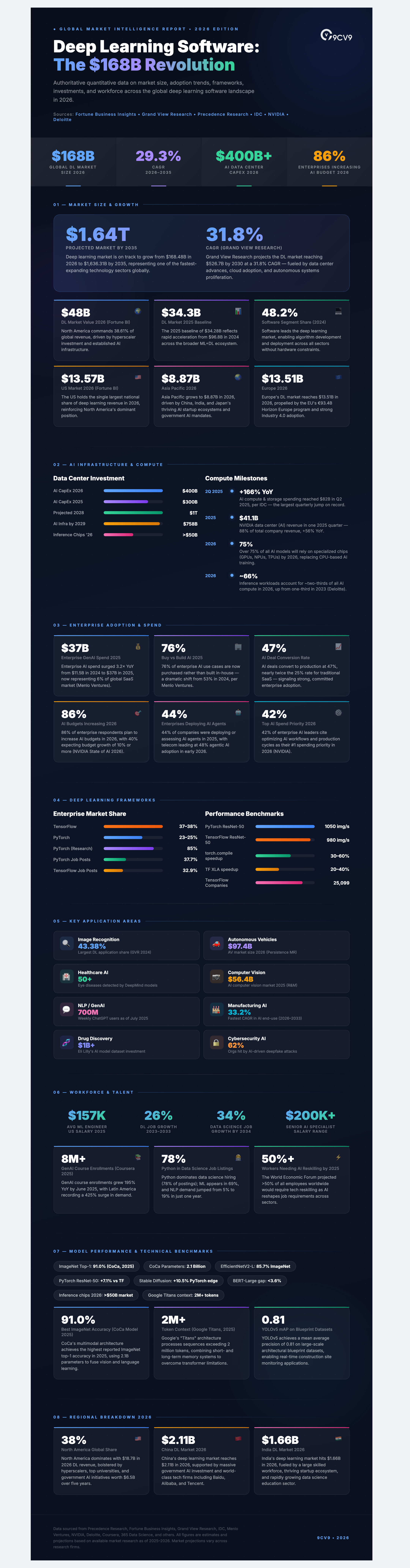
These differences are important when interpreting deep learning software statistics in 2026. Market research organizations may include different combinations of software, platforms, infrastructure, services, applications and related technologies within their definitions. As a result, individual market-size estimates should not automatically be treated as directly comparable.
The direction of travel, however, is remarkably consistent: deep learning is expected to remain a high-growth technology category throughout the remainder of the decade.
The software component alone demonstrates the scale of the opportunity. One estimate cited in this dataset projects the deep learning software market to increase from $7.1 billion in 2023 to $54.2 billion by 2033, representing a 23.1% CAGR. Another estimate places deep learning software at $27.2 billion in 2023 and projects it could reach $236.3 billion by 2030.
Whatever methodology is applied, deep learning software is increasingly becoming a fundamental layer of the modern technology stack.
Deep Learning Is Becoming Core Enterprise Infrastructure
One of the most consequential deep learning trends in 2026 is the transition from experimentation to operational deployment.
Businesses are no longer asking only whether artificial intelligence can perform a particular task. Increasingly, they are deciding where AI should be deployed, which models should be used, how inference costs can be reduced, how AI workflows should be governed and whether organizations should build capabilities internally or purchase them from specialized vendors.
Enterprise generative AI spending reached approximately $37 billion in 2025, according to statistics included in the dataset, representing a 3.2-fold increase from $11.5 billion in 2024. Enterprise AI was estimated to represent around 6% of the global SaaS market, while 76% of enterprise AI use cases were purchased rather than developed internally in 2025, up significantly from 53% in 2024.
That build-versus-buy shift could have particularly important implications for the deep learning software industry.
When organizations prefer commercial solutions rather than developing models and infrastructure internally, spending can migrate toward AI platforms, APIs, model providers, MLOps products, inference services, data platforms, AI development environments and specialized industry applications. Deep learning therefore becomes not merely a technical capability but a commercial software category distributed across much of the enterprise technology market.
AI projects are also showing comparatively strong progression from evaluation to production. The statistics collected for this report cite an AI deal conversion rate of 47% from exploration to production, compared with 25% for traditional SaaS. Meanwhile, 86% of enterprise decision-makers surveyed planned to increase their AI budgets in 2026, and 40% expected those budgets to increase by at least 10%.
The priorities behind those budgets are changing as well.
Approximately 42% of enterprise AI leaders identified optimizing AI workflows and production cycles as their leading spending priority for 2026, while another 31% planned to allocate budget toward discovering additional AI use cases.
Together, these figures suggest that the enterprise AI market is progressing beyond isolated proofs of concept. Companies are increasingly concerned with production performance, operational efficiency, workflow integration and expansion into additional business functions.
AI Agents Are Creating Another Deep Learning Software Growth Layer
Agentic AI represents another important trend influencing deep learning software adoption in 2026.
The dataset indicates that 44% of companies were already deploying or assessing AI agents in 2025, with broader deployments continuing across industries into 2026. Telecommunications stands out in particular, with an estimated 48% agentic AI adoption rate, the highest among industries included in the cited survey.
This evolution has potentially significant consequences for software architecture.
Traditional AI applications often involve relatively narrow interactions: provide an input, execute a model, receive an output. Agentic systems can potentially introduce longer workflows involving reasoning, planning, tool use, retrieval, memory, external systems and multiple model calls.
That can increase demand not only for foundation models themselves but also for orchestration software, observability, vector databases, model monitoring, security, inference infrastructure and governance platforms.
As enterprises deploy more autonomous AI workflows, deep learning software increasingly becomes embedded inside the operational layer of businesses rather than existing solely as a standalone analytics or research technology.
AI Infrastructure Spending Is Reaching Extraordinary Levels
The growth of deep learning software cannot be understood without examining the enormous infrastructure investment required to train and operate modern AI systems.
Global AI data center capital expenditure is projected in the dataset to reach approximately $400 billion to $450 billion in 2026, compared with roughly $300 billion in 2025. By 2028, AI data center capital expenditure could potentially approach $1 trillion.
Another cited forecast expects AI-related capital expenditure among major technology companies to surpass $2.8 trillion by 2029.
These numbers illustrate an important structural reality of the deep learning industry: advances in software are tightly connected to advances in computing infrastructure.
Deep learning models require enormous quantities of accelerated computing, high-bandwidth memory, networking, storage and increasingly specialized data center architectures. The resulting infrastructure buildout is creating an economic ecosystem that extends far beyond the companies developing individual models.
In the second quarter of 2025 alone, AI compute and storage spending reportedly reached approximately $82 billion, representing 166% year-over-year growth. The broader AI infrastructure market is projected to reach $758 billion by 2029.
Cloud environments are capturing much of that investment. Approximately 84.1% of AI infrastructure spending was deployed in cloud and shared environments in Q2 2025, while hyperscalers, cloud service providers and digital service providers accounted for around 86.7% of spending.
For businesses selecting deep learning software in 2026, the implication is significant. The competitive landscape increasingly involves an interconnected stack consisting of models, frameworks, accelerators, cloud platforms, APIs, inference engines and development tools rather than a single isolated software product.
Inference Is Becoming as Important as Training
For much of the modern deep learning era, model training received the majority of industry attention.
That balance is changing.
Approximately two-thirds of AI compute could be associated with inference workloads in 2026, according to estimates included in the dataset, compared with around one-third in 2023 and half in 2025. The market for inference-optimized chips is consequently expected to exceed $50 billion in 2026.
This shift from training toward inference is one of the most important deep learning software trends to watch.
Training creates the model. Inference is where that model is repeatedly used by customers, employees, applications, autonomous systems and software products. As AI usage expands to hundreds of millions of people and potentially billions of daily interactions, inference efficiency becomes a major economic variable.
Software capable of reducing latency, memory requirements or computational expense can therefore create substantial value even without improving the underlying intelligence of the model.
The hardware market reflects the same transition. Around 75% of AI models are expected to rely on specialized chips such as GPUs, NPUs and TPUs by 2026, while chip costs could represent approximately $250 billion to $300 billion of the projected $400 billion to $450 billion in global AI capital expenditure for the year.
The global AI data center GPU market itself was estimated at $10.51 billion in 2025 and is projected to reach $77.15 billion by 2035, representing a CAGR of 22.06%.
NVIDIA’s financial performance provides another indication of the magnitude of accelerated computing demand. The dataset records approximately $41.1 billion in NVIDIA data center revenue in a single quarter of 2025, accounting for 88% of company revenue and representing 56% year-over-year growth.
TensorFlow and PyTorch Remain Central to the Deep Learning Ecosystem
Behind many commercial AI applications are the frameworks developers use to construct, train and deploy deep learning models.
TensorFlow and PyTorch remain two of the most important platforms in this ecosystem, although their relative positions vary substantially depending on whether adoption is measured through enterprise production systems, academic research, developer communities or employment demand.
The statistics assembled for this report estimate TensorFlow’s enterprise production share at approximately 37% to 38% in 2025–2026, compared with roughly 23% to 25% for PyTorch. TensorFlow is also reported to be used in production by approximately 25,099 companies and had accumulated around 181,000 GitHub stars by 2026.
Research presents a very different picture.
Approximately 85% of deep learning research papers at leading AI conferences were reported to use PyTorch in 2025–2026. Employment data cited in the report similarly shows PyTorch appearing in approximately 37.7% of AI job postings, compared with 32.9% for TensorFlow.
Performance optimization is becoming increasingly important for both ecosystems.
PyTorch’s torch.compile is associated with reported performance improvements of approximately 30% to 60% over eager execution in certain 2025–2026 benchmarks, while TensorFlow’s XLA compiler can provide roughly 20% to 40% improvements over unoptimized execution in relevant workloads.
On one cited ResNet-50 benchmark using an A100 GPU and FP16 precision, PyTorch achieved approximately 1,050 images per second, compared with 980 images per second for TensorFlow, a difference of around 7.1%. PyTorch was also reported to hold a 10.5% performance advantage in a cited Stable Diffusion benchmark using an RTX 4090.
These statistics highlight an increasingly important theme for 2026: deep learning software competition is not simply about model accuracy. Developer experience, compilation, inference speed, hardware optimization, deployment flexibility and ecosystem integrations are becoming critical differentiators.
Computer Vision Remains a Major Deep Learning Application
Generative AI and large language models dominate many discussions about artificial intelligence, but computer vision remains one of deep learning’s largest and most established commercial applications.
Image recognition represented approximately 43.38% of the global deep learning application market in 2024, according to statistics included in the report. The AI computer vision market was valued at approximately $56.4 billion in 2025 and is projected to reach around $117 billion by 2030, representing a 15.7% CAGR.
Generative AI is adding another growth engine to this market.
The generative AI segment of computer vision is projected to grow at approximately 32.9% annually between 2025 and 2030, compared with around 8.3% for traditional machine learning applications in computer vision.
This divergence reflects the rapid expansion of deep learning beyond traditional image classification and object detection.
Modern systems can generate images, analyze videos, enhance resolution, create synthetic training data and combine language with visual reasoning. The boundaries between computer vision, natural language processing and generative AI are consequently becoming less distinct.
Technical benchmarks demonstrate how far the underlying models have advanced. The dataset cites a reported 91.0% top-1 ImageNet accuracy for the 2.1-billion-parameter CoCa multimodal architecture, while EfficientNetV2-L achieved approximately 85.7% accuracy when pretrained on ImageNet-21K and fine-tuned on ImageNet-1K.
Autonomous Vehicles Demonstrate Deep Learning in the Physical World
Few industries illustrate the practical complexity of deep learning better than autonomous transportation.
The autonomous vehicles market is estimated in the dataset at approximately $97.4 billion in 2026. Deep learning applications within automotive and transportation are projected to grow at a 33.2% CAGR through 2033, making the sector one of the fastest-growing end-use categories represented in the report.
Autonomous mobility also provides tangible evidence that sophisticated deep learning systems can move from laboratories into large-scale real-world operations.
Waymo was already completing approximately 250,000 paid autonomous rides per week in the United States by mid-2024, according to the dataset. Meanwhile, Level 3 conditional automation represented approximately 30% of the autonomous vehicle market by autonomy level in 2025.
Automotive AI combines many branches of deep learning simultaneously, including object detection, image segmentation, sensor fusion, prediction, planning and decision-making.
It therefore provides a useful window into the future of deep learning software more broadly: models are increasingly expected not merely to classify information but to perceive environments and contribute to real-time decisions.
Healthcare, Finance and Manufacturing Are Expanding Deep Learning Adoption
Deep learning software is also spreading rapidly through industry-specific applications.
Healthcare AI is projected in the dataset to grow at approximately 19.1% annually from 2026 to 2035, making healthcare one of the fastest-growing end-use industries. Deep learning applications increasingly span medical imaging, diagnostics, clinical decision support, drug discovery and healthcare workflow automation.
One example cited in the statistics is DeepMind’s work on retinal imaging, where a deep learning system can identify more than 50 eye diseases from a single retinal scan.
Pharmaceutical companies are also making large AI investments. Eli Lilly reportedly invested more than $1 billion in the AI model training dataset underpinning its TuneLab drug-discovery platform, which was opened to biotechnology partners in September 2025.
Financial services represents another major market. Banking, financial services and insurance accounted for approximately 19.6% of the global AI market in 2025, the largest industry share cited in the dataset. Applications include fraud detection, risk analysis, algorithmic trading, customer service and credit decisioning.
Manufacturing is another increasingly important deployment environment. The predictive analytics market serving manufacturing is projected to reach approximately $3.55 billion in 2026, supported by a 21.6% CAGR. Deep learning can support predictive maintenance, computer-vision inspection, anomaly detection and production optimization across industrial environments.
Deep Learning Is Also Expanding the Cybersecurity Attack Surface
The same capabilities creating economic opportunities are creating new security risks.
Approximately 62% of organizations represented in one statistic had experienced deepfake attacks involving social engineering or manipulation of automated systems. Another 32% of cybersecurity leaders reported at least one AI-driven adversarial prompt attack against their AI applications during 2024 or early 2025.
This dual-use characteristic of deep learning will become increasingly important in 2026.
Generative models can improve threat detection, security analytics and incident response, while simultaneously giving attackers new tools for impersonation, automated social engineering and manipulation of AI-powered systems.
Consequently, cybersecurity is becoming inseparable from enterprise deep learning deployment.
Deep Learning Skills Continue to Command a Labor-Market Premium
The expansion of deep learning software is also reshaping technology employment.
Machine learning engineers in the United States earned a cited median base salary of approximately $157,000 in 2025, with senior positions frequently exceeding $200,000. Deep learning research scientists averaged approximately $124,237 in base salary, while mid-level data scientist compensation was projected to range from roughly $138,000 to $175,000 in 2026.
Senior data scientists were projected to earn approximately $157,000 to $194,000, while highly specialized senior AI, NLP and computer-vision professionals could command salaries ranging from roughly $200,000 to $312,000.
Employment demand is expected to remain strong.
Data science employment is projected by the U.S. Bureau of Labor Statistics to grow approximately 34% through 2034, while another statistic in the dataset cites 26% projected growth for deep-learning-related data scientist roles between 2023 and 2033.
Python remains central to this workforce. Approximately 78% of data scientist job listings cited Python as a required skill in 2024, while 69% mentioned machine learning skills. NLP appeared in approximately 19% of data science job listings in 2025, compared with just 5% in 2024, representing a reported 280% increase in one year.
The emergence of generative AI has also created entirely new occupational categories. The dataset identifies approximately 10,000 generative-AI-specific job postings by mid-2025, compared with essentially none in 2021.
Education is scaling alongside employment demand. Generative AI courses on Coursera had accumulated more than 8 million enrollments by June 2025, representing approximately 195% year-over-year growth.
Deep Learning Has Already Reached Mass-Market Users
Perhaps the clearest indication that deep learning is no longer a specialist technology comes from consumer adoption.
ChatGPT had approximately 700 million weekly users by July 2025, equivalent to roughly 10% of the world’s adult population, according to figures included in the dataset. Approximately 21% of the world’s population was reported to use AI tools daily in early 2025, while 61% of American adults had used an AI tool during the preceding six months.
These numbers matter for the deep learning software industry because widespread consumer adoption changes expectations.
Users increasingly expect search engines, productivity software, customer-support systems, creative applications and business platforms to incorporate intelligent capabilities. AI can therefore transition from a premium novelty into a standard software feature.
This creates pressure throughout the software industry to determine where deep learning genuinely improves a product and how those capabilities can be delivered economically at scale.
Governance Is Emerging as a Major Deep Learning Software Category
As deep learning systems become embedded in business operations, governance becomes increasingly important.
The AI governance market is projected in the dataset to expand from approximately $890 million in 2024 to $5.8 billion by 2029, representing a remarkable 45% CAGR. Organizations adopting AI governance platforms could potentially achieve a 25% improvement in regulatory compliance by 2028, according to another cited forecast.
The rise of AI governance reflects the growing maturity of enterprise adoption.
Companies deploying AI at scale must increasingly consider model monitoring, auditability, explainability, security, data lineage, regulatory compliance, access control and risk management.
That means the deep learning software market of 2026 encompasses far more than neural-network development frameworks.
It increasingly includes the complete lifecycle surrounding intelligent systems: data preparation, model development, training, fine-tuning, evaluation, deployment, inference, monitoring, optimization, security and governance.
What the Deep Learning Statistics for 2026 Tell Us
Taken together, the 103 deep learning software statistics, data points and trends in this report reveal an industry simultaneously expanding across several dimensions.
The market is growing. Enterprise budgets are rising. AI infrastructure investment is accelerating. Inference is becoming increasingly important. PyTorch and TensorFlow continue to shape model development. Computer vision remains commercially significant. Agentic AI is creating new software architectures. Healthcare, financial services, automotive and manufacturing are expanding their deployments. Specialized AI talent remains valuable. Governance and cybersecurity are becoming essential components of production AI.
Perhaps most importantly, deep learning is becoming increasingly difficult to separate from the broader software industry itself.
The global AI market was valued at approximately $390.91 billion in 2025 in one estimate included in the dataset, with deep learning representing the largest technology segment at roughly 25.3% of AI market revenue. Another estimate valued AI technologies at approximately $244 billion in 2025 and projected the market to exceed $800 billion by 2030.
Governments are investing alongside businesses. The European Union’s Digital Europe Programme carries approximately $7.5 billion in funding for AI and related digital technologies for 2021–2027, while the dataset cites approximately $6.5 billion in U.S. National AI Initiative Act funding for AI research, education and standards development over five years from 2021 to 2026.
The result is a deep learning ecosystem being built simultaneously from the bottom up and the top down: developers are adopting increasingly powerful frameworks, businesses are integrating AI into workflows, cloud companies are investing hundreds of billions of dollars in infrastructure, governments are funding research and strategic capacity, and hundreds of millions of consumers are interacting with deep-learning-powered products.
For technology leaders, investors, developers, researchers, marketers and business decision-makers, understanding these numbers is therefore about much more than following another software trend.
The Top 103 Deep Learning Software Statistics, Data & Trends in 2026 provide a quantitative snapshot of a broader transition in computing: deep learning is evolving from a specialized branch of artificial intelligence into a foundational technology layer underpinning how software is developed, deployed, consumed and monetized.
The statistics that follow examine that transformation in detail—from market valuations and regional growth to enterprise adoption, infrastructure spending, TensorFlow and PyTorch usage, computer vision, autonomous vehicles, healthcare AI, workforce demand, model performance, investment and AI governance—providing a data-driven view of where the deep learning software industry stands in 2026 and where it may be heading next.
Before we venture further into this article, we would like to share who we are and what we do.
About 9cv9
9cv9 is a business tech startup based in Singapore and Asia, with a strong presence all over the world.
With over ten years of startup and business experience, and being highly involved in connecting with thousands of companies and startups, the 9cv9 team has listed some important and crucial software tools in this review.
If you like to get your company listed in our top B2B software reviews, check out our world-class 9cv9 Media and PR service and pricing plans here.
Top 103 Deep Learning Software Statistics, Data & Trends in 2026
🌐 MARKET SIZE & VALUATION
1. $168.48 billion — The global deep learning market is projected to reach $168.48B in 2026, up from $125.65B in 2025.
This explosive growth underscores how deep learning has transitioned from a research curiosity to the backbone of global technology spending, with a near-35% year-over-year increase.
2. $1,636.31 billion — Precedence Research projects the deep learning market will reach $1.636 trillion by 2035 at a CAGR of 29.26%.
Crossing the trillion-dollar threshold within a decade makes deep learning one of the most consequential technological investment opportunities of the 21st century.
3. $34.28 billion — Global deep learning market size in 2025, per Fortune Business Insights.
This baseline reveals the staggering acceleration in adoption between 2025 and 2026, reflecting intensifying enterprise deployments and model commercialization.
4. $48.03 billion — Fortune Business Insights’ estimate for the global DL market in 2026, growing to $342.34B by 2034 at a CAGR of 27.83%.
Even the most conservative reputable estimates signal sustained, multi-decade high-growth dynamics across the deep learning software sector.
5. $526.7 billion — Grand View Research’s projection for the deep learning market by 2030, at a CAGR of 31.8%.
With nearly half a trillion dollars expected within five years, organizations investing in deep learning capabilities now are positioned for significant first-mover advantages.
6. $423.4 billion — IMARC Group’s projection for the global deep learning market by 2033, at a CAGR of 29.92%.
Multiple independent research firms converge on a consistent high-growth narrative, providing investors and enterprises with robust confidence in the sector’s trajectory.
7. $96.8 billion — Global deep learning market estimated by Grand View Research for 2024, the most recent full-year figure.
This 2024 baseline demonstrates that the market nearly doubled between 2024 and 2026, a remarkable pace that reflects both maturation and rapid new-use-case discovery.
8. $125.65 billion — Global deep learning market size calculated by Precedence Research for 2025.
The significant spread between research firm estimates (ranging from $30B to $125B for 2025) reflects differing methodologies; the true scale likely sits in the middle, emphasizing the need for triangulated analysis.
9. $506.75 billion — MarketsandMarkets forecasts the global deep learning market will reach $506.75B by 2035 at a CAGR of 31.7%.
MarketsandMarkets’ assessment aligns with the broader industry consensus around 30%+ CAGR, making deep learning one of the fastest-growing technology sectors globally.
10. $7.1 billion → $54.2 billion — The deep learning software market specifically (excluding hardware/services) will grow from $7.1B in 2023 to $54.2B by 2033 at a CAGR of 23.1%.
This software-specific figure highlights that pure-play software vendors and frameworks represent a substantial and fast-growing subset of the broader DL ecosystem.
🌍 REGIONAL MARKET DATA
11. 38.61% — North America’s share of global deep learning revenue in 2025, per Fortune Business Insights.
North America’s commanding lead is built on a foundation of established cloud hyperscalers (AWS, Azure, GCP), top-tier AI research universities, and trillions in private capital flows.
12. $18.7 billion — North America’s projected deep learning market size in 2026.
With nearly a fifth of global DL revenue concentrated in a single continent, North America continues to export AI frameworks, talent, and standards to the rest of the world.
13. $13.57 billion — The US market specifically is expected to reach $13.57B in 2026 per Fortune Business Insights.
The United States alone accounts for over one-quarter of the global deep learning market, reflecting the density of AI-first enterprises and research institutions on American soil.
14. $13.51 billion — Europe’s deep learning market size in 2026, representing approximately 28% of global revenue.
Europe’s DL sector benefits from strong government mandates, with the EU’s Horizon Europe program allocating €93.4B for AI and related innovation through 2027.
15. $8.87 billion — Asia Pacific’s deep learning market in 2026, growing from $6.16B in 2025.
Asia Pacific’s 44% year-over-year growth rate exceeds every other region, driven by China, India, Japan, and the Philippines’ rapidly scaling AI ecosystems.
16. $2.11 billion — China’s deep learning market projected to reach $2.11B in 2026.
China’s DL market is expected to accelerate significantly beyond 2026, with national AI strategies targeting leadership in everything from computer vision to autonomous vehicles.
17. $1.99 billion — Japan’s deep learning market projected for 2026.
Japan’s deep learning investment is concentrated in robotics, automotive AI, and healthcare diagnostics, where aging demographics create urgent use cases for AI-driven automation.
18. $1.66 billion — India’s deep learning market anticipated to reach $1.66B in 2026.
India’s combination of a large English-speaking tech workforce, rapidly expanding AI education sector, and government digitalization push positions it as a key driver of Asia Pacific’s DL growth.
19. 40% — North America’s share of the applied AI in autonomous vehicles market in 2025.
The concentration of self-driving vehicle R&D in California’s Silicon Valley and Pittsburgh’s Carnegie Mellon corridor reinforces North America’s dominance in deep learning’s most complex real-world applications.
20. 28.9% — Asia Pacific’s share of the AI computer vision market in 2026, with the region expected to grow fastest globally.
Led by Chinese computer vision giants like SenseTime and Megvii, Asia Pacific is quickly closing the gap with Western markets in deployment of production-ready deep learning vision systems.
🏢 ENTERPRISE AI ADOPTION
21. $37 billion — Enterprise spending on generative AI in 2025, a 3.2× increase from $11.5B in 2024 (Menlo Ventures).
The tripling of enterprise AI spend in a single year is historically unprecedented for any software category and reflects the urgency executives feel to integrate AI into core business processes.
22. 6% — Enterprise AI now represents 6% of the global SaaS market, growing faster than any other software category.
This share is expected to continue expanding as AI-native applications displace traditional software across CRM, ERP, and analytics categories.
23. 76% — Share of enterprise AI use cases that are now purchased rather than built in-house in 2025, up from 53% in 2024.
The dramatic swing from “build” to “buy” signals that ready-made AI solutions have reached a level of maturity and ROI demonstration that makes internal development economically unjustifiable for most organizations.
24. 47% — AI deal conversion rate (from exploration to production), compared to 25% for traditional SaaS.
The near-doubling of conversion rates for AI versus legacy software proves that organizations are committing to AI investments with unprecedented conviction and urgency.
25. 86% — Share of enterprise decision-makers planning to increase AI budgets in 2026 (NVIDIA State of AI 2026, 3,200+ respondents).
Virtually universal budget growth intent across industries suggests that AI adoption is no longer a competitive differentiator but an existential business requirement.
26. 40% — Share of respondents expecting AI budget growth of 10% or more in 2026.
Double-digit budget growth expectations sustained across multiple years point to deep learning software becoming a permanent and growing line item in enterprise technology planning.
27. 44% — Share of companies deploying or assessing AI agents in 2025, with full deployments scaling across industries in early 2026.
AI agents represent the next frontier of deep learning deployment, moving from passive tools to autonomous systems capable of multi-step reasoning, planning, and execution.
28. 48% — Telecommunications sector agentic AI adoption rate in 2026 — the highest of any industry surveyed by NVIDIA.
Telecom’s leadership in AI agent adoption reflects the sector’s urgent need to automate complex network management, customer service, and fraud detection at scale.
29. 42% — Share of enterprise AI leaders citing “optimizing AI workflows and production cycles” as their #1 spending priority in 2026.
The shift from experimentation to optimization signals that enterprise AI has entered a maturation phase where efficiency and cost-effectiveness matter as much as capability.
30. 31% — Share of enterprise leaders planning to spend AI budgets on finding additional use cases in 2026.
Organizations have moved past proof-of-concept and are now systematically mapping AI solutions to more of their business functions, deepening the total addressable market for deep learning software.
🖥️ AI INFRASTRUCTURE & COMPUTE
31. $400–$450 billion — Global AI data center capital expenditure projected for 2026 (Deloitte).
This sum exceeds the GDP of many nations and represents the largest single-year infrastructure investment in computing history, driven almost entirely by deep learning workload demands.
32. $300 billion — AI data center CapEx in 2025, growing 33% to $400B+ in 2026.
The relentless ramp in data center spending reflects the insatiable compute appetite of large language models, image generators, and multimodal deep learning systems.
33. $1 trillion — Projected AI data center capital expenditure by 2028 (Deloitte).
The trajectory from $300B to $1T in just three years represents the fastest infrastructure buildout in technology history, with deep learning training and inference as the primary drivers.
34. $82 billion — AI compute and storage spending in Q2 2025 alone, representing a 166% year-over-year increase (IDC).
A single quarter surpassing $80B in AI infrastructure spend illustrates how the pace of investment has shifted from strategic to existential for cloud providers and enterprises alike.
35. $758 billion — Total AI infrastructure market projected by IDC to reach by 2029.
IDC’s forecast reinforces that AI infrastructure investment will remain elevated for the remainder of the decade, creating durable demand for deep learning hardware, software, and services.
36. 84.1% — Share of AI infrastructure spending deployed in cloud and shared environments in Q2 2025 (IDC).
The overwhelming preference for cloud-based AI compute reflects organizations’ desire for elasticity, speed of deployment, and access to the latest GPU generations without capital commitments.
37. 86.7% — Share of AI spending contributed by hyperscalers, cloud service providers, and digital service providers in Q2 2025.
The concentration of AI spend among a handful of global hyperscalers (AWS, Azure, GCP, Oracle) has created a powerful flywheel where scale advantages compound into ever-greater DL capabilities.
38. 75% — Proportion of AI models expected to rely on specialized chips (GPUs, NPUs, TPUs) by 2026, up from minority use of CPUs.
The transition to specialized AI silicon is structurally irreversible; traditional CPU-based AI training has become economically and technically obsolete for serious deep learning workloads.
39. ~66% — Share of all AI compute represented by inference workloads in 2026, up from one-third in 2023 and half in 2025 (Deloitte).
The tipping point from training-dominated to inference-dominated compute marks a maturation of the DL lifecycle, as deployed models begin to generate economic value at scale.
40. $50 billion — Market for inference-optimized chips expected to exceed $50B in 2026 (Deloitte).
The emergence of a distinct inference chip market — including NVIDIA’s H100, AMD’s MI300, and custom ASICs from Google and Amazon — is creating new competitive dynamics in deep learning hardware.
41. $250–$300 billion — Estimated chip costs within the projected $400–450B global AI CapEx in 2026.
Chips represent 60–65% of total AI data center capital expenditure in 2026, underscoring NVIDIA’s extraordinary leverage over the deep learning software ecosystem through its hardware dominance.
42. $10.51 billion — Global AI data center GPU market in 2025, projected to grow to $77.15B by 2035 at a CAGR of 22.06%.
The AI GPU market’s growth trajectory ensures sustained demand for CUDA-optimized deep learning frameworks and the software toolchains built around NVIDIA’s hardware ecosystem.
43. $41.1 billion — NVIDIA’s data center (AI) revenue in a single quarter of 2025, representing 88% of the company’s total revenue and a 56% year-over-year increase.
NVIDIA’s extraordinary financial results are the most concrete market signal available: deep learning compute demand is real, large, and growing rapidly across every sector.
44. $2.8 trillion — AI-related capital spending by major tech companies forecast to exceed $2.8T by 2029 (Citigroup).
This multi-trillion-dollar figure encapsulates the total transformative scale of the AI infrastructure buildout, of which deep learning software is both a beneficiary and an enabler.
🔧 FRAMEWORKS & TOOLS
45. 37–38% — TensorFlow’s enterprise production market share in 2025–2026.
Despite PyTorch’s surge in research popularity, TensorFlow’s deep integration with Google’s production infrastructure and mature MLOps tooling maintains its lead in enterprise deployment contexts.
46. 23–25% — PyTorch’s enterprise production market share in 2025–2026.
PyTorch’s production share is growing rapidly, particularly in organizations with heavy NLP and generative AI workloads, where its Hugging Face integration provides significant advantages.
47. 85% — Share of deep learning research papers at top AI conferences using PyTorch in 2025–2026.
PyTorch’s near-total dominance in academic research is the clearest leading indicator of where production adoption will be in 3–5 years, as researchers become the engineers of tomorrow.
48. 25,099 — Number of companies currently using TensorFlow in production (as tracked publicly in 2026).
TensorFlow’s broad enterprise adoption base provides Google with a powerful ecosystem lock-in, making it the default choice for organizations requiring proven enterprise-grade ML pipelines.
49. 181,000 — GitHub stars earned by TensorFlow as of 2026.
TensorFlow remains one of the most starred repositories in GitHub history, reflecting its massive developer community and years of accumulated open-source contributions.
50. 37.7% — Share of AI job postings mentioning PyTorch in 2026.
PyTorch leading TensorFlow (32.9%) in job postings reflects the forward-looking nature of hiring — employers are building teams for research-adjacent workloads and new model development.
51. 32.9% — Share of AI job postings mentioning TensorFlow in 2026.
Despite losing ground in research, TensorFlow’s presence in nearly a third of all AI job postings confirms it remains an essential skill for deep learning practitioners.
52. 30–60% — Speedup achieved by PyTorch’s torch.compile over eager mode in 2025–2026 benchmarks.
The torch.compile optimization pipeline — combining TorchDynamo graph capture and Inductor kernel generation — represents a fundamental architectural advancement that closes PyTorch’s historical production gap.
53. 20–40% — Speedup achieved by TensorFlow’s XLA compiler over unoptimized execution.
TensorFlow’s XLA compiler continues to provide meaningful performance gains particularly on large-scale transformer workloads, supporting its sustained relevance in high-throughput production settings.
54. 1,050 images/second — PyTorch’s throughput on ResNet-50 training with A100 GPU and FP16 precision, outperforming TensorFlow (980 img/s) by 7.1%.
The 7.1% advantage for PyTorch on the most common benchmark workload is practically meaningful for organizations training models at scale, where throughput directly translates into cost savings.
55. 10.5% — PyTorch’s performance advantage over TensorFlow on Stable Diffusion benchmark on RTX 4090.
For generative image model workloads — one of the hottest areas of commercial deep learning — PyTorch’s eager execution model provides a measurable and operationally meaningful performance edge.
56. 43 million — Anaconda platform users in 2026 — one of the world’s most widely-used data science and deep learning development environments.
Anaconda’s massive user base demonstrates that deep learning adoption is no longer limited to elite research labs, extending to millions of data scientists and engineers globally.
📊 APPLICATIONS & USE CASES
57. 43.38% — Image recognition’s share of the global deep learning application market in 2024 (Grand View Research).
Image recognition remains the dominant deep learning application by market share, powering everything from smartphone cameras to industrial quality control to medical diagnostics.
58. 25.3% — Deep learning technology’s share of the broader AI market revenue in 2025 (Grand View Research).
As the leading AI technology by revenue share, deep learning is the engine powering the majority of commercially valuable AI applications deployed in enterprises today.
59. $56.4 billion — AI computer vision market size in 2025, projected to reach $117B by 2030 at a 15.7% CAGR.
The doubling of the computer vision market in five years reflects deep learning’s central role in enabling machines to see, interpret, and act upon visual information across industries.
60. 32.9% — Generative AI’s projected CAGR in the computer vision market from 2025 to 2030.
Generative AI’s integration with computer vision — enabling synthetic data generation, super-resolution, and novel-view synthesis — is the single fastest-growing sub-segment of the entire deep learning application landscape.
61. $97.4 billion — Autonomous vehicles market size in 2026 (Persistence Market Research).
Deep learning, particularly transformer-based models trained on billions of miles of driving data, is the foundational technology enabling the commercial deployment of self-driving transportation.
62. 250,000 — Weekly paid autonomous rides completed by Waymo in the US by mid-2024, with continued expansion in 2026.
Waymo’s operational scale provides the most credible real-world validation that production-grade deep learning perception systems can reliably support commercial autonomous mobility at meaningful volume.
63. 30% — Level 3 (conditional automation) autonomous vehicle segment market share in 2025 — the largest by autonomy level.
Level 3 autonomy’s leadership reflects the current sweet spot where deep learning perception systems are sufficiently mature to assist drivers while the regulatory and liability frameworks for higher autonomy levels continue to develop.
64. 700 million — Weekly ChatGPT users as of July 2025, representing approximately 10% of the global adult population.
The scale of consumer exposure to deep learning NLP systems via ChatGPT represents the most rapid mass-market technology adoption in history, with profound implications for enterprise AI investment.
65. 50+ — Number of distinct eye diseases DeepMind’s deep learning model can detect from a single retinal scan.
DeepMind’s ophthalmology AI demonstrates that deep learning has reached diagnostic accuracy matching specialist physicians, enabling scalable early disease detection in resource-constrained healthcare systems.
66. 33.2% — Projected CAGR for deep learning applications in automotive and transportation through 2033 — the fastest of any end-use sector (Grand View Research).
Automotive AI’s explosive growth trajectory reflects the convergence of multiple deep learning disciplines — perception, planning, decision-making, and natural language interaction — within a single product category.
67. 8.3% — CAGR of traditional machine learning applications in computer vision from 2025 to 2030, compared to 32.9% for generative AI.
The near-4× difference in growth rates between GenAI and traditional ML in computer vision confirms that deep learning’s transformer architectures are rapidly displacing older approaches.
💊 SECTOR-SPECIFIC ADOPTION
68. 19.1% — Projected CAGR of healthcare AI (2026 to 2035) — the fastest-growing end-use industry by growth rate (Precedence Research).
Healthcare’s accelerating AI adoption is driven by documented improvements in diagnostic accuracy, drug discovery timelines, and clinical workflow efficiency from deep learning applications.
69. 19.6% — BFSI (banking, financial services, insurance) sector’s share of the global AI market in 2025 — the largest of any industry.
Financial services firms leverage deep learning for fraud detection, algorithmic trading, credit scoring, and customer service automation, creating the largest concentrated vertical market for DL software.
70. $1 billion+ — Eli Lilly’s investment in the AI model training dataset underlying its TuneLab drug discovery platform, opened to biotech partners in September 2025.
Eli Lilly’s TuneLab exemplifies the “AI factory” model emerging in pharma, where deep learning infrastructure becomes a platform service enabling industry-wide acceleration of drug discovery.
71. 62% — Share of organizations that have experienced deepfake attacks involving social engineering or manipulation of automated systems.
The weaponization of deep learning generative models against enterprise security represents a critical dual-use risk, with 62% organizational exposure highlighting the urgency of AI-powered defensive measures.
72. 32% — Share of cybersecurity leaders reporting at least one AI-driven adversarial prompt attack on their AI applications in 2024–early 2025 (Gartner).
As deep learning systems become integral to enterprise operations, they simultaneously expand the attack surface for sophisticated adversarial attacks, creating a new cybersecurity arms race.
73. $3.55 billion — Predictive analytics market in manufacturing sector projected to reach by 2026 at a CAGR of 21.6%.
Manufacturing’s adoption of deep learning for predictive maintenance, defect detection, and production optimization represents one of the clearest ROI stories across all industrial sectors.
👨💻 WORKFORCE & TALENT
74. $157,000 — Median US base salary for machine learning engineers in 2025, often exceeding $200,000 for senior roles.
ML engineering has become one of the highest-compensated technical disciplines globally, reflecting the acute talent shortage relative to surging enterprise demand for production AI systems.
75. $124,237 — Average US base salary for deep learning research scientists in 2025 (Glassdoor).
Deep learning research salaries have outpaced general software engineering compensation by 40–60%, reflecting the premium organizations pay for specialists who can advance model capabilities.
76. $138,000–$175,000 — Mid-level data scientist salary range in the US for 2026 (Motion Recruitment).
The continued salary escalation for data scientists even amid tech-sector layoffs confirms that deep learning practitioners remain in structural shortage relative to organizational demand.
77. $157,000–$194,000 — Senior-level data scientist salary range projected for 2026.
Senior AI practitioners command total compensation packages that rival or exceed those in investment banking and medicine, reflecting the existential importance enterprises place on AI-first leadership.
78. $200,000–$312,000 — Salary range for the most senior AI specialists and NLP/computer vision experts in 2026.
The emergence of a new class of “AI Principal Engineers” earning over $300K annually reflects how deep learning expertise has become the most valued human capital in the technology industry.
79. 26% — Projected growth rate for deep learning job roles (data scientist track) from 2023 to 2033 per US BLS.
A 26% decade-long job growth rate from the Bureau of Labor Statistics places deep learning among the top 5 fastest-growing occupational categories in the United States.
80. 34% — Data science employment growth projected by the US Bureau of Labor Statistics through 2034.
At more than five times the average job growth rate, data science positions powered by deep learning expertise represent one of the most economically secure career paths for the next decade.
81. 8 million+ — Total GenAI course enrollments on Coursera by June 2025, growing 195% year-over-year.
The 8M+ enrollment milestone marks a genuine democratization of deep learning education, with Latin America (425% growth) and Africa (134% growth) emerging as unexpected hotbeds of talent development.
82. 50%+ — Share of all employees globally projected to need significant tech reskilling in AI/automation by 2025 (World Economic Forum).
The World Economic Forum’s reskilling projection frames deep learning not as a niche technical trend but as a structural force reshaping the skills required across virtually every professional discipline.
83. 21% — Share of the world’s population using AI tools daily in early 2025 (KPMG global study).
Daily AI usage by a fifth of humanity demonstrates that deep learning has achieved genuine mass-market penetration, with implications for how software companies must design and price AI features.
84. 61% — Share of American adults who have used AI tools in the past six months as of 2025.
America’s AI usage rate of over 60% of adults reveals a population that has moved beyond early-adopter demographics, creating broad societal familiarity that accelerates enterprise AI buying decisions.
85. 78% — Share of data scientist job listings mentioning Python as a required skill in 2024.
Python’s near-universal presence in data science hiring reflects its role as the de facto language of deep learning, with TensorFlow, PyTorch, Keras, and Hugging Face all Python-native.
86. 69% — Share of data science job listings mentioning machine learning skills in hiring requirements.
Machine learning’s prevalence in two-thirds of all data science postings confirms that pure statistical data analysis roles are rapidly converging with applied deep learning engineering.
87. 19% — Share of data science job listings requiring NLP skills in 2025, up from just 5% in 2024 — a 280% increase in one year.
NLP’s explosive growth in hiring requirements directly reflects the commercial success of large language models, which have made natural language the primary interface for most consumer and enterprise AI products.
88. 10,000 — GenAI-specific job postings by mid-2025, compared to essentially zero in 2021.
The creation of an entirely new job category — Generative AI Engineer — in under four years represents one of the most rapid labor market transformations driven by a single technological development.
📐 MODEL PERFORMANCE & TECHNICAL BENCHMARKS
89. 91.0% — Highest reported top-1 accuracy on the ImageNet benchmark by any model in 2025, achieved by the CoCa multimodal architecture.
CoCa’s 91% ImageNet accuracy — using 2.1 billion parameters — sets the current state of the art for image classification, representing a 15+ percentage point improvement over AlexNet’s 2012 results.
90. 2.1 billion — Parameter count of the CoCa model achieving the highest ImageNet accuracy in 2025.
While 2.1B parameters sounds vast, it is orders of magnitude smaller than the largest language models, demonstrating that vision-language alignment can be achieved with relatively efficient architectures.
91. 85.7% — ImageNet accuracy achieved by EfficientNetV2-L when pretrained on ImageNet-21K and fine-tuned on ImageNet-1K.
EfficientNetV2’s strong performance at a fraction of CoCa’s parameter count makes it the preferred choice for resource-constrained deployments including mobile, edge, and IoT deep learning applications.
92. 0.81 — YOLOv5’s mean average precision (mAP) on large-scale architectural blueprint datasets, with high F1-score and low latency.
YOLOv5’s 81% mAP on specialized construction datasets demonstrates that real-time deep learning detection systems can achieve near-human accuracy in specialized industrial domains.
93. 2 million+ — Token context window supported by Google’s “Titans” deep learning architecture, introduced in January 2025.
Google’s Titans architecture shatters the context window limitations of standard transformers, enabling deep learning systems to reason across entire books, codebases, or datasets in a single pass.
94. 55–85% — Accuracy gap closed by Google Neural Machine Translation versus human translators, estimated on a 6-point scale (Wu et al., 2016 — foundational benchmark still cited).
The near-human performance of deep learning translation systems established the template for AI capability benchmarking that continues to drive commercial investment in NLP applications.
95. 20–25% — ResNet-50 speedup achievable with PyTorch’s torch.compile using the Triton compiler backend.
The compile-time optimization capability built into modern DL frameworks has made software-level performance tuning accessible to practitioners without deep GPU programming expertise.
💡 MARKET DYNAMICS & INVESTMENT
96. $390.91 billion — Global AI market size in 2025, with deep learning accounting for the largest technology segment share (Grand View Research).
As the dominant AI sub-technology by revenue contribution, deep learning is the primary driver of the broader AI market’s explosive growth trajectory toward $3.5T by 2033.
97. $244 billion — AI technologies market in 2025 per Statista, expected to exceed $800B by 2030.
Statista’s market sizing, while more conservative than specialized AI research firms, still projects more than a tripling of AI market value in five years — validating the structural growth thesis.
98. $7.5 billion — EU Digital Europe Programme budget for AI and deep learning (2021–2027), with the EU also planning €1.4B for deep tech research in 2025 alone.
The EU’s sustained multi-billion-euro AI commitment reflects Europe’s strategic imperative to develop indigenous deep learning capabilities and reduce dependence on US and Chinese AI platforms.
99. $6.5 billion — US National AI Initiative Act funding for AI research, education, and standards development over five years (2021–2026).
Federal AI investment through the National AI Initiative Act has catalyzed billions in matching private-sector investment, establishing the US as the world’s most generously funded AI research ecosystem.
100. 29.84% — CAGR of the US deep learning market specifically from 2026 to 2035, with the market projected to surpass $450B.
The US deep learning market’s own 30% CAGR for a decade means that the value of American deep learning intellectual property, infrastructure, and talent will compound dramatically over the coming years.
101. $27.2 billion → $236.3 billion — Deep learning software market growth from 2023 to 2030, per Next MSC.
An 8.7× multiplication of the software-only DL market in seven years reflects how software monetization of DL capabilities — through APIs, SaaS, and embedded features — is accelerating even faster than the underlying technology market.
102. 45% — Projected CAGR of the AI governance market, growing from $890M in 2024 to $5.8B by 2029 (MarketsandMarkets).
AI governance platforms’ rapid growth signals that enterprises are maturing beyond raw capability deployment toward structured, auditable, and compliant deep learning systems — a critical inflection point for enterprise adoption.
103. 25% — Expected improvement in regulatory compliance for organizations adopting AI governance platforms by 2028 (Gartner).
Governance-compliant AI deployments will command premium enterprise pricing and faster sales cycles, creating a distinct market segment for deep learning platforms that prioritize explainability and auditability.
Conclusion
The Top 103 Deep Learning Software Statistics, Data & Trends in 2026 collectively point toward one overarching conclusion: deep learning is no longer a specialized technology confined to research laboratories, experimental projects or a narrow group of technology companies. It is becoming a foundational layer of the global digital economy, influencing how software is developed, how businesses automate operations, how consumers interact with technology and how enormous amounts of computing infrastructure are being built around the world.
The scale of the opportunity is visible immediately in the market forecasts. One estimate included in our dataset places the global deep learning market at $168.48 billion in 2026, up from $125.65 billion in 2025, before potentially reaching $1.636 trillion by 2035 at a 29.26% CAGR. Other estimates differ substantially in their definitions and methodologies, including a forecast of $48.03 billion for 2026 and $342.34 billion by 2034, but virtually every projection contained in the dataset points toward sustained long-term expansion.
That variation between market estimates is itself an important takeaway. Deep learning increasingly intersects with cloud infrastructure, AI software, generative AI, computer vision, machine learning platforms, autonomous systems and enterprise applications. Consequently, different analysts draw the boundaries of the market differently. Rather than relying on any single valuation, businesses and investors should examine the broader pattern across multiple indicators.
And that pattern is clear: deep learning software is growing quickly, attracting enormous capital investment and becoming embedded across an expanding range of industries.
Deep Learning Software Is Moving From Experimentation to Production
Perhaps the most consequential deep learning trend in 2026 is the transition from AI experimentation toward production-scale deployment.
Enterprise generative AI spending reached approximately $37 billion in 2025, representing a 3.2× increase from $11.5 billion in 2024. Enterprise AI accounted for approximately 6% of the global SaaS market, while 76% of enterprise AI use cases were being purchased rather than built internally, compared with only 53% in 2024.
This shift has profound implications for deep learning software companies.
When businesses choose to buy rather than build, commercial opportunities expand across model APIs, AI platforms, MLOps tools, development environments, inference software, data infrastructure, observability platforms and specialized industry applications.
Enterprise commitment appears likely to continue. According to the statistics compiled in this report, 86% of enterprise decision-makers planned to increase their AI budgets in 2026, while 40% expected increases of at least 10%. Approximately 42% of enterprise AI leaders identified optimization of AI workflows and production cycles as their top spending priority, while another 31% intended to invest in discovering additional AI use cases.
These are indicators of an industry entering a more mature phase.
The central enterprise question is increasingly shifting from “Can AI work?” toward “How can AI be deployed efficiently, securely and profitably across the organization?”
That transition could ultimately prove more commercially important than the original wave of AI experimentation.
AI Infrastructure Has Become a Global Capital Investment Race
Another defining conclusion from the 2026 deep learning statistics is that software growth is being accompanied by an extraordinary physical infrastructure buildout.
Global AI data center capital expenditure is projected to reach approximately $400 billion to $450 billion in 2026, compared with around $300 billion in 2025. By 2028, that figure could approach $1 trillion. Meanwhile, AI-related capital expenditure by major technology companies is forecast to surpass $2.8 trillion by 2029.
The scale becomes even clearer when examining quarterly spending.
Approximately $82 billion was spent on AI compute and storage during Q2 2025 alone, representing a reported 166% year-over-year increase. The overall AI infrastructure market is projected to reach approximately $758 billion by 2029.
Much of this infrastructure is being concentrated in cloud and shared environments. Around 84.1% of AI infrastructure spending in Q2 2025 was deployed through cloud or shared infrastructure, while hyperscalers, cloud service providers and digital service providers accounted for approximately 86.7% of spending.
These statistics reinforce the increasingly interconnected relationship between deep learning software and infrastructure.
The most sophisticated models require specialized accelerators, enormous memory bandwidth, high-performance networking, large-scale storage systems and increasingly optimized software stacks. Improvements at any layer can affect the economics of the entire system.
Deep learning software in 2026 therefore cannot be evaluated independently of the infrastructure on which it operates.
The Economics of Deep Learning Are Shifting Toward Inference
Training frontier models remains extremely expensive, but the next major economic battleground may increasingly be inference.
Approximately 66% of AI compute is expected to come from inference workloads in 2026, compared with roughly one-third in 2023 and half in 2025. At the same time, the market for inference-optimized chips is expected to exceed $50 billion in 2026.
This represents an important structural transition.
Training expenditure is concentrated around creating and improving models. Inference expenditure grows as those models are actually used.
Every chatbot conversation, image generation request, recommendation, autonomous-driving decision, medical analysis or enterprise AI agent interaction potentially creates another inference workload.
As adoption scales, seemingly small improvements in cost per inference can translate into substantial savings across millions or billions of model executions.
Consequently, some of the most commercially valuable deep learning software developments may come not from producing larger models but from making existing models faster, cheaper and more computationally efficient.
Specialized hardware is accelerating this transition. Approximately 75% of AI models are expected to depend on specialized chips such as GPUs, NPUs and TPUs by 2026, while chip costs could represent approximately $250 billion to $300 billion of projected global AI data center capital expenditure for the year.
The AI data center GPU market, estimated at $10.51 billion in 2025, is projected to reach approximately $77.15 billion by 2035 at a 22.06% CAGR.
For deep learning software developers, this creates an increasingly important competitive requirement: software must be optimized not only for model quality but also for the hardware architectures on which those models run.
TensorFlow and PyTorch Continue to Define the Development Landscape
The 2026 deep learning software statistics also reveal an interesting divide between enterprise production and AI research.
TensorFlow retains substantial enterprise adoption, with an estimated 37% to 38% share of enterprise production environments, compared with approximately 23% to 25% for PyTorch. Around 25,099 companies were reported to use TensorFlow in production, while its GitHub repository had accumulated approximately 181,000 stars.
PyTorch, however, holds an especially strong position in research.
Approximately 85% of deep learning research papers at leading AI conferences were reported to use PyTorch in 2025–2026. PyTorch was also mentioned in approximately 37.7% of AI job postings, ahead of TensorFlow at approximately 32.9%.
These figures suggest that the future deep learning software ecosystem may remain multi-framework rather than converging immediately around a single winner.
Performance optimization is also becoming central to framework competition. PyTorch’s torch.compile has produced reported performance improvements of 30% to 60% over eager mode in selected benchmarks, while TensorFlow’s XLA compiler can deliver approximately 20% to 40% improvements over unoptimized execution for relevant workloads.
The direction is significant: developer frameworks are increasingly becoming performance platforms.
Ease of experimentation will remain important, but production-scale deep learning requires much more. Organizations increasingly need compilation, hardware acceleration, distributed computing, monitoring, deployment tooling and inference optimization.
Computer Vision Remains a Powerful Commercial Deep Learning Market
The explosion of interest in large language models can sometimes obscure how commercially significant computer vision remains.
Image recognition accounted for approximately 43.38% of the global deep learning application market in 2024. Meanwhile, the AI computer vision market was estimated at approximately $56.4 billion in 2025 and could reach around $117 billion by 2030 at a 15.7% CAGR.
Generative AI is also reshaping this established market.
Generative AI applications within computer vision are projected to expand at approximately 32.9% annually between 2025 and 2030, substantially faster than the 8.3% CAGR cited for traditional machine learning applications in computer vision.
This creates an increasingly multimodal future for deep learning.
The distinction between language models, vision models and generative models is becoming less rigid as systems learn to understand and generate combinations of text, images, video and other forms of information.
Technical progress demonstrates this convergence. The dataset includes a reported 91.0% top-1 ImageNet accuracy for the 2.1-billion-parameter CoCa multimodal architecture, while EfficientNetV2-L achieved approximately 85.7% accuracy after pretraining and fine-tuning on the relevant ImageNet datasets.
For businesses evaluating deep learning technologies, multimodal capabilities may therefore become increasingly important when comparing platforms and development ecosystems.
Autonomous Transportation Shows Deep Learning Moving Into the Physical Economy
Deep learning is not limited to digital software experiences.
Autonomous transportation demonstrates how neural networks are increasingly interacting directly with the physical world.
The autonomous vehicles market is estimated at approximately $97.4 billion in 2026, while deep learning applications across automotive and transportation are projected to expand at approximately 33.2% annually through 2033.
Real-world deployments are already operating at significant scale. Waymo was completing approximately 250,000 paid autonomous rides per week in the United States by mid-2024, according to the dataset. Level 3 conditional automation meanwhile represented approximately 30% of the autonomous vehicle market by autonomy level in 2025.
These developments are particularly significant because autonomous vehicles require deep learning systems to operate under complex, unpredictable real-world conditions.
The technology must perceive surroundings, identify objects, interpret behavior, process sensor data and contribute to decisions within extremely short timeframes.
Success in these environments demonstrates how deep learning is evolving from software that predicts information into systems capable of supporting real-world actions.
Healthcare Could Become One of Deep Learning’s Most Transformative Markets
Healthcare represents another particularly important area of deep learning expansion.
Healthcare AI is projected to grow at approximately 19.1% annually from 2026 through 2035. Applications increasingly extend across medical imaging, disease detection, drug discovery, predictive analytics and clinical workflow automation.
Some applications demonstrate the potential scale of the technology.
A DeepMind deep learning system cited in the dataset can detect more than 50 different eye diseases from a single retinal scan.
Pharmaceutical development is also becoming an important AI investment area. Eli Lilly reportedly invested more than $1 billion in the AI model training dataset behind its TuneLab drug-discovery platform.
Healthcare therefore illustrates a broader theme visible throughout the 103 statistics: deep learning is increasingly moving into industries where improvements in prediction, detection or automation can produce consequences far beyond conventional software productivity.
Financial Services, Manufacturing and Other Industries Are Building Their Own Deep Learning Economies
The adoption pattern extends far beyond healthcare and technology.
Banking, financial services and insurance represented approximately 19.6% of the global AI market in 2025, making BFSI the largest industry segment cited in the dataset. Deep learning applications across the sector include fraud detection, algorithmic trading, customer service, credit scoring and risk analysis.
Manufacturing provides another significant use case.
The predictive analytics market serving manufacturing is projected to reach approximately $3.55 billion in 2026, growing at a 21.6% CAGR. Applications include predictive maintenance, visual defect detection, anomaly identification and production optimization.
These vertical applications demonstrate why the deep learning software market can expand even as foundational models become increasingly concentrated among a smaller group of large technology companies.
Much of the future economic value of deep learning may be generated at the application layer, where models are adapted to specific industries, workflows and business problems.
AI Agents Could Become the Next Major Software Interface
Agentic AI is another trend likely to influence how deep learning software develops after 2026.
Approximately 44% of companies were already deploying or assessing AI agents in 2025, while telecommunications recorded a cited 48% agentic AI adoption rate in 2026, the highest among industries represented in the underlying survey.
The importance of agents extends beyond another category of AI software.
Traditional software typically requires users to navigate interfaces and explicitly execute actions. AI agents introduce the possibility of software systems that interpret objectives, plan sequences of tasks and interact with other tools on behalf of users.
If this model continues to mature, it could alter the architecture of enterprise software itself.
Deep learning platforms would increasingly need to support orchestration, memory, tool use, permissions, monitoring, security and multi-step workflows.
The result could be another substantial software layer built on top of foundational models.
Deep Learning Talent Remains Economically Valuable
The workforce statistics reinforce how important deep learning expertise has become.
Machine learning engineers in the United States earned a cited median base salary of approximately $157,000 in 2025, while senior positions could exceed $200,000. Senior data scientist compensation was projected to range from approximately $157,000 to $194,000 in 2026, while highly specialized AI, NLP and computer-vision professionals could earn approximately $200,000 to $312,000.
Employment demand is expected to remain substantial. U.S. data science employment is projected to increase by approximately 34% through 2034, while another statistic included in the report places projected growth for deep-learning-related data scientist roles at approximately 26% between 2023 and 2033.
Technical requirements are evolving rapidly as well.
Approximately 78% of data scientist job listings cited Python as a required skill, while 69% mentioned machine learning capabilities. NLP appeared in approximately 19% of data science job postings in 2025, compared with only 5% in 2024, representing a reported 280% year-over-year increase.
Generative AI is simultaneously creating new categories of work. Approximately 10,000 GenAI-specific job postings existed by mid-2025, compared with essentially none in 2021.
Education is responding accordingly. Generative AI courses on Coursera had attracted more than 8 million enrollments by June 2025, growing approximately 195% year over year.
These numbers indicate that deep learning’s economic impact cannot be measured solely through software revenue. It is also reshaping skills, education and technical career paths.
Mass Consumer Adoption Is Accelerating Commercial Deep Learning
One of the strongest indicators of deep learning’s maturity is simply the number of people already interacting with it.
ChatGPT reached approximately 700 million weekly users by July 2025, equivalent to around 10% of the global adult population, according to the dataset. Approximately 21% of people globally were reported to use AI tools daily in early 2025, while 61% of American adults had used AI tools during the preceding six months.
Mass adoption creates a powerful feedback loop for deep learning software.
As consumers become accustomed to conversational interfaces, automated content generation and intelligent recommendations, expectations for other software products change.
Capabilities that once differentiated an AI-first product can gradually become expected features across conventional software.
This creates incentives for SaaS companies, consumer platforms and enterprise software providers to integrate deep learning even when AI was not originally central to their products.
Security and Governance Will Become Core Requirements, Not Optional Features
Rapid adoption also creates substantial risks.
Approximately 62% of organizations represented in one statistic had experienced deepfake attacks involving social engineering or manipulation of automated systems. Another 32% of cybersecurity leaders reported experiencing at least one AI-driven adversarial prompt attack against their AI applications during 2024 or early 2025.
The same models that increase productivity can therefore increase the sophistication of cyber threats.
This helps explain the rapid emergence of AI governance software.
The AI governance market is projected to grow from approximately $890 million in 2024 to $5.8 billion by 2029, representing an extraordinary 45% CAGR. Organizations implementing AI governance platforms could potentially achieve a 25% improvement in regulatory compliance by 2028, according to another forecast contained in the dataset.
Governance, security, explainability and auditability are therefore likely to become increasingly important criteria when enterprises evaluate deep learning platforms.
The winners of the enterprise AI market may not necessarily be the platforms capable of producing the most impressive demonstration. They may increasingly be the platforms capable of delivering strong AI performance while also satisfying requirements around reliability, security, cost control and compliance.
The Deep Learning Software Market Is Becoming a Full Technology Stack
Perhaps the biggest lesson from these 103 deep learning statistics is that there is no longer a single deep learning market.
Instead, an entire technology stack is forming around deep learning.
At the bottom are semiconductor manufacturers, GPUs, specialized accelerators, data centers, networking and cloud infrastructure.
Above them sit development frameworks such as TensorFlow and PyTorch, together with model architectures, compilers and optimization technologies.
Another layer includes foundation models, computer vision systems, language models and multimodal models.
Above those are development platforms, APIs, MLOps tools, data platforms, inference engines, observability products and governance systems.
Finally, application developers are integrating these technologies into healthcare, financial services, manufacturing, transportation, cybersecurity, telecommunications and countless other industries.
Every layer can create opportunities for new software products and business models.
This helps explain why the deep learning software opportunity can continue growing even as individual technologies become commoditized.
What Businesses Should Take Away From the 2026 Deep Learning Statistics
For business leaders, the central lesson is not simply that artificial intelligence is growing.
The more important observation is that AI is becoming operational infrastructure.
Organizations evaluating deep learning software in 2026 should therefore move beyond asking whether a particular model produces impressive outputs.
They increasingly need to evaluate the complete economics and lifecycle of deployment: infrastructure requirements, inference costs, integration complexity, scalability, security, governance, developer productivity and measurable business outcomes.
The 76% enterprise preference for purchasing AI solutions rather than building them internally, the 86% of enterprise decision-makers planning larger AI budgets, and the enormous infrastructure investment underway all suggest that the commercialization phase of deep learning is accelerating.
For software vendors, this creates opportunities to build products that simplify the increasingly complicated AI stack.
For developers, demand is shifting toward skills that connect models with production environments.
For investors, the opportunity extends beyond foundation-model companies into infrastructure, vertical applications, inference optimization, cybersecurity and governance.
For enterprises, the challenge is increasingly about identifying where deep learning produces sustainable economic value rather than deploying AI simply because competitors are doing so.
The Deep Learning Outlook Beyond 2026
Looking beyond 2026, the statistics in this report suggest that several structural trends could define the next phase of deep learning.
Models are likely to become increasingly multimodal. Inference could represent a growing share of AI computing demand. AI agents may automate increasingly complex workflows. Computer vision will continue moving into physical environments. Healthcare and autonomous transportation could expand real-world deployments. Enterprises will increasingly optimize rather than merely experiment with AI. And governance will become more important as artificial intelligence becomes more deeply integrated into consequential business processes.
The sheer scale of projected investment suggests that this transition has considerable momentum.
One forecast expects the global deep learning market to reach approximately $1.636 trillion by 2035. Another expects the U.S. deep learning market to grow at approximately 29.84% annually between 2026 and 2035. The deep learning software market itself is projected in another estimate to rise from $27.2 billion in 2023 to $236.3 billion by 2030.
Even where individual forecasts disagree about absolute market size, the broader conclusion remains remarkably consistent.
Deep learning is expected to grow.
Infrastructure investment is expected to grow.
Enterprise adoption is expected to grow.
Demand for specialized software is expected to grow.
And the number of industries incorporating deep learning into everyday operations is expected to expand.
The Top 103 Deep Learning Software Statistics, Data & Trends in 2026 ultimately document something larger than the expansion of another software category. They capture a fundamental transformation in computing, where machine intelligence is becoming embedded into the infrastructure, applications and interfaces through which people and businesses interact with technology.
In earlier phases of the software industry, competitive advantage often came from digitizing information, moving applications to the cloud or converting manual processes into software workflows. The next phase increasingly involves making those systems capable of interpreting information, generating content, recognizing patterns, predicting outcomes and assisting with decisions.
Deep learning is one of the core technologies enabling that transformation.
The companies that create the models will matter. The semiconductor companies powering them will matter. The cloud providers operating them will matter. But an equally important opportunity exists in the enormous software ecosystem required to make deep learning accessible, efficient, secure, governable and commercially useful.
That is why the most significant deep learning trend in 2026 may not be any single model, framework, benchmark or market forecast.
It is the transition of deep learning itself from an emerging AI technology into an increasingly foundational component of modern software and the wider global digital economy.
If you find this article useful, why not share it with your hiring manager and C-level suite friends and also leave a nice comment below?
We, at the 9cv9 Research Team, strive to bring the latest and most meaningful data, guides, and statistics to your doorstep.
To get access to top-quality guides, click over to 9cv9 Blog.
To hire top talents using our modern AI-powered recruitment agency, find out more at 9cv9 Modern AI-Powered Recruitment Agency.
People Also Ask
What is deep learning software?
Deep learning software includes frameworks, platforms and tools used to build, train, optimize, deploy and manage neural networks for applications such as generative AI, computer vision, NLP, healthcare and autonomous systems.
How big is the deep learning market in 2026?
One forecast values the global deep learning market at $168.48 billion in 2026, up from $125.65 billion in 2025. Other estimates differ because research firms use different market definitions and methodologies.
How fast is the deep learning market growing in 2026?
One projection indicates growth from $125.65 billion in 2025 to $168.48 billion in 2026, an increase of roughly 34%. Long-term forecasts commonly anticipate strong double-digit annual growth.
How large could the deep learning market become by 2035?
One forecast projects the global deep learning market could reach approximately $1.636 trillion by 2035, supported by a 29.26% compound annual growth rate.
Why do deep learning market size estimates vary so much?
Market estimates differ because research firms may include different combinations of deep learning software, hardware, services, infrastructure and applications. Their geographic coverage, base years and forecasting methodologies can also differ.
What is the deep learning software market size?
One estimate projects the deep learning software market to grow from $7.1 billion in 2023 to $54.2 billion by 2033 at a 23.1% CAGR. Another forecasts growth from $27.2 billion in 2023 to $236.3 billion by 2030.
Which region leads the deep learning market?
North America held an estimated 38.61% of global deep learning revenue in 2025. Its leadership is supported by major cloud providers, AI companies, research institutions and substantial investment in AI infrastructure.
How large is the US deep learning market in 2026?
The US deep learning market is projected to reach approximately $13.57 billion in 2026 according to one estimate cited in the dataset.
How fast is deep learning growing in Asia Pacific?
The Asia Pacific deep learning market is projected at $8.87 billion in 2026, up from $6.16 billion in 2025. China, Japan and India are among the major markets contributing to regional adoption.
How much are enterprises spending on generative AI?
Enterprise generative AI spending reached approximately $37 billion in 2025, representing a 3.2× increase from $11.5 billion in 2024, according to statistics included in the dataset.
Are companies increasing their AI budgets in 2026?
Yes. Approximately 86% of surveyed enterprise decision-makers planned to increase their AI budgets in 2026, while 40% expected budget growth of at least 10%.
Are enterprises building or buying AI software?
Buying is increasingly common. About 76% of enterprise AI use cases were purchased rather than built internally in 2025, up from 53% in 2024.
How widely are AI agents being adopted?
Approximately 44% of companies were deploying or assessing AI agents in 2025. Telecommunications recorded a cited agentic AI adoption rate of 48% in 2026.
How much will be spent on AI data centers in 2026?
Global AI data center capital expenditure is projected at approximately $400 billion to $450 billion in 2026, compared with about $300 billion in 2025.
How large could AI data center spending become?
AI data center capital expenditure could reach approximately $1 trillion by 2028 according to a forecast included in the dataset, illustrating the enormous infrastructure requirements of modern AI systems.
What percentage of AI compute is used for inference in 2026?
Approximately two-thirds of AI compute could represent inference workloads in 2026, compared with around one-third in 2023 and half in 2025.
How large is the AI inference chip market in 2026?
The market for inference-optimized chips is expected to exceed $50 billion in 2026 as deployed AI models generate growing demand for efficient, high-volume inference computing.
What percentage of AI models use specialized chips?
Approximately 75% of AI models are expected to rely on specialized chips such as GPUs, NPUs and TPUs by 2026, reflecting the computing demands of modern deep learning workloads.
Is TensorFlow still popular in 2026?
Yes. TensorFlow’s estimated enterprise production market share is 37%–38% in 2025–2026, and approximately 25,099 companies were reported to use TensorFlow in production.
Is PyTorch more popular than TensorFlow for AI research?
PyTorch is particularly strong in research. Approximately 85% of deep learning papers at leading AI conferences were reported to use PyTorch in 2025–2026.
Is PyTorch or TensorFlow more in demand for AI jobs?
The dataset reports PyTorch in approximately 37.7% of AI job postings in 2026, compared with 32.9% for TensorFlow, suggesting strong employer demand for both frameworks.
What are the biggest deep learning applications in 2026?
Major applications include image recognition, generative AI, computer vision, NLP, autonomous vehicles, healthcare diagnostics, fraud detection, predictive analytics and enterprise automation.
How large is the AI computer vision market?
The AI computer vision market was estimated at $56.4 billion in 2025 and is projected to reach approximately $117 billion by 2030, representing a 15.7% CAGR.
How important is image recognition to deep learning?
Image recognition accounted for approximately 43.38% of the global deep learning application market in 2024, making it one of deep learning’s largest established commercial applications.
How is deep learning used in autonomous vehicles?
Deep learning supports perception, object detection, prediction and decision-making in autonomous vehicles. The autonomous vehicles market is estimated at approximately $97.4 billion in 2026.
How is deep learning being used in healthcare?
Healthcare applications include medical imaging, disease detection, drug discovery and workflow automation. Healthcare AI is projected to grow at approximately 19.1% annually from 2026 to 2035.
How much do machine learning engineers earn?
The dataset cites a median US base salary of approximately $157,000 for machine learning engineers in 2025, with senior positions often exceeding $200,000.
How fast are data science jobs growing?
US data science employment is projected to grow approximately 34% through 2034. Another statistic in the dataset cites 26% projected growth for deep-learning-related data scientist roles from 2023 to 2033.
How large is the AI governance market?
The AI governance market is projected to increase from approximately $890 million in 2024 to $5.8 billion by 2029, representing a 45% CAGR.
What are the biggest deep learning trends for 2026?
Key trends include rising enterprise AI budgets, AI agents, inference optimization, specialized chips, multimodal AI, computer vision, cloud infrastructure, industry-specific AI applications, cybersecurity and rapidly expanding AI governance.
Sources
Fortune Business Insights Precedence Research Grand View Research IMARC Group MarketsandMarkets IDC Menlo Ventures NVIDIA Deloitte PatentPC Vention Teams JetBrains Second Talent Tech-Insider Ace Cloud Persistence Market Research Research and Markets Coherent Market Insights Motion Recruitment 365 Data Science Coursera Refonte Learning Market.us MADAI Lab Global Insight Services Next MSC IntuitionLabs Capterra India