























Key Takeaways
- Sweden’s Labour Market Faces Persistent Challenges: Sweden’s employment rate reached 69.0% in 2025, while unemployment remained elevated in 2026, highlighting skills mismatches and recruitment challenges.
- Talent Shortages and AI Are Reshaping Recruitment: Healthcare, IT, engineering, and cybersecurity face strong demand for skilled professionals, while 35% of Swedish enterprises adopted AI in 2025.
- Competitive Salaries and Flexible Work Drive Hiring Trends: Sweden’s estimated average monthly salary reached SEK 47,500 in 2026, while 75% of tech companies offered hybrid work arrangements.
Sweden’s recruitment market in 2026 faces persistent skills shortages, elevated unemployment, and growing demand for specialised talent. With a 69.0% employment rate in 2025 and 35% of enterprises adopting AI, these 102 recruitment statistics reveal key trends in salaries, job vacancies, remote work, and hiring opportunities. Explore the data to improve workforce planning.
Sweden’s recruitment landscape in 2026 is undergoing a significant transformation, shaped by economic recovery, persistent talent shortages, artificial intelligence adoption, changing workforce expectations, and evolving employment regulations. As one of Europe’s most technologically advanced economies, Sweden continues to attract international businesses, skilled professionals, and innovative startups. However, beneath its reputation for progressive employment policies and a highly educated workforce lies an increasingly complex labour market that presents both opportunities and challenges for employers, recruiters, HR professionals, and job seekers.
Also, read some of our top articles here:
How to Find and Hire Employees in Sweden
The State of Hiring and Recruitment in Sweden
Top 10 Recruitment Agencies in Sweden
Understanding the latest recruitment statistics in Sweden in 2026 is essential for organisations seeking to develop effective hiring strategies, attract qualified candidates, remain competitive in salary negotiations, and navigate changing labour market conditions. From unemployment rates and job vacancies to remote work adoption and emerging skills shortages, Sweden’s employment landscape reveals important trends that will influence workforce planning throughout 2026 and beyond.
Sweden’s Labour Market in 2026: Economic Recovery Meets Recruitment Challenges
Sweden entered 2026 with a labour market characterised by high workforce participation but persistent unemployment and structural skills mismatches. According to Statistics Sweden (SCB), the country recorded approximately 5.26 million employed individuals in 2025, representing an employment rate of 69.0%. Meanwhile, the total labour force reached approximately 5.77 million people, reflecting continued workforce expansion.
Despite these relatively strong employment figures, unemployment remains a significant concern. Sweden’s seasonally adjusted unemployment rate stood at approximately 8.7% in early 2026, while the March 2026 unemployment rate reached 9.7%. Youth unemployment was particularly elevated, reaching 30.1% among individuals aged 15–24 in March, although this figure includes substantial numbers of full-time students actively seeking employment.
These figures highlight a fundamental contradiction in Sweden’s recruitment market: employers continue to experience difficulties finding qualified candidates even while hundreds of thousands of individuals remain unemployed.
The challenge is particularly pronounced in specialised industries, where employers require technical expertise, professional certifications, and industry-specific experience that are not always readily available among job seekers.
Nevertheless, Sweden’s broader economic outlook offers reasons for cautious optimism. Economic forecasts included in the dataset anticipate GDP growth of approximately 2.6%–3.0% in 2026, supported by improving household consumption, fiscal stimulus, and more favourable monetary conditions. Such developments could gradually strengthen business confidence and encourage employers to expand their recruitment activities.
Hiring Demand, Job Vacancies, and Sweden’s Growing Skills Gap
One of the most important recruitment trends in Sweden in 2026 is the growing disconnect between available talent and employer requirements.
Sweden recorded approximately 147,500 job vacancies in mid-2025, representing a 13% year-on-year decline. This reduction reflects a cooling recruitment environment following the exceptionally strong hiring activity experienced during the post-pandemic recovery.
However, declining vacancies do not necessarily indicate that employers are finding recruitment easier.
Approximately one in three Swedish employers reported difficulties recruiting qualified candidates, according to estimates attributed to the Swedish Public Employment Service (Arbetsförmedlingen).
Talent shortages remain especially challenging across healthcare, information technology, engineering, cybersecurity, education, and specialised technical occupations.
Healthcare organisations continue to face recruitment pressure from an ageing population and demand for medical professionals. Meanwhile, technology companies are competing for experienced software developers, AI engineers, cybersecurity specialists, and cloud infrastructure professionals.
Regional differences also influence recruitment outcomes. Stockholm, Västra Götaland, and Skåne collectively account for approximately half of Sweden’s job openings, highlighting the importance of geographic concentration in the country’s employment market.
For employers and recruitment agencies operating in Sweden, these developments reinforce the importance of targeted talent acquisition, competitive compensation, workforce upskilling, and broader candidate sourcing strategies.
Salary Trends and Employee Compensation in Sweden
Salary expectations and compensation competitiveness are becoming increasingly important considerations for Swedish employers in 2026.
The dataset estimates Sweden’s average monthly gross salary at approximately SEK 47,500 in 2026, equivalent to around SEK 570,000 annually. This represents an estimated increase of approximately 4% compared with the previous year.
Sweden’s collective bargaining system continues to play a central role in determining wage growth. The 2025–2027 Swedish Industry Agreement established negotiated wage increases of 3.4% in its first year and 3.0% in its second year, providing an important benchmark for compensation negotiations across numerous industries.
Nevertheless, significant salary differences remain between occupations and sectors.
Highly specialised medical professionals and senior technology employees command substantially higher salaries than workers in hospitality and other lower-paying service industries.
Gender pay disparities also remain relevant, particularly in technology, where the dataset identifies an unadjusted gender pay gap of approximately 17%.
For HR professionals, understanding these salary statistics is critical for developing competitive compensation packages, improving employee retention, supporting pay equity, and attracting skilled workers in an increasingly selective recruitment environment.
Artificial Intelligence Is Reshaping Recruitment and Workforce Demand
Artificial intelligence is emerging as one of the most influential forces transforming Sweden’s employment market.
According to the dataset, approximately 35% of Swedish enterprises with at least 10 employees adopted AI technologies in 2025, compared with 25.2% in 2024. This expansion demonstrates the growing importance of automation, machine learning, and AI-powered business operations.
The implications for recruitment are substantial.
As Swedish organisations integrate artificial intelligence into their operations, demand is increasing for professionals with expertise in AI engineering, machine learning operations, data science, cybersecurity, and digital transformation.
At the same time, AI adoption is creating new workforce challenges. The dataset reports that 74.7% of Swedish companies not adopting AI identified insufficient internal expertise as a major barrier.
AI is also influencing employment opportunities differently across age groups and occupations, raising important questions about entry-level hiring, reskilling, and the future demand for certain professional roles.
For recruitment agencies and employers, these developments suggest that hiring strategies must increasingly prioritise digital capabilities, adaptable skill sets, and continuous professional development.
Remote Work, Hybrid Employment, and Changing Candidate Expectations
Flexible working arrangements remain a defining characteristic of Sweden’s recruitment landscape.
Sweden has long been recognised for its emphasis on work-life balance, employee wellbeing, and progressive workplace policies. These characteristics continue to influence how businesses attract and retain talent.
The dataset indicates that approximately 75% of Swedish technology companies offered hybrid working arrangements in 2026, while 49% continued to provide fully remote positions.
Furthermore, approximately 45% of Swedish workers were estimated to engage in remote work on either a full-time or part-time basis.
These figures demonstrate that workplace flexibility has become an important consideration in recruitment and employee retention, particularly within technology and knowledge-intensive industries.
Employers offering flexible schedules, remote working opportunities, professional development, and supportive workplace cultures may be better positioned to compete for skilled candidates.
However, the expansion of flexible employment also introduces new challenges involving team collaboration, organisational culture, performance management, and cross-border workforce compliance.
International Recruitment and Employment Regulations in Sweden
International hiring is another important dimension of Sweden’s recruitment market in 2026.
As domestic talent shortages persist in specialised occupations, Swedish employers are increasingly exploring opportunities to recruit professionals from other European countries and international labour markets.
However, immigration requirements, work permit salary thresholds, and employment regulations can significantly influence recruitment decisions.
The dataset identifies a proposed or reported work permit salary threshold of SEK 33,390 per month for June 2026, illustrating the importance of monitoring regulatory changes when recruiting non-EU professionals.
Sweden’s distinctive labour market model also requires employers to understand collective bargaining agreements, employee protections, paid leave entitlements, and sector-specific employment conditions.
With approximately 70% trade union membership and 88% collective bargaining coverage reported in the dataset, labour relations remain a central consideration for workforce management.
For international companies entering Sweden, understanding these requirements is essential for developing compliant, sustainable, and competitive hiring strategies.
What to Expect From These 102 Sweden Recruitment Statistics
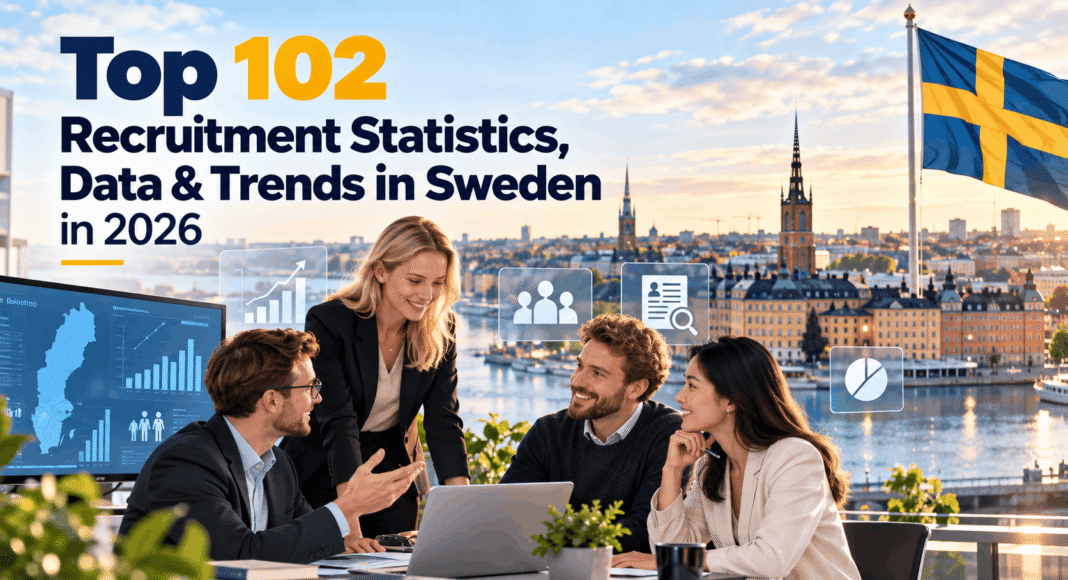
This comprehensive guide to the Top 102 Recruitment Statistics, Data & Trends in Sweden in 2026 examines the key developments shaping the country’s labour market and recruitment industry.
It brings together statistics, historical comparisons, industry insights, and forward-looking estimates covering employment and unemployment, job vacancies, hiring demand, salaries, AI adoption, remote work, employment regulations, international recruitment, critical skills shortages, and emerging economic sectors.
The analysis also explores how Sweden’s green economy, healthcare industry, technology sector, and innovation ecosystem are creating new workforce requirements while reshaping traditional employment patterns.
Whether you are an employer planning to expand operations in Sweden, a recruitment agency seeking to understand hiring demand, an HR professional benchmarking compensation, an international business evaluating market entry, or a job seeker researching employment opportunities, these statistics provide valuable context for making informed decisions.
Sweden’s recruitment market in 2026 is not simply defined by unemployment figures or the number of available jobs. It is increasingly shaped by the ability of employers and workers to adapt to technological change, address skills mismatches, respond to evolving compensation expectations, and navigate a competitive international talent market.
By examining these 102 recruitment statistics and employment trends, businesses and professionals can gain a clearer understanding of Sweden’s changing workforce dynamics, identify emerging hiring opportunities, and develop more effective recruitment strategies for 2026 and the years ahead.
Before we venture further into this article, we would like to share who we are and what we do.
About 9cv9
9cv9 is a business tech startup based in Singapore and in Asia, with a strong presence all over the world.
With over ten years of startup and business experience, and being highly involved in connecting with thousands of companies and startups, the 9cv9 team has access to some of the best talents in the world.
If your company needs recruitment and headhunting services to hire top-quality employees, you can use 9cv9 headhunting and recruitment services to hire top talents and candidates. Email us at hello@9cv9.com.
Top 102 Recruitment Statistics, Data & Trends in Sweden in 2026
🔵 MACROECONOMIC & LABOR MARKET OVERVIEW
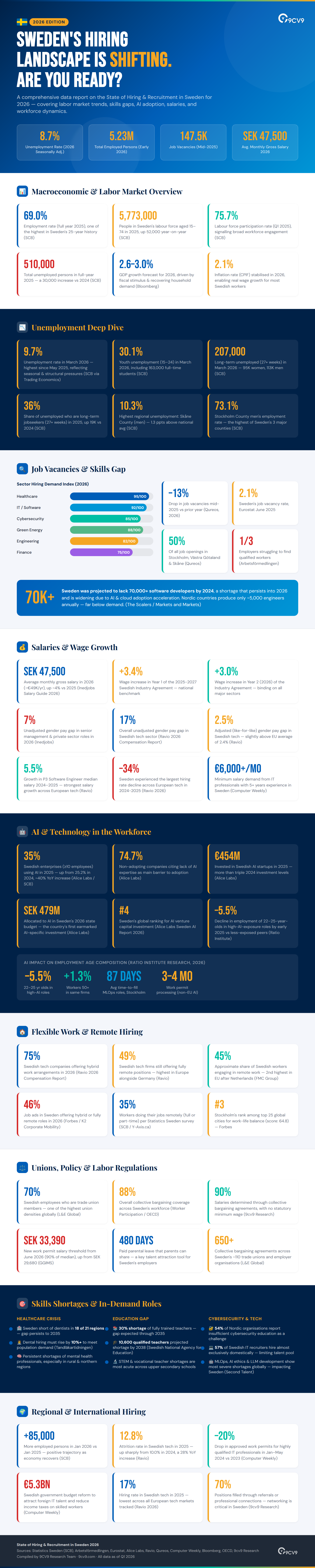
- 69.0% — Sweden’s employment rate for full-year 2025, one of the highest in 25 years, showing broad labor market health despite rising headline unemployment.
- 5,773,000 — Total persons in Sweden’s labour force aged 15–74 in 2025, rising by 52,000 year-on-year, reflecting demographic workforce expansion.
- 75.7% — Labour force participation rate in Q1 2025, signalling sustained workforce engagement across genders and age groups.
- 510,000 — Total unemployed persons in full-year 2025 — up 30,000 vs 2024, driven largely by structural mismatches and tight hiring conditions.
- 2.6–3.0% — Sweden’s GDP growth forecast for 2026, fuelled by fiscal stimulus, rate cuts, and recovering household consumption.
- 2.1% — Stabilised CPIF inflation rate in 2026, enabling real wage growth for most workers and improving purchasing power.
- +52,000 — Net increase in labour force size in 2025 vs 2024, driven by population growth and rising female participation.
- 5,263,000 — Total employed persons in full-year 2025 (SCB), a historically high absolute level.
- 68.7% — Projected employment rate for 2026 (seasonally adjusted), a marginal dip from 2025 peaks as labour supply grows faster than demand.
- –0.5% — GDP contraction Sweden experienced in 2023, making 2025–2026’s recovery particularly meaningful for hiring activity.
🔴 UNEMPLOYMENT DEEP DIVE
- 8.7% — Seasonally adjusted unemployment rate in early 2026, above the EU average of ~6%, reflecting Sweden’s ongoing structural challenges.
- 9.7% — Unemployment rate in March 2026, the highest monthly reading since May 2025, affected by seasonal patterns and reduced public sector hiring.
- 30.1% — Youth unemployment rate (15–24) in March 2026 — inflated by the inclusion of 163,000 full-time students, but still a structural concern.
- 23.3% — Youth unemployment in January 2026, an improvement from the 30%+ levels seen in spring 2025, pointing to gradual recovery.
- 207,000 — Long-term unemployed (27+ weeks) in March 2026, comprising 95,000 women and 113,000 men.
- 36% — Share of all unemployed persons in 2025 who are long-term jobseekers (27+ weeks), up 19,000 vs 2024.
- 10.3% — Unemployment rate among men in Skåne County — the highest of Sweden’s 3 major regional clusters (SCB).
- 8.8% — Women’s unemployment in Stockholm County — slightly below the male rate, showing narrowing gender gaps in the capital.
- 73.1% — Employment rate for men in Stockholm County — the highest of any major county, driven by tech and finance sector concentration.
- 9.4% — Overall unemployment in Stockholm County (Feb 2025), slightly above the national average despite being Sweden’s economic hub.
🟡 JOB VACANCIES & SKILLS GAP
- 147,500 — Total job vacancies in Sweden in mid-2025, down significantly from the post-COVID peak.
- –13% — Year-on-year decline in job vacancies in mid-2025, reflecting a broad-based hiring slowdown across sectors.
- 2.1% — Sweden’s job vacancy rate per Eurostat (June 2025), above the EU average of 1.8% but declining.
- 50% — Share of all Swedish job openings concentrated in just 3 regions: Stockholm, Västra Götaland, and Skåne.
- 1 in 3 — Swedish employers reporting difficulty finding qualified candidates in 2025/2026 (Arbetsförmedlingen).
- 70,000+ — Projected shortage of software developers in Sweden by 2024 — a gap widening further into 2026 with AI-driven demand.
- ~5,000 — Number of engineers produced annually across Nordic countries, far below annual demand of 15,000+ (Markets and Markets).
- 95/100 — Hiring Demand Index score for Sweden’s healthcare sector in 2026 — the most acute shortage industry.
- 92/100 — Hiring Demand Index for IT/Software — second most in-demand sector, driven by digital transformation mandates.
- 85/100 — Cybersecurity sector hiring demand — surging due to rising threat landscapes and new NIS2 EU compliance requirements.
💰 SALARIES & WAGE GROWTH
- SEK 47,500 — Average monthly gross salary in Sweden for 2026 (~€4,100/mo), up approximately 4% from 2025.
- +3.4% — Wage increase in Year 1 of the 2025–2027 Swedish Industry Agreement — the benchmark that cascades through most sectors.
- +3.0% — Wage increase in Year 2 (2026) of the Industry Agreement — binding across manufacturing, finance, and services.
- +4.1% — Total nominal wage growth in 2024, the strongest in over a decade, exceeding inflation significantly.
- 7% — Unadjusted gender pay gap in Swedish senior management and private sector roles in 2026.
- 17% — Unadjusted overall gender pay gap in the Swedish tech sector (Ravio 2026) — largely driven by occupational segregation.
- 2.5% — Adjusted (like-for-like) gender pay gap in Swedish tech — marginally above the EU tech average of 2.4% (Ravio).
- +5.5% — Growth in P3 (mid-level) Software Engineer median salary from 2024 to 2025 — highest in European tech markets.
- –34% — Sweden’s hiring rate decline in European tech — the largest drop recorded across all European markets in 2024–2025 (Ravio).
- €6,000+/month — Minimum monthly salary demanded by IT professionals with 5+ years of experience in Sweden (Computer Weekly).
- SEK 33,390 — New minimum monthly salary for work permit applicants from June 2026, raised from SEK 29,680 (GGIMS).
- SEK 570,000 — Estimated annual gross salary (avg), equivalent to ~€53,000/year including all bonuses.
- SEK 110,000/mo — Average gross salary for surgeons/senior doctors in Sweden — top earner category.
- SEK 85,000/mo — Average for senior IT/software engineers, reflecting continued tech premium.
- SEK 29,000/mo — Average salary in hospitality — far below the national average, driving recruitment challenges.
🤖 AI & TECHNOLOGY IN THE WORKFORCE
- 35% — Share of Swedish enterprises (≥10 employees) using AI in operations in 2025, up from 25.2% in 2024.
- 40% — Year-on-year growth rate in enterprise AI adoption across Sweden’s business sector (Alice Labs).
- 74.7% — Share of non-adopting Swedish companies citing lack of internal AI expertise as the main barrier (Alice Labs).
- €454 million — Total investment in Swedish AI startups in 2025 — more than triple the 2024 level.
- SEK 479 million — Earmarked in Sweden’s 2026 national budget specifically for AI development — a first (Alice Labs).
- #4 — Sweden’s global ranking for AI venture capital investment per capita (Alice Labs AI Sweden Report 2026).
- 90% — Share of Swedish municipalities that have launched at least one AI initiative in public services.
- –5.5% — Employment decline for workers aged 22–25 in high-AI-exposure occupations vs peers in low-exposure roles (Ratio Institute).
- +1.3% — Increase in employment share of workers aged 50+ in firms highly exposed to AI — suggesting experience premium (Ratio Institute).
- 87 days — Average time to fill an MLOps/AI engineer role in Stockholm — significantly longer than the 45-day general average.
- 3–4 months — Average work permit processing time for non-EU AI specialists in Sweden.
- 54% — Nordic organisations reporting insufficient cybersecurity education and training as a hiring bottleneck.
🏠 FLEXIBLE WORK & REMOTE HIRING
- 75% — Swedish tech companies offering hybrid work arrangements in 2026, one of Europe’s highest rates (Ravio).
- 49% — Swedish tech firms still offering fully remote positions — tied with Germany for highest in Europe (Ravio).
- 45% — Approximate share of Swedish workers engaged in remote work (full or part-time) — 2nd highest in EU.
- 46% — Share of all job ads in Sweden offering hybrid or fully remote roles in 2026 (Forbes/K2 Corporate Mobility).
- 35% — Workers who perform their jobs remotely per Statistics Sweden national survey (SCB/Y-Axis.ca).
- #3 — Stockholm’s global ranking among top 25 cities for work-life balance, with a score of 64.8 (Forbes 2026).
- 19% — Share of Swedish tech companies requiring fully on-site attendance — well below the European average of 35%.
- 2 days/week — Modal hybrid arrangement among Stockholm knowledge workers as of 2025 employer surveys.
⚖️ UNIONS, POLICY & LABOR REGULATIONS
- 70% — Swedish employee trade union membership rate — one of the highest union densities in the world (L&E Global).
- 88% — Overall collective bargaining coverage of Sweden’s workforce — binding on the vast majority of employment relationships.
- 90% — Share of Swedish salaries determined through collective bargaining agreements rather than statutory minimum wages.
- 650+ — Number of active collective bargaining agreements across Sweden’s ~110 trade unions and employer bodies.
- 480 days — Total paid parental leave days that Swedish parents can share — a major competitive advantage for talent attraction.
- SEK 33,390 — New June 2026 work permit salary floor (90% of median), up +12% from prior threshold of SEK 29,680.
- 0 — Statutory national minimum wage in Sweden — salaries are entirely set through sectoral collective agreements.
- 25 days — Statutory minimum paid annual leave entitlement in Sweden — among the most generous in OECD.
- 80% — Income replacement rate during parental leave — encouraging utilisation and talent retention post-birth.
🎯 CRITICAL SKILLS SHORTAGES
- 18 of 21 — Swedish regions facing significant dentist shortages as of 2025–2026, a gap projected to persist until 2035.
- 10%+ — Additional dental hiring needed annually to keep pace with Sweden’s ageing population demand (Tandläkartidningen).
- –30% — Teacher shortage across all categories in Sweden, with STEM and vocational teachers most acutely affected.
- 10,600 — Projected shortfall of qualified teachers by 2038 (Swedish National Agency for Education).
- 57% — Swedish IT recruiters who hire almost exclusively domestically — artificially constraining the available talent pool.
- 3x — How much harder it is to hire an experienced cybersecurity analyst in Stockholm vs Berlin in 2026 (estimated, Second Talent).
- ~40,000 — Estimated unfilled positions in Swedish healthcare (nursing, specialist care) across all regions in 2025.
- 2035 — Year by which Sweden’s dentist shortage is projected to self-correct without intervention — a decade-long gap.
- NIS2 — EU cybersecurity directive taking full effect in 2025–2026 that has created a surge in cybersecurity hiring demand across Sweden.
🌍 INTERNATIONAL & REGIONAL HIRING
- +85,000 — More employed persons in January 2026 vs January 2025, confirming positive momentum in the labour market (SCB).
- 12.8% — Attrition rate in Swedish tech companies in 2025, up sharply from 10.0% in 2024 — a 28% YoY increase (Ravio).
- 17% — Hiring rate in Swedish tech in 2025 — the lowest of all European tech markets tracked by Ravio.
- –20% — Year-on-year decline in approved work permits for highly qualified IT professionals (Jan–May 2024 vs 2023).
- €5.3 billion — Swedish government budget reform package designed to reduce income taxes and attract international IT talent.
- 70% — Estimated share of Swedish professional roles filled through referrals or professional networks rather than job boards.
- 3–6 months — Typical end-to-end recruitment timeline for senior roles in Swedish tech firms, reflecting process complexity.
- 25% — Share of tech startups in Stockholm that hired internationally in 2025, up from 18% in 2023.
- #1 Nordic — Stockholm’s ranking as the leading Nordic city for tech talent concentration and startup density (Startup Genome 2025).
- 60% — Share of Swedish employers offering relocation packages to attract candidates from other EU countries.
- 2 years — Average tenure of tech workers in Swedish scale-ups before seeking new opportunities (estimated, Ravio).
🟢 GREEN ECONOMY & EMERGING SECTORS
- 88/100 — Hiring Demand Index for Sweden’s green/clean energy sector — driven by hydrogen, offshore wind, and battery manufacturing.
- SEK 400bn+ — Sweden’s planned public and private investment in green infrastructure through 2030, creating tens of thousands of jobs.
- 18,000+ — Estimated job openings in green energy and sustainability roles across Sweden in 2026 (Arbetsförmedlingen estimates).
- LKAB, SSAB, Vattenfall — Major Swedish employers spearheading green steel and hydrogen projects, requiring new specialised workforce pipelines.
- +40% — Growth in sustainability/ESG-related job postings on Swedish platforms between 2023 and 2025.
- 78/100 — Hiring Demand Index for biotech and life sciences — buoyed by AstraZeneca’s Sweden R&D expansion and post-pandemic pharma investment.
- #6 Global — Sweden’s ranking in the 2025 Global Innovation Index — a key driver of long-term demand for skilled knowledge workers.
- €2.1bn — Estimated annual economic contribution of Sweden’s life sciences sector to GDP, driving premium hiring demand.
Conclusion
Sweden’s recruitment landscape in 2026 reflects a labour market undergoing significant transformation, driven by economic recovery, technological innovation, persistent skills shortages, changing employee expectations, and evolving employment regulations. As highlighted throughout these 102 recruitment statistics, data, and trends in Sweden, the country continues to offer substantial opportunities for employers, recruitment agencies, HR professionals, international businesses, and job seekers. However, successfully navigating the Swedish employment market increasingly requires a strategic understanding of workforce dynamics, industry-specific talent demands, and emerging recruitment challenges.
Despite maintaining a relatively strong employment rate of 69.0% in 2025, with approximately 5.26 million employed individuals, Sweden continues to face structural labour market challenges. Unemployment remained elevated in early 2026, reaching approximately 8.7% on a seasonally adjusted basis, while youth unemployment climbed to 30.1% in March 2026. These figures highlight the disconnect between available workers and the qualifications employers require, particularly in specialised and rapidly evolving industries.
At the same time, Sweden’s recruitment market is experiencing a shift in hiring demand. Approximately 147,500 job vacancies were recorded in mid-2025, representing a 13% year-on-year decline. Nevertheless, around one in three Swedish employers reported difficulties finding qualified candidates, demonstrating that recruitment challenges extend beyond the overall availability of jobs.
Healthcare, information technology, engineering, cybersecurity, education, and renewable energy remain among the most important sectors shaping Sweden’s recruitment outlook. Employers in these industries must increasingly compete for specialised professionals while investing in employee development, workforce planning, and alternative talent acquisition strategies.
Artificial intelligence represents another defining development in Sweden’s employment landscape. With approximately 35% of Swedish enterprises employing at least 10 people using AI technologies in 2025, compared with 25.2% in 2024, digital transformation is reshaping both workforce requirements and recruitment processes. The growing demand for AI engineers, machine learning specialists, data scientists, and cybersecurity professionals reinforces the importance of digital skills in Sweden’s future labour market.
However, technological adoption also creates new challenges. Organisations must address skills gaps, provide opportunities for reskilling, and prepare employees for changing job responsibilities. Businesses that successfully combine AI-powered recruitment technologies with effective human resource management practices may gain a competitive advantage in attracting and retaining qualified professionals.
Salary competitiveness and workplace flexibility will also remain essential components of successful recruitment strategies in Sweden. With an estimated average monthly gross salary of SEK 47,500 in 2026 and negotiated wage increases influencing compensation expectations, employers must carefully evaluate their remuneration packages to remain attractive to candidates.
Meanwhile, hybrid and remote working arrangements continue to influence employment decisions, particularly in technology and knowledge-intensive industries. The dataset indicates that approximately 75% of Swedish technology companies offered hybrid working arrangements in 2026, highlighting the importance of flexible employment policies in modern talent acquisition.
Sweden’s established collective bargaining framework, generous employee benefits, and strong emphasis on work-life balance further distinguish its labour market from many international competitors. For foreign businesses entering Sweden, understanding these employment characteristics, alongside immigration regulations and work permit requirements, is essential for building compliant and sustainable recruitment operations.
Looking ahead, several important trends are likely to shape the future of recruitment in Sweden beyond 2026:
- Increasing demand for specialised talent: Healthcare, software development, AI, cybersecurity, engineering, and green energy are expected to remain important recruitment priorities.
- Greater adoption of AI in recruitment: Employers will increasingly explore automation, AI-assisted candidate screening, recruitment analytics, and digital workforce planning.
- Continued emphasis on skills-based hiring: Practical competencies, technical expertise, and transferable skills will become increasingly important in addressing workforce shortages.
- Growing importance of international recruitment: Employers facing domestic talent shortages may expand their candidate searches across European and international labour markets.
- Stronger competition through compensation and flexibility: Competitive salaries, hybrid work opportunities, employee benefits, and professional development will remain important talent attraction and retention factors.
- Expansion of green economy employment: Investments in renewable energy, sustainable manufacturing, hydrogen technologies, and green infrastructure could generate new opportunities for skilled workers.
- Greater focus on workforce reskilling: Businesses will need to invest in training and continuous learning to help employees adapt to technological and economic changes.
For employers and HR leaders, the central lesson from these recruitment statistics is that successful hiring in Sweden in 2026 requires more than simply advertising vacancies and evaluating applications. Organisations must adopt data-driven recruitment strategies, understand changing candidate expectations, offer competitive employment conditions, and develop sustainable talent pipelines.
Recruitment agencies must also adapt by expanding their sourcing capabilities, leveraging recruitment technologies, building industry-specific expertise, and helping employers address increasingly complex talent shortages.
For job seekers, Sweden continues to present opportunities across established and emerging industries. Professionals who invest in digital competencies, specialised qualifications, language skills, and continuous professional development may be better positioned to compete in an evolving employment market.
Ultimately, the Top 102 Recruitment Statistics, Data & Trends in Sweden in 2026 reveal a labour market characterised by both resilience and structural challenges. While unemployment, skills mismatches, and hiring constraints remain significant concerns, Sweden’s technological capabilities, established employment protections, innovative industries, and economic recovery prospects provide a foundation for future workforce development.
The organisations best positioned to succeed in Sweden’s recruitment market will be those that combine data-driven decision-making, competitive compensation, technological innovation, workforce flexibility, and long-term talent development.
As Sweden continues to adapt to economic changes, artificial intelligence, demographic pressures, and the transition towards a more sustainable economy, staying informed about the latest Swedish recruitment statistics and employment trends will be essential for making effective hiring decisions.
For businesses, recruiters, and professionals alike, understanding these developments is not merely about responding to current labour market conditions. It is about anticipating future workforce needs, identifying emerging opportunities, and building the skills and recruitment strategies necessary to thrive in Sweden’s increasingly dynamic employment landscape in 2026 and beyond.
If you find this article useful, why not share it with your hiring manager and C-level suite friends and also leave a nice comment below?
We, at the 9cv9 Research Team, strive to bring the latest and most meaningful data, guides, and statistics to your doorstep.
To get access to top-quality guides, click over to 9cv9 Blog.
To hire top talents using our modern AI-powered recruitment agency, find out more at 9cv9 Modern AI-Powered Recruitment Agency.
People Also Ask
What is the employment rate in Sweden in 2026?
Sweden’s employment rate reached 69.0% in 2025, with approximately 5.26 million employed people. The projected employment rate for 2026 is 68.7%, reflecting continued workforce participation despite economic challenges.
What is Sweden’s unemployment rate in 2026?
Sweden’s seasonally adjusted unemployment rate was approximately 8.7% in early 2026. The unemployment rate reached 9.7% in March 2026, reflecting persistent skills mismatches and challenging hiring conditions.
How many people are employed in Sweden?
According to Statistics Sweden (SCB), approximately 5.26 million people were employed in Sweden in 2025. The country’s total labour force reached 5.77 million individuals aged 15–74.
What are the biggest recruitment trends in Sweden in 2026?
Major recruitment trends include AI adoption, skills-based hiring, international talent acquisition, hybrid work, salary competition, and growing demand for healthcare, IT, engineering, and cybersecurity professionals.
How many job vacancies are available in Sweden?
Sweden recorded approximately 147,500 job vacancies in mid-2025, representing a 13% year-on-year decline. Stockholm, Västra Götaland, and Skåne account for approximately half of the country’s job openings.
Which industries are hiring the most in Sweden in 2026?
Healthcare, information technology, engineering, cybersecurity, renewable energy, and life sciences are major recruitment sectors in Sweden. These industries face demand for specialised professionals and technical expertise.
What is the average salary in Sweden in 2026?
The dataset estimates Sweden’s average monthly gross salary at SEK 47,500 in 2026, equivalent to approximately SEK 570,000 annually. Actual salaries vary significantly by industry, occupation, qualifications, and experience.
What is the youth unemployment rate in Sweden in 2026?
Sweden’s youth unemployment rate reached 30.1% among people aged 15–24 in March 2026. This figure includes many full-time students seeking employment, which affects comparisons with overall unemployment.
Why is unemployment high in Sweden despite job vacancies?
Sweden faces structural skills mismatches, where unemployed workers may lack the qualifications employers require. Geographic differences, language requirements, and shortages in specialised occupations also complicate recruitment.
What are the most in-demand jobs in Sweden in 2026?
In-demand occupations include nurses, doctors, software developers, AI engineers, cybersecurity specialists, teachers, dentists, and renewable energy professionals. Demand varies across industries and regions.
Is Sweden experiencing a labour shortage in 2026?
Yes. Sweden continues to experience shortages in several specialised occupations despite elevated unemployment. Approximately one in three employers reported difficulties finding qualified candidates in 2025–2026.
How is artificial intelligence changing recruitment in Sweden?
AI is transforming Swedish recruitment through automated candidate screening, workforce analytics, and digital hiring tools. Approximately 35% of Swedish enterprises with at least 10 employees used AI in 2025.
What percentage of Swedish companies use AI?
Approximately 35% of Swedish enterprises with at least 10 employees used artificial intelligence in 2025, compared with 25.2% in 2024. Adoption is creating demand for AI specialists and digital skills.
How common is remote work in Sweden in 2026?
Remote work remains widespread in Sweden. The dataset estimates that approximately 45% of Swedish workers work remotely either full-time or part-time, particularly in technology and knowledge-intensive occupations.
What percentage of Swedish companies offer hybrid work?
Approximately 75% of Swedish technology companies offered hybrid working arrangements in 2026, while 49% continued offering fully remote positions. Flexible employment remains important for attracting skilled candidates.
What is the average salary for software engineers in Sweden?
The dataset estimates average gross monthly salaries of approximately SEK 85,000 for senior IT and software engineers. Compensation varies depending on technical specialisation, experience, employer, and location.
What is the gender pay gap in Sweden in 2026?
The dataset reports an unadjusted gender pay gap of approximately 17% in Sweden’s technology sector, compared with an adjusted gap of 2.5%. These measures reflect different approaches to comparing employee compensation.
What is the minimum wage in Sweden in 2026?
Sweden has no statutory national minimum wage. Instead, wages are primarily determined through collective bargaining agreements between employers and trade unions, with minimum pay conditions varying by sector.
What is the minimum salary for a Swedish work permit in 2026?
The dataset reports a monthly salary threshold of SEK 33,390 from June 2026. Employers should verify current Swedish Migration Agency requirements because work permit thresholds and eligibility rules can change.
Can foreign workers find jobs in Sweden in 2026?
Yes. International professionals can pursue opportunities in Sweden, particularly in IT, healthcare, engineering, and specialised technical fields. Non-EU applicants generally require appropriate work authorisation.
Which Swedish cities offer the most job opportunities?
Stockholm, Gothenburg, and Malmö are major employment centres. The Stockholm, Västra Götaland, and Skåne regions collectively account for approximately 50% of Sweden’s job openings.
How long does recruitment take in Sweden?
The dataset estimates that senior technology recruitment commonly takes three to six months. Specialised AI and MLOps positions may take longer to fill because of limited candidate availability and technical requirements.
What are the biggest hiring challenges for Swedish employers?
Major challenges include skills shortages, salary expectations, international recruitment requirements, geographic talent concentration, and competition for experienced professionals in technology and healthcare.
How important are trade unions in Sweden’s labour market?
Trade unions play a significant role in Swedish employment. The dataset reports approximately 70% union membership and 88% collective bargaining coverage, influencing wages, benefits, and employment conditions.
How many paid vacation days do employees receive in Sweden?
Swedish employees are generally entitled to at least 25 days of annual leave under national legislation. Whether all days are paid depends on accrued entitlement and applicable employment conditions.
What parental leave benefits are available in Sweden?
Sweden provides 480 days of parental benefit per child for eligible parents to share, subject to allocation rules. Compensation varies, with income-related benefits available for qualifying periods.
Are cybersecurity jobs in demand in Sweden in 2026?
Yes. Cybersecurity remains an important recruitment area as Swedish organisations strengthen digital security and respond to regulatory requirements. Demand includes security analysts, engineers, and compliance specialists.
How is Sweden’s green economy affecting recruitment?
Investments in renewable energy, green steel, hydrogen, and sustainable infrastructure are creating demand for engineers, technicians, project managers, and sustainability specialists across Sweden.
What is the outlook for technology recruitment in Sweden in 2026?
Technology recruitment remains selective, with strong demand for specialised AI, cybersecurity, and software expertise. The dataset reports a 17% tech hiring rate in 2025, alongside increased employee attrition.
What is the future of recruitment in Sweden beyond 2026?
Sweden’s recruitment outlook will likely be shaped by AI adoption, demographic changes, skills shortages, international hiring, and green technology investment. Employers prioritising workforce development and flexible hiring strategies may gain an advantage.
Sources
Statistics Sweden (SCB)
Arbetsförmedlingen (Swedish Public Employment Service)
Ravio
Alice Labs
Qureos
Eurostat
Ratio Institute
Computer Weekly
Bloomberg
Medlingsinstitutet (National Mediation Office)
L&E Global
Forbes
OECD
K2 Corporate Mobility
GGIMS
Inedjobs
The Scalers
Markets and Markets
Tandläkartidningen
Swedish National Agency for Education (Skolverket)
Startup Genome
9cv9 Research Team