




























Key Takeaways
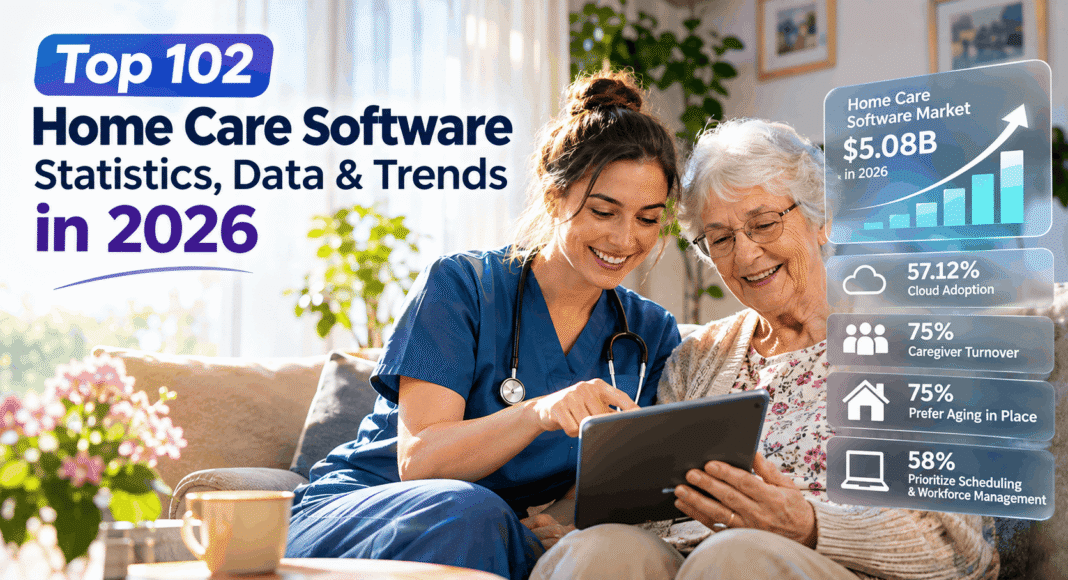
- Rapid Home Care Software Market Growth: The global home healthcare software market is estimated at USD 5.08 billion in 2026 and projected to reach USD 9.27 billion by 2031, growing at a CAGR of 12.74%.
- Accelerating Cloud Adoption and Digital Transformation: Cloud-based platforms accounted for 57.12% of the home healthcare software market in 2025, while AI, automation, electronic visit verification (EVV), and remote patient monitoring are reshaping healthcare delivery.
- Growing Demand for Workforce Management Solutions: With caregiver turnover reaching 75% and 59% of home care agencies experiencing staffing shortages, advanced scheduling, workforce automation, and integrated home care management software are becoming essential operational investments.
The global home care software market is projected to grow from USD 5.08 billion in 2026 to USD 9.27 billion by 2031, at a compound annual growth rate of 12.74%. Key growth drivers include aging populations, caregiver shortages, cloud adoption, artificial intelligence, electronic visit verification, and increasing demand for home-based healthcare services.
The global home care industry is undergoing a significant digital transformation in 2026, driven by rapidly aging populations, increasing demand for personalized healthcare services, persistent caregiver shortages, rising operational costs, and the growing adoption of advanced healthcare technologies. As healthcare delivery continues to shift from traditional institutional settings toward home-based care, home care software has become an increasingly essential component of modern healthcare infrastructure, enabling providers to improve operational efficiency, streamline administrative processes, strengthen regulatory compliance, and enhance patient care outcomes.
Home care software encompasses a comprehensive range of digital solutions designed to help home care agencies, home healthcare providers, skilled nursing organizations, hospice providers, and independent caregivers manage their daily operations. These platforms integrate essential functionalities such as caregiver scheduling, workforce management, electronic visit verification (EVV), patient records management, clinical documentation, billing and invoicing, remote patient monitoring, telehealth, compliance management, and real-time operational analytics.
The rapid expansion of the global home healthcare software market highlights the increasing importance of these technologies. One market estimate values the global home healthcare software market at approximately USD 5.08 billion in 2026, up from USD 4.51 billion in 2025, with projections indicating that it could reach USD 9.27 billion by 2031, representing a compound annual growth rate (CAGR) of 12.74%. Other market estimates, using broader category definitions, project even greater growth, reflecting the expanding commercial opportunities across clinical and nonclinical home care software segments.
The nonclinical home care software market alone is estimated to reach USD 5.6 billion in 2026 and is projected to expand to USD 14.17 billion by 2035. This growth demonstrates that digital transformation extends beyond clinical healthcare delivery, with administrative automation, workforce coordination, financial management, and operational optimization becoming increasingly important investment areas for home care organizations.
One of the most significant factors driving home care software adoption in 2026 is the rapid aging of the global population. By 2030, approximately one in six people worldwide will be aged 60 or older, with the global population within this age group projected to reach 1.4 billion. Furthermore, the worldwide population aged 65 and above is expected to reach approximately 1.7 billion by 2054, creating substantial long-term demand for accessible, scalable, and technology-enabled home healthcare services.
Consumer preferences are also accelerating the transition toward home-based healthcare. Approximately 75% of American adults aged 50 and older prefer to remain in their current homes as they age, while 84% consider aging in place an important objective. These preferences are encouraging healthcare organizations to invest in digital platforms that support independent living, continuous patient monitoring, personalized care coordination, and efficient communication between caregivers, patients, healthcare professionals, and family members.
However, the increasing demand for home care services is accompanied by substantial workforce challenges. Caregiver turnover among United States home care agencies reached a median of approximately 75% in 2024, while an estimated 59% of agencies report operating with insufficient staffing. Furthermore, approximately one in four families seeking home care services is turned away because providers cannot adequately fill available shifts.
With caregiver replacement costs ranging from USD 2,600 to USD 5,000 per employee, home care organizations are increasingly prioritizing software solutions that improve workforce utilization, automate scheduling, simplify employee onboarding, reduce administrative workloads, and support caregiver retention. In 2026, approximately 58% of surveyed home care providers identify scheduling and workforce management software as a leading technology investment priority, followed by back-office automation at 53% and clinical documentation tools at 47%.
Cloud computing is another major force reshaping the home care software industry. Cloud-based platforms accounted for approximately 57.12% of the home healthcare software market by deployment mode in 2025, with cloud-based solutions projected to grow at a CAGR of 14.22% between 2026 and 2031. The increasing adoption of cloud infrastructure allows healthcare providers to centralize patient information, facilitate remote access, improve organizational scalability, reduce infrastructure expenses, and coordinate distributed caregiving teams more effectively.
Mobile technology is similarly transforming home healthcare operations. Smartphones and handheld devices represented approximately 46% of home healthcare software access-layer demand in 2024, highlighting the growing importance of mobile-first caregiver applications. These solutions enable healthcare workers to access patient information, document visits, update care plans, verify service delivery, and communicate with agency administrators while working in patients’ homes.
Regulatory compliance is also becoming an increasingly influential factor in home care software purchasing decisions. Electronic visit verification requirements, Medicaid reimbursement policies, Medicare billing regulations, and healthcare documentation standards are encouraging agencies to adopt integrated platforms capable of maintaining accurate digital records and supporting compliant claims submissions.
As regulatory enforcement becomes more stringent, particularly across the United States, home care agencies must increasingly rely on automated compliance management systems to minimize documentation errors, prevent reimbursement delays, reduce claim denials, and maintain operational accountability.
Meanwhile, emerging technologies such as artificial intelligence (AI), machine learning, predictive analytics, remote patient monitoring, telehealth, and healthcare interoperability are expanding the capabilities of modern home care software platforms. AI-powered scheduling tools can support more efficient caregiver allocation, while predictive analytics can help healthcare providers identify potential patient risks, optimize resource utilization, and improve care planning. Remote patient monitoring solutions are also gaining momentum as healthcare organizations seek to monitor patient conditions beyond traditional in-person visits.
The rising cost of healthcare further reinforces the importance of operational efficiency. The national median hourly rate for nonmedical home care in the United States reached USD 35 in 2025, translating into approximately USD 80,080 annually for individuals receiving 44 hours of weekly care. Rising labor expenses, reimbursement pressures, and increasing service demand are creating additional incentives for home care providers to implement automation and data-driven management technologies.
Beyond professional healthcare providers, home care software is also becoming increasingly relevant to family caregivers. Approximately 63 million Americans provided ongoing unpaid care to family members or friends in 2025, representing a 45% increase compared with 2015. Digital care coordination platforms, family communication tools, remote monitoring applications, and shared scheduling systems can help bridge the gap between professional healthcare services and informal caregiving networks.
From a business perspective, understanding the latest home care software statistics, market data, adoption patterns, and emerging technology trends is essential for healthcare executives, home care agency owners, software developers, technology investors, healthcare administrators, and digital transformation professionals. These insights can support more informed software purchasing decisions, strategic technology investments, competitive positioning, product development, and long-term operational planning.
This comprehensive guide explores the top 102 home care software statistics, data, and trends in 2026, providing an in-depth overview of the global home healthcare software market, cloud and mobile technology adoption, electronic visit verification requirements, caregiver workforce challenges, aging population trends, aging-in-place preferences, healthcare costs, unpaid family caregiving, agency performance, and emerging digital healthcare innovations.
By examining these critical home care software statistics, businesses and healthcare professionals can gain a deeper understanding of the forces shaping the industry, identify emerging growth opportunities, anticipate operational and regulatory challenges, and develop more effective strategies for delivering efficient, accessible, compliant, and patient-centered home healthcare services in 2026 and beyond.
Before we venture further into this article, we would like to share who we are and what we do.
About 9cv9
9cv9 is a business tech startup based in Singapore and Asia, with a strong presence all over the world.
With over ten years of startup and business experience, and being highly involved in connecting with thousands of companies and startups, the 9cv9 team has listed some of the top and best companies/tools in this review.
If you like to get your company listed in our top B2B software reviews, check out our world-class 9cv9 Media and PR service and pricing plans here.
Top 102 Home Care Software Statistics, Data & Trends in 2026
Market Size & Growth
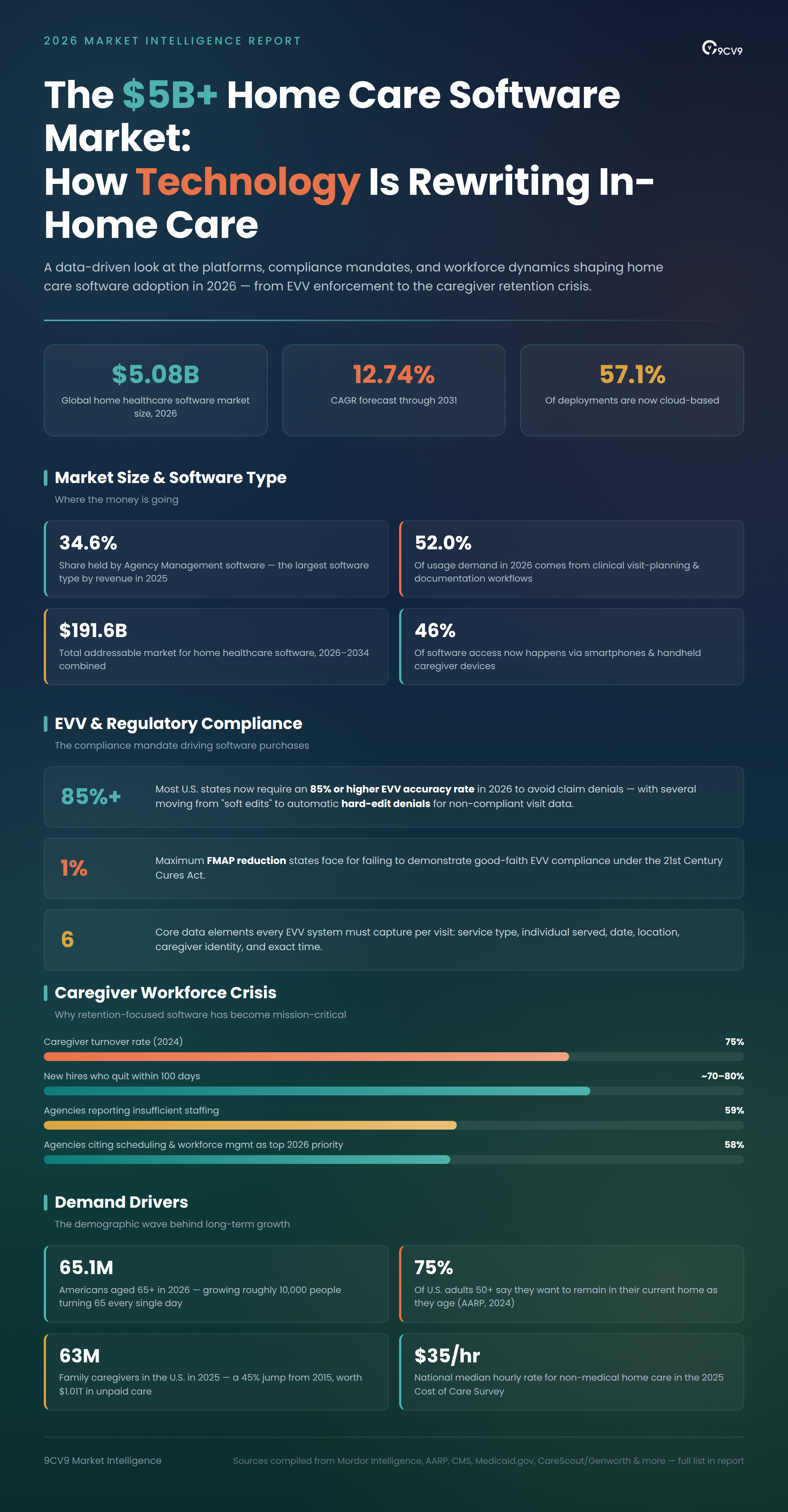
- The global home healthcare software market is valued at approximately $5.08 billion in 2026, up from $4.51 billion in 2025 — a clear signal that digital care infrastructure spending is accelerating across agencies, hospitals, and home health providers.
- Forecasts show the home healthcare software market climbing to $9.27 billion by 2031 at a 12.74% CAGR, underlining that this remains one of the fastest-compounding subsegments within healthcare IT.
- One market report pegs the broader home healthcare software category at $14.35 billion in 2026, projected to reach $34.63 billion by 2032 at a 15.7% CAGR — a reminder that market-size estimates vary widely by scope definition, but directional growth is consistent.
- A separate analysis estimates the market at $9.73 billion in 2026, growing at 11.7% CAGR toward $15.12 billion by 2030, driven by chronic disease management demand and cloud platform expansion.
- Longer-range projections put the home healthcare software market at $155.71 billion by 2034 — up from just $11.47 billion in 2024 — reflecting a striking 29.8% CAGR tied to demographic and telehealth tailwinds.
- The nonclinical homecare software segment alone is estimated at $5.6 billion in 2026, expected to reach $14.17 billion by 2035, showing that back-office and scheduling tools are scaling just as fast as clinical modules.
- Agency Management Solutions led the home healthcare software type segment with a 34.62% revenue share in 2025, confirming that scheduling, billing, and compliance remain the software backbone for most agencies.
- Clinical Management Systems captured more than 37.5% of the home healthcare software type market in 2024, making it the single largest functional category ahead of billing and telehealth modules.
- Skilled Nursing services held 41.28% of the home healthcare software market by service line in 2025, showing where the deepest software investment is concentrated.
- North America holds roughly 45% of the global home healthcare software market share, strengthened by CMS interoperability mandates and the ongoing shift to value-based care.
Cloud, Mobile & Delivery Model Adoption
- Cloud-based platforms captured 57.12% of the home healthcare software market by delivery mode in 2025, confirming cloud has become the default deployment choice for new agency software purchases.
- Cloud-based home care software delivery is forecast to grow at a 14.22% CAGR between 2026 and 2031, comfortably outpacing on-premises alternatives.
- Moving from on-premises to cloud-based systems can lower the total cost of ownership by roughly 77%, a major reason smaller home care agencies are migrating away from legacy servers.
- Handheld devices and smartphones accounted for 46% of access-layer demand for home healthcare software in 2024, reinforcing that mobile caregiver apps are now central to how visits are documented in the field.
- Clinical homecare systems supporting visit planning and documentation are expected to represent 52.0% of total home care software usage demand in 2026, the largest single workflow driving platform adoption.
- Cloud-based solutions are projected to hold 47.3% share of the home healthcare software deployment market by 2036, extending cloud dominance well into the next decade.
- Home Health Agencies accounted for 60.02% of home healthcare software market demand by end-user in 2025, making agency-facing tools the largest software buyer segment ahead of hospitals and individual providers.
- Telehealth usage has risen an estimated 38% globally in recent years, a trend that is pushing home care software vendors to bundle virtual-visit and remote-monitoring modules directly into their core platforms.
Electronic Visit Verification (EVV) & Regulatory Compliance
- Under the 21st Century Cures Act, all U.S. states were required to implement Electronic Visit Verification for Medicaid-funded personal care services by January 1, 2020, and for home health services by January 1, 2023.
- States that fail to demonstrate good-faith EVV compliance face a Federal Medical Assistance Percentage (FMAP) reduction of up to 1%, a direct financial incentive pushing agencies toward compliant software.
- In 2026, most U.S. states now require 85%+ EVV accuracy rates for home care agencies to avoid claim denials or FMAP penalties.
- Pennsylvania mandates an 85% EVV compliance rate for home care providers, while Florida enforces an equivalent or higher threshold depending on managed care organization policy.
- New York’s Medicaid program anticipated a 90% EVV compliance benchmark, among the strictest state-level thresholds in the country.
- Minnesota introduced a new EVV compliance floor in early 2026, starting at a 50% visit-verification rate and rising toward 80%, illustrating how quickly state thresholds are tightening.
- Many states are shifting in 2026 from “soft edits” — which flag but still pay claims with EVV errors — to “hard edits” that automatically deny non-compliant claims, materially raising the cost of poor EVV software.
- EVV systems are required to capture six core data elements per visit (service type, individual served, date, location, caregiver identity, and exact time), a data standard now baked into virtually every compliant home care platform.
- Texas formally moved to hard-edit EVV enforcement in early 2026, meaning incomplete visit data can now trigger immediate claim rejection rather than a warning.
- Arizona completed a full transition of its EVV infrastructure from the Sandata vendor system to an in-house AHCCCS platform in October 2025, illustrating how frequently state EVV requirements can change.
- Common EVV-triggered claim denials stem from missing visit start/end times, GPS location mismatches, and incomplete caregiver identification — all of which modern home care software is designed to auto-validate before submission.
Workforce, Caregiver Shortage & Turnover
- Caregiver turnover in U.S. home care agencies reached a median of 75% in 2024, an improvement from a peak of roughly 79.2% but still among the highest turnover rates of any occupation category.
- Nearly four out of five caregivers who leave an agency do so within their first 100 days on the job, a pattern that puts enormous pressure on scheduling and onboarding software.
- An estimated 59% of home care agencies report operating with insufficient staffing, directly limiting how many new clients they can safely accept.
- As a direct consequence of staffing shortages, roughly one in four families seeking home care is currently being turned away by agencies unable to fill shifts.
- Replacing a single departed caregiver costs an agency between $2,600 and $5,000 in recruitment and retraining expenses, a cost driver that is pushing agencies toward retention-focused scheduling software.
- For a mid-sized home care agency, cumulative annual caregiver replacement costs can exceed $200,000, making retention technology a direct line to profitability.
- From 2024 to 2034, the U.S. home care workforce is projected to generate more than 6.1 million total job openings, ranking second among all U.S. occupations for volume of openings.
- Caregiver shortages remain the top operational concern for home care agencies, cited by 53% of providers in the AxisCare 2026 Home Care Industry Survey.
- Profitability pressure has risen sharply among home care operators, climbing from 13% to 34% of agencies citing it as a top concern amid rising wages and tighter Medicaid reimbursement.
- Home health and personal care aides earned an average base wage of $16.82 per hour as of the most recent BLS data, only modestly above the $15.07 hourly average for fast-food and counter workers.
- Around 46% of home care workers are employed only part-time, and roughly 17% work only part of the year, contributing to the sector’s chronic income instability.
- About 59% of home care workers receive some form of public assistance, and 15% live below the federal poverty line despite working in an essential caregiving role.
Aging Population & Demand Drivers
- By 2030, one in six people worldwide will be aged 60 or older, with that cohort’s global population rising from 1 billion in 2020 to a projected 1.4 billion.
- The global population aged 65 and older is projected to nearly double from roughly 830 million today to 1.7 billion by 2054, a demographic wave that underpins long-term home care software demand.
- In the United States, the number of adults aged 65 and older is estimated to reach 65.1 million in 2026, growing about 2.8% annually as the baby boomer generation ages in.
- Roughly 10,000 Americans turn 65 every single day, a pace that is expected to continue through 2030 and keep expanding the addressable market for home care platforms.
- The U.S. population aged 65 and older is expected to double from 45 million today to 90 million by 2050, doubling the long-term customer base for home care software vendors.
- By 2034, the U.S. Census Bureau projects there will be more people aged 65+ than children under 18 for the first time in the nation’s history.
- The number of Americans aged 100 and older is projected to quadruple by 2054, adding an entirely new tier of ultra-high-acuity home care demand.
- Globally, the population aged 80 and older is expected to more than triple between 2020 and 2050, reaching roughly 426 million people who will disproportionately require in-home clinical support.
- About 19.2% of the American population was aged 65 or older in 2026, a share forecast to climb to 22.8% by 2050.
- China’s senior population share grew from 7% in 2000 to 15% in 2024 and is projected to hit roughly 33% by mid-century — one of the fastest aging curves of any major economy and a signal of rising global home care software demand outside the U.S.
Aging in Place Preference
- About 75% of U.S. adults aged 50 and older say they want to remain in their current home as they age, according to AARP’s 2024 Home and Community Preferences Survey.
- A separate 2025 survey found 84% of adults aged 50+ consider aging in place an important goal, with 58% calling it “extremely important.”
- Among adults 65 and older, 93% currently live in their own home or apartment rather than any form of institutional care.
- If they could no longer live independently, 60% of older adults say they would prefer to receive care at home rather than move into assisted living, versus just 18% who would choose assisted living.
- Only about 5% of older Americans actually live in a nursing home at any given time, despite common assumptions that institutional care is the default.
- Falls remain the leading cause of injury among adults over 65, generating an estimated $50 billion in annual medical costs — a major reason home care software increasingly bundles fall-risk and safety-check features.
- Preventive home safety measures such as grab bars and barrier-free entries can reduce fall risk by roughly 38%, reinforcing the operational value of home care visit checklists.
- Only about 34% of older adults believe it is “very feasible” financially for them to age in their current home, highlighting the affordability gap that home care agencies and their software must help bridge.
- Nearly 9 out of 10 seniors say they would prefer to age in place rather than move into an institutional care setting, according to industry survey data compiled from multiple sources.
Cost of Care
- The national median hourly rate for non-medical home care rose 3% year-over-year to $35 per hour in the 2025 CareScout/Genworth Cost of Care Survey.
- At the $35/hour national median and 44 hours of weekly care, the annual cost of non-medical home care now totals roughly $80,080 per client.
- The national median hourly rate for private-duty skilled nursing delivered in the home is $90 per hour, with a median per-visit rate of $160.
- State-level home care costs range from around $24 per hour in Mississippi to as high as $46 per hour in Wyoming, illustrating the wide geographic variance agencies and their software must accommodate in billing configuration.
- Home care costs have risen at roughly twice the pace of general consumer inflation over the past five years, intensifying pressure on agencies to run leaner, software-driven operations.
- The national median cost for an assisted living community reached $6,200 per month ($74,400 per year) in the 2025 Cost of Care Survey, making home care a comparatively flexible, pay-for-hours-used alternative.
- Nursing home care costs a national median of $315 per day for a semi-private room and $355 per day for a private room — multiples higher than most home care arrangements for equivalent hours of support.
- Labor costs were identified as the single largest driver of home care price increases in the latest Cost of Care Survey, reinforcing why scheduling efficiency software has become a margin-protection tool for agencies.
Family & Unpaid Caregivers
- An estimated 63 million Americans — nearly one in four adults — provided ongoing unpaid care to a family member or friend in 2025, a 45% increase from 2015.
- Family caregivers in the U.S. delivered 49.5 billion hours of unpaid care in 2024, worth an estimated $1.01 trillion in total economic value.
- The economic value of unpaid family caregiving now exceeds total U.S. Medicaid spending, which stood at $932 billion in the same year.
- Nearly one in four family caregivers report providing 40 or more hours of care per week — effectively a full-time, unpaid job on top of any other employment.
- Nearly one in three family caregivers also raise children under 18 while simultaneously caring for an adult loved one, a group often referred to as the “sandwich generation.”
- Almost half of family caregivers report at least one major negative financial impact from caregiving, such as taking on debt or depleting their savings.
- About 64% of family caregivers report high emotional stress and 45% report high physical strain associated with their caregiving responsibilities.
- Roughly 6 in 10 family caregivers are simultaneously employed, and half say caregiving duties have affected their ability to meet workplace obligations.
Home Care Agency Landscape, Quality & Software Market Structure
- More than 12,000 Medicare-certified home health agencies were evaluated in the first-ever U.S. News “Best Home Health” ratings released in early 2026.
- Of those evaluated, only 1,319 agencies (about 11%) earned the top “High Performing” designation, showing meaningful quality variance across the industry that software-driven care coordination can help close.
- The number of active Medicare-certified home health agencies in the U.S. has declined from a peak of roughly 12,967 in 2013 to around 11,506 by 2023, reflecting industry consolidation.
- Approximately 6,000 U.S. home healthcare organizations currently hold Joint Commission accreditation, a widely recognized quality benchmark that many software platforms help agencies maintain documentation for.
- Patients treated by top-rated home health agencies were 93% likely to see improved mobility, compared with 83% among the national average — underscoring the link between operational quality and patient outcomes.
- The CMS Calendar Year 2026 Home Health Prospective Payment System rule finalized a 1.3% aggregate Medicare payment reduction, a smaller cut than the 6.4% initially proposed but still a margin pressure agencies must absorb through efficiency.
- Roughly 78% of U.S. home health agencies are Medicaid-certified, reflecting how central public payer billing accuracy is to core home care software functionality.
- In 2020, 98.7% of home health agencies were Medicare-certified, a saturation level that makes CMS billing-code compliance a near-universal software requirement.
- About 424 million home health care visits were logged in the U.S. in 2020 alone, a 7.6% increase from 2013, giving a sense of the sheer visit-documentation volume home care software must process nationally.
- Client satisfaction with home health care remains high, with roughly 91% of surveyed clients expressing overall satisfaction with the care and coordination they received.
Technology & Operational Trends
- AI-driven predictive analytics for patient-outcome forecasting and readmission-risk reduction became embedded in home care software platforms industry-wide starting in 2025, according to market analysts tracking the category.
- Remote Patient Monitoring software is currently the fastest-growing subsegment of home healthcare software, propelled by demand for continuous vital-sign tracking without in-person visits.
- AI-enabled predictive scheduling and resource allocation tools are becoming a standard feature set in nonclinical homecare software as agencies try to offset chronic staffing volatility.
- Interoperability with hospital and payer systems is cited as a growing purchase criterion, as more agencies participate in hospital-at-home programs requiring seamless data handoff.
- Multi-payer billing complexity — spanning Medicare, Medicaid, private insurance, and private pay — is repeatedly cited by agencies as a leading reason for switching home care software platforms.
- Back-office automation, including EVV compliance layers and billing reconciliation, is now prioritized by 53% of home care agencies as a top 2026 technology investment area.
- Scheduling and workforce management software is the single highest technology investment priority for home care agencies in 2026, cited by 58% of providers surveyed.
- Clinical documentation tools rank as the third-highest technology priority for home care agencies in 2026, cited by 47% of providers, just behind scheduling and back-office automation.
Broader Market & Segment Data
- The U.S. long-term care software market, a category closely adjacent to home care software, was valued at $2.41 billion in 2025 and is projected to reach $4.11 billion by 2033.
- Within long-term care software, cloud-based delivery already held the largest deployment share at 41.55% in 2025, mirroring the same cloud-first trend seen in home care specifically.
- The Electronic Health Records (EHR) module remains the single largest application segment within long-term care software by market share.
- Global total addressable market for home healthcare software between 2026 and 2034 is projected to reach approximately $191.62 billion, reflecting how large the category could grow across all sub-segments combined.
- Asia-Pacific is cited as the fastest-growing regional market for home healthcare software, driven by rapidly rising telehealth penetration and an accelerating geriatric population.
- Hospice and palliative-care software is identified as the fastest-growing end-user segment within home healthcare software, driven by rising demand for home-based end-of-life care.
- Skilled Nursing Facilities held the largest end-use share of long-term care software adoption in 2025, ahead of assisted living and home health agency segments.
- Homecare Management Software is cited as the leading solution type within the broader home healthcare software market due to its comprehensive scheduling, patient record, and care-coordination functionality.
Conclusion
The home care software industry in 2026 stands at a critical intersection of technological innovation, demographic transformation, healthcare modernization, and evolving patient expectations. As the global population continues to age and demand for personalized, accessible, and cost-effective healthcare services increases, home care software is becoming an indispensable component of modern healthcare delivery. From caregiver scheduling and workforce management to electronic visit verification, clinical documentation, remote patient monitoring, and artificial intelligence, digital solutions are fundamentally transforming how home care organizations operate, scale, and deliver patient-centered services.
The top 102 home care software statistics, data, and trends in 2026 demonstrate that the industry is positioned for substantial long-term expansion. With one estimate valuing the global home healthcare software market at approximately USD 5.08 billion in 2026 and projecting growth to USD 9.27 billion by 2031 at a compound annual growth rate of 12.74%, the sector presents significant opportunities for healthcare technology companies, software developers, investors, and healthcare service providers.
Although market size estimates differ considerably depending on segment definitions, research methodologies, and geographic coverage, the overall direction remains consistent: demand for integrated, scalable, and intelligent home care management solutions is increasing.
Aging Populations Will Continue to Drive Home Care Software Demand
One of the most influential long-term drivers of home care software market growth is the unprecedented aging of the global population. By 2030, approximately one in six individuals worldwide will be aged 60 or older, while the global population aged 65 and above is projected to reach approximately 1.7 billion by 2054.
These demographic developments will place considerable pressure on traditional healthcare infrastructure, increasing the need for alternative care delivery models that support independent living, chronic disease management, preventive healthcare, and personalized assistance.
Furthermore, approximately 75% of American adults aged 50 and older prefer to remain in their current homes as they age, while 84% consider aging in place an important objective. These preferences highlight a structural shift toward home-based healthcare services that is likely to support sustained investment in home care management software, telehealth platforms, remote monitoring systems, and digital care coordination tools.
Healthcare organizations that successfully integrate these technologies will be better positioned to accommodate growing patient populations while maintaining service quality, operational efficiency, and continuity of care.
Workforce Management and Caregiver Retention Remain Critical Priorities
Despite the considerable growth potential of the home care industry, workforce shortages and high caregiver turnover remain significant operational challenges.
With median caregiver turnover reaching approximately 75% in 2024 and an estimated 59% of home care agencies reporting insufficient staffing, healthcare providers face increasing difficulties in maintaining service availability, managing employee workloads, and meeting rising patient demand.
The financial implications are equally substantial. Replacing a single caregiver can cost between USD 2,600 and USD 5,000, while cumulative annual replacement expenses for a mid-sized home care agency can exceed USD 200,000.
These statistics reinforce the importance of investing in advanced home care workforce management software capable of supporting:
- Automated caregiver scheduling and shift allocation.
- Employee onboarding and training management.
- Workforce availability and utilization tracking.
- Caregiver communication and engagement.
- Predictive staffing and resource allocation.
- Administrative workload reduction.
- Employee retention and performance management.
The fact that 58% of surveyed home care providers identify scheduling and workforce management as a leading technology investment priority in 2026 further demonstrates the strategic importance of workforce optimization.
As competition for qualified caregivers intensifies, home care agencies that leverage intelligent workforce management platforms may be better equipped to improve employee experiences, reduce avoidable administrative burdens, and maintain consistent service delivery.
Cloud-Based and Mobile Home Care Software Will Shape Future Operations
Cloud computing and mobile technology have emerged as foundational elements of the modern home care software ecosystem.
Cloud-based platforms accounted for approximately 57.12% of the home healthcare software market by delivery mode in 2025, while cloud-based home care software is projected to expand at a CAGR of 14.22% between 2026 and 2031.
This growing adoption reflects the advantages of cloud infrastructure, including greater accessibility, centralized information management, organizational scalability, remote collaboration, and reduced dependence on traditional on-premises infrastructure.
Mobile technology is equally important, particularly given the distributed nature of home healthcare services. Smartphones and handheld devices accounted for approximately 46% of home healthcare software access-layer demand in 2024, demonstrating the increasing reliance on mobile applications among caregivers and healthcare professionals.
Mobile-first home care software enables caregivers to access patient records, document clinical observations, verify visits, update care plans, communicate with administrators, and manage schedules directly from the field.
Moving forward, cloud-native architectures, mobile accessibility, real-time synchronization, and secure information sharing are likely to remain important considerations for organizations evaluating home care software solutions.
Regulatory Compliance and Electronic Visit Verification Will Influence Software Investment
Regulatory compliance continues to play a central role in shaping home care software adoption, particularly within the United States.
Electronic visit verification requirements, Medicaid billing regulations, Medicare reimbursement policies, and healthcare documentation standards have increased the importance of accurate digital recordkeeping and automated compliance management.
As electronic visit verification enforcement becomes more stringent across various states, home care agencies must ensure that their software platforms can accurately capture required visit information, identify documentation inconsistencies, and support compliant reimbursement submissions.
The transition from warning-based enforcement mechanisms toward automatic claim denials in certain jurisdictions further increases the financial risks associated with incomplete or inaccurate visit documentation.
Consequently, integrated home care software platforms that combine electronic visit verification, clinical documentation, billing reconciliation, compliance monitoring, and reporting capabilities are becoming increasingly valuable.
Healthcare providers that prioritize regulatory readiness can reduce exposure to avoidable reimbursement delays, administrative inefficiencies, and compliance-related financial risks.
Artificial Intelligence and Automation Will Transform Home Healthcare Delivery
The future of home care software is increasingly connected to artificial intelligence, machine learning, predictive analytics, intelligent automation, and connected healthcare technologies.
AI-powered scheduling systems are emerging as valuable tools for optimizing caregiver assignments and improving resource allocation. Predictive analytics can support patient risk identification and care planning, while automated administrative workflows can help reduce repetitive tasks and improve operational consistency.
Remote patient monitoring represents another important growth opportunity within the home healthcare software market. By enabling healthcare professionals to monitor patient conditions outside traditional clinical environments, remote monitoring technologies can support continuous care, earlier identification of potential health concerns, and more informed clinical decision-making.
The growing integration of telehealth, electronic health records, hospital information systems, payer platforms, and home care management software also highlights the increasing importance of healthcare interoperability.
As these technologies mature, home care software vendors will need to balance innovation with data security, patient privacy, clinical reliability, regulatory compliance, and appropriate human oversight.
Rising Healthcare Costs Will Accelerate Operational Digitalization
The increasing cost of home healthcare services presents another compelling reason for organizations to invest in digital transformation.
The national median hourly rate for nonmedical home care in the United States reached USD 35 in 2025, resulting in an estimated annual expenditure of USD 80,080 for individuals receiving 44 hours of care per week.
Meanwhile, rising labor costs, caregiver recruitment expenses, reimbursement pressures, and administrative complexities continue to challenge the financial sustainability of home care agencies.
These economic pressures are encouraging healthcare organizations to adopt software solutions that improve scheduling efficiency, streamline billing operations, automate administrative processes, reduce documentation errors, and provide greater visibility into organizational performance.
The growing prioritization of back-office automation, identified as a leading technology investment area by 53% of surveyed home care agencies in 2026, illustrates how operational efficiency is becoming increasingly important to long-term profitability.
Home care software should therefore be viewed not simply as an administrative expense but as a strategic investment that can support financial sustainability, organizational productivity, and scalable service delivery.
Family Caregiving Represents a Significant Opportunity for Digital Innovation
The home care software market also extends beyond professional healthcare organizations to include millions of unpaid family caregivers.
Approximately 63 million Americans provided ongoing unpaid care to family members or friends in 2025, representing a 45% increase compared with 2015. Furthermore, family caregivers delivered an estimated 49.5 billion hours of unpaid care in 2024, representing approximately USD 1.01 trillion in economic value.
These figures highlight the enormous contribution of informal caregivers to the broader healthcare ecosystem and the growing opportunity for digital solutions that support their responsibilities.
Family-oriented home care software can facilitate shared care planning, appointment coordination, medication reminders, caregiver communication, remote patient monitoring, and collaboration with professional healthcare providers.
By connecting formal and informal caregiving networks, technology providers can help improve information accessibility, reduce coordination challenges, and support more comprehensive home-based care experiences.
Strategic Opportunities for Home Care Software Vendors and Healthcare Organizations
The home care software statistics and trends examined throughout this guide reveal considerable opportunities for organizations operating across the healthcare technology ecosystem.
For software developers and technology vendors, emerging opportunities include AI-enabled workforce management, mobile-first caregiver applications, remote patient monitoring, integrated compliance solutions, healthcare interoperability, hospice management platforms, and automated revenue cycle management.
For home care agencies and healthcare providers, the priority should be selecting software solutions that address existing operational challenges while providing sufficient flexibility to accommodate future growth.
Important software evaluation considerations include usability, scalability, integration capabilities, regulatory compliance, implementation requirements, data security, mobile functionality, customer support, and total cost of ownership.
For investors and healthcare technology entrepreneurs, the combination of demographic expansion, increasing healthcare expenditure, workforce shortages, regulatory requirements, and digital transformation creates a compelling long-term market opportunity. However, investment decisions should account for differences in market definitions, regional healthcare regulations, reimbursement structures, and competitive conditions.
The Future Outlook for Home Care Software Beyond 2026
Looking beyond 2026, the home care software industry is expected to become increasingly intelligent, interconnected, automated, and patient-centric.
Traditional standalone scheduling and billing applications are likely to face growing competition from comprehensive home healthcare management platforms that integrate clinical operations, workforce coordination, financial management, compliance monitoring, predictive analytics, and patient engagement.
Emerging opportunities in Asia-Pacific, hospice and palliative care, remote patient monitoring, and nonclinical home care management further demonstrate the expanding scope of the industry.
However, successful digital transformation will depend on more than simply adopting new technologies. Healthcare organizations must also invest in employee training, effective implementation strategies, data governance, workflow optimization, cybersecurity, and continuous performance evaluation.
Technology should complement the expertise of healthcare professionals and caregivers rather than replace the human relationships that remain fundamental to high-quality home care.
Ultimately, the top 102 home care software statistics, data, and trends in 2026 highlight a rapidly evolving industry with substantial growth potential and an increasingly important role in the future of global healthcare.
As aging populations expand, healthcare costs rise, caregiver shortages persist, and consumer preferences shift toward home-based services, the demand for efficient, secure, compliant, and innovative home care software solutions is likely to continue increasing.
Home care agencies, healthcare organizations, software vendors, and investors that proactively respond to these developments will be better positioned to capitalize on emerging opportunities, address operational challenges, strengthen competitive advantages, and contribute to a more accessible and sustainable healthcare ecosystem.
In the years ahead, home care software will increasingly serve not merely as a digital management tool but as a strategic foundation for delivering coordinated, efficient, personalized, and patient-centered healthcare services. Organizations that embrace technological innovation while maintaining a strong commitment to caregiver support, patient safety, regulatory compliance, and service quality will be best positioned to succeed in the evolving home healthcare landscape of 2026 and beyond.
If you find this article useful, why not share it with your hiring manager and C-level suite friends and also leave a nice comment below?
We, at the 9cv9 Research Team, strive to bring the latest and most meaningful data, guides, and statistics to your doorstep.
To get access to top-quality guides, click over to 9cv9 Blog.
To hire top talents using our modern AI-powered recruitment agency, find out more at 9cv9 Modern AI-Powered Recruitment Agency.
People Also Ask
“Give a list of 30 Seo-optimised FAQ questions and answers that people will ask for the blog topic “”Top 102 Home Care Software Statistics, Data & Trends in 2026″”. Please write each answer in under 320 characters. – Remove all the “”Q:”” and “”A:””. – Format the questions in H4 and remove all bullet points. – Bold the questions only – Remove all numberings, if any. – Do not bold the answers – Write 30 questions/answers – Do not write any HTML tag in the answer – Do not write the “”H4″” word in it”
What is home care software?
Home care software is a digital solution that helps healthcare providers manage caregiver scheduling, patient records, billing, electronic visit verification, clinical documentation, compliance, and care coordination.
How big is the home care software market in 2026?
The global home healthcare software market is estimated to reach USD 5.08 billion in 2026, driven by aging populations, increasing healthcare demand, cloud adoption, and operational digitalization.
What is the projected growth rate of the home care software market?
The global home healthcare software market is projected to grow at a CAGR of 12.74% between 2026 and 2031, reaching approximately USD 9.27 billion by 2031.
What are the biggest home care software trends in 2026?
Major trends include AI-powered scheduling, cloud-based platforms, remote patient monitoring, electronic visit verification, mobile caregiver applications, healthcare interoperability, and administrative automation.
What percentage of home care software is cloud-based?
Cloud-based platforms accounted for approximately 57.12% of the home healthcare software market by delivery mode in 2025, reflecting increasing demand for accessible and scalable digital solutions.
Which region dominates the global home care software market?
North America accounts for approximately 45% of the global home healthcare software market, supported by advanced healthcare infrastructure, regulatory requirements, and digital healthcare adoption.
Which region is the fastest-growing home care software market?
Asia-Pacific is identified as the fastest-growing regional market for home healthcare software, driven by aging populations, expanding healthcare infrastructure, and increasing telehealth adoption.
What is driving the growth of home care software in 2026?
Key growth drivers include aging populations, caregiver shortages, rising healthcare costs, chronic disease management, regulatory compliance requirements, and increasing demand for home-based healthcare.
How does artificial intelligence improve home care software?
AI enhances home care software through predictive scheduling, automated documentation, patient risk assessment, resource allocation, and operational analytics, supporting more efficient healthcare delivery.
What is electronic visit verification in home care software?
Electronic visit verification (EVV) digitally records essential information about home care visits, including service type, patient identity, caregiver identity, date, location, and visit start and end times.
Is electronic visit verification mandatory for home care agencies?
EVV is federally mandated in the United States for qualifying Medicaid-funded personal care and home health services under the 21st Century Cures Act. Specific enforcement requirements vary by state.
How does home care software improve regulatory compliance?
Home care software supports compliance through automated visit verification, accurate clinical documentation, billing validation, audit trails, regulatory reporting, and secure patient information management.
What is the caregiver turnover rate in the home care industry?
The median caregiver turnover rate among U.S. home care agencies reached approximately 75% in 2024, highlighting significant workforce retention challenges across the industry.
How many home care agencies experience caregiver shortages?
Approximately 59% of home care agencies report insufficient staffing, limiting their ability to accept new clients, maintain service availability, and meet growing healthcare demand.
How much does it cost to replace a home care caregiver?
Replacing a single caregiver can cost a home care agency between USD 2,600 and USD 5,000 in recruitment and retraining expenses, emphasizing the importance of workforce retention strategies.
What is the leading technology investment priority for home care agencies in 2026?
Scheduling and workforce management software is the leading technology investment priority, identified by approximately 58% of surveyed home care providers in 2026.
How does home care software help address caregiver shortages?
Home care software helps agencies address staffing shortages through automated scheduling, caregiver availability tracking, shift allocation, workforce analytics, and streamlined onboarding processes.
How does home care software reduce operational costs?
Home care software can reduce operational costs by automating administrative tasks, improving scheduling efficiency, minimizing billing errors, reducing paperwork, and optimizing workforce utilization.
How much does nonmedical home care cost in the United States?
The national median hourly rate for nonmedical home care in the United States reached USD 35 in 2025, equivalent to approximately USD 80,080 annually for 44 hours of weekly care.
What is the market size of nonclinical home care software in 2026?
The global nonclinical home care software market is estimated at USD 5.6 billion in 2026 and is projected to reach approximately USD 14.17 billion by 2035.
How does an aging population influence home care software demand?
By 2030, approximately one in six people worldwide will be aged 60 or older, increasing demand for home healthcare services, digital care coordination, remote monitoring, and caregiver management software.
What percentage of older adults prefer aging in place?
Approximately 75% of U.S. adults aged 50 and older prefer to remain in their current homes as they age, while 84% consider aging in place an important objective.
How does home care software support aging in place?
Home care software supports aging in place through remote patient monitoring, medication reminders, personalized care planning, caregiver coordination, safety assessments, and family communication tools.
What is the fastest-growing segment of home healthcare software?
Remote patient monitoring is identified as the fastest-growing home healthcare software subsegment, supported by increasing demand for continuous health monitoring and virtual healthcare services.
How important is mobile technology in home care software?
Smartphones and handheld devices accounted for approximately 46% of home healthcare software access-layer demand in 2024, highlighting the importance of mobile-first caregiver applications.
What percentage of home care agencies prioritize back-office automation?
Approximately 53% of surveyed home care agencies identify back-office automation as a leading technology investment priority in 2026, including billing reconciliation and compliance management.
How many unpaid family caregivers are there in the United States?
Approximately 63 million Americans provided unpaid care to family members or friends in 2025, representing nearly one in four adults and a 45% increase compared with 2015.
What features should businesses look for in home care software?
Essential features include caregiver scheduling, electronic visit verification, patient records, billing automation, clinical documentation, mobile accessibility, compliance reporting, analytics, and secure integrations.
What are the benefits of cloud-based home care software?
Cloud-based home care software offers remote accessibility, centralized patient information, real-time collaboration, scalable infrastructure, simplified updates, and potentially lower infrastructure costs.
What is the future of home care software beyond 2026?
The future of home care software is expected to feature greater AI integration, predictive analytics, intelligent automation, remote patient monitoring, healthcare interoperability, and personalized digital care management.
Sources
- Mordor Intelligence
- Research and Markets
- Market.us
- Fortune Business Insights
- Coherent Market Insights
- Future Market Insights
- The Insight Partners
- Fairfield Market Research
- Business Research Insights
- HHAeXchange
- ShiftCare
- Medicaid
- myEZcare
- AveeCare
- AxisCare
- Home Care Association of America
- CARE HOMECARE
- Home Health Care News
- United Nations
- United Nations Population Fund
- Our World in Data
- Visual Capitalist
- IBISWorld
- AARP
- Retirement Living
- Pew Research Center
- CareScout
- Genworth
- A Place for Mom
- National Alliance for Caregiving
- Centers for Medicare & Medicaid Services
- U.S. News & World Report
- Statista
- Boost Home Healthcare
- Grand View Research