




























Key Takeaways
- The global EDC software market is projected to reach $2.71 billion in 2026, supported by clinical trial digitization, cloud adoption, and growing data complexity.
- Cloud and SaaS EDC solutions are projected to capture 72.3% of the market in 2026 as sponsors and CROs prioritize scalability, collaboration, and compliance.
- AI, EHR integration, and decentralized clinical trials are reshaping EDC software, enabling faster data validation, lower costs, improved accuracy, and shorter trial timelines.
Electronic Data Capture (EDC) software transforms clinical trial data management in 2026 through cloud platforms, AI-powered validation, automation, and real-time data collection. The global EDC market is projected to reach $2.71 billion in 2026 as pharmaceutical companies, biotechnology firms, and CROs increasingly digitize clinical research workflows.
Electronic Data Capture (EDC) software has become a critical part of the modern clinical research technology stack, helping pharmaceutical companies, biotechnology firms, contract research organizations (CROs), medical device companies, and research institutions collect, validate, manage, and analyze clinical trial data digitally. As clinical studies become larger, more decentralized, and increasingly data-intensive, demand for scalable EDC systems continues to accelerate.
Also, read our article on the Top 10 Electronic Data Capture Software.
The numbers illustrate the scale of this transformation. The global EDC systems market is projected to reach approximately $2.71 billion in 2026, up from $2.34 billion in 2025 and $2.02 billion in 2024. Longer-term forecasts suggest the market could reach $5.88 billion by 2034, while another projection places it as high as $10.14 billion by 2035. Although estimates differ between research providers because of varying market definitions and methodologies, the overall direction remains consistent: Electronic Data Capture software is experiencing strong, sustained growth.
Cloud adoption is one of the biggest forces reshaping the EDC software market in 2026. Cloud and SaaS deployments are projected to represent 72.3% of the market, enabling clinical research teams to scale studies, collaborate across international sites, and manage compliance updates without maintaining extensive on-premise infrastructure. Meanwhile, web-hosted EDC already accounted for 52.9% of the market in 2024, demonstrating how rapidly clinical data management has shifted toward remotely accessible platforms.
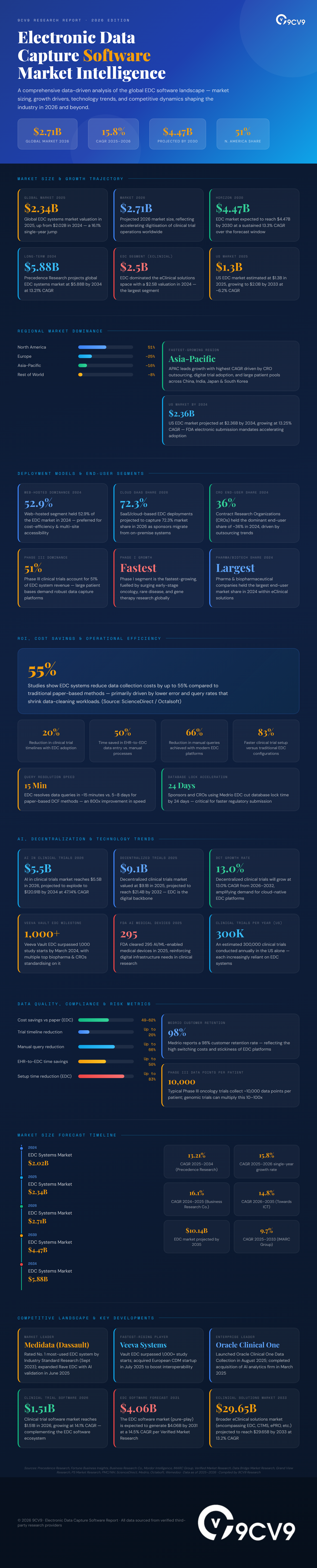
Artificial intelligence, EHR integration, and decentralized clinical trials are adding another layer of momentum. The AI in clinical trials market is estimated at $5.5 billion in 2026, while the decentralized clinical trials market reached $9.1 billion in 2025 and is projected to grow to $21.4 billion by 2032. EHR-to-EDC automation has also demonstrated potential time savings of up to 50% across manual review, data entry, and quality-control activities, highlighting the operational benefits of increasingly connected clinical research systems.
EDC adoption is also changing the economics of clinical research. The statistics compiled for this report indicate potential data-collection cost reductions of 49%–62% compared with paper-based processes, trial timeline reductions of up to 20%, and significantly faster study setup and database-lock workflows. Phase III trials remain particularly important, accounting for approximately 51% of EDC system usage in 2024, while CROs represented roughly 36% of end-user revenue.
Regional growth is equally important. North America remains the largest Electronic Data Capture software market, supported by pharmaceutical R&D activity, established clinical research infrastructure, and regulatory requirements. At the same time, Asia-Pacific is emerging as the fastest-growing region as clinical trial outsourcing expands and pharmaceutical, biotechnology, and CRO ecosystems mature across Asian markets.
The following 102 Electronic Data Capture (EDC) software statistics, data points, and trends for 2026 provide a comprehensive view of where the industry stands and where it is heading. From EDC market size and CAGR forecasts to cloud adoption, AI-powered validation, clinical trial efficiency, regional growth, regulatory compliance, data quality, CRO adoption, and the competitive landscape, these statistics reveal how EDC technology is becoming foundational infrastructure for the next generation of digital clinical research.
Before we venture further into this article, we would like to share who we are and what we do.
About 9cv9
9cv9 is a business tech startup based in Singapore and Asia, with a strong presence all over the world.
With over ten years of startup and business experience, and being highly involved in connecting with thousands of companies and startups, the 9cv9 team has listed some of the top and best companies/tools in this review.
If you like to get your company listed in our top B2B software reviews, check out our world-class 9cv9 Media and PR service and pricing plans here.
Top 102 Electronic Data Capture (EDC) Software Statistics, Data & Trends in 2026
🏦 Market Size & Valuation
- $2.02B (2024) — The global EDC systems market was valued at $2.02 billion in 2024, marking the clearest signal yet that clinical data digitisation has crossed from niche to mainstream adoption.
- $2.34B (2025) — The EDC market reached $2.34 billion in 2025, accelerating on the back of decentralised trial mandates and cloud migration by major pharmaceutical sponsors globally.
- $2.71B (2026) — In 2026, the global EDC systems market is projected to reach $2.71 billion, driven by surging Phase III trial volumes and AI-enhanced data validation capabilities.
- $4.47B (2030) — The EDC market is on course to reach $4.47 billion by 2030, sustaining a 13.3% CAGR as clinical trial complexity demands increasingly sophisticated digital data infrastructure.
- $5.88B (2034) — Precedence Research projects the EDC market will more than double to $5.88 billion by 2034, reflecting a compounding 13.21% CAGR over the 2025–2034 forecast window.
- $10.14B (2035) — The EDC systems market is expected to reach $10.14 billion by 2035 according to Towards ICT, driven by biotech expansion, cloud scalability, and government healthcare digitisation initiatives.
- $1.84B (2025, Fortune Business Insights) — Fortune Business Insights valued the EDC market at $1.84 billion in 2025, confirming robust consensus across research providers despite methodological variation in scope.
- $1.86B (2025, Mordor Intelligence) — Mordor Intelligence puts the 2025 EDC market at $1.86 billion, expected to grow to $3.28 billion by 2030 at a 12.02% CAGR — a dependable mid-range estimate.
- $1.4B (2024, IMARC Group) — IMARC Group reported the EDC systems market at $1.4 billion in 2024, projecting growth to $3.3 billion by 2033 — reflecting the compound acceleration from chronic disease-driven trial activity.
- $1.88B (2024, Verified Market Reports) — Verified Market Reports estimated the EDC systems market at $1.88 billion in 2024, with a trajectory toward $4.32 billion by 2032 at a 10.96% CAGR.
- $1.37B (2024, EDC Software) — The pure-play EDC software segment (excluding broader systems) was valued at $1.37 billion in 2024, with a strong 14.5% CAGR forecast through 2031.
- $4.06B (2031, EDC Software) — The EDC software market alone is expected to generate $4.06 billion in revenue by 2031, reflecting accelerating SaaS platform adoption and rising subscription ARR per sponsor.
- $2.5B (2024, eClinical EDC Segment) — Within the broader eClinical solutions landscape, the EDC segment dominated with a $2.5 billion valuation in 2024 — the single largest subsegment.
- $2.38B (2024, metastat) — Metastat Insight valued the EDC market at approximately $2.04 billion in 2025, forecasting it to exceed $4.92 billion by 2032 at a 13.4% CAGR.
- $5.4B (2032, MRFR) — Market Research Future projects EDC systems to reach $5.4 billion by 2032 at an 11.58% CAGR, fuelled by EHR integration, AI deployment, and remote patient monitoring trends.
📈 Growth Rates (CAGRs)
- 15.8% CAGR (2025–2026) — The single-year growth rate from 2025 to 2026 stands at 15.8% — among the highest in health IT, reflecting a market moving from early-majority to late-majority adoption.
- 16.1% CAGR (2024–2025) — The 2024–2025 single-year expansion came in at 16.1%, underscoring the intensity of the post-pandemic digital trial transformation across global sponsors and CROs.
- 13.21% CAGR (2025–2034, Precedence) — A sustained 13.21% compound annual growth rate over a decade is a rare signal of durable structural demand — not cyclical hype — in the EDC software market.
- 13.57% CAGR (Fortune Business Insights) — Fortune Business Insights forecasts a 13.57% CAGR through 2034, implying the EDC market will triple in size within a decade from its 2025 base.
- 14.8% CAGR (2026–2035, Towards ICT) — At 14.8% CAGR, the EDC market is growing faster than the broader healthcare IT sector (avg ~10–11% CAGR), driven by regulatory mandates and trial modernisation.
- 12.02% CAGR (Mordor Intelligence) — Even conservative estimates from Mordor Intelligence peg EDC at a 12.02% CAGR — well above global GDP growth — reflecting irreversible digitisation of clinical research.
- 9.7% CAGR (2025–2033, IMARC Group) — IMARC Group’s 9.7% CAGR estimate represents the floor of credible forecast consensus, still representing near-doubling of market size over an eight-year period.
- 14.5% CAGR (2024–2031, Verified MR) — Verified Market Research’s 14.5% CAGR forecast through 2031 aligns with enterprise SaaS expansion patterns in similarly regulated industries like financial compliance software.
- 11.58% CAGR (2024–2032, MRFR) — Market Research Future’s 11.58% CAGR projection reflects a mid-consensus view, consistent with organic pharma R&D spend growth and incremental EDC platform upgrades.
- 13.3% CAGR (2026–2030) — The 2026–2030 CAGR of 13.3% is projected to be sustained despite market maturation in North America, driven largely by Asia-Pacific and Latin American clinical trial expansion.
🌍 Regional Insights
- 51% North America Share (2024) — North America commanded 51% of the global EDC market in 2024 — a dominance built on FDA regulatory pressure, advanced healthcare IT infrastructure, and deep pharma R&D ecosystems.
- 42.39% North America (Fortune BI, 2025) — Fortune Business Insights puts North America’s 2025 share at 42.39%, still comfortably the largest region but declining slightly as Asia-Pacific accelerates.
- $770M US Market (2025) — The US EDC market alone was estimated at $770 million in 2025, projected to surpass $2.36 billion by 2034 — a testament to FDA-driven electronic submission mandates.
- $1.3B US Market (2025, Verified MR) — A separate estimate from Verified Market Reports pegs the US EDC market at $1.3 billion in 2025, illustrating the US’s outsized role in global EDC demand.
- Asia-Pacific = Fastest-Growing Region — Asia-Pacific is consistently identified as the fastest-growing EDC market region across all research providers, fuelled by CRO outsourcing growth, large patient populations, and expanding telemedicine infrastructure.
- 13.9% CAGR Asia-Pacific (DCT) — In the adjacent decentralised clinical trials market, Asia-Pacific is growing at 13.9% CAGR — a proxy for the region’s accelerating demand for EDC systems as DCT infrastructure.
- $2.0B US Market by 2033 — The US EDC market is projected to double from $1.3 billion to $2.0 billion by 2033, supported by the FDA’s sustained push toward electronic records and real-world evidence collection.
- $3.10B US EDC by 2030 — A separate DataM Intelligence report projects the US EDC market to reach $3.10 billion by 2030 at a 9.2% CAGR — reflecting deep institutional entrenchment of EDC in US trial operations.
- Europe = Robust Regulatory Framework — Europe’s EDC market is growing steadily, underpinned by stringent EMA and GDPR requirements that mandate secure, auditable electronic data management across all clinical research.
- 18.56% CAGR Asia-Pacific (Pharma Mgmt Software) — Asia-Pacific pharmaceutical management software is growing at 18.56% CAGR through 2030 — indicating broad regional appetite for digital clinical research tools including EDC.
🖥️ Deployment & Technology
- 52.9% Web-Hosted Share (2024) — Web-hosted EDC held 52.9% market share in 2024, valued for cost-efficiency, minimal IT overhead, and its compatibility with multi-site remote trial monitoring workflows.
- 72.3% Cloud/SaaS Share (2026) — Cloud/SaaS deployments are projected to capture 72.3% of the EDC market in 2026, as sponsors prioritise scalability, real-time collaboration, and automatic compliance updates.
- Cloud-Based = Fastest-Growing Deployment — The cloud-based EDC segment is consistently identified as the fastest-growing deployment mode, driven by lower infrastructure costs and seamless scalability for global multi-site trials.
- On-Premise CAGR ~9.49% — Even the traditionally conservative on-premise segment is growing at 9.49% CAGR, as regulated industries with strict data sovereignty requirements maintain hybrid deployment models.
- 65.45% Cloud Share in Pharma Mgmt Software (2024) — Cloud-based products held 65.45% of the broader pharmaceutical management software market in 2024, confirming a sector-wide preference for hosted solutions.
- AI-Powered Validation Adoption Accelerating — Major EDC vendors including Medidata and Oracle have integrated AI-powered real-time data validation in 2025, enabling instant anomaly detection without manual data cleaning cycles.
- AI Study Build Time Reduction — AI-powered EDC platforms reduce study build time from the traditional 10–12 weeks to just days by automating eCRF generation from protocol documents using NLP.
- EDC + EHR Integration = 50% Time Savings — EHR-to-EDC automated data capture reduces combined manual review, data entry, and quality control time by up to 50%, per a 2024 SWOG cancer trial evaluation.
- 3,500+ CRFs Processed via EHR-to-EDC — In the SWOG cancer studies programme, the EHR-to-EDC application processed data for over 160 patients covering more than 3,500 case report forms by December 2024.
- 37% Time Saving on Demographic Data — EHR-to-EDC applications delivered a 37% time saving on demographic data collection alone, consistent with findings from the earlier RADaptor pilot study.
👥 End-Users & Clinical Phases
- 36% CRO Share (2024) — Contract Research Organizations held approximately 36% of EDC system end-user revenue in 2024, driven by the pharmaceutical industry’s growing reliance on outsourced clinical operations.
- 17.59% CRO CAGR (Pharma Software) — CROs logged the highest CAGR of 17.59% in pharma management software end-user categories — confirming their pivotal and expanding role in the digital clinical research ecosystem.
- 51% Phase III Share (2024) — Phase III clinical trials accounted for 51% of EDC system usage in 2024, as their large patient bases, global sites, and regulatory intensity demand robust, validated data capture platforms.
- Phase I = Fastest-Growing Phase Segment — Phase I is the fastest-growing trial phase in EDC adoption, driven by accelerating early-stage oncology, rare disease, and gene therapy research that demands agile, rapid-iteration platforms.
- Phase II Accounts for ~21% of EDC Usage — Phase II studies represent approximately 21% of EDC deployment, as sponsors increasingly digitise mid-stage trials to streamline the path from proof-of-concept to pivotal study.
- Pharma/Biotech = Largest End-User Segment — Pharmaceutical and biopharmaceutical companies remained the largest EDC end-user segment in 2024, generating the majority of revenue from enterprise-scale, multi-year platform contracts.
- ~300,000 US Clinical Trials Per Year — An estimated 300,000 clinical trials are conducted annually in the United States, each increasingly reliant on EDC systems as the FDA tightens its electronic records and submission requirements.
- 10,000 Data Points Per Patient (Phase III) — A typical Phase III oncology trial collects approximately 10,000 data points per patient; genomic and digital health trial additions can multiply this volume by 10 to 100 times.
- Medical Device Companies = Key Growth Segment — Medical device companies are an emerging and high-growth EDC end-user segment, driven by the FDA’s Digital Health Center of Excellence and increased scrutiny of clinical evidence standards.
💰 Cost & ROI
- 49–62% Cost Reduction vs Paper — Studies published in ScienceDirect demonstrate that EDC reduces data collection costs by 49–62% compared to paper-documented clinical trials, primarily through lower error rates and automated data cleaning.
- 55% Reduction in Data Collection Costs — A widely cited simulation study found that EDC decreased overall data collection costs by 55%, primarily by eliminating transcription, manual verification, and paper archiving expenses.
- Up to 20% Trial Timeline Reduction — EDC adoption has been shown to shorten clinical trial timelines by up to 20%, accelerating time-to-market for drug approvals and reducing the carrying costs of extended development programmes.
- 66% Reduction in Manual Queries — Modern EDC platforms such as Wemedoo’s oomnia report a 66% reduction in manual data queries, dramatically shrinking the workload on data managers and clinical research associates.
- 83% Faster Trial Setup — Advanced EDC platforms with drag-and-drop eCRF builders and reusable templates deliver up to 83% faster trial setup compared to traditional EDC configuration processes.
- $80–120 Per Paper DCF Query — Resolving a single data clarification form (DCF) via paper-based methods costs $80–120 and takes 5–8 days, making EDC’s 15-minute electronic resolution a transformative operational improvement.
- 15-Minute EDC Query Resolution — EDC systems can resolve data queries in approximately 15 minutes from the moment a discrepancy is flagged, compared to the 5–8-day cycle time typical of paper-based query management.
- 24-Day Database Lock Reduction (Medrio) — Sponsors and CROs using Medrio’s EDC platform cut database lock time by 24 days on average, creating a significant head-start advantage in regulatory submissions.
- 10–15 Minutes Saved Per Patient (Audit Reports) — EHR-to-EDC applications are estimated to save 10–15 minutes per patient in generating audit and redacted reports, compounding to significant efficiency gains in large trials.
- EDC Eliminates Courier & Archiving Costs — EDC digitisation entirely removes the recurring expenses of paper CRF courier logistics and physical archiving — costs that compound over multi-year, multi-site trials.
🤖 AI, DCT & Technology Trends
- $3.8B AI in Clinical Trials (2025) — The AI in clinical trials market was valued at $3.8 billion in 2025, directly complementing EDC platforms as AI-driven validation, anomaly detection, and recruitment optimisation become standard features.
- $5.5B AI in Clinical Trials (2026) — The AI-in-trials market surges to $5.5 billion in 2026, growing at a remarkable 47.14% CAGR toward an estimated $120.91 billion by 2034.
- $9.1B Decentralised Clinical Trials Market (2025) — The decentralised clinical trials (DCT) market reached $9.1 billion in 2025 — a sector that relies fundamentally on EDC as its core data capture and management infrastructure.
- $21.4B DCT Market by 2032 — Decentralised clinical trials are projected to more than double to $21.4 billion by 2032 at a 13.0% CAGR, making EDC the single most strategic software layer in decentralised research design.
- 295 FDA AI/ML Medical Devices Cleared (2025) — The FDA cleared 295 AI/ML-enabled medical devices in 2025, signalling regulatory comfort with AI-integrated clinical data systems and validating AI-embedded EDC platform development.
- Hybrid Trial Designs to Dominate 2026 — Industry analysts predict that hybrid decentralised trial designs will dominate in 2026, balancing participant convenience with operational control — and requiring adaptive, real-time EDC platforms to manage complexity.
- Veeva Vault EDC: 1,000+ Study Starts — Veeva Vault EDC surpassed 1,000 study starts by March 2024, with multiple top biopharma companies and CROs standardising on it as their primary cloud-native EDC platform.
- Medidata Rave AI Expansion (June 2025) — Medidata expanded its Rave EDC with AI-powered data validation and real-time monitoring dashboards in June 2025, boosting data accuracy and supporting decentralised and hybrid trial models.
- Oracle Clinical One Launch (August 2025) — Oracle launched Oracle Clinical One Data Collection in August 2025, integrating EDC, RTSM, and CTMS into a unified AI-driven trial management environment.
- Veeva Acquired European CDM Startup (July 2025) — Veeva Systems acquired a European clinical data management startup in July 2025 to enhance interoperability between its Vault Clinical Suite and third-party CTMS and ePRO platforms.
- Oracle Acquired Clinical AI Firm (March 2025) — Oracle Health Sciences completed the acquisition of a clinical AI software firm in March 2025, specialising in real-time data validation and predictive analytics for its EDC platform.
🔒 Compliance & Regulatory
- FDA 21 CFR Part 11 Compliance is Mandatory — All commercial EDC systems for US trials must comply with FDA 21 CFR Part 11 for electronic records and signatures, making compliance a baseline expectation rather than a competitive differentiator.
- ICH-GCP, HIPAA & GDPR Alignment Required — Enterprise EDC platforms must simultaneously comply with ICH-GCP, HIPAA, GDPR, and regional equivalents — driving demand for unified, pre-validated compliance frameworks built into the software.
- Full Audit Trail at Every Action — EDC systems maintain a timestamped audit trail of every data entry, modification, and query — a non-negotiable requirement for inspection-readiness and the foundation of regulatory data integrity.
- Role-Based Access Controls Standard — Modern EDC platforms enforce role-based access control, ensuring each user can only view and modify data relevant to their assigned trial role — reducing risk of unauthorised data access or manipulation.
- eSource Data as Primary Record — Regulators increasingly accept EDC-captured data as the primary source document, eliminating the traditional requirement for parallel paper source documentation and streamlining site monitoring.
🏢 Competitive Landscape
- Medidata = #1 Most-Used EDC (Industry Standard Research, 2023) — Medidata was rated the pharmaceutical industry’s preferred and most recently used EDC provider in a September 2023 Industry Standard Research report — a top position it has held for multiple consecutive years.
- 98% Medrio Customer Retention Rate — Medrio EDC reports a 98% customer retention rate, among the highest in enterprise clinical software — reflecting the high switching costs, deep workflow integration, and strong satisfaction associated with EDC platforms.
- Key Players: Medidata, Oracle, Veeva, IQVIA — The EDC market is semi-consolidated, with Medidata (Dassault Systèmes), Oracle, Veeva Systems, and IQVIA dominating enterprise deployments while Castor, OpenClinica, and Medrio serve academic and mid-market segments.
- Signant Health Joined IQVIA One Home for Sites (Sept 2024) — Signant Health’s integration into IQVIA’s One Home for Sites initiative exemplifies the broader trend of EDC vendors embedding into sponsor-facing clinical ecosystems rather than operating as standalone tools.
- Advarra Partnered with IgniteData (Nov 2025) — Advarra and IgniteData announced a partnership in November 2025 to develop a new EDC solution for healthcare, reflecting continued M&A and partnership activity reshaping the competitive landscape.
- Market is Semi-Consolidated — The EDC market remains semi-consolidated, with major players pursuing M&A to acquire AI/analytics capabilities while smaller vendors compete on agility, deployment speed, and specialised therapeutic area support.
- CRSCUBE (South Korea) — Emerging Global Player — CRSCUBE, a South Korean EDC firm, announced new market expansion moves in November 2025, underscoring Asia-Pacific’s emergence as both a growth market and a source of competitive EDC innovation.
- Octalsoft: Major Contender on Everest Group PEAK Matrix (2 Consecutive Years) — Octalsoft has been recognised as a Major Contender on Everest Group’s PEAK Matrix for two consecutive years, reflecting accelerating growth and innovation in the mid-market EDC segment.
📐 eClinical Ecosystem & Adjacent Markets
- $9.71B eClinical Solutions Market (2024) — The broader eClinical solutions market — encompassing EDC, CTMS, ePRO, RTSM, and eTMF — reached $9.71 billion in 2024, of which EDC is the largest individual component.
- $29.65B eClinical Market by 2033 — The global eClinical solutions market is projected to grow nearly threefold to $29.65 billion by 2033, at a 13.2% CAGR — creating sustained demand for integrated EDC capabilities across the entire clinical stack.
- $11.1B eClinical Market (2024, GMInsights) — Grand View Research’s analysis puts the global eClinical market at $11.1 billion in 2024, growing at 12.1% CAGR to 2034 — with EDC as the dominant and fastest-adopted component.
- $1.32B Clinical Trial Software Market (2025) — The clinical trial software market reached $1.32 billion in 2025 and is growing at 14.1% CAGR — directly complementary to EDC as sponsors adopt integrated digital trial infrastructure.
- $2.53B Clinical Trial Software by 2030 — Clinical trial software is projected to reach $2.53 billion by 2030, driven by virtual/decentralised trial adoption, SaaS investment, and AI-powered data analytics integration with EDC.
- $7.5B+ eClinical Market in 2024 (CCRPS) — CCRPS estimated the broader eClinical market at over $7.5 billion in 2024, affirming strong demand continuity for EDC platforms as foundational infrastructure within modern trial operations.
📊 Data Quality & Accuracy
- EDC Comparable Accuracy to Paper (Netbook: 5.1% Error Rate) — In a peer-reviewed PLOS ONE study, netbook-based EDC achieved a 5.1% error rate vs. 3.6% for paper in the final study week — statistically comparable and significantly faster in downstream processing.
- Tablet PC EDC: 5.2% Error Rate vs. Paper’s 3.6% — Tablet PC-based EDC demonstrated a 5.2% error rate in the same PLOS ONE study — not significantly different from paper, while offering the decisive advantage of immediate digital availability.
- Error Rates Decrease Substantially Over 3 Weeks of EDC Use — The PLOS ONE study found that EDC error rates decreased considerably across all device types over a three-week study period, confirming a strong learning curve advantage for trained site staff.
- EDC Eliminates Double Data Entry — Paper-based CRFs require a second manual entry into a database for analysis — a step EDC eliminates entirely, removing a major source of transcription errors at the point of data collection.
- Free Text & Date Fields Have Highest Error Rates — Research confirms that free text and date fields have the highest EDC error rates, informing best-practice eCRF design that prioritises structured fields, dropdown menus, and automated date validators.
- Real-Time Edit Checks Flag Errors Instantly — EDC systems’ built-in edit checks flag data entry errors — such as out-of-range values, missing fields, or protocol deviations — at the moment of entry, enabling immediate correction rather than post-hoc data cleaning.
- EDC Reduces Time from Data Collection to Database Lock Significantly — One of EDC’s most strategically important benefits is the dramatic compression of the data-collection-to-database-lock timeline, directly accelerating regulatory submission and approval timelines.
- AI ML Detects Inconsistencies During Entry — Machine learning algorithms integrated into next-generation EDC platforms detect statistical inconsistencies and data anomalies during real-time entry, flagging patterns that would take human reviewers days to identify manually.
Conclusion
The Electronic Data Capture (EDC) software market in 2026 is entering a period of sustained expansion as pharmaceutical companies, biotechnology firms, CROs, medical device companies, and research organizations accelerate the digital transformation of clinical trials. With the global EDC systems market projected to reach approximately $2.71 billion in 2026, and several forecasts pointing toward multibillion-dollar growth over the next decade, EDC is becoming an increasingly important foundation of modern clinical research infrastructure.
The 102 Electronic Data Capture software statistics and trends examined in this report highlight several forces driving that growth. Cloud and SaaS deployments are projected to capture 72.3% of the EDC market in 2026, while AI-powered validation, automated eCRF generation, EHR-to-EDC integration, real-time edit checks, and machine-learning-based anomaly detection are changing how clinical data is collected and validated. Decentralized and hybrid clinical trials are further increasing demand for platforms capable of securely managing data across patients, sites, devices, and geographic locations.
The potential operational benefits are equally significant. The data compiled in this report points to 49%–62% lower data collection costs compared with paper-based approaches, trial timeline reductions of up to 20%, and substantial improvements in study setup, query resolution, data cleaning, and database lock. EHR-to-EDC automation can also reduce combined manual review, data entry, and quality-control time by as much as 50%, demonstrating why automation and interoperability are becoming major priorities for clinical research organizations.
Geographically, North America continues to command the largest share of the EDC market, while Asia-Pacific is emerging as the fastest-growing region. At the same time, CROs are becoming increasingly influential technology buyers, Phase III trials remain a major source of EDC usage, and pharmaceutical and biopharmaceutical companies continue to represent the largest end-user segment. These trends suggest that future EDC growth will come not only from replacing paper processes but also from supporting increasingly complex, global and data-intensive clinical studies.
Looking ahead, the future of Electronic Data Capture software will increasingly revolve around cloud-native infrastructure, artificial intelligence, interoperability, automation, decentralized trial support, regulatory compliance, and real-time clinical data intelligence. Established providers such as Medidata, Oracle, Veeva Systems, and IQVIA operate alongside a growing ecosystem of specialized and emerging EDC vendors, creating a competitive market where usability, integration capabilities, deployment speed, data quality, and compliance will remain important differentiators.
Ultimately, the Electronic Data Capture software statistics for 2026 show an industry moving beyond basic digital data entry toward intelligent, interconnected clinical research platforms. As trial volumes, patient-generated data, AI adoption, and decentralized research models continue to expand, EDC software is positioned to remain a core technology for organizations seeking faster studies, higher-quality clinical data, stronger regulatory readiness, and more efficient paths from research to regulatory submission.
If you find this article useful, why not share it with your hiring manager and C-level suite friends and also leave a nice comment below?
We, at the 9cv9 Research Team, strive to bring the latest and most meaningful data, guides, and statistics to your doorstep.
To get access to top-quality guides, click over to 9cv9 Blog.
To hire top talents using our modern AI-powered recruitment agency, find out more at 9cv9 Modern AI-Powered Recruitment Agency.
People Also Ask
What is Electronic Data Capture (EDC) software?
Electronic Data Capture (EDC) software is a digital system used to collect, manage, validate, and store clinical trial data, replacing paper-based case report forms with secure electronic workflows.
How big is the Electronic Data Capture software market in 2026?
The global EDC systems market is projected to reach approximately $2.71 billion in 2026, up from $2.34 billion in 2025 and $2.02 billion in 2024.
How fast is the EDC software market growing in 2026?
The EDC market is projected to grow 15.8% from 2025 to 2026. Longer-term forecasts in the dataset generally place EDC growth between roughly 10% and 15% CAGR.
What will the EDC software market be worth by 2030?
One forecast projects the global EDC market to reach approximately $4.47 billion by 2030, representing a 13.3% CAGR as clinical trials become increasingly digital and data-intensive.
What is driving Electronic Data Capture software market growth?
EDC market growth is being driven by clinical trial digitization, cloud migration, decentralized trials, AI-powered validation, EHR integration, growing trial complexity, and expanding pharmaceutical R&D.
What percentage of the EDC market is cloud-based in 2026?
Cloud and SaaS deployments are projected to account for 72.3% of the EDC market in 2026 as sponsors prioritize scalability, real-time collaboration, and easier compliance management.
Why are cloud-based EDC systems becoming more popular?
Cloud-based EDC systems offer scalability, lower infrastructure requirements, real-time collaboration, easier updates, and better support for global multi-site and decentralized clinical trials.
Which region has the largest EDC software market?
North America remains the largest EDC market. It held 51% of the global market in one 2024 estimate, while another source placed its 2025 share at 42.39%.
Which region has the fastest-growing EDC software market?
Asia-Pacific is consistently identified as the fastest-growing EDC region, supported by CRO outsourcing, large patient populations, telemedicine expansion, and growing clinical research activity.
How large is the US Electronic Data Capture market?
Estimates vary by methodology. One source valued the US EDC market at $770 million in 2025, while another estimated approximately $1.3 billion for the same year.
What percentage of EDC usage comes from Phase III clinical trials?
Phase III clinical trials accounted for approximately 51% of EDC system usage in 2024 because their large patient populations, global sites, and regulatory requirements demand robust data management.
Which clinical trial phase is growing fastest for EDC adoption?
Phase I is identified as the fastest-growing clinical trial phase for EDC adoption, driven by expanding early-stage oncology, rare disease, and gene therapy research.
How important are CROs to the EDC software market?
Contract Research Organizations accounted for approximately 36% of EDC end-user revenue in 2024, reflecting pharmaceutical companies’ increasing reliance on outsourced clinical trial operations.
Who are the main users of Electronic Data Capture software?
EDC systems are primarily used by pharmaceutical and biopharmaceutical companies, CROs, medical device companies, research institutions, clinical trial sites, and other clinical research organizations.
How much can EDC software reduce clinical data collection costs?
Research cited in the dataset indicates EDC can reduce clinical data collection costs by approximately 49%–62% compared with paper-based clinical trial processes.
Can EDC software shorten clinical trial timelines?
Yes. EDC adoption has been associated with clinical trial timeline reductions of up to 20% by improving data collection, validation, query management, and database preparation.
How quickly can EDC software resolve data queries?
The dataset reports that electronic EDC queries can be resolved in approximately 15 minutes, compared with 5–8 days for traditional paper-based data clarification processes.
How does EDC software improve clinical trial data quality?
EDC systems improve data quality through real-time edit checks, structured fields, automated validation, audit trails, and immediate error detection for missing, inconsistent, or out-of-range data.
Does Electronic Data Capture eliminate double data entry?
Yes. EDC eliminates the need to collect information on paper and manually re-enter it into a database, removing an important source of transcription errors and administrative work.
How is artificial intelligence changing EDC software?
AI is enabling EDC platforms to automate eCRF creation, detect anomalies, validate data in real time, identify inconsistencies, and reduce manual data-cleaning workloads.
How large is the AI in clinical trials market in 2026?
The AI in clinical trials market is estimated to reach $5.5 billion in 2026, compared with $3.8 billion in 2025, highlighting rapid investment in AI-enabled clinical research technology.
How does EHR-to-EDC integration improve clinical trials?
EHR-to-EDC automated data capture can reduce combined manual review, data entry, and quality-control time by up to 50%, improving efficiency while reducing repetitive site workloads.
How much time can EHR-to-EDC integration save?
A 2024 SWOG evaluation cited in the dataset found up to 50% savings across manual review, data entry, and quality control, including a 37% time saving for demographic data collection.
How are decentralized clinical trials affecting EDC software demand?
Decentralized and hybrid trials increase demand for EDC systems capable of collecting, validating, and managing clinical data remotely across patients, sites, devices, and geographic locations.
How large is the decentralized clinical trials market?
The decentralized clinical trials market reached approximately $9.1 billion in 2025 and is projected to grow to $21.4 billion by 2032 at a 13% CAGR.
What compliance standards are important for EDC software?
The dataset highlights FDA 21 CFR Part 11, ICH-GCP, HIPAA, and GDPR as major regulatory and data-protection frameworks affecting enterprise EDC platforms and clinical research workflows.
Why are audit trails important in EDC systems?
EDC audit trails create timestamped records of data entries, modifications, and queries, supporting data integrity, accountability, regulatory inspections, and clinical trial compliance.
Who are the leading Electronic Data Capture software vendors?
The dataset identifies Medidata, Oracle, Veeva Systems, and IQVIA among the major enterprise EDC players, alongside vendors such as Castor, OpenClinica, Medrio, and CRSCUBE.
How large is the broader eClinical solutions market?
One estimate valued the global eClinical solutions market at $9.71 billion in 2024 and projects it to reach $29.65 billion by 2033 at a 13.2% CAGR.
What are the biggest EDC software trends to watch in 2026?
Major EDC trends in 2026 include cloud and SaaS adoption, AI-powered validation, EHR integration, decentralized and hybrid trials, real-time data monitoring, automation, interoperability, and stronger regulatory compliance.
Sources
Precedence Research Fortune Business Insights The Business Research Company Research and Markets Mordor Intelligence IMARC Group Towards ICT Verified Market Research Data Bridge Market Research Market Research Future Metastat Insight Grand View Research GMInsights Market Data Forecast PS Market Research GlobeNewswire PR Newswire ScienceDirect PLOS ONE PMC NIH Octalsoft Medrio Wemedoo Greenlight Guru Anju Software CCRPS DataM Intelligence OpenPR Clinical Trials Arena







 software statistics, market data, growth trends, AI adoption and insights for 2026.)