

























Key Takeaways
- Rapid Market Growth: Dry cleaning software adoption is accelerating in 2026 as cloud-based platforms, automation, mobile apps, and digital management tools reshape the global garment-care industry.
- Cloud, AI & Automation Lead: Cloud software, AI-powered tools, route optimisation, CRM, analytics, and automated workflows are becoming increasingly important for improving dry cleaning efficiency and customer experience.
- Digitalisation Drives Competitive Advantage: Dry cleaners adopting integrated software can streamline operations, control costs, strengthen customer retention, and compete more effectively as demand for convenient, technology-enabled services grows.
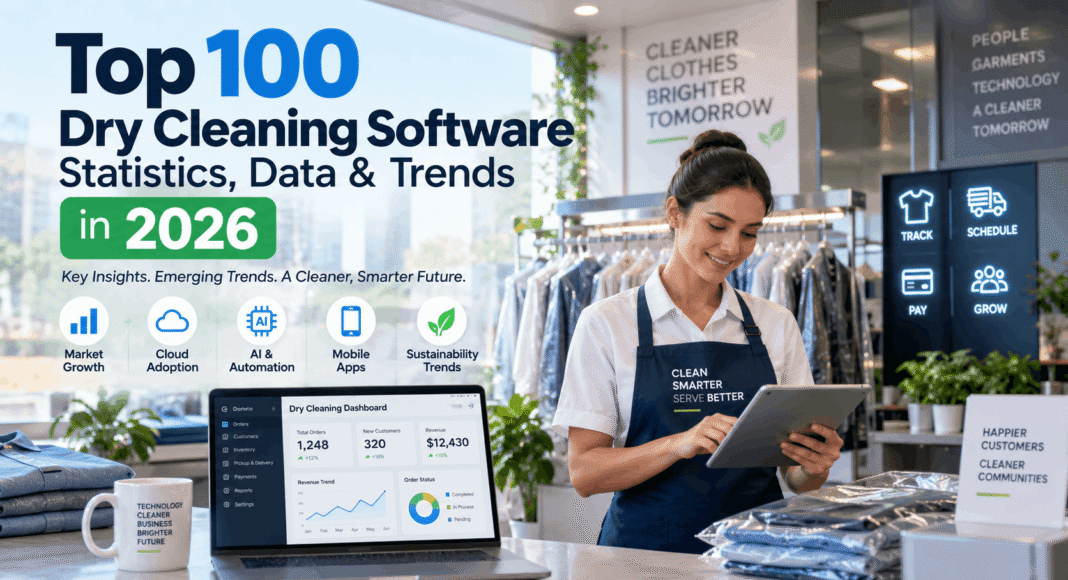
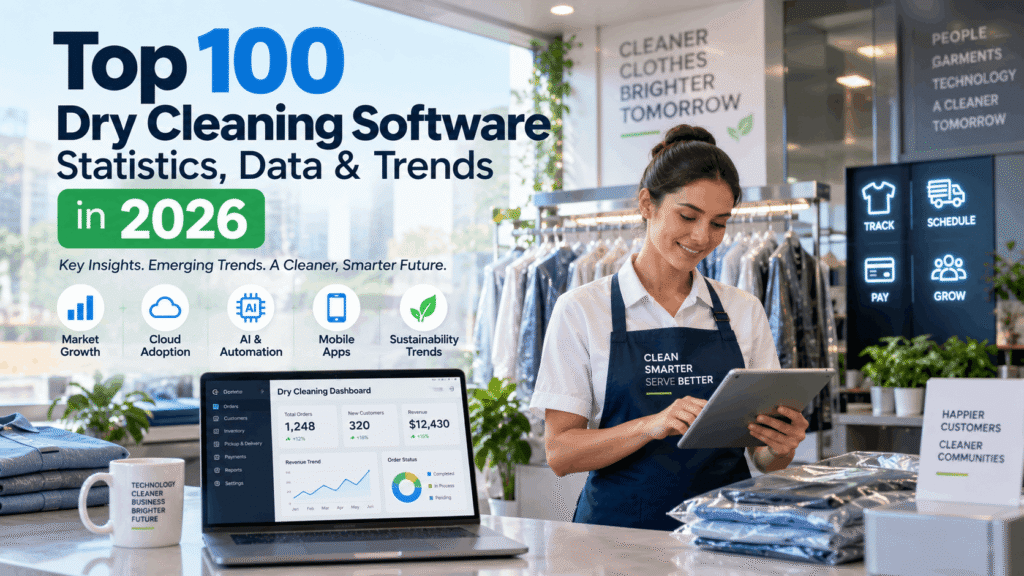
Dry cleaning software transforms how garment-care businesses manage orders, customers, payments, deliveries, inventory, and daily operations in 2026. The latest statistics show accelerating cloud adoption, growing AI and automation capabilities, stronger mobile integration, and expanding demand for data-driven tools as dry cleaners pursue greater efficiency, customer retention, and profitability.
The dry cleaning industry is undergoing a significant digital transformation, with cloud-based platforms, automation, mobile applications, artificial intelligence, route optimisation, customer relationship management, and integrated payment technologies reshaping how garment-care businesses operate. As competition intensifies and customers increasingly expect convenient, technology-enabled services, dry cleaners are turning to specialised software to streamline operations, reduce costs, improve customer retention, and manage everything from point-of-sale transactions and garment tracking to pickup and delivery.
Also, read our article on the Top 10 Dry Cleaning Software.
The latest dry cleaning software statistics for 2026 illustrate the scale of this transition. According to the data compiled in this report, one market estimate valued the global dry cleaning software market at approximately $230 million in 2024 and projects it to reach $381.5 million by 2030, representing an 8.8% compound annual growth rate. Broader market definitions produce considerably larger estimates, including projections that the market could reach $2.5 billion by 2031. These differences demonstrate how rapidly the category is expanding beyond traditional point-of-sale software into comprehensive laundry management, SaaS, logistics, CRM, analytics, and automation platforms.
Cloud technology is becoming particularly important. The statistics indicate that cloud-based solutions accounted for approximately 60% of the cleaning services software market in 2023, with their share projected to reach 70% by 2026. Among North American dry cleaning software users, POS and order management adoption is reported at 92%, CRM module adoption at 85%, mobile app-enabled service delivery at 82%, and pickup and delivery route optimisation at 78%. Analytics and business intelligence dashboards are also becoming increasingly prominent as operators seek greater visibility into sales, customers, productivity, costs, and operational performance.

These technologies are becoming more valuable as dry cleaners confront significant operating pressures. The dataset estimates that labour can account for up to 40% of operating expenses, while traditional dry cleaning establishments typically operate at profit margins of only 5–8%. At the same time, digital workflows can potentially deliver substantial efficiency improvements: the compiled statistics cite processing-time reductions of 20–30% from automated workflows and fuel and labour cost reductions of up to 30% through route optimisation.
Consumer behaviour is changing alongside the technology. Mobile scheduling, cashless payments, real-time order updates, automated notifications, loyalty programs, contactless lockers, subscriptions, and app-based pickup and delivery are transforming dry cleaning from a largely offline service into an increasingly connected, on-demand experience. The dataset reports average customer retention of 63% for offline dry cleaning services compared with 82% for app-based operations, highlighting the potential commercial importance of digital customer experiences.
Looking toward the remainder of 2026 and beyond, artificial intelligence, IoT-connected equipment, predictive maintenance, automated garment sorting, stain recognition, sustainability tracking, advanced analytics, and integrations with accounting and payment platforms could further reshape the competitive landscape. Asia Pacific is also emerging as an important growth market, while North America remains a major center for software adoption and technological innovation.
In this guide to the Top 100 Dry Cleaning Software Statistics, Data & Trends in 2026, we examine the numbers defining this evolving market, including market size and growth forecasts, regional trends, cloud software adoption, operational efficiency, mobile technology, AI and automation, customer retention, sustainability, software pricing, leading vendors, and the future of digital dry cleaning. Together, these statistics provide a data-driven view of where the dry cleaning software industry stands in 2026 and where it may be heading next.
Before we venture further into this article, we would like to share who we are and what we do.
About 9cv9
9cv9 is a business tech startup based in Singapore and Asia, with a strong presence all over the world.
With over ten years of startup and business experience, and being highly involved in connecting with thousands of companies and startups, the 9cv9 team has listed some of the top and best companies/tools in this review.
If you like to get your company listed in our top B2B software reviews, check out our world-class 9cv9 Media and PR service and pricing plans here.
Top 100 Dry Cleaning Software Statistics, Data & Trends in 2026
🏦 Market Size & Revenue
1. The global dry cleaning software market was valued at approximately USD $230 million in 2024.
The dry cleaning software market has crossed the $230 million threshold, reflecting strong baseline demand for purpose-built operational tools across laundry and garment-care businesses worldwide.
2. The market is projected to reach USD $381.5 million by 2030, growing at a CAGR of 8.8% (2025–2030).
With an 8.8% compound annual growth rate, the dry cleaning software sector is on a strong upward trajectory, outpacing many legacy business software verticals during the same period.
3. A broader market definition puts the global dry cleaning software market at USD $1.2 billion in 2024.
Depending on how the market scope is drawn — including adjacent laundry management and SaaS platforms — total addressable market estimates run as high as $1.2 billion, indicating vast untapped opportunity.
4. The global dry cleaning software market is projected to reach USD $2.5 billion by 2031 at a 9.5% CAGR.
A 9.5% CAGR signals that software adoption in the dry cleaning industry is accelerating faster than the broader laundry services sector, driven by rising demand for automation and cloud-based tools.
5. The market was valued at USD $680 million in 2023 and is set to hit USD $1.24 billion by 2032 (CAGR 6.7%).
Even at conservative estimates, the dry cleaning software market is doubling in under a decade — a compelling case for software vendors and investors targeting this niche vertical.
6. The cleaning service software market as a whole is projected to grow from $2.62 billion in 2025 to $6.45 billion by 2035 at a 9.42% CAGR.
The broader cleaning software category shows robust, sustained growth — a rising tide that directly benefits dry cleaning software players competing for market share.
🇺🇸 U.S. Industry Landscape
7. The U.S. Laundry Facilities & Dry-Cleaning Services Market is anticipated to reach $12.74 billion in 2025.
The U.S. market alone represents a massive commercial opportunity, with $12.74 billion in 2025 revenues highlighting the scale at which dry cleaning software can drive meaningful ROI for operators.
8. The U.S. market is projected to grow at a CAGR of 5.43%, reaching $18.45 billion by 2032.
Steady, multi-year growth of the U.S. laundry and dry-cleaning market provides a durable foundation for software adoption, as businesses invest in tools to stay competitive.
9. The global dry-cleaning and laundry services market was valued at USD $83.2 billion in 2025.
The sheer scale of the global laundry services industry — at $83.2 billion — underscores why software solutions capable of improving even small operational margins create enormous aggregate value.
10. The global market is projected to reach USD $149.1 billion by 2035 at a 6% CAGR.
As the overall laundry services market nearly doubles by 2035, software solutions enabling scalable, efficient operations will be essential to capturing the growth.
11. There are an estimated 25,284 dry cleaning businesses in the U.S. as of 2025.
Despite consolidation pressures, over 25,000 U.S. dry cleaning businesses represent a large addressable market for purpose-built software solutions targeting operational modernisation.
12. The number of U.S. dry cleaning businesses declined at an average of 2.8% per year between 2020 and 2025.
A consistent decline in business count signals that only operations capable of optimising costs and customer experience — often via software — are surviving in the post-pandemic landscape.
13. The number of dry cleaning businesses in the U.S. decreased by 1.9% from 2024 to 2025.
The pace of closure is slowing slightly, suggesting that surviving businesses are becoming more resilient — often by adopting digital management tools that improve margins and retention.
14. Approximately 30% of dry cleaning businesses have closed since the pandemic.
The pandemic-era contraction eliminated operators who lacked digital adaptability, making a strong argument for proactive software adoption among remaining businesses.
15. Successful dry cleaners report average annual revenues of around $759,000.
A $759,000 annual revenue benchmark for thriving dry cleaners shows that even modest software-driven efficiency improvements — say 5–10% — can add $40,000–$75,000 in annual value.
16. Traditional dry cleaning establishments typically operate on profit margins of 5–8%.
With thin margins of 5–8%, any software solution that reduces labour inefficiency, order errors, or lost garments directly translates to meaningful bottom-line improvement.
17. Eco-friendly dry cleaners can achieve profit margins of 10–20%, outperforming conventional operators.
Businesses combining green cleaning methods with digital operations — including online scheduling and automated billing — consistently achieve higher margins than legacy operators.
18. Dry cleaning business startup costs range widely, from $50,000 to over $1 million depending on scale and location.
The wide startup cost range ($50K–$1M) means software ROI is proportionally significant for smaller operators, where even $5,000 in saved labour per month represents major savings.
19. Monthly utility costs (electricity, water, gas) for a dry cleaner range from $2,000 to $5,000.
Utility costs represent 15–20% of monthly operating expenses, and IoT-enabled software features that track energy usage are beginning to deliver measurable savings in this area.
20. Labor costs account for up to 40% of total operating expenses for dry cleaning businesses.
Labor is the single largest cost driver in most dry cleaning operations, making automated scheduling, task tracking, and workforce management features in software especially high-value.
21. Total monthly operating costs for a dry cleaning store range from $8,500 to $28,500.
Operational software that helps owners track every dollar of the $8,500–$28,500 monthly cost structure creates immediate visibility for smarter cost management decisions.
22. Dry cleaning businesses typically allocate 2–5% of annual revenue to advertising and marketing.
Software platforms with built-in marketing automation — SMS reminders, loyalty programs, email campaigns — help operators maximise the impact of their limited marketing spend.
23. Basic dry cleaning machine models cost between $15,000 and $40,000.
Capital-intensive equipment like dry cleaning machines makes operational efficiency software even more critical: protecting expensive hardware through better maintenance scheduling and usage tracking.
24. High-end, eco-friendly dry cleaning machines can exceed $70,000.
As eco-compliant equipment investment rises, software that tracks utilisation, maintenance schedules, and energy metrics helps operators justify and protect that capital expenditure.
25. The global dry cleaning and laundry services market was valued at $119.94 billion in 2024.
A $119.94 billion global market in 2024 positions dry cleaning and laundry as one of the largest consumer service verticals — and software is becoming the backbone of its digital infrastructure.
26. The market grew to $123.63 billion in 2025, reflecting a 3.1% year-on-year expansion.
Consistent, if moderate, market growth sustains software demand: even slow market expansion creates pressure for operators to differentiate through superior digital customer experience.
27. The market is projected to reach $140.26 billion by 2029 at a 3.1% CAGR.
Reaching $140 billion by 2029 means the window for early software adopters to build competitive moats is closing — making 2025–2026 a critical investment period for digital tools.
28. Laundry services constitute 60–65% of the global dry-cleaning and laundry services market.
Laundry services dominate the market mix, and the best dry cleaning software platforms are increasingly designed to handle both laundry and dry cleaning workflows in a unified system.
29. The U.S. dry cleaning and laundry services market is expected to grow at a CAGR of 6.6% from 2025 to 2030.
A 6.6% growth rate for the U.S. market over the next five years signals sustained demand for professional garment care — and, by extension, for software that manages it efficiently.
30. The U.S. laundry facilities and dry-cleaning services market was estimated at $15.75 billion in 2024.
Grand View Research’s $15.75 billion estimate for the U.S. market reaffirms the sector’s economic weight and its attractiveness for software investment and product development.
🌏 Regional Market Dynamics
31. North America accounts for approximately 35% of global cleaning services software revenue.
North America’s dominant 35% market share reflects early and deep adoption of digital tools in U.S. and Canadian dry cleaning operations, setting the pace for global peers.
32. Asia Pacific holds approximately 30% of the global cleaning services software market.
Asia Pacific’s 30% share — already nearly matching North America — signals rapid digital transformation in markets like China, India, Japan, and Southeast Asia.
33. Europe holds approximately 20% of the global cleaning services software market.
Europe’s 20% share reflects mature, regulation-conscious markets where compliance features, digital receipts, and eco-tracking have accelerated software adoption.
34. Latin America accounts for approximately 8% of global cleaning services software revenue.
At 8% share, Latin America represents significant greenfield opportunity for dry cleaning software vendors, particularly as franchised laundry chains expand into the region.
35. The Middle East and Africa account for approximately 7% of global market revenue.
MEA’s 7% share — while modest today — is supported by growing urbanisation, hotel industry expansion, and increasing consumer expectations for professional garment care.
36. Asia Pacific is the fastest-growing region for dry cleaning software, with a projected CAGR of 8.2%.
Asia Pacific’s 8.2% CAGR makes it the single most attractive expansion market for dry cleaning software vendors seeking international growth beyond saturated Western markets.
37. The Asia Pacific cleaning services software market is projected to grow at 15% CAGR.
A 15% CAGR in Asia Pacific — driven by urbanisation, rising incomes, and mass smartphone adoption — reflects how quickly digital laundry services models are taking hold.
38. Asia Pacific held the largest regional share of the cleaning service software market in 2025.
By 2025, Asia Pacific overtook North America as the largest region in cleaning service software, driven by scale-driven adoption across thousands of urban laundry operators.
39. North America is expected to be the fastest-growing region for cleaning service software in the forecast period.
Despite its maturity, North America’s ongoing digital transformation — with AI features, contactless services, and subscription models — is driving renewed software growth.
40. The cleaning service software market was valued at $4.25 billion in 2024 and is projected to reach $8.35 billion by 2033 (CAGR 8.4%).
This near-doubling of market size by 2033 reflects the structural shift underway as operators across all segments transition from manual to software-driven operations.
☁️ Deployment & Software Types
41. Cloud-based solutions accounted for approximately 60% of the cleaning services software market in 2023.
Cloud deployment has already surpassed on-premise as the dominant model, enabling dry cleaning businesses to access real-time data, automatic updates, and remote management.
42. Cloud-based market share is projected to reach 70% by 2026.
As internet infrastructure matures globally and data security concerns ease, cloud-based dry cleaning software is expected to dominate 70% of deployments by 2026.
43. Web-based solutions account for approximately 40% of the cleaning services software market.
Web-based platforms — accessible via browser without installation — remain popular for multi-store operators and businesses with technical constraints, complementing mobile-first solutions.
44. The cleaning service software market was valued at $1.96 billion in 2025 and is expected to reach $2.16 billion in 2026 (CAGR 10.1%).
A 10.1% annual growth rate for 2025–2026 confirms that the dry cleaning software investment cycle is in full swing, with rapid new entrant adoption across all business sizes.
45. The market is expected to grow to $2.99 billion by 2030 at an 8.5% CAGR.
Sustained 8.5% CAGR through 2030 signals that software adoption in dry cleaning is structural — not cyclical — and will continue even in mature markets.
46. POS & order management system adoption reaches 92% among North American dry cleaning operators.
Near-universal POS adoption in North America demonstrates that basic digitalisation of transactions is now table-stakes — operators without it are quickly losing competitive ground.
47. Customer CRM module adoption reaches 85% among North American dry cleaning software users.
CRM tools are the second-most adopted feature, reflecting the industry’s recognition that customer loyalty and repeat business are more valuable than any individual transaction.
48. Mobile app-enabled service delivery is adopted by 82% of North American dry cleaning software users.
Four in five software-enabled dry cleaners now offer mobile apps for pickups, tracking, and payment — making mobile presence essential for customer acquisition and retention.
49. Cloud deployment is used by approximately 70% of dry cleaning software users globally by 2026 (projected).
By 2026, the majority of the world’s dry cleaning software users will operate on cloud platforms, enabling real-time dashboards, remote management, and seamless multi-location oversight.
50. Pickup and delivery route optimisation features are adopted by 78% of North American operators.
Route optimisation is among the highest-value software features, directly reducing fuel costs, driver time, and missed delivery windows — making it a near-universal adoption priority.
📱 Technology & Digital Transformation
51. Digital platforms and mobile apps for scheduling pickups and deliveries are becoming industry standards.
Scheduling apps are no longer a premium feature — they are the expected baseline for any professional dry cleaning business serving time-pressed urban consumers in 2026.
52. In 2023, over 200 startups launched mobile laundry apps globally, attracting over 35 million downloads.
The explosion of 200+ laundry app startups and 35 million downloads in 2023 alone signals that the digital laundry economy is entering its high-growth phase globally.
53. GPS-tracked pickups and real-time updates are significantly boosting customer engagement and retention, especially among tech-savvy millennials.
Real-time garment tracking — akin to package delivery notifications — is one of the single highest-impact customer experience innovations available to modern dry cleaners.
54. AI-driven garment sorting and stain recognition are emerging as key AI applications in dry cleaning software.
Artificial intelligence is beginning to automate some of the most error-prone tasks in garment care, with early platforms offering automated stain classification and care-label reading.
55. IoT-enabled machines can provide real-time data on energy use and maintenance needs.
Smart machines connected to dry cleaning management software create feedback loops that reduce unplanned downtime, cut energy costs, and improve overall plant throughput.
56. Automation of scheduling, billing, and delivery logistics is driving productivity gains across small and medium dry-cleaning enterprises.
SMEs that embrace full-stack automation — not just POS, but logistics and billing — report the largest relative gains in productivity compared to larger, slower-moving enterprises.
57. AI/ML features in dry cleaning software are adopted by approximately 45% of North American operators.
While AI adoption lags behind core features at ~45%, its rapid uptake trajectory suggests it will match CRM and route optimisation levels within 3–4 years.
58. Analytics and BI dashboard adoption reaches 72% among North American dry cleaning software users.
Nearly three-quarters of software-enabled U.S. dry cleaners now use analytics dashboards, reflecting a shift from intuition-based to data-driven business decision-making.
59. Smart laundromat installations are growing, offering cashless payments and contactless transactions.
Contactless, cashless self-service models — enabled by integrated software — are cutting labour costs while satisfying consumer expectations shaped by e-commerce and on-demand apps.
60. Subscription-based laundry and dry cleaning service models are growing rapidly, providing predictable revenue streams.
Subscription models — powered by software to manage billing, frequency, and customer communications — are transforming dry cleaning from transactional to recurring-revenue businesses.
📊 Operational Impact & Efficiency
61. Businesses implementing CleanCloud’s automated workflows experience a 20–30% reduction in garment processing time.
A 20–30% processing time reduction is directly translatable to throughput gains, cost per garment reductions, and the ability to take on more orders without adding headcount.
62. Advanced POS solutions drive a 20% increase in overall operational efficiency (McKinsey).
McKinsey’s finding of 20% operational efficiency gains from advanced POS underscores that software ROI in dry cleaning is not marginal — it’s transformational at the operational level.
63. Businesses using integrated software report up to 30% revenue growth (Laundry Kare case study).
Real-world case studies like Laundry Kare’s 30% revenue growth confirm that the compounding effect of better order management, customer retention, and upsell automation is substantial.
64. Route optimisation features reduce fuel and labor costs by up to 30%.
Fuel and driver costs can represent a significant portion of a delivery-enabled dry cleaner’s expenses — making route optimisation one of the fastest-payback software features available.
65. Customer retention rates average 63% for offline dry cleaning services vs 82% for app-based operations (2024).
The 19-percentage-point gap in customer retention between offline and app-based services is one of the most compelling business cases for dry cleaning software adoption.
66. Software-enabled dry cleaners see higher customer referral rates due to smoother booking and payment experiences.
Frictionless digital experiences — from booking to payment to garment pickup — generate word-of-mouth referrals that reduce customer acquisition costs over time.
67. Monthly equipment maintenance and repair costs for a medium-sized operation range from $10,000 to $20,000 annually.
Software with predictive maintenance alerts and equipment usage tracking can reduce unplanned repair costs by flagging issues before they become expensive equipment failures.
68. Automated SMS and email notifications significantly improve customer satisfaction and reduce no-shows.
Proactive communication — automated pickup reminders, “garment ready” alerts, and delivery notifications — reduces missed pickups by an estimated 15–25% in operator-reported data.
69. Software with integrated loyalty programs increases repeat purchase rates among existing customer segments.
Loyalty modules that automatically apply discounts, track points, and send personalised offers are among the highest-ROI features for dry cleaning operators focused on lifetime value.
70. Barcode and QR-code garment tagging systems eliminate manual tracking errors and enable garment-level traceability.
QR-based tracking — integrated into dry cleaning software — practically eliminates the lost garment problem that has historically been a significant source of customer complaints and claims.
💼 Competitive Landscape & Market Players
71. Major dry cleaning software players include CleanCloud, SPOT Business Systems, Geelus, Compassmax, Vivaldi, TMS, and DragonPOS.
A diverse and growing vendor landscape means dry cleaning operators can choose between enterprise-grade and SME-friendly platforms with varying feature sets, pricing, and deployment options.
72. CleanCloud entered a strategic partnership with Cobblers Direct (online shoe repair) in February 2023.
CleanCloud’s partnership with Cobblers Direct signals a broader trend of dry cleaning software platforms expanding into adjacent garment care verticals to increase stickiness.
73. SMRT Systems has emerged as a leading enterprise solution for high-volume garment care operations.
Enterprise-grade platforms like SMRT Systems — focused on large-volume plant operations — reflect the market segmentation between SME and enterprise dry cleaning software buyers.
74. The dry cleaning software market features 12+ globally recognised software vendors competing for market share.
A crowded vendor landscape is actually good news for buyers: increased competition is driving innovation, better pricing, and more responsive customer support across the ecosystem.
75. Turns is positioned as a leading laundry software solution provider by multiple analyst rankings in 2026.
Turns’ emergence as a top-ranked platform in 2026 reflects the increasing importance of user experience, onboarding simplicity, and mobile-first design in winning market share.
76. AI-powered dry cleaning software is a fast-growing sub-category, with vendors like Krowdbase aggregating AI-native solutions.
AI-native platforms offering automated stain recognition, smart tagging, and predictive customer communications are rapidly becoming a distinct sub-category within dry cleaning software.
77. On-premises software deployment is declining — falling from 25% market share in 2021 to approximately 10% by 2026.
The rapid decline of on-premises software reflects the practical advantages of cloud platforms — automatic updates, lower IT overhead, and anywhere/anytime management access.
78. The dry cleaning software market is increasingly segmented by end-user: hotels, commercial laundries, and SME retail cleaners.
Distinct workflows between hotel linen services, large commercial laundries, and retail dry cleaners are driving specialised software products rather than one-size-fits-all solutions.
79. SaaS-based dry cleaning software for SMEs typically costs $50–$300 per month.
Monthly SaaS pricing of $50–$300 makes dry cleaning software accessible even to solo-operator dry cleaners, with ROI achievable within the first month through order volume alone.
80. Enterprise-tier dry cleaning software often involves custom pricing based on location count and order volume.
For multi-location chains and commercial laundry operators, custom enterprise pricing models reflect the much higher transaction volumes and integration complexity involved.
🌱 Sustainability & Market Trends
81. Eco-friendly cleaning methods are gaining significant traction, reducing reliance on perchloroethylene (PERC).
Regulatory pressure and consumer demand are accelerating the shift away from PERC, and dry cleaning software increasingly supports tracking of alternative solvent usage and compliance.
82. Wet cleaning with biodegradable detergents is growing as an alternative to traditional dry cleaning chemical processes.
Wet cleaning represents the fastest-growing service category among eco-conscious operators, and software that supports wet-cleaning-specific workflows is gaining competitive advantage.
83. Businesses adopting eco-friendly practices can achieve profit margins 10–20% higher than conventional counterparts.
Sustainability is not just ethically motivated — it’s commercially rewarding. Dry cleaning software that helps operators document and promote green practices directly supports premium pricing.
84. Energy and water conservation features in software (via IoT integration) are becoming a competitive differentiator.
As utilities account for 15–20% of monthly operating expenses, IoT-integrated software that monitors and optimises energy consumption is delivering direct, measurable cost savings.
85. Consumer demand for eco-friendly garment care is driving software features for chemical tracking, carbon reporting, and green certifications.
Forward-looking dry cleaning software vendors are building sustainability dashboards that help operators track and report their environmental footprint — increasingly required by corporate clients.
86. The circular fashion economy is creating demand for garment restoration and care services trackable via software.
As consumers seek to extend clothing lifespans rather than replace them, dry cleaning software that tracks garment repair, restoration, and alteration services is gaining new relevance.
87. Market consolidation post-pandemic is creating larger, more technology-equipped dry cleaning chains.
The surviving segment of the dry cleaning industry is disproportionately composed of tech-adopter businesses — chains that have used software to absorb market share from closing independents.
88. Franchised dry cleaning operations represent a growing segment driving enterprise software demand.
Franchise growth — which requires brand consistency, centralised reporting, and multi-location management — is one of the strongest drivers of high-tier dry cleaning software adoption.
89. Pick-up and delivery services are the single fastest-growing value-added service category in the dry cleaning industry.
Pickup and delivery services — now offered by the majority of software-enabled dry cleaners — are the top differentiator for winning customers who would otherwise use at-home appliances.
90. Locker-based contactless drop-off and pick-up systems, managed via dry cleaning software, are gaining popularity.
Self-service lockers integrated with order management software allow dry cleaners to extend service hours, reduce wait times, and operate with reduced front-desk staffing.
🔮 Growth Drivers & Future Outlook
91. Increasing urbanisation globally is the primary macro driver of dry cleaning service and software demand.
As more people live in urban apartments without in-unit laundry — and with increasingly busy lifestyles — the structural demand for professional garment care services continues to grow.
92. Rising dual-income household numbers are increasing outsourced laundry demand in major markets.
Dual-income households — which have less time for domestic chores — are the core customer segment for dry cleaning pickup and delivery apps, driving both volume and app usage.
93. The hospitality sector is a key and growing end-user of dry cleaning software for hotel linen and guest garment management.
Hotels increasingly require software-integrated laundry management systems to meet occupancy-driven demand, track linen inventory, and manage service delivery for guests.
94. Mobile app-based services for millennials and Gen Z consumers are becoming the primary customer acquisition channel.
Younger consumers who discovered on-demand services through ride-sharing and food delivery now expect the same digital experience from laundry and dry cleaning — mobile-first or not at all.
95. Custom software for inventory, scheduling, and route optimisation is increasingly popular among expanding dry cleaning franchises.
As dry cleaning chains scale, bespoke software integrations — connecting inventory, scheduling, delivery, and CRM — become necessary to maintain quality and brand consistency at volume.
96. Software investment payback periods in the dry cleaning industry are generally estimated at under 12 months.
With monthly SaaS costs of $50–$300 and documented efficiency gains of 20–30%, most dry cleaning software implementations achieve full payback within the first year of deployment.
97. Stricter environmental regulations on PERC and chemical waste are indirectly driving compliance-feature development in software.
Regulatory pressure is pushing dry cleaning software vendors to add chemical usage tracking, waste documentation, and environmental reporting modules — turning compliance into a software feature.
98. Integration with accounting, ERP, and payment processing systems is becoming a baseline expectation for dry cleaning software buyers.
Buyers increasingly expect dry cleaning software to integrate seamlessly with QuickBooks, Xero, and major payment gateways — reducing double-data-entry and accounting errors.
99. The Asia Pacific dry cleaning software market is forecast to grow at 8.2% CAGR — the fastest of any global region.
Asia Pacific’s 8.2% CAGR reflects rapid infrastructure growth, rising middle-class incomes, and a hospitality sector that is aggressively adopting technology-enabled laundry services.
100. The global addressable market for dry cleaning technology innovation is projected to exceed $2.5 billion by 2031.
With a $2.5 billion+ total addressable market by 2031, dry cleaning software remains one of the most underpenetrated and high-potential verticals in the broader enterprise SME software landscape.
Conclusion
The Top 100 Dry Cleaning Software Statistics, Data & Trends in 2026 reveal an industry moving decisively toward digital, cloud-based, automated operations. Dry cleaning software is evolving beyond traditional point-of-sale and order management systems into comprehensive business platforms that combine customer relationship management, mobile applications, pickup and delivery management, route optimisation, analytics, payments, loyalty programs, garment tracking, and increasingly, artificial intelligence and IoT capabilities.
Market growth projections reinforce this transformation. The data examined in this report includes estimates placing the global dry cleaning software market at approximately $230 million in 2024 and $381.5 million by 2030, representing an 8.8% CAGR. Broader definitions of the industry produce considerably larger estimates, including projections of a market reaching $2.5 billion by 2031. While these forecasts differ according to market scope and methodology, they collectively point toward continued investment in technology across the professional garment-care industry.
Cloud adoption represents one of the clearest dry cleaning software trends for 2026. The compiled statistics indicate that cloud-based solutions accounted for approximately 60% of the cleaning services software market in 2023, with their share projected to reach 70% by 2026. This transition gives operators greater flexibility to manage orders, customers, employees, inventory, payments, and multiple locations without relying on traditional on-premises infrastructure.
Digital adoption is also extending deep into everyday operations. Among North American dry cleaning software users, the dataset reports 92% adoption of POS and order management systems, 85% adoption of CRM modules, 82% adoption of mobile app-enabled services, 78% adoption of pickup and delivery route optimisation, and 72% adoption of analytics and business intelligence dashboards. These figures illustrate how software is increasingly becoming part of the core operating infrastructure rather than an optional administrative tool.
The potential financial impact is especially important in an industry facing tight margins and substantial operating expenses. Traditional dry cleaning establishments are reported to operate at 5–8% profit margins, while labour can account for as much as 40% of total operating expenses. Against that backdrop, automation, route optimisation, better scheduling, garment tracking and data-driven management can potentially produce meaningful improvements in productivity and profitability. The statistics compiled here include 20–30% reductions in garment processing time from automated workflows and potential fuel and labour cost reductions of up to 30% through route optimisation.
Customer expectations are changing just as quickly. Mobile booking, digital payments, automated SMS and email notifications, loyalty programs, subscriptions, real-time tracking, pickup and delivery, and contactless lockers are helping transform dry cleaning into a more convenient, technology-driven service. The dataset’s reported 82% retention rate for app-based operations compared with 63% for offline dry cleaning services highlights the potential relationship between digital convenience and long-term customer loyalty.
Looking beyond 2026, the next phase of dry cleaning software industry growth is likely to be shaped by AI-powered garment sorting, stain recognition, predictive maintenance, IoT-connected machinery, sustainability reporting, advanced business intelligence, accounting integrations and increasingly sophisticated delivery logistics. Environmental trends are important as well, with software beginning to support chemical tracking, energy monitoring, water conservation and other sustainability-focused processes.
Ultimately, the statistics and trends compiled in this report point toward a fundamental change in how modern dry cleaning businesses compete. The operators positioned for the future will increasingly be those capable of combining garment-care expertise with efficient digital operations, convenient customer experiences and data-driven decision-making.
For dry cleaners, laundries, franchises, software developers, investors and other industry stakeholders, 2026 represents an important stage in the digital transformation of the dry cleaning industry. Software is no longer simply helping businesses record transactions; it is becoming the technological foundation connecting customers, garments, employees, equipment, payments, logistics and business intelligence. As adoption continues to expand, dry cleaning software could become one of the most important competitive differentiators determining which garment-care businesses successfully scale in an increasingly digital marketplace.
If you find this article useful, why not share it with your hiring manager and C-level suite friends and also leave a nice comment below?
We, at the 9cv9 Research Team, strive to bring the latest and most meaningful data, guides, and statistics to your doorstep.
To get access to top-quality guides, click over to 9cv9 Blog.
To hire top talents using our modern AI-powered recruitment agency, find out more at 9cv9 Modern AI-Powered Recruitment Agency.
People Also Ask
What is dry cleaning software?
Dry cleaning software is a business management platform that helps dry cleaners manage orders, customers, payments, garment tracking, inventory, scheduling, pickup and delivery, marketing, and reporting from one system.
How big is the dry cleaning software market in 2026?
Market estimates vary considerably by scope. The compiled data shows forecasts ranging from a narrowly defined dry cleaning software segment to broader laundry and cleaning software markets worth billions of dollars.
How fast is the dry cleaning software market growing?
One market estimate projects dry cleaning software to grow at an 8.8% CAGR from 2025 to 2030, reaching approximately $381.5 million by 2030.
What are the biggest dry cleaning software trends in 2026?
Major trends include cloud adoption, mobile apps, AI, automation, route optimisation, digital payments, CRM, analytics, IoT integration, subscriptions, contactless lockers, and sustainability tracking.
How popular is cloud-based dry cleaning software?
Cloud-based solutions accounted for approximately 60% of the cleaning services software market in 2023, with the share projected to reach around 70% by 2026.
Why are dry cleaners switching to cloud software?
Cloud software gives dry cleaners remote access to orders, customer information, payments, reporting, and multi-location operations while reducing dependence on locally installed systems.
How widely adopted are dry cleaning POS systems?
The compiled statistics report POS and order management system adoption of approximately 92% among North American dry cleaning operators, making these systems a core part of digital operations.
How is AI being used in dry cleaning software?
Emerging AI applications include garment sorting, stain recognition, predictive customer communications, analytics, and workflow automation. AI and machine-learning feature adoption is estimated at about 45% among North American operators.
Can dry cleaning software improve operational efficiency?
Yes. The compiled data reports 20–30% reductions in garment processing time from automated workflows, while advanced POS solutions are associated with improvements in overall operational efficiency.
Can dry cleaning software reduce operating costs?
Software can help control costs through automated scheduling, route optimisation, workforce management, equipment monitoring, digital communications, and better visibility into business performance.
How does route optimisation benefit dry cleaners?
Route optimisation can reduce unnecessary mileage, driver time, fuel consumption, and delivery inefficiencies. The compiled statistics indicate potential fuel and labour cost reductions of up to 30%.
How popular are pickup and delivery features in dry cleaning software?
Pickup and delivery route optimisation features are reported to have reached approximately 78% adoption among North American operators, reflecting growing demand for convenient garment-care services.
Do mobile apps improve dry cleaning customer retention?
The compiled data reports average retention of 82% for app-based dry cleaning operations compared with 63% for offline services, suggesting digital convenience can play an important role in customer loyalty.
How widely used are mobile apps by dry cleaning businesses?
Mobile app-enabled service delivery is reported at approximately 82% among North American dry cleaning software users, supporting booking, pickup, tracking, payments, and customer communications.
What role does CRM play in dry cleaning software?
CRM features help dry cleaners maintain customer records, track purchasing behaviour, manage loyalty programs, personalise promotions, and encourage repeat business. CRM adoption is reported at 85% among North American software users.
How important is data analytics for dry cleaning businesses?
Analytics helps operators understand revenue, customers, productivity, costs, and operational performance. Analytics and BI dashboard adoption is reported at 72% among North American dry cleaning software users.
How much does dry cleaning software cost?
The compiled statistics indicate that SaaS-based dry cleaning software for SMEs typically costs around $50–$300 per month, while enterprise systems commonly use custom pricing based on locations and order volume.
What features should dry cleaning software include in 2026?
Important features include POS, order management, CRM, garment tracking, payments, inventory, analytics, mobile apps, automated notifications, route optimisation, loyalty programs, accounting integrations, and multi-location management.
What are the leading dry cleaning software companies?
The dataset identifies CleanCloud, SPOT Business Systems, Geelus, Compassmax, Vivaldi, TMS, DragonPOS, SMRT Systems, and Turns among companies operating within the dry cleaning and laundry software market.
What is the future of dry cleaning software?
The market is moving toward increasingly connected platforms combining cloud computing, AI, IoT, analytics, mobile services, automated logistics, digital payments, sustainability monitoring, and predictive maintenance.
How does dry cleaning software help with garment tracking?
Barcode and QR-code tagging can assign garments unique digital identities, helping employees track items throughout processing while reducing manual tracking errors and improving garment-level traceability.
Can dry cleaning software automate customer notifications?
Yes. Modern platforms can automatically send SMS and email messages for order confirmations, pickup reminders, garment-ready alerts, delivery updates, promotions, and other customer communications.
How is IoT changing the dry cleaning industry?
IoT-enabled equipment can provide real-time information about energy consumption, equipment usage, and maintenance requirements, allowing software platforms to improve operational visibility and reduce unexpected downtime.
How does dry cleaning software support sustainability?
Modern systems can support chemical tracking, energy and water monitoring, environmental reporting, equipment efficiency, waste documentation, and other processes associated with sustainable garment care.
Are subscription-based dry cleaning services growing?
Yes. Subscription-based laundry and dry cleaning models are growing as operators use software to automate recurring billing, service frequency, customer communications, and scheduled pickup and delivery.
Why is Asia Pacific important to the dry cleaning software market?
Asia Pacific is identified as a major growth region, supported by urbanisation, rising incomes, smartphone adoption, hospitality growth, and expanding demand for technology-enabled laundry and garment-care services.
How large is the U.S. dry cleaning industry?
The compiled statistics estimate more than 25,000 dry cleaning businesses in the U.S. in 2025, creating a substantial potential customer base for POS, CRM, automation, logistics, and management software.
Why is automation important for dry cleaning businesses?
Automation can reduce repetitive administrative work across scheduling, billing, customer communication, order processing, and delivery logistics, helping operators increase productivity without proportionally increasing headcount.
Can dry cleaning software integrate with accounting and payment systems?
Yes. Integration with accounting, ERP, and payment platforms is becoming a baseline expectation as businesses seek to reduce duplicate data entry, simplify reconciliation, and connect operational and financial information.
What will drive dry cleaning software growth after 2026?
Future growth is expected to be supported by cloud adoption, AI, mobile services, pickup and delivery, urbanisation, environmental regulations, IoT, digital payments, customer demand for convenience, and continued automation.
Sources
Valuates Reports Market Research Intellect OpenPR Dataintelo HTF Market Intelligence Grand View Research GlobeNewswire ResearchAndMarkets Press Cleaners Blog The Laundry Bag MarketGrowthReports Market Research Future Verified Market Reports The Business Research Company Future Market Insights DARK POS Blog 9CV9 Blog WashIt Laundry Software Quick Dry Cleaning Software Business Plan Templates Starter Story Dojo Business Capterra Dry Cleaning Software Directory