



























Key Takeaways
- Digital workplace software is surging: The global market is estimated at $100.5 billion in 2026, driven by cloud adoption, digital transformation and demand for integrated workplace platforms.
- Hybrid work and AI are reshaping the workplace: 52% of remote-capable U.S. employees work hybrid, while 52% of U.S. employees now use AI in their roles.
- Productivity, employee experience and cybersecurity are key priorities: Businesses are investing in automation and digital workplace tools while addressing AI governance, security risks, employee engagement and software sprawl.
Digital workplace software transforms how organizations manage hybrid work, AI, collaboration, productivity, employee experience, and cybersecurity in 2026. The global market is estimated at $100.5 billion this year, while growing AI adoption and flexible work models are making digital workplace platforms increasingly important for modern organizations and distributed teams.
The digital workplace has evolved from a collection of collaboration tools into a critical part of modern business infrastructure. In 2026, organizations are investing heavily in digital workplace software to support hybrid teams, automate workflows, integrate artificial intelligence, strengthen cybersecurity, improve employee experiences, and increase productivity across increasingly distributed workforces.
Also, read our article on the Top 10 Digital Workplace Software.

The numbers illustrate how quickly this transformation is accelerating. The digital workplace market is estimated at approximately $100.5 billion in 2026 and is projected to reach $244.16 billion by 2031, representing a 19.43% compound annual growth rate. Other market forecasts anticipate similarly strong long-term expansion, while Asia-Pacific is emerging as one of the fastest-growing regions for digital workplace technology.
Hybrid and remote work remain major drivers of this growth. Among U.S. employees with remote-capable jobs, 52% work in hybrid arrangements and around 26–27% work exclusively remotely. Meanwhile, 83% of global employees prefer a hybrid setup, and research cited in the data shows that hybrid work can reduce employee attrition by 33% without negatively affecting performance. These trends are making digital collaboration, communication, employee engagement, workflow management, and remote-access technologies increasingly important to everyday business operations.
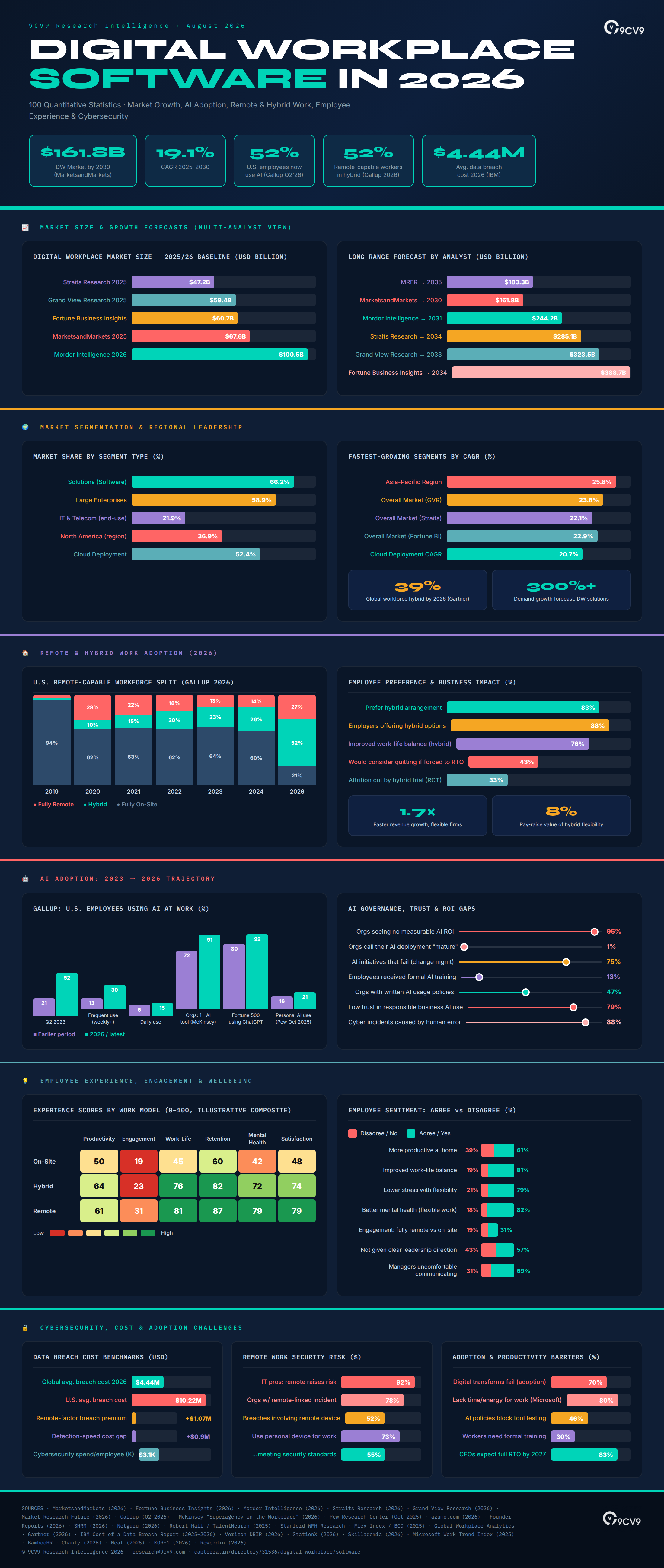
Artificial intelligence is also reshaping the digital workplace at remarkable speed. Gallup data cited in the statistics shows that 52% of U.S. employees used AI in their roles by Q2 2026, compared with just 21% three years earlier. Yet adoption does not automatically translate into results: only a small proportion of organizations consider themselves mature in AI deployment, while significant gaps remain in AI training, governance, employee trust, and measurable return on investment.
At the same time, organizations must contend with cybersecurity threats, software sprawl, employee engagement challenges, digital transformation failures, and the growing complexity of managing distributed workforces. These pressures are influencing what businesses expect from modern digital workplace platforms and how technology vendors design their products.
This collection of the Top 100 Digital Workplace Software Statistics, Data & Trends in 2026 examines the numbers shaping this rapidly changing market. From digital workplace market size and hybrid work adoption to AI and automation, employee experience, productivity, cybersecurity, infrastructure, and software spending, these statistics provide an evidence-based overview of where the digital workplace stands in 2026 and where it may be heading next.
Before we venture further into this article, we would like to share who we are and what we do.
About 9cv9
9cv9 is a business tech startup based in Singapore and Asia, with a strong presence all over the world.
With over ten years of startup and business experience, and being highly involved in connecting with thousands of companies and startups, the 9cv9 team has listed some of the top and best companies/tools in this review.
If you like to get your company listed in our top B2B software reviews, check out our world-class 9cv9 Media and PR service and pricing plans here.
Top 100 Digital Workplace Software Statistics, Data & Trends in 2026
Market Size & Growth (1–15)
1. The global digital workplace market is projected to grow from $67.57 billion in 2025 to $161.82 billion by 2030, at a 19.1% CAGR.
This trajectory confirms that digital workplace software is transitioning from a discretionary IT purchase into a core enterprise infrastructure category commanding sustained double-digit investment growth.
2. An alternative projection from Fortune Business Insights values the market at $60.65 billion in 2025, forecasting growth to $388.68 billion by 2034 at a 22.93% CAGR.
The wide variance across analyst firms reflects differing market scope definitions, but all major forecasts agree the sector will multiply several times over within a decade.
3. Mordor Intelligence pegs the 2026 market at $100.5 billion, projecting growth to $244.16 billion by 2031 at a 19.43% CAGR.
This more bullish 2026 baseline suggests the category may already be scaling faster than several 2025-era projections anticipated.
4. Straits Research values the 2025 market at $47.19 billion, forecasting $285.06 billion by 2034 at a 22.12% CAGR.
Even the more conservative estimates still point to a six-fold market expansion within roughly a decade, underlining broad-based confidence in the category’s growth.
5. Grand View Research places the 2025 market at $59.4 billion, projecting $323.5 billion by 2033 at a 23.8% CAGR.
The consistency of high-double-digit CAGR figures across independent research firms is a strong signal of durable, structural demand rather than a short-term spending cycle.
6. North America dominated the digital workplace market with a 36.9% revenue share in 2025, according to Grand View Research.
North America’s continued market leadership reflects its mature cloud infrastructure, high enterprise software spend, and early adoption of hybrid work policies.
7. Asia-Pacific is the fastest-growing region, expanding at a 25.8% CAGR from 2026 to 2033 per Grand View Research.
Rapid urbanization and expanding internet penetration are positioning Asia-Pacific as the primary engine of future digital workplace software growth.
8. The solutions (software) segment accounted for over 66.2% of digital workplace market revenue in 2025.
This dominance confirms that licensed software platforms — not implementation services — represent the bulk of enterprise digital workplace spending.
9. Large enterprises accounted for 58.9% of digital workplace market revenue in 2025.
While large enterprises currently anchor the market, this also signals substantial headroom for vendors targeting the still-underpenetrated small and mid-sized business segment.
10. IT & telecommunications represented the largest end-use segment at 21.9%–24% of digital workplace market revenue.
The sector’s technical workforce and existing cloud infrastructure make it a natural early adopter and bellwether for broader digital workplace software trends.
11. The end of Windows 10 support in 2025 triggered a combined device refresh and cloud PC migration cycle that lifted demand across multiple digital workplace solution areas.
This forced technology transition illustrates how infrastructure lifecycle events can act as unplanned but powerful accelerants for digital workplace software adoption.
12. Cloud held 52.38% of digital workplace deployments in 2025 and is projected to expand at a 20.70% CAGR through 2031.
Cloud’s growing dominance over on-premises deployment confirms that subscription-based, infrastructure-light platforms are becoming the default procurement model.
13. More than 70% of organizations are focusing on digital transformation programs specifically to improve workplace operations.
This widespread strategic prioritization demonstrates that digital workplace initiatives have moved from IT department projects to board-level transformation agendas.
14. Workforce productivity has reportedly improved by over 40% following digital workplace technology adoption in surveyed organizations.
Such a substantial productivity gain provides a concrete, quantifiable justification for continued enterprise capital allocation toward digital workplace platforms.
15. Demand for digital workplace solutions is projected to increase by more than 300% over the current forecast period.
This exponential demand curve suggests the market is still in an early growth phase relative to its eventual saturation point.
Remote & Hybrid Work Adoption (16–35)
16. Among U.S. employees with remote-capable jobs, 52% work hybrid, 26–27% are exclusively remote, and 21–22% are fully on-site, per Gallup’s 2026 data.
This near-80% combined hybrid-and-remote share confirms that fully in-office work has become the exception rather than the norm among knowledge workers.
17. Gallup’s Q1 2026 Hybrid Work Indicator shows this distribution has remained stable for roughly 18 months despite ongoing return-to-office headlines.
The data’s stability suggests hybrid work has reached a genuine equilibrium rather than being a transitional phase awaiting reversal.
18. Two-thirds of U.S. firms (66%) offer location flexibility, while 34% now require full-time office attendance, a Flex Index Q3 2025 report shows.
The rising share of RTO mandates, driven largely by government agencies, indicates a bifurcating labor market between flexible and rigid employers.
19. 83% of global employees say they prefer a hybrid setup that mixes remote and in-office days.
With such an overwhelming employee preference, organizations that fail to offer hybrid arrangements risk a structural disadvantage in talent attraction and retention.
20. Fully Flexible companies grew revenues 1.7x faster than mandate-driven firms from 2019–2024, even after adjusting for industry and size.
This performance gap provides compelling evidence that flexible work policies enabled by digital workplace software are correlated with, not merely coincidental to, stronger business outcomes.
21. A landmark randomized controlled trial found hybrid work cut employee attrition by 33% with no loss in performance.
Rigorous experimental evidence like this substantially strengthens the retention-focused business case for hybrid-enabling digital workplace investment.
22. Remote work reduces quit rates by 35%, according to Stanford research, and 43% of employees say they would consider quitting if forced back into the office full-time.
These figures make workplace flexibility a quantifiable retention lever rather than simply a perk, directly linking digital workplace enablement to reduced hiring costs.
23. Employees value hybrid flexibility at the equivalent of an 8% pay raise, per Stanford / Nicholas Bloom research.
This wage-equivalent framing gives HR and finance leaders a concrete monetary benchmark for the value that digital workplace-enabled flexibility delivers to employees.
24. 46% of work-from-home employees say they would be unlikely to stay in their job if remote work were eliminated.
This finding underscores that for a significant share of the modern workforce, digital workplace-enabled remote access is now a retention-critical benefit rather than a bonus.
25. 95% of employers say telework has a high impact on employee retention, according to Global Workplace Analytics.
Near-universal employer agreement on this point signals that the retention value of digital workplace flexibility is no longer a contested assumption but an accepted operating reality.
26. 24% of new U.S. job postings were hybrid in Q4 2025, up from just 9% in early 2023, per Robert Half data.
This near-tripling in under two years demonstrates how rapidly employer-side hiring practices are adapting to match candidate demand for flexible arrangements.
27. Remote or hybrid job postings make up about 20% of listings but attract 60% of all applications, according to LinkedIn data cited by ERE.
This striking supply-demand imbalance confirms that flexible-work employers can access a substantially larger and more competitive applicant pool.
28. Only 16% of job seekers say an in-office role is their top preference, and just 25% would even consider a five-day office job, per Robert Half.
With fully in-office roles now a minority preference, digital workplace software has effectively become a prerequisite for competitive talent acquisition.
29. Hybrid employees average roughly 2.3 work-from-home days per week, according to Breeze’s 2026 analysis.
This consistent mid-week hybrid pattern is shaping how enterprises design meeting cadences and digital collaboration workflows around predictable in-office overlap days.
30. Skipping the daily commute frees up roughly 72 minutes per day for remote and hybrid employees.
This reclaimed time represents a meaningful quality-of-life and productivity dividend that digital workplace tools make structurally possible.
31. Approximately 34.6 million employed Americans teleworked in August 2025, with the U.S. telework rate stabilizing between 17.9% and 23.8% since late 2022.
This scale confirms remote work has become a durable, multi-decade structural feature of the U.S. labor market rather than a pandemic-era anomaly.
32. 61% of remote workers say they are more productive working from home, while 81.4% report improved work-life balance.
These self-reported gains, corroborated across multiple independent surveys, continue to challenge management skepticism about remote work productivity.
33. In 2025, 79% of remote professionals reported lower stress levels, and 82% said their mental health improved with flexible work arrangements.
These wellbeing outcomes give digital workplace software a defensible role in corporate mental health and employee experience strategy, not just operational efficiency.
34. Teams with a formal hybrid collaboration plan are 2.2 times more likely to report an extremely positive impact on collaboration, per 2026 research.
This finding highlights that digital workplace software alone is insufficient — structured hybrid policies are needed to fully realize collaboration benefits.
35. 83% of global CEOs anticipate a return to full-time office work by 2027, according to a 2025 CEO survey.
This notable disconnect between executive expectations and employee preference data suggests continued organizational friction over the future of hybrid work policy.
AI & Automation in the Workplace (36–58)
36. Gallup’s Q2 2026 survey found 52% of U.S. employees now use AI in their role, up from 21% in Q2 2023.
This more-than-doubling of AI usage within three years demonstrates one of the fastest workplace technology adoption curves ever recorded by Gallup’s tracking methodology.
37. Frequent AI use (a few times a week or more) reached 30% of the workforce in Gallup’s Q2 2026 data, with 15% using AI daily.
The steady climb in high-frequency usage suggests AI tools are moving beyond occasional experimentation into embedded daily workflows for a meaningful share of employees.
38. McKinsey reports 91% of employees say their organizations use at least one AI tool.
This near-universal organizational AI presence indicates that the debate has shifted from whether to adopt AI to how effectively it is being deployed.
39. Pew Research’s October 2025 survey found only 21% of U.S. workers say they personally use AI at work, up from 16% previously.
This substantial gap between organizational AI claims (91%) and individual usage (21%) reveals a significant “headline inflation” problem worth scrutinizing in vendor and analyst reporting.
40. 58% of employees report regular, intentional use of AI tools at work, with about 33% using AI weekly or daily, per azumo.com’s 2026 analysis.
This more optimistic usage figure illustrates how survey methodology and question framing can produce meaningfully different AI adoption estimates.
41. Over 92% of Fortune 500 companies have employees using ChatGPT, up from 80% in late 2023.
This near-saturation penetration among the world’s largest companies confirms generative AI has become a baseline productivity tool at the enterprise level.
42. ChatGPT enterprise “seats” reached 1.5 million as of March 2025, a 10x increase in a single year.
This explosive seat growth demonstrates that enterprise generative AI adoption is scaling through formal, paid deployments rather than informal individual use alone.
43. 44% of employees said their organization used AI for a range of operations in 2025, up from 33% the previous year.
This year-over-year increase reflects AI’s expanding footprint from narrow pilot use cases into broader operational integration across departments.
44. Only 37% of employees say their organization has implemented AI to meaningfully improve productivity, efficiency, or quality, per a Gallup survey.
This relatively modest figure suggests many organizations are still in the early stages of translating AI tool access into measurable performance outcomes.
45. 92% of companies plan to increase AI investment over the next three years, yet only 1% of leaders describe their company as “mature” in AI deployment, per McKinsey.
This striking maturity gap indicates that near-universal investment intent has not yet translated into sophisticated, embedded AI capability at most organizations.
46. 95% of organizations report seeing no measurable ROI from their AI investments, despite a 2x increase in adoption since 2023.
This sobering statistic is an important counterbalance to adoption-focused headlines, underscoring that deployment scale does not guarantee financial return.
47. 40% of workers have received “workslop” — low-quality AI-generated content — costing nearly two hours to fix per incident.
This finding highlights a genuine quality-control risk that digital workplace platforms must address through better AI governance and review workflows.
48. 70–80% of AI initiatives fail, primarily due to change management issues rather than technology limitations, according to 2026 research.
This reinforces that successful AI integration into digital workplace software depends as much on organizational readiness and training as on the underlying technology.
49. 77% of employers plan to reskill workers for AI, but only 13% of employees report having received any formal AI training.
This training gap represents a clear and immediate opportunity for digital workplace vendors that embed structured AI onboarding directly into their platforms.
50. Only 1 in 4 HR professionals played a leading role in their organization’s AI implementation, despite two-thirds believing HR should lead AI change management, per SHRM.
This disconnect between perceived ownership and actual involvement suggests HR functions remain underutilized in enterprise AI rollout strategy.
51. 92% of CHROs anticipate greater AI integration into workforce operations in 2026, and 87% expect increased AI adoption specifically within HR processes.
This forward-looking executive confidence signals strong continued demand for AI-embedded HR and digital workplace software throughout the year.
52. SHRM found only 47% of AI-adopting organizations have written policies governing AI use, rising to 56% at large firms and falling to 36% at small firms.
This substantial governance gap represents both a compliance risk for buyers and a clear product opportunity for vendors offering built-in AI usage controls.
53. 30% of workers admitted knowingly breaking their organization’s AI usage rules, most often by using tools still under internal review, per SHRM’s 2026 survey.
This finding illustrates that restrictive AI policies without accessible, sanctioned alternatives may simply push usage underground rather than eliminate it.
54. 46% of all workers say existing AI policies block them from testing new and potentially useful tools, according to SHRM.
This tension between governance and innovation highlights a design challenge for digital workplace platforms: balancing security control with employee experimentation.
55. Approximately 6–7% of the U.S. workforce could see positions displaced by widespread AI adoption, though the effect appears temporary, per Netguru’s 2026 analysis.
This measured displacement estimate provides a more calibrated perspective than the more alarmist projections sometimes seen in AI adoption commentary.
56. A one-standard-deviation increase in firm-level AI investment corresponds with a 3.7% increase in college-educated employment.
This finding suggests AI investment is reshaping workforce composition toward higher-skilled roles rather than simply reducing overall headcount.
57. Nearly half of employees (46%) believe time saved through AI tools belongs to them personally rather than to their employer.
This attitude has significant implications for how organizations frame AI-driven productivity gains and calculate return on digital workplace AI investment.
58. 79% of people express low trust in businesses to use AI responsibly, according to a 2026 workplace AI survey.
This trust deficit represents a meaningful barrier to full AI feature adoption within digital workplace platforms and underscores the need for transparent AI governance.
Employee Experience, Engagement & Wellbeing (59–78)
59. 76% of hybrid employees cite improved work-life balance as one of the greatest benefits of hybrid work, per Gallup’s 2026 data.
This consistently top-ranked benefit should anchor digital workplace software messaging aimed at HR and employee-experience decision-makers.
60. 81.4% of remote workers report improved work-life balance overall, according to Chanty’s 2026 analysis.
The consistency of this figure across multiple independent surveys strengthens confidence in work-life balance as a genuine, measurable outcome of remote enablement.
61. Remote (40%) and hybrid workers (38%) report slightly higher rates of anxiety and depression compared to in-person workers (35%).
This nuanced finding complicates the wellbeing narrative around remote work, suggesting isolation and blurred boundaries require deliberate mitigation through workplace design.
62. 88% of U.S. employers now offer at least some hybrid options, up significantly from pre-2022 levels, per Robert Half data.
This near-universal employer accommodation confirms hybrid capability has become a baseline expectation rather than a competitive differentiator on its own.
63. Globally, employees average 1.27 work-from-home days per week, a figure that has remained flat since 2023, per Stanford WFH Research.
This stabilization suggests the market has found a durable average equilibrium for distributed work rather than continuing to trend toward either extreme.
64. Remote-capable work has settled at a 51% hybrid / 28% fully remote / 21% fully on-site split, according to Gallup’s 2025 data cited by Rewordin.
The near-identical figures across independent analyses in 2025 and 2026 confirm this distribution represents a genuine market equilibrium. <br>
65. 23% higher profitability has been documented at companies with highly engaged workforces, based on Gallup’s long-standing engagement benchmark.
This profitability premium provides a direct commercial justification for digital workplace investments aimed at improving communication and employee engagement.
66. U.S. employee engagement fell to an 11-year low in 2024, according to Gallup, with the sharpest declines among workers under 35.
This engagement crisis, particularly among younger employees, signals urgent demand for digital workplace tools that rebuild connection and purpose in distributed teams.
67. 57% of employees feel they are not given clear direction from leadership, according to workplace communication research.
This communication gap creates a direct and quantifiable value proposition for digital workplace intranets, OKR platforms, and structured communication tools.
68. 69% of managers report discomfort communicating effectively with their employees.
This finding highlights those manager-facing communication templates and coaching tools embedded in digital workplace platforms address a widespread and specific organizational pain point.
69. 70% of digital transformation initiatives fail to meet their objectives, largely due to insufficient employee adoption.
This high failure rate reframes digital workplace software success as fundamentally a change-management and user-experience challenge rather than purely a technology procurement decision.
70. 30% of workers report struggling to adopt new digital tools without formal training, according to SHRM-cited research.
This adoption barrier underscores why embedded, in-product training and guided onboarding are increasingly critical differentiators among digital workplace platform vendors.
71. Effective remote onboarding programs increase employee retention by up to 82%, according to BambooHR-cited data.
This substantial retention lift demonstrates that digital onboarding tools deliver value extending well beyond an employee’s first weeks on the job.
72. Remote onboarding satisfaction now reportedly surpasses traditional in-office onboarding, at 87% versus 82% respectively.
This reversal challenges the assumption that in-person onboarding is inherently superior, validating continued investment in digital-first employee experience design.
73. Fully remote employees report a 31% engagement rate compared to 19% for fully on-site employees, per Gallup’s 2024 data.
This 12-percentage-point engagement gap directly challenges blanket return-to-office mandates on productivity and morale grounds.
74. 78% of managers acknowledge their organization is directing substantial financial resources toward digital workplace transformation.
This high level of budgetary commitment at the operational management level confirms digital workplace investment has moved from a discretionary line item to a funded strategic priority.
75. 80% of employees and leaders say they lack the time or energy needed to do their work effectively, per Microsoft’s Work Trend Index research.
This widespread sense of overload creates urgent demand for digital workplace tools that reduce meeting load, automate routine tasks, and streamline information access.
76. 53% of business leaders say productivity must increase within their organizations, according to Microsoft’s 2025 research.
This explicit leadership mandate for productivity growth provides the underlying demand driver sustaining the digital workplace software category’s continued expansion.
77. Employees using AI report time savings of 1.5 to 2.5 hours per week on writing and problem-solving tasks, particularly in marketing, HR, and software engineering roles.
This role-specific time savings data gives digital workplace buyers concrete, function-level benchmarks for evaluating AI feature ROI.
78. 77% of employees who save time using AI say they would still spend at least half of that reclaimed time on work-related activities.
This finding suggests employers can reasonably expect AI-driven time savings to translate into genuine productivity gains rather than being fully redirected to personal time.
Security, Infrastructure & Market Challenges (79–100)
79. The global average cost of a data breach reached $4.44 million in 2026, though this is down 9% from $4.88 million in 2024, per IBM’s Cost of a Data Breach Report.
Despite this improvement, breach costs remain high enough that robust, integrated security features are a critical differentiator among digital workplace software vendors.
80. The United States has the highest average data breach cost globally at $10.22 million, more than double the Middle East’s $7.29 million.
This substantial geographic cost disparity should inform how digital workplace security features and pricing are localized across different regional markets.
81. Data breaches involving remote workers cost approximately $1.07 million more on average than breaches without a remote work factor, per IBM’s 2025 report.
This premium provides a compelling, quantified argument for enterprise investment in security-hardened digital workplace platforms specifically designed for distributed teams.
82. 92% of IT professionals say remote work increases cybersecurity risk, according to StationX’s 2026 research.
This near-unanimous professional consensus confirms security remains the most significant unresolved concern among enterprise digital workplace software buyers.
83. 78% of organizations experienced at least one security incident linked to remote work within the past year.
This high incidence rate demonstrates that remote work security risk is a present, ongoing operational reality rather than a theoretical concern.
84. 52% of security incidents in 2025 involved a remote worker’s device or network connection, per Verizon’s Data Breach Investigations Report.
This finding places remote endpoints squarely at the center of enterprise security strategy for any organization adopting digital workplace software at scale.
85. Phishing attacks targeting remote workers increased 41% since 2023, frequently exploiting home Wi-Fi networks and personal email accounts.
This trend underscores the growing importance of built-in phishing protection and secure network access features within digital workplace platforms.
86. 73% of remote employees admit to using personal devices for work, yet only 55% of those devices meet corporate security standards.
This gap between BYOD prevalence and compliance highlights significant unmanaged risk that mobile device management features in digital workplace software are designed to close.
87. 88% of all cyber incidents are attributed to human error, such as phishing clicks, weak passwords, or misconfigurations.
This statistic reframes cybersecurity as fundamentally a workplace behavior and training challenge, reinforcing the value of built-in security awareness features.
88. 29% of total ransomware attacks in 2025 originated from home office environments, according to workplace cybersecurity research.
This substantial share underscores that home-based endpoints have become a primary, rather than marginal, attack vector for enterprise ransomware incidents.
89. The global cybersecurity market is projected to reach $211.69–$215 billion in 2026, en route to over $375 billion by 2029.
This parallel security market growth confirms that digital workplace software expansion and cybersecurity investment are closely intertwined trends.
90. Organizations spend an average of 12% of their IT budget on cybersecurity, equivalent to roughly $3,100 per employee annually.
This budget allocation benchmark gives enterprise buyers a useful reference point when evaluating the total cost of ownership for secure digital workplace deployments.
91. 3.5 million cybersecurity jobs remain unfilled globally, contributing to a 15% year-over-year rise in cybersecurity salaries.
This acute talent shortage strengthens the case for digital workplace platforms with built-in, automated security features that reduce reliance on scarce specialist staff.
92. AI-powered cyberattacks increased 300% since 2022, while AI-driven defense tools now detect threats 60% faster than traditional methods.
This escalating arms race between offensive and defensive AI underscores why modern digital workplace software increasingly embeds AI-native threat detection as a core feature.
93. Gartner forecasts that 39% of the global workforce will operate under a hybrid model by 2026.
This projection reinforces hybrid work’s transition from a pandemic-era exception into a durable, globally significant share of total employment.
94. Per-employee cybersecurity spending for remote workforces ranges from $600 to $2,400 annually, with regulated industries at the higher end.
This spending range gives digital workplace software buyers in finance, healthcare, and defense sectors a useful budgeting benchmark for security-hardened deployments.
95. Tool sprawl costs a typical 1,000-person remote company approximately $340,000 per year in redundant software licenses.
This finding makes a strong economic case for platform consolidation, favoring integrated digital workplace suites over fragmented point solutions.
96. Employers still save approximately $11,000 per year per remote employee by eliminating real estate and associated overhead costs, according to Global Workplace Analytics.
Even after accounting for additional cybersecurity and infrastructure spending, this net savings figure keeps the financial case for remote-enabling digital workplace software strongly positive.
97. Internal breach detection rates reached 50% in 2025, up from just 33% in 2023, driven substantially by AI-powered monitoring systems.
This improvement demonstrates measurable, quantifiable value from AI-driven security features increasingly embedded within digital workplace platforms.
98. The cost gap between internally detected breaches ($4.18 million) and attacker-disclosed breaches ($5.08 million) is $900,000, representing quantifiable ROI for faster detection tools.
This concrete dollar figure gives digital workplace security vendors a clear, defensible return-on-investment argument for AI-driven monitoring capabilities.
99. The U.S. cybersecurity market alone is expected to generate $93 billion in 2026, representing 44% of the global total.
This outsized American share reflects both the scale of the U.S. enterprise software market and heightened regulatory and liability pressure driving security spending.
100. Verizon’s 2026 Data Breach Investigations Report analyzed more than 22,000 security incidents — the largest dataset in the report’s 19-year history.
The sheer scale of this dataset lends significant statistical credibility to the security trends shaping digital workplace software design and buyer priorities in 2026.
Conclusion
The Top 100 Digital Workplace Software Statistics, Data & Trends in 2026 reveal a workplace technology market undergoing rapid and lasting transformation. Digital workplace software is no longer limited to messaging, video conferencing, or remote access. It is becoming an integrated foundation for how organizations collaborate, automate processes, manage employees, deploy artificial intelligence, protect company data, and support increasingly distributed workforces.
Market growth reflects this shift. One estimate places the global digital workplace market at approximately $100.5 billion in 2026, with projected growth to $244.16 billion by 2031 at a 19.43% CAGR. Other forecasts point to similarly substantial expansion, while Asia-Pacific is expected to be among the fastest-growing regions. Cloud deployment, enterprise digital transformation, and demand for integrated workplace platforms are helping sustain this momentum.
Hybrid work has also become a structural part of the modern workplace. Around 52% of U.S. employees with remote-capable jobs work hybrid, while another 26–27% work exclusively remotely. Employee preferences remain strongly aligned with flexibility, with 83% of global employees preferring hybrid arrangements. Research cited in the statistics also associates hybrid work with lower employee attrition, while employees place considerable financial value on workplace flexibility.
Artificial intelligence represents another major digital workplace trend in 2026. 52% of U.S. employees now use AI in their roles, according to the Gallup data included in this collection, compared with 21% in Q2 2023. However, the statistics also expose a significant gap between AI adoption and AI maturity. Organizations continue to face challenges involving measurable ROI, employee training, governance, trust, and the quality of AI-generated work.
Cybersecurity will be equally important as digital workplaces expand. The data highlights multimillion-dollar breach costs, security risks associated with remote endpoints, widespread use of personal devices, phishing threats, and growing cybersecurity expenditure. At the same time, tool sprawl and redundant software subscriptions are creating pressure for businesses to consolidate their technology stacks around more integrated and secure platforms.
Ultimately, the digital workplace trends of 2026 point toward a future defined by AI-powered automation, hybrid work, cloud-based software, stronger cybersecurity, improved employee experience, and greater platform consolidation. Organizations that successfully combine these technologies with effective training, governance, communication, and change management will be better positioned to turn digital workplace investments into measurable productivity, retention, and business performance gains.
For digital workplace software vendors, HR technology providers, IT leaders, business owners, and investors, these 100 statistics provide more than a snapshot of the market. They highlight where enterprise technology spending is moving, what employees increasingly expect from their workplaces, and which digital workplace trends are likely to shape the future of work beyond 2026.
If you find this article useful, why not share it with your hiring manager and C-level suite friends and also leave a nice comment below?
We, at the 9cv9 Research Team, strive to bring the latest and most meaningful data, guides, and statistics to your doorstep.
To get access to top-quality guides, click over to 9cv9 Blog.
To hire top talents using our modern AI-powered recruitment agency, find out more at 9cv9 Modern AI-Powered Recruitment Agency.
People Also Ask
What is digital workplace software?
Digital workplace software is technology that helps employees communicate, collaborate, automate tasks, access information and work securely across office, hybrid and remote environments.
How big is the digital workplace software market in 2026?
One market estimate values the global digital workplace market at approximately $100.5 billion in 2026, with projected growth to $244.16 billion by 2031.
What is the growth rate of the digital workplace market?
Market forecasts vary, but several estimates project compound annual growth rates above 19%, demonstrating strong long-term demand for digital workplace technologies.
What are the biggest digital workplace trends in 2026?
Major digital workplace trends include AI adoption, workflow automation, hybrid work, cloud deployment, employee experience technology, cybersecurity and software platform consolidation.
Which region leads the digital workplace software market?
North America led the digital workplace market with a 36.9% revenue share in 2025, supported by mature cloud infrastructure and high enterprise technology spending.
Which region is growing fastest in the digital workplace market?
Asia-Pacific is projected to be the fastest-growing digital workplace region, expanding at a 25.8% CAGR between 2026 and 2033.
How important is cloud technology to digital workplaces?
Cloud deployments represented 52.38% of digital workplace deployments in 2025 and are projected to expand at a 20.70% CAGR through 2031.
How common is hybrid work in 2026?
Among U.S. employees with remote-capable jobs, approximately 52% work hybrid, 26–27% work fully remotely and 21–22% work fully on-site.
Do employees prefer hybrid work?
Yes. According to the statistics collected, 83% of global employees prefer a hybrid arrangement combining remote and in-office work.
Does hybrid work reduce employee turnover?
A randomized controlled trial cited in the data found that hybrid work reduced employee attrition by 33% without reducing performance.
How valuable is hybrid work to employees?
Research cited in the statistics suggests employees value hybrid work flexibility at approximately the equivalent of an 8% pay increase.
Are remote and hybrid jobs more popular with job seekers?
Yes. Remote and hybrid positions account for about 20% of job listings but attract approximately 60% of applications, showing strong candidate demand for flexibility.
How many days per week do hybrid employees work from home?
Hybrid employees average approximately 2.3 work-from-home days each week, helping establish predictable patterns for office collaboration and remote work.
Does remote work improve productivity?
According to the collected statistics, 61% of remote workers say they are more productive at home, while digital workplace technology adoption has reportedly improved productivity by over 40% in surveyed organizations.
How is AI changing the digital workplace in 2026?
AI is increasingly embedded in everyday workflows for writing, problem-solving, automation and operations, making AI-enabled tools an important component of digital workplace technology.
How many employees use AI at work in 2026?
Gallup’s Q2 2026 data found that 52% of U.S. employees use AI in their roles, compared with 21% in Q2 2023.
How many employees use AI at work every day?
Gallup’s Q2 2026 data found that 15% of U.S. employees use AI daily, while 30% use it frequently, defined as at least a few times per week.
Are companies increasing their AI investments?
Yes. The collected data indicates 92% of companies plan to increase AI investment over the next three years, although only 1% of leaders describe their organizations as mature in AI deployment.
Are companies seeing ROI from workplace AI?
Results remain mixed. One statistic in the dataset reports that 95% of organizations see no measurable ROI from AI investments, highlighting the gap between adoption and measurable financial results.
How much time can workplace AI save employees?
Employees using AI reportedly save around 1.5 to 2.5 hours per week on writing and problem-solving tasks, particularly in HR, marketing and software engineering.
What is the biggest challenge with workplace AI adoption?
Training, governance and change management remain major challenges. While 77% of employers plan to reskill workers for AI, only 13% of employees report receiving formal AI training.
How many companies have workplace AI policies?
Only 47% of AI-adopting organizations reportedly have written AI policies, increasing to 56% among large organizations and falling to 36% among small businesses.
How does digital workplace technology affect employee engagement?
Digital workplace technology can support communication, flexibility and employee experience. Highly engaged workforces have been associated with 23% higher profitability in Gallup’s engagement benchmark.
Does remote work improve work-life balance?
Yes. The collected data shows 81.4% of remote workers report improved work-life balance, while 76% of hybrid employees identify better work-life balance as a major benefit.
Why do digital workplace transformations fail?
Around 70% of digital transformation initiatives reportedly fail to meet their objectives, with insufficient employee adoption identified as a major contributing factor.
Why is cybersecurity important for digital workplaces?
Distributed work expands security exposure across devices, networks and locations. The statistics show remote endpoints, phishing, BYOD and human error remain significant workplace cybersecurity concerns.
What is the average cost of a data breach in 2026?
The dataset reports a global average data breach cost of $4.44 million in 2026, demonstrating why cybersecurity remains a major digital workplace investment priority.
Does remote work increase cybersecurity risks?
Yes. According to the collected statistics, 92% of IT professionals believe remote work increases cybersecurity risk, while remote devices and networks remain important attack vectors.
How much does software tool sprawl cost businesses?
The statistics estimate that redundant software licenses can cost a typical 1,000-person remote company approximately $340,000 annually, strengthening the case for platform consolidation.
What is the future of digital workplace software beyond 2026?
Digital workplace software is expected to become increasingly AI-powered, automated, cloud-based, integrated and security-focused as organizations optimize hybrid work, productivity and employee experience.
Sources
MarketsandMarkets Fortune Business Insights Mordor Intelligence Straits Research Grand View Research Market Research Future Gallup McKinsey Pew Research Center Azumo Founder Reports SHRM Netguru Robert Half TalentNeuron Stanford WFH Research Flex Index BCG Global Workplace Analytics Gartner IBM Verizon StationX Skillademia Microsoft BambooHR Chanty Neat KORE1 Rewordin