


























Key Takeaways
- The global dance studio software market is experiencing strong double-digit growth, driven by increasing adoption of cloud-based SaaS platforms, AI-powered automation, and mobile-first studio management solutions.
- Cloud computing, automated billing, CRM, virtual classes, and AI-driven analytics are transforming how dance studios manage operations, improve student experiences, and scale their businesses worldwide.
- North America remains the largest market, while Asia-Pacific is the fastest-growing region, creating significant opportunities for software vendors, investors, and dance studio owners through 2035.
Dance studio software is transforming how studios manage classes, automate billing, engage students, and grow revenue. This guide explores the top 100 dance studio software statistics, data, and trends in 2026, helping studio owners, software vendors, and investors understand market growth, AI adoption, cloud innovation, and the technologies shaping the future of dance management.
The global dance industry is undergoing one of the most significant digital transformations in its history, with dance studios increasingly relying on modern software platforms to streamline operations, improve student experiences, automate administrative tasks, and accelerate business growth. What was once an industry dominated by paper registrations, manual attendance tracking, spreadsheet scheduling, and cash payments has rapidly evolved into a sophisticated ecosystem powered by cloud-based management platforms, artificial intelligence, mobile applications, integrated payment systems, customer relationship management (CRM), virtual class technologies, and advanced business analytics. As dance education expands across recreational, competitive, wellness, and professional markets worldwide, software has become an indispensable foundation for studios seeking to remain competitive in an increasingly digital-first economy.
Also, read our guide on the Top 10 Best Dance Studio Software.
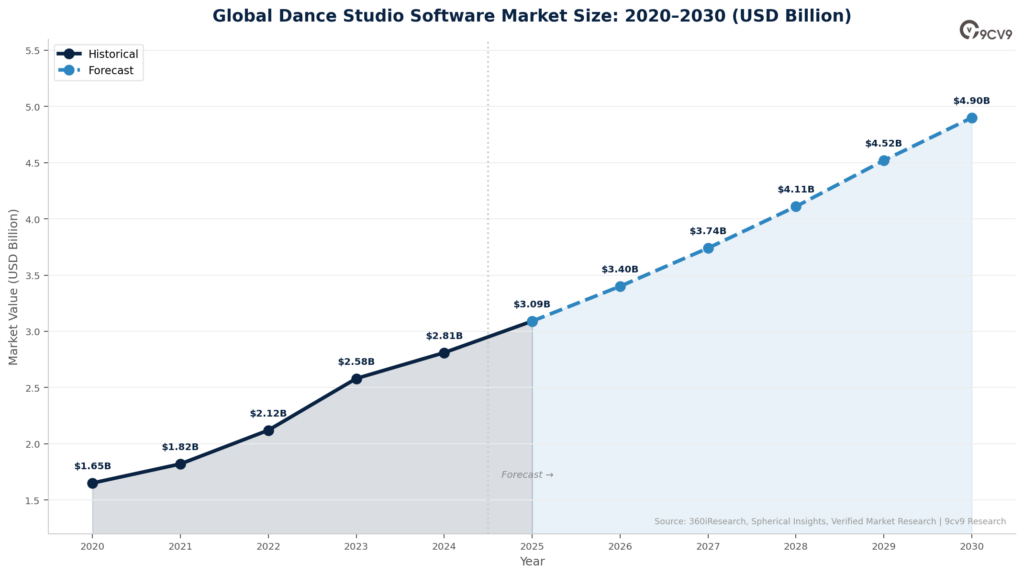
The numbers behind this transformation tell a compelling story. The global dance studio software market is projected to reach approximately $3.09 billion in 2025 and is forecast to grow to nearly $4.90 billion by 2030, representing an impressive compound annual growth rate (CAGR) of 9.72%. Even more optimistic forecasts suggest the industry could surpass $10.75 billion by 2035 under accelerated digital adoption scenarios. Multiple independent research firms consistently value the current market at around $2.6–2.9 billion, reinforcing confidence that dance studio software has matured into a significant vertical Software-as-a-Service (SaaS) industry rather than a niche technology segment. These figures demonstrate that investment in dance management technology is no longer optional but increasingly viewed as a strategic necessity for studios of all sizes.
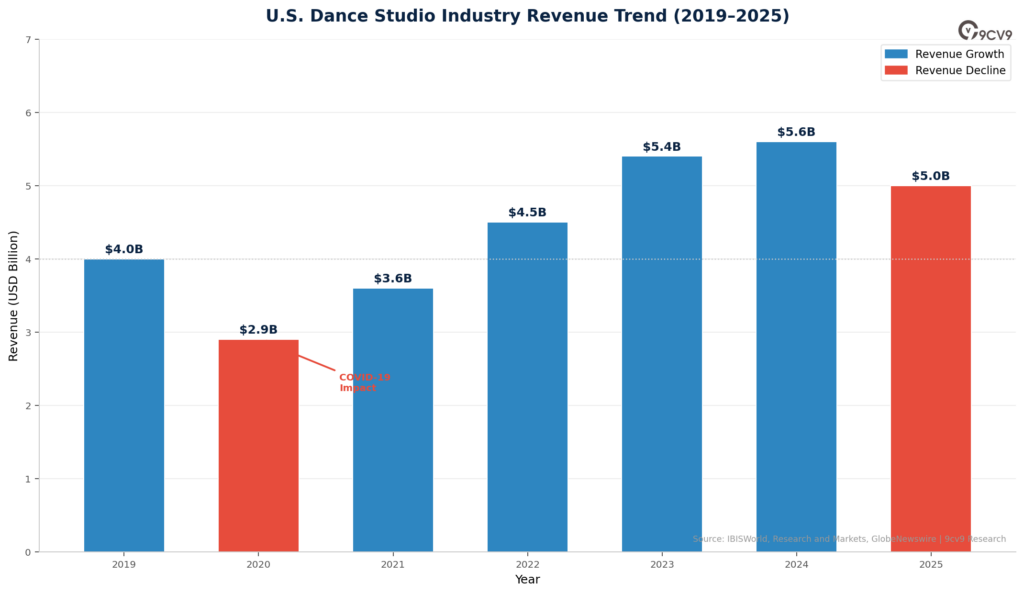
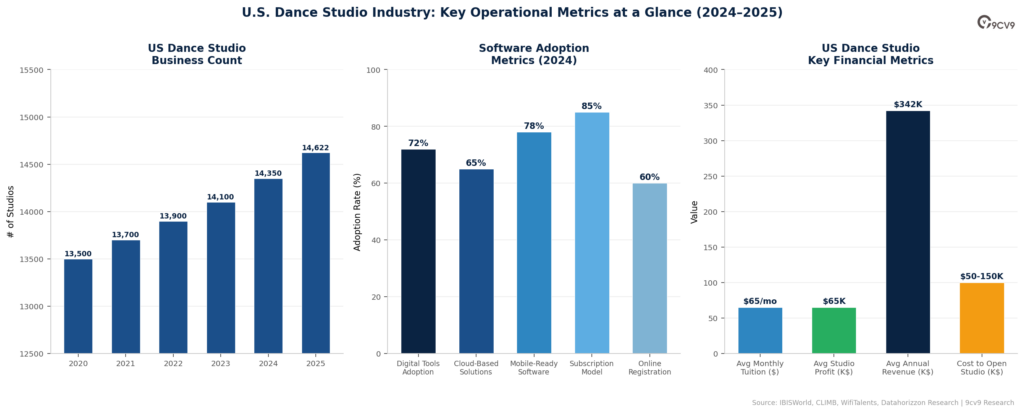
The expansion of dance studio software mirrors the steady growth of the broader dance industry itself. In the United States alone, there are more than 14,600 dedicated dance studio businesses generating approximately $5 billion in annual revenue, while broader estimates place the total number of dance instruction facilities at over 28,000 locations nationwide. Millions of children, teenagers, adults, and competitive dancers participate in structured dance education every year, creating a vast customer base that depends on efficient scheduling, enrollment management, billing systems, communication tools, and performance planning. As studio owners juggle increasing operational complexity, software platforms have become essential for managing everything from class registrations and instructor schedules to recurring tuition payments and parent engagement.
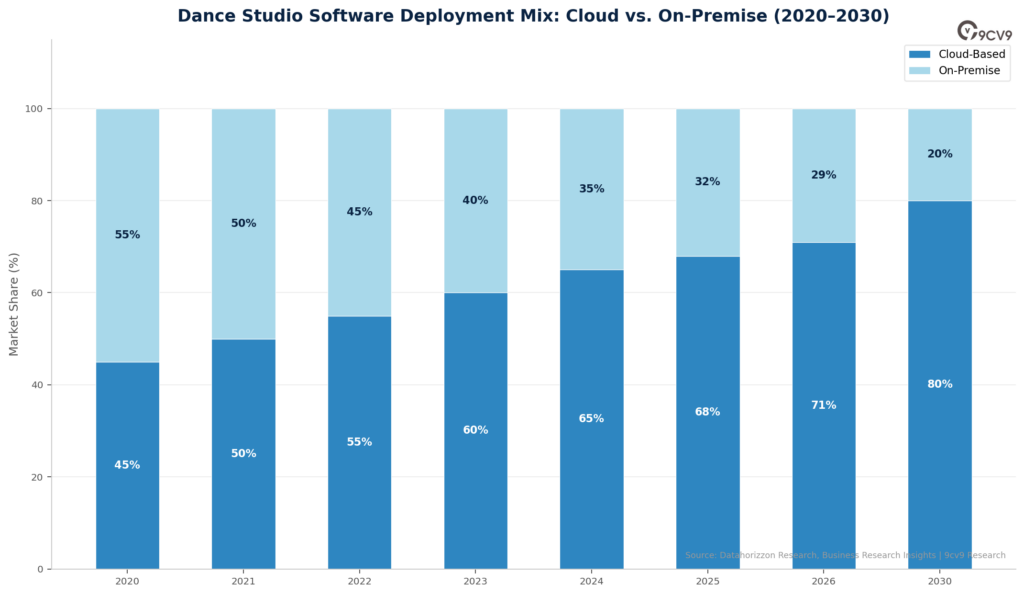
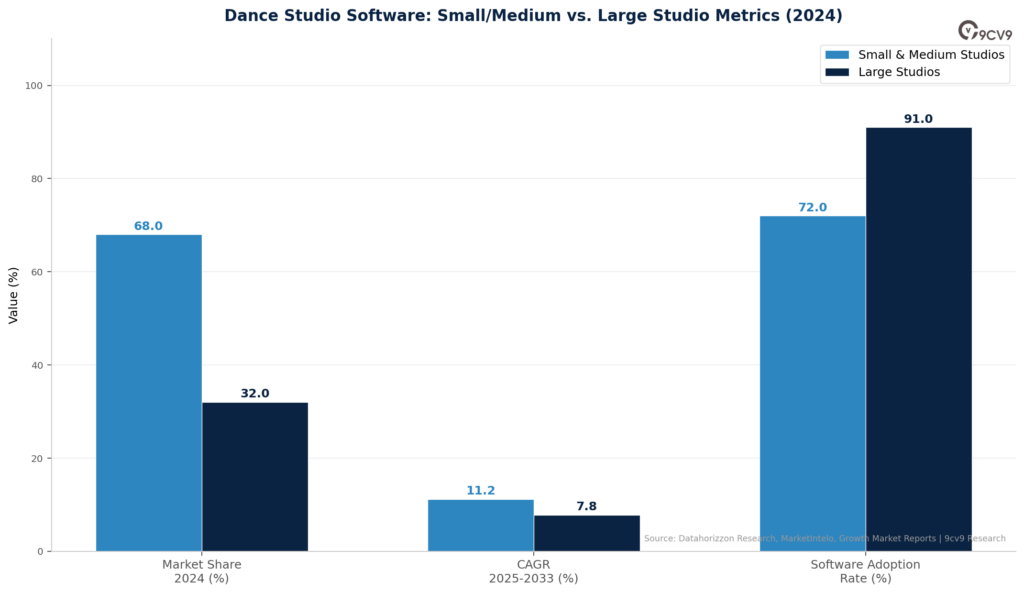
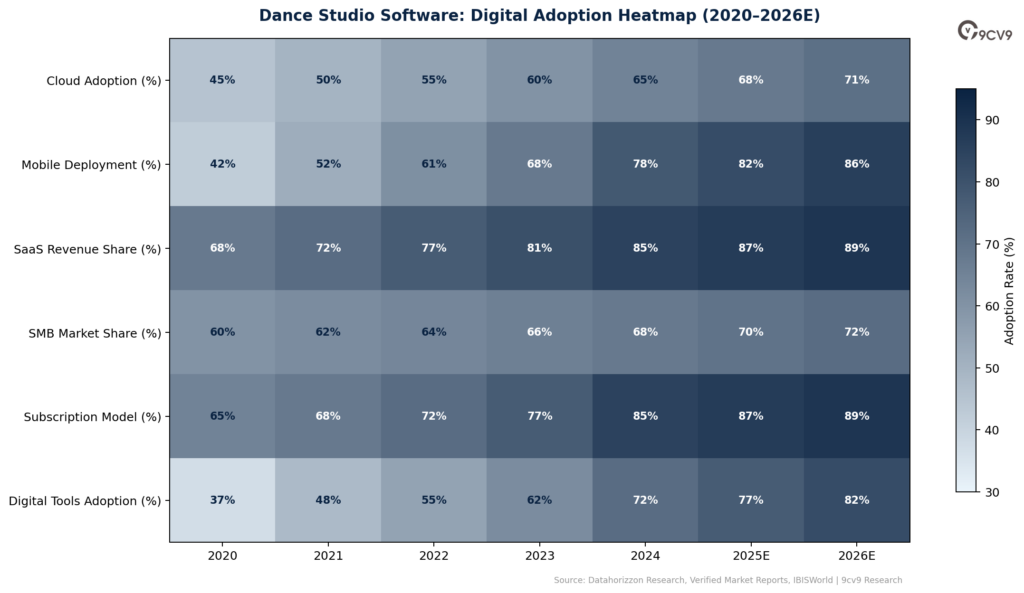
Cloud computing has fundamentally reshaped how dance studios operate. Approximately 65% of the market now consists of cloud-based solutions, while subscription-based SaaS pricing accounts for roughly 85% of total software revenue. Rather than investing in expensive on-premise systems, studio owners increasingly prefer flexible monthly subscriptions that reduce upfront costs while providing automatic updates, remote accessibility, enhanced security, and seamless scalability. This shift is particularly beneficial for independent studios and small businesses, which collectively contribute nearly 68% of total market revenue and continue to increase software spending at double-digit annual growth rates. Cloud deployment has democratized access to enterprise-grade management capabilities, allowing even small neighborhood studios to leverage sophisticated business tools previously available only to large organizations.
Automation has emerged as one of the most valuable benefits offered by modern dance studio software. Administrative processes that once consumed countless hours each week can now be completed automatically through integrated workflows. Automated billing alone is estimated to reduce administrative workloads by approximately 60%, allowing owners and instructors to dedicate more time to teaching, choreography, student development, and business expansion instead of paperwork. Combined with online enrollment, digital waivers, attendance tracking, waitlist management, financial reporting, instructor payroll, and CRM capabilities, these efficiencies directly improve profitability while enhancing the overall customer experience.
Mobile technology has become another defining characteristic of the industry. Nearly 78% of newly deployed dance studio software solutions now emphasize robust mobile functionality, reflecting changing consumer expectations among parents, students, and instructors. Today’s users expect to register for classes, receive notifications, make payments, view schedules, communicate with instructors, and access virtual learning materials directly from their smartphones. For studio owners, mobile accessibility enables real-time business management regardless of location, making operational oversight significantly more efficient than traditional desktop-only systems.
The COVID-19 pandemic accelerated digital adoption across performing arts organizations, permanently changing the industry’s technology landscape. Since 2020, approximately 72% of performing arts businesses have adopted digital management tools, representing a 35% increase in technology adoption compared to pre-pandemic levels. Virtual dance classes experienced explosive growth, online performances became mainstream, and hybrid learning models emerged as permanent business offerings rather than temporary solutions. Today, many software vendors include integrated livestreaming, virtual classroom management, video libraries, digital content delivery, and online performance capabilities as standard features instead of premium add-ons.
Social media has also transformed how dance studios attract and retain students. Around 70% of dance studios now rely on social media as their primary customer acquisition channel, while the #Dance hashtag has accumulated more than 500 billion views on TikTok. Younger audiences increasingly discover dance trends, instructors, and local studios through digital platforms before ever visiting a physical location. Consequently, leading dance studio software providers are investing heavily in marketing automation, customer engagement tools, social media integrations, online reputation management, and CRM systems that help studios convert digital interest into long-term student enrollments.
Artificial intelligence is rapidly becoming one of the industry’s most influential innovations. Vendors are introducing AI-powered scheduling, predictive analytics, automated customer communication, intelligent reporting, personalized learning recommendations, and advanced business insights designed specifically for dance studios. Platforms such as Mindbody have expanded their AI capabilities with more than 100 built-in reports and intelligent business insights, while AI-powered creative tools are also gaining traction across choreography, performance production, motion analysis, and virtual instruction. As AI adoption accelerates, software providers are increasingly differentiating themselves through intelligent automation rather than simply offering digital versions of traditional administrative tasks.
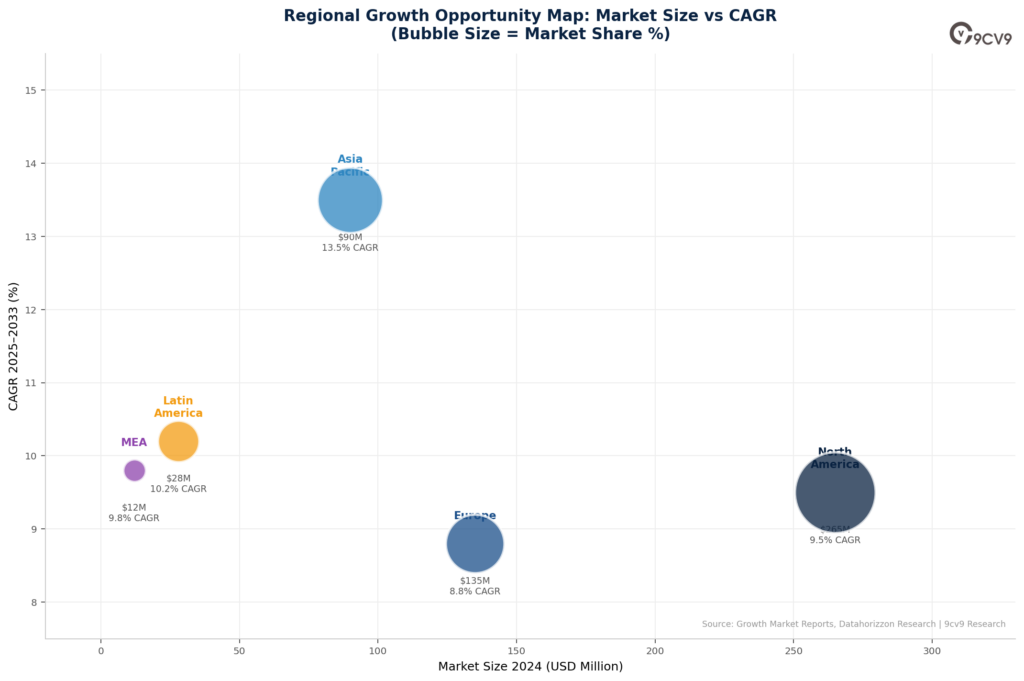
Regional growth patterns further illustrate the market’s strong long-term potential. North America currently accounts for approximately 42% of the global dance studio software market thanks to its mature studio ecosystem and widespread digital adoption. However, Asia-Pacific is rapidly emerging as the fastest-growing region, with projected annual growth rates exceeding 13%. Rising disposable incomes, expanding youth participation in dance, urbanization, and increasing investment in digital infrastructure are driving strong software demand across countries such as China, India, and Southeast Asia. Europe also remains a significant contributor, supported by vibrant performing arts communities and sustained investment in cultural participation and digital transformation.
The competitive landscape has become increasingly dynamic as established fitness software vendors, specialist dance management platforms, and emerging AI startups compete for market share. Leading providers continue to differentiate themselves through comprehensive feature sets that include scheduling, billing, CRM, payment processing, performance management, mobile applications, reporting dashboards, marketing automation, virtual class management, and AI-enhanced business intelligence. As customer expectations continue to evolve, software vendors are expanding beyond operational management to become complete business growth platforms capable of supporting every stage of the student lifecycle.
Looking ahead, the long-term outlook for dance studio software remains exceptionally positive. The broader global dance economy is estimated to be worth hundreds of billions of dollars, with more than 50 million Americans participating in dance classes annually and thousands of professional dance companies operating worldwide. Emerging technologies such as AI-generated choreography, motion capture, digital performances, hybrid learning, virtual instructors, creator economy integrations, and advanced analytics will continue reshaping how studios operate over the coming decade. As studios increasingly prioritize operational efficiency, student engagement, recurring revenue growth, and data-driven decision-making, software will become even more deeply embedded in every aspect of dance education and business management.
In this comprehensive guide, we present the Top 100 Dance Studio Software Statistics, Data & Trends in 2026, bringing together the latest market research, industry forecasts, technology adoption figures, regional analyses, business insights, AI developments, competitive intelligence, and operational benchmarks from leading research organizations and industry sources. Whether you are a dance studio owner, software provider, investor, entrepreneur, instructor, consultant, technology strategist, or market analyst, these carefully curated statistics provide a data-driven overview of one of the fastest-growing vertical SaaS markets in the performing arts industry, helping you better understand where the market stands today and where it is heading in the years ahead.
Before we venture further into this article, we would like to share who we are and what we do.
About 9cv9
9cv9 is a business tech startup based in Singapore and Asia, with a strong presence all over the world.
With over ten years of startup and business experience, and being highly involved in connecting with thousands of companies and startups, the 9cv9 team has listed some important and crucial software tools in this review.
If you like to get your company listed in our top B2B software reviews, check out our world-class 9cv9 Media and PR service and pricing plans here.
Top 100 Dance Studio Software Statistics, Data & Trends in 2026
🌐 SECTION 1: Global Market Size & Valuation
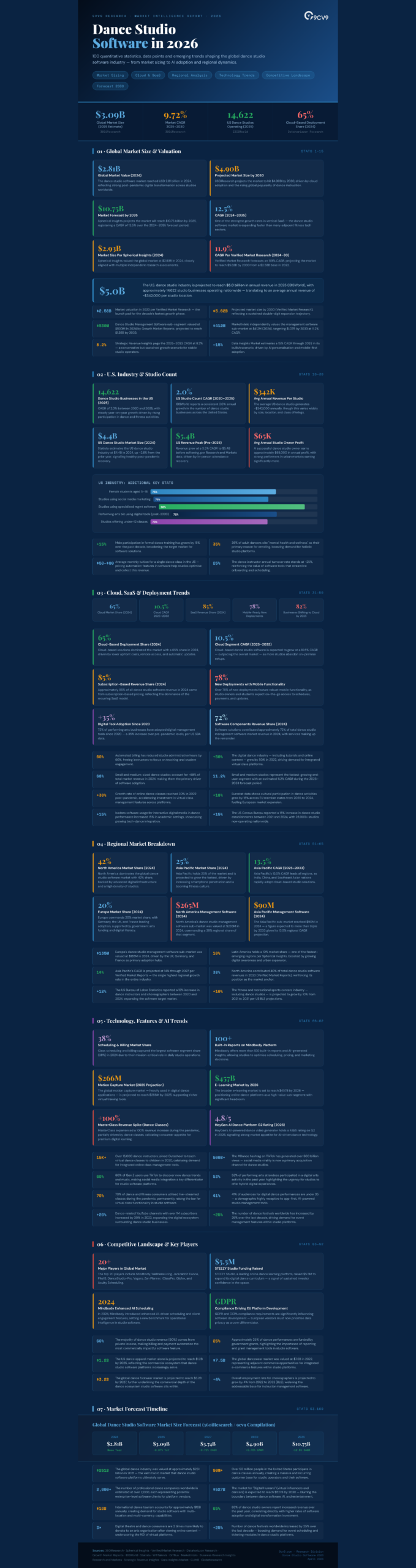
- $2.81 billion — Global dance studio software market value in 2024. The market has grown steadily from its pre-pandemic base, reflecting broad adoption of digital tools across studios worldwide.
- $3.09 billion — Projected global market size in 2025 per 360iResearch. This signals a near-10% year-on-year expansion, validating that the post-pandemic digital shift in dance education is structural, not cyclical.
- $4.90 billion — Projected global market size by 2030 (360iResearch). At a 9.72% CAGR, the dance studio software market is one of the fastest-growing vertical SaaS segments in the performing arts and fitness sectors.
- 9.72% — CAGR of the global dance studio software market from 2025 to 2030. This above-average SaaS growth rate reflects the acceleration of cloud adoption among independent studios and school-based programs.
- $2.93 billion — Market size in 2024 per Spherical Insights. Multiple independent research firms corroborate a sub-$3B valuation in 2024, suggesting consensus on the market’s current trajectory.
- $10.75 billion — Projected market size by 2035 per Spherical Insights. This more than threefold expansion underscores the long-term runway available to platform vendors targeting the global dance instruction economy.
- 12.5% — CAGR for 2024–2035 per Spherical Insights. This is one of the higher CAGR estimates and reflects scenarios where AI personalisation and hybrid class management drive accelerated platform adoption.
- $2.58 billion — Market size in 2023 per Verified Market Research. This serves as the baseline for forecasts projecting a doubling of the market by 2030 at an 11.9% CAGR.
- $5.62 billion — Projected market size by 2030 per Verified Market Research. In a higher-growth scenario driven by AI tools and global studio formation, the market may significantly exceed the consensus $4.9B estimate.
- 11.9% — CAGR 2024–2030 per Verified Market Research. This bullish scenario assumes continued acceleration of cloud migration and expansion of dance education in emerging markets.
- $2.58 billion — Global dancing studio software market valued at $2.58B in 2024 per Business Research Insights. Consistent multi-source valuation gives high confidence in current market sizing.
- 11.9% — CAGR for dancing studio software market from 2024 to 2033 per Business Research Insights. Studios transitioning from manual administration to automated platforms are a primary growth catalyst.
- $530 million — Dance Studio Management Software sub-market valued at $530M in 2024 per Growth Market Reports. This narrower segment highlights the portion of the broader market specifically dedicated to studio operations management.
- $1.35 billion — Projected sub-market size by 2033 per Growth Market Reports. At 11.2% CAGR, the management software sub-segment is growing faster than many adjacent HR or scheduling software verticals.
- $412 million — Independently valued at $412M in 2024 by MarketIntelo. Reaching $1.07B by 2033 at 11.2% CAGR — the management sub-segment is approaching the scale of a mid-sized SaaS industry.
🇺🇸 SECTION 2: U.S. Industry & Studio Count
- 14,622 — Number of dance studio businesses in the US in 2025 (IBISWorld). With a 2.0% annual growth rate, the sector has demonstrated remarkable resilience despite economic headwinds.
- 2.0% — CAGR of US dance studio business count from 2020 to 2025 (IBISWorld). Steady formation of new studio businesses creates a continuously expanding addressable market for software vendors.
- $5.0 billion — Projected total US dance studio industry revenue in 2025 (IBISWorld). This scale reflects dance instruction’s central role as a mainstream fitness, arts, and youth development activity.
- $342,000 — Average annual revenue per US dance studio in 2025 (CLIMB). Wide variance exists — urban premium studios may generate multiples of this, while smaller suburban operations earn less.
- $4.4 billion — US dance studio industry market size in 2024 per Statista, up ~2.6% from 2023. Consistent year-on-year revenue growth has returned following the pandemic recovery phase.
- $4.3 billion — Market size in 2023 per Statista. The compound growth between 2023 and 2025 reflects a re-acceleration phase, supported by rising youth dance enrollment.
- $5.4 billion — Peak US dance studio revenue reached via a 3.5% CAGR over recent years per Research and Markets. This figure demonstrates the industry’s robust recovery trajectory post-COVID.
- 3.5% — CAGR of US dance studio revenue over the last several years (Research and Markets). While lower than the software market’s CAGR, it underpins the continued commercial viability driving software investment.
- $65,000 — Average annual profit for a successful US dance studio owner (WifiTalents). Studio software that reduces administrative overhead directly improves this margin for owner-operators.
- $50–$80/month — Average monthly tuition for a single dance class in the US (WifiTalents). Automated billing tools within software platforms are critical for capturing this recurring revenue reliably.
- $50,000–$150,000 — Average cost to open a dance studio in the US (WifiTalents). This upfront investment range highlights why affordable SaaS pricing models are preferred over expensive on-premise software.
- 75% — Proportion of dance studio students who are female aged 5–18 (WifiTalents). This demographic insight should inform how studio software designs parent communication and student management features.
- +15% — Growth in male participation in formal dance training over the past decade (WifiTalents). Broadening demographics justify investment in gender-neutral marketing tools within studio platforms.
- 35% — Proportion of adult dance students citing “mental health and wellness” as their primary motivation (WifiTalents). Studios are increasingly positioning themselves as wellness businesses — a use case well-served by CRM and retention tools.
- 70% — Percentage of US dance studios using social media as their primary customer acquisition channel (WifiTalents). Integration with TikTok, Instagram, and similar platforms is becoming a non-negotiable feature for competitive studio software.
☁️ SECTION 3: Cloud, SaaS & Deployment Trends
- 65% — Cloud-based solutions’ market share in 2024 (Datahorizzon Research). Cloud dominance reflects studios’ preference for low upfront costs, remote accessibility, and automatic software updates.
- 10.5% — CAGR of cloud-based dance studio software from 2025 to 2033 (Datahorizzon Research). Cloud is growing faster than the overall market, as on-premise solutions increasingly lose ground to scalable alternatives.
- 85% — Subscription-based pricing’s share of total dance studio software revenue in 2024 (Datahorizzon Research). The SaaS model’s predictability aligns perfectly with studios’ month-to-month tuition revenue cycles.
- 78% — Proportion of new software deployments featuring robust mobile functionality in 2024 (Datahorizzon Research). Mobile-first design is no longer a differentiator — it is now the baseline expectation.
- 82% — Proportion of businesses expected to shift to cloud computing by 2025 per Verified Market Reports. This economy-wide trend directly accelerates adoption of cloud-based dance studio platforms.
- 72% — Proportion of performing arts businesses, including dance studios, that have adopted digital management tools since 2020 (US SBA via Datahorizzon Research). This represents a 35% increase versus pre-pandemic adoption levels.
- +35% — Increase in digital management tool adoption among performing arts businesses since 2020 (US SBA). The pandemic permanently altered the technology investment calculus for studio owners.
- 60% — Administrative hours saved through automated billing tools (WifiTalents). Automation ROI is one of the strongest adoption drivers for studio software, particularly for owner-operated businesses.
- +50% — Growth rate of the digital dance industry, including tutorials and online content, in 2022 (WifiTalents). This boom in online dance content creates recurring demand for platforms that integrate virtual class delivery.
- 68% — Proportion of total market revenue contributed by small and medium-sized dance studios in 2024 (MarketIntelo). SMBs are not just the majority of studios — they are the majority of revenue for software vendors.
- 11.2% — CAGR for the small and medium studio end-user segment from 2025 to 2033 (Datahorizzon Research). SMBs are growing their software spending faster than large studios, driven by cost-effective SaaS pricing.
- +30% — Growth rate of online dance classes in 2022 post-pandemic (WifiTalents). This growth solidified virtual class management as a permanent, revenue-generating feature for studio platforms.
- 72% — Software solutions’ contribution to total dance studio management software market revenue in 2024, vs. 28% from services (MarketIntelo). Core platform revenue dominates over implementation and consulting services.
- +18% — Growth in cultural participation in dance activities across EU member states from 2020 to 2024 (Eurostat via Datahorizzon Research). This surge underpins European studio expansion and justifies increased software investment.
- +15% — Increase in dance studio establishments in the US between 2021 and 2024 (US Census Bureau via Datahorizzon Research). A 15% expansion in studio count directly expands the addressable customer base for software vendors.
- 28,000+ — Dance studios currently operating in the US per US Census Bureau data. This figure, higher than IBISWorld’s narrower definition, reflects all fitness and recreational centres incorporating dance instruction.
- +12% — Increase in US dance instructors and choreographers between 2020 and 2024 (US BLS via Datahorizzon Research). More instructors means more complex scheduling needs — a core software value proposition.
- +10% — Projected growth in the US fitness and recreational sports centers industry from 2021 to 2031 (US BLS). Sustained industry growth provides a structural tailwind for dance studio software adoption.
- 80% — Proportion of dance performances now streamed online (WifiTalents). Live streaming integration is rapidly becoming an expected feature in studio platforms serving performance-oriented schools.
- +20% — Increase in dance-related YouTube channels with over 1M subscribers in 2023 (WifiTalents). Growing creator economies around dance generate new demand for content scheduling and publication tools.
🗺️ SECTION 4: Regional Market Breakdown
- 42% — North America’s share of the global dance studio software market in 2024 (Datahorizzon Research). Advanced digital infrastructure and a high density of studio businesses cement North America’s leadership position.
- 25% — Asia Pacific’s market share in 2024. The region is the second-largest market and the fastest-growing, driven by rising urbanisation, disposable income, and youth fitness culture.
- 13.5% — Asia Pacific’s CAGR from 2025 to 2033 (Growth Market Reports). This is the highest projected growth rate of any region, fuelled by India, China, and Southeast Asia’s rapid studio formation.
- 14% — Asia Pacific CAGR projected through 2027 per Verified Market Reports. Multiple sources confirm Asia Pacific’s acceleration, making it the priority region for platform expansion.
- 20% — Europe’s market share in 2024. Germany, the UK, and France lead adoption, supported by vibrant performing arts communities and strong digital literacy.
- 10% — Latin America’s market share in 2024. The region is an emerging growth market with increasing digital awareness and a strong cultural affinity for dance.
- 3% — Middle East & Africa’s current market share, representing the smallest but fastest-emerging region from a low base. Infrastructure investment and youth demographics are key growth drivers.
- $265 million — North America’s dance studio management software sub-market value in 2024 (Growth Market Reports). The region accounts for approximately 38% of the $530M management software segment.
- $135 million — Europe’s dance studio management software sub-market in 2024 (Growth Market Reports). Steady growth from this level is underpinned by ongoing digital infrastructure investment across the continent.
- $90 million — Asia Pacific’s management software sub-market in 2024. At the projected 13.5% CAGR, this segment could exceed $300M by 2033, making it the fastest-growing regional market in absolute terms.
- 38% — North America’s share of total dance studio software revenue in 2023 (Verified Market Reports). Consistent leadership across multiple years confirms North America’s role as the most mature market.
- $28 million — Latin America’s management software sub-market in 2024. While small today, growing studio formation and digital adoption suggest meaningful expansion over the forecast horizon.
- $12 million — MEA’s management software sub-market in 2024 (Growth Market Reports). The region’s low base means even moderate software adoption gains will produce high percentage growth rates.
- +18% — Cultural participation growth in dance across EU member states from 2020 to 2024 (Eurostat). This growing demand for dance instruction in Europe drives corresponding demand for efficient studio management tools.
- +10% — Projected growth in fitness and recreational centres in the US from 2021 to 2031 (US BLS). This industry-level growth rate creates a persistent flow of new studio businesses entering the software market.
💻 SECTION 5: Technology, Features & AI Trends
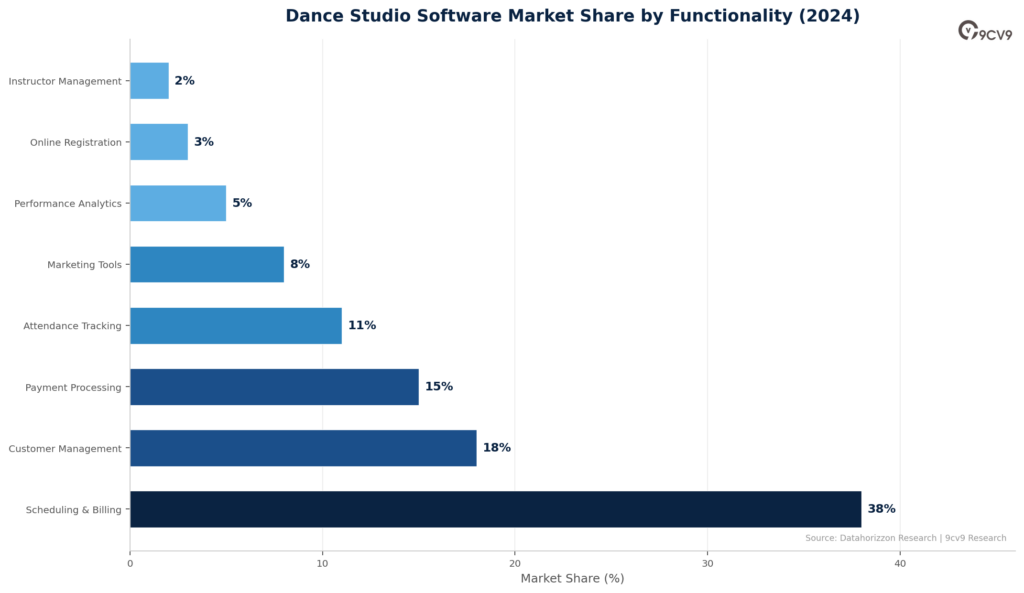
- 38% — Class scheduling and billing’s market share among all software functionalities in 2024 (Datahorizzon Research). As the most operationally critical feature, this segment has the highest monetisation and retention value.
- 18% — Customer management’s share of the functionality market in 2024. CRM capabilities are the second most important software feature, reflecting studios’ need to manage student relationships at scale.
- 15% — Payment processing functionality’s market share in 2024. Frictionless payment tools, including digital wallets and instalment plans, are a key differentiator among competing platforms.
- 100+ — Number of built-in reports and AI-generated insights in Mindbody’s platform (Mindbody). This depth of analytics is increasingly the standard expectation for studio owners seeking data-driven decisions.
- $266 million — Projected global motion capture market size by 2025 (GiTNux). Motion capture technology is increasingly being integrated into premium studio platforms for advanced choreography training.
- $457 billion — Projected global e-learning market size by 2026 (GiTNux/WifiTalents). Dance studio software platforms that offer integrated virtual learning tools are tapping into this massive sector’s growth.
- +100% — MasterClass revenue growth spike during the pandemic, driven partly by celebrity dance classes (GiTNux). This validated the demand for premium online dance instruction and influenced studio software roadmaps.
- $5.5 million — Funding raised by STEEZY Studio, a leading online dance learning platform (GiTNux). Investor interest in digital dance education confirms the segment’s commercial viability and growth potential.
- 15,000+ — Dance instructors who joined Outschool to teach virtual classes to children in 2020 (GiTNux). This rapid adoption of virtual teaching platforms demonstrates the long-term value of online class management features.
- 500 billion+ — Total views of the #Dance hashtag on TikTok (GiTNux). Social media virality is now the dominant discovery mechanism for dance studios — making platform integration with TikTok a strategic priority.
- 60% — Proportion of Gen Z users who use TikTok to discover new dance trends and music (GiTNux). Gen Z’s influence on enrollment trends makes social media and content marketing tools essential in studio software.
- 53% — Proportion of performing arts attendees who participated in a digital arts activity in the past year (GiTNux). Hybrid engagement is the new normal, requiring platforms to support both physical and digital studio experiences.
- 70% — Proportion of dance and fitness consumers who used live-streamed classes during the pandemic era (GiTNux). This usage pattern solidified virtual class features as a permanent software requirement, not just a pandemic workaround.
- 41% — Proportion of digital dance performance audiences under age 35 (GiTNux). Younger audiences are more likely to discover and engage with studios through digital channels — reinforcing the need for mobile-optimised platforms.
- 3× — Digital dance consumers are 3 times more likely to donate to an arts organisation after viewing online content (GiTNux). This finding supports studios investing in virtual class capabilities as a community engagement and fundraising tool.
- +15% — Growth in Isadora software usage for interactive digital media in dance performance in academic settings (GiTNux). AI-augmented performance technology is increasingly making its way into formal dance education institutions.
- 4.8/5 — HeyGen AI dance platform rating on G2 in 2026. The strong user satisfaction scores for AI dance generation tools signal growing market acceptance of AI as a creative and operational tool in the dance sector.
🏢 SECTION 6: Competitive Landscape & Key Players
- 20+ — Number of major players in the global dance studio software market including Mindbody, WellnessLiving, Jackrabbit Dance, Pike13, DanceStudio-Pro, Vagaro, Zen Planner, iClassPro, Glofox, and Acuity Scheduling. The fragmented landscape creates opportunities for differentiation on niche features and pricing.
- 2024 — Year Mindbody introduced enhanced AI scheduling and client engagement features. This milestone set a new benchmark for intelligent automation in dance studio operations and raised expectations across the vendor ecosystem.
- 2023 — Year DanceStudio-Pro introduced a dedicated virtual dance class feature. The integration of virtual tools into specialist platforms reflects the sector’s permanent pivot to hybrid teaching models.
- 2023 — Zen Planner launched a new mobile app specifically designed for dance studios in 2023, underscoring the industry-wide trend toward mobile-first platform development.
- GDPR + CCPA — The primary regulatory frameworks shaping European and North American dance studio software development. Compliance with these data protection laws is now a table-stakes requirement for platform vendors.
- 60% — Revenue share from private lessons as a proportion of total dance studio income (WifiTalents). The dominance of private lesson revenue underscores why billing, payment processing, and scheduling automation are the highest-ROI software features.
- 25% — Proportion of dance performances funded by government grants (WifiTalents). Grant management and financial reporting modules are increasingly valued by non-profit and community dance organisations.
- $1.2 billion — Projected size of the US dance apparel market by 2025 (CLIMB). Adjacent commerce integrations — such as in-app merchandise sales — represent an untapped revenue opportunity for dance studio platforms.
- $7.5 billion — Global dancewear market value in 2022 (WifiTalents). The scale of this adjacent market highlights opportunities for dance studio platforms to develop integrated e-commerce or affiliate features.
- $3.2 billion — Projected global dance footwear market by 2027 (WifiTalents). This reinforces the broader commercial ecosystem within which dance studio software operates and its monetisation adjacencies.
📊 SECTION 7: Market Forecasts & Macro Trends
- $251 billion — Estimated value of the global dance industry in 2021 (WifiTalents). The macro dance economy dwarfs the software market — representing a vast and largely untapped addressable opportunity for platform vendors.
- 50 million+ — Annual US dance class participants (WifiTalents). With over 50 million participants, the US alone generates a massive, recurring demand for studio services and the software that manages them.
- 2,000+ — Estimated number of professional dance companies worldwide (WifiTalents). Each represents a potential enterprise-level software client, particularly for companies offering multi-location and performance management features.
- $527 billion — Projected market for “Digital Humans” (virtual influencers and dancers) by 2030 (GiTNux). The convergence of dance, AI, and avatars will create entirely new categories of software demand not yet captured in current market estimates.
- $10 billion — Annual economic impact of international dance tourism (WifiTalents). Studios serving international students and performers will require software capable of handling multi-currency payments and diverse scheduling needs.
- 65% — Proportion of dance studio owners who report increased revenue over the past year (WifiTalents). The correlation between software adoption and revenue growth is a key selling proposition for platforms targeting growth-oriented studios.
- +4% — Projected employment growth for choreographers from 2022 to 2032 (BLS). This workforce expansion directly increases the number of studio relationships and scheduling complexity that management software must handle.
- +25% — Increase in the number of dance festivals worldwide over the last decade (WifiTalents). Festival and event management capabilities — including ticketing, scheduling, and student roster management — are becoming increasingly important differentiators among studio software platforms.
Conclusion
As the data throughout this report clearly demonstrates, the dance studio software industry is no longer a niche segment serving only administrative needs. It has evolved into a rapidly expanding vertical Software-as-a-Service (SaaS) market that sits at the intersection of performing arts, education, fitness, artificial intelligence, cloud computing, and digital business transformation. With multiple research firms consistently valuing the global market at approximately $2.6–2.9 billion today and forecasting growth toward $4.9 billion by 2030—or potentially more than $10 billion by 2035 under accelerated adoption scenarios—the industry’s long-term outlook remains exceptionally strong. Double-digit compound annual growth rates reported across multiple market studies highlight the sustained demand for technology that enables dance studios to operate more efficiently, deliver superior student experiences, and scale their businesses in an increasingly digital economy.
One of the most significant themes emerging from these statistics is the continued shift toward cloud-first business operations. Cloud-based deployments now dominate the market, subscription pricing has become the preferred commercial model, and mobile accessibility is rapidly becoming a standard expectation rather than a premium feature. Dance studios increasingly expect software that can automate scheduling, attendance, tuition billing, communication, reporting, and customer relationship management while remaining accessible from any device. This migration away from manual processes and legacy desktop systems reflects broader digital transformation trends affecting small businesses worldwide and positions dance studio software vendors to benefit from long-term recurring SaaS revenue models.
Automation continues to deliver measurable business value for studio owners. Administrative processes that previously required hours of manual effort are now streamlined through integrated workflows that save significant operational time while reducing errors and improving customer satisfaction. Automated billing, online registration, digital payment processing, attendance tracking, instructor scheduling, and CRM capabilities allow studios to spend less time managing paperwork and more time focusing on instruction, choreography, performance development, and community building. For independent studio owners operating with limited administrative resources, these productivity improvements translate directly into stronger financial performance and improved scalability.
The statistics also reveal that the customer experience is becoming a primary competitive differentiator. Parents, students, and instructors increasingly expect intuitive digital experiences that include online enrollment, instant notifications, self-service portals, mobile applications, digital waivers, recurring payment options, virtual classes, and real-time communication. Studios that embrace modern software platforms are better positioned to meet these expectations while strengthening retention, increasing operational transparency, and building stronger long-term relationships with their communities. As customer expectations continue evolving alongside consumer technology, software usability will become just as important as feature depth.
Artificial intelligence represents the next major growth catalyst for the industry. AI-powered scheduling, predictive analytics, intelligent reporting, automated customer engagement, business forecasting, and personalized learning recommendations are rapidly moving from experimental innovations to mainstream capabilities. Software providers are increasingly differentiating themselves through intelligent automation that helps studio owners make faster, more informed business decisions rather than simply digitizing existing administrative workflows. As AI technologies continue to mature, dance studio software will likely become significantly more proactive, offering predictive insights that improve retention, optimize scheduling, forecast enrollment trends, and identify revenue opportunities before problems emerge.
Hybrid learning has also permanently reshaped the industry’s technology requirements. The rapid adoption of virtual classes, livestream performances, digital choreography, online tutorials, and hybrid education models demonstrates that digital experiences are no longer temporary responses to extraordinary circumstances. Instead, they have become permanent revenue streams that complement traditional in-person instruction. Future software platforms will increasingly integrate livestreaming, on-demand content libraries, online performance management, digital certifications, and creator-economy tools to help studios diversify income sources and reach audiences beyond their physical locations.
Regional market trends further reinforce the industry’s promising future. North America continues to lead global adoption due to its mature dance ecosystem and advanced digital infrastructure, while Asia-Pacific is emerging as the fastest-growing region thanks to expanding middle-class populations, increasing youth participation in dance, rising disposable incomes, and accelerating digital transformation. Europe maintains steady growth supported by strong cultural investment and performing arts participation. These regional dynamics create substantial opportunities for software vendors seeking international expansion while highlighting the importance of localized features, multilingual support, regional payment systems, and compliance with local regulatory frameworks.
The competitive landscape is also becoming more sophisticated. Traditional studio management platforms are expanding their capabilities to include advanced CRM systems, integrated payment processing, marketing automation, analytics dashboards, AI-powered insights, virtual learning tools, merchandise management, event ticketing, and ecosystem integrations. As feature parity increases across established vendors, future competition is likely to focus on customer experience, intelligent automation, interoperability, pricing flexibility, implementation simplicity, and measurable business outcomes rather than simply offering larger feature lists.
Another important insight from these statistics is the resilience of the broader dance economy itself. Millions of students continue participating in dance education, thousands of studios operate across global markets, and adjacent industries—including dancewear, footwear, digital content, online education, live performances, motion capture technology, and creator platforms—continue expanding. This broader ecosystem creates additional opportunities for software providers to build integrated platforms that extend beyond studio management into commerce, marketing, education, fundraising, performance management, and community engagement. The convergence of these adjacent markets suggests that the next generation of dance studio software will become increasingly comprehensive, supporting nearly every aspect of studio operations and business growth.
Looking ahead, the future of dance studio software will likely be defined by intelligent automation, predictive analytics, personalized learning experiences, mobile-first interfaces, deeper AI integration, stronger cybersecurity, seamless third-party integrations, and increasingly data-driven decision-making. Studio owners who embrace these innovations will be better equipped to improve operational efficiency, increase student retention, strengthen instructor productivity, diversify revenue streams, and compete in a marketplace where digital excellence is becoming a fundamental expectation rather than a competitive advantage.
Ultimately, the 100 statistics presented throughout this report paint a remarkably consistent picture. The dance studio software industry is experiencing sustained global expansion, driven by structural shifts in technology adoption rather than temporary market conditions. Cloud computing, SaaS pricing, artificial intelligence, hybrid learning, automation, mobile accessibility, and digital customer engagement are collectively transforming how dance businesses operate around the world. For software vendors, investors, entrepreneurs, consultants, and dance studio owners alike, understanding these trends is essential for making informed strategic decisions over the coming years.
As digital transformation accelerates across the performing arts sector, dance studio software will continue evolving from an operational management tool into the central technology platform that powers student engagement, instructor collaboration, financial management, business intelligence, marketing, and long-term organizational growth. Organizations that invest early in scalable, intelligent, and user-friendly software solutions will be best positioned to capitalize on the industry’s next phase of innovation, while those that delay modernization risk falling behind in an increasingly technology-driven marketplace. The statistics featured in this report provide a comprehensive benchmark for understanding today’s market while offering valuable insight into where one of the performing arts industry’s fastest-growing software sectors is heading throughout the remainder of the decade.
If you find this article useful, why not share it with your hiring manager and C-level suite friends and also leave a nice comment below?
We, at the 9cv9 Research Team, strive to bring the latest and most meaningful data, guides, and statistics to your doorstep.
To get access to top-quality guides, click over to 9cv9 Blog.
To hire top talents using our modern AI-powered recruitment agency, find out more at 9cv9 Modern AI-Powered Recruitment Agency.
People Also Ask
What is dance studio software?
Dance studio software is a platform that helps studios manage class scheduling, student enrollment, attendance, billing, payments, communication, reporting, and marketing from a single system.
How large is the global dance studio software market in 2026?
The market is valued at several billion dollars and continues to grow steadily, driven by cloud computing, SaaS adoption, mobile technology, and AI-powered business management tools.
What is driving the growth of the dance studio software market?
Key drivers include digital transformation, automated administration, online payments, mobile apps, AI features, virtual classes, and increasing demand for efficient studio management.
Why are dance studios adopting cloud-based software?
Cloud software offers remote access, automatic updates, improved security, lower upfront costs, easy scalability, and seamless collaboration for studio owners and instructors.
How does dance studio software improve business efficiency?
It automates scheduling, billing, attendance, communication, and reporting, reducing administrative workload while allowing instructors to focus more on teaching.
What are the most important features of dance studio software?
Popular features include class scheduling, online registration, payment processing, attendance tracking, CRM, reporting, mobile apps, instructor management, and marketing automation.
How is AI changing dance studio software?
AI helps automate scheduling, generate business insights, predict enrollment trends, improve customer communication, and enhance operational decision-making.
Why is SaaS popular in the dance studio software industry?
SaaS provides affordable subscription pricing, continuous software updates, cloud accessibility, and flexible scaling without requiring expensive infrastructure.
Which regions lead the dance studio software market?
North America remains the largest market, while Asia-Pacific is experiencing the fastest growth due to increasing dance participation and digital adoption.
How does dance studio software support online classes?
Many platforms offer livestreaming, virtual classrooms, video libraries, digital content delivery, and hybrid learning capabilities alongside in-person class management.
What role does mobile technology play in dance studio software?
Mobile apps allow students and parents to register for classes, make payments, receive notifications, and manage schedules from anywhere.
How does dance studio software improve customer experience?
It simplifies enrollment, enables online payments, automates reminders, provides self-service portals, and improves communication between studios and families.
Can small dance studios benefit from management software?
Yes. Small studios often gain the greatest benefits through automation, reduced administrative work, improved organization, and better financial management.
What payment features are commonly included in dance studio software?
Most platforms support recurring tuition payments, online invoices, payment reminders, digital receipts, and integrations with popular payment processors.
How important is CRM in dance studio software?
CRM helps studios manage leads, communicate with students, retain customers, and automate marketing campaigns to improve enrollment and retention.
How does dance studio software help increase revenue?
Automation, improved customer retention, online bookings, upselling opportunities, and better financial visibility contribute to stronger revenue growth.
What role does reporting play in dance studio software?
Reporting dashboards provide insights into enrollment, revenue, attendance, instructor performance, customer retention, and overall business performance.
Is cybersecurity important for dance studio software?
Yes. Secure cloud platforms help protect student information, payment data, business records, and customer privacy through modern security practices.
How has the pandemic affected dance studio software adoption?
The pandemic accelerated digital transformation by increasing demand for online classes, hybrid learning, automated communication, and cloud-based management systems.
Why is automation becoming essential for dance studios?
Automation reduces repetitive administrative tasks, minimizes human error, improves operational efficiency, and saves valuable staff time.
What trends are shaping dance studio software in 2026?
Major trends include AI integration, cloud migration, mobile-first platforms, virtual classes, business analytics, workflow automation, and personalized customer experiences.
How does dance studio software support instructors?
It manages schedules, attendance, payroll, student records, communication, and lesson planning while reducing administrative responsibilities.
What is the difference between cloud and on-premise dance studio software?
Cloud software is accessed online with automatic updates, while on-premise software is installed locally and usually requires manual maintenance.
How do analytics help dance studio owners?
Analytics identify enrollment patterns, revenue trends, student retention, class popularity, and operational performance to support data-driven decisions.
Can dance studio software integrate with other business tools?
Yes. Many platforms integrate with accounting software, payment gateways, email marketing tools, calendars, CRM systems, and virtual meeting platforms.
How competitive is the dance studio software market?
The market is highly competitive, with vendors differentiating themselves through AI capabilities, mobile experiences, automation, reporting, and customer support.
What industries overlap with dance studio software?
Dance studio software intersects with fitness management, performing arts, education technology, event management, CRM, SaaS, and digital payment industries.
What should studio owners consider when choosing dance studio software?
They should evaluate pricing, scalability, automation features, mobile access, integrations, security, reporting capabilities, customer support, and ease of use.
What is the long-term outlook for the dance studio software market?
The market is expected to continue expanding as studios invest in AI, cloud computing, automation, mobile technologies, and digital customer engagement.
Why should businesses monitor dance studio software statistics?
Industry statistics help studio owners, software vendors, investors, and analysts understand market growth, technology trends, competitive dynamics, and future business opportunities.
Sources
360iResearch Spherical Insights Verified Market Research Verified Market Reports Datahorizzon Research Growth Market Reports MarketIntelo IBISWorld Statista Research and Markets Strategic Revenue Insights Data Insights Market Business Research Insights CLIMB WifiTalents GiTNux GlobeNewswire Mindbody