

























Key Takeaways
- The customer experience software market is expanding rapidly in 2026, driven by AI, automation, omnichannel engagement, and rising customer expectations, making CX technology a critical investment for businesses worldwide.
- Artificial intelligence is transforming customer experience, enabling faster support, hyper-personalization, predictive analytics, and higher ROI while improving customer satisfaction, loyalty, and operational efficiency.
- The latest customer experience software statistics and trends reveal that organizations prioritizing CX innovation consistently outperform competitors in customer retention, revenue growth, and long-term business success.
Customer experience software helps businesses improve customer satisfaction, automate support, personalize interactions, and increase customer loyalty using AI and data-driven insights. This guide explores the top 100 customer experience software statistics, data, and trends in 2026 to help organizations make smarter technology investments and stay competitive in an increasingly customer-centric marketplace.
Customer experience has evolved from being a competitive differentiator into one of the most influential drivers of business growth, customer loyalty, and long-term profitability. In 2026, organizations across every industry—from SaaS and financial services to healthcare, retail, manufacturing, telecommunications, and hospitality—are investing heavily in customer experience (CX) software to meet rising customer expectations, streamline service operations, and unlock new revenue opportunities. As digital transformation accelerates and artificial intelligence reshapes customer interactions, businesses are increasingly recognizing that delivering exceptional customer experiences is no longer optional—it is essential for survival in an increasingly competitive marketplace.
Also, read our guide on the Top 10 Best Customer Experience Software.

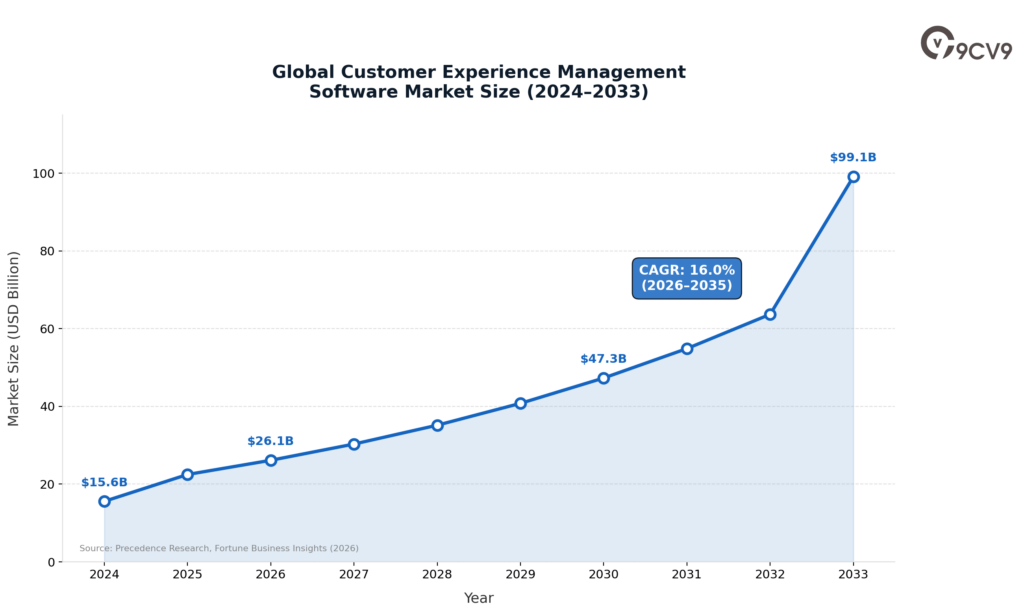
The numbers behind this transformation are remarkable. The global customer experience management software market is projected to reach approximately $26.11 billion in 2026, while long-term forecasts suggest the industry could expand to nearly $99.08 billion by 2035, supported by a sustained compound annual growth rate of around 16%. Independent market research firms also estimate that the CX software market will surpass $47.72 billion by 2033, reinforcing the strong consensus that customer experience technology remains one of the fastest-growing enterprise software categories worldwide. These projections demonstrate that organizations are making customer experience one of their highest strategic technology priorities for the coming decade.
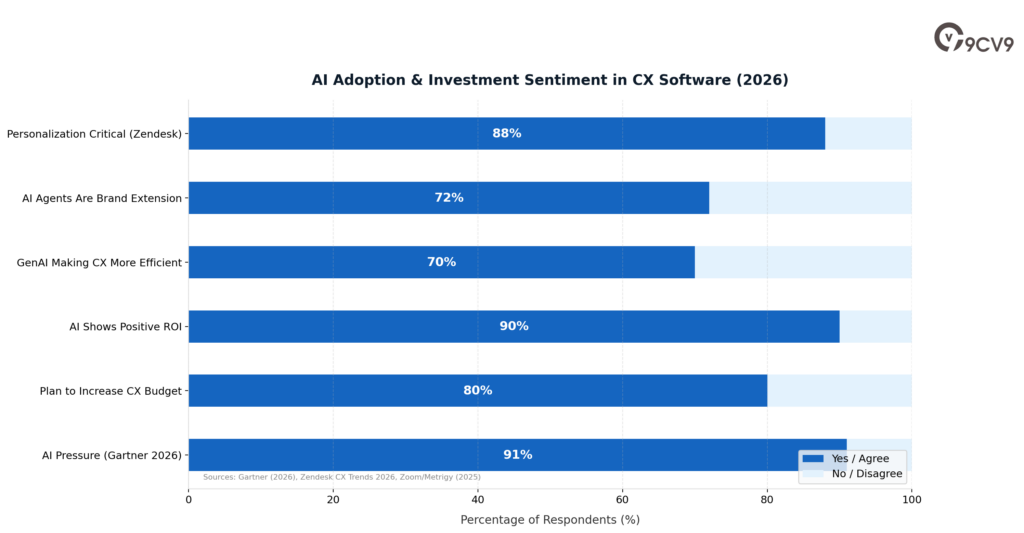
Artificial intelligence sits at the center of this transformation. What was once considered an experimental capability has rapidly become a business necessity. In 2026, 91% of customer experience leaders report facing executive pressure to implement AI solutions, highlighting a dramatic shift from AI experimentation toward enterprise-wide deployment. Businesses are no longer investing in AI solely to reduce costs—they are deploying intelligent automation to improve customer satisfaction, accelerate response times, personalize interactions, predict customer behavior, and increase employee productivity. This evolution is fundamentally changing how organizations engage with customers across every touchpoint.
Investment trends further illustrate the strategic importance of customer experience technology. Approximately 80% of organizations plan to increase their CX budgets during the coming year, reflecting growing executive confidence that customer experience delivers measurable business outcomes. Even more compelling, 90% of CX leaders report achieving positive returns from AI investments, while organizations implementing structured customer experience initiatives increasingly experience measurable ROI within just a few years. Early adopters of AI-powered CX platforms are also significantly outperforming competitors, with many reporting substantially higher returns compared to organizations that delayed digital transformation initiatives.
The financial implications of customer experience extend well beyond customer satisfaction metrics. Leading customer experience organizations consistently outperform lagging competitors in revenue growth, profitability, and customer retention. Research increasingly shows that customer experience quality has become a measurable contributor to enterprise value, influencing everything from recurring revenue and pricing power to shareholder confidence and long-term market performance. Organizations aligning customer experience with broader brand strategies are unlocking significantly greater revenue growth, while even modest improvements in customer retention continue to generate substantial profit increases across industries.
Conversely, poor customer experiences have become extraordinarily expensive. Businesses continue to lose billions of dollars annually due to customer churn, ineffective support operations, and poor service quality. Customers today have more alternatives than ever before, and their willingness to switch brands after negative experiences continues to increase. Studies consistently show that more than half of consumers permanently stop purchasing from companies after poor customer experiences, while many customers abandon brands after only a handful of disappointing interactions. These trends emphasize why organizations are increasingly viewing customer experience software as a revenue protection investment rather than simply another operational expense.
Modern customer expectations have also undergone a dramatic transformation. Consumers now expect immediate responses, personalized recommendations, seamless omnichannel interactions, and intelligent AI-powered assistance available around the clock. Customers increasingly demand that businesses remember previous conversations, maintain context across communication channels, and eliminate the frustration of repeatedly explaining the same issues to different service representatives. Organizations unable to deliver these expectations risk losing customers to competitors offering more intelligent, responsive, and personalized digital experiences.
This growing demand has fueled rapid innovation across the customer experience software landscape. Today’s leading platforms combine customer relationship management (CRM), help desk automation, AI-powered virtual agents, knowledge management systems, omnichannel messaging, analytics, workflow automation, customer journey orchestration, sentiment analysis, predictive intelligence, and conversational AI into unified ecosystems. Rather than relying on disconnected software solutions, enterprises increasingly prefer integrated customer experience platforms capable of delivering consistent experiences across websites, mobile applications, social media, email, voice, messaging apps, and physical locations.
One of the defining trends of 2026 is the explosive rise of generative AI and autonomous AI agents within customer support environments. AI copilots now assist human service representatives by drafting responses, retrieving knowledge instantly, summarizing conversations, recommending next-best actions, and automating repetitive administrative tasks. At the same time, autonomous AI agents are beginning to resolve increasingly complex customer inquiries without human intervention. Industry analysts predict that AI will handle the overwhelming majority of routine customer service interactions over the coming years, significantly reducing operational costs while improving service availability and response speed.
Omnichannel engagement has emerged as another defining characteristic of successful customer experience strategies. Businesses are increasingly integrating live chat, messaging platforms, email, phone support, social media, mobile applications, self-service portals, and AI assistants into unified customer journeys. Organizations with mature omnichannel capabilities consistently achieve dramatically higher customer retention, stronger engagement, and faster revenue growth than companies relying on fragmented communication channels. As customer journeys become increasingly digital and interconnected, seamless omnichannel experiences are rapidly becoming a baseline expectation rather than a premium feature.
Personalization has similarly evolved into a core business requirement. Consumers increasingly expect businesses to understand their preferences, remember prior interactions, anticipate future needs, and deliver highly relevant recommendations throughout every stage of the customer lifecycle. Companies successfully implementing AI-driven personalization strategies are reporting stronger customer loyalty, higher conversion rates, improved retention, lower acquisition costs, and significantly greater revenue growth than organizations delivering generic customer experiences. As AI technologies become more sophisticated, hyper-personalization is expected to become one of the most important competitive advantages available to modern enterprises.
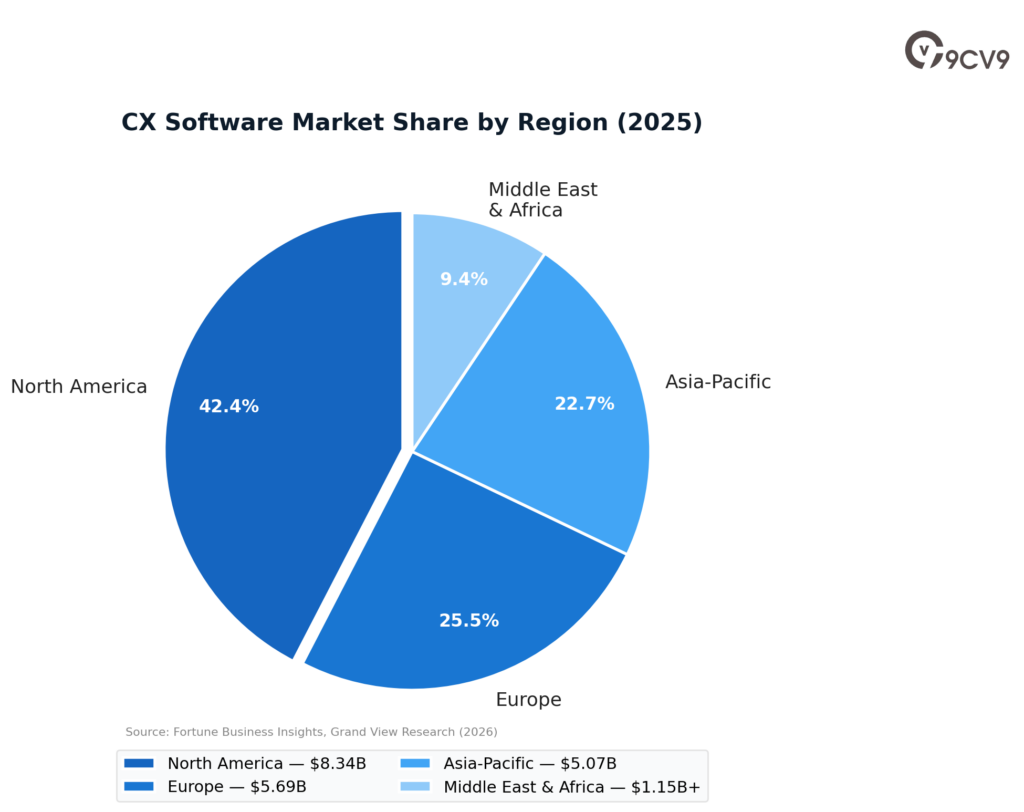
Regional investment patterns further highlight the worldwide importance of customer experience software. North America remains the largest CX software market, supported by mature digital infrastructure, widespread AI adoption, and a strong ecosystem of enterprise software vendors. Meanwhile, Asia-Pacific continues to emerge as the fastest-growing region, driven by accelerating digital transformation initiatives, expanding e-commerce ecosystems, government-supported innovation programs, and rapidly increasing consumer expectations across countries including China, Japan, India, Singapore, and Southeast Asia. This regional expansion illustrates that customer experience has become a truly global strategic priority rather than a trend limited to developed economies.
Organizations are also expanding their investments beyond customer-facing technologies to include analytics, predictive intelligence, employee experience, workflow integration, and customer feedback management. Companies increasingly recognize that exceptional customer experiences depend upon empowered employees, unified customer data, advanced analytics, and continuous operational improvement. Predictive customer experience platforms now enable organizations to identify customer dissatisfaction before it results in churn, while AI-powered analytics uncover valuable insights from millions of customer interactions that would previously have remained hidden.
The competitive landscape is becoming equally dynamic. Established enterprise software leaders continue expanding their customer experience capabilities through AI innovation, while specialized CX startups attract significant venture capital funding to develop next-generation conversational AI, customer intelligence, and automation platforms. This accelerating pace of innovation ensures that organizations have more software choices than ever before, making it increasingly important to understand the latest market trends, adoption patterns, customer expectations, investment priorities, and technology developments before selecting a customer experience solution.
Against this rapidly evolving backdrop, statistics have become indispensable for executives, investors, IT leaders, customer service managers, marketers, product teams, consultants, and digital transformation professionals seeking to make informed technology decisions. Reliable data helps organizations benchmark performance, justify investments, prioritize innovation initiatives, identify emerging opportunities, and better understand the direction of the customer experience software industry.
This comprehensive guide presents the Top 100 Customer Experience Software Statistics, Data & Trends in 2026, bringing together the latest research, market intelligence, AI adoption figures, customer behavior insights, investment trends, ROI benchmarks, and industry forecasts from leading research firms and technology organizations. Whether you are evaluating customer experience platforms, building an AI-powered service strategy, planning digital transformation initiatives, improving customer retention, or simply staying informed about one of the fastest-growing enterprise software markets, these carefully curated statistics provide an authoritative snapshot of where the customer experience software industry stands today—and where it is heading in the years ahead.
Before we venture further into this article, we would like to share who we are and what we do.
About 9cv9
9cv9 is a business tech startup based in Singapore and Asia, with a strong presence all over the world.
With over ten years of startup and business experience, and being highly involved in connecting with thousands of companies and startups, the 9cv9 team has listed some important and crucial software tools in this review.
If you like to get your company listed in our top B2B software reviews, check out our world-class 9cv9 Media and PR service and pricing plans here.
Top 100 Customer Experience Software Statistics, Data & Trends in 2026
🌍 Market Size & Growth
1. $26.11B — Global CX Management Software Market Size in 2026
The global customer experience management software market is projected to reach $26.11 billion in 2026, reflecting the accelerating enterprise recognition that delivering exceptional customer experiences is no longer optional but a core competitive strategy. (Fortune Business Insights, 2026)
2. $99.08B — Projected CX Management Market by 2035
The CX management software market is forecast to reach nearly $100 billion by 2035, driven by relentless AI investment, rising digital expectations, and the convergence of CRM, analytics, and automation into unified platforms. (Precedence Research, Feb 2026)
3. 16.0% CAGR — CX Management Software Growth Rate (2026–2035)
With a 16% compound annual growth rate, customer experience software ranks among the fastest-growing enterprise technology categories — outpacing general software spending growth and reflecting the strategic prioritization of CX at the board level. (Precedence Research, 2026)
4. $47.72B — Projected CX Market by 2033 (Grand View Research)
Grand View Research’s independent forecast of $47.72 billion by 2033 validates the sustained investment trajectory, with AI-powered personalization, journey orchestration, and omnichannel capabilities cited as primary growth catalysts. (Grand View Research, 2026)
5. 15.2% CAGR — CX Management Market 2026–2033
A consistent mid-teens CAGR across multiple research bodies confirms that the CX software market is in a sustained growth phase, not a hype cycle — making it a reliable long-term investment category for enterprise technology buyers. (Grand View Research, 2026)
6. 42.4% — North America’s CX Market Share in 2025
North America commands the largest share of the global CX software market, underpinned by mature digital ecosystems, a strong CX vendor landscape (Salesforce, Zendesk, Genesys, Qualtrics), and the region’s tendency to treat CX as a board-level KPI. (Grand View Research, 2026)
7. $8.34B — North America CX Market Value in 2025
The North American CX market generated $8.34 billion in 2025, with the United States accounting for 82.8% of the regional total — reflecting the country’s early and deep adoption of AI-powered customer engagement platforms. (Fortune Business Insights, 2026)
8. $9.91B — North America CX Market Value in 2026
North America’s CX market is expanding to $9.91 billion in 2026, driven by aggressive AI deployment, CRM modernization initiatives, and the pressure on customer service leaders to demonstrate measurable ROI from technology investment. (Fortune Business Insights, 2026)
9. 22.7% — Asia-Pacific CX Market Share in 2025
Asia-Pacific holds nearly a quarter of the global CX software market and is forecast to grow faster than any other region through 2035, led by China, Japan, India, and rapidly digitalizing Southeast Asian economies. (Fortune Business Insights, 2026)
10. 18%+ YoY — Asia-Pacific CX Software Investment Growth Rate
Asia-Pacific’s year-over-year CX software investment growth exceeds 18%, fueled by government digital transformation initiatives in Singapore, India, and Japan, expanding e-commerce, and surging consumer demand for mobile-first service experiences. (Market Reports World, 2026)
🤖 AI Adoption & Technology Investment
11. 91% — CX Leaders Under Pressure to Implement AI in 2026
A Gartner survey of 321 customer service leaders found that 91% face executive pressure to deploy AI — not just for cost efficiency but to directly improve customer satisfaction — marking a definitive shift from AI experimentation to AI obligation. (Gartner, Feb 2026)
12. 80% — Companies Planning to Increase CX Investment
Eight in ten businesses plan to increase their customer experience budgets in the coming year, signaling that CX has permanently graduated from a discretionary spend to a recurring strategic investment across industries. (Zendesk CX Trends 2026)
13. 90% — CX Leaders Reporting Positive AI ROI
Nine out of ten CX leaders report positive return on investment from AI tools deployed for customer service agents, making AI in CX one of the highest-ROI enterprise technology categories of the current decade. (Zendesk, 2025)
14. $3.50 per $1 — Average Return from AI-Powered CX Investment
For every dollar spent on AI customer service implementation, businesses are generating $3.50 in returns — a 3.5× ROI ratio that makes AI-driven CX one of the most compelling technology investments available to service organizations. (Crescendo AI, cited 2026)
15. 94% — Organizations Seeing CX Investment ROI Within 5 Years
Nearly all organizations that have invested in structured CX programs report measurable returns within five years, validating the business case for sustained CX spending and challenging the notion that CX benefits are intangible or hard to quantify. (Nextiva State of CX, 2026)
16. 128% More Likely — Early AI Adopters Reporting High CX ROI
Organizations that adopted AI-powered CX tools early are 128% more likely to report high ROI compared to late adopters, creating a compounding competitive advantage that widens the gap between CX leaders and laggards over time. (Zendesk CX Trends, 2026)
17. 6× Revenue Growth — CX Leaders vs. Laggards
Top-quartile CX performers deliver approximately six times the revenue growth of bottom-quartile peers, according to Forrester’s CX Index 2026 — establishing customer experience quality as one of the most potent predictors of long-term financial performance. (Forrester CX Index 2026)
18. 14% — Revenue Variance Attributed to CX Quality (S&P 500)
Among S&P 500 companies, 14% of revenue variance is now directly attributable to CX quality — up from 9% in 2023 — indicating that CX excellence has become a measurable driver of stock performance and investor confidence. (Forrester CX Index 2026)
19. 3× Return — Typical CX Investment ROI Within 24 Months
The typical CX technology investment returns 3× within 24 months, with the fastest returns concentrated in organizations that have unified their CRM, service, and AI agent infrastructure rather than operating fragmented point solutions. (Forrester CX Index 2026)
20. 3.5× Revenue — Aligning CX + Brand Experience
Brands that strategically align their customer experience (CX) with their brand experience (BX) can unlock up to 3.5 times greater revenue growth — making experience integration a priority for CMOs and CCOs seeking measurable commercial impact. (Forrester Total Experience Score)
21. 25–95% Profit Lift — From a 5% Retention Improvement
Bain & Company’s foundational research — confirmed again in 2026 — shows that a mere 5-percentage-point improvement in customer retention drives 25% to 95% profit growth, with subscription and SaaS businesses clustering at the upper end of that range. (Bain & Company, 2026)
22. $75B Lost Annually — US Revenue from Poor Customer Service
American businesses lose an estimated $75 billion per year due to poor customer service through customer churn and lost sales — a figure that powerfully quantifies the cost of underinvestment in customer experience capabilities. (Pylon, 2025)
23. $1.6 Trillion Lost/Year — Global Revenue from Customer Churn
Globally, customer churn costs businesses $1.6 trillion annually — a number larger than the GDP of most countries — underscoring that every investment in retention-driving CX software is competing against a catastrophically expensive alternative. (Accenture, cited 2025)
📞 Channel Preference & Self-Service
24. 45% — Live Chat Share of All CX Interactions in 2026
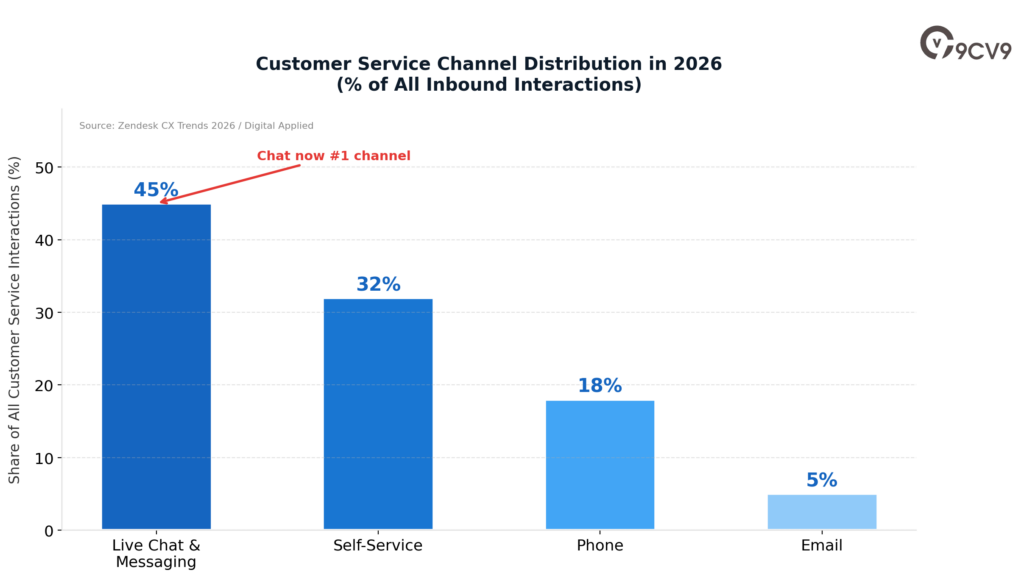
Live chat and messaging now account for 45% of all inbound customer service interactions — the single largest channel — surpassing self-service, phone, and email, driven by AI agent capabilities that enable sub-minute chat resolution at scale. (Zendesk CX Trends 2026)
25. 32% — Self-Service Share of Customer Service Interactions
Self-service now handles nearly a third of all customer service interactions, reflecting a significant behavioral shift as AI-powered knowledge bases and chatbots become sophisticated enough to resolve complex issues without human escalation. (Zendesk CX Trends 2026)
26. 83% of CX Leaders — Memory-Rich AI Is Key to Personalization
An overwhelming majority of CX leaders identify memory-rich AI agents — those that carry context, preferences, and interaction history across channels — as the critical enabler of truly personalized and seamless customer journeys in 2026. (Zendesk CX Trends 2026)
27. 85% of CX Leaders — Customers Drop Brands Over Unresolved First-Contact Issues
According to Zendesk’s 2026 research, 85% of CX leaders acknowledge that customers will abandon a brand entirely if an issue isn’t resolved on the first contact — raising the stakes for AI-assisted first-contact resolution capabilities. (Zendesk CX Trends 2026)
28. 74% of Consumers — Frustrated by Repeating Information to Agents
Nearly three-quarters of consumers express frustration when required to repeat their story to different agents or across different channels — a pain point that unified customer data platforms and persistent AI context are directly designed to solve. (Zendesk CX Trends 2026)
29. 76% Would Choose — Brands Supporting Multimedia Threaded Support
Three in four customers say they would actively choose a company that lets them share text, images, and video within a single support thread — indicating that multimodal, context-rich support is becoming a purchasing differentiator. (Zendesk CX Trends 2026)
30. 83% of Consumers — Believe the Customer Journey Should Be Improved
A striking 83% of consumers globally believe the customer journey should be significantly improved, revealing a persistent gap between current CX delivery and customer expectations that AI personalization and automation are racing to close. (Zendesk CX Trends 2026)
🔗 Omnichannel & Personalization
31. 89% Retention — Strong Omnichannel Strategy Firms
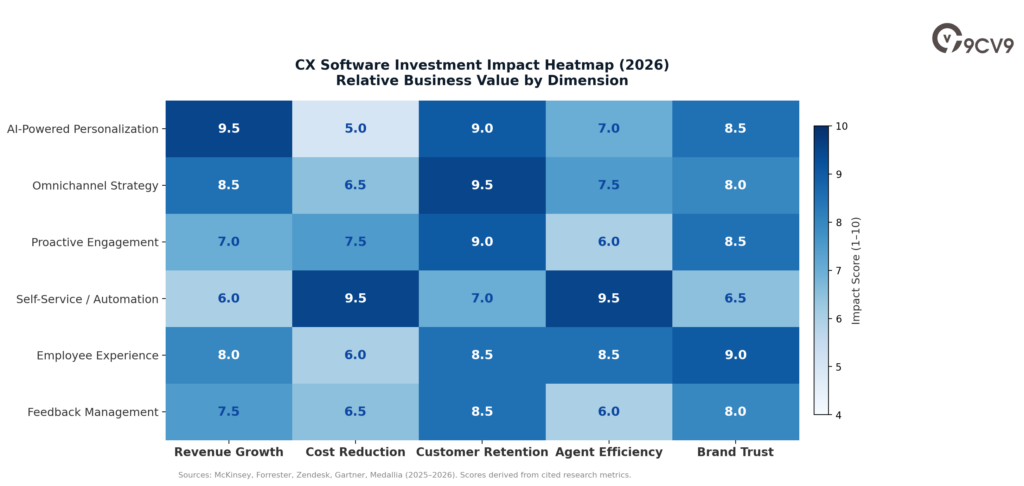
Companies with highly effective omnichannel customer engagement strategies retain 89% of their customers, compared to just 33% for those with weak strategies — a 56-percentage-point retention gap that makes omnichannel investment among the highest-return CX decisions available. (Aberdeen Group, 2025)
32. 250% Higher — Engagement Rate in Omnichannel vs. Single-Channel
Customer engagement and purchase rates are 250% higher in omnichannel campaigns versus single-channel approaches — a differential that reflects the compounding value of meeting customers on their preferred channel at the right moment. (Wisernotify, 2025)
33. 9.5% Revenue Growth — Strong Omnichannel Companies
Companies with highly effective omnichannel engagement experience 9.5% annual revenue growth compared to significantly lower rates for their peers, confirming that omnichannel strategy is a direct revenue lever rather than a purely operational concern. (Nextiva, cited 2025)
34. 40% More Revenue — Personalization for Faster-Growing Companies
Faster-growing companies generate 40% more revenue from personalization than their slower-growing counterparts, according to McKinsey — establishing personalization capability as a distinguishing feature of high-performance CX organizations. (McKinsey & Company, 2025)
35. 88% of CX Leaders — Personalized Experiences Are Business-Critical
Nearly nine in ten CX leaders view delivering personalized customer experiences as critically important as they integrate new AI technologies — confirming that personalization has moved from a premium differentiator to a baseline business expectation. (Zendesk, 2025)
36. 76% of Customers — Expect Personalized Experiences
Seventy-six percent of customers expect personalized interactions with brands, and an equal proportion report frustration when these expectations aren’t met — making personalization a loyalty risk management priority as much as a growth strategy. (Salesforce, 2026)
37. 25% Revenue Uplift — From Hyper-Personalization Strategies
McKinsey’s research demonstrates that companies investing in hyper-personalized CX strategies — using real-time data and predictive AI — achieve up to 25% revenue growth, along with 50% lower customer acquisition costs. (McKinsey, 2025)
🧠 AI, Automation & Efficiency
38. 70% of CX Leaders — GenAI Makes Digital Interactions More Efficient
Seven in ten CX leaders confirm that generative AI is making every digital customer interaction more efficient — from drafting responses faster to surfacing relevant context — validating the wave of enterprise GenAI investment in service functions. (Zendesk Benchmark, 2026)
39. 75% of CX Leaders — AI to Resolve 80% of Issues Without Humans
Three-quarters of CX leaders expect that AI agents will resolve 80% of customer interactions without human involvement within the next few years — a projection that fundamentally alters workforce planning and service economics for contact centers. (Zendesk, 2025)
40. 40% of Enterprise Apps — Will Include Task-Specific AI Agents by 2026
Gartner projects that enterprise applications featuring task-specific AI agents will jump to 40% by end-2026 — up from under 5% in 2025 — representing one of the fastest technology adoption transitions in enterprise software history. (Gartner, 2025)
41. 80% of CS Issues — Agentic AI to Resolve by 2029
Gartner predicts that agentic AI will autonomously resolve 80% of common customer service issues by 2029, cutting operational costs by 30% — a forecast that is already accelerating enterprise investment in AI agent infrastructure. (Gartner, 2025)
42. 30% Cost Reduction — Via AI-Enabled CX Platforms
AI-enabled CX platforms are projected to reduce customer service costs by up to 30% by 2026, primarily through enhanced self-service tools, chatbot deflection, and autonomous AI agents handling routine inquiry volumes. (Market Reports World, 2026)
43. 65% Time Saved — Agent Knowledge Lookup with GenAI Copilots
McKinsey found that deploying generative AI copilots in customer service teams reduced agent knowledge lookup time by 65% — one of the most impactful efficiency gains documented from AI deployment in customer-facing operations. (McKinsey, 2025)
44. 210% 3-Year ROI — Enterprise AI Agent Deployment
Organizations that deploy enterprise-grade AI agents achieve a 210% return on investment over three years with payback periods under six months — making AI agent implementation one of the fastest-payback technology investments in the CX stack. (Forrester, cited 2025)
45. 28% AHT Reduction — Via Agent Assist Tools
CX leaders using AI-powered agent assist tools have reduced average handle time by 28%, allowing service organizations to handle higher inquiry volumes at lower cost while simultaneously improving agent wellbeing and customer satisfaction. (Metrigy, 2025)
46. 27% Revenue Growth — AI-Driven CX Organizations
Organizations that have integrated AI into their CX operations report 27% average revenue growth — suggesting that AI’s impact on customer experience extends well beyond cost savings into tangible demand generation and upsell capture. (Metrigy, 2025)
47. 21% Cost Cut — From AI in CX (per Leaders)
CX leaders report an average 21% cost reduction from AI deployment — a figure that, combined with the 27% revenue growth figure, paints a compelling dual-benefit case that AI is simultaneously growing revenue and cutting costs in service organizations. (Metrigy, 2025)
💔 Customer Behavior, Churn & Loyalty
48. 52% of Consumers — Stopped Using Brands Due to Poor CX
More than half of consumers have permanently stopped purchasing from a brand after a bad experience, according to PwC — quantifying the direct revenue cost of CX failures and making the case for proactive investment in experience management. (PwC 2025 CX Survey)
49. 140% More Spend — Customers Rating CX a Perfect Score
Customers who rate a company’s experience a perfect score spend 140% more and remain loyal up to six times longer than average customers — demonstrating that CX excellence is not merely a retention play but a significant revenue expansion mechanism. (SuperOffice, cited 2026)
50. 16% Price Premium — For Excellent Customer Experience
Consumers are willing to pay a 16% price premium for excellent customer experience, establishing CX quality as a pricing power enabler that allows organizations to command higher margins without sacrificing customer satisfaction. (PwC, cited 2026)
51. 99% of Consumers — Service Influences Buying Decisions
Virtually all consumers — 99% — say customer service quality influences their purchasing decisions, making service excellence indistinguishable from product quality as a driver of commercial outcomes. (Salesforce, cited 2026)
52. 86% of Buyers — Willing to Pay More for Better CX
A substantial majority of buyers across markets and categories indicate willingness to pay more for superior customer experience — a finding that should inform pricing strategy and CX investment justification in equal measure. (Industry Data, 2026)
53. 73% of Customers — Rate CX as #1 Purchase Factor
Nearly three-quarters of customers now identify customer experience as the number one consideration in their purchase decisions — ahead of product features, brand reputation, and pricing — placing CX at the center of competitive strategy. (Zendesk, 2026)
54. 90% of Customers — CX as Important as Products/Services
Nine in ten customers equate the importance of customer experience with the quality of the products or services themselves — a parity that compels businesses to invest in CX with the same rigor they apply to product development. (Salesforce, cited 2026)
55. 50% Switch After — Just 1 Poor Interaction
Half of customers will switch to a competitor following a single poor customer service interaction — underscoring that there are no throw-away interactions in modern CX and every customer touchpoint carries retention risk. (Zendesk, cited 2025)
56. 92% Abandon — After 2–3 Negative Experiences
The overwhelming majority of customers — 92% — will completely abandon a brand after two to three negative experiences, and most do so silently without providing feedback, making proactive experience monitoring an essential capability. (SuperOffice, cited 2025)
57. 5× More Costly — Customer Acquisition vs. Retention
Acquiring new customers costs five times more than retaining existing ones — an economic reality that makes every investment in CX software capable of improving retention directly accretive to margins compared to equivalent acquisition spend. (Industry Benchmark, 2026)
58. 67% More Spend — Repeat Buyers vs. First-Time Shoppers
Repeat customers spend 67% more per transaction than first-time buyers, illustrating the compounding financial value of loyalty and the outsized returns available to organizations that use CX software to deepen customer relationships. (Industry Data, 2026)
💰 CX Spending Breakdown
59. 24% of CX Spend — CRM Modernization in 2026
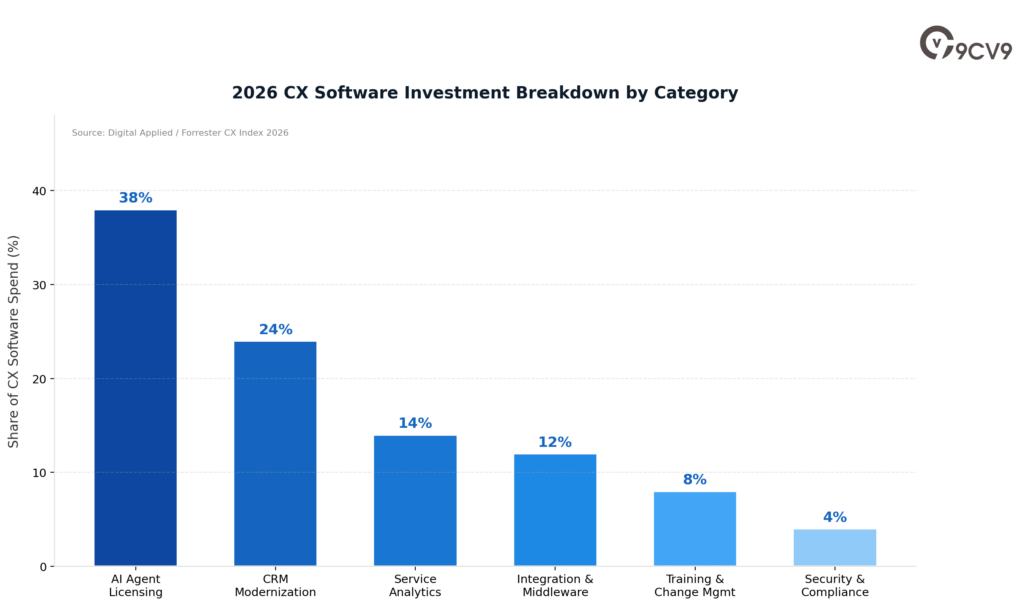
CRM modernization is the single largest category of CX software investment in 2026, consuming 24% of total spend — a lesson learned from 2024–2025 when AI agents deployed on fragmented customer data consistently underperformed and eroded CSAT scores. (Forrester CX Index 2026)
60. 14% of CX Spend — Service Analytics in 2026
Service analytics — encompassing conversation mining, sentiment analysis, and journey analytics — commands 14% of CX spend in 2026, reflecting the growing recognition that understanding customer signals is prerequisite to improving them. (Forrester CX Index 2026)
61. 12% of CX Spend — Integration & Middleware in 2026
Integration and middleware infrastructure absorbs 12% of CX budgets in 2026, as organizations prioritize the API plumbing that connects CRM to service to marketing stacks — the connective tissue without which AI personalization fails to scale. (Forrester CX Index 2026)
62. 1.8× Revenue — When EX Is Prioritized Alongside CX
Organizations that prioritize employee experience (EX) alongside customer experience report 1.8 times higher revenue growth — a finding that reframes agent wellbeing and empowerment not as an HR concern but as a direct CX revenue strategy. (Forrester, cited 2026)
63. 1.5× Revenue Growth — Strong CX Strategy Firms
Companies with a demonstrably strong CX strategy achieve 1.5 times higher revenue growth than those without one — confirming that structured, measured, and funded CX programs outperform ad-hoc customer service improvements. (Forrester, cited 2026)
🏆 CX Leadership & Organizational Maturity
64. 49% Faster Profit — Customer-Obsessed Organizations
Companies classified as “customer-obsessed” — those placing customer needs at the center of every decision — achieve 49% faster profit growth and 51% better customer retention rates than peers, per Forrester’s 2024 research. (Forrester, 2024)
65. 41% Achieved — 10%+ Revenue Growth (Customer-Obsessed Firms)
Forty-one percent of customer-obsessed companies achieve at least 10% revenue growth in their most recent fiscal year, compared to just 10% of less mature organizations — a four-fold performance gap that quantifies the value of CX-centric leadership. (Forrester, cited 2025)
66. 25% Cost Savings — Proactive Customer Service Programs
Organizations that deploy proactive customer service — reaching out to customers before issues escalate — reduce operating costs by 25% while simultaneously improving satisfaction scores and reducing inbound complaint volumes. (Zendesk, cited 2025)
67. 15–20% CSAT Improvement — From Predictive Analytics
Implementing predictive analytics within CX operations improves customer satisfaction scores by 15 to 20 percentage points, as businesses can anticipate and address friction before it becomes frustration — shifting from reactive to anticipatory service. (Renascence, cited 2025)
68. 30% Retention Improvement — Companies Using Predictive CX
Companies that deploy predictive CX tools see a 30% improvement in customer retention rates, according to McKinsey — making predictive analytics one of the highest-leverage capabilities available to CX leaders operating in competitive markets. (McKinsey, cited 2025)
⏱️ Consumer Expectations in 2026
69. 74% of Consumers — Expect 24/7 Service Availability via AI
Nearly three-quarters of consumers expect round-the-clock customer service availability — a demand that AI agents are uniquely positioned to meet at scale, transforming always-on support from a cost-prohibitive aspiration to a deployable reality. (Zendesk CX Trends 2026)
70. 67% of Consumers — Expect Tailored Support from Prior Interactions
Two-thirds of consumers expect brands to personalize support based on their previous interactions — a contextual intelligence requirement that demands persistent AI memory, unified customer data platforms, and cross-channel context propagation. (Zendesk CX Trends 2026)
71. 81% of Consumers — Want Conversations to Continue Without Backtracking
Over four-fifths of consumers expect agents — human or AI — to pick up conversations where they left off without requiring the customer to re-explain their situation, making continuous context a fundamental CX infrastructure requirement. (Zendesk CX Trends 2026)
72. 88% of Customers — Expect Faster Responses Than Last Year
Consumer expectations for response speed are accelerating annually, with 88% of customers demanding faster responses than they expected just one year prior — driven by AI-normalized response times that are resetting baseline service expectations across all channels. (Zendesk, cited 2026)
73. 63% of Customers — Demanding Greater CX Transparency
Sixty-three percent of customers report increasing demands for transparency from brands regarding how their data is used, how decisions are made, and how AI is deployed in service — signaling that trust architecture is becoming a CX investment priority. (Zendesk CX Trends 2026)
🤖 Self-Service & Chatbot Adoption
74. 72% of Users — Actively Using Self-Service Portals
Nearly three-quarters of customers are now active users of company self-service portals — a majority that reflects the maturity of digital self-service as a channel and the importance of maintaining accurate, searchable, AI-augmented knowledge bases. (Zoom, 2025)
75. 55% Have Interacted — With Self-Service Chatbots
More than half of customers have engaged with self-service chatbots in their most recent customer service experiences, marking chatbot interaction as a mainstream rather than emerging channel that must be optimized for quality and containment. (Zoom, 2025)
76. 51% Prefer Bots — Over Humans for Immediate Service
A majority of consumers now prefer interacting with AI bots over humans when they want immediate service — a preference driven by speed, availability, and the improving conversational quality of modern large-language-model-powered assistants. (Zendesk, cited 2026)
77. 74% Would Use — A Chatbot for Quick Resolution
Nearly three-quarters of consumers indicate they would willingly use a chatbot if it led to a quick resolution of their issue — revealing that customer resistance to AI service is primarily driven by poor past experiences rather than an inherent preference for human interaction. (Zoom, 2024)
78. 80% More Likely — Repeat Purchase After Great Digital CX
Customers who experience excellent digital service are 80% more likely to become repeat purchasers — a conversion statistic that directly quantifies the revenue value of investing in digital customer experience quality and AI-powered service capabilities. (Zoom, cited 2026)
79. 93% Spend More — When Not Made to Repeat Themselves
Ninety-three percent of consumers say they are willing to spend more with companies that eliminate repetition across their service journey — making data continuity and agent context tools a direct driver of wallet-share expansion. (Zendesk, cited 2026)
📈 AI in Business Operations
80. 72% of Businesses — Using or Exploring AI for CX
Nearly three-quarters of businesses are either already using or actively exploring AI for customer experience applications — signaling that AI adoption in CX has crossed the mainstream threshold and is now a standard component of digital transformation strategy. (IBM, cited 2025)
81. 40% Productivity Boost — From AI in CX Teams
AI integration into CX workflows is documented to increase business productivity by 40% — a gain that compounds over time as AI systems learn from interaction data and continuously improve their accuracy, containment rates, and resolution quality. (Techjury, cited 2025)
82. $1.2B+ Funding — Raised by CX Startups Globally in 2024
Over 65 customer experience-focused startups raised more than $1.2 billion in global funding in 2024, with strong concentration in the US, India, and UK — reflecting investor confidence in the long-term growth of the CX software category. (Market Reports World, 2026)
83. 35% of CX Funds — Directed at AI & Machine Learning
Thirty-five percent of all CX software funding is directed specifically at AI and machine learning integration — including predictive analytics, NLP, and automation — confirming that AI capability is the primary competitive battleground in the CX software market. (Market Reports World, 2026)
84. 72% of Enterprises — Planning CX Infrastructure Upgrade by 2026
In retail and banking specifically, 72% of enterprises have indicated plans to upgrade or replace their existing CX infrastructure by 2026 — driven by the convergence of AI capabilities, rising consumer expectations, and intensifying competitive pressure. (Market Reports World, 2026)
85. 65% Cut Spending — After Poor CX Standards
Sixty-five percent of customers have actively reduced spending with companies that failed to meet their evolving customer experience standards — establishing poor CX delivery as a direct revenue risk that can be quantified and reported to finance and the board. (Broadridge, 2023, cited 2026)
86. 43 pts Outperformance — Brands Excelling in CX Sentiment
Brands that excel in customer sentiment outperform their peers by 43 percentage points in five-year stock returns — a finding that makes CX excellence a compelling argument for institutional investors and positions it as a shareholder value driver. (NICE, 2024)
87. 25% Higher NRR — Firms with Dedicated Customer Success Managers
Organizations with dedicated Customer Success Manager teams achieve up to 25% higher Net Revenue Retention than those without — confirming that the human element of CX, particularly in B2B contexts, remains essential to retention economics. (Benchmarkit, cited 2025)
88. $15T+ in B2B Spend — To Be AI Agent-Intermediated by 2028
Gartner projects that AI agents will intermediate more than $15 trillion in B2B spending by 2028 — a prediction that positions AI-powered CX infrastructure as critical commercial plumbing for B2B enterprises seeking to maintain buyer relationships. (Gartner, Oct 2025)
89. 80% of Businesses — Plan to Invest in GenAI for CX in 2026
Four in five businesses plan to invest in generative AI specifically for customer experience applications in 2026 — reflecting the widespread recognition that GenAI represents the most immediate and impactful AI opportunity in customer-facing operations. (McKinsey, cited 2026)
90. 85% of CX Leaders — Use AI Interaction Analytics for Service
The vast majority of CX leaders now deploy AI-powered interaction analytics for customer service operations — using conversation mining, sentiment analysis, and pattern recognition to identify improvement opportunities at scale across millions of interactions. (Metrigy, cited 2026)
91. 88% of Enterprises — Report Regular AI Use Across Functions
McKinsey’s 2025 AI survey found that 88% of enterprises report regular AI use across at least one business function — confirming that AI has transitioned from an experimental technology to standard operational infrastructure for the global business community. (McKinsey AI Survey 2025)
92. 37% of Leaders — Cite Cost Reduction as Top CX Priority
More than a third of business leaders identify cost reduction as their primary objective when investing in customer service across channels — a motivation that CX software vendors are addressing through AI automation, self-service deflection, and agent efficiency tools. (McKinsey, 2024)
🔄 Feedback, Loyalty & Continuous Improvement
93. 15% Retention Lift — Companies Acting on Customer Feedback
Organizations that regularly collect and act on customer feedback see a 15% increase in customer retention rates — demonstrating that closed-loop feedback management is not just a listening exercise but a measurable retention intervention. (Gartner, cited 2026)
94. 25% Less Churn — Companies Implementing Feedback Changes
Companies that make demonstrable product or service changes based on customer feedback experience a 25% reduction in customer churn — validating the value of voice-of-customer programs that move beyond data collection to actionable implementation. (Forrester, cited 2025)
95. 70% More Loyal — Customers of Feedback-Listening Companies
Seven in ten customers report greater loyalty to brands that demonstrably listen to and act on their feedback — making feedback management platforms a retention investment with a direct and measurable impact on customer lifetime value. (Medallia, cited 2025)
96. 57% Expect Rise — In Customer Service Call Volumes
More than half of business leaders anticipate customer service call volumes increasing by up to 20% over the next one to two years — a projection that strengthens the business case for AI automation, IVR modernization, and voice AI deployment. (McKinsey, cited 2026)
97. 62% Feel Behind — In Providing Instant Experiences
Nearly two-thirds of CX leaders acknowledge feeling behind in their ability to deliver the instant, frictionless experiences that customers increasingly expect — creating sustained demand for AI automation, real-time data, and intelligent routing capabilities. (Zendesk Benchmark, 2026)
98. 81% of CX Leaders — Say Employee AI Access Transforms Decision-Making
An overwhelming majority of CX leaders believe that equipping every employee with AI-powered analytical access will transform organizational decision-making — signaling a shift from centralized BI reporting to democratized real-time intelligence across service teams. (Zendesk CX Trends 2026)
99. 16% CAGR — US CX Market 2026–2033
The United States CX management market is expected to grow at a 16% compound annual growth rate between 2026 and 2033 — one of the fastest expansion rates in enterprise software — driven by AI investment, digital transformation, and rising consumer expectations. (Grand View Research, 2026)
100. $6.86B — Projected US CX Market Size in 2026
The US customer experience management software market is projected to reach $6.86 billion in 2026, reinforcing America’s position as both the largest single-country CX market and the global innovation leader for AI-powered customer experience platforms. (Fortune Business Insights, 2026)
Conclusion
The customer experience software industry in 2026 stands at a defining moment. No longer viewed as simply a collection of customer support tools or CRM extensions, modern CX platforms have become mission-critical business infrastructure that directly influences revenue growth, customer loyalty, operational efficiency, and long-term competitive advantage. The statistics presented throughout this report clearly demonstrate that organizations across every sector are fundamentally changing how they engage with customers, with artificial intelligence, automation, omnichannel communication, and hyper-personalization now shaping the future of customer interactions.
Perhaps the strongest takeaway is the extraordinary pace at which the market continues to expand. With the global customer experience management software market reaching an estimated $26.11 billion in 2026 and projected to approach $100 billion over the next decade, CX technology has firmly established itself as one of the fastest-growing enterprise software categories worldwide. Consistent double-digit annual growth forecasts from multiple independent research firms reinforce the view that this is not a temporary technology trend but a sustained transformation in how businesses compete and deliver value.
Artificial intelligence has emerged as the single greatest catalyst driving this transformation. The overwhelming majority of customer experience leaders now face executive mandates to implement AI, while businesses continue increasing their investments in generative AI, intelligent automation, predictive analytics, and autonomous AI agents. AI is no longer being adopted solely to reduce operational costs; it is increasingly viewed as the engine that powers faster resolutions, more personalized interactions, improved first-contact resolution, higher customer satisfaction, and better business outcomes. Organizations that embrace AI early are already reporting significantly higher returns on investment, creating an increasingly wide competitive gap between innovation leaders and slower adopters.
Another clear trend is the shift toward unified customer experience ecosystems. Businesses are moving away from fragmented point solutions and investing in integrated platforms that combine CRM, help desk software, conversational AI, analytics, journey orchestration, customer data management, and workflow automation into a single connected environment. This integration enables organizations to deliver seamless experiences across websites, mobile apps, live chat, social media, messaging platforms, voice channels, and self-service portals while maintaining customer context throughout every interaction. As customer expectations continue rising, disconnected systems are becoming an increasingly significant barrier to delivering exceptional experiences.
Customer expectations themselves have never been higher. Consumers now expect businesses to respond instantly, remember previous conversations, provide personalized recommendations, and offer consistent support regardless of channel or time of day. They increasingly expect AI-powered assistance to complement human expertise rather than replace it, with the ideal customer journey combining automation, intelligence, and empathy. Organizations that fail to meet these expectations risk losing customers after just one or two poor experiences, highlighting how closely customer experience is now linked to customer retention, brand reputation, and long-term revenue generation.
The financial evidence supporting customer experience investment is equally compelling. High-performing organizations consistently outperform competitors in revenue growth, customer retention, profitability, and pricing power. Businesses delivering exceptional customer experiences enjoy stronger customer loyalty, higher repeat purchase rates, greater customer lifetime value, and increased willingness among consumers to pay premium prices for superior service. At the same time, the enormous financial losses associated with poor customer service and customer churn reinforce that underinvesting in customer experience can have substantial long-term business consequences.
Personalization continues to evolve into one of the defining characteristics of successful customer engagement strategies. AI-powered personalization enables organizations to anticipate customer needs, recommend relevant products and services, tailor communications, and create experiences that feel increasingly natural and context-aware. As consumers continue demanding individualized interactions, businesses capable of combining unified customer data with intelligent automation will be better positioned to strengthen customer relationships, improve conversion rates, and accelerate sustainable revenue growth.
Omnichannel engagement is another recurring theme across today’s customer experience landscape. Organizations that successfully integrate multiple communication channels consistently outperform those relying on isolated customer touchpoints. Customers increasingly expect conversations to continue seamlessly across live chat, email, messaging apps, social media, websites, mobile applications, and phone support without needing to repeat information or restart their journey. Delivering this continuity requires both sophisticated software platforms and well-integrated organizational processes, making omnichannel capability a foundational investment rather than an optional enhancement.
Regional market trends also highlight the expanding global importance of customer experience software. North America continues leading overall market adoption and innovation, while Asia-Pacific is emerging as one of the fastest-growing regions thanks to accelerating digital transformation, expanding e-commerce ecosystems, government-backed technology initiatives, and rapidly evolving consumer expectations. This worldwide momentum demonstrates that customer experience excellence has become a universal business priority across developed and emerging markets alike.
Looking beyond 2026, the future of customer experience software appears increasingly intelligent, predictive, and autonomous. AI agents will continue handling larger volumes of routine customer inquiries, predictive analytics will identify customer issues before they occur, conversational AI will become increasingly natural, and real-time personalization will become standard across industries. Businesses will increasingly measure success not only through traditional customer satisfaction metrics but also through predictive loyalty indicators, customer lifetime value, revenue expansion, operational efficiency, and AI-assisted employee productivity.
At the same time, technology alone will not guarantee success. Organizations that achieve lasting competitive advantage will be those that combine advanced software with customer-centric leadership, empowered employees, continuous feedback loops, responsible AI governance, robust data integration, and a culture focused on delivering meaningful customer outcomes. Successful customer experience strategies will require close collaboration across customer service, marketing, sales, product development, operations, and executive leadership to ensure that every customer interaction contributes positively to the overall brand experience.
For technology buyers, business executives, customer success leaders, investors, consultants, and digital transformation teams, the statistics compiled in this report provide valuable benchmarks for understanding the current state of the customer experience software industry. They illustrate where organizations are investing, how customer expectations are changing, which technologies are delivering measurable returns, and what trends are likely to shape the market over the coming years. These insights can help businesses make more informed software purchasing decisions, prioritize innovation initiatives, benchmark performance against industry standards, and identify opportunities to improve both customer satisfaction and financial performance.
Ultimately, customer experience has become one of the most important determinants of business success in the digital economy. Organizations that leverage AI-powered customer experience software to create faster, smarter, more personalized, and more consistent interactions will be better positioned to retain customers, strengthen brand loyalty, increase operational efficiency, and drive sustainable long-term growth. As the customer experience software market continues its rapid expansion, staying informed about the latest statistics, market trends, emerging technologies, and evolving customer expectations will remain essential for every business seeking to compete and thrive in an increasingly experience-driven world.
If you find this article useful, why not share it with your hiring manager and C-level suite friends and also leave a nice comment below?
We, at the 9cv9 Research Team, strive to bring the latest and most meaningful data, guides, and statistics to your doorstep.
To get access to top-quality guides, click over to 9cv9 Blog.
To hire top talents using our modern AI-powered recruitment agency, find out more at 9cv9 Modern AI-Powered Recruitment Agency.
People Also Ask
What is customer experience software?
Customer experience software helps businesses manage, improve, and personalize customer interactions across multiple channels using AI, automation, analytics, CRM integrations, and support tools to increase satisfaction and loyalty.
Why is customer experience software important in 2026?
Customer experience software is essential in 2026 because customers expect fast, personalized, and seamless interactions. Businesses use it to improve retention, increase revenue, reduce support costs, and gain a competitive advantage.
How large is the customer experience software market in 2026?
The global customer experience software market is valued at tens of billions of dollars in 2026 and continues growing rapidly as organizations invest in AI, automation, and omnichannel customer engagement.
What are the biggest customer experience trends in 2026?
Key trends include AI-powered customer service, generative AI, predictive analytics, omnichannel engagement, hyper-personalization, conversational AI, self-service automation, and real-time customer insights.
How is AI transforming customer experience software?
AI automates customer support, predicts customer needs, personalizes recommendations, improves response times, analyzes customer sentiment, and helps businesses deliver more efficient and engaging customer experiences.
What industries use customer experience software the most?
Retail, e-commerce, banking, healthcare, telecommunications, travel, hospitality, SaaS, insurance, and manufacturing are among the biggest adopters of customer experience software.
What is omnichannel customer experience?
Omnichannel customer experience connects every communication channel, allowing customers to move seamlessly between chat, email, phone, websites, social media, and mobile apps without losing conversation history.
What is customer experience management software?
Customer experience management software helps organizations monitor, analyze, and improve every stage of the customer journey using analytics, automation, surveys, AI, and customer feedback tools.
How does customer experience software improve customer satisfaction?
It delivers faster support, personalized interactions, consistent communication, proactive assistance, and streamlined customer journeys that increase satisfaction and strengthen long-term customer relationships.
What role does automation play in customer experience?
Automation handles repetitive customer requests, routes inquiries intelligently, reduces response times, improves efficiency, and allows support teams to focus on more complex customer issues.
Why is personalization important in customer experience?
Personalization increases engagement by delivering relevant recommendations, customized communications, and tailored customer journeys that improve loyalty, satisfaction, and conversion rates.
What are the benefits of customer experience software?
Benefits include higher customer satisfaction, improved retention, increased revenue, lower operational costs, faster support, better customer insights, stronger loyalty, and more efficient workflows.
How does customer experience software increase revenue?
It improves customer retention, encourages repeat purchases, boosts customer lifetime value, enhances cross-selling opportunities, and increases conversion rates through personalized experiences.
What features should businesses look for in customer experience software?
Important features include AI automation, CRM integration, omnichannel support, analytics, customer journey mapping, self-service portals, reporting dashboards, workflow automation, and personalization tools.
What is conversational AI in customer experience?
Conversational AI uses chatbots and virtual assistants powered by natural language processing to answer questions, resolve issues, and provide instant customer support around the clock.
How does predictive analytics improve customer experience?
Predictive analytics identifies customer behavior patterns, anticipates future needs, reduces churn, improves marketing effectiveness, and enables proactive customer support.
Why are customer experience statistics important?
Customer experience statistics help businesses benchmark performance, identify market trends, evaluate technology investments, and make informed decisions based on reliable industry data.
How do businesses measure customer experience success?
Common metrics include Customer Satisfaction Score (CSAT), Net Promoter Score (NPS), Customer Effort Score (CES), customer retention, churn rate, response time, and customer lifetime value.
What is customer journey mapping?
Customer journey mapping visualizes every interaction customers have with a business, helping organizations identify pain points, optimize experiences, and improve customer satisfaction.
How does customer experience software reduce customer churn?
It identifies dissatisfied customers early, improves service quality, personalizes interactions, resolves issues faster, and strengthens customer relationships before they leave.
What is the future of customer experience software?
The future includes autonomous AI agents, predictive personalization, advanced analytics, real-time customer intelligence, voice AI, and deeper integration across enterprise business systems.
Why are companies investing more in customer experience technology?
Businesses recognize that exceptional customer experiences drive loyalty, improve profitability, strengthen brand reputation, and create sustainable competitive advantages.
Can small businesses benefit from customer experience software?
Yes. Small businesses use customer experience software to automate support, improve customer relationships, personalize communications, and compete more effectively with larger organizations.
How does customer experience software support digital transformation?
It modernizes customer interactions through AI, automation, cloud platforms, integrated communication channels, and data-driven decision-making across the organization.
What is the difference between CRM and customer experience software?
CRM manages customer information and sales activities, while customer experience software focuses on optimizing interactions, satisfaction, engagement, and the overall customer journey.
How does AI improve customer support efficiency?
AI answers routine inquiries instantly, routes tickets intelligently, recommends solutions, analyzes conversations, and assists agents, significantly reducing response and resolution times.
Which regions are driving customer experience software growth?
North America remains the largest market, while Asia-Pacific is experiencing some of the fastest growth due to digital transformation, e-commerce expansion, and increasing AI adoption.
How does customer experience software improve customer loyalty?
By delivering personalized, consistent, and responsive experiences, businesses build trust, encourage repeat purchases, strengthen customer relationships, and increase long-term loyalty.
What challenges do businesses face when implementing customer experience software?
Common challenges include integrating legacy systems, managing customer data, training employees, maintaining data privacy, and ensuring consistent experiences across all channels.
Why should businesses follow customer experience software statistics in 2026?
Tracking the latest customer experience software statistics helps organizations understand market trends, evaluate emerging technologies, benchmark competitors, and make smarter strategic investment decisions.
Sources
Precedence Research Fortune Business Insights Grand View Research Gartner Zendesk Forrester Digital Applied McKinsey & Company Pylon Bain & Company Ringly Market Reports World Metrigy Research Zoom PwC ClearlyRated Salesforce Onramp Aberdeen Group Fullview IMARC Group Datagrid Medallia NICE Benchmarkit Renascence CustomerGauge