


























Key Takeaways
- The global CSR software market has surpassed USD 1 billion in 2026 and is projected to more than double by 2035, driven by ESG reporting requirements, sustainability initiatives, and growing regulatory compliance demands.
- AI-powered ESG reporting, cloud-based CSR platforms, and automated sustainability management tools are transforming how organizations collect, analyze, and disclose corporate responsibility data at scale.
- CSR software adoption is accelerating worldwide as businesses leverage sustainability technology to improve compliance, strengthen employee engagement, enhance investor confidence, and meet rising consumer expectations for corporate responsibility.
CSR software helps organizations manage sustainability reporting, track ESG performance, automate compliance processes, and improve employee engagement initiatives. In 2026, the CSR software market continues to grow rapidly as businesses adopt cloud-based and AI-powered platforms to meet regulatory requirements, strengthen stakeholder trust, and measure corporate social responsibility outcomes more effectively.
Corporate Social Responsibility (CSR) software has rapidly evolved from a niche corporate reporting tool into one of the most important technology investments for organizations navigating sustainability, governance, compliance, employee engagement, and stakeholder accountability in 2026. As governments tighten ESG disclosure requirements, investors demand greater transparency, consumers increasingly support purpose-driven brands, and employees seek meaningful workplace impact, organizations across every industry are turning to CSR software platforms to manage, measure, and communicate their sustainability initiatives more effectively than ever before.
Also, read our top list of the Top 11 CSR Software Solutions.

The numbers tell a compelling story. The global CSR software market has officially crossed the billion-dollar milestone, reaching approximately USD 1.03 billion in 2026 and projected to exceed USD 2.28 billion by 2035. Meanwhile, adjacent sectors such as ESG reporting software, sustainability management platforms, and carbon accounting solutions are growing at even faster rates, with some segments forecast to expand at annual growth rates exceeding 20%. These figures highlight a fundamental shift in how organizations approach corporate responsibility. What was once viewed as a voluntary business practice is now becoming a strategic necessity supported by sophisticated technology ecosystems.
Much of this growth is being driven by an increasingly complex regulatory landscape. The European Union’s Corporate Sustainability Reporting Directive (CSRD), Environmental, Social, and Governance (ESG) disclosure mandates, International Sustainability Standards Board (ISSB) frameworks, and emerging climate reporting regulations worldwide are creating unprecedented demand for specialized software solutions. Organizations are moving away from spreadsheets and fragmented reporting processes toward integrated CSR platforms capable of collecting, validating, analyzing, and reporting sustainability data across multiple business units and jurisdictions. The requirement for machine-readable XBRL reporting formats beginning in 2026 further reinforces the need for purpose-built technology solutions.
At the same time, sustainability software adoption is no longer limited to large multinational corporations. While enterprises currently account for the majority of CSR software spending, small and medium-sized businesses are becoming one of the fastest-growing customer segments. Affordable cloud-based platforms, increasing supply chain compliance requirements, and stakeholder expectations are making CSR technology accessible to organizations of every size. This democratization of sustainability software is helping create a global ecosystem where responsible business practices can be measured and improved at scale.
Regional adoption trends reveal significant shifts in market dynamics. North America continues to dominate the CSR and ESG software landscape, accounting for more than one-third of global market share, supported by strong investor scrutiny, regulatory developments, and mature digital infrastructure. Europe remains a major force due to extensive sustainability regulations affecting tens of thousands of organizations. However, the fastest growth is occurring across Asia-Pacific, where countries such as Singapore, Japan, Australia, South Korea, and China are introducing new reporting requirements and sustainability initiatives that are accelerating software adoption throughout the region.
Technology innovation is also transforming the capabilities of modern CSR platforms. Artificial intelligence has become one of the most influential trends reshaping the industry. From automated ESG disclosures and sustainability data collection to AI-powered carbon accounting and predictive analytics, vendors are increasingly embedding intelligent features into their software offerings. Industry surveys show overwhelming confidence among CSR professionals regarding AI’s future impact, while major technology companies and startups alike are launching next-generation solutions designed to reduce manual workloads and improve reporting accuracy. The rise of AI-powered sustainability management signals a future where organizations can monitor ESG performance in near real time rather than relying solely on annual reporting cycles.
Beyond compliance and reporting, CSR software is increasingly recognized for its role in strengthening employee engagement, retention, and workplace culture. Modern platforms enable organizations to manage volunteer programs, charitable giving initiatives, community investment strategies, and purpose-driven employee experiences. Research consistently demonstrates that employees who participate in corporate social responsibility programs are more satisfied, stay longer with their employers, and develop stronger connections to organizational culture. As talent attraction and retention remain top priorities for business leaders, CSR software is becoming a valuable component of broader human capital strategies.
Investor expectations are further accelerating market expansion. Sustainable investing continues to gain momentum globally, with trillions of dollars in assets influenced by ESG considerations. Investors increasingly require reliable, auditable, and standardized sustainability data when evaluating companies. This growing demand for transparency places CSR software at the center of investor relations, risk management, and corporate governance initiatives. Organizations that can provide credible sustainability metrics are often better positioned to attract capital, strengthen stakeholder trust, and maintain competitive advantages in rapidly evolving markets.
Consumer behavior is also contributing to the rise of CSR technology. Modern consumers increasingly expect businesses to address environmental and social challenges while demonstrating measurable impact. Strong sustainability programs can influence purchasing decisions, improve customer loyalty, and strengthen brand reputation. As a result, companies are investing in software platforms that help them track outcomes, communicate progress, and validate sustainability claims with greater credibility and precision.
The competitive landscape is evolving just as quickly as the market itself. Hundreds of new ESG and CSR software modules have been introduced in recent years, while mergers, acquisitions, and strategic partnerships continue reshaping the industry. Established enterprise vendors are expanding their sustainability offerings, while innovative startups are challenging traditional approaches through AI-driven automation, cloud-native architectures, blockchain-enabled transparency, and integrated compliance capabilities. This rapid pace of innovation is creating a highly dynamic market where organizations have more choices than ever before when selecting sustainability technology solutions.
In this comprehensive guide, we examine the Top 100 CSR Software Statistics, Data & Trends in 2026, covering market growth, regional adoption, technology innovations, enterprise implementation patterns, regulatory developments, employee engagement metrics, investor expectations, corporate giving trends, and emerging AI-powered sustainability technologies. Whether you are a sustainability professional, CSR manager, ESG consultant, compliance leader, investor, HR executive, software vendor, or business decision-maker, these statistics provide valuable insights into how CSR software is transforming the future of responsible business worldwide.
From billion-dollar market projections and regulatory mandates to AI-driven reporting tools and employee volunteering trends, these data points reveal why CSR software has become one of the most strategically important technology categories in the modern enterprise. Understanding these trends is essential for organizations seeking to navigate evolving compliance requirements, strengthen stakeholder trust, improve sustainability performance, and build resilient businesses in an increasingly purpose-driven global economy.
Before we venture further into this article, we would like to share who we are and what we do.
About 9cv9
9cv9 is a business tech startup based in Singapore and Asia, with a strong presence all over the world.
With over nine years of startup and business experience, and being highly involved in connecting with thousands of companies and startups, the 9cv9 team has listed some important learning points in this overview of the Top 100 CSR Software Statistics, Data & Trends in 2026.
If you like to get your company listed in our top B2B software reviews, check out our world-class 9cv9 Media and PR service and pricing plans here.
Top 100 CSR Software Statistics, Data & Trends in 2026
MARKET SIZE & GROWTH
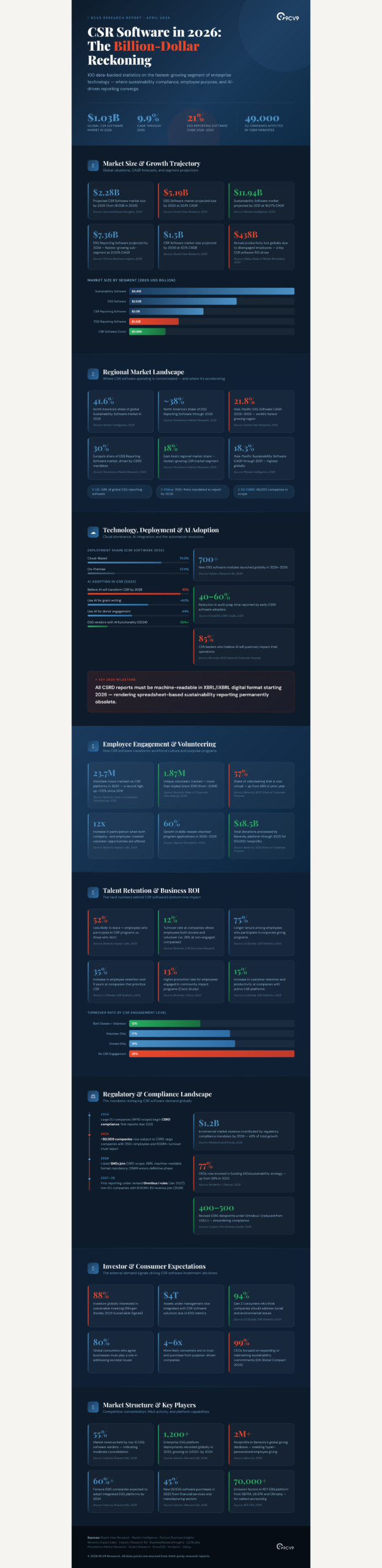
1. The global CSR software market is valued at approximately USD 1.03 billion in 2026, projected to reach USD 2.28 billion by 2035.
The CSR software market’s billion-dollar valuation in 2026 signals that sustainability is no longer optional for enterprises — it’s a core infrastructure investment.
2. The CSR software market is forecast to expand at a CAGR of 9.9% from 2026 to 2035.
A near-double-digit CAGR confirms that CSR software is among the most consistently growing categories in enterprise technology.
3. In 2025, the global CSR software market was valued at USD 981.03 million, just shy of the $1 billion milestone.
Crossing the $1 billion threshold in 2026 marks a symbolic turning point for the maturity and mainstream adoption of CSR software platforms.
4. The CSR software market is projected to reach USD 2.365 billion by 2035, based on a 9.20% CAGR.
More than doubling in value over a decade, the CSR software market reflects deep structural demand driven by regulation, ESG mandates, and stakeholder accountability.
5. An alternate market estimate values the CSR software market at USD 944.7 million in 2024, growing to USD 1.5 billion by 2030 at an 8% CAGR.
Even conservative forecasts show the CSR software market doubling by 2030, illustrating a robust and resilient growth trajectory regardless of economic conditions.
6. The CSR software market was valued at USD 818.3 million in 2023, growing to a projected USD 1.5 billion by 2030 at a CAGR of 7.48%.
Three consecutive years of accelerating valuations — from $818M to $981M to $1.03B — underscore that CSR software adoption is gaining unstoppable momentum.
7. The ESG software market was valued at USD 1.24 billion in 2025 and is projected to hit USD 5.19 billion by 2033 at a CAGR of 20.1%.
With a 20% growth rate, ESG software — the reporting backbone of CSR — is expanding at more than twice the pace of the broader enterprise software market.
8. The global ESG reporting software market was valued at USD 1.32 billion in 2025 and is projected to reach USD 7.36 billion by 2034 at a CAGR of 21.02%.
The ESG reporting software segment is outpacing the broader CSR market, as mandatory disclosure deadlines push companies to adopt sophisticated reporting platforms at speed.
9. The sustainability software market was valued at USD 4.41 billion in 2025, projected to reach USD 11.94 billion by 2031 at a CAGR of 18.07%.
Sustainability software — the broader category encompassing CSR, ESG, and carbon tools — is on track to nearly triple in market size within just six years.
10. The CSR reporting software market is estimated at USD 2 billion in 2025, growing at a CAGR of 15% to reach approximately USD 6 billion by 2033.
A 15% annual growth rate in CSR reporting software confirms that compliance deadlines and stakeholder demands are converting corporate intention into measurable technology spend.
REGIONAL MARKET SHARE
11. North America holds a 34.1% share of the global CSR software market as of 2024.
North America’s dominant market share reflects the depth of ESG regulatory pressure, investor activism, and digital infrastructure maturity in the US and Canada.
12. North America leads ESG reporting software with approximately 38% of global market share through 2026.
With the SEC’s climate disclosure rules and investor-driven ESG scrutiny, North America is firmly established as the world’s most active market for sustainability reporting platforms.
13. Europe accounts for ~30% of global ESG reporting software market share through 2026, underpinned by CSRD and ESRS mandates.
Europe’s 30% share reflects the continent’s regulatory leadership, with nearly 49,000 organizations required to deploy auditable ESG reporting infrastructure under CSRD.
14. North America captured 41.62% of sustainability software market share in 2025.
North America’s growing dominance in sustainability software is powered by the SEC disclosure rule and accelerating federal procurement guidelines that mandate carbon data in financial statements.
15. Asia-Pacific ESG software is projected to grow at the fastest CAGR of 21.8% from 2026 to 2033.
Asia-Pacific’s explosive growth in ESG software stems from expanding regulatory enforcement in Singapore, Japan, and Australia, making it the world’s fastest-growing CSR technology region.
16. East Asia captures 18% of the global ESG reporting software market, representing the fastest-growing regional segment.
Led by China’s regulatory expansion, Japan’s mature ESG practices, and South Korea’s tech-driven sustainability ecosystem, East Asia is rapidly closing the gap with Western markets.
17. The U.S. ESG reporting software market accounts for approximately 34% of the global market share, making it the largest national market.
The United States’ outsized share underscores how investor pressure, regulatory alignment, and corporate sustainability culture are converging to create the world’s most concentrated ESG software demand.
18. Asia-Pacific sustainability software is projected to post an 18.31% CAGR through 2031 — the highest regional growth rate.
As China mandates sustainability reports from 300+ listed firms by 2026 and Singapore requires climate reporting from most issuers, Asia-Pacific is transforming from a compliance laggard to a global ESG tech leader.
19. Europe’s CSRD mandates approximately 49,000 organizations across 27 EU member states to report sustainability data beginning 2025–2026.
CSRD’s sweeping reach across 49,000 companies makes it the single largest regulatory driver of CSR software demand globally, fundamentally reshaping the European sustainability technology landscape.
20. Following the EU Omnibus I package (approved December 2025), CSRD scope was narrowed to companies with over 1,000 employees and turnover exceeding €450 million.
The Omnibus revision significantly narrows CSRD’s scope, reducing the total reporting universe but concentrating demand for advanced, audit-grade CSR software among the largest enterprises.
DEPLOYMENT & TECHNOLOGY
21. Cloud-based CSR software dominates with a revenue share of over 73.0% in 2024, with on-premise at approximately 27%.
Cloud dominance in CSR software mirrors enterprise IT trends broadly, offering scalability, real-time data access, and seamless regulatory update deployment without IT overhead.
22. The cloud-based CSR software segment is projected to grow at a CAGR of 10.1% during 2026–2035.
As CSR programs scale globally, cloud deployment becomes the default — enabling multi-entity reporting, real-time collaboration, and lower total cost of ownership across distributed workforces.
23. Cloud-based ESG reporting software dominates with approximately 61% market share, favored for scalability and rapid compliance readiness.
The cloud’s 61% dominance in ESG reporting reflects a clear market preference for platforms that can be rapidly updated to meet evolving regulatory frameworks without IT bottlenecks.
24. The on-premise CSR software market share is projected to decline from 27.48% in 2020 to 21.77% by 2025.
The steady erosion of on-premise CSR software market share illustrates that even heavily regulated sectors are increasingly trusting cloud infrastructure for sensitive sustainability data.
25. Cloud-native ESG software modules represent around 36% of new licences in the ESG software market in 2025.
The surge in cloud-native module adoption indicates enterprises are not just migrating legacy systems but building ESG data management capabilities from scratch on modern SaaS architectures.
26. Over 700 new ESG software modules were launched globally in 2024–2026.
The proliferation of 700+ new ESG modules in just two years underscores the intensely competitive nature of the CSR technology market and the speed at which vendor capabilities are evolving.
27. All CSRD reports must be machine-readable in XBRL/iXBRL format starting 2026, with software platforms adding automated tagging features.
The mandatory shift to machine-readable XBRL reporting formats is accelerating adoption of dedicated CSRD compliance software, effectively rendering spreadsheet-based approaches obsolete.
28. AI-driven analytics in CSR software are identified as a key trend, with over 20% of ESG software providers introducing AI-driven functionality for automated ESG disclosures in 2024.
One in five ESG software vendors has already embedded AI into their disclosure workflows, signaling that automation will become a standard feature rather than a premium differentiator within two years.
29. 85% of CSR leaders believe AI will have a positive impact on CSR operations, even as most agree it isn’t yet ready for high-stakes or people-facing decisions.
The near-universal optimism about AI’s CSR potential, tempered by appropriate caution on high-stakes use cases, reflects a measured but accelerating path toward AI-augmented sustainability management.
30. 44% of CSR organizations are using AI primarily for donor engagement and fundraising, while nearly 60% are using it for grant writing.
AI adoption in CSR is currently concentrated in data-heavy administrative workflows, with the biggest near-term opportunity being the automation of grant writing and stakeholder reporting at scale.
ENTERPRISE ADOPTION
31. Large enterprises account for 71.5% of CSR software market share by application in 2024.
Large enterprises’ commanding share of CSR software spend reflects both the resource requirements for deploying comprehensive platforms and the disproportionate regulatory pressure they face.
32. The SME segment is expected to grow at the fastest CAGR of 11.1% during the forecast period (2025–2030).
SMEs’ faster-than-average growth in CSR software adoption signals that sustainability reporting is democratizing, driven by affordable SaaS models and supply chain compliance requirements.
33. Large enterprises dominate ESG reporting software with 68.27% of the market, while SMEs are the fastest-growing segment expected to reach 40% by 2035.
While large enterprises currently dominate CSR software spend, SMEs are on track to claim 40% of the market by 2035 — a structural shift that will reshape vendor pricing and feature strategies.
34. More than 60% of Fortune 500 companies are expected to adopt integrated ESG platforms by 2034.
Fortune 500 ESG platform adoption is set to exceed the 60% threshold within a decade, making sustainability technology a boardroom-level infrastructure requirement comparable to ERP systems.
35. More than 40% of mid-market firms are expected to deploy purpose-built ESG software by 2034.
The mid-market’s growing ESG software investment reflects increasing pressure from supply chain mandates, investor expectations, and talent recruitment in purpose-driven organizations.
36. In 2024, there were approximately 430 deployments of ESG software platforms in large U.S. enterprises.
With only 430 large-enterprise deployments in the U.S. as of 2024, the domestic market still has enormous headroom for growth as regulatory timelines force previously hesitant organizations to act.
37. Over 250 U.S. public companies implemented ESG software modules by late 2024, driven by SEC disclosure framework pressure.
The SEC’s regulatory pressure has been a decisive catalyst for ESG software adoption among public companies, converting compliance risk into technology investment at unprecedented speed.
38. 45% of new ESG software purchases in 2025 were made by firms in financial services and manufacturing verticals in the U.S.
Financial services and manufacturing’s outsized share of new ESG software purchases reflects their high exposure to both investor scrutiny and supply chain decarbonization requirements.
39. Top 10 vendors account for roughly 55% of total vendor revenue in the ESG software market.
With the top 10 ESG vendors controlling over half of market revenue, the CSR software landscape is moderately consolidated — creating clear leaders while leaving room for specialist challengers.
40. Over 1,200 enterprise ESG software deployments were recorded in 2025 globally, expected to grow to 3,500+ across 50+ countries by 2034.
The tripling of enterprise ESG deployments over the next decade will cement sustainability software as a standard component of global corporate IT architecture.
REGULATORY & COMPLIANCE DRIVERS
41. CSRD applies to approximately 50,000 companies across the EU — all listed companies (2024), large EU firms (2025), listed SMEs (2026), and non-EU companies with €150M+ EU revenue (2028).
CSRD’s phased expansion from 50,000 companies creates a multi-year pipeline of new CSR software demand, each wave requiring progressively more sophisticated reporting capabilities.
42. Early CSRD software adopters report a 40–60% reduction in audit preparation time with dedicated compliance software.
A 40–60% reduction in audit preparation time is a compelling business case for CSR software investment, translating directly into measurable hours saved and reduced professional services costs.
43. Regulatory compliance mandates are projected to contribute approximately $1.2 billion in incremental market revenue by 2026, representing 43% of total market growth.
Regulatory compliance is not just a market driver — it is responsible for nearly half of all new CSR software revenue in 2026, making regulatory risk the industry’s most powerful commercial catalyst.
44. Countries offering tax incentives for sustainability investments provide estimated annual fiscal support exceeding $500 million globally.
Government fiscal support exceeding half a billion dollars annually is meaningfully lowering the financial barrier to CSR software adoption, particularly for mid-market and SME organizations.
45. The ESRS datapoints under revised CSRD have been reduced from over 1,100 to an estimated 400–500 following the Omnibus I package.
The dramatic reduction in ESRS datapoints from 1,100 to ~450 simplifies the compliance burden for in-scope companies while raising the quality bar for the remaining disclosures — demanding smarter software, not less.
46. The EU’s CSRD Omnibus I package, approved December 2025, narrowed the reporting universe to ~90% fewer firms than initially expected.
The CSRD Omnibus revision represents the largest single regulatory recalibration in the CSR software market’s history, concentrating demand among fewer, larger, and more sophisticated enterprise buyers.
47. CFO involvement in ESG and sustainability strategy funding has surged from 59% in 2023 to 77% in 2025.
The dramatic rise in CFO involvement signals that sustainability is moving from a brand exercise to a financial discipline, which will accelerate CSR software investment as ROI metrics become central to budgeting decisions.
48. Over 60% of sustainability leaders now say demonstrating business value from CSR technology is a “very important” or “top priority” goal.
As sustainability leaders face growing financial scrutiny, CSR software vendors that can quantify ROI — in efficiency gains, compliance savings, and risk reduction — will command premium pricing and stronger retention.
49. 99% of CEOs report they are focused on expanding or maintaining their sustainability-related commitments (UN Global Compact / Accenture 2025 CEO Study).
Virtual unanimity among global CEOs on sustainability commitment creates a uniquely supportive executive environment for CSR software investment decisions across every industry sector.
50. The Carbon Border Adjustment Mechanism (CBAM) enters its definitive phase in 2026, adding compliance requirements that CSR software must accommodate.
CBAM’s full implementation in 2026 adds a new layer of cross-border carbon reporting complexity that will drive demand for integrated CSR software platforms capable of handling multi-jurisdictional regulatory frameworks.
EMPLOYEE ENGAGEMENT & VOLUNTEERING
51. Approved volunteer hours via CSR platforms have grown 175% in six years, reaching a record 23.7 million hours in 2025.
A 175% increase in platform-tracked volunteer hours demonstrates that CSR software is not just a reporting tool — it is fundamentally transforming how companies organize, measure, and celebrate employee purpose.
52. Average volunteering participation rates have grown by 30% since 2019 across Benevity’s global client base.
A 30% rise in participation rates since 2019 shows that well-designed CSR software platforms, not just corporate mandates, are driving genuine behavioral change in employee giving and volunteering.
53. The number of unique volunteers tracked by CSR platforms has more than tripled to 1.87 million since 2019.
Tripling the number of tracked unique volunteers since 2019 underscores CSR software’s role in making participation visible, measurable, and personally meaningful for individual employees.
54. Volunteer hour growth was approximately 11% in 2025 across corporate CSR programs.
Consistent 11% annual growth in volunteer hours signals durable, organic momentum in employee engagement that CSR platform analytics are uniquely positioned to capture, optimize, and report.
55. Virtual volunteering has rebounded, rising from 48% to 57% of total volunteering participation (Benevity 2025).
The rebound to 57% virtual volunteering reflects the normalization of hybrid work — making CSR platforms that support remote engagement essential infrastructure for any enterprise with a distributed workforce.
56. “Micro-volunteers” — those contributing less than 5 hours — accounted for 12% of all volunteers in 2019 and grew to 25% by 2025.
The rise of the micro-volunteer is a defining behavioral shift that CSR software must accommodate, with platforms increasingly offering short-form, on-demand volunteering experiences to capture this growing segment.
57. Skills-based volunteer program applications grew 60% among unique volunteers from 2024 to 2025 (Taproot Foundation).
The 60% surge in skills-based volunteer applications signals an evolution from time-giving to expertise-sharing — a shift that requires more sophisticated CSR platform matching and impact-measurement capabilities.
58. From 2019 to 2025, hours per volunteer dropped by 23%, from 16.4 to 12.7 hours annually.
The 23% decline in average volunteer hours reflects changing employee behavior toward shorter, more frequent engagement — a trend that progressive CSR software must accommodate with flexible, modular participation options.
59. 94% of companies link employee volunteering directly to business resilience.
When 94% of companies connect volunteering to resilience, it elevates CSR software from a “nice-to-have” engagement tool to a strategic risk management asset with measurable enterprise value.
60. Volunteering is identified as the only workplace intervention among 90 studied that shows a positive impact on both employee well-being and belonging.
CSR software platforms that facilitate volunteering have a unique, evidence-based claim to improving employee mental health outcomes — a differentiator with growing relevance to CHROs and wellbeing officers.
EMPLOYEE RETENTION & TALENT IMPACT
61. Employees who participate in CSR programs are 52% less likely to leave their organization (Benevity Impact Labs 2025).
A 52% reduction in employee turnover among CSR participants delivers direct, quantifiable ROI that makes CSR software investment justifiable purely on talent cost savings, before any social impact is considered.
62. Turnover at companies where employees donated money AND volunteered time was 12%, compared to 28% at companies where they did neither.
The stark contrast between 12% and 28% turnover rates at CSR-engaged vs. non-engaged companies provides one of the most compelling single data points for the business case of CSR software investment.
63. 79% of employees who participate in corporate volunteer programs are more satisfied with their jobs, versus 55% of non-participants.
The 24-percentage-point satisfaction gap between volunteer participants and non-participants quantifies the culture premium that CSR software platforms can help organizations unlock at scale.
64. Employees who participate in corporate giving have 75% longer tenures with their companies.
A 75% longer tenure among corporate giving participants translates directly into millions of dollars in avoided recruitment and training costs — making CSR software among the highest-ROI HR technology investments.
65. Companies that prioritize CSR witness a significant 35% increase in employee retention over a 5-year period.
A 35% retention improvement over five years means CSR-invested companies systematically outperform peers on workforce stability — a structural competitive advantage that scales with company size.
66. 77% of employees say a sense of purpose is a factor in their choice of current employer.
With nearly 8 in 10 employees citing purpose as a job factor, CSR software platforms that make purpose programs visible and accessible become a critical tool in employer branding and recruitment strategy.
67. 83% of employees would consider leaving their jobs if CSR practices aren’t upheld.
The finding that 83% of employees would consider departing over CSR failures transforms sustainability software from a compliance cost into a retention safeguard worth significant enterprise investment.
68. 55% of employees would prefer to work for a socially responsible company even at a smaller salary.
Employees’ willingness to accept lower pay for a purpose-driven employer gives organizations with mature CSR platforms a meaningful compensation arbitrage in talent markets — reducing payroll cost while improving attraction.
69. 88% of millennials report finding their jobs more fulfilling when their employers provide CSR opportunities.
With millennials now the largest workforce cohort globally, the 88% fulfillment premium of CSR-engaged employees creates a clear mandate for organizations to invest in platforms that make participation effortless.
70. 96% of employees report having a more positive company culture due to volunteering.
Near-universal agreement on volunteering’s cultural impact makes it the highest-ROI, lowest-risk CSR intervention — and underscores why CSR software platforms that optimize volunteer programs command premium enterprise pricing.
CONSUMER & INVESTOR TRENDS
71. 73% of global investors say their efforts to improve the environment and society influence their investment decisions.
With nearly three-quarters of investors factoring in ESG impact, the ability of CSR software to generate credible, comparable sustainability data has become a direct driver of cost of capital for public companies.
72. 88% of investors globally are interested in sustainable investing (Morgan Stanley 2025 Sustainable Signals).
The near-universal investor appetite for sustainable investment options creates an immense structural demand for CSR software that can produce audit-ready, investor-grade sustainability data at scale.
73. Institutional investors now prioritize ESG metrics, influencing $4 trillion in assets under management to integrate CSR software solutions.
$4 trillion in ESG-influenced assets under management creates a powerful financial feedback loop: companies without credible CSR software face capital allocation penalties that far exceed the cost of the software itself.
74. 80% of global consumers agree that businesses must play a role in addressing societal issues.
Consumer expectations of corporate social responsibility are now near-universal, making CSR program visibility — enabled by modern CSR platforms — a critical brand equity and loyalty driver.
75. Individuals are “4–6x more likely to trust, protect, champion, and purchase” from companies with a strong social purpose.
A 4–6x trust multiplier from corporate purpose programs makes CSR software one of the highest-leverage tools in a marketing leader’s stack, delivering brand equity returns that traditional advertising cannot replicate.
76. 94% of Gen Z think companies should address social and environmental issues.
Gen Z’s near-unanimous expectation of corporate social responsibility means that organizations targeting the next generation as customers or employees cannot afford to have weak, unverifiable CSR credentials.
77. 75% of millennials believe businesses can make a difference in income inequality through CSR initiatives.
Millennials’ belief in corporate power to address inequality creates authentic engagement opportunities for CSR platforms that feature community investment, matched giving, and social equity tracking capabilities.
78. Companies leveraging CSR platforms report a 15% increase in customer retention.
A 15% customer retention uplift from CSR platform adoption quantifies the commercial return of sustainability investment — giving sales and marketing teams a compelling metric to justify CSR technology budgets.
79. Companies with CSR initiatives saw a 15% increase in productivity and quality.
The 15% productivity premium associated with CSR-active companies suggests that purpose-driven culture — made measurable and scalable by CSR software — has direct operational, not just reputational, benefits.
80. 70% of companies planned to increase their investment in social responsibility programs in 2025.
Seven in ten companies increasing CSR investment in 2025 validates that corporate social responsibility is moving from discretionary budget to strategic priority — and driving demand for software to manage it accordingly.
AI, AUTOMATION & EMERGING TECHNOLOGY
81. 92% of CSR professionals believe AI will transform their work by 2028, yet most have not yet fully automated their workflows.
The 92% conviction that AI will transform CSR operations contrasts sharply with low current automation rates — creating a significant technology adoption gap that forward-thinking vendors are positioned to bridge.
82. In June 2025, PwC Germany and SAP launched CSRD.AI Manager, an AI-powered solution automating ESG data collection and KPI calculation for CSRD compliance.
The entry of enterprise heavyweights like SAP and PwC into AI-powered CSRD compliance tools signals that AI-augmented sustainability reporting is rapidly transitioning from startup territory to mainstream enterprise capability.
83. In May 2025, UK startup Zevero launched an AI-powered ESG Disclosure Reporting solution that automatically extracts data from sustainability reports for CDP and CSRD frameworks.
AI-native ESG startups like Zevero are compressing months of manual data extraction into minutes — raising the competitive bar for incumbent CSR software platforms to accelerate their own AI roadmaps.
84. In November 2025, Tata Motors and TCS launched Prakriti, an AI-driven sustainability platform enabling real-time emissions tracking and automated ESG reporting aligned with India’s SEBI BRSR framework.
Enterprise AI sustainability platforms like Prakriti demonstrate that CSR software is evolving from retrospective reporting tools into real-time operational management systems with predictive capability.
85. Blockchain technology is gaining traction in CSR applications for supply chain transparency and ethical sourcing verification.
Blockchain’s entry into CSR software addresses the trust deficit in supply chain sustainability claims, offering immutable, auditable records that satisfy increasingly skeptical investors and regulators.
86. KEY ESG incorporates more than 70,000 emission factors from DEFRA, US EPA, and Climatiq for carbon accounting across all 15 Scope 3 categories.
The integration of 70,000+ emission factors into a single platform illustrates the data complexity that modern CSR software must manage — complexity that is far beyond the capacity of spreadsheet-based approaches.
87. Verdantix 2026 predictions identify AI agents delivering near real-time sustainability data as the top emerging CSR software trend.
Real-time AI agents for sustainability data represent the next evolutionary leap in CSR software — transforming static annual reports into dynamic, always-current ESG performance dashboards.
88. Over 60% of sustainability leaders are considering or have moved from point solutions to enterprise-wide sustainability platforms.
The pivot from point solutions to integrated enterprise platforms signals market maturation — as CSR software buyers prioritize holistic data management and cross-departmental workflows over siloed best-of-breed tools.
89. In January 2025, EQS Group acquired Daato Technologies to create an “all-in-one” ESG compliance solution addressing CSRD, ESRS, and EU Taxonomy requirements.
M&A activity like the EQS-Daato deal reflects the intensifying competition among CSR software vendors to offer comprehensive regulatory coverage in a single platform — forcing consolidation across the vendor landscape.
90. In October 2025, Diligent partnered with Persefoni AI to enhance AI-driven carbon accounting and sustainability reporting for CSRD and ISSB compliance.
Strategic partnerships between GRC platforms and AI carbon accounting specialists signal a new integration era in CSR software, where governance, risk, compliance, and sustainability data converge in unified platforms.
CORPORATE GIVING & GRANTS
91. Benevity has processed more than $18.5 billion in donations and 99 million hours of volunteering time supporting 513,000 nonprofits worldwide.
Benevity’s $18.5 billion in processed donations through its CSR platform illustrates the extraordinary philanthropic scale that enterprise-grade giving software can enable — scale impossible to achieve without technology.
92. 38% of foundations, 24% of large enterprises, and 19% of CSR departments report likely increases in community investment budgets in 2025.
The differential investment growth rates reveal that foundations are leading the charge in CSR budget expansion, while large enterprises and dedicated CSR departments are consolidating rather than dramatically scaling.
93. Only 51% of companies are confident in their grantmaking effectiveness, despite adopting best practices.
The low confidence in grantmaking effectiveness highlights a critical gap that advanced CSR software with impact measurement, outcome tracking, and AI-powered grant optimization tools is uniquely positioned to close.
94. 40% of employees want higher corporate matching and 39% prefer employers to offer a wider variety of giving programs (Fidelity Charitable).
Employee demand for richer giving programs validates investment in more sophisticated CSR software platforms capable of managing tiered matching, multi-cause portfolios, and personalized charitable experiences.
95. Companies with strong social impact initiatives see up to 50% lower turnover among employees who participate in giving programs.
A 50% reduction in turnover among corporate giving participants transforms philanthropic match programs from charitable expenditure into a high-return talent retention strategy with measurable financial impact.
96. Cisco’s longitudinal study found that employees engaged in community impact programs had a 13% higher promotion rate.
The 13% promotion premium for CSR-engaged employees suggests that purpose programs don’t just improve retention — they accelerate talent development, making CSR software an unexpected contributor to internal mobility strategies.
97. Gallup’s 2025 State of the Global Workplace report shows global employee engagement has fallen to just 21%, linked to $438 billion in lost productivity annually.
With global engagement at a historic low of 21%, CSR platforms that reconnect employees to organizational purpose represent one of the highest-potential levers available to HR leaders tackling the “Great Detachment.”
98. Benevity’s platform has a global database of 2 million nonprofits, facilitating corporate and individual giving connections at unprecedented scale.
A 2-million-nonprofit database transforms employee giving from a limited curated list into a truly personalized experience — driving participation rates and employee satisfaction that simpler programs cannot match.
99. Benevity data reveals that when both company-created and employee-created volunteer opportunities are available, participation increases on average 12x.
The 12x participation multiplier for hybrid volunteer program designs is one of the most actionable CSR software optimization insights available — offering a clear blueprint for program administrators to dramatically scale engagement.
100. The ESG software SME segment represented USD 1.6 billion in 2025, accounting for 37% of the total ESG software market, with a projected CAGR of 12.8%.
SMEs’ 37% share of the ESG software market — and their faster-than-average 12.8% growth rate — signals that sustainability technology is rapidly democratizing beyond the Fortune 500 into the mainstream commercial market.
Conclusion
As the Top 100 CSR Software Statistics, Data & Trends in 2026 clearly demonstrate, corporate social responsibility software has evolved far beyond a niche sustainability tool into a critical component of modern business infrastructure. The industry has crossed a significant milestone, surpassing the USD 1 billion market value threshold and establishing itself as one of the fastest-growing segments within enterprise technology. With projections showing the CSR software market reaching well over USD 2 billion by 2035 and adjacent ESG and sustainability software segments expanding at annual growth rates exceeding 20%, the future trajectory of the industry appears exceptionally strong.
The statistics reveal that the primary drivers of this growth are no longer voluntary corporate initiatives alone. Regulatory frameworks such as the European Union’s Corporate Sustainability Reporting Directive (CSRD), ESG disclosure mandates, ISSB standards, climate reporting requirements, and carbon accounting obligations are fundamentally reshaping how organizations collect, manage, and report sustainability data. Businesses are increasingly recognizing that spreadsheets, disconnected systems, and manual reporting processes are no longer sufficient to meet the complexity, scale, and auditability requirements of modern sustainability compliance. As a result, dedicated CSR software platforms are becoming essential tools for organizations seeking to remain compliant, competitive, and credible.
Another key trend emerging from the data is the growing convergence between sustainability, finance, governance, and risk management. The significant increase in CFO involvement in ESG initiatives highlights a major shift in corporate thinking. Sustainability is no longer viewed as a standalone communications or branding exercise. Instead, it is becoming deeply integrated into strategic planning, capital allocation, operational efficiency, and long-term business resilience. Organizations are increasingly evaluating CSR software investments through measurable business outcomes such as compliance efficiency, risk reduction, talent retention, investor confidence, and operational performance.
The regional trends are equally significant. While North America and Europe continue to dominate the global CSR software landscape, Asia-Pacific is emerging as the fastest-growing market worldwide. Governments and regulators across Singapore, Japan, Australia, South Korea, China, and other economies are introducing new sustainability reporting requirements that are accelerating demand for ESG and CSR technology solutions. This geographic expansion indicates that sustainability software adoption is becoming a truly global phenomenon rather than a trend concentrated in a handful of developed markets.
The rapid rise of cloud-based deployment models further illustrates the maturity of the industry. Cloud platforms now account for the overwhelming majority of new CSR software implementations, providing organizations with scalable, cost-effective, and continuously updated solutions capable of supporting complex multinational reporting requirements. As sustainability programs expand across global supply chains and multiple jurisdictions, cloud-based CSR software will continue to serve as the foundation for efficient data collection, collaboration, analytics, and disclosure management.
Perhaps the most transformative trend identified throughout these statistics is the emergence of artificial intelligence. AI-powered sustainability reporting, automated ESG disclosures, intelligent data extraction, carbon accounting automation, predictive analytics, and real-time sustainability monitoring are rapidly becoming standard platform capabilities. Major technology providers, consulting firms, and innovative startups are investing heavily in AI-driven sustainability solutions, signaling that the next generation of CSR software will be increasingly automated, proactive, and data-driven. Organizations that adopt these technologies early may gain substantial advantages in reporting efficiency, compliance readiness, and strategic decision-making.
The employee engagement statistics provide another compelling dimension to the business case for CSR software. Organizations that invest in volunteer management, corporate giving, purpose-driven initiatives, and community engagement programs consistently report stronger retention, higher employee satisfaction, improved workplace culture, and increased organizational loyalty. In a labor market where purpose and values play an increasingly important role in attracting and retaining talent, CSR software has become an important enabler of employee experience strategies rather than merely a sustainability reporting tool.
Investor and consumer expectations continue to amplify this momentum. The growing influence of sustainable investing, the increasing integration of ESG criteria into capital allocation decisions, and the widespread consumer preference for socially responsible organizations are creating powerful incentives for businesses to invest in credible sustainability programs. CSR software serves as the technological backbone that allows organizations to generate transparent, auditable, and reliable sustainability data capable of meeting these stakeholder expectations.
The data also suggests that the market remains in a relatively early stage of development. Despite significant growth, many organizations have yet to fully implement integrated sustainability platforms. The projected increase in enterprise deployments, expanding SME adoption, and ongoing software innovation indicate substantial room for continued market expansion. As reporting requirements become more sophisticated and stakeholder scrutiny intensifies, demand for advanced CSR software solutions is expected to accelerate further throughout the remainder of the decade.
Looking ahead, the organizations most likely to succeed will be those that treat sustainability data with the same level of importance as financial data. They will invest in technologies that enable accurate reporting, meaningful measurement, operational integration, and strategic decision-making. CSR software is increasingly becoming the system of record for sustainability performance, helping organizations transform corporate responsibility from a compliance obligation into a measurable source of competitive advantage.
Ultimately, the top CSR software statistics and trends of 2026 paint a clear picture: sustainability technology is no longer optional. It has become a strategic necessity for organizations seeking regulatory compliance, operational efficiency, stronger stakeholder relationships, improved employee engagement, enhanced investor confidence, and long-term business resilience. As sustainability expectations continue to rise across governments, investors, customers, employees, and communities, CSR software will play an increasingly central role in helping organizations navigate the future of responsible and sustainable business.
If you find this article useful, why not share it with your hiring manager and C-level suite friends and also leave a nice comment below?
We, at the 9cv9 Research Team, strive to bring the latest and most meaningful data, guides, and statistics to your doorstep.
To get access to top-quality guides, click over to 9cv9 Blog.
To hire top talents using our modern AI-powered recruitment agency, find out more at 9cv9 Modern AI-Powered Recruitment Agency.
People Also Ask
What is CSR software?
CSR software helps organizations manage corporate social responsibility programs, ESG reporting, sustainability initiatives, employee volunteering, charitable giving, and regulatory compliance through a centralized digital platform.
How large is the global CSR software market in 2026?
The global CSR software market is valued at approximately USD 1.03 billion in 2026 and is projected to more than double over the next decade as sustainability reporting requirements increase.
What is driving growth in the CSR software market?
Key growth drivers include ESG regulations, sustainability disclosure mandates, investor pressure, employee engagement programs, climate reporting requirements, and increased demand for transparent corporate reporting.
What is the projected CAGR of the CSR software market?
The CSR software market is expected to grow at nearly 9.9% annually through 2035, making it one of the fastest-growing enterprise software categories.
How does ESG software differ from CSR software?
ESG software focuses primarily on environmental, social, and governance reporting, while CSR software often includes employee volunteering, corporate giving, community investment, and broader social impact management.
Which region dominates the CSR software market?
North America leads the global CSR software market, accounting for more than one-third of total market share due to strong ESG regulations and investor expectations.
Why is Europe important for CSR software adoption?
Europe’s CSRD and ESRS regulations require thousands of organizations to disclose sustainability data, creating significant demand for advanced CSR and ESG reporting software.
Which region is growing fastest in ESG software adoption?
Asia-Pacific is the fastest-growing region, supported by expanding sustainability regulations in countries such as Singapore, Australia, Japan, South Korea, and China.
What percentage of CSR software deployments are cloud-based?
Cloud-based CSR software accounts for more than 73% of deployments, reflecting demand for scalability, flexibility, and easier regulatory updates.
Why are organizations moving to cloud-based CSR platforms?
Cloud platforms reduce IT costs, support global collaboration, enable real-time reporting, and simplify compliance management across multiple business units and locations.
How is artificial intelligence influencing CSR software?
AI is helping automate ESG disclosures, data collection, carbon accounting, sustainability reporting, compliance monitoring, and predictive analytics.
Are CSR software vendors adopting AI rapidly?
Yes. More than 20% of ESG software providers have introduced AI-driven features to improve reporting efficiency and automate sustainability workflows.
What industries invest the most in ESG software?
Financial services and manufacturing organizations represent some of the largest buyers due to intense regulatory scrutiny and supply chain sustainability requirements.
Do small businesses use CSR software?
Yes. SMEs are increasingly adopting CSR software as affordable cloud solutions become available and sustainability requirements extend throughout supply chains.
How many companies are affected by CSRD reporting requirements?
CSRD impacts tens of thousands of organizations across Europe and selected non-EU companies, making it one of the largest sustainability reporting regulations globally.
What benefits does CSR software provide for compliance?
CSR software automates data collection, improves reporting accuracy, reduces audit preparation time, and helps organizations meet evolving ESG disclosure requirements.
Can CSR software reduce audit preparation time?
Yes. Early adopters report audit preparation time reductions of 40% to 60% through automated reporting and centralized sustainability data management.
How does CSR software support employee engagement?
CSR platforms enable volunteering, charitable giving, matching programs, and community initiatives that encourage employees to participate in social impact activities.
Does employee volunteering improve retention?
Research shows employees participating in CSR initiatives are significantly less likely to leave their organizations and often report higher job satisfaction.
How many volunteer hours are tracked through CSR platforms?
Approved volunteer hours tracked through CSR software platforms reached approximately 23.7 million hours in 2025, highlighting growing employee participation.
Why do companies invest in employee volunteering software?
Volunteering programs strengthen workplace culture, improve employee well-being, boost retention, and help organizations demonstrate social impact.
How important is sustainability reporting for investors?
Sustainability reporting is increasingly important because investors rely on ESG data to evaluate risk, long-term performance, and responsible business practices.
How does CSR software support sustainable investing?
CSR software generates reliable ESG data, helping organizations provide transparent sustainability disclosures required by investors and financial institutions.
What role does CSR software play in customer loyalty?
Companies using CSR platforms often strengthen brand trust, improve reputation, and increase customer retention through transparent social responsibility initiatives.
What is sustainability software?
Sustainability software is a broader category that includes CSR software, ESG reporting tools, carbon accounting platforms, and environmental management solutions.
Are ESG software markets growing faster than CSR software markets?
Yes. Many ESG software segments are growing at annual rates exceeding 20%, significantly faster than the broader CSR software market.
What technologies are shaping the future of CSR software?
Artificial intelligence, machine learning, automation, cloud computing, blockchain, real-time analytics, and carbon accounting technologies are driving innovation.
Will CSR software become a standard business tool?
Yes. Growing regulations, investor expectations, and sustainability commitments are making CSR software an essential part of modern business operations.
Why are CFOs becoming more involved in ESG initiatives?
CFOs increasingly view sustainability as a financial and strategic issue that affects compliance, risk management, capital allocation, and long-term value creation.
What is the future outlook for the CSR software industry?
The outlook remains highly positive, with continued growth driven by ESG regulations, AI innovation, sustainability reporting requirements, and expanding enterprise adoption.
Sources
BusinessResearchInsights Expert Market Research Grand View Research Verified Market Reports Industry Research Biz Fortune Business Insights Mordor Intelligence Roots Analysis Straits Research Persistence Market Research Benevity State of Corporate Purpose Benevity State of Corporate Volunteering Benevity Blog LLCBuddy YourCause Blackbaud HR Executive KnowESG Clearyst Coolset Markets and Markets MarketsizeandTrends HackMD