



























Key Takeaways
- The top engineering CAD software in 2026 combines AI-driven design, cloud collaboration, simulation, and digital twin capabilities to improve engineering efficiency and innovation.
- Leading platforms such as AutoCAD, SOLIDWORKS, CATIA, Siemens NX, and Creo dominate industries like aerospace, automotive, manufacturing, and infrastructure with specialized workflows.
- Choosing the right CAD software depends on business size, project complexity, industry requirements, budget, and the need for PLM, ERP, and manufacturing integration.
The best engineering CAD software in 2026 helps companies design faster, reduce errors, and improve manufacturing results. Platforms like Autodesk AutoCAD lead the market by supporting 2D drafting, 3D modeling, simulation, and digital workflows across engineering, construction, and industrial production.
Engineering CAD software has become one of the most critical foundations of global industrial innovation in 2026. From aerospace and automotive manufacturing to civil infrastructure, electronics, industrial machinery, and smart city development, Computer-Aided Design platforms now serve as the digital backbone of modern engineering.
Download the summary infographic below:
They are no longer limited to drafting technical drawings or producing basic 3D models. Today’s engineering CAD systems integrate design, simulation, manufacturing, product lifecycle management, digital twins, and artificial intelligence into a single strategic workflow.

As industries become more complex and product development cycles become shorter, the demand for advanced CAD software continues to rise across every major engineering sector.
Businesses are expected to design faster, validate earlier, reduce material waste, improve manufacturability, and maintain full lifecycle traceability from concept to production.
This has transformed CAD software from an operational design tool into a high-value business investment that directly impacts profitability, compliance, sustainability, and long-term competitiveness.
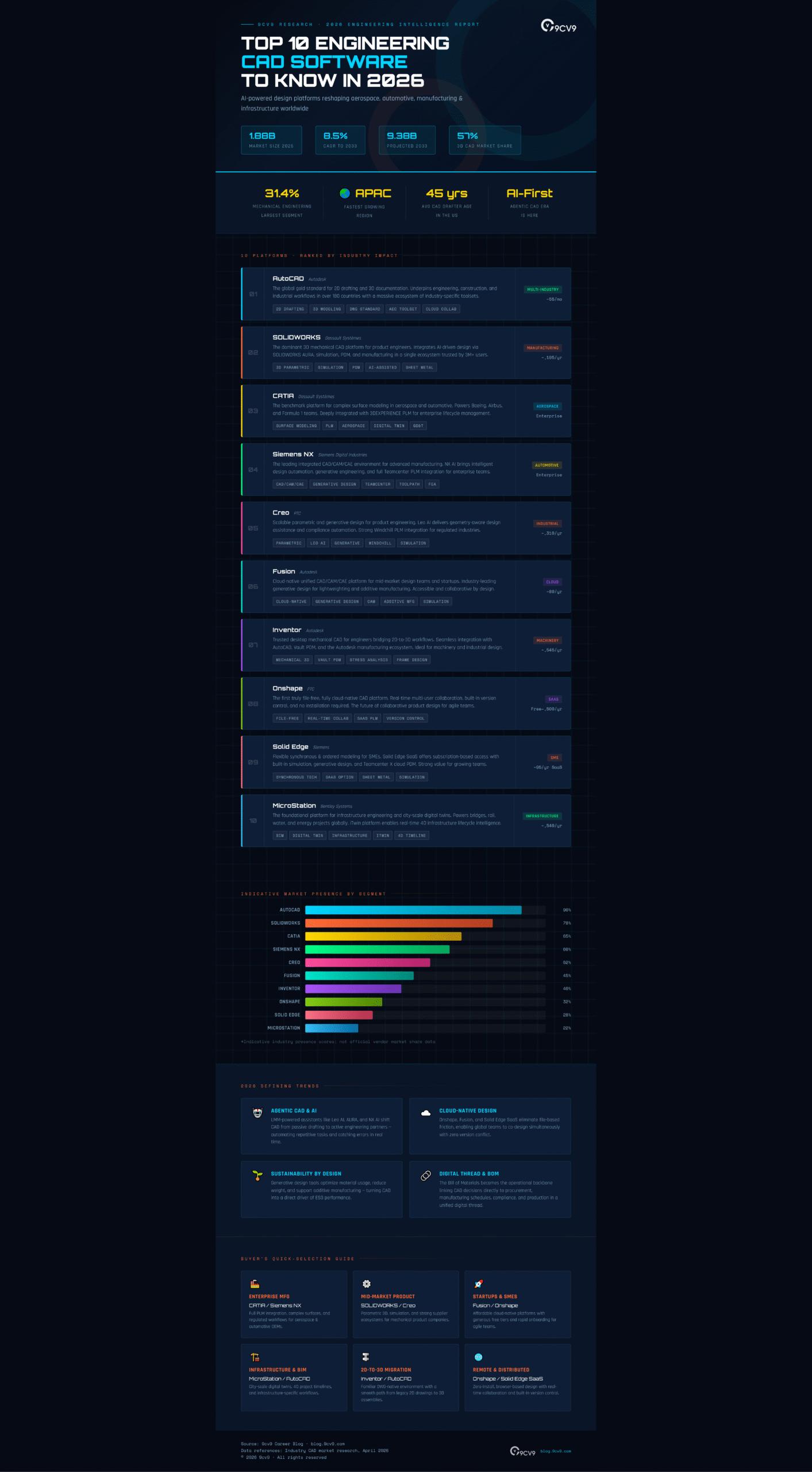
The global engineering CAD market reflects this transformation. Industry research shows that the Technology CAD Software market is projected to reach approximately USD 11.88 billion in 2026 and is expected to grow to nearly USD 19.38 billion by 2033, with a projected CAGR of 8.5 percent. The 3D CAD segment dominates this landscape, accounting for over 57 percent of the total market share, driven by increasing reliance on simulation-ready design environments, additive manufacturing, and digital twin applications across manufacturing and infrastructure sectors.
Mechanical engineering remains the largest application segment, holding approximately 31.4 percent of the market, while BIM and infrastructure-driven engineering continue to accelerate demand for civil engineering platforms such as Bentley MicroStation and advanced Autodesk ecosystems. North America remains the largest revenue contributor due to its concentration of aerospace, defense, and automotive headquarters, while Asia-Pacific has become the fastest-growing region because of manufacturing relocation, semiconductor expansion, electric vehicle production, and infrastructure modernization across India, China, South Korea, and Southeast Asia.
At the same time, the engineering software landscape is experiencing a major technological shift. The industry is moving from traditional CAD systems toward intelligent engineering platforms powered by AI-assisted design, Large Mechanical Models (LMMs), and cloud-native collaboration. Tools like SOLIDWORKS AURA, Siemens NX AI, Autodesk Fusion generative design, and geometry-aware engineering assistants such as Leo AI are transforming how engineers work. Instead of simply creating models, engineers can now use AI to automate drafting, detect manufacturability issues, retrieve historical design decisions, and optimize products for weight, strength, and sustainability.
This transition is often described as the rise of Agentic CAD, where software moves from being a passive drafting interface to an active engineering partner capable of reasoning, validating, and accelerating product development. In this environment, choosing the right CAD software is no longer just about interface preference or feature lists. It is about selecting the right platform to support the full engineering lifecycle, from ideation and simulation to production, compliance, and enterprise integration.
The top engineering CAD software platforms in the world in 2026 each serve different strategic roles depending on industry requirements, business scale, and operational complexity. Autodesk AutoCAD remains the global standard for 2D drafting and technical documentation. Dassault Systèmes SOLIDWORKS continues to lead mechanical 3D design for product development teams. CATIA dominates high-end aerospace and automotive engineering where complex surfaces and enterprise PLM integration are essential. Siemens NX stands out as the leading integrated CAD, CAM, and CAE platform for advanced manufacturing. PTC Creo drives scalable product design and generative engineering workflows. Autodesk Fusion leads the cloud-native mid-market design segment, while Inventor remains a trusted desktop platform for mechanical engineers transitioning from 2D to 3D environments.
PTC Onshape represents the future of fully cloud-native CAD, removing files entirely and enabling real-time collaborative design. Siemens Solid Edge provides SMEs with flexible modeling and SaaS-driven product development. Bentley MicroStation continues to serve as the foundational platform for global infrastructure projects, digital twins, and city-scale engineering environments.
Each of these platforms solves different engineering problems. Some prioritize enterprise lifecycle management. Others focus on manufacturing integration, simulation accuracy, infrastructure complexity, or affordability for startups and growing teams. Understanding these differences is essential for engineering leaders, operations managers, procurement teams, and business owners who need to make strategic software decisions in an increasingly competitive market.
Another critical factor shaping CAD adoption in 2026 is interoperability. Engineering organizations now operate in multi-CAD ecosystems where software must connect seamlessly with PLM, ERP, PDM, and supplier systems. The Bill of Materials (BOM) has become the operational center of the digital thread, linking engineering decisions directly to procurement, manufacturing schedules, compliance requirements, and production outcomes. Companies are prioritizing CAD platforms that support strong lifecycle connectivity rather than isolated design capabilities.
Sustainability has also become a measurable design metric. Generative design tools in Autodesk Fusion and PTC Creo are helping manufacturers reduce weight, optimize material usage, and support additive manufacturing strategies that lower carbon footprints across aerospace, automotive, and industrial production. Engineering software is now directly influencing environmental performance and long-term operational efficiency.
Hardware requirements have also evolved significantly. Professional CAD workflows in 2026 require high-frequency CPUs, 32 GB to 64 GB of RAM, dedicated workstation GPUs, and high-performance NVMe SSD storage to support massive assemblies, real-time rendering, AI-assisted simulation, and city-scale digital twin environments. Performance is no longer a convenience—it is a competitive engineering advantage.
At the workforce level, the industry faces an aging talent base and an increasing skills gap. The average CAD drafter in the United States is now approximately 45 years old, and the shortage of highly skilled modeling professionals is accelerating the adoption of AI-powered mentoring systems and agentic engineering layers that preserve institutional knowledge and improve compliance for junior engineers.
This makes the selection of engineering CAD software even more important. The right platform does not simply improve design speed—it strengthens organizational intelligence, protects engineering quality, and creates long-term operational resilience.
This guide explores the Top 10 Engineering CAD Software in the world in 2026 by examining their features, pricing, market share, AI innovation, business value, and strategic use cases across industries. Whether the goal is mechanical design, infrastructure development, aerospace engineering, digital manufacturing, or enterprise product lifecycle management, understanding the strengths of each platform helps businesses make smarter, more profitable engineering decisions.
In a world where engineering speed, manufacturing precision, sustainability, and digital transformation define competitive advantage, CAD software is no longer just software.
It is strategic industrial infrastructure.
Before we venture further into this article, we would like to share who we are and what we do.
About 9cv9
9cv9 is a business tech startup based in Singapore and Asia, with a strong presence all over the world.
With over nine years of startup and business experience, and being highly involved in connecting with thousands of companies and startups, the 9cv9 team has listed some important learning points in this overview of the Top 10 Engineering CAD Software To Know in 2026.
If you like to get your company listed in our top B2B software reviews, check out our world-class 9cv9 Media and PR service and pricing plans here.
Top 10 Engineering CAD Software To Know in 2026
- Autodesk AutoCAD
- Dassault Systèmes SOLIDWORKS
- Dassault Systèmes CATIA
- Siemens NX
- PTC Creo
- Autodesk Fusion
- Autodesk Inventor
- PTC Onshape
- Siemens Solid Edge
- Bentley MicroStation
1. Autodesk AutoCAD
Autodesk AutoCAD remains the most widely adopted CAD software globally, continuing to set the benchmark for 2D drafting and technical documentation in 2026. With an estimated market share approaching 38–39% and over 150,000 enterprise users, AutoCAD maintains a dominant position across architecture, engineering, and construction industries.
The platform’s continued leadership is driven by its evolution into a multi-disciplinary design suite. Its “Specialized Toolsets” now cater to mechanical, electrical, and architectural workflows within a unified environment, reducing the need for separate software ecosystems.
Strategic Positioning of AutoCAD in 2026
| Capability Area | AutoCAD Positioning (2026) | Strategic Advantage |
|---|---|---|
| Core Function | 2D drafting and documentation | Industry-standard compatibility (DWG ecosystem) |
| Expansion Layer | Specialized engineering toolsets | Multi-discipline workflow integration |
| Deployment Model | Subscription + cloud-enabled | Flexible enterprise scaling |
| Target Market | SMEs to large enterprises | Broad adoption across industries |
| Innovation Focus | Automation and AI-assisted drafting | Improved design productivity |
Financial Performance and Investment Strength
AutoCAD plays a critical role in Autodesk’s overall financial performance. The company reported total revenues exceeding USD 7 billion in 2026, with the AutoCAD product family contributing a significant portion of this figure.
A notable aspect of Autodesk’s strategy is its sustained investment in research and development, allocating hundreds of millions of dollars annually to enhance AutoCAD’s capabilities. This continuous innovation enables the platform to integrate emerging technologies such as generative design, machine learning, and cloud-based collaboration.
AutoCAD Key Financial and Market Metrics (2026)
| Metric | Value |
|---|---|
| Estimated Market Share | ~38–39% |
| Verified Company Users | 150,000+ |
| Annual Subscription Cost | Approx. USD 2,284 |
| Annual R&D Investment | Over USD 500 million |
| Revenue Contribution | Multi-billion USD segment |
| Growth Trend | Double-digit annual growth |
Pricing Evolution and Enterprise Adoption Trends
One of the most significant shifts in AutoCAD’s commercial strategy has been the transition to usage-based and subscription-driven pricing models. This shift has allowed large enterprises to optimize licensing costs by aligning usage with actual demand.
Impact of Pricing Transformation
| Business Segment | Impact of Usage-Based Pricing | Resulting Outcome |
|---|---|---|
| Large Enterprises | Dynamic license allocation | Reduced software underutilization |
| Mid-sized Companies | Flexible scaling | Improved cost efficiency |
| Small Businesses | Higher perceived cost barrier | Increased exploration of alternatives |
| Global Organizations | Centralized license management | Enhanced operational visibility |
Reports indicate that enterprises adopting usage-based licensing have reduced software inefficiencies by over 20%, highlighting the effectiveness of this model in large-scale deployments.
However, despite these advantages, the relatively high subscription cost remains a key consideration, particularly for small and medium-sized businesses (SMBs), many of which are actively exploring lower-cost or open-source CAD alternatives.
Competitive Landscape of Top Engineering CAD Software in 2026
The CAD software market is highly fragmented yet dominated by a few major players offering specialized solutions for different engineering domains.
Leading CAD Software Ecosystem
| CAD Software | Vendor | Core Strength | Primary Industry Use Case |
|---|---|---|---|
| AutoCAD | Autodesk | 2D drafting and documentation | Architecture, construction |
| SolidWorks | Dassault Systèmes | Parametric 3D modeling | Mechanical engineering |
| CATIA | Dassault Systèmes | Advanced surface modeling | Aerospace, automotive |
| Siemens NX | Siemens | Integrated CAD/CAM/CAE | Industrial manufacturing |
| PTC Creo | PTC | Product design and simulation | Engineering and product development |
| Fusion 360 | Autodesk | Cloud-based CAD/CAM | Startups and SMEs |
| Solid Edge | Siemens | Synchronous technology modeling | Mechanical design |
| Inventor | Autodesk | Digital prototyping | Mechanical engineering |
| MicroStation | Bentley Systems | Infrastructure design | Civil engineering |
| Onshape | PTC | Cloud-native collaboration | Distributed engineering teams |
These platforms collectively serve a global base of hundreds of thousands of organizations, with Autodesk, Dassault Systèmes, Siemens, and PTC leading in market share and technological innovation.
Market Dynamics Shaping CAD Software in 2026
The evolution of CAD software is driven by several transformative trends:
Key Industry Drivers
| Trend | Description | Strategic Impact |
|---|---|---|
| Cloud-Based CAD | Increasing adoption of SaaS platforms | Enables global collaboration |
| AI and Generative Design | Integration of machine learning in design workflows | Accelerates product innovation |
| Digital Twin Technology | Real-time simulation and lifecycle modeling | Improves engineering accuracy |
| Industry 4.0 Integration | Alignment with smart manufacturing ecosystems | Enhances automation and efficiency |
| Cross-Platform Collaboration | Multi-user, real-time design environments | Supports distributed teams |
These trends are reshaping CAD tools into comprehensive engineering platforms rather than standalone design applications.
Strategic Comparison of CAD Platforms in 2026
| Evaluation Criteria | Traditional CAD (e.g., AutoCAD) | Advanced CAD (e.g., NX, CATIA) | Cloud CAD (e.g., Onshape, Fusion 360) |
|---|---|---|---|
| Design Complexity | Low to medium | High | Medium to high |
| Collaboration Capability | Limited | Moderate | High |
| Deployment Model | Desktop | Hybrid | Fully cloud |
| Learning Curve | Moderate | High | Low to moderate |
| Cost Structure | Subscription | Enterprise licensing | Flexible subscription |
| Industry Focus | General-purpose | Specialized industries | Agile teams and startups |
Conclusion: Why AutoCAD Still Leads the CAD Market in 2026
Despite increasing competition from advanced and cloud-native CAD solutions, AutoCAD continues to dominate the global market due to its widespread adoption, strong ecosystem compatibility, and continuous innovation. Its role as the foundational drafting tool across industries ensures its relevance, even as newer platforms introduce advanced modeling and simulation capabilities.
However, the broader CAD market is clearly transitioning toward more integrated, cloud-based, and AI-enhanced environments. As engineering workflows become more complex and distributed, organizations are increasingly adopting hybrid CAD strategies that combine traditional tools like AutoCAD with advanced and cloud-native platforms.
For businesses evaluating the top engineering CAD software in 2026, the decision ultimately depends on several key factors: design complexity, collaboration needs, budget constraints, and industry-specific requirements.
2. Dassault Systèmes SOLIDWORKS
Dassault Systèmes SOLIDWORKS continues to rank among the most influential engineering CAD platforms globally in 2026, particularly within the domain of mechanical design and product development. Recognized for its robust parametric modeling capabilities, intuitive interface, and deep integration across engineering workflows, SOLIDWORKS has maintained a strong global footprint, supported by millions of users and widespread enterprise adoption.
The platform holds an estimated market share of over 13%, positioning it as one of the top 3D CAD solutions worldwide. Its ecosystem spans approximately 250,000 companies and more than 2 million engineers, reflecting its critical role in industries such as automotive, aerospace, industrial manufacturing, and consumer product design.
Strategic Positioning of SOLIDWORKS in the Global CAD Ecosystem
SOLIDWORKS distinguishes itself through its focus on precision engineering, simulation-driven design, and seamless product lifecycle integration. In 2026, its competitive edge is increasingly shaped by its alignment with Dassault Systèmes’ broader digital platform strategy.
| Capability Area | SOLIDWORKS Positioning (2026) | Strategic Advantage |
|---|---|---|
| Core Function | Parametric 3D modeling | High precision mechanical design |
| Platform Integration | 3DEXPERIENCE ecosystem | Unified data and lifecycle management |
| Deployment Model | Hybrid (desktop + cloud integration) | Flexible engineering workflows |
| Target Market | Mid to large enterprises | Strong industrial and manufacturing adoption |
| Innovation Focus | AI-assisted design and automation | Accelerated product development |
Transition to the 3DEXPERIENCE Platform
A defining transformation for SOLIDWORKS in 2026 is its deeper integration into the 3DEXPERIENCE platform, which serves as a cloud-native backbone for design collaboration, data management, and product lifecycle operations.
This shift represents a broader industry trend toward centralized engineering ecosystems, where CAD tools are no longer standalone applications but part of a connected digital environment. The platform enables:
- Real-time collaboration across distributed engineering teams
- Centralized product data management
- Seamless integration with simulation, manufacturing, and PLM systems
- Improved version control and traceability
Recent updates emphasize enhanced workflow efficiency, improved data visibility, and tighter integration between design and enterprise systems.
AI-Driven Innovation: Introduction of AURA and Intelligent Design Automation
One of the most significant advancements in SOLIDWORKS 2026 is the introduction of “AURA,” an AI-powered virtual companion embedded within the 3DEXPERIENCE environment.
AURA represents a shift toward conversational and intelligent CAD systems. It supports engineers by:
- Providing contextual design recommendations
- Retrieving relevant documentation and engineering knowledge
- Automating repetitive modeling tasks
- Assisting with constraint definition and feature creation
The assistant operates directly within the platform interface, enabling engineers to access insights without interrupting their workflow.
In addition, SOLIDWORKS 2026 introduces AI-driven automation features such as auto-generated drawings, which can interpret geometry and produce complete technical documentation with minimal manual input.
These capabilities significantly reduce design time while improving accuracy and consistency across engineering outputs.
Core Feature Enhancements in SOLIDWORKS 2026
The 2026 release includes over 400 enhancements spanning design, simulation, electrical systems, and data management, reinforcing its position as a comprehensive engineering platform.
Key Functional Improvements
| Feature Category | Enhancement Description | Business Impact |
|---|---|---|
| AI-Powered Drawings | Automated generation of technical drawings | Reduces manual drafting time |
| Selective Loading | Load only necessary components in large assemblies | Improves system performance |
| Fastener Recognition | Automated identification of standard components | Enhances modeling efficiency |
| Auto-Mating | Intelligent assembly alignment | Simplifies complex assemblies |
| Data Management Integration | Seamless connection to cloud-based PLM | Improves collaboration and traceability |
These enhancements demonstrate Dassault Systèmes’ ongoing investment in improving productivity, reducing manual effort, and enhancing design precision.
Pricing Structure and Subscription Model in 2026
The pricing model for SOLIDWORKS reflects its transition toward cloud-integrated and subscription-based offerings, aligned with the 3DEXPERIENCE ecosystem.
| Subscription Tier | Annual Cost (USD) | Key Capabilities |
|---|---|---|
| Standard | 2,820 | Core 3D modeling and design tools |
| Professional | 3,456 | Advanced collaboration and validation features |
| Premium | 4,716 | Simulation, advanced analysis, and automation tools |
This tiered pricing structure enables organizations to select solutions based on complexity, scale, and engineering requirements.
Market Adoption and Educational Ecosystem
SOLIDWORKS maintains a strong presence in both enterprise and academic environments, which contributes significantly to its long-term market dominance.
Adoption Metrics
| Metric | Value |
|---|---|
| Global Engineers | 2 million+ |
| Enterprise Users | ~250,000 companies |
| Market Share | ~13.5% |
| Annual Student Certifications | 500,000+ |
Its extensive certification programs and academic partnerships ensure a continuous pipeline of skilled engineers trained on the platform, reinforcing its industry relevance.
Competitive Comparison Within the CAD Market
| Evaluation Criteria | SOLIDWORKS | AutoCAD | Siemens NX / CATIA |
|---|---|---|---|
| Design Focus | Mechanical 3D modeling | 2D drafting | Advanced engineering design |
| Ease of Use | High | Very high | Moderate to complex |
| Cloud Integration | Strong (3DEXPERIENCE) | Moderate | Strong |
| Simulation Capability | Built-in | Limited | Advanced |
| Industry Adoption | Manufacturing-heavy | Cross-industry | High-end industries |
Strategic Outlook: SOLIDWORKS in the Future of Engineering Design
SOLIDWORKS is undergoing a clear transformation from a traditional CAD tool into an intelligent engineering platform powered by AI, cloud infrastructure, and integrated lifecycle management.
Key strategic directions include:
- Expansion of AI-driven design automation
- Deeper integration with digital twin and simulation technologies
- Continued migration toward cloud-native engineering environments
- Enhanced collaboration capabilities for global engineering teams
As engineering complexity increases and product development cycles accelerate, SOLIDWORKS is well-positioned to remain a central tool for mechanical design professionals worldwide.
Conclusion: Why SOLIDWORKS Remains a Top Engineering CAD Software in 2026
SOLIDWORKS continues to be one of the most trusted and widely used 3D CAD platforms due to its balance of usability, advanced functionality, and ecosystem integration. Its shift toward AI-enhanced workflows and cloud-based collaboration ensures that it remains competitive in an evolving digital engineering landscape.
For organizations seeking a reliable and scalable solution for mechanical design in 2026, SOLIDWORKS stands out as a strategic investment—offering not only powerful modeling capabilities but also a forward-looking platform aligned with the future of engineering innovation.
3. Dassault Systèmes CATIA
Dassault Systèmes CATIA remains the undisputed leader in high-end enterprise engineering CAD software in 2026, particularly across the aerospace, automotive, defense, shipbuilding, and advanced industrial manufacturing sectors. Unlike general-purpose CAD platforms, CATIA is purpose-built for organizations managing highly complex mechanical systems, advanced surface engineering, and large-scale industrial product lifecycles.
Its dominance is especially visible among major OEMs (Original Equipment Manufacturers), where CATIA maintains exceptionally high penetration, particularly in aerospace and automotive industries. Large manufacturers rely on CATIA for mission-critical engineering projects involving aircraft systems, automotive platforms, electric vehicles, defense equipment, and industrial machinery where precision, scalability, and lifecycle integration are non-negotiable.
CATIA’s strategic value lies not only in its powerful design engine but also in its deep integration with Product Lifecycle Management (PLM), simulation systems, manufacturing workflows, and the broader Dassault Systèmes 3DEXPERIENCE platform.
Strategic Positioning of CATIA in the Enterprise CAD Market
CATIA operates in a different market segment compared to tools such as AutoCAD and SOLIDWORKS. While those platforms dominate drafting and mid-market mechanical design, CATIA is designed for enterprise-scale engineering environments where multi-disciplinary collaboration and product complexity are significantly higher.
| Capability Area | CATIA Positioning (2026) | Strategic Advantage |
|---|---|---|
| Core Function | Advanced 3D engineering and surface design | High-end precision for complex industrial systems |
| Platform Integration | Full PLM + 3DEXPERIENCE ecosystem | End-to-end digital engineering lifecycle |
| Deployment Model | Enterprise desktop + cloud platform | Scalable global engineering collaboration |
| Target Market | Large enterprises and OEMs | Aerospace, automotive, defense, industrial sectors |
| Innovation Focus | Industrial AI + virtual twin technology | Engineering optimization and predictive workflows |
Why CATIA Dominates Aerospace and Automotive Engineering
CATIA has long been the preferred platform for organizations building some of the world’s most complex engineered products. Aircraft manufacturers, automotive giants, and industrial OEMs require advanced surfacing, assembly management, and configuration control that exceed the capabilities of conventional CAD systems.
Its strengths include:
- Class-A surface modeling for aerospace and automotive exterior design
- Massive assembly management for multi-thousand-part systems
- Tight integration with simulation and validation workflows
- PLM synchronization across design, manufacturing, and service
- Virtual twin modeling through the 3DEXPERIENCE platform
This makes CATIA particularly critical for sectors where engineering errors can result in massive financial, regulatory, or safety consequences.
Pricing Structure: Premium Cost Reflecting Premium Capability
CATIA remains one of the most expensive engineering CAD platforms in the world, reflecting its specialized enterprise-grade functionality and deep PLM architecture.
Pricing varies depending on licensing structure, deployment model, and modules selected.
CATIA Pricing Overview (2026)
| License Type | Estimated Cost (USD) | Notes |
|---|---|---|
| Standalone Perpetual License | Starting from 14,100 | Plus annual maintenance costs |
| Annual Term License (Entry-Level) | Starting from 5,600 | Lower entry point for enterprise adoption |
| CATIA Mechanical Designer (3DEXPERIENCE) | Around 7,560/year | Includes collaboration tools and platform access |
| CATIA Mechanical Essential | 7,080/year | Single-user yearly subscription |
| CATIA Mechanical Elite | 14,598/year | Advanced enterprise configuration |
Dassault’s official store confirms CATIA Mechanical Designer annual subscriptions at approximately USD 7,560, while CATIA Mechanical Essential starts at USD 7,080 annually.
Third-party reseller pricing also places perpetual licenses starting around USD 14,100 and entry-level yearly licenses from approximately USD 5,600.
Revenue Performance and Business Importance to Dassault Systèmes
CATIA is one of the core revenue engines within Dassault Systèmes’ Industrial Innovation portfolio, alongside SIMULIA and ENOVIA.
This division represents the majority of Dassault’s enterprise engineering business and reflects the strategic importance of CATIA in supporting large industrial clients globally.
Industrial Innovation software contributes more than half of the company’s software revenue, demonstrating that high-end engineering solutions remain central to Dassault’s long-term business model.
The company’s strategic focus in 2026 includes:
- Industrial AI offerings
- Value-based monetization models
- Virtual twin expansion
- Industry-specific engineering intelligence
- Cloud-native enterprise engineering ecosystems
These initiatives position CATIA not just as a CAD tool, but as a foundation for industrial digital transformation.
Core Feature Strengths of CATIA in 2026
Key Functional Capabilities
| Feature Category | Enterprise Value | Business Impact |
|---|---|---|
| Advanced Surface Modeling | Precision Class-A surfaces for automotive and aerospace | Superior product quality |
| Large Assembly Management | Handles extremely complex multi-part systems | Enterprise-scale engineering efficiency |
| PLM Integration | Connected design-to-manufacturing workflows | Lifecycle traceability and governance |
| Simulation Integration | Linked with SIMULIA validation environments | Reduced design failure risks |
| Virtual Twin Support | Real-time digital representation of products | Better operational forecasting |
| Industrial AI Assistance | Predictive and knowledge-based engineering support | Faster engineering decision-making |
CATIA vs Other Leading CAD Platforms
| Evaluation Criteria | CATIA | SOLIDWORKS | AutoCAD |
|---|---|---|---|
| Primary Focus | Enterprise engineering | Mechanical 3D modeling | 2D drafting |
| Target Company Size | Large OEMs and enterprises | SMEs to enterprise | SMEs to enterprise |
| Surface Modeling | Extremely advanced | Strong | Limited |
| PLM Integration | Native enterprise-grade | Moderate | Limited |
| Learning Curve | Very high | Moderate | Low to moderate |
| Pricing | Very high | Mid to high | Moderate |
This comparison highlights why CATIA is often selected for the most complex engineering environments, while other tools serve broader commercial markets.
The Future of CATIA: Industrial AI and Value-Based Engineering
Dassault Systèmes is aggressively positioning CATIA for the next phase of industrial engineering through Industrial AI and value-based monetization strategies.
This includes:
- AI-driven engineering recommendations
- Predictive failure analysis
- Automated design optimization
- Virtual twin expansion for lifecycle prediction
- Industry-specific engineering intelligence
Rather than simply charging for licenses, the company is increasingly aligning pricing with measurable business outcomes such as reduced development cycles, improved product quality, and manufacturing efficiency.
This shift reflects the broader movement from software ownership toward engineering outcome monetization.
Conclusion: Why CATIA Remains a Top Engineering CAD Software in 2026
CATIA continues to dominate the highest tier of the engineering CAD market because it solves problems that conventional CAD platforms cannot handle effectively. Its unmatched capabilities in surface modeling, enterprise PLM integration, large assembly management, and industrial AI make it the preferred solution for the world’s most complex engineering projects.
While its pricing is significantly higher than most competitors, the value proposition is equally higher for organizations operating at industrial scale.
For aerospace leaders, automotive manufacturers, and advanced industrial enterprises, CATIA is not simply software—it is critical engineering infrastructure that supports the design of some of the world’s most sophisticated products.
4. Siemens NX
Siemens NX, formerly known as Unigraphics, continues to stand as one of the most powerful and comprehensive engineering software platforms in the world in 2026. Unlike traditional CAD tools that focus primarily on design, NX delivers a fully integrated environment combining CAD (Computer-Aided Design), CAM (Computer-Aided Manufacturing), and CAE (Computer-Aided Engineering) within a single enterprise-grade ecosystem.
This unified approach makes Siemens NX particularly valuable for large-scale manufacturers operating in aerospace, automotive, industrial machinery, medical devices, and high-precision engineering sectors. Organizations that require seamless coordination between design, simulation, manufacturing, and lifecycle management consistently rely on NX as a mission-critical platform.
The strategic importance of Siemens NX has increased significantly following Siemens’ acquisition of Altair Engineering, a USD 10 billion transaction completed in March 2025. This acquisition strengthens Siemens’ industrial software leadership and expands the Siemens Xcelerator platform into one of the world’s most comprehensive digital twin ecosystems.
Strategic Positioning of Siemens NX in the Global CAD Market
Siemens NX is not positioned as a standalone design software—it is a complete digital engineering infrastructure built for enterprise manufacturing. Its strength lies in connecting product development with simulation, factory operations, and lifecycle optimization.
| Capability Area | Siemens NX Positioning (2026) | Strategic Advantage |
|---|---|---|
| Core Function | Integrated CAD + CAM + CAE | End-to-end engineering workflow management |
| Platform Integration | Siemens Xcelerator + Digital Twin | Unified engineering and operational intelligence |
| Deployment Model | Enterprise desktop + SaaS hybrid | Flexible global manufacturing deployment |
| Target Market | Large manufacturers and OEMs | Aerospace, automotive, industrial production |
| Innovation Focus | AI-driven feature recognition | Design reuse and engineering consistency |
Impact of the Altair Acquisition on Siemens NX
The acquisition of Altair Engineering represents one of the most important industrial software consolidations of the decade. Siemens completed the acquisition for approximately USD 10 billion, significantly expanding its capabilities in:
- Mechanical simulation
- Electromagnetic simulation
- High-performance computing (HPC)
- Data science and analytics
- Industrial artificial intelligence
- Digital twin technology
This strategic move allows Siemens NX to operate within a far more advanced simulation ecosystem, enabling manufacturers to create stronger predictive models, optimize performance earlier in the design cycle, and accelerate product validation.
Siemens stated that integrating Altair strengthens the “most comprehensive Digital Twin” and creates one of the world’s most complete AI-powered industrial software portfolios.
This has major implications for aerospace and automotive manufacturers, where simulation accuracy directly impacts safety, compliance, and production efficiency.
AI-Powered Design Intelligence in Siemens NX 2026
One of the most important innovations in Siemens NX 2026 is its advanced AI-driven pattern and feature recognition system.
Rather than simply assisting with drafting, NX AI helps engineers:
- Identify repeated design patterns across massive assemblies
- Reuse validated components and engineering logic
- Maintain design consistency across global teams
- Reduce redundant engineering work
- Improve compliance and standardization across operations
This capability is particularly important for multinational manufacturers managing thousands of interconnected components across multiple product lines.
By enabling design reuse and knowledge-driven engineering, NX significantly improves both speed and engineering quality while reducing operational risk.
Modular Pricing Structure and Enterprise Flexibility
Unlike fixed-license CAD platforms, Siemens NX follows a highly modular pricing structure. This allows organizations to build customized environments based on their exact engineering requirements.
The base package provides core CAD/CAM functionality, while advanced modules are added depending on industry needs.
Siemens NX Pricing Overview (2026)
| License Type / Module | Estimated Cost (USD) | Primary Function |
|---|---|---|
| Core NX CAD/CAM Package | Custom enterprise pricing | Fundamental design and manufacturing capabilities |
| NX Scan to Part | USD 459/month | Reverse engineering from scanned 3D data |
| NX Drafting & Layout | USD 119/month | Technical drawing and documentation |
| NX X Design Premium | Approx. USD 12,000/year | Advanced SaaS engineering capabilities |
| Additional Specialized Modules | Variable pricing | Robotics, simulation, additive manufacturing |
Industry pricing sources confirm that NX Scan to Part is priced at approximately USD 459 per month, while NX Drafting & Layout is around USD 119 monthly.
This modular strategy allows manufacturers to optimize costs while ensuring they only pay for capabilities directly tied to operational needs.
Core Strengths of Siemens NX in 2026
Key Enterprise Capabilities
| Feature Category | Enterprise Value | Business Impact |
|---|---|---|
| Integrated CAD/CAM/CAE | Single unified engineering platform | Eliminates workflow fragmentation |
| Massive Assembly Management | Handles highly complex industrial systems | Improves enterprise scalability |
| AI Feature Recognition | Pattern detection and component reuse | Reduces repetitive engineering |
| Digital Twin Integration | Real-time simulation of product behavior | Improves predictive engineering |
| Manufacturing Integration | Direct connection between design and production | Faster production readiness |
| Modular Expansion | Flexible feature licensing | Better cost control and customization |
Siemens NX vs Other Leading Enterprise CAD Platforms
| Evaluation Criteria | Siemens NX | CATIA | SOLIDWORKS |
|---|---|---|---|
| Primary Focus | CAD + CAM + CAE integration | High-end enterprise design | Mechanical 3D design |
| Best For | Manufacturing ecosystems | Aerospace and automotive OEMs | Mid-market engineering |
| Simulation Strength | Very strong | Very strong | Moderate |
| CAM Integration | Native and advanced | Moderate | Limited |
| AI Design Support | Strong | Growing | Moderate |
| Pricing Model | Highly modular | High fixed enterprise pricing | Tiered subscription |
This comparison shows why Siemens NX is often selected by organizations where manufacturing integration is just as important as design itself.
Future Outlook: Siemens NX and the Digital Twin Economy
The future of Siemens NX is closely tied to the rise of the industrial digital twin economy.
As manufacturers increasingly prioritize predictive engineering, AI-assisted optimization, and smart factories, NX is positioned as a central platform enabling:
- Closed-loop product development
- Simulation-driven manufacturing decisions
- Lifecycle-based product optimization
- AI-powered industrial engineering
- Cross-functional collaboration across global operations
The Siemens + Altair combination is expected to accelerate this transformation, making NX even more valuable for organizations competing in advanced industrial sectors.
Conclusion: Why Siemens NX Remains a Top Engineering CAD Software in 2026
Siemens NX continues to rank among the top engineering CAD software platforms in the world because it goes far beyond design. It provides a fully integrated digital engineering environment where CAD, CAM, simulation, manufacturing, and lifecycle management operate as one connected system.
Its combination of enterprise scalability, AI-assisted engineering, modular pricing, and digital twin integration makes it particularly valuable for large manufacturers managing complex global operations.
For aerospace leaders, automotive giants, and industrial manufacturers, Siemens NX is not simply a CAD solution—it is a strategic engineering platform that supports the full journey from concept to production and beyond.
5. PTC Creo
PTC Creo continues to rank among the top engineering CAD software platforms in the world in 2026, particularly for organizations focused on advanced mechanical design, industrial product development, and scalable engineering workflows. As the direct successor to the legendary Pro/Engineer platform, Creo has built a strong reputation for precision-driven parametric modeling, robust simulation, and enterprise-grade design management.
Unlike entry-level CAD tools focused mainly on drafting or basic 3D modeling, Creo is designed for manufacturers and engineering teams that require deep control over product geometry, simulation-driven development, and seamless design-to-manufacturing workflows. Its strong presence across industrial equipment, automotive components, electronics, heavy machinery, and high-performance manufacturing sectors reflects its long-standing enterprise value.
PTC’s financial performance further reinforces Creo’s market importance. The company reported strong Annual Recurring Revenue (ARR) growth of 8.5% in 2025, while total revenue reached approximately USD 2.739 billion, demonstrating sustained demand for its engineering software portfolio and subscription-driven business model.
Strategic Positioning of Creo in the Global CAD Software Market
Creo occupies a unique position between mid-market mechanical design tools like SOLIDWORKS and enterprise-heavy platforms such as CATIA and Siemens NX. It is especially favored by companies that require scalable parametric engineering without the extreme complexity or cost of ultra-high-end enterprise systems.
Its strength lies in model-based product development, where design, simulation, manufacturing, and lifecycle decisions are interconnected from the earliest concept stages.
| Capability Area | Creo Positioning (2026) | Strategic Advantage |
|---|---|---|
| Core Function | Parametric 3D modeling | High-precision engineering control |
| Platform Integration | CAD + Simulation + Manufacturing | Unified product development workflow |
| Deployment Model | Desktop + Cloud Extensions | Flexible enterprise scalability |
| Target Market | Mid-size to large manufacturers | Industrial engineering and product development |
| Innovation Focus | Generative Design + Cloud Optimization | Faster design iteration and manufacturable outputs |
Generative Design Extension (GDX): One of Creo’s Biggest Innovations in 2026
One of the most significant advancements in Creo 2026 is the continued expansion of the Generative Design Extension (GDX), a cloud-powered topology optimization solution that dramatically improves product development speed and manufacturability.
Traditional topology optimization often creates mesh outputs that require time-consuming mesh-to-solid conversion before they can be used in production workflows. Creo’s GDX eliminates this friction by returning editable B-Rep geometry directly into the native Creo environment.
This delivers major workflow advantages:
- Cloud-based simultaneous design exploration
- Multiple material and manufacturing scenario evaluation
- Editable production-ready B-Rep geometry
- Elimination of mesh-to-solid conversion bottlenecks
- Faster optimization for additive and traditional manufacturing
PTC highlights that GDX allows engineers to generate optimized designs automatically based on manufacturing requirements, materials, and constraints, while maintaining seamless workflow continuity inside Creo.
Why Creo’s Generative Design Matters for Modern Manufacturing
Generative design is becoming a major competitive differentiator across the CAD industry. For manufacturers focused on lightweight engineering, cost reduction, and accelerated prototyping, GDX provides significant operational value.
Generative Design Business Impact
| Feature Area | Business Benefit | Strategic Outcome |
|---|---|---|
| Cloud-Based Optimization | Faster multi-scenario evaluation | Reduced engineering cycle time |
| Editable B-Rep Geometry | Direct native CAD usability | No downstream conversion delays |
| Manufacturing Constraints | Production-ready optimization | Higher manufacturability |
| Material Scenario Testing | Cost and performance comparison | Better engineering decisions |
| AI-Assisted Design | Automated topology suggestions | Increased innovation speed |
This positions Creo as one of the strongest platforms for design optimization within industrial engineering environments.
Creo Pricing Structure in 2026
PTC follows a subscription-based pricing model with multiple capability tiers, allowing organizations to scale based on complexity and operational needs.
Estimated Creo Pricing (2026)
| Subscription Tier | Annual Subscription Cost (USD) | Core Use Case |
|---|---|---|
| Tier 1 – Essentials | ~3,350 to 4,092 | Core 3D modeling and parametric design |
| Tier 2 – Advanced | ~4,526 to 11,990 | Large assemblies and advanced design |
| Tier 3 – Advanced Professional | ~16,940 | Surface modeling and mold design |
| Tier 4 – Premium | ~23,430 | Simulation, advanced analysis, collaboration |
| Tier 5 – Premium Plus | ~32,340 | Topology optimization and advanced manufacturing |
Pricing varies depending on license type, floating vs node-locked access, and bundled extensions. Tier 1 Design Essentials is commonly positioned as the entry point, while higher tiers serve advanced enterprise requirements.
Core Functional Strengths of Creo in 2026
Creo continues to be recognized for its depth in mechanical engineering and industrial product development.
Key Enterprise Capabilities
| Feature Category | Enterprise Value | Business Impact |
|---|---|---|
| Parametric Modeling | Precise geometry control | High engineering accuracy |
| Large Assembly Management | Supports complex industrial products | Scalable product development |
| Model-Based Definition (MBD) | Single source of engineering truth | Reduced production errors |
| Simulation Integration | Embedded engineering validation | Faster design verification |
| Generative Design Extension | AI-driven optimization | Reduced product development time |
| Additive Manufacturing | Direct manufacturing readiness | Better prototyping and production efficiency |
These capabilities make Creo particularly strong for organizations where design changes must propagate efficiently across engineering, manufacturing, and supplier ecosystems.
Creo vs Other Leading Mechanical CAD Platforms
| Evaluation Criteria | PTC Creo | SOLIDWORKS | Siemens NX |
|---|---|---|---|
| Primary Focus | Parametric product development | Mechanical 3D modeling | Integrated CAD/CAM/CAE |
| Generative Design | Very strong | Strong | Very strong |
| Learning Curve | Moderate to high | Moderate | High |
| Manufacturing Integration | Strong | Moderate | Very strong |
| Enterprise Scalability | High | Medium to high | Very high |
| Pricing | Mid to high | Moderate | High |
This comparison explains why Creo remains highly attractive for companies seeking enterprise capability without the full complexity of NX or CATIA.
Future Outlook: Creo and the Next Phase of Industrial Engineering
PTC continues to position Creo around the future of digital product development through:
- Cloud-native generative design
- AI-assisted engineering optimization
- Expanded simulation-driven workflows
- Additive manufacturing integration
- Stronger PLM connectivity with Windchill
- Greater support for electrification and sustainable design
As manufacturers demand faster product cycles and smarter engineering decisions, Creo’s ability to combine design intelligence with practical manufacturability will remain a major competitive strength.
Conclusion: Why PTC Creo Remains a Top Engineering CAD Software in 2026
PTC Creo remains one of the world’s top engineering CAD platforms because it delivers the ideal balance between advanced parametric modeling, enterprise scalability, and next-generation design optimization.
Its Generative Design Extension is especially important in 2026, allowing organizations to move beyond traditional modeling and into AI-assisted engineering workflows that reduce cost, improve manufacturability, and accelerate innovation.
For manufacturers seeking a scalable, simulation-ready, and production-focused CAD solution, Creo continues to be one of the most strategic investments in the engineering software market.
6. Autodesk Fusion
Autodesk Fusion, formerly known as Fusion 360, has become one of the most influential engineering CAD platforms in the world in 2026, particularly for startups, SMEs, product development teams, and agile manufacturing businesses. Unlike traditional enterprise-heavy CAD systems, Fusion was built around a cloud-first philosophy, combining CAD, CAM, CAE, PCB design, simulation, collaboration, and manufacturing workflows inside a single connected platform.
This unified approach has made Autodesk Fusion one of the fastest-growing professional-grade design tools globally, especially among companies that require affordability, flexibility, and rapid product iteration without the complexity or cost of legacy enterprise CAD systems.
Autodesk officially positions Fusion as a complete cloud-based product development platform that supports CAD, CAM, CAE, electronics, PCB design, data management, and collaborative workflows within one ecosystem. Autodesk also highlights that more than 4.6 million design and manufacturing professionals use Fusion as their primary design-to-manufacturing platform.
This broad adoption reflects Fusion’s strategic role as the preferred platform for engineering teams seeking professional capabilities without enterprise-level overhead.
Strategic Positioning of Autodesk Fusion in the Global CAD Software Market
Fusion occupies a unique space between entry-level design tools and enterprise platforms such as CATIA, Siemens NX, and Creo. It is especially attractive for startups, industrial designers, manufacturing teams, and growing product companies that require a connected engineering workflow with strong cost efficiency.
Its core strength lies in eliminating fragmented software stacks by integrating multiple engineering disciplines into one subscription.
| Capability Area | Autodesk Fusion Positioning (2026) | Strategic Advantage |
|---|---|---|
| Core Function | Unified CAD + CAM + CAE + PCB | Full product development workflow |
| Platform Integration | Cloud-native Autodesk ecosystem | Centralized collaboration and version control |
| Deployment Model | Desktop + Cloud-connected platform | Hybrid flexibility with cloud intelligence |
| Target Market | Startups, SMEs, mid-market manufacturers | Affordable professional engineering |
| Innovation Focus | Generative AI + manufacturability analysis | Faster product validation and production readiness |
AI-Powered Innovation in Fusion 2026
One of the biggest differentiators of Autodesk Fusion in 2026 is the expansion of Fusion AI, which introduces automated generative design alternatives and machine learning-driven manufacturability analysis.
Rather than functioning as a simple drafting assistant, Fusion AI helps engineers:
- Generate multiple optimized design alternatives automatically
- Evaluate weight, strength, and manufacturability constraints
- Detect production bottlenecks before manufacturing begins
- Improve CNC and additive manufacturing readiness
- Reduce engineering rework and production delays
Autodesk confirms that Fusion includes AI-powered capabilities such as generative design, AutoConstrain, Automated Drawings, and cloud-based simulation workflows to accelerate design-to-manufacturing processes.
This makes Fusion particularly valuable for lean teams where engineering efficiency directly impacts time-to-market.
Why Fusion’s Manufacturability Analysis Matters
Traditional CAD systems often separate design from manufacturing validation, creating expensive downstream issues. Fusion addresses this by embedding manufacturability intelligence directly into the design process.
AI-Driven Manufacturing Benefits
| Feature Area | Business Benefit | Strategic Outcome |
|---|---|---|
| Generative Design | Multiple optimized design options | Faster innovation cycles |
| Manufacturability Analysis | Early detection of production risks | Reduced manufacturing errors |
| Integrated CAM | Design-to-production workflow continuity | Lower operational friction |
| PCB + Mechanical Integration | Unified electronics and product design | Better product coordination |
| Cloud Collaboration | Shared engineering visibility | Faster team decision-making |
This integrated workflow is one of the main reasons Fusion is dominating the startup and mid-market engineering segment.
Pricing Structure: One of the Most Affordable Professional CAD Platforms
Fusion remains one of the most affordable professional engineering platforms in 2026, making it highly attractive for smaller teams and fast-growing companies.
Autodesk confirms that pricing starts at USD 85 per month or USD 680 per year for the full commercial subscription, which includes access to CAD, CAM, CAE, PCB, and data management features.
Autodesk Fusion Pricing Overview (2026)
| Subscription Type | Cost (USD) | Core Use Case |
|---|---|---|
| Monthly Subscription | 85/month | Flexible short-term commercial use |
| Annual Subscription | 680/year | Most cost-effective professional option |
| 3-Year Subscription | 2,040 | Long-term enterprise savings |
| Personal Use Version | Free (limited) | Non-commercial hobbyist projects |
| Extensions (Add-ons) | Variable pricing | Advanced simulation and manufacturing capabilities |
This affordability gives Fusion a major competitive advantage over higher-cost platforms such as CATIA, NX, and Creo.
Revenue Growth and Autodesk’s “Make” Product Family Performance
Autodesk’s broader “Make” product family, which includes Fusion, continues to demonstrate strong financial momentum.
In fiscal 2026, Autodesk reported that the Make portfolio delivered approximately USD 796 million in revenue, representing a 22% year-over-year increase. This reflects strong market demand for connected product development solutions and validates Fusion’s growing strategic importance within Autodesk’s long-term business model.
This revenue growth is also supported by Autodesk’s broader AI investments across its manufacturing and design platforms, reinforcing Fusion’s position as a major growth engine for the company.
Core Functional Strengths of Autodesk Fusion in 2026
Key Platform Capabilities
| Feature Category | Enterprise Value | Business Impact |
|---|---|---|
| Integrated CAD/CAM/CAE | Unified engineering environment | Reduced software fragmentation |
| PCB Design | Electronics + mechanical integration | Better product development efficiency |
| Generative AI | Automated design alternatives | Faster engineering decisions |
| Cloud Data Management | Centralized files and version control | Improved collaboration |
| Automated Drawings | AI-generated technical documentation | Reduced drafting time |
| Manufacturing Extensions | Advanced CNC and production workflows | Better factory readiness |
These capabilities make Fusion particularly strong for businesses that need engineering speed, collaboration, and production alignment.
Autodesk Fusion vs Other Leading CAD Platforms
| Evaluation Criteria | Autodesk Fusion | SOLIDWORKS | PTC Creo |
|---|---|---|---|
| Primary Focus | Unified cloud product development | Mechanical 3D modeling | Parametric product design |
| Cloud Collaboration | Very strong | Moderate | Moderate |
| Affordability | Very high | Moderate | Moderate to high |
| Manufacturing Integration | Strong | Moderate | Strong |
| AI Design Features | Very strong | Strong | Very strong |
| Best For | Startups and SMEs | Mid-market manufacturers | Enterprise product teams |
This comparison highlights why Fusion is often selected by businesses prioritizing speed, affordability, and cloud-native collaboration.
Future Outlook: Fusion and the Next Generation of Engineering Workflows
Autodesk continues to position Fusion as a central platform for the future of manufacturing through:
- Expanded generative AI workflows
- Stronger automated manufacturability validation
- Deeper cloud-native engineering collaboration
- Enhanced electronics and PCB integration
- Greater support for CNC and additive manufacturing
- Improved AI-powered design automation
As modern engineering teams demand faster iteration and smaller software stacks, Fusion’s all-in-one platform strategy becomes increasingly valuable.
Conclusion: Why Autodesk Fusion Is One of the Top Engineering CAD Software Platforms in 2026
Autodesk Fusion has fundamentally reshaped the mid-market engineering software landscape by delivering professional-grade CAD, CAM, CAE, and manufacturing capabilities inside a highly affordable cloud-connected platform.
Its AI-powered design intelligence, strong manufacturability analysis, and low barrier to entry make it one of the most strategically important CAD solutions for startups, SMEs, and agile product teams in 2026.
For companies seeking speed, affordability, collaboration, and production readiness without enterprise complexity, Autodesk Fusion remains one of the smartest engineering software investments available today.
7. Autodesk Inventor
Autodesk Inventor continues to be one of the most trusted engineering CAD platforms in the world in 2026, particularly for mechanical engineers, industrial designers, and manufacturers that require robust design-to-manufacturing workflows. As Autodesk’s flagship desktop-based mechanical engineering solution, Inventor is specifically designed for organizations that need precision-driven 3D modeling, advanced assembly management, product simulation, and manufacturing-ready documentation.
Unlike cloud-first platforms such as Autodesk Fusion, Inventor remains deeply rooted in high-performance desktop engineering, making it especially valuable for manufacturers handling large assemblies, detailed machine systems, and production-critical engineering environments. Its strong integration with AutoCAD also makes it a preferred platform for companies transitioning from traditional 2D documentation into full 3D simulation-driven product development.
Autodesk officially positions Inventor as a complete set of mechanical design solutions for 3D modeling, simulation, visualization, and documentation, with built-in tools for machine design, sheet metal, frame design, cable systems, tube and pipe, and Model-Based Definition (MBD).
Strategic Positioning of Autodesk Inventor in the Global CAD Software Market
Inventor serves a unique position between AutoCAD’s drafting dominance and Fusion’s cloud-native flexibility. It is especially favored by manufacturers that prioritize engineering stability, large assembly performance, and advanced desktop modeling precision.
Its strength lies in delivering a highly stable engineering environment for organizations managing thousands of components across complex mechanical systems.
| Capability Area | Autodesk Inventor Positioning (2026) | Strategic Advantage |
|---|---|---|
| Core Function | Mechanical 3D design and simulation | High-precision manufacturing workflows |
| Platform Integration | Tight AutoCAD + Autodesk Vault connection | Seamless design documentation and data control |
| Deployment Model | Desktop-first with cloud collaboration | Stability for complex engineering projects |
| Target Market | Manufacturers and mechanical engineers | Industrial product development |
| Innovation Focus | Assembly management + MBD workflows | Faster production readiness and traceability |
Why Inventor Remains a Preferred Platform for Manufacturers
Inventor is widely used by engineering teams that need stability, predictable workflows, and precise control over complex assemblies.
Its advantages are especially clear in industries such as:
- Industrial machinery
- Manufacturing equipment
- Sheet metal fabrication
- Heavy equipment production
- Custom machine design
- Factory systems engineering
- Product simulation and validation
Autodesk highlights that Inventor enables engineers to create a virtual representation of the final product before manufacturing begins, helping validate form, fit, and function while reducing development costs and accelerating time-to-market.
This capability is critical for manufacturers where engineering errors can result in expensive production delays.
Pricing Structure and Subscription Model in 2026
Inventor follows Autodesk’s subscription-based pricing model and remains positioned as a premium desktop mechanical engineering solution.
Autodesk pricing sources and market references confirm the following approximate subscription structure for 2026:
Autodesk Inventor Pricing Overview (2026)
| Subscription Type | Cost (USD) | Core Use Case |
|---|---|---|
| Annual Subscription | 2,585/year | Full professional mechanical design workflow |
| Monthly Subscription | 320/month | Flexible short-term engineering access |
| Flex Usage Model | Approx. 300 / 100 tokens | Pay-as-you-go for occasional users |
| Multi-Year Subscription | Variable | Enterprise cost optimization |
Autodesk’s official pricing pages and market listings confirm Inventor annual pricing around USD 2,585 and monthly pricing around USD 320, positioning it above many SMB budgets but well aligned with enterprise mechanical design requirements.
Market Presence and Industry Adoption
Inventor continues to maintain a solid market presence among professional engineering organizations, particularly manufacturers requiring strong desktop CAD performance.
Inventor Market Metrics (2026)
| Metric | Value |
|---|---|
| Annual Subscription | USD 2,585 |
| Monthly Subscription | USD 320 |
| Estimated Market Share | Approx. 2.5%+ |
| Primary Users | Mechanical engineers and manufacturers |
| Core Deployment Strength | Large assemblies and production design |
Although its market share is smaller than AutoCAD or SOLIDWORKS, Inventor remains highly specialized and valuable within manufacturing-heavy engineering environments where workflow reliability matters more than mass-market adoption.
Core Functional Strengths of Inventor in 2026
Inventor’s value comes from its ability to bridge product design and manufacturing execution with strong engineering discipline.
Key Platform Capabilities
| Feature Category | Enterprise Value | Business Impact |
|---|---|---|
| Large Assembly Modeling | Handles thousands of parts efficiently | Supports complex machine systems |
| AutoCAD Integration | Native DWG compatibility | Easier migration from 2D to 3D workflows |
| Model-Based Definition (MBD) | Embedded manufacturing information | Improved production accuracy |
| Rules-Based Design | iLogic automation and configurable products | Faster repetitive engineering tasks |
| Simulation Tools | Product validation before manufacturing | Reduced engineering errors |
| Autodesk Vault Integration | Secure engineering data management | Better version control and collaboration |
Autodesk also emphasizes iLogic automation and Vault integration as major productivity drivers for engineering teams managing repeatable workflows and controlled product lifecycles.
Autodesk Inventor vs Other Leading Mechanical CAD Platforms
| Evaluation Criteria | Autodesk Inventor | Autodesk Fusion | SOLIDWORKS |
|---|---|---|---|
| Primary Focus | Desktop mechanical engineering | Cloud-native product development | Mechanical 3D modeling |
| Large Assembly Handling | Very strong | Moderate | Strong |
| AutoCAD Integration | Native and deep | Moderate | Limited |
| Cloud Collaboration | Moderate | Very strong | Moderate |
| Manufacturing Readiness | Very strong | Strong | Strong |
| Pricing | Mid to high | Highly affordable | Moderate |
This comparison shows why Inventor remains a strong choice for firms prioritizing desktop reliability and complex manufacturing workflows over cloud-first flexibility.
Future Outlook: Inventor and the Shift from 2D to Simulation-Driven Engineering
In 2026, Inventor remains one of the most important platforms for organizations modernizing from legacy drafting systems into full simulation-driven product development.
Its continued relevance is driven by:
- Strong migration path from AutoCAD workflows
- Reliable desktop performance for large assemblies
- Better integration with manufacturing documentation
- Expanded MBD and digital prototyping capabilities
- Stable engineering workflows for industrial environments
- Enterprise-ready lifecycle data management through Vault
This makes Inventor especially attractive for traditional manufacturers that are modernizing without fully abandoning desktop engineering infrastructure.
Conclusion: Why Autodesk Inventor Remains a Top Engineering CAD Software in 2026
Autodesk Inventor continues to be one of the top engineering CAD software platforms because it delivers exactly what manufacturers need most: stability, precision, assembly control, and strong design-to-manufacturing execution.
Its deep AutoCAD integration, powerful large assembly management, and manufacturing-focused engineering workflows make it particularly valuable for firms transitioning from traditional drafting to advanced 3D product development.
For organizations that require robust desktop mechanical engineering rather than purely cloud-native workflows, Autodesk Inventor remains one of the smartest long-term investments in industrial CAD software in 2026.
8. PTC Onshape
PTC Onshape continues to stand at the forefront of cloud-native CAD innovation in 2026, representing one of the most significant shifts in how modern engineering teams design, collaborate, and manage product development. Built by the original founders of SOLIDWORKS, Onshape was designed from the ground up to eliminate the traditional limitations of file-based CAD systems and desktop software dependency.
Unlike legacy CAD platforms that rely on local installation, manual version control, and disconnected data storage, Onshape operates entirely in the cloud through a browser-based SaaS architecture. This means there are no software installations, no version conflicts, no file corruption risks, and no need for separate Product Data Management (PDM) systems.
PTC positions Onshape as a complete cloud-native CAD and PDM platform built for modern distributed engineering teams, offering real-time collaboration, secure data management, branching and merging, and enterprise-ready scalability.
With over 2 million users since inception and rapidly growing adoption across startups, manufacturing firms, robotics companies, and enterprise product teams, Onshape has proven that the engineering world is increasingly ready for a fileless CAD future.
Strategic Positioning of Onshape in the Global CAD Market
Onshape occupies a unique category within the CAD industry: it is not simply “cloud-enabled,” but truly cloud-native. This distinction gives it a major advantage over traditional desktop CAD tools retrofitted for cloud access.
Its architecture is especially attractive for distributed engineering teams, fast-moving startups, and global organizations that require continuous collaboration without IT complexity.
| Capability Area | Onshape Positioning (2026) | Strategic Advantage |
|---|---|---|
| Core Function | Cloud-native 3D CAD + Built-in PDM | No files, no local installs, no version conflicts |
| Platform Integration | CAD + Data Management + Collaboration | Unified engineering workflow |
| Deployment Model | Fully browser-based SaaS | Zero IT overhead and instant updates |
| Target Market | Startups to enterprise manufacturers | Distributed product development teams |
| Innovation Focus | Real-time collaboration + data control | Faster engineering execution |
Why Onshape Is Leading the Fileless CAD Movement
Traditional CAD systems create major operational friction through file duplication, manual version tracking, corrupted assemblies, and disconnected collaboration workflows.
Onshape eliminates these issues by replacing file-based storage with centralized cloud databases.
Its advantages include:
- No software installation required
- Real-time simultaneous multi-user editing
- Built-in version control and branching
- Automatic updates with no upgrade cycles
- Secure cloud-based design history
- Infinite restore and audit trails
- Native PDM without separate system licensing
PTC highlights that Onshape enables multiple users to work on the same design at the same time, similar to collaborative cloud document editing. This fundamentally changes how engineering teams operate.
Real-Time Collaboration: A Major Competitive Advantage
One of Onshape’s most powerful differentiators is true real-time collaborative design.
Instead of sending files back and forth, multiple engineers can simultaneously work on the same part, assembly, or drawing in a single live environment.
This is particularly valuable for:
- Remote engineering teams
- Global manufacturing operations
- Supplier collaboration workflows
- Startup product development teams
- High-speed design iteration environments
The adoption of collaborative cloud workflows has increased significantly among distributed engineering teams, with Onshape becoming one of the strongest beneficiaries of this market shift.
Collaboration Business Impact
| Feature Area | Business Benefit | Strategic Outcome |
|---|---|---|
| Simultaneous Editing | Multiple users design together | Faster engineering decisions |
| Built-in Version Control | No manual file management | Reduced engineering errors |
| Branching and Merging | Safe experimentation without duplication | Better design innovation |
| Browser-Based Access | Any device, anywhere | Improved operational flexibility |
| Zero IT Maintenance | No installations or upgrade cycles | Lower infrastructure costs |
This architecture is one of the primary reasons Onshape adoption continues to grow rapidly across modern engineering organizations.
Pricing Structure in 2026
Onshape follows a subscription-only SaaS model with no perpetual licenses, making budgeting simpler and more predictable compared to legacy CAD platforms.
Official pricing confirms:
- Standard Plan: USD 1,500 per user per year
- Professional Plan: USD 2,500 per user per year
- Enterprise Plan: Custom pricing based on organizational requirements
Onshape Pricing Overview (2026)
| Subscription Tier | Annual Cost (USD) | Primary Use Case |
|---|---|---|
| Standard | 1,500 | Individual professionals and small teams |
| Professional | 2,500 | Team collaboration and formal release management |
| Enterprise | Custom pricing | Large organizations with advanced governance |
| Startups Program | Contact-based / qualified free access | Hardware startups and entrepreneurs |
The Professional plan includes advanced release management, approvals, metadata control, and company-wide administration, while Enterprise adds deeper analytics, governance, and enterprise-grade visibility.
Core Functional Strengths of Onshape in 2026
Key Platform Capabilities
| Feature Category | Enterprise Value | Business Impact |
|---|---|---|
| Cloud-Native CAD | No local software dependency | Faster deployment and accessibility |
| Built-in PDM | Native data control and version management | Reduced software stack complexity |
| Real-Time Collaboration | Live simultaneous design editing | Accelerated product development |
| Secure Audit Trails | Full design history and traceability | Better compliance and governance |
| Browser + Mobile Access | Engineering from any device | Greater workforce flexibility |
| Enterprise Scalability | Advanced governance and workflow management | Strong enterprise adoption |
These capabilities make Onshape especially valuable for companies prioritizing agility, distributed collaboration, and reduced IT complexity.
Onshape vs Other Leading CAD Platforms
| Evaluation Criteria | Onshape | SOLIDWORKS | Autodesk Fusion |
|---|---|---|---|
| Core Architecture | Fully cloud-native | Desktop-first | Hybrid cloud |
| Real-Time Collaboration | Extremely strong | Limited | Strong |
| Built-in PDM | Native | Separate systems often needed | Moderate |
| Installation Requirements | None | Required | Required |
| Startup Friendliness | Very high | Moderate | Very high |
| Enterprise Governance | Strong | Moderate | Moderate |
This comparison explains why Onshape is often selected by companies prioritizing speed, collaboration, and operational simplicity over traditional desktop engineering workflows.
Future Outlook: Onshape and the Next Generation of Product Development
PTC continues to position Onshape as a central platform for the future of product development through:
- Expanded AI-assisted design workflows
- Stronger enterprise analytics and governance
- Deeper manufacturing integration
- Enhanced CAM and simulation ecosystems
- Greater support for distributed engineering teams
- Continued elimination of legacy file-based workflows
As engineering teams become increasingly global and product development cycles accelerate, Onshape’s browser-first architecture becomes even more strategically valuable.
Conclusion: Why PTC Onshape Remains a Top Engineering CAD Software in 2026
PTC Onshape remains one of the top engineering CAD platforms in the world because it solves one of the biggest long-term problems in engineering: outdated file-based workflows.
Its cloud-native architecture, real-time collaboration, built-in PDM, and zero-IT deployment model make it fundamentally different from traditional CAD systems.
For startups, distributed teams, and enterprises modernizing engineering operations, Onshape is not simply another CAD platform—it is a new operating model for product development in 2026.
9. Siemens Solid Edge
Siemens Solid Edge continues to hold a strong position in the global engineering CAD software market in 2026 as Siemens’ primary solution for small and medium-sized enterprises (SMEs), product designers, and manufacturers seeking professional-grade 3D CAD capabilities without the complexity or cost of enterprise-heavy platforms like Siemens NX.
Built around its signature “Synchronous Technology,” Solid Edge offers a hybrid modeling environment that combines the flexibility of direct modeling with the precision and control of parametric design. This enables engineers to make rapid design changes without being restricted by rigid feature history trees, making it especially valuable for fast-moving product development teams.
In 2026, Siemens has significantly accelerated its cloud-first strategy through “Solid Edge X,” the SaaS-based version of the platform that delivers browser-connected access, built-in Product Data Management (PDM), automatic updates, and predictable subscription pricing. Siemens officially describes Solid Edge X as a secure SaaS environment with integrated cloud data management and reduced IT complexity.
This evolution positions Solid Edge as one of the strongest alternatives to SOLIDWORKS and Autodesk Fusion for organizations seeking scalable engineering workflows with modern cloud infrastructure.
Strategic Positioning of Solid Edge in the Global CAD Market
Solid Edge is designed for businesses that need advanced product development capabilities but do not require the full enterprise depth of Siemens NX. Its balance of affordability, speed, and modeling flexibility makes it especially attractive for SMEs and growing manufacturers.
| Capability Area | Solid Edge Positioning (2026) | Strategic Advantage |
|---|---|---|
| Core Function | 3D CAD + simulation + manufacturing | Flexible product development workflows |
| Platform Integration | Solid Edge X + built-in cloud PDM | Simplified engineering data management |
| Deployment Model | SaaS-first + desktop compatibility | Reduced IT overhead and stronger collaboration |
| Target Market | SMEs and mid-sized manufacturers | Affordable industrial-grade engineering |
| Innovation Focus | Synchronous Technology + AI productivity | Faster design changes and engineering agility |
Synchronous Technology: The Key Competitive Advantage
The defining innovation behind Solid Edge is Siemens’ Synchronous Technology, which removes one of the biggest pain points in traditional CAD systems: rigid history-based modeling.
Traditional parametric systems often require engineers to rebuild large portions of a model when design changes occur. Solid Edge allows rapid geometry modification without breaking the feature tree, dramatically improving design speed.
This provides major advantages:
- Faster concept iteration
- Easier design revisions late in development
- Better imported CAD data editing
- Improved multi-CAD interoperability
- Reduced engineering rework
- Higher design reuse across teams
Siemens emphasizes that Synchronous Technology combines “the speed and flexibility of direct modeling with the control of parametric design.”
This makes Solid Edge particularly valuable for SMEs where engineering speed directly impacts competitiveness.
Solid Edge X: The SaaS Transformation in 2026
The biggest strategic shift for Solid Edge in 2026 is the transition toward Solid Edge X, the fully managed SaaS environment that modernizes product development infrastructure.
Solid Edge X provides:
- Centralized cloud license management
- Built-in secure cloud PDM
- Automatic software updates
- Browser and mobile collaboration
- AI-powered productivity assistance
- Lower IT ownership costs
Siemens specifically states that Solid Edge X helps reduce IT complexity and costs while enabling collaboration from anywhere.
This SaaS architecture allows SMEs to access enterprise-grade engineering workflows without requiring large internal IT teams.
Pricing Structure and Subscription Model in 2026
Solid Edge follows a tiered subscription structure designed to serve organizations of different sizes and complexity levels.
Public pricing references show that annual subscriptions generally range from approximately USD 2,676 to USD 4,764 depending on the package and deployment structure, while Solid Edge X monthly plans range from around USD 113 to over USD 500 depending on functionality.
Siemens Solid Edge Pricing Overview (2026)
| Subscription Tier | Estimated Annual Cost (USD) | Core Use Case |
|---|---|---|
| Foundation / Standard | 2,676 – 3,132 | Core 3D CAD for SMEs |
| Advanced / Classic | 3,300 – 3,921 | Enhanced product development workflows |
| Premium | 4,186 – 4,956 | Advanced simulation and manufacturing |
| Design & Drafting XaaS | From 113/month | Entry-level cloud drafting and design |
| Solid Edge X Premium | From 516/month | Full SaaS engineering environment |
This pricing makes Solid Edge more accessible than CATIA or Siemens NX while still offering strong industrial capabilities.
Market Presence and Specialized Positioning
Despite its strong technical capabilities, Solid Edge maintains a relatively small verified company market share compared to dominant platforms like AutoCAD and SOLIDWORKS.
Its estimated verified company market share remains around 0.09%, reflecting its role as a specialized alternative rather than a mass-market platform.
Solid Edge Market Metrics (2026)
| Metric | Value |
|---|---|
| Estimated Market Share | ~0.09% |
| Annual Subscription Range | USD 2,676 – 4,764 |
| Core User Segment | SMEs and industrial manufacturers |
| Delivery Model | SaaS + desktop hybrid |
| Strategic Competitors | SOLIDWORKS, Fusion, Inventor |
This smaller market share does not reflect weakness, but rather Solid Edge’s highly targeted role for engineering teams seeking a specific balance of flexibility and affordability.
Core Functional Strengths of Solid Edge in 2026
Key Platform Capabilities
| Feature Category | Enterprise Value | Business Impact |
|---|---|---|
| Synchronous Technology | Flexible direct + parametric modeling | Faster design revisions |
| Built-in Cloud PDM | Native data management | Reduced need for separate PDM systems |
| AI Productivity Assistance | Real-time workflow guidance | Improved engineering efficiency |
| Large Assembly Support | Scalable industrial design | Better manufacturing readiness |
| Multi-CAD Interoperability | Easier external design collaboration | Stronger supplier ecosystem alignment |
| SaaS Delivery | Automatic updates and cloud access | Lower IT costs and improved accessibility |
These capabilities make Solid Edge particularly attractive for growing manufacturers modernizing their engineering operations.
Solid Edge vs Other Mid-Market CAD Platforms
| Evaluation Criteria | Solid Edge | SOLIDWORKS | Autodesk Fusion |
|---|---|---|---|
| Core Architecture | Hybrid SaaS + desktop | Desktop-first | Cloud-connected hybrid |
| Modeling Flexibility | Very strong | Strong | Strong |
| PDM Integration | Built-in with Solid Edge X | Often separate systems | Moderate |
| SME Affordability | High | Moderate | Very high |
| Large Assembly Handling | Strong | Strong | Moderate |
| Best For | Manufacturing SMEs | Broad mechanical design | Startups and agile teams |
This comparison explains why many manufacturers choose Solid Edge as a strategic alternative to both SOLIDWORKS and Fusion.
Future Outlook: Solid Edge and the Next Phase of SME Engineering
Siemens continues to position Solid Edge around:
- Cloud-native engineering through Solid Edge X
- Greater AI-powered design assistance
- Stronger manufacturing integration
- Simplified lifecycle data management
- Improved distributed team collaboration
- Lower total cost of ownership for SMEs
As smaller manufacturers adopt digital transformation strategies, Solid Edge is becoming increasingly important as a bridge between affordability and industrial capability.
Conclusion: Why Siemens Solid Edge Remains a Top Engineering CAD Software in 2026
Siemens Solid Edge remains one of the top engineering CAD software platforms in 2026 because it delivers enterprise-grade engineering capabilities in a format that is accessible for SMEs and agile manufacturing teams.
Its Synchronous Technology, Solid Edge X SaaS platform, built-in PDM, and strong pricing flexibility make it a compelling alternative to SOLIDWORKS and Autodesk Fusion.
For manufacturers seeking rapid design iteration, predictable costs, and reduced IT complexity, Solid Edge remains one of the smartest CAD investments available in the global engineering software market.
10. Bentley MicroStation
Bentley MicroStation remains one of the most important engineering CAD platforms in the world in 2026, particularly for infrastructure, civil engineering, transportation networks, utilities, bridge systems, rail projects, and large-scale public works. Unlike mechanical CAD tools such as SOLIDWORKS or Creo, MicroStation is purpose-built for infrastructure engineering where precision, scalability, and geospatial context are critical.
It serves as the foundational design engine for some of the world’s largest infrastructure projects and is widely used by government agencies, EPC contractors, utilities, oil and gas companies, and multinational engineering firms. Verified enterprise usage includes approximately 3,300 companies globally, including major organizations such as Cargill, IBM, and ExxonMobil, reinforcing its position as a mission-critical platform for infrastructure development.
Bentley officially positions MicroStation as its flagship CAD and visualization platform for infrastructure design, supporting roads, bridges, utilities, rail, cities, plants, and complex digital twin environments.
Strategic Positioning of MicroStation in the Global CAD Market
MicroStation is not designed to compete directly with mechanical product design platforms. Instead, it dominates the infrastructure design layer where engineers must manage extremely large datasets, real-world geospatial conditions, and asset lifecycle integration.
Its deep connection to Bentley’s iTwin ecosystem and digital twin strategy makes it especially valuable for organizations managing long-term infrastructure assets.
| Capability Area | MicroStation Positioning (2026) | Strategic Advantage |
|---|---|---|
| Core Function | Infrastructure CAD + Visualization | Large-scale civil engineering precision |
| Platform Integration | Bentley iTwin + Infrastructure Cloud | Full asset lifecycle intelligence |
| Deployment Model | Desktop + Subscription ecosystem | Enterprise-grade stability |
| Target Market | Governments, utilities, EPC firms | Civil and infrastructure engineering |
| Innovation Focus | Digital twins + 3D Tiles streaming | City-scale engineering and infrastructure management |
Why MicroStation Dominates Civil and Infrastructure Engineering
MicroStation is indispensable in sectors where infrastructure complexity exceeds the scope of traditional CAD platforms.
Its primary use cases include:
- Civil engineering and transportation systems
- Bridge and tunnel modeling
- Utility networks and water systems
- Rail and transit infrastructure
- Smart city development
- Industrial plants and energy facilities
- Airport and port engineering
Its strength lies in the ability to connect design models to real-world operational data, making it central to digital twin initiatives across governments and enterprise infrastructure owners.
Bentley emphasizes that MicroStation supports precise 2D and 3D modeling with enterprise-grade scalability for infrastructure projects across the full asset lifecycle.
3D Tiles and the Rise of City-Scale Digital Twins
One of the most important advancements in MicroStation 2026 is native support for 3D Tiles, a major capability that enables efficient streaming and visualization of extremely large geospatial datasets.
This is critical for modern digital twin initiatives involving:
- Entire city models
- National transportation systems
- Utility grid infrastructure
- Large industrial campuses
- Smart infrastructure planning
- Real-time urban operations
Rather than forcing engineers to work with fragmented datasets, 3D Tiles enables scalable visualization of full infrastructure environments while maintaining performance and usability.
This dramatically improves decision-making for asset owners and engineering teams managing city-scale infrastructure projects.
Business Impact of 3D Tiles Support
| Feature Area | Business Benefit | Strategic Outcome |
|---|---|---|
| Native 3D Tiles Support | Efficient streaming of massive infrastructure models | Better digital twin performance |
| Geospatial Data Integration | Real-world engineering context | Improved infrastructure accuracy |
| Large Dataset Visualization | Full city-scale engineering visibility | Faster project coordination |
| Digital Twin Enablement | Lifecycle-based asset intelligence | Stronger operational forecasting |
| Asset Management Integration | Connected design and maintenance planning | Long-term infrastructure efficiency |
This makes MicroStation one of the most strategically important platforms in the infrastructure software market.
Financial Performance and Bentley Systems Revenue Strength
Bentley Systems reported strong financial performance entering 2026, highlighting the continued importance of infrastructure engineering software globally.
As of December 31, 2025:
- Annualized Recurring Revenue (ARR) reached USD 1,462.1 million
- ARR growth was 11.5% on a constant currency basis
- Full-year total revenue reached USD 1.5018 billion for 2025
This sustained growth demonstrates strong demand for Bentley’s infrastructure software portfolio, with MicroStation serving as a foundational revenue driver across transportation, utilities, energy, and government sectors.
Bentley Systems Financial Metrics (2026)
| Metric | Value |
|---|---|
| Annualized Recurring Revenue | USD 1,462.1 million |
| ARR Growth Rate | 11.5% constant currency |
| Full-Year Revenue (2025) | USD 1.5018 billion |
| Verified Company Users | 3,300+ |
| Core Market | Infrastructure engineering |
Pricing Structure and Subscription Model
MicroStation follows Bentley’s subscription-driven Virtuoso and SELECT licensing model, designed for both project-based flexibility and enterprise ownership.
Public pricing references show annual pricing around USD 2,284 for the Virtuoso plan, while SELECT licensing offers additional enterprise flexibility.
Bentley MicroStation Pricing Overview (2026)
| Subscription Type | Cost (USD) | Core Use Case |
|---|---|---|
| MicroStation Virtuoso | ~2,284/year | Named-user infrastructure design |
| MicroStation on SELECT | ~1,208/year | Shared enterprise licensing |
| Perpetual License + SELECT | Higher one-time purchase | Long-term enterprise investment |
| Enterprise Licensing | Custom pricing | Government and multinational deployments |
Capterra lists MicroStation Virtuoso pricing at approximately USD 2,284 annually, while Bentley confirms 12-month subscription-based licensing through its Virtuoso model.
Core Functional Strengths of MicroStation in 2026
Key Platform Capabilities
| Feature Category | Enterprise Value | Business Impact |
|---|---|---|
| Infrastructure CAD | Civil and utility design precision | Higher project accuracy |
| Large Dataset Management | Handles massive geospatial models | Better city-scale engineering |
| 3D Tiles Support | Efficient digital twin visualization | Improved infrastructure planning |
| Bentley iTwin Integration | Asset lifecycle intelligence | Stronger operational control |
| Multi-Discipline Coordination | Unified infrastructure workflows | Reduced project fragmentation |
| Enterprise Licensing Models | Flexible deployment options | Better procurement flexibility |
These capabilities make MicroStation one of the strongest platforms available for infrastructure owners and engineering firms managing large, long-life assets.
MicroStation vs Other Leading CAD Platforms
| Evaluation Criteria | MicroStation | AutoCAD | Autodesk Civil 3D |
|---|---|---|---|
| Primary Focus | Infrastructure engineering | General drafting | Civil engineering workflows |
| Digital Twin Integration | Very strong | Limited | Moderate |
| Geospatial Scale | Extremely strong | Moderate | Strong |
| Government Adoption | Very high | Moderate | High |
| Large Asset Lifecycle Use | Native capability | Limited | Moderate |
| Best For | Utilities, bridges, cities | General CAD | Land development |
This comparison shows why MicroStation remains the preferred platform for infrastructure projects where asset scale and lifecycle intelligence matter most.
Future Outlook: MicroStation and the Digital Infrastructure Economy
Bentley continues to position MicroStation at the center of the digital infrastructure economy through:
- Expanded iTwin ecosystem integration
- Stronger 3D Tiles and city-scale visualization
- Infrastructure AI assistance
- Improved asset lifecycle analytics
- Better utility and transportation system intelligence
- Deeper smart city engineering support
As governments and enterprises invest more heavily in digital twins and infrastructure modernization, MicroStation’s strategic importance continues to rise.
Conclusion: Why Bentley MicroStation Remains a Top Engineering CAD Software in 2026
Bentley MicroStation remains one of the top engineering CAD platforms in the world because it solves challenges that traditional CAD systems were never built to handle—massive infrastructure datasets, city-scale engineering, and long-term asset lifecycle management.
Its combination of infrastructure specialization, digital twin enablement, 3D Tiles support, and strong enterprise adoption makes it essential for civil engineering and public infrastructure projects.
For governments, utilities, EPC contractors, and major infrastructure owners, MicroStation is far more than CAD software—it is foundational digital infrastructure for the built world in 2026.
The Global Economic Landscape of Engineering CAD in 2026
The global engineering CAD software market in 2026 reflects a rapidly evolving industrial economy shaped by advanced manufacturing, digital twins, smart infrastructure, and increasingly complex global supply chains. Computer-Aided Design is no longer viewed as a standalone drafting tool—it has become a foundational technology powering aerospace innovation, automotive electrification, semiconductor manufacturing, industrial automation, and modern infrastructure development.
As organizations accelerate digital transformation, engineering CAD platforms now serve as the backbone for design validation, simulation, lifecycle management, and production optimization. This transition is especially visible in regions with concentrated manufacturing ecosystems and strong industrial R&D investment.
Industry analysis shows that North America remains the dominant revenue generator in the technology CAD software market, while Asia-Pacific has emerged as the fastest-growing regional segment. At the same time, 3D CAD continues to significantly outperform traditional 2D drafting solutions, reflecting the growing importance of simulation-driven engineering and manufacturing readiness.
According to recent market research, North America holds an estimated 41.4% market share in 2026, while Asia-Pacific accounts for 23.6% and is projected to grow the fastest. The 3D CAD software segment leads with 57.3% market share, and mechanical engineering remains the largest application segment with 31.4% share.
Regional Distribution of CAD Market Leadership
The global distribution of engineering CAD revenue closely mirrors the concentration of advanced industrial production and engineering-intensive sectors.
North America: The Largest Revenue Generator
North America maintains its position as the leading regional market for engineering CAD software in 2026, accounting for approximately 41.4% of total market share, equivalent to nearly USD 4.92 billion in revenue.
This dominance is driven by several structural advantages:
- High concentration of aerospace and defense headquarters
- Major automotive R&D centers across the United States and Canada
- Early adoption of digital twin and Industry 4.0 technologies
- Strong enterprise investment in PLM, simulation, and advanced manufacturing
- Large installed base of enterprise software users across engineering sectors
The presence of major OEMs such as Boeing, Lockheed Martin, Ford, General Motors, Tesla, and numerous industrial manufacturing giants creates sustained demand for high-end CAD ecosystems such as CATIA, Siemens NX, Creo, and AutoCAD.
Asia-Pacific: The Fastest-Growing Region
In contrast, Asia-Pacific has become the fastest-growing geographical market, holding 23.6% market share in 2026 and projected to outpace global growth rates over the next decade.
This rapid growth is driven by:
- Accelerated industrialization across India, China, and South Korea
- Expansion of electronics and semiconductor manufacturing
- Government-led smart manufacturing initiatives
- Growth in electric vehicle production
- Massive infrastructure development and urbanization
Countries such as China and India are increasingly adopting advanced 3D CAD platforms to manage complex industrial machinery, consumer electronics, and next-generation automotive supply chains.
Regional CAD Leadership Matrix
| Region | Market Role in 2026 | Primary Growth Drivers |
|---|---|---|
| North America | Largest revenue contributor | Aerospace, defense, automotive, digital twins |
| Asia-Pacific | Fastest-growing regional market | Industrialization, EV production, infrastructure |
| Europe | High-value engineering ecosystem | Automotive OEMs, industrial manufacturing |
| Middle East | Emerging infrastructure demand | Smart cities, utilities, energy infrastructure |
| Latin America | Growing industrial modernization | Manufacturing expansion and industrial automation |
Market Size and Segment Growth Projections
The engineering CAD market structure in 2026 clearly shows a strong shift toward advanced 3D functionality over traditional 2D drafting.
While 2D drafting remains essential for legacy workflows and technical documentation, 3D CAD has become the dominant segment because it supports:
- Finite Element Analysis (FEA)
- Computational Fluid Dynamics (CFD)
- Generative Design
- Additive Manufacturing
- Product Lifecycle Management (PLM)
- Digital Twin simulation
- Advanced prototyping and validation
The 3D CAD software segment now represents 57.3% of total market share, reflecting the growing demand for simulation-ready engineering environments.
Engineering CAD Market Size by Segment (2026)
| Market Segment | Estimated Value 2026 (USD Billion) | Forecasted Value 2033 (USD Billion) | Projected CAGR |
|---|---|---|---|
| Technology CAD (Total) | 11.88 | 19.38 | 8.5% |
| 3D CAD Software | 13.60 | 21.21 | 6.6% |
| Mechanical Engineering Application | 3.73 | — | — |
| AEC / BIM Dependency Market | 7.90 | — | — |
The total market continues to expand rapidly as engineering complexity increases across both product design and infrastructure sectors.
Why 3D CAD Dominates Over Traditional 2D CAD
The structural preference for 3D CAD is not simply a technology trend—it is a direct response to manufacturing and engineering complexity.
Business Drivers Behind 3D CAD Growth
| Driver | Strategic Impact | Resulting Business Outcome |
|---|---|---|
| Product Complexity | More advanced mechanical systems | Greater simulation dependency |
| Manufacturing Precision | Reduced prototyping costs | Faster product development |
| Industry 4.0 Adoption | Smart factory integration | Real-time engineering feedback |
| Digital Twins | Lifecycle-based operational modeling | Better predictive maintenance |
| Additive Manufacturing | Production-ready geometry requirements | Improved manufacturing efficiency |
This explains why platforms such as Siemens NX, CATIA, Creo, and Fusion continue to gain market importance compared to pure drafting tools.
Mechanical Engineering: The Largest CAD Application Segment
Mechanical engineering remains the largest consumer of engineering CAD software in 2026, accounting for 31.4% of the total application market.
This leadership is driven by:
- Automotive engineering
- Aerospace component design
- Industrial machinery development
- Robotics and automation systems
- Electronics and product manufacturing
- Consumer goods engineering
Mechanical engineering requires continuous design iteration, simulation validation, and manufacturing optimization, making CAD software absolutely central to operational success.
This explains why software platforms such as SOLIDWORKS, Creo, Inventor, and Solid Edge maintain strong enterprise adoption.
BIM and AEC: The Infrastructure Growth Engine
The Building Information Modeling (BIM) market, valued at approximately USD 7.9 billion in 2026, remains heavily dependent on underlying CAD engines for its functionality.
This segment powers:
- Architecture and construction planning
- Civil engineering infrastructure
- Smart city development
- Utilities and transportation networks
- Government infrastructure modernization
Platforms such as Bentley MicroStation and Autodesk’s infrastructure solutions continue to dominate this space due to their ability to manage geospatially complex projects and digital twin workflows.
CAD Ecosystem Strategic Matrix
| CAD Ecosystem | Market Role in 2026 | Optimization Focus Area |
|---|---|---|
| AutoCAD | Foundational drafting ecosystem | Technical documentation and interoperability |
| SOLIDWORKS | Mechanical design leader | Parametric product development |
| CATIA | Enterprise engineering standard | Aerospace and automotive complexity |
| Siemens NX | Integrated manufacturing platform | CAD + CAM + CAE + Digital Twin |
| Bentley MicroStation | Infrastructure engineering backbone | Civil engineering and smart infrastructure |
| Autodesk Fusion | Mid-market innovation platform | Cloud-native product development |
Conclusion: Engineering CAD as Strategic Industrial Infrastructure
The global economic landscape of engineering CAD in 2026 demonstrates that these platforms are no longer optional design tools—they are strategic industrial infrastructure.
North America leads revenue because of deep industrial maturity, while Asia-Pacific is accelerating rapidly through industrialization and manufacturing expansion. At the same time, 3D CAD has become the dominant market segment because modern engineering increasingly depends on simulation, lifecycle intelligence, and production-ready design.
Mechanical engineering remains the largest application area, while BIM and infrastructure design continue to drive long-term growth across civil and public sectors.
For businesses evaluating the top engineering CAD software in 2026, the decision is no longer simply about drafting capability. It is about selecting the right engineering platform to support innovation, operational efficiency, and long-term competitive advantage in a global industrial economy.
Technological Convergence: The Agentic Revolution of Engineering CAD in 2026
The most transformative shift in engineering CAD in 2026 is not simply faster modeling, better simulation, or stronger cloud collaboration—it is the transition from CAD as a passive software tool to CAD as an active engineering agent.
For decades, CAD platforms functioned as highly sophisticated instruments that required engineers to manually create, validate, search, and justify every design decision. In 2026, that model is rapidly changing. The rise of AI-native engineering assistants, Large Mechanical Models (LMMs), and geometry-aware design intelligence is creating a new paradigm where CAD systems can reason, retrieve, recommend, and explain decisions autonomously.
This evolution marks the beginning of what many industry leaders call “Agentic CAD”—a model where software becomes an engineering collaborator rather than just a design interface.
The foundation of this shift is the emergence of Large Mechanical Models (LMMs), AI systems specifically trained to understand engineering geometry, product logic, and design history rather than only text prompts or image-based approximations.
From CAD Tool to CAD Agent
Traditional generative AI systems such as standard Large Language Models (LLMs) struggle in engineering because they interpret information primarily through text and images. Mechanical engineering, however, depends on exact geometry relationships, tolerances, mates, constraints, and manufacturing logic that cannot be reliably understood through screenshots or textual summaries alone.
This is where Large Mechanical Models change the landscape.
LMMs are designed to work directly with CAD-native geometry structures, especially Boundary Representation (B-rep), which is the industry-standard method used to define solid models through faces, edges, curves, and topological relationships. Modern CAD systems rely heavily on B-rep because advanced operations such as fillets, chamfers, and surface interactions depend on explicit B-rep primitives rather than simple command histories.
This allows AI systems to move beyond approximation and into true engineering understanding.
The Role of LMMs in Geometric Interpretation
One of the strongest examples of this shift is Leo AI, which positions itself as the first AI platform with granted patents for natively reading B-rep CAD geometry.
Unlike traditional AI copilots that rely on screenshots, filenames, or text descriptions, Leo AI reads:
- Features
- Dimensions
- Tolerances
- Mates
- Surface relationships
- Geometric dependencies
- Historical design logic
Leo states that its patented Large Mechanical Model reads actual geometry directly rather than converting models into text descriptions, enabling engineers to search by shape rather than by part number or file name.
This creates a fundamentally different engineering workflow.
Geometric Interpretation Matrix
| AI Capability | Traditional CAD Search | LMM-Based CAD Intelligence |
|---|---|---|
| Search Method | Filename, metadata, manual lookup | Shape, geometry, tolerances, relationships |
| Knowledge Retrieval | Human memory dependent | AI-cited design history retrieval |
| Legacy Part Reuse | Slow manual identification | Instant geometry-aware similarity search |
| Tolerance Justification | Manual document tracing | Direct citation to original design decision |
| Design Consistency | Engineer-dependent | AI-supported organizational memory |
This is the core reason LMMs represent a true platform shift rather than a simple productivity feature.
Creating the Digital Thread Across Engineering Organizations
Perhaps the most important business implication of LMMs is the creation of the “digital thread.”
The digital thread connects technical decisions made years ago to their original engineering justifications, calculations, and compliance requirements.
For example:
If an engineer asks:
“Why was this tolerance selected on a shaft designed in 2009?”
the AI can retrieve:
- The original calculation sheet
- The engineering note
- Validation reports
- Supplier requirements
- Compliance documentation
- The exact design justification with clickable citations
Leo specifically describes this capability, where the system surfaces the original calculation document or design note from PDM/PLM systems with traceable references.
This transforms engineering from tribal knowledge into searchable institutional intelligence.
Instead of relying on senior engineers’ memory or manual archive searches, organizations gain a persistent engineering knowledge layer across the entire enterprise.
Real-World Enterprise Impact: HP Indigo Example
A practical example of this transformation comes from HP Indigo, where engineering teams reportedly reduced a complex historical design query from two days of manual searching to approximately two minutes using AI-supported cited retrieval.
This is not simply a productivity improvement—it fundamentally changes decision speed, engineering confidence, and operational continuity.
Business Impact of the Digital Thread
| Engineering Problem | Traditional Workflow | Agentic CAD Workflow |
|---|---|---|
| Legacy design explanation | Manual search across old systems | Instant cited retrieval |
| Standard part identification | Rebuilding from scratch | AI finds reusable existing geometry |
| Compliance validation | Multi-system manual audit | AI-linked traceable design history |
| Cross-team knowledge transfer | Dependent on senior engineers | Persistent organizational engineering memory |
| Design review speed | Days to weeks | Minutes to hours |
This significantly reduces engineering bottlenecks in large manufacturing organizations.
AI-Driven Efficiency Gains Across CAD Workflows
The integration of AI into CAD is already producing measurable efficiency gains across engineering teams.
Industry data indicates:
- CAD automation can reduce design cycle times for standard products by as much as 60–70%
- AI-assisted drafting and dimensioning adoption is expected to increase by over 50% by the end of 2026
- Tools such as SOLIDWORKS AURA, Siemens NX AI, and Leo AI are becoming standard components of enterprise deployments
Leo also emphasizes that engineers use geometry-aware search to avoid redesigning existing parts, significantly reducing repetitive work and enabling stronger part reuse across organizations.
This creates direct ROI through:
- Faster time-to-market
- Lower design redundancy
- Better compliance accuracy
- Reduced prototyping costs
- Stronger manufacturing consistency
AI Efficiency Gains Matrix
| Workflow Area | Traditional Process Time | AI-Driven Process Improvement |
|---|---|---|
| Standard Product Design | Full manual development | 60–70% faster design cycles |
| Drafting and Dimensioning | Manual annotation | 50%+ automation increase by end of 2026 |
| Legacy Part Search | Hours to days | Minutes |
| Compliance Verification | Manual cross-system validation | Automated cited retrieval |
| Design Reuse | Low due to discoverability gaps | High through geometry-aware search |
These improvements explain why AI adoption is moving from optional experimentation to enterprise requirement.
The Rise of Agentic CAD Platforms
The most advanced CAD systems in 2026 are no longer selling only software licenses—they are selling engineering outcomes.
Platforms such as:
- SOLIDWORKS AURA
- Siemens NX AI
- PTC Creo Generative Design
- Autodesk Fusion AI
- Leo AI
- Dassault Systèmes’ Industrial AI initiatives
are all moving toward systems that can:
- Recommend design decisions
- Validate manufacturability
- Retrieve institutional knowledge
- Generate assemblies
- Predict engineering risks
- Automate compliance checks
This is the beginning of programmable engineering.
Engineering is shifting from “draw and validate” toward “ask, validate, and execute.”
CAD Ecosystem Transformation Matrix
| CAD Ecosystem | Traditional Role | Agentic Role in 2026 |
|---|---|---|
| AutoCAD | Drafting platform | AI-assisted technical documentation |
| SOLIDWORKS | Mechanical design tool | Conversational design intelligence |
| Siemens NX | Enterprise CAD/CAM/CAE | Predictive engineering platform |
| CATIA | Complex enterprise engineering | AI-powered lifecycle optimization |
| PTC Creo | Parametric modeling | Cloud generative engineering |
| Leo AI | Knowledge assistant | Full geometry-aware engineering agent |
Conclusion: 2026 Is the Beginning of Agentic Engineering
The most important CAD trend of 2026 is not simply AI inside software—it is the emergence of software that thinks like an engineering partner.
Large Mechanical Models are enabling AI to understand geometry natively through B-rep rather than relying on weak approximations. This creates a true digital thread across engineering organizations, transforming decades of design history into instantly accessible institutional knowledge.
The result is a shift from CAD as a drafting interface to CAD as an autonomous engineering agent capable of reasoning, citing, validating, and accelerating product development.
This is not a future trend—it is already happening.
The organizations that adopt Agentic CAD first will not simply design faster; they will build stronger engineering intelligence as a permanent competitive advantage.
Hardware and Performance Benchmarking for Engineering CAD Software in 2026
Engineering CAD software in 2026 demands significantly more powerful hardware than previous generations due to the rise of massive assemblies, real-time visualization, simulation-heavy workflows, AI-powered design assistants, and digital twin environments. Modern CAD platforms such as Autodesk AutoCAD, Dassault Systèmes SOLIDWORKS, Siemens NX, CATIA, Bentley MicroStation, and PTC Creo are no longer simple drafting applications—they are computational engineering ecosystems requiring workstation-grade performance.
The hardware strategy for CAD professionals has shifted from “buy the fastest PC” to “optimize for the right bottleneck.” In most professional workflows, the primary performance bottleneck remains single-threaded CPU speed for interactive design tasks, while rendering, simulation, and AI-driven automation increasingly benefit from higher core counts, larger RAM capacity, and certified workstation GPUs with substantial VRAM.
Autodesk officially recommends 32 GB RAM for AutoCAD 2026 and a processor with 3+ GHz base and 4+ GHz turbo performance, while workstation benchmarking strongly prioritizes CPUs such as Intel Core Ultra 9 285K and AMD Ryzen 9 9950X for their high single-core performance.
CPU Architecture: Why Frequency Still Beats Core Count
Despite the rise of multi-core workloads, most interactive CAD operations such as sketching, feature editing, parametric changes, constraint solving, and assembly manipulation remain heavily dependent on single-thread CPU performance.
This means turbo clock speed matters more than total core count for daily design responsiveness.
AutoCAD 2026 and SOLIDWORKKS 2026 benchmarking confirms that CPUs with the highest single-core frequency deliver the best real-world experience for professional users.
Why Single-Core Performance Matters
Tasks most affected by single-core speed include:
- Sketch creation and editing
- Part regeneration
- Assembly updates
- Feature recalculation
- View manipulation
- Constraint solving
- Technical drafting
- Parametric updates
Velocity Micro identifies the Intel Core Ultra 9 285K and AMD Ryzen 9 9950X as the top workstation recommendations for AutoCAD 2026 due to their superior single-core performance and 5.7 GHz boost clocks.
CPU Benchmark Comparison for CAD Workstations (2026)
| Processor Model | Max Turbo Clock | Performance Index (Single Core) | Best Use Case |
|---|---|---|---|
| Intel Core Ultra 9 285K | 5.7 GHz | 100% (Baseline) | AutoCAD, SOLIDWORKS, Creo, Inventor |
| AMD Ryzen 9 9950X | 5.7 GHz | 98% | CAD + rendering + simulation hybrid workflows |
| Intel Core Ultra 7 265K | 5.5 GHz | 94% | Professional mid-range engineering workstations |
| Intel Core i9-14900K | 5.6+ GHz | 93% | Legacy high-performance CAD builds |
| AMD Ryzen 9 7900X | 5.4 GHz | 90% | Strong multi-purpose CAD workstation |
This benchmarking confirms that high turbo frequency remains the most important investment for professional CAD users.
RAM Requirements: 32 GB Is the New Standard
Memory requirements have increased substantially as CAD models become larger and digital twin workflows become more common.
Autodesk officially recommends 32 GB RAM for AutoCAD 2026, while advanced SOLIDWORKS guidance suggests:
- 16 GB for simple parts and small assemblies
- 32 GB for professional engineering workflows
- 64 GB+ for LiDAR point clouds, BIM, simulation-heavy workflows, and massive civil engineering datasets
This is particularly important for:
- Bentley MicroStation city-scale projects
- Siemens NX large industrial assemblies
- CATIA aerospace systems
- Revit and BIM workflows
- Point cloud processing
- CFD and FEA simulations
RAM Recommendation Matrix
| Workflow Type | Recommended RAM | Primary Software Examples |
|---|---|---|
| Basic 2D Drafting | 16 GB | AutoCAD LT, drafting workflows |
| Professional Mechanical Design | 32 GB | SOLIDWORKS, Inventor, Creo |
| Large Assemblies | 32–64 GB | NX, CATIA, Solid Edge |
| BIM + Infrastructure Projects | 64 GB+ | Revit, MicroStation, Civil 3D |
| LiDAR + Point Cloud Integration | 64 GB+ | Bentley MicroStation, infrastructure twins |
| Advanced Simulation + Rendering | 64–128 GB | NX CAE, SOLIDWORKS Simulation, CATIA |
In 2026, 32 GB is no longer considered premium—it is the professional baseline.
GPU Demands and VRAM Capacity
GPU requirements have changed dramatically due to:
- Real-time rendering
- AI-assisted simulation
- Massive 3D assemblies
- Visualization-heavy digital twins
- Large texture environments
- Cloud-connected simulation workflows
While AutoCAD 2D drafting can still function with modest graphics requirements, large-scale 3D engineering now requires dedicated workstation GPUs with sufficient VRAM.
Autodesk notes that AutoCAD basic workflows can operate with smaller GPU requirements, but professional 3D modeling environments increasingly require significantly more VRAM to avoid performance loss from spilling into system RAM.
Industry guidance strongly recommends:
- Minimum 8 GB VRAM for serious 3D workflows
- 16–24 GB VRAM for simulation-heavy enterprise use
- ISV-certified workstation GPUs for SOLIDWORKS, CATIA, and NX stability
Recommended Professional GPUs for CAD (2026)
SOLIDWORKS and CATIA environments benefit significantly from ISV-certified workstation GPUs rather than consumer gaming cards.
Dassault officially maintains a certified hardware list for SOLIDWORKKS, while multiple workstation guides recommend NVIDIA RTX Ada and Blackwell professional cards for stability.
GPU Recommendation Matrix
| GPU Model | VRAM Capacity | Best Use Case |
|---|---|---|
| NVIDIA RTX 4000 Ada | 20 GB | SOLIDWORKS, CATIA, Inventor |
| NVIDIA RTX PRO 3000 Blackwell | 8 GB+ | Mobile workstation CAD professionals |
| NVIDIA RTX Pro 4000 Blackwell | 24 GB | Advanced rendering + simulation |
| NVIDIA RTX A2000 | 8–12 GB | Mid-range CAD workstations |
| AMD Radeon Pro W7800 | 32 GB | Infrastructure and enterprise simulation |
SOLIDWORKS workstation guidance also highlights RTX 4000 Ada Generation and RTX Pro Blackwell as ideal professional options.
Storage Performance: SSD Is Mandatory
In 2026, traditional hard drives are no longer acceptable for professional CAD workflows.
NVMe Gen4 SSDs are now standard due to:
- Faster assembly loading
- Better simulation caching
- Faster rendering output
- Reduced save/open delays
- Improved large project handling
Professional workstations typically recommend:
- Minimum 1 TB NVMe SSD
- 2 TB preferred for enterprise users
- Separate scratch disks for rendering and simulation-heavy environments
This is especially important for Siemens NX, Bentley MicroStation, and CATIA deployments.
Ideal CAD Workstation Configuration (2026)
Professional Engineering Workstation Benchmark
| Component | Recommended Specification |
|---|---|
| CPU | Intel Core Ultra 9 285K / AMD Ryzen 9 9950X |
| RAM | 32–64 GB DDR5 |
| GPU | NVIDIA RTX 4000 Ada / RTX Pro 4000 Blackwell |
| Storage | 1–2 TB NVMe Gen4 SSD |
| Secondary Storage | Additional SSD for simulation/render cache |
| Display | 27”–32” 4K IPS professional monitor |
| OS | Windows 11 Pro |
| Cooling | Workstation-grade thermal management |
This configuration supports nearly all professional CAD environments across industries.
CAD Platform Hardware Prioritization Matrix
| CAD Software | CPU Priority | GPU Priority | RAM Priority | Best Hardware Focus |
|---|---|---|---|---|
| AutoCAD | Very High | Moderate | Moderate | High single-core frequency |
| SOLIDWORKS | Very High | High | High | Certified GPU + fast CPU |
| Siemens NX | High | Very High | Very High | Balanced enterprise workstation |
| CATIA | High | Very High | Very High | ISV-certified enterprise hardware |
| MicroStation | Moderate | High | Very High | Large RAM + infrastructure visualization |
| Autodesk Fusion | High | Moderate | Moderate | Strong CPU + cloud workflow optimization |
This shows why hardware planning should always align with the actual software ecosystem being used.
Conclusion: Performance Is Now a Competitive Engineering Advantage
In 2026, workstation hardware is no longer a secondary IT decision—it is a direct productivity multiplier for engineering teams.
The most important takeaway is clear:
- CPU frequency matters most for day-to-day CAD responsiveness
- 32 GB RAM is now the professional minimum
- 64 GB+ is essential for advanced infrastructure and simulation work
- 8 GB+ VRAM is mandatory for serious 3D engineering
- Certified workstation GPUs outperform gaming cards for stability
- SSD-only environments are now standard practice
As AI-driven CAD workflows continue expanding, the demand for workstation-grade performance will only increase.
For engineering teams competing on speed, accuracy, and product complexity, the right hardware is no longer optional—it is strategic infrastructure.
Workforce Demographics and the Skills Gap in Engineering CAD in 2026
As of 2026, the global engineering CAD industry supports approximately 7.5 million professional users worldwide, spanning mechanical engineering, infrastructure design, manufacturing, architecture, aerospace, automotive development, and industrial product innovation. While the software ecosystem continues to advance rapidly through AI, cloud collaboration, and digital twins, the human workforce behind these systems faces a growing structural challenge: an aging talent base, limited diversity, and an increasing shortage of highly skilled modeling professionals.
This workforce gap is becoming one of the most important business issues in the engineering software market. Organizations are investing not only in better CAD platforms such as CATIA, Siemens NX, SOLIDWORKS, and Creo, but also in “Agentic Layer” AI systems that can preserve institutional knowledge, mentor junior engineers, and improve compliance across increasingly complex engineering environments.
Industry reports estimate approximately 7.5 million professional CAD users globally, while workforce research highlights that the average age of a CAD drafter in the United States is around 45 years old, women represent only 14% of the design and drafting workforce, and the average salary for a CAD designer has reached approximately USD 62,000 annually.
The Aging Professional Base: A Structural Talent Challenge
One of the most significant issues facing the CAD industry in 2026 is the aging workforce.
The average CAD drafter in the United States is now approximately 45 years old, reflecting a mature workforce where a large percentage of highly experienced professionals are approaching retirement age. Broader labor statistics from the U.S. Bureau of Labor Statistics also show that drafter roles face limited new-entry growth and are increasingly shaped by replacement hiring rather than expansion. The median annual wage for drafters reached USD 65,380 in May 2024, with about 16,200 openings per year projected mainly due to workforce exits and retirement.
This creates serious long-term risks for engineering organizations because high-end CAD modeling often depends on:
- Deep product knowledge
- Legacy design understanding
- Tolerance decision history
- Supplier-specific engineering standards
- Manufacturing validation experience
- Institutional compliance knowledge
These are skills that cannot be replaced quickly through hiring alone.
Workforce Age Risk Matrix
| Workforce Factor | Current Condition (2026) | Strategic Business Risk |
|---|---|---|
| Average CAD Drafter Age | ~45 years old | Retirement-driven knowledge loss |
| Senior Engineering Dependence | Very high | Slower onboarding for new engineers |
| Legacy Product Knowledge | Concentrated in senior staff | High operational vulnerability |
| Replacement Hiring | Primarily retirement replacement | Talent pipeline pressure |
| Complex Enterprise Modeling | Experience-heavy | Reduced design quality if knowledge is lost |
This is why AI adoption is increasingly viewed as a workforce strategy rather than just a software productivity upgrade.
Gender Diversity and the Representation Gap
The CAD and drafting profession also continues to face a major diversity challenge.
Women account for only approximately 14% of the design and drafting workforce, highlighting a significant imbalance in one of the most important technical talent pools supporting manufacturing and engineering innovation.
This underrepresentation creates several long-term issues:
- Smaller talent pipeline
- Reduced workforce resilience
- Slower innovation diversity
- Greater competition for specialized engineering talent
- Higher recruitment costs for employers
In an industry already struggling with aging demographics, limited diversity compounds the skills shortage and increases pressure on employers to modernize training and retention strategies.
Workforce Diversity Snapshot
| Workforce Demographic | Estimated Share (2026) | Industry Implication |
|---|---|---|
| Male Workforce | ~86% | Highly concentrated talent pool |
| Female Workforce | ~14% | Major diversity and recruitment challenge |
| Senior Professionals | High concentration | Retirement-driven succession risks |
| Junior Talent Pipeline | Limited growth | Slower replacement of expert knowledge |
This explains why many engineering organizations are prioritizing mentorship systems and AI-supported knowledge transfer.
Agentic Layer Tools: AI as the New Engineering Mentor
To address this growing skills gap, companies are increasingly deploying what many call the “Agentic Layer”—AI systems that function as automated engineering mentors rather than simple productivity assistants.
These systems do not merely automate drafting; they:
- Evaluate model quality in real time
- Check compliance against company standards
- Validate geometry against design rules
- Detect manufacturability risks
- Recommend proven design patterns
- Surface historical design decisions
- Reduce dependency on tribal knowledge
Platforms such as bananaz AI and Leo AI are being used to create this layer of engineering intelligence.
Instead of relying solely on senior engineers for review and correction, junior engineers receive immediate feedback directly inside the design workflow.
This dramatically improves:
- Onboarding speed
- Compliance consistency
- Engineering quality
- Design review speed
- Institutional knowledge retention
The AI effectively becomes a persistent engineering reviewer operating 24/7.
Agentic Layer Business Impact Matrix
| Traditional Engineering Gap | Agentic Layer Solution | Resulting Benefit |
|---|---|---|
| Senior engineer dependency | AI-assisted design review | Faster onboarding |
| Standards compliance checking | Real-time model validation | Reduced engineering errors |
| Legacy design explanation | AI-cited design history retrieval | Stronger knowledge retention |
| Junior engineer quality control | Automated mentor workflows | Higher output consistency |
| Slow review cycles | Instant model feedback | Faster product development |
This is becoming one of the strongest ROI drivers for enterprise CAD investment.
Salary Growth and Economic Value of CAD Talent
As engineering complexity increases, CAD professionals continue to command strong compensation.
The average salary for a CAD designer in the United States has reached approximately USD 62,000 annually, while U.S. Bureau of Labor Statistics data shows median wages for drafters at USD 65,380, with specialized roles earning significantly more depending on industry and expertise.
Higher-end roles in aerospace, advanced manufacturing, and enterprise simulation environments often exceed these averages substantially.
Salary Range by CAD Role
| Role Type | Average Salary (USD) | Typical Industry Use Case |
|---|---|---|
| General CAD Designer | ~62,000 | Manufacturing, drafting, product support |
| U.S. Drafter Median Wage | 65,380 | Broad drafting professions |
| Mechanical CAD Specialist | Higher enterprise range | Aerospace, automotive, advanced manufacturing |
| CATIA / NX Enterprise Engineer | Premium salary tier | OEM and industrial innovation |
| Simulation + Digital Twin Expert | High-value specialist | Enterprise manufacturing and infrastructure |
This salary growth reinforces the value of retaining engineering talent rather than constantly replacing it.
ROI of High-End 3D CAD Adoption
Organizations are increasingly justifying expensive enterprise licenses such as CATIA, Siemens NX, and Creo through measurable reductions in engineering errors and faster development cycles.
Industry analysis suggests that high-end 3D CAD environments can reduce design errors by approximately 45% compared to legacy 2D methods, particularly when simulation, model-based definition (MBD), and AI-assisted compliance validation are fully integrated.
This creates direct ROI through:
- Fewer production failures
- Reduced prototyping costs
- Lower supplier correction costs
- Faster compliance approvals
- Shorter product development cycles
- Improved manufacturing consistency
ROI Comparison: 2D vs 3D CAD
| Workflow Type | Legacy 2D Methods | High-End 3D CAD Systems |
|---|---|---|
| Design Error Rate | Higher | Up to 45% lower |
| Product Validation Speed | Manual-heavy | Simulation-driven |
| Manufacturing Readiness | Late-stage validation | Early-stage optimization |
| Compliance Documentation | Fragmented | Integrated traceability |
| Engineering Rework | Frequent | Significantly reduced |
This is why expensive licenses remain economically justified for large manufacturers.
CAD Workforce Strategic Matrix
| CAD Ecosystem | Workforce Challenge | AI Optimization Focus Area |
|---|---|---|
| SOLIDWORKS | Mid-career talent scaling | Conversational engineering support |
| CATIA | Senior expert dependency | Enterprise design knowledge retention |
| Siemens NX | Global manufacturing consistency | AI compliance and design reuse |
| PTC Creo | Parametric design training | Automated modeling guidance |
| Autodesk Inventor | 2D to 3D workforce transition | Junior engineer onboarding |
| Bentley MicroStation | Infrastructure knowledge continuity | Long-term project memory and validation |
Conclusion: The Future of CAD Depends on Talent + AI
The engineering CAD market in 2026 is facing a clear paradox: software capabilities are accelerating faster than the available skilled workforce.
With approximately 7.5 million professional users globally, an aging talent base, limited diversity, and increasing design complexity, the industry cannot solve the problem through hiring alone.
The future depends on combining human expertise with Agentic Layer AI systems that preserve institutional knowledge, mentor new engineers, and enforce engineering standards at scale.
This is why CAD platforms are no longer just design tools—they are becoming workforce infrastructure.
The companies that succeed in 2026 will not simply own the best software. They will build the strongest combination of engineering talent, institutional knowledge, and AI-powered operational intelligence.
Interoperability and the Digital Thread in Engineering CAD in 2026
In 2026, the traditional idea of a closed CAD ecosystem is rapidly disappearing. Engineering organizations no longer operate within a single software environment. Instead, they manage increasingly complex multi-CAD ecosystems where platforms such as SOLIDWORKS, AutoCAD, PTC Creo, Siemens NX, CATIA, Autodesk Inventor, and Bentley MicroStation must coexist across suppliers, factories, engineering teams, and enterprise systems.
This shift has made interoperability one of the most critical strategic priorities in engineering operations.
More than half of CAD managers report that interoperability remains their greatest technical challenge because design data must move accurately between CAD, PDM, PLM, ERP, manufacturing execution systems, and supplier networks without losing design intent, BOM integrity, or revision control.
The problem is no longer simply “Can this software open that file?”
The real challenge is:
“How does engineering data move seamlessly from design to manufacturing, procurement, compliance, and production scheduling without breaking the digital thread?”
This is where PLM, ERP integration, and modern interoperability platforms become mission-critical.
CADTALK specifically states that it automatically transfers Bills of Material (BOMs) with real-time two-way communication and transforms engineering BOMs from over 30 CAD, PDM, and PLM applications into manufacturing BOMs, routings, and ERP-ready structures.
Why Interoperability Has Become the Biggest CAD Challenge
Modern manufacturers rarely operate with a single CAD platform.
A typical enterprise may use:
- CATIA for aerospace engineering
- Siemens NX for manufacturing simulation
- SOLIDWORKKS for mechanical product design
- AutoCAD for documentation
- MicroStation for infrastructure integration
- Creo for product lifecycle engineering
At the same time, suppliers, partners, and subcontractors may use completely different systems.
This creates major operational friction:
- File format incompatibility
- BOM synchronization failures
- Revision mismatch across departments
- Duplicate item creation in ERP
- Slow engineering change order (ECO) execution
- Lost design intent during handoffs
Industry interoperability research consistently identifies BOM control as the center of these challenges, because BOM synchronization determines how design becomes manufacturing reality.
The Digital Thread: From Design Intent to Manufacturing Execution
The “digital thread” refers to the continuous, traceable connection between:
- CAD design decisions
- Product Data Management (PDM)
- Product Lifecycle Management (PLM)
- Enterprise Resource Planning (ERP)
- Manufacturing operations
- Procurement and supplier systems
- Quality and compliance records
Instead of disconnected software silos, the digital thread creates a unified engineering lifecycle where every design decision is linked to production reality.
This means:
If a design engineer changes a hole diameter in Creo…
…the BOM updates in Windchill…
…the ERP routing updates in SAP…
…the supplier requirements update automatically…
…and production schedules adjust without manual re-entry.
This is the operational goal of modern interoperability.
OpenBOM describes the Digital BOM as “the backbone of modern product lifecycle management,” acting as the central structured layer connecting CAD, ERP, engineering, procurement, and manufacturing decisions.
Why the Bill of Materials (BOM) Is the Center of Everything
The Bill of Materials is no longer just a parts list.
In 2026, the BOM is the single source of operational truth across the enterprise.
It connects:
- Engineering structure (eBOM)
- Manufacturing structure (mBOM)
- Procurement requirements
- Inventory planning
- Supplier relationships
- Costing models
- Compliance and sustainability data
- Service and maintenance workflows
This is why PLM platforms are expected to provide a structured, revision-controlled BOM view across multiple product variants and revisions.
Without BOM integrity, digital transformation fails.
BOM Importance Matrix
| Engineering Layer | Dependency on BOM | Business Risk if Broken |
|---|---|---|
| CAD Design | Source of engineering intent | Design inconsistency |
| PLM | Variant and revision management | Version conflicts |
| ERP | Manufacturing execution | Production delays |
| Procurement | Supplier coordination | Cost overruns |
| Compliance | Traceability and regulation | Audit failures |
| Service Lifecycle | Maintenance and replacement planning | Operational inefficiency |
This explains why BOM synchronization is considered the most important interoperability problem.
PLM and ERP Integration Matrix
In 2026, CAD software selection is heavily influenced by how well the platform integrates with PLM and ERP systems—not just by modeling capability.
CAD System Integration Matrix
| CAD System | Primary PDM / PLM Pairing | Supported ERP Platforms |
|---|---|---|
| SOLIDWORKS | SOLIDWORKKS PDM Professional | NetSuite, SAP, Business Central |
| AutoCAD | Autodesk Vault | IFS Cloud, Infor, Acumatica |
| PTC Creo | PTC Windchill | Oracle Agile, Epicor |
| Siemens NX | Siemens Teamcenter | SAP, IFS Cloud |
| CATIA | Dassault ENOVIA | SAP, Oracle, enterprise PLM ecosystems |
| Bentley MicroStation | Bentley ProjectWise + iTwin | Infrastructure and utility ERP ecosystems |
This matrix reflects how software decisions are increasingly driven by lifecycle connectivity rather than pure CAD features.
CADTALK and the Rise of Cross-System Integration Platforms
One of the strongest examples of interoperability infrastructure is CADTALK.
CADTALK supports:
- Item transfer
- Engineering BOM (eBOM) conversion
- Manufacturing BOM (mBOM) creation
- Routings
- Engineering Change Orders (ECOs)
- Inventory updates
- Part number creation
- Revision synchronization
- ERP scheduling alignment
It integrates with systems such as:
- SAP
- Oracle
- Acumatica
- IFS Cloud
- Microsoft Business Central
- Infor
- QAD
- Sage X3
- SYSPRO
CADTALK states that it reduces engineering-to-manufacturing handoff by 80% and creates ongoing bi-directional communication between systems.
This eliminates one of the largest operational inefficiencies in manufacturing: manual re-entry of engineering data.
CADTALK Operational Impact Matrix
| Traditional Workflow Problem | CADTALK Solution | Resulting Benefit |
|---|---|---|
| Manual BOM entry into ERP | Automated eBOM to mBOM transfer | Faster production launch |
| Part number duplication | Automated item creation | Better inventory accuracy |
| ECO delays | Real-time engineering revision updates | Faster change execution |
| Routing mismatches | Automatic routing generation | Better scheduling accuracy |
| Supplier coordination issues | ERP-connected BOM synchronization | Stronger procurement alignment |
This is why interoperability platforms are now strategic investments rather than optional integrations.
Multi-CAD Reality in Enterprise Manufacturing
Aerospace, automotive, and industrial manufacturers increasingly run multi-CAD environments rather than forcing standardization onto a single platform.
For example:
- CATIA + NX + Creo may coexist inside one aerospace supplier network
- SOLIDWORKS + AutoCAD + Fusion may coexist inside industrial manufacturing
- MicroStation + AutoCAD + Civil 3D may coexist inside infrastructure projects
This requires:
- STEP AP242
- JT
- Neutral data standards
- Multi-CAD visualization layers
- Cross-platform PLM governance
Modern interoperability is not about replacing systems—it is about making them work together.
Interoperability Strategic Matrix
| CAD Ecosystem | Traditional Limitation | Interoperability Optimization Focus |
|---|---|---|
| SOLIDWORKS | PDM fragmentation | ERP-connected BOM automation |
| AutoCAD | Legacy documentation silos | Vault + production traceability |
| PTC Creo | PLM dependency complexity | Windchill lifecycle continuity |
| Siemens NX | Enterprise system scale | Teamcenter + SAP synchronization |
| CATIA | OEM supplier collaboration | Multi-CAD supplier interoperability |
| Bentley MicroStation | Infrastructure asset lifecycle | Digital twin + long-term asset integration |
Conclusion: Interoperability Is Now More Important Than Modeling
In 2026, engineering organizations are discovering that the true competitive advantage is not simply better CAD modeling—it is stronger interoperability.
The ability to maintain a digital thread across CAD, PDM, PLM, ERP, and manufacturing systems determines:
- Speed of production
- Cost efficiency
- Compliance readiness
- Supplier coordination
- Engineering change execution
- Product lifecycle control
The BOM sits at the center of this transformation.
The companies that succeed will not be the ones with the most expensive CAD licenses—they will be the ones that build the strongest connection between engineering decisions and operational execution.
In the age of digital manufacturing, interoperability is no longer an IT problem.
It is a business strategy.
The Rise of Sustainable and Additive Design in Engineering CAD in 2026
Sustainability has become one of the most important measurable performance indicators inside engineering CAD software in 2026. Modern design platforms are no longer evaluated only by modeling speed, drafting precision, or simulation capability—they are increasingly judged by how effectively they help organizations reduce material waste, improve manufacturability, lower energy consumption, and decrease the long-term carbon footprint of industrial products.
This shift has transformed generative design from a premium innovation feature into a core operational requirement across aerospace, automotive, industrial manufacturing, medical devices, and high-performance product engineering.
Platforms such as Autodesk Fusion and PTC Creo are leading this transformation by embedding generative design and topology optimization directly into engineering workflows. These tools allow engineers to automatically generate lightweight, structurally optimized parts that maintain strength while using less material—a critical capability for additive manufacturing and sustainability-driven product development.
Autodesk confirms that Fusion generative design creates performance-optimized parts with reduced material usage, improved sustainability, and strong integration with additive manufacturing and CNC production workflows. Autodesk specifically highlights lightweight structures, reduced waste, and carbon footprint reduction as major benefits.
Why Sustainability Has Become a CAD Metric
In previous decades, sustainability was often addressed after the design phase through procurement choices or operational efficiency improvements.
In 2026, sustainability begins inside CAD.
Engineering teams are now expected to optimize:
- Material usage
- Product weight
- Manufacturing waste
- Energy efficiency
- Supply chain impact
- Lifecycle maintenance requirements
- Recyclability and material selection
- Carbon emissions from production and transportation
This means the design stage has become the most important place to influence sustainability outcomes.
Lightweighting—reducing component mass without sacrificing performance—is now one of the most valuable sustainability strategies because lower mass improves:
- Fuel efficiency in aerospace and automotive
- Shipping efficiency across supply chains
- Material cost reduction
- Lower embodied carbon
- Additive manufacturing efficiency
- Production speed and tooling requirements
This is why generative design adoption continues to accelerate globally.
Generative Design and Additive Manufacturing: A Strategic Pairing
Generative design and additive manufacturing now function as a connected engineering strategy rather than separate technologies.
Autodesk explains that additive manufacturing and generative design work particularly well together because additive processes can easily produce the complex organic geometries that generative algorithms often create.
This enables engineers to move beyond traditional manufacturability constraints and optimize directly for performance.
Key Advantages of This Integration
| Capability Area | Business Benefit | Sustainability Impact |
|---|---|---|
| Generative Design | AI-generated optimized geometries | Lower material consumption |
| Additive Manufacturing | Production of complex lightweight parts | Reduced waste and tooling requirements |
| Cloud Simulation | Faster design validation | Lower prototyping costs |
| Topology Optimization | Material placement only where needed | Reduced embodied carbon |
| Manufacturability Analysis | Early production validation | Fewer production failures |
This combination is now especially dominant in aerospace, where every kilogram of weight reduction produces measurable long-term carbon savings.
The Mathematics of Lightweighting
The engineering principle behind sustainable generative design is often expressed through topology optimization.
The objective is simple:
Minimize mass while preserving structural integrity.
Massoptimized=∫Vρ(x)dVsubject toσ(x)≤σyield
In this equation:
- ρ(x) represents the density distribution across the design volume
- V represents the full available design space
- σ(x) represents local stress values
- σyield represents the allowable material yield strength
The AI optimizes density distribution so that material exists only where structurally necessary.
This creates lighter parts without compromising safety or functionality.
Autodesk’s generative design workflows explicitly support performance criteria such as strength, stiffness, materials, and manufacturing methods, allowing these constraints to be solved automatically in cloud environments.
Why This Matters for Aerospace and High-Performance Engineering
Aerospace engineers were among the earliest adopters of generative design because lightweighting directly impacts:
- Fuel efficiency
- Range extension
- Payload optimization
- Maintenance costs
- Emissions reduction
- Certification efficiency
Research and industry adoption show that generative design is particularly valuable for aerospace components because additive manufacturing can produce highly optimized geometries that traditional machining cannot achieve efficiently.
By 2026, lightweighting is no longer considered experimental—it is standard engineering practice in advanced manufacturing environments.
This same principle is now expanding rapidly into:
- Electric vehicles
- Robotics
- Medical implants
- Consumer electronics
- Industrial machinery
- Energy systems
Autodesk Fusion and PTC Creo as Sustainability Leaders
Autodesk Fusion and PTC Creo have become two of the strongest platforms for sustainable design workflows.
Autodesk Fusion Strengths
Autodesk Fusion focuses heavily on:
- Cloud-based generative design
- Unlimited design exploration
- Additive manufacturing readiness
- Structural and thermal simulation
- Manufacturing-aware AI optimization
- CNC and hybrid manufacturing compatibility
Autodesk states that Fusion’s generative design helps reduce material usage while improving product performance and manufacturability.
PTC Creo Strengths
PTC Creo’s Generative Design Extension (GDX) focuses on:
- Cloud topology optimization
- Editable B-Rep geometry output
- Elimination of mesh-to-solid conversion
- Direct native manufacturable models
- Fast simulation-driven iteration
- Strong enterprise production integration
This makes Creo particularly valuable for enterprise-scale product optimization.
Sustainability Adoption Matrix
| CAD Platform | Sustainability Focus Area | Primary Optimization Strength |
|---|---|---|
| Autodesk Fusion | Generative + additive manufacturing | Lightweight structures + manufacturability |
| PTC Creo | Cloud topology optimization | Editable optimized B-Rep outputs |
| Siemens NX | Digital twin sustainability analysis | Lifecycle optimization |
| CATIA | Enterprise industrial efficiency | Large-scale manufacturing optimization |
| SOLIDWORKS | Simulation-driven validation | Reduced prototyping and material waste |
| Bentley MicroStation | Infrastructure lifecycle sustainability | Long-term asset efficiency |
This demonstrates that sustainability is now embedded across the entire CAD ecosystem.
Carbon Footprint Reduction Through Design
The greatest sustainability impact often comes not from greener materials, but from better engineering decisions.
Examples include:
- A lighter aircraft bracket reducing fuel use for 20 years
- An optimized EV chassis improving battery efficiency
- A redesigned industrial pump reducing operational energy consumption
- A stronger but lighter robotic arm lowering manufacturing cost and shipping emissions
Generative design allows these improvements to happen automatically during design exploration rather than through years of manual iteration.
This is why many manufacturers now treat CAD sustainability metrics as executive-level business KPIs.
Sustainable Design ROI Matrix
| Traditional Design Workflow | Generative Sustainable Design Workflow | Business Result |
|---|---|---|
| Manual part optimization | AI-driven topology optimization | Faster innovation |
| Overbuilt components | Performance-driven lightweighting | Lower material cost |
| Late manufacturability checks | Integrated additive manufacturing logic | Reduced redesign cycles |
| High prototype dependency | Cloud simulation validation | Lower development cost |
| Higher operational emissions | Lifecycle-aware lightweight engineering | Reduced carbon footprint |
This creates measurable financial and environmental ROI simultaneously.
Conclusion: Sustainable CAD Is Now Competitive Engineering
The rise of sustainable and additive design in 2026 proves that CAD software is no longer just about geometry—it is about environmental performance, production intelligence, and long-term industrial responsibility.
Generative design platforms like Autodesk Fusion and PTC Creo are enabling engineers to optimize mass, manufacturability, and lifecycle sustainability through AI-driven topology optimization and additive manufacturing workflows.
The mathematical objective is simple: use less material while maintaining performance.
The business outcome is much larger: lower cost, faster innovation, stronger compliance, and reduced carbon impact.
In modern engineering, sustainability is no longer a reporting function after production.
It begins inside CAD.
Regional Analysis: The Strategic Shift to Asia-Pacific in Engineering CAD in 2026
While North America remains the largest revenue-generating region in the global engineering CAD market, the Asia-Pacific region has become the true engine of new license growth in 2026. This shift reflects a deeper transformation in global manufacturing geography, where production, product development, and industrial innovation are increasingly concentrated across Asia.
The movement of electronics manufacturing, electric vehicle production, semiconductor fabrication, industrial machinery, and automotive supply chains into Asia-Pacific has fundamentally changed where CAD software growth is happening. Instead of mature replacement-driven demand, the region is experiencing fresh enterprise adoption, large-scale infrastructure digitization, and aggressive expansion of cloud-native engineering systems.
North America still leads with approximately 41.4% market share in 2026, but Asia-Pacific, holding approximately 23.6%, is the fastest-growing region and is projected to outpace global growth rates through 2033. The broader technology CAD software market is projected to grow at a CAGR of 8.5% from 2026 to 2033, with Asia-Pacific driving much of that acceleration.
Why Asia-Pacific Is Becoming the Growth Center of CAD
The rise of Asia-Pacific is directly linked to the relocation of global manufacturing capacity.
Major sectors driving this expansion include:
- Consumer electronics manufacturing
- Electric vehicle production
- Semiconductor fabrication
- Aerospace component manufacturing
- Industrial machinery and robotics
- Smart city infrastructure development
- Renewable energy systems
- Advanced medical device production
Countries such as China, India, South Korea, Japan, and Vietnam are increasingly becoming the operational centers for global engineering and production networks.
This means CAD adoption is no longer simply tied to design headquarters—it is tied to where production happens.
The World Bank and multiple industry studies note that Asia-Pacific generates more than 50% of global manufacturing output, making advanced CAD and engineering platforms essential for competitive industrial operations.
India: One of the Fastest-Rising CAD Powerhouses
India has emerged as one of the most important CAD growth markets in the world and is increasingly viewed as one of the largest customer bases for professional engineering software.
Government initiatives such as:
- Make in India
- Smart Cities Mission
- Production Linked Incentive (PLI) programs
- Semiconductor manufacturing expansion
- EV manufacturing investment
have created strong structural demand for engineering platforms across automotive, infrastructure, and industrial sectors.
India is also identified as the fastest-growing country within the Asia-Pacific CAD market by multiple market reports, supported by strong automotive activity from companies such as Tata Motors and Mahindra & Mahindra and rising infrastructure development.
This explains why India has become one of the largest enterprise customer bases for CAD licensing and cloud engineering adoption.
Regional CAD Leadership Matrix
| Region | Market Role in 2026 | Primary Growth Drivers |
|---|---|---|
| North America | Largest revenue contributor | Aerospace, defense, automotive, digital twins |
| Asia-Pacific | Fastest-growing regional market | Manufacturing relocation, EVs, semiconductors |
| Europe | High-value precision engineering | Automotive OEMs, industrial manufacturing |
| Middle East | Infrastructure modernization | Smart cities, utilities, energy projects |
| Latin America | Industrial modernization growth | Manufacturing expansion and automation |
This shift shows that future CAD growth depends increasingly on industrial expansion rather than legacy software replacement.
Asia-Pacific Growth Characteristics
The growth of the Asia-Pacific CAD market is not simply about more users—it is driven by specific structural transformations inside manufacturing and engineering operations.
Core Growth Drivers
High CAGR Through 2033
The technology CAD software market overall is projected to grow at an 8.5% CAGR from 2026 to 2033, while Asia-Pacific-specific CAD studies show even stronger growth rates.
For example:
- Asia-Pacific CAD software market projected CAGR: 9.4% (2026–2032)
- Asia-Pacific 3D CAD software CAGR: 8.3% (2024–2030)
- APAC CAD market CAGR: 10.3% (2025–2029)
This confirms that Asia-Pacific is expanding faster than the global average.
Heavy Investment in Semiconductor Technology CAD (TCAD)
One of the strongest growth drivers is semiconductor Technology CAD (TCAD), which supports transistor miniaturization, chip design simulation, and advanced semiconductor validation.
As transistor geometries continue shrinking for:
- AI chips
- High-performance computing
- EV battery systems
- Semiconductor fabs
- Mobile processors
- Advanced manufacturing automation
TCAD becomes increasingly critical.
This is particularly strong across:
- Taiwan
- South Korea
- China
- India
- Japan
The expansion of domestic semiconductor ecosystems has significantly increased demand for simulation-heavy engineering platforms.
Rapid Adoption of Cloud-Based CAD
Cloud-native CAD adoption is accelerating rapidly across Asia-Pacific because distributed supply chains require real-time engineering collaboration across multiple countries.
Cloud deployment allows:
- Remote engineering collaboration
- Supplier integration across borders
- Faster product iteration
- Lower infrastructure costs
- Better startup accessibility
- Reduced IT overhead for SMEs
Grand View Research identifies cloud deployment as the fastest-growing segment in Asia-Pacific 3D CAD adoption, even while on-premises still holds the largest installed base.
This is especially important for startups and distributed manufacturing ecosystems.
Asia-Pacific CAD Growth Matrix
| Growth Driver | Strategic Impact | Business Outcome |
|---|---|---|
| Manufacturing Relocation | More design activity near production | Higher enterprise CAD licensing |
| Semiconductor Expansion | TCAD simulation demand | Growth in high-end engineering platforms |
| EV and Automotive Growth | Product complexity increase | Greater 3D CAD adoption |
| Cloud CAD Adoption | Distributed supplier collaboration | Faster engineering execution |
| Smart Infrastructure Investment | BIM and infrastructure modernization | Stronger civil engineering software demand |
This makes Asia-Pacific the most strategically important region for future CAD vendors.
Software Ecosystem Winners in Asia-Pacific
Different CAD platforms benefit differently from Asia-Pacific growth.
Strategic Platform Alignment
| CAD Ecosystem | Strongest APAC Growth Area | Optimization Focus Area |
|---|---|---|
| Autodesk Fusion | Startups + SMEs | Cloud-native product development |
| SOLIDWORKS | Manufacturing and industrial design | Mechanical engineering scaling |
| Siemens NX | Automotive + industrial manufacturing | CAD + CAM + CAE enterprise integration |
| CATIA | Aerospace + automotive OEMs | High-end enterprise engineering |
| Bentley MicroStation | Smart cities + infrastructure | Civil engineering and utilities |
| PTC Creo | Industrial product development | Generative manufacturing workflows |
This is why vendors are increasingly prioritizing Asia-Pacific expansion strategies.
North America vs Asia-Pacific: The Strategic Contrast
Revenue Leadership vs Growth Leadership
| Strategic Dimension | North America | Asia-Pacific |
|---|---|---|
| Revenue Leadership | Highest total market revenue | Fastest new license growth |
| Market Maturity | Mature enterprise replacement | Fresh industrial expansion |
| Core Industries | Aerospace, defense, automotive | Electronics, EVs, semiconductors |
| CAD Buying Pattern | Optimization and upgrades | First-time enterprise deployment |
| Cloud Adoption Speed | Moderate | Very high |
North America dominates established enterprise revenue.
Asia-Pacific dominates the future growth story.
Conclusion: Asia-Pacific Is Where the Next CAD Battle Will Be Won
The engineering CAD market in 2026 is increasingly shaped by Asia-Pacific, not because North America is weakening, but because global manufacturing gravity is shifting east.
India, China, South Korea, Japan, and Southeast Asia are driving new license growth through manufacturing relocation, semiconductor expansion, EV production, and cloud-based collaboration across distributed supply chains.
North America remains the revenue leader.
Asia-Pacific is the strategic growth engine.
For CAD vendors, PLM providers, and enterprise manufacturers, winning Asia-Pacific is no longer optional—it is the defining competitive priority for the next decade of engineering software growth.
Conclusion
In conclusion, the landscape of engineering accounting software in 2026 is no longer defined by basic bookkeeping or standalone financial reporting. It has evolved into a highly strategic business function that directly influences project profitability, operational efficiency, resource planning, compliance management, and long-term business scalability. For engineering firms operating in increasingly complex environments—whether in construction, manufacturing, consulting, architecture, EPC projects, or industrial design—the right accounting platform is no longer optional. It is a core competitive advantage.
Engineering businesses face financial challenges that traditional accounting software simply cannot solve effectively. Project-based billing, percentage-of-completion revenue recognition, job costing, labor utilization tracking, change order management, milestone invoicing, subcontractor cost allocation, and real-time margin forecasting require specialized systems designed for engineering operations. Generic finance platforms often create fragmented workflows, manual reconciliation issues, delayed reporting, and costly visibility gaps.
This is why the global demand for engineering accounting software continues to accelerate. Market analysis indicates strong growth driven by cloud adoption, automation, AI-assisted forecasting, and the need for real-time financial visibility across project portfolios. Industry reports show that the Engineering Accounting Software market is projected to grow significantly through 2033, supported by increasing demand for project-centric financial management and integrated ERP ecosystems.
The top engineering accounting software platforms in the world in 2026—including Deltek Vantagepoint, Oracle NetSuite, Sage Intacct, Microsoft Dynamics 365 Project Operations, CMiC, Acumatica, ERPNext, QuickBooks Enterprise, BQE CORE, and Procore Financials—each offer unique strengths depending on business size, project complexity, industry focus, and international operational requirements. Some are purpose-built for architecture and engineering firms, while others excel in enterprise ERP, global financial consolidation, or construction-specific project controls.
The decision-making process should therefore focus less on popularity and more on operational alignment.
Firms must ask critical questions such as:
Can the software handle complex multi-phase project accounting?
Does it support accurate WIP tracking and percentage-of-completion billing?
Can finance teams monitor project profitability in real time?
Does it integrate with CRM, procurement, payroll, HR, and ERP systems?
Can leadership forecast margin at completion before financial issues become serious?
Does it support multi-entity, multi-country, and multi-currency operations?
Can it scale as the company grows from 20 employees to 500+ professionals?
The strongest software investment is always the one that aligns directly with the company’s business model rather than the one with the longest feature list.
Cloud-native platforms are becoming increasingly dominant because engineering firms need distributed collaboration, faster reporting cycles, and reduced IT overhead. AI is also transforming accounting workflows through predictive forecasting, anomaly detection, invoice automation, resource optimization, and profitability forecasting. Modern finance leaders are no longer using software just to record transactions—they are using it to drive decisions.
This shift is particularly important for leadership teams because financial visibility now determines strategic agility. Firms that can identify margin erosion early, detect underperforming projects faster, and automate financial controls more effectively gain a significant advantage over competitors still relying on spreadsheets and disconnected systems.
The ROI of investing in high-quality engineering accounting software is often immediate and measurable:
Reduced revenue leakage
Faster invoicing cycles
Improved cash flow visibility
Lower project overruns
Stronger compliance and audit readiness
Higher billable utilization
More accurate forecasting
Better executive decision-making
Improved client profitability analysis
Reduced administrative workload
In highly competitive sectors such as engineering consulting, construction, and industrial project delivery, even small improvements in project margin can produce major bottom-line results.
Another major trend shaping 2026 is the convergence of accounting software with project management, ERP, and operational intelligence. Financial systems are no longer isolated departments—they are becoming the control center of the business. Engineering accounting software must now support the entire lifecycle of a project, from proposal and budgeting to execution, billing, forecasting, and final profitability analysis.
This convergence is what separates true engineering accounting software from standard accounting tools.
The future belongs to platforms that unify project operations and finance into a single source of truth.
Businesses that continue relying on disconnected accounting systems, Excel-based forecasting, or manual reporting structures will face increasing difficulty scaling profitably. In contrast, firms that adopt integrated engineering accounting systems gain stronger control, better forecasting accuracy, and significantly more confidence in strategic planning.
Ultimately, choosing the best engineering accounting software in 2026 is not just a technology decision—it is a business transformation decision.
It determines how fast a company can grow.
How accurately it can protect margins.
How effectively it can manage risk.
And how confidently leadership can make decisions.
The best engineering accounting software does not simply record financial outcomes.
It helps shape them.
As engineering firms continue to navigate digital transformation, global expansion, labor cost pressures, and increasing client expectations, the software they choose will define not only their financial operations—but their long-term market leadership.
That is why selecting the right engineering accounting platform in 2026 is one of the most important strategic investments any engineering business can make.
If you find this article useful, why not share it with your hiring manager and C-level suite friends and also leave a nice comment below?
We, at the 9cv9 Research Team, strive to bring the latest and most meaningful data, guides, and statistics to your doorstep.
To get access to top-quality guides, click over to 9cv9 Blog.
To hire top talents using our modern AI-powered recruitment agency, find out more at 9cv9 Modern AI-Powered Recruitment Agency.
People Also Ask
What is the best engineering CAD software in the world in 2026?
Autodesk AutoCAD, SOLIDWORKS, CATIA, Siemens NX, and PTC Creo are among the best engineering CAD software platforms in 2026 due to their strong design, simulation, manufacturing, and AI-driven engineering capabilities.
Why is AutoCAD still popular in 2026?
AutoCAD remains popular because it is the global standard for 2D drafting, technical documentation, and engineering workflows. Its specialized toolsets for architecture, mechanical, and electrical design keep it highly relevant.
Is SOLIDWORKS better than AutoCAD for mechanical design?
Yes, SOLIDWORKS is generally better for mechanical 3D design because it focuses on parametric modeling, assemblies, and simulation, while AutoCAD is stronger for 2D drafting and technical documentation.
Why do aerospace companies use CATIA?
CATIA is preferred in aerospace because it handles complex surface modeling, massive assemblies, and enterprise PLM integration. It supports advanced engineering requirements that standard CAD tools cannot manage effectively.
What makes Siemens NX different from other CAD software?
Siemens NX combines CAD, CAM, and CAE in one platform. It supports design, simulation, and manufacturing together, making it ideal for large manufacturers and advanced industrial engineering environments.
Is PTC Creo good for product design?
Yes, PTC Creo is excellent for product design because it offers strong parametric modeling, simulation, generative design, and manufacturing workflows for industrial product development and engineering teams.
Why is Autodesk Fusion popular among startups?
Autodesk Fusion is affordable, cloud-based, and combines CAD, CAM, CAE, and PCB design in one platform. Startups prefer it because it reduces software costs and supports faster product development.
What is the advantage of Autodesk Inventor?
Inventor offers strong large assembly modeling, AutoCAD integration, and manufacturing-ready workflows. It is ideal for mechanical engineers moving from 2D drafting to advanced 3D product development.
Why is Onshape called cloud-native CAD?
Onshape is fully browser-based and requires no installation. It offers real-time collaboration, built-in PDM, and version control without files, making it a true cloud-native engineering platform.
What is Siemens Solid Edge best used for?
Solid Edge is best for SMEs and manufacturers needing flexible 3D modeling, built-in PDM, and fast design changes through Siemens’ Synchronous Technology and SaaS-based Solid Edge X platform.
Why is Bentley MicroStation important for civil engineering?
MicroStation is built for infrastructure projects like bridges, roads, rail, and utilities. It handles massive geospatial datasets and supports digital twins for city-scale engineering projects.
What is generative design in CAD software?
Generative design uses AI to create optimized design alternatives based on weight, strength, and manufacturability requirements. It helps engineers reduce material usage and improve product performance.
How does AI improve engineering CAD software in 2026?
AI helps automate drafting, improve design validation, suggest engineering decisions, detect manufacturability issues, and speed up design cycles through tools like SOLIDWORKS AURA and Siemens NX AI.
What is a digital twin in engineering CAD?
A digital twin is a virtual model of a physical product, machine, or infrastructure asset. It helps engineers simulate performance, predict maintenance needs, and improve lifecycle management.
Which CAD software is best for beginners?
Autodesk Fusion, AutoCAD, and SOLIDWORKS are often best for beginners because they offer easier learning curves, strong tutorials, and broad industry adoption compared to more complex tools like CATIA or NX.
What is the difference between 2D CAD and 3D CAD?
2D CAD focuses on technical drawings and documentation, while 3D CAD creates full product models for simulation, manufacturing, and digital prototyping. Most industries now prioritize 3D CAD for engineering.
Why is 3D CAD more important than 2D CAD in 2026?
3D CAD supports simulation, digital twins, additive manufacturing, and product lifecycle management. It reduces design errors and improves manufacturing readiness compared to traditional 2D workflows.
Which CAD software is best for manufacturing companies?
Siemens NX, PTC Creo, SOLIDWORKS, and Autodesk Inventor are excellent for manufacturing because they support design-to-production workflows, simulation, BOM control, and manufacturing integration.
How much does professional CAD software cost in 2026?
Pricing varies widely. Fusion starts around USD 680 annually, while CATIA enterprise licenses can exceed USD 14,000. Costs depend on features, deployment model, and business size.
What is PLM in CAD software?
PLM stands for Product Lifecycle Management. It connects design, revisions, BOMs, manufacturing, compliance, and service workflows to create a full digital thread across the product lifecycle.
Why is interoperability important in CAD software?
Interoperability allows CAD systems to work with ERP, PLM, and supplier systems. It ensures BOM accuracy, faster production updates, and smoother engineering collaboration across multiple platforms.
Which CAD software is best for automotive engineering?
CATIA, Siemens NX, and Creo are widely used in automotive engineering because they support advanced surface modeling, simulation, PLM integration, and large-scale manufacturing workflows.
Which CAD software is best for architecture and infrastructure?
AutoCAD and Bentley MicroStation are leading choices for architecture and infrastructure projects because they support drafting, BIM workflows, utilities, transportation systems, and digital twin environments.
Can CAD software reduce engineering errors?
Yes, advanced 3D CAD software can reduce design errors significantly through simulation, model-based definition, AI validation, and early manufacturability checks before production begins.
What hardware is needed for CAD software in 2026?
Most professionals need a high-frequency CPU, 32 GB RAM, SSD storage, and at least 8 GB VRAM for 3D modeling. Enterprise users often require workstation GPUs and 64 GB RAM or more.
Why are cloud-based CAD platforms growing fast?
Cloud CAD improves collaboration, reduces IT costs, supports remote teams, and removes installation barriers. Platforms like Fusion and Onshape are leading this shift in modern engineering workflows.
What is additive manufacturing in CAD design?
Additive manufacturing refers to 3D printing production methods. CAD software optimizes designs for lightweight structures and manufacturability, especially in aerospace, automotive, and medical engineering.
Which CAD software is best for SMEs?
Autodesk Fusion, SOLIDWORKS, Solid Edge, and Onshape are strong choices for SMEs because they balance affordability, professional features, cloud collaboration, and scalable engineering workflows.
Why is Asia-Pacific growing fast in the CAD market?
Asia-Pacific is growing due to manufacturing relocation, EV production, semiconductor expansion, and infrastructure development across India, China, South Korea, and Southeast Asia.
How do companies choose the right CAD software in 2026?
Companies should evaluate project complexity, industry requirements, team size, budget, cloud needs, simulation demands, and PLM or ERP integration before selecting the best engineering CAD software.
Sources
Coherent Market Insights Leo AI Dassault Systèmes WifiTalents 6sense Autodesk Investor Relations Capterra CoLab Software ZWSOFT Skill Across GoEngineer TriMech bananaz AI Penta3D Macrotrends PTC Investor Relations Ultra Librarian Lightloop Business Research Insights Gartner Landbase Apps Run The World Bentley Investor Relations Bentley Blog Velocity Micro Petronella Technology Group Javelin Technologies Aletiq CADTALK