



























Key Takeaways
- Best Headless eCommerce Software in 2026: Shopify Plus, commercetools, BigCommerce, Adobe Commerce, and Salesforce Commerce Cloud lead the market with scalable, API-first architectures, enterprise integrations, and customizable storefronts.
- AI-Powered and Composable Commerce: Leading headless eCommerce platforms offer AI-driven personalization, agentic commerce capabilities, omnichannel selling, and modular technology stacks to improve customer experiences and operational efficiency.
- Pricing, Scalability, and Business Suitability: Choosing the right headless eCommerce software requires comparing subscription costs, API flexibility, implementation expenses, B2B and B2C functionality, and long-term scalability to maximize ROI.
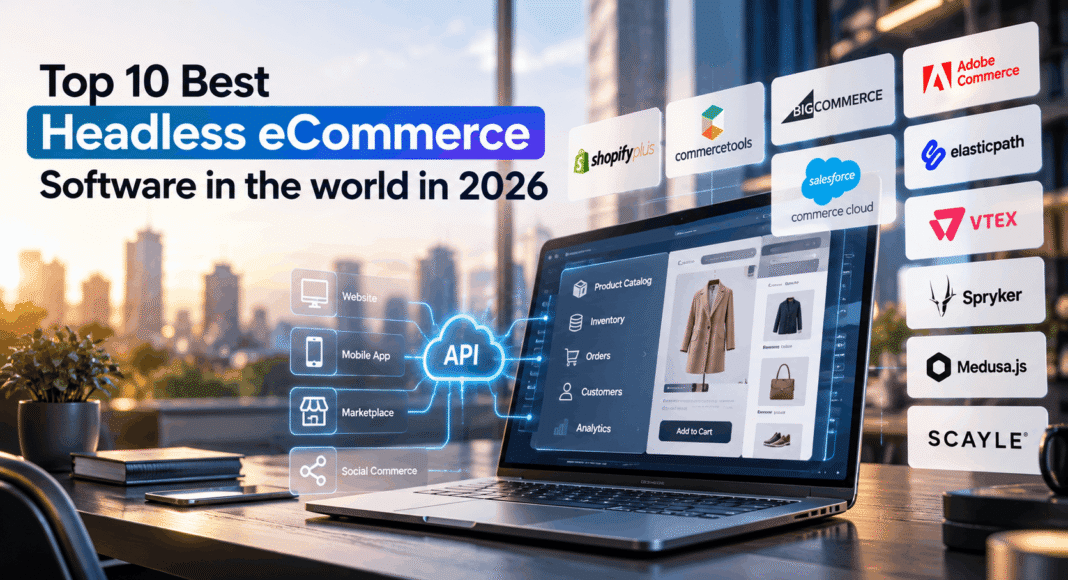
Shopify Plus leads the best headless eCommerce software options in 2026, offering scalable infrastructure, customizable storefronts, and AI-powered commerce capabilities. Other leading platforms include commercetools, BigCommerce, Adobe Commerce, Salesforce Commerce Cloud, Elastic Path, VTEX, Spryker, Medusa.js, and SCAYLE, supporting API-first architecture, composable commerce, and omnichannel retail operations.
The global eCommerce industry is undergoing a significant transformation in 2026 as businesses increasingly adopt headless commerce, composable architecture, and artificial intelligence to deliver faster, more personalized, and scalable digital shopping experiences. Traditional eCommerce platforms often limit customization by tightly connecting frontend storefronts with backend commerce operations. In contrast, headless eCommerce software separates the customer-facing presentation layer from the underlying commerce engine, allowing businesses to independently design, develop, and optimize their online shopping experiences.
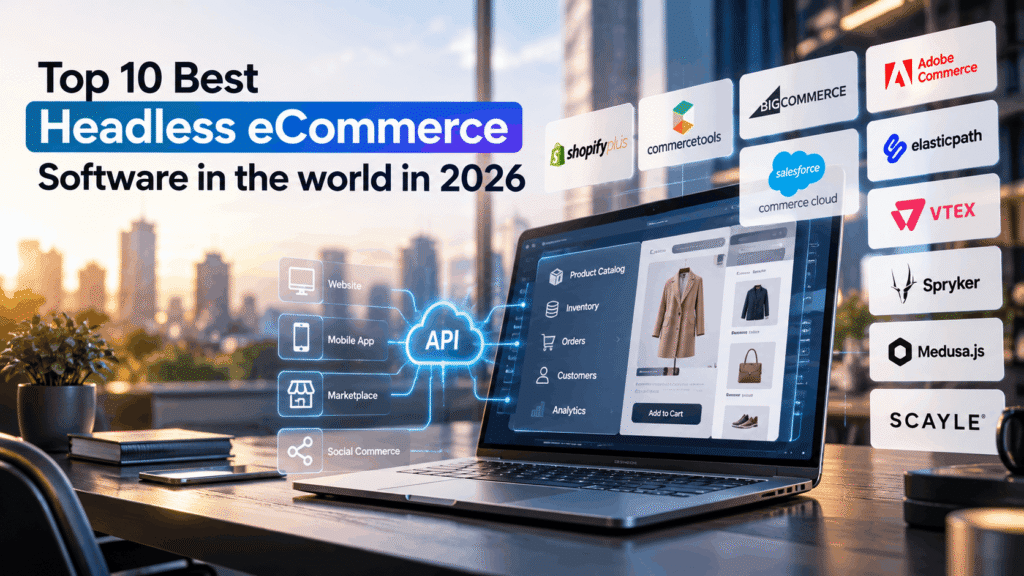
The best headless eCommerce software in 2026 includes Shopify Plus, commercetools, BigCommerce, Adobe Commerce, Salesforce Commerce Cloud, Elastic Path, VTEX, Spryker, Medusa.js, and SCAYLE Commerce Engine. These platforms offer different combinations of API-first architecture, enterprise scalability, omnichannel capabilities, advanced integrations, and flexible storefront development.
As digital commerce becomes more competitive, businesses are seeking platforms that support multiple sales channels, including websites, mobile applications, online marketplaces, social commerce, and emerging AI-powered shopping interfaces. Headless eCommerce solutions enable organizations to connect these channels to centralized systems for product information, inventory management, pricing, checkout, and order processing.
One of the most important developments shaping headless commerce in 2026 is the growing adoption of composable commerce and MACH architecture, which emphasizes microservices, API-first development, cloud-native infrastructure, and headless technology. This approach allows enterprises to select specialized software components, integrate third-party services, and modernize their commerce infrastructure without necessarily replacing their entire technology stack.
Artificial intelligence is also becoming increasingly relevant to modern headless eCommerce platforms. AI-powered product recommendations, intelligent search, automated merchandising, conversational shopping, and agentic commerce are creating new opportunities for businesses to improve customer engagement and streamline operations. However, the availability and maturity of these capabilities vary significantly between software providers.
For enterprise retailers, B2B distributors, manufacturers, marketplace operators, and growing direct-to-consumer brands, selecting the right headless commerce platform requires careful consideration of technical flexibility, implementation complexity, API performance, security, pricing, and total cost of ownership. While some platforms provide fully managed SaaS infrastructure, others prioritize open-source development, modular commerce services, or extensive enterprise customization.
This comprehensive guide examines the top 10 best headless eCommerce software platforms in the world in 2026, comparing their core features, AI capabilities, architecture, pricing models, strengths, limitations, and suitability for different business requirements. Whether an organization is migrating from a traditional eCommerce platform, launching an omnichannel retail operation, or building a composable commerce ecosystem, this comparison provides practical insights to support a more informed software selection decision.
Before we venture further into this article, we would like to share who we are and what we do.
About 9cv9
9cv9 is a business tech startup based in Singapore and Asia, with a strong presence all over the world.
With over ten years of startup and business experience, and being highly involved in connecting with thousands of companies and startups, the 9cv9 team has listed some of the top and best companies/tools in this review.
If you like to get your company listed in our top B2B software reviews, check out our world-class 9cv9 Media and PR service and pricing plans here.
Top 10 Best Headless eCommerce Software To Try in 2026
- Shopify Plus
- commercetools
- BigCommerce (Enterprise & Catalyst)
- Adobe Commerce (formerly Magento Commerce)
- Salesforce Commerce Cloud
- Elastic Path
- VTEX
- Spryker
- Medusa.js
- SCAYLE Commerce Engine
1. Shopify Plus
Platform Overview
Shopify Plus is an enterprise eCommerce platform designed for high-growth retailers, international brands, and businesses seeking scalable, API-driven digital commerce solutions. As one of the leading headless eCommerce software platforms in 2026, Shopify Plus combines managed commerce infrastructure, customizable storefront development, artificial intelligence, and omnichannel selling capabilities.
Unlike traditional eCommerce platforms that tightly couple storefront presentation with backend operations, Shopify Plus supports headless commerce architectures. Businesses can develop independent customer-facing experiences while retaining Shopify’s centralized commerce engine for product management, inventory, checkout, payments, and order processing.
Its headless ecosystem includes Hydrogen, a React-based storefront framework, Oxygen, a globally distributed hosting solution, and the Shopify Storefront API. These technologies enable developers to create customized shopping experiences across websites, mobile applications, and emerging digital channels.
Shopify Plus Technical Specifications
| Technical Component | Shopify Plus Capabilities | Business Benefits |
|---|---|---|
| Platform Category | Enterprise SaaS eCommerce platform | Reduces infrastructure management requirements |
| Commerce Architecture | API-first, headless-compatible architecture | Separates storefront development from commerce operations |
| Frontend Framework | Hydrogen, React, and custom frontend frameworks | Enables flexible storefront customization |
| Hosting Infrastructure | Oxygen global hosting and third-party hosting options | Supports scalable storefront delivery |
| Storefront API | GraphQL-based Storefront API | Connects custom interfaces with commerce functionality |
| Admin API | GraphQL Admin API | Supports enterprise integrations and automation |
| Checkout | Shopify Checkout and Checkout Extensibility | Provides managed checkout infrastructure |
| Business Automation | Shopify Flow and Shopify Functions | Automates workflows and customizes supported commerce logic |
| International Commerce | Shopify Markets | Supports international selling and localization |
| AI Features | Shopify Magic and Sidekick | Assists with content creation and store administration |
| Enterprise Integrations | APIs, webhooks, and third-party applications | Connects ERP, CRM, PIM, and other business systems |
Shopify Plus is particularly suitable for enterprises seeking a balance between storefront flexibility and managed backend reliability.
Headless Commerce Architecture and Development
Shopify Plus supports decoupled commerce architectures in which the customer-facing storefront communicates with Shopify’s backend through APIs.
Hydrogen provides developers with commerce-focused React components, routing capabilities, and storefront development tools. Oxygen complements Hydrogen by providing managed hosting for supported Hydrogen storefront deployments.
Businesses can also develop storefronts using other frontend technologies, including Next.js, although these applications may require independent hosting and infrastructure management.
Shopify Plus Headless Technology Stack
| Architecture Layer | Technology | Primary Function |
|---|---|---|
| Customer Experience | Hydrogen, React, Next.js, custom applications | Delivers personalized storefront experiences |
| API Connectivity | Storefront API | Retrieves products, collections, carts, and customer-facing commerce data |
| Hosting | Oxygen or external infrastructure | Deploys and serves custom storefront applications |
| Commerce Backend | Shopify Commerce Engine | Manages products, inventory, orders, and customers |
| Checkout | Shopify Checkout | Processes customer purchases |
| Custom Business Logic | Shopify Functions | Extends supported discount, payment, and delivery functionality |
| Workflow Automation | Shopify Flow | Automates administrative and operational processes |
| External Systems | Admin API, webhooks, integration applications | Connects business software and third-party services |
| AI Commerce | AI-powered discovery and supported agent integrations | Enables emerging conversational shopping experiences |
An important architectural distinction is that the Storefront API and Admin API serve different purposes. The Storefront API handles customer-facing commerce interactions, while the Admin API supports authenticated administrative and integration operations.
Their authentication models, permissions, and rate limits should be evaluated separately when designing enterprise integrations.
AI Capabilities and Agentic Commerce Integrations
Artificial intelligence has become an increasingly important component of Shopify Plus in 2026. The platform incorporates AI-powered administrative tools, content generation, workflow automation, and emerging conversational commerce capabilities.
Shopify Magic assists merchants with generating product descriptions and other content, while Sidekick provides a conversational interface for analyzing store information and completing administrative tasks.
Sidekick Pulse also surfaces recommendations and operational insights within the Shopify administration environment.
Shopify Plus AI Features Comparison
| AI Feature | Primary Function | Business Application |
|---|---|---|
| Shopify Magic | AI-assisted content and image editing | Accelerates product content production |
| Shopify Sidekick | Conversational commerce administration | Simplifies operational tasks and analysis |
| Sidekick Pulse | Proactive business recommendations | Identifies opportunities for operational improvements |
| Shopify Flow | Automated workflows | Reduces repetitive administrative processes |
| Shopify Catalog | Structured product information for AI commerce | Supports AI-powered product discovery |
| Agentic Storefronts | AI commerce channel management | Expands selling opportunities across AI interfaces |
| Universal Commerce Protocol | Standardized agent-to-merchant commerce interactions | Supports interoperable AI shopping experiences |
Agentic Commerce and AI Shopping
Shopify has expanded its agentic commerce strategy through the Universal Commerce Protocol, developed in collaboration with Google.
The protocol provides standardized capabilities for product discovery, checkout, payments, and order-related interactions between merchants and AI-powered applications.
Shopify’s agentic commerce ecosystem also includes integrations involving ChatGPT, Microsoft Copilot, and Google shopping experiences.
However, the availability of individual purchasing features varies by AI platform, geographic market, merchant eligibility, and integration status. Support for an AI commerce protocol does not automatically guarantee autonomous purchasing across every channel.
For enterprise retailers, these developments create opportunities to reach customers through conversational shopping experiences beyond traditional search engines and storefronts.
Shopify Plus Pricing and Total Cost of Ownership in 2026
Shopify Plus uses a subscription-based enterprise pricing model, with additional costs potentially arising from payment processing, application subscriptions, custom development, and system integrations.
Its published US dollar subscription rates depend on contract duration.
Shopify Plus Pricing Breakdown
| Pricing Component | Estimated Cost in 2026 | Additional Considerations |
|---|---|---|
| Three-Year Subscription | US$2,300 per month | Standard starting price for eligible contracts |
| One-Year Subscription | US$2,500 per month | Higher monthly subscription commitment |
| Three-Year Base Subscription Total | US$82,800 | Excludes additional operational expenses |
| One-Year Base Subscription Total | US$30,000 | Excludes transaction and development costs |
| Enterprise Variable Fees | Custom quotation | May apply to complex or high-volume businesses |
| Payment Processing | Varies by payment method and location | Depends on negotiated processing arrangements |
| Third-Party Payment Providers | Provider charges and applicable Shopify fees | Subject to merchant configuration |
| Hydrogen Development | Project-dependent | Requires frontend engineering resources |
| Oxygen Hosting | Included for eligible storefront deployments | Subject to Shopify plan and platform limits |
| Third-Party Applications | Varies by application | Recurring subscription expenses may apply |
| ERP and CRM Integrations | Custom pricing | Depends on integration complexity |
Three-Year Total Cost of Ownership
The base subscription represents only part of the financial commitment required to operate an enterprise headless eCommerce platform.
| Cost Category | Three-Year Financial Consideration |
|---|---|
| Shopify Plus Subscription | US$82,800 at the published three-year contract rate |
| Headless Storefront Development | Depends on project scope and engineering requirements |
| Custom API Integrations | Depends on the number and complexity of connected systems |
| Payment Processing | Varies with transaction volume and payment methods |
| Application Subscriptions | Depends on installed enterprise applications |
| Maintenance and Optimization | Ongoing development, monitoring, and performance improvements |
| International Expansion | Additional localization, compliance, and operational expenses |
A realistic Shopify Plus total cost of ownership assessment should account for both initial implementation and ongoing technical operations.
Although Shopify manages much of the underlying commerce infrastructure, businesses remain responsible for custom storefront code, integration maintenance, frontend security, and customer experience optimization.
Enterprise Scalability and Performance
Shopify Plus is designed to accommodate high-volume commerce operations, including seasonal demand increases, promotional campaigns, and international sales.
The platform provides managed checkout infrastructure, expanded API capacity, and enterprise-oriented operational capabilities.
Shopify Plus also supports up to 25 Hydrogen storefronts through its headless storefront offering, making it suitable for organizations managing multiple customer experiences.
Enterprise Performance Capabilities
| Performance Area | Shopify Plus Capabilities | Enterprise Value |
|---|---|---|
| Checkout Infrastructure | Managed high-volume checkout | Supports large transaction volumes |
| API Capacity | Enhanced enterprise API limits | Facilitates complex integrations |
| Hydrogen Storefronts | Up to 25 supported storefronts | Enables multiple digital experiences |
| Global Delivery | Oxygen edge hosting | Supports geographically distributed customers |
| International Selling | Shopify Markets | Facilitates regional commerce operations |
| Business Automation | Shopify Flow | Reduces manual operational workloads |
| Checkout Customization | Checkout Extensibility | Supports brand-specific checkout requirements |
| Security and Compliance | Managed platform security capabilities | Reduces selected infrastructure responsibilities |
Actual storefront performance depends on application architecture, caching strategies, frontend implementation, external integrations, and traffic characteristics.
Shopify Plus User Reviews and Market Reputation
Shopify Plus is frequently evaluated by enterprise retailers for its ease of use, managed infrastructure, application ecosystem, and checkout capabilities.
Customer feedback generally highlights its relatively straightforward administration and ability to support rapid commerce deployment.
However, businesses with highly specialized backend requirements may encounter limitations compared with self-hosted or deeply customizable commerce systems.
Shopify Plus Strengths and Limitations
| Evaluation Area | Strengths | Potential Limitations |
|---|---|---|
| Ease of Use | Centralized administrative interface | Advanced customization requires technical expertise |
| Headless Commerce | Hydrogen, APIs, and flexible frontend development | Custom storefronts increase engineering responsibilities |
| Scalability | Managed infrastructure and enterprise checkout | Platform limits and API constraints still apply |
| AI Capabilities | Native AI tools and agentic commerce integrations | AI functionality varies by feature and availability |
| International Commerce | Multi-market selling capabilities | Localization may require additional configuration |
| Integrations | Extensive application and developer ecosystem | Third-party application costs can accumulate |
| Customization | Shopify Functions and Checkout Extensibility | Core backend access remains restricted |
| Pricing | Predictable starting subscription | Enterprise implementation costs can be substantial |
Review ratings should be evaluated separately for Shopify and Shopify Plus because general Shopify review profiles may combine feedback from merchants using different subscription tiers. Review counts and scores also change over time.
Ideal Businesses for Shopify Plus
Shopify Plus is particularly appropriate for established retailers and growing digital commerce companies that require enterprise functionality without independently maintaining their entire commerce infrastructure.
Shopify Plus Business Suitability Matrix
| Business Type | Suitability | Primary Reason |
|---|---|---|
| Large Online Retailers | Excellent | Scalable checkout and enterprise operations |
| Direct-to-Consumer Brands | Excellent | Flexible storefront experiences and omnichannel selling |
| International Retailers | Excellent | Localization and multi-market commerce capabilities |
| Multi-Brand Enterprises | Excellent | Multiple storefront and expansion capabilities |
| B2B Wholesalers | High | B2B catalogs, customer-specific commerce functionality |
| Subscription Businesses | High | Integration with subscription applications |
| Small Online Businesses | Moderate | Enterprise pricing may exceed operational requirements |
| Highly Customized Commerce Platforms | Moderate | Restricted access to underlying backend infrastructure |
Final Assessment: Is Shopify Plus Worth It in 2026?
Shopify Plus remains one of the strongest enterprise headless eCommerce software options in 2026 for businesses prioritizing scalability, managed infrastructure, customizable customer experiences, and rapid digital commerce expansion.
Its combination of Hydrogen, Oxygen, GraphQL APIs, Shopify Functions, and Checkout Extensibility provides a comprehensive foundation for modern headless commerce development.
The addition of Shopify Magic, Sidekick, and agentic commerce integrations further strengthens its position among AI-enabled enterprise eCommerce platforms.
Nevertheless, Shopify Plus may be less suitable for businesses requiring complete control over backend source code, highly specialized transaction workflows, or minimal recurring platform expenses.
Overall, Shopify Plus is a compelling choice for medium-sized and large enterprises seeking a managed, API-driven headless commerce platform with strong international selling capabilities and an expanding AI commerce ecosystem.
2. commercetools
Platform Overview
commercetools is a leading enterprise headless eCommerce platform specializing in composable commerce, API-first architecture, and cloud-native digital commerce infrastructure. Recognized as an early pioneer of MACH architecture, commercetools enables businesses to develop highly customizable commerce ecosystems without depending on traditional monolithic eCommerce platforms.
MACH represents Microservices, API-first, Cloud-native SaaS, and Headless architecture. This approach allows enterprises to independently develop, deploy, and integrate commerce capabilities while maintaining flexibility across customer-facing applications and backend systems.
Unlike conventional eCommerce software, commercetools separates core commerce functionality into modular services covering product catalogs, pricing, shopping carts, inventory, promotions, and order management.
Its architecture is particularly suitable for multinational retailers, large B2B distributors, manufacturers, and digital-first enterprises requiring complex integrations and highly customized customer experiences.
commercetools Technical Specifications
| Technical Component | commercetools Capabilities | Business Benefits |
|---|---|---|
| Platform Category | Enterprise composable commerce software | Supports modular digital commerce development |
| Architecture | MACH-based, API-first, cloud-native SaaS | Reduces dependence on monolithic systems |
| Commerce APIs | REST and GraphQL interfaces | Enables flexible frontend and backend integrations |
| Frontend Compatibility | Next.js, React, Vue.js, mobile applications | Supports custom omnichannel experiences |
| Product Catalog | Flexible product models and attributes | Accommodates complex product portfolios |
| Pricing Management | Customer-specific pricing and price selection | Supports sophisticated commercial models |
| Inventory Management | Inventory tracking and availability services | Connects stock information with commerce operations |
| Cart and Order Management | Cart processing and commerce order APIs | Supports customized purchasing workflows |
| Promotions | Discounts and promotional rules | Enables targeted commercial campaigns |
| Integration Framework | commercetools Connect | Simplifies selected third-party integrations |
| Cloud Infrastructure | Managed multi-tenant SaaS | Reduces core platform infrastructure responsibilities |
| Enterprise Customization | Custom objects, custom fields, API extensions | Supports specialized business requirements |
commercetools provides enterprises with the flexibility to select and integrate individual commerce technologies rather than adopting a single vendor’s complete digital experience ecosystem.
Composable Commerce Architecture and Development
The primary advantage of commercetools lies in its modular architecture, which separates commerce functionality from the presentation layer and external business applications.
Businesses can independently develop customer experiences using modern frontend frameworks while connecting those experiences to commercetools through standardized APIs.
This approach also enables organizations to replace or upgrade individual technology components without rebuilding the entire commerce platform.
commercetools Enterprise Technology Stack
| Architecture Layer | Technology or Component | Primary Function |
|---|---|---|
| Presentation Layer | Next.js, React, Vue.js, mobile applications | Delivers customized digital shopping experiences |
| API Layer | REST APIs and GraphQL API | Connects storefronts and external applications |
| Commerce Engine | commercetools Composable Commerce | Processes core commerce operations |
| Product Management | Product Catalog and Product Types | Organizes products, attributes, and variants |
| Pricing | Price selection and discount capabilities | Supports regional and customer-specific pricing |
| Cart and Checkout | Cart and Order APIs | Manages purchasing workflows |
| Inventory | Inventory Entry APIs | Tracks inventory availability |
| Integration | commercetools Connect, subscriptions, API extensions | Connects external enterprise systems |
| Content Management | Third-party headless CMS platforms | Manages digital content independently |
| Enterprise Systems | ERP, CRM, PIM, OMS, payment providers | Supports enterprise-wide data integration |
This architecture is especially valuable for enterprises operating multiple brands, regional storefronts, B2B portals, and direct-to-consumer channels.
However, composable commerce also introduces additional integration and operational responsibilities because businesses must coordinate multiple technology providers.
AI Capabilities and Agentic Commerce Integrations
commercetools has expanded beyond traditional headless eCommerce into AI-powered autonomous commerce, introducing technologies designed to help enterprises automate complex commercial operations.
In June 2026, the company introduced commercetools Sphere, a unified enterprise commerce platform designed to support human-operated and AI-driven transactions.
According to the company’s published figures, Sphere supports more than US$100 billion in annualized gross merchandise value and delivers average response times below 60 milliseconds across its reported infrastructure workloads.
The company also introduced MosAIc, an AI orchestration layer that coordinates commerce operations across connected business applications. MosAIc entered early access in July 2026, meaning its availability and functionality should not be treated as equivalent to fully established production features.
commercetools AI Features Comparison
| AI Technology | Primary Function | Enterprise Application |
|---|---|---|
| commercetools Sphere | Unified commerce infrastructure | Supports high-volume human and AI commerce transactions |
| MosAIc | Autonomous workflow orchestration | Coordinates operational tasks across commerce systems |
| AgenticLift | Agentic commerce integration | Connects existing commerce platforms to AI shopping channels |
| AI Hub | AI channel orchestration | Connects commerce data and business rules to AI applications |
| Model Context Protocol Support | Standardized AI tool connectivity | Enables controlled agent access to commerce capabilities |
| Dynamic Pricing Agents | AI-assisted pricing optimization | Adjusts pricing within configured business policies |
| Inventory Automation | Demand forecasting and replenishment workflows | Supports inventory planning and stock management |
| Campaign Optimization | AI-driven promotional orchestration | Coordinates campaigns based on commercial objectives |
Agentic Commerce and Autonomous Operations
AgenticLift enables businesses to participate in AI-powered commerce experiences without necessarily replacing their existing eCommerce infrastructure.
Through AI Hub, enterprises can connect product information, inventory availability, pricing, and transaction capabilities to supported conversational shopping environments.
This creates opportunities for businesses to reach customers through AI platforms such as ChatGPT, Google Gemini, and Microsoft Copilot.
MosAIc addresses a different operational requirement by enabling AI agents to coordinate tasks across commerce and enterprise systems.
For example, an autonomous commerce workflow could analyze inventory levels, identify products requiring replenishment, and initiate approved operational actions.
However, actual automation capabilities depend on system integrations, permissions, enterprise governance policies, and feature availability.
commercetools Pricing and Total Cost of Ownership in 2026
commercetools primarily uses enterprise quotation-based pricing rather than publishing standardized subscription prices for every deployment.
Commercial agreements may consider business requirements, projected usage, platform capabilities, and contractual terms.
Consequently, publicly circulated licensing estimates should be treated as indicative market assumptions rather than verified official subscription prices.
commercetools Pricing Breakdown
| Pricing Component | Indicative Cost | Additional Considerations |
|---|---|---|
| Core Commerce Licensing | Custom enterprise quotation | Depends on commercial agreement and usage requirements |
| Mid-Market Planning Estimate | US$40,000–US$50,000 annually | Unverified budgeting assumption |
| Enterprise Planning Estimate | US$150,000–US$400,000+ annually | Illustrative range, not an official published price |
| Initial Implementation | US$150,000–US$1 million+ | Depends on complexity and implementation partner |
| Headless Frontend Development | Project-dependent | Requires frontend engineering and integration work |
| Third-Party Commerce Services | Vendor-dependent | Includes CMS, search, payments, and related systems |
| Integration Maintenance | Ongoing operational expense | Covers ERP, PIM, OMS, and other enterprise connections |
| AI Commerce Capabilities | Contract-dependent | Availability and pricing vary by product |
Three-Year Total Cost of Ownership
The total cost of implementing commercetools extends beyond software licensing because composable commerce environments typically combine multiple technologies.
| Cost Category | Three-Year Financial Consideration |
|---|---|
| Platform Licensing | Negotiated enterprise subscription |
| Initial Implementation | Architecture, development, migration, and testing |
| Frontend Infrastructure | Hosting, content delivery, and application monitoring |
| Enterprise Integrations | ERP, CRM, PIM, payment, and order management connections |
| Third-Party Software | CMS, search, personalization, and analytics subscriptions |
| Internal Engineering | Development, DevOps, security, and maintenance personnel |
| Platform Optimization | Performance improvements and ongoing feature development |
A broad three-year budgeting scenario of approximately US$345,000 to more than US$2.5 million may be useful for preliminary planning, but it is not a verified commercetools pricing range.
Actual expenditure can differ substantially depending on existing infrastructure, implementation scope, internal development capabilities, and integration requirements.
Enterprise Scalability and Performance
commercetools is designed for enterprises managing complex product catalogs, high transaction volumes, multiple storefronts, and sophisticated B2B or B2C purchasing workflows.
Its cloud-native infrastructure allows businesses to scale commerce services without independently managing the underlying core platform infrastructure.
The platform’s API-first architecture also supports integration with external enterprise applications and specialized commerce services.
Enterprise Performance Capabilities
| Performance Area | commercetools Capabilities | Enterprise Benefits |
|---|---|---|
| Infrastructure | Cloud-native, multi-tenant SaaS | Reduces infrastructure administration |
| API Performance | Enterprise-grade commerce APIs | Supports responsive application integrations |
| Transaction Scale | Infrastructure supporting over US$100 billion in annualized GMV | Demonstrates large-scale commerce usage |
| Multi-Store Operations | Stores, channels, and configurable commerce models | Supports international and multi-brand businesses |
| Product Complexity | Custom attributes and flexible product modeling | Accommodates extensive product portfolios |
| B2B Commerce | Customer-specific pricing and purchasing workflows | Supports wholesale and enterprise procurement |
| Integrations | commercetools Connect and API-based extensions | Enables modular technology ecosystems |
| AI Readiness | Sphere, AI Hub, and agent connectivity | Supports emerging autonomous commerce applications |
Although commercetools provides scalable core infrastructure, overall storefront performance still depends on frontend development, external integrations, caching, and application architecture.
commercetools User Reviews and Market Reputation
commercetools is recognized for its API flexibility, modular architecture, and ability to support complex enterprise commerce requirements.
Enterprise users frequently highlight its extensibility, stable APIs, flexible data modeling, and compatibility with specialized technology ecosystems.
However, reviewers also identify challenges involving implementation complexity, developer requirements, and functionality that must be built or integrated separately.
commercetools Customer Ratings
| Review Platform | Reported Rating | Review Volume |
|---|---|---|
| Gartner Peer Insights | 4.4 out of 5 | 147 ratings |
| G2 | Approximately 4.5 out of 5 | 16 reviews |
Ratings and review counts represent observed 2026 figures and may change.
commercetools Strengths and Limitations
| Evaluation Area | Strengths | Potential Limitations |
|---|---|---|
| Architecture | Flexible MACH-based composable architecture | Requires architectural expertise |
| APIs | Extensive REST and GraphQL capabilities | Complex integrations require development resources |
| Customization | Flexible data models and extensions | Some features require custom implementation |
| Enterprise B2B | Supports complex pricing and purchasing models | Advanced workflows may require additional configuration |
| Scalability | Cloud-native enterprise infrastructure | External systems can introduce performance dependencies |
| AI Commerce | Emerging agentic commerce capabilities | Some features remain subject to rollout and eligibility |
| Integration | Supports best-of-breed technology selection | Multiple vendors increase operational complexity |
| Pricing | Enterprise-specific commercial arrangements | Limited public pricing transparency |
| Implementation | Highly adaptable enterprise solutions | Potentially substantial implementation costs |
Ideal Businesses for commercetools
commercetools is most suitable for organizations with complex commerce requirements, established engineering resources, and a long-term composable commerce strategy.
commercetools Business Suitability Matrix
| Business Type | Suitability | Primary Reason |
|---|---|---|
| Multinational Retailers | Excellent | Supports multi-market and multi-brand commerce |
| Enterprise B2B Distributors | Excellent | Accommodates complex pricing and purchasing workflows |
| Large Manufacturers | Excellent | Supports sophisticated product models and enterprise integrations |
| Omnichannel Retailers | Excellent | Connects multiple customer experiences to centralized commerce services |
| Digital-First Enterprises | Excellent | Enables customized storefronts and rapid technology evolution |
| Mid-Market Retailers | High | Suitable when technical resources and budgets are available |
| Small eCommerce Businesses | Low | Implementation complexity may outweigh benefits |
| Businesses Seeking Turnkey Stores | Low | Requires more development than conventional hosted storefront platforms |
Final Assessment: Is commercetools Worth It in 2026?
commercetools remains one of the leading enterprise headless eCommerce software platforms in 2026, particularly for organizations seeking composable architecture, API flexibility, and sophisticated B2B or B2C commerce capabilities.
Its MACH-based foundation enables enterprises to build customized commerce ecosystems while integrating specialized technologies for content management, search, payments, inventory, and customer engagement.
The introduction of Sphere, MosAIc, AI Hub, and AgenticLift also positions commercetools as an emerging infrastructure provider for autonomous and agentic commerce.
Nevertheless, businesses must carefully evaluate implementation complexity, technical staffing requirements, third-party software expenses, and long-term maintenance responsibilities.
Overall, commercetools is particularly well suited to large enterprises and technically mature organizations that prioritize architectural flexibility, extensive customization, and long-term digital commerce scalability over the simplicity of an all-in-one eCommerce solution.
3. BigCommerce (Enterprise & Catalyst)
Platform Overview
BigCommerce Enterprise is a leading headless eCommerce software platform designed for growing retailers, B2B distributors, manufacturers, and multinational businesses seeking scalable digital commerce solutions. Its Open SaaS architecture combines managed commerce infrastructure with extensive API accessibility, allowing enterprises to customize customer experiences without maintaining an entirely self-hosted commerce system.
BigCommerce supports traditional storefronts, headless commerce, and composable architectures, enabling businesses to select frontend technologies while retaining centralized commerce functionality for product catalogs, inventory, pricing, payments, and order management.
Its flagship headless storefront framework, Catalyst, is built using Next.js and React. Catalyst provides a development foundation for creating customized, high-performance shopping experiences connected to BigCommerce through its GraphQL Storefront API.
Unlike purely developer-oriented headless platforms, BigCommerce also emphasizes merchant usability through visual content editing and integrated commerce administration.
The platform is particularly suitable for businesses seeking enterprise headless commerce capabilities without the operational complexity associated with fully custom-built commerce infrastructure.
BigCommerce Technical Specifications
| Technical Component | BigCommerce Capabilities | Business Benefits |
|---|---|---|
| Platform Category | Enterprise Open SaaS eCommerce platform | Combines managed infrastructure with customization |
| Commerce Architecture | API-first, headless, and composable commerce | Supports flexible technology architectures |
| Headless Framework | Catalyst, built with Next.js and React | Accelerates custom storefront development |
| Storefront API | GraphQL Storefront API | Connects storefronts with commerce data |
| Management APIs | REST APIs and supported GraphQL capabilities | Enables automated commerce operations |
| Frontend Development | Catalyst and third-party frontend frameworks | Supports differentiated customer experiences |
| Visual Editing | Catalyst-compatible visual editing capabilities | Enables marketers to manage supported storefront content |
| B2B Commerce | BigCommerce B2B Edition | Supports business purchasing workflows |
| Product Management | Catalog, variants, pricing, and inventory | Centralizes merchandise operations |
| Payment Integration | Multiple supported payment gateways | Provides flexible payment processing |
| Multi-Storefront | Multiple storefront management capabilities | Supports international and multi-brand operations |
| Enterprise Integrations | APIs, webhooks, and third-party applications | Connects ERP, CRM, PIM, and other systems |
BigCommerce has historically emphasized extensive API coverage across its commerce engine. However, API availability and functionality vary by endpoint, product edition, and implementation requirements.
Headless Commerce Architecture and Catalyst Framework
Catalyst is BigCommerce’s open-source headless storefront framework, designed to simplify enterprise storefront development using modern web technologies.
It provides a structured application foundation that allows developers to build customized shopping experiences while relying on BigCommerce for core commerce operations.
The separation between frontend presentation and backend commerce functionality enables businesses to update customer-facing applications independently of the commerce engine.
BigCommerce Catalyst Technology Stack
| Architecture Layer | Technology or Component | Primary Function |
|---|---|---|
| Presentation Layer | Catalyst, Next.js, React | Delivers customized storefront experiences |
| Content Editing | Compatible visual editing tools | Supports marketer-managed page content |
| Storefront Connectivity | GraphQL Storefront API | Retrieves products, customer data, and cart information |
| Commerce Backend | BigCommerce Commerce Engine | Manages commerce transactions and operations |
| Product Management | Catalog and inventory services | Organizes products, variants, and availability |
| B2B Functionality | BigCommerce B2B Edition | Supports company accounts and business purchasing |
| Payment Processing | Integrated payment gateway ecosystem | Processes customer transactions |
| Enterprise Integrations | APIs, webhooks, middleware | Connects external business applications |
| Analytics and Optimization | Native reporting and third-party analytics | Supports performance measurement and optimization |
| AI and Personalization | Third-party AI and merchandising integrations | Enables intelligent product discovery |
Catalyst’s open-source architecture gives developers greater control over storefront presentation, while BigCommerce continues to manage the underlying commerce platform.
Visual editing capabilities depend on the selected integration and configuration. They should not be interpreted as unrestricted drag-and-drop control over every custom React component.
AI Capabilities and Intelligent Commerce Integrations
BigCommerce supports AI-powered commerce through its native platform capabilities, partner integrations, and open API ecosystem.
Rather than requiring merchants to use a single proprietary AI engine, BigCommerce allows businesses to integrate specialized technologies for product discovery, personalization, merchandising, customer service, and operational automation.
Its AI strategy also benefits from the broader Commerce ecosystem, including Feedonomics for product feed management and Makeswift for visual experience development.
BigCommerce AI Features Comparison
| AI Capability | Primary Function | Business Application |
|---|---|---|
| AI-Powered Product Discovery | Semantic search and product recommendations | Improves product discovery and conversion |
| Intelligent Merchandising | Automated product ranking and optimization | Supports merchandising efficiency |
| Predictive Analytics | Sales and customer behavior analysis | Helps identify commercial opportunities |
| AI Content Generation | Automated product descriptions and marketing content | Reduces content production workloads |
| Feedonomics | Product feed optimization and distribution | Improves multichannel product visibility |
| AI Customer Support | Chatbots and conversational assistance | Automates routine customer interactions |
| Agentic Commerce Integrations | API-based connections to AI shopping applications | Supports emerging AI-assisted purchasing experiences |
| Workflow Automation | Integrations with automation platforms | Reduces repetitive administrative tasks |
Many advanced AI capabilities depend on third-party applications or separately licensed services rather than being included automatically in every BigCommerce subscription.
Agentic Commerce and AI Shopping
BigCommerce’s open architecture provides a foundation for integrating conversational commerce applications and AI-powered shopping assistants.
Through its APIs, businesses can expose relevant catalog information, retrieve pricing and availability, and support cart operations within authorized shopping experiences.
These capabilities can help enterprises prepare for AI-driven product discovery and purchasing.
However, autonomous checkout functionality requires additional attention to authentication, payment security, transaction permissions, and compatibility with individual AI platforms.
BigCommerce Pricing and Total Cost of Ownership in 2026
BigCommerce introduced an updated pricing structure effective June 1, 2026, replacing its previous Standard, Plus, Pro, and Enterprise plan names with Core, Growth, Scale, and Performance.
The updated structure also introduced revised sales thresholds and payment provider fees.
BigCommerce Pricing Comparison
| Pricing Component | Monthly Billing | Annual Billing Equivalent |
|---|---|---|
| Core | US$39 per month | US$29 per month |
| Growth | US$105 per month | US$79 per month |
| Scale | US$399 per month | US$299 per month |
| Performance | Custom quotation | Starting at US$1,499 per month |
Performance is the enterprise-oriented tier and generally requires a customized commercial agreement.
Payment Processing and Sales Thresholds
| Plan | Sales Threshold | Open Payment Provider Fee |
|---|---|---|
| Core | US$30,000 trailing 12-month GMV | 2.0% |
| Growth | US$100,000 trailing 12-month GMV | 1.0% |
| Scale | US$33,333 monthly GMV before overage | 0.6% |
| Performance | Contract-dependent | No standard open provider fee under applicable contracted terms |
Scale also applies a 0.9% overage rate to monthly GMV exceeding US$33,333. Merchants reaching US$2 million in trailing 12-month GMV transition to Performance under the published pricing structure.
BigCommerce does not charge its additional Open Payment Provider Fee on orders processed through designated Embedded Payment Providers. However, payment processors still charge their own transaction fees.
Catalyst Implementation Costs
Catalyst is an open-source storefront framework, but launching a production headless storefront involves additional development and hosting expenses.
| Cost Category | Indicative Financial Consideration |
|---|---|
| BigCommerce Subscription | Depends on selected plan |
| Catalyst Framework | Open-source framework |
| Custom Catalyst Development | Approximately US$75,000–US$150,000 for a substantial implementation planning scenario |
| Production Hosting | Separate infrastructure expense |
| Makeswift Visual Editing | Depends on applicable subscription and usage |
| Third-Party Integrations | Project-dependent |
| Ongoing Maintenance | Development, security, and optimization expenses |
The development range is illustrative rather than an official BigCommerce implementation price. Smaller implementations may cost less, while complex enterprise projects may cost substantially more.
Enterprise Scalability and Performance
BigCommerce Enterprise supports organizations managing complex catalogs, multiple storefronts, international markets, and business purchasing workflows.
Its Open SaaS infrastructure reduces the operational responsibilities associated with maintaining a self-hosted commerce backend.
Catalyst complements this infrastructure with modern frontend development capabilities and performance-oriented architecture.
Enterprise Performance Capabilities
| Performance Area | BigCommerce Capabilities | Enterprise Benefits |
|---|---|---|
| Infrastructure | Managed SaaS commerce platform | Reduces backend infrastructure management |
| Storefront Performance | Next.js-based Catalyst framework | Supports optimized customer experiences |
| Multi-Storefront | Centralized multi-storefront capabilities | Supports multiple brands and markets |
| B2B Commerce | BigCommerce B2B Edition | Enables company accounts and specialized purchasing |
| API Integration | Extensive commerce APIs | Supports custom enterprise integrations |
| Content Management | Makeswift visual editing | Improves marketing team independence |
| Payment Flexibility | Multiple embedded payment providers | Provides processor selection flexibility |
| International Commerce | Multi-currency and localization capabilities | Supports cross-border expansion |
Production Catalyst storefronts require separately managed hosting, even though BigCommerce provides one-click preview deployment capabilities.
BigCommerce User Reviews and Market Reputation
BigCommerce is recognized for its Open SaaS architecture, B2B functionality, API ecosystem, and support for both conventional and headless storefront development.
Customer feedback frequently highlights its flexibility, product management capabilities, and payment gateway integrations.
However, some users report challenges involving administrative complexity, customization requirements, and sales-based subscription thresholds.
BigCommerce Customer Ratings
| Review Platform | Reported Rating | Review Volume |
|---|---|---|
| Gartner Peer Insights | Approximately 4.4 out of 5 | 218 ratings |
| G2 | Approximately 4.2 out of 5 | 582 reviews |
These figures are indicative review snapshots and may change. Ratings can also cover the broader BigCommerce platform rather than Catalyst or Enterprise exclusively.
BigCommerce Strengths and Limitations
| Evaluation Area | Strengths | Potential Limitations |
|---|---|---|
| Headless Commerce | Catalyst and GraphQL Storefront API | Requires frontend development expertise |
| Ease of Use | Centralized administration and visual editing | Advanced settings can be complex |
| B2B Commerce | Dedicated B2B capabilities | Specialized workflows may require configuration |
| Scalability | Managed SaaS commerce infrastructure | Subscription costs increase with business scale |
| Payments | Multiple supported payment providers | Additional fees apply to certain processors |
| Customization | Open APIs and flexible integrations | Core backend remains managed by BigCommerce |
| AI Capabilities | Flexible AI integration ecosystem | Advanced AI features may require external services |
| Pricing | Transparent entry-level subscriptions | Enterprise pricing requires negotiation |
Ideal Businesses for BigCommerce Enterprise and Catalyst
BigCommerce Enterprise and Catalyst are particularly suitable for businesses seeking a balance between headless storefront flexibility, managed commerce infrastructure, and operational usability.
BigCommerce Business Suitability Matrix
| Business Type | Suitability | Primary Reason |
|---|---|---|
| Mid-Market Retailers | Excellent | Scalable SaaS commerce with customizable storefronts |
| Enterprise B2C Brands | Excellent | Supports advanced storefront experiences |
| B2B Distributors | Excellent | Dedicated B2B commerce functionality |
| Manufacturers | High | Supports complex catalogs and business purchasing |
| Multi-Brand Retailers | Excellent | Centralized multi-storefront management |
| International Businesses | High | Supports localization and cross-border commerce |
| Digital-First Companies | Excellent | Modern frontend architecture and API flexibility |
| Small Online Businesses | Moderate | Headless development may exceed technical requirements |
| Highly Customized Backend Platforms | Moderate | Managed SaaS limits direct backend modification |
Final Assessment: Is BigCommerce Enterprise and Catalyst Worth It in 2026?
BigCommerce Enterprise and Catalyst represent a competitive combination for businesses seeking scalable, API-driven headless eCommerce software in 2026.
Catalyst’s Next.js architecture, GraphQL Storefront API, and Makeswift visual editing provide a practical foundation for building customized shopping experiences while retaining the operational benefits of a managed SaaS commerce engine.
The platform is particularly attractive to mid-market retailers, enterprise B2C brands, and B2B organizations seeking extensive integrations without adopting a completely custom commerce backend.
Its revised 2026 pricing structure also provides clearer subscription tiers, although businesses must account for sales thresholds, payment provider fees, hosting expenses, and implementation costs.
Overall, BigCommerce Enterprise and Catalyst are strong options for organizations prioritizing frontend flexibility, B2B functionality, visual content management, and scalable digital commerce operations.
4. Adobe Commerce (formerly Magento Commerce)
Platform Overview
Adobe Commerce, formerly Magento Commerce, is an enterprise eCommerce platform designed for businesses requiring advanced product catalog management, complex B2B and B2C transactions, extensive customization, and international digital commerce operations.
Built on the Magento technology ecosystem, Adobe Commerce combines a flexible commerce engine with enterprise capabilities for product management, customer segmentation, pricing, inventory, order processing, and multi-store operations.
Unlike conventional SaaS eCommerce platforms, Adobe Commerce offers extensive backend customization capabilities alongside API-driven headless commerce architecture. Businesses can create independent storefront experiences while maintaining centralized commerce operations.
Adobe Commerce is available through cloud-hosted and managed deployment options, with architectural and operational responsibilities varying by edition.
In 2026, Adobe’s headless commerce strategy increasingly emphasizes Edge Delivery Services, Adobe Commerce Storefront, and reusable storefront drop-in components. These technologies enable enterprises to develop fast, customizable shopping experiences integrated with Adobe’s broader digital experience ecosystem.
The platform is particularly suitable for multinational retailers, large manufacturers, B2B distributors, and enterprises operating complex product catalogs across multiple markets.
Adobe Commerce Technical Specifications
| Technical Component | Adobe Commerce Capabilities | Business Benefits |
|---|---|---|
| Platform Category | Enterprise digital commerce platform | Supports complex B2B and B2C operations |
| Commerce Architecture | Modular, API-driven, headless-compatible | Enables extensive commerce customization |
| Backend Technology | PHP-based commerce engine | Supports custom modules and business logic |
| Database Infrastructure | MySQL or MariaDB, depending on supported release | Handles structured commerce data |
| Search Infrastructure | OpenSearch and Adobe commerce search services | Supports product discovery and catalog search |
| Storefront Technology | Adobe Commerce Storefront and Edge Delivery Services | Enables modern headless shopping experiences |
| API Connectivity | GraphQL and REST APIs | Connects custom storefronts and external applications |
| Product Catalog | Complex products, attributes, variants, and catalogs | Supports extensive merchandise portfolios |
| B2B Commerce | Company accounts, shared catalogs, quotes, and purchasing workflows | Supports enterprise procurement |
| Inventory Management | Multi-source inventory capabilities | Coordinates inventory across locations |
| International Commerce | Multiple websites, stores, currencies, and languages | Supports global commerce operations |
| Enterprise Integrations | Adobe App Builder, API Mesh, and integration services | Connects commerce with external business systems |
Adobe Commerce’s supported PHP, database, and search engine versions depend on the specific software release. Requirements such as PHP 8.3 or 8.4, MySQL 8.4, MariaDB 11.4, and OpenSearch 2.x should therefore be verified against the selected release’s compatibility documentation rather than treated as universal requirements.
Headless Commerce Architecture and Development
Adobe Commerce supports headless architectures that separate the customer-facing storefront from the underlying commerce engine.
Its GraphQL and REST APIs enable developers to connect custom websites, mobile applications, and other digital experiences with centralized commerce services.
Adobe Commerce Storefront, supported by Edge Delivery Services and modular drop-in components, provides a modern approach to storefront development.
These components can accelerate implementation of essential commerce functionality, including product listings, shopping carts, checkout experiences, and customer account interactions.
Adobe Commerce Headless Technology Stack
| Architecture Layer | Technology or Component | Primary Function |
|---|---|---|
| Presentation Layer | Adobe Commerce Storefront, Edge Delivery Services | Delivers customized shopping experiences |
| Experience Management | Adobe Experience Manager | Supports enterprise content management |
| Storefront Components | Adobe Commerce drop-in components | Provides reusable commerce interface functionality |
| API Connectivity | GraphQL, REST, and API Mesh | Connects storefronts and backend services |
| Catalog Services | Adobe Commerce Catalog Service | Supports scalable product data delivery |
| Commerce Backend | Adobe Commerce Core | Manages products, customers, orders, and transactions |
| B2B Commerce | Adobe Commerce B2B capabilities | Supports company purchasing and negotiated pricing |
| Inventory | Multi-Source Inventory | Coordinates stock across fulfillment locations |
| Search and Discovery | Adobe Commerce Live Search | Delivers intelligent product search |
| AI and Personalization | Adobe Sensei-powered services | Supports merchandising and product discovery |
| Enterprise Integrations | Adobe App Builder and integration services | Connects ERP, CRM, PIM, and other applications |
Adobe’s newer storefront architecture provides an alternative to traditional Magento themes and earlier PWA Studio implementations.
However, existing PWA Studio storefronts do not automatically require replacement. Migration decisions should consider current performance, maintenance costs, customization requirements, and long-term technical strategy.
AI Capabilities and Intelligent Commerce Integrations
Adobe Commerce incorporates artificial intelligence through Adobe Sensei-powered merchandising services, product recommendations, search optimization, and integrations with the broader Adobe Experience Cloud ecosystem.
Its AI capabilities primarily focus on improving product discovery, personalizing shopping experiences, and supporting data-driven merchandising decisions.
Adobe Commerce Live Search provides AI-powered product search with dynamic faceting and intelligent result re-ranking based on shopper behavior during active browsing sessions.
Product Recommendations complements these capabilities by displaying relevant merchandise using customer behavior, product relationships, and shopping trends.
Adobe Commerce AI Features Comparison
| AI Feature | Primary Function | Business Application |
|---|---|---|
| Adobe Sensei | AI and machine learning technology | Supports intelligent commerce experiences |
| Live Search | AI-powered product search | Improves product discovery |
| Intelligent Re-ranking | Adjusts search results using shopper behavior | Increases product relevance |
| Dynamic Faceting | Adapts product filters | Simplifies catalog navigation |
| Product Recommendations | Personalized merchandise suggestions | Supports cross-selling and upselling |
| Adobe Commerce Optimizer | Catalog optimization and merchandising services | Improves storefront discovery and performance |
| Adobe Experience Platform Integration | Customer data and experience orchestration | Enables advanced personalization |
| Adobe App Builder | Custom application and integration development | Supports specialized automation and AI workflows |
Agentic Commerce and AI Automation
Adobe Commerce’s API-driven architecture enables enterprises to connect AI agents and external automation systems with commerce functionality.
Potential applications include automated product enrichment, inventory analysis, customer service workflows, procurement assistance, and personalized purchasing recommendations.
However, capabilities such as autonomous margin-based price changes, AI-generated quotations, and predictive procurement should not be assumed to be standard native Adobe Commerce features.
These advanced workflows may require custom development, third-party applications, enterprise data integrations, and human approval controls.
Adobe Commerce Pricing and Total Cost of Ownership in 2026
Adobe Commerce uses enterprise quotation-based pricing, with commercial terms varying according to the selected deployment model, business scale, and contracted services.
Publicly circulated licensing estimates often reference annual gross merchandise value or business revenue, but Adobe does not provide a universal public price list for every enterprise configuration.
Adobe Commerce Licensing Estimates
| Annual Business Revenue | Indicative Annual Licensing Budget |
|---|---|
| Below US$1 Million | Approximately US$40,000 |
| US$1 Million–US$10 Million | US$55,000–US$120,000 |
| US$10 Million–US$25 Million | US$120,000–US$160,000 |
| Above US$25 Million | US$160,000–US$200,000+ |
These figures are third-party budgeting estimates, not verified official Adobe Commerce prices. Actual licensing must be confirmed through an enterprise quotation.
Adobe Commerce as a Cloud Service also has product-specific licensing and usage entitlements, including catalog capacity, API retrieval volume, and storefront content requests.
Implementation and Maintenance Costs
| Cost Category | Indicative Cost | Key Considerations |
|---|---|---|
| Initial Implementation | US$50,000–US$500,000+ | Depends on customization and integrations |
| Annual Maintenance | US$40,500–US$313,000 | Depends on engineering and support requirements |
| Headless Storefront Development | Project-dependent | Includes frontend development and testing |
| ERP and PIM Integrations | Custom quotation | Depends on connected enterprise systems |
| Hosting and Infrastructure | Deployment-dependent | Varies between SaaS, PaaS, and self-hosted options |
| AI and Personalization | Contract-dependent | Additional services may affect pricing |
| Security and Upgrades | Ongoing expense | Responsibilities differ by deployment model |
Three-Year Total Cost of Ownership
Adobe Commerce typically requires a substantial long-term technology investment, especially when enterprises implement customized storefronts, complex product catalogs, and multiple business integrations.
A comprehensive three-year TCO assessment should include licensing, implementation, hosting, integration development, maintenance, security, and internal engineering.
The assumption that total ownership costs equal two to three times the base annual license fee is not universally reliable. Highly customized implementations may exceed that ratio considerably.
Enterprise Scalability and Performance
Adobe Commerce supports enterprise requirements involving large catalogs, complex product relationships, multiple stores, and sophisticated B2B purchasing arrangements.
Its cloud-delivered Catalog Service and modern storefront architecture help separate high-volume product browsing workloads from transactional commerce operations.
Enterprise Performance Capabilities
| Performance Area | Adobe Commerce Capabilities | Enterprise Benefits |
|---|---|---|
| Product Catalog | Extensive product modeling and catalog services | Supports complex merchandise structures |
| B2B Pricing | Shared catalogs and customer-specific pricing | Enables negotiated business purchasing |
| Multi-Store Management | Multiple websites, stores, and store views | Supports international operations |
| Inventory | Multi-source inventory functionality | Coordinates distributed stock |
| Search | Live Search and Catalog Service | Improves product discovery |
| Storefront Delivery | Edge Delivery Services | Supports optimized content delivery |
| Backend Customization | Modules and extensions in supported PaaS deployments | Enables specialized business logic |
| Enterprise Integration | APIs, events, and App Builder | Connects external enterprise systems |
Claims involving more than 250 million SKUs or 30,000 price lists per SKU should be evaluated against the exact catalog service, product edition, and documented capacity limits. They should not be interpreted as guaranteed performance for every Adobe Commerce deployment.
Adobe Commerce User Reviews and Market Reputation
Adobe Commerce is widely recognized for its flexibility, sophisticated product management, native B2B capabilities, and extensive customization options.
Enterprise users frequently value its ability to accommodate complex purchasing workflows and multi-store operations.
However, its technical complexity can increase implementation costs and create greater dependence on experienced development teams.
Adobe Commerce Customer Ratings
| Review Platform | Reported Rating | Review Volume |
|---|---|---|
| Gartner Peer Insights | Approximately 4.4 out of 5 | 359 ratings |
| G2 | Approximately 4.0 out of 5 | 623 reviews |
These figures are indicative review snapshots and may change.
Adobe Commerce Strengths and Limitations
| Evaluation Area | Strengths | Potential Limitations |
|---|---|---|
| Customization | Extensive commerce functionality and extensibility | Requires experienced developers |
| B2B Commerce | Advanced native purchasing capabilities | Configuration can be complex |
| Product Catalog | Flexible product and pricing models | Large catalogs require careful optimization |
| Headless Commerce | APIs, Edge Delivery Services, and storefront components | Implementation requires technical expertise |
| AI Capabilities | Intelligent search and recommendations | Advanced automation may require additional services |
| International Commerce | Multi-store and localization support | Global configurations increase complexity |
| Maintenance | Managed SaaS options reduce selected responsibilities | PaaS and self-hosted deployments require ongoing upkeep |
| Pricing | Enterprise-specific commercial arrangements | High total cost of ownership |
Ideal Businesses for Adobe Commerce
Adobe Commerce is best suited for organizations requiring extensive commerce customization, sophisticated product structures, and complex enterprise integrations.
Adobe Commerce Business Suitability Matrix
| Business Type | Suitability | Primary Reason |
|---|---|---|
| Multinational Retailers | Excellent | Supports multiple markets and storefronts |
| Enterprise B2B Distributors | Excellent | Advanced purchasing and pricing capabilities |
| Large Manufacturers | Excellent | Handles complex product catalogs |
| Hybrid B2B and B2C Businesses | Excellent | Supports multiple customer and purchasing models |
| Multi-Brand Enterprises | Excellent | Centralized multi-store management |
| Complex Product Retailers | Excellent | Flexible product attributes and configurations |
| Mid-Market Businesses | High | Suitable when technical resources are available |
| Small Online Businesses | Low | Enterprise costs and complexity may be excessive |
| Businesses Seeking Simple SaaS | Moderate | Managed SaaS is available, but implementation remains substantial |
Final Assessment: Is Adobe Commerce Worth It in 2026?
Adobe Commerce remains one of the leading enterprise headless eCommerce software platforms in 2026 for businesses requiring sophisticated B2B functionality, extensive customization, and complex product catalog management.
Its integration with Edge Delivery Services, Adobe Commerce Storefront, Catalog Service, Live Search, and Adobe’s broader digital experience ecosystem provides a comprehensive foundation for modern enterprise commerce.
The availability of both PaaS and SaaS deployment models also gives organizations options for balancing customization, infrastructure management, and operational responsibility.
Nevertheless, Adobe Commerce requires careful financial and technical planning because implementation complexity, development requirements, and long-term maintenance can significantly increase total ownership costs.
Overall, Adobe Commerce is particularly well suited for multinational retailers, manufacturers, distributors, and enterprises prioritizing advanced commerce functionality and architectural flexibility over low-cost, turnkey deployment.
5. Salesforce Commerce Cloud
Platform Overview
Salesforce Commerce Cloud is an enterprise digital commerce platform designed for retailers, manufacturers, B2B distributors, and multinational businesses seeking integrated customer experiences across online stores, mobile applications, and digital sales channels.
Originally developed from Demandware for B2C commerce, Salesforce Commerce Cloud has evolved into a broader digital commerce ecosystem supporting both B2C and B2B business models.
The platform combines cloud-based commerce infrastructure, headless storefront development, customer relationship management, marketing automation, customer service, and artificial intelligence.
Its headless commerce architecture uses Salesforce Commerce API (SCAPI), allowing developers to create customized storefronts independently of the underlying commerce engine.
Salesforce also provides PWA Kit, a React-based storefront framework, and Managed Runtime, a hosting environment designed for progressive web applications.
A major advantage of Salesforce Commerce Cloud is its integration with the wider Salesforce ecosystem, including Sales Cloud, Service Cloud, Marketing Cloud, Data 360, and Agentforce.
These capabilities make Salesforce Commerce Cloud particularly attractive to enterprises seeking to connect digital commerce transactions with customer data, marketing activities, sales operations, and AI-powered customer engagement.
Salesforce Commerce Cloud Technical Specifications
| Technical Component | Salesforce Commerce Cloud Capabilities | Business Benefits |
|---|---|---|
| Platform Category | Enterprise cloud-based eCommerce software | Supports complex digital commerce operations |
| Commerce Architecture | API-driven, headless-compatible SaaS | Enables customized shopping experiences |
| Headless Framework | PWA Kit, React | Accelerates modern storefront development |
| Commerce APIs | Salesforce Commerce API | Connects storefronts with commerce services |
| Storefront Hosting | Managed Runtime | Supports managed storefront deployment |
| B2C Commerce | Product catalogs, promotions, checkout, and orders | Supports enterprise retail operations |
| B2B Commerce | Account-based purchasing, pricing, and order workflows | Supports business procurement |
| CRM Integration | Salesforce Sales Cloud | Connects commerce with customer relationships |
| Customer Service | Salesforce Service Cloud | Supports post-purchase customer engagement |
| Marketing Integration | Salesforce Marketing Cloud | Enables personalized customer campaigns |
| Customer Data | Salesforce Data 360 | Unifies customer information across systems |
| AI Capabilities | Salesforce Einstein and Agentforce | Supports intelligent and agent-assisted commerce |
Salesforce Commerce Cloud is especially suitable for medium-sized and large enterprises requiring sophisticated customer engagement and commerce operations across multiple channels.
Headless Commerce Architecture and Development
Salesforce Commerce Cloud supports headless commerce through a decoupled architecture in which frontend applications communicate with backend commerce services using APIs.
PWA Kit provides reusable React-based storefront components, while Managed Runtime supports the deployment and operation of compatible storefront applications.
Businesses can also develop custom mobile applications and other digital experiences using Salesforce Commerce APIs.
Salesforce Commerce Cloud Headless Technology Stack
| Architecture Layer | Technology or Component | Primary Function |
|---|---|---|
| Presentation Layer | PWA Kit, React, custom applications | Delivers customized customer experiences |
| Storefront Hosting | Managed Runtime | Hosts supported headless storefronts |
| API Connectivity | Salesforce Commerce API | Connects frontend applications with commerce functionality |
| B2C Commerce Engine | Salesforce B2C Commerce | Manages retail catalogs, carts, checkout, and orders |
| B2B Commerce Engine | Salesforce B2B Commerce | Supports business purchasing workflows |
| Customer Data | Salesforce Data 360 | Unifies customer information |
| CRM Integration | Sales Cloud | Connects sales and commerce operations |
| Customer Support | Service Cloud | Supports service interactions and order assistance |
| Marketing | Marketing Cloud | Coordinates personalized marketing experiences |
| AI Layer | Einstein and Agentforce | Enables AI-assisted customer interactions |
| Enterprise Integrations | Salesforce APIs and MuleSoft | Connects external business applications |
Salesforce’s B2C and B2B commerce offerings have different underlying architectures and capabilities. Enterprises should therefore evaluate the appropriate commerce edition rather than assuming that every feature is available across both products.
AI Capabilities and Agentforce Commerce Integrations
Salesforce Commerce Cloud integrates artificial intelligence through Einstein AI, Agentforce, and customer data capabilities across the Salesforce ecosystem.
Agentforce Commerce enables businesses to deploy AI-powered shopping assistants that help customers discover products, receive personalized recommendations, and resolve purchasing-related inquiries.
For B2B organizations, AI agents can assist with account-specific product discovery, purchasing workflows, and sales support. More complex activities, such as negotiating quotations or modifying orders, depend on the available tools, integrations, and authorization controls.
Salesforce Commerce Cloud AI Features Comparison
| AI Feature | Primary Function | Business Application |
|---|---|---|
| Agentforce Commerce | AI-powered commerce assistance | Supports conversational shopping |
| Einstein AI | Predictive intelligence and recommendations | Improves personalization |
| B2C Shopper Agent | Conversational product discovery and assistance | Guides customers through purchasing |
| Agentforce for Service | AI-assisted customer support | Handles routine service inquiries |
| Data 360 | Unified customer data | Enables personalized customer experiences |
| AI-Powered Merchandising | Product discovery and merchandising optimization | Supports conversion improvements |
| Agent-Assisted Order Support | Order inquiries and supported service actions | Reduces customer service workloads |
| Agentforce Builder | Configurable AI agent development | Supports customized business workflows |
Agentic Commerce and Autonomous Shopping
Agentforce Commerce supports the transition from conventional online shopping toward conversational commerce, where customers interact with AI assistants throughout the purchasing journey.
Its integration with Salesforce customer data and service applications enables AI agents to provide more contextual assistance.
Businesses can also configure AI agents to interact with approved commerce workflows, subject to permissions and security requirements.
However, autonomous transactions and complex B2B negotiations should not be assumed to be universally available without additional configuration.
Salesforce Commerce Cloud Pricing and Total Cost of Ownership in 2026
Salesforce Commerce Cloud primarily uses enterprise quotation-based pricing, with licensing structures that may depend on gross merchandise value, transaction volume, selected editions, and contractual commitments.
Its B2C and B2B offerings have distinct commercial models, making direct price comparisons difficult.
Salesforce Commerce Cloud Pricing Overview
| Pricing Component | Indicative Cost | Additional Considerations |
|---|---|---|
| B2C Commerce Growth | Custom quotation | Depends on business requirements |
| B2C Commerce Plus | Custom quotation | Enterprise features and entitlements vary |
| B2C Commerce Premium | Custom quotation | Advanced enterprise functionality |
| B2B Commerce Growth | Custom quotation | Designed for business purchasing |
| Enterprise Annual Licensing | US$150,000–US$500,000+ | Illustrative enterprise budgeting range |
| GMV-Based Licensing | Contract-dependent | Percentage-based arrangements may apply |
| Implementation | Project-dependent | Requires technical integration and configuration |
| Premier Success Plan | Contract-dependent | Additional support charges may apply |
The frequently cited GMV-based licensing range of 0.75%–2.0% is not a universal published Salesforce Commerce Cloud rate. Actual agreements may differ substantially.
Agentforce Pricing Comparison
| Agentforce Pricing Model | Published Starting Price | Billing Basis |
|---|---|---|
| Conversations | US$2 | Per eligible conversation |
| Flex Credits | US$500 | Per 100,000 credits |
| Agentforce User License | US$5 | Per user per month |
| Flat Fee Access | US$125 | Per user per month |
| Salesforce Foundations | US$0 | Eligible foundational capabilities |
Agentforce Flex Credits are consumption-based. Different actions can consume different quantities of credits, meaning the cost of an automated workflow depends on its activity.
Agentforce pricing is separate from the underlying Commerce Cloud licensing unless explicitly included in the enterprise contract.
Three-Year Total Cost of Ownership
| Cost Category | Three-Year Financial Consideration |
|---|---|
| Commerce Cloud Licensing | Negotiated enterprise subscription |
| Headless Storefront Development | PWA Kit implementation and customization |
| Salesforce Integrations | CRM, marketing, service, and customer data connectivity |
| Agentforce Usage | Consumption-based or user-based AI expenses |
| Implementation Partner | Architecture, development, and deployment |
| Maintenance | Application updates, testing, and integrations |
| Enterprise Support | Contracted technical support services |
A comprehensive TCO calculation should include both commerce platform costs and the additional Salesforce products required to deliver the intended customer experience.
Enterprise Scalability and Performance
Salesforce Commerce Cloud is designed to support high-volume digital commerce operations, international storefronts, and complex customer engagement requirements.
Its managed infrastructure reduces backend hosting responsibilities, while PWA Kit and Managed Runtime support modern headless storefront development.
Enterprise Performance Capabilities
| Performance Area | Salesforce Commerce Cloud Capabilities | Enterprise Benefits |
|---|---|---|
| Infrastructure | Managed enterprise SaaS | Reduces infrastructure administration |
| Headless Storefronts | PWA Kit and Managed Runtime | Supports customized digital experiences |
| API Scalability | Salesforce Commerce API | Enables high-volume commerce integrations |
| International Commerce | Multi-site and localization capabilities | Supports global operations |
| Personalization | Einstein and customer data integration | Improves customer engagement |
| B2B Commerce | Account-based purchasing functionality | Supports enterprise procurement |
| Customer Service | Service Cloud integration | Connects commerce and customer support |
| AI Automation | Agentforce | Supports intelligent customer interactions |
A notable development in 2026 is Salesforce’s deprecation of the legacy Open Commerce API in favor of SCAPI for new development.
Existing implementations should evaluate migration requirements, although deprecation does not mean that the older API has already been discontinued.
Salesforce Commerce Cloud User Reviews and Market Reputation
Salesforce Commerce Cloud is recognized for its enterprise functionality, integration with Salesforce applications, and ability to support sophisticated customer engagement strategies.
Customers frequently value its personalization capabilities, managed infrastructure, and connection with CRM and marketing systems.
However, users also identify challenges involving implementation complexity, licensing expenses, and dependence on specialized Salesforce development expertise.
Salesforce Commerce Cloud Customer Ratings
| Review Platform | Reported Rating | Review Volume |
|---|---|---|
| Gartner Peer Insights | Approximately 4.4 out of 5 | 122 ratings |
| G2 B2C Commerce | Approximately 4.3 out of 5 | 704 reviews |
| G2 B2B Commerce | Product-specific rating varies | 369 reviews |
These are indicative review figures and may change. B2C and B2B ratings should be evaluated independently.
Salesforce Commerce Cloud Strengths and Limitations
| Evaluation Area | Strengths | Potential Limitations |
|---|---|---|
| Headless Commerce | PWA Kit and SCAPI | Requires specialized development |
| CRM Integration | Deep Salesforce ecosystem connectivity | Full capabilities may require additional products |
| AI Commerce | Agentforce and Einstein | Usage-based AI costs can increase |
| Personalization | Unified customer data and recommendations | Advanced implementations require configuration |
| Scalability | Enterprise-managed infrastructure | Platform constraints still apply |
| B2B Commerce | Business purchasing functionality | Complex workflows may require customization |
| Pricing | Enterprise-specific agreements | Limited public pricing transparency |
| Implementation | Extensive partner ecosystem | High integration and development costs |
Ideal Businesses for Salesforce Commerce Cloud
Salesforce Commerce Cloud is particularly suitable for organizations already using Salesforce applications or seeking tightly integrated commerce, CRM, marketing, and customer service capabilities.
Salesforce Commerce Cloud Business Suitability Matrix
| Business Type | Suitability | Primary Reason |
|---|---|---|
| Multinational Retailers | Excellent | Supports international commerce operations |
| Enterprise B2C Brands | Excellent | Advanced personalization and customer engagement |
| B2B Manufacturers | Excellent | Supports account-based purchasing workflows |
| Salesforce CRM Customers | Excellent | Strong ecosystem integration |
| Omnichannel Retailers | Excellent | Connects commerce and customer interactions |
| Large Consumer Brands | Excellent | Supports personalized digital experiences |
| Mid-Market Businesses | High | Suitable when enterprise requirements justify costs |
| Small Online Businesses | Low | Pricing and implementation may be excessive |
| Businesses Seeking Simple SaaS | Moderate | Extensive capabilities increase complexity |
Final Assessment: Is Salesforce Commerce Cloud Worth It in 2026?
Salesforce Commerce Cloud remains one of the leading enterprise headless eCommerce software platforms in 2026, particularly for organizations prioritizing customer data integration, AI-powered shopping experiences, and omnichannel commerce.
Its combination of Salesforce Commerce API, PWA Kit, Managed Runtime, Einstein AI, and Agentforce provides a comprehensive foundation for building customized digital storefronts and intelligent customer interactions.
The platform is especially attractive to enterprises already invested in Salesforce CRM, Service Cloud, Marketing Cloud, and related applications.
Nevertheless, businesses should carefully assess licensing costs, integration complexity, AI consumption expenses, and long-term implementation requirements.
Overall, Salesforce Commerce Cloud is a strong option for large retailers, B2B enterprises, and multinational organizations seeking an integrated headless commerce platform with advanced customer relationship management and agentic AI capabilities.
6. Elastic Path
Platform Overview
Elastic Path is an enterprise headless eCommerce software platform specializing in composable commerce, API-first architecture, and complex B2B, B2C, and B2B2C business models. The platform enables organizations to build customized digital commerce experiences by combining modular commerce capabilities with independently selected frontend technologies and enterprise applications.
Unlike traditional monolithic eCommerce platforms, Elastic Path separates essential commerce functions such as product management, pricing, catalogs, shopping carts, checkout, and integrations into flexible services.
Its Product Experience Manager (PXM) is a central component of the platform, enabling businesses to manage complex product information, customer-specific catalogs, and pricing structures across multiple sales channels.
Elastic Path also offers Composer, an integration orchestration solution designed to simplify connections between commerce services and third-party business applications.
The platform is particularly suitable for manufacturers, wholesale distributors, subscription-based businesses, and multinational enterprises requiring sophisticated product configurations and personalized purchasing experiences.
Elastic Path Technical Specifications
| Technical Component | Elastic Path Capabilities | Business Benefits |
|---|---|---|
| Platform Category | Enterprise composable commerce software | Supports modular commerce architectures |
| Commerce Architecture | API-first, headless, cloud-native | Enables independent frontend development |
| Product Management | Product Experience Manager | Centralizes complex product information |
| Catalog Management | Flexible catalogs and hierarchies | Supports differentiated customer experiences |
| Pricing Management | Price books and customer-specific pricing | Enables negotiated commercial arrangements |
| Integration Platform | Elastic Path Composer | Simplifies third-party service orchestration |
| Storefront Development | Custom React, Next.js, and other frontend frameworks | Supports tailored shopping experiences |
| Cart and Checkout | API-driven cart and checkout functionality | Enables customized purchasing workflows |
| B2B Commerce | Account structures and customer-specific commerce configurations | Supports business purchasing requirements |
| Subscription Commerce | Subscription and entitlement integrations | Supports recurring revenue models |
| Payment Integration | External payment service providers | Provides payment processing flexibility |
| Enterprise Connectivity | APIs, webhooks, and integration connectors | Connects ERP, CRM, PIM, and other systems |
Elastic Path is especially attractive to businesses seeking extensive control over their digital commerce architecture without maintaining a completely custom-built commerce backend.
Composable Commerce Architecture and Development
Elastic Path follows a composable commerce approach in which independent services communicate through APIs and integration layers.
This architecture allows enterprises to select specialized technologies for storefront development, search, payments, content management, and customer engagement.
Product Experience Manager supports flexible product modeling and catalog management, while Composer helps coordinate connections between commerce services and external systems.
Elastic Path Composable Technology Stack
| Architecture Layer | Technology or Component | Primary Function |
|---|---|---|
| Presentation Layer | Custom Next.js, React, and mobile storefronts | Delivers personalized shopping experiences |
| Storefront Development | Elastic Path storefront tooling and third-party frameworks | Accelerates frontend implementation |
| API Connectivity | Elastic Path Commerce APIs | Connects customer experiences with commerce services |
| Integration Orchestration | Elastic Path Composer | Coordinates external applications and integrations |
| Product Management | Product Experience Manager | Manages products, attributes, and relationships |
| Catalog Services | Catalog APIs | Supports multiple customer and channel catalogs |
| Pricing | Price Books | Enables differentiated pricing structures |
| Cart and Checkout | Commerce cart and checkout APIs | Manages purchasing transactions |
| Subscription Services | Subscription and entitlement capabilities | Supports recurring commerce requirements |
| Payment Processing | Integrated third-party payment providers | Supports flexible payment arrangements |
| Enterprise Integrations | ERP, CRM, PIM, OMS, and headless CMS | Connects commerce with business operations |
The separation of commerce functionality from storefront presentation enables organizations to update individual technology components without replacing the entire commerce platform.
However, businesses must still coordinate integrations, data synchronization, monitoring, and application security across their composable technology ecosystem.
AI Capabilities and Agentic Commerce Integrations
Elastic Path has expanded its intelligent commerce capabilities to support AI-powered product discovery, automated storefront development, and AI-assisted business operations.
Its semantic search technology enables customers to discover products using natural-language queries rather than relying exclusively on exact keyword matching.
The platform also provides Model Context Protocol (MCP) connectivity, allowing compatible AI development tools and agents to interact with commerce APIs and structured product information.
Elastic Path AI Features Comparison
| AI Feature | Primary Function | Business Application |
|---|---|---|
| Semantic AI Search | Natural-language and vector-based product discovery | Improves product relevance |
| AI Storefront Builder | AI-assisted storefront generation | Accelerates frontend development |
| Developer MCP Server | Connects AI tools with commerce development workflows | Simplifies application development |
| Merchandiser Agent | AI-assisted merchandising operations | Reduces repetitive catalog tasks |
| AI Documentation Agent | Conversational technical assistance | Improves developer productivity |
| Product Experience Manager | Structured, AI-ready product information | Supports AI-powered product discovery |
| Composer Automation | Integration and workflow orchestration | Simplifies enterprise connectivity |
| Commerce Extensions | Configurable business objects and APIs | Supports specialized commerce functionality |
Agentic Commerce and Autonomous Shopping
Elastic Path’s AI-ready architecture enables enterprises to expose structured product information, pricing rules, catalog relationships, and purchasing capabilities to authorized AI applications.
This creates opportunities for conversational product discovery, intelligent purchasing assistance, and automated B2B commerce workflows.
The platform’s MCP capabilities also support AI-assisted development, including generating storefront components and coordinating API interactions.
However, production deployment of autonomous purchasing agents still requires appropriate authentication, permissions, payment controls, and transaction governance.
Elastic Path Pricing and Total Cost of Ownership in 2026
Elastic Path provides publicly available starting prices for its composable commerce platform, with commercial arrangements based primarily on annual gross merchandise value or order volume.
Its pricing model also accommodates businesses using alternative metrics, including annual recurring revenue, active subscriptions, and storefront volume.
Elastic Path Pricing Comparison
| Pricing Tier | Annual Starting Price | Usage Allowance |
|---|---|---|
| Entry — GMV-Based | US$49,500 | Up to US$5 million annual GMV |
| Entry — Order-Based | US$49,500 | Up to 15,000 annual orders |
| Professional — GMV-Based | Custom quotation | Above US$5 million annual GMV |
| Professional — Order-Based | Custom quotation | Above 15,000 annual orders |
| Enterprise — GMV-Based | Volume-based quotation | US$50 million+ annual GMV |
| Enterprise — Order-Based | Volume-based quotation | 150,000+ annual orders |
| Custom Commercial Model | Negotiated pricing | Subscription, marketplace, and hybrid models |
The Entry tier includes capabilities such as Product Experience Manager, Search, Visual Builder and CMS, frontend hosting, Composer, Promotions Builder, and Commerce Extensions.
Higher-tier pricing depends on negotiated usage allowances and enterprise requirements.
Additional Pricing Considerations
| Cost Component | Pricing Structure | Business Implication |
|---|---|---|
| Core Platform | Annual subscription | Predictable baseline licensing |
| Payment Processing | External payment provider charges | Depends on processor agreement |
| Platform Payment Surcharge | No additional platform transaction surcharge advertised | Provides payment provider flexibility |
| Subscriptions | 0.5% of processed subscription revenue | Adds variable recurring commerce costs |
| Implementation | Project-dependent | Depends on integration and customization |
| Third-Party Software | Vendor-specific pricing | Additional services may increase costs |
| Enterprise Support | Included according to commercial terms | Reduces separate support expenses |
Three-Year Total Cost of Ownership
| Cost Category | Three-Year Financial Consideration |
|---|---|
| Entry Platform Subscription | US$148,500 before additional costs |
| Enterprise Licensing | Custom negotiated amount |
| Initial Implementation | Frontend development, integration, and migration |
| External Business Systems | ERP, CRM, PIM, and other software |
| Payment Processing | Transaction-dependent |
| Subscription Commerce | Applicable recurring revenue fees |
| Ongoing Maintenance | Engineering, monitoring, and optimization |
Elastic Path’s published entry pricing provides a useful starting point for enterprise budgeting. However, total implementation costs depend heavily on existing systems, development requirements, and operational complexity.
Enterprise Scalability and Performance
Elastic Path provides enterprise-grade infrastructure designed to support high-volume API interactions and complex commerce operations.
The company reports average API response times of approximately 30 milliseconds, a 99.999% uptime service-level agreement, and the ability to increase infrastructure capacity tenfold within five minutes.
These are vendor-reported platform performance characteristics rather than guaranteed end-to-end storefront performance.
Enterprise Performance Capabilities
| Performance Area | Elastic Path Capabilities | Enterprise Benefits |
|---|---|---|
| API Performance | Approximately 30ms average response time | Supports responsive commerce applications |
| Availability | 99.999% uptime SLA | Supports business continuity |
| Autoscaling | Up to 10x capacity within five minutes | Accommodates demand increases |
| Catalog Management | Multiple catalogs without duplicating core product records | Supports complex product portfolios |
| Pricing | Multiple customer-specific price books | Enables negotiated B2B pricing |
| Integration | Composer with 100+ integration options | Simplifies external system connectivity |
| Search | Catalog-aware product search | Supports relevant product discovery |
| Subscriptions | Recurring billing and entitlements | Enables subscription business models |
Elastic Path User Reviews and Market Reputation
Elastic Path is recognized for its composable commerce architecture, flexible catalog management, sophisticated B2B pricing, and extensive API capabilities.
Enterprise users value its ability to accommodate complex product structures and integrate specialized business applications.
However, implementation can require substantial technical expertise, particularly for organizations transitioning from conventional monolithic eCommerce platforms.
Elastic Path Customer Ratings
| Review Platform | Reported Rating | Review Volume |
|---|---|---|
| Gartner Peer Insights | Approximately 4.6 out of 5 | 96 ratings |
| G2 | Approximately 4.2 out of 5 | 30 reviews |
These figures are indicative review snapshots and may change.
Elastic Path Strengths and Limitations
| Evaluation Area | Strengths | Potential Limitations |
|---|---|---|
| Architecture | Flexible API-first composable platform | Requires architectural planning |
| Product Management | Advanced catalog and product modeling | Initial configuration can be complex |
| B2B Commerce | Customer-specific catalogs and pricing | Specialized workflows may require customization |
| Integrations | Composer integration orchestration | External systems still require maintenance |
| AI Capabilities | Semantic search and MCP integration | Advanced AI workflows require configuration |
| Scalability | Enterprise API performance and availability | End-to-end performance depends on implementation |
| Pricing | Published entry-level enterprise pricing | Higher tiers require quotations |
| Developer Experience | Extensive APIs and development tools | Requires experienced engineering teams |
Ideal Businesses for Elastic Path
Elastic Path is particularly suitable for enterprises requiring sophisticated product catalogs, customized pricing, recurring commerce, and complex business purchasing workflows.
Elastic Path Business Suitability Matrix
| Business Type | Suitability | Primary Reason |
|---|---|---|
| B2B Manufacturers | Excellent | Supports complex product structures |
| Wholesale Distributors | Excellent | Enables account-specific pricing and catalogs |
| B2B2C Networks | Excellent | Supports differentiated storefront experiences |
| Subscription Businesses | Excellent | Provides recurring billing and entitlement capabilities |
| Multi-Brand Enterprises | Excellent | Supports multiple catalogs and storefronts |
| International Retailers | High | Enables market-specific product experiences |
| Mid-Market Businesses | High | Suitable for organizations with complex requirements |
| Small Online Retailers | Low | Enterprise pricing may exceed business needs |
| Businesses Seeking Turnkey Stores | Moderate | Composable architecture requires technical planning |
Final Assessment: Is Elastic Path Worth It in 2026?
Elastic Path remains a strong enterprise headless eCommerce software option in 2026, particularly for businesses requiring advanced B2B commerce, flexible catalog management, customer-specific pricing, and modular technology integration.
Its combination of Product Experience Manager, Composer, Commerce Extensions, semantic AI search, and subscription capabilities provides a comprehensive foundation for building sophisticated digital commerce environments.
The platform’s published enterprise performance commitments and transparent entry pricing also help organizations assess its technical and financial suitability.
Nevertheless, businesses should carefully evaluate implementation requirements, internal engineering resources, integration complexity, and long-term maintenance costs.
Overall, Elastic Path is particularly well suited for manufacturers, distributors, subscription businesses, and B2B2C enterprises seeking an API-first composable commerce platform with advanced product management and emerging AI commerce capabilities.
7. VTEX
Platform Overview
VTEX is an enterprise headless eCommerce software platform that combines digital commerce, distributed order management, and marketplace operations within a unified cloud-based environment. Designed for B2C retailers, B2B distributors, manufacturers, and multinational enterprises, VTEX enables businesses to manage complex digital commerce operations across online stores, physical locations, and third-party sellers.
Unlike traditional eCommerce platforms that require separate applications for marketplace management and order orchestration, VTEX provides native capabilities for managing multiple sellers, coordinating fulfillment, and connecting sales channels.
Its headless commerce architecture includes VTEX IO, a serverless development platform, and FastStore, a performance-focused storefront framework built using React and Next.js technologies.
VTEX also supports composable commerce through APIs and modular services, allowing enterprises to develop customized shopping experiences while retaining centralized control over products, pricing, inventory, orders, and marketplace transactions.
In 2026, VTEX has expanded its AI capabilities through VTEX Vision, AI Workspace, and the VTEX CX Platform, introducing intelligent commerce agents and conversational shopping experiences.
VTEX Technical Specifications
| Technical Component | VTEX Capabilities | Business Benefits |
|---|---|---|
| Platform Category | Enterprise unified commerce SaaS | Centralizes commerce operations |
| Commerce Architecture | API-first, headless, composable | Supports customized digital experiences |
| Storefront Framework | FastStore, React, Next.js | Enables performance-focused storefronts |
| Development Platform | VTEX IO | Supports serverless application development |
| Commerce APIs | REST APIs and platform services | Connects external applications |
| Order Management | Distributed Order Management | Coordinates omnichannel fulfillment |
| Marketplace Engine | Native multi-seller marketplace | Supports third-party seller operations |
| Product Management | Catalog, pricing, promotions, and inventory | Centralizes merchandise operations |
| B2B Commerce | Business accounts and purchasing workflows | Supports enterprise procurement |
| Search | VTEX Intelligent Search | Improves product discovery |
| AI Capabilities | VTEX Vision and AI Workspace | Supports intelligent commerce operations |
| Conversational Commerce | VTEX CX Platform | Enables AI-assisted shopping and customer service |
| Enterprise Integrations | APIs, connectors, and VTEX IO applications | Connects external business systems |
VTEX is particularly suitable for enterprises seeking an integrated commerce platform that reduces dependence on multiple standalone marketplace, order management, and fulfillment applications.
Headless Commerce Architecture and Development
VTEX supports headless commerce by separating customer-facing storefront applications from its centralized commerce engine.
FastStore provides a modern development framework optimized for storefront performance, while VTEX IO enables developers to build and deploy custom applications within the VTEX ecosystem.
The platform also provides APIs covering catalog management, checkout, pricing, promotions, inventory, logistics, and order management.
VTEX Headless Technology Stack
| Architecture Layer | Technology or Component | Primary Function |
|---|---|---|
| Presentation Layer | FastStore, React, Next.js | Delivers customized storefront experiences |
| Development Environment | VTEX IO | Supports serverless application development |
| API Connectivity | VTEX Commerce APIs | Connects storefronts and external systems |
| Commerce Backend | VTEX Commerce Platform | Manages core commerce transactions |
| Order Management | VTEX Distributed OMS | Coordinates inventory and fulfillment |
| Marketplace | Native marketplace engine | Manages third-party sellers and transactions |
| Product Management | Catalog, pricing, and promotions | Supports merchandise operations |
| Search | VTEX Intelligent Search | Improves product discovery |
| Customer Experience | VTEX CX Platform | Supports conversational commerce |
| AI Operations | VTEX Vision AI Workspace | Coordinates intelligent commerce agents |
| Enterprise Integrations | ERP, CRM, PIM, payment, and logistics systems | Connects commerce with business operations |
FastStore and VTEX IO Store Framework are distinct storefront approaches. FastStore prioritizes performance and modern frontend development, while Store Framework emphasizes customization through VTEX IO applications.
Businesses should evaluate feature compatibility before choosing an architecture because certain FastStore capabilities, particularly specialized B2B and international configurations, may have availability restrictions.
Native Marketplace and Omnichannel Commerce
One of VTEX’s principal competitive advantages is its ability to combine first-party retail operations with third-party marketplace selling.
Businesses can operate their own inventory while onboarding external sellers and coordinating marketplace transactions through a centralized commerce environment.
VTEX Marketplace and OMS Capabilities
| Capability | Primary Function | Business Application |
|---|---|---|
| Seller Onboarding | Registers and manages marketplace sellers | Expands merchandise availability |
| Marketplace Catalog | Integrates seller product information | Supports multi-seller product discovery |
| Commission Management | Configures marketplace commercial arrangements | Supports marketplace monetization |
| Distributed OMS | Coordinates order allocation and fulfillment | Improves omnichannel operations |
| Inventory Visibility | Connects stock across fulfillment locations | Supports accurate availability |
| Order Routing | Selects fulfillment locations | Balances delivery speed and operating costs |
| Store Fulfillment | Supports physical-store fulfillment workflows | Enables omnichannel retail |
| Marketplace Integrations | Connects external sales channels | Expands distribution opportunities |
These capabilities make VTEX particularly attractive to large retailers seeking to operate both direct-to-consumer storefronts and multi-seller marketplaces.
AI Capabilities and Agentic Commerce Integrations
VTEX has expanded its artificial intelligence strategy through VTEX Vision, which introduces AI-powered operational agents and intelligent customer experience tools.
Its AI Workspace allows commerce teams to coordinate specialized agents responsible for catalog optimization, promotions, search relevance, order allocation, and business insights.
The VTEX CX Platform extends these capabilities into conversational commerce, supporting AI-assisted product discovery, customer service, and purchasing workflows across websites and messaging applications.
VTEX AI Features Comparison
| AI Feature | Primary Function | Business Application |
|---|---|---|
| Catalog Agent | Optimizes product information | Improves catalog quality |
| Promotions Agent | Identifies promotional opportunities | Supports revenue and margin optimization |
| Search Optimizer Agent | Improves search relevance | Reduces product discovery friction |
| Data Insights Agent | Analyzes commerce performance | Identifies trends and operational issues |
| Order Allocation Agent | Optimizes fulfillment strategies | Balances delivery cost and speed |
| AI Assistant | Coordinates specialized agents | Simplifies commerce administration |
| AI-Powered Enterprise CMS | Assists content creation and localization | Accelerates marketing operations |
| AI Personal Shopper | Conversational product recommendations | Supports customer purchasing decisions |
| VTEX CX Platform | AI-powered customer interactions | Automates sales and service workflows |
The availability of individual AI agents depends on product rollout, commercial eligibility, and platform configuration.
Agentic Commerce and WhatsApp Shopping
VTEX supports conversational commerce through its customer experience platform, including AI-powered shopping experiences on WhatsApp.
Customers can discover products, compare merchandise, receive recommendations, and complete supported purchasing workflows through conversational interactions.
The VTEX WhatsApp Store connects directly with commerce services, including product catalogs, pricing, inventory, checkout, and order management.
VTEX also supports emerging AI shopping experiences through integrations involving Google’s Universal Commerce Protocol.
Conversational Commerce Capabilities
| Capability | VTEX Functionality | Business Benefit |
|---|---|---|
| Product Discovery | AI-assisted product recommendations | Simplifies shopping |
| Conversational Checkout | Purchasing through supported messaging channels | Reduces checkout friction |
| Cart Recovery | Automated abandoned-cart engagement | Supports conversion recovery |
| Order Tracking | Conversational order status updates | Improves customer service |
| Product Availability | Real-time catalog and inventory integration | Reduces inaccurate product information |
| Customer Support | Automated responses and escalation | Reduces repetitive support work |
| AI Shopping Channels | Supported agentic commerce integrations | Expands digital sales opportunities |
In October 2026, VTEX also introduced a Shopping Assistant integration for FastStore, allowing merchants to provide conversational product discovery and order support. Usage is subject to VTEX CX Platform pricing.
VTEX Pricing and Total Cost of Ownership in 2026
VTEX primarily uses enterprise quotation-based pricing, with commercial agreements reflecting business scale, selected capabilities, and transaction requirements.
Some enterprise agreements may incorporate gross merchandise value, minimum subscription commitments, or negotiated usage structures.
However, VTEX does not publish a universal enterprise pricing schedule covering every deployment.
VTEX Enterprise Pricing Estimates
| Pricing Component | Indicative Annual Cost | Additional Considerations |
|---|---|---|
| Core Commerce Platform | Custom quotation | Depends on enterprise requirements |
| Mid-Market Planning Scenario | US$200,000–US$450,000 | Unverified enterprise budgeting estimate |
| Large Enterprise Scenario | US$700,000–US$1.2 million | Illustrative estimate for complex deployments |
| B2B Capabilities | Contract-dependent | May be bundled or separately negotiated |
| Additional Storefronts | Contract-dependent | Depends on commercial agreement |
| Development Environments | Contract-dependent | Depends on deployment requirements |
| VTEX CX Platform | Usage-based pricing | Depends on customer conversation volume |
| Marketplace Capabilities | Contract-dependent | Depends on selected services |
The commonly cited GMV-based pricing range of 0.5%–1.5% should be treated as an indicative market assumption rather than an official VTEX rate.
Similarly, estimates for individual modules and additional storefronts are not universally applicable.
Implementation and Maintenance Costs
| Cost Category | Financial Consideration |
|---|---|
| Initial Implementation | Depends on storefront complexity and integrations |
| FastStore Development | Requires frontend engineering |
| VTEX IO Customization | Depends on custom application requirements |
| ERP and OMS Integrations | Depends on enterprise systems |
| Marketplace Configuration | Includes seller onboarding and commercial workflows |
| AI Commerce Services | Depends on selected agents and usage |
| Ongoing Maintenance | Development, monitoring, and optimization |
Large-scale implementation budgets may reach several hundred thousand dollars or more than US$1 million, particularly for complex international marketplace projects.
However, the proposed US$500,000–US$2.5 million implementation range is not a verified standard VTEX implementation cost.
Three-Year Total Cost of Ownership
| Cost Category | Three-Year Financial Consideration |
|---|---|
| Enterprise Licensing | Negotiated annual platform fees |
| Initial Development | Storefront, marketplace, and integration implementation |
| Third-Party Applications | External business software and specialized services |
| AI Services | Usage-based conversational commerce expenses |
| Integration Maintenance | ERP, logistics, payment, and customer data connections |
| Technical Support | Contracted support and internal engineering |
| Optimization | Ongoing performance and conversion improvements |
Businesses should request detailed commercial quotations covering subscription fees, GMV-related charges, marketplace capabilities, AI usage, and implementation services before estimating long-term ownership costs.
Enterprise Scalability and Performance
VTEX is designed for large-scale commerce operations involving multiple sales channels, distributed inventory, and complex fulfillment networks.
Its managed SaaS infrastructure supports centralized commerce operations, while FastStore provides performance-oriented storefront development.
VTEX Enterprise Performance Capabilities
| Performance Area | VTEX Capabilities | Enterprise Benefits |
|---|---|---|
| Infrastructure | Cloud-based enterprise SaaS | Reduces backend infrastructure management |
| Storefront Performance | FastStore and modern frontend architecture | Supports optimized shopping experiences |
| Order Management | Distributed OMS | Coordinates fulfillment operations |
| Marketplace Scale | Native multi-seller management | Supports marketplace expansion |
| Inventory | Distributed inventory visibility | Improves stock allocation |
| International Commerce | Multi-market configurations | Supports regional expansion |
| B2B Operations | Business purchasing capabilities | Supports wholesale commerce |
| AI Automation | VTEX Vision agents | Improves operational efficiency |
Actual performance depends on storefront implementation, traffic patterns, integrations, and enterprise configuration.
VTEX User Reviews and Market Reputation
VTEX is recognized for its unified commerce architecture, native marketplace capabilities, and integrated order management functionality.
Its ability to support omnichannel retail operations makes it particularly relevant to large retailers and marketplace operators.
Customer feedback also highlights the platform’s flexibility, although implementation complexity and enterprise pricing can present challenges.
VTEX Customer Ratings
| Review Platform | Reported Rating | Review Volume |
|---|---|---|
| Gartner Peer Insights — Digital Commerce | 4.5 out of 5 | 282 reviews |
| Gartner Peer Insights — Marketplace Operations | 4.8 out of 5 | 24 reviews |
| G2 | Approximately 4.5 out of 5 | 37 reviews |
Review figures are snapshots and may change. Ratings for different VTEX product categories should be evaluated independently.
VTEX Strengths and Limitations
| Evaluation Area | Strengths | Potential Limitations |
|---|---|---|
| Unified Commerce | Integrated commerce, OMS, and marketplace | Broad functionality increases configuration complexity |
| Headless Commerce | FastStore and VTEX IO | Requires specialized development |
| Marketplace | Native multi-seller capabilities | Seller operations require governance |
| Omnichannel | Distributed order and inventory management | Complex fulfillment requires careful configuration |
| AI Commerce | VTEX Vision and conversational agents | Some capabilities depend on rollout and usage pricing |
| International Commerce | Supports multi-market operations | Localization requires planning |
| Pricing | Enterprise-specific agreements | Limited public pricing transparency |
| Implementation | Broad commerce functionality | Complex projects require experienced teams |
Ideal Businesses for VTEX
VTEX is particularly suitable for enterprises requiring integrated marketplace operations, omnichannel fulfillment, and sophisticated digital commerce capabilities.
VTEX Business Suitability Matrix
| Business Type | Suitability | Primary Reason |
|---|---|---|
| Large Omnichannel Retailers | Excellent | Integrated commerce and order management |
| Marketplace Operators | Excellent | Native multi-seller marketplace capabilities |
| Multinational Retailers | Excellent | Supports international commerce operations |
| B2B Distributors | High | Supports business purchasing workflows |
| Manufacturers | High | Connects commerce with distribution operations |
| Multi-Brand Enterprises | Excellent | Supports multiple storefronts and channels |
| Regional Retail Chains | Excellent | Coordinates physical and digital fulfillment |
| Mid-Market Businesses | High | Suitable when unified commerce requirements justify costs |
| Small Online Businesses | Low | Enterprise complexity may be excessive |
| Businesses Seeking Simple Storefronts | Moderate | Extensive platform capabilities may be unnecessary |
Final Assessment: Is VTEX Worth It in 2026?
VTEX is one of the leading unified headless eCommerce software platforms in 2026 for businesses requiring integrated digital commerce, distributed order management, and native marketplace functionality.
Its combination of FastStore, VTEX IO, distributed OMS, and marketplace services provides a strong foundation for sophisticated omnichannel commerce operations.
The introduction of VTEX Vision, AI Workspace, and conversational commerce capabilities further strengthens its position among AI-enabled enterprise commerce platforms.
Nevertheless, businesses should carefully evaluate licensing arrangements, implementation complexity, AI usage costs, and compatibility between storefront technologies and required commerce features.
Overall, VTEX is particularly well suited for multinational retailers, marketplace operators, omnichannel businesses, and enterprises seeking to unify digital storefronts, third-party sellers, inventory, and fulfillment within a single composable commerce ecosystem.
8. Spryker
Platform Overview
Spryker is an enterprise composable headless eCommerce software platform designed for complex B2B commerce, manufacturing, wholesale distribution, multi-vendor marketplaces, and unified retail operations. Its modular architecture enables organizations to develop customized digital commerce ecosystems using independently configurable business capabilities.
Unlike traditional monolithic eCommerce platforms, Spryker uses Packaged Business Capabilities (PBCs), allowing enterprises to implement specific commerce functions without relying on a single tightly coupled application.
The platform supports sophisticated business processes, including customer-specific pricing, quotation management, approval workflows, multi-cart purchasing, marketplace operations, and enterprise system integrations.
Spryker also specializes in Thing Commerce, an approach that connects Internet of Things devices with automated purchasing and replenishment workflows.
Its cloud-based commerce infrastructure uses PHP, Symfony, and Amazon Web Services technologies, while its headless architecture enables developers to build independent storefronts and applications through APIs.
Spryker is particularly suitable for manufacturers, industrial distributors, marketplace operators, and multinational enterprises requiring complex purchasing processes and extensive backend customization.
Spryker Technical Specifications
| Technical Component | Spryker Capabilities | Business Benefits |
|---|---|---|
| Platform Category | Enterprise composable commerce software | Supports complex digital commerce operations |
| Commerce Architecture | Modular, API-first, headless | Enables flexible application development |
| Backend Technology | PHP and Symfony | Supports extensible commerce business logic |
| Cloud Infrastructure | Spryker Cloud Commerce OS on AWS | Provides managed cloud infrastructure |
| API Connectivity | Spryker Glue APIs | Connects storefronts and external applications |
| Frontend Compatibility | Custom web applications, PWAs, mobile applications | Supports customized shopping experiences |
| Modular Architecture | Packaged Business Capabilities | Enables selective commerce functionality |
| B2B Commerce | Quotes, approvals, company accounts, multi-cart workflows | Supports complex enterprise procurement |
| Marketplace | Multi-vendor marketplace capabilities | Enables third-party seller operations |
| Product Management | Product information and catalog capabilities | Supports complex merchandise structures |
| Order Management | Configurable order workflows | Supports specialized fulfillment processes |
| Thing Commerce | IoT-connected purchasing integrations | Enables automated replenishment |
| Enterprise Integrations | APIs, events, and middleware | Connects ERP, CRM, PIM, and other systems |
Spryker is particularly differentiated by its ability to support complex business processes that may require substantial customization on conventional eCommerce platforms.
Composable Commerce Architecture and Development
Spryker follows a modular commerce architecture in which individual business capabilities can be configured and extended independently.
Its Packaged Business Capabilities provide reusable functionality for product management, pricing, shopping carts, checkout, order management, and marketplace operations.
The Spryker Glue API layer enables developers to connect custom frontend applications and external business systems with the underlying commerce engine.
Spryker Composable Technology Stack
| Architecture Layer | Technology or Component | Primary Function |
|---|---|---|
| Presentation Layer | Custom PWAs, web storefronts, mobile applications | Delivers personalized customer experiences |
| API Connectivity | Spryker Glue APIs | Connects frontend applications with commerce services |
| Commerce Infrastructure | Spryker Cloud Commerce OS | Hosts core commerce functionality |
| Backend Framework | PHP and Symfony | Supports custom business logic |
| Modular Commerce | Packaged Business Capabilities | Provides configurable commerce functions |
| B2B Procurement | Quotes, approval workflows, company accounts | Supports enterprise purchasing |
| Marketplace | Multi-vendor marketplace modules | Manages sellers and marketplace transactions |
| Product Management | Catalog and product information capabilities | Organizes complex merchandise data |
| Order Management | Configurable order processing | Supports specialized fulfillment |
| IoT Connectivity | Thing Commerce integrations | Enables machine-initiated transactions |
| Enterprise Systems | ERP, CRM, PIM, analytics, and payment services | Connects commerce with business operations |
This architecture is especially valuable for enterprises that require specialized workflows, complex organizational structures, and integration with multiple backend systems.
However, implementing a highly customized Spryker environment generally requires experienced developers and careful architectural planning.
AI Capabilities and Agentic Commerce Integrations
Spryker has expanded its AI commerce capabilities in 2026 through modular AI services, development automation, and integrations with external AI providers.
Its AI Foundation provides a provider-independent layer for connecting commerce applications with AI models, while AI Commerce capabilities support assisted storefront and back-office workflows.
Spryker also introduced an AI Development SDK that helps developers generate, test, and validate customizations while maintaining human approval checkpoints.
Spryker AI Features Comparison
| AI Capability | Primary Function | Business Application |
|---|---|---|
| AI Foundation | Connects commerce applications with AI providers | Supports flexible AI integration |
| AI Commerce | AI-assisted storefront and back-office operations | Improves commerce productivity |
| AI Development SDK | Assists with code generation, testing, and customization | Accelerates implementation |
| Commerce MCP Server | Connects AI assistants with commerce APIs | Enables conversational shopping |
| Business Intelligence | Commerce reporting and analytics | Supports operational decisions |
| Automated Order Processing | Configurable order workflow automation | Reduces manual order administration |
| Marketplace Automation | Seller, offer, and order workflow support | Improves marketplace efficiency |
| Thing Commerce | Machine-initiated commerce transactions | Supports industrial replenishment |
Spryker’s AI Foundation and AI Commerce capabilities are documented within its modular product architecture. However, AI-driven email-to-order processing, autonomous commission optimization, and specific Amazon QuickSight integrations should be evaluated as implementation-dependent capabilities rather than universally included native features.
Agentic Commerce and Machine-to-Machine Purchasing
Spryker’s Commerce MCP Server enables compatible AI assistants to interact with commerce functions through standardized tools.
The June 2026 preview supports product discovery, shopping cart management, customer authentication, order information, and demonstration checkout workflows.
This provides a foundation for conversational purchasing and AI-assisted shopping.
However, the MCP Server remains an early-access preview. Its demonstration checkout does not establish production-ready autonomous payment processing.
Thing Commerce extends the concept of automated transactions into industrial environments, where connected devices can initiate purchasing workflows based on predefined business rules.
For example, an industrial machine could detect a low consumable level and initiate a replenishment request through an authorized procurement integration.
Spryker Pricing and Total Cost of Ownership in 2026
Spryker primarily uses enterprise quotation-based pricing, with commercial agreements reflecting selected capabilities, implementation requirements, cloud infrastructure, and contractual terms.
The company does not publish a universal price list for every enterprise deployment.
Spryker Enterprise Pricing Overview
| Pricing Component | Indicative Cost | Additional Considerations |
|---|---|---|
| Core Platform Licensing | Custom enterprise quotation | Depends on contracted capabilities |
| Annual Licensing Planning Range | US$80,000–US$250,000+ | Unverified market budgeting estimate |
| Enterprise Marketplace | Contract-dependent | Depends on marketplace requirements |
| B2B Commerce Modules | Contract-dependent | Depends on selected functionality |
| Cloud Infrastructure | Contract-dependent | Additional infrastructure charges may apply |
| Implementation Services | US$200,000–US$500,000+ | Illustrative project budgeting range |
| Third-Party Integrations | Project-dependent | Depends on connected systems |
| AI Commerce Services | Contract-dependent | Depends on product availability and usage |
An AWS Marketplace listing also displays a US$900,000 annual contract configuration. This represents a specific commercial listing rather than a universal starting price.
Consequently, organizations should obtain a direct quotation instead of treating publicly circulated pricing ranges as guaranteed subscription costs.
Three-Year Total Cost of Ownership
| Cost Category | Three-Year Financial Consideration |
|---|---|
| Platform Licensing | Negotiated enterprise subscription |
| Initial Implementation | Architecture, customization, and deployment |
| Cloud Infrastructure | Contracted hosting and infrastructure resources |
| B2B Configuration | Quotation, approval, pricing, and purchasing workflows |
| Marketplace Development | Seller management and marketplace integrations |
| Enterprise Integrations | ERP, PIM, CRM, payment, and logistics connections |
| Maintenance | Application upgrades, testing, and monitoring |
| AI and Automation | Selected AI services and custom workflows |
The total cost of ownership can be substantial for complex manufacturing and marketplace implementations.
However, businesses with specialized commerce requirements may benefit from Spryker’s modular architecture by avoiding the need to develop every commerce capability independently.
Enterprise Scalability and Performance
Spryker Cloud Commerce OS is designed to support sophisticated enterprise commerce environments, including large product catalogs, multiple business entities, complex purchasing workflows, and marketplace transactions.
Its AWS-based infrastructure provides managed cloud services, while its modular application architecture enables businesses to extend functionality according to operational requirements.
Spryker Enterprise Performance Capabilities
| Performance Area | Spryker Capabilities | Enterprise Benefits |
|---|---|---|
| Infrastructure | AWS-based managed cloud environments | Supports enterprise deployment |
| Architecture | Modular application components | Enables selective functionality |
| API Connectivity | Glue APIs and evolving API Platform integrations | Supports headless commerce |
| B2B Purchasing | RFQ, approvals, and customer-specific pricing | Supports enterprise procurement |
| Marketplace | Multi-vendor marketplace functionality | Enables seller ecosystem expansion |
| Order Management | Configurable order state management | Supports specialized fulfillment |
| Product Management | Flexible catalog and product models | Handles complex merchandise structures |
| IoT Commerce | Machine-to-machine integration capabilities | Enables automated purchasing |
Spryker’s 2026 API strategy also introduces an API Platform-based integration layer while continuing support for existing Glue APIs.
The standard Storefront API is REST-based and follows JSON:API conventions. GraphQL should not be assumed to be universally available as a native Glue API interface.
Spryker User Reviews and Market Reputation
Spryker is recognized for its sophisticated B2B commerce capabilities, modular architecture, enterprise marketplace functionality, and support for complex business models.
The company was recognized as a Niche Player in the 2026 Gartner Magic Quadrant for Digital Commerce and as a Leader in the 2026 IDC MarketScape for worldwide retail marketplace platforms.
Customer feedback generally emphasizes its flexibility and ability to accommodate specialized commerce workflows.
However, users also identify implementation complexity, developer learning requirements, and enterprise pricing as potential challenges.
Spryker Customer Ratings
| Review Platform | Reported Rating | Review Volume |
|---|---|---|
| Gartner Peer Insights | Approximately 4.2 out of 5 | 128 ratings |
| G2 | Approximately 4.5 out of 5 | Varies by review period |
These figures are indicative review snapshots and may change.
Spryker Strengths and Limitations
| Evaluation Area | Strengths | Potential Limitations |
|---|---|---|
| B2B Commerce | Sophisticated procurement workflows | Requires detailed configuration |
| Architecture | Modular Packaged Business Capabilities | Demands architectural expertise |
| Marketplace | Enterprise multi-vendor functionality | Seller operations require management |
| Customization | Extensive backend extensibility | Requires experienced developers |
| Headless Commerce | API-driven storefront development | Frontend implementation requires engineering |
| AI Capabilities | AI Foundation, AI Commerce, and development SDK | Some agentic features remain in preview |
| IoT Commerce | Supports machine-initiated transactions | Requires external device and system integration |
| Pricing | Enterprise-specific commercial arrangements | Limited public pricing transparency |
Ideal Businesses for Spryker
Spryker is particularly suitable for enterprises with complex commerce requirements that cannot be efficiently addressed through conventional turnkey eCommerce platforms.
Spryker Business Suitability Matrix
| Business Type | Suitability | Primary Reason |
|---|---|---|
| Industrial Manufacturers | Excellent | Supports complex B2B purchasing |
| Wholesale Distributors | Excellent | Advanced pricing, quotes, and approval workflows |
| Enterprise Marketplaces | Excellent | Multi-vendor marketplace functionality |
| Automotive and Spare Parts Businesses | Excellent | Supports complex product and fulfillment models |
| IoT-Enabled Enterprises | Excellent | Enables machine-connected commerce |
| Multinational B2B Companies | Excellent | Supports sophisticated organizational requirements |
| Omnichannel Retailers | High | Configurable commerce and order workflows |
| Mid-Market Businesses | Moderate | Suitable when requirements justify implementation costs |
| Small Online Retailers | Low | Platform complexity may exceed business needs |
| Businesses Seeking Turnkey SaaS | Low | Customization and technical planning are often necessary |
Final Assessment: Is Spryker Worth It in 2026?
Spryker remains one of the leading composable headless eCommerce software platforms in 2026 for businesses requiring complex B2B procurement, enterprise marketplace operations, and highly customized digital commerce workflows.
Its modular Packaged Business Capabilities, AWS-based infrastructure, Glue APIs, and extensive backend customization options provide a strong foundation for sophisticated commerce environments.
The introduction of AI Foundation, AI Commerce, the AI Development SDK, and emerging agentic commerce integrations further strengthens its suitability for enterprises exploring intelligent commerce automation.
Nevertheless, organizations should carefully evaluate licensing costs, implementation complexity, developer requirements, and long-term integration responsibilities.
Overall, Spryker is particularly well suited for manufacturers, industrial distributors, marketplace operators, and large enterprises seeking a highly customizable composable commerce platform rather than a conventional all-in-one online store solution.
9. Medusa.js
Platform Overview
Medusa.js is an open-source headless eCommerce framework designed for developers, startups, digital commerce businesses, and enterprises seeking complete control over their commerce infrastructure. Built using Node.js and TypeScript, Medusa provides a modular, API-driven alternative to proprietary eCommerce platforms.
Unlike traditional SaaS commerce software, Medusa allows businesses to access, modify, and deploy their commerce backend without mandatory software licensing fees or platform-imposed gross merchandise value charges.
The framework operates under the permissive MIT license, enabling organizations to customize its source code and integrate commerce functionality into proprietary applications.
Medusa v2 introduced a redesigned modular architecture that separates essential commerce capabilities, including product management, pricing, promotions, inventory, shopping carts, and order processing.
Its framework also includes a Workflows SDK for orchestrating multi-step business processes and an Index Module for querying related information across commerce modules.
Medusa is particularly suitable for development teams building customized storefronts, B2B commerce applications, marketplaces, subscription platforms, and specialized digital commerce experiences.
Medusa.js Technical Specifications
| Technical Component | Medusa.js Capabilities | Business Benefits |
|---|---|---|
| Platform Category | Open-source headless commerce framework | Provides extensive backend control |
| Software License | MIT License | Eliminates mandatory core licensing fees |
| Backend Technology | Node.js and TypeScript | Supports modern JavaScript development |
| Commerce Architecture | Modular, API-first, headless | Enables customized commerce applications |
| Core Modules | Product, Pricing, Inventory, Cart, Promotion, Order | Separates commerce functionality |
| API Connectivity | REST APIs and extensible API routes | Connects storefronts and external systems |
| Frontend Compatibility | Next.js, React, and custom applications | Supports independent storefront development |
| Workflow Orchestration | Medusa Workflows SDK | Coordinates complex business processes |
| Data Querying | Medusa Index Module | Simplifies cross-module data retrieval |
| Database | PostgreSQL | Provides relational data storage |
| Caching and Events | Redis and configurable infrastructure components | Supports performance and background processing |
| Managed Hosting | Medusa Cloud | Simplifies deployment and infrastructure management |
| Self-Hosting | Docker, VPS, and cloud infrastructure | Provides deployment flexibility |
Medusa’s modular design allows developers to extend existing functionality or introduce custom modules without rebuilding the entire commerce engine.
Headless Commerce Architecture and Development
Medusa v2 uses a modular architecture in which commerce services operate as independently defined components connected through a common application framework.
The architecture separates business logic from storefront presentation, enabling developers to build customized shopping experiences while retaining centralized commerce functionality.
Medusa’s Workflows SDK coordinates multi-step operations, including order creation, inventory updates, payment processing, and fulfillment.
Its compensation mechanisms can reverse completed workflow steps when subsequent operations fail, helping maintain consistency across connected systems.
Medusa v2 Headless Technology Stack
| Architecture Layer | Technology or Component | Primary Function |
|---|---|---|
| Presentation Layer | Next.js, React, custom storefronts | Delivers customer-facing shopping experiences |
| Storefront Connectivity | Medusa Store APIs | Connects frontend applications with commerce functionality |
| Administrative Interface | Medusa Admin | Manages products, orders, and operations |
| Framework Core | Medusa Framework | Coordinates application services |
| Business Workflows | Workflows SDK | Orchestrates multi-step operations |
| Data Querying | Index Module and Query API | Retrieves related commerce information |
| Product Management | Product Module | Manages products, variants, and collections |
| Pricing | Pricing Module | Supports configurable price structures |
| Inventory | Inventory Module | Tracks inventory across locations |
| Promotions | Promotion Module | Manages discounts and promotional rules |
| Payments | Payment Module and provider integrations | Coordinates payment processing |
| Infrastructure | Medusa Cloud or self-hosted deployment | Hosts commerce applications |
| AI Integration | MCP-compatible tooling and custom AI applications | Supports AI-assisted development and operations |
The modular framework offers considerable flexibility for developers building specialized commerce applications.
However, the architecture should not be confused with a fully distributed microservices environment. Medusa modules can operate within the same application deployment, and workflow compensation is not equivalent to an automatic database rollback across unrelated external systems.
AI Capabilities and Agentic Commerce Integrations
Medusa has expanded its AI development ecosystem through Model Context Protocol integrations, agent-assisted development tools, and AI-compatible commerce APIs.
Its Medusa MCP server enables AI assistants to retrieve information from deployed commerce applications, including products, orders, customers, and custom API endpoints.
The Docs MCP server provides a separate interface for retrieving technical documentation and implementation guidance.
Medusa Cloud also includes development-oriented AI capabilities designed to assist with debugging, application development, and deployment management.
Medusa AI Features Comparison
| AI Feature | Primary Function | Business Application |
|---|---|---|
| Medusa MCP | Connects AI agents with commerce data | Enables conversational data analysis |
| Docs MCP | Provides AI-accessible documentation | Accelerates development |
| Medusa Development Agent | AI-assisted development | Supports application customization |
| Cloud Assistant | AI-powered project assistance | Helps diagnose deployment issues |
| Agentic Cloud CLI | Agent-compatible deployment tooling | Supports infrastructure workflows |
| Medusa Search | Full-text and semantic search | Improves product discovery |
| Custom Workflow Agents | Developer-defined automation | Enables specialized commerce operations |
| Custom API Integration | Extensible commerce endpoints | Supports external AI applications |
Agentic Commerce and MCP Integration
Medusa MCP allows compatible AI assistants to access commerce information through standardized interfaces.
For example, an authorized AI assistant can retrieve recent orders, analyze inventory information, inspect customer data, or examine deployment logs.
However, as of October 2026, the hosted Medusa MCP server provides read-only access. It does not natively authorize agents to create products, modify orders, or execute purchases through MCP.
Businesses requiring autonomous purchasing or administrative actions must develop separately authorized integrations with appropriate security controls.
Medusa.js Pricing and Total Cost of Ownership in 2026
One of Medusa’s main advantages is its open-source licensing model, which eliminates mandatory software licensing charges for its core commerce framework.
Businesses can self-host Medusa or subscribe to Medusa Cloud for managed infrastructure.
Although the open-source core is available under the MIT license, certain Enterprise Edition capabilities require a separate commercial agreement.
Medusa Cloud Pricing Comparison
| Plan | Starting Monthly Price | Annual Base Cost | Primary Features |
|---|---|---|---|
| Develop | US$29 | US$348 | Shared hosting, development environments, basic infrastructure |
| Launch | US$99 | US$1,188 | Autoscaling, backups, custom storefront domains |
| Scale | US$299 | US$3,588 | Background workers, semantic search, priority support |
| Enterprise | Custom quotation | Contract-dependent | Enterprise security, dedicated support, service commitments |
These are starting subscription prices. Additional resource consumption, environments, storage, and development seats may increase monthly expenditure.
Medusa Cloud Resource Comparison
| Resource | Develop | Launch | Scale |
|---|---|---|---|
| Application Hosting | Shared server | Expanded shared infrastructure | Additional worker capacity |
| Automatic Scaling | Limited | Included | Included |
| Automated Backups | Basic infrastructure provisions | Included | Extended retention |
| Semantic Search | Not included | Not included | Included |
| Background Workers | Limited | Plan-dependent | Included |
| Priority Support | Standard | Standard | Included |
| Custom Backend Domain | Not standard | Plan-dependent | Included |
Self-Hosted Infrastructure Costs
| Deployment Type | Indicative Monthly Budget | Suitable For |
|---|---|---|
| Small VPS Deployment | US$35–US$106 | Development and small production stores |
| Managed Cloud Deployment | US$100–US$500+ | Growing commerce applications |
| High-Availability Infrastructure | US$500–US$2,000+ | Enterprise production workloads |
| Complex Multi-Region Deployment | Custom quotation | Large international commerce platforms |
These infrastructure figures are illustrative planning estimates, not guaranteed hosting prices.
Implementation and Development Costs
| Project Type | Indicative Implementation Budget |
|---|---|
| Basic Custom Storefront | Project-dependent |
| Startup Commerce MVP | US$27,000–US$48,000 |
| Advanced B2B Commerce | US$60,000–US$130,000 |
| Enterprise Integrations | Custom quotation |
| Marketplace Development | Custom quotation |
Actual development expenses depend on functionality, developer experience, integrations, and deployment requirements.
Three-Year Total Cost of Ownership
| Cost Category | Three-Year Financial Consideration |
|---|---|
| Open-Source Licensing | US$0 for MIT-licensed core |
| Medusa Cloud Develop | US$1,044 base subscription |
| Medusa Cloud Launch | US$3,564 base subscription |
| Medusa Cloud Scale | US$10,764 base subscription |
| Custom Development | Depends on implementation complexity |
| Payment Processing | External provider charges |
| Infrastructure and Maintenance | Depends on hosting arrangement |
| Enterprise Features | Additional commercial licensing where applicable |
Medusa’s low base licensing costs make it attractive to businesses seeking to avoid revenue-based platform fees.
However, software development, infrastructure, monitoring, security, and maintenance remain important ownership expenses.
Enterprise Scalability and Performance
Medusa’s modular architecture supports businesses ranging from small online stores to complex commerce applications requiring specialized business logic.
The framework allows organizations to customize commerce modules and deploy them within independently managed infrastructure.
Medusa Cloud provides managed hosting, database services, caching, deployment automation, and infrastructure scaling.
Medusa Enterprise Performance Capabilities
| Performance Area | Medusa Capabilities | Business Benefits |
|---|---|---|
| Architecture | Modular commerce framework | Supports customized applications |
| Backend | Node.js and TypeScript | Enables modern development workflows |
| Database | PostgreSQL | Supports structured commerce operations |
| Search | Full-text and semantic search | Improves product discovery |
| Hosting | Managed cloud or self-hosting | Provides deployment flexibility |
| Workflows | Configurable workflow orchestration | Supports complex transactions |
| Integrations | Custom APIs and module providers | Connects external systems |
| Enterprise Hosting | Contracted service commitments | Supports business-critical operations |
Medusa Cloud Enterprise advertises a 99.99% uptime guarantee, while standard hosting plans provide different resource and support entitlements.
Actual application performance depends on infrastructure configuration, database optimization, frontend architecture, and external integrations.
Medusa.js User Reviews and Developer Reputation
Medusa has developed a substantial open-source developer community and is frequently evaluated as an alternative to proprietary headless commerce platforms.
Developers value its TypeScript architecture, modularity, extensibility, and ability to retain control over backend source code.
However, businesses without internal engineering resources may find implementation and maintenance more demanding than using fully managed SaaS eCommerce software.
Medusa.js Strengths and Limitations
| Evaluation Area | Strengths | Potential Limitations |
|---|---|---|
| Licensing | Free MIT-licensed core | Enterprise features may require commercial licensing |
| Customization | Extensive source code control | Requires development expertise |
| Architecture | Modular and API-first | Complex implementations require planning |
| Developer Experience | TypeScript and modern tooling | Major upgrades may require migration |
| AI Capabilities | MCP and agent-assisted development | Hosted MCP currently provides read-only access |
| Hosting | Self-hosted and managed options | Self-hosting creates operational responsibilities |
| Pricing | No core GMV-based platform fee | Infrastructure and development costs remain |
| Ecosystem | Active open-source community | Smaller enterprise partner ecosystem than some established platforms |
Medusa does not have the same breadth of independently verified enterprise customer reviews as some established commercial eCommerce platforms. GitHub activity and developer adoption should be considered alongside production case studies, technical documentation, and operational requirements.
Ideal Businesses for Medusa.js
Medusa is particularly suitable for development-focused organizations seeking flexible commerce functionality without mandatory proprietary platform licensing.
Medusa Business Suitability Matrix
| Business Type | Suitability | Primary Reason |
|---|---|---|
| Technology Startups | Excellent | Low licensing costs and flexible development |
| Developer-Led Businesses | Excellent | Complete control over application architecture |
| Direct-to-Consumer Brands | Excellent | Supports customized storefront experiences |
| Custom B2B Platforms | High | Enables specialized purchasing workflows |
| Marketplace Startups | High | Supports custom marketplace development |
| Subscription Businesses | High | Extensible recurring commerce workflows |
| Digital Product Businesses | High | Supports custom commerce models |
| Enterprise Retailers | High | Suitable with experienced engineering teams |
| Small Businesses Without Developers | Moderate | Requires technical implementation |
| Businesses Seeking Turnkey SaaS | Low | More development responsibility than conventional platforms |
Final Assessment: Is Medusa.js Worth It in 2026?
Medusa.js is one of the most compelling open-source headless eCommerce frameworks in 2026 for businesses prioritizing backend ownership, modular architecture, developer flexibility, and low platform licensing costs.
Its TypeScript-based framework, modular commerce services, Workflows SDK, Index Module, and API-first architecture provide a strong foundation for customized digital commerce applications.
The introduction of Medusa MCP, AI-assisted development tools, and Medusa Cloud infrastructure further improves its appeal to development teams exploring intelligent commerce automation.
Nevertheless, businesses should carefully evaluate engineering requirements, infrastructure responsibilities, enterprise licensing conditions, and long-term maintenance expenses.
Overall, Medusa.js is particularly well suited for startups, development agencies, digital-first brands, and technically mature enterprises seeking an open-source headless commerce platform with extensive customization capabilities and predictable core software licensing costs.
10. SCAYLE Commerce Engine
Platform Overview
SCAYLE Commerce Engine is an enterprise headless eCommerce software platform designed for multinational retailers, fashion brands, lifestyle businesses, and large direct-to-consumer companies seeking scalable digital commerce infrastructure.
Originally developed within ABOUT YOU, the European fashion and lifestyle retailer, SCAYLE is now part of Zalando SE. Its technology combines retail-focused commerce functionality with an API-first, composable architecture that enables businesses to develop customized storefronts while centralizing backend operations.
Unlike headless eCommerce platforms that require multiple third-party applications for essential commerce functions, SCAYLE integrates Product Information Management (PIM), shop management, checkout, and Order Management Systems (OMS) within a unified administrative environment.
The platform supports international retail expansion through configurable product catalogs, localized storefronts, regional pricing, inventory management, and omnichannel integrations.
In October 2026, SCAYLE was recognized as a Challenger in the Gartner Magic Quadrant for Digital Commerce. It also ranked among the three highest-scoring vendors for the B2C Commerce use case in Gartner’s companion Critical Capabilities report.
SCAYLE is particularly suitable for enterprise retailers managing multiple brands, extensive product assortments, and international commerce operations.
SCAYLE Commerce Engine Technical Specifications
| Technical Component | SCAYLE Capabilities | Business Benefits |
|---|---|---|
| Platform Category | Enterprise composable commerce SaaS | Supports complex retail operations |
| Commerce Architecture | API-first, headless, modular | Enables customized commerce experiences |
| Frontend Compatibility | Custom web storefronts, PWAs, and mobile applications | Supports independent frontend development |
| Storefront API | REST-based commerce API | Connects storefronts with commerce services |
| Admin API | REST-based administration API | Automates product and shop management |
| Product Management | Integrated PIM functionality | Centralizes product information |
| Shop Management | Multi-brand and multi-country administration | Supports international expansion |
| Checkout | Configurable checkout and payment integrations | Supports localized purchasing |
| Order Management | Integrated OMS | Coordinates order processing |
| Inventory | Stock and warehouse management | Supports omnichannel availability |
| Search | Product search, filtering, and merchandising | Improves product discovery |
| AI Capabilities | AI-assisted content and merchandising integrations | Supports retail optimization |
| Enterprise Integrations | APIs, SDKs, and add-ons | Connects ERP, CRM, PIM, and logistics systems |
SCAYLE’s primary technical advantage is its combination of integrated enterprise retail functionality and flexible frontend architecture.
Headless Commerce Architecture and Development
SCAYLE follows an API-first architecture that separates customer-facing applications from backend commerce operations.
Developers can create customized storefronts using modern frontend technologies while connecting product information, pricing, inventory, shopping carts, and checkout functionality through SCAYLE’s commerce APIs.
The platform provides separate Storefront and Admin APIs for customer-facing and administrative operations.
Its Storefront API uses REST rather than GraphQL as its primary documented interface, making it important for businesses to distinguish native API capabilities from optional integration layers.
SCAYLE Headless Technology Stack
| Architecture Layer | Technology or Component | Primary Function |
|---|---|---|
| Presentation Layer | Custom storefronts, PWAs, mobile applications | Delivers customer shopping experiences |
| Storefront Connectivity | SCAYLE Storefront API | Retrieves product and commerce information |
| Administrative Connectivity | SCAYLE Admin API | Manages backend commerce data |
| Commerce Backend | SCAYLE Commerce Engine | Processes core commerce operations |
| Product Management | Integrated PIM | Organizes products, variants, and attributes |
| Shop Management | Multi-store administration | Supports multiple brands and markets |
| Checkout | SCAYLE Checkout | Coordinates purchasing and payment processing |
| Order Management | Integrated OMS | Manages order operations |
| Inventory | Stock and warehouse services | Supports availability management |
| Search | Search and filtering capabilities | Improves product navigation |
| Enterprise Integrations | SDKs, add-ons, and external APIs | Connects third-party systems |
SCAYLE also provides software development kits for several programming languages, including JavaScript, Java, and PHP.
Its modular architecture allows enterprises to integrate selected commerce capabilities into existing technology environments without necessarily replacing every component of their digital infrastructure.
International Commerce and Omnichannel Retail
One of SCAYLE’s main strengths is its ability to support international retail operations from a centralized commerce environment.
The platform provides capabilities for managing multiple storefronts, product assortments, currencies, languages, promotions, and inventory configurations.
SCAYLE International Commerce Capabilities
| Capability | Primary Function | Business Application |
|---|---|---|
| Multi-Brand Management | Manages multiple retail brands | Supports enterprise brand portfolios |
| Multi-Country Storefronts | Configures regional commerce operations | Enables international expansion |
| Product Localization | Manages translated product information | Supports local shopping experiences |
| Regional Pricing | Configures market-specific prices | Supports local commercial strategies |
| Inventory Management | Coordinates stock availability | Improves fulfillment accuracy |
| Omnichannel Integration | Connects online and offline sales channels | Supports unified retail operations |
| Promotions | Manages campaigns and discounts | Supports regional marketing |
| Checkout Localization | Connects regional payment and checkout services | Improves purchasing convenience |
These capabilities make SCAYLE particularly relevant to fashion, lifestyle, and general merchandise retailers expanding into multiple international markets.
AI Capabilities and Intelligent Commerce Integrations
SCAYLE has expanded its AI-related offerings through intelligent product content production, merchandising workflows, and integrations with specialized retail technologies.
A notable development in 2026 is SCAYLE STUDIOS, an AI-powered content production solution designed primarily for fashion and lifestyle brands.
SCAYLE STUDIOS helps retailers generate product imagery and marketing assets using AI, potentially reducing dependence on conventional product photography workflows.
However, SCAYLE STUDIOS is a separate AI content product rather than a complete native agentic commerce engine within SCAYLE Commerce Engine.
SCAYLE AI Features Comparison
| AI Capability | Primary Function | Business Application |
|---|---|---|
| SCAYLE STUDIOS | AI-generated product imagery | Accelerates visual content production |
| AI Product Content | Assists with product presentation | Improves catalog content workflows |
| AI Image Variations | Generates multiple product image formats | Supports product detail pages |
| AI Lifestyle Content | Creates marketing-oriented product visuals | Supports brand campaigns |
| Product Search Integration | Connects search and merchandising technologies | Improves product discovery |
| Personalization Integrations | Supports external recommendation solutions | Enables tailored shopping experiences |
| Commerce Analytics | Provides commerce performance information | Supports operational decisions |
| API-Based AI Extensions | Connects external AI applications | Enables customized automation |
SCAYLE STUDIOS AI Content Capabilities
| Feature | Function | Retail Benefit |
|---|---|---|
| Product Photography Generation | Creates product imagery using AI | Reduces manual photography requirements |
| Fashion Model Imagery | Generates model-based product presentations | Supports apparel merchandising |
| Lifestyle Images | Produces contextual marketing visuals | Improves campaign production |
| Product Image Variations | Creates multiple product views | Expands visual merchandising assets |
| AI Video Generation | Produces short product videos | Supports digital marketing |
| Brand Styling Controls | Applies consistent visual guidelines | Improves brand consistency |
| Bulk Content Production | Supports high-volume image creation | Accelerates catalog preparation |
SCAYLE STUDIOS advertises pricing starting at approximately EUR 1.10 per generated image and EUR 5.50 per generated video.
These charges relate to the separate content-generation service and should not be confused with SCAYLE Commerce Engine licensing.
Agentic Commerce and AI Automation
SCAYLE’s API-first architecture provides a foundation for connecting external AI agents and intelligent commerce applications.
Businesses can integrate authorized AI systems with product catalogs, inventory information, search functionality, and other commerce services.
Potential applications include conversational product discovery, automated product enrichment, intelligent merchandising, and AI-assisted customer service.
However, claims regarding native autonomous pricing agents, fully automated inventory allocation agents, or AI-controlled checkout should be evaluated against the specific products and integrations available.
SCAYLE’s documented strengths remain its retail commerce infrastructure, operational integration, and scalable storefront architecture.
SCAYLE Commerce Engine Pricing and Total Cost of Ownership in 2026
SCAYLE uses enterprise quotation-based pricing rather than publishing standardized monthly subscriptions.
Commercial agreements may combine recurring licensing charges, service fees, and transaction-related components depending on the selected capabilities and business requirements.
The company also offers a commercial arrangement under which GMV-based billing begins when the first storefront goes live, potentially reducing overlapping platform costs during migration.
SCAYLE Enterprise Pricing Overview
| Pricing Component | Indicative Cost | Additional Considerations |
|---|---|---|
| Core Commerce Platform | Custom enterprise quotation | Depends on business scale and requirements |
| Annual Enterprise Budget | US$150,000–US$500,000+ | Illustrative planning estimate, not an official price |
| Multi-Brand Capabilities | Contract-dependent | Depends on selected services |
| International Storefronts | Contract-dependent | Depends on deployment scope |
| PIM Functionality | Included within the integrated platform offering | Specific entitlements depend on contract |
| Order Management | Integrated platform capability | Configuration requirements vary |
| Third-Party Integrations | Project-dependent | Depends on external systems |
| SCAYLE STUDIOS | Separate usage-based pricing | Applies to AI content generation |
The US$150,000–US$500,000 annual range is an unverified enterprise budgeting assumption rather than a published SCAYLE pricing schedule.
Implementation and Maintenance Costs
| Cost Category | Financial Consideration |
|---|---|
| Initial Implementation | Depends on storefront and integration complexity |
| Frontend Development | Custom storefront engineering |
| Data Migration | Product, customer, and order migration |
| International Configuration | Regional stores, currencies, and localization |
| ERP and Logistics Integrations | External enterprise connectivity |
| AI Content Production | Separate SCAYLE STUDIOS expenses |
| Ongoing Maintenance | Development, monitoring, and optimization |
Three-Year Total Cost of Ownership
| Cost Category | Three-Year Financial Consideration |
|---|---|
| Platform Licensing | Negotiated enterprise fees |
| Initial Implementation | Storefront development and migration |
| Third-Party Software | External integrations and applications |
| International Expansion | Regional configuration and localization |
| AI Content Services | Usage-based content production |
| Maintenance | Technical support and development |
| Optimization | Performance, conversion, and merchandising improvements |
SCAYLE’s integrated PIM, checkout, and OMS capabilities may reduce the need for some standalone software subscriptions.
However, actual cost savings depend on existing systems, contractual arrangements, and the complexity of enterprise integrations.
Enterprise Scalability and Performance
SCAYLE was originally developed to support high-volume online retail operations, making scalability a central aspect of its platform architecture.
Its commerce infrastructure supports extensive product assortments, international storefronts, complex promotional campaigns, and high-demand retail periods.
SCAYLE Enterprise Performance Capabilities
| Performance Area | SCAYLE Capabilities | Enterprise Benefits |
|---|---|---|
| Infrastructure | Enterprise cloud-based commerce platform | Supports large-scale retail operations |
| Storefront APIs | Performance-oriented REST APIs | Enables responsive commerce applications |
| Product Management | Integrated PIM | Supports extensive product catalogs |
| International Commerce | Multi-country storefront management | Facilitates global expansion |
| Order Management | Integrated OMS | Centralizes order operations |
| Promotions | Configurable campaigns and discounts | Supports seasonal retail demand |
| Inventory | Stock and warehouse management | Improves availability visibility |
| Omnichannel | Online and offline integration capabilities | Supports unified retail experiences |
Actual performance depends on frontend architecture, integration complexity, infrastructure configuration, and transaction workloads.
SCAYLE User Reviews and Market Reputation
SCAYLE has developed a strong reputation among enterprise retailers, particularly in fashion, lifestyle, and international B2C commerce.
Its retail-oriented administrative interface, integrated commerce functionality, and support for international operations are frequently highlighted as strengths.
The company has also received positive recognition from industry analysts and customer review platforms.
SCAYLE Customer Ratings
| Review Platform | Reported Rating | Review Volume |
|---|---|---|
| Gartner Peer Insights | Approximately 4.8 out of 5 | Around 55 ratings |
| G2 | Approximately 4.8 out of 5 | Review volume varies |
These figures represent indicative review snapshots and may change. Reported recommendation percentages should also be evaluated in the context of sample size.
SCAYLE Strengths and Limitations
| Evaluation Area | Strengths | Potential Limitations |
|---|---|---|
| Retail Commerce | Extensive enterprise retail functionality | Primarily focused on B2C retail |
| Headless Architecture | Flexible API-first development | Requires frontend engineering |
| International Commerce | Strong multi-country capabilities | Localization still requires planning |
| Product Management | Integrated PIM | Specialized workflows may require extensions |
| Order Management | Integrated OMS | Complex logistics require configuration |
| AI Content | SCAYLE STUDIOS | Separate product and pricing |
| Pricing | Enterprise-specific agreements | Limited public pricing transparency |
| Ecosystem | Established European retail experience | Smaller global developer ecosystem than some competitors |
Ideal Businesses for SCAYLE Commerce Engine
SCAYLE is particularly suitable for established retail organizations seeking centralized commerce operations and international expansion capabilities.
SCAYLE Business Suitability Matrix
| Business Type | Suitability | Primary Reason |
|---|---|---|
| Multinational Fashion Retailers | Excellent | Strong product and international commerce capabilities |
| Lifestyle Brands | Excellent | Retail-focused commerce and merchandising |
| Multi-Brand Retail Groups | Excellent | Centralized shop and catalog management |
| Large B2C Retailers | Excellent | Integrated commerce and order management |
| International D2C Brands | Excellent | Supports regional storefront expansion |
| Omnichannel Retailers | High | Connects online and offline operations |
| General Merchandise Retailers | High | Supports extensive product assortments |
| Mid-Market Retailers | Moderate | Enterprise pricing may be substantial |
| Complex B2B Manufacturers | Moderate | Less specialized in B2B procurement than B2B-focused platforms |
| Small Online Businesses | Low | Enterprise complexity may exceed requirements |
Final Assessment: Is SCAYLE Commerce Engine Worth It in 2026?
SCAYLE Commerce Engine is one of the strongest enterprise headless eCommerce software options in 2026 for multinational retailers, fashion brands, lifestyle businesses, and large B2C organizations.
Its combination of integrated Product Information Management, shop management, checkout, Order Management Systems, and API-first architecture provides a comprehensive foundation for sophisticated retail operations.
The platform’s international commerce capabilities and retail-focused administrative tools make it particularly attractive to organizations managing multiple brands and regional storefronts.
The introduction of SCAYLE STUDIOS also expands the company’s AI offering, particularly in product imagery and digital content production.
Nevertheless, businesses should carefully assess enterprise licensing costs, frontend development requirements, third-party integrations, and the availability of specialized functionality.
Overall, SCAYLE is particularly well suited for global retailers seeking an integrated, scalable headless commerce platform that combines operational efficiency, international expansion capabilities, and modern storefront flexibility.
Conclusion
The best headless eCommerce software in 2026 is transforming how businesses build, manage, and scale their digital commerce operations. As customer expectations evolve and omnichannel shopping becomes increasingly important, headless commerce platforms provide the flexibility, scalability, and customization capabilities required to deliver seamless shopping experiences across websites, mobile applications, marketplaces, and emerging AI-powered commerce channels.
The top 10 headless eCommerce platforms reviewed in this guide—Shopify Plus, commercetools, BigCommerce Enterprise & Catalyst, Adobe Commerce, Salesforce Commerce Cloud, Elastic Path, VTEX, Spryker, Medusa.js, and SCAYLE Commerce Engine—offer distinct advantages for different business models, technical requirements, and growth strategies.
Shopify Plus stands out for its managed enterprise infrastructure, extensive application ecosystem, and developer-friendly Hydrogen framework. commercetools and Elastic Path are particularly suitable for enterprises prioritizing API-first architecture, composable commerce, and complex integrations. BigCommerce Enterprise & Catalyst provides a compelling balance between headless storefront flexibility, B2B functionality, and managed SaaS infrastructure.
Meanwhile, Adobe Commerce excels in advanced catalog management and highly customized B2B and B2C operations, while Salesforce Commerce Cloud offers strong integration with CRM, customer data, personalization, and AI-powered commerce capabilities. VTEX is especially attractive for omnichannel retailers and marketplace operators, whereas Spryker addresses sophisticated enterprise procurement, manufacturing, and marketplace requirements.
For development-focused businesses seeking greater backend ownership and lower software licensing costs, Medusa.js provides an open-source alternative. SCAYLE Commerce Engine, on the other hand, offers integrated commerce functionality tailored to multinational retailers and fast-growing fashion and lifestyle brands.
Beyond traditional headless architecture, artificial intelligence, agentic commerce, composable technology stacks, and API-driven automation are becoming important considerations when evaluating eCommerce software in 2026. Businesses increasingly require platforms that can support personalized product discovery, conversational shopping, automated workflows, and integration with AI-powered customer experiences.
However, selecting the right headless eCommerce platform involves more than comparing features or subscription prices. Organizations should carefully evaluate total cost of ownership, API performance, frontend development flexibility, integration capabilities, security, scalability, developer resources, and long-term maintenance requirements.
Ultimately, the best headless eCommerce software is the platform that aligns most closely with an organization’s business model, technical capabilities, operational complexity, and future growth objectives. By choosing a scalable, flexible, and integration-ready commerce architecture, businesses can improve customer experiences, accelerate digital innovation, and establish a stronger competitive position in the global eCommerce market in 2026 and beyond.
If you find this article useful, why not share it with your hiring manager and C-level suite friends and also leave a nice comment below?
We, at the 9cv9 Research Team, strive to bring the latest and most meaningful data, guides, and statistics to your doorstep.
To get access to top-quality guides, click over to 9cv9 Blog.
To hire top talents using our modern AI-powered recruitment agency, find out more at 9cv9 Modern AI-Powered Recruitment Agency.
People Also Ask
What is the best headless eCommerce software in 2026?
Shopify Plus is a leading headless eCommerce platform in 2026, offering scalable infrastructure, customizable storefronts, AI capabilities, and enterprise integrations. Other top options include commercetools, BigCommerce, Adobe Commerce, and Salesforce Commerce Cloud.
What is headless eCommerce software?
Headless eCommerce software separates the frontend shopping experience from the backend commerce engine. Businesses use APIs to connect custom websites, mobile applications, and other digital channels with centralized product, inventory, checkout, and order management systems.
What are the top 10 best headless eCommerce platforms in 2026?
The top 10 headless eCommerce platforms are Shopify Plus, commercetools, BigCommerce, Adobe Commerce, Salesforce Commerce Cloud, Elastic Path, VTEX, Spryker, Medusa.js, and SCAYLE Commerce Engine.
How does headless eCommerce work?
Headless eCommerce uses APIs to connect independent storefronts with backend commerce services. Developers can customize customer-facing experiences without changing the underlying systems responsible for products, payments, inventory, and orders.
What are the main benefits of headless eCommerce platforms?
Headless eCommerce platforms offer greater design flexibility, faster frontend development, omnichannel selling, improved integration capabilities, and scalable architecture. They also enable businesses to deliver personalized shopping experiences across multiple devices.
What is the difference between headless commerce and traditional eCommerce?
Traditional eCommerce platforms typically combine storefront presentation and backend functionality. Headless commerce separates these layers, allowing businesses to independently develop customer experiences while connecting to commerce services through APIs.
Which headless eCommerce platform is best for enterprise businesses?
Shopify Plus, commercetools, Adobe Commerce, Salesforce Commerce Cloud, and SCAYLE are strong enterprise options. The best choice depends on transaction volume, integration complexity, customization requirements, and available development resources.
Which headless eCommerce software is best for small businesses?
Medusa.js is suitable for technically capable small businesses seeking open-source flexibility. Shopify and BigCommerce also provide headless capabilities, although enterprise plans and custom storefront development may be expensive for smaller merchants.
What is the best open-source headless eCommerce platform in 2026?
Medusa.js is a leading open-source headless commerce framework in 2026. Built with Node.js and TypeScript, it offers modular commerce functionality, extensive customization, and an MIT-licensed core without mandatory software licensing fees.
How much does headless eCommerce software cost in 2026?
Headless eCommerce software ranges from free open-source frameworks to enterprise platforms costing thousands of dollars monthly. Total expenses also include frontend development, hosting, integrations, payment processing, maintenance, and technical support.
Is Shopify Plus a headless eCommerce platform?
Yes. Shopify Plus supports headless commerce through Hydrogen, Oxygen, and the Shopify Storefront API. Businesses can develop customized storefronts while using Shopify’s managed commerce infrastructure for products, checkout, payments, and orders.
What is the difference between Shopify Plus and commercetools?
Shopify Plus combines managed commerce infrastructure with customizable storefronts. commercetools emphasizes MACH architecture and modular commerce services, providing greater architectural flexibility for enterprises requiring complex integrations.
Is BigCommerce suitable for headless eCommerce development?
Yes. BigCommerce supports headless commerce through its Catalyst framework, built with Next.js and React. Its GraphQL Storefront API enables customized storefronts while retaining managed backend functionality for products, checkout, and orders.
What makes Adobe Commerce suitable for enterprise headless commerce?
Adobe Commerce supports complex product catalogs, advanced B2B purchasing, multi-store management, and extensive backend customization. Its APIs and modern storefront technologies enable enterprises to build tailored digital commerce experiences.
Does Salesforce Commerce Cloud support headless architecture?
Yes. Salesforce Commerce Cloud supports headless storefronts through Salesforce Commerce API, PWA Kit, and Managed Runtime. It also integrates with Salesforce CRM, marketing, customer service, and AI applications.
Which headless eCommerce software is best for B2B businesses?
Spryker, Elastic Path, Adobe Commerce, and commercetools are strong B2B headless commerce platforms. They support complex product catalogs, customer-specific pricing, purchasing approvals, enterprise integrations, and customized procurement workflows.
Which headless eCommerce platform is best for marketplaces?
VTEX and Spryker are strong choices for enterprise marketplaces. VTEX provides native multi-seller marketplace functionality and integrated order management, while Spryker supports customized marketplace models and complex B2B operations.
What is composable commerce in eCommerce software?
Composable commerce allows businesses to build digital commerce systems using independent, interchangeable components. Companies can select specialized solutions for storefronts, payments, search, content management, and order processing.
What is MACH architecture in headless eCommerce?
MACH stands for Microservices, API-first, Cloud-native SaaS, and Headless. It describes a flexible commerce architecture that allows businesses to develop, integrate, and update individual technology components independently.
What is the difference between headless commerce and composable commerce?
Headless commerce separates storefront presentation from backend operations. Composable commerce extends this flexibility by allowing businesses to combine independently selected services for payments, search, inventory, content management, and other functions.
Which headless eCommerce platforms offer AI capabilities in 2026?
Shopify Plus, Salesforce Commerce Cloud, commercetools, Adobe Commerce, VTEX, and Elastic Path offer AI capabilities or integrations. These include product recommendations, intelligent search, content generation, conversational shopping, and workflow automation.
What is agentic commerce in headless eCommerce?
Agentic commerce uses AI agents to assist with product discovery, shopping decisions, customer support, and authorized transactions. Headless commerce APIs help connect these agents with product catalogs, inventory, pricing, and checkout systems.
Can headless eCommerce improve website speed and SEO?
Yes. Headless commerce enables developers to optimize frontend performance, mobile responsiveness, structured data, and page rendering. However, SEO improvements depend on technical implementation, content quality, indexing, and website performance.
Does headless eCommerce support omnichannel selling?
Yes. Headless commerce enables businesses to connect websites, mobile applications, marketplaces, and other sales channels to centralized commerce services. This supports consistent product information, pricing, inventory visibility, and customer experiences.
Which headless eCommerce platform is best for international retailers?
SCAYLE, Shopify Plus, VTEX, and Salesforce Commerce Cloud are strong options for international retailers. They support multi-market operations, localized storefronts, regional pricing, and integrations for global commerce management.
Can headless eCommerce platforms integrate with ERP and CRM software?
Yes. Most enterprise headless eCommerce platforms provide APIs, webhooks, and integration tools for connecting ERP, CRM, PIM, and order management systems. These integrations help synchronize customer information, inventory, pricing, and transactions.
Is headless eCommerce more expensive than traditional eCommerce?
Headless eCommerce can be more expensive initially because it often requires custom frontend development, hosting, and integrations. However, businesses may benefit from greater flexibility, reusable components, and long-term scalability.
What are the disadvantages of headless eCommerce software?
Common disadvantages include higher implementation complexity, greater developer dependency, integration maintenance, and potentially higher ownership costs. Businesses must also manage frontend security, performance, and compatibility between connected systems.
How should businesses choose the best headless eCommerce software?
Businesses should compare pricing, API capabilities, scalability, customization, B2B and B2C functionality, AI features, integrations, and developer requirements. The best platform should match operational needs, technical resources, and long-term growth objectives.
What is the future of headless eCommerce beyond 2026?
Headless eCommerce is expected to evolve through AI-powered personalization, agentic shopping, composable architecture, and omnichannel automation. Businesses will increasingly prioritize flexible APIs, scalable infrastructure, and connected customer experiences.
Sources
Wcart
Coherent Market Insights
Vendure
FocusReactive
Crystallize
commercetools
MetaRouter
Naturaily
Aggentic
Presta
Netguru
Gitnux
Elogic Commerce
AI Tool Hunt
DataRefs
MarketSplash
Medusa.js
Alhena AI
Ecommerce Guide
Weaverse
PageSpeed Matters
Virtina
BigCommerce
Shopify
Gartner
CheckThat
Wagento
Net Solutions
Coworker AI
G2
Toollers
Dawloom
Turnaround Commerce
Enrich Labs
eSEOspace
First Page Sage
Swell
Vendor Benchmark
LitExtension
No7 Software
Work Management
MGT Commerce
Adobe
Adobe Experience League
Magestore
Layer3Labs
Salesforce Ben
Oliv AI
ZenML
Salesforce
Elastic Path
Digital Commerce 360
RFP Wiki
TrustRadius
Software Finder
Laioutr
VTEX
ISV CoSell
Saaskart
Spryker
DesignOdin
Build With Matija
GMI Software
SCAYLE
Capterra
ShopExperts