























Key Takeaways
- Best GRC Software in 2026: Leading Governance, Risk and Compliance platforms, including Optro, ServiceNow IRM, MetricStream, Archer, and Diligent One, help businesses streamline enterprise risk management, regulatory compliance, internal audits, and corporate governance.
- AI-Powered Compliance Automation: Modern GRC solutions such as Vanta, Drata, LogicGate Risk Cloud, and OneTrust offer automated risk assessments, continuous compliance monitoring, AI-driven workflows, and support for frameworks including SOC 2, ISO 27001, GDPR, and HIPAA.
- Choosing the Right GRC Platform: Businesses should compare GRC software pricing, features, scalability, integrations, implementation costs, and regulatory coverage to select the best solution for their industry, organizational size, and risk management requirements.
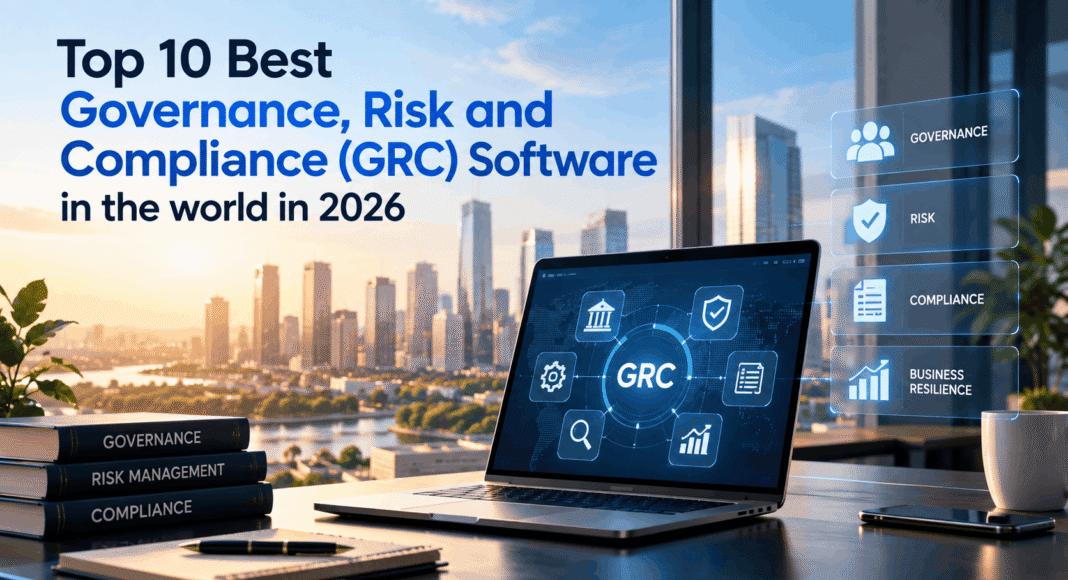
The best Governance, Risk and Compliance (GRC) software in 2026 includes Optro, ServiceNow IRM, MetricStream, Archer, Workiva, Vanta, Drata, LogicGate Risk Cloud, OneTrust, and Diligent One. These leading GRC platforms help businesses manage enterprise risks, automate regulatory compliance, strengthen internal audits, monitor security controls, and improve corporate governance.
As businesses navigate increasingly complex regulatory requirements, cybersecurity threats, data privacy obligations, and operational risks, effective governance, risk management, and compliance have become essential components of long-term business success. In 2026, organizations across industries are turning to Governance, Risk and Compliance (GRC) software to centralize risk assessments, automate compliance processes, strengthen internal controls, and improve corporate accountability.
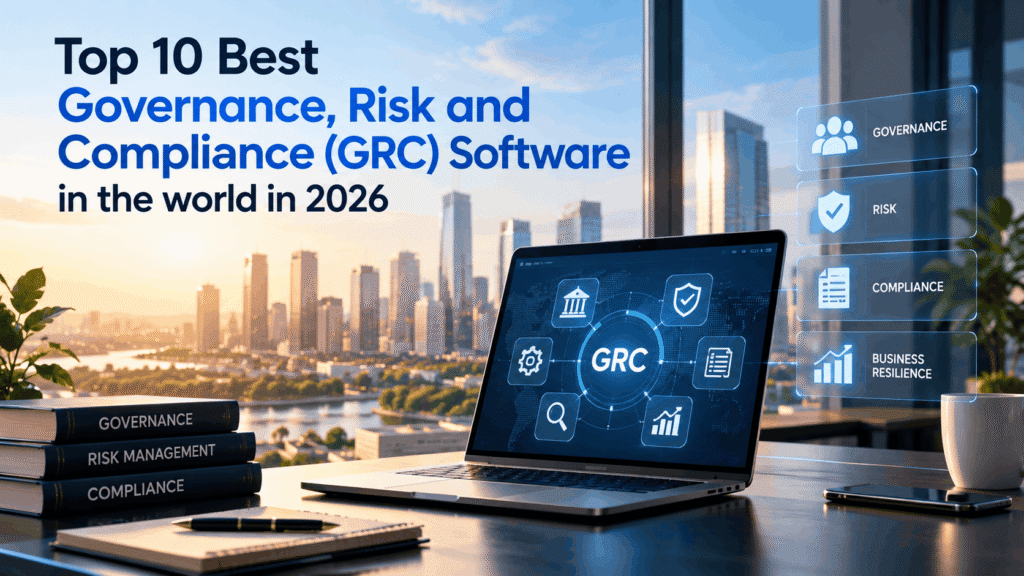
GRC software provides organizations with a unified framework for managing enterprise risks, regulatory obligations, internal audits, corporate policies, and third-party relationships. Rather than relying on disconnected spreadsheets, manual reporting, and fragmented compliance systems, businesses can use modern GRC platforms to gain greater visibility into their risk exposure, monitor compliance activities, and make more informed decisions.
The best GRC software in 2026 goes beyond traditional risk registers and compliance checklists. Leading platforms increasingly incorporate artificial intelligence, automated evidence collection, continuous control monitoring, real-time risk dashboards, predictive analytics, and configurable workflows. These capabilities help organizations reduce administrative workloads, identify potential compliance gaps earlier, and respond more efficiently to changing regulatory expectations.
The growing importance of cybersecurity regulations, financial reporting standards, environmental and social governance requirements, and AI governance has also expanded the role of GRC technology. Businesses must manage compliance with frameworks and regulations such as SOC 2, ISO 27001, GDPR, HIPAA, SOX, and the EU Digital Operational Resilience Act (DORA), depending on their industry, location, and operational requirements. A suitable GRC platform can simplify the management of these obligations while supporting consistent documentation, audit readiness, and accountability.
However, not all governance, risk, and compliance solutions serve the same purpose. Some enterprise GRC platforms specialize in comprehensive risk management, regulatory intelligence, and internal audit operations. Others focus on cybersecurity compliance automation, vendor risk assessments, privacy management, or financial controls. Selecting the right solution requires careful consideration of organizational size, industry regulations, implementation complexity, integration capabilities, scalability, and total cost of ownership.
This article explores the top 10 best Governance, Risk and Compliance (GRC) software platforms in the world in 2026, including Optro, ServiceNow Integrated Risk Management (IRM), MetricStream, Archer, Workiva, Vanta, Drata, LogicGate Risk Cloud, OneTrust, and Diligent One Platform.
Each platform is examined based on its core features, GRC automation capabilities, compliance management functionality, risk assessment tools, pricing considerations, advantages, limitations, and suitability for different business requirements.
Whether an organization is a growing startup preparing for its first SOC 2 audit, a financial institution managing complex regulatory obligations, or a multinational enterprise seeking an integrated risk management solution, this comprehensive GRC software comparison provides practical insights to support a more informed technology investment.
By understanding the capabilities and differences among the leading GRC solutions, businesses can identify software that strengthens regulatory compliance, improves enterprise risk visibility, streamlines internal audits, and builds a more resilient governance framework in 2026 and beyond.
Before we venture further into this article, we would like to share who we are and what we do.
About 9cv9
9cv9 is a business tech startup based in Singapore and Asia, with a strong presence all over the world.
With over ten years of startup and business experience, and being highly involved in connecting with thousands of companies and startups, the 9cv9 team has listed some of the top and best companies/tools in this review.
If you like to get your company listed in our top B2B software reviews, check out our world-class 9cv9 Media and PR service and pricing plans here.
Top 10 Best Governance, Risk and Compliance (GRC) Software You Need To Know in 2026
- Optro
- ServiceNow IRM
- MetricStream
- Archer
- Workiva
- Vanta
- Drata
- LogicGate Risk Cloud
- OneTrust
- Diligent One Platform
1. Optro
Optro, formerly known as AuditBoard, is an enterprise Governance, Risk, and Compliance (GRC) software platform specializing in internal audit management, Sarbanes-Oxley (SOX) compliance, internal controls, and enterprise risk management.
The platform is particularly suited to large enterprises, publicly traded companies, and highly regulated organizations seeking to centralize audit activities, strengthen financial controls, and improve regulatory compliance.
Following its rebranding from AuditBoard in March 2026, Optro has continued positioning itself as a connected risk management platform. Its integrated architecture enables internal auditors, compliance officers, risk managers, and IT security teams to collaborate through shared workflows, centralized documentation, and automated control monitoring.
Unlike traditional GRC solutions that primarily focus on maintaining compliance records, Optro emphasizes continuous audit readiness, cross-functional risk visibility, and evidence-based assurance.
Key Features and Capabilities
| Feature | Functionality | Business Benefits |
|---|---|---|
| Internal Audit Management | Centralizes audit planning, fieldwork, documentation, and reporting | Improves audit efficiency and accountability |
| SOX Compliance Management | Manages financial controls, testing, certifications, and supporting evidence | Reduces manual SOX compliance workloads |
| Enterprise Risk Management | Consolidates risk assessments, registers, and mitigation activities | Strengthens enterprise-wide risk visibility |
| Internal Controls Management | Connects control ownership, testing, deficiencies, and remediation | Improves control effectiveness |
| IT Risk and Compliance | Coordinates technology risks and IT control assessments | Supports cybersecurity and regulatory oversight |
| AI-Powered Automation | Assists with repetitive audit and compliance activities | Reduces administrative effort |
| Evidence Management | Centralizes supporting documents across audit and compliance workflows | Minimizes duplicate evidence requests |
| Audit Reporting | Provides dashboards and reporting for audit committees and executives | Supports faster, evidence-based decisions |
AI-Powered Audit Automation and Connected Compliance
A major differentiator of Optro is its connected approach to audit, risk, and compliance management.
The platform links internal controls, business risks, audit findings, and remediation activities, allowing organizations to manage related assurance processes without maintaining completely separate systems.
Its AI capabilities can assist teams with document analysis, workflow automation, and identifying information relevant to control testing. However, organizations should assess the extent of autonomous testing available within their specific subscription and configuration.
Optro also supports evidence reuse across overlapping compliance requirements, helping organizations reduce repeated documentation requests when controls address multiple regulatory frameworks.
| Compliance Framework | Typical Optro Application |
|---|---|
| SOX | Financial reporting controls, testing, and deficiency management |
| SOC 2 | Evidence collection and assessment of relevant security controls |
| ISO 27001 | Information security control documentation and audit support |
| COSO | Internal control and enterprise risk management alignment |
| Internal Audit Standards | Audit planning, workpapers, findings, and reporting |
These capabilities make Optro particularly relevant to organizations managing multiple audit programs and complex compliance obligations.
Optro Ratings and Market Performance in 2026
Optro has established a strong presence in enterprise audit and GRC software, supported by adoption among major corporations and favorable customer evaluations.
| Performance Metric | 2026 Benchmark |
|---|---|
| Gartner Peer Insights Rating | 4.5 out of 5 stars, approximately 1,190 ratings |
| G2 User Rating | Approximately 4.6 out of 5 stars |
| Enterprise Customer Base | Approximately 2,500 enterprises reported in 2026 |
| Fortune 500 Adoption | More than 50% |
| Annual Recurring Revenue | Reportedly exceeds $300 million |
| Ownership | Hg, following its 2024 acquisition |
| Primary Market | Mid-market and large enterprises |
| Core Specialization | Internal audit, SOX compliance, enterprise risk, and controls management |
Customer ratings and adoption figures may change over time and should be treated as approximate 2026 benchmarks.
Optro Pricing and Implementation Costs
Optro uses a customized enterprise subscription model rather than publicly advertised fixed-price plans. Pricing depends on selected applications, organizational requirements, licensed users, and implementation complexity.
| Pricing Component | Estimated Cost |
|---|---|
| Median Annual Contract Value | $45,947 |
| Lower-End Annual Contract | $21,220 |
| Higher-End Observed Annual Contract | $111,208 |
| Large Enterprise Contracts | Potentially $150,000 or more annually |
| Implementation Services | Approximately 10% to 25% of annual subscription value |
| Stakeholder Access | Unlimited stakeholder licenses advertised |
| Pricing Model | Custom enterprise quotation |
The annual contract benchmarks reflect historical purchasing data rather than official list prices. Larger deployments involving multiple applications, complex integrations, and extensive implementation services may cost substantially more.
Implementation duration varies according to organizational readiness, data migration requirements, integration complexity, and the number of modules deployed. A six-to-twelve-week implementation may be achievable for a relatively focused rollout, but should not be interpreted as a guaranteed deployment timeline.
Advantages and Limitations of Optro
| Advantages | Limitations |
|---|---|
| Strong SOX compliance and internal audit functionality | Enterprise pricing may be expensive for smaller organizations |
| Centralized audit evidence and control documentation | Advanced configuration can require dedicated administrators |
| Integrated audit, risk, and compliance workflows | Full-platform implementation may involve significant preparation |
| AI-assisted control testing and automation | Some AI capabilities require additional validation and oversight |
| Unlimited stakeholder collaboration licenses | Specialized analytics requirements may need external tools |
| Strong enterprise adoption and established audit workflows | Total costs increase with additional modules and services |
Best Use Cases for Optro
Optro is particularly suitable for organizations with mature internal audit departments, extensive regulatory obligations, and complex internal control environments.
| Organization Type | Recommended Application | Suitability |
|---|---|---|
| Publicly Listed Companies | SOX compliance and financial controls testing | Excellent |
| Large Multinational Enterprises | Integrated audit and enterprise risk management | Excellent |
| Financial Institutions | Internal controls, operational risk, and regulatory assurance | High |
| Healthcare Organizations | Compliance documentation and enterprise risk oversight | High |
| Technology Enterprises | IT risk, SOC 2 readiness, and control monitoring | High |
| Small Businesses | Basic compliance tracking and risk registers | Limited |
Overall Assessment
Optro ranks among the leading Governance, Risk, and Compliance software solutions in 2026 for organizations prioritizing internal audit automation, SOX compliance, and integrated enterprise risk management.
Its combination of established audit workflows, centralized controls management, AI-assisted testing, and enterprise collaboration capabilities makes it a compelling option for large organizations seeking to reduce manual compliance activities.
However, its customized pricing and implementation requirements may make it less suitable for small businesses with straightforward compliance needs.
Best For: Large enterprises, publicly listed companies, internal audit departments, and organizations requiring advanced SOX compliance and enterprise-wide risk management.
2. ServiceNow IRM
ServiceNow Integrated Risk Management (IRM), previously known as ServiceNow Governance, Risk, and Compliance (GRC), is an enterprise risk management platform designed to integrate governance, regulatory compliance, IT risk, and operational resilience into existing business workflows.
Built on the ServiceNow Now Platform, the software is particularly suitable for multinational corporations, financial institutions, technology companies, and highly regulated enterprises already using ServiceNow for IT Service Management (ITSM), IT Operations Management (ITOM), or Security Operations (SecOps).
Unlike standalone GRC software that operates independently from enterprise IT infrastructure, ServiceNow IRM connects risk assessments, compliance obligations, IT assets, security incidents, and business services within a unified operational environment.
This integrated approach enables organizations to identify emerging risks, coordinate remediation activities, monitor regulatory obligations, and improve accountability across business and technology departments.
Key Features and Capabilities
| Feature | Functionality | Business Benefits |
|---|---|---|
| Enterprise Risk Management | Centralizes risk identification, assessments, scoring, and mitigation | Improves enterprise-wide risk visibility |
| Policy and Compliance Management | Manages internal policies, regulatory requirements, controls, and assessments | Strengthens compliance oversight |
| IT Risk Management | Connects technology risks with infrastructure, applications, and IT services | Improves technology risk prioritization |
| Operational Resilience Management | Maps critical business services, dependencies, and disruption scenarios | Strengthens business continuity and resilience |
| Third-Party Risk Management | Evaluates supplier risks, vendor assessments, and remediation activities | Improves supply chain risk oversight |
| CMDB Integration | Connects configuration items and business services to risk records | Provides contextual risk intelligence |
| Automated Compliance Workflows | Coordinates control testing, evidence requests, approvals, and remediation | Reduces repetitive compliance administration |
| Risk Dashboards and Reporting | Consolidates risk indicators, compliance status, and remediation progress | Supports executive decision-making |
Native Integration with ServiceNow ITSM and CMDB
A major competitive advantage of ServiceNow IRM is its integration with the Now Platform and Configuration Management Database (CMDB).
The CMDB provides a structured inventory of configuration items, including servers, applications, infrastructure components, and their relationships with business services.
By connecting these records with risk and compliance processes, organizations can evaluate how technology failures, vulnerabilities, and operational disruptions affect critical business activities.
For example, when an organization identifies a security vulnerability affecting a critical application, ServiceNow can connect the affected configuration item with relevant business services and associated risk records.
Configured workflows can then initiate risk reassessments, notify control owners, create remediation tasks, or escalate unresolved issues.
However, automated risk-score updates and incident-to-risk escalation depend on the organization’s implementation, configured rules, data relationships, and integrations. They should not be assumed to occur automatically in every deployment.
| Operational Event | ServiceNow IRM Integration | Risk Management Outcome |
|---|---|---|
| Critical Security Vulnerability | Associates affected assets with relevant risk records | Supports risk reassessment and remediation |
| IT Infrastructure Outage | Identifies affected configuration items and business services | Improves operational impact analysis |
| Failed Compliance Control | Creates issues and assigns remediation responsibilities | Strengthens compliance accountability |
| Third-Party Service Disruption | Connects supplier dependencies with business services | Supports third-party risk response |
| Regulatory Requirement Change | Updates applicable obligations and control assessments | Improves regulatory change management |
| Recurring IT Incident | Provides operational evidence for risk evaluation | Helps identify persistent technology risks |
This architecture makes ServiceNow IRM particularly valuable for enterprises seeking closer alignment between IT operations, cybersecurity, compliance, and enterprise risk governance.
Regulatory Compliance and Operational Resilience
ServiceNow IRM supports organizations managing multiple regulatory frameworks, particularly those requiring evidence-based controls, operational resilience, and third-party oversight.
Its policy management, control assessment, risk evaluation, and operational resilience capabilities can help compliance teams coordinate obligations across business units.
| Regulatory Framework | Typical ServiceNow IRM Application |
|---|---|
| EU Digital Operational Resilience Act (DORA) | ICT risk, operational resilience, third-party dependencies, and information registers |
| ISO 27001 | Information security controls, risk assessments, and compliance evidence |
| NIST Cybersecurity Framework | Cybersecurity risk evaluation and control monitoring |
| GDPR | Privacy-related risks, control assessments, and compliance workflows |
| SOX | Internal control assessments, evidence management, and remediation |
| SOC 2 | Security control documentation and compliance readiness |
| Basel Banking Framework | Operational risk governance and financial institution risk oversight |
For financial institutions operating within the European Union, ServiceNow offers capabilities supporting DORA-related ICT risk and third-party information management.
Nevertheless, deploying ServiceNow IRM does not automatically establish regulatory compliance. Organizations remain responsible for configuring appropriate controls, maintaining accurate records, and satisfying applicable legal and supervisory requirements.
ServiceNow IRM Ratings and Market Performance in 2026
ServiceNow IRM is an established enterprise GRC solution, particularly among organizations already using the Now Platform for IT operations, cybersecurity, and enterprise service management.
| Performance Metric | 2026 Benchmark |
|---|---|
| G2 User Rating | Approximately 4.2 to 4.4 out of 5 stars |
| Gartner Peer Insights Rating | Approximately 3.8 out of 5 stars |
| Primary Customer Segment | Large enterprises and multinational organizations |
| Deployment Model | Cloud-based enterprise platform |
| Primary Specialization | IT risk, operational resilience, regulatory compliance |
| Integration Advantage | Native Now Platform and CMDB connectivity |
| Implementation Ecosystem | ServiceNow-certified implementation specialists and partners |
Review ratings are indicative historical benchmarks. Current ratings and review counts should be verified against the specific ServiceNow product listing because IRM, GRC, and related applications may have separate review profiles.
ServiceNow IRM Pricing and Implementation Costs
ServiceNow IRM follows a customized enterprise subscription model. Organizations typically purchase access according to their required capabilities, licensed user roles, deployment scale, and contractual arrangements.
| Pricing Component | Estimated Cost or Structure |
|---|---|
| Entry-Level Enterprise Deployment | Approximately $50,000 to $60,000 annually, indicative estimate |
| Multi-Module Enterprise Deployment | Approximately $150,000 to $500,000 or more annually |
| Published Enterprise Cost Example | $441,000 initial-period fees in a commissioned Forrester model |
| Subsequent Annual Fees in That Model | $397,500 |
| Third-Party Implementation Services in That Model | $400,000 initial deployment |
| Core Implementation Timeline in That Model | Approximately 6 months |
| Pricing Model | Customized subscription based on licensed roles and capabilities |
The entry-level and enterprise pricing ranges are planning estimates rather than official ServiceNow list prices.
A 2026 Forrester economic impact study commissioned by ServiceNow models substantial licensing, professional services, and internal staffing costs for a representative enterprise deployment. Actual expenditure can vary significantly.
Organizations should therefore evaluate the total cost of ownership, including software subscriptions, integration services, internal administration, training, and ongoing maintenance.
Advantages and Limitations of ServiceNow IRM
| Advantages | Limitations |
|---|---|
| Native integration with ServiceNow ITSM, ITOM, and SecOps | Higher implementation costs than many standalone GRC tools |
| CMDB-based visibility into technology and business service dependencies | Requires accurate configuration and asset data |
| Extensive enterprise risk and compliance capabilities | Complex workflows can create a steep learning curve |
| Strong operational resilience and third-party risk functionality | Advanced customization may require specialized expertise |
| Scalable architecture for multinational organizations | Additional modules and integrations increase costs |
| Centralized risk, control, and remediation workflows | May be excessive for organizations with basic compliance needs |
Best Use Cases for ServiceNow IRM
| Organization Type | Recommended Application | Suitability |
|---|---|---|
| Global Enterprises | Enterprise-wide IT risk and compliance management | Excellent |
| Financial Institutions | DORA compliance support and operational resilience | Excellent |
| ServiceNow ITSM Customers | Integrated incident, asset, and risk management | Excellent |
| Technology Companies | Cybersecurity risk and IT control monitoring | High |
| Healthcare Enterprises | Operational risk and regulatory compliance | High |
| Manufacturing Enterprises | Business continuity and third-party risk management | High |
| Small Businesses | Basic risk registers and compliance tracking | Limited |
Overall Assessment
ServiceNow IRM is among the leading Governance, Risk, and Compliance software platforms in 2026 for enterprises seeking to integrate risk management directly with IT operations, cybersecurity, and business service infrastructure.
Its primary competitive advantage is its ability to connect operational data, technology assets, business services, risk assessments, and compliance workflows within the Now Platform.
Although implementation complexity and enterprise pricing may discourage smaller organizations, ServiceNow IRM remains a strong choice for businesses with established ServiceNow environments and sophisticated IT risk governance requirements.
Best For: Large enterprises, financial institutions, ServiceNow customers, and organizations prioritizing IT risk management, operational resilience, and integrated regulatory compliance.
3. MetricStream
MetricStream is a leading enterprise Governance, Risk, and Compliance (GRC) software platform designed for multinational corporations, financial institutions, healthcare organizations, manufacturers, and highly regulated industries managing complex risk and compliance requirements.
Headquartered in San Jose, California, MetricStream provides integrated solutions for enterprise risk management, cybersecurity governance, regulatory compliance, internal auditing, and third-party risk management.
Its ConnectedGRC architecture enables organizations to consolidate risk information, standardize compliance processes, and coordinate governance activities across multiple business units, geographical regions, and regulatory jurisdictions.
Unlike lightweight compliance management platforms primarily designed for small and medium-sized businesses, MetricStream focuses on large-scale enterprise governance, sophisticated risk assessment methodologies, and complex regulatory obligations.
The platform’s extensive configurability makes it particularly suitable for organizations managing overlapping international compliance frameworks and enterprise-wide risk programs.
Key Features and Capabilities
| Feature | Functionality | Business Benefits |
|---|---|---|
| Enterprise Risk Management | Centralizes risk identification, assessments, monitoring, and mitigation | Improves enterprise-wide risk visibility |
| Regulatory Change Management | Identifies regulatory developments and assesses their relevance | Reduces compliance monitoring workloads |
| Cyber Risk Management | Evaluates cybersecurity threats, vulnerabilities, and control effectiveness | Strengthens information security governance |
| Internal Audit Management | Coordinates audit planning, fieldwork, evidence, and reporting | Improves audit efficiency |
| Policy and Compliance Management | Connects policies, regulatory obligations, controls, and assessments | Strengthens regulatory accountability |
| Third-Party Risk Management | Manages vendor assessments, due diligence, and risk monitoring | Reduces supplier-related exposure |
| AI-Powered Risk Analytics | Supports risk evaluation, regulatory analysis, and automated workflows | Improves risk-based decision-making |
| Business Continuity Management | Coordinates business impact assessments and recovery planning | Strengthens operational resilience |
| Risk Dashboards | Consolidates key risk indicators, control results, and remediation progress | Improves executive reporting |
ConnectedGRC and AI-Powered Risk Intelligence
A major differentiator of MetricStream is its ConnectedGRC approach, which brings enterprise risk, regulatory compliance, cybersecurity, and internal audit activities into a unified governance environment.
The platform connects risk registers, control libraries, regulatory requirements, business processes, and audit findings, allowing organizations to manage related obligations without maintaining completely independent systems.
MetricStream also offers CyberGRC capabilities that enable organizations to assess cybersecurity risks, quantify potential financial exposure, monitor security controls, and prioritize remediation activities.
Its 2026 AI capabilities extend to regulatory summarization, control documentation, assessment analysis, and workflow assistance.
| AI Capability | Application | Operational Value |
|---|---|---|
| AI Regulatory Summarization | Summarizes regulatory alerts and supporting documents | Accelerates regulatory analysis |
| Regulatory Applicability Assessment | Classifies regulatory changes according to organizational relevance | Helps prioritize compliance reviews |
| AI Control Description Refinement | Generates clearer control descriptions | Improves audit documentation |
| Automated Assessment Flags | Identifies responses exceeding defined risk thresholds | Highlights potential compliance issues |
| Cyber Risk Quantification | Estimates financial exposure from cybersecurity scenarios | Supports risk-based investment decisions |
| AI Governance Controls | Supports model oversight, audit logging, and data protection | Strengthens responsible AI adoption |
These capabilities can reduce repetitive administrative activities while allowing risk and compliance professionals to focus on significant exposures and regulatory decisions.
Regulatory Change Management and Global Compliance
MetricStream is particularly well suited to organizations operating across multiple jurisdictions with frequently changing regulatory requirements.
Its Regulatory Change Management capabilities help compliance teams collect regulatory updates, evaluate their applicability, associate changes with internal obligations, and identify potentially affected policies and controls.
AI-assisted regulatory analysis can also summarize new requirements and help determine which business units may need additional compliance assessments.
However, the breadth of regulatory content depends on configured feeds, licensed content providers, and organizational requirements. Claims of monitoring a fixed number of regulatory sources should be verified during vendor evaluation.
| Regulatory Framework | Typical MetricStream Application |
|---|---|
| Basel III and Related Banking Standards | Banking risk, capital-related governance, and regulatory control oversight |
| SOX | Financial reporting controls, testing, and audit documentation |
| COSO | Enterprise risk management and internal control alignment |
| HIPAA | Healthcare compliance risk assessments and control monitoring |
| GDPR | Data protection governance and privacy-related compliance controls |
| ISO 27001 | Information security risk assessments and control management |
| NIST Cybersecurity Framework | Cybersecurity governance, risk evaluation, and remediation |
| DORA | ICT risk management, operational resilience, and third-party oversight |
MetricStream supports compliance management processes, but implementation alone does not guarantee certification or regulatory compliance.
MetricStream Ratings and Market Performance in 2026
MetricStream maintains an established position in the enterprise GRC software market, particularly among organizations requiring sophisticated risk governance and regulatory management.
| Performance Metric | 2026 Benchmark |
|---|---|
| G2 Seller Rating | 3.8 out of 5 stars, based on 14 reviews |
| Gartner Peer Insights: Integrated Risk Management | 3.9 out of 5 stars, based on 48 ratings |
| Gartner Peer Insights: IT Risk Management | 4.3 out of 5 stars, based on 21 ratings |
| Headquarters | San Jose, California, United States |
| Year Founded | 1999 |
| Reported Employee Range | 1,001 to 5,000 |
| Primary Customer Segment | Large enterprises and regulated multinational organizations |
| Core Specialization | Enterprise risk, regulatory compliance, cyber risk, and internal audit |
Ratings vary by product category and review platform. The figures above represent available 2026 review benchmarks rather than a single consolidated customer satisfaction score.
MetricStream Pricing and Implementation Costs
MetricStream follows a customized enterprise pricing model. Subscription costs depend on the number of applications, organizational scale, user requirements, integration complexity, and implementation services.
| Pricing Component | Estimated Cost |
|---|---|
| Enterprise Entry-Level Deployment | Approximately $50,000 to $150,000 annually |
| Mid-Sized Enterprise Deployment | Approximately $150,000 to $400,000 annually |
| Large Multi-Module Enterprise Deployment | $400,000 or more annually |
| Global Enterprise Full Suite | Potentially $750,000 to $1 million or more annually |
| Implementation Services | Custom quotation based on deployment complexity |
| Implementation Timeline | Approximately 3 to 6 months for many enterprise projects; complex rollouts may take longer |
| Pricing Model | Customized enterprise subscription |
These figures are indicative market estimates, not verified official MetricStream pricing tiers. Actual contracts may differ considerably.
Organizations should assess the total cost of ownership, including subscription fees, professional services, integrations, data migration, training, and ongoing administration.
Advantages and Limitations of MetricStream
| Advantages | Limitations |
|---|---|
| Extensive enterprise risk and compliance functionality | Higher subscription costs than lightweight GRC platforms |
| Strong support for complex regulatory environments | Implementation may require significant configuration |
| Integrated risk, compliance, audit, and cybersecurity workflows | Advanced functionality creates a learning curve |
| AI-assisted regulatory monitoring and analysis | AI outputs still require professional validation |
| Highly configurable risk assessments and reporting | Customization may increase maintenance requirements |
| Suitable for large multinational deployments | May be excessive for smaller organizations |
| Comprehensive third-party and operational risk capabilities | Deployment timelines can be lengthy |
Best Use Cases for MetricStream
| Organization Type | Recommended Application | Suitability |
|---|---|---|
| Global Financial Institutions | Banking regulations, operational risk, and compliance management | Excellent |
| Multinational Corporations | Enterprise-wide risk governance across jurisdictions | Excellent |
| Healthcare Organizations | Healthcare compliance and operational risk oversight | Excellent |
| Manufacturing Enterprises | Supply chain, operational, and regulatory risk management | High |
| Government and Defense Organizations | Complex governance, cybersecurity, and compliance programs | High |
| Technology Enterprises | Cyber risk and third-party risk management | High |
| Small Businesses | Basic compliance tracking and risk registers | Limited |
Overall Assessment
MetricStream is among the leading Governance, Risk, and Compliance software solutions in 2026 for large organizations managing complex regulatory requirements, enterprise-wide risks, and multinational compliance programs.
Its ConnectedGRC architecture, advanced risk analytics, AI-assisted regulatory change management, and broad functional coverage make it particularly valuable for financial institutions, healthcare organizations, and multinational enterprises.
However, its enterprise pricing, implementation complexity, and extensive configuration requirements may make it less practical for smaller businesses seeking straightforward compliance automation.
Best For: Large multinational corporations, global financial institutions, highly regulated industries, and organizations requiring comprehensive enterprise risk management and multi-jurisdictional regulatory compliance.
4. Archer
Archer, formerly known as RSA Archer, is an established enterprise Governance, Risk, and Compliance (GRC) software platform designed for organizations requiring highly configurable risk management, regulatory compliance, internal auditing, and third-party risk oversight.
With more than two decades of experience in the enterprise risk management market, Archer serves financial institutions, government agencies, defense organizations, energy companies, and operators of critical infrastructure.
The platform is particularly suitable for organizations managing complex risk structures, specialized regulatory requirements, and extensive internal governance processes.
Unlike standardized GRC platforms that rely heavily on predefined workflows, Archer provides a flexible application framework that enables organizations to configure risk taxonomies, assessment methodologies, data relationships, approval processes, and reporting structures according to their operational requirements.
Its support for cloud-hosted and on-premises deployment models also makes it relevant to enterprises with strict data residency, infrastructure control, and security requirements.
Key Features and Capabilities
| Feature | Functionality | Business Benefits |
|---|---|---|
| Enterprise Risk Management | Centralizes risk identification, assessments, monitoring, and mitigation | Improves enterprise-wide risk visibility |
| Operational Risk Management | Tracks operational threats, incidents, losses, and control effectiveness | Strengthens operational resilience |
| IT and Security Risk Management | Evaluates cybersecurity risks, technology assets, and security controls | Improves cybersecurity governance |
| Regulatory Compliance Management | Connects regulatory obligations, policies, controls, and assessments | Strengthens compliance accountability |
| Third-Party Risk Management | Manages supplier assessments, due diligence, and ongoing risk monitoring | Reduces vendor-related exposure |
| Internal Audit Management | Coordinates audit planning, documentation, findings, and remediation | Improves audit efficiency |
| Quantitative Risk Analysis | Estimates financial exposure associated with defined risk scenarios | Supports risk-based investment decisions |
| Configurable GRC Workflows | Enables customized applications, data structures, and approval processes | Accommodates complex organizational requirements |
| Risk Dashboards and Reporting | Consolidates risk indicators, assessment results, and remediation progress | Supports executive decision-making |
Flexible GRC Architecture and Enterprise Customization
A major competitive advantage of Archer is its highly configurable application architecture.
The platform allows risk and compliance administrators to create customized data structures, define relationships between risk records, configure assessment workflows, and develop organization-specific reporting processes.
This flexibility is particularly valuable for multinational corporations operating across multiple business units, regulatory jurisdictions, and risk management frameworks.
For example, a global financial institution can configure Archer to connect operational risks with business processes, regulatory requirements, control owners, historical incidents, and remediation activities.
| Customization Capability | Enterprise Application | Business Value |
|---|---|---|
| Custom Risk Taxonomies | Defines organization-specific risk categories | Improves consistency in risk classification |
| Configurable Data Relationships | Connects risks, controls, assets, and business processes | Strengthens risk traceability |
| Automated Approval Workflows | Routes assessments and remediation tasks to responsible teams | Improves accountability |
| Custom Risk Scoring | Applies tailored likelihood, impact, and control evaluation methods | Supports consistent risk prioritization |
| Business Unit Segmentation | Organizes governance programs across subsidiaries and departments | Supports multinational operations |
| Custom Reporting | Develops dashboards for executives, auditors, and regulators | Improves management oversight |
However, extensive customization can increase implementation complexity and ongoing maintenance requirements. Organizations should establish clear configuration standards to prevent unnecessary technical debt.
Archer Insight and Quantitative Risk Analysis
Archer Insight extends the platform’s risk management capabilities through quantitative cyber risk analysis.
Rather than relying exclusively on qualitative risk ratings such as low, medium, or high, quantitative risk modeling estimates potential financial losses associated with cybersecurity threats and operational risk scenarios.
Archer Insight incorporates methodologies associated with the Factor Analysis of Information Risk (FAIR) framework, helping organizations evaluate risk in financial terms.
| Risk Analysis Capability | Functionality | Business Benefits |
|---|---|---|
| Financial Risk Quantification | Estimates potential financial losses from risk scenarios | Supports financial risk prioritization |
| FAIR-Based Modeling | Evaluates loss event frequency and potential loss magnitude | Improves consistency in cyber risk analysis |
| Scenario Analysis | Examines potential outcomes of cybersecurity incidents | Strengthens risk preparedness |
| Risk Exposure Reporting | Presents estimated financial exposure across risk scenarios | Improves executive communication |
| Risk Treatment Evaluation | Compares potential exposure before and after mitigation | Supports security investment decisions |
| Portfolio Risk Analysis | Aggregates modeled risk exposure across business areas | Improves enterprise risk oversight |
Quantitative estimates depend on the quality of underlying assumptions, historical data, and modeling techniques. They represent estimated exposure rather than guaranteed financial outcomes.
Archer Ratings and Market Performance in 2026
Archer maintains a significant presence in the enterprise GRC software market, particularly among organizations requiring configurable risk management processes and flexible deployment options.
| Performance Metric | 2026 Benchmark |
|---|---|
| G2 User Rating | Approximately 3.9 out of 5 stars |
| TrustRadius Rating | Historically reported around 8.4 out of 10 |
| Industry Experience | More than 25 years |
| Enterprise Customer Base | More than 1,500 organizations, according to company figures |
| Ownership | Cinven, acquired in 2023 |
| Deployment Options | Cloud, hybrid, and on-premises |
| Primary Customer Segment | Mid-sized and large regulated enterprises |
| Core Specialization | Enterprise risk, regulatory compliance, cyber risk quantification |
Customer review scores are approximate and may vary by product listing and review date.
Archer Pricing and Implementation Costs
Archer uses a customized enterprise licensing model, with costs influenced by selected applications, deployment infrastructure, user requirements, and implementation complexity.
| Pricing Component | Estimated Cost |
|---|---|
| Limited Enterprise Deployment | Approximately $14,000 to $75,000 annually |
| Mid-Market Annual Contract | Approximately $80,000 to $250,000 |
| Enterprise Multi-Module Deployment | Approximately $300,000 to $600,000 or more annually |
| Implementation Services | Potentially 25% to 40% of initial licensing expenditure |
| Deployment Timeline | Several weeks for focused deployments; several months for complex implementations |
| Pricing Model | Customized enterprise quotation |
These figures are indicative third-party estimates rather than official Archer pricing tiers. Actual costs depend on contract scope and implementation requirements.
Advantages and Limitations of Archer
| Advantages | Limitations |
|---|---|
| Highly configurable enterprise GRC architecture | Extensive customization can increase administration requirements |
| Supports cloud, hybrid, and on-premises deployment | On-premises installations require infrastructure management |
| Quantitative risk analysis through Archer Insight | Financial risk estimates depend on modeling assumptions |
| Broad regulatory compliance and audit functionality | Complex configurations may require specialist expertise |
| Established presence in regulated industries | Some users report a steep learning curve |
| Integrated enterprise and third-party risk management | Advanced implementations may involve substantial costs |
Best Use Cases for Archer
| Organization Type | Recommended Application | Suitability |
|---|---|---|
| Financial Institutions | Operational risk, regulatory compliance, and quantitative risk modeling | Excellent |
| Government Agencies | Customized governance and regulatory oversight | Excellent |
| Defense Organizations | Controlled infrastructure and specialized risk workflows | Excellent |
| Energy and Utilities Companies | Operational resilience and critical infrastructure risk | Excellent |
| Multinational Corporations | Enterprise-wide risk management and regulatory compliance | High |
| Healthcare Enterprises | Compliance management and operational risk monitoring | High |
| Small Businesses | Basic compliance tracking and risk registers | Limited |
Overall Assessment
Archer remains one of the leading Governance, Risk, and Compliance software platforms in 2026 for enterprises requiring extensive customization, quantitative risk analysis, and flexible deployment infrastructure.
Its configurable architecture, established enterprise risk management capabilities, and Archer Insight risk quantification tools distinguish it from more standardized GRC solutions.
However, implementation costs, administrative complexity, and the potential for excessive customization should be carefully evaluated before adoption.
Best For: Financial institutions, government agencies, defense organizations, critical infrastructure operators, and large enterprises requiring customizable GRC workflows, quantitative risk management, and on-premises deployment capabilities.
5. Workiva
Workiva is a leading cloud-based Governance, Risk, and Compliance (GRC) software platform specializing in connected financial reporting, regulatory compliance, internal audit management, enterprise risk management, and sustainability disclosures.
Headquartered in the United States and publicly traded on the New York Stock Exchange under the ticker WK, Workiva provides an integrated environment for finance, accounting, audit, risk, and sustainability teams.
The company generated approximately $884.6 million in revenue during fiscal year 2025, representing nearly 20% annual growth. By June 2026, its customer base had reached 6,750 organizations, with a gross revenue retention rate of 97.3%.
Unlike conventional GRC platforms that primarily focus on risk registers and compliance assessments, Workiva connects governance activities directly with financial reporting, regulatory filings, internal controls, and enterprise disclosures.
Its integrated architecture enables organizations to maintain consistent financial and compliance information across documents, spreadsheets, presentations, audit reports, and regulatory submissions.
Key Features and Capabilities
| Feature | Functionality | Business Benefits |
|---|---|---|
| Connected Financial Reporting | Integrates financial data across reports, spreadsheets, and disclosures | Improves reporting accuracy and consistency |
| SOX Compliance Management | Coordinates internal controls, testing, certifications, and remediation | Strengthens financial compliance |
| Internal Audit Management | Centralizes audit planning, evidence, findings, and reporting | Improves audit efficiency |
| Enterprise Risk Management | Connects enterprise risks, controls, assessments, and reporting | Strengthens risk visibility |
| Data Linking Technology | Synchronizes linked information across documents and reports | Reduces manual data reconciliation |
| ESG and Sustainability Reporting | Manages sustainability data, disclosures, and assurance processes | Supports sustainability compliance |
| AI-Powered GRC Automation | Assists with control creation, documentation, and risk analysis | Reduces administrative workloads |
| XBRL Reporting | Supports structured regulatory reporting and financial tagging | Streamlines regulatory submissions |
| Audit Trails and Version Control | Tracks document changes, approvals, and supporting evidence | Improves accountability and audit readiness |
Connected Reporting and Real-Time Data Linking
Workiva’s primary competitive advantage is its data-linking technology, which connects information across multiple reporting and compliance workflows.
Rather than manually copying financial figures, control testing results, or sustainability metrics into separate documents, organizations can establish relationships between source information and corresponding reporting outputs.
When linked source data changes, Workiva can propagate updated values to connected documents, spreadsheets, and reports, subject to configured data relationships and workflow controls.
This reduces inconsistencies between financial statements, internal audit documentation, regulatory filings, and management reports.
| Reporting Process | Traditional Approach | Workiva Approach |
|---|---|---|
| Financial Statements | Manually transfers figures between spreadsheets and reports | Maintains connected financial data |
| SOX Compliance | Collects control evidence across disconnected systems | Centralizes control documentation and testing |
| Regulatory Filings | Reconciles financial information across separate documents | Links reporting data to disclosure documents |
| ESG Reporting | Consolidates sustainability metrics manually | Connects sustainability data with disclosures |
| Internal Audit | Maintains independent audit workpapers and findings | Connects audit information with controls and risks |
| Executive Reporting | Recreates charts and financial summaries | Reuses linked information across reporting outputs |
This connected reporting model is particularly valuable for publicly listed companies and multinational enterprises managing recurring regulatory submissions.
AI-Powered GRC and Audit Automation
In March 2026, Workiva announced an expansion of its AI-powered GRC capabilities, emphasizing connected audit, risk, and controls management.
The expanded platform supports intelligent control creation, automated testing workflows, risk analysis, and improved documentation processes.
These capabilities help organizations reduce repetitive compliance activities while improving collaboration between financial reporting teams and internal auditors.
| AI Capability | Application | Business Value |
|---|---|---|
| Intelligent Control Creation | Assists with drafting and structuring internal controls | Accelerates compliance documentation |
| Control Coverage Analysis | Identifies potential control overlaps and gaps | Improves control rationalization |
| AI-Assisted Documentation | Generates narratives and supporting descriptions | Reduces manual documentation effort |
| Automated Testing Workflows | Coordinates control testing and assessment activities | Improves audit efficiency |
| Risk Insights | Supports analysis of enterprise risk information | Strengthens risk-based decisions |
| Connected Audit Analytics | Analyzes information across audit and compliance workflows | Improves audit visibility |
AI-generated outputs and automated testing results still require appropriate validation, particularly when used in financial reporting and regulated compliance processes.
Regulatory Compliance and Sustainability Reporting
Workiva supports organizations managing complex financial disclosure requirements, internal control obligations, and sustainability reporting frameworks.
Its combination of connected data, structured reporting, and audit documentation makes it especially relevant to organizations preparing recurring regulatory submissions.
| Regulatory Framework | Typical Workiva Application |
|---|---|
| SOX | Internal control testing, certifications, and financial reporting compliance |
| SEC Reporting | Financial statement preparation and regulatory disclosures |
| XBRL and Inline XBRL | Structured financial reporting and regulatory tagging |
| COSO | Internal control documentation and risk management alignment |
| CSRD and ESRS | Sustainability disclosures and reporting workflows |
| GRI Standards | Sustainability performance reporting |
| ISSB Standards | Sustainability-related financial disclosures |
| SOC 2 | Control documentation and audit evidence management |
Workiva can support regulatory reporting and compliance processes, but organizations remain responsible for meeting applicable legal requirements and validating submitted information.
Workiva Ratings and Market Performance in 2026
Workiva maintains a strong position in the enterprise reporting and GRC software market, supported by customer adoption, recurring revenue, and favorable user reviews.
| Performance Metric | 2026 Benchmark |
|---|---|
| G2 User Rating | 4.5 out of 5 stars, approximately 2,147 reviews |
| Gartner Peer Insights Rating | 4.5 out of 5 stars, approximately 638 ratings |
| FY2025 Revenue | $884.6 million |
| FY2025 Revenue Growth | 19.7% |
| Customer Base | 6,750 as of June 2026 |
| Gross Revenue Retention | 97.3% as of June 2026 |
| Net Revenue Retention | 110.5% as of June 2026 |
| Customers Spending Over $300,000 Annually | 656 as of June 2026 |
| Primary Specialization | Financial reporting, SOX compliance, audit, and sustainability disclosures |
These figures demonstrate Workiva’s established enterprise market presence and recurring subscription revenue model. Customer ratings may change as additional reviews are published.
Workiva Pricing and Implementation Costs
Workiva follows a customized enterprise subscription model, with pricing determined by selected solutions, reporting requirements, organizational complexity, and implementation services.
Unlike traditional per-user licensing structures, Workiva generally emphasizes solution-based pricing with broad collaboration access.
| Pricing Component | Estimated Cost or Structure |
|---|---|
| Median Annual Contract Spend | Approximately $49,420 |
| Lower-End Observed Contract | Approximately $12,736 annually |
| Higher-End Observed Contract | Approximately $153,365 annually |
| Large Enterprise Deployment | Potentially $150,000 to $300,000 or more annually |
| Enterprise Accounts Above $300,000 ACV | 656 customers as of June 2026 |
| Licensing Structure | Solution-based enterprise subscription |
| User Access | Unlimited-user access is advertised for applicable solutions |
| Implementation Services | Customized according to reporting complexity and integrations |
The contract values are indicative third-party purchasing benchmarks rather than official Workiva pricing tiers.
Actual costs depend on the number of solutions purchased, implementation requirements, integrations, and enterprise reporting needs. Unlimited-user arrangements should also be confirmed against specific contractual terms.
Advantages and Limitations of Workiva
| Advantages | Limitations |
|---|---|
| Powerful data linking across financial and compliance reports | Subscription costs can increase as additional solutions are added |
| Strong SOX compliance and regulatory reporting capabilities | Less specialized for certain operational and cybersecurity risk use cases |
| Integrated financial, audit, and sustainability reporting | Complex implementations may require dedicated administrators |
| AI-assisted control creation and documentation | AI outputs require human oversight |
| Detailed audit trails and version control | Data integration and linking require proper configuration |
| Broad collaboration capabilities | Advanced reporting workflows may involve a learning curve |
| Established enterprise customer base | May be excessive for businesses with basic compliance requirements |
Best Use Cases for Workiva
| Organization Type | Recommended Application | Suitability |
|---|---|---|
| Publicly Listed Companies | SEC reporting, SOX compliance, and financial disclosures | Excellent |
| Multinational Corporations | Connected financial reporting and enterprise compliance | Excellent |
| Financial Institutions | Internal controls, regulatory reporting, and audit management | Excellent |
| Large Accounting and Finance Teams | Financial consolidation and reporting collaboration | Excellent |
| Sustainability Reporting Teams | ESG disclosures and sustainability assurance | Excellent |
| Internal Audit Departments | Audit documentation, control testing, and remediation | High |
| Small Businesses | Basic risk registers and compliance tracking | Limited |
Overall Assessment
Workiva ranks among the leading Governance, Risk, and Compliance software platforms in 2026 for organizations prioritizing connected financial reporting, SOX compliance, internal audit management, and sustainability disclosures.
Its proprietary data-linking technology, AI-assisted GRC capabilities, structured regulatory reporting tools, and extensive enterprise collaboration features distinguish it from conventional risk management platforms.
Although its solution-based subscription costs can increase with broader adoption, Workiva offers substantial value to organizations seeking to connect financial data, compliance activities, and regulatory disclosures within a unified environment.
Best For: Publicly listed companies, multinational corporations, financial institutions, internal audit teams, and organizations requiring integrated financial reporting, SOX compliance, and sustainability disclosure management.
6. Vanta
Vanta is a leading cloud-based Governance, Risk, and Compliance (GRC) software platform specializing in automated security compliance, continuous control monitoring, audit readiness, and third-party risk management.
Founded in 2018 and headquartered in San Francisco, Vanta has emerged as a prominent provider of compliance automation software for startups, SaaS companies, technology enterprises, and rapidly growing businesses.
In April 2026, Vanta surpassed $300 million in annual recurring revenue (ARR), serving more than 16,000 customers globally. The company achieved a private market valuation of $4.15 billion following its $150 million Series D funding round in July 2025.
Unlike traditional enterprise GRC platforms that rely heavily on manual risk assessments and complex administrative workflows, Vanta emphasizes automated evidence collection, continuous security monitoring, and streamlined compliance management.
Its cloud-native architecture integrates with more than 400 business and technology applications, enabling organizations to monitor security controls, identify compliance gaps, and maintain audit documentation throughout the year.
Key Features and Capabilities
| Feature | Functionality | Business Benefits |
|---|---|---|
| Automated Compliance Monitoring | Continuously evaluates security configurations and compliance controls | Reduces manual compliance workloads |
| Evidence Collection | Collects audit evidence from connected business applications | Accelerates audit preparation |
| SOC 2 Compliance Automation | Manages security controls, documentation, and audit readiness | Simplifies SOC 2 preparation |
| ISO 27001 Compliance | Supports information security management controls and assessments | Improves certification readiness |
| Vendor Risk Management | Evaluates third-party security risks and supplier compliance | Strengthens supply chain security |
| Trust Center | Provides a centralized portal for sharing security and compliance information | Improves customer confidence |
| AI Questionnaire Automation | Assists with completing customer security questionnaires | Reduces repetitive sales compliance tasks |
| AI Policy Management | Supports security policy drafting and maintenance | Improves documentation efficiency |
| Access Reviews | Coordinates employee access assessments and approvals | Strengthens identity governance |
| Compliance Dashboards | Displays control status, outstanding tasks, and audit progress | Improves compliance visibility |
Automated Evidence Collection and Continuous Compliance Monitoring
Vanta’s primary competitive advantage is its ability to automate evidence collection and monitor security controls through direct integrations with existing business systems.
The platform connects with cloud infrastructure providers, identity management systems, HR software, development platforms, endpoint management tools, and security applications.
These integrations enable Vanta to collect relevant configuration information, monitor security requirements, and identify deviations from established compliance controls.
Rather than relying exclusively on annual compliance reviews, organizations can continuously assess their security posture and address control failures as they arise.
| Integrated System | Monitoring Capability | Compliance Benefit |
|---|---|---|
| Amazon Web Services | Cloud configuration and security settings | Supports cloud infrastructure compliance |
| Microsoft Azure | Cloud resources and access configurations | Improves security control visibility |
| Google Cloud | Infrastructure configurations and security evidence | Supports continuous cloud monitoring |
| Okta | User identities, authentication, and access controls | Strengthens identity governance |
| Google Workspace | User accounts and security configurations | Improves workforce security oversight |
| GitHub | Repository settings, access permissions, and development controls | Supports secure development practices |
| Jira | Security tasks, remediation tickets, and workflows | Improves compliance issue resolution |
| HR Information Systems | Employee onboarding and offboarding records | Supports personnel security controls |
Vanta’s automated monitoring can significantly reduce repetitive evidence collection. However, manual assessments remain necessary for controls that cannot be fully verified through technical integrations.
Vanta Trust Graph and AI-Powered Compliance Automation
In 2026, Vanta expanded its capabilities through its Trust Graph architecture and Vanta AI Agent.
The Trust Graph connects security controls, compliance evidence, vendor relationships, and regulatory obligations within a continuously updated environment.
This architecture helps organizations understand how security risks and compliance requirements relate to their technology infrastructure and third-party services.
Vanta AI Agent builds on this information to assist with compliance tasks, audit preparation, vendor assessments, and security questionnaire workflows.
| AI Capability | Application | Business Value |
|---|---|---|
| AI Policy Generation | Assists with drafting security and compliance policies | Reduces documentation time |
| Automated Control Mapping | Associates controls with applicable compliance requirements | Minimizes duplicated compliance work |
| AI Questionnaire Automation | Generates responses to customer security questionnaires | Accelerates enterprise sales processes |
| AI-Assisted Remediation | Recommends actions for identified security gaps | Improves issue resolution |
| Vendor Risk Analysis | Supports assessment of third-party security information | Strengthens supplier oversight |
| AI Compliance Assistance | Helps teams interpret evidence and outstanding requirements | Improves compliance productivity |
These capabilities make Vanta particularly attractive to organizations operating with relatively small security and compliance teams.
Supported Compliance Frameworks
Vanta supports a broad range of information security, privacy, and regulatory compliance frameworks.
Its control-mapping functionality allows organizations to reuse relevant evidence across overlapping requirements, reducing the need to maintain completely separate compliance programs.
| Compliance Framework | Typical Vanta Application |
|---|---|
| SOC 2 | Security controls, evidence collection, and audit preparation |
| ISO 27001 | Information security management and certification readiness |
| HIPAA | Healthcare security and privacy-related safeguards |
| GDPR | Data protection controls and compliance documentation |
| NIST Cybersecurity Framework | Cybersecurity risk management and control assessments |
| PCI DSS | Payment card security compliance monitoring |
| HITRUST | Healthcare security and risk management assessments |
| ISO 42001 | Artificial intelligence management system governance |
| Custom Frameworks | Organization-specific security policies and compliance requirements |
Framework availability and advanced functionality may depend on the selected subscription package.
Vanta helps organizations prepare for compliance assessments but does not independently guarantee certification, regulatory approval, or successful audit outcomes.
Vanta Ratings and Market Performance in 2026
Vanta has established a strong market position in compliance automation, supported by rapid revenue growth, expanding enterprise adoption, and favorable customer reviews.
| Performance Metric | 2026 Benchmark |
|---|---|
| G2 User Rating | 4.6 out of 5 stars |
| G2 Review Volume | Approximately 2,734 reviews |
| Annual Recurring Revenue | More than $300 million as of April 2026 |
| Private Market Valuation | $4.15 billion as of July 2025 |
| Series D Funding | $150 million |
| Total Funding Raised | More than $500 million |
| Global Customer Base | More than 16,000 organizations |
| Integration Ecosystem | More than 400 integrations |
| Primary Customer Segment | Startups, SaaS companies, mid-market businesses, and enterprises |
| Core Specialization | Security compliance automation and continuous monitoring |
These figures reflect publicly reported 2026 benchmarks. Customer review counts and market metrics may change over time.
Vanta Pricing and Implementation Costs
Vanta uses a customized subscription pricing model, with costs determined by company size, compliance frameworks, required integrations, and additional security management capabilities.
Its commercial packages include different levels of compliance automation, risk management, Trust Center functionality, and AI-powered workflows.
| Pricing Component | Estimated Cost |
|---|---|
| Small Business Deployment | Approximately $10,000 to $15,000 annually |
| Growing Business Deployment | Approximately $24,000 to $45,000 annually |
| Enterprise Deployment | Approximately $50,000 to $120,000 or more annually |
| Median Annual Contract | Approximately $20,000 |
| External Audit Services | Separately quoted by independent auditors |
| Implementation Timeline | Several weeks for straightforward deployments; longer for complex environments |
| Pricing Model | Customized annual subscription |
These figures represent indicative third-party market estimates rather than official Vanta pricing tiers.
Actual subscription costs depend on contractual terms, organizational complexity, and selected products. Independent auditor fees, penetration testing, consulting services, and additional security tools may increase total expenditure.
Advantages and Limitations of Vanta
| Advantages | Limitations |
|---|---|
| Extensive automated evidence collection | Some controls still require manual verification |
| More than 400 technology integrations | Legacy systems may require custom integrations |
| Strong SOC 2 and ISO 27001 automation | Less specialized for complex financial and operational risk management |
| Continuous compliance monitoring | Advanced features may increase subscription costs |
| User-friendly compliance dashboards | Initial control mapping requires careful configuration |
| AI-assisted questionnaires and policy management | AI-generated outputs require human validation |
| Integrated Trust Center and vendor risk management | Enterprise-wide customization may be less extensive than traditional GRC platforms |
Best Use Cases for Vanta
| Organization Type | Recommended Application | Suitability |
|---|---|---|
| SaaS Companies | SOC 2 compliance and continuous security monitoring | Excellent |
| Technology Startups | Initial security compliance and audit readiness | Excellent |
| Growing Mid-Market Businesses | Multi-framework compliance automation | Excellent |
| Cloud-Native Enterprises | Automated infrastructure security monitoring | Excellent |
| B2B Software Providers | Customer security questionnaires and Trust Center management | Excellent |
| Healthcare Technology Companies | HIPAA-related controls and security compliance | High |
| Large Financial Institutions | Complex enterprise risk and regulatory compliance | Moderate |
Overall Assessment
Vanta ranks among the leading Governance, Risk, and Compliance software platforms in 2026 for businesses seeking automated security compliance, continuous monitoring, and faster audit preparation.
Its extensive integration ecosystem, AI-powered compliance workflows, Trust Graph architecture, and strong support for SOC 2 and ISO 27001 distinguish it from traditional enterprise GRC solutions.
Although Vanta may not provide the same depth of customized operational risk management as larger enterprise platforms, it offers significant advantages for technology-driven organizations seeking to reduce manual compliance work and maintain continuous security visibility.
Best For: SaaS companies, technology startups, growing enterprises, cloud-native organizations, and businesses requiring automated SOC 2, ISO 27001, vendor risk management, and continuous security compliance monitoring.
7. Drata
Drata is a leading cloud-based Governance, Risk, and Compliance (GRC) software platform specializing in continuous compliance monitoring, automated evidence collection, enterprise risk management, and security assurance.
Founded in 2020, Drata has developed into a prominent provider of compliance automation software for SaaS companies, technology startups, mid-market businesses, and large enterprises.
By 2026, the platform served more than 8,500 organizations worldwide. Drata has raised approximately $328 million in venture funding, including a $200 million Series C round that valued the company at $2 billion in 2022.
Its estimated annual recurring revenue reached approximately $98 million in early 2025, although this figure should not be interpreted as confirmed 2026 revenue.
Unlike traditional GRC software that relies heavily on periodic assessments and manual documentation, Drata emphasizes continuous monitoring, automated control testing, and integrated trust management.
Its acquisition of SafeBase in February 2025 expanded the platform’s capabilities in customer-facing Trust Centers, AI-powered security questionnaires, and enterprise security assurance.
Key Features and Capabilities
| Feature | Functionality | Business Benefits |
|---|---|---|
| Continuous Compliance Monitoring | Monitors security controls and compliance requirements | Improves ongoing audit readiness |
| Automated Evidence Collection | Collects supporting evidence from integrated business systems | Reduces manual documentation |
| Multi-Framework Compliance | Maps shared controls across multiple security frameworks | Minimizes duplicated compliance work |
| Enterprise Risk Management | Centralizes risk registers, assessments, and remediation | Strengthens organizational risk visibility |
| Third-Party Risk Management | Evaluates vendor security documentation and risk exposure | Improves supplier risk oversight |
| Trust Center | Provides customers with controlled access to security documentation | Strengthens customer confidence |
| AI Questionnaire Assistance | Drafts security questionnaire responses using approved information | Accelerates customer security reviews |
| AI Agent Governance | Supports visibility and governance of enterprise AI agents | Improves oversight of AI-related risks |
| Access Reviews | Coordinates user access assessments and approvals | Strengthens identity security |
| Compliance Dashboards | Tracks control status, evidence gaps, and remediation activities | Improves compliance accountability |
Continuous Compliance Monitoring and Automated Evidence Collection
Drata’s primary competitive advantage is its ability to connect with existing technology systems and continuously collect information relevant to security and compliance controls.
The platform integrates with cloud infrastructure, identity providers, HR systems, development tools, and security applications.
These connections allow organizations to monitor access permissions, employee security requirements, infrastructure configurations, and other compliance indicators without repeatedly collecting the same evidence manually.
When monitoring identifies a failed control or missing evidence, compliance teams can investigate the issue and coordinate remediation.
| Integrated System | Monitoring Capability | Compliance Benefit |
|---|---|---|
| Amazon Web Services | Cloud configurations and infrastructure security | Supports cloud security compliance |
| Microsoft Azure | Cloud resources and access controls | Improves infrastructure risk visibility |
| Google Cloud | Security settings and cloud configurations | Supports continuous control monitoring |
| Okta | Identity management and authentication controls | Strengthens access governance |
| Google Workspace | User accounts and security configurations | Supports workforce security oversight |
| GitHub | Repository settings and development controls | Improves software development compliance |
| Jira | Compliance tasks and remediation workflows | Strengthens issue management |
| HR Information Systems | Employee onboarding and offboarding records | Supports personnel security controls |
Automated monitoring reduces repetitive audit preparation activities, although certain controls still require manual documentation, professional judgment, or independent verification.
Multi-Framework Compliance and Control Mapping
Drata supports organizations managing multiple information security, privacy, and regulatory frameworks.
Its mapped control architecture enables relevant evidence to support multiple compliance requirements when those requirements share common control objectives.
For example, evidence demonstrating effective employee access management may support applicable requirements under SOC 2, ISO 27001, and other security frameworks.
| Compliance Framework | Typical Drata Application |
|---|---|
| SOC 2 | Security controls, evidence collection, and audit preparation |
| ISO 27001 | Information security management and certification readiness |
| HIPAA | Healthcare security safeguards and compliance documentation |
| GDPR | Privacy-related security controls and governance |
| NIST Cybersecurity Framework | Cybersecurity risk assessments and control monitoring |
| PCI DSS | Payment security controls and compliance readiness |
| DORA | ICT risk and operational resilience compliance support |
| Australian Essential Eight | Cybersecurity maturity assessments and control monitoring |
| EU AI Act | AI governance and relevant compliance documentation |
| ISO 42001 | Artificial intelligence management system governance |
Framework availability varies by subscription, licensing arrangements, and product configuration.
The platform can streamline compliance preparation, but it does not independently guarantee regulatory compliance or successful certification.
Agentic AI and Automated Trust Management
Drata has expanded beyond conventional compliance automation into agentic trust management.
Its AI capabilities assist with vendor assessments, security questionnaire responses, evidence analysis, and compliance workflows.
In June 2026, Drata also announced AI Agent Governance capabilities designed to help organizations discover, monitor, and govern AI agents operating within enterprise environments.
These AI Agent Governance capabilities entered early access in 2026, so availability should be distinguished from fully released platform functionality.
| AI Capability | Application | Business Value |
|---|---|---|
| AI Questionnaire Assistance | Drafts answers using approved security documentation | Reduces repetitive questionnaire work |
| Agentic Vendor Assessments | Analyzes supplier evidence against defined risk criteria | Accelerates third-party reviews |
| AI Evidence Analysis | Helps identify relevant compliance documentation | Improves assessment efficiency |
| AI Trust Center Content | Generates descriptions from existing security information | Simplifies Trust Center maintenance |
| AI Agent Discovery | Identifies AI agents operating within connected environments | Improves AI governance visibility |
| AI Risk Analysis | Assists with interpreting security and compliance findings | Supports risk-based decisions |
AI-assisted assessments should remain subject to human review, especially when evaluating regulatory obligations, supplier risks, and sensitive security information.
SafeBase Integration and Customer Trust Centers
Drata’s acquisition of SafeBase in 2025 strengthened its position in security assurance and customer trust management.
The combined capabilities allow organizations to provide customers and prospective buyers with controlled access to security documentation, compliance information, and other assurance materials.
This is particularly valuable for B2B software providers undergoing enterprise procurement reviews.
| Trust Management Capability | Functionality | Business Benefits |
|---|---|---|
| Customer Trust Center | Centralizes security and compliance information | Improves customer transparency |
| Document Access Controls | Manages access requests and sensitive documentation | Protects confidential information |
| AI Security Questionnaires | Drafts responses using approved security content | Reduces procurement delays |
| Security Assurance Updates | Maintains current compliance and security information | Strengthens customer confidence |
| Vendor Security Reviews | Organizes third-party security assessments | Improves supplier oversight |
| Sales Workflow Support | Helps buyers access relevant assurance documentation | Reduces repetitive security review requests |
These capabilities make Drata particularly relevant to organizations that must regularly demonstrate their security posture to enterprise customers.
Drata Ratings and Market Performance in 2026
Drata has established a strong presence in the compliance automation market, supported by customer growth, venture investment, and favorable user reviews.
| Performance Metric | 2026 Benchmark |
|---|---|
| G2 User Rating | 4.7 out of 5 stars |
| G2 Review Volume | Approximately 1,397 reviews |
| Global Customer Base | More than 8,500 organizations |
| Estimated Annual Recurring Revenue | Approximately $98 million in early 2025 |
| Total Venture Funding | Approximately $328 million |
| Reported Private Valuation | $2 billion following its 2022 Series C |
| Series C Funding | $200 million |
| SafeBase Acquisition | February 2025 |
| Average Implementation Time on G2 | Approximately 2 months |
| Primary Customer Segment | Technology companies, SaaS providers, and growing enterprises |
| Core Specialization | Continuous compliance, automated evidence collection, and trust management |
These figures represent available public benchmarks. Customer ratings, review counts, and financial estimates may change over time.
Drata Pricing and Implementation Costs
Drata uses a customized subscription model with three principal platform tiers: Foundation, Advanced, and Enterprise.
Pricing depends on organizational size, compliance framework coverage, required integrations, and additional modules.
| Pricing Component | Estimated Cost or Structure |
|---|---|
| Foundation Tier | Custom quotation for core compliance requirements |
| Advanced Tier | Custom quotation for expanded assurance and trust management |
| Enterprise Tier | Custom quotation for advanced risk management and enterprise workflows |
| Indicative Startup Deployment | Approximately $10,000 to $20,000 annually |
| Indicative Mid-Market Deployment | Approximately $25,000 to $50,000 annually |
| Indicative Enterprise Deployment | Approximately $60,000 to $100,000 or more annually |
| Additional Modules | May require separate licensing |
| Implementation Timeline | Approximately 2 months based on G2 user benchmarks |
The estimated annual pricing ranges are third-party planning estimates rather than official published Drata subscription prices.
Additional compliance frameworks, Trust Center functionality, AI Questionnaire Assistance, vendor risk management, and enterprise features may increase the overall subscription cost.
Advantages and Limitations of Drata
| Advantages | Limitations |
|---|---|
| Strong continuous compliance automation | Subscription costs may be high for smaller startups |
| Automated evidence collection and control monitoring | Certain controls still require manual assessments |
| Multi-framework control mapping | Additional frameworks may increase licensing costs |
| Integrated SafeBase Trust Center capabilities | Advanced assurance features may require add-ons |
| AI-assisted vendor assessments and questionnaires | AI outputs require professional validation |
| Modern interface and established integration ecosystem | Some integrations offer limited customization |
| Expanding enterprise risk management capabilities | Less specialized in complex financial risk quantification |
Best Use Cases for Drata
| Organization Type | Recommended Application | Suitability |
|---|---|---|
| SaaS Companies | SOC 2 compliance and automated evidence collection | Excellent |
| Technology Startups | Initial security compliance and audit readiness | Excellent |
| B2B Software Providers | Trust Centers and customer security questionnaires | Excellent |
| Mid-Market Enterprises | Multi-framework compliance automation | Excellent |
| Cloud-Native Organizations | Continuous security monitoring | Excellent |
| Healthcare Technology Companies | HIPAA-related security compliance | High |
| Large Financial Institutions | Enterprise risk and regulatory compliance | Moderate to High |
Overall Assessment
Drata ranks among the leading Governance, Risk, and Compliance software solutions in 2026 for organizations prioritizing continuous compliance automation, AI-powered risk management, and customer security assurance.
Its automated evidence collection, multi-framework control mapping, integrated SafeBase Trust Center, and expanding agentic AI capabilities distinguish it from traditional GRC platforms.
Although subscription costs and additional module fees may increase with organizational complexity, Drata offers significant value for technology companies seeking to reduce manual compliance workloads, improve audit readiness, and streamline enterprise customer security reviews.
Best For: SaaS companies, B2B technology providers, growing enterprises, and organizations requiring automated SOC 2 and ISO 27001 compliance, third-party risk management, and customer-facing Trust Centers.
8. LogicGate Risk Cloud
LogicGate Risk Cloud is a cloud-based Governance, Risk, and Compliance (GRC) software platform specializing in no-code workflow automation, enterprise risk management, regulatory compliance, and third-party risk management.
Founded in 2015 and headquartered in Chicago, Illinois, LogicGate provides a flexible GRC environment designed for mid-market businesses, large enterprises, and organizations seeking to modernize risk and compliance operations without extensive custom software development.
Unlike traditional enterprise GRC platforms that often require specialized programming expertise and lengthy implementation projects, LogicGate emphasizes configurable applications, visual workflow design, and interconnected risk data.
Its Risk Cloud platform enables organizations to develop customized risk assessments, automate approval processes, centralize compliance documentation, and connect related governance activities through a unified system.
This approach makes LogicGate particularly suitable for businesses transitioning from spreadsheets, disconnected compliance tools, and manually maintained risk registers to a more structured enterprise risk management environment.
Key Features and Capabilities
| Feature | Functionality | Business Benefits |
|---|---|---|
| No-Code Workflow Builder | Creates customized GRC applications using visual configuration tools | Reduces dependence on software developers |
| Enterprise Risk Management | Centralizes risk registers, assessments, scoring, and mitigation | Improves organizational risk visibility |
| Regulatory Compliance Management | Maps requirements to policies, controls, and assessments | Strengthens compliance accountability |
| Third-Party Risk Management | Manages vendor assessments, due diligence, and risk monitoring | Improves supplier risk oversight |
| Internal Audit Management | Coordinates audit planning, evidence collection, findings, and remediation | Improves audit efficiency |
| Automated Risk Assessments | Standardizes questionnaires, scoring, and approval workflows | Reduces repetitive administrative tasks |
| Connected Risk Data | Links related risks, controls, assets, vendors, and incidents | Improves cross-functional risk analysis |
| Risk Quantification | Supports financial risk analysis and risk-based prioritization | Improves resource allocation |
| Compliance Dashboards | Consolidates risk indicators, control results, and outstanding tasks | Supports management reporting |
| Enterprise Integrations | Connects risk workflows with existing business applications | Reduces fragmented governance processes |
No-Code Workflow Automation and Custom GRC Applications
LogicGate’s primary competitive advantage is its visual no-code application builder, which allows administrators to configure risk and compliance workflows without modifying the platform’s underlying source code.
Organizations can design assessment forms, define risk scoring methodologies, create approval processes, and establish automated task assignments according to their internal governance requirements.
For example, a company can create a vendor risk assessment workflow that automatically assigns questionnaires, evaluates responses, routes high-risk findings for review, and creates remediation tasks.
| No-Code Capability | Application | Business Value |
|---|---|---|
| Visual Workflow Builder | Configures risk assessment and compliance processes | Accelerates workflow development |
| Custom Assessment Forms | Creates questionnaires for vendors, employees, and business units | Standardizes information collection |
| Configurable Risk Scoring | Applies organization-specific risk evaluation methodologies | Improves risk prioritization |
| Automated Task Routing | Assigns reviews and remediation activities | Strengthens accountability |
| Conditional Workflow Logic | Triggers actions based on assessment results | Reduces manual coordination |
| Custom Dashboards | Displays relevant risk and compliance indicators | Improves executive visibility |
| Reusable Applications | Adapts existing workflows to new governance requirements | Supports operational scalability |
Although LogicGate reduces the need for traditional software development, complex implementations still require thoughtful process design, data governance, and administrative expertise.
Connected Risk Management and Data Relationships
LogicGate Risk Cloud connects governance information across multiple applications, allowing organizations to understand relationships between business risks, third-party vendors, internal controls, and operational incidents.
Instead of maintaining isolated risk registers, compliance spreadsheets, and supplier assessments, organizations can associate related records and reuse relevant information across workflows.
For example, a vendor risk assessment can be linked to the applications supported by that vendor, the associated business processes, and any relevant security incidents.
| Connected Data Relationship | Risk Management Application | Operational Benefit |
|---|---|---|
| Vendors and Business Assets | Identifies systems dependent on third-party services | Improves supplier risk visibility |
| Risks and Internal Controls | Associates risk exposures with mitigating controls | Strengthens control effectiveness |
| Compliance Requirements and Policies | Connects obligations with internal governance documentation | Improves regulatory traceability |
| Audit Findings and Remediation | Links identified deficiencies with corrective actions | Strengthens issue resolution |
| Incidents and Risk Registers | Associates operational events with relevant risks | Supports risk reassessment |
| Business Units and Risk Owners | Assigns accountability across departments | Improves enterprise governance |
This connected architecture is especially valuable for organizations seeking greater visibility into how operational, regulatory, and third-party risks affect different business functions.
Regulatory Compliance and Supported Frameworks
LogicGate supports a wide range of governance and compliance requirements through configurable applications, control libraries, and automated workflows.
Its Controls Compliance capabilities help organizations manage evidence, assess control effectiveness, and coordinate compliance activities across multiple frameworks.
| Compliance Framework | Typical LogicGate Application |
|---|---|
| SOC 2 | Security control assessments and audit evidence management |
| ISO 27001 | Information security governance and control monitoring |
| HIPAA | Healthcare security and compliance assessments |
| GDPR | Data protection risk and compliance management |
| PCI DSS | Payment security controls and compliance documentation |
| NIST Cybersecurity Framework | Cybersecurity risk assessments and control mapping |
| SOX | Financial controls, testing, and remediation workflows |
| COSO | Enterprise risk management and internal control alignment |
Framework coverage and automated testing capabilities depend on the selected applications, integrations, and configuration.
LogicGate Ratings and Market Performance in 2026
LogicGate maintains a competitive position in the GRC software market, particularly among organizations prioritizing customization, automation, and usability.
| Performance Metric | 2026 Benchmark |
|---|---|
| G2 User Rating | 4.6 out of 5 stars |
| G2 Review Volume | Approximately 191 reviews |
| Gartner Peer Insights Rating | 4.1 out of 5 stars |
| Gartner Review Volume | Approximately 55 ratings |
| Available GRC Applications | More than 30 |
| Integration Ecosystem | More than 200 integrations |
| Average Implementation Timeline | 96 days, company-reported |
| Customer Support Satisfaction | 98%, company-reported benchmark |
| Primary Customer Segment | Mid-market and large enterprises |
| Core Specialization | No-code GRC automation and connected risk management |
LogicGate has also received recognition in Gartner’s Magic Quadrant for GRC Tools and Forrester’s assessment of third-party risk management platforms.
Ratings and review counts may change over time.
LogicGate Pricing and Implementation Costs
LogicGate uses a customized enterprise pricing model based on selected GRC applications and Power User licenses.
Unlike platforms charging for every employee accessing the system, LogicGate includes Standard User and External User access without additional per-user licensing fees.
| Pricing Component | Estimated Cost or Structure |
|---|---|
| Median Annual Contract Value | Approximately $53,784 |
| Lower-End Observed Contract | Approximately $12,294 annually |
| Higher-End Observed Contract | Approximately $136,130 annually |
| Mid-Market Deployment | Approximately $40,000 to $80,000 annually, indicative estimate |
| Power User Licenses | Priced according to administrative requirements |
| Standard Users | Included without additional per-user fees |
| External Users | Included without additional per-user fees |
| Risk Cloud Quantify | Additional licensed capability |
| Implementation Services | Customized according to deployment requirements |
| Pricing Model | Application-based subscription plus Power User licenses |
The contract figures represent third-party purchasing benchmarks rather than official LogicGate list prices.
Organizations should also account for implementation, integrations, professional services, and optional advanced features when estimating total ownership costs.
Advantages and Limitations of LogicGate Risk Cloud
| Advantages | Limitations |
|---|---|
| Highly flexible no-code workflow configuration | Complex applications still require administrative expertise |
| More than 30 purpose-built GRC applications | Extensive customization can increase maintenance complexity |
| Connected risk data across multiple governance processes | Relationships between workflows may require careful configuration |
| Broad integration ecosystem | Some integrations require additional setup or services |
| Strong customer support satisfaction | Advanced functionality may increase subscription costs |
| Included Standard and External User access | Power User licenses and applications are separately priced |
| Quantitative risk management capabilities | Specialized audit analytics may require complementary tools |
Best Use Cases for LogicGate
| Organization Type | Recommended Application | Suitability |
|---|---|---|
| Mid-Market Enterprises | Customizable risk and compliance management | Excellent |
| Growing Multinational Companies | Connected enterprise risk workflows | Excellent |
| Financial Services Companies | Operational risk and regulatory compliance | High |
| Healthcare Organizations | HIPAA-related controls and compliance management | High |
| Technology Enterprises | IT risk, vendor assessments, and security compliance | Excellent |
| Internal Audit Teams | Audit workflows, evidence collection, and remediation | High |
| Small Businesses | Basic risk registers and compliance tracking | Moderate |
Overall Assessment
LogicGate Risk Cloud ranks among the leading Governance, Risk, and Compliance software solutions in 2026 for organizations seeking flexible, no-code risk management and automated compliance workflows.
Its visual application builder, connected risk data architecture, configurable assessments, and expanding AI capabilities distinguish it from more rigid enterprise GRC platforms.
Although sophisticated implementations still require administrative planning and specialized expertise, LogicGate offers a compelling alternative for organizations seeking to replace fragmented spreadsheets and disconnected risk management systems.
Best For: Mid-market businesses, growing enterprises, compliance teams, and organizations requiring customizable no-code GRC workflows, connected risk management, and automated regulatory compliance processes.
9. OneTrust
OneTrust is a leading enterprise Governance, Risk, and Compliance (GRC) software platform specializing in data privacy management, regulatory compliance, third-party risk management, cybersecurity governance, and artificial intelligence risk oversight.
Founded in 2016 and headquartered in Atlanta, Georgia, OneTrust serves multinational corporations, financial institutions, healthcare organizations, technology enterprises, and businesses operating across complex regulatory environments.
The company has raised approximately $920 million in venture funding and achieved a reported private market valuation of $4.5 billion. Its global customer base exceeds 14,000 organizations, reflecting its established position in enterprise privacy and compliance software.
Originally recognized for cookie consent management and data privacy automation, OneTrust has expanded into a broader governance platform connecting privacy, data governance, technology risk, third-party risk, and AI governance.
Its integrated architecture helps organizations manage regulatory obligations, assess business risks, automate compliance workflows, and maintain oversight of sensitive information across multiple business functions.
Key Features and Capabilities
| Feature | Functionality | Business Benefits |
|---|---|---|
| Privacy Management | Centralizes privacy assessments, policies, and regulatory obligations | Strengthens data protection compliance |
| Consent Management | Manages cookie consent and user privacy preferences | Supports digital privacy requirements |
| Data Discovery and Governance | Identifies sensitive information across connected systems | Improves data visibility and governance |
| Data Subject Rights Automation | Coordinates access, deletion, and correction requests | Reduces manual privacy administration |
| Third-Party Risk Management | Evaluates supplier risks, assessments, and ongoing monitoring | Strengthens vendor oversight |
| Technology Risk Management | Connects IT assets, risks, controls, and compliance requirements | Improves cybersecurity governance |
| AI Governance | Manages AI inventories, assessments, policies, and risk monitoring | Supports responsible AI adoption |
| Regulatory Compliance Management | Maps regulatory obligations to internal controls | Improves compliance accountability |
| Ethics and Compliance | Supports policy management and organizational ethics programs | Strengthens corporate governance |
| Risk Dashboards | Consolidates compliance findings and risk indicators | Supports executive decision-making |
Integrated Privacy and Data Governance
OneTrust’s primary competitive advantage is its extensive privacy management and data governance functionality.
The platform helps organizations identify sensitive information, document data processing activities, conduct privacy impact assessments, and manage regulatory obligations.
Its data discovery capabilities can connect with enterprise systems to identify personal information and support the maintenance of data inventories.
OneTrust also automates significant portions of the data subject rights request process, including request intake, identity verification workflows, task assignment, and response coordination.
| Privacy Capability | Application | Business Value |
|---|---|---|
| Data Discovery | Identifies personal and sensitive information | Improves data visibility |
| Data Mapping | Documents information flows and processing activities | Strengthens regulatory accountability |
| Privacy Impact Assessments | Evaluates privacy risks associated with business activities | Supports proactive risk mitigation |
| Consent Management | Records and manages user privacy preferences | Improves consent governance |
| Data Subject Rights Requests | Coordinates access, deletion, and correction requests | Reduces manual request processing |
| Privacy Incident Management | Tracks privacy incidents and response activities | Improves incident accountability |
| Regulatory Intelligence | Supports monitoring of changing privacy obligations | Strengthens compliance planning |
These capabilities are particularly valuable for organizations managing large volumes of personal information across multiple jurisdictions.
Third-Party Risk Management and Vendor Intelligence
OneTrust provides extensive third-party risk management capabilities designed to help organizations evaluate supplier security, regulatory compliance, and operational dependencies.
Its Vendorpedia Exchange contains more than 75,000 vendor profiles, supporting vendor identification and assessment workflows.
The platform also provides access to third-party risk intelligence covering a substantially larger population of organizations.
Companies can use this information to prioritize supplier assessments, identify potential risks, and coordinate remediation activities.
| Third-Party Risk Capability | Functionality | Business Benefits |
|---|---|---|
| Vendor Inventory | Maintains centralized supplier records | Improves third-party visibility |
| Vendorpedia Exchange | Provides access to more than 75,000 vendor profiles | Accelerates supplier identification |
| Automated Vendor Assessments | Distributes questionnaires and collects responses | Reduces assessment workloads |
| Risk Intelligence | Incorporates external information into supplier evaluations | Improves risk prioritization |
| Continuous Monitoring | Tracks relevant changes in third-party risk information | Supports ongoing supplier oversight |
| Remediation Workflows | Assigns corrective actions and monitors progress | Strengthens vendor accountability |
| Vendor Lifecycle Management | Coordinates onboarding, monitoring, and offboarding | Improves supplier governance |
The depth of vendor intelligence and automated monitoring depends on licensed capabilities and available data sources.
AI Governance and Enterprise AI Risk Management
OneTrust has expanded its AI governance capabilities to help organizations manage risks associated with artificial intelligence systems, machine learning models, and autonomous AI agents.
Its AI Governance solution supports centralized AI inventories, risk assessments, policy management, approval workflows, and ongoing oversight.
In September 2026, OneTrust announced additional platform innovations involving its contextual intelligence layer, AI Control Plane, and Governance Command Center.
These capabilities are designed to connect AI governance decisions with existing privacy, compliance, and technology risk information.
Certain newly announced capabilities remained in private preview during 2026 and should not be treated as universally available production features.
| AI Governance Capability | Application | Business Value |
|---|---|---|
| AI System Inventory | Records AI models, applications, agents, and vendors | Improves enterprise AI visibility |
| AI Risk Assessments | Evaluates security, privacy, and regulatory risks | Supports responsible AI deployment |
| EU AI Act Alignment | Maps AI systems against relevant regulatory obligations | Improves AI compliance readiness |
| AI Policy Management | Defines internal AI governance requirements | Strengthens organizational oversight |
| AI Approval Workflows | Coordinates assessments before production deployment | Reduces uncontrolled AI adoption |
| AI Performance Monitoring | Supports oversight of model behavior and risk indicators | Improves ongoing AI governance |
| AI Agent Governance | Establishes controls for autonomous AI activities | Strengthens oversight of agentic systems |
Regulatory Compliance and Supported Frameworks
OneTrust supports organizations managing overlapping privacy, cybersecurity, technology risk, and AI governance requirements.
| Regulatory Framework | Typical OneTrust Application |
|---|---|
| GDPR | Privacy governance, data subject rights, and processing assessments |
| California Consumer Privacy Act | Consumer privacy requests and data governance |
| EU AI Act | AI system classification, risk assessments, and governance |
| ISO 27001 | Information security risk and control management |
| ISO 42001 | AI management system governance |
| NIST Cybersecurity Framework | Cybersecurity risk assessments and control oversight |
| SOC 2 | Security control documentation and compliance assessments |
| HIPAA | Healthcare privacy and security governance |
| DORA | ICT risk management and third-party oversight |
OneTrust can help organizations manage regulatory obligations, but software deployment alone does not guarantee legal compliance or certification.
OneTrust Ratings and Market Performance in 2026
OneTrust maintains a strong position in enterprise privacy management and integrated risk management, supported by broad product coverage and established enterprise adoption.
| Performance Metric | 2026 Benchmark |
|---|---|
| G2 Seller Rating | 4.4 out of 5 stars |
| G2 Review Volume | Approximately 286 seller-level reviews |
| Gartner Peer Insights IT Risk Management Rating | 4.2 out of 5 stars |
| Gartner IT Risk Management Reviews | Approximately 102 ratings |
| Reported Private Valuation | $4.5 billion |
| Total Venture Funding | Approximately $920 million |
| Global Customer Base | More than 14,000 organizations |
| Vendorpedia Exchange | More than 75,000 vendor profiles |
| Headquarters | Atlanta, Georgia, United States |
| Core Specialization | Privacy, data governance, third-party risk, and AI governance |
Customer review ratings vary across OneTrust’s individual products and software categories. Seller-level ratings should not be interpreted as ratings for every GRC module.
OneTrust Pricing and Implementation Costs
OneTrust uses a modular enterprise subscription model, with pricing determined by selected products, organizational scale, and deployment requirements.
The company does not publish universal fixed subscription rates. Pricing metrics differ across products, including administrative users, data inventories, AI assets, and third-party vendors.
| Pricing Component | Estimated Cost or Structure |
|---|---|
| Reported Minimum Annual Contract | Approximately $10,000, based on third-party reporting |
| Small-to-Mid-Market Deployment | Approximately $10,000 to $40,000 annually |
| Mid-Market Corporate Deployment | Approximately $40,000 to $120,000 annually |
| Enterprise Multi-Suite Deployment | Approximately $120,000 to $500,000 or more annually |
| Median Observed Contract | Approximately $11,970 annually |
| Observed Transaction Range | Approximately $1,620 to $48,230 annually |
| Implementation Services | Potentially 20% to 40% of annual subscription expenditure |
| Pricing Model | Customized modular subscription |
The observed contract benchmarks are based on third-party purchasing data covering approximately 307 transactions in February 2026.
The reported $10,000 annual minimum should not be interpreted as a universally confirmed contractual requirement. Actual pricing and renewal terms must be verified with OneTrust.
Advantages and Limitations of OneTrust
| Advantages | Limitations |
|---|---|
| Extensive privacy management and data governance capabilities | Enterprise pricing can be expensive for smaller organizations |
| Integrated third-party risk management and vendor intelligence | Implementation may require specialized expertise |
| Strong support for global privacy regulations | Broad functionality can create administrative complexity |
| Expanding AI governance and AI risk management tools | Some advanced AI capabilities remain in preview |
| Automated data subject rights workflows | Data discovery requires appropriate integrations |
| Modular enterprise architecture | Additional products can significantly increase costs |
| Centralized privacy, technology risk, and compliance management | Some customers report concerns about renewal pricing and support |
Best Use Cases for OneTrust
| Organization Type | Recommended Application | Suitability |
|---|---|---|
| Multinational Corporations | Global privacy governance and regulatory compliance | Excellent |
| Financial Institutions | Third-party risk and technology risk management | Excellent |
| Healthcare Organizations | Sensitive data governance and privacy compliance | Excellent |
| Technology Enterprises | AI governance, data privacy, and vendor assessments | Excellent |
| E-Commerce Businesses | Consent management and consumer privacy requests | Excellent |
| AI Development Companies | AI system inventories and regulatory risk assessments | High |
| Small Businesses | Basic cookie consent and privacy compliance | Moderate |
Overall Assessment
OneTrust ranks among the leading Governance, Risk, and Compliance software solutions in 2026 for organizations prioritizing data privacy, third-party risk management, and enterprise AI governance.
Its integrated privacy automation, Vendorpedia intelligence network, technology risk capabilities, and expanding AI governance tools distinguish it from traditional GRC platforms primarily focused on internal audit and financial controls.
Although enterprise pricing, implementation complexity, and additional module costs may present challenges, OneTrust offers significant value to organizations managing sensitive information, complex vendor relationships, and evolving AI regulations.
Best For: Multinational corporations, financial institutions, healthcare organizations, technology enterprises, and businesses requiring comprehensive privacy management, third-party risk oversight, and AI governance.
10. Diligent One Platform
Diligent One is an enterprise Governance, Risk, and Compliance (GRC) software platform designed to connect corporate board governance, internal audit, enterprise risk management, regulatory compliance, and executive reporting within a unified environment.
Developed by Diligent, a global governance technology provider, the platform combines board management capabilities with advanced audit analytics and enterprise risk oversight.
Diligent’s governance portfolio incorporates technologies from HighBond, Galvanize, and ACL Analytics, enabling organizations to manage risks across operational departments while providing directors and senior executives with greater visibility into governance performance.
Unlike conventional GRC platforms that primarily serve compliance officers and risk managers, Diligent One emphasizes the connection between operational assurance activities and board-level decision-making.
This approach makes it particularly suitable for publicly listed companies, financial institutions, multinational corporations, government organizations, and enterprises requiring sophisticated internal audit and corporate governance capabilities.
Key Features and Capabilities
| Feature | Functionality | Business Benefits |
|---|---|---|
| Board Governance Management | Supports board meetings, governance documents, and executive collaboration | Strengthens corporate governance |
| Enterprise Risk Management | Centralizes risk assessments, registers, monitoring, and mitigation | Improves enterprise-wide risk visibility |
| Internal Audit Management | Coordinates audit planning, fieldwork, evidence, and reporting | Improves audit efficiency |
| ACL Data Analytics | Analyzes transactional datasets to identify anomalies and control deficiencies | Strengthens financial and operational assurance |
| Continuous Controls Monitoring | Uses automated analytics to evaluate defined control conditions | Supports earlier identification of risks |
| Regulatory Compliance Management | Connects compliance obligations, policies, and controls | Improves regulatory accountability |
| Third-Party Risk Management | Evaluates vendor risks and supplier compliance | Strengthens third-party oversight |
| Audit Workflow Automation | Automates repetitive testing and data processing activities | Reduces manual audit workloads |
| Executive Risk Dashboards | Presents consolidated governance, risk, and compliance information | Supports board-level decisions |
| ESG and Sustainability Oversight | Supports governance and reporting of sustainability-related information | Improves corporate transparency |
Integrated Board Governance and Enterprise Risk Management
Diligent One’s primary competitive advantage is its ability to connect operational risk and compliance information with executive and board governance processes.
Traditional GRC systems frequently operate separately from board management platforms, requiring governance teams to manually consolidate risk assessments, audit findings, and compliance reports into executive presentations.
Diligent’s connected platform reduces this fragmentation by bringing governance and assurance information into a shared environment.
Risk managers can monitor enterprise exposures, internal auditors can document control deficiencies, and executives can review consolidated information through governance dashboards and reporting workflows.
| Governance Function | Diligent Capability | Business Value |
|---|---|---|
| Board Oversight | Provides access to governance information and executive reporting | Improves strategic risk visibility |
| Audit Committee Reporting | Consolidates audit findings and remediation progress | Strengthens audit accountability |
| Enterprise Risk Management | Connects risk assessments with mitigation activities | Improves risk prioritization |
| Regulatory Compliance | Tracks compliance obligations and control effectiveness | Supports regulatory oversight |
| Internal Audit | Coordinates audit engagements and supporting evidence | Improves assurance efficiency |
| Executive Reporting | Presents consolidated risk and governance indicators | Supports informed decision-making |
Board portal capabilities and operational GRC modules may require separate subscriptions or integrations. Organizations should confirm the scope of connected functionality during vendor evaluation.
ACL Analytics and Full-Population Transaction Testing
A major technical differentiator of Diligent’s governance portfolio is its ACL Analytics technology.
ACL Analytics enables internal audit and risk teams to examine large transactional datasets, identify unusual patterns, and evaluate control effectiveness using repeatable analytical procedures.
Unlike traditional sample-based auditing, which evaluates a selected subset of transactions, ACL Analytics can perform full-population testing across an entire available dataset.
For example, a financial institution can analyze payment transactions to identify duplicate payments, unusual transaction amounts, unauthorized approvals, or potential segregation-of-duties violations.
| Audit Analytics Capability | Application | Business Benefits |
|---|---|---|
| Full-Population Testing | Analyzes all records within an accessible dataset | Improves transaction coverage |
| Duplicate Payment Detection | Identifies repeated invoices or payment transactions | Supports financial loss prevention |
| Fraud Risk Analysis | Detects suspicious transaction patterns | Strengthens fraud monitoring |
| Segregation-of-Duties Testing | Evaluates conflicting user roles and approval activities | Improves internal controls |
| Financial Reconciliation | Compares transactions across financial systems | Reduces reconciliation errors |
| Exception Reporting | Highlights transactions breaching predefined rules | Improves investigation efficiency |
| Continuous Audit Analytics | Repeats defined tests on updated datasets | Supports ongoing assurance |
Full-population analysis depends on data accessibility, completeness, analytical rules, and system configuration. Examining every record does not automatically guarantee detection of every error or fraudulent activity.
Automated Audit Workflows and Diligent Robots
Diligent’s Robots technology supports automated data analysis and recurring audit procedures.
Organizations can configure scheduled analytics to extract data, execute predefined tests, and generate results for audit and compliance teams.
These capabilities help reduce repetitive manual activities and support more frequent control assessments.
| Automation Capability | Functionality | Operational Value |
|---|---|---|
| Scheduled Data Extraction | Retrieves information from connected systems | Reduces manual data collection |
| Automated Audit Testing | Executes predefined analytical procedures | Improves testing consistency |
| Exception Detection | Identifies transactions matching risk conditions | Accelerates investigations |
| Recurring Control Monitoring | Repeats control tests at configured intervals | Strengthens continuous assurance |
| Automated Reporting | Produces structured results for review | Reduces reporting preparation |
| Workflow Integration | Connects analytical findings with audit processes | Improves remediation coordination |
Automated analytics can improve audit coverage and operational efficiency, but professional judgment remains necessary when interpreting exceptions and determining corrective actions.
AI-Powered Governance and Risk Intelligence
In September 2026, Diligent announced expanded agentic AI capabilities within Diligent One, designed to improve risk analysis, compliance workflows, and governance reporting while retaining human oversight.
Its AI functionality supports regulatory change analysis, internal control mapping, audit analytics scripting, and the preparation of board-level insights.
| AI Capability | Application | Business Value |
|---|---|---|
| AI Board Summaries | Summarizes governance materials and reports | Improves executive preparation |
| Regulatory Change Analysis | Compares regulatory versions and identifies significant changes | Accelerates compliance reviews |
| AI Control Mapping | Associates internal controls with regulatory requirements | Reduces manual control mapping |
| Natural Language Analytics | Assists with creating and troubleshooting analytical scripts | Makes audit analytics more accessible |
| Risk Intelligence | Consolidates internal and external risk information | Strengthens strategic oversight |
| AI-Assisted Reporting | Helps prepare governance and risk summaries | Reduces reporting workloads |
Diligent One Ratings and Market Performance in 2026
Diligent maintains an established presence in corporate governance and enterprise GRC software, with adoption across publicly listed companies, regulated industries, and multinational organizations.
| Performance Metric | 2026 Benchmark |
|---|---|
| G2 User Rating | Approximately 4.3 out of 5 stars |
| Gartner Peer Insights Rating | Approximately 4.1 out of 5 stars |
| Global Customer Base | More than 25,000 organizations across Diligent products |
| Fortune 500 Adoption | More than 75% use Diligent products |
| Global User Base | More than 1 million users |
| Third-Party Integrations | More than 100 API-level integrations advertised |
| Deployment Model | Cloud-based platform with supported local analytics components |
| Primary Specialization | Board governance, internal audit, risk management, and continuous controls monitoring |
The customer adoption figures represent Diligent’s broader product portfolio rather than Diligent One GRC subscriptions alone. Review ratings also vary across individual applications.
Diligent One Pricing and Implementation Costs
Diligent One uses a customized enterprise subscription model. Pricing depends on selected applications, user requirements, analytics capabilities, organizational scale, and implementation services.
| Pricing Component | Estimated Cost or Structure |
|---|---|
| Median Observed Diligent Contract | Approximately $25,000 to $26,000 annually |
| Three-Year Illustrative Software Budget | Approximately $132,000, or $44,000 annually |
| Enterprise Multi-Module Deployment | Potentially $150,000 to $250,000 or more annually |
| Implementation Services | Approximately $12,000 to $50,000 for selected deployments |
| ACL Analytics and Robotics | Licensing depends on edition and functionality |
| Audit and Risk Applications | Available through solution-specific licensing |
| Pricing Model | Customized enterprise subscription |
The median contract benchmark includes Diligent’s broader product portfolio, particularly board management software, and should not be interpreted as the typical price of a complete Diligent One GRC deployment.
Other figures are illustrative planning estimates rather than verified official price tiers. Diligent provides customized quotations based on organizational requirements.
Advantages and Limitations of Diligent One
| Advantages | Limitations |
|---|---|
| Integrates board governance with enterprise GRC | Product packaging and licensing can be complex |
| Powerful ACL Analytics capabilities | Advanced scripting requires technical expertise |
| Supports full-population transactional testing | Data quality affects analytical accuracy |
| Automated monitoring through ACL Robotics | Automation requires configuration and maintenance |
| Comprehensive audit, risk, and compliance applications | Multi-module implementations may be expensive |
| Board-ready dashboards and executive reporting | Complex deployments can involve a learning curve |
| Established enterprise governance ecosystem | Some specialized capabilities require separate subscriptions |
Best Use Cases for Diligent One
| Organization Type | Recommended Application | Suitability |
|---|---|---|
| Publicly Listed Companies | Board governance, SOX controls, and audit oversight | Excellent |
| Financial Institutions | Transaction analytics, fraud detection, and operational risk | Excellent |
| Multinational Corporations | Integrated governance and enterprise risk reporting | Excellent |
| Internal Audit Departments | Continuous auditing and full-population testing | Excellent |
| Government Organizations | Regulatory compliance and governance oversight | High |
| Healthcare Enterprises | Internal controls, audit management, and compliance | High |
| Small Businesses | Basic risk registers and compliance tracking | Limited |
Overall Assessment
Diligent One ranks among the leading Governance, Risk, and Compliance software platforms in 2026 for organizations seeking to connect board-level governance with operational risk management, internal audit, and continuous controls monitoring.
Its combination of board management capabilities, ACL Analytics, automated audit workflows, and AI-assisted risk intelligence distinguishes it from conventional GRC platforms.
Although implementation complexity and licensing costs may present challenges, Diligent One offers substantial value to enterprises requiring advanced audit analytics and direct visibility between operational risk activities and executive governance.
Best For: Publicly listed companies, financial institutions, multinational corporations, internal audit departments, and organizations requiring integrated board governance, full-population transaction analytics, and continuous risk monitoring.
Conclusion
As regulatory requirements become increasingly complex and organizations face growing cybersecurity threats, operational risks, and data privacy obligations, investing in the best Governance, Risk and Compliance (GRC) software in 2026 has become essential for businesses seeking to strengthen corporate governance, maintain regulatory compliance, and improve enterprise risk management.
The top 10 best GRC software solutions in 2026, including Optro, ServiceNow IRM, MetricStream, Archer, Workiva, Vanta, Drata, LogicGate Risk Cloud, OneTrust, and Diligent One Platform, offer different capabilities tailored to specific organizational needs, industries, and compliance requirements.
For large enterprises requiring comprehensive internal audit management and SOX compliance, Optro and Diligent One provide advanced audit workflows, control testing, and executive reporting capabilities. ServiceNow IRM and MetricStream are particularly suitable for multinational corporations seeking integrated IT risk management, operational resilience, and regulatory compliance across complex business environments.
Meanwhile, Archer and LogicGate Risk Cloud stand out for their highly customizable risk management frameworks and flexible compliance workflows. Organizations prioritizing financial reporting, sustainability disclosures, and connected regulatory reporting may find Workiva particularly valuable.
For technology startups, SaaS providers, and growing businesses, Vanta and Drata offer automated compliance monitoring, evidence collection, and streamlined SOC 2 and ISO 27001 audit preparation. OneTrust, on the other hand, is especially relevant for enterprises managing data privacy, third-party risks, and emerging artificial intelligence governance requirements.
When selecting the right GRC software, organizations should evaluate several critical factors, including regulatory framework coverage, workflow automation, integration capabilities, scalability, implementation complexity, user experience, and total cost of ownership. Businesses should also consider whether they require specialized compliance automation or a comprehensive enterprise-wide GRC platform.
In 2026, artificial intelligence, continuous control monitoring, automated risk assessments, and real-time compliance reporting are reshaping the GRC software market. Modern platforms increasingly enable organizations to move beyond periodic compliance reviews toward more proactive, data-driven risk management strategies.
Ultimately, the best Governance, Risk and Compliance software is not necessarily the platform with the most features or the highest price, but the solution that best aligns with an organization’s regulatory obligations, operational complexity, risk exposure, and long-term business objectives.
By selecting an appropriate GRC platform, businesses can reduce compliance workloads, strengthen internal controls, improve organizational transparency, and build a more resilient governance framework capable of adapting to evolving regulatory and business challenges.
If you find this article useful, why not share it with your hiring manager and C-level suite friends and also leave a nice comment below?
We, at the 9cv9 Research Team, strive to bring the latest and most meaningful data, guides, and statistics to your doorstep.
To get access to top-quality guides, click over to 9cv9 Blog.
To hire top talents using our modern AI-powered recruitment agency, find out more at 9cv9 Modern AI-Powered Recruitment Agency.
People Also Ask
What is Governance, Risk and Compliance (GRC) software?
GRC software helps organizations manage corporate governance, identify business risks, monitor regulatory compliance, and automate internal controls through a centralized platform.
What are the best GRC software platforms in 2026?
The top GRC software platforms in 2026 include Optro, ServiceNow IRM, MetricStream, Archer, Workiva, Vanta, Drata, LogicGate Risk Cloud, OneTrust, and Diligent One.
Which GRC software is best for large enterprises?
ServiceNow IRM, MetricStream, Archer, and Optro are strong choices for large enterprises requiring advanced risk management, regulatory compliance, internal auditing, and enterprise-wide governance.
What is the best GRC software for small businesses?
Vanta and Drata are popular choices for small businesses and startups seeking automated compliance monitoring, SOC 2 readiness, and simplified security management.
How much does GRC software cost in 2026?
GRC software pricing varies widely. Smaller compliance automation deployments may cost $5,000 to $25,000 annually, while comprehensive enterprise GRC platforms can exceed $100,000 per year.
What are the main features of GRC software?
Common GRC software features include risk assessments, compliance monitoring, policy management, internal audits, control testing, vendor risk management, automated reporting, and regulatory tracking.
Why is GRC software important for businesses in 2026?
GRC software helps businesses manage increasing regulatory complexity, cybersecurity threats, third-party risks, and compliance obligations while improving operational transparency and accountability.
What is the difference between GRC software and compliance management software?
GRC software integrates governance, enterprise risk management, and compliance processes. Compliance management software focuses primarily on tracking regulatory requirements, policies, and compliance activities.
Which GRC software is best for SOC 2 compliance?
Vanta and Drata are leading SOC 2 compliance automation platforms, offering continuous control monitoring, automated evidence collection, audit preparation, and integrations with cloud infrastructure.
What is the best GRC software for ISO 27001 compliance?
Vanta, Drata, OneTrust, and MetricStream support ISO 27001 compliance through security control management, risk assessments, evidence collection, and audit preparation workflows.
Which GRC platform is best for SOX compliance?
Optro, Workiva, and Diligent One offer strong SOX compliance capabilities, including internal control documentation, automated testing workflows, audit evidence management, and financial reporting oversight.
What is the best GRC software for financial institutions?
MetricStream, Archer, ServiceNow IRM, and Diligent One are suitable for financial institutions managing operational risks, regulatory obligations, internal controls, and complex audit requirements.
Can GRC software automate regulatory compliance?
Yes. Modern GRC platforms automate evidence collection, control monitoring, compliance assessments, reporting, and remediation workflows. However, regulatory interpretation and final compliance decisions still require human oversight.
How does AI improve GRC software in 2026?
AI-powered GRC software assists with risk analysis, compliance documentation, regulatory monitoring, control mapping, security questionnaires, and identifying potential compliance gaps.
Which GRC software offers the best AI-powered automation?
Vanta, Drata, OneTrust, ServiceNow IRM, and MetricStream provide AI-assisted compliance and risk management capabilities, although automation depth varies by product and subscription.
What is the best GRC software for cybersecurity risk management?
ServiceNow IRM, Archer, MetricStream, and OneTrust provide cybersecurity risk management capabilities, including security assessments, control monitoring, incident workflows, and risk reporting.
Which GRC software is best for third-party risk management?
OneTrust, MetricStream, ServiceNow IRM, and Drata offer vendor risk assessments, third-party monitoring, supplier due diligence, and remediation management capabilities.
What is the difference between Vanta and Drata?
Both platforms specialize in compliance automation. Vanta emphasizes continuous monitoring and integrations, while Drata combines automated compliance management with extensive Trust Center and security assurance capabilities.
How does ServiceNow IRM compare with MetricStream?
ServiceNow IRM integrates risk management with IT operations and the Now Platform. MetricStream emphasizes enterprise-wide regulatory compliance, risk analytics, and complex multinational governance requirements.
What makes Archer different from other GRC platforms?
Archer offers highly customizable risk management workflows, flexible deployment options, and quantitative cyber risk analysis, making it suitable for organizations with complex governance requirements.
Which GRC software provides no-code workflow automation?
LogicGate Risk Cloud specializes in no-code GRC workflows, allowing organizations to configure risk assessments, approval processes, compliance applications, and reporting without extensive programming.
What is the best GRC software for internal audit management?
Optro, Diligent One, Workiva, and MetricStream provide comprehensive internal audit capabilities, including audit planning, workpapers, control testing, evidence management, and remediation tracking.
Can GRC software help with GDPR compliance?
Yes. OneTrust, MetricStream, and other GRC platforms support GDPR compliance through privacy assessments, data governance, policy management, regulatory tracking, and compliance documentation.
Which GRC software is best for AI governance?
OneTrust offers dedicated AI governance capabilities, including AI system inventories, risk assessments, policy management, and support for regulatory frameworks such as the EU AI Act.
What is the best GRC software for ESG reporting?
Workiva is a strong choice for ESG and sustainability reporting, offering connected data management, regulatory disclosures, audit trails, and collaboration across finance and sustainability teams.
How long does it take to implement GRC software?
Implementation may take several weeks for focused compliance automation platforms and three to twelve months for complex enterprise GRC deployments, depending on integrations, customization, and organizational readiness.
What should businesses consider when choosing GRC software?
Businesses should evaluate regulatory coverage, automation capabilities, integrations, scalability, ease of use, implementation requirements, vendor support, security, and total cost of ownership.
Is cloud-based GRC software better than on-premises GRC software?
Cloud-based GRC software offers easier updates, remote access, and scalability. On-premises solutions provide greater infrastructure control and may suit organizations with strict security or data residency requirements.
Can GRC software integrate with existing business systems?
Yes. Many GRC platforms integrate with ERP, HR, ITSM, cloud infrastructure, identity management, and cybersecurity tools to centralize risk information and automate compliance workflows.
What are the future trends in GRC software beyond 2026?
Emerging GRC software trends include agentic AI, continuous compliance monitoring, predictive risk analytics, automated regulatory intelligence, AI governance, and stronger integration between cybersecurity and enterprise risk management.
Sources
Market Data Forecast
Business Research Insights
Market Growth Reports
Pathlock
DigitalXForce
Business of GRC
The National Law Review
Orbiq
RiskWatch
Mordor Intelligence
Wolfia
Congruence Market Insights
CERRIX
Spherical Insights
Drata
G2
Gartner
Apono
Thalamus
Mitratech
Bright Defense
Fabric
NewsData
Internal Audit Guide
DevToolLab
Sacra
Amazon Web Services
RFP Wiki
9cv9 Blog
Quantumrun
CloudEagle
Fortiv
Gart Solutions
Atlas Systems
AuditXYZ
AnswerManiac
Sprinto
InvGate
Changeflow
Aclaimant
SoftExpert
eSecurity Planet
Workiva
CFO Shortlist
Wikipedia
ComplyJet
LogicGate
Enzuzo
Branded Agency
AnswerMyQ
CheckThat
FinanceOps Club
Scytale