
























Key Takeaways
- The best fundraising software in 2026 combines online donations, donor management, recurring giving, automation, analytics, and campaign tools.
- Leading fundraising platforms such as Givebutter, Donorbox, Bloomerang, Zeffy, and DonorPerfect serve different nonprofit budgets, fundraising strategies, and growth stages.
- Choosing the right fundraising software requires comparing platform fees, payment processing costs, CRM capabilities, integrations, event tools, scalability, and donor experience.
Givebutter leads the best fundraising software options in 2026 for organizations seeking an all-in-one platform. It combines online donations, donor management, recurring giving, peer-to-peer fundraising, events, auctions, payments, and supporter engagement, while alternatives such as Donorbox, Bloomerang, Zeffy, and OneCause address more specialized fundraising requirements.
Fundraising has become increasingly digital, data-driven, and relationship-focused in 2026. Nonprofits, charities, educational institutions, healthcare foundations, community organizations, and even startup founders now rely on fundraising software to manage campaigns, collect contributions, engage supporters, organize events, analyze performance, and build long-term relationships with donors or investors.
The best fundraising software in 2026 goes far beyond providing a simple online donation form. Modern platforms can combine donor relationship management, recurring giving, peer-to-peer fundraising, event ticketing, auctions, mobile bidding, payment processing, email and SMS engagement, campaign automation, wealth screening, reporting, and fundraising analytics within a connected technology ecosystem. These capabilities can help organizations reduce administrative work while providing supporters with faster and more convenient ways to contribute.
However, fundraising platforms differ considerably in their target users and pricing models. Some solutions provide free or tip-supported fundraising, while others charge monthly subscriptions, transaction fees, payment-processing fees, or enterprise licensing costs. A platform designed for a small community nonprofit may therefore be unsuitable for a university foundation managing hundreds of thousands of constituent records. Similarly, organizations running auctions and galas have substantially different requirements from those focused on recurring online donations or major-gift fundraising.
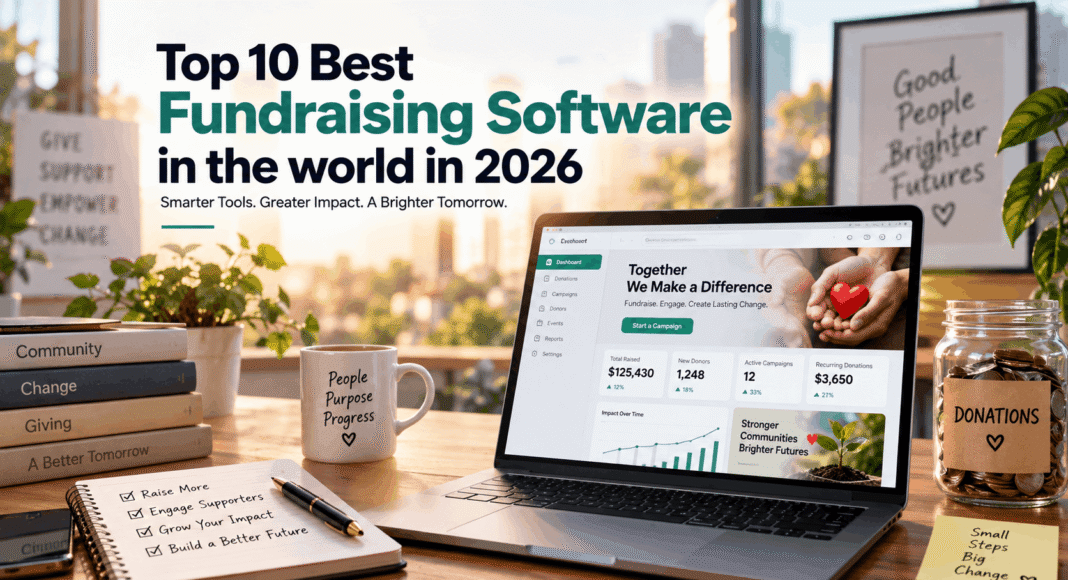
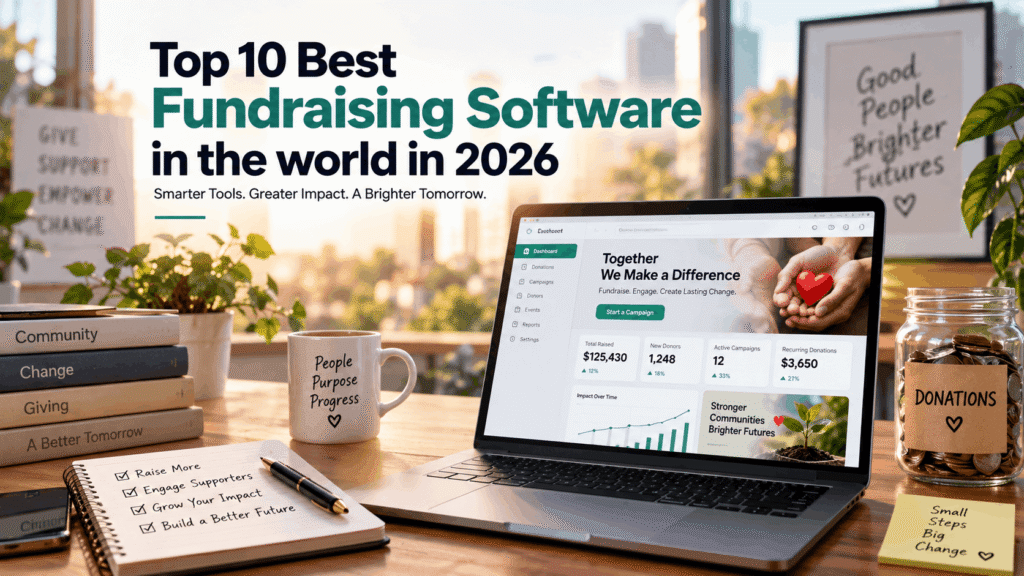
The Top 10 Best Fundraising Software in the world in 2026 comparison examines Givebutter, Donorbox, Bloomerang, OneCause, Zeffy, DonorPerfect, Blackbaud Raiser’s Edge NXT, GalaBid, Funraise, and Gritt.io. Together, these platforms represent a broad range of fundraising approaches, from zero-fee nonprofit fundraising and digital donation forms to sophisticated donor CRM systems, event fundraising platforms, enterprise constituent databases, and startup investor outreach.
When comparing the best fundraising platforms, organizations should consider more than the advertised subscription price. Platform fees, payment-processing costs, donor database limits, integrations, reporting capabilities, recurring donation tools, campaign automation, customer support, implementation requirements, and scalability can all influence the true cost and long-term value of a fundraising system.
This guide examines the features, pricing structures, strengths, limitations, ideal use cases, and user feedback associated with each platform. Whether an organization needs affordable nonprofit fundraising software, an advanced donor management CRM, peer-to-peer fundraising tools, auction software, event fundraising technology, or an enterprise fundraising database, the comparison provides a practical starting point for identifying the fundraising software that best matches its goals in 2026.
Before we venture further into this article, we would like to share who we are and what we do.
About 9cv9
9cv9 is a business tech startup based in Singapore and Asia, with a strong presence all over the world.
With over ten years of startup and business experience, and being highly involved in connecting with thousands of companies and startups, the 9cv9 team has listed some of the top and best companies/tools in this review.
If you like to get your company listed in our top B2B software reviews, check out our world-class 9cv9 Media and PR service and pricing plans here.
Top 10 Best Fundraising Software To Use in 2026
- Givebutter
- Donorbox
- Bloomerang
- OneCause
- Zeffy
- DonorPerfect
- Blackbaud Raiser’s Edge NXT
- GalaBid
- Funraise
- Gritt.io
1. Givebutter
Founded in 2016, Givebutter has developed into a prominent all-in-one fundraising software platform for nonprofits, schools, community organizations, charities, and other mission-driven groups. Its positioning is centered on consolidating fundraising, donor management, events, auctions, payments, and supporter engagement within one system rather than requiring organizations to maintain several separate applications.
For organizations evaluating the best fundraising software in 2026, Givebutter is particularly notable for combining a free nonprofit CRM with donation forms, fundraising pages, peer-to-peer campaigns, event ticketing, auctions, recurring giving, payment processing, and marketing capabilities. This broad feature set makes it especially relevant to small and midsize nonprofits seeking to reduce software complexity and administrative overhead.
Givebutter Fundraising Ecosystem
| Capability | Givebutter Offering | Primary Use Case |
|---|---|---|
| Online Fundraising | Donation forms and campaign pages | Collecting one-time and recurring donations |
| Peer-to-Peer Fundraising | Individual and team fundraising pages | Community-led fundraising campaigns |
| Donor Management | Built-in nonprofit CRM | Centralizing supporter and donation records |
| Events | Ticketing and event management | In-person, virtual, and hybrid events |
| Auctions | Mobile bidding and auction management | Charity and fundraising auctions |
| Marketing | Email, text, and direct-mail capabilities | Donor engagement and retention |
| Payments | Cards, ACH and multiple digital wallets | Providing flexible donation methods |
| Reporting | Transaction and supporter reporting | Fundraising performance analysis |
Fundraising and Campaign Management
Givebutter supports several fundraising formats within the same environment. Organizations can create standalone donation forms, comprehensive fundraising pages, events, auctions, recurring-giving programs, and peer-to-peer campaigns.
Its peer-to-peer functionality enables supporters to establish personalized fundraising pages and participate individually or as teams. Campaign administrators can use goal tracking, leaderboards, supporter feeds, personalized links, and fundraising progress indicators to encourage participation.
The platform also supports online and offline donation tracking, allowing organizations to consolidate digital contributions, ticket purchases, recurring gifts, auction activity, cash donations, and other transactions within their donor records.
Donor Management and CRM
A major differentiator is Givebutter’s integrated nonprofit CRM. Organizations can create, import, and manage unlimited contacts on the free platform while maintaining donor histories, custom fields, notes, tags, transactions, and engagement information.
This approach can be particularly valuable for smaller nonprofits that would otherwise need separate fundraising and donor-management subscriptions. Fundraising activity can automatically feed into constituent records, providing teams with a more unified view of supporter relationships.
Pricing Model
Givebutter’s Standard pricing model uses optional donor tips to subsidize its core fundraising technology. When optional tips are enabled, Givebutter states that organizations pay no platform or processing fees for qualifying online transactions under its guarantee.
Organizations that disable optional tips instead face a 3% platform fee plus payment-processing costs. Standard card and digital-wallet processing is 2.9% plus $0.30 per transaction, while eligible verified nonprofits can receive ACH processing at 1.9% plus $0.30.
| Pricing Scenario | Platform Fee | Processing Cost | Organization Cost Structure |
|---|---|---|---|
| Optional Tips Enabled | 0% | Covered under qualifying guarantee | Potentially no organization-paid fees |
| Optional Tips Disabled | 3% | 2.9% + $0.30 for cards | Organization or donor covers applicable fees |
| ACH with Tips Disabled | 3% | 1.9% + $0.30 for eligible nonprofits | Lower processing rate than card transactions |
| Free CRM | $0 subscription | Not applicable | Unlimited contacts and core CRM capabilities |
| Givebutter Plus | Contact-based | Transaction rules still apply | Adds advanced engagement and automation tools |
Givebutter Plus
Organizations requiring more sophisticated fundraising operations can upgrade to Givebutter Plus. The premium layer adds functionality such as automated workflows, task management, advanced email creation, texting, custom reporting, expanded data visualization, data hygiene tools, file uploads, and discounted direct mail.
Annual pricing begins at $29 per month for databases below 250 contacts, increases to $79 per month for 250 to 1,000 contacts, and reaches $129 per month for 1,001 to 2,500 contacts. Higher contact volumes move into additional pricing tiers, with custom pricing available above 10,000 contacts.
| Contact Database | Givebutter Plus Annual-Billing Rate |
|---|---|
| Under 250 | $29 per month |
| 250 to 1,000 | $79 per month |
| 1,001 to 2,500 | $129 per month |
| 2,501 to 5,000 | $179 per month |
| 5,001 to 10,000 | $279 per month |
| Over 10,000 | Custom pricing |
Independent User Ratings
Givebutter maintains strong user ratings across major software-review platforms. As of 2026, Capterra reports a 4.8 out of 5 overall rating from 872 reviews, including 4.7 ratings for both ease of use and customer service. G2 reports a 4.7 out of 5 rating based on more than 2,200 reviews.
| Review Platform | Overall Rating | Review Volume |
|---|---|---|
| Capterra | 4.8 / 5 | 872 reviews |
| G2 | 4.7 / 5 | More than 2,200 reviews |
Strengths and Considerations
Givebutter’s strongest proposition is the breadth of functionality available without requiring a conventional recurring software subscription. Fundraising campaigns, donor management, events, auctions, peer-to-peer fundraising, payments, and engagement tools can operate within a unified platform.
The pricing structure nevertheless deserves careful evaluation. Its lowest-cost configuration depends substantially on retaining optional donor tipping. Organizations that prefer a checkout experience without Givebutter tips must account for the 3% platform fee plus payment-processing charges. This can make the effective transaction cost considerably higher for campaigns that choose to absorb those fees themselves.
Givebutter Assessment for 2026
| Evaluation Area | Assessment |
|---|---|
| Fundraising Capabilities | Excellent |
| Peer-to-Peer Fundraising | Excellent |
| Donor CRM | Excellent for small and midsize nonprofits |
| Events and Auctions | Strong |
| Marketing Automation | Stronger with Givebutter Plus |
| Entry Cost | Highly competitive |
| Pricing Simplicity | Moderate |
| Scalability | Strong |
| Best Fit | Small and midsize nonprofit organizations |
| Main Consideration | Dependence on optional-tip pricing model |
Overall Assessment
Givebutter remains a compelling contender among the best fundraising software platforms in 2026 because it combines fundraising infrastructure, donor management, events, auctions, peer-to-peer campaigns, payments, and supporter engagement in one ecosystem.
Its free CRM and broad collection of core fundraising tools can significantly lower the technology barrier for smaller organizations. At the same time, prospective users should evaluate the donor-tip model carefully and compare the economics of leaving tips enabled against paying the 3% platform fee and associated processing charges. For organizations comfortable with that model, Givebutter offers an unusually comprehensive fundraising technology stack with a relatively low barrier to entry.
2. Donorbox
Donorbox is a fundraising and donation management platform designed primarily for nonprofits, charities, religious organizations, educational institutions, political organizations, and other fundraising groups that want to accept donations through their existing websites.
Rather than requiring organizations to rebuild their websites around a proprietary fundraising system, Donorbox emphasizes embeddable and pop-up donation forms that can be integrated with popular website platforms including WordPress, Squarespace and Wix. Organizations can also operate dedicated Donorbox-hosted fundraising pages. The platform supports one-time and recurring donations, crowdfunding, peer-to-peer fundraising, memberships, events and in-person giving.
This combination makes Donorbox a notable contender among the best fundraising software in 2026, particularly for organizations prioritizing rapid deployment, recurring giving and flexible website integration.
Core Fundraising Capabilities
Donorbox has expanded beyond its original donation-form focus into a broader fundraising ecosystem. Its platform now encompasses online fundraising, crowdfunding, peer-to-peer campaigns, event ticketing, memberships, donor management, text giving and physical donation kiosks.
| Fundraising Capability | Donorbox Offering | Primary Application |
|---|---|---|
| Online Donations | Embedded and hosted donation forms | Website fundraising |
| Recurring Giving | Configurable recurring donation schedules | Monthly donor programs |
| Crowdfunding | Dedicated campaign pages | Project and cause-based fundraising |
| Peer-to-Peer | Organization and supporter campaigns | Community-driven fundraising |
| Events | Event registration and ticketing | Fundraising events |
| Memberships | Recurring membership payments | Associations and member organizations |
| Donor Management | Donorbox CRM | Donor records and engagement |
| Text Giving | Text-to-Give | Mobile fundraising |
| In-Person Giving | Donorbox Live Kiosk | Events, venues and physical locations |
| Alternative Giving | Stock and cryptocurrency support | Expanding donor payment options |
Donation Forms and Website Integration
Donorbox’s core strength remains its donation-form technology. Organizations can embed forms directly into existing websites or deploy pop-up forms connected to donation buttons without developing an entirely separate fundraising website.
Forms can be customized with branding, suggested donation amounts, custom questions and recurring-giving options. Donorbox also supports more than 50 currencies and numerous payment methods, making the platform suitable for organizations fundraising internationally.
This approach can be particularly useful for smaller nonprofit teams that already operate established websites and need to introduce online fundraising without a lengthy implementation project.
Pricing Structure
Donorbox follows a hybrid pricing model combining subscription tiers with transaction-based platform fees. Standard has no monthly subscription, while Pro introduces a fixed monthly cost in exchange for lower transaction fees and additional functionality. Premium uses customized pricing for larger organizations.
| Plan | Subscription | Core Platform Fee | Selected Activities Fee | Best Suited For |
|---|---|---|---|---|
| Standard | $0 per month | 2.95% | 3.95% | Smaller organizations |
| Pro | $150 per month | 1.75% | 2.00% | Growing fundraising programs |
| Premium | Custom pricing | 1.60% | 2.00% | Larger nonprofits |
Standard Plan
The Standard plan has no monthly subscription charge. Donation forms, fundraising pages, crowdfunding pages, QuickDonate and organization-level peer-to-peer fundraising generally carry a 2.95% Donorbox platform fee.
Event ticketing, memberships and supporter-led peer-to-peer transactions carry a higher 3.95% platform fee.
Payment-processing charges are additional. For registered U.S. nonprofits operating in U.S. dollars, Donorbox currently lists Stripe’s discounted card rate at 2.2% plus $0.30 per transaction. Actual processor pricing can vary according to payment method, nonprofit eligibility, geography and payment provider.
Pro Plan
Donorbox Pro costs $150 per month before any applicable annual-billing discount. It reduces the platform fee for major fundraising features to 1.75%, while events, memberships and supporter peer-to-peer fundraising carry a 2% platform fee.
Pro also adds capabilities aimed at more established fundraising operations.
| Pro Capability | Operational Benefit |
|---|---|
| Reduced Platform Fees | Improves economics as fundraising volume grows |
| Advanced Customization | Greater control over fundraising experiences |
| Receipt White-Labeling | Stronger organizational branding |
| API Access | Enables custom integrations |
| Zapier Integration | Connects fundraising workflows with other systems |
| Tracking and Analytics | Provides deeper campaign measurement |
| Stock and Crypto Giving | Expands donation channels |
| Jay AI | AI-assisted fundraising capabilities |
| Recurring Donation Upsell | Supports recurring donor acquisition |
Premium Plan
Premium targets organizations requiring greater customization, lower fees and dedicated support. Pricing is negotiated directly.
The core platform fee can fall to 1.6% for donation forms and several major fundraising features, while selected activities remain at 2%. Premium can additionally provide an enterprise customer success manager, guided onboarding, custom domains, priority support and recurring-donor migration.
Additional Fundraising Products
Organizations should account for optional products when calculating the complete cost of deploying Donorbox.
| Add-On or Service | Indicative 2026 Pricing |
|---|---|
| Text-to-Give Standard | $19 per month |
| Text-to-Give Custom Keyword | $50 per month |
| Live Kiosk: Standard/Pro | $80 per month for first device |
| Live Kiosk: Premium | $50 per month for first device |
| Additional Kiosk Devices | $15 per month each |
| API and Zapier on Standard | $17 per month |
| Mailchimp Integration | $8 per month |
| Salesforce Integration | $50 per month |
Donorbox CRM is also available across the product ecosystem, although current public pricing directs prospective customers to contact the company for pricing rather than presenting the previously advertised $75 starting price as a universal current rate.
Transaction Cost Considerations
The absence of a monthly subscription does not make the Standard plan transaction-free. For example, an organization processing $50,000 in ordinary donations would incur approximately $1,475 in Donorbox platform fees at the 2.95% rate before payment-processing charges.
| Annual Standard Donations | 2.95% Platform Fee |
|---|---|
| $10,000 | $295 |
| $25,000 | $737.50 |
| $50,000 | $1,475 |
| $100,000 | $2,950 |
| $250,000 | $7,375 |
Organizations can allow donors to cover fees during checkout, potentially reducing the nonprofit’s effective fundraising costs. However, fundraising teams should evaluate donor experience and conversion alongside the financial benefit.
Independent User Ratings
Donorbox continues to perform strongly across major software review platforms in 2026. Capterra reports an overall rating of 4.8 out of 5 from 625 reviews, including a 4.8 ease-of-use rating and 4.7 customer-service rating. G2 reports approximately 4.6 out of 5 from more than 1,500 reviews.
| Review Platform | Overall Rating | Review Volume |
|---|---|---|
| Capterra | 4.8 / 5 | 625 reviews |
| G2 | 4.6 / 5 | More than 1,500 reviews |
User Feedback
Positive feedback frequently centers on straightforward setup, ease of use, website integration and the ability to launch fundraising campaigns without extensive technical knowledge. This reinforces Donorbox’s positioning as an accessible fundraising solution for organizations without dedicated software-development teams.
Critical feedback is more frequently associated with transaction costs, customization limitations and particular integrations or event-management workflows. Consequently, organizations experiencing substantial fundraising growth should compare the economics of remaining on Standard against upgrading to Pro or negotiating Premium pricing.
Donorbox Assessment for 2026
| Evaluation Area | Assessment |
|---|---|
| Donation Forms | Excellent |
| Recurring Giving | Excellent |
| Website Integration | Excellent |
| Peer-to-Peer Fundraising | Strong |
| Events and Memberships | Strong |
| Donor CRM | Strong |
| International Fundraising | Strong |
| Initial Cost | Highly accessible |
| High-Volume Economics | Requires careful plan comparison |
| Ease of Deployment | Excellent |
| Best Fit | Small and growing nonprofit organizations |
| Main Consideration | Platform fees increase with transaction volume |
Overall Assessment
Donorbox remains a strong fundraising software option in 2026 for organizations that prioritize conversion-oriented donation forms, recurring giving and straightforward integration with an existing website. Its free-entry Standard plan significantly lowers the barrier to launching digital fundraising, while Pro and Premium provide pathways for organizations requiring lower transaction fees and more advanced functionality.
Its primary trade-off is financial scalability. Transaction-based platform fees can become substantial as annual donation volume increases, making plan selection increasingly important for growing nonprofits. Organizations should therefore compare subscription costs, platform fees, payment-processing expenses and donor fee-coverage rates when assessing Donorbox’s total cost of ownership.
3. Bloomerang
Founded in 2012 and headquartered in Indianapolis, Bloomerang is a nonprofit fundraising and donor management platform built around improving supporter relationships, donor retention and long-term fundraising performance. Unlike fundraising tools centered primarily on payment collection, Bloomerang combines constituent relationship management, fundraising, payment processing, volunteer management and donor intelligence within a connected nonprofit technology ecosystem.
The platform has expanded considerably through acquisitions. Bloomerang acquired volunteer management provider InitLive in 2023 and fundraising technology company Qgiv in 2024. Qgiv’s capabilities have subsequently been incorporated into Bloomerang Fundraising, while InitLive technology supports Bloomerang Volunteer. Growth investor Warburg Pincus also invested in the company alongside existing investor JMI Equity.
Bloomerang Platform Ecosystem
| Platform Component | Primary Function | Typical Application |
|---|---|---|
| Bloomerang CRM | Constituent and donor management | Central nonprofit database |
| Bloomerang Fundraising | Digital fundraising and events | Donations, campaigns and auctions |
| Bloomerang Volunteer | Volunteer management | Recruitment, scheduling and engagement |
| Predictive Insights | Donor intelligence | Identifying giving opportunities |
| Wealth Screening | Prospect research | Major-donor development |
| Marketing Tools | Email and supporter engagement | Donor retention and communication |
| Reporting and Analytics | Fundraising intelligence | Performance and retention measurement |
| Bloomerang Payments | Integrated payment processing | Online and in-person donations |
Donor Management and Retention
Bloomerang’s CRM remains one of its principal differentiators. It provides unified constituent profiles, segmentation, wealth screening, engagement tracking, reporting, marketing capabilities and predictive giving insights.
Its donor engagement functionality is particularly relevant for retention-focused nonprofits. Rather than treating the database simply as a repository of contact and transaction information, Bloomerang uses giving history, interactions, volunteerism and marketing engagement to help organizations understand supporter relationships.
Data-management functionality also includes automatic duplicate management and data stewardship capabilities. Bloomerang states that its platform performs nightly National Change of Address updates alongside deceased-donor suppression and other data-cleaning processes.
Fundraising Capabilities
Following the Qgiv acquisition, Bloomerang’s fundraising capabilities extend substantially beyond traditional CRM functionality.
Bloomerang Fundraising provides donation forms, event management, auctions, peer-to-peer fundraising, text fundraising, mobile fundraising, reporting and analytics. Organizations can therefore manage both donor records and the campaigns generating those records within a broader connected ecosystem.
| Fundraising Capability | Bloomerang Functionality |
|---|---|
| Online Donations | Customizable fundraising forms |
| Peer-to-Peer | Supporter-driven fundraising campaigns |
| Events | Registration and event fundraising |
| Auctions | Integrated fundraising auctions |
| Text Fundraising | Mobile giving campaigns |
| Mobile Fundraising | Fundraiser and donor applications |
| Donor CRM | Unified supporter records |
| Major Gifts | Wealth screening and predictive insights |
| Volunteer Management | Recruitment, scheduling and engagement |
| Analytics | Campaign, donor and retention reporting |
Pricing Structure
Bloomerang uses annual subscription pricing, with different products available separately and a combined Giving Platform for organizations seeking a broader solution.
As of 2026, Bloomerang CRM starts at $125 per month when billed annually. Bloomerang Fundraising starts at $40 per month, while Bloomerang Volunteer begins at $119 per month. The integrated Giving Platform starts at $242 per month and combines fundraising, CRM, volunteer engagement, support and donor intelligence capabilities.
| Bloomerang Product | Starting Price | Primary Purpose |
|---|---|---|
| Bloomerang Fundraising | $40 per month | Digital fundraising |
| Bloomerang CRM | $125 per month | Donor and constituent management |
| Bloomerang Volunteer | $119 per month | Volunteer management |
| Giving Platform | $242 per month | Integrated nonprofit operations |
Prices are billed annually, and actual CRM expenditure can vary according to database requirements and the organization’s selected configuration.
Payment Processing Costs
Payment-processing costs require particular attention because Bloomerang operates different fee schedules across CRM and Fundraising transactions.
For Bloomerang CRM, Visa, Mastercard, Discover and American Express transactions currently carry a 3.2% plus $0.30 processing charge. ACH transactions cost 1.8% plus $0.30.
Bloomerang Fundraising uses a different structure. Visa, Mastercard and Discover transactions currently cost 3.95% plus $0.30, while American Express transactions cost 4.95% plus $0.30. Peer-to-peer fundraising carries an additional 1% transaction fee.
| Transaction Type | Current Processing Cost |
|---|---|
| CRM Card Transaction | 3.2% + $0.30 |
| CRM ACH | 1.8% + $0.30 |
| Fundraising Visa/Mastercard/Discover | 3.95% + $0.30 |
| Fundraising American Express | 4.95% + $0.30 |
| Fundraising ACH | 1.95% + $0.95 |
| Peer-to-Peer | Additional 1% |
This is an important 2026 pricing update because the commonly cited 2.9% plus $0.30 card-processing figure no longer accurately represents Bloomerang’s current published payment schedule.
Volunteer Management
Bloomerang Volunteer broadens the platform beyond donors into overall supporter management. Organizations can use it for volunteer recruitment, onboarding, scheduling, qualification, communications, attendance tracking and recognition.
Features include reusable registration forms, digital waivers, group registrations, recurring shifts, waitlists, schedule conflict detection, volunteer self-service, email and SMS communications, attendance tracking and mobile applications.
The product starts at $119 per month when billed annually.
Retention and Fundraising Performance
Bloomerang places considerable emphasis on measurable donor-retention outcomes. The company reports that nonprofits using its Giving Platform achieve first-time donor retention rates 28.5 percentage points higher than industry averages.
It also reports that organizations raise an average of 47% more within five years of upgrading to the Giving Platform. These figures are useful indicators of Bloomerang’s retention-oriented strategy, although they should be interpreted as vendor-reported performance results rather than universal outcomes guaranteed for every nonprofit.
| Vendor-Reported Performance Indicator | Reported Result |
|---|---|
| First-Time Donor Retention | 28.5 percentage points above industry average |
| Fundraising Growth | 47% more raised within five years |
| Primary Optimization Area | Donor retention |
| Data Strategy | Unified donor and volunteer intelligence |
Strengths
Bloomerang’s principal advantage is the depth of its nonprofit relationship-management ecosystem. Fundraising, donor records, volunteer engagement, wealth screening, predictive insights and supporter communications can increasingly be managed within the same platform.
Its retention-oriented CRM is especially attractive to nonprofits that need more than basic donation processing. Automated data stewardship, engagement scoring, segmentation and predictive insights can help fundraising teams determine which donors require attention and where future giving opportunities may exist.
Considerations
The platform’s expanding functionality also introduces greater cost and complexity than lightweight fundraising applications. Smaller organizations requiring only donation forms may find a dedicated fundraising platform more economical.
Payment processing is another consideration. Fundraising card transactions can reach 3.95% plus $0.30, with American Express higher still, while peer-to-peer transactions add another 1%. Organizations processing substantial donation volumes should therefore calculate subscription and transaction costs together when estimating total ownership expenses.
Bloomerang Assessment for 2026
| Evaluation Area | Assessment |
|---|---|
| Donor CRM | Excellent |
| Donor Retention Tools | Excellent |
| Fundraising | Excellent |
| Peer-to-Peer Fundraising | Strong |
| Volunteer Management | Excellent |
| Data Management | Excellent |
| Predictive Donor Insights | Strong |
| Entry-Level Affordability | Moderate |
| Payment Processing Costs | Moderate to High |
| Scalability | Strong |
| Best Fit | Growing small and midsize nonprofits |
| Main Consideration | Total subscription and transaction costs |
Overall Assessment
Bloomerang stands out among the best fundraising software in 2026 for organizations that consider donor retention and relationship management as important as collecting donations. Its evolution from a donor CRM into an integrated fundraising, payments and volunteer-management ecosystem gives nonprofits a broader view of supporter activity.
The combination of Bloomerang CRM, Bloomerang Fundraising and Bloomerang Volunteer is particularly compelling for growing nonprofits seeking to replace disconnected fundraising and supporter-management applications. However, organizations should carefully model subscription costs and the current payment-processing structure as fundraising volume grows.
For nonprofits prioritizing long-term donor relationships, data quality, volunteer engagement and fundraising intelligence over simply obtaining the lowest-cost donation form, Bloomerang represents one of the more comprehensive fundraising platforms available in 2026.
4. OneCause
OneCause is a fundraising software platform specializing in auctions, mobile bidding, ticketed events, galas, peer-to-peer campaigns and digital fundraising. Following its acquisition by Bonterra in October 2025, OneCause became part of the broader Bonterra nonprofit technology ecosystem, expanding Bonterra’s capabilities across event fundraising, donor engagement and online giving.
The platform has substantial experience in event-driven fundraising. Since its establishment in 2008, OneCause has supported more than 14,000 nonprofit organizations in the United States and Canada and facilitated more than $8 billion in fundraising. This makes it particularly relevant when evaluating the best fundraising software in 2026 for nonprofits that rely heavily on galas, auctions, golf outings and other high-value events.
Fundraising Platform
OneCause extends beyond traditional auction software by combining event administration with online fundraising, ticketing, sponsorship management, supporter records, payments and analytics.
| Fundraising Capability | OneCause Functionality | Primary Application |
|---|---|---|
| Silent Auctions | Mobile and online bidding | Charity auctions |
| Live Auctions | Auction management and paddle tools | Galas and major events |
| Ticketing | Registration and ticket management | Fundraising events |
| Table Management | Guest and seating administration | Galas and dinners |
| Sponsorships | Sponsor management | Corporate fundraising |
| Peer-to-Peer | Supporter-led campaigns | Community fundraising |
| Online Giving | Digital fundraising campaigns | Year-round donations |
| Text Fundraising | SMS-based giving | Events and campaigns |
| Reporting | Real-time fundraising analytics | Performance monitoring |
| Payments | Integrated processing | Donation and event payments |
Auction and Event Fundraising
Event fundraising remains one of OneCause’s strongest areas. Organizations can manage ticket sales, tables, sponsorships, guest registration, item procurement, silent auctions, live auctions, raffles, fixed-price items, donations, checkout and reconciliation within the same environment.
Mobile bidding allows attendees to browse auction catalogs and submit bids digitally, reducing dependence on paper bidding systems. Features such as bid confirmations, auction displays, fundraising progress information and event analytics help administrators monitor activity during live events.
OneCause’s Professional package also includes Auction AI, item procurement tools, display sheets, supporter management, reporting, SMS messaging and payment processing.
Pricing Structure
OneCause offers two particularly important pricing approaches in 2026: Pay-As-You-Go and annual subscriptions.
The company publicly advertises pricing starting at $200, while its Professional Auction and Event annual package begins at $2,995.
| Pricing Model | Starting Cost | Cost Structure | Suitable Organization |
|---|---|---|---|
| Pay-As-You-Go | From $200 | Usage-based | Occasional fundraisers |
| Professional Auction & Event | $2,995 annually | Annual subscription | Regular event fundraisers |
| Enterprise | Custom quote | Organization-specific | Larger nonprofits |
| Nationals | Custom quote | Organization-specific | Multi-chapter organizations |
Pay-As-You-Go
The Pay-As-You-Go model provides organizations with an alternative to paying the entire software subscription upfront. OneCause applies a 5% fee to proceeds under this structure, subject to a maximum cap.
OneCause currently describes this option as best suited to organizations raising approximately $50,000 or less annually. Organizations exceeding that level are encouraged to evaluate annual subscription pricing instead.
This distinction is important because the $200 figure should not be interpreted simply as a conventional $200-per-event software license. The current OneCause model combines an initial entry price with a percentage-based pay-later mechanism.
Professional Auction and Event Plan
Organizations conducting multiple fundraising activities can instead select the Professional Auction and Event package, beginning at $2,995 annually.
Professional provides unlimited events and campaigns alongside event giving sites, personal fundraising pages, raffles, Auction AI, item procurement, silent and live auctions, supporter management, payment processing, SMS messaging, reporting and analytics.
| Professional Capability | Included |
|---|---|
| Unlimited Events and Campaigns | Yes |
| Silent Auctions | Yes |
| Live Auctions | Yes |
| Auction AI | Yes |
| Raffles | Yes |
| Personal Fundraising Pages | Yes |
| Payment Processing | Yes |
| SMS Messaging | Yes |
| Reporting and Analytics | Yes |
| Phone, Email and Live Chat Support | Yes |
Enterprise and National Organizations
Larger nonprofits can move into Enterprise or Nationals configurations.
Enterprise is designed for organizations operating larger or multiple ticketed events that require additional fundraising strategies, engagement functionality and integrations. Additional capabilities include event series, ambassador fundraising and sponsorship invoicing.
The Nationals package adds organizational hierarchies, reusable event templates, multi-affiliate reporting and API support, making it more appropriate for nonprofit networks operating multiple chapters or regional fundraising programs.
Independent User Ratings
OneCause continues to receive strong independent customer ratings. Capterra reports a 4.7 out of 5 overall rating from 388 reviews, including 4.8 for customer service, 4.4 for ease of use and 4.5 for value for money.
G2’s current auction-software data reports a 4.7 out of 5 category rating from 512 reviews, with an 8.9 out of 10 Ease of Use score.
| Review Metric | Current Rating |
|---|---|
| Capterra Overall | 4.7 / 5 |
| Capterra Customer Service | 4.8 / 5 |
| Capterra Ease of Use | 4.4 / 5 |
| Capterra Value for Money | 4.5 / 5 |
| G2 Auction Rating | 4.7 / 5 |
| G2 Ease of Use | 8.9 / 10 |
User Experience
Customer feedback frequently highlights OneCause’s event-management capabilities, mobile bidding experience and customer support. Capterra’s analysis indicates that nonprofits particularly value centralized ticketing, auction setup, guest communications, bidding and checkout capabilities.
There are nevertheless usability considerations. Administrators can encounter a learning curve when configuring complex events, reports and integrations. Some reviews also mention repetitive administrative workflows and limited information carryover between events.
Guest registration can create additional friction in certain situations. One verified Capterra reviewer specifically reported confusion when complimentary-ticket guests were required to provide credit card information when claiming their tickets.
Cost Considerations
OneCause can represent a significant investment for smaller nonprofits. Capterra’s 2026 review analysis shows that some organizations consider its pricing difficult to justify at smaller fundraising volumes, even though 93% of the analyzed reviewers rate its value for money as good or excellent.
The economics become more attractive for organizations conducting numerous events because the Professional package includes unlimited events and campaigns. A nonprofit running several auctions, galas or fundraising events can therefore distribute the annual software expense across multiple campaigns.
OneCause Assessment for 2026
| Evaluation Area | Assessment |
|---|---|
| Auction Fundraising | Excellent |
| Mobile Bidding | Excellent |
| Gala and Event Management | Excellent |
| Ticketing | Excellent |
| Peer-to-Peer Fundraising | Strong |
| Online Fundraising | Strong |
| Event Analytics | Excellent |
| Customer Support | Excellent |
| Entry-Level Affordability | Moderate |
| Multi-Event Scalability | Excellent |
| Best Fit | Event-intensive nonprofit organizations |
| Main Consideration | Cost for smaller fundraising programs |
Overall Assessment
OneCause stands out among the best fundraising software platforms in 2026 for nonprofits where auctions and fundraising events represent major revenue channels. Its combination of mobile bidding, ticketing, guest management, sponsorships, auctions, peer-to-peer fundraising, online giving and real-time reporting provides considerably more specialized event functionality than basic donation-form platforms.
Its acquisition by Bonterra also places OneCause within a substantially larger nonprofit technology ecosystem. The combination potentially strengthens its long-term role in organizations seeking connected fundraising, engagement and donor-management technology.
The primary consideration is cost. Smaller organizations running occasional campaigns should carefully model the economics of the Pay-As-You-Go structure, particularly its 5% proceeds fee. Organizations conducting multiple significant fundraising events each year are more likely to benefit from the predictable $2,995 annual Professional package and its unlimited-event structure.
5. Zeffy
Zeffy, formerly known as Simplyk, is a nonprofit fundraising platform distinguished by an unusual zero-fee business model. Instead of charging nonprofits subscription, platform or payment-processing fees, Zeffy finances its operations through optional contributions that donors can choose to make during checkout.
By 2026, Zeffy reports serving more than 100,000 nonprofit organizations and having processed more than $2 billion in fundraising. Its combination of online donations, event ticketing, peer-to-peer campaigns, memberships, e-commerce, raffles, auctions and donor management makes it a particularly compelling option for cost-conscious organizations evaluating the best fundraising software in 2026.
Zero-Fee Fundraising Model
Zeffy’s principal competitive advantage is straightforward: eligible nonprofits receive 100% of the money they raise through the platform.
Zeffy absorbs payment-processing expenses, including the underlying processing charges associated with Stripe. The organization itself pays no monthly subscription, platform fee or credit-card processing fee.
| Cost Category | Zeffy Cost |
|---|---|
| Monthly Subscription | $0 |
| Platform Fee | 0% |
| Transaction Fee | 0% |
| Credit Card Processing | $0 to the nonprofit |
| ACH Processing | $0 to the nonprofit |
| Apple Pay / Google Pay | $0 to the nonprofit |
| Donor CRM | $0 |
| Per-Contact Fee | $0 |
How Zeffy Makes Money
Rather than deducting fees from donations, Zeffy asks donors whether they would like to make a separate voluntary contribution to support the platform.
The contribution is optional and remains separate from the donation made to the nonprofit. Zeffy states that approximately two-thirds of donors choose to leave such a contribution. Whether a donor contributes to Zeffy or not, the nonprofit still receives the full amount designated for its organization.
This structure creates a substantially different fundraising economics model from conventional platforms that combine monthly subscriptions with percentage-based transaction charges.
Fundraising Capabilities
Zeffy has developed beyond simple online donation forms into a broader nonprofit fundraising suite.
| Fundraising Capability | Zeffy Offering | Primary Application |
|---|---|---|
| Online Donations | One-time and recurring giving | General fundraising |
| Event Ticketing | Registration and ticket sales | Fundraising events |
| Peer-to-Peer | Supporter fundraising campaigns | Community fundraising |
| Memberships | Membership registration | Associations and nonprofits |
| E-Commerce | Online nonprofit store | Merchandise fundraising |
| Raffles and Lotteries | Numbered ticketing | Prize-based fundraising |
| Auctions | Online auction functionality | Charity auctions |
| In-Person Payments | Tap-to-pay functionality | Events and physical locations |
| Donor Management | Integrated CRM | Supporter management |
| Donor communications | Engagement and retention |
All of these core capabilities are included without requiring nonprofits to upgrade to a paid subscription tier.
Fundraising Cost Comparison
Zeffy’s economics become particularly significant as fundraising volume increases. Because there is no percentage-based platform charge, software and processing expenses do not automatically rise alongside donation revenue.
| Annual Funds Raised | Zeffy Platform and Processing Fees | Funds Retained |
|---|---|---|
| $10,000 | $0 | $10,000 |
| $25,000 | $0 | $25,000 |
| $50,000 | $0 | $50,000 |
| $100,000 | $0 | $100,000 |
| $250,000 | $0 | $250,000 |
For example, Zeffy’s own pricing comparison estimates that an organization raising $50,000 through 500 gifts retains the complete $50,000 rather than losing part of the amount to fundraising software and payment-processing charges.
Donor Management and CRM
Zeffy also includes donor-management functionality at no additional cost. Organizations can maintain supporter records, import existing contacts and donation histories, filter and tag constituents, create custom lists and communicate with selected donor segments.
Importantly, the platform does not apply contact-based pricing. This means database growth does not automatically move an organization into a more expensive subscription tier.
For smaller and midsize nonprofits, this can provide considerable cost advantages over fundraising CRMs that charge according to constituent database size.
API and Integrations
One area where Zeffy has become more capable in 2026 is API access. Earlier assessments describing the platform as having only basic API capabilities are increasingly outdated.
Zeffy now provides a free public API in beta. Organizations can retrieve payment, contact and campaign information, while selected write operations are supported for contacts and offline payments. Potential applications include custom dashboards, accounting synchronization and connections with external CRM platforms.
| API Capability | 2026 Availability |
|---|---|
| Payment Data | Available |
| Contact Data | Available |
| Campaign Data | Available |
| Contact Writes | Available |
| Offline Payment Recording | Available |
| Custom Dashboards | Supported through API |
| External CRM Synchronization | Possible through API |
| API Cost | $0 |
Independent User Ratings
Zeffy maintains some of the strongest customer ratings among fundraising platforms in 2026.
Capterra currently reports a 4.8 out of 5 rating from 496 reviews, with 4.8 for ease of use and 4.9 for customer service. G2 reports a 4.9 out of 5 rating from approximately 2,600 reviews.
| Review Platform | Overall Rating | Review Volume |
|---|---|---|
| Capterra | 4.8 / 5 | 496 reviews |
| G2 | 4.9 / 5 | Approximately 2,600 reviews |
| Capterra Ease of Use | 4.8 / 5 | User-rated |
| Capterra Customer Service | 4.9 / 5 | User-rated |
Strengths
Zeffy’s strongest advantage is financial. Eliminating subscriptions, platform charges and processing fees allows nonprofits to preserve fundraising margins that would otherwise be consumed by technology expenses.
Its increasingly broad feature portfolio is another advantage. Donation forms, events, auctions, peer-to-peer campaigns, memberships, e-commerce and donor management can all operate within one system without separate paid modules.
The platform is therefore especially attractive to smaller nonprofits, community organizations and volunteer-led charities where several thousand dollars in annual software and transaction expenses could represent a meaningful portion of the organization’s operating budget.
Limitations and Considerations
Zeffy’s zero-fee model does not necessarily make it the strongest platform in every functional category.
Organizations with sophisticated fundraising departments may require deeper donor analytics, advanced workflow automation, wealth intelligence, complex reporting or enterprise-level constituent relationship management capabilities beyond those typically associated with Zeffy’s streamlined platform.
Its optional-contribution checkout model should also be considered from the donor-experience perspective. Although contributions to Zeffy are voluntary, organizations should understand how this additional checkout element fits their preferred donor journey.
The public API significantly improves Zeffy’s extensibility in 2026, but it remains in beta and currently exposes a focused collection of payments, contacts and campaign resources rather than functioning as an unrestricted enterprise integration framework.
Zeffy Assessment for 2026
| Evaluation Area | Assessment |
|---|---|
| Pricing | Exceptional |
| Donation Processing | Excellent |
| Event Ticketing | Strong |
| Peer-to-Peer Fundraising | Strong |
| Auctions and Raffles | Strong |
| Donor CRM | Good |
| API and Extensibility | Improving |
| Advanced Donor Intelligence | Moderate |
| Ease of Use | Excellent |
| Fundraising Cost Efficiency | Exceptional |
| Best Fit | Small and midsize nonprofits |
| Main Consideration | Less sophisticated than enterprise CRM suites |
Overall Assessment
Zeffy represents one of the most distinctive fundraising software propositions available in 2026. Its combination of a $0 subscription, 0% platform fee and zero nonprofit-paid transaction processing can materially change the economics of digital fundraising, particularly for organizations that would otherwise lose thousands of dollars annually to software and processing costs.
The platform is no longer simply a free donation-form solution. Its expanding ecosystem now encompasses events, peer-to-peer fundraising, memberships, auctions, raffles, e-commerce, donor management, email communications, in-person payments and API connectivity.
For organizations primarily seeking sophisticated enterprise donor intelligence and highly advanced CRM automation, more expensive specialist platforms may remain preferable. For nonprofits prioritizing fundraising efficiency, ease of deployment and retaining 100% of the funds they raise, however, Zeffy stands out as one of the strongest value propositions among the best fundraising software platforms in 2026.
6. DonorPerfect
DonorPerfect is an established fundraising and donor management platform designed for nonprofits that require more sophisticated constituent tracking than a basic online donation system. Serving organizations since 1981, the platform combines donor CRM functionality, gift processing, campaign management, reporting, communications, online fundraising and accounting integrations within a centralized fundraising database.
For organizations evaluating the best fundraising software in 2026, DonorPerfect is particularly relevant to established development teams managing large donor histories, recurring gifts, pledges, campaigns and complex reporting requirements. Its emphasis is less on providing the cheapest donation checkout and more on maintaining a comprehensive fundraising system of record.
Core Fundraising and CRM Capabilities
DonorPerfect centralizes constituent records and fundraising activity so development teams can track relationships across donations, campaigns, communications and other interactions.
| Capability | DonorPerfect Functionality | Primary Application |
|---|---|---|
| Donor Management | Central constituent database | Complete supporter records |
| Gift Tracking | Detailed donation histories | Fundraising accounting |
| Pledge Management | Pledges and payment schedules | Major and recurring commitments |
| Campaign Management | Funds, campaigns and solicitations | Fundraising attribution |
| Online Forms | Donation and registration forms | Digital fundraising |
| Receipting | Automated acknowledgements | Donor stewardship |
| Reporting | Custom reports and dashboards | Fundraising analysis |
| Email Marketing | Constant Contact integration | Donor communications |
| Accounting Integration | QuickBooks connectivity | Financial reconciliation |
| API Access | External system integration | Customized nonprofit technology stacks |
Donor and Constituent Management
DonorPerfect’s CRM architecture provides extensive flexibility for organizations with complicated constituent structures. Teams can maintain contact details, giving histories, pledges, relationships, communications, campaign participation and other custom information within individual constituent records.
Customization is an important strength. Organizations can configure fields and reporting structures around their own fundraising processes rather than operating entirely within a predetermined database model.
This flexibility makes DonorPerfect particularly suitable for established fundraising teams that have accumulated years of donor information and need granular segmentation and historical analysis.
Pledge and Gift Management
Gift administration represents another major strength. DonorPerfect supports pledges, recurring donations, soft credits, matching gifts, tribute gifts and other contribution types.
Automated acknowledgements can reduce repetitive administrative work after gifts are received. Development teams can create workflows around donation recognition and maintain historical records of interactions with supporters.
| Gift Management Area | Operational Benefit |
|---|---|
| Pledge Tracking | Monitors commitments and payments |
| Recurring Giving | Supports continuing donor relationships |
| Gift History | Creates comprehensive donor histories |
| Acknowledgements | Automates donor recognition |
| Campaign Attribution | Associates gifts with fundraising initiatives |
| Reporting | Supports financial and development analysis |
Pricing Structure
Current third-party pricing data places DonorPerfect’s starting price at approximately $119 per month. Actual expenditure depends on organizational requirements, database size, functionality and additional services.
More sophisticated configurations are generally quote-based, making it important for organizations to obtain a complete proposal rather than evaluating the platform solely from its advertised entry price.
| Pricing Consideration | DonorPerfect Approach |
|---|---|
| Published Starting Price | Approximately $119 per month |
| Advanced Configurations | Custom pricing |
| Database Requirements | Can influence overall pricing |
| Additional Features | May increase total expenditure |
| Integrations | Availability and cost vary |
| Overall Pricing Model | Subscription plus selected services |
The previously cited $99 starting price should therefore be treated as historical rather than representative of the current 2026 entry point.
Accounting and Integrations
DonorPerfect can serve as the fundraising database while connecting with other systems used by nonprofit finance and marketing teams.
QuickBooks integration is particularly useful for organizations seeking to reduce duplicate data entry between development and accounting operations. Recent verified user feedback specifically identifies seamless QuickBooks integration as one of DonorPerfect’s strengths.
Constant Contact integration also supports email communications, while APIs provide options for organizations requiring more specialized integrations.
Reporting and Customization
Reporting is one of DonorPerfect’s most powerful but potentially complex areas.
Development teams can create customized reports, queries and dashboards for donor segmentation, fundraising performance, campaign analysis, gift history and financial reporting. This depth is particularly useful for organizations with experienced database administrators or development operations personnel.
However, the same flexibility creates a learning curve. Recent reviewers describe advanced reporting and customization as less intuitive than basic everyday functionality, particularly for users without database-management experience.
Independent User Ratings
DonorPerfect continues to receive strong customer feedback in 2026. Capterra currently reports a 4.5 out of 5 overall rating from approximately 1,480 reviews, alongside 4.3 for ease of use and 4.8 for customer service. Its likelihood-to-recommend figure is approximately 82%.
G2 currently reports a lower 4.4 out of 5 rating. The original 922-review figure therefore does not match the current G2 listing and should not be used as a current 2026 statistic.
| Review Metric | 2026 Result |
|---|---|
| Capterra Overall Rating | 4.5 / 5 |
| Capterra Reviews | Approximately 1,480 |
| Capterra Ease of Use | 4.3 / 5 |
| Capterra Customer Service | 4.8 / 5 |
| Likelihood to Recommend | 82% |
| G2 Overall Rating | 4.4 / 5 |
Strengths
DonorPerfect’s principal advantage is the depth and flexibility of its fundraising database. Organizations can track donors, gifts, campaigns, pledges, communications and fundraising activity within a highly configurable environment.
Customer support is another notable strength. Capterra gives DonorPerfect a 4.8 out of 5 customer-service score, and numerous 2026 reviews specifically praise the responsiveness and knowledge of its support team.
Its long operating history also makes DonorPerfect particularly relevant to established nonprofits migrating from spreadsheets, legacy databases or more expensive enterprise fundraising systems.
Limitations and Considerations
Customization and reporting depth come with additional complexity. New users may require training before becoming comfortable with sophisticated reports, database configuration and advanced workflows.
Recent reviews describe some reporting processes as unintuitive or cumbersome, while others note that extensive customization can create inconsistent data-entry practices if organizations do not establish internal standards.
Cost should also be evaluated beyond the entry subscription. Capterra’s pricing analysis indicates that users generally regard DonorPerfect as good value, but some report that costs increase as additional functionality is introduced. Approximately 90% of analyzed reviewers nevertheless rate its value for money as good or excellent.
DonorPerfect Assessment for 2026
| Evaluation Area | Assessment |
|---|---|
| Donor CRM | Excellent |
| Gift Management | Excellent |
| Pledge Tracking | Excellent |
| Campaign Management | Excellent |
| Reporting | Excellent but potentially complex |
| Accounting Integration | Strong |
| Customization | Excellent |
| Ease of Initial Learning | Moderate |
| Customer Support | Excellent |
| Entry-Level Affordability | Moderate |
| Scalability | Strong |
| Best Fit | Established nonprofit development teams |
| Main Consideration | Complexity and total configuration cost |
Overall Assessment
DonorPerfect remains a strong contender among the best fundraising software platforms in 2026 for nonprofits requiring comprehensive donor management rather than simply online payment collection.
Its greatest strengths are detailed constituent records, pledge and gift management, customizable fundraising structures, acknowledgements, reporting and integrations with important nonprofit business systems. These capabilities make it particularly suitable for established development departments managing substantial donor histories and multiple fundraising programs.
The trade-off is complexity. Organizations seeking an extremely simple fundraising tool may find lighter platforms easier and less expensive to operate. For nonprofits that require a configurable fundraising database capable of supporting increasingly sophisticated development operations, however, DonorPerfect offers considerably greater depth and long-term flexibility.
7. Blackbaud Raiser’s Edge NXT
Blackbaud Raiser’s Edge NXT is an enterprise-grade fundraising and constituent relationship management platform designed for organizations with complex donor databases, sophisticated development operations and high-volume fundraising programs.
The platform is particularly established among higher education institutions, healthcare organizations, foundations and larger nonprofits. Rather than functioning primarily as a donation-processing application, Raiser’s Edge NXT serves as a central fundraising system of record, bringing together constituent data, gift histories, campaigns, prospect management, reporting, online giving and fundraising intelligence.
For organizations comparing the best fundraising software in 2026, Raiser’s Edge NXT occupies the enterprise end of the market, where database depth, reporting flexibility and major-gift management generally take priority over simplicity or low subscription costs.
Enterprise Fundraising Ecosystem
Raiser’s Edge NXT combines fundraising CRM capabilities with Blackbaud’s broader nonprofit technology ecosystem.
| Capability | Raiser’s Edge NXT Functionality | Primary Application |
|---|---|---|
| Constituent CRM | Detailed supporter records | Enterprise donor management |
| Gift Management | Donations, pledges and recurring gifts | Fundraising administration |
| Major Gifts | Prospect and opportunity management | Major-gift fundraising |
| Prospect Research | Data enrichment and research tools | Donor identification |
| Campaign Management | Funds, appeals and campaigns | Fundraising attribution |
| Online Giving | Digital donation capabilities | Online fundraising |
| Reporting | Flexible reports and analytics | Development intelligence |
| Events | Fundraising event management | Donor engagement |
| Marketing | Email and social engagement | Constituent communications |
| Financial Integration | Blackbaud Financial Edge NXT connectivity | Fundraising and accounting alignment |
Constituent and Donor Management
Database depth remains one of Raiser’s Edge NXT’s principal advantages. Organizations can maintain extensive records covering donor identities, relationships, gifts, pledges, communications, campaigns, interests and fundraiser interactions.
This makes the software particularly suitable for organizations managing large constituent populations where a single supporter might simultaneously be an alumnus, donor, volunteer, event attendee, corporate contact or major-gift prospect.
The platform can consequently function as a centralized institutional fundraising database rather than simply a collection of online donation records.
Major Gifts and Fundraising Pipelines
Raiser’s Edge NXT is especially well suited to structured major-gift fundraising.
Development teams can assign prospects to individual fundraisers, maintain opportunities, document interactions and monitor movement through cultivation and solicitation pipelines. Fundraisers can also access constituent information through the web interface while working outside the development office.
| Major-Gift Function | Operational Value |
|---|---|
| Prospect Records | Centralizes potential major donors |
| Opportunity Tracking | Monitors active gift opportunities |
| Fundraiser Assignment | Establishes relationship ownership |
| Interaction History | Records donor communications |
| Giving History | Provides historical fundraising context |
| Portfolio Management | Organizes fundraiser portfolios |
| Analytics | Supports prospect prioritization |
Pricing Structure
Blackbaud does not publish a standardized public price list for Raiser’s Edge NXT in 2026. Pricing is custom-quoted and varies according to factors such as constituent record volume, required functionality and additional modules.
Independent pricing information indicates that contracts can scale substantially as organizations increase database size and functionality. G2 reports that the platform is subscription-based, has no free tier or free trial, and requires prospective customers to negotiate final pricing directly with Blackbaud.
| Pricing Component | 2026 Structure |
|---|---|
| Published List Price | Not publicly available |
| Free Version | No |
| Free Trial | No |
| Subscription | Custom quote |
| Constituent Volume | Can influence pricing |
| Additional Functionality | Can increase contract value |
| Enterprise Implementation | Organization-specific |
| Financial Edge NXT | Separate/additional product |
Previously cited estimates of approximately $4,000 to $8,000 or more annually can provide historical context, but they should not be presented as Blackbaud’s official 2026 pricing. G2 cites one reviewer whose base contract began around $4,700 annually and subsequently renewed above $10,000, illustrating how actual expenditure can vary substantially between organizations.
Financial Edge NXT Integration
Organizations can extend the Blackbaud environment through Financial Edge NXT, the company’s nonprofit fund-accounting platform.
Integration between fundraising and financial systems can reduce duplicate data entry and improve reconciliation between development and finance departments. A verified G2 reviewer specifically highlighted the Raiser’s Edge-to-Financial Edge connection as an important internal-control improvement because financial information can flow between the systems rather than being manually entered into separate fundraising and accounting applications.
This combination is particularly relevant to universities, healthcare foundations and larger nonprofits operating dedicated development and finance departments.
Reporting and Analytics
Reporting represents another important Raiser’s Edge NXT capability. Organizations can analyze donor activity, campaign performance, fundraising progress and constituent information while producing lists and reports for development teams.
The platform’s depth is also responsible for part of its learning curve. Advanced workflows have historically required interaction with both the newer NXT web environment and the older Database View.
Recent 2026 reviewers continue to identify this split experience as a limitation, particularly when advanced administrative tasks require returning to Database View.
Independent User Ratings
Current review data is somewhat stronger than the 4.1 out of 5 benchmark in the original assessment.
Capterra reports Raiser’s Edge NXT at 4.2 out of 5 from 418 reviews as of September 2026. Ease of use receives 3.9 out of 5, while customer service receives 4.1. Capterra’s value-for-money rating is lower at 3.7, reflecting recurring concerns surrounding overall cost.
| Capterra Metric | 2026 Rating |
|---|---|
| Overall Rating | 4.2 / 5 |
| Ease of Use | 3.9 / 5 |
| Features | 4.1 / 5 |
| Customer Service | 4.1 / 5 |
| Value for Money | 3.7 / 5 |
Enterprise Strengths
The primary advantage of Raiser’s Edge NXT is its ability to manage sophisticated fundraising operations at considerable scale.
Recent reviewers describe it as particularly capable when handling complex donor relationships, large fundraising databases, gift processing, reporting and fundraiser accountability. TrustRadius reviewers similarly identify constituent management, donation records, major-gift fundraising and communication tracking as major use cases.
This depth can make Raiser’s Edge NXT significantly more appropriate for a university advancement department or major healthcare foundation than lightweight fundraising applications built principally around online donation forms.
Limitations and Cost Considerations
Cost remains one of the platform’s most significant disadvantages. Capterra’s 2026 analysis identifies high and complex pricing as a recurring concern, with reviewers mentioning additional modules and associated expenses.
Complexity represents the second major consideration. The platform can require substantial training, particularly for employees responsible for database administration, advanced reporting and detailed gift processing. The coexistence of web and legacy-style database workflows can further increase onboarding requirements.
| Consideration | Potential Impact |
|---|---|
| Custom Enterprise Pricing | Difficult to estimate costs before sales consultation |
| Database Complexity | Requires experienced administrators |
| Training Requirements | Longer onboarding for advanced users |
| Web and Database Views | Can create inconsistent workflows |
| Additional Modules | Can increase total ownership cost |
| Contract Renewals | Requires careful budgeting and contract review |
| Small Nonprofit Suitability | Often excessive for basic fundraising needs |
Best-Fit Organizations
Raiser’s Edge NXT is most compelling when an organization has reached a level of fundraising complexity where donor database quality and development operations outweigh the need for a low-cost, immediately deployable platform.
| Organization Type | Suitability |
|---|---|
| Higher Education | Excellent |
| Healthcare Foundations | Excellent |
| Large Nonprofits | Excellent |
| Major-Gift Programs | Excellent |
| International Organizations | Strong |
| Mid-Sized Established Nonprofits | Strong |
| Small Nonprofits | Moderate to Low |
| Volunteer-Led Organizations | Low |
Raiser’s Edge NXT Assessment for 2026
| Evaluation Area | Assessment |
|---|---|
| Constituent CRM | Excellent |
| Major-Gift Management | Excellent |
| Gift Processing | Excellent |
| Reporting and Analytics | Excellent |
| Large Database Management | Excellent |
| Financial Integration | Excellent |
| Ease of Learning | Moderate |
| Implementation Complexity | High |
| Entry-Level Affordability | Low |
| Enterprise Scalability | Excellent |
| Best Fit | Large and complex fundraising operations |
| Main Consideration | Cost and administrative complexity |
Overall Assessment
Blackbaud Raiser’s Edge NXT remains one of the most established enterprise fundraising platforms available in 2026. Its strength lies in managing sophisticated donor relationships, large constituent databases, complex gift structures, major-gift pipelines, campaigns and institutional reporting.
The platform is considerably more powerful than most lightweight donation and fundraising applications, but that capability comes with higher financial and operational requirements. Current user feedback continues to identify cost, training requirements and the transition between newer web functionality and legacy database workflows as notable disadvantages.
For universities, healthcare foundations and established nonprofits with dedicated fundraising operations, Raiser’s Edge NXT can provide the database depth and institutional scalability required for complex development programs. Smaller nonprofits primarily seeking online donations, events or simple donor management are likely to find less expensive fundraising platforms easier to implement and maintain.
8. GalaBid
GalaBid is an online and event fundraising platform designed for charities, nonprofits, schools, community organizations and other fundraising groups. The software combines silent auctions, live auctions, digital raffles, donations, event ticketing, paddle raises and mobile bidding within a single campaign environment.
Founded in 2011, GalaBid has developed particular strength in event-based fundraising. Rather than requiring separate systems for ticketing, auctions, raffles and donations, organizations can combine these fundraising methods within one campaign website. Supporters can participate directly through their phones or other web-enabled devices without installing a dedicated application.
For organizations evaluating the best fundraising software in 2026, GalaBid is particularly relevant when auctions, galas, raffles and live fundraising events form an important part of the fundraising strategy.
Fundraising Platform
GalaBid provides more than 100 fundraising and campaign-management features. Its architecture allows several fundraising methods to operate simultaneously within the same campaign.
| Fundraising Capability | GalaBid Functionality | Primary Application |
|---|---|---|
| Silent Auctions | Online and mobile bidding | Charity auctions and galas |
| Live Auctions | Auctioneer-led bidding integration | Live fundraising events |
| Digital Raffles | Automated online ticketing and draws | Prize-based fundraising |
| Donations | Online donation collection | General fundraising |
| Paddle Raises | Rapid pledge recording | Galas and fund-a-need events |
| Event Ticketing | Ticket sales and guest registration | Fundraising events |
| Mobile Bidding | Browser-based bidding | In-person and remote participation |
| Buy Now | Fixed-price fundraising items | Merchandise and auction items |
| Live Displays | Leaderboards and campaign totals | Event engagement |
| Checkout | Digital payment collection | Event settlement |
This breadth makes GalaBid considerably more event-oriented than fundraising platforms centered primarily on static donation forms.
Silent Auctions and Mobile Bidding
Silent auctions represent one of GalaBid’s strongest capabilities. Organizations can build digital auction catalogs containing images, descriptions, starting prices, bid increments and optional Buy Now prices.
Participants can bid from their own devices, while automated notifications inform supporters about auction activity and winning bids. Organizations can also configure automatic closing times and overtime functionality to prevent last-second bidding from abruptly ending competitive auctions.
Remote bidding enables supporters who cannot attend an event physically to participate in the same auction as attendees at the venue.
Live Events and Paddle Raises
GalaBid also provides functionality specifically designed for traditional fundraising galas.
Organizations can assign paddle numbers during event check-in and record donations rapidly during a live paddle raise. Pledges are subsequently added to each participant’s invoice for payment processing.
Live auction items can similarly be displayed before the auction, receive advance bids and then have final winning bids entered by event staff. This creates a connected workflow between silent auctions, live auctions, donations and checkout.
Free Fundraising Model
GalaBid offers a free-with-tips pricing structure in supported markets. Organizations using this option receive access to the fundraising platform without paying a subscription or conventional platform fee.
Instead, supporters are presented with an optional contribution to GalaBid during checkout.
| Cost Component | Free-with-Tips Model |
|---|---|
| Subscription Fee | $0 |
| Platform Access | Free |
| Supporter Tip | Optional |
| Fundraiser Tip Share | 10% of GalaBid tips |
| Payment Processing | Standard Stripe rates apply |
| Fund Distribution | Direct to fundraiser’s Stripe account |
| Feature Access | Full fundraising feature set |
Supporters can accept the suggested tip, modify it or enter zero. Declining the tip does not reduce the amount received by the fundraising organization.
Tip Revenue Sharing
GalaBid introduced an unusual variation of the supporter-funded fundraising model in 2025: organizations receive 10% of the tips collected by GalaBid on qualifying free-with-tips campaigns.
For example, when supporters donate, purchase tickets, win auction items or enter raffles and subsequently leave GalaBid a voluntary tip, 10% of that tip is allocated back to the fundraiser.
The tip-sharing promotion currently applies to qualifying campaigns in North America and the United Kingdom. This means the 10% tip-share should not be assumed to apply universally across every country where GalaBid operates.
Payment Processing
Payments are processed through Stripe rather than being held by GalaBid. Each organization connects its own Stripe account, and online payments flow directly into that account.
GalaBid therefore does not operate an intermediary holding account for fundraiser proceeds. This can simplify cash flow for organizations that do not want fundraising proceeds held by the software provider before payout.
| Payment Element | GalaBid Approach |
|---|---|
| Payment Processor | Stripe |
| Fund Destination | Organization’s connected Stripe account |
| GalaBid Holding Period | None |
| Platform Processing Markup | None under free-with-tips model |
| Stripe Charges | Standard local processing rates |
| Fee Recovery | Optional service-fee functionality |
GalaBid also allows organizations to configure service fees to help offset payment-processing expenses, subject to applicable local regulations.
No-Tip Pricing
Organizations that do not want supporters to encounter a GalaBid tip request can select paid no-tip pricing.
This gives fundraising teams a useful choice between supporter-funded software and organization-funded software. The former minimizes direct platform expenses, while the latter provides greater control over the checkout experience.
| Pricing Approach | Platform Cost | Supporter Tip Prompt | Best Fit |
|---|---|---|---|
| Free with Tips | No platform subscription | Yes, optional | Cost-conscious fundraisers |
| Paid No-Tip | Paid pricing | No | Organizations prioritizing checkout control |
Current no-tip pricing varies according to campaign requirements and market, so organizations should obtain the applicable current price rather than relying on older fixed-fee estimates.
Independent User Ratings
GalaBid receives strong customer ratings in 2026. Capterra currently reports 4.8 out of 5 from 56 reviews, including 4.7 for ease of use and 4.9 for customer service.
Trustpilot reports an even higher 4.9 out of 5 from 160 reviews.
| Review Platform | Overall Rating | Review Volume |
|---|---|---|
| Capterra | 4.8 / 5 | 56 reviews |
| Trustpilot | 4.9 / 5 | 160 reviews |
| Capterra Ease of Use | 4.7 / 5 | User-rated |
| Capterra Customer Service | 4.9 / 5 | User-rated |
The original claim of more than 150 reviews is therefore directionally correct for Trustpilot, although the current figure has reached 160.
Customer Support
Customer support is one of GalaBid’s most consistently praised characteristics.
The company provides 24/7 live-chat assistance alongside WhatsApp support and bookable calls. Recent Trustpilot reviews specifically mention access to knowledgeable human support outside conventional business hours, including assistance during live fundraising events.
This can be particularly valuable for auction and gala software because technical problems occurring during a live fundraising event require substantially faster resolution than issues affecting an ordinary back-office CRM.
Strengths
GalaBid’s greatest advantage is its ability to consolidate multiple event fundraising mechanisms into one campaign. An organization can sell admission tickets, register guests, conduct a silent auction, run a live auction, sell raffle tickets, accept donations and execute a paddle raise without creating independent fundraising systems for every activity.
Its free-with-tips model also lowers the financial barrier to sophisticated event fundraising. The 10% tip-sharing arrangement further differentiates GalaBid from conventional voluntary-tip models by creating an additional revenue stream for qualifying fundraisers.
Direct Stripe settlement, mobile bidding and extensive human support further strengthen its position for organizations running time-sensitive fundraising events.
Limitations and Considerations
GalaBid’s extensive event functionality can be unnecessary for organizations that only require a simple donation form.
A small nonprofit seeking nothing more than a static website donation widget may find a donation-focused platform easier to administer. GalaBid becomes substantially more compelling when an organization needs auctions, raffles, ticketing, mobile bidding or other interactive fundraising mechanisms.
The optional-tip experience should also be evaluated. Organizations uncomfortable with presenting supporters with an additional platform contribution during checkout may prefer GalaBid’s paid no-tip alternative.
Finally, GalaBid’s CRM functionality is oriented toward campaign participants and fundraising activity rather than replacing a sophisticated enterprise donor database. Organizations requiring advanced wealth intelligence, complex major-gift pipelines and extensive constituent relationship management may therefore use GalaBid alongside a dedicated nonprofit CRM.
GalaBid Assessment for 2026
| Evaluation Area | Assessment |
|---|---|
| Silent Auctions | Excellent |
| Mobile Bidding | Excellent |
| Live Auctions | Excellent |
| Digital Raffles | Excellent |
| Paddle Raises | Excellent |
| Event Ticketing | Strong |
| Online Donations | Strong |
| Donor CRM | Moderate |
| Payment Settlement | Excellent |
| Customer Support | Excellent |
| Entry-Level Cost | Exceptional |
| Best Fit | Event-driven fundraising organizations |
| Main Consideration | More functionality than simple donation campaigns require |
Overall Assessment
GalaBid stands out among the best fundraising software platforms in 2026 for organizations that rely heavily on auctions, raffles, galas and interactive fundraising events. Its ability to combine silent auctions, live bidding, ticketing, donations, paddle raises and digital raffles within one campaign provides a more specialized event fundraising environment than conventional donation-form software.
Its pricing model is equally distinctive. Fundraisers can access the platform through a free-with-tips structure, receive 10% of qualifying GalaBid tip revenue and have fundraising proceeds deposited directly through their connected Stripe account. Organizations preferring to remove tip requests can instead choose paid no-tip pricing.
For organizations conducting sophisticated fundraising events, GalaBid offers a compelling combination of functionality, low entry cost and highly rated human support. For nonprofits requiring only basic donation collection or enterprise-level constituent management, a more specialized donation platform or nonprofit CRM may provide a simpler fit.
9. Funraise
Funraise is an integrated fundraising and donor management platform designed to combine the supporter-facing donation experience with the back-office technology nonprofits use to manage donors, campaigns and fundraising performance.
The platform brings together customizable donation forms, recurring giving, donor CRM, events and ticketing, fundraising websites, peer-to-peer campaigns, automation, email and SMS engagement, wealth screening and fundraising intelligence. This makes Funraise a notable contender among the best fundraising software in 2026 for organizations seeking both digital fundraising tools and constituent management within the same ecosystem.
Importantly, Funraise’s pricing has changed considerably from earlier versions of the platform. The previously cited $129 to $275 monthly range no longer accurately represents its current public pricing structure. Funraise now offers a free plan alongside custom-priced Premium plans.
Fundraising Technology Ecosystem
Funraise is positioned between lightweight donation-form software and traditional nonprofit CRM systems. Its front-end fundraising technology connects directly with donor records and campaign data on the back end.
| Capability | Funraise Functionality | Primary Application |
|---|---|---|
| Donation Forms | Customizable giving experiences | Website fundraising |
| Recurring Giving | Monthly giving and automated upgrades | Donor retention |
| Donor CRM | Constituent and donation management | Central supporter database |
| Peer-to-Peer | Personal fundraising pages | Community fundraising |
| Events | Ticketing and event management | Fundraising events |
| Auctions | Silent auction capabilities | Event fundraising |
| Fundraising Websites | Campaign website builder | Digital campaigns |
| Automated donor communications | Engagement and retention | |
| SMS | Messaging and Text-to-Give | Mobile fundraising |
| Wealth Screening | Prospect intelligence | Major-donor identification |
| Fundraising Intelligence | Analytics and dashboards | Fundraising optimization |
Digital Giving and Donation Forms
Digital giving remains one of Funraise’s strongest capabilities. Organizations can build branded donation forms and fundraising pages optimized for mobile and desktop giving.
Recurring giving receives particular attention. Funraise can present recurring donation opportunities within the donation flow, while its automated recurring-upgrade functionality encourages one-time donors to become recurring supporters.
A donor portal allows recurring supporters to manage important account information themselves, including payment methods and recurring donation details. Funraise also provides an automatic card updater designed to reduce involuntary recurring-donor churn when payment cards expire or are replaced.
Peer-to-Peer Fundraising
Funraise provides campaign websites and individual supporter fundraising pages for peer-to-peer programs.
Organizations can create branded campaign websites containing fundraising progress indicators and donor feeds, while supporters can establish individual pages connected to the organization’s campaign. Automated emails and SMS communications can then help organizations maintain fundraiser engagement throughout a campaign.
| Peer-to-Peer Capability | Fundraising Application |
|---|---|
| Personal Fundraising Pages | Supporter-led fundraising |
| Campaign Websites | Central campaign destination |
| Progress Tracking | Goal visualization |
| Automated Emails | Fundraiser engagement |
| SMS Communication | Campaign updates |
| Social Integration | Multi-channel fundraising |
| Campaign Templates | Faster campaign deployment |
Current Pricing Structure
Funraise now separates its offering into Free and Premium configurations.
The Free plan is intended for organizations raising less than $1 million annually and includes donation forms, donation pages, recurring giving, events and ticketing, fundraising websites, donor management, donation management and selected integrations.
Premium plans are quote-based and add functionality such as peer-to-peer fundraising, wealth screening, Fundraising Intelligence, SMS messaging, Text-to-Give, auctions, email campaigns, complete integrations and API access.
| Pricing Area | Free | Premium |
|---|---|---|
| Monthly Subscription | $0 | Custom pricing |
| Donation Forms | Included | Included |
| Recurring Giving | Included | Included |
| Donor Management | Included | Included |
| Events and Ticketing | Included | Included |
| Peer-to-Peer | Not core Free feature | Included |
| Wealth Screening | Not core Free feature | Included |
| SMS and Text-to-Give | Not core Free feature | Included |
| Email Campaigns | Not core Free feature | Included |
| API | Not core Free feature | Included |
| Platform Fee | 5% | 0% to 3% |
Capterra separately lists Premium pricing from approximately $99 per month, but organizations should treat Funraise’s own quote-based pricing as the authoritative basis for current Premium purchasing decisions.
Platform and Processing Fees
Transaction costs are an important consideration when evaluating Funraise.
The Free plan carries a 5% platform fee. Premium plans can carry platform fees ranging from 0% to 3%, depending on the organization’s configuration and fee-coverage model. Funraise states that approximately 90% of donors cover fees across its customer base.
Funraise also changed its payment-processing rates in February 2026. Standard card transactions through Funraise Payments powered by Stripe now cost 2.9% plus $0.60 rather than the previous 2.9% plus $0.30. ACH processing costs 1% plus $0.60.
| Transaction Component | 2026 Cost |
|---|---|
| Free Platform Fee | 5% |
| Premium Platform Fee | 0% to 3% |
| Standard Card Processing | 2.9% + $0.60 |
| ACH Processing | 1% + $0.60 |
| American Express | Additional 1% |
| Currency Conversion | Additional 1% |
| International Payment | Additional 1.5% |
The platform’s Donors Cover Fees model can reduce the nonprofit’s effective platform expense. Under one Premium configuration, a platform fee is assessed only when the donor elects to cover it; when the donor declines, Funraise states that no platform fee is assessed.
Donor CRM and Fundraising Intelligence
Funraise’s back-office environment provides constituent and donation management alongside its digital fundraising technology.
Development teams can manage donor histories, cultivation activities, tasks and acknowledgements while connecting those records with campaigns and online giving activity. Premium organizations can extend these capabilities through Fundraising Intelligence and wealth screening.
This combination can be valuable for nonprofits that want to avoid operating one platform for online fundraising and another completely independent system for donor management.
Independent User Ratings
Funraise maintains a 4.5 out of 5 overall rating on Capterra. As of September 2026, the platform has 122 reviews rather than the previously cited 119. Ease of use is rated 4.4 out of 5, while customer service receives a particularly strong 4.8 out of 5.
| Capterra Metric | 2026 Rating |
|---|---|
| Overall Rating | 4.5 / 5 |
| Review Count | 122 |
| Ease of Use | 4.4 / 5 |
| Customer Service | 4.8 / 5 |
User Feedback
Customer support is one of Funraise’s most consistently praised characteristics. Recent verified reviewers highlight responsive support, onboarding assistance and the willingness of Funraise staff to help organizations solve unusual implementation problems.
Donation pages and fundraising websites also receive positive feedback. Reviewers highlight the ability to build fundraising landing pages with automation while maintaining relatively straightforward donor experiences.
However, limitations remain. Recent reviews mention restricted customization in certain CRM areas, integration complications, backend quirks and occasional difficulty understanding newer functionality. One 2026 reviewer also specifically cautions organizations to examine the complete fee structure and add-on costs carefully before purchasing.
Strengths and Considerations
Funraise’s strongest proposition is the connection between digital fundraising and donor management. Organizations can acquire donations through branded forms and campaign pages while automatically feeding that information into a fundraising-focused CRM.
Recurring giving, peer-to-peer campaigns, wealth screening, automated communications and fundraising intelligence provide additional capabilities for organizations seeking to develop more sophisticated fundraising programs.
The principal consideration is total cost. Organizations should calculate subscription expenses, platform fees, payment-processing charges and optional features together. The 2026 increase in the fixed processing component from $0.30 to $0.60 is particularly relevant to organizations receiving large numbers of relatively small donations.
Funraise Assessment for 2026
| Evaluation Area | Assessment |
|---|---|
| Donation Forms | Excellent |
| Recurring Giving | Excellent |
| Donor CRM | Strong |
| Peer-to-Peer Fundraising | Excellent |
| Fundraising Websites | Excellent |
| Wealth Screening | Strong |
| Automation | Strong |
| Fundraising Intelligence | Strong |
| Customer Support | Excellent |
| Entry-Level Accessibility | Excellent |
| Pricing Simplicity | Moderate |
| Best Fit | Growing digital-first nonprofits |
| Main Consideration | Platform and processing fee structure |
Overall Assessment
Funraise is a strong contender among the best fundraising software platforms in 2026 for nonprofits seeking to connect modern digital fundraising experiences with donor management, recurring giving, peer-to-peer campaigns and fundraising intelligence.
The introduction of a genuine $0 monthly Free plan makes the platform considerably more accessible than older pricing information suggests. At the same time, organizations should distinguish between subscription cost and transaction cost: the Free plan carries a 5% platform fee, while Premium organizations can access lower platform-fee structures alongside substantially more sophisticated fundraising functionality.
For growing nonprofits that place significant emphasis on online donor acquisition, recurring giving, campaign websites and supporter engagement, Funraise provides a compelling combination of front-end fundraising technology and back-office donor management.
10. Gritt.io
Gritt.io is a specialized startup fundraising platform built for founders raising capital from angel investors, venture capital firms and other early-stage investors. Unlike nonprofit fundraising platforms focused on donations, events or charitable giving, Gritt.io addresses a fundamentally different fundraising workflow: identifying relevant investors, researching their portfolios, conducting personalized outreach and managing an equity fundraising pipeline.
This distinction makes Gritt.io an unconventional but relevant entry among the best fundraising software in 2026. It is most appropriate for startup founders and entrepreneurial teams rather than charities or nonprofit development departments.
Investor Discovery and Fundraising Workflow
Gritt.io combines investor discovery, targeting, AI-assisted outreach and CRM-style pipeline management within a single platform. Its database currently contains more than 45,000 investor profiles, and the platform specifically targets founders approaching angels and early-stage investors.
| Capability | Gritt.io Functionality | Primary Application |
|---|---|---|
| Investor Database | 45,000+ investor profiles | Investor discovery |
| Stage Filtering | Funding-stage targeting | Finding appropriate investors |
| Sector Filtering | Industry-based targeting | Identifying relevant investors |
| Geographic Filtering | Location-based discovery | Regional fundraising |
| Portfolio Research | Previous investment analysis | Investor-fit assessment |
| AI Personalization | Investor-specific email drafting | Fundraising outreach |
| Gmail Integration | Founder-controlled sending | Direct investor communication |
| CRM Tracking | Investor pipeline management | Managing fundraising progress |
| CSV Export | Investor and pipeline exports | External analysis and workflows |
Investor Database
Gritt.io’s investor database is one of the platform’s principal assets. Published product information identifies 45,563 investor profiles, including 25,694 email addresses and 9,743 social handles.
The database can be filtered according to characteristics such as investment stage, industry and geography. Portfolio information provides another layer of qualification, allowing founders to examine whether investors have previously backed businesses resembling their own.
| Database Metric | Published Figure |
|---|---|
| Investor Profiles | 45,563 |
| Email Addresses | 25,694 |
| Social Handles | 9,743 |
| Primary Investor Types | Angels and venture investors |
| Core Target Market | Early-stage startups |
These figures also highlight an important limitation. The number of email addresses is considerably lower than the number of investor profiles. Consequently, founders should not assume that every database record contains a directly usable email address.
AI-Personalized Investor Outreach
Gritt.io has increasingly repositioned its product around personalized investor outreach rather than simply providing a searchable investor directory.
Founders provide information about their startup, including the company, funding stage, pitch and traction. Gritt.io then identifies investors matching the company’s profile and uses investor portfolio information alongside the startup pitch to draft individualized outreach emails.
The founder reviews and approves each message before it is sent.
This human-approval workflow differentiates Gritt.io from conventional bulk-email prospecting tools. The objective is not to send thousands of identical investor emails but to create a controlled stream of individually personalized messages.
Gmail-Based Outreach
Approved messages are sent through the founder’s connected Gmail account rather than from a generic campaign mailbox.
| Outreach Stage | Gritt.io Workflow |
|---|---|
| Startup Profile | Founder supplies company information |
| Investor Selection | Platform identifies relevant investors |
| Portfolio Analysis | Investor history informs personalization |
| AI Drafting | Individual outreach email generated |
| Founder Review | Founder approves or rejects message |
| Delivery | Approved email sent through Gmail |
| Response | Investor replies to founder’s normal inbox |
This architecture keeps founders directly involved in communication while reducing the manual research required to personalize every investor approach.
Pricing Structure
Gritt.io’s pricing has changed significantly, making the original €40, €80 and €150 subscription structure outdated for a current 2026 comparison.
The platform now advertises Free, Starter, Growth and Scale plans.
| Plan | Current Monthly Price | Approved Email Capacity | Daily Investor Pace |
|---|---|---|---|
| Free | €0 | Preview only | Campaign generation |
| Starter | €50 | 150 in 30 days | 5 per day |
| Growth | €100 | 360 in 30 days | 12 per day |
| Scale | €200 | 900 in 30 days | 30 per day |
The Free plan allows founders to generate a fundraising campaign and preview AI-written investor emails without supplying a credit card. Sending functionality requires a paid plan.
This represents an important 2026 update from Gritt.io’s earlier Basic, Advanced and Ultimate structure.
Free Plan
The current Free plan functions primarily as a product evaluation and campaign-preparation tier.
Founders can generate their campaign, access the investor database and preview personalized emails. However, they must upgrade before connecting their inbox and sending the generated outreach.
This approach allows founders to evaluate investor targeting and AI personalization before committing financially.
Paid Fundraising Plans
The primary distinction between current paid plans is fundraising velocity.
Starter provides up to five investor contacts per day and 150 approved emails over 30 days. Growth increases this to 12 investors daily and 360 approved emails, while Scale supports 30 investors daily and 900 approved emails.
| Fundraising Scenario | Most Relevant Plan |
|---|---|
| Testing Investor Targeting | Free |
| Small Focused Angel Round | Starter |
| Active Seed Fundraising | Growth |
| High-Volume Investor Campaign | Scale |
This structure aligns pricing more directly with outreach capacity rather than simply gating individual database features.
CRM and Pipeline Management
Gritt.io also provides CRM functionality for managing investor relationships throughout a fundraising round.
The platform is designed to help founders move away from fragmented spreadsheets, inboxes and informal notes. Investor records can be tracked from initial identification through outreach and subsequent fundraising stages.
This becomes increasingly valuable as a fundraising round expands from a small investor shortlist into dozens of simultaneous conversations.
Investor Targeting
Gritt.io’s strongest strategic feature may be the connection between investor discovery and outreach.
A founder can identify an investor, examine investment fit and then move directly into personalized communication without manually reconstructing the investor record inside another CRM.
| Targeting Signal | Fundraising Value |
|---|---|
| Investment Stage | Prevents targeting investors at the wrong stage |
| Industry | Improves sector relevance |
| Geography | Identifies geographically appropriate capital |
| Portfolio Companies | Reveals investment patterns |
| Previous Investments | Provides personalization context |
| Contact Information | Enables direct outreach |
| CRM Status | Prevents duplicate or forgotten outreach |
The system therefore emphasizes investor relevance rather than simply maximizing the number of contacts available.
Strengths
Gritt.io’s principal advantage is specialization. The product is designed around the actual workflow of an early-stage fundraising round rather than adapting a generic sales CRM to investor relations.
Investor discovery, contact information, portfolio research, AI personalization, Gmail outreach and pipeline tracking exist within the same workflow.
This can reduce the need for founders to combine an investor database, spreadsheet, email-personalization application and separate CRM.
The founder approval mechanism is another strength. AI generates the initial personalized communication, but founders retain control over which messages are actually sent.
Limitations and Considerations
Contact coverage remains an important consideration. Published database figures show approximately 25,700 email addresses across more than 45,500 investor profiles. Therefore, a substantial portion of the database does not have an email address represented in the published statistics.
Gritt.io should also not be confused with conventional nonprofit fundraising software. It does not primarily address donation processing, charitable events, donor receipting, auctions or nonprofit constituent management.
Another consideration is the changing product model. Older descriptions of Gritt.io emphasize database enrichment credits, warm-introduction discovery and tier-gated CSV exports. Its current product positioning places considerably greater emphasis on AI-personalized investor outreach and daily sending capacity.
Gritt.io Assessment for 2026
| Evaluation Area | Assessment |
|---|---|
| Investor Discovery | Excellent |
| Startup Fundraising | Excellent |
| Investor Targeting | Excellent |
| AI Outreach | Excellent |
| Portfolio-Based Personalization | Strong |
| Fundraising CRM | Strong |
| Direct Email Coverage | Moderate to Strong |
| Nonprofit Fundraising | Not Applicable |
| Donation Processing | Not Applicable |
| Entry-Level Accessibility | Excellent |
| Ease of Experimentation | Excellent |
| Best Fit | Early-stage startup founders |
| Main Consideration | Investor contact coverage and specialized use case |
Best Fit
Gritt.io is fundamentally different from nonprofit-oriented platforms such as Givebutter, Donorbox, Zeffy or Bloomerang.
| Fundraising Requirement | Gritt.io Suitability |
|---|---|
| Seed Funding | Excellent |
| Angel Investor Outreach | Excellent |
| Venture Capital Outreach | Excellent |
| Investor Pipeline Management | Strong |
| Fundraising Email Personalization | Excellent |
| Charitable Donations | Not Suitable |
| Nonprofit Events | Not Suitable |
| Donor CRM | Not Suitable |
| Auctions and Raffles | Not Suitable |
Overall Assessment
Gritt.io earns consideration among specialized fundraising software in 2026 because it addresses an entirely different definition of fundraising: startup equity financing.
Its combination of more than 45,000 investor profiles, investor-fit filtering, portfolio research, AI-generated personalized emails, Gmail-based delivery and fundraising CRM functionality provides founders with a focused workflow for moving from investor discovery to active conversations.
However, current pricing differs materially from the original €40, €80 and €150 tiers. The latest public plans are Free at €0, Starter at €50, Growth at €100 and Scale at €200 per month, with paid tiers differentiated primarily by the number of approved investor emails that can be sent.
For early-stage founders who would otherwise manage fundraising through investor databases, spreadsheets and manually personalized emails, Gritt.io provides a specialized fundraising operating system. For charities and nonprofits seeking donation processing or donor management, however, it belongs to a fundamentally different software category.
Conclusion
Choosing the best fundraising software in 2026 depends heavily on the type of organization, fundraising model, donor base, campaign complexity, budget, and long-term growth strategy. The fundraising technology market has expanded beyond basic online donation processing, with modern platforms now supporting donor CRM, recurring giving, peer-to-peer campaigns, auctions, events, volunteer management, payment processing, automation, analytics, and AI-assisted fundraising.
The ten fundraising software platforms covered in this guide — Givebutter, Donorbox, Bloomerang, OneCause, Zeffy, DonorPerfect, Blackbaud Raiser’s Edge NXT, GalaBid, Funraise, and Gritt.io — address distinctly different fundraising requirements.
Givebutter and Zeffy stand out for organizations seeking accessible, low-cost fundraising ecosystems, while Donorbox offers a strong combination of embeddable donation forms and recurring giving. Bloomerang and DonorPerfect are particularly suitable for nonprofits that place greater emphasis on donor relationship management, retention, pledge tracking, and detailed constituent records.
For event-intensive fundraising, OneCause and GalaBid provide specialized capabilities for auctions, mobile bidding, ticketing, raffles, galas, and live fundraising experiences. Funraise combines modern digital giving experiences with CRM, automation, peer-to-peer fundraising, and donor intelligence, making it an attractive option for growing digital-first nonprofits.
At the enterprise level, Blackbaud Raiser’s Edge NXT remains particularly relevant to universities, healthcare foundations, major nonprofits, and organizations managing sophisticated fundraising operations and large constituent databases. Gritt.io represents a fundamentally different category, focusing on startup fundraising by helping founders discover investors, manage fundraising pipelines, and conduct personalized investor outreach.
Ultimately, there is no single fundraising platform that is ideal for every organization. Decision-makers should compare total ownership costs rather than subscription prices alone, accounting for platform fees, payment-processing charges, database limits, premium modules, integrations, implementation requirements, and fundraising volume.
The best fundraising software in 2026 should ultimately do more than process transactions. It should reduce administrative work, improve the supporter or investor experience, provide actionable fundraising intelligence, and help organizations build stronger relationships that translate into sustainable long-term funding.
If you find this article useful, why not share it with your hiring manager and C-level suite friends and also leave a nice comment below?
We, at the 9cv9 Research Team, strive to bring the latest and most meaningful data, guides, and statistics to your doorstep.
To get access to top-quality guides, click over to 9cv9 Blog.
To hire top talents using our modern AI-powered recruitment agency, find out more at 9cv9 Modern AI-Powered Recruitment Agency.
People Also Ask
What is the best fundraising software in 2026?
Givebutter is a strong all-in-one option in 2026, while Donorbox, Bloomerang, Zeffy, OneCause, DonorPerfect, and others are better suited to specific fundraising models, budgets, and organization sizes.
What is fundraising software?
Fundraising software helps organizations collect donations, manage donors, run campaigns, process payments, organize events, track pledges, automate communications, and analyze fundraising performance.
What are the top fundraising software platforms in 2026?
Leading options include Givebutter, Donorbox, Bloomerang, OneCause, Zeffy, DonorPerfect, Blackbaud Raiser’s Edge NXT, GalaBid, Funraise, and Gritt.io.
What is the best fundraising software for nonprofits?
Givebutter, Bloomerang, Donorbox, Zeffy, and DonorPerfect are strong nonprofit fundraising platforms. The best choice depends on donation volume, CRM requirements, events, automation, and budget.
What is the best free fundraising software in 2026?
Zeffy is a notable free fundraising platform because eligible nonprofits pay no subscription, platform, or payment-processing fees. Givebutter also provides extensive fundraising functionality without a traditional monthly subscription.
What is the best fundraising software for small nonprofits?
Zeffy, Givebutter, and Donorbox are attractive options for small nonprofits because they provide accessible online fundraising tools without the substantial upfront costs associated with enterprise fundraising systems.
What is the best fundraising CRM software?
Bloomerang and DonorPerfect provide strong nonprofit CRM capabilities, while Blackbaud Raiser’s Edge NXT is designed for larger organizations requiring sophisticated constituent management and major-gift fundraising.
What is the best online donation software?
Donorbox is particularly strong for embeddable donation forms and recurring giving. Givebutter, Zeffy, and Funraise are also competitive choices for organizations seeking modern online donation experiences.
What is the best fundraising software for charities?
Givebutter, Donorbox, Zeffy, Bloomerang, and DonorPerfect are strong options for charities. Organizations should compare fees, donor management, payment processing, campaign features, and integrations before choosing.
What fundraising software has no transaction fees?
Zeffy charges eligible nonprofits no platform or payment-processing fees and allows them to retain 100% of qualifying funds raised through its fundraising platform.
What is the best fundraising software for events?
OneCause and GalaBid specialize in event fundraising. Their capabilities include mobile bidding, silent auctions, live auctions, ticketing, raffles, guest management, donations, and other event-focused tools.
What is the best fundraising software for auctions?
OneCause and GalaBid are leading options for nonprofit auctions in 2026. Both provide digital bidding and event fundraising capabilities designed for silent auctions, live events, galas, and charity campaigns.
What is the best peer-to-peer fundraising software?
Givebutter, Donorbox, OneCause, Bloomerang, and Funraise provide peer-to-peer fundraising capabilities that allow supporters to create personal fundraising pages and raise money for an organization.
What is the best donor management software in 2026?
Bloomerang, DonorPerfect, and Blackbaud Raiser’s Edge NXT stand out for donor management. They provide detailed constituent records, fundraising histories, segmentation, reporting, and relationship-management tools.
How much does fundraising software cost in 2026?
Fundraising software can range from free platforms to enterprise systems costing thousands of dollars annually. Total costs may include subscriptions, platform fees, payment processing, implementation, integrations, and premium modules.
How do I choose the best fundraising software?
Compare donation tools, CRM capabilities, transaction fees, payment processing, recurring giving, events, peer-to-peer fundraising, integrations, reporting, automation, scalability, and customer support.
What features should fundraising software have?
Important features include donation forms, recurring giving, donor CRM, payment processing, campaign management, peer-to-peer fundraising, reporting, automation, event management, integrations, and donor communications.
Can fundraising software manage recurring donations?
Yes. Platforms such as Donorbox, Givebutter, Funraise, Zeffy, and other modern fundraising systems support recurring giving, helping organizations build more predictable donation revenue.
Can fundraising software manage donor relationships?
Yes. Fundraising CRM platforms maintain donor profiles, gift histories, communications, campaigns, pledges, relationships, engagement information, and other data that helps organizations strengthen donor relationships.
What is the best fundraising software for large nonprofits?
Blackbaud Raiser’s Edge NXT is particularly suited to large nonprofits, universities, and healthcare foundations requiring extensive constituent databases, major-gift pipelines, reporting, and enterprise integrations.
What is the best fundraising software for schools?
Givebutter, Donorbox, Zeffy, OneCause, and GalaBid can support school fundraising. The best option depends on whether the school needs donations, peer-to-peer campaigns, ticketing, auctions, or event fundraising.
What is the best fundraising software for churches?
Donorbox, Givebutter, and Zeffy are suitable options for churches and religious organizations seeking online donations, recurring giving, donor management, campaign pages, and accessible payment processing.
Does fundraising software integrate with accounting software?
Many fundraising platforms provide accounting integrations or data exports. DonorPerfect is particularly notable for QuickBooks connectivity, while larger platforms can support more extensive financial workflows.
Does fundraising software support payment processing?
Yes. Modern fundraising platforms typically support credit cards, bank transfers, digital wallets, or integrated payment processors. Processing rates vary considerably between platforms and payment methods.
What is the difference between fundraising software and donor management software?
Fundraising software focuses on raising and processing funds, while donor management software organizes constituent relationships and histories. Modern platforms increasingly combine both capabilities within one system.
What is the best fundraising software for recurring giving?
Donorbox and Funraise provide particularly strong recurring-giving functionality. Givebutter and Zeffy are also attractive options for organizations building monthly or other recurring donor programs.
What is the best fundraising software for startup fundraising?
Gritt.io specializes in startup fundraising rather than nonprofit donations. It helps founders discover relevant investors, research investment portfolios, personalize outreach, and manage equity fundraising pipelines.
Is free fundraising software really free?
Some platforms are genuinely free to nonprofits, while others use optional donor tips or transaction fees. Organizations should examine subscriptions, processing fees, platform charges, premium features, and checkout models.
Why should nonprofits use fundraising software?
Fundraising software can reduce administrative work, simplify donation processing, centralize donor information, automate communications, improve campaign reporting, and provide supporters with a more convenient giving experience.
Which fundraising software offers the best value in 2026?
Zeffy offers exceptional value for eligible nonprofits prioritizing zero platform and processing fees, while Givebutter provides broad all-in-one functionality. The best value ultimately depends on fundraising volume and required features.
Sources
Research and Markets Market Research Future The Insight Partners Mordor Intelligence The Economic Times Bonterra Nonprofit CRM Software GalaBid G2 Raklet Zeffy Capterra Givebutter Donorbox Bloomerang CheckThat 4aGoodCause GetApp Gritt.io Tracxn OneCause