























Key Takeaways
- AI tools in 2026 offer smart automation, personalized scheduling, and performance tracking to streamline social media management across platforms.
- Platforms like Sked Social, Sprout Social, and Canva AI enable brands to optimize content creation, commerce integration, and ROI measurement.
- Security, compliance, and agentic intelligence are now critical features that define the top-performing AI tools in the social marketing ecosystem.
In 2026, the digital marketing landscape has undergone a major transformation, led by the rapid integration of artificial intelligence into every aspect of social media strategy. What was once a manual, time-consuming process has now become faster, smarter, and more data-driven, thanks to a new generation of AI-powered tools that manage everything from content creation and audience engagement to performance analytics and social commerce execution. The global shift toward AI adoption has reshaped how brands, agencies, and independent creators approach social media management—and the competition for attention in this space is fiercer than ever.

As social media platforms continue to evolve, so do the tools used to navigate them. The average user now interacts with 6 to 7 social platforms each month, and this multi-channel environment demands tools that can deliver consistent, personalized content at scale. AI is the engine making this possible. From predictive scheduling algorithms that determine the best time to post, to intelligent design platforms that generate visual assets instantly, these tools are empowering marketers to focus more on strategy and storytelling while automating operational tasks in the background.
The top AI tools for social media management and scheduling in 2026 have one thing in common—they are designed not just to manage posts, but to manage entire digital ecosystems. These platforms have evolved beyond basic scheduling dashboards. They now offer features such as agentic AI assistants that execute complex workflows, unified inbox systems that consolidate customer interactions, AI content copilot features that generate tailored posts across platforms, and advanced attribution modeling that links every social interaction to business outcomes. With these tools, brands can operate at scale without compromising personalization, compliance, or quality.
This shift is particularly important in an era when engagement is moving from public feeds to private channels, and where consumers increasingly discover and purchase products directly through social apps. AI-driven platforms have responded by integrating social commerce tools, influencer campaign management, and real-time performance tracking—all while maintaining strong data privacy standards and audit-ready compliance features. The most successful platforms are those that balance intelligence, speed, and trust, making them indispensable to modern marketing teams.
In this blog, we explore the top 10 AI tools that are leading the way in 2026. Each platform is evaluated for its innovation, performance, scalability, and impact on the ever-evolving social media marketing ecosystem. Whether you’re managing content for a global brand, a boutique agency, or your own creator business, these tools represent the cutting edge of what’s possible with AI in social media. They are not just helping marketers keep up—they are giving them the competitive edge to lead.
Before we venture further into this article, we would like to share who we are and what we do.
About 9cv9
9cv9 is a business tech startup based in Singapore and Asia, with a strong presence all over the world.
With over nine years of startup and business experience, and being highly involved in connecting with thousands of companies and startups, the 9cv9 team has listed some important learning points in this overview of the Top 10 AI Tools For Social Media Management and Scheduling in 2026.
If you like to get your company listed in our top B2B software reviews, check out our world-class 9cv9 Media and PR service and pricing plans here.
Top 10 AI Tools For Social Media Management and Scheduling in 2026
- Sked Social
- PostEverywhere.ai
- Sintra AI
- Sprout Social
- Hootsuite
- Buffer
- Later
- Agorapulse
- SocialBee
- Canva AI
1. Sked Social

Sked Social has emerged as one of the top AI-powered platforms for social media management and scheduling in 2026. Designed specifically for marketing agencies, franchise businesses, and large-scale brands, it combines intelligent automation with collaborative efficiency. Its standout feature, the AI Idea Planner, enables marketing teams to streamline content ideation and automate scheduling workflows at scale.
Streamlining Content Planning with AI
Sked Social’s AI Idea Planner allows teams to move from brainstorming to a full content calendar in minutes. The tool captures early-stage concepts and instantly transforms them into publish-ready posts, aligned with the brand’s voice and audience intent.
- Converts rough ideas into calendar-based plans
- Integrates scheduling, visual content creation, and performance tracking
- Minimizes the need to switch between tools
AI Optimization for High-Frequency Posting
In 2026, social media performance heavily depends on consistency and volume. Sked Social is engineered to support high-frequency posting across visual platforms like Instagram and TikTok. Large accounts publishing more than 50 times a week benefit from its direct publishing capability without relying on push notifications.
- Enables direct, frictionless publishing to TikTok and Instagram
- Supports carousel, video, reel, and story formats
- Enhances visibility by recommending post formats like polls and quizzes
Key Feature Summary of Sked Social
Below is a detailed breakdown of the platform’s core specifications and unique offerings:
Table: Sked Social 2026 Feature Overview
| Feature Category | Details |
|---|---|
| Target Audience | Agencies, multi-location businesses, franchises |
| AI Capabilities | AI Idea Planner, Context-Aware Captions, Interactive Post Suggestions |
| Supported Platforms | Instagram, TikTok, Facebook, LinkedIn, X, Threads |
| Scheduling Functionality | Direct Publishing (No manual mobile push required) |
| Collaboration Support | Unlimited user access for enterprise-level clients |
| Free Trial Offer | 14-day trial without credit card |
| Key Differentiator | Unified AI-driven social workflow from ideation to analytics |
AI-Driven Sentiment Analysis and Attribution
Beyond content creation, Sked Social enhances social media intelligence with its advanced attribution engine. It uses AI to uncover hidden engagement trends and connects those insights to business outcomes.
- Identifies sentiment shifts in user comments and story responses
- Tracks brand mentions in “dark social” environments (e.g., shared DMs or screenshots)
- Converts invisible engagement into measurable lead generation metrics
Performance Comparison Matrix (2026)
To illustrate Sked Social’s position among leading tools, the table below compares its capabilities against other top platforms in the market.
Matrix: Competitive Comparison of Social Media AI Tools (2026)
| Tool Name | AI Content Planner | Direct Publishing | Sentiment & ROI Tracking | Enterprise Scalability |
|---|---|---|---|---|
| Sked Social | Excellent | Yes | Advanced | Excellent |
| Hootsuite | Moderate | Yes | Basic | Good |
| Buffer | Basic | No | Basic | Moderate |
| Later | Good | Yes | Moderate | Good |
Why Sked Social Stands Out in 2026
Sked Social offers an integrated solution that aligns with the high-performance expectations of 2026’s digital environment. Its unified AI approach to content strategy, real-time scheduling, and performance insights helps brands remain competitive while reducing manual workloads. This makes it a top choice for agencies and enterprises looking for both scale and precision in their social media campaigns.
2. PostEverywhere.ai
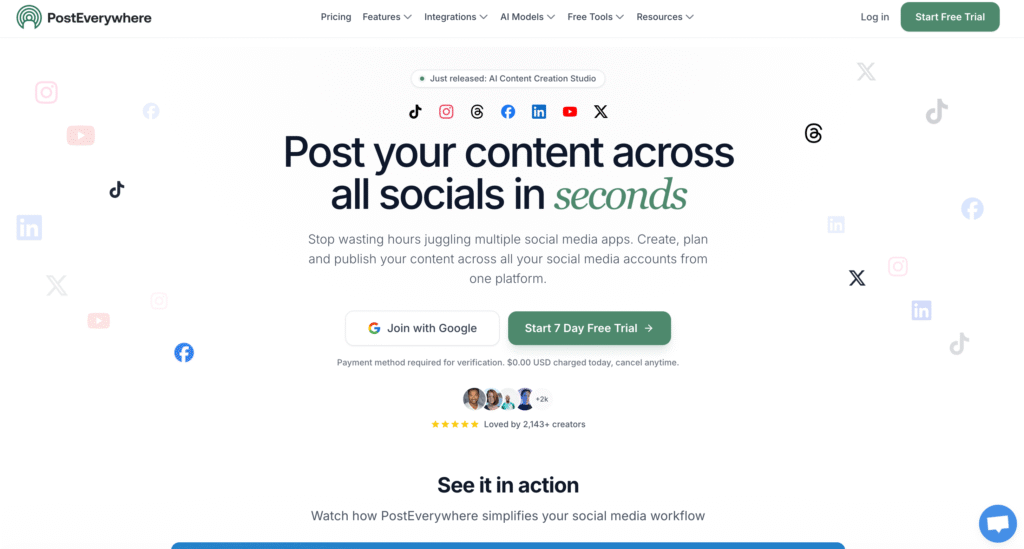
In 2026, PostEverywhere.ai stands out as one of the most advanced AI tools for managing and scheduling content across multiple social media platforms. It has gained global recognition for its intelligent automation, cross-platform adaptability, and enterprise-grade reliability. Designed especially for businesses that manage varied content formats and tones across different channels, PostEverywhere.ai makes it easy to tailor a single post to fit the specific requirements of each platform without manual rewriting.
Cross-Platform Content Adaptation with AI Intelligence
PostEverywhere.ai’s core innovation is its AI Content Adaptation Engine. This technology automatically transforms one piece of content into customized versions for platforms such as LinkedIn, Facebook, Instagram, X, TikTok, and Reddit.
- Automatically adapts tone and format to suit each platform’s audience expectations
- Helps B2B and SaaS companies maintain professionalism on LinkedIn and promote creativity on TikTok or Instagram
- Adjusts visuals, captions, hashtags, and even character limits depending on the platform
Comprehensive Automation for Global Campaigns
For global marketing teams, managing content across different time zones and audiences can be challenging. PostEverywhere.ai includes a visual, timezone-aware calendar that makes international content planning seamless. Its smart scheduler queues content based on audience engagement patterns in different regions.
- Helps schedule and publish posts at the most effective times
- Reduces manual work with automatic timezone adjustments
- Simplifies campaign execution across global markets
Pricing Plans of PostEverywhere.ai in 2026
The platform is accessible to companies of all sizes through a range of flexible pricing plans. Each tier includes core automation features with increasing functionality as the team size and campaign complexity grow.
Table: PostEverywhere.ai Pricing Tiers and Features (2026)
| Pricing Plan | Monthly Cost | Included Users | Key Features |
|---|---|---|---|
| Starter | $29.00 | 1 user | 10 channels, AI Content Assist |
| Professional | $49.00 | 5 users | Lead Tracking, Bulk Scheduling |
| Business | $99.00 | Unlimited users | CRM Integration, Approval Workflows, Full AI Automation |
| Free Trial | 7 Days | Full access | Includes access to all premium AI capabilities and scheduling functions |
Advanced AI Features for Precise Campaign Control
One of PostEverywhere.ai’s most powerful advantages is its deep AI configuration, which enables high-precision content generation and scheduling. Unlike many simple caption generators, its AI system uses keyword-focused prompts and channel-specific rewrite models to maximize audience engagement.
- Creates different tones for business content vs. entertainment posts
- Supports dynamic hashtag integration and SEO-friendly text optimization
- Previews how content will appear across different platforms before publishing
Operational Architecture Built for Reliability
To ensure smooth performance during high-traffic periods, the platform uses a background publishing engine. This system performs continuous token health checks, which help avoid missed posts or publishing errors during heavy API usage.
- Reduces campaign disruption caused by platform downtime
- Ensures critical posts are published even during platform overload
- Automatically reconnects to accounts if token expires or connection is broken
Functionality Comparison Matrix of Top AI Tools for Social Media (2026)
To highlight PostEverywhere.ai’s competitive position, the table below compares its functionality with other major tools in the 2026 market.
Matrix: Key Feature Comparison of AI Social Tools (2026)
| Tool Name | AI-Based Cross-Platform Adaptation | Bulk Scheduling | Token Health Check System | Global Timezone Calendar |
|---|---|---|---|---|
| PostEverywhere.ai | Yes | Yes | Yes | Yes |
| Sked Social | Moderate | Yes | No | Yes |
| Buffer | No | Limited | No | No |
| Later | Moderate | Yes | No | Yes |
| Hootsuite | Basic | Yes | No | Limited |
Conclusion: Why PostEverywhere.ai is a Top Choice in 2026
PostEverywhere.ai has redefined how marketing teams manage cross-platform content by removing the manual effort of rewriting, formatting, and scheduling. With its intelligent adaptation engine, scalable pricing model, and reliability-focused publishing infrastructure, it is ideally positioned for enterprises and growing businesses that need to deliver high-volume campaigns with speed and consistency. Its AI-first design and global content management features make it a top recommendation among the best social media management tools in the world today.
3. Sintra AI
In 2026, Sintra AI is recognized as one of the most advanced AI-powered tools in the global market for social media management and scheduling. It goes far beyond a typical scheduling assistant—offering a fully integrated AI workforce made up of multiple specialized agents. Each agent is designed for a specific role such as social media marketing, copywriting, customer service, and SEO. These agents collaborate seamlessly through a central intelligence system known as Brain AI, allowing businesses to manage digital campaigns with exceptional speed and brand consistency.
Multi-Agent Intelligence for End-to-End Automation
Unlike traditional AI tools that serve a single function, Sintra AI uses more than 12 intelligent agents to replicate the roles of a full digital marketing team. This unique structure ensures that all aspects of content creation, publishing, and engagement are managed without manual handoff between tools or departments.
- Soshie (Social Media Manager): Oversees content planning, scheduling, post creation, hashtag strategy, and analytics
- Penn (Copywriter): Converts long-form blogs into short-form posts and runs A/B testing for captions
- Seomi (SEO Expert): Conducts keyword research and optimizes social posts for search visibility
- Cassie (Support Agent): Handles comments and direct messages, providing real-time customer service
- Vizzy (Admin Assistant): Manages meetings and task assignments
Core Functional Capabilities of Sintra AI Agents
The following table highlights how each AI agent contributes to a cohesive social media management strategy.
Table: Core Roles of Sintra AI’s Specialized Agents
| Agent Name | Primary Role | Contribution to Social Media Management |
|---|---|---|
| Soshie | Social Media Manager | Schedules posts, manages interactions, tracks performance |
| Penn | Senior Copywriter | Rewrites content, runs A/B tests, generates platform-specific text |
| Seomi | SEO Strategist | Optimizes keywords and social search metadata |
| Cassie | Customer Support Agent | Moderates comments and responds to messages |
| Vizzy | Administrative Assistant | Schedules content meetings and manages team tasks |
AI Performance, Platform Reach, and Pricing Structure
Sintra AI is built for companies that want a scalable, intelligent assistant that doesn’t just automate tasks, but also learns the company’s tone and preferences. Its Brain AI system ensures every agent is synchronized—so once customer data is input by one agent, it is shared across the platform in real-time.
Table: Sintra AI User and Pricing Overview (2026)
| Metric Description | Value |
|---|---|
| Individual Agent Plan | $39.00 per month |
| Full AI Suite Plan | $97.00 per month |
| Discounted Annual Plan | $15.60 per month (billed annually) |
| Average Monthly Website Traffic | 1.05 million visits |
| User Satisfaction Score | 4.6 out of 5.0 based on over 5,000 reviews (Trustpilot) |
| Investment Raised (June 2025) | $17 million in seed funding |
Key AI Advantages for Modern Marketing Teams
Sintra AI introduces a more intelligent way to manage social media at scale. The platform does not rely on a single large language model. Instead, it uses a multi-LLM architecture, selecting the most efficient model for each specific task. This includes using Claude-4.5-Haiku for website content creation and GPT-4o for processing audio and video content for social platforms.
- Multi-model AI ensures faster and more accurate outputs
- Retrieval-Augmented Generation (RAG) anchors content to internal brand documents
- Learns a brand’s tone within 14 days, outperforming freelance content writers
Comparison Matrix of Top AI Social Tools in 2026
To better understand how Sintra AI performs compared to other top-rated platforms, the following matrix compares core features such as multi-agent intelligence, content customization, customer interaction handling, and adaptive learning.
Matrix: Functional Comparison of Leading AI Tools for Social Media (2026)
| Platform Name | Multi-Agent AI Support | Adaptive Brand Voice Learning | Comment & DM Management | Advanced SEO Integration |
|---|---|---|---|---|
| Sintra AI | Yes | Yes | Yes | Yes |
| Sked Social | No | Moderate | Moderate | Limited |
| PostEverywhere.ai | Limited | Yes | No | Basic |
| Buffer | No | Basic | No | No |
| Hootsuite | No | Basic | Yes | Basic |
Conclusion: Sintra AI’s Leadership in AI-Driven Social Media Tools
Sintra AI offers a forward-looking solution in 2026 for organizations seeking complete automation across their digital marketing operations. Its AI workforce mimics the efficiency of a professional marketing department—managing content, engagement, and optimization tasks with speed and accuracy. With a well-rounded architecture, adaptable pricing, and a commitment to continuous learning, Sintra AI is one of the most comprehensive AI platforms available for social media management in today’s highly competitive digital space.
4. Sprout Social
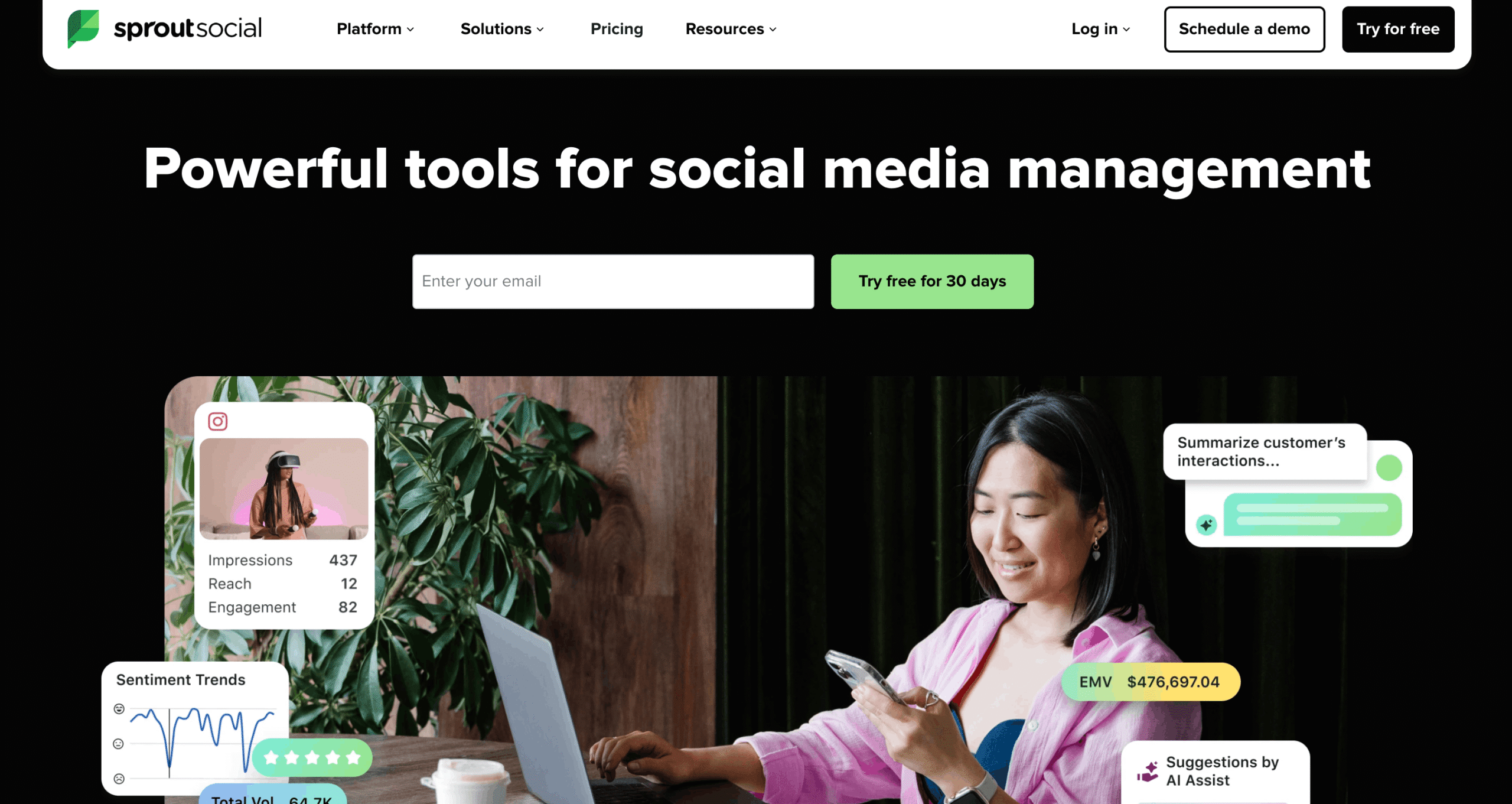
Sprout Social stands as one of the most powerful and widely adopted AI tools for social media management and scheduling in 2026. Recognized for its enterprise-grade resilience, financial intelligence, and advanced analytics capabilities, the platform has continued to lead among large and mid-market businesses that prioritize data-backed decision-making. With comprehensive AI features and a strategic focus on ROI, Sprout Social has proven to be more than just a management tool—it is a business growth enabler.
Enterprise Performance and Market Position
As of early 2026, Sprout Social has maintained a strong presence in the enterprise SaaS space, supported by impressive annual revenues and ongoing investments in AI capabilities. Despite market fluctuations, its financial and operational footprint underscores its maturity and reliability in the social media management industry.
Table: Sprout Social Financial & Market Overview (2026)
| Financial Indicator | Value |
|---|---|
| Annual Revenue (TTM) | $444.00 Million |
| Market Capitalization (January 2026) | Approximately $553.00 Million |
| EBITDA (TTM) | -$32.21 Million |
| Revenue per Employee | $335,666 |
| Net Income (TTM) | -$47.00 Million |
| Forecasted Analyst Price Target | $19.00 to $24.70 |
| ROI for Composite Organizations | 268% over 3 years (~$1.31M in financial benefits per client) |
AI-Powered Features Tailored for High-Impact Marketing
At the core of Sprout Social is its intelligent AI system, “Trellis,” which integrates seamlessly across content scheduling, sentiment analysis, engagement prioritization, and performance reporting. The AI Assist feature enhances team productivity by generating insightful suggestions and summarizing real-time engagement patterns.
- Trellis AI Engine: Automates detection of emotional sentiment and prioritizes messages based on brand relevance
- Smart Inbox: Filters out low-priority noise to help customer support teams focus on high-impact conversations
- AI Assist Tools: Recommends optimal posting times, responds to basic queries, and surfaces trending content topics
These features are especially beneficial for enterprise-level teams managing hundreds of interactions daily across multiple platforms.
Pricing Structure for Enterprise-Grade Services
Sprout Social is positioned as a premium solution, offering value through in-depth analytics and automation. While its price points are higher than typical tools, the investment is offset by measurable returns in efficiency, brand reach, and marketing ROI.
Table: Sprout Social Plan Structure and Pricing (2026)
| Plan Type | Monthly Cost per User (Annual Billing) | Key Inclusions |
|---|---|---|
| Standard | $199.00 | Core scheduling, reporting, and Smart Inbox access |
| Professional | $399.00 | Advanced analytics, competitive benchmarking, integrations |
| Advanced | $499.00 | Full-suite enterprise tools with AI-powered social listening |
Market Reach and Segment Usage Statistics
Sprout Social holds significant market share across multiple business tiers, particularly among small businesses and mid-sized companies. Its high usage rates reflect its ease of adoption, robust features, and strong customer success reputation.
Table: Sprout Social Usage by Business Segment (2026)
| Business Segment | Percentage of Teams Using Sprout Social |
|---|---|
| Small Businesses | 45% |
| Mid-Market Companies | 37% |
| Enterprises | 18% (focused on data-driven social ROI tracking) |
Strategic Value and Measurable Impact
Sprout Social differentiates itself from lower-cost platforms by offering highly customizable dashboards, real-time tracking, and strategic performance summaries that align with key business metrics. This makes the platform especially attractive to CMOs and data-focused marketing leaders who must defend marketing budgets with measurable outcomes.
- Supports data visualization with exportable executive-ready reports
- Enables campaign optimization through sentiment trend analysis
- Links customer interactions directly to conversions, growth metrics, and retention
Competitive Functionality Matrix: Sprout Social vs. Other Leading Tools
To better understand its premium position, the table below compares Sprout Social with other top AI tools in terms of analytics, financial performance, and advanced AI integration.
Matrix: Comparative Evaluation of Top AI Social Management Tools (2026)
| Platform Name | Enterprise Analytics | AI Sentiment Detection | Smart Inbox Feature | Market ROI Benchmark |
|---|---|---|---|---|
| Sprout Social | Advanced | Yes | Yes | 268% over 3 years |
| Sked Social | Moderate | Partial | Yes | Moderate |
| PostEverywhere.ai | Basic | No | No | Not Measured |
| Buffer | Limited | No | No | Not Tracked |
| Hootsuite | Moderate | Limited | Yes | Basic |
Conclusion: Why Sprout Social Is a Top AI Social Media Tool in 2026
Sprout Social stands out as a trusted and comprehensive AI platform built for organizations that prioritize real business outcomes from their social media activities. Its strong market presence, intelligent AI features, and data-rich ecosystem position it as a strategic choice for CMOs, marketing leaders, and performance-driven teams. For businesses seeking both scale and insight, Sprout Social is among the most effective tools available in 2026 for social media management and scheduling.
5. Hootsuite

In 2026, Hootsuite remains one of the most powerful and trusted AI tools for managing and scheduling social media content across large organizations and multinational brands. Known for its enterprise-grade security, vast feature set, and growing presence in social commerce, the platform continues to support more than 200,000 businesses worldwide. It combines advanced automation with strategic intelligence, making it a preferred solution for companies that prioritize security, content volume, and revenue generation through social platforms.
Enterprise Focus on Social Commerce and Security
Hootsuite has built its reputation by helping businesses operate securely and efficiently at scale. The platform’s robust security framework includes multi-layered permission settings and integration with customer relationship management systems, which is particularly valuable for companies managing multiple accounts and teams.
Key strengths include:
- Enterprise-level governance and user access control
- Secure multi-brand content workflows
- CRM integration to maintain sales and brand consistency
Hootsuite’s continued relevance in 2026 is also tied to its push into social commerce. With integrated tools for in-app checkout and performance tracking, the platform enables companies to turn social media engagement into direct sales—meeting the demands of an audience that increasingly shops through platforms like TikTok and Instagram.
Financial and Operational Snapshot of Hootsuite in 2026
The following data offers a comprehensive view of Hootsuite’s financial performance, user impact, and platform efficiency.
Table: Hootsuite Market Presence & Operational Metrics (2026)
| Metric Description | Value |
|---|---|
| Estimated Annual Revenue | $350.00 Million (2024 base, continuing growth in 2026) |
| Total Global Employees | Between 1,001 and 5,000 staff |
| AI Chatbot Workload Reduction | 80% improvement in support automation |
| Growth Using Hootsuite Enterprise Suite | 500% increase in engagement metrics |
| Total Followers Gained via Enterprise Use | Over 2.0 million new followers added |
| Ease of Use Rating (Based on G2 Reviews) | 88% satisfaction score |
AI Innovations and Content Creation Support
Hootsuite’s AI content engine, known as OwlyWriter, plays a vital role in supporting marketing teams under pressure. By generating post drafts based on trending topics and industry-specific feeds, OwlyWriter helps brands avoid creative fatigue and produce consistent, relevant content.
Capabilities include:
- Draft generation using AI based on current trends
- Industry-tailored content recommendations
- A central content calendar for unified team planning
Hootsuite’s “Unified Social Inbox” works alongside the AI system to eliminate the challenge of managing high message volumes. An AI-powered chatbot handles common inquiries, flags high-priority messages, and helps ensure that no customer engagement goes unnoticed.
Hootsuite Pricing Plans and Account Scalability (2026)
Hootsuite offers multiple pricing tiers to cater to individual users, teams, and enterprise-level organizations. These plans are built to support different account sizes and collaboration levels.
Table: Hootsuite Pricing and Profile Limits (2026)
| Plan Name | Monthly Cost | User Limit | Social Profile Capacity |
|---|---|---|---|
| Professional | $99.00 | 1 user | Up to 10 profiles |
| Team | $249.00 | 3 users | Up to 20 profiles |
| Business | $762.00 | 5 users | Up to 35 profiles |
| Enterprise | Custom Pricing | Multi-user access | Suitable for large-scale operations |
Responding to the Rise of Social Commerce
Hootsuite’s roadmap in 2026 emphasizes the growing role of social media as a platform for direct product sales. The platform integrates e-commerce tools that allow brands to convert interactions into revenue, especially on platforms where consumer behavior is increasingly purchase-oriented.
- Enables in-app checkout and integrated product tagging
- Supports shoppable posts, live product showcases, and campaign performance dashboards
- Captures key commerce data from social channels to optimize product marketing
For example, TikTok now converts nearly 44% of its users into buyers. Hootsuite’s alignment with such trends ensures that businesses are ready to monetize their audiences in real-time.
Feature Comparison Matrix: Hootsuite vs. Other Leading Platforms (2026)
To assess its competitive position, the following matrix compares Hootsuite’s features with other top AI tools for social media management.
Matrix: Comparative Analysis of Top AI Social Media Tools (2026)
| Platform Name | AI Content Generator | Unified Inbox with Chatbot | Social Commerce Tools | Enterprise Security |
|---|---|---|---|---|
| Hootsuite | Yes (OwlyWriter) | Yes | Yes | Advanced |
| Sprout Social | Yes (AI Assist) | Yes | Limited | Advanced |
| Sked Social | Yes (AI Planner) | Partial | No | Moderate |
| PostEverywhere.ai | Yes | No | No | Moderate |
| Buffer | Basic | No | No | Basic |
Conclusion: Why Hootsuite Is a Leading Social Media AI Platform in 2026
Hootsuite continues to be a trusted and high-performing solution in 2026 for global organizations that require advanced security, intelligent automation, and strong performance in social commerce. Its balance of powerful AI tools, user-friendly interfaces, and scalable infrastructure makes it an essential platform for brands seeking to grow audiences, drive revenue, and manage content efficiently across platforms. For businesses that aim to stay competitive in a fast-changing digital landscape, Hootsuite delivers a future-ready foundation.
6. Buffer
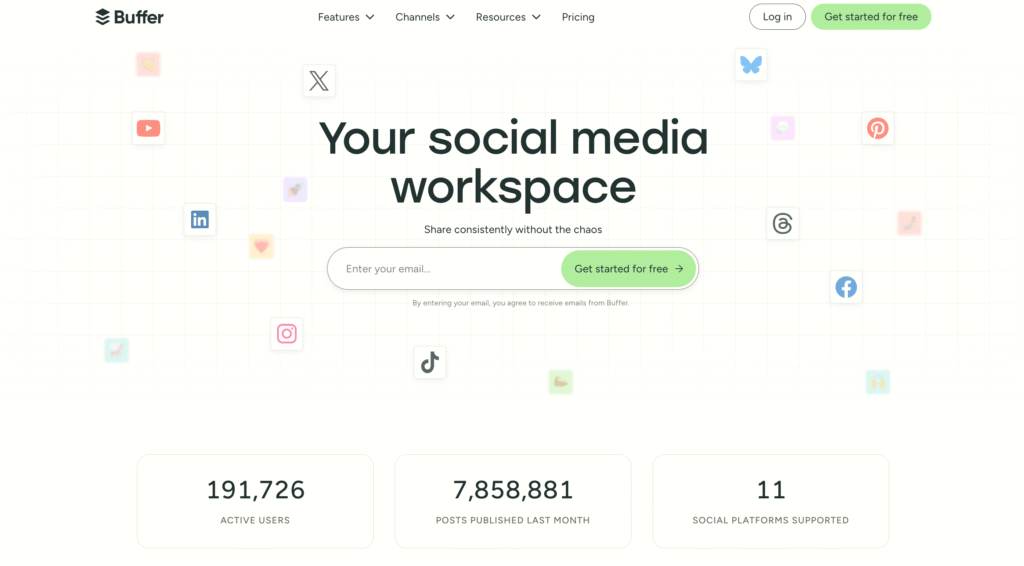
In the evolving landscape of social media tools in 2026, Buffer has secured its place as the go-to solution for individual creators, freelancers, and small businesses. It is designed for those who value simplicity, ease of use, and cost-efficiency over complex enterprise functionalities. While other platforms aim at large-scale operations, Buffer focuses on helping users build consistent content routines and grow their online presence with minimal friction. Its friendly interface, accessible pricing, and helpful AI assistant make it ideal for content creators who need efficiency without technical overload.
AI-Driven Simplicity for Solo Creators and Small Teams
Buffer’s platform is engineered to help users post consistently and stay active on social media without becoming overwhelmed. The tool’s built-in AI Assistant supports idea generation, caption rewriting, and content repurposing. This helps users save time while ensuring each post is tailored to fit the format and tone of different platforms such as Instagram, Facebook, TikTok, Threads, LinkedIn, Pinterest, and X.
Additional features include:
- An AI-powered “Create Space” to store post ideas on the go
- Support for multiple platforms with customized post formatting
- Quick repurposing of content across channels to maintain brand consistency
Gamified Posting Habit with “Streaks” Feature
One of Buffer’s most unique contributions in 2026 is the introduction of the “Streaks” feature. This tool adds gamification to the user experience, encouraging creators to post regularly by tracking their publishing activity streaks. This consistent activity supports algorithmic visibility and improves post performance over time.
- Encourages daily posting habits with gamified progress tracking
- Aligns with algorithmic preferences for consistent content output
- Helps users build brand awareness through regular activity
Pricing Plans and Access Structure in 2026
Buffer offers some of the most affordable and transparent pricing plans in the social media management industry. Its free plan is especially attractive to new creators, allowing them to manage up to three channels and schedule up to ten posts per channel without time limits. Paid plans are structured per channel, allowing teams to scale affordably based on their needs.
Table: Buffer Pricing and Feature Access (2026)
| Plan Tier | Monthly Cost (Per Channel) | Channels Included | Key Features |
|---|---|---|---|
| Free Plan | $0.00 | 3 Channels | 10 scheduled posts per channel, AI Assistant access |
| Paid Plan (Starter) | $6.00 | Customizable | Unlimited posts, analytics, AI-powered content creation |
| Team Plan | $12.00 | Customizable | Team collaboration, scheduling tools, engagement tracking |
User-Centered Features Designed for Growth
Buffer is known for its strong focus on usability, making it ideal for users with limited technical experience. In 2026, the platform is rated as one of the top beginner-friendly tools in the industry. Its AI tools are streamlined to help users brainstorm content without overwhelming them with options.
Other features include:
- A built-in “Start Page,” allowing users to create branded landing pages instead of relying on generic link-in-bio tools
- Basic but effective analytics for post performance tracking
- Seamless platform-specific adjustments using AI-generated suggestions
Strategic Positioning Among AI Tools in 2026
While Buffer does not compete directly with high-end enterprise platforms in terms of scale or deep analytics, its focus on usability, affordability, and content consistency positions it as an essential tool in the creator economy.
Matrix: Comparative Positioning of Buffer Among AI Social Tools (2026)
| Platform Name | Beginner-Friendly Design | AI Content Repurposing | Post Consistency Support | Cost Efficiency |
|---|---|---|---|---|
| Buffer | Excellent | Yes | Yes (via Streaks) | Very High |
| Sprout Social | Moderate | Yes | Moderate | Low |
| Hootsuite | Moderate | Yes (OwlyWriter) | Yes | Moderate |
| PostEverywhere.ai | Basic | Yes | Limited | Moderate |
| Sked Social | Moderate | Yes | Yes | Moderate |
Conclusion: Why Buffer Is Among the Top AI Tools for Social Media in 2026
Buffer stands out in 2026 by offering a lightweight, accessible, and smart solution for individuals and small businesses looking to grow their online presence. Its AI-powered content support, gamified consistency tracking, and low-cost plans make it ideal for new creators entering the social media space. For those who prioritize ease, affordability, and regular posting without needing the complexity of enterprise platforms, Buffer is a top recommendation among the world’s best AI tools for social media management and scheduling this year.
7. Later
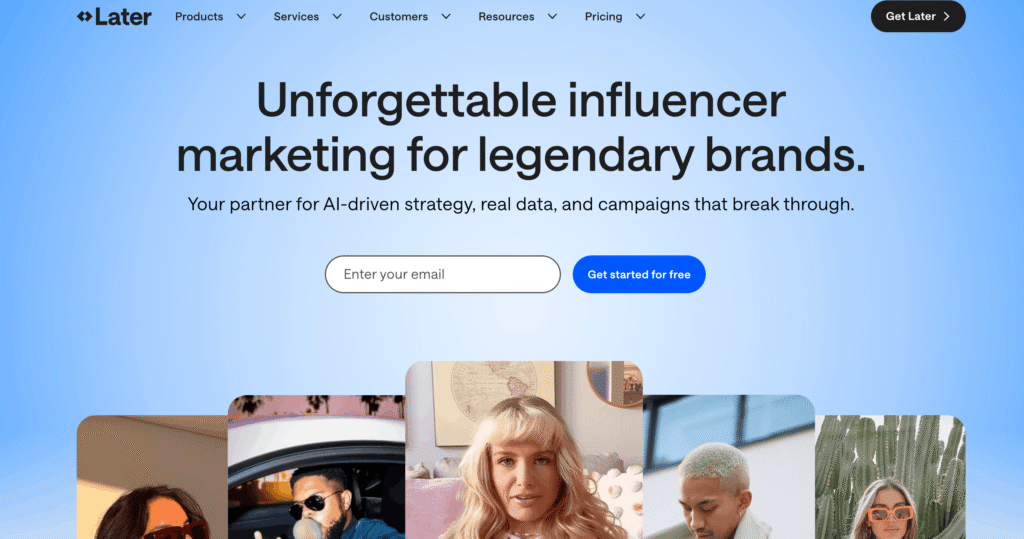
Later has firmly positioned itself as a top-tier AI-powered social media management tool in 2026, particularly for visual-first brands, influencers, and creators. As the US creator economy expands rapidly—projected to double from $20.64 billion in 2025 to $40 billion by the end of 2026—Later has emerged as one of the most effective platforms supporting professional content monetization, performance tracking, and AI-driven content strategies. Originally known as Latergramme, the platform now plays a pivotal role in helping creators generate real business results from their online presence.
Optimized for Instagram, TikTok, and Visual Commerce
Later focuses on platforms that thrive on visual storytelling. Its ecosystem is designed to make Instagram, TikTok, and similar channels not only look better—but also perform better. Unlike generalized tools, Later is engineered to help brands and creators turn views into meaningful conversions.
Key functionalities include:
- Advanced post scheduling optimized for visual engagement
- Seamless integration of commerce tools like Linkin.bio
- Campaign-level analytics for ROAS, impressions, and engagement tracking
- Tools for managing UGC licensing, influencer partnerships, and affiliate promotions
Monetization Support for the Modern Creator Economy
One of Later’s most valuable contributions in 2026 is its emphasis on “diversified monetization.” As more content creators treat their work as a business, Later provides built-in systems for managing:
- Affiliate marketing campaigns (used by 54% of creators)
- User-generated content (UGC) licensing (leveraged by 42% of creators)
- Paid brand collaborations and partnerships
- E-commerce product tagging and social checkout integrations
These tools support a new wave of independent professionals turning online communities into full-time income streams.
Performance Highlights and Measurable Outcomes
Later has become known for its ability to significantly improve creators’ and brands’ returns on social investment. Multiple user case studies show that Later consistently delivers better results than many other tools in its category.
Table: Later Performance Benchmarks (2026)
| Metric Description | Measured Value |
|---|---|
| Average Return on Ad Spend (ROAS) | $11.80 per $1 spent (versus industry avg. $5.00) |
| Average Engagement Rate | 7.50% (7.5x the industry average) |
| Average Cost Per Engagement | $0.03 |
| Campaign Example – Impressions (Reebok) | 928,600 |
| Campaign Example – Engagements (Reebok) | 55,600 |
AI-Powered Tools That Support Deeper Audience Engagement
Later’s AI features have matured significantly in 2026. They are designed not just to automate workflows, but to drive higher quality engagement and deeper creator-audience relationships. This includes content ideation, personalized caption writing, and audience sentiment tracking.
Additional AI-powered advantages:
- Detection of high-performing content formats for repurposing
- Suggestions for post timing based on audience activity
- “Create to Commerce” journey analysis, helping shorten the gap between attention and purchase
Security and Authenticity in the Age of AI Content
In response to growing concerns over synthetic content and deepfakes, Later introduced its “Creator Content Authentication” feature. This system verifies creator identity and content authenticity to ensure audience trust and campaign legitimacy—particularly valuable in influencer campaigns and user-generated licensing deals.
- Confirms that social content is produced by real creators
- Builds trust between brands, creators, and audiences
- Protects against reputational risks tied to AI-generated misinformation
Pricing Tiers for Different Growth Stages in 2026
Later offers a tiered pricing model that caters to solo creators, growing businesses, and larger influencer teams. Each plan includes access to analytics, monetization tools, and AI-powered scheduling.
Table: Later Pricing Structure (2026)
| Plan Name | Monthly Cost | Intended Users | Core Features |
|---|---|---|---|
| Starter | $18.00 | Solo creators and freelancers | Basic analytics, Linkin.bio, post scheduling |
| Growth | $40.00 | Growing teams and partnerships | Affiliate/UGC tools, campaign ROI tracking, brand collaboration |
| Advanced | $80.00 | Full-scale creator brands or agencies | Full suite access, Creator Authentication, performance modeling |
Strategic Matrix: Later vs. Other Leading AI Tools in 2026
The table below compares Later to other top social media tools by its focus areas, making it clear where the platform delivers exceptional value—especially for visual-driven, commerce-focused users.
Matrix: Functional Positioning of Later Among Social AI Tools (2026)
| Platform Name | Visual Content Optimization | Monetization Features | AI Campaign Insights | Creator-Specific Tools |
|---|---|---|---|---|
| Later | Excellent | Advanced | Yes | Yes |
| Hootsuite | Moderate | Moderate | Yes | No |
| Sprout Social | Good | Basic | Yes | No |
| Buffer | Basic | Limited | Basic | No |
| Sked Social | Good | Moderate | Yes | Partial |
Conclusion: Why Later Is a Leading AI Platform for Social Creators in 2026
Later has built a reputation as one of the most creator-friendly and business-effective tools in the AI social media space. Its emphasis on visual storytelling, monetization strategies, and campaign performance measurement makes it an essential solution for today’s creator economy. With AI capabilities tailored to meet both creative and financial needs, Later empowers individuals and small teams to operate like professional marketing agencies—without requiring enterprise-level budgets. In 2026, it is undoubtedly one of the top AI tools for social media management and scheduling on a global scale.
8. Agorapulse
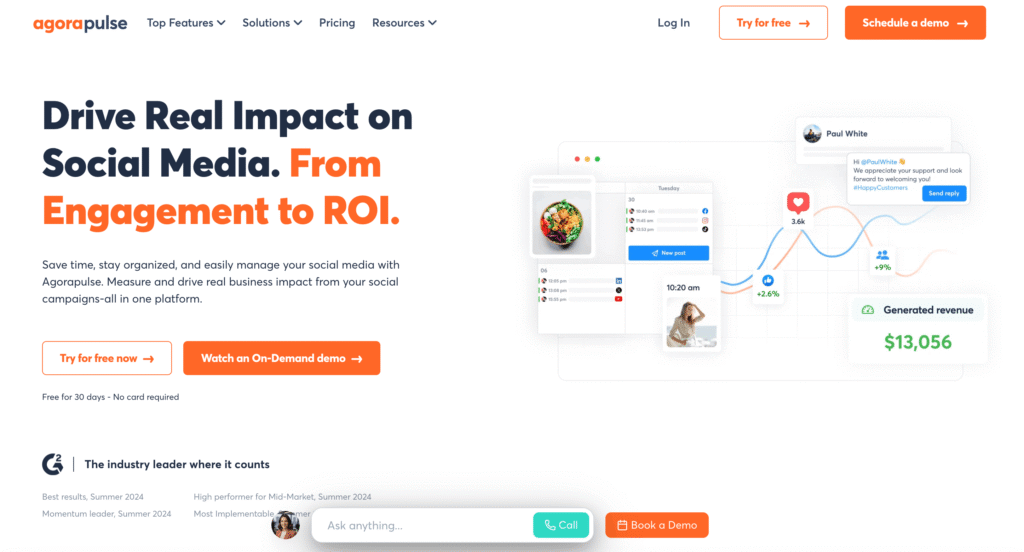
Agorapulse has earned its place among the top AI-powered social media management tools in 2026 by focusing on delivering exceptional engagement experiences, especially for agencies and mid-sized teams. Known for its Unified Social Inbox and advanced AI workflow automation, the platform helps businesses handle high volumes of comments, messages, and brand interactions across multiple platforms—without losing context or quality.
Agorapulse is built to meet the growing demand for real-time, one-on-one communication, which has become increasingly important as customer engagement shifts away from public posts and into private direct messages and broadcast channels.
Unified Inbox and AI-Powered Message Management
Agorapulse’s standout feature is its “Inbox Zero” approach. Through a central inbox interface, it collects comments, private messages, and interactions from platforms like Facebook, Instagram, LinkedIn, TikTok, and X—allowing teams to respond efficiently from a single stream.
At the heart of this workflow is the AI-powered “Inbox Assistant.” This smart assistant helps teams manage conversations at scale by automatically:
- Tagging messages by topic, urgency, or sentiment
- Assigning inquiries to the right team members
- Archiving or escalating critical issues
- Filtering out irrelevant or low-priority content
This automation helps reduce manual workload and ensures the most important customer interactions get timely attention.
Agorapulse Operational Overview and Financial Metrics (2026)
Agorapulse has continued to grow steadily, now serving over 11,000 customers globally. It remains one of the top-ranked social engagement platforms among more than 1,200 competitors, as tracked by major analytics firms.
Table: Agorapulse Business Profile and Pricing (2026)
| Metric Description | Value |
|---|---|
| Total Active Customers | Over 11,000 |
| Global Team Headcount | 11 (US) / 20+ (International) |
| Series B Funding Raised | $18.3 Million |
| Standard Plan Pricing | $79.00 per month per user |
| Team Plan Pricing | $99.00 per month per user |
| Competitive Ranking (Tracxn, 2026) | 5th place among 1,246 active competitors |
Adaptation to Changing Engagement Trends
In 2026, customer engagement is increasingly occurring in private spaces such as DMs, group chats, and closed platforms. This “Side Quest Trend,” as Agorapulse refers to it, requires platforms to offer tools that allow brands to handle personalized conversations with clarity and speed.
Agorapulse addresses this with its unified inbox strategy, which eliminates the fragmentation that often occurs when teams manage multiple profiles manually. Instead, all incoming activity is presented contextually and chronologically, giving teams the full history and sentiment of each interaction.
Competitor Benchmarking and Industry Insights
Agorapulse also includes real-time competitor analysis, enabling brands to evaluate their performance against peers across various metrics such as engagement rates, audience growth, and content responsiveness.
This is especially important given the platform-specific engagement shifts in 2026:
Table: Engagement Rate Benchmarks by Platform (2026)
| Social Platform | Average Engagement Rate (2026) |
|---|---|
| TikTok | 3.70% |
| 0.98% | |
| 0.45% | |
| X (formerly Twitter) | 0.30% |
| 0.15% |
Agorapulse helps users identify where engagement opportunities still exist and how to prioritize content strategies for each platform accordingly.
Human-Centric Approval and Publishing Workflow
While Agorapulse makes strong use of automation, it also includes built-in human approval layers to ensure brand tone remains consistent and authentic. This is especially important in 2026 as consumers are increasingly cautious of AI-generated messages and prefer personalized, human-like interactions.
Key publishing features include:
- Multi-step content approval workflows
- Role-based team permissions and collaboration tools
- Real-time editing before posts go live
- Scheduling tools that adapt to optimal posting times
Feature Comparison Matrix: Agorapulse vs Other Top AI Social Tools (2026)
To showcase Agorapulse’s unique value, the matrix below compares its capabilities with other leading platforms focused on engagement and customer interaction management.
Matrix: Comparative Functionality of Social Media AI Tools (2026)
| Platform Name | Unified Inbox | AI Inbox Automation | Competitor Benchmarking | Approval Workflow |
|---|---|---|---|---|
| Agorapulse | Yes | Yes | Yes | Yes |
| Hootsuite | Yes | Partial | Limited | Yes |
| Sprout Social | Yes | Yes | Yes | Yes |
| Sked Social | Partial | Basic | No | Moderate |
| Buffer | No | Limited | No | No |
Conclusion: Why Agorapulse Is Among the Top 10 AI Tools for Social Media in 2026
Agorapulse continues to deliver impressive results in 2026 by helping agencies, brands, and social media teams focus on meaningful engagement. Its ability to centralize communications, automate tedious inbox tasks, and measure performance in real-time sets it apart in a crowded market. As more businesses seek to humanize their brand voice while scaling efficiently, Agorapulse offers a balanced and intelligent solution that combines AI speed with human oversight—making it one of the best tools for social media management and scheduling in the world today.
9. SocialBee
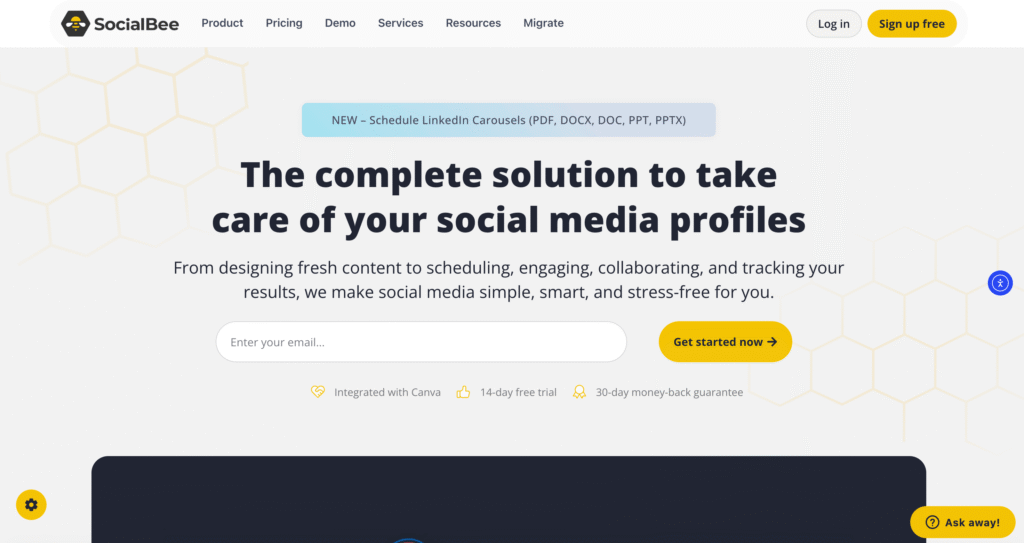
SocialBee has emerged in 2026 as a powerful social media management platform tailored to the needs of solo entrepreneurs, small teams, and consultants. It focuses on providing structured automation, helping users maintain consistent posting routines without the constant pressure of generating new content daily. Through its innovative content recycling and AI-based strategy planning, SocialBee has become one of the most dependable tools for maximizing audience reach with fewer resources.
Automated Scheduling with Structured Content Categories
At the heart of SocialBee’s approach is its content categorization system. This allows users to organize their posts into different types—such as promotional, curated, educational, or evergreen content. By scheduling posts from each category at different intervals, users can ensure their social feeds remain diverse, engaging, and brand-consistent.
- Promotional posts can be scheduled weekly
- Educational tips shared midweek
- Curated articles and news reserved for weekends
- Evergreen content reshared during low-traffic periods
This structure simplifies the content calendar and ensures long-term engagement without burning out creative teams.
Evergreen Recycling to Maximize Reach
As content saturation increases in 2026, SocialBee’s evergreen recycling feature becomes particularly valuable. By reusing high-performing posts, brands can maintain strong visibility while reducing the need for continuous content production.
- Automatically reuses top-performing posts in new time slots
- Optimizes content reach by targeting different audiences on different days
- Keeps brand messages consistent without repetitive manual work
AI-Powered Social Media Copilot for Strategic Automation
In 2026, SocialBee introduced its “Social Media Copilot”—a smart AI feature that creates a custom content strategy tailored to each business type. This AI tool analyzes a brand’s niche, ideal posting times, and target audience behaviors, then builds an optimized weekly calendar.
For example:
- A real estate agent might receive tips on showcasing properties on Wednesdays and sharing market insights on Fridays
- A wellness coach could get automated scheduling for motivational quotes in the morning and live Q&A promotions in the evening
The AI Copilot ensures that each content type aligns with what the audience is most likely to engage with, making every post count.
SocialBee Pricing, Reach, and User Metrics (2026)
SocialBee is accessible to small teams with budget-conscious plans while offering scalability for advanced users. It supports individuals managing just one profile, as well as power users handling over 10 accounts.
Table: SocialBee Platform Metrics and User Behavior (2025–2026)
| Category Description | Value / Share |
|---|---|
| Users Managing 1–2 Social Accounts | 39.5% |
| Users Managing 3–4 Social Accounts | 28.1% |
| Users Managing 11+ Social Accounts | 6.4% |
| Total Posts Analyzed in Platform Study | 9,332,840 |
| Weekly Post Concentration (Tuesday–Thursday) | ~50% of all content |
| Highest Daily Posting Activity | Wednesday (15.6% of all posts) |
| Share of Growing Facebook Profiles | 31.0% |
| Share of Growing Instagram Profiles | 23.5% |
Table: SocialBee Financial and Market Overview (2026)
| Business Data Point | Metric |
|---|---|
| Starting Subscription Price | $29.00 per month |
| Estimated Annual Revenue Range | $1.0M to $10.0M |
| Free Trial Offering | 14-Day Full Access |
| Competitive Ranking (Tracxn, 2026) | 168th out of 703 active tools |
Integrated Tools and Creative Resources
SocialBee is designed to be a one-stop-shop for content planning and creation. Its integrations with tools like Canva and Unsplash allow users to create stunning visuals directly within the platform, further streamlining the workflow.
- Design new graphics without leaving the scheduler
- Access a vast image library through Unsplash
- Collaborate with visual branding tools inside the platform
Feature Matrix: SocialBee vs Other AI Tools for Small Teams (2026)
To understand SocialBee’s positioning among the top tools for smaller teams, the matrix below compares its key features with similar platforms.
Matrix: Comparison of Social Media AI Tools for Small Teams (2026)
| Platform Name | Structured Content Categories | Evergreen Recycling | AI Strategy Generator | Visual Tool Integration |
|---|---|---|---|---|
| SocialBee | Yes | Yes | Yes (Social Copilot) | Yes (Canva, Unsplash) |
| Buffer | No | Limited | Moderate | Partial |
| Later | Basic | No | Yes | Yes |
| Hootsuite | Moderate | No | Yes | Yes |
| PostEverywhere.ai | Basic | No | Yes | Limited |
Conclusion: Why SocialBee Ranks Among the Top AI Tools in 2026
SocialBee has become one of the top AI-powered platforms for social media management and scheduling by making structured, strategic posting accessible to small teams and solopreneurs. Its unique content category system, evergreen recycling engine, and AI-based posting assistant enable users to plan months of engaging content in just a few hours. With affordable pricing, useful analytics, and creative integrations, SocialBee delivers the perfect mix of automation and personalization—helping growing brands appear polished, consistent, and professional in 2026.
10. Canva AI
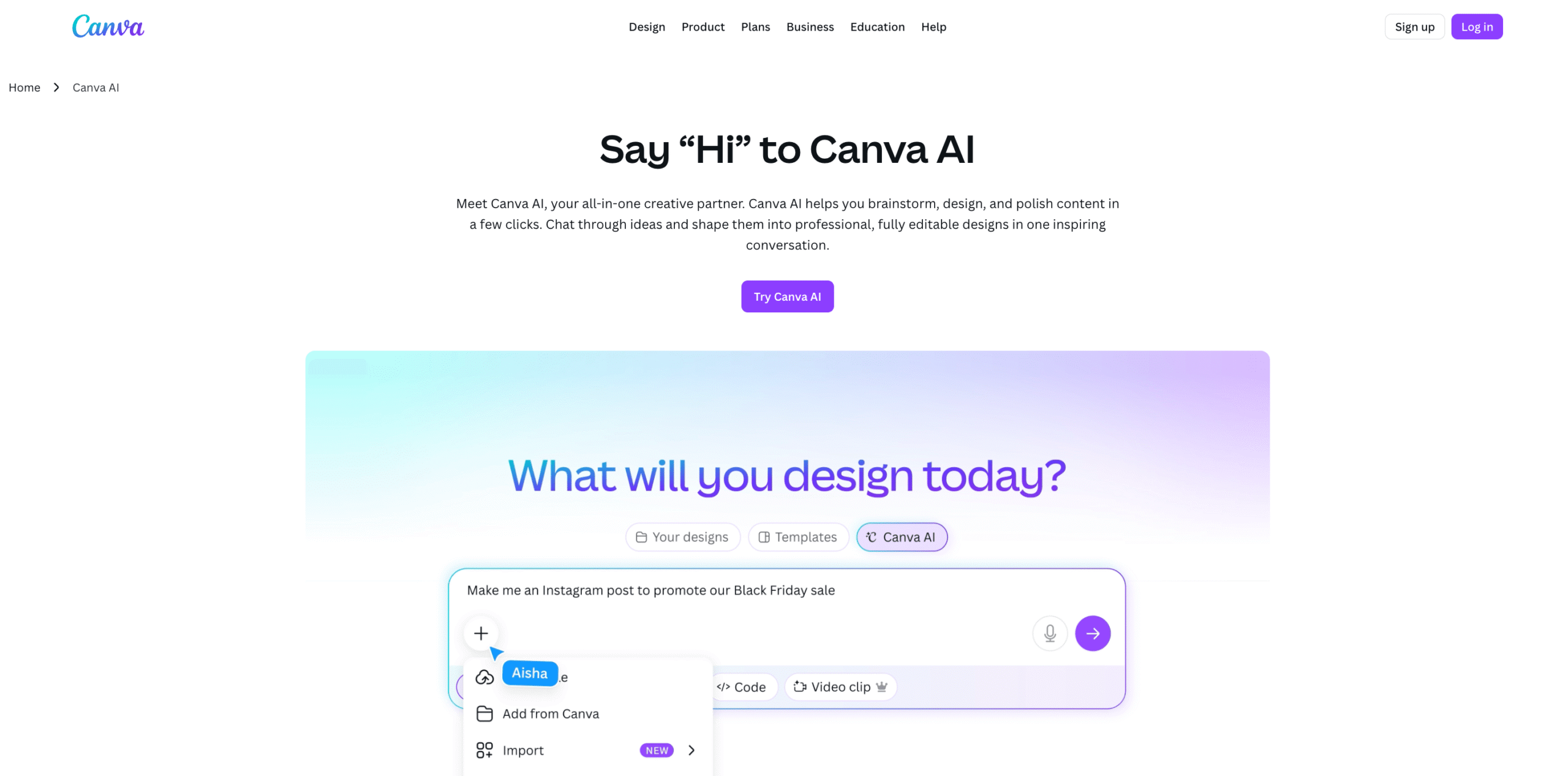
In 2026, Canva AI has become an essential part of the global content creation ecosystem, particularly for social media professionals and digital marketers. While Canva is not a full-service social media management tool like Sprout Social or Hootsuite, its AI-powered design capabilities are deeply embedded in nearly every brand’s content production process. Its value lies in making high-quality visuals faster, easier, and more adaptable across multiple platforms—an essential need in an era where the average user interacts with 6 to 7 social platforms each month.
Magic Studio: Streamlining Visual Content for Multi-Platform Reach
The center of Canva’s AI offering is its “Magic Studio,” which includes several tools that automate complex design tasks. These tools help creators generate professional content with minimal manual effort, transforming the way social graphics, ads, and video snippets are produced.
Key AI features include:
- Magic Resize: Automatically adjusts a single design to fit the size requirements of platforms like Instagram, LinkedIn, TikTok, and YouTube
- Magic Switch: Converts static designs into animated posts or carousels in one click
- AI Writing Assistant: Produces headlines, captions, and ad copy based on user input
These features support a new kind of marketing workflow—one where design speed and adaptability are just as important as visual quality.
AI-Powered Design Impact and Usage Metrics
Canva’s growth and usage in 2026 reflect its widespread adoption across both enterprise and independent creator markets. It now plays a pivotal role in how brands scale content across social platforms.
Table: Canva AI Usage and Platform Impact (2026)
| Metric Description | Reported Volume |
|---|---|
| Total AI Tool Actions via Magic Studio | 16.0+ Billion Uses |
| Words Generated by AI Writing Assistant | 1.0+ Billion Words |
| Share of Social Images Created Using AI | 71.0% of total content across major platforms |
| Monthly Cost for Pro Plan | $14.99 per user |
| Free Core Tier | Yes (basic features and templates included) |
Brand Kit Control and Design Consistency
One of Canva AI’s most significant contributions to professional marketing in 2026 is its “Brand Kit Management” feature. This functionality allows marketing teams to define and lock in brand colors, fonts, and layouts—ensuring design consistency, even across automated and AI-generated outputs.
- Prevents visual drift caused by multiple contributors or AI variations
- Speeds up approval by standardizing templates across teams
- Supports multiple brand kits for agencies or multi-product companies
For social media managers, this means that even when different people or departments contribute to content creation, all posts maintain a uniform and professional appearance.
Direct Publishing and Platform Optimization
Although Canva does not include features like a unified inbox or full post-scheduling automation, its direct publishing tools allow users to post content to several platforms without leaving the design interface. This creates a smoother transition between creation and deployment.
- Supports direct publishing to platforms like Instagram, Facebook, Pinterest, and X
- Offers preset dimensions for Reels, Shorts, Carousels, and Story formats
- Eliminates the need for third-party resizing tools or manual reformatting
Tool Function Matrix: Canva AI Compared to Other Top Social Media Tools (2026)
To understand Canva’s unique position, the matrix below compares it with other leading tools in terms of visual automation, design flexibility, and platform optimization.
Matrix: Canva AI vs. Leading Social Media AI Tools (2026)
| Tool Name | AI Design Generation | Platform-Specific Resizing | Post Scheduling Capabilities | Brand Asset Locking |
|---|---|---|---|---|
| Canva AI | Yes (Magic Studio) | Yes (Magic Resize) | Basic Direct Publishing | Yes (Brand Kit) |
| Sprout Social | Moderate | No | Advanced | Yes |
| Hootsuite | Basic | Limited | Advanced | Moderate |
| Buffer | No | No | Moderate | No |
| Later | Limited | Yes | Yes | Limited |
Conclusion: Why Canva AI Is Among the Top AI Tools for Social Media in 2026
Canva AI has redefined how visual content is produced and scaled in the social media marketing world. Its intuitive interface, combined with powerful AI tools, empowers businesses of all sizes to generate professional, platform-optimized content with unmatched speed. In a landscape where content volume and design consistency directly impact engagement, Canva stands out as the go-to visual logic layer for modern marketers. Even without advanced inbox or campaign management features, its influence on the social ecosystem in 2026 is undeniable—making it one of the most important AI tools shaping the future of digital marketing.
The Technological Leap in 2026: From AI Assistance to Agentic Intelligence in Social Media Management
The social media landscape in 2026 has undergone a major transformation. Artificial intelligence, once limited to support tasks like caption suggestions or hashtag generation, has now evolved into what experts call “agentic AI.” This advanced form of artificial intelligence does not just assist—it takes ownership of complex workflows. Modern social media management tools are now equipped with pre-programmed and customizable AI agents that handle entire operations autonomously, from content strategy and scheduling to engagement monitoring and ROI analysis.
This shift represents a new era in digital marketing where speed, precision, and data integration are key. As of 2026, the overwhelming majority of social media professionals—over 96%—actively use AI in their daily work, with more than 72% relying on AI tools multiple times per day. These numbers highlight the growing dependence on AI-driven solutions to manage high-volume, multi-platform content operations efficiently.
Rise of Unified AI-Driven Social Suites
What differentiates today’s top-performing social media platforms is their transformation into unified AI suites. These platforms no longer function as disconnected tools but serve as centralized systems that combine several essential components:
- Strategic content planning across channels
- Integrated performance analytics with real-time insights
- Creator and influencer marketing management
- AI-generated responses and customer support integration
The result is a single, streamlined ecosystem where brands can control every part of their social presence without switching tools or exporting data across platforms.
Bridging ROI Measurement with Unified Data Models
One of the most critical breakthroughs in 2026 is the ability of social platforms to measure return on investment accurately. Historically, social media campaigns suffered from disconnected metrics and siloed performance data. This made it hard for marketing teams to show the real business value of their efforts.
Thanks to AI integration with CRM systems and customer support tools, modern platforms now enable:
- First-party data enrichment for deeper audience insights
- Attribution models like U-shaped, time-decay, and multi-touch tracking
- Full-funnel analysis of content performance—from views to revenue
This integration allows marketers to justify every dollar spent on influencers, paid campaigns, and organic growth strategies.
AI Adoption Rates and Market-Wide Impact (2025–2026)
The following data illustrates the widespread acceptance and impact of AI adoption across brands, agencies, and content teams.
Table: AI Usage and Performance Metrics in Social Media (2025–2026)
| AI Metric Description | Measured Value |
|---|---|
| Social Media Professionals Using AI Tools | 96.01% |
| Daily AI Usage Among Social Teams | 72.46% |
| Brands Incorporating AI in Marketing Strategies | 95.0% |
| Agencies Using AI for Social Media and Content Services | 97.0% |
| Revenue Growth from AI-Driven Marketing and Sales | 71.0% |
| Average Content Volume Created with AI Assistance | Over 50% |
These statistics reflect the depth of AI’s integration into modern marketing operations and its role in driving measurable performance improvements.
The Shift Toward Social Search and Intent-Based Discovery
Another key trend shaping the 2026 landscape is the rise of “social search.” Younger users—especially Gen Z and Gen Alpha—now begin their brand discovery journey not on Google but directly on TikTok, Instagram, or YouTube. This change in behavior has prompted brands to reimagine content not only as a form of communication but also as searchable assets that can surface during intent-driven browsing.
Approximately 24% of consumers use social media as their primary discovery platform, requiring tools that:
- Optimize videos and posts for algorithmic visibility
- Use keywords, captions, and tags aligned with search behavior
- Track discovery-to-conversion paths through AI-powered analytics
As a result, social media management tools in 2026 are built not just to publish content but to ensure every asset is strategically positioned for discovery.
Technology Comparison Matrix: Assistive vs. Agentic AI Tools in Social Media
The matrix below outlines the distinction between legacy assistive tools and modern agentic platforms that lead in 2026.
Matrix: Evolution of AI in Social Media Platforms
| Feature Category | Assistive AI Tools (Pre-2024) | Agentic AI Tools (2026) |
|---|---|---|
| Caption Writing | Yes | Yes (plus A/B testing and optimization) |
| Content Planning | Manual | Fully AI-scheduled and context-aware |
| Customer Engagement | Limited Chatbot Support | Multi-agent inbox handling and routing |
| ROI Analytics | Basic Reports | Multi-touch attribution modeling |
| Data Integration | Partial API Syncs | Unified CRM and support integration |
| Campaign Execution | Human-led | AI-led from concept to publication |
Conclusion: Why Agentic AI Tools Lead Social Media Management in 2026
The social media industry in 2026 is now fully shaped by the emergence of agentic AI systems—tools that not only assist but act with autonomy, intelligence, and strategic intent. The most effective platforms combine content creation, customer interaction, influencer campaigns, and performance tracking into one powerful suite. With AI doing more than ever before, businesses gain speed, consistency, and measurable returns.
This paradigm shift has raised the bar for what marketers expect from their technology stack and redefined what it means to manage social media effectively in a highly competitive digital environment. For any brand aiming to lead in 2026, embracing these agentic platforms is no longer optional—it’s essential.
Economic Impact of AI in Social Media Management: Quantifying ROI in 2026
The integration of artificial intelligence into social media management is not just a technological shift—it’s an economic revolution. In 2026, the adoption of AI-driven tools across marketing departments, creative teams, and agencies has led to measurable financial gains. From improving team efficiency to unlocking higher sales revenue, AI has become a strategic investment with proven returns.
Financial Returns on AI Investment Across Social Media Functions
One of the most compelling reasons for widespread AI adoption in social media is the clear financial return it offers. For every $1 invested in marketing automation and AI-based tools, businesses now report an average return of $5.44. This multiplier effect is driven by AI’s ability to reduce manual work, enhance content targeting, increase user engagement, and convert digital audiences into buyers more effectively.
Table: ROI and Productivity Gains from AI in 2026
| Impact Metric Description | Measured Value |
|---|---|
| Return on Investment (Marketing Automation) | $5.44 for every $1 invested |
| Increase in Marketing Productivity | 14.5% boost in efficiency |
| Reduction in Marketing Operational Overhead | 12.2% lower budget expenditure |
| Revenue Growth from AI in Marketing & Sales | 71.0% average lift reported |
| Cost Savings in AI-Driven Service Operations | 49.0% reduction in operational costs |
| Conversion Rate Lift from UX/Usability Improvements | 35.0% increase in conversion |
| Improvement in Sales Win Rates through Effective AI Use | 15% to 25% higher win probability |
| Growth in AI-Supported Productive Sales Activities | 25.0% increase in efficiency |
These data points demonstrate that AI is no longer viewed as an experimental tool—it is now a performance-driving asset directly linked to improved business outcomes.
Labour Efficiency and Cross-Time Zone Execution
One of the clearest operational benefits of AI adoption is the drastic reduction in manual labor. Around 83% of marketing departments now automate their content publishing tasks. This has eliminated the need for off-hour content scheduling, allowing brands to stay active across global time zones without late-night manual effort.
For example:
- Scheduled campaigns automatically adjust to local peak engagement hours
- AI optimizes posting times based on audience interaction data
- Teams no longer need to assign night shifts for regional content distribution
This capability frees up valuable hours for marketing teams, allowing them to focus on strategy, creativity, and performance analysis rather than routine execution.
Economic Transformation of the Creator Economy
AI tools are also reshaping the financial dynamics of the creator economy. In 2026, full-time creators using AI tools for content generation, brand engagement, and performance analysis are seeing massive growth in revenue. The creator segment, long seen as informal or experimental, is now a professional class with measurable impact on brand pipelines and purchase journeys.
- Professional creators forecast 78% revenue growth in 2026
- Brands now evaluate influencer ROI using incrementality metrics and revenue attribution
- AI supports personalized content creation, media planning, and conversion tracking
This shift has enabled businesses to move beyond vanity metrics like likes or follower counts and instead focus on how creator-driven content contributes directly to conversions and bottom-line outcomes.
Matrix: Economic Impact of AI Adoption in Social Media
The following matrix summarizes the core areas where AI is driving the most significant financial and productivity gains in the social media landscape of 2026.
Matrix: Economic Benefit Categories Enabled by AI in Social Media
| Benefit Category | Description | Impact Summary |
|---|---|---|
| Operational Efficiency | Reduces manual tasks in publishing, content approval, and scheduling | 12%–15% cost and time savings |
| Revenue Performance | Drives more targeted campaigns, conversions, and pipeline attribution | Up to 71% revenue growth |
| Conversion Optimization | Improves user journey through AI-driven UX enhancements | 35% average increase in conversions |
| Influencer ROI Measurement | Measures content effectiveness using incrementality and attribution data | Better content-to-sales visibility |
| Automation for Global Coverage | Manages time zone scheduling and performance optimization | 24/7 brand presence with no extra headcount |
Conclusion: Why AI Integration Is Economically Critical in 2026
The economic impact of AI in 2026 is undeniable. Whether for global brands, lean agencies, or independent creators, AI enables smarter resource allocation, greater performance output, and stronger revenue growth. From lifting productivity to transforming how ROI is tracked across the content lifecycle, AI tools have become a core element of the modern marketing stack. As businesses continue to shift their strategies around automation, intelligent content workflows, and predictive analytics, AI is proving to be both a cost-saving engine and a revenue-generating powerhouse in the world of social media management.
Social Commerce in 2026: How AI Tools Are Powering the Fusion of Content, Influence, and Sales
In 2026, social media has evolved into more than just a communication channel—it now functions as a fully operational digital shopping environment. Social commerce has reached a point where users discover, evaluate, and purchase products without ever leaving their favorite social platforms. As a result, top AI-powered social media management tools have adapted to integrate advanced commerce features directly into their workflows, collapsing the traditional marketing funnel into a seamless, app-native shopping experience.
Mobile now drives the majority of social ad engagement, with 83% to 84% of paid social revenue coming from mobile users. Brands are optimizing for mobile-first campaigns with embedded checkout, product tagging, and influencer integrations. AI tools play a critical role in powering these real-time transactions, enhancing content personalization, and automating everything from product placement to audience targeting.
Performance and Reach of Social Commerce Across Platforms (2026)
The following data highlights the growing dominance of social platforms as sales engines and their reach across global users.
Table: Social Network Commerce and Ad Reach in 2026
| Platform or Metric | Value or Reach |
|---|---|
| TikTok Buyer Conversion Rate | 43.8% |
| Users Primarily Shopping via Social Channels | 1 in 7 shoppers globally |
| Instagram Global Advertising Reach | Over 1.7 Billion users |
| Facebook Global Advertising Reach | 2.28 Billion users |
| LinkedIn Global Advertising Reach | 1.20 Billion users |
| Pinterest Monthly Active Users (Global) | 600 Million |
| U.S. Influencer Marketing Spend | $6.2 Billion |
| U.S. Paid Social Ad Spend | $88.3 Billion |
These numbers reflect a significant shift in consumer behavior, where social platforms serve both as inspiration hubs and transaction points.
Short-Form Video and Influencer Content Dominate the Commerce Funnel
Short-form video is now the most powerful tool in driving purchase decisions. Platforms like TikTok, Instagram Reels, and YouTube Shorts are outperforming traditional digital ads by delivering snackable, engaging content that blends entertainment with product discovery. This shift has triggered a realignment of marketing budgets, with brands now spending more on influencer partnerships than on classic ad placements.
To adapt, leading social media tools have introduced new monetization features powered by AI:
- Automated influencer matching based on audience overlap and engagement history
- Real-time product tagging in videos and carousels
- Performance-based ROI reporting for individual influencer campaigns
Licensing Creator Identity and Protecting Digital IP
As creator content becomes more valuable than traditional media, platforms such as Later and Hootsuite have added AI-powered solutions for identity licensing and content protection. These features are designed to help both creators and brands safeguard their intellectual property while enabling long-term monetization beyond individual posts.
Key capabilities include:
- Creator likeness licensing agreements for long-term campaign use
- AI-driven IP detection to track misuse or unauthorized reposting
- Rights management dashboards for both creators and brands
This functionality ensures that influencer collaborations evolve from one-time transactions into repeatable, revenue-generating assets.
Platform Capability Matrix: Social Commerce Features in Leading AI SMM Tools (2026)
The matrix below compares top social media tools and their built-in commerce capabilities.
Matrix: Commerce-Enabled Features Across Top AI Social Tools (2026)
| Platform Name | In-App Checkout Integration | Influencer ROI Analytics | Creator IP Licensing | Short-Form Commerce Tools |
|---|---|---|---|---|
| Later | Yes | Yes | Yes | Yes |
| Hootsuite | Yes | Yes | Yes | Yes |
| Sprout Social | Partial | Yes | Limited | Yes |
| Buffer | No | No | No | Basic |
| Canva AI | No | No | No | Design support only |
Conclusion: Why Social Commerce is Central to AI-Powered Marketing in 2026
Social commerce is no longer a trend—it is now the default path for product discovery and digital purchasing. As consumers rely more on short-form video, influencer trust, and app-integrated checkout systems, AI-driven tools have stepped in to manage this complexity at scale. From optimizing creative assets to tracking campaign attribution, these platforms ensure that brands can convert attention into action efficiently.
The ability to blend content creation, commerce facilitation, and brand protection in one ecosystem is what places these tools at the forefront of the 2026 marketing landscape. Social media is now the storefront, and AI is the engine that keeps it open, optimised, and profitable.
Data Privacy, Security, and Governance in 2026: Core Requirements for AI-Powered Social Media Management
As artificial intelligence becomes more autonomous and embedded within daily operations, data privacy and security are no longer just concerns—they are essential standards. In 2026, top-tier AI tools for social media management and scheduling must meet strict enterprise-grade governance requirements to maintain trust, meet legal expectations, and support users operating in highly regulated sectors like healthcare, finance, and government.
The rise of agentic AI systems—AI that independently executes complex tasks—has made these regulatory expectations more critical than ever. In fact, companies in regulated industries are now using AI tools up to 50% more than those in unregulated markets. However, their adoption comes with significantly higher expectations for compliance, transparency, and risk mitigation.
Governance Features Integrated into Leading AI SMM Tools
To address the demand for robust governance, social media management platforms have enhanced their systems with several key protections and compliance-ready mechanisms. These features ensure AI tools can be trusted in environments where legal, ethical, and operational standards must be met.
Table: Core Governance Features in Leading AI Social Media Platforms (2026)
| Governance Capability | Functional Description |
|---|---|
| Audit-Ready Compliance | Role-based user controls, secure access logs, and traceable content approvals |
| GDPR / FedRAMP Workflow Compatibility | Built-in process flows aligned with European and U.S. compliance frameworks |
| Hallucination Prevention via RAG | Uses Retrieval-Augmented Generation to keep AI responses grounded in company content |
| On-Device Personalization | Content personalization without transferring sensitive user data to cloud environments |
| Granular Access Management | Assigns permissions to users based on roles, content type, and region |
These features have become mandatory for enterprise accounts that need to pass audits and regulatory reviews while continuing to innovate with AI-driven content and customer engagement.
The New Standard: Trust as a Strategic Differentiator
Consumer expectations around digital privacy are reshaping the social media landscape. Trust is now a competitive advantage, especially as users increasingly migrate from the open web to private, gated communities on platforms like Discord, Threads, and Slack-based ecosystems.
A major consequence of this shift is the rapid decline in display advertising. By 2026, industry projections show that display ad spending will fall by 30%, driven by users opting out of traditional cookie-tracking systems and seeking safer, more curated digital spaces.
Table: Key Shifts in Privacy and Ad Landscape (2026)
| Trend or Indicator | Observed Change |
|---|---|
| Decline in Display Ad Budgets | Projected drop of 30% across major digital channels |
| Increase in Private Community Engagement | Surge in activity on closed platforms like Discord and Threads |
| Privacy Regulation Enforcement | Global enforcement of data minimization and usage transparency |
| Brand Risk Sensitivity | Higher scrutiny of data handling by both B2B and B2C organizations |
For AI tools to remain viable and scalable, they must support trust-centric models that allow brands to engage responsibly with their audiences, maintain data control, and meet regulatory standards without compromising creative agility.
Matrix: Privacy and Security Capabilities in Top AI Social Media Tools (2026)
To understand how the leading platforms meet the new privacy-first expectations, the following matrix compares their governance frameworks and compliance-supporting features.
Matrix: Compliance and Data Protection Capabilities by Platform
| Platform Name | GDPR/FedRAMP Workflow Support | Hallucination Prevention (RAG) | On-Device Personalization | Role-Based Access Controls | Audit Logging |
|---|---|---|---|---|---|
| Sprout Social | Yes | Yes | Limited | Yes | Yes |
| Hootsuite | Yes | Partial | Moderate | Yes | Yes |
| Later | Moderate | No | No | Limited | Partial |
| Buffer | Basic | No | No | Basic | No |
| Sked Social | Moderate | Yes | Yes | Yes | Yes |
Conclusion: Privacy and Governance Are Now Non-Negotiable in 2026
As AI becomes more integrated into the daily workflows of marketing teams, social media managers, and content creators, privacy and governance have risen to the top of platform selection criteria. The most respected AI tools in 2026 are not only innovative in content creation and scheduling—they also deliver the controls, transparency, and compliance structures needed to thrive in a complex digital environment.
Trust, accountability, and ethical data use have become strategic differentiators. Only those platforms that provide secure, compliant, and audit-ready infrastructure will continue to scale alongside enterprise customers in this privacy-first era of social media management.
Conclusion
As the digital landscape continues to evolve, the role of artificial intelligence in social media management has grown from a novelty to a necessity. The year 2026 marks a significant shift where AI is no longer a supportive add-on but the driving force behind how brands manage content, engage with audiences, track performance, and convert attention into measurable results.
The top 10 AI tools for social media management and scheduling in 2026 each bring unique strengths to this new ecosystem—from agentic intelligence that autonomously executes multi-step campaigns to powerful visual engines like Canva AI that streamline the creative process. These platforms are no longer just tools for publishing; they are intelligent systems built to orchestrate complex workflows across design, marketing, customer engagement, and commerce.
AI-powered scheduling platforms such as Sked Social and PostEverywhere.ai have redefined what productivity looks like in social marketing by eliminating manual planning and introducing context-aware content distribution. Tools like Sintra AI have introduced entire AI agent teams capable of managing different roles—from social media managers to support assistants—making small teams perform at enterprise scale. Meanwhile, Sprout Social and Hootsuite are leading with enterprise-ready governance, robust data compliance frameworks, and in-app social commerce features that reflect the new reality of digital retail.
Smaller, creator-first platforms like Buffer, Later, and SocialBee continue to serve as essential solutions for freelancers, solopreneurs, and emerging brands, offering a balance of affordability, automation, and personal branding power. Their user-friendly AI assistants, evergreen scheduling, and audience-building features enable digital creators to compete on the same playing field as larger organizations.
Equally important is the industry-wide focus on trust, privacy, and performance accountability. The platforms that rank highest in 2026 are those that have invested heavily in data security, audit-ready compliance, and privacy-preserving personalization. In a landscape where consumers demand ethical data use and regulatory scrutiny is increasing, AI tools must not only be smart—they must be secure, transparent, and responsible.
Social media in 2026 is no longer about managing posts—it’s about managing entire digital ecosystems. From creator identity licensing to real-time sales attribution, from cross-platform automation to private community engagement, AI is reshaping every corner of the social marketing funnel. Businesses that choose the right AI tools are not only saving time and cutting costs—they are gaining a competitive edge in relevance, reach, and revenue.
For organizations, agencies, and individual creators alike, the takeaway is clear: selecting the right AI-powered social media platform in 2026 is one of the most strategic marketing decisions they will make. The tools covered in this blog represent the forefront of that transformation—each delivering powerful features, measurable value, and scalable infrastructure tailored to the modern demands of digital communication. As we look to the future, embracing AI in social media management is not just a trend—it is the new operational standard.
If you find this article useful, why not share it with your hiring manager and C-level suite friends and also leave a nice comment below?
We, at the 9cv9 Research Team, strive to bring the latest and most meaningful data, guides, and statistics to your doorstep.
To get access to top-quality guides, click over to 9cv9 Blog.
To hire top talents using our modern AI-powered recruitment agency, find out more at 9cv9 Modern AI-Powered Recruitment Agency.
People Also Ask
What are the best AI tools for social media management in 2026?
The best AI tools for 2026 include Sked Social, PostEverywhere.ai, Sintra AI, Sprout Social, Hootsuite, and others designed for automation and performance.
How does AI improve social media scheduling in 2026?
AI improves scheduling by analyzing audience behavior, optimizing post timing, automating content planning, and reducing manual workload.
Which AI platforms offer unified social inbox features in 2026?
Tools like Agorapulse, Sprout Social, and Hootsuite offer unified inbox systems that centralize all social interactions in one dashboard.
Are AI tools suitable for small teams and solo creators?
Yes, platforms like Buffer, Later, and SocialBee are built with features tailored for individual creators and small business teams.
What is agentic AI in social media management?
Agentic AI refers to systems that independently manage content workflows, engagement, and analytics without constant human oversight.
Can AI tools track social media ROI in 2026?
Yes, advanced tools now support multi-touch attribution models and connect to CRMs to provide complete ROI tracking.
Which tools support evergreen content recycling?
SocialBee offers evergreen content recycling to help users repost top-performing content across multiple platforms.
Is Canva AI a full social media manager?
No, Canva AI focuses on design and visual content creation, but it integrates with scheduling tools and supports direct publishing.
How does Later support visual-first social commerce?
Later enables content scheduling, product tagging, and influencer management, making it ideal for Instagram and TikTok marketing.
What role does short-form video play in 2026 AI tools?
Short-form video is prioritized by AI tools due to high engagement and conversion rates, especially on TikTok and Reels.
Are these tools compliant with data privacy regulations?
Yes, top tools like Sprout Social and Hootsuite include GDPR and FedRAMP-compliant workflows for enterprise data protection.
Do AI tools offer influencer ROI tracking features?
Many platforms, including Hootsuite and Later, now include tools to track influencer campaign performance and revenue impact.
What is the average ROI for AI-powered marketing tools?
In 2026, businesses report an average return of $5.44 for every $1 spent on AI-powered marketing automation platforms.
Do AI tools replace human content creators?
No, AI enhances workflows but human input is still essential for creativity, tone, brand voice, and final content approvals.
Can these AI platforms manage multiple social accounts?
Yes, tools like Sked Social and SocialBee are designed to manage multiple accounts efficiently from a single dashboard.
Which platforms support mobile-optimized publishing?
Most AI tools in 2026 support mobile-first publishing strategies, ensuring content performs well across smartphones and tablets.
What is the role of RAG in AI-powered content creation?
Retrieval-Augmented Generation (RAG) helps ground AI outputs in verified brand documents to reduce misinformation or hallucinations.
Which AI tool is best for enterprise-level governance?
Sprout Social leads in governance features, offering audit logging, advanced permissions, and data compliance configurations.
Is AI used daily by social media teams in 2026?
Yes, over 72% of social media teams use AI tools daily to streamline content creation, scheduling, and customer engagement.
How does AI support personalized content at scale?
AI analyzes user behavior and platform trends to generate and schedule content that aligns with specific audience segments.
What is the function of a social media copilot?
Social media copilots like those in SocialBee use AI to recommend weekly content strategies tailored to your brand and audience.
Are AI tools expensive for small businesses?
No, platforms like Buffer and Later offer affordable pricing with essential AI features to support small teams and solo creators.
Which platforms integrate with design tools like Canva?
SocialBee and Buffer integrate with Canva, allowing users to create and post visuals directly from within their scheduling platforms.
Do AI tools support posting across time zones?
Yes, AI tools use automation to schedule and publish content in optimal time zones without requiring manual adjustments.
What makes Sked Social ideal for agencies?
Sked Social provides AI-powered planning, unlimited user access, and direct publishing across visual platforms like Instagram and TikTok.
Are AI tools secure for handling sensitive content?
Enterprise-grade platforms use encrypted access, role-based permissions, and compliance protocols to secure sensitive content.
How do AI tools support social search optimization?
AI tools enhance discoverability by optimizing captions, hashtags, and video metadata for social platform search algorithms.
Is PostEverywhere.ai suitable for multi-platform campaigns?
Yes, it adapts content formats for each platform automatically, saving time and maintaining consistent brand messaging.
Do AI tools offer trial periods before purchase?
Most platforms offer free trials ranging from 7 to 14 days, allowing users to explore features before committing to a subscription.
Which platforms prioritize brand consistency?
Canva AI and Later help maintain visual and message consistency through brand kits and pre-set design templates.
Sources
Metricool
PPC Land
Fortune Business Insights
Hootsuite
Pod Digital
Forrester
Templated
Mordor Intelligence
Sked Social
Hostinger
PostEverywhere
Brandwatch
Uplift GTM
Slashdot
Sintra AI
Lindy
Semrush
Nordic 9
Tracxn
PitchBook
Stock Analysis
Intellectia AI
Perplexity
Eesel AI
G2
G2 Learning Hub
MarketBeat
Similarweb
PM Insights
Eclincher
Buffer
Jotform
AI Tools SME
Later
Impact
Agorapulse
Socialinsider
SocialBee
LeadIQ
The Rank Masters