



























Key Takeaways
- Recruitment agency fees in Cambodia in 2026 typically vary by hiring model, with contingency, retained executive search, flat-fee, and volume recruitment offering different cost structures.
- Executive search, specialist hiring, RPO, payroll outsourcing, and Employer of Record services generally cost more but provide deeper sourcing, compliance, and workforce support.
- Employers should compare total recruitment costs, candidate quality, hiring speed, replacement guarantees, SLAs, and regulatory compliance rather than choosing an agency solely on the lowest fee.
Recruitment agencies in Cambodia typically charge employers through contingency fees, retained search fees, flat placement fees, RPO pricing, or recurring EOR and payroll charges in 2026. Recruitment agencies calculate costs based on role seniority, hiring difficulty, salary level, search complexity, hiring volume, and the level of workforce support required.
Understanding how much recruitment agencies charge in Cambodia in 2026 is increasingly important for employers planning to hire local professionals, technical specialists, senior managers, executives, or large operational teams. Recruitment costs can vary considerably depending on the position, salary level, talent scarcity, hiring volume, search complexity, and the type of recruitment service selected.
Also, read our article on the Top 10 Best Recruitment Agencies in Cambodia.

In Cambodia, employers can choose from several recruitment pricing models. Traditional contingency recruitment generally charges a success fee when a candidate is hired, while specialist and executive searches can involve higher percentage-based fees, exclusivity arrangements, or retained search payments. Some recruitment agencies also offer flat-fee hiring, volume recruitment, Recruitment Process Outsourcing, payroll outsourcing, and Employer of Record services.
The headline recruitment fee, however, represents only part of the true cost of hiring in Cambodia. Employers may also need to consider VAT, National Social Security Fund contributions, payroll administration, employee benefits, foreign-worker compliance, work permits, replacement guarantees, and other statutory employment costs. For international companies entering Cambodia, EOR and outsourced payroll services can add recurring per-employee costs while reducing the administrative burden of employing workers locally.
Technology is also reshaping Cambodia’s recruitment market in 2026. Online job platforms, applicant tracking systems, searchable CV databases, and AI-assisted screening tools are making straightforward recruitment more accessible to internal HR teams. As a result, recruitment agencies are increasingly concentrating their value on specialist headhunting, executive search, difficult-to-fill positions, high-volume recruitment, cross-border hiring, and workforce compliance.
Employers should therefore avoid comparing recruitment agencies solely by their advertised placement percentage. Shortlist quality, time-to-hire, industry expertise, candidate screening, replacement guarantees, Service Level Agreements, payment terms, and regulatory support can significantly affect the overall value of a recruitment partnership.
This guide examines recruitment agency fees in Cambodia in 2026 across contingency recruitment, retained executive search, flat-fee and volume hiring, RPO, payroll outsourcing, and Employer of Record services. It also explains guarantee periods, agency SLAs, foreign-worker requirements, statutory employment costs, and the key commercial factors employers should evaluate before selecting a recruitment agency.
Before we venture further into this article, we would like to share who we are and what we do.
About 9cv9
9cv9 is a business tech startup based in Singapore and Asia, with a strong presence all over the world.
With over ten years of startup and business experience, and being highly involved in connecting with thousands of companies and startups, the 9cv9 team has listed some of the top and best companies/tools in this review.
If you like to get your company listed in our top B2B software reviews, check out our world-class 9cv9 Media and PR service and pricing plans here.
How Much Do Recruitment Agencies Charge in Cambodia in 2026?
- Contingency Recruitment Models
- Retained Executive Search Models
- Digital SaaS Subscriptions, RPO, and Flat-Fee Pricing
- Co-Sourced Employer of Record and Payroll Outsourcing Pricing
- Service Level Agreements, Guarantee Periods, and Risk Mitigation
- Cross-Border Talent Mobility, Labour Quotas, and Migrant Placement
- Regulatory Compliance, Statutory Labour Costs, and Professional Advisory Pricing
- Strategic Insights and Market Outlook
1. Contingency Recruitment Models
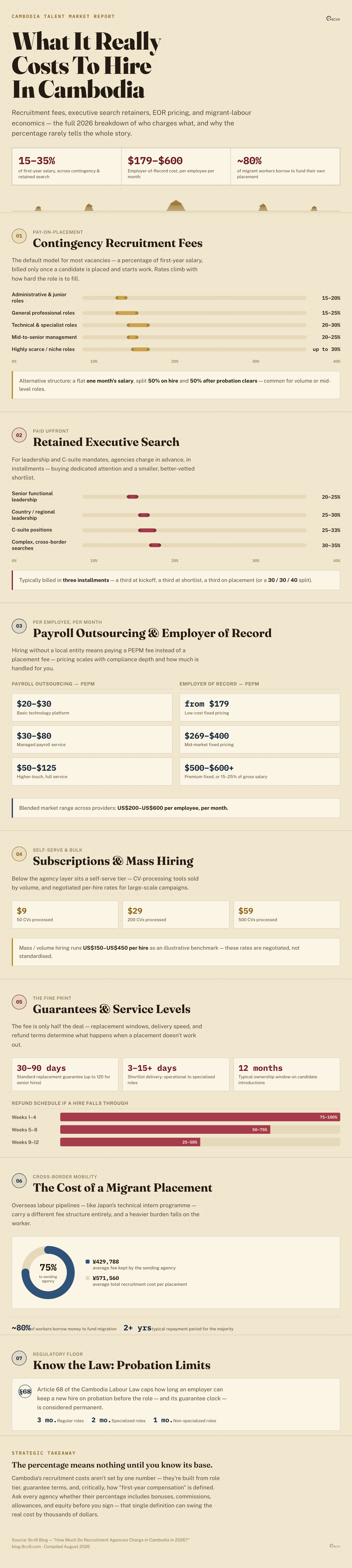
Contingency recruitment remains an important commercial model for professional hiring in Cambodia in 2026, particularly for mid-level, technical, sales, operational, and administrative positions. Under this success-based structure, the employer generally pays the recruitment agency only when a candidate is successfully hired. Cambodia-focused recruitment guidance describes contingency fees of approximately 15% to 30% of first-year salary, while individual agencies may use substantially different pricing structures.
The standard percentage-based calculation can be expressed as:
Contingency Recruitment Fee = Agreed First-Year Gross Salary × Recruitment Fee Percentage
However, employers should not assume that every recruitment agency in Cambodia calculates fees using annual salary. Published Cambodian market offerings demonstrate that some providers instead charge the equivalent of one month of salary, illustrating the diversity of commercial structures available.
| Recruitment Category | Indicative Fee Structure | Main Pricing Drivers |
|---|---|---|
| Administrative and Junior Roles | Approximately 15%–20% where percentage pricing applies | Candidate availability, hiring volume, screening requirements |
| General Professional Roles | Approximately 15%–25% | Experience, salary level and sourcing complexity |
| Technical and Specialist Roles | Approximately 20%–30% | Talent scarcity, technical assessment and passive sourcing |
| Mid-to-Senior Management | Approximately 20%–25% | Seniority, industry specialization and candidate availability |
| Highly Scarce or Critical Roles | Can approach 30% | Limited talent pools and intensive headhunting |
| Alternative Cambodia Pricing | One-month-salary models are also available | Agency commercial model and service scope |
Technical recruitment frequently sits toward the upper end of contingency pricing. Software development, engineering, data, cybersecurity, cloud infrastructure, and other difficult-to-source positions can require longer sourcing cycles, specialized screening, and direct approaches to passive candidates. Cambodia-focused market data places many technical recruitment arrangements around 20% to 25%, with particularly difficult searches potentially reaching 30%.
Fee Calculation and Remuneration Base
The definition of “gross salary” should be established before an agency begins the search. Depending on the recruitment agreement, fixed salary and guaranteed allowances may form part of the fee calculation, while performance-dependent bonuses, commissions, equity awards, and non-cash benefits may receive different treatment.
| Compensation Component | Typical Contract Treatment | Employer Action |
|---|---|---|
| Base Salary | Usually included | Confirm annualized amount |
| Fixed Allowances | Frequently included | Define eligible allowances |
| Guaranteed Bonuses | May be included | Specify treatment in agreement |
| Performance Bonuses | Often excluded or separately negotiated | Confirm before search begins |
| Sales Commissions | Usually requires separate definition | Establish calculation basis |
| Equity Compensation | Normally treated separately | Define valuation or exclusion |
| Non-Cash Benefits | Commonly excluded | Record exclusion contractually |
Employers should therefore compare recruitment proposals using the same remuneration definition. A quoted 18% fee based on total guaranteed compensation could ultimately cost more than a 20% fee calculated only on base salary.
Alternative Salary-Based Contingency Fees
Cambodia also demonstrates that contingency recruitment does not necessarily require percentage-based pricing. One published recruitment service charges the equivalent of one month of salary, with 50% payable upon hiring and the remaining 50% after probation. If the candidate fails the 90-day probation period, the second portion is not charged.
This creates materially different recruitment costs from a traditional annual-salary percentage model.
| Monthly Salary | Annual Salary | One-Month Fee | 20% Annual Salary Fee |
|---|---|---|---|
| US$500 | US$6,000 | US$500 | US$1,200 |
| US$1,000 | US$12,000 | US$1,000 | US$2,400 |
| US$1,500 | US$18,000 | US$1,500 | US$3,600 |
| US$2,500 | US$30,000 | US$2,500 | US$6,000 |
| US$4,000 | US$48,000 | US$4,000 | US$9,600 |
Consequently, employers comparing recruitment agencies in Cambodia in 2026 should evaluate the actual monetary cost rather than relying solely on headline percentages.
Replacement Guarantees and Contingency Risk
Replacement guarantees are another important component of contingency recruitment agreements. Published Cambodian recruitment services currently advertise replacement protection ranging from approximately 30 to 90 days, while another Cambodia-based provider includes a three-month probation warranty and provides defined refund protection when a candidate resigns within specified conditions.
| Commercial Provision | What Employers Should Verify |
|---|---|
| Payment Trigger | Offer acceptance, employment start date or another milestone |
| Fee Basis | Annual salary, monthly salary or guaranteed remuneration |
| Guarantee Period | Number of days or months covered |
| Candidate Resignation | Whether free replacement applies |
| Employer Termination | Circumstances covered by the guarantee |
| Failed Replacement | Whether credit or refund is available |
| Candidate Ownership | Period during which an introduction remains attributable to the agency |
| Duplicate Candidates | Rules where several agencies introduce the same person |
For Cambodian employers, the most appropriate contingency arrangement therefore depends on more than obtaining the lowest percentage. Candidate scarcity, position seniority, screening requirements, speed of delivery, replacement protection, and the precise definition of chargeable remuneration should all be considered when comparing recruitment agency fees in Cambodia in 2026.
2. Retained Executive Search Models
Retained executive search is generally used in Cambodia for senior, confidential, or business-critical appointments where ordinary contingency recruitment may not provide sufficient search depth. Typical assignments include Chief Executive Officers, Country Directors, Chief Financial Officers, Chief Technology Officers, Vice Presidents, functional heads, and highly specialized technical leaders.
Unlike contingency recruitment, retained search creates an exclusive and committed relationship between the employer and the executive search firm. Cambodia-focused executive search providers describe the model as particularly appropriate for highly qualified senior-level candidates and positions requiring comprehensive candidate evaluation and benchmarking.
Executive Search Fee Structure
Market benchmarks in 2026 generally position retained executive search at approximately 20% to 33% of first-year compensation, with major international firms commonly occupying the upper end of the range. Other published recruitment benchmarks place retained searches as high as approximately 35%, depending on the seniority, complexity, and search provider.
Cambodia-focused recruitment market estimates similarly place retained search for senior-level roles at approximately 25% to 35% of annual salary. These percentages should be treated as indicative commercial benchmarks rather than regulated Cambodian fee schedules.
| Executive Search Category | Indicative Fee Range | Typical Application |
|---|---|---|
| Senior Functional Leadership | Approximately 20%–25% | Department heads and senior specialists |
| Country and Regional Leadership | Approximately 25%–30% | Country Directors and General Managers |
| C-Suite Executive Search | Approximately 25%–33% | CEO, CFO, CTO, COO and equivalent positions |
| Highly Complex Executive Search | Approximately 30%–35% | Confidential, scarce or strategically critical appointments |
| Boutique Retained Search | Approximately 20%–25% globally | Specialized or growth-company mandates |
| Global Executive Search Firms | Approximately 25%–33% globally | Board, C-suite and multinational leadership searches |
Three-Stage Retained Search Payment Model
A three-installment payment structure is widely associated with retained executive search. Importantly, employers should not assume that every agency uses exactly the same milestone definitions.
A Cambodia-focused retained-search provider describes three payment stages: assignment of the search, the candidate reaching final interview, and the selected candidate accepting the position. Other 2026 industry benchmarks use signing, shortlist delivery, and successful placement as the three principal milestones.
| Payment Stage | Indicative Share | Typical Search Activity |
|---|---|---|
| Search Engagement | Approximately one-third | Search strategy, role profiling, research and market mapping |
| Candidate Milestone | Approximately one-third | Candidate assessment, shortlist or finalist presentation |
| Search Completion | Remaining balance | Appointment, offer acceptance or agreed completion milestone |
A Cambodia-focused market example also describes a 30% upfront, 30% shortlist, and 40% successful-placement structure for retained senior-level recruitment.
Retained Fee Calculation Example
Where the agency charges 30% of first-year compensation, the calculation can be illustrated as:
Retained Search Fee = First-Year Compensation × 30%
For an executive receiving US$100,000 in applicable first-year compensation:
Total Search Fee = US$100,000 × 30% = US$30,000
Under an equal three-stage arrangement, approximately US$10,000 would become payable at each contractual milestone.
| First-Year Executive Compensation | 25% Search Fee | 30% Search Fee | 33% Search Fee |
|---|---|---|---|
| US$40,000 | US$10,000 | US$12,000 | US$13,200 |
| US$60,000 | US$15,000 | US$18,000 | US$19,800 |
| US$80,000 | US$20,000 | US$24,000 | US$26,400 |
| US$100,000 | US$25,000 | US$30,000 | US$33,000 |
| US$150,000 | US$37,500 | US$45,000 | US$49,500 |
What the Retained Fee Typically Covers
Retained executive search commands a higher fee because the assignment normally extends substantially beyond advertising a vacancy and forwarding applications. Contemporary retained-search services commonly incorporate market mapping, passive-candidate outreach, qualification assessment, shortlist development, interview management, references, and offer support.
| Search Activity | Retained Executive Search |
|---|---|
| Executive role profiling | Typically included |
| Market and competitor mapping | Typically included |
| Passive candidate identification | Core component |
| Direct executive headhunting | Core component |
| Candidate qualification | Included |
| Leadership assessment | Frequently included |
| Candidate benchmarking | Frequently included |
| Shortlist preparation | Included |
| Interview management | Included |
| Reference checking | Frequently included |
| Offer negotiation support | Frequently included |
| Post-placement support | Depends on agreement |
Alternative Two-Stage Retained Search
Not every retained-search provider follows the traditional thirds model. Some firms use simplified payment arrangements in which 30% to 50% is payable when the search begins and the balance becomes payable at a later contractual milestone. A current 2026 retained-search provider, for example, reports kickoff payments ranging from 30% to 50%, with the remaining balance typically becoming due upon contract signature.
| Structure | Initial Payment | Intermediate Payment | Final Payment |
|---|---|---|---|
| Traditional Three-Stage | Approximately 30%–33% | Approximately 30%–33% | Remaining balance |
| 30/30/40 Model | 30% | 30% | 40% |
| Two-Stage Model | Approximately 30%–50% | None | Remaining balance |
| Negotiated Milestone Model | Contract-specific | Contract-specific | Contract-specific |
Retained Search Versus Contingency Recruitment
The principal difference is not simply the recruitment fee. Retained search purchases dedicated search capacity and a deeper research process, while contingency recruitment primarily transfers financial risk to the agency because payment normally depends on a successful hire.
| Factor | Contingency Recruitment | Retained Executive Search |
|---|---|---|
| Typical Target | Professional and mid-level roles | Senior leadership and C-suite |
| Upfront Payment | Usually none | Usually required |
| Agency Exclusivity | Often non-exclusive | Usually exclusive |
| Market Mapping | Limited to moderate | Extensive |
| Passive Headhunting | Varies | Core requirement |
| Candidate Benchmarking | Varies | Frequently comprehensive |
| Search Priority | Shared across assignments | Dedicated commitment |
| Payment | Primarily success-based | Milestone-based |
| Indicative Fee | Generally lower | Generally higher |
| Confidential Search | Possible | Particularly suitable |
Cambodia-based providers explicitly distinguish retained search through exclusivity, senior-level specialization, candidate benchmarking, and dedicated search commitment. Retained executive search is therefore most economically justified when the consequences of leaving a leadership position vacant, appointing the wrong executive, or exposing a confidential search are significantly greater than the additional recruitment fee.
3. Digital SaaS Subscriptions, RPO, and Flat-Fee Pricing
Cambodia’s recruitment market in 2026 is increasingly extending beyond traditional agency placement fees. Employers can now combine digital recruitment subscriptions, Applicant Tracking Systems, candidate databases, Recruitment Process Outsourcing, mass recruitment projects, and negotiated flat-fee arrangements.
This shift is particularly relevant for companies with recurring or high-volume hiring requirements because technology and outsourced recruitment models can provide more predictable recruitment capacity than repeatedly paying conventional percentage-based placement fees.
Digital Recruitment and SaaS Subscription Models
Digital recruitment platforms provide employers with direct access to job advertising, candidate databases, Applicant Tracking Systems, recruitment analytics, candidate screening, and other hiring technologies.
JobNet Cambodia, for example, operates a digital recruitment platform offering job postings, resume-database access, ATS functionality, Talent CRM capabilities, candidate matching, and recruitment analytics. Its commercial terms confirm that customers purchase products or subscriptions, with purchased credits generally expiring within 12 months and services remaining available according to the applicable subscription period.
| Digital Recruitment Service | Typical Commercial Structure | Employer Benefit |
|---|---|---|
| Job Posting Credits | Prepaid credit package | Flexible vacancy advertising |
| CV Database Access | Subscription or access package | Direct candidate sourcing |
| Applicant Tracking System | Subscription-based | Centralized applicant management |
| Talent CRM | Subscription or enterprise package | Development of reusable talent pools |
| AI Candidate Matching | Bundled with recruitment technology | Faster candidate identification |
| Recruitment Analytics | Platform or enterprise package | Hiring performance visibility |
| Employer Branding | Campaign or package pricing | Increased candidate attraction |
| Enterprise Recruitment Technology | Negotiated subscription | Multi-user and high-volume hiring support |
The Cambodian digital recruitment ecosystem is also becoming more sophisticated. By 2026, JobNet had introduced semantic AI candidate matching, enhanced employer dashboards, ATS candidate tracking, multi-user workflows, and AI-assisted job-description creation. Its platform reported more than 80,000 registered job seekers and more than 8,500 CV applications per month by April 2026.
SaaS Recruitment Pricing
Recruitment SaaS does not necessarily follow a single annual enterprise subscription model. Cambodian employers can encounter prepaid credits, fixed-duration subscriptions, usage-based packages, and customized enterprise contracts.
For example, another Cambodia-focused recruitment technology platform publicly lists credit packages from US$9 for processing up to 50 CVs, US$29 for up to 200 CVs, and US$59 for up to 500 CVs. This illustrates how technology-led recruitment pricing can scale according to actual candidate-processing requirements.
| SaaS Pricing Model | Cost Basis | Best Suited For |
|---|---|---|
| Pay-per-post | Number of vacancies | Occasional recruitment |
| Credit package | Number of postings or candidates processed | SMEs and intermittent hiring |
| Monthly subscription | Recurring platform access | Continuous recruitment |
| Annual subscription | Annual access and recruitment capacity | Established HR teams |
| Enterprise package | Negotiated features and usage | Large organizations |
| Usage-based model | CVs, searches or processing volume | Variable recruitment demand |
Recruitment Process Outsourcing
Recruitment Process Outsourcing represents a substantially broader service than purchasing access to recruitment software.
Under an RPO arrangement, an external provider assumes responsibility for some or substantially all of an employer’s recruitment operation. Cambodia-based RPO services currently cover dedicated talent acquisition personnel, candidate-database development, recruitment consulting, sourcing, candidate assessment, interview coordination, process reporting, offer management, and new-hire documentation.
| Recruitment Function | Traditional Agency | RPO Provider |
|---|---|---|
| Candidate Sourcing | Yes | Yes |
| Candidate Screening | Yes | Yes |
| Dedicated Recruitment Team | Usually no | Common |
| Interview Coordination | Frequently | Yes |
| Candidate Database Development | Limited | Core capability |
| Offer Management | Frequently | Yes |
| Recruitment Reporting | Varies | Structured |
| Hiring KPI Management | Limited | Core component |
| High-Volume Recruitment | Possible | Particularly suitable |
| End-to-End Recruitment Ownership | Limited | Available |
RPO Pricing Structures
RPO pricing in Cambodia is generally customized according to project scale rather than governed by a standard public fee schedule. Factors can include expected headcount, number of hiring locations, recruitment duration, seasonal demand, required recruiter capacity, job complexity, and overall labor costs.
A major Cambodia RPO provider states that recruitment and replacement costs can be incorporated into the agreed project scope rather than charged separately for every employee hired. Its broader outsourcing guidance similarly states that service charges depend on project size, scope, and total labor cost.
| RPO Pricing Structure | How It Works | Budget Characteristic |
|---|---|---|
| Fixed Project Fee | One negotiated amount for defined hiring scope | Highly predictable |
| Monthly Management Fee | Recurring payment for dedicated recruitment capacity | Predictable monthly expenditure |
| Per-Hire Fee | Agreed amount for each successful employee | Scales with hiring results |
| Hybrid RPO | Base management fee plus performance component | Balances capacity and results |
| Embedded Recruiter | Fee for dedicated recruitment personnel | Predictable resource cost |
| Customized Enterprise RPO | Negotiated end-to-end arrangement | Suitable for complex hiring programs |
Flat-Fee and Per-Head Volume Recruitment
Flat-fee recruitment can be particularly useful when employers need dozens or hundreds of workers within a defined period. Common applications include manufacturing expansion, retail openings, hospitality projects, sales-force development, customer-service operations, logistics facilities, and other workforce-intensive projects.
Cambodian recruitment providers explicitly offer mass recruitment for project-based requirements, business expansion, and short-term high-volume hiring. However, publicly available Cambodia-specific evidence does not establish US$150 to US$450 per hire as a universal market range. Employers should therefore treat such figures as indicative negotiating benchmarks rather than standardized Cambodian recruitment rates.
| Volume Hiring Model | Pricing Basis | Suitable Situation |
|---|---|---|
| Flat Fee Per Hire | Fixed amount for every placement | Standardized operational positions |
| Tiered Per-Hire Fee | Unit price decreases with volume | Large hiring campaigns |
| Fixed Project Fee | Total price for defined hiring target | New facilities or expansion |
| Monthly RPO | Recurring outsourced recruitment fee | Continuous high-volume hiring |
| Embedded Recruitment Team | Dedicated recruiters for agreed period | Sustained recruitment demand |
| Hybrid Model | Fixed project fee plus performance payment | Complex recruitment campaigns |
Economics of High-Volume Recruitment
The commercial advantage of RPO and flat-fee recruitment becomes clearer as hiring volume increases.
An employer recruiting 100 operational employees through conventional percentage-based placement fees could face substantial and variable expenditure. A negotiated volume arrangement instead allows the employer to establish a clearer cost-per-hire target and forecast the total recruitment budget before the campaign begins.
| Hiring Volume | Illustrative US$150 Per Hire | Illustrative US$300 Per Hire | Illustrative US$450 Per Hire |
|---|---|---|---|
| 25 Employees | US$3,750 | US$7,500 | US$11,250 |
| 50 Employees | US$7,500 | US$15,000 | US$22,500 |
| 100 Employees | US$15,000 | US$30,000 | US$45,000 |
| 250 Employees | US$37,500 | US$75,000 | US$112,500 |
| 500 Employees | US$75,000 | US$150,000 | US$225,000 |
These figures are illustrative scenarios rather than published standard Cambodia market prices. Actual RPO and mass-recruitment quotations are generally negotiated according to scope.
Choosing Between SaaS, Flat-Fee Recruitment, and RPO
The optimal commercial model depends largely on whether the employer wants recruitment technology, successful placements, or an outsourced recruitment function.
| Employer Requirement | Suitable Model | Primary Advantage |
|---|---|---|
| Occasional vacancies | Job posting credits | Low commitment |
| Internal recruitment team needing candidates | CV database subscription | Direct sourcing |
| Improving recruitment administration | ATS or Talent CRM | Greater efficiency |
| Small recurring hiring program | SaaS subscription | Predictable technology cost |
| Multiple identical vacancies | Flat fee per hire | Predictable unit economics |
| New store or facility opening | Mass recruitment project | Rapid workforce creation |
| Continuous large-scale hiring | RPO | Dedicated recruitment capacity |
| Multi-location expansion | RPO or project recruitment | Centralized hiring management |
| Complete recruitment outsourcing | End-to-end RPO | Reduced internal HR workload |
For Cambodian employers in 2026, digital recruitment subscriptions, RPO, and flat-fee hiring provide important alternatives to conventional contingency recruitment. SaaS platforms are particularly suitable when organizations retain internal recruitment capabilities, while RPO becomes more attractive when hiring volumes are sufficiently large to justify dedicated external recruitment resources. Flat-fee and per-head models occupy the middle ground, giving employers greater cost predictability for standardized, high-volume recruitment campaigns.
4. Co-Sourced Employer of Record and Payroll Outsourcing Pricing
Employer of Record and payroll outsourcing services have become important components of Cambodia’s recruitment and workforce-services market in 2026, particularly for foreign companies entering the country, regional businesses managing small Cambodian teams, and organizations that want to outsource employment administration.
An Employer of Record arrangement enables a foreign organization to hire employees in Cambodia without first establishing its own local employing entity. The EOR becomes the legal employer while the client generally retains responsibility for the employee’s day-to-day work, performance, and operational management. Cambodia-focused EOR services typically cover employment contracts, payroll processing, salary-tax withholding, National Social Security Fund administration, statutory filings, onboarding, leave administration, and employment compliance.
Payroll Outsourcing Versus Employer of Record
Payroll outsourcing and EOR services should not be treated as interchangeable. Payroll outsourcing generally assumes that the client already operates an appropriate Cambodian legal entity, whereas an EOR supplies the employing infrastructure required when the foreign company does not have its own local entity.
| Service Area | Payroll Outsourcing | Employer of Record |
|---|---|---|
| Local Entity Required | Generally yes | No |
| Payroll Calculation | Included | Included |
| Payslip Administration | Included | Included |
| Salary Tax Processing | Typically included | Included |
| NSSF Administration | Typically included | Included |
| Employment Contract | Client responsibility or supported | EOR manages compliant contract |
| Legal Employer | Client | EOR provider |
| HR Compliance Support | Varies | Core service |
| Onboarding Administration | Varies | Usually included |
| Termination Administration | Usually limited | Usually supported |
| Pricing Structure | PEPM or recurring payroll fee | PEPM, percentage or customized fee |
| Best Application | Established Cambodian operation | Foreign company without local entity |
Payroll Outsourcing Pricing
Cambodia payroll outsourcing pricing varies considerably according to headcount, payroll complexity, reporting requirements, benefits, overtime calculations, payroll frequency, and the degree of statutory administration included.
Current published benchmarks show that basic global payroll technology can start around US$23 to US$29 per employee per month, while more comprehensive Cambodia-focused outsourced payroll estimates can reach approximately US$30 to US$80 PEPM or higher. One Cambodia entity-cost analysis estimates outsourced payroll arrangements at approximately US$50 to US$125 PEPM.
Therefore, a US$4 to US$25 PEPM assumption may be achievable for basic or highly scaled payroll technology in some markets, but it should not be presented as the standard Cambodia-wide price for fully managed payroll outsourcing.
| Payroll Service Level | Indicative 2026 Pricing Approach | Typical Scope |
|---|---|---|
| Basic Payroll Technology | Approximately US$20–US$30 PEPM starting benchmarks | Payroll platform and basic processing |
| Managed Payroll | Approximately US$30–US$80 PEPM indicative | Processing, reporting and compliance support |
| Higher-Touch Local Payroll | Can reach US$50–US$125 PEPM | More comprehensive administration |
| Enterprise Payroll | Negotiated | High headcount, integrations and custom reporting |
| Complex Payroll | Customized | Bonuses, shifts, overtime and multiple allowances |
Employer of Record Pricing in Cambodia
Current Cambodia-specific EOR pricing indicates that fixed monthly PEPM pricing is increasingly common.
Published 2026 Cambodia rates include approximately US$179, US$299, US$399, US$400, US$559 and US$599 per employee per month depending on provider and service configuration. Another Cambodia-focused source characterizes the broader market at approximately US$200 to US$600 PEPM.
Percentage-based arrangements also exist. Cambodia payroll and EOR market guidance places some EOR arrangements at approximately 15% to 25% of gross salary. Consequently, the proposed 8% to 15% range should not be treated as a universal Cambodia market benchmark.
| EOR Pricing Model | Indicative 2026 Benchmark | Commercial Characteristic |
|---|---|---|
| Low-Cost Fixed PEPM | From approximately US$179 | Technology-led or streamlined service |
| Mid-Market Fixed PEPM | Approximately US$269–US$400 | Common fixed-fee positioning |
| Premium Fixed PEPM | Approximately US$500–US$600+ | Higher-touch global EOR service |
| Percentage-Based EOR | Approximately 15%–25% in some market estimates | Cost increases with salary |
| Enterprise EOR | Negotiated | Volume discounts and customized services |
Illustrative EOR Cost Comparison
Fixed PEPM and percentage-based EOR pricing behave differently as employee salaries increase.
| Monthly Gross Salary | US$299 Fixed EOR | US$399 Fixed EOR | 15% of Payroll | 20% of Payroll |
|---|---|---|---|---|
| US$500 | US$299 | US$399 | US$75 | US$100 |
| US$1,000 | US$299 | US$399 | US$150 | US$200 |
| US$1,500 | US$299 | US$399 | US$225 | US$300 |
| US$2,500 | US$299 | US$399 | US$375 | US$500 |
| US$4,000 | US$299 | US$399 | US$600 | US$800 |
| US$6,000 | US$299 | US$399 | US$900 | US$1,200 |
This comparison demonstrates why fixed PEPM arrangements can become increasingly attractive for higher-paid professionals and executives, while percentage-based pricing can be economical for lower-salary employees.
What the EOR Management Fee Typically Covers
A Cambodia EOR fee should be distinguished from the employee’s salary and statutory employment costs. Current providers generally charge the management fee separately while passing salary and statutory employer obligations through to the client.
| EOR Service Component | Typical Inclusion |
|---|---|
| Local Legal Employment | Included |
| Employment Contract Preparation | Included |
| Employee Onboarding | Included |
| Monthly Payroll | Included |
| Salary Tax Withholding | Included |
| NSSF Registration and Administration | Included |
| Statutory Filing Support | Included |
| Leave Administration | Usually included |
| HR Compliance Monitoring | Included |
| Contract Amendments | Usually included |
| Termination Administration | Usually included |
| Employee HR Support | Frequently included |
| Recruitment | May be separate or bundled |
| Private Benefits | Often additional |
| Work Permit Support | Provider-dependent |
EOR Pricing Variables
Employers should compare the complete commercial proposal rather than the advertised starting fee. Pricing can change according to employee numbers, compensation structure, benefits administration, payroll complexity, industry requirements, contract duration, and required compliance support.
| Pricing Variable | Potential Effect on Cost |
|---|---|
| Employee Headcount | Volume discounts may reduce PEPM |
| Employee Salary | Important under percentage pricing |
| Payroll Complexity | Can increase administration charges |
| Bonuses and Allowances | Additional calculation requirements |
| Benefits Administration | May increase monthly cost |
| Foreign Employees | Work permit support may add fees |
| Contract Duration | Annual commitments may receive discounts |
| Onboarding | May attract one-time setup charges |
| Termination | Some providers may charge additional fees |
| Currency Conversion | FX margins can affect total expenditure |
| Deposit Requirements | May increase initial cash requirement |
Commercial Engagement Benchmarks for Cambodia in 2026
Recruitment, RPO, payroll, and EOR pricing should ultimately be viewed as separate layers of Cambodia’s HR services market. Based on available 2026 market evidence, a more defensible consolidated framework is:
| Commercial Engagement Tier | Typical Employee Profile | Primary Pricing Mechanism | Indicative 2026 Benchmark | Typical Billing Structure |
|---|---|---|---|---|
| Operational and Support Recruitment | Junior and operational employees | Contingency or flat fee | Negotiated placement or volume fee | Usually success-based |
| Professional Recruitment | Skilled professional employees | Contingency search | Approximately 15%–25% of annual salary where percentage pricing applies | Usually upon successful hire |
| Senior Technical and Management | Scarce specialists and managers | Contingency, exclusive or hybrid | Approximately 20%–30% depending on search difficulty | Success or milestone-based |
| Executive Search | C-suite, GM and senior leadership | Retained search | Approximately 25%–35% indicative | Commonly milestone-based |
| Mass Recruitment / RPO | High-volume operational workforce | Project, per-hire or recurring RPO | Customized according to scope and volume | Project milestones or recurring fee |
| Payroll Outsourcing | Employees of existing Cambodian entity | PEPM or subscription | Approximately US$20–US$80+ PEPM depending on service depth | Monthly |
| Employer of Record | Local or expatriate employees without client entity | Fixed PEPM or percentage | Approximately US$179–US$599+ PEPM in current published offerings | Monthly |
| Percentage-Based EOR | Employees without client entity | Percentage of gross payroll | Approximately 15%–25% in some market estimates | Monthly |
The distinction between recruitment, payroll outsourcing, and Employer of Record services is especially important for foreign investors budgeting for Cambodia in 2026. Recruitment primarily addresses talent acquisition; payroll outsourcing manages employees already employed through the client’s local structure; and EOR services provide the legal employment infrastructure required to employ Cambodian personnel without establishing a local entity.
For smaller foreign teams and companies testing the Cambodian market, EOR can therefore provide faster market entry and predictable monthly administration costs. As local headcount expands, companies should periodically compare the cumulative EOR expense against establishing their own Cambodian entity and moving employees to conventional outsourced or internally managed payroll.
5. Service Level Agreements, Guarantee Periods, and Risk Mitigation
Recruitment agency Service Level Agreements in Cambodia in 2026 increasingly function as measurable performance frameworks covering shortlist delivery, candidate screening, communication standards, replacement guarantees, and post-placement support.
However, employers should distinguish between Cambodian market practices, individual agency commitments, and contractual provisions used internationally. There is no universal Cambodian regulation requiring every recruitment agency to provide a specific shortlist timeline, 90-day guarantee, refund schedule, or candidate-ownership period. These protections are primarily commercial terms negotiated between the agency and employer.
Delivery Milestones and Sourcing Timelines
Candidate-delivery timelines vary according to role complexity. Current Cambodia-focused providers advertise qualified shortlists within approximately three to seven business days for many searches. One Cambodian HR provider promises an initial shortlist within three to five days, with certain service levels targeting 48 to 72 hours, while another Cambodia-focused headhunting service advertises three to seven business days.
Highly specialized technical and executive searches may reasonably require longer because they involve market mapping, passive candidate outreach, assessment, compensation discussions, and potentially confidential approaches.
| Recruitment Assignment | Indicative Shortlist Target | Main Timeline Drivers |
|---|---|---|
| Operational / Administrative | 3–5 business days | Candidate availability and screening volume |
| General Professional | 3–7 business days | Experience and salary requirements |
| Specialized Technical | 5–15+ business days | Scarcity and assessment complexity |
| Senior Management | 7–15+ business days | Passive sourcing and candidate availability |
| Executive Search | Assignment-specific | Market mapping, confidentiality and executive assessment |
| Mass Recruitment | Project milestones | Headcount, locations and hiring ramp |
These should be treated as indicative SLA targets rather than statutory Cambodia-wide requirements.
Candidate Vetting Standards
Recruitment agencies can also differentiate their services through the depth of candidate assessment.
Cambodia-based recruitment services currently advertise end-to-end processes incorporating sourcing, screening, interviews, reference checks, offer negotiation, competency interviews, scenario assessments, language checks, candidate scorecards, and post-hire follow-up.
| Vetting Component | Basic Recruitment | Comprehensive Recruitment SLA |
|---|---|---|
| CV Screening | Included | Included |
| Recruiter Interview | Usually included | Structured competency interview |
| Employment History Review | Basic | Detailed verification |
| Skills Assessment | Limited | Role-specific where appropriate |
| Identity Verification | Provider-dependent | Can be contractually required |
| Academic Verification | Provider-dependent | Can be contractually required |
| Professional References | Varies | Recommended for critical positions |
| Candidate Scorecard | Uncommon | Increasingly used |
| Compensation Validation | Basic | Detailed |
| Offer Management | Varies | Included in end-to-end service |
Cambodian institutional recruitment procedures also demonstrate the importance of references: NCDD recruitment guidance requires at least two satisfactory references before final appointment and recommends contacting referees directly where possible.
Replacement Guarantee Periods
Replacement guarantees protect employers when a successfully placed employee leaves within an agreed period.
Cambodia-specific agency offerings demonstrate considerable variation. Current providers advertise guarantees ranging from approximately 30 to 90 days, three months, and up to 120 days depending on the provider and service arrangement.
| Recruitment Category | Indicative Guarantee Structure | Market Interpretation |
|---|---|---|
| General Placement | 30–90 days | Common Cambodia-focused offering |
| Professional Placement | Approximately 90 days frequently available | Often aligned with probation |
| Premium Headhunting | Up to approximately 120 days from some providers | Enhanced commercial protection |
| Executive Search | Negotiated, potentially longer | Depends heavily on agency contract |
| Mass Recruitment | Project-specific | May use replacement pools or service credits |
The frequently used three-month guarantee has a logical connection with Cambodian employment practices. Article 68 of Cambodia’s Labour Law states that probation cannot exceed three months for regular employees, two months for specialized workers, and one month for non-specialized workers.
The recruitment guarantee itself, however, is a contractual commercial protection rather than a statutory requirement created by Article 68.
Warranty Conditions and Exclusions
Recruitment guarantees normally contain conditions that determine whether an employer qualifies for a free replacement.
Common recruitment-contract practices require invoices to have been paid according to the agreed terms and the employer to notify the agency promptly when employment ends. Guarantees frequently exclude redundancies, restructuring, material changes to the position, and other employer-driven circumstances.
| Warranty Condition | Typical Contract Treatment |
|---|---|
| Candidate resigns voluntarily | Frequently covered |
| Candidate proves unsuitable | Frequently covered |
| Performance-related termination | Frequently covered subject to conditions |
| Redundancy | Commonly excluded |
| Organizational restructuring | Commonly excluded |
| Position eliminated | Commonly excluded |
| Material job-description change | Commonly excluded |
| Employer relocates position | May be excluded |
| Compensation reduced after hiring | May invalidate protection |
| Invoice remains unpaid | Frequently invalidates guarantee |
| Employer breaches employment agreement | Normally excluded |
| Guarantee period expires | No replacement obligation |
Employers should therefore review the actual guarantee clause rather than assuming that a “90-day guarantee” protects against every reason for termination.
Replacement Process
A strong SLA should also specify what happens after a guarantee is triggered.
International recruitment terms demonstrate structures requiring written notification within seven days and commencement of another search under the original terms. Other agreements provide approximately 45 to 60 days for the agency to identify a replacement.
| Replacement Stage | Recommended SLA Definition |
|---|---|
| Employer Notification | Written notification within defined period |
| Agency Acknowledgement | 1–5 business days |
| Replacement Search Start | Immediately or within agreed SLA |
| Replacement Job Specification | Same or substantially equivalent role |
| Replacement Search Period | Contractually defined |
| Higher Replacement Salary | Incremental fee may apply |
| Successful Replacement | No additional placement fee where guarantee applies |
| Failed Replacement | Credit, refund or other negotiated remedy |
Importantly, Cambodian law does not impose a general rule requiring recruitment agencies to provide exactly one free replacement. The number of replacements and applicable remedies depend on the service agreement.
Financial Credits and Pro-Rata Refunds
Refunds should similarly be treated as contractual rather than standardized Cambodian requirements.
Recruitment agreements internationally demonstrate several approaches. Some provide only a replacement or credit note, while others use sliding refund percentages according to how quickly employment ends. Examples include 100%, 75%, and 50% credit bands over a 12-week period, while another model provides 75%, 50%, and 25% refunds across the first 90 days.
An illustrative framework could therefore look like this:
| Employee Departure Period | Illustrative Refund / Credit | Agency Fee Retained |
|---|---|---|
| Weeks 1–4 | 75%–100% | 0%–25% |
| Weeks 5–8 | 50%–75% | 25%–50% |
| Weeks 9–12 | 25%–50% | 50%–75% |
| After Warranty | Normally 0% | 100% |
This matrix represents an illustrative contractual structure rather than a standardized Cambodia recruitment-agency refund schedule.
Replacement Versus Refund Models
| Risk-Mitigation Model | Employer Receives | Primary Advantage |
|---|---|---|
| Free Replacement | Another search at no placement fee | Restores hiring outcome |
| Credit Note | Credit toward replacement/future recruitment | Preserves recruitment expenditure |
| Pro-Rata Refund | Percentage of original fee returned | Direct financial recovery |
| Extended Warranty | Longer replacement protection | Useful for senior hires |
| Hybrid Guarantee | Replacement first, credit/refund if unsuccessful | Stronger employer protection |
Candidate Introduction and Ownership Periods
Candidate ownership clauses are another important feature of recruitment agreements. The purpose is to protect an agency when it introduces a candidate who is subsequently hired outside the original recruitment process.
Twelve-month introduction periods are widely used in recruitment contracts. Examples specify that a fee remains payable when an introduced candidate is hired directly, through another agency, by a related company, or following an indirect introduction within the contractual ownership period.
| Candidate Scenario | Typical Contractual Outcome |
|---|---|
| Client immediately hires introduced candidate | Placement fee payable |
| Client rejects candidate but hires later | Fee may remain payable during ownership period |
| Candidate applies directly later | Fee may remain payable |
| Another agency subsequently represents candidate | Original introduction clause may apply |
| Related company hires candidate | Fee may apply depending on agreement |
| Candidate hired after ownership expires | Usually no introduction fee under that clause |
| Candidate was already known to employer | Contract should define notification procedure |
It is more accurate to describe this provision as an “introduction ownership” or “fee-protection period” rather than stating that candidates themselves are agency intellectual property. Candidates remain individuals who control their own employment decisions.
Third-Party Candidate Introductions
Agency agreements commonly prohibit clients from forwarding introduced candidate information to third parties without authorization.
If a third-party referral results in employment during the ownership period, recruitment agreements can make the original client liable for the placement fee. Twelve-month protection periods appear frequently in published agency terms.
| Introduction Event | Potential Fee Exposure |
|---|---|
| Direct employment by client | Full placement fee |
| Employment by subsidiary | Potential full fee |
| Employment by parent company | Potential full fee |
| Candidate forwarded to business partner | Potential liability if subsequently hired |
| Candidate hired through another recruiter | Original introduction provisions may apply |
| Candidate hired after contractual protection expires | Normally outside ownership provision |
Offer Withdrawal and Cancellation Protection
Agencies may also protect themselves against employers withdrawing an accepted offer after substantial recruitment work has been completed.
There is no universal Cambodian rule requiring a cancellation charge equal to exactly 50% of the placement fee. Instead, cancellation charges should be expressly established in the recruitment agreement.
| Offer Situation | Recommended Contract Treatment |
|---|---|
| Candidate rejects offer | Normally no contingency placement fee |
| Employer withdraws before acceptance | Define whether administrative/search fee applies |
| Employer withdraws after acceptance | Cancellation fee may apply |
| Position cancelled during retained search | Retainer typically remains subject to contract |
| Start date repeatedly delayed | Define agency and candidate remedies |
| Salary materially changed | Establish responsibility for failed placement |
Recommended Recruitment SLA Framework for Cambodia in 2026
Employers can reduce recruitment risk by converting broad agency promises into measurable contractual obligations.
| SLA Category | Recommended Contract Definition |
|---|---|
| Shortlist Delivery | Number of business days |
| Shortlist Quality | Minimum candidate qualification criteria |
| Screening | Required recruiter assessment |
| Verification | Identity, qualifications and employment checks where required |
| References | Number and type of professional references |
| Communication | Update frequency and response times |
| Interview Coordination | Scheduling responsibilities |
| Replacement Period | Exact number of calendar days |
| Replacement Trigger | Eligible departure circumstances |
| Replacement Deadline | Time allowed to find replacement |
| Failed Replacement | Refund, credit or alternative remedy |
| Candidate Ownership | Exact introduction-protection period |
| Duplicate Candidates | Procedure for competing introductions |
| Third-Party Referrals | Fee-liability provisions |
| Offer Withdrawal | Applicable cancellation charge |
| Post-Placement Support | Defined follow-up schedule |
For recruitment agencies in Cambodia in 2026, the strongest SLA is therefore not necessarily the agreement offering the longest guarantee. Employers should evaluate the complete combination of shortlist speed, candidate quality, verification standards, replacement conditions, financial remedies, candidate-introduction rules, and exclusions. Crucially, commercial provisions such as 90-day warranties, 12-month candidate-introduction periods, refund scales, notification deadlines, and cancellation fees should be expressly documented rather than assumed to be mandatory Cambodian industry standards.
6. Cross-Border Talent Mobility, Labour Quotas, and Migrant Placement
Cambodia’s recruitment ecosystem in 2026 extends beyond domestic hiring into two distinct cross-border talent markets: outbound placement of Cambodian workers into overseas labour markets and inbound recruitment of foreign executives, specialists, and technical professionals.
These activities operate under substantially different commercial and regulatory frameworks. Outbound migration raises issues involving recruitment fees, worker debt, ethical recruitment, bilateral labour agreements, and licensed sending agencies. Inbound recruitment is more heavily influenced by Cambodia’s foreign-worker quotas, work permits, employment cards, visas, and employer compliance obligations.
Outbound Migrant Recruitment from Cambodia
Cambodian workers have historically migrated to destinations including Thailand, Japan, South Korea, and Malaysia. Recruitment channels can include government-to-government programs, licensed private recruitment agencies, bilateral arrangements, and other authorized labour-migration mechanisms.
Recruitment costs remain an important policy concern. International Labour Organization research has found that migrant workers can remain responsible for substantial recruitment and migration costs despite international efforts to shift those expenses away from workers. High recruitment costs financed through borrowing can increase vulnerability to debt bondage, exploitation, and forced labour.
| Cross-Border Recruitment Issue | Commercial or Compliance Significance |
|---|---|
| Recruitment Agency Fee | Can materially increase migration costs |
| Training | Particularly relevant for Japan-bound workers |
| Documentation | Passports, permits and other required documents |
| Transportation | Domestic and international travel expenses |
| Medical Examination | May be required by destination market |
| Visa / Entry Processing | Depends on destination-country rules |
| Worker Borrowing | Increases financial vulnerability |
| Informal Brokers | Creates transparency and compliance risks |
| Employer-Pays Recruitment | Reduces worker-funded migration costs |
Japan Technical Intern Recruitment Costs
Historical survey evidence demonstrates the scale of recruitment costs faced by some Cambodian workers entering Japan under the Technical Intern Training Program.
Japanese immigration survey data reported average total pre-departure payments of JPY 571,560 for Cambodian technical interns. Comparable averages were JPY 287,405 for workers from Myanmar and JPY 656,014 for Vietnamese workers.
| Worker Origin | Average Reported Pre-Departure Cost |
|---|---|
| Cambodia | JPY 571,560 |
| Myanmar | JPY 287,405 |
| Vietnam | JPY 656,014 |
| Indonesia | JPY 231,412 |
| Philippines | JPY 94,191 |
The Cambodian figure included an average sending-agency component of approximately JPY 429,788 and pre-departure education costs of approximately JPY 109,144.
Debt Exposure Among Cambodian Migrant Workers
The economic consequences extend beyond the headline recruitment charge. Regional research found that approximately 80% of surveyed Cambodian and Vietnamese workers borrowed money to finance migration costs. More than 80% of Cambodian respondents expected repayment to take two years or longer.
| Migration Cost Indicator | Cambodian Worker Evidence |
|---|---|
| Average Japan-related cost | JPY 571,560 |
| Workers borrowing to finance costs | Approximately 80% in cited survey |
| Expected debt repayment of 2+ years | More than 80% of Cambodian respondents |
| Principal risk | Debt burden before overseas earnings begin |
| Recruitment implication | Strong case for lower-cost and employer-funded recruitment |
These figures describe historical survey findings rather than mandatory recruitment prices in Cambodia in 2026. The International Labour Organization reported in 2024 that excessive recruitment fees, illicit brokers, and insufficient access to remedies remained concerns for Cambodian workers migrating to Japan.
Transition Toward Employer-Pays Recruitment
International fair-recruitment standards increasingly support a “worker-pays-nothing” approach. The International Labour Organization’s fair recruitment principles state that workers should not be charged, directly or indirectly, recruitment fees or related recruitment costs.
This creates an important distinction between historical worker-funded migration practices and the direction of responsible recruitment policy.
| Recruitment Cost Model | Worker-Pays Model | Employer-Pays Model |
|---|---|---|
| Agency Recruitment Fee | Worker | Employer |
| Placement Costs | Primarily worker | Employer |
| Migration Debt Risk | Higher | Lower |
| Worker Financial Exposure | High | Significantly reduced |
| Forced-Labour Risk Indicator | Higher where debt becomes excessive | Lower |
| Cost Transparency | Frequently problematic | More auditable |
| ESG Alignment | Weaker | Stronger |
| Ethical Recruitment Alignment | Limited | Strong |
For multinational employers and recruitment agencies, employer-funded recruitment is consequently becoming an important responsible-sourcing and workforce-governance consideration.
Cambodia-Thailand Recruitment and MOU Channels
Cambodia and Thailand maintain formal bilateral labour-migration arrangements designed to facilitate legal employment and improve worker protections. The governments renewed their employment cooperation arrangements in 2023, including provisions concerning worker documentation, health examinations, information sharing, and regular migration channels.
A frequently cited historical Cambodian directive established a US$49 package for workers migrating legally to Thailand. The published breakdown was US$10 for a worker card, US$4 for a passport, US$15 covering transportation and food, and US$20 associated with the Thai-side labour document.
| Historical Cambodia-Thailand Cost Component | Published Amount |
|---|---|
| Worker Card | US$10 |
| Passport | US$4 |
| Transportation and Food | US$15 |
| Thai-Side Labour Document | US$20 |
| Total | US$49 |
The US$49 figure dates from a 2014 directive and should therefore not be presented as a confirmed statutory 2026 fee schedule. Employers and recruitment agencies should verify current government charges and bilateral procedures before budgeting for new deployments.
Inbound Expatriate and Foreign Talent Recruitment
The other side of Cambodia’s cross-border recruitment market involves foreign professionals entering Cambodia.
Foreign executives and technical specialists remain important in sectors where employers cannot obtain the necessary expertise locally. However, recruiting a foreign candidate does not automatically give that individual authorization to work. Employers must separately comply with Cambodia’s foreign-worker quota and work-permit framework.
Foreign Employee Quota in Cambodia for 2026
Cambodia continues to apply a standard foreign-worker quota equivalent to a maximum of 10% of the employer’s Cambodian workforce.
For the 2026 quota year, the standard allocation remains divided into three categories: 3% office employees, 6% skilled workers, and 1% unskilled workers.
| Foreign Worker Category | Standard Maximum Allocation |
|---|---|
| Office Employees | 3% |
| Skilled Workers | 6% |
| Unskilled Workers | 1% |
| Total Standard Foreign Workforce Quota | 10% |
The denominator is important. Current 2026 legal guidance describes the calculation in relation to the employer’s Cambodian workforce rather than simply stating that foreigners may comprise 10% of total company headcount.
Foreign Quota Exemptions
The 10% framework is not necessarily an absolute ceiling.
Cambodia’s Prakas No. 277/20 permits employers experiencing difficulty recruiting sufficient qualified Cambodian employees to request permission to exceed the standard foreign-worker quota. Approval remains subject to the Ministry of Labour and Vocational Training.
| Hiring Situation | Standard Compliance Route |
|---|---|
| Foreign hiring within quota | Standard annual quota application |
| Foreign hiring above 10% | Special approval required |
| Scarce technical expertise unavailable locally | Potential basis for additional quota request |
| New foreign employee | Work authorization still required |
| Existing foreign employee | Annual compliance requirements continue |
| Company hiring no foreign workers | Foreign-worker quota generally not relevant |
For recruitment agencies sourcing expatriate professionals, quota availability should therefore be assessed early in the search process. Finding an exceptional foreign candidate provides limited value if the employer subsequently cannot obtain authorization to employ that individual.
Foreign Worker Centralized Management System
Cambodia manages foreign-worker compliance through the Foreign Workers Centralized Management System.
Employers intending to hire or continue employing foreign nationals during 2026 were required to apply for their 2026 foreign employee quota by the end of November 2025. Companies commencing operations after that deadline can follow the applicable procedures after commencing operations.
| Compliance Stage | Primary Responsibility |
|---|---|
| Determine Foreign Hiring Need | Employer |
| Verify Available Quota | Employer / HR provider |
| Submit Annual Quota Application | Employer |
| Request Excess Quota if Required | Employer |
| Candidate Immigration Documentation | Employer, employee and service provider |
| Work Permit Application | Foreign employee / sponsoring employer process |
| Employment Card / Worker Documentation | Required under applicable rules |
| Annual Renewal | Employer and foreign worker |
| Compliance Monitoring | Employer |
Work Permits and Employment Cards
Cambodian labour law requires foreign nationals legally working in the country to hold appropriate work authorization. Cambodia’s investment guidance confirms that foreign employees must possess valid work permits or employment cards as well as valid passport or residence documentation.
Current 2026 compliance guidance also states that foreign nationals entering Cambodia for employment must apply for their work permit and foreign worker documentation through the centralized management system within 90 days of entering the country.
| Foreign Worker Requirement | 2026 Compliance Position |
|---|---|
| Employer Foreign-Worker Quota | Required where applicable |
| Passport | Required |
| Appropriate Immigration Status | Required |
| Work Permit | Required |
| Employment / Foreign Worker Documentation | Required |
| FWCMS Registration | Used for foreign-worker administration |
| Annual Compliance | Required |
| Excess-Quota Approval | Required when standard quota is exceeded |
Recruitment Agency Compliance Matrix for Foreign Professionals
Recruitment agencies handling expatriate searches can create greater value by integrating candidate sourcing with immigration and workforce-compliance planning.
| Recruitment Stage | Talent Requirement | Compliance Requirement |
|---|---|---|
| Role Definition | Determine required foreign expertise | Check whether local talent is reasonably available |
| Candidate Search | Source international candidates | Review employer quota position |
| Shortlisting | Assess professional qualifications | Identify immigration constraints |
| Final Selection | Confirm compensation and availability | Confirm foreign-worker eligibility |
| Offer | Negotiate employment package | Coordinate immigration documentation |
| Pre-Employment | References and credentials | Work authorization preparation |
| Onboarding | Relocation and commencement | Work permit and employment compliance |
| Employment | Ongoing candidate support | Annual permit and quota compliance |
Cross-Border Recruitment Risk Matrix
| Risk Area | Outbound Cambodian Workers | Inbound Foreign Professionals |
|---|---|---|
| Excessive Recruitment Fees | High concern | Lower concern |
| Worker Debt | Significant potential risk | Generally lower |
| Informal Brokers | Important compliance risk | Possible but less prominent |
| Bilateral Labour Rules | Highly relevant | Limited |
| Employer-Pays Principle | Increasingly important | Common commercial structure |
| Immigration Compliance | Destination country | Cambodia |
| Foreign Worker Quota | Not applicable | Critical |
| Work Permit | Destination-country requirement | Cambodia requirement |
| Ethical Recruitment | Critical | Important |
| Recruitment Agency Due Diligence | Critical | Critical |
For Cambodia’s recruitment industry in 2026, cross-border talent mobility therefore requires considerably more than candidate sourcing. Outbound recruitment increasingly demands transparent, ethical, and lower-cost migration pathways that reduce worker-paid fees and debt exposure. Inbound foreign recruitment requires employers and agencies to integrate talent acquisition with Cambodia’s 10% standard foreign-worker quota, annual quota procedures, work permits, and centralized foreign-worker administration.
The strongest recruitment providers operating across borders are consequently those capable of combining talent sourcing with documented fee transparency, migration compliance, worker protection, employer due diligence, and accurate management of Cambodia’s foreign-employment requirements.
7. Regulatory Compliance, Statutory Labour Costs, and Professional Advisory Pricing
Recruitment expenditure in Cambodia in 2026 extends beyond the agency placement fee. Employers must account for employment-contract requirements, working-time rules, paid leave, National Social Security Fund contributions, salary-tax withholding, and potentially professional legal or HR advisory costs.
These statutory obligations affect the true cost of hiring and should therefore be incorporated into recruitment budgets, compensation benchmarking, payroll planning, and Employer of Record comparisons.
Cambodian Employment Contract Structures
Cambodian labour law distinguishes principally between Fixed Duration Contracts and Undetermined Duration Contracts. A Fixed Duration Contract must be in writing and contain a defined ending date. Under Article 67 of the Labour Law, its duration generally cannot exceed two years, including qualifying renewals; arrangements exceeding the permitted duration can become contracts of undetermined duration.
| Contract Feature | Fixed Duration Contract | Undetermined Duration Contract |
|---|---|---|
| Duration | Defined contractual period | No predetermined ending date |
| Written Requirement | Required for FDC status | Can generally be written or verbal |
| General Maximum FDC Duration | Two years including applicable renewals | Not applicable |
| Natural Termination | Agreed expiry date | Continues until legally terminated |
| Early Termination | More restrictive | Subject to statutory termination procedures |
| Notice | Special FDC rules apply | Tenure-based statutory notice |
| End-of-Service Cost | FDC severance rules | Seniority-payment framework applies |
Fixed Duration Contract Termination Costs
An important distinction is required between normal FDC severance and damages for premature termination.
At normal expiration, Article 73 provides for severance proportional to wages and contract duration. Where no collective agreement establishes another amount, the severance must be at least 5% of wages paid during the contract.
However, if an employer unilaterally terminates an FDC prematurely without an applicable lawful basis, potential damages can be substantially greater than 5%. Cambodian government guidance states that damages can be at least equal to the remuneration the employee would have received through the remaining contract period.
| FDC Event | Potential Employer Cost |
|---|---|
| Normal contract expiration | At least 5% of wages paid where no different collective-agreement provision applies |
| Mutual early termination | Subject to statutory procedure |
| Serious misconduct | Different termination rules apply |
| Employer prematurely terminates without permitted basis | Potential damages based on remaining contractual remuneration |
| Employment continues beyond permitted FDC structure | Potential conversion to UDC |
UDC Notice Requirements
For an Undetermined Duration Contract, minimum notice periods increase with employee tenure.
| Continuous Service | Minimum Notice |
|---|---|
| Less than 6 months | 7 days |
| 6 months to 2 years | 15 days |
| More than 2 years to 5 years | 1 month |
| More than 5 years to 10 years | 2 months |
| More than 10 years | 3 months |
These periods are reflected in Article 75 of Cambodia’s Labour Law framework.
Working Hours and Overtime
Cambodian labour law generally limits normal working time to eight hours per day and 48 hours per week.
Employers should budget separately for overtime, night work, weekly-rest-day work, and other premium working periods rather than assuming that the employee’s base salary represents the complete labour cost.
For ordinary overtime, a 150% wage rate is generally applicable, while overtime performed at night or during weekly rest days is generally compensated at 200%. Employers should therefore be cautious about using a broad “130% to 200%” range without identifying the particular statutory situation involved.
| Working-Time Category | General Cost Treatment |
|---|---|
| Standard Work | Normal hourly remuneration |
| Ordinary Overtime | Approximately 150% of normal rate |
| Night Overtime | Approximately 200% |
| Weekly Rest-Day Overtime | Approximately 200% |
| Shift / Special Arrangements | Depends on applicable labour requirements |
Paid Annual Leave
Employees generally accrue paid annual leave at 1.5 working days for every month of continuous service, equivalent to 18 working days over 12 months.
Entitlement increases with seniority, with an additional day generally added for each three years of service.
| Continuous Service | General Annual Leave Entitlement |
|---|---|
| First year | 18 working days |
| After 3 years | 19 working days |
| After 6 years | 20 working days |
| After 9 years | 21 working days |
| After 12 years | 22 working days |
For recruitment budgeting, paid leave represents an indirect employment cost even though it is not normally included in the recruitment agency’s placement invoice.
National Social Security Fund Contributions
NSSF costs require particular care because the original 5.4% employer-overhead assumption does not accurately represent the current 2026 contribution structure.
Current guidance identifies three principal schemes: occupational risk, healthcare, and pension. Occupational risk is 0.8%; healthcare is 2.6%; and pension is 4% during the current contribution phase. Current guidance indicates that healthcare is borne by the employer, while pension is divided equally between employer and employee at 2% each.
| NSSF Scheme | Employer Contribution | Employee Contribution | Combined Rate |
|---|---|---|---|
| Occupational Risk | 0.8% | 0% | 0.8% |
| Healthcare | 2.6% | 0% | 2.6% |
| Pension | 2.0% | 2.0% | 4.0% |
| Total | Approximately 5.4% | Approximately 2.0% | Approximately 7.4% |
The NSSF itself confirms that healthcare contributions have been borne by employers since January 2018.
Contribution calculations are also subject to applicable contributory wage bands and ceilings. Consequently, employers should not simply multiply every employee’s entire gross salary by 5.4% when preparing payroll forecasts.
NSSF Cost Illustration
Using the current percentage structure before applying applicable wage ceilings:
| Eligible Contributory Wage | Employer Occupational Risk | Employer Healthcare | Employer Pension | Indicative Employer Total |
|---|---|---|---|---|
| US$200 | US$1.60 | US$5.20 | US$4.00 | US$10.80 |
| US$250 | US$2.00 | US$6.50 | US$5.00 | US$13.50 |
| US$300 | US$2.40 | US$7.80 | US$6.00 | US$16.20 |
This illustration demonstrates why contribution ceilings matter particularly for higher-paid professional and executive employees.
Salary Tax Withholding
Employers must also incorporate Cambodian Tax on Salary obligations into payroll administration.
Cambodia operates progressive monthly salary-tax rates for resident employees, with rates extending from 0% to 20%. Employers generally calculate, withhold, declare, and remit the applicable salary tax through payroll.
| Payroll Compliance Component | Employer Responsibility |
|---|---|
| Determine taxable salary | Required |
| Apply applicable tax bracket | Required |
| Calculate employee withholding | Required |
| Deduct tax through payroll | Required |
| Submit applicable tax filing | Required |
| Maintain payroll records | Required |
Salary tax is primarily an employee tax withholding rather than an additional recruitment agency charge. Nevertheless, it affects compensation negotiations because expatriate and senior-level packages may sometimes be negotiated on gross or net-of-tax terms.
VAT on Recruitment and Professional Services
Cambodia’s standard Value Added Tax rate is 10%. Recruitment agencies and professional advisers that are registered and required to charge VAT may therefore add VAT to taxable professional-service invoices.
An employer comparing recruitment quotations should establish whether the quoted agency fee is VAT-inclusive or VAT-exclusive.
| Recruitment Fee | 10% VAT | Total Invoice |
|---|---|---|
| US$1,000 | US$100 | US$1,100 |
| US$2,500 | US$250 | US$2,750 |
| US$5,000 | US$500 | US$5,500 |
| US$10,000 | US$1,000 | US$11,000 |
| US$20,000 | US$2,000 | US$22,000 |
Total Employer Cost Beyond Base Salary
The actual financial commitment associated with a Cambodian employee therefore extends beyond quoted monthly salary.
| Cost Component | Recruitment Stage | Employment Stage |
|---|---|---|
| Agency Placement Fee | Yes | Usually one-time |
| Executive Search Retainer | Where applicable | Usually one-time |
| Base Salary | Compensation planning | Recurring |
| Fixed Allowances | Offer negotiation | Recurring |
| NSSF Contributions | Budgeted | Recurring |
| Paid Annual Leave | Budgeted | Recurring indirect cost |
| Overtime | Estimated | Variable |
| Seniority / Severance | Risk provision | Employment-related |
| Salary Tax Administration | Payroll planning | Recurring |
| Work Permit Costs | Foreign hires | Usually recurring annually |
| Payroll / EOR Fee | Where outsourced | Recurring |
| Legal / HR Advisory | Where required | Project or hourly |
Professional HR and Legal Advisory Pricing
Complex recruitment engagements can require specialist advice beyond the services normally included in an agency placement fee. Examples include executive employment agreements, restrictive covenants, workforce restructuring, labour disputes, foreign-worker compliance, internal employment regulations, due diligence, and employment-related tax advice.
Unlike statutory NSSF or tax rates, professional advisory rates are not standardized by Cambodian labour legislation. They depend on the firm, professional seniority, assignment complexity, client relationship, urgency, and whether the work is billed hourly or under a fixed-fee arrangement.
Accordingly, rates such as US$500–US$600 per hour for partners or US$100–US$200 for junior professionals should be regarded as potential commercial benchmarks rather than official Cambodia-wide billing standards.
| Professional Level | Illustrative Billing Position | Typical Assignment |
|---|---|---|
| Partner / Senior Director | Premium hourly or negotiated project fee | Complex disputes, executive matters, restructuring |
| Counsel / Senior Consultant | High-level hourly fee | Labour audits, investigations and strategic advice |
| HR / Legal Consultant | Mid-market hourly or project fee | Employment policies and contract reviews |
| Junior Adviser / Paralegal | Lower hourly fee | Research, filings and document preparation |
| Immigration Specialist | Fixed or project-based fee common | Work permits and foreign-worker administration |
| Translation / Documentation | Per-page or fixed fee possible | Employment and regulatory documentation |
For budgeting purposes, employers should request a written scope and fee estimate before engaging professional advisers rather than assuming a standardized hourly tariff.
Compliance Impact on Recruitment Agency Pricing
Regulatory complexity can indirectly influence recruitment fees even where the statutory costs themselves are not charged by the recruitment agency.
| Hiring Scenario | Compliance Complexity | Potential Effect on Recruitment Cost |
|---|---|---|
| Local Junior Employee | Low | Limited |
| Local Professional | Low to Moderate | Standard recruitment pricing |
| Senior Manager | Moderate | Greater contract and compensation review |
| C-Suite Executive | High | Legal and executive-contract input may be required |
| Foreign Professional | High | Quota and work-permit considerations |
| Large Workforce Expansion | High | Payroll and NSSF administration become significant |
| Restructuring-Related Hiring | High | Employment-law advice may be required |
| EOR Workforce | High but outsourced | Compliance incorporated into recurring service |
Recruitment Cost Compliance Matrix for 2026
| Cost or Obligation | Typical Basis | Who Bears the Cost | Recruitment Budget Relevance |
|---|---|---|---|
| Recruitment Fee | Salary percentage or fixed fee | Employer | Direct |
| VAT on Taxable Agency Service | 10% where applicable | Employer / subject to tax treatment | Direct |
| Occupational Risk NSSF | 0.8% of applicable contributory wage | Employer | Recurring |
| Healthcare NSSF | 2.6% of applicable contributory wage | Employer | Recurring |
| Pension NSSF | 2% employer + 2% employee | Shared | Recurring |
| Salary Tax | Progressive 0%–20% | Employee, withheld by employer | Payroll |
| Annual Leave | Minimum statutory entitlement | Employer | Indirect |
| FDC Severance | Statutory / contractual | Employer | End-of-contract |
| UDC Seniority Obligations | Statutory | Employer | Recurring / termination |
| Legal and HR Advice | Hourly or project fee | Employer | Situational |
| Foreign-Worker Compliance | Government and professional fees | Employer | Foreign hires |
For employers assessing recruitment agencies in Cambodia in 2026, the agency fee should therefore be viewed as only one component of total cost per hire. Employment-contract classification, NSSF contributions, overtime exposure, paid leave, termination obligations, salary-tax administration, VAT, and professional advisory expenses can materially change the economics of a hire.
The most reliable recruitment budget separates statutory obligations from negotiable agency charges and uses current Cambodian government, NSSF, labour-law, and tax requirements when calculating the fully loaded employment cost.
8. Strategic Insights and Market Outlook
Cambodia’s recruitment market in 2026 is moving toward a more segmented and technology-enabled structure. Digital platforms are reducing the cost and administrative burden of mainstream sourcing, while recruitment agencies are finding greater commercial value in specialist search, executive recruitment, workforce outsourcing, Employer of Record services, cross-border mobility, and compliance support.
At the same time, Cambodia’s labour market is operating against a mixed economic backdrop. Foreign direct investment reached US$5.1 billion in 2025 and was estimated to have generated approximately 400,000 formal jobs, while the World Bank projects real GDP growth of 3.9% for 2026. These conditions continue to create recruitment demand even as employers navigate broader economic pressures.
Tight Skilled-Talent Supply Supports Higher-Touch Search Models
Cambodia’s headline unemployment indicators have historically been very low, but this should not automatically be interpreted as evidence that every occupation faces the same level of labour scarcity. The more commercially important issue for recruitment agencies is the availability of appropriately qualified candidates for specialist and leadership positions.
Employers in banking, telecommunications, technology, construction, property, automotive, FMCG, and other expanding sectors continue to compete for experienced professionals. JobNet’s May 2026 vacancy data shows active recruitment across banking and financial services, automotive, retail, FMCG, telecommunications, internet services, construction, property, and other major sectors.
| Talent Segment | 2026 Recruitment Dynamic | Likely Agency Response |
|---|---|---|
| Entry-Level Talent | Larger accessible candidate pools | Digital sourcing and automation |
| General Professionals | Competitive but broadly searchable | Contingency recruitment |
| Experienced Specialists | Smaller qualified talent pools | Specialist headhunting |
| Technical Experts | Higher sourcing complexity | Exclusive or hybrid search |
| Senior Management | Greater passive-candidate dependence | Retained or hybrid search |
| C-Suite Leadership | Small and confidential talent pools | Retained executive search |
This environment supports hybrid recruitment arrangements in which employers provide an engagement payment or partial retainer in exchange for dedicated sourcing resources, while a substantial portion of the fee remains linked to successful placement.
A 15% to 20% upfront deposit can be used as a negotiated hybrid-search structure, but it should not be characterized as a standardized Cambodia-wide requirement. Actual engagement fees vary substantially between agencies.
| Search Model | Employer Commitment | Agency Commitment | Appropriate Use |
|---|---|---|---|
| Pure Contingency | Low | Moderate | Mainstream vacancies |
| Exclusive Contingency | Moderate | Higher | Difficult professional roles |
| Hybrid Search | Partial upfront commitment | Dedicated sourcing | Scarce specialists |
| Retained Search | High | High | Leadership appointments |
| Full Executive Search | High | Very high | C-suite and confidential searches |
Expansion of Integrated Recruitment, EOR, and Payroll Services
Cambodia’s continued attraction of foreign investment creates opportunities for workforce providers offering more than candidate placement.
Foreign investors may need recruitment, employment contracts, payroll, statutory administration, work permits, foreign-worker quota support, HR administration, and Employer of Record infrastructure. The World Bank’s reported US$5.1 billion of FDI in 2025 provides a useful indication of the continuing scale of international investment activity supporting formal employment.
This encourages recruitment businesses to move from transaction-based revenue toward recurring workforce-management revenue.
| Traditional Recruitment Model | Integrated Workforce Model |
|---|---|
| One-time placement fee | Placement plus recurring service revenue |
| Candidate sourcing | Candidate sourcing and onboarding |
| Employer handles payroll | Provider can administer payroll |
| Employer handles compliance | Provider supports compliance |
| Local entity generally required | EOR can support entity-light market entry |
| Revenue ends after placement | Revenue continues during employment |
| Recruitment-focused relationship | Broader workforce partnership |
EOR pricing should nevertheless be treated carefully. Published Cambodia offerings show substantial differences between providers, and fixed PEPM charges can extend well beyond US$400 depending on service level. Consequently, US$150–US$400 PEPM is better treated as an indicative commercial range for certain providers rather than a universal Cambodia benchmark.
The strategic direction remains clear: recruitment firms capable of combining talent acquisition with payroll, EOR, immigration, compliance, and HR administration can capture a greater share of employer workforce expenditure.
Digital Recruitment Automation Is Reshaping Agency Economics
Digital recruitment is one of the clearest structural changes visible in Cambodia during 2026.
JobNet introduced enhanced semantic candidate matching, employer-dashboard filtering, applicant tracking improvements, and additional recruitment workflow capabilities in January 2026. It subsequently introduced AI-generated job descriptions in April.
By April 2026, the platform reported more than 80,000 registered job seekers, more than 8,500 CV applications per month, more than 500,000 monthly website visits, and adoption by more than 250 companies.
Other Cambodian recruitment technology providers are similarly introducing AI-based CV screening and candidate ranking.
| Recruitment Activity | Automation Potential | Agency Value Remaining |
|---|---|---|
| Job Advertising | Very High | Low |
| CV Collection | Very High | Low |
| Initial CV Ranking | High | Moderate |
| Applicant Tracking | Very High | Low |
| Basic Candidate Matching | High | Moderate |
| Specialist Sourcing | Moderate | High |
| Passive Headhunting | Moderate | High |
| Executive Assessment | Lower | Very High |
| Compensation Negotiation | Lower | High |
| Cross-Border Compliance | Lower | Very High |
| Executive Market Mapping | Lower | Very High |
The implication for conventional agencies is significant. Charging premium placement fees for activities that employers can increasingly perform through inexpensive recruitment technology becomes harder to justify.
Recruitment agencies are therefore incentivized to move toward areas where human networks, judgment, confidentiality, persuasion, specialist knowledge, and regulatory expertise remain commercially valuable.
Agency Market Positioning Is Moving Upmarket
The emerging market structure can be viewed as a recruitment value pyramid.
| Recruitment Layer | Likely Commercial Model | Competitive Pressure |
|---|---|---|
| Job Advertising | SaaS / Credits | Very High |
| CV Database Search | Subscription | High |
| Entry-Level Recruitment | Automation / Flat Fee | High |
| Professional Recruitment | Contingency | Moderate |
| Specialist Recruitment | Premium Contingency / Hybrid | Moderate |
| Senior Management | Hybrid / Retained | Lower |
| Executive Search | Retained | Lower |
| Cross-Border Talent | Search + Compliance | Specialized |
| EOR / Workforce Management | Recurring PEPM | Specialized |
| Strategic Workforce Advisory | Consulting / Project Fee | Specialized |
This does not mean conventional recruitment agencies will disappear. Instead, technology is changing what clients are willing to pay agencies to do.
A company may increasingly use recruitment software internally for junior vacancies while engaging agencies selectively for difficult engineering searches, senior management appointments, international candidates, or urgent expansion projects.
Recruitment Technology Is Also Expanding Beyond Large Employers
Digitalization is not restricted to enterprise HR departments. Cambodia-focused recruitment technology providers now offer relatively inexpensive AI-assisted CV processing. ScreenWise, for example, currently advertises packages starting at US$9 for 50 CVs, US$29 for 200 CVs, and US$59 for 500 CVs.
This creates additional pricing pressure at the lower end of the recruitment market.
| Employer Requirement | Increasingly Competitive Solution |
|---|---|
| Post vacancies | Digital job platform |
| Screen hundreds of CVs | AI screening |
| Track applicants | ATS |
| Reuse historical candidates | Talent CRM |
| Rank applicants | AI matching |
| Hire junior employees | Internal HR + technology |
| Find scarce specialists | Recruitment agency |
| Approach passive executives | Executive search firm |
| Enter Cambodia without entity | EOR provider |
Consequently, recruitment agencies charging 15% to 25% of annual salary will increasingly need to demonstrate value beyond database searching and CV forwarding.
Institutionalization of Ethical Migrant Recruitment
Cross-border recruitment represents another area undergoing structural change.
Cambodia has been working with the International Labour Organization and industry bodies to strengthen fair recruitment practices. ILO reporting describes work toward eliminating worker-paid recruitment fees and related migration costs and notes review of private recruitment agencies against Code of Conduct requirements covering licensing, worker recruitment, contracts, placement, fees, loans, training, destination-country conditions, complaints, and return procedures.
The broader direction aligns with international fair-recruitment principles under which recruitment fees and related costs should not ultimately be borne by workers.
| Historical Recruitment Structure | Emerging Ethical Structure |
|---|---|
| Worker pays recruitment costs | Employer funds recruitment |
| Worker borrows for deployment | Lower worker debt exposure |
| Informal broker participation | Licensed recruitment channels |
| Limited fee transparency | Documented cost allocation |
| Candidate-facing revenue | Corporate B2B revenue |
| Placement-focused relationship | Workforce mobility service |
| Limited ESG oversight | Greater compliance scrutiny |
This transition has important commercial implications for Cambodian recruitment agencies. Revenue does not necessarily disappear when worker-paid fees are eliminated. Instead, the commercial customer increasingly becomes the destination employer, staffing company, or international workforce partner.
Ethical Recruitment Is Becoming a B2B Differentiator
Responsible recruitment can consequently become part of agency positioning rather than simply a compliance obligation.
| Agency Capability | Potential Employer Value |
|---|---|
| Zero worker-paid recruitment fees | Reduced human-rights exposure |
| Transparent cost documentation | Better compliance auditing |
| Licensed recruitment processes | Lower regulatory risk |
| Worker grievance procedures | Stronger workforce governance |
| Pre-departure preparation | Better employee readiness |
| Recruitment supply-chain monitoring | ESG reporting support |
| Destination-employer due diligence | Reduced reputational risk |
For international employers operating under modern ESG, human-rights, responsible-sourcing, and supply-chain standards, the recruitment process itself can therefore become part of vendor due diligence.
Recurring Revenue Will Become More Important to Recruitment Agencies
The combination of automation and fluctuating hiring demand also encourages agencies to diversify away from one-time success fees.
| Revenue Stream | Revenue Pattern | 2026 Strategic Attractiveness |
|---|---|---|
| Contingency Placement | Transactional | Established |
| Executive Search | High-value transactional | Strong |
| RPO | Recurring / Project | Strong |
| Payroll Outsourcing | Recurring | Strong |
| EOR | Recurring | Strong |
| Recruitment SaaS | Subscription | Growing |
| Immigration Support | Transactional / Recurring | Specialized |
| Workforce Advisory | Project-based | Growing |
| Cross-Border Recruitment | B2B placement / project | Specialized |
An agency that recruits an employee once may receive a single placement fee. An integrated workforce provider can potentially generate recruitment, onboarding, payroll, EOR, compliance, permit, and advisory revenue throughout the employment relationship.
Cambodia Recruitment Market Outlook for 2026 and Beyond
The strongest competitive position is likely to belong to providers combining technology efficiency with high-value human expertise.
| Market Development | Expected Impact on Employers | Expected Impact on Agencies |
|---|---|---|
| AI Recruitment Adoption | Lower sourcing costs | Pressure on basic placement services |
| Larger Digital Talent Databases | More direct sourcing | Need for greater specialization |
| Continued Foreign Investment | New workforce requirements | More corporate recruitment demand |
| Specialist Talent Competition | Difficult senior hiring | Supports headhunting |
| EOR Adoption | Easier market entry | Recurring revenue opportunity |
| Payroll Outsourcing | Reduced administration | Recurring HR services opportunity |
| Fair Recruitment Standards | Lower worker fee exposure | Shift toward employer-funded models |
| Cross-Border Mobility | Wider talent options | Compliance expertise becomes valuable |
| Recruitment Analytics | Greater fee scrutiny | Agencies must demonstrate measurable value |
The broader strategic outlook for Cambodia’s recruitment industry in 2026 is therefore one of specialization rather than simple expansion. Digital platforms are progressively commoditizing advertising, CV sourcing, applicant tracking, and initial candidate screening, while employers continue to require specialist support for difficult searches, executive appointments, cross-border recruitment, regulatory compliance, and workforce administration.
Recruitment agencies that depend primarily on traditional CV sourcing are likely to experience increasing pricing pressure. Those combining specialist headhunting, executive search, RPO, EOR, payroll, international mobility, ethical recruitment, and workforce advisory services are better positioned to defend premium fees and build recurring B2B revenue.
For employers, this evolution creates a broader spectrum of commercial choices: inexpensive recruitment technology for straightforward vacancies, contingency agencies for professional hiring, hybrid and retained models for scarce talent, and integrated workforce providers for complex or international employment. The central purchasing question in 2026 is therefore shifting from “How much does the recruitment agency charge?” toward “Which recruitment model delivers the best combination of cost, speed, talent quality, compliance, and employment risk?”
9cv9 Recruitment Agency as the Top Recruitment Agency in Cambodia for 2026
For employers searching for a top recruitment agency in Cambodia in 2026, 9cv9 Recruitment Agency stands out as a strong recruitment partner for companies seeking local professionals, specialized talent, management candidates, and regional hires across Cambodia and Southeast Asia.
9cv9 combines recruitment agency expertise with recruitment technology, helping employers move beyond traditional job advertising toward more targeted candidate sourcing, screening, and talent acquisition. This approach is particularly relevant in Cambodia, where employers can face challenges identifying experienced professionals and specialized candidates within relatively limited talent pools.
Why Employers Can Consider 9cv9 Recruitment Agency in Cambodia
9cv9 supports businesses through a recruitment process designed around candidate discovery, screening, matching, and employer requirements. Rather than relying exclusively on inbound job applications, recruitment teams can identify candidates through broader talent networks and targeted sourcing methods.
This makes 9cv9 particularly relevant for employers that need assistance filling positions that are difficult, time-consuming, or expensive to recruit internally.
| 9cv9 Recruitment Capability | Value for Employers in Cambodia |
|---|---|
| Candidate Sourcing | Expands access beyond direct job applicants |
| Candidate Screening | Helps reduce unsuitable applications reaching employers |
| Professional Recruitment | Supports skilled and experienced hiring requirements |
| Technology Recruitment | Helps source candidates for competitive digital and technical roles |
| Management Recruitment | Supports searches requiring experienced professionals |
| Regional Talent Access | Extends recruitment possibilities across Southeast Asia |
| Recruitment Technology | Supports more efficient candidate discovery and matching |
| Employer Support | Helps businesses manage recruitment from sourcing through selection |
Recruitment Support for Cambodia’s Growing Industries
Cambodia’s employment market continues to diversify beyond traditional manufacturing and agriculture. Employers increasingly recruit across technology, financial services, telecommunications, logistics, e-commerce, retail, hospitality, sales, marketing, engineering, and professional services.
9cv9 Recruitment Agency can be particularly useful when employers require candidates with specific experience rather than simply generating a large volume of applications.
| Hiring Requirement | How 9cv9 Can Add Value |
|---|---|
| Technology Professionals | Targeted sourcing for specialized digital talent |
| Sales and Business Development | Identification of commercially experienced candidates |
| Marketing and Digital Roles | Access to modern marketing and growth talent |
| Finance and Corporate Roles | Professional candidate sourcing and screening |
| Operations and Logistics | Recruitment for expanding operational teams |
| Management Positions | Targeted search for experienced professionals |
| Regional Positions | Broader Southeast Asian candidate sourcing |
| Difficult-to-Fill Vacancies | More proactive candidate identification |
Technology-Enabled Recruitment
One of the important changes affecting recruitment agencies in Cambodia in 2026 is the growing use of recruitment technology.
Employers increasingly expect agencies to provide more than CV forwarding. Candidate databases, digital screening, structured candidate evaluation, and technology-assisted matching can help recruiters identify suitable candidates faster while reducing the amount of manual screening required from employers.
9cv9’s combination of a recruitment agency and technology-driven hiring ecosystem positions it well within this changing environment.
Supporting Local and Regional Talent Acquisition
Another advantage for companies hiring in Cambodia is the ability to consider talent beyond a single domestic candidate database.
For positions where Cambodian talent is scarce, regional candidate sourcing can expand the available talent pool. This can be particularly useful for technology, engineering, management, specialized commercial, and other positions requiring experience that may be difficult to locate through conventional job advertising.
For multinational companies, startups, expanding regional businesses, and Cambodian employers competing for skilled professionals, access to broader Southeast Asian talent networks can become an important recruitment advantage.
9cv9 Recruitment Agency Versus Basic Job Advertising
The value of a recruitment agency becomes clearest when compared with relying exclusively on job advertisements.
| Recruitment Factor | Basic Job Advertising | 9cv9 Recruitment Agency |
|---|---|---|
| Active Applicants | Strong | Strong |
| Passive Candidate Sourcing | Limited | Available through targeted recruitment |
| Candidate Screening | Primarily employer-managed | Recruitment support available |
| Difficult-to-Fill Roles | More challenging | Targeted sourcing approach |
| Regional Talent Search | Limited by platform reach | Broader recruitment capability |
| Employer Workload | Higher | Reduced through agency support |
| Candidate Matching | Application-driven | More targeted |
| Recruitment Guidance | Limited | Agency-supported |
When Employers Should Consider 9cv9 in Cambodia
9cv9 Recruitment Agency can be particularly suitable for companies that have struggled to find qualified candidates through conventional job advertisements, need to recruit quickly, require specialized professionals, want access to regional talent, or prefer external recruiters to handle significant portions of candidate sourcing and screening.
The agency model can also provide value to international businesses entering Cambodia that may not yet possess extensive local recruitment networks.
A Strong Recruitment Agency Choice in Cambodia for 2026
The definition of the best recruitment agency in Cambodia ultimately depends on an employer’s industry, hiring volume, budget, required skills, and recruitment objectives. No single provider will necessarily be the optimal agency for every vacancy.
However, 9cv9 Recruitment Agency represents a strong option for employers seeking a technology-enabled recruitment partner with experience connecting companies and candidates across Cambodia and the wider Southeast Asian employment market.
As recruitment technology increasingly automates basic job advertising and CV collection, the value of recruitment agencies is shifting toward candidate quality, proactive sourcing, specialist recruitment, regional talent access, and efficient screening. These are areas where 9cv9’s combination of recruitment services and technology can provide meaningful value.
For organizations evaluating recruitment agencies in Cambodia in 2026, 9cv9 Recruitment Agency is therefore a compelling provider to consider, particularly for professional, specialized, technology, management, and cross-border hiring requirements.
Conclusion
Understanding how much recruitment agencies charge in Cambodia in 2026 requires looking beyond a single placement-fee percentage. Recruitment costs vary significantly according to job seniority, talent scarcity, hiring volume, search complexity, service level, guarantee terms, and whether employers require additional services such as payroll outsourcing, Recruitment Process Outsourcing, Employer of Record support, or cross-border workforce management.
For conventional permanent recruitment, employers will commonly encounter success-based contingency fees calculated as a percentage of the candidate’s first-year salary, although flat-fee and salary-multiple arrangements are also available. Specialist and senior positions generally command higher fees because they require deeper market research, passive candidate sourcing, technical assessment, and more intensive headhunting. At the executive level, retained search typically involves higher fees and milestone-based payments in exchange for dedicated search resources, confidentiality, market mapping, and comprehensive candidate evaluation.
High-volume employers have additional options. Flat-fee recruitment, project-based mass hiring, and RPO arrangements can provide more predictable cost-per-hire economics than traditional percentage-based fees. Meanwhile, foreign companies entering Cambodia without a local employing entity can combine recruitment with EOR, payroll, work-permit, and compliance services, transforming recruitment expenditure from a one-time placement cost into a broader recurring workforce-management expense.
The Cambodian recruitment market is also becoming increasingly technology-driven. Job platforms, CV databases, Applicant Tracking Systems, AI-assisted screening, and recruitment SaaS solutions are making straightforward candidate sourcing more accessible to internal HR teams. As these technologies reduce the value of basic CV sourcing, recruitment agencies are increasingly differentiating themselves through specialist headhunting, executive search, cross-border recruitment, regulatory expertise, RPO, payroll, and EOR services.
Employers should therefore avoid choosing a recruitment agency based solely on the lowest advertised fee. A cheaper placement can become expensive if candidate quality is poor, hiring takes too long, replacement protection is weak, or contractual terms are unclear. Conversely, a higher agency fee can deliver stronger value when it reduces time-to-hire, provides access to difficult-to-reach candidates, improves retention, and protects the employer through a well-defined replacement guarantee.
Before signing a recruitment agreement in Cambodia in 2026, companies should compare the fee calculation method, payment milestones, salary components used to calculate fees, VAT treatment, shortlist timelines, candidate-screening standards, replacement guarantees, refund or credit provisions, candidate-introduction periods, and any additional payroll or compliance charges.
Ultimately, the answer to “How much do recruitment agencies charge in Cambodia in 2026?” depends on what an employer is actually purchasing. Basic recruitment can remain relatively transactional, while specialist search, executive recruitment, RPO, EOR, and cross-border workforce solutions command progressively more sophisticated commercial structures. The best recruitment partner is therefore not necessarily the cheapest agency, but the provider that delivers the strongest combination of talent quality, hiring speed, transparent pricing, regulatory compliance, risk protection, and measurable long-term hiring value.
If you find this article useful, why not share it with your hiring manager and C-level suite friends and also leave a nice comment below?
We, at the 9cv9 Research Team, strive to bring the latest and most meaningful data, guides, and statistics to your doorstep.
To get access to top-quality guides, click over to 9cv9 Blog.
To hire top talents using our modern AI-powered recruitment agency, find out more at 9cv9 Modern AI-Powered Recruitment Agency.
People Also Ask
How much do recruitment agencies charge in Cambodia in 2026?
Recruitment agencies in Cambodia may charge a percentage of first-year salary, a flat placement fee, or a recurring service fee. Pricing varies by seniority, talent scarcity, hiring volume, and recruitment model.
What is the average recruitment agency fee in Cambodia?
Permanent recruitment fees commonly fall around 15% to 25% of first-year salary where percentage pricing applies. Specialist, senior, and difficult-to-fill positions may command higher fees.
How are recruitment agency fees calculated in Cambodia?
Agencies may calculate fees as a percentage of annual salary, a multiple of monthly salary, a fixed placement fee, or a negotiated project rate. The calculation method should be defined in the recruitment agreement.
What is contingency recruitment in Cambodia?
Contingency recruitment is a success-based model where the agency generally earns its placement fee only when an introduced candidate is successfully hired by the employer.
How much does contingency recruitment cost in Cambodia?
Percentage-based contingency fees can generally range from about 15% to 30% of first-year salary, depending on seniority, specialization, talent scarcity, and search difficulty.
Do Cambodian recruitment agencies charge one month of salary?
Some Cambodia recruitment providers use a fee equivalent to one month of the successful candidate’s salary instead of charging a percentage of annual compensation.
How much do recruitment agencies charge for junior employees in Cambodia?
Junior and administrative recruitment generally attracts lower fees than specialist hiring. Employers may encounter lower percentage rates, fixed placement fees, or discounted volume-hiring arrangements.
How much does technical recruitment cost in Cambodia?
Specialist technical recruitment can cost around 20% to 30% of annual salary where percentage pricing applies, particularly for scarce technology, engineering, data, and other specialized skills.
How much does executive search cost in Cambodia?
Retained executive search can cost approximately 25% to 35% of first-year compensation, depending on leadership seniority, search complexity, confidentiality, and the executive search provider.
How are retained executive search fees paid in Cambodia?
Retained search fees are commonly divided into milestones, such as an initial engagement payment, a payment when candidates reach an agreed stage, and the remaining balance when the search is completed.
What is the difference between contingency and retained recruitment in Cambodia?
Contingency recruitment is primarily success-based, while retained search requires financial commitment during the assignment and provides dedicated resources for senior, confidential, or difficult searches.
Do recruitment agencies in Cambodia offer flat-fee hiring?
Yes. Flat-fee recruitment may be available for standardized positions, high-volume recruitment, project hiring, and other situations where employers want predictable recruitment expenditure.
How much does mass recruitment cost in Cambodia?
Mass recruitment pricing is generally negotiated according to headcount, role complexity, locations, recruitment duration, and delivery targets. Agencies may use per-hire, project-based, or recurring RPO pricing.
What is Recruitment Process Outsourcing in Cambodia?
RPO allows an employer to outsource part or all of its recruitment operation to a specialist provider, potentially covering sourcing, screening, interviews, reporting, offers, and recruitment administration.
How is RPO pricing calculated in Cambodia?
RPO can use fixed project fees, monthly management charges, per-hire pricing, dedicated recruiter fees, or hybrid arrangements. Costs depend heavily on hiring volume and service scope.
What is Employer of Record recruitment in Cambodia?
An Employer of Record legally employs workers in Cambodia for another company while typically handling contracts, payroll, statutory administration, onboarding, and employment compliance.
How much does an Employer of Record cost in Cambodia?
Published Cambodia EOR offerings vary substantially, with fixed monthly pricing ranging from roughly US$179 to US$599 or more per employee. Percentage-based payroll pricing may also be available.
Is payroll outsourcing cheaper than EOR in Cambodia?
Generally, yes. Payroll outsourcing handles payroll for an employer that already has an appropriate local entity, while EOR services additionally provide legal employment infrastructure and broader compliance support.
How much does payroll outsourcing cost in Cambodia?
Payroll outsourcing can range from relatively inexpensive technology-led services to US$30–US$80 or more per employee monthly for managed services. Pricing depends on headcount, payroll complexity, and service scope.
Do recruitment agencies charge VAT in Cambodia?
Cambodia’s standard VAT rate is 10%. Where applicable, VAT may be added to taxable recruitment and professional-service invoices, so employers should confirm whether quotations include or exclude VAT.
Do recruitment agencies in Cambodia offer replacement guarantees?
Many agencies offer replacement guarantees when a placed employee leaves within an agreed period. Cambodia-focused providers advertise periods ranging from roughly 30 to 120 days depending on the service.
What is a 90-day recruitment guarantee in Cambodia?
A 90-day guarantee generally allows an employer to request a replacement if the hired candidate leaves or qualifies under specified termination conditions during the first 90 days of employment.
Can employers get a recruitment fee refund in Cambodia?
Refunds depend on the agency contract. Some agreements prioritize free replacement or recruitment credits, while others may provide partial refunds based on when the employee leaves.
How long does a recruitment agency take to provide candidates in Cambodia?
Some Cambodia-focused agencies advertise initial shortlists within roughly three to seven business days for standard searches. Specialist and executive assignments can require significantly longer.
Who pays recruitment agency fees in Cambodia?
For conventional corporate recruitment, the hiring employer generally pays the agency fee. Ethical international recruitment frameworks also increasingly promote employer-paid recruitment for migrant workers.
Are recruitment agency fees negotiable in Cambodia?
Yes. Employers may negotiate fees based on annual hiring volume, exclusivity, multiple vacancies, long-term relationships, recruitment difficulty, guarantee periods, and the overall service package.
What should employers compare when choosing a recruitment agency in Cambodia?
Employers should compare pricing, candidate quality, shortlist speed, industry expertise, screening methods, replacement guarantees, communication standards, compliance capabilities, and total cost per successful hire.
Are recruitment fees higher for foreign employees in Cambodia?
They can be. International recruitment may involve specialist sourcing, relocation, immigration coordination, foreign-worker quota considerations, work permits, and compliance services beyond standard placement.
What additional costs should employers budget for when hiring in Cambodia?
Employers should consider salary, NSSF contributions, recruitment fees, VAT where applicable, paid leave, overtime, payroll administration, work permits for foreign employees, benefits, and potential advisory costs.
Is using a recruitment agency in Cambodia worth the cost in 2026?
It can be valuable when an agency reduces hiring time, reaches passive candidates, fills scarce positions, improves screening, provides replacement protection, or handles complex recruitment and workforce compliance.
Sources
Triloknath Immigration Service Papaya Global HRINC Jobs JobNet Cambodia HRINC Cambodia Talentnet Group Aplus Consulting Mekong Migration Network SearchX Recruitment Salt Recruitment Payoneer RemotePeople HRINC Expertini StaffMatters Recruitment Khmer Online Jobs Engage Anywhere The Cambodia Daily Multiplier PwC Legal International Labour Organization DFDL