




























Key Takeaways
- Home Builder Software Market Growth: The global home builder software market is projected to reach $4.6 billion by 2032, driven by cloud adoption, construction automation, and increasing demand for integrated project management solutions.
- AI and Digital Transformation Accelerate: Approximately 66.7% of surveyed builders use artificial intelligence, while 80% track jobsite progress digitally, highlighting the growing importance of AI-powered construction software and real-time project management.
- Financial Management and Operational Efficiency Remain Priorities: With 91% of surveyed builders tracking job costs in real time on at least some projects and 28.6% experiencing budget overruns, integrated estimating, accounting, and construction management software are becoming essential for improving profitability.
Home builder software streamlines residential construction through integrated project management, estimating, scheduling, accounting, and automation. In 2026, 66.7% of surveyed builders use artificial intelligence, 80% track jobsite progress digitally, and 91% monitor job costs in real time on at least some projects. The global market is projected to reach $4.6 billion by 2032.
The home building industry is undergoing a significant digital transformation in 2026, driven by rising construction costs, persistent labour shortages, evolving customer expectations, and the rapid adoption of artificial intelligence (AI). As residential construction companies seek to improve operational efficiency, reduce project delays, and maximise profitability, home builder software has emerged as an essential technology for managing increasingly complex construction workflows.
From project management, construction estimating, and job costing to customer relationship management (CRM), scheduling, accounting, and subcontractor coordination, modern home builder software enables construction businesses to centralise their operations within integrated digital platforms. Cloud-based solutions, mobile applications, real-time analytics, and AI-powered automation are fundamentally reshaping how residential builders plan, execute, monitor, and deliver construction projects.
The global home builder software market reflects this accelerating technological transformation. Valued at approximately $2.1 billion in 2023, the market is projected to reach $4.6 billion by 2032. Meanwhile, the broader global construction software market is forecast to expand from $11.78 billion in 2026 to $24.72 billion by 2034, registering a compound annual growth rate (CAGR) of 9.70%. The residential building segment is expected to grow even faster, recording a projected CAGR of 11.78%.
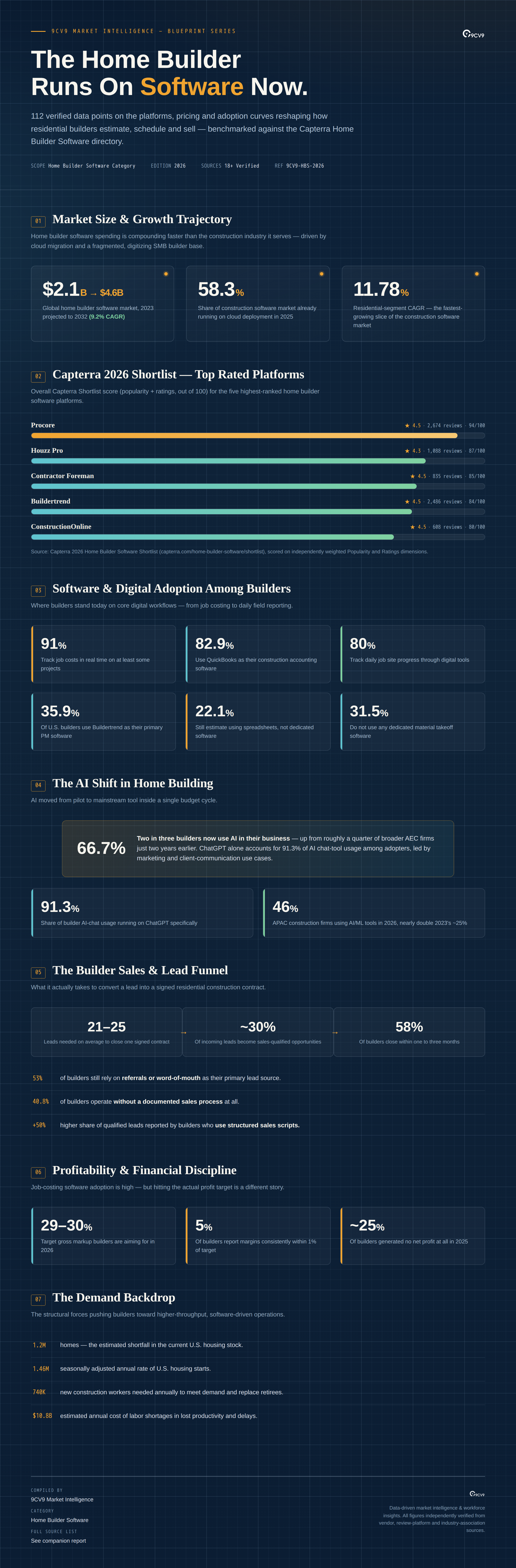
Key home builder software statistics highlight the growing importance of digital technology across residential construction. Among surveyed builders, 80% track daily jobsite progress digitally, 67% provide clients with real-time project visibility through software-based portals, and 91% track job costs in real time on at least some of their projects. Furthermore, 86% integrate construction estimating directly into job costing, demonstrating the increasing importance of connected financial management systems.
Artificial intelligence is also becoming a major catalyst for innovation within the home builder software industry. Approximately 66.7% of surveyed builders use AI in their businesses, with marketing and client communications emerging as leading applications. AI-powered estimating, automated documentation, predictive analytics, intelligent scheduling, and digital sales tools are creating new opportunities for construction companies to enhance productivity and competitiveness.
Despite these technological advancements, significant operational challenges remain. Approximately 28.6% of surveyed builders report exceeding project budgets, 21.4% still deliver projects late, and 31.5% do not use dedicated construction takeoff software. Nearly 25% of builders failed to generate a net profit in 2025, highlighting the growing need for accurate financial forecasting, effective resource allocation, and comprehensive construction management solutions.
Leading home builder software platforms, including Buildertrend, Procore, Houzz Pro, Contractor Foreman, Buildxact, and ConstructionOnline, are competing to address these challenges through increasingly sophisticated features, flexible pricing models, mobile accessibility, and third-party integrations. The expanding range of available solutions is making construction technology more accessible to independent contractors, custom home builders, remodelers, and large residential construction enterprises.
Understanding the latest home builder software statistics, market data, and technology trends is therefore essential for construction business owners, project managers, property developers, software vendors, investors, and industry decision-makers. These insights provide valuable benchmarks for evaluating software adoption, identifying operational inefficiencies, assessing technology investments, and developing competitive digital transformation strategies.
This comprehensive guide to the Top 112 Home Builder Software Statistics, Data & Trends in 2026 explores the most important developments shaping the residential construction technology landscape, including:
- Global home builder software market size, growth forecasts, and investment trends.
- Leading home builder software platforms, customer ratings, and user satisfaction benchmarks.
- Construction software adoption and digital transformation statistics.
- Artificial intelligence and automation trends in residential construction.
- Cloud-based construction management and mobile technology adoption.
- Buildertrend adoption, customer demographics, and market performance.
- Construction CRM, sales automation, and lead management statistics.
- Financial management, construction estimating, accounting, and job costing trends.
- Housing market conditions and workforce challenges driving software demand.
- Home builder software pricing, subscription models, and purchasing benchmarks.
By examining these 112 statistics, construction professionals and business leaders can gain a comprehensive understanding of the current home builder software market, recognise emerging technological opportunities, and make more informed decisions about software selection and implementation.
As the residential construction industry continues to embrace digitalisation, home builder software is evolving beyond conventional project management tools into comprehensive business management ecosystems. Companies that effectively integrate automation, artificial intelligence, cloud computing, and real-time financial intelligence into their operations will be better positioned to improve project outcomes, strengthen customer relationships, protect profit margins, and achieve sustainable growth in an increasingly competitive construction market.
Before we venture further into this article, we would like to share who we are and what we do.
About 9cv9
9cv9 is a business tech startup based in Singapore and Asia, with a strong presence all over the world.
With over ten years of startup and business experience, and being highly involved in connecting with thousands of companies and startups, the 9cv9 team has listed some of the top and best companies/tools in this review.
If you like to get your company listed in our top B2B software reviews, check out our world-class 9cv9 Media and PR service and pricing plans here.
Top 112 Home Builder Software Statistics, Data & Trends in 2026
A. Market Size, Growth & Investment
1. The global home builder software market was valued at approximately $2.1 billion in 2023 and is projected to reach $4.6 billion by 2032. This nearly 2.2x growth trajectory signals sustained enterprise and vendor investment in residential-construction-specific technology through the decade.
2. Industry-wide, the broader home builder software category is forecast to grow at a 9.2% CAGR between 2025 and 2033. A high-single-digit compound growth rate places home builder software among the faster-growing verticals within construction technology.
3. A separate market model pegs the home builder software segment at $504 million in 2025, rising to $1.57 billion by 2035 at a 12% CAGR. The double-digit growth rate reflects accelerating digitization even among smaller and mid-sized residential building firms.
4. The global construction software market overall is projected to expand from $11.78 billion in 2026 to $24.72 billion by 2034, at a 9.70% CAGR. Home builder software sits within this larger ecosystem, benefiting from the same cloud and SaaS tailwinds reshaping the wider construction industry.
5. The residential building segment within construction software is expected to be the fastest-growing category, at an 11.78% CAGR, outpacing commercial and industrial construction software growth. This is largely driven by rising demand for lightweight, lower-cost digital tools suited to smaller residential builders.
6. Cloud-based deployment is projected to represent 58.3% of the construction software market share in 2025. More than half the market has already shifted away from on-premise systems, underscoring cloud-first as the new default for home builder platforms.
7. Builders and contractors represent the largest end-user segment of construction software, holding a 54.2% market share. This confirms that home builders and general contractors — not architects or facility owners — are the primary buyers driving category demand.
8. The U.S. construction and design software market was valued at $2.39 billion in 2023 and is projected to grow at an 8.1% CAGR through 2030. The United States remains the single largest national market for home builder and construction design software.
9. The home builder CRM software segment specifically was estimated at $1.2 billion in 2024, forecast to reach $2.5 billion by 2033 at an 8.9% CAGR. CRM-specific tools are carving out their own fast-growing niche within the broader home builder software category.
10. North America is consistently identified as the leading region for home builder software adoption, with Asia Pacific tipped as the fastest-growing region going forward. Mature construction markets in the U.S. and Canada continue to set the pace, while Asia Pacific’s urbanization wave is driving the next wave of growth.
11. Latin America contributed roughly $0.61 billion to the global construction software market in 2025, about 5.70% of the total, and is projected to reach $0.66 billion in 2026. Even smaller regional markets are showing steady, incremental adoption of construction and home builder software.
12. Commercial and industrial building software is estimated to hold 57.70% of the construction software market in 2026, versus a smaller but faster-growing residential share. Larger capital budgets in commercial construction still command more total software spend, even as residential adoption accelerates at a quicker pace.
B. Capterra Ratings & Reviews for Leading Home Builder Platforms (Capterra Directory Data)
13. Procore holds a 4.5-star rating from 2,674 reviews on Capterra’s 2026 Home Builder Software Shortlist, earning the top overall score of 94/100. Its consistently high rating across thousands of verified reviews cements Procore’s reputation as the most trusted enterprise-grade platform in the category.
14. Procore scores 4.4 for Ease of Use, 4.5 for Customer Service, 4.3 for Features and 4.1 for Value for Money on Capterra. Balanced scores above 4.0 across every review dimension indicate broad user satisfaction rather than strength in just one area.
15. Houzz Pro is rated 4.3 stars from 1,088 Capterra reviews and carries an 87/100 overall Capterra Shortlist score, the highest “Great Value” designation in the category. Its combination of design tools and business management functionality appeals strongly to design-build remodelers and custom home builders.
16. Houzz Pro starts at $399 per month and includes both a free trial and a free version, according to Capterra’s 2026 pricing data. Offering a genuine free tier lowers the barrier to entry for smaller residential builders evaluating design-focused software.
17. Contractor Foreman earns a 4.5-star rating from 835 Capterra reviews with an 85/100 Shortlist score, tagged as the category’s “Feature Rich” pick. Its 4.6 Value for Money score — the highest among Capterra’s top five home builder platforms — makes it a standout for budget-conscious builders.
18. Contractor Foreman’s starting price of $49 per month is the lowest among Capterra’s Top 5 Home Builder Software picks for 2026. This makes it one of the most accessible entry points into dedicated home builder software for very small construction businesses.
19. Buildertrend is rated 4.5 stars across 2,486 Capterra reviews, with an 84/100 Shortlist score and the “Easy to Use” designation. A 4.7 Customer Service score — its highest sub-metric — reflects particularly strong satisfaction with Buildertrend’s support experience.
20. ConstructionOnline holds a 4.5-star Capterra rating from 608 reviews, an 80/100 Shortlist score, and the “Top Support” designation with a 4.8 Customer Service score. Its near-perfect support rating suggests builders value hands-on onboarding as much as core feature depth.
21. Premier Construction Software achieves the highest Capterra rating among all reviewed home builder platforms at 4.7 stars from 288 reviews, alongside a perfect 50/50 Ratings score. Despite a smaller review volume, its near-flawless satisfaction scores make it a standout for builders prioritizing financial and ERP-grade functionality.
22. Buildxact carries a 4.6-star Capterra rating from 183 reviews and the highest Category Features completeness among Capterra’s Top Home Builder picks, at 14 of 17 possible features. This breadth of native functionality reduces the need for third-party estimating add-ons.
23. Buildxact’s starting price is listed at $199 per month on Capterra’s 2026 Home Builder Shortlist, positioning it as a mid-tier option between budget and enterprise platforms. Its pricing sits comfortably between entry-level tools like Contractor Foreman and premium suites like ConstructionOnline.
24. Sage Construction Suite scores 4.0 stars from 1,061 Capterra reviews, the lowest overall rating (69/100) among the eight platforms on Capterra’s shortlist. Despite lagging peer ratings, its long operating history and deep accounting integration continue to sustain a large review base.
25. Across Capterra’s Top 5 Home Builder Software picks, average integrations range from 7 (Buildertrend) to 81 (Procore). This more than 11x spread in integration depth highlights how dramatically ecosystem connectivity varies between lightweight and enterprise-grade platforms.
26. Buildertrend is described by GetApp as used on more than half of all new home builds in the United States, with over 20,000 contractors running their businesses on the platform. This scale of adoption makes Buildertrend the most commonly cited software brand associated with U.S. residential construction.
27. Buildertrend reports that 61% of its reviews come from businesses with 2 to 50 employees, according to Software Advice analysis of 2,486 verified reviews. This confirms Buildertrend’s core customer base skews toward small and mid-sized residential building companies rather than large enterprises.
28. Of over 550 aggregated third-party reviews, 85% of Buildertrend ratings are 4 or 5 stars, according to Technology Evaluation Centers analysis. An 85% top-tier satisfaction rate across independent review platforms reinforces Buildertrend’s reputation as a category leader.
29. Buildxact reviews are 98% from small businesses and 93% from the construction industry specifically, according to Capterra’s reviewer demographic breakdown. This makes Buildxact one of the most narrowly focused platforms for small residential construction firms rather than diversified contractors.
30. CoConstruct holds a 3.6-star rating from 329 reviews compared to Buildxact’s 3.9 stars from 407 reviews in a head-to-head RFP.wiki comparison. The rating gap suggests users increasingly favor Buildxact’s estimating-first workflow over CoConstruct’s broader but pricier feature set.
31. G2 lists Buildertrend with 229 filterable reviews, with “Ease of Use,” “Project Management” and “Document Management” cited as the most common positive themes. Independent G2 data corroborates Capterra’s findings that usability and document control are Buildertrend’s strongest perceived advantages.
32. Only 5% of Buildxact Capterra reviewers come from Building Materials companies and just 1% from Accounting firms, versus 93% from core Construction businesses. This lopsided distribution confirms Buildxact’s product-market fit is concentrated almost entirely among hands-on builders and estimators.
C. Adoption of Home Builder Software & Digital Tools
33. Buildertrend data shows 35.9% of U.S. builders use Buildertrend as their primary project management software. This single-vendor concentration is unusually high for a fragmented software category, reflecting Buildertrend’s long tenure and residential-construction focus.
34. 22.1% of builders still use spreadsheets for estimating rather than dedicated estimating software, per Buildertrend’s 2026 customer data report. Roughly one in five builders remains under-digitized in one of construction’s most error-prone workflows, representing a clear growth opportunity for estimating software vendors.
35. 31.5% of builders do not use dedicated takeoff software at all. Nearly a third of the market still performs material takeoffs manually, leaving significant room for takeoff-specific tools like Buildxact and STACK to expand adoption.
36. 80% of builders track daily job site progress digitally, according to Buildertrend’s 2026 benchmark data. Digital daily logs have become the dominant standard, with only a small minority of builders still relying on paper-based site tracking.
37. 67% of builders provide clients with real-time visibility into project progress through software-based client portals. Two-thirds of the market now treats homeowner-facing transparency tools as standard practice rather than a premium add-on.
38. 67% of builders have a defined project closeout process or checklist, typically managed through their construction software. Structured closeout processes are now the norm among two-thirds of builders, correlating with better warranty and customer-satisfaction outcomes.
39. 43.6% of builders do not conduct post-project completion audits. Despite widespread software adoption, nearly half of builders still skip a formal post-project review step that could otherwise feed back into estimating accuracy.
40. 21.4% of builders still deliver projects late, even with modern scheduling software available. This shows that software adoption alone does not eliminate scheduling risk without disciplined process management layered on top.
41. 27.7% of new home builders cite subcontractor delays as their biggest project management challenge. Subcontractor coordination remains the single largest scheduling pain point that home builder software is designed to solve.
42. 82.9% of U.S. builders use QuickBooks as their accounting software, frequently integrated with their home builder project management platform. QuickBooks’ dominance explains why nearly every major home builder software vendor prioritizes native QuickBooks or Xero integration.
43. 66% of builders actively use dashboards or reporting tools to monitor business performance. Two-thirds of builders have moved beyond static spreadsheets toward live, software-driven business intelligence.
44. 79% of builders track financial performance or profitability KPIs through their software systems. This high tracking rate reflects growing recognition that job-level financial visibility is now a baseline operational requirement, not a luxury.
45. 81.3% of builders generating more than $10 million annually produce monthly financial reports, compared to just 46.3% of builders under $1 million in revenue. This nearly 2x adoption gap illustrates how financial-reporting software usage scales directly with business size.
46. 55% of builders complete between 6 and 30 projects annually, the volume range where dedicated project management software delivers the clearest ROI. This mid-volume segment represents the core addressable market most home builder software vendors are built to serve.
47. Nearly 70% of surveyed construction professionals rated real-time data access as a “very” or “extremely important” ERP requirement, per a 2026 Lumber industry survey. Real-time visibility has become a non-negotiable buying criterion rather than a nice-to-have feature.
D. AI in Home Building & Construction Software
48. 66.7% of builders now use AI in their businesses, according to Buildertrend’s 2026 customer data report. Two-thirds adoption marks AI as a mainstream tool in residential construction rather than an experimental technology.
49. ChatGPT accounts for 91.3% of AI chat tool usage among builders who have adopted AI. This overwhelming preference shows builders are gravitating toward general-purpose AI assistants over construction-specific AI chatbots for now.
50. Marketing and client communications are the leading AI use case among builders, ahead of estimating or scheduling. Builders are currently deploying AI more for sales and homeowner-facing tasks than for back-office construction management.
51. AI adoption in the broader AEC (architecture, engineering, construction) industry reached approximately 24% of surveyed organizations, per industry analytics tracking. The gap between AI use in general AEC firms (24%) and residential builders specifically (66.7%) suggests home builders may be adopting AI tools faster than commercial construction peers.
52. Deloitte’s State of Digital Adoption survey found AI or machine learning tool usage among construction and engineering businesses in Asia-Pacific rose to 46% in 2026, up from around a quarter in 2023. This near-doubling in three years shows AI adoption accelerating rapidly across international construction markets, not just in North America.
53. 44% of contractors plan to increase investment in artificial intelligence in 2025, according to a 2025 AGC (Associated General Contractors) survey. Nearly half the industry is actively allocating new budget toward AI capabilities rather than treating it as a future consideration.
54. Buildxact markets an AI-powered estimate generator priced separately at $99 per user per month, layered on top of its core subscription tiers. The emergence of dedicated AI pricing tiers signals that AI estimating features are now being monetized as a distinct premium capability.
55. NAHB’s 2026 International Builders’ Show introduced a dedicated “AI & Tech Studio,” reflecting industry-wide recognition that AI-driven lead conversion and virtual sales tools are becoming a competitive differentiator. Trade-show programming investment is a strong leading indicator that AI tooling is moving from novelty to expected standard practice in home building.
E. Cloud, Mobile & Technology Usage
56. Data analytics is used by 56% of construction and engineering businesses surveyed across six Asia-Pacific markets in Deloitte’s 2026 digital adoption report. More than half of firms now treat data analytics as embedded infrastructure rather than an emerging capability.
57. Construction management cloud software is used by 50% of businesses in the same Deloitte APAC survey. Cloud-based construction management has crossed the halfway adoption threshold even in markets outside North America.
58. Mobile apps are used by 47% of construction and engineering businesses surveyed by Deloitte in 2026. Mobile-first workflows are now used by nearly half of firms internationally, reinforcing smartphone access as core infrastructure on the jobsite.
59. Only 16% of construction firms have reached “advanced” digital maturity, according to Deloitte Australia’s 2026 State of Digital Adoption report. Despite high tool adoption rates, true digital maturity — where systems are integrated and data-driven — remains rare across the industry.
60. 25% of surveyed construction businesses still depend mainly on paper documentation for project management and field operations. A quarter of the industry has yet to make the leap to digital-first documentation, even as software adoption accelerates elsewhere.
61. The median number of disconnected software systems used by construction businesses fell from 11 to 6 year-over-year, according to Deloitte’s 2026 findings. This consolidation trend shows builders are actively reducing software sprawl in favor of more unified, all-in-one platforms.
62. 92% of construction industry respondents reported using their smartphone every day at work, per JBKnowledge’s ConTech Report. Daily smartphone use is now near-universal among construction professionals, cementing mobile compatibility as a baseline software requirement.
63. 48% of construction professionals say they will only adopt new software if it includes an easy-to-use mobile app, according to JBKnowledge’s Construction Technology Report. Mobile usability has become a hard purchasing filter for nearly half the market, not just a bonus feature.
64. 73% of surveyed construction professionals report already using a cloud-based, construction-specific ERP system, per a 2026 Lumber industry survey. Cloud ERP has moved well past early-adopter status and is now the majority approach for construction financial and operations management.
65. Within that cloud-ERP-adopting group, 46% remain open to switching to a different cloud platform. Nearly half of current cloud ERP users are still actively comparing alternatives, indicating vendor loyalty in the category remains far from settled.
66. The most commonly used cloud-enabled construction systems are invitation-to-bid tools (36.1% adoption), project management (28.3%), field data collection (27.2%) and CRM platforms (21.2%), per JBKnowledge survey data. Bidding and project management remain the two cloud functions builders adopt earliest, ahead of CRM and field data tools.
67. 63% of respondents in a 2020 JBKnowledge ConTech survey reported using three to six or more construction-specific apps on their phones. Multi-app workflows are common, underscoring ongoing demand for platforms that consolidate scattered point solutions.
F. Vendor-Specific Data: Buildertrend
68. Buildertrend has empowered nearly 1 million users across more than 100 countries since its 2006 launch. Two decades of continuous growth have made Buildertrend one of the most globally distributed home builder software brands in the category.
69. Buildertrend customers have collectively managed more than 2 million construction jobs on the platform. This scale of cumulative project volume gives Buildertrend an unusually large proprietary dataset to benchmark builder performance against.
70. Buildertrend achieved revenue growth of more than 240% over a recent three-year period, according to company press materials citing Deloitte’s Technology Fast 500 recognition. Triple-digit multi-year growth places Buildertrend among the fastest-growing software companies recognized by Deloitte, not just within construction technology specifically.
71. Enlyft market research estimates Buildertrend holds approximately 0.64% market share within the broader construction software category. Despite strong brand recognition, Buildertrend’s overall construction-software market share remains modest given how fragmented and vendor-diverse the category is.
72. 6sense data shows over 3,517 companies actively using Buildertrend as a communication tool worldwide, with 83.58% of those customers based in the United States. The heavy U.S. concentration confirms Buildertrend’s customer base remains predominantly domestic despite its 100-country reach.
73. The majority of Buildertrend’s customer base — roughly 1,835 of the companies tracked by 6sense — falls into the 0-9 employee company-size bracket. This confirms Buildertrend’s primary market is very small residential construction businesses rather than mid-market or enterprise firms.
74. TheirStack.com data identifies 6,745 companies currently using Buildertrend across tracked technology usage records. Independent technographic data corroborates Buildertrend’s position as one of the most widely deployed platforms in residential construction.
75. Companies using Buildertrend span 21 different industry verticals, though usage is most concentrated in Professional Services, Construction and Real Estate, and Retail, according to AppsRunTheWorld data. This vertical spread shows Buildertrend’s appeal extends beyond pure homebuilders into adjacent trades and property-related businesses.
76. Buildertrend’s pricing tiers span from $299/month (Essential) to $699/month (Complete), with all plans including unlimited users, according to third-party review site Softabase. An unlimited-user pricing model differentiates Buildertrend from seat-based competitors and can significantly lower per-user costs for larger field teams.
77. Buildertrend cites over 5,000 aggregated reviews across G2, GetApp and Capterra with an average 4.5-star rating, per its own homepage disclosure. Consistency of the 4.5-star average across three independent review platforms strengthens confidence in the rating’s reliability.
78. Buildertrend’s website traffic ranks it #4 in the “Construction and Maintenance” category in the United States, according to Similarweb’s June 2026 estimates. A top-4 category ranking for organic and direct web traffic reflects strong brand search demand relative to competitors.
79. Buildertrend customer data indicates the platform is used by businesses across all revenue tiers, though 94.61% of tracked customer companies have 0-100 employees, per AppsRunTheWorld. This heavy skew toward micro and small businesses reinforces that home builder software adoption is strongest among smaller, owner-operator-led firms.
G. Sales, CRM & Lead Management
80. 53% of builders rely on referrals or word-of-mouth marketing to generate new business, rather than paid advertising or digital lead generation. This heavy reliance on referrals highlights why CRM tools that help builders track and nurture referral relationships remain highly valuable.
81. 35.3% of builders identify generating quality leads as their single biggest sales challenge. More than a third of the industry struggles specifically with lead quality rather than lead volume, pointing to a gap that CRM and marketing-automation software aims to close.
82. Builders need approximately 21-25 leads on average to close a single signed contract. This conversion ratio underscores why structured CRM pipelines matter — inefficient lead tracking can directly translate into dozens of missed opportunities per closed deal.
83. Roughly 30% of incoming leads become sales-qualified opportunities, according to Buildertrend’s 2026 customer benchmark data. A 30% qualification rate gives builders a concrete benchmark against which to measure their own CRM-driven sales funnel performance.
84. 40.8% of builders do not have a documented sales process in place. Despite widespread CRM software availability, more than four in ten builders are still selling without a formalized, repeatable process.
85. Builders who use sales scripts report a 50% higher share of qualified leads than those who do not. This substantial lift demonstrates a clear, measurable ROI case for CRM-embedded sales scripting and playbook features.
86. Companies that conduct regular sales training achieve a 2.5% higher gross markup on average. Even a modest training-driven markup improvement compounds meaningfully across a builder’s full annual project volume.
87. Builders who charge for quotes report 3-4% higher gross markups than those who provide free estimates. This pricing strategy insight is increasingly built into modern estimating and CRM software as a configurable proposal option.
88. 58% of builders close projects within one to three months of initial contact. A majority sales cycle length of under 90 days reinforces why fast, software-driven quote turnaround directly affects close rates.
89. 95.6% of clients pay using bank transfers, and 50% of clients pay for projects without financing, loans or credit. These payment behavior statistics explain why integrated payment and invoicing modules have become a standard feature within home builder software suites.
90. 20.7% of construction respondents in earlier JBKnowledge surveys said mobile technologies were “not important,” a figure that has steadily declined as CRM and field apps matured. The shrinking share of mobile skeptics tracks closely with rising CRM and field-communication software adoption over the past decade.
H. Financial Management, Job Costing & Accounting
91. 86% of builders integrate estimating directly into job costing within their software systems. This tight estimating-to-job-costing integration is now the majority approach, reducing the double data-entry errors common with disconnected spreadsheet workflows.
92. 91% of builders track job costs in real time on at least some of their projects. Real-time job costing has effectively become the industry standard rather than a differentiating premium feature.
93. 33% of builders identify labor costs as the biggest challenge to staying on budget. Labor cost volatility is the single largest budget-overrun driver builders report, ahead of materials or subcontractor pricing.
94. 28.6% of builders report going over budget on their projects. Despite high real-time job-costing adoption, more than a quarter of builders still experience budget overruns, suggesting software alone cannot fully offset estimating or cost-control gaps.
95. Builders and remodelers are targeting a 29-30% gross markup in 2026. This benchmark range gives builders using job-costing software a clear industry target to measure their own project profitability against.
96. Only 5% of builders report margins that consistently match their targets within 1% accuracy. This extremely low precision rate highlights a significant opportunity for better forecasting and job-costing tools to close the gap between targeted and actual profitability.
97. 68.1% of builders monitor project gross margins on a monthly basis. Monthly margin monitoring is now the majority practice, reflecting growing financial discipline enabled by integrated reporting dashboards.
98. 20% of builders do not fully understand the difference between margin and markup, a foundational financial concept for accurate estimating. This knowledge gap represents a meaningful training opportunity that software vendors increasingly address through built-in educational content and calculators.
99. Nearly 25% of builders failed to generate a net profit in 2025. A profitability shortfall among roughly one in four builders underscores rising urgency around cost control and financial-visibility software.
100. 40% of builders do not know how to calculate their Work in Progress (WIP) figure, a critical construction accounting metric. This gap illustrates why accounting-integrated home builder software increasingly automates WIP calculations rather than leaving them to manual bookkeeping.
I. Housing Market Context Driving Software Demand
101. The U.S. housing market remains short by roughly 1.2 million homes, creating sustained pressure on builders to increase throughput. This persistent housing shortage is a structural tailwind for productivity-focused home builder software, since builders need to build more homes without proportionally more staff.
102. U.S. housing starts are running at a seasonally adjusted annual rate of approximately 1.46 million units. This pace of new construction sustains a large and continuous addressable market for project management and estimating software.
103. The construction industry needs approximately 740,000 new workers every year to meet current demand and replace departing workers. Persistent labor shortages are a primary driver pushing builders toward software that increases per-employee productivity.
104. Labor shortages are costing the construction industry more than $10.8 billion annually through lost productivity and delayed projects. This multibillion-dollar productivity drag creates a strong financial incentive for builders to invest in scheduling and workforce-coordination software.
105. Workforce constraints are adding nearly two months, on average, to construction project timelines. Extended timelines directly translate into higher carrying costs, reinforcing demand for scheduling software that can help tighten project delivery.
106. Nearly 41% of the current construction workforce is expected to retire by 2031. This looming retirement wave is accelerating urgency around software that captures institutional knowledge and standardizes processes before experienced staff exit the industry.
107. Residential building material prices have grown at more than 3% annually since June 2025, continuing to squeeze builder margins. Persistent material inflation increases the value of accurate, software-driven estimating that can track live pricing changes.
108. 67% of builders reported housing demand was slower than expected as of May 2026. Softer-than-expected demand increases competitive pressure among builders, raising the stakes for software-enabled efficiency and customer experience differentiation.
J. Pricing & Purchase Benchmarks
109. Entry-level home builder software pricing on Capterra’s 2026 Shortlist ranges from $49/month (Contractor Foreman) to $475/month (ConstructionOnline) among the category’s top five platforms. This roughly 9.7x spread reflects the wide range of functionality and target business sizes across the home builder software landscape.
110. Buildxact’s tiered pricing spans from $149 to $509 per month depending on plan level, according to multiple third-party pricing breakdowns. This tiered structure allows builders to scale their software investment alongside business growth rather than committing to enterprise pricing upfront.
111. Several leading platforms, including Houzz Pro, Contractor Foreman, ConstructionOnline and Buildxact, now offer free trials ranging from 14 to 30 days, per Capterra’s 2026 data. The prevalence of free trials across nearly every major platform reflects a highly competitive category where vendors compete aggressively on evaluation access.
112. Capterra’s proprietary Shortlist scoring methodology combines a Popularity Score and a Ratings Score, each independently weighted, to rank home builder software vendor-neutrality. This dual-metric approach is designed to prevent vendor size alone from dominating rankings, giving smaller but highly-rated platforms like Premier Construction Software a path to top placement.
Conclusion
The Top 112 Home Builder Software Statistics, Data & Trends in 2026 reveal an industry undergoing a fundamental transformation as residential construction businesses increasingly embrace digital technologies to improve operational efficiency, project profitability, customer satisfaction, and long-term competitiveness. Home builder software is evolving beyond traditional construction project management tools into comprehensive business management platforms that integrate estimating, scheduling, accounting, customer relationship management, workforce coordination, and artificial intelligence.
The global home builder software market demonstrates substantial growth potential, with its valuation projected to increase from approximately $2.1 billion in 2023 to $4.6 billion by 2032. Furthermore, the broader construction software market is expected to reach $24.72 billion by 2034, growing at a CAGR of 9.70%. With the residential building software segment projected to achieve an even higher CAGR of 11.78%, digital transformation is becoming an increasingly important strategic priority for home builders worldwide.
Digital Transformation Is Reshaping Residential Construction
The latest home builder software adoption statistics demonstrate how extensively digital technologies are becoming embedded within everyday construction operations.
Among surveyed builders:
- 80% track daily jobsite progress digitally.
- 67% provide clients with real-time project visibility through digital portals.
- 91% track job costs in real time on at least some projects.
- 86% integrate construction estimating directly into job costing.
- 79% track financial performance or profitability metrics through software systems.
- 66% actively use dashboards or reporting tools to monitor business performance.
- 82.9% use QuickBooks for accounting.
These findings highlight the growing importance of integrated construction management software in eliminating fragmented workflows, improving financial transparency, strengthening collaboration, and supporting data-driven decision-making.
Cloud-based home builder software is also becoming increasingly prominent, with cloud deployment projected to account for 58.3% of the construction software market in 2025. Combined with widespread smartphone usage and increasing demand for real-time information, cloud computing and mobile accessibility are becoming fundamental considerations when selecting residential construction software.
Artificial Intelligence Is Emerging as a Major Competitive Advantage
Artificial intelligence represents one of the most significant home builder software trends in 2026. Approximately 66.7% of surveyed builders already use AI within their businesses, demonstrating the technology’s transition from experimental applications to mainstream business operations.
Although marketing and client communications currently represent leading AI applications, the potential for artificial intelligence within residential construction extends considerably further.
Emerging AI-powered home builder software capabilities include automated construction estimating, intelligent project scheduling, predictive financial analytics, automated documentation, lead qualification, customer communication, and resource optimisation.
As these technologies mature, construction companies that successfully incorporate AI into their existing workflows may be better positioned to reduce administrative workloads, improve estimating accuracy, accelerate decision-making, and increase employee productivity.
Operational Challenges Continue to Drive Home Builder Software Demand
Despite increasing construction software adoption, the residential building industry continues to face significant operational and financial challenges.
Approximately 28.6% of surveyed builders report exceeding project budgets, while 21.4% still experience late project delivery. Additionally, 27.7% identify subcontractor delays as their biggest project management challenge, and 33% identify labour costs as their primary obstacle to maintaining project budgets.
Financial management remains another critical concern. Nearly 25% of builders failed to generate a net profit in 2025, while only 5% consistently achieve margins that match their targets within 1% accuracy. Furthermore, 40% do not know how to calculate their Work in Progress (WIP) figure, highlighting persistent gaps in construction accounting knowledge.
These statistics demonstrate that purchasing home builder software alone does not guarantee improved business performance. Successful digital transformation requires effective implementation, employee training, standardised processes, accurate data management, and continuous performance monitoring.
Integrated construction estimating, real-time job costing, automated financial reporting, and advanced project management capabilities can help address these challenges when supported by disciplined operational practices.
Significant Opportunities Remain for Home Builder Software Adoption
Despite substantial technological progress, several areas of residential construction remain under-digitised.
Approximately 22.1% of surveyed builders continue to rely on spreadsheets for estimating, while 31.5% do not use dedicated construction takeoff software. Additionally, 43.6% do not conduct post-project completion audits, and 40.8% lack a documented sales process.
These adoption gaps represent significant opportunities for home builder software providers to develop more accessible, affordable, and intuitive digital solutions.
Small and medium-sized construction businesses represent a particularly important market segment. Approximately 61% of Buildertrend reviews originate from businesses employing between two and 50 employees, while 98% of Buildxact reviewers come from small businesses.
These figures demonstrate the importance of scalable pricing structures, simplified onboarding, mobile-friendly interfaces, and comprehensive functionality tailored to smaller residential construction companies.
The Home Builder Software Market Is Becoming Increasingly Competitive
Leading construction software providers, including Buildertrend, Procore, Houzz Pro, Contractor Foreman, Buildxact, ConstructionOnline, and Premier Construction Software, continue to compete across functionality, affordability, customer support, usability, and integration capabilities.
Entry-level pricing among selected leading home builder software platforms ranges from $49 to $475 per month, illustrating the considerable diversity of solutions available to residential construction businesses.
Customer satisfaction statistics also highlight the importance of evaluating software beyond its subscription price. Factors such as ease of use, customer service quality, accounting integrations, mobile accessibility, feature completeness, and scalability can significantly influence the overall value of a construction management platform.
Construction companies evaluating the best home builder software in 2026 should therefore consider their operational requirements, project volumes, workforce size, financial management needs, existing technology infrastructure, and long-term business objectives before selecting a solution.
The Future of Home Builder Software Beyond 2026
The future of home builder software is expected to be increasingly shaped by artificial intelligence, cloud computing, workflow automation, real-time financial intelligence, mobile-first construction management, and integrated software ecosystems.
Persistent construction workforce shortages, rising building material costs, competitive housing markets, and increasing homeowner expectations are likely to strengthen demand for technology that enables residential builders to accomplish more with limited resources.
The growing consolidation of construction technology is another important development. The median number of disconnected software systems used by surveyed construction businesses declined from 11 to six, reflecting increasing demand for unified platforms that reduce software fragmentation and improve data accessibility.
Over the coming years, home builder software providers that deliver seamless integrations, intelligent automation, accurate financial forecasting, accessible pricing, and intuitive user experiences are likely to be better positioned to capture emerging market opportunities.
For residential construction businesses, the strategic priority will increasingly shift from simply adopting digital tools towards building connected, efficient, and data-driven operational ecosystems.
Final Thoughts
The 112 home builder software statistics, data, and trends examined throughout this guide provide valuable insights into the evolving relationship between technology and residential construction. From accelerating market growth and widespread cloud adoption to artificial intelligence integration, construction CRM innovation, and real-time financial management, the industry is experiencing substantial technological change.
However, the continued prevalence of project delays, budget overruns, profitability challenges, and fragmented business processes demonstrates that considerable opportunities for improvement remain.
For home builders, general contractors, remodelers, property developers, construction technology providers, and industry investors, understanding these statistics is essential for identifying emerging opportunities, benchmarking operational performance, evaluating software investments, and developing effective digital transformation strategies.
Ultimately, home builder software in 2026 is becoming a strategic business asset rather than merely an administrative tool. Residential construction companies that combine the right technology with effective implementation, financial discipline, continuous employee development, and data-driven decision-making will be better positioned to improve construction productivity, strengthen profitability, deliver superior customer experiences, and achieve sustainable growth in an increasingly competitive global construction industry.
If you find this article useful, why not share it with your hiring manager and C-level suite friends and also leave a nice comment below?
We, at the 9cv9 Research Team, strive to bring the latest and most meaningful data, guides, and statistics to your doorstep.
To get access to top-quality guides, click over to 9cv9 Blog.
To hire top talents using our modern AI-powered recruitment agency, find out more at 9cv9 Modern AI-Powered Recruitment Agency.
People Also Ask
What is home builder software?
Home builder software is a digital solution that helps residential construction companies manage projects, estimates, schedules, budgets, subcontractors, customer relationships, accounting, and construction workflows from a centralised platform.
How big is the global home builder software market?
The global home builder software market was valued at approximately $2.1 billion in 2023 and is projected to reach $4.6 billion by 2032, reflecting growing demand for digital construction management solutions.
What is the growth rate of the home builder software market?
The home builder software market is forecast to grow at a compound annual growth rate of 9.2% between 2025 and 2033, driven by digital transformation, cloud computing, and construction automation.
How large is the global construction software market in 2026?
The global construction software market is projected to reach $11.78 billion in 2026 and expand to $24.72 billion by 2034, registering a compound annual growth rate of 9.70%.
What are the biggest home builder software trends in 2026?
Leading trends include AI-powered estimating, cloud-based project management, mobile construction applications, real-time job costing, automated scheduling, integrated accounting, predictive analytics, and digital customer portals.
What percentage of home builders use artificial intelligence?
Approximately 66.7% of surveyed builders use artificial intelligence in their businesses, with marketing, customer communications, and administrative automation among the leading applications.
What percentage of builders track construction progress digitally?
Approximately 80% of surveyed builders track daily jobsite progress digitally, demonstrating the growing adoption of construction management software and mobile reporting tools.
What percentage of builders use real-time job costing software?
Approximately 91% of surveyed builders track job costs in real time on at least some projects, helping improve financial visibility, budget management, and profitability monitoring.
What are the best home builder software platforms in 2026?
Leading home builder software platforms include Buildertrend, Procore, Houzz Pro, Contractor Foreman, Buildxact, ConstructionOnline, and Premier Construction Software. The best choice depends on business size, budget, and operational requirements.
How much does home builder software cost in 2026?
Entry-level pricing among selected leading home builder software platforms ranges from $49 to $475 per month. Advanced subscriptions may cost more depending on functionality, integrations, and business requirements.
What percentage of construction software is cloud-based?
Cloud-based deployment was projected to account for 58.3% of the construction software market in 2025, reflecting increasing demand for remote accessibility, real-time collaboration, and scalable infrastructure.
What percentage of builders use Buildertrend?
Approximately 35.9% of builders in one industry dataset use Buildertrend as their primary project management software, highlighting its strong presence in residential construction management.
How many users does Buildertrend have worldwide?
Buildertrend has served nearly one million users across more than 100 countries since its launch in 2006, with customers collectively managing over two million construction projects.
What percentage of home builders use QuickBooks?
Approximately 82.9% of surveyed U.S. builders use QuickBooks for accounting, highlighting the importance of accounting integrations within home builder software platforms.
How many builders still use spreadsheets for construction estimating?
Approximately 22.1% of surveyed builders continue to use spreadsheets for estimating rather than dedicated construction estimating software, indicating significant opportunities for further digital adoption.
What percentage of builders use construction takeoff software?
Approximately 68.5% of surveyed builders use dedicated construction takeoff software, while 31.5% do not, highlighting continued opportunities for digital material estimation and quantity surveying tools.
What percentage of builders experience construction project delays?
Approximately 21.4% of surveyed builders report delivering projects late, demonstrating that effective scheduling, subcontractor coordination, and project management remain important despite technological advancements.
What percentage of home builders exceed project budgets?
Approximately 28.6% of surveyed builders report exceeding project budgets, highlighting the importance of accurate estimating, real-time job costing, financial forecasting, and expense monitoring.
What is the biggest project management challenge for home builders?
Subcontractor delays are a leading challenge, with 27.7% of surveyed new home builders identifying them as their biggest project management obstacle.
What percentage of builders use customer portals?
Approximately 67% of surveyed builders provide clients with real-time project visibility through software-based customer portals, supporting greater transparency, communication, and homeowner engagement.
What percentage of builders use business intelligence dashboards?
Approximately 66% of surveyed builders actively use dashboards or reporting tools to monitor business performance, reflecting increasing demand for data-driven construction management.
What percentage of builders track financial performance using software?
Approximately 79% of surveyed builders track financial performance or profitability metrics through software systems, highlighting the importance of integrated construction accounting and financial analytics.
How does home builder software improve profitability?
Home builder software supports profitability through accurate estimating, real-time job costing, expense tracking, resource allocation, automated financial reporting, and improved project coordination.
What percentage of home builders failed to generate a profit in 2025?
Nearly 25% of surveyed builders failed to generate a net profit in 2025, underscoring the importance of effective cost control, financial forecasting, and construction management.
What is the average gross markup target for home builders in 2026?
Builders and remodelers are targeting a gross markup of approximately 29% to 30% in 2026. Actual profitability depends on labour expenses, material costs, overheads, and project management efficiency.
What percentage of construction companies use mobile applications?
Approximately 47% of surveyed construction and engineering businesses across six Asia-Pacific markets use mobile applications, supporting field communication, project reporting, and remote construction management.
How does artificial intelligence improve home builder software?
Artificial intelligence enhances home builder software through automated estimating, predictive analytics, intelligent scheduling, document processing, customer communications, lead qualification, and administrative workflow automation.
Which region leads the global home builder software market?
North America is identified as the leading region for home builder software adoption, while Asia-Pacific is expected to experience the fastest growth due to urbanisation, infrastructure development, and digital transformation.
Is home builder software worth the investment for small construction businesses?
Home builder software can deliver value by reducing administrative workloads, improving estimating accuracy, strengthening financial visibility, and centralising project management. Returns depend on software costs, implementation quality, and employee adoption.
What is the future of home builder software beyond 2026?
The future of home builder software is expected to feature advanced AI automation, predictive financial analytics, integrated construction management platforms, mobile-first workflows, real-time collaboration, and increasingly connected software ecosystems.
Sources
Available Upon Request