




























Key Takeaways
- Financial Fraud Detection Software Market Growth: The global financial fraud detection software market is estimated at $22.12 billion in 2026 and projected to reach $36.99 billion by 2030, driven by rising cybercrime, digital payments, and demand for advanced fraud prevention solutions.
- AI and Machine Learning Transforming Fraud Detection: Approximately 90% of financial institutions use AI for fraud detection and investigation, while 64% deploy AI agents, accelerating real-time threat identification, improving detection accuracy, and reducing false positives.
- Rising Financial Fraud Losses and Emerging Security Threats: With US reported cybercrime losses exceeding $20.8 billion in 2025, organizations are prioritizing real-time fraud monitoring, identity verification, deepfake detection, and AML compliance to combat increasingly sophisticated financial crimes.
Financial fraud detection software is a rapidly growing market, valued at approximately $22.12 billion in 2026 and projected to reach $36.99 billion by 2030. The top 111 financial fraud detection software statistics for 2026 highlight AI adoption, rising fraud losses, real-time transaction monitoring, identity verification, and emerging financial security trends.
Financial fraud is becoming one of the most significant challenges facing banks, financial institutions, fintech companies, insurance providers, and businesses worldwide. As digital transactions accelerate and cybercriminals adopt increasingly sophisticated technologies, organizations are investing heavily in advanced fraud detection and prevention solutions to safeguard financial assets, protect customer information, and maintain regulatory compliance.
Also, read our article on the Top 10 Financial Fraud Detection Software To Know.
In 2026, the financial fraud detection software market is undergoing a major transformation, driven by artificial intelligence (AI), machine learning, real-time transaction monitoring, behavioral analytics, and automated risk assessment. According to market estimates, the global financial fraud detection software market is valued at approximately $22.12 billion in 2026, with projections suggesting it could reach $36.99 billion by 2030, representing a compound annual growth rate (CAGR) of 13.7%. Meanwhile, the broader fraud detection and prevention market is expected to experience substantial expansion as businesses prioritize intelligent security technologies.
The growing financial impact of fraud is accelerating this investment. Industry estimates indicate that global financial fraud losses reached hundreds of billions of dollars in 2025, while the FBI’s Internet Crime Complaint Center recorded more than $20.8 billion in reported cybercrime losses during the same year. These figures highlight the increasing financial exposure businesses face from payment fraud, identity theft, account takeovers, investment scams, money laundering, and AI-powered cyberattacks.
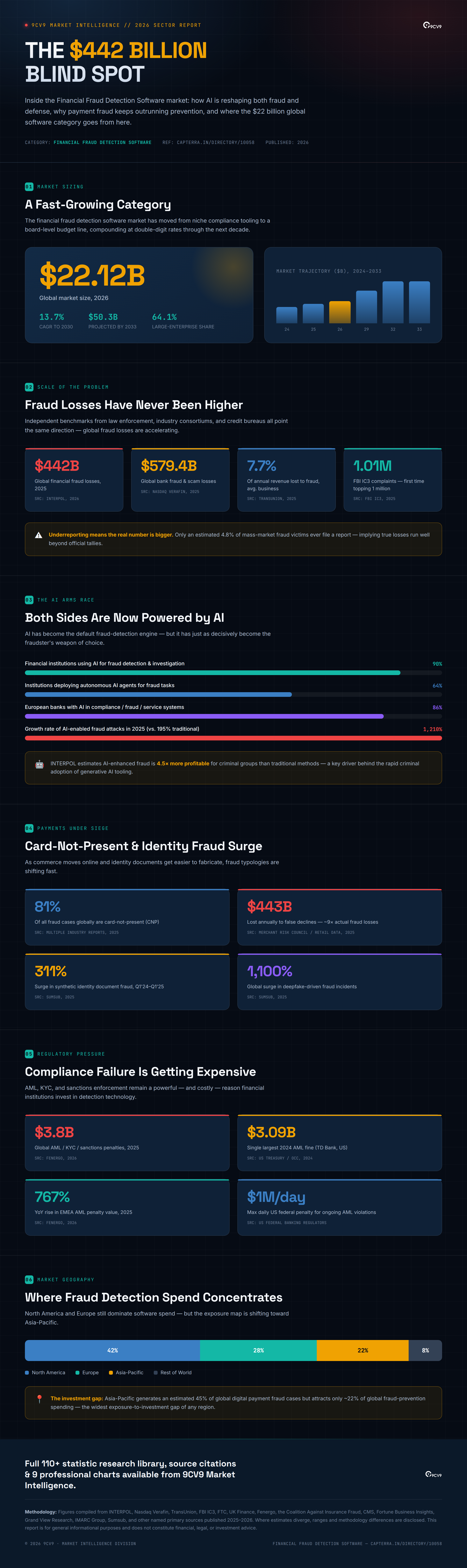
Artificial intelligence has emerged as a defining technology in modern financial fraud prevention. Research compiled for 2026 suggests that 90% of financial institutions now use AI for fraud detection and investigation, while 64% have deployed AI agents for fraud-related activities. Advanced AI-powered fraud detection software can analyze transaction patterns, identify suspicious behavior, reduce false positives, and detect potential threats significantly faster than traditional rule-based systems.
However, the rapid adoption of AI is also creating new challenges. Cybercriminals are increasingly leveraging generative AI, deepfake technology, synthetic identities, and automated social engineering techniques to bypass conventional security controls. With generative AI-enabled fraud losses in the United States projected to reach $40 billion by 2027, financial institutions must continuously strengthen their fraud prevention strategies to stay ahead of emerging threats.
Beyond banking, financial fraud detection software is becoming increasingly important across e-commerce, insurance, digital payments, lending, cryptocurrency, and financial services. Businesses are adopting cloud-based fraud prevention platforms, biometric authentication, identity verification systems, anti-money laundering (AML) software, and real-time risk scoring solutions to improve detection accuracy while minimizing disruptions to legitimate customers.
Regulatory requirements are also reshaping the industry. Financial institutions face growing pressure to comply with Know Your Customer (KYC) obligations, AML regulations, data protection requirements, and evolving financial crime enforcement frameworks. Consequently, modern fraud detection solutions must deliver not only effective threat identification but also transparency, scalability, auditability, and regulatory compliance.
The expansion of instant payment networks and digital banking services adds another layer of complexity. Fraud detection systems increasingly need to evaluate hundreds of behavioral and contextual signals within milliseconds, enabling organizations to identify suspicious transactions without compromising payment speed or customer experience. This shift toward real-time, AI-driven fraud prevention is expected to influence software development, enterprise technology investments, and financial security strategies throughout 2026 and beyond.
Understanding these developments is essential for financial executives, cybersecurity professionals, compliance officers, fintech innovators, software vendors, and business leaders seeking to strengthen their fraud prevention capabilities.
This comprehensive guide explores the Top 111 Financial Fraud Detection Software Statistics, Data & Trends in 2026, providing insights into global market size, industry growth forecasts, financial fraud losses, AI and machine learning adoption, payment fraud trends, identity theft, insurance fraud, AML compliance, regional market developments, and real-time fraud detection performance.
By examining these financial fraud detection software statistics and emerging industry trends, organizations can better understand the evolving financial crime landscape, evaluate fraud prevention technologies, identify investment opportunities, and develop more effective strategies for protecting their operations and customers in an increasingly digital financial ecosystem.
Before we venture further into this article, we would like to share who we are and what we do.
About 9cv9
9cv9 is a business tech startup based in Singapore and Asia, with a strong presence all over the world.
With over ten years of startup and business experience, and being highly involved in connecting with thousands of companies and startups, the 9cv9 team has listed some of the top and best companies/tools in this review.
If you like to get your company listed in our top B2B software reviews, check out our world-class 9cv9 Media and PR service and pricing plans here.
Top 111 Financial Fraud Detection Software Statistics, Data & Trends in 2026
A. Market Size & Growth Projections
- The global financial fraud detection software market is valued at $22.12 billion in 2026. This underscores how quickly enterprises are formalizing budget lines specifically for fraud-detection technology rather than folding it into general cybersecurity spend.
- The financial fraud detection software market is forecast to grow at a 13.7% CAGR through 2030, reaching $36.99 billion. This sustained double-digit growth rate signals that fraud-detection software has moved from a discretionary IT purchase to a core operating requirement for financial institutions.
- IMARC Group values the financial fraud detection software market at $50.3 billion by 2033, up from $16.5 billion in 2024. The three-fold expansion over less than a decade highlights how digital payment growth is directly translating into fraud-tooling demand.
- The Business Research Company projects the financial fraud detection software market will reach $32.53 billion by 2029. This trajectory reflects steady enterprise reinvestment in transaction monitoring and identity verification tooling as digital transaction volumes scale.
- Allied Market Research pegs the financial fraud detection software market at $13 billion in 2022, growing at a 14.8% CAGR to 2032. This decade-long compounding growth rate illustrates how fraud software spend has consistently outpaced broader enterprise software growth.
- The broader fraud detection and prevention (FDP) market is projected to hit $67.12 billion in 2026, per Fortune Business Insights. Because this figure spans adjacent categories like AML and identity verification, it signals the wider financial-crime technology stack buyers are now bundling together.
- Grand View Research forecasts the fraud detection and prevention market will reach $171.84 billion by 2031, growing at 19.61% CAGR. This faster growth rate versus narrower fraud-software segments reflects rising demand for integrated, AI-native platforms rather than point solutions.
- Vantage Market Research values the fraud detection and prevention market at $38.7 billion in 2025, projected to reach $142.8 billion by 2035. The near four-fold decade growth path reinforces long-term investor and vendor confidence in the category.
- Technavio projects the fraud detection and prevention market will expand by $190.60 billion between 2025 and 2030 at a 34.7% CAGR. This is one of the more aggressive growth estimates in the sector, largely attributed to accelerating cloud-native and AI-driven platform adoption.
- The solutions segment (versus services) is projected to hold 63.4% of the fraud detection market share in 2026. Buyers are increasingly favoring packaged software solutions over consulting-heavy service engagements, favoring speed of deployment.
- Large enterprises account for 64.09% of the fraud detection and prevention market share in 2026. Despite this dominance, SMEs represent the fastest-growing buyer segment as cloud pricing makes enterprise-grade fraud tooling accessible to smaller firms.
- North America is projected to hold a 37.3%–42% share of the global fraud detection market in 2026. This regional concentration reflects the density of BFSI institutions, fintechs, and stringent US regulatory requirements driving software procurement.
B. Global Fraud Losses & Economic Impact
- Global financial fraud losses totaled an estimated $442 billion in 2025, according to INTERPOL’s 2026 Global Financial Fraud Threat Assessment. This figure places financial fraud among the top five global crime threats, directly justifying enterprise investment in detection software.
- Financial fraud-related INTERPOL Notices and Diffusions rose 54% between 2024 and 2025. The sharp rise in cross-border law enforcement alerts illustrates how fraud has become an internationally coordinated criminal enterprise rather than isolated incidents.
- Companies worldwide lost an average of 7.7% of annual revenue to fraud over the past year, representing roughly $534 billion, per TransUnion. This revenue-share framing helps CFOs quantify fraud-detection software ROI in terms directly tied to top-line protection.
- US business leaders reported losing the equivalent of 9.8% of revenue to fraud in the past year — a 46% increase over 2024. The accelerating loss rate in the world’s largest economy signals urgency for US-based financial institutions specifically.
- Nasdaq Verafin recorded $579.4 billion in global bank fraud and scam losses in 2025, up $53.3 billion from 2023. This 9.2% year-over-year increase is explicitly attributed by the report to fraudsters’ growing use of artificial intelligence.
- American consumers and businesses reported $36.8 billion in fraud losses to federal authorities in 2025 (combined FBI IC3 and FTC data). This figure represents only reported losses, meaning the true US fraud burden is almost certainly significantly higher.
- The FBI’s IC3 received 1,008,597 fraud complaints in 2025 — the first time in the center’s 25-year history that annual volume exceeded one million. Averaging nearly 3,000 complaints daily, this milestone illustrates the sheer operational scale financial institutions must now monitor.
- FBI IC3 losses reached $20.877 billion in 2025, a 26% year-over-year increase and the first time the annual tally surpassed $20 billion. This is up from just $4.2 billion in 2020, a 397% increase over five years.
- The average reported fraud loss per FBI IC3 complaint was $20,699 in 2025. This high per-incident average shows fraud has shifted toward fewer, higher-value, more sophisticated attacks rather than mass low-value scams.
- Only 4.8% of mass-market fraud victims ever file a complaint with a government entity, according to a study cited by the FTC. This chronic underreporting means published fraud-loss figures likely represent a small fraction of true economic damage.
- Applying standard underreporting ratios, the FTC’s own 2025 data implies true fraud losses could reach up to $195.9 billion for 2024 alone. This wide gap between reported and estimated true losses is a key argument for proactive, automated fraud-detection technology rather than reactive victim reporting.
- Cumulative cybercrime losses reported to the FBI from 2020 through 2025 reached $71.3 billion, a 397% increase from 2020. The average annual growth rate of approximately 37.8% over this period vastly outpaces general economic growth.
- Business Email Compromise (BEC) generated $3.046 billion in reported US losses from just 24,768 complaints in 2025 — roughly $123,000 per incident. BEC’s high loss-per-complaint ratio demonstrates why financial fraud detection software increasingly incorporates behavioral and email-authentication signals.
- 86% of BEC-related funds move via wire transfer or ACH, according to FBI IC3 transaction data. This confirms that BEC attacks exploit standard financial workflows rather than exotic payment channels, making transaction-monitoring software a frontline defense.
- Investment fraud has been the highest-loss US fraud category for four consecutive years, totaling at least $8.6 billion in FBI-tracked losses in 2025. Its persistence at the top of loss rankings reflects the sophistication of AI-enhanced investment scam scripts.
C. AI & Machine Learning in Fraud Detection
- 90% of financial institutions now use AI for fraud detection and investigation. This near-universal adoption confirms AI-based detection has become the industry baseline rather than a competitive differentiator.
- 64% of financial institutions specifically deploy AI agents for fraud-related tasks. The rise of autonomous “agentic” fraud-fighting tools reflects an industry shift from static rule engines toward adaptive, self-operating systems.
- AI-based fraud detection systems are reducing false positives by up to 80% in major US banks. This dramatic reduction directly cuts operational review costs and improves legitimate customer experience simultaneously.
- AI reduces false positives by up to 60% compared to traditional rule-based systems, achieving 90–99% detection accuracy. This accuracy range represents the current performance ceiling that vendors are competing to exceed.
- AI-driven credit risk modeling has improved loan approval accuracy by 34% in mid-size banks. Beyond fraud prevention, AI-powered financial software is simultaneously improving underwriting precision, adding a secondary ROI justification.
- 91% of financial-crime decision-makers report noticing more financial crimes being committed using AI technology. This nearly universal perception among practitioners underscores the urgency of the current AI arms race between fraudsters and defenders.
- 67% of financial institutions and fintechs experienced an uptick in fraud attempts in the past year, per Alloy’s 2026 State of Fraud Report. This rising attempt volume, even amid better detection tools, illustrates that attacker sophistication is scaling in parallel with defense capability.
- AI-enhanced financial fraud is estimated to be 4.5 times more profitable than traditional fraud methods, per INTERPOL. This profitability gap explains why criminal organizations are rapidly reallocating resources toward AI-powered scam operations.
- 86% of banks in Europe have integrated AI into compliance, fraud detection, or customer service systems. Europe’s high adoption rate reflects regulatory pressure under PSD2 and AML directives pushing institutions toward automated monitoring.
- 65% of global financial institutions now use machine learning algorithms for portfolio management and trading insights, alongside fraud detection. This dual-use pattern shows fraud-detection ML investment often shares infrastructure with broader risk-analytics initiatives.
- 60% of financial institutions report AI is improving their fraud detection accuracy. This majority-adoption figure indicates measurable, not just theoretical, performance gains from AI deployment.
- 28% of banks report using AI specifically for KYC/AML and credit-approval-linked fraud detection functions. This targeted deployment pattern shows institutions prioritizing AI where regulatory and financial-crime risk intersect most directly.
- AI-enabled fraud grew at a rate of 1,210% in 2025, compared to 195% growth for traditional fraud, per Vectra AI. This means AI-powered fraud schemes are scaling roughly six times faster than non-AI fraud, a critical benchmark for prioritizing AI-native defense tools.
- Generative AI-enabled fraud losses in the US are projected to reach $40 billion by 2027, up from $12.3 billion in 2023 — a 32% CAGR. This trajectory represents one of the fastest-growing threat categories tracked by any fraud research firm.
- A PSCU-Elastic AI implementation saved approximately $35 million in fraud across 1,500 credit unions over 18 months. This real-world case study demonstrates tangible ROI achievable through combining classical machine learning with modern AI platforms.
- The same implementation reduced mean time to respond to fraud by 99%. This near-instant response capability illustrates how AI-driven fraud detection is shifting the industry from after-the-fact loss documentation toward real-time loss prevention.
D. Payment & Card Fraud
- Card-not-present (CNP) fraud accounts for 81% of all fraud cases globally and 65% of all credit card fraud losses. This dominance confirms that online and remote transactions remain the primary battleground for fraud-detection software investment.
- Global card-not-present fraud losses could hit £28.1 billion by 2026, a 40% increase since 2023. This steep rise tracks closely with the continued migration of consumer spending toward e-commerce and card-on-file transactions.
- The European Central Bank reported that card-not-present fraud accounted for 79% of total card fraud value in the EEA in 2024. This EU-specific figure confirms CNP fraud dominance holds even in markets with strong customer authentication mandates like PSD2.
- Fraud rates for EEA card transactions without Strong Customer Authentication (SCA) were twice as high in value as transactions with SCA in 2024. This regulatory data point provides direct empirical evidence that authentication requirements measurably suppress fraud.
- Global ecommerce fraud losses reached $48 billion in 2025, a 16% increase from the prior year. Ecommerce fraud is projected to climb further to $107 billion by 2029, a 141% five-year increase.
- US merchants lose $4.61 for every $1 of actual fraud once fees, labor, and lost merchandise are factored in — up 32% since 2022. This “true cost of fraud” multiplier is a key metric software vendors use to demonstrate ROI beyond direct chargeback prevention.
- False declines cost retailers an estimated $443 billion globally per year — roughly nine times more than actual fraud losses. This staggering figure highlights why modern fraud software increasingly optimizes for minimizing false positives, not just catching fraud.
- First-party fraud (friendly fraud) now accounts for 36% of all global fraud cases, more than doubling in a single year. This shift toward abuse of legitimate customer relationships requires fraud software to incorporate behavioral and dispute-pattern analytics beyond simple identity checks.
- Synthetic identity document fraud surged 311% between Q1 2024 and Q1 2025, per Sumsub. This explosive growth in blended real/fake identity documents is driving demand for document-verification and biometric liveness detection modules.
- Deepfake fraud has surged 1,100% globally, according to Sumsub’s fraud research. This makes AI-generated identity spoofing one of the fastest-growing individual threat vectors tracked in the fraud detection industry.
- Deepfake fraud instances grew 700% year-over-year in the US and 3,400% in Canada, per Cropink. North America’s disproportionate spike suggests fraud-detection vendors serving these markets should prioritize deepfake-detection capabilities.
- Businesses lost an average of $500,000 per deepfake-related incident in 2024, with large-enterprise losses reaching $680,000. These high per-incident losses justify significant per-seat investment in deepfake-detection software for large financial institutions.
- Chargeback volume is projected to hit 337 million globally by 2026, up 41% from 2023. Rising chargeback volumes directly increase the operational case for automated dispute-management and pre-chargeback alert software.
- On average, merchants now use 5 fraud detection tools, up from 4 in 2022. This growing tool-stack size reflects the increasing complexity and layering required to address diverse fraud vectors simultaneously.
E. UK Payment Fraud & Authorized Push Payment (APP) Scams
- UK payment fraud losses climbed to £1.28 billion in 2025, up 4% year-on-year, per UK Finance’s Annual Fraud Report 2026. This continued rise, despite years of industry investment, illustrates the persistent arms race between fraud prevention and criminal adaptation.
- UK Finance recorded over 4 million confirmed fraud cases in 2025, including 3.81 million unauthorized fraud cases and 248,070 APP fraud cases. The sheer case volume underscores the transaction-monitoring scale required of modern UK financial institutions.
- On average, eight people were defrauded every minute in the UK in 2025, with nearly £2,500 stolen each minute. This per-minute framing makes the human and financial scale of fraud immediately tangible for consumers and regulators alike.
- Authorized Push Payment (APP) fraud losses among UK banks rose 19% year-on-year to £576.4 million in 2025. APP fraud’s rapid growth, despite funds being “authorized” by victims, is pushing vendors toward behavioral coercion-detection techniques.
- APP scams now account for 32% of all UK fraud losses in 2025. This nearly one-third share confirms that scam-based, victim-authorized fraud has become as significant a threat as traditional unauthorized card and account fraud.
- Investment fraud accounted for the highest proportion of UK APP losses at £221.5 million, up 40% year-on-year. This category’s rapid growth mirrors the US pattern where investment scams also lead loss categories.
- Two-thirds of APP fraud in the UK originated online in 2025, while 17% came through telecommunications channels. This channel breakdown highlights why fraud-detection strategy increasingly requires collaboration between financial institutions, telecom providers, and digital platforms.
- UK Finance reported £1.68 billion in unauthorized fraud prevented in 2025 through existing detection systems. This prevention figure demonstrates that current fraud-detection software investment is already delivering measurable loss avoidance at national scale.
F. AML, Compliance & Regulatory Fines
- Global penalties for AML, KYC, sanctions, and customer due diligence breaches totaled $3.8 billion in 2025, down from $4.6 billion in 2024 and $6.6 billion in 2023, per Fenergo. Despite the year-over-year decline, this figure represents billions in avoidable cost that transaction-monitoring software directly helps institutions prevent.
- US AML enforcement fines fell 61% year-on-year in 2025, but the US remains the largest single source of AML penalties at $1.67 billion. Analysts attribute the decline to regulatory capacity constraints rather than eased scrutiny, suggesting enforcement volume could rebound.
- EMEA AML penalties rose 767% year-on-year in 2025, and APAC penalties rose 44%. This sharp regional divergence signals financial institutions outside North America should not assume declining US enforcement reflects a global trend.
- Regulatory fines issued to financial institutions globally increased 417% in H1 2025 compared to H1 2024, totaling approximately $1.23 billion. This surge was driven primarily by intensified crackdowns on the digital assets sector.
- In 2024, TD Bank was fined $3.09 billion in the US for systemic AML compliance failures — one of the largest AML penalties in recent history. High-profile cases like this serve as cautionary benchmarks that directly influence enterprise fraud-and-compliance software procurement decisions.
- Global AML fines hit $10.4 billion in 2024, per Norton Rose Fulbright, with enforcement projected to exceed $15 billion in 2026. This projected escalation suggests compliance-linked fraud detection spend will likely rise correspondingly.
- Since the 2007–2008 financial crash, an estimated $69+ billion in AML enforcement actions has been levied against financial institutions and individuals. This cumulative figure illustrates the sustained, multi-decade regulatory pressure driving AML technology investment.
- Federal banking regulators can fine institutions between $5,000 and $1 million per day for ongoing AML violations in the US. This daily-accrual penalty structure creates a strong financial incentive for continuous, automated rather than periodic manual compliance monitoring.
- Under the EU’s Sixth Anti-Money Laundering Directive (6AMLD), minimum prison sentences for money laundering rose from one to four years. Criminal liability now also extends to legal entities, raising the stakes for corporate AML technology investment across the EU.
- Upcoming EU and US frameworks are expected to require explainability for AI-driven AML decisions. This regulatory direction is pushing vendors toward “explainable AI” architectures rather than black-box models for compliance-critical fraud decisioning.
G. Insurance Fraud
- Insurance fraud costs the US economy an estimated $308.6 billion annually, according to the Coalition Against Insurance Fraud. This figure has risen dramatically from roughly $80 billion cited just two years earlier, reflecting both increased fraud activity and improved detection/measurement.
- Insurance fraud adds approximately $900 to each US policyholder’s annual premiums, per industry estimates. This direct consumer cost framing is a powerful argument insurers use to justify continued fraud-detection technology spend.
- 96% of insurers now employ anti-fraud technologies, reflecting near-universal industry adoption. This saturation suggests future insurance-sector growth in the category will come from deeper AI capability rather than first-time adoption.
- Healthcare/medical insurance fraud leads all categories at approximately $105 billion in annual US losses. This single category represents roughly one-third of total US insurance fraud losses, making it a priority vertical for specialized fraud-detection vendors.
- Life insurance fraud costs insurers an estimated $74.7 billion annually — the largest single contributor among traditional insurance fraud types. Life insurance fraud often goes undetected for years, making long-horizon anomaly-detection modeling especially valuable in this line of business.
- The 2025 National Health Care Fraud Takedown charged 324 defendants in schemes involving more than $14.6 billion in alleged improper claims. This is among the largest coordinated healthcare fraud enforcement actions in US history.
- Auto insurance premium fraud results in $35.1 billion in losses annually as applicants misrepresent information to secure lower rates. This “soft fraud” category demonstrates how fraud-detection software must also validate application-stage data, not just claims.
- Synthetic identity fraud is linked to an estimated $30 billion in annual life insurance sector losses. The life insurance industry’s exposure to synthetic identities mirrors patterns seen in banking, reinforcing cross-industry demand for identity-verification technology.
- Insurers using AI to detect fraud can reduce fraud losses by 20–40%, depending on implementation and fraud type. This wide but substantial range gives insurers a concrete performance benchmark for evaluating AI-powered claims-fraud software.
- 73% of insurers reported direct exposure to cyber-enabled fraud in 2025. This nearly three-quarters exposure rate confirms that cyber and traditional insurance fraud risks have become deeply intertwined.
H. Identity Theft & Synthetic Identity Fraud
- Businesses lose an estimated $20–$40 billion globally to synthetic identity fraud each year. This wide range reflects the inherent difficulty of measuring a fraud type specifically designed to evade detection through blended real and fabricated data.
- US losses from synthetic identity fraud are projected to exceed $23 billion annually by 2030. This conservative, US-specific projection still represents a substantial and growing line-item risk for American lenders.
- US lenders faced over $3.3 billion in exposure to synthetic identities tied to newly opened accounts in H1 2025 data. This exposure figure highlights account-opening and onboarding as a critical control point for identity-verification software.
- 44% of organizations rank synthetic identity fraud as their top-tracked fraud type. This leading ranking among fraud professionals signals where vendor R&D investment is increasingly concentrated.
- 8.3% of digital account creations were suspected fraudulent in H1 2025. Nearly one in twelve new digital accounts being flagged as suspect underscores the scale of onboarding-stage fraud pressure financial institutions face.
- 62% of banks say digital onboarding is the highest-risk point for synthetic identity fraud exposure. This consensus view among banks reinforces why identity-verification and document-authentication tools are typically deployed earliest in the customer lifecycle.
- Reported identity and related fraud losses in financial services reached $12.5 billion in 2024, up 25% over 2023. This double-digit annual growth rate in identity-linked losses specifically (versus fraud broadly) signals an accelerating sub-trend within the wider fraud landscape.
- Large banks reported fraud losses roughly four times the industry average, reflecting their broader attack surface. This disparity suggests fraud-detection software needs differ substantially by institution size, informing vendor tiering and pricing strategy.
- Identity fraud costs climbed to $27.2 billion in US consumer losses in 2024, up 19% year-over-year. This consumer-side figure complements enterprise-loss statistics, showing fraud’s financial impact spans both individuals and institutions.
- Fraud rates rose for 67% of financial institutions in 2025, according to synthetic identity fraud research. This majority-experience statistic indicates rising fraud pressure is now the norm rather than the exception across the sector.
I. Real-Time Payments, Detection Latency & Operational Metrics
- A competitive real-time fraud decision should return in under 100 milliseconds at the 99th percentile for card authorization and instant payments. This sub-second benchmark reflects the technical bar modern fraud-detection software must clear to avoid slowing down legitimate transactions.
- 45% of merchants identify real-time payment fraud as their next biggest fraud attack vector as instant payment rails scale. This forward-looking concern is driving vendor roadmaps toward purpose-built real-time payment fraud modules.
- 43% of merchants already accept real-time payments, tightening fraud-detection decision windows for banks and PSPs. As instant rails expand, the time available for fraud analysis continues to compress, raising the technical bar for detection infrastructure.
- India’s Unified Payments Interface (UPI) processed 16.73 billion transactions in December 2025 alone — a 45% year-over-year increase. This transaction volume strained batch-oriented legacy fraud systems, accelerating the shift toward real-time analytics architectures in high-growth digital payment markets.
- Most institutions target a false-positive rate below 5% for tier-1 real-time fraud detection, though the industry average sits considerably higher. This gap between target and actual performance represents a key competitive differentiator among fraud-detection software vendors.
- Analyst review of false-positive fraud alerts costs an estimated $15 to $50 per alert. At scale, this can translate into hundreds of thousands of dollars in daily analyst time spent on alerts that ultimately lead nowhere, directly justifying investment in more precise AI models.
- Modern fraud prevention models evaluate 200+ behavioral and contextual features in real time, typically in under 50 milliseconds. This feature-richness reflects how far detection technology has evolved beyond simple rule-based transaction thresholds.
- Nearly 1 in 3 cardholders who experience a false decline will use that card less frequently or stop using it altogether, per PYMNTS Intelligence. This customer-retention risk gives fraud-detection software a direct revenue-protection rationale beyond fraud-loss prevention alone.
- 58% of organizations reported check fraud in 2025, outpacing both ACH fraud and wire fraud, per the AFP Payments Fraud and Control Survey. This finding is a reminder that legacy payment rails remain a persistent fraud vector even amid digital-first prevention investment.
J. Regional, Vendor & Market Structure
- Over 32,960 companies are recorded using financial fraud detection tools, according to 6sense technographic data. This adoption base illustrates the category has moved well beyond early-adopter status into mainstream enterprise deployment.
- Companies using financial fraud detection technology are predominantly based in the United States (68.70%), followed by the United Kingdom (8.18%) and Saudi Arabia (4.58%). This concentration pattern reflects both regulatory intensity and digital payment maturity in these markets.
- The top industries using financial fraud detection software are Wealth Management, Insurance, and Credit Cards, per 6sense. This industry ranking highlights where transaction value and regulatory exposure intersect most acutely.
- The cloud deployment segment is projected to reach 46.44% of the fraud detection and prevention market share in 2026. Cloud-based deployment is increasingly preferred for scalability, particularly benefiting small and mid-sized enterprises with limited in-house infrastructure.
- Cloud adoption in fraud detection can lower the barrier to entry for robust security tooling by up to 50%, per Technavio. This cost reduction is a key driver behind SME adoption of enterprise-grade fraud-detection capability that was previously only accessible to large institutions.
- Asia-Pacific accounts for approximately 45% of global digital payment fraud cases while representing only about 22% of global fraud-prevention market spending. This investment-versus-exposure gap suggests significant future growth headroom for fraud-detection software vendors expanding into APAC markets.
- Fragmented legacy mainframe systems can prolong fraud-software integration timelines to as long as 36 months in some large institutions. This integration complexity remains one of the most cited barriers to faster fraud-detection technology adoption among established banks.
Conclusion
The Top 111 Financial Fraud Detection Software Statistics, Data & Trends in 2026 highlight a rapidly evolving industry in which financial security, artificial intelligence, regulatory compliance, and digital transformation are becoming increasingly interconnected. As financial fraud grows more sophisticated and digital transactions continue to expand, organizations worldwide are recognizing the importance of investing in advanced fraud detection and prevention technologies to protect their operations, customers, and financial assets.
With the global financial fraud detection software market estimated at $22.12 billion in 2026 and projected to reach $36.99 billion by 2030, the industry is positioned for sustained growth. This expansion reflects increasing demand for AI-powered fraud detection platforms, real-time transaction monitoring, identity verification solutions, anti-money laundering (AML) systems, and automated risk management technologies across banking, insurance, fintech, e-commerce, and other financial services sectors.
One of the most significant trends shaping financial fraud detection software in 2026 is the widespread adoption of artificial intelligence and machine learning. Research estimates suggest that 90% of financial institutions now utilize AI for fraud detection and investigation, while 64% have introduced AI agents into fraud-related workflows. These technologies are transforming traditional fraud prevention strategies by enabling faster threat identification, improved detection accuracy, fewer false positives, and more efficient fraud investigations.
However, technological advancements are also empowering cybercriminals. The growing prevalence of generative AI-powered scams, deepfake fraud, synthetic identity theft, account takeovers, and sophisticated payment fraud demonstrates that financial institutions must continuously adapt their security infrastructure. With generative AI-enabled fraud losses in the United States projected to reach $40 billion by 2027, businesses can no longer rely exclusively on conventional rule-based fraud detection systems.
The financial consequences of inadequate fraud prevention remain substantial. Reported cybercrime losses in the United States exceeded $20.8 billion in 2025, while global financial fraud losses are estimated to reach hundreds of billions of dollars annually. Beyond direct financial losses, organizations must also consider regulatory penalties, operational disruptions, reputational damage, customer dissatisfaction, and the long-term consequences of compromised financial information.
Another important development is the increasing demand for real-time fraud detection and prevention software. As instant payments, mobile banking, digital wallets, and cross-border transactions become more prevalent, financial institutions need systems capable of analyzing complex transaction data within milliseconds. Advanced behavioral analytics, predictive risk scoring, biometric authentication, and automated transaction monitoring are becoming essential capabilities for maintaining security without compromising customer experience.
Regulatory compliance will remain a major driver of financial fraud detection software adoption. Financial institutions must navigate increasingly complex AML requirements, Know Your Customer (KYC) regulations, sanctions screening obligations, and financial crime reporting standards. Organizations that integrate fraud detection with broader compliance and risk management processes will be better positioned to improve operational efficiency, strengthen governance, and respond effectively to regulatory scrutiny.
Looking ahead, several developments are expected to shape the future of the financial fraud detection software industry:
- AI-driven fraud prevention: Greater adoption of machine learning, generative AI, and autonomous AI agents to identify suspicious activities and automate fraud investigations.
- Real-time transaction monitoring: Increased demand for low-latency fraud detection systems capable of analyzing digital payments and preventing fraudulent transactions before completion.
- Advanced identity verification: Growing investment in biometric authentication, behavioral analysis, synthetic identity detection, and deepfake prevention technologies.
- Cloud-based fraud detection platforms: Continued migration toward scalable, cloud-native security solutions that provide advanced fraud prevention capabilities to businesses of different sizes.
- Integrated financial crime compliance: Closer integration between fraud detection, AML monitoring, KYC verification, sanctions screening, and regulatory reporting systems.
- Improved fraud detection accuracy: Greater emphasis on reducing false positives, minimizing legitimate transaction declines, and improving customer satisfaction.
- Cross-industry fraud prevention: Expanding adoption of specialized fraud detection solutions across banking, insurance, healthcare, e-commerce, lending, and digital financial services.
Ultimately, the financial fraud detection software statistics for 2026 demonstrate that fraud prevention is no longer simply a cybersecurity function but a critical component of financial resilience, customer trust, regulatory compliance, and sustainable business growth.
For banks, financial institutions, fintech companies, insurers, and enterprises, the ability to identify emerging threats, respond to suspicious activities in real time, and continuously improve fraud detection capabilities will become an increasingly important competitive advantage.
Organizations that prioritize intelligent fraud detection technologies, invest in adaptable security infrastructure, and adopt proactive financial crime prevention strategies will be better equipped to navigate the increasingly complex digital financial landscape.
As the industry moves beyond 2026, the future of financial fraud detection software will be defined by the convergence of artificial intelligence, predictive analytics, automation, real-time intelligence, and integrated regulatory compliance. Businesses that embrace these innovations while maintaining strong governance and customer protection standards will be best positioned to reduce financial losses, strengthen operational resilience, and build lasting trust in an increasingly interconnected global economy.
If you find this article useful, why not share it with your hiring manager and C-level suite friends and also leave a nice comment below?
We, at the 9cv9 Research Team, strive to bring the latest and most meaningful data, guides, and statistics to your doorstep.
To get access to top-quality guides, click over to 9cv9 Blog.
To hire top talents using our modern AI-powered recruitment agency, find out more at 9cv9 Modern AI-Powered Recruitment Agency.
People Also Ask
What is financial fraud detection software?
Financial fraud detection software identifies, monitors, and prevents suspicious financial activities using artificial intelligence, machine learning, transaction monitoring, and behavioral analytics. It helps banks, fintech companies, insurers, and businesses reduce fraud risks.
How big is the financial fraud detection software market in 2026?
The global financial fraud detection software market is estimated at $22.12 billion in 2026. Growing digital transactions, cybercrime threats, and AI adoption are driving demand for advanced fraud prevention technologies.
What is the projected growth rate of the financial fraud detection software market?
The financial fraud detection software market is projected to grow at a compound annual growth rate (CAGR) of 13.7% through 2030, reaching approximately $36.99 billion.
What are the biggest financial fraud detection software trends in 2026?
Major trends include AI-powered fraud detection, machine learning, real-time transaction monitoring, biometric authentication, synthetic identity detection, cloud-based fraud prevention, and automated anti-money laundering compliance.
How is artificial intelligence transforming financial fraud detection?
Artificial intelligence analyzes transaction patterns, detects unusual behavior, automates fraud investigations, and reduces false positives. Research estimates suggest that 90% of financial institutions use AI for fraud detection and investigation.
What percentage of financial institutions use AI for fraud detection in 2026?
Approximately 90% of financial institutions reportedly use artificial intelligence for fraud detection and investigation, while 64% deploy AI agents for fraud-related activities.
How much money is lost to financial fraud globally each year?
Industry estimates cited in the research place global financial fraud losses in the hundreds of billions of dollars annually. One estimate puts worldwide losses at approximately $442 billion in 2025.
How much did cybercrime cost the United States in 2025?
The FBI’s Internet Crime Complaint Center recorded approximately $20.88 billion in reported cybercrime losses in 2025, representing a 26% increase from the previous year.
What are the main types of financial fraud in 2026?
Common financial fraud types include credit card fraud, payment fraud, identity theft, synthetic identity fraud, account takeovers, investment scams, business email compromise, insurance fraud, and money laundering.
How does machine learning improve fraud detection accuracy?
Machine learning identifies suspicious transaction patterns, analyzes historical fraud data, and adapts to emerging threats. Research estimates suggest AI-powered systems can reduce false positives by up to 60% compared with traditional rules.
What is real-time fraud detection software?
Real-time fraud detection software analyzes transactions as they occur, identifying suspicious activities before payments are completed. Advanced systems use AI, behavioral analytics, and automated risk scoring to make rapid fraud decisions.
How fast can modern financial fraud detection systems process transactions?
Advanced fraud detection systems can evaluate hundreds of behavioral and contextual signals within milliseconds. The research identifies response times below 100 milliseconds as a competitive benchmark for real-time payment fraud detection.
What is the role of behavioral analytics in fraud prevention?
Behavioral analytics examines customer activities, transaction habits, device information, and unusual behavior patterns. It helps financial institutions identify suspicious transactions and potential account takeovers.
How effective is AI-powered fraud detection software?
Research estimates suggest AI-powered fraud detection systems can achieve 90%–99% detection accuracy in certain implementations. Actual effectiveness depends on data quality, fraud patterns, model performance, and deployment conditions.
What is synthetic identity fraud, and why is it increasing?
Synthetic identity fraud combines genuine and fabricated personal information to create false identities. Its growth is driving demand for identity verification, biometric authentication, and AI-powered fraud detection solutions.
How much does synthetic identity fraud cost businesses?
The research estimates global synthetic identity fraud losses at $20 billion to $40 billion annually. US losses alone are projected to exceed $23 billion per year by 2030.
How are deepfakes affecting financial fraud detection in 2026?
Deepfake technology enables criminals to impersonate individuals using AI-generated images, videos, and voices. Financial institutions are responding with biometric verification, liveness detection, and advanced identity authentication systems.
What is payment fraud detection software?
Payment fraud detection software monitors card payments, digital wallets, bank transfers, and online transactions for suspicious activities. It uses transaction analytics, machine learning, and risk scoring to prevent unauthorized payments.
What percentage of credit card fraud involves card-not-present transactions?
The research estimates that card-not-present fraud accounts for approximately 65% of global credit card fraud losses. European Central Bank data indicates it represented 79% of card fraud value in the EEA in 2024.
How much money do businesses lose to e-commerce fraud?
Global e-commerce fraud losses were estimated at $48 billion in 2025, with projections suggesting losses could reach $107 billion by 2029 as online transactions and digital payment adoption expand.
What is anti-money laundering software?
Anti-money laundering (AML) software helps financial institutions identify suspicious transactions, monitor customer activities, screen sanctions lists, and support regulatory compliance through automated financial crime detection.
How much do financial institutions pay in AML regulatory fines?
According to the research, global penalties for AML, KYC, sanctions, and customer due diligence violations totaled approximately $3.8 billion in 2025, highlighting the financial importance of compliance monitoring.
How does fraud detection software help banks comply with regulations?
Fraud detection software supports transaction monitoring, customer identity verification, suspicious activity identification, audit trails, and regulatory reporting. These capabilities help banks manage AML, KYC, and financial crime compliance obligations.
What is the cost of insurance fraud in the United States?
The Coalition Against Insurance Fraud estimates that insurance fraud costs the US economy approximately $308.6 billion annually, increasing pressure on insurers to adopt automated claims monitoring and AI-powered fraud prevention systems.
How is AI used to detect insurance fraud?
AI analyzes insurance claims, identifies suspicious patterns, detects inconsistencies, and flags potentially fraudulent applications. Research estimates suggest AI-powered systems can reduce insurance fraud losses by 20%–40% in some implementations.
What are false positives in financial fraud detection?
False positives occur when legitimate transactions are incorrectly flagged as fraudulent. They can cause payment declines, unnecessary investigations, higher operational costs, and customer dissatisfaction.
How much can financial institutions save by reducing fraud detection false positives?
The research estimates that reviewing a false-positive fraud alert costs $15–$50. Reducing unnecessary alerts can lower investigation expenses, improve operational efficiency, and prevent legitimate customer transactions from being declined.
Why is cloud-based financial fraud detection software growing?
Cloud-based fraud detection software offers scalable processing, flexible deployment, and access to advanced AI capabilities. It can help smaller financial institutions adopt fraud prevention technologies without extensive infrastructure investments.
Which region has the largest financial fraud detection software market?
North America is projected to hold approximately 37.3%–42% of the global fraud detection market in 2026, supported by its established banking industry, fintech ecosystem, and financial regulatory requirements.
What is the future of financial fraud detection software beyond 2026?
The future of financial fraud detection software will focus on AI agents, predictive analytics, real-time transaction monitoring, deepfake detection, biometric identity verification, cloud platforms, and integrated financial crime compliance systems.
Sources
- IMARC Group
- The Business Research Company
- Allied Market Research
- Fortune Business Insights
- Grand View Research
- Vantage Market Research
- Technavio
- Fungies
- INTERPOL
- Nasdaq Verafin
- TransUnion
- FBI Internet Crime Complaint Center (IC3)
- Federal Trade Commission (FTC)
- CoinLaw
- Alloy
- Vectra AI
- Deloitte Center for Financial Services
- Gitnux
- Market.us
- PSCU
- Elastic
- Merchant Risk Council
- Juniper Research
- European Central Bank
- Sumsub
- Cropink
- PYMNTS Intelligence
- UK Finance
- Fenergo
- Norton Rose Fulbright
- US Department of the Treasury
- Office of the Comptroller of the Currency (OCC)
- Coalition Against Insurance Fraud
- National Association of Insurance Commissioners (NAIC)
- Senior Medicare Patrol
- Centers for Medicare & Medicaid Services (CMS)
- ValuePenguin
- US Department of Justice (DOJ)
- 6sense