



























Key Takeaways
- Financial Close Software Market Growth: The global financial close software market is projected to grow significantly through 2035, driven by cloud adoption, AI-powered automation, and increasing demand for accurate financial reporting.
- AI Automation Accelerates Financial Closing: Financial close automation can reduce month-end closing cycles by approximately 30%–50%, while advanced AI-enabled finance teams are achieving closing times of fewer than three days.
- Spreadsheet Reliance Drives Software Adoption: Approximately 94% of finance teams still rely on Excel for financial close activities, highlighting growing opportunities for automated reconciliation, continuous accounting, and improved financial accuracy.
Financial close software in 2026 is transforming accounting through AI automation, faster reconciliation, and cloud-based reporting. The global market is estimated at USD 928.91 million, while the median month-end close takes 6.4 days. Explore 102 key statistics covering market growth, software adoption, financial close efficiency, and emerging industry trends.
Financial close software is transforming how businesses manage month-end accounting, financial reconciliation, consolidation, regulatory compliance, and financial reporting. As organizations face increasing pressure to deliver accurate financial statements faster, the adoption of automated financial close solutions, artificial intelligence (AI), and cloud-based accounting platforms is becoming an essential component of modern financial management.
Also, read our article on the Top 10 Financial Close Software To Try.

In 2026, the financial close software market is experiencing significant growth, driven by digital transformation, increasingly complex financial regulations, and the growing demand for real-time financial visibility. Market estimates vary considerably depending on the scope of the software category, with one analysis valuing the global financial close software market at approximately USD 928.91 million in 2026, while broader estimates encompassing financial consolidation and reporting solutions place the market substantially higher. These differences highlight the expanding range of technologies supporting financial close management.
Despite advances in accounting automation, many finance departments continue to struggle with lengthy closing cycles, manual reconciliations, spreadsheet errors, and fragmented financial systems. Industry benchmarking data indicates that the median monthly financial close takes approximately 6.4 days, while only 18% of finance teams complete their closing processes within three business days. Furthermore, approximately 94% of finance teams continue to rely on Microsoft Excel for financial close activities, demonstrating the substantial opportunities available for automation and process improvement.
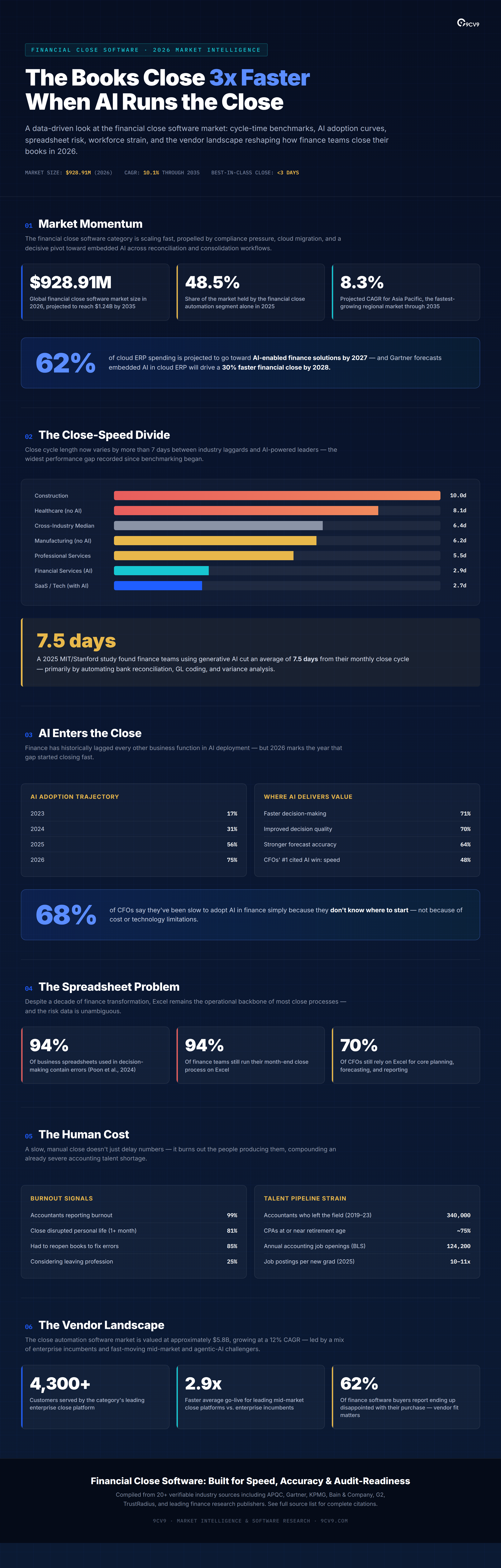
Artificial intelligence is emerging as one of the most influential trends shaping financial close software in 2026. AI-powered reconciliation, automated journal entries, anomaly detection, predictive analytics, and continuous accounting technologies are helping organizations reduce repetitive tasks and accelerate financial reporting. Industry estimates suggest that financial close automation can reduce closing cycles by approximately 30% to 50%, while advanced AI-enabled finance teams are achieving closing times of fewer than three days.
The growing adoption of financial close automation also reflects broader challenges facing accounting professionals. Talent shortages, increasing workloads, employee burnout, and heightened compliance requirements are encouraging chief financial officers (CFOs) and finance leaders to invest in technologies that improve operational efficiency without sacrificing accuracy or financial controls. Leading financial close software providers, including BlackLine, FloQast, and HighRadius, are responding by expanding their AI capabilities, automated reconciliation functions, and enterprise financial management solutions.
Meanwhile, cloud-based financial consolidation platforms, intercompany reconciliation software, and continuous close technologies are gaining importance as businesses expand across multiple entities, jurisdictions, and accounting systems. These developments are reshaping the competitive landscape and influencing how organizations evaluate financial close software pricing, implementation timelines, return on investment (ROI), scalability, and integration capabilities.
Understanding the latest financial close software statistics, market trends, adoption rates, and industry benchmarks for 2026 is essential for businesses seeking to modernize their accounting operations. Whether evaluating financial close automation software, comparing accounting technology providers, or developing a digital finance transformation strategy, reliable industry data can help decision-makers identify opportunities, assess implementation challenges, and prioritize technology investments.
This comprehensive guide explores the top 102 financial close software statistics, data, and trends in 2026, covering global market size and growth projections, month-end close performance benchmarks, AI adoption in finance, spreadsheet dependency, financial reporting accuracy, regulatory compliance, accounting workforce challenges, and the evolving financial close software vendor landscape.
By examining these statistics and emerging developments, CFOs, financial controllers, accounting managers, finance professionals, software vendors, and business leaders can gain valuable insights into the future of financial close automation and make more informed decisions about improving financial efficiency, accuracy, and long-term organizational performance.
Before we venture further into this article, we would like to share who we are and what we do.
About 9cv9
9cv9 is a business tech startup based in Singapore and Asia, with a strong presence all over the world.
With over ten years of startup and business experience, and being highly involved in connecting with thousands of companies and startups, the 9cv9 team has listed some of the top and best companies/tools in this review.
If you like to get your company listed in our top B2B software reviews, check out our world-class 9cv9 Media and PR service and pricing plans here.
Top 102 Financial Close Software Statistics, Data & Trends in 2026
Market Size & Growth
- The global financial close software market is valued at approximately USD 928.91 million in 2026 and is projected to reach USD 1,239.76 million by 2035, at a CAGR of 10.1% — signaling a decade of sustained double-digit expansion for close automation vendors.
- A separate market analysis pegs the financial close software market at USD 8.8 billion in 2025, growing to USD 18.5 billion by 2034 at an 8.1% CAGR, reflecting how methodology differences across research firms (narrow “close automation” vs. broader “close + consolidation + reporting”) create wide valuation ranges buyers should account for when benchmarking vendor claims.
- The global financial consolidation software market stood at USD 3.56 billion in 2026, on track to reach USD 7.77 billion by 2035 at a 9% CAGR, underscoring that consolidation — a core financial close function — is growing nearly as fast as the broader close category.
- The financial close automation segment captured around 48.5% of total financial close software market share in 2025, confirming that automation-first products now represent the largest single slice of buyer spend in this category.
- The financial consolidation segment held the largest application-based market share at 50.5% in 2025, making consolidation the single biggest functional driver of financial close software purchases.
- Intercompany reconciliation is projected to be the fastest-growing functionality segment in financial close software, driven by rising demand for accurate cross-entity transaction matching and faster close cycles.
- Asia Pacific is expected to be the fastest-growing region for financial close software, expanding at roughly 8.3% CAGR between 2026 and 2035, fueled by cloud adoption, AI-assisted automation, and digital transformation across India, China, and Japan.
- North America and Europe currently lead financial close software adoption, attributed to mature digital infrastructure, strict compliance requirements, and a large base of enterprise finance users.
- Nearly 42% of organizations cite data integration complexity across legacy systems as the primary barrier to adopting financial consolidation software, making integration depth a top vendor-selection criterion.
- Approximately 65% of enterprises are actively shifting to cloud-based consolidation platforms to support real-time financial visibility and multi-entity reporting, cementing cloud-first deployment as the market default.
- Top vendors collectively command nearly 55% of the financial consolidation software market, indicating a moderately consolidated competitive landscape dominated by a handful of established players.
- On-premises deployments still represent roughly 47% of the consolidation software market, showing that despite the cloud shift, a substantial share of large enterprises retain on-prem systems for data control reasons.
- According to Gartner, AI-enabled solutions are projected to capture 62% of cloud ERP spending by 2027, a trend directly reshaping how financial close platforms are built and marketed.
- Gartner projects that embedded AI in cloud ERP finance applications will drive a 30% faster financial close by 2028, giving finance leaders a concrete automation ROI benchmark to plan against.
- The average BlackLine enterprise contract runs between USD 77,000 and USD 340,000 annually, illustrating the wide cost spectrum between mid-market and enterprise-grade financial close deployments.
Month-End Close Cycle Benchmarks
- The median cycle time to monthly close across 2,300 organizations, per APQC benchmarking data, sits at 6.4 days, remaining the most widely cited cross-industry close benchmark.
- Healthcare organizations without AI report the slowest average close time in 2026 at 8.1 days, driven by complex revenue cycle reconciliation and payer mix adjustments.
- Manufacturing companies average a 6.2-day close without AI, largely due to inventory valuation, multi-site intercompany activity, and high accounts payable transaction volumes.
- SaaS and technology companies using AI now close in under 3 days, representing the fastest segment benchmarked in the 2026 finance close data.
- Best-in-class finance teams — primarily SaaS and financial services firms using AI — are closing in 2.4 to 2.9 days, a pace considered unattainable for mid-market teams as recently as 2022.
- AI agent deployment compresses close cycle time by 40% to 55% across all six industries benchmarked in 2026, the largest single-source improvement recorded since 2020.
- A 2025 MIT/Stanford study found finance teams using generative AI cut an average of 7.5 days from their monthly close cycle, driven primarily by automating bank reconciliation, GL coding, and variance analysis.
- Only 18% of finance teams manage to close their books within 3 business days, according to a 2025 industry benchmarking study, while half take 6 or more business days.
- Small businesses under USD 5 million in revenue typically take 12 to 20 business days to complete their close, often due to lacking a formal close checklist or dedicated close software.
- In a Gartner survey, 55% of finance functions say they are targeting a fully touchless close, reflecting how continuous, automation-first closing has become a stated strategic goal rather than an aspiration.
- A Gartner survey found 86% of finance functions want a faster, real-time close, showing near-universal appetite for close acceleration technology.
- Reducing close time from 10 days to 5 days is a commonly cited real-world outcome among companies implementing modern ERP and close automation tools, freeing up finance teams for forecasting and analysis instead of manual data validation.
- Roughly 94% of finance teams still rely on Excel for close activities, according to a 2025 benchmarking study, with half of those teams saying Excel is the primary reason their close runs slow.
- Cash reconciliation alone can consume 20 to 50 hours per month for teams still performing this task manually, representing one of the single largest time drains in the close process.
- Automation reduces close cycles by roughly 30% to 50% on average, based on vendor-reported figures compiled across multiple 2026 benchmark studies.
- Only about 30% of companies have a documented, step-by-step month-end close checklist with assigned owners and deadlines, despite this being considered a foundational best practice.
- Close quality follows a “U-curve,” where both rushed and very slow closes tend to carry more errors, with the four-to-eight-day window identified as the accuracy sweet spot.
- Professional services and simple retail businesses typically close in 4 to 7 days, the fastest range among traditional (non-SaaS) industries.
- Industries with complex revenue recognition — SaaS, construction, and healthcare — average 8 to 12+ business days to close, reflecting how revenue complexity directly extends close timelines.
- Manufacturing companies fall in the middle of the close-speed spectrum at 7 to 10 days, driven by inventory and cost accounting complexity.
- Continuous close practices — daily reconciliations, weekly expense reviews, real-time revenue recognition — can reduce month-end work to just 1 to 3 days, representing the most advanced close operating model available today.
AI Adoption in Finance
- 56% of finance leaders now use AI-powered tools in their daily work, up from 31% in 2024 and just 17% in 2023 — effectively doubling year over year.
- Despite this growth, finance still ranks last among all business functions in AI deployment, trailing engineering, marketing, and customer success in full workflow automation maturity.
- 68% of CFOs say they have been slow to adopt AI because they don’t know where to start, identifying strategic uncertainty — not technology limitations — as the primary adoption barrier.
- 45% of finance teams remain in “limited pilot” mode with AI, while only 17% are using it in core workflows, showing that most AI adoption in finance is still shallow rather than embedded.
- ChatGPT leads specialized and general AI tool usage among finance teams at 35% adoption, ahead of purpose-built finance AI tools.
- A KPMG global survey found active AI use in finance more than doubled from 30% in 2024 to 75% in 2026, with 71% of finance leaders saying AI is meeting or exceeding ROI expectations.
- Fewer than half of organizations (42%) report being fully “assurance-ready” for AI-enabled finance processes, and only 29% track where their AI adoption is failing — a governance gap regulators are increasingly scrutinizing.
- 36% of organizations cite data quality as both their biggest AI adoption barrier and their biggest opportunity, highlighting that data readiness — not model capability — remains the binding constraint.
- 70% of organizations report improved decision-making quality after adopting AI in finance, with 71% reporting faster decision-making and 64% reporting stronger forecast accuracy.
- In banking, 71% of finance leaders report improved forecast accuracy from AI, compared to just 44% in healthcare — a 27-point gap attributed to differences in underlying data structure quality.
- Gartner’s 2025 survey found finance function AI adoption grew from 37% in 2023 to 58% in 2024, before slowing to a slight increase in 2025 as complexity, data, and talent challenges emerged as adoption headwinds.
- Knowledge management is the most common AI use case in finance at 49% adoption, followed by accounts payable process automation (37%) and error/anomaly detection (34%).
- 56% of finance leaders surveyed by Bain & Company are increasing enterprise-wide AI investment by more than 15% this year, with 83% planning increases above 15% over the next two years.
- Only 31% of CFOs rate their AI outcomes in finance as “strongly positive,” even as investment accelerates — reflecting a gap between adoption enthusiasm and measured returns.
- When CFOs describe their biggest AI win, speed and cycle-time reduction leads at 48%, ahead of headcount or direct cost savings at 34%, confirming that faster closes — not layoffs — are the primary value driver cited by finance leaders.
- A Consero 2026 survey of 102 PE/VC-backed finance leaders found AI adoption reached 97% across finance departments, up from 76% in 2025, with 42% saying AI is now broadly or fully embedded in their operations.
- More than 75% of AI investments in finance are already generating positive returns within 12 months, according to the same Consero survey, while only 3% of finance leaders remain skeptical of future AI payoffs.
- HighRadius reports its agentic AI financial close platform reduces days-to-close by 30% and improves close productivity by 50% without adding headcount, illustrating vendor-reported gains from autonomous close agents.
- Modern autonomous accounting platforms report achieving a 96% bank reconciliation auto-match rate, automating the vast majority of routine reconciliation work.
- Some AI-enabled platforms report automating 95% of journal postings, virtually eliminating manual journal entry work for standard, rules-based transactions.
- Finance teams remain the most focused function in any company, spending 89.9% of their day on productive tasks — yet their AI usage sits at just 3.1%, one of the sharpest productivity-versus-automation contradictions across corporate functions.
- BlackLine’s April 2026 “Agentic Financial Operations” launch introduced AI-powered “digital workers” for reconciliation preparation, transaction matching, and collections management, signaling the shift from rules-based to agentic close automation industry-wide.
- Roughly 20% of BlackLine’s customers were using any AI features as of late 2025, showing that even among enterprise financial close software users, AI feature adoption significantly lags platform adoption.
- AI-driven cash application automation reduces manual matching time by 30% to 50% within the first 90 days of implementation, with days-sales-outstanding improvements of 8 to 15 days.
Excel & Spreadsheet Reliance
- Nearly 88% of accounting spreadsheets contain human errors, according to research frequently cited across the finance automation industry — a figure that has remained persistently high for over a decade.
- A 2024 academic study led by Prof. Pak-Lok Poon found that 94% of business spreadsheets used in decision-making contain errors, some minor and some catastrophic to financial outcomes.
- 70% of CFOs still rely on Excel for core finance planning, forecasting, and reporting functions, despite documented risks around data security, compliance, and error rates.
- 68% of large firms and 69% of small businesses depend on spreadsheets to manage complex financial calculations, according to Robert Half/FERF research.
- Approximately 94% of finance teams still run their month-end close process on Excel, per a 2026 benchmark roundup — making it the dominant close tool despite the growth of dedicated close software.
- Ray Panko’s landmark spreadsheet research found that, on average, 88% of Excel spreadsheets contain formula errors of 1% or more, a figure widely cited across financial modeling and audit literature.
- In one high-profile 2022 incident, an incorrect spreadsheet data entry led to roughly USD 92 million being misallocated within a sovereign wealth fund’s balance calculations, illustrating the real-world financial stakes of manual spreadsheet processes.
- The number of U.S. public companies forced to withdraw and restate financial statements due to accounting errors reached a nine-year high in 2024, with 140 companies issuing restatements in the first ten months alone.
Corporate Restatements & Compliance
- Corporate financial restatements dropped 18% in 2025 to 391 total, the second-lowest count in the past 20 years, according to Ideagen Audit Analytics — a trend consistent with wider adoption of automated close and reconciliation controls.
- The percentage of companies issuing restatements in 2025 fell to just 5.1%, continuing a long-term downward trend in restatement frequency.
- Debt and equity issues were the most common restatement trigger, appearing in 27% of all 2025 restatements, highlighting complex instrument accounting as a persistent close risk area.
- 2021 saw the highest restatement count in the past two decades at 1,060, driven almost entirely by an SEC staff statement on SPAC warrant accounting — a reminder that regulatory shifts can rapidly spike restatement volume regardless of software maturity.
- Hundreds of U.S.-listed companies have disclosed material weaknesses explicitly tied to accounting staff shortages, with several citing delayed filings as a direct consequence.
- Incremental SOX remediation costs commonly range from USD 250,000 to USD 1.5 million annually in accelerated testing and consultant support for organizations facing control gaps.
- Understaffed finance teams see audit cycles extend by 2 to 6 weeks, driving incremental audit fees of USD 100,000 to USD 500,000 for mid-cap filers.
- Month-end close frequently slips 3 to 7 days in lean, understaffed finance teams, directly linking talent shortages to close performance degradation.
Accountant Talent, Burnout & Workforce
- 99% of surveyed accountants report experiencing some level of burnout, according to a FloQast survey of roughly 200 accounting and finance professionals, with 24% reporting medium-to-high burnout levels.
- 81% of accountants report at least one month in the past year where the financial close process disrupted their personal life, with 43% saying it happened during three or more months.
- 85% of accountants had to reopen the books at least once in the past year to fix errors, with nearly half (49%) needing to reopen books during three or more months.
- 340,000 accountants left the U.S. accounting profession between 2019 and 2023 — a 17% decline from an estimated workforce of approximately 1.6 million.
- Approximately 75% of CPAs in the U.S. are at or near retirement age, implying continued significant workforce exits through the remainder of the decade.
- The Bureau of Labor Statistics projects roughly 124,000 accounting and auditing job openings annually through 2034, even as the supply of qualified candidates continues to shrink.
- 86% of accountants report burnout, and 25% say they are seriously considering leaving the profession within the next year, according to a Sage “Practice of Now” survey spanning six markets.
- During the 2024–2025 busy season, 48% of public accountants reported working 51–60 hours per week, with 19% working 61–70 hours and 12% logging 71+ hours weekly.
- 88% of public accountants say they want better work-life balance, and 87% want to work fewer hours, signaling that burnout-driven attrition risk remains elevated across the profession.
- LinkedIn showed roughly 550,000 to 625,000 active accounting job postings at any point during 2025 — equating to 10–11 open postings per new accounting graduate entering the market.
- The active CPA workforce is aging, with a shrinking pipeline of new candidates, driven partly by the 150-college-credit-hour CPA licensure requirement, which research from MIT Sloan links to a significant decline in candidates, particularly among lower-income and minority students.
- Bureau of Labor Statistics data projects 5% growth in accountant and auditor employment from 2024 to 2034, faster than the average for all occupations — even as bookkeeping and clerk-level roles are projected to decline 6% over the same period, reflecting how automation is reshaping the profession’s composition rather than eliminating it outright.
Vendor & Product Landscape
- BlackLine serves more than 4,300 customers, primarily in the enterprise segment, while FloQast serves approximately 2,800 customers concentrated in the mid-market — illustrating the segment-based competitive split within close software.
- The broader close automation software market is valued at approximately USD 5.8 billion, growing at a 12% CAGR, according to a 2026 vendor landscape analysis.
- BlackLine’s transaction-matching engine achieves auto-match rates exceeding 90% on properly configured accounts, a benchmark figure commonly cited in enterprise reconciliation evaluations.
- BlackLine’s auto-certification capability handles between 43% and 85% of reconciliation accounts without human touch, depending on configuration and account complexity.
- FloQast customers report reaching positive ROI in approximately 11 months on average, while implementation timelines run roughly 1.7 months compared to BlackLine’s approximately 5-month average — a 2.9x faster go-live cited in G2 comparison data.
- FloQast’s auto-match reconciliation engine achieves 50% to 80% accuracy according to finance team reviews, notably lower than BlackLine’s enterprise-grade matching engine, reflecting the tradeoff between ease-of-adoption and matching depth across close platforms.
- One case study cites a company migrating system-to-system SOX reconciliations from a legacy platform to a newer agentic close tool, lifting match rates from 88% to over 98%, demonstrating measurable automation gains from platform modernization.
- A separate close automation case study reports 75% faster daily bank reconciliations and automated clearing of nearly 99% of more than 45,000 monthly line items using AI/ML-powered transaction matching.
- The average organization reduces close time by 30% to 50% within the first year of deploying dedicated reconciliation software, with best-in-class teams progressing toward continuous close capability.
- Named a Leader in the 2026 Gartner Magic Quadrant for Financial Close and Consolidation, several established vendors continue to anchor the top of the enterprise buying evaluation criteria, while newer AI-native entrants are positioned as Niche Players or Visionaries.
- Enterprise generative AI spending reached approximately USD 37 billion in 2025 — more than triple the prior year — with the share funded from experimental innovation budgets collapsing from 25% to 7% in a single year, reflecting AI’s rapid move from pilot budgets into core operating spend, including finance and close functions.
- Roughly three in five finance leaders say the CFO or finance organization signs off on AI purchase decisions, positioning finance leadership as a central gatekeeper for enterprise AI investment beyond just their own function.
- 62% of finance software buyers report ending up disappointed with their purchase, according to compiled Capterra, Gartner, RAND, and Thomson Reuters data — a reminder that vendor selection rigor matters as much as software capability in the financial close category.
- Over 30% of financial close software vendors recently enhanced AI-powered consolidation modules aimed at faster close cycles and automated error detection, confirming AI feature investment is now a near-universal vendor roadmap priority rather than a differentiator reserved for a few players.
Conclusion
The top 102 financial close software statistics, data, and trends in 2026 highlight a significant transformation in how organizations approach financial reporting, accounting automation, reconciliation, and month-end closing processes. As businesses face increasing demands for financial accuracy, operational efficiency, regulatory compliance, and real-time financial visibility, financial close software is evolving from a specialized accounting solution into an essential component of modern financial management.
One of the most important findings is the continued expansion of the global financial close software market, supported by growing investments in artificial intelligence, cloud-based financial management platforms, and automated accounting workflows. With one market estimate placing the industry at approximately USD 928.91 million in 2026 and projecting sustained growth through 2035, the demand for financial close automation solutions is expected to remain strong. Although market valuations differ depending on whether financial consolidation, reporting, and related technologies are included, the overall direction points toward increasing adoption and innovation.
The statistics also reveal substantial opportunities to improve financial close efficiency. With the median month-end close taking approximately 6.4 days and only 18% of finance teams completing their closing processes within three business days, many organizations still face significant operational bottlenecks. Manual reconciliations, fragmented accounting systems, spreadsheet dependency, and limited process standardization continue to slow financial reporting. Dedicated financial close software can help address these challenges by automating repetitive tasks, improving workflow visibility, and strengthening financial controls.
Artificial intelligence is emerging as a major driver of financial close software innovation in 2026. AI-powered transaction matching, automated journal entries, anomaly detection, intelligent reconciliation, and predictive financial analytics are changing how accounting teams manage complex financial processes. Industry estimates suggest that automation can reduce financial close cycles by approximately 30% to 50%, while some advanced AI-enabled finance teams are achieving closing times of fewer than three days. However, these improvements depend on implementation quality, data readiness, system integration, and organizational processes.
Another important trend is the continued reliance on traditional accounting tools despite the availability of advanced automation technologies. Approximately 94% of finance teams still use Excel for financial close activities, demonstrating that spreadsheet-based processes remain deeply embedded in financial operations. While spreadsheets offer flexibility and familiarity, excessive dependence on manual workflows can introduce reconciliation errors, version-control problems, audit challenges, and unnecessary administrative workloads.
Beyond technology adoption, the findings emphasize the growing importance of accounting workforce sustainability. Talent shortages, employee burnout, increasing compliance requirements, and expanding financial reporting responsibilities are placing additional pressure on finance departments. Financial close automation offers organizations an opportunity to reduce repetitive work, improve employee productivity, and allow accounting professionals to concentrate on financial analysis, strategic planning, risk management, and business decision-making.
Looking ahead, several developments are likely to shape the future of financial close software beyond 2026, including the expansion of agentic AI, continuous accounting, cloud-based financial consolidation, automated intercompany reconciliation, and real-time financial reporting. Leading financial close software providers such as BlackLine, FloQast, and HighRadius are increasingly investing in intelligent automation capabilities, while emerging software vendors are introducing new approaches to financial process management.
For CFOs, financial controllers, accounting managers, and business leaders, these developments reinforce the importance of evaluating financial close software based on measurable business outcomes rather than individual features alone. Key considerations include financial close cycle reduction, reconciliation accuracy, integration capabilities, implementation costs, regulatory compliance, scalability, and long-term return on investment.
Ultimately, the financial close software statistics for 2026 demonstrate that the future of accounting is becoming increasingly automated, intelligent, and data-driven. Organizations that successfully combine financial close automation with strong internal controls, reliable financial data, and well-designed accounting processes will be better positioned to accelerate reporting cycles, improve financial transparency, and strengthen operational resilience.
As the financial technology landscape continues to evolve, investing in the right financial close management software will be an increasingly important strategic decision for organizations seeking to build faster, more accurate, and more efficient finance functions. The businesses that prioritize intelligent automation, continuous process improvement, and financial data integrity today will be better prepared to navigate the accounting and reporting challenges of 2027 and beyond.
If you find this article useful, why not share it with your hiring manager and C-level suite friends and also leave a nice comment below?
We, at the 9cv9 Research Team, strive to bring the latest and most meaningful data, guides, and statistics to your doorstep.
To get access to top-quality guides, click over to 9cv9 Blog.
To hire top talents using our modern AI-powered recruitment agency, find out more at 9cv9 Modern AI-Powered Recruitment Agency.
People Also Ask
What is financial close software?
Financial close software automates accounting tasks such as reconciliations, journal entries, financial consolidation, and reporting. It helps businesses close their books faster, improve accuracy, maintain compliance, and reduce manual accounting workloads.
What is the global financial close software market size in 2026?
The global financial close software market is estimated at approximately USD 928.91 million in 2026. Broader market estimates are substantially higher when financial consolidation, reporting, and related accounting technologies are included.
How fast is the financial close software market growing?
The financial close software market is projected to grow at a compound annual growth rate (CAGR) of approximately 10.1% through 2035, driven by increasing demand for AI automation, cloud accounting solutions, and faster financial reporting.
What are the biggest financial close software trends in 2026?
Major trends include AI-powered reconciliation, automated journal entries, continuous accounting, cloud-based financial consolidation, real-time reporting, agentic AI, and increased investment in financial process automation.
How long does the average month-end financial close take?
APQC benchmarking data indicates a median monthly financial close cycle of approximately 6.4 days. Closing times vary depending on industry, company size, accounting complexity, automation maturity, and financial reporting requirements.
How does financial close automation reduce closing time?
Financial close automation accelerates reconciliations, journal entries, approvals, and reporting workflows. Industry estimates suggest automated solutions can reduce financial close cycles by approximately 30% to 50%, depending on implementation and process complexity.
What percentage of finance teams use Excel for financial closing?
Approximately 94% of finance teams still rely on Excel for financial close activities. This widespread spreadsheet dependency highlights opportunities for automated reconciliation, improved data accuracy, and more efficient accounting workflows.
How is artificial intelligence transforming financial close software?
AI transforms financial close software through intelligent transaction matching, automated journal postings, anomaly detection, predictive analytics, and continuous reconciliation. These capabilities reduce repetitive tasks and improve financial reporting efficiency.
What percentage of finance leaders use AI in 2026?
Industry survey findings indicate that approximately 56% of finance leaders use AI-powered tools in their daily work. Adoption continues to expand as organizations integrate intelligent automation into accounting, reporting, and financial analysis.
What is continuous financial close?
Continuous financial close is an accounting approach that performs reconciliations, transaction reviews, and financial adjustments throughout the reporting period instead of waiting until month-end. Advanced implementations can reduce final closing activities to one to three days.
What are the benefits of financial close management software?
Financial close management software improves reporting accuracy, accelerates month-end closing, reduces manual errors, strengthens audit readiness, enhances financial visibility, and allows accounting teams to focus on strategic financial activities.
Which companies provide financial close automation software?
Leading financial close software providers include BlackLine, FloQast, and HighRadius. These companies offer solutions for account reconciliation, financial close management, transaction matching, workflow automation, and AI-powered accounting operations.
What is the difference between BlackLine and FloQast?
BlackLine primarily serves enterprises requiring advanced reconciliation and financial automation capabilities. FloQast focuses heavily on mid-market accounting teams seeking streamlined close management, collaboration, and relatively straightforward implementation.
How much does financial close software cost?
Financial close software pricing varies by vendor, company size, functionality, and implementation requirements. Enterprise BlackLine contracts have been estimated at approximately USD 77,000 to USD 340,000 annually, although actual pricing depends on contractual terms.
What is financial reconciliation software?
Financial reconciliation software automatically compares transactions, account balances, and financial records across systems. It identifies discrepancies, supports audit trails, reduces manual matching, and improves the accuracy of financial statements.
How accurate is automated transaction matching?
Advanced financial reconciliation platforms report transaction auto-match rates exceeding 90% on properly configured accounts. Actual accuracy depends on data quality, transaction complexity, matching rules, and software capabilities.
What percentage of finance teams close their books within three days?
Approximately 18% of finance teams complete their monthly financial close within three business days, according to industry benchmarking data. Advanced AI-enabled finance teams can achieve closing cycles of fewer than three days.
Why do companies struggle with month-end closing?
Common challenges include manual reconciliations, fragmented accounting systems, spreadsheet errors, complex revenue recognition, insufficient staffing, delayed approvals, and limited automation across financial reporting workflows.
What is cloud-based financial close software?
Cloud-based financial close software provides online access to reconciliation, consolidation, accounting workflows, and reporting tools. It supports collaboration across finance teams, centralized financial data, scalable operations, and automated updates.
How popular is cloud financial consolidation software?
Approximately 65% of enterprises are actively transitioning toward cloud-based financial consolidation platforms. This shift reflects increasing demand for real-time reporting, centralized accounting data, and improved multi-entity financial management.
What is financial consolidation software?
Financial consolidation software combines financial information from multiple subsidiaries, departments, or business entities into unified financial statements. It automates intercompany eliminations, currency conversions, and consolidated reporting.
What is the financial consolidation software market size in 2026?
The global financial consolidation software market is estimated at approximately USD 3.56 billion in 2026 and projected to reach USD 7.77 billion by 2035, representing a compound annual growth rate of around 9%.
How does financial close software improve regulatory compliance?
Financial close software supports regulatory compliance through standardized accounting workflows, approval controls, audit trails, reconciliation documentation, and automated reporting. These features help organizations strengthen financial governance and audit readiness.
Can financial close software reduce accounting errors?
Yes. Financial close software reduces manual data entry, standardizes reconciliation procedures, and identifies transaction discrepancies. Automated validation and anomaly detection can improve financial accuracy, although human oversight remains important.
What is agentic AI in financial close automation?
Agentic AI uses intelligent software agents to execute accounting tasks such as transaction matching, reconciliation preparation, journal processing, and exception management. It aims to reduce manual intervention while maintaining appropriate financial controls.
How does financial close automation affect accounting jobs?
Financial close automation reduces repetitive accounting activities and shifts employee responsibilities toward financial analysis, compliance, strategic planning, and exception management. It can help understaffed finance teams manage increasing reporting demands.
What percentage of accountants experience burnout?
A FloQast survey reported that 99% of surveyed accounting and finance professionals experienced some level of burnout. Financial close pressures, repetitive workloads, and demanding reporting deadlines contribute to workforce challenges.
What is the ROI of financial close automation software?
Financial close automation ROI comes from faster closing cycles, reduced manual work, improved reconciliation accuracy, and stronger financial controls. Vendor-reported benchmarks indicate potential close-time reductions of 30% to 50%.
Which region has the fastest-growing financial close software market?
Asia Pacific is projected to be the fastest-growing regional market, with an estimated CAGR of approximately 8.3% between 2026 and 2035. Growth is supported by cloud adoption, AI automation, and digital transformation initiatives.
What is the future of financial close software beyond 2026?
Financial close software is expected to evolve toward autonomous accounting, agentic AI, continuous reconciliation, predictive financial analytics, and real-time reporting. Cloud integration and intelligent automation will increasingly shape financial management strategies.
Sources
- Global Market Statistics
- Custom Market Insights
- GlobeNewswire
- Business Research Insights
- ChatFin
- Rand Group
- Eagle Rock CFO
- Time Doctor
- Numeric
- Dokka
- Datarails
- Summit Global
- MSDynamicsWorld
- Ramp
- FloQast
- CPACharge
- Vintti
- Century Group
- Frederick Fox
- CurateSuite
- Gitnux
- SIMAA
- CFO Connect
- Consero Global
- Bain & Company
- North Penn Now
- KPMG
- Gartner
- Federal Reserve
- CFO
- Enable
- Cap Ex SaaS
- NextProcess
- CFO Tech
- Numerix
- Qashqade
- Limelight
- Full Stack Modeller
- Phys.org
- Transformance
- HighRadius
- Netgain
- Maxima
- Ledge
- TrustRadius
- Accounting Today