




























Key Takeaways
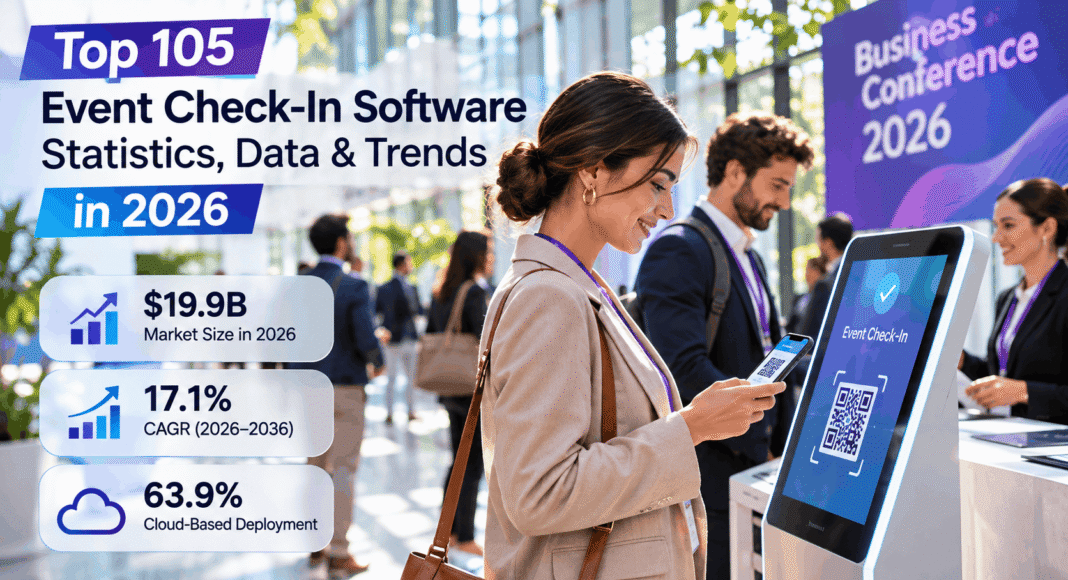
- Event Check-In Software Market Growth: The global event management software market is projected to reach $19.9 billion in 2026 and $96.5 billion by 2036, driven by digital transformation, cloud adoption, and automated event registration solutions.
- QR Code, RFID, and Self-Service Check-In Adoption: Automated event check-in technologies can reduce attendee processing times from 30–60 seconds to just 5–10 seconds, while self-service kiosks can cut waiting times by up to 75%, improving operational efficiency and attendee satisfaction.
- AI-Powered Event Check-In and Emerging Technology Trends: With 48% of event management platform users adopting AI-powered features and 79% of organizers integrating CRM or marketing automation tools, intelligent analytics, biometric authentication, and contactless check-in are shaping event technology in 2026.
Event check-in software in 2026 helps organizers streamline attendee registration, reduce waiting times, and improve event security. With the global event management software market estimated at $19.9 billion, QR code scanning, RFID, AI-powered automation, and self-service kiosks are transforming event operations, enabling faster check-ins, real-time attendance tracking, and better attendee experiences.
The event industry is undergoing a significant digital transformation, with event check-in software becoming an essential tool for streamlining attendee registration, reducing waiting times, enhancing security, and improving overall event experiences. As businesses, conference organizers, and event professionals increasingly embrace automation, technologies such as QR code scanning, RFID wristbands, facial recognition, self-service kiosks, and AI-powered attendance tracking are redefining how events operate in 2026.
Also, read our article on the Top 10 Event Check In Software To Know.
The growing demand for efficient event management solutions is reflected in the industry’s impressive market projections. According to Future Market Insights, the global event management software market is valued at approximately $19.9 billion in 2026 and is projected to reach $96.5 billion by 2036, expanding at a compound annual growth rate (CAGR) of 17.1%. Meanwhile, Coherent Market Insights estimates that cloud-based deployment accounts for 63.9% of the market, highlighting the increasing importance of scalable, accessible, and real-time event management platforms.
One of the most notable event check-in software trends in 2026 is the rapid adoption of self-service and contactless technologies. Industry estimates suggest that QR code-based self-service kiosks can reduce attendee check-in times from 30–60 seconds to just 5–10 seconds per person, while kiosk solutions can reduce waiting times by as much as 75%. These improvements allow event organizers to manage larger crowds more efficiently, minimize staffing requirements, and deliver smoother attendee experiences.

Artificial intelligence and advanced analytics are also reshaping event operations. The collected industry data indicates that 48% of event management platform users employ AI-powered features for personalized agendas and networking recommendations, while 79% of event organizers have integrated their event management platforms with CRM or marketing automation tools. These developments demonstrate how modern event check-in systems are evolving beyond basic attendance tracking into comprehensive platforms for attendee engagement, operational intelligence, and event ROI measurement.
At the same time, security and attendee verification are becoming increasingly important. RFID-enabled credentials, dynamic QR codes, biometric authentication, and real-time attendance monitoring are helping organizers strengthen access control and reduce ticket fraud. With hybrid and virtual events continuing to influence the industry, event check-in software must also support seamless experiences across physical venues and digital environments.
For event planners, corporate event managers, conference organizers, venue operators, and technology providers, understanding the latest event check-in software statistics, market data, adoption rates, and emerging technology trends is essential for making informed investment and operational decisions.
This comprehensive guide explores the top 105 event check-in software statistics, data, and trends in 2026, covering market size and growth forecasts, regional adoption, QR code check-in, self-service kiosks, RFID and NFC technologies, facial recognition, AI-powered automation, security, operational efficiency, hybrid event integration, and attendee satisfaction.
By examining these statistics and industry developments, businesses and event professionals can better understand the evolving event technology landscape, identify opportunities to improve check-in efficiency, evaluate software capabilities, and prepare for the future of digital event management.
Before we venture further into this article, we would like to share who we are and what we do.
About 9cv9
9cv9 is a business tech startup based in Singapore and Asia, with a strong presence all over the world.
With over ten years of startup and business experience, and being highly involved in connecting with thousands of companies and startups, the 9cv9 team has listed some of the top and best companies/tools in this review.
If you like to get your company listed in our top B2B software reviews, check out our world-class 9cv9 Media and PR service and pricing plans here.
Top 105 Event Check-In Software Statistics, Data & Trends in 2026
🏛️ MARKET SIZE & GROWTH
1. The global event management software market is valued at $19.9 billion in 2026, establishing the sector as a major enterprise technology investment area with clear ties to corporate event strategy. (Future Market Insights, 2026)
2. A CAGR of 17.1% will propel the event management software market to $96.5 billion by 2036, making it one of the fastest-growing enterprise SaaS verticals in the decade ahead. (Future Market Insights, 2026)
3. The Mordor Intelligence valuation pegs the 2026 event management software market at $15.2 billion, expected to reach $24.17 billion by 2031 at a steady 9.73% CAGR, reflecting durable enterprise demand. (Mordor Intelligence, 2026)
4. An alternative analysis projects the event management software market at $13 billion in 2026 growing at a 14.69% CAGR to $44.8 billion by 2035, underscoring the sector’s compounding value creation. (Industry Research Biz, 2026)
5. By 2036, event management platforms are projected to reach $96.5 billion, reflecting a generational shift in how organizations plan, execute, and measure the ROI of live and digital events. (Future Market Insights, 2026)
6. The software segment commands 85.1% of total event management market share in 2026, underscoring that integrated platforms — not standalone services — are the dominant commercial choice for event organizers. (Coherent Market Insights, 2026)
7. Coherent Market Insights values the event management software market at $18.03 billion in 2026, projecting it to reach $41.13 billion by 2033 at a 12.5% CAGR. (Coherent Market Insights, 2026)
8. Fortune Business Insights values the market at $11.31 billion in 2026, growing to $32.62 billion by 2034 at a 14.16% CAGR, driven by rising automation demand. (Fortune Business Insights, 2026)
9. Roots Analysis estimates the market at $14.29 billion in 2026, projected to reach $94.73 billion by 2040 — a CAGR of 14.46% — reflecting transformative long-term platform adoption. (Roots Analysis, 2026)
10. The top 10 event software providers hold approximately 55% of total event software market share, creating a moderately fragmented competitive landscape with meaningful opportunity for specialized check-in tools. (Industry Research Biz, 2026)
🌍 REGIONAL & DEPLOYMENT BREAKDOWN
11. North America captured 45.8% of global event management software market share in 2026, sustained by high enterprise spending and mature digital event infrastructure. (Coherent Market Insights, 2026)
12. Cloud-based deployment holds 63.9% market share in 2026, driven by accessibility, scalability, and the ability to support real-time check-in data synchronization across multiple event locations. (Coherent Market Insights, 2026)
13. Asia Pacific is set to register an 11.01% CAGR through 2031 — the fastest-growing region for event tech adoption — driven by digital infrastructure expansion and rising corporate event activity. (Mordor Intelligence, 2026)
14. Corporate end-users hold 39.7% market share in 2026, driven by the complexity and frequency of enterprise events requiring advanced check-in and registration automation. (Coherent Market Insights, 2026)
15. North America dominated the event management software market with 43.3% share among event planners and organizers, maintaining clear leadership as the world’s most mature event tech market. (Roots Analysis, 2026)
16. Large enterprises represent 61.5% of the event management software market by enterprise size, reflecting the high operational complexity of corporate events and the need for scalable check-in solutions. (Future Market Insights, 2026)
17. Event planners and organizers dominate current market share at 44.27%, making professional event teams the single largest buyer cohort for check-in software platforms globally. (Roots Analysis, 2026)
18. Cloud deployment penetration in the USA exceeds 79%, while AI-driven analytics adoption stands at 44%, with U.S. digital event penetration reaching 85%. (Market Growth Reports, 2026)
19. In North America, more than 68% of enterprises host at least 10 events annually through platforms, and nearly 72% of U.S.-based B2B organizations use event management software for conferences exceeding 500 attendees. (Market Growth Reports, 2026)
20. The U.S. represents over 41% of total event management platform adoption by user count, cementing America’s position as the world’s primary testing ground for check-in innovation. (Market Growth Reports, 2026)
🖥️ SELF-SERVICE & KIOSK CHECK-IN
21. QR-code self-service kiosks compress attendee check-in to just 5–10 seconds per person (vs. 30–60 seconds for manual), fundamentally transforming entry throughput at large-scale events. (QR Sage, 2025)
22. Event registration kiosks reduce attendee wait times by 75%, directly improving first impressions and overall event satisfaction while significantly easing pressure on front-of-house staff. (TouchWo, 2026)
23. Self-service check-in kiosks reduce staffing requirements by 70%, allowing a single monitor to oversee four to six kiosk stations versus the one-to-one ratio required by traditional manual check-in. (QR Sage, 2025)
24. A compelling 92% of event attendees prefer self-service check-in over staff-assisted alternatives, signaling that autonomous entry has become the modern attendee’s baseline expectation. (TouchWo, 2026)
25. Kiosk-based check-in solutions deliver 80% faster attendee processing compared to traditional manual registration, dramatically cutting congestion during peak arrival windows at large conferences. (TouchWo, 2026)
26. Event check-in kiosks generate a 50% reduction in overall staffing costs, enabling organizers to redirect budget and personnel toward higher-value attendee experience roles such as concierge support. (TouchWo, 2026)
27. On-site kiosk deployments generate a 25% increase in on-site ticket upgrades and add-on purchases, demonstrating that seamless check-in experiences have measurable revenue implications beyond logistics. (TouchWo, 2026)
28. 36% of individuals have already used a QR code to register for a virtual event, illustrating how deeply embedded code-based check-in has become across both physical and digital event formats. (Wavetec, 2025)
29. For a 500-attendee conference, self-service kiosks save 3–4 cumulative hours of wait time compared to manual check-in, representing significant time value for both attendees and organizers. (QR Sage, 2025)
30. Manual check-in carries a 30–60 second processing time per attendee, whereas QR scan + validation + badge print via kiosk compresses the same flow to a total elapsed time of just 5–10 seconds. (QR Sage, 2025)
📡 RFID & CONTACTLESS TECHNOLOGY
31. The global RFID market was worth $15.6 billion in 2025, covering tags, readers, and software across passive and active RFID — an ecosystem that directly underpins event wristband and badge infrastructure. (IDTechEx, 2025)
32. Around 55 billion passive RFID tags were sold in 2025 — a 10% year-on-year increase — driven by broad adoption across sectors including event management, retail, and logistics. (IDTechEx, 2025)
33. The global RFID market is projected to grow from $17.1 billion in 2025 to $37.7 billion by 2032 at ~12% CAGR, driven by broad adoption across sectors including live events and venue management. (CYBRA, 2026)
34. The contactless payments RFID segment is projected to grow at the highest CAGR of 11.8%, supported by NFC-enabled payment systems, transit fare collection, and access-based transactions at events. (MarketsandMarkets, 2026)
35. NFC mobile ticketing was used at 2.8 billion events worldwide in 2023 — a rapidly growing access-control method that eliminates the need for physical paper tickets and reduces check-in bottlenecks. (GiTnux, 2026)
36. Organizers report 15–30% higher on-site spending after switching to RFID cashless payments, illustrating that RFID goes far beyond check-in to become a revenue-driving commerce infrastructure. (Arnett Credentials, 2026)
37. RFID wristbands for events cost $0.30–$1.50 per unit, making mass deployment cost-effective even for mid-size events — particularly when weighed against the staffing savings and fraud prevention benefits. (Arnett Credentials, 2026)
38. NFC adoption in smartphones reached 92% in North America by Q4 2023, making mobile-based event check-in technically feasible for virtually all attendees without requiring additional hardware investment. (GiTnux, 2026)
39. Global NFC contactless payment users grew to 1.2 billion in 2023, a user base whose familiarity with tap-to-pay directly accelerates adoption of NFC-enabled event entry and check-in systems. (GiTnux, 2026)
40. NFC access control systems were installed in 45% of Fortune 500 offices by 2023, creating enterprise familiarity with tap-based credentialing that is rapidly transferring to the corporate event context. (GiTnux, 2026)
41. RFID wristband-based check-in eliminates pass-back fraud — the practice of one person sneaking in multiple attendees — because the system deactivates a wristband after its first successful entry scan. (Ticket Fairy, 2026)
42. The NFC market from contactless payments hit $18.9 billion revenue in 2023, providing a commercial foundation that sustains investment in the NFC infrastructure also used for event access management. (GiTnux, 2026)
🤖 FACIAL RECOGNITION & BIOMETRIC CHECK-IN
43. Top facial recognition algorithms now achieve over 99.5% accuracy according to NIST, making them reliable enough for high-volume identity verification at large-scale conferences and public events. (Fielddrive / NIST, 2026)
44. Modern facial recognition event systems can verify thousands of visitors in under one second per scan, enabling frictionless mass entry that no traditional check-in method can match for sheer throughput. (Facia.ai, 2025)
45. The facial recognition market is projected to reach $19.3 billion by 2032, with event management accounting for a growing share of deployments driven by frictionless attendee entry requirements. (Fielddrive, 2026)
46. 53% of Americans say they’d accept facial recognition at public events provided they’re informed in advance, representing a strong consent baseline for event organizers considering biometric check-in adoption. (PhotoAid, 2025)
47. A 2024 Gartner report found that crowd management effectiveness improved by 35% at venues that adopted real-time attendee analytics — an outcome increasingly delivered through biometric check-in systems. (Facia.ai, 2025)
48. Over 176 million Americans currently use facial recognition technology — with 131 million using it daily — establishing biometric familiarity that reduces friction for facial check-in at live events. (PhotoAid, 2025)
49. U.S. Customs and Border Protection has screened over 193 million travelers using biometric facial comparison, demonstrating the proven scalability of this technology for high-throughput identity verification. (PhotoAid / CBP, 2025)
50. Seven in ten governments (70%) use facial recognition extensively, establishing a regulatory familiarity and public-sector precedent that is accelerating private-sector event adoption. (PhotoAid, 2025)
51. Facial recognition at events enables real-time dashboards tracking crowd movement, peak attendance, and dwell time across venue zones — turning entry data into actionable crowd management intelligence. (Facia.ai, 2025)
52. Biometric facial authentication systems like Wicket are now deployed at venues preparing for the 2026 FIFA World Cup and 2028 Olympics, setting a new global benchmark for event entry technology. (Stadium Tech Report, 2025)
🔒 SECURITY & FRAUD PREVENTION
53. Over 80% of online event ticket traffic can be bots, requiring AI-powered fraud detection embedded in check-in software to protect organizers and legitimate attendees from systematic scalping attacks. (Ticket Fairy, 2026)
54. Cybersecurity reports show that over 12% of online ticket transactions in 2024 were fraudulent or suspicious, a direct revenue threat that modern check-in verification software is designed to neutralize. (Yotix, 2025)
55. An estimated 5 million people buy counterfeit event tickets annually, resulting in millions in lost revenue — a problem that digital check-in validation with unique dynamic QR codes directly addresses. (Ticket Fairy, 2026)
56. Approximately 30% of event tech security breaches now originate through third-party supply chain weaknesses, making integrated, security-certified check-in platforms a critical risk management priority. (Ticket Fairy, 2026)
57. An AI-driven system at a major Singapore sports event in 2025 flagged and cancelled over 12,000 counterfeit QR-code tickets before event day, saving nearly $450,000 in potential losses. (Yotix, 2025)
58. By 2027, over 65% of ticketing and event check-in platforms are expected to integrate AI and blockchain as core fraud-prevention components, transforming vendor selection criteria for enterprise buyers. (Yotix, 2025)
59. Dynamic QR codes — which change with each view — prevent duplication and are now standard in leading event check-in platforms, eliminating the single biggest paper ticket counterfeit vulnerability. (Softjourn, 2026)
60. When Coachella introduced blockchain-backed tickets for select events, counterfeit attempts dropped by over 90%, illustrating the combined power of distributed ledger verification and RFID-style tamper resistance. (Yotix, 2025)
⚙️ OPERATIONAL EFFICIENCY & ERROR REDUCTION
61. Manual paper check-in carries a 15–20% error rate at the door, reduced to under 1% with app-based QR scanning — a dramatic accuracy improvement that prevents duplicate entries and identity conflicts. (Perspective AI, 2026)
62. Free events experience no-show rates approaching 65%, while paid events still see 20–30% no-shows — data that check-in software captures to enable smarter capacity planning and revenue recovery. (Perspective AI, 2026)
63. Modern on-demand badge printers output a complete personalized badge in 3–5 seconds per attendee, compared to 60+ seconds for manual search and distribution during traditional check-in. (EventHex, 2026)
64. Best-in-class check-in platforms reduce average attendee processing time from 45 seconds to under 5 seconds — a nine-fold improvement that transforms large-scale conference arrivals into smooth, queue-free experiences. (EventHex, 2026)
65. Automation tools embedded in event platforms decrease overall planning workloads by 29%, freeing event teams to focus on experience design rather than administrative logistics and manual coordination. (Market Growth Reports, 2026)
66. Analytics dashboards integrated with check-in platforms improve sponsor ROI visibility by 33%, transforming raw attendance data into actionable, commercially valuable reporting for exhibitors and brand partners. (Market Growth Reports, 2026)
67. Mobile check-in solutions have reduced average attendee wait times by 35% across deployments, with real-time dashboards simultaneously enabling organizers to adjust staffing and manage crowd flow proactively. (Market Growth Reports, 2026)
68. A single staff member can monitor 4–6 self-service check-in kiosks simultaneously, compared to one-to-one manual check-in — enabling organizers to serve the same crowd with far fewer staff resources. (QR Sage, 2025)
🤖 AI & TECHNOLOGY TRENDS
69. Approximately 50% of meeting planners now use AI tools for scheduling, matchmaking, and content creation — with AI-driven check-in and registration increasingly central to this enterprise automation wave. (gassProductions, 2026)
70. 48% of event management platform users currently employ AI-powered features to personalize agendas and networking recommendations, signaling that AI has moved from differentiator to baseline expectation. (Market Growth Reports, 2026)
71. Platforms incorporating AI features saw a 60% increase in user satisfaction scores compared to non-AI counterparts, validating strong preference for intelligent automation in event workflows. (vFairs, 2026)
72. Predictive analytics adoption within event platforms improves attendee retention by 26%, as organizers use behavioral data from check-in and session tracking to inform smarter programming decisions. (Market Growth Reports, 2026)
73. Over half (54%) of event planners plan to deploy AI-driven engagement tools at events exceeding 1,000 attendees, making AI-backed check-in and personalization essential for large-scale event success. (Market Growth Reports, 2026)
74. 79% of event organizers have integrated their event management platform with CRM or marketing automation tools, making check-in data a live input into enterprise sales and marketing pipelines. (Bizzabo, 2026)
75. 64% of event organizers plan to switch their event management software vendor within the next year, highlighting the competitive pressure on check-in platforms to continuously innovate and improve UX. (Bizzabo, 2026)
76. 73% of attendees expect in-person conferences to use modern event technology, with check-in software and real-time badge printing among the top features that define “modern” event operations in 2026. (Bizzabo, 2026)
77. Recommendation engines powered by check-in and session data increase sponsor visibility by 33%, creating a direct commercial return on investment in sophisticated event data infrastructure. (Market Growth Reports, 2026)
78. AI-powered event platforms can analyze real-time badge scan data to identify where attendees are gathering, enabling instant adjustments to staffing, room assignments, and session capacity in real time. (Bizzabo, 2026)
📱 HYBRID & VIRTUAL EVENT INTEGRATION
79. The virtual events market reached $243 billion in 2025, growing at a 17.8% CAGR — driving demand for unified check-in software that bridges in-person and digital attendee management in a single platform. (AMW Group, 2026)
80. Over 123 million hybrid events were hosted globally in 2025, each requiring dual-mode check-in for in-person badge scanning and virtual access token management simultaneously. (AMW Group, 2026)
81. 83% of organizers report higher total attendance for hybrid events compared to in-person-only events, making multi-format check-in software a strategic investment with direct attendance growth implications. (AMW Group, 2026)
82. 74.5% of event planners have adopted hybrid formats, requiring check-in software capable of managing both physical badge scanning and virtual access authentication within a single workflow. (Remo.co, 2026)
83. Hybrid and virtual formats now account for 55% of all managed events globally, meaning the majority of event check-in software deployments must support at least two distinct attendee experience modes. (Market Growth Reports, 2026)
84. 59.4% of organizations want event software that supports both in-person and virtual check-in from a single platform, making unified multi-format capability a decisive purchasing criterion in 2026. (MarketsandMarkets, 2026)
85. 63% of event planners say hybrid events will be the most common format by 2027, driving sustained investment in check-in software capable of simultaneously managing in-person and virtual audiences. (AMW Group, 2026)
86. 93% of event marketers plan to invest in virtual events in 2026, creating parallel demand for digital check-in and access management tools that mirror the convenience of physical badge scanning. (vFairs, 2026)
👥 ATTENDEE EXPERIENCE & SATISFACTION
87. 55% of attendees say the mobile event app can make or break their overall event experience, connecting the check-in moment directly to broader satisfaction outcomes that influence repeat attendance. (Bizzabo, 2026)
88. 74% of event professionals identify attendee engagement as a key success metric in 2026, yet 39% still cite it as a top challenge — highlighting the strategic role of frictionless check-in in setting positive engagement tone. (EventsAir, 2026)
89. 54% of attendees plan to attend more in-person events in 2026 compared to the previous year, reinforcing sustained demand for robust onsite check-in and badge management infrastructure. (Bizzabo, 2026)
90. 71% of attendees believe in-person B2B conferences offer the most effective way to learn about new products or services, making the check-in experience a critical first impression in a high-value commercial context. (Bizzabo, 2026)
91. 97.4% of event professionals rate in-person events as very or moderately important to their 2026 strategy — up from 95.4% in 2025 — reinforcing that physical event check-in software remains mission-critical. (EventsAir, 2026)
92. 78% of event professionals rate content quality as “very important” to event success, with efficient check-in software serving as the gateway that ensures attendees arrive on time and primed for engagement. (EventsAir, 2026)
📊 PLATFORM ADOPTION & INDUSTRY BENCHMARKS
93. More than 75,000 event technology platforms were in active use worldwide by 2023, reflecting a highly fragmented landscape where specialized check-in tools compete with full-suite event management platforms. (Industry Research Biz, 2026)
94. Over 30,000 organizations in the U.S. use full-suite event management platforms for conferences, conventions, trade shows, and corporate events — creating a deep domestic market for check-in software. (Industry Research Biz, 2026)
95. The average large conference deploys 8 to 10 different software modules — including check-in — highlighting the integration complexity facing event technology buyers and the value of unified platforms. (Industry Research Biz, 2026)
96. 70% of enterprise event deployments in the U.S. feature mobile check-in, push notifications, and real-time analytics as standard components — a baseline that has continued to rise year over year. (Industry Research Biz, 2026)
97. U.S. event management platforms processed over 100 million registrations across events in 2022, illustrating the massive transaction volume that modern check-in infrastructure must reliably support at scale. (Industry Research Biz, 2026)
98. 67.4% of event organizers plan to switch their event management software, driven by UX dissatisfaction and integration gaps — creating significant opportunity for platforms offering superior check-in experience. (MarketsandMarkets, 2026)
99. Blackstone paid $4.6 billion to acquire Cvent in August 2024, signaling the massive institutional value placed on integrated event management and check-in platforms in the global enterprise event ecosystem. (Mordor Intelligence, 2026)
100. Eventbrite agreed to be acquired by Bending Spoons for $500 million, confirming ongoing M&A consolidation in event tech and the strategic value of platforms with built-in check-in and ticketing capabilities. (Mordor Intelligence, 2026)
101. 46% of global enterprises have replaced manual spreadsheet-based event management with integrated platform solutions — with check-in automation consistently cited as the primary initial use case. (Market Growth Reports, 2026)
102. Over 62% of corporate events now integrate at least five platform-based modules including check-in, compared to 38% just five years ago, reflecting rapid digital maturation of enterprise event operations. (Market Growth Reports, 2026)
103. More than 58% of organizations deploy event management platforms specifically to handle events with over 1,000 attendees, where automated check-in and real-time capacity management are operationally essential. (Market Growth Reports, 2026)
104. 81.8% of virtual event organizers use live polling — a capability increasingly bundled with hybrid check-in platforms that unify in-person and digital attendance management in a single interface. (gassProductions, 2026)
105. 40% of organizers now report difficulty proving event ROI — down dramatically from 70% in 2025 — with check-in analytics integration into CRM being the key driver of this improvement in measurement capability. (Bizzabo, 2026)
Conclusion
The top 105 event check-in software statistics, data, and trends in 2026 highlight an industry undergoing rapid digital transformation, driven by growing demand for automation, contactless technology, enhanced security, and seamless attendee experiences. As event organizers increasingly prioritize operational efficiency and data-driven decision-making, event check-in software has evolved from a basic registration tool into an essential component of modern event management.
The market outlook reinforces this transformation. According to Future Market Insights, the global event management software market is valued at approximately $19.9 billion in 2026 and is projected to reach $96.5 billion by 2036, growing at a CAGR of 17.1%. Although market estimates vary across research providers, the overall projections indicate sustained demand for digital event management platforms, including advanced attendee registration and check-in solutions.
One of the most significant developments is the increasing adoption of QR code check-in, RFID technology, self-service kiosks, and mobile event registration systems. Industry estimates suggest that automated QR code check-in can reduce attendee processing times from 30–60 seconds to just 5–10 seconds, while self-service kiosks can decrease waiting times by up to 75%. These improvements demonstrate the potential of event check-in automation to reduce congestion, optimize staffing resources, and create more convenient attendee experiences.
Artificial intelligence is also playing an increasingly important role in shaping the future of event check-in software. With 48% of event management platform users adopting AI-powered personalization features and 79% of event organizers integrating their platforms with CRM or marketing automation tools, event technology is becoming more intelligent, interconnected, and commercially valuable. AI-powered attendance analytics, predictive insights, and real-time monitoring enable organizers to improve crowd management, personalize attendee engagement, and measure event performance more effectively.
Meanwhile, event security, fraud prevention, and biometric authentication are emerging as important areas of innovation. Technologies such as dynamic QR codes, facial recognition, RFID wristbands, and digital access credentials offer new ways to strengthen attendee verification and prevent unauthorized entry. However, organizations must also consider data privacy, cybersecurity, implementation costs, and regulatory compliance when evaluating these solutions.
The continued evolution of hybrid and virtual events further emphasizes the importance of flexible, cloud-based event check-in platforms. With cloud deployment accounting for an estimated 63.9% of the event management software market in 2026, organizers are increasingly seeking scalable solutions that unify physical attendance tracking, virtual access management, and real-time event analytics.
For businesses, event planners, conference organizers, and venue operators, these 2026 event check-in software statistics provide valuable insights into the technologies, market opportunities, and operational benchmarks shaping the industry. Selecting the right event check-in solution requires evaluating factors such as processing speed, ease of use, integration capabilities, scalability, security, reporting functionality, and total cost of ownership.
Looking ahead, the future of event check-in software will likely be defined by greater automation, AI-powered intelligence, contactless authentication, and deeper integration with broader event management ecosystems. Organizations that strategically adopt these technologies will be better positioned to reduce operational friction, enhance attendee satisfaction, strengthen security, and generate measurable value from their events.
Ultimately, event check-in software in 2026 is no longer simply about recording attendance; it is about delivering faster, smarter, safer, and more connected event experiences. As digital expectations continue to rise, investing in efficient and adaptable check-in technology will remain an important competitive advantage for organizations seeking to deliver successful, scalable, and data-driven events.
If you find this article useful, why not share it with your hiring manager and C-level suite friends and also leave a nice comment below?
We, at the 9cv9 Research Team, strive to bring the latest and most meaningful data, guides, and statistics to your doorstep.
To get access to top-quality guides, click over to 9cv9 Blog.
To hire top talents using our modern AI-powered recruitment agency, find out more at 9cv9 Modern AI-Powered Recruitment Agency.
People Also Ask
What is event check-in software?
Event check-in software is a digital solution that automates attendee registration, identity verification, badge printing, and attendance tracking. It helps event organizers reduce waiting times, improve security, and streamline entry management at conferences, trade shows, and corporate events.
How big is the event check-in software market in 2026?
The global event management software market is estimated at $19.9 billion in 2026, according to Future Market Insights. This broader market includes event check-in, registration, ticketing, attendee management, and event analytics solutions.
What is the projected growth rate of event management software?
Future Market Insights projects the global event management software market will grow at a compound annual growth rate of 17.1% from 2026 to 2036, potentially reaching $96.5 billion by the end of the forecast period.
What are the biggest event check-in software trends in 2026?
Major event check-in software trends include QR code scanning, RFID wristbands, self-service kiosks, facial recognition, AI-powered analytics, mobile check-in applications, cloud-based platforms, and integration with CRM and marketing automation systems.
How does QR code event check-in software work?
QR code event check-in software generates unique digital codes for registered attendees. Organizers scan these codes using smartphones, tablets, or kiosks to verify registrations, record attendance, and authorize entry without manual paperwork.
How much faster is automated event check-in than manual registration?
Industry estimates suggest automated QR code check-in can process attendees in 5–10 seconds, compared with 30–60 seconds for manual registration. Actual processing speeds depend on hardware, network connectivity, and event requirements.
How much can self-service check-in kiosks reduce waiting times?
Industry estimates cited in the article suggest self-service event check-in kiosks can reduce attendee waiting times by up to 75%. These systems automate registration verification and badge printing, helping organizers manage peak arrival periods.
What percentage of event attendees prefer self-service check-in?
According to TouchWo’s reported industry figures, 92% of event attendees prefer self-service check-in over staff-assisted registration. This highlights growing demand for convenient, independent, and faster event entry experiences.
How does RFID technology improve event check-in?
RFID event check-in uses wireless identification technology embedded in wristbands, badges, or credentials. Attendees can enter designated areas through compatible readers, enabling faster verification, access control, and real-time attendance monitoring.
What is the global RFID market size in 2026?
The article cites an RFID market valuation of $15.6 billion in 2025 from IDTechEx. RFID supports event check-in through contactless badges, wristbands, access control, and cashless payments, although the broader market covers many industries.
What are the benefits of contactless event check-in?
Contactless event check-in reduces physical contact, shortens registration queues, improves attendance accuracy, and supports automated access control. Common technologies include QR codes, NFC-enabled smartphones, RFID wristbands, and biometric verification.
How is artificial intelligence transforming event check-in software?
AI-powered event check-in software supports predictive attendance analytics, personalized attendee experiences, crowd monitoring, and automated operational insights. These capabilities help organizers allocate resources and improve event management efficiency.
What percentage of event management platforms use AI features?
The article cites industry data indicating that 48% of event management platform users employ AI-powered features for personalized agendas and networking recommendations, reflecting growing adoption of intelligent event technology.
How does facial recognition event check-in work?
Facial recognition event check-in compares an attendee’s facial image against an enrolled identity record. When a match is confirmed, the system can authorize entry and record attendance without requiring physical tickets or manual identification.
Is biometric event check-in secure?
Biometric check-in can strengthen identity verification and reduce credential sharing. However, security depends on encryption, consent management, data retention policies, system accuracy, and compliance with applicable privacy regulations.
What percentage of Americans accept facial recognition at public events?
According to PhotoAid’s cited research, 53% of Americans would accept facial recognition at public events if informed beforehand. This suggests that transparency and clear communication are important considerations for biometric event check-in.
How does event check-in software prevent ticket fraud?
Event check-in software helps prevent ticket fraud through unique QR codes, digital credential validation, duplicate-entry detection, RFID authentication, and real-time verification against registration databases.
What are dynamic QR codes in event ticketing?
Dynamic QR codes are digital event credentials that can refresh or change over time. When supported by secure validation systems, they help prevent unauthorized ticket duplication, screenshot sharing, and fraudulent event entry.
How much can event check-in software reduce staffing costs?
TouchWo’s reported figures suggest self-service event check-in kiosks can reduce staffing costs by up to 50%. Actual savings depend on event size, kiosk deployment costs, staffing arrangements, and attendee support requirements.
How accurate is digital event check-in compared to manual registration?
The article cites estimates suggesting manual paper check-in can have error rates of 15–20%, compared with under 1% for app-based QR scanning. Digital systems can reduce transcription mistakes, duplicate entries, and attendance record inconsistencies.
What is cloud-based event check-in software?
Cloud-based event check-in software manages registration records, attendee verification, and attendance analytics through internet-connected platforms. It enables authorized event teams to access synchronized information across devices and locations.
What percentage of event management software is cloud-based?
According to Coherent Market Insights, cloud-based deployment accounts for approximately 63.9% of the event management software market in 2026, reflecting demand for scalable, accessible, and integrated event technology solutions.
Which region dominates the event management software market?
North America holds approximately 45.8% of the global event management software market in 2026, according to Coherent Market Insights. Strong enterprise technology adoption and established event infrastructure support its leading position.
Which region has the fastest-growing event management software market?
Asia Pacific is projected to record an 11.01% compound annual growth rate through 2031, according to Mordor Intelligence. Expanding digital infrastructure and increasing corporate event activity are contributing to regional growth.
How does event check-in software support hybrid events?
Hybrid event check-in software manages physical attendee registration and virtual participant access through connected systems. It helps organizers monitor attendance across formats, maintain participant records, and consolidate event performance reporting.
What percentage of event planners use hybrid event formats?
The article cites Remo.co data indicating that 74.5% of event planners have adopted hybrid event formats. This highlights demand for event management solutions supporting both in-person registration and virtual attendance tracking.
Why is CRM integration important for event check-in software?
CRM integration connects event attendance records with customer and prospect information. It helps sales and marketing teams identify engaged attendees, automate follow-ups, measure event-generated opportunities, and improve reporting.
What percentage of event organizers integrate event software with CRM systems?
According to Bizzabo’s cited industry statistics, 79% of event organizers have integrated their event management platforms with CRM or marketing automation tools, demonstrating the importance of connected attendee and marketing data.
How should businesses choose the best event check-in software in 2026?
Businesses should evaluate event check-in software based on registration speed, QR code and RFID support, offline functionality, security, badge printing, CRM integrations, reporting capabilities, scalability, ease of use, and total ownership costs.
What is the future of event check-in software beyond 2026?
Event check-in software is expected to evolve through AI-powered analytics, biometric authentication, contactless access, cloud integration, and automated attendee management. Future solutions will increasingly prioritize speed, security, personalization, and measurable event ROI.
Sources
Future Market Insights
Mordor Intelligence
Industry Research Biz
Coherent Market Insights
Fortune Business Insights
Roots Analysis
Market Growth Reports
QR Sage
TouchWo
Wavetec
Fielddrive
PhotoAid
Facia AI
IDTechEx
CYBRA
MarketsandMarkets
Gitnux
Arnett Credentials
Ticket Fairy
Yotix
Softjourn
Perspective AI
EventHex
Bizzabo
AMW Group
Remo
vFairs
EventsAir
gassProductions
Stadium Tech Report
Capterra