



























Key Takeaways
- Equipment Maintenance Software Market Growth: The global equipment management software market is projected to reach $11.48 billion in 2026 and $16.47 billion by 2030, driven by increasing demand for CMMS, cloud-based maintenance solutions, and digital asset management.
- AI and Predictive Maintenance Adoption: AI-powered predictive maintenance can reduce maintenance costs by 18–25% and unplanned equipment downtime by up to 50%, while 65% of maintenance teams plan to adopt AI within the next 12 months.
- Cloud CMMS and Emerging Maintenance Trends: Approximately 64% of new CMMS installations are expected to be cloud-based in 2026, as businesses increasingly embrace IoT integration, real-time equipment monitoring, automated maintenance scheduling, and data-driven asset management.
Equipment maintenance software is transforming asset management in 2026, with the global market projected to reach $11.48 billion and grow to $16.47 billion by 2030. Explore 107 key statistics covering market growth, CMMS adoption, AI-powered predictive maintenance, cloud solutions, equipment downtime costs, and emerging industry trends shaping maintenance efficiency and operational performance.
Equipment maintenance software is transforming how businesses manage physical assets, prevent equipment failures, reduce operational costs, and improve productivity. As industries increasingly embrace digital transformation, artificial intelligence (AI), predictive analytics, and the Internet of Things (IoT), equipment maintenance management has evolved from traditional reactive repairs into a strategic, data-driven approach to asset performance and operational efficiency.

In 2026, the global equipment management software market is estimated to reach $11.48 billion, up from $10.46 billion in 2025, representing annual growth of approximately 9.8%. The market is projected to expand to $16.47 billion by 2030, reflecting growing enterprise investment in automated maintenance scheduling, real-time equipment monitoring, and intelligent asset management solutions.
Meanwhile, the computerized maintenance management system (CMMS) software market continues to experience significant growth. Industry forecasts estimate that the global CMMS market could reach between $1.63 billion and $2.4 billion in 2026, depending on market definitions and research methodologies. Cloud-based CMMS platforms are becoming increasingly popular, with approximately 64% of new installations expected to use cloud deployment models in 2026.
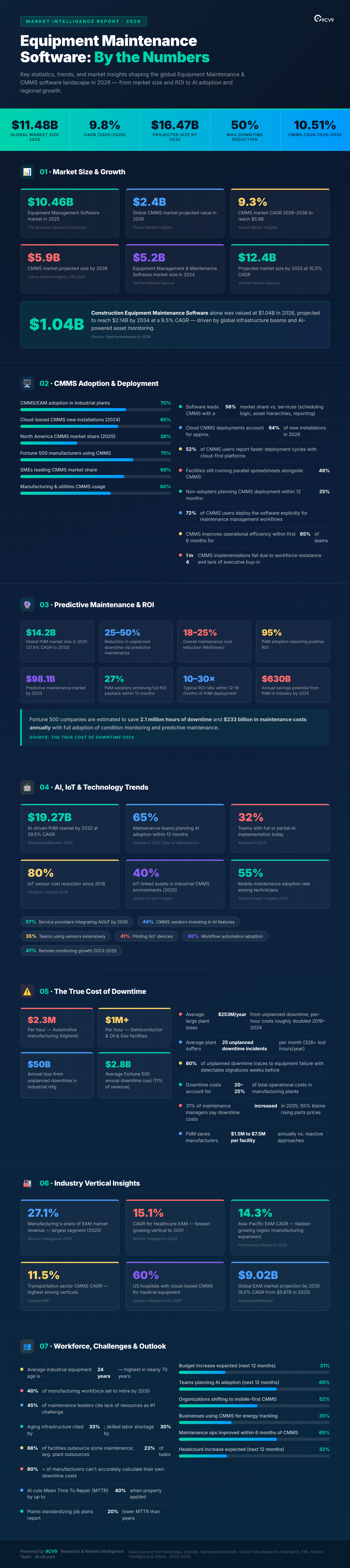
One of the most significant equipment maintenance software trends in 2026 is the rapid adoption of AI-powered predictive maintenance. Research indicates that predictive maintenance can reduce overall maintenance costs by 18–25% while cutting unplanned equipment downtime by as much as 50%. Furthermore, 65% of maintenance teams plan to use AI within the next 12 months, highlighting the growing importance of intelligent automation, predictive failure detection, and data-driven maintenance decisions.
The financial implications of equipment downtime further reinforce the importance of modern maintenance management software. Unplanned downtime can cost automotive manufacturers approximately $2.3 million per hour, while large manufacturing facilities face substantial annual losses from unexpected equipment failures. These challenges are accelerating investments in enterprise asset management (EAM), preventive maintenance software, condition monitoring technologies, and integrated maintenance management platforms.
Despite these technological advancements, organizations continue to face challenges involving software implementation, workforce adoption, aging infrastructure, and skilled labor shortages. Approximately 45% of maintenance leaders identify insufficient resources as their primary challenge, while only 27% of facilities reported fully implementing predictive maintenance in 2025. These figures highlight the considerable opportunities for businesses to improve maintenance maturity through better technology integration, employee training, and operational planning.
Understanding the latest equipment maintenance software statistics, market size, adoption rates, industry benchmarks, and emerging trends is essential for manufacturers, facility managers, maintenance professionals, operations executives, and technology decision-makers seeking to optimize asset reliability and maximize return on investment.
This comprehensive guide explores the top 107 equipment maintenance software statistics, data, and trends in 2026, covering global market growth, CMMS adoption, predictive maintenance ROI, AI and IoT integration, equipment downtime costs, industry-specific applications, and workforce developments. These insights provide a data-driven perspective on the evolving equipment maintenance software industry and the technologies shaping the future of maintenance management in 2026 and beyond.
Before we venture further into this article, we would like to share who we are and what we do.
About 9cv9
9cv9 is a business tech startup based in Singapore and Asia, with a strong presence all over the world.
With over ten years of startup and business experience, and being highly involved in connecting with thousands of companies and startups, the 9cv9 team has listed some of the top and best companies/tools in this review.
If you like to get your company listed in our top B2B software reviews, check out our world-class 9cv9 Media and PR service and pricing plans here.
Top 107 Equipment Maintenance Software Statistics, Data & Trends in 2026
🔷 Market Size & Growth
- The global Equipment Management Software market reached $10.46 billion in 2025, growing to $11.48 billion in 2026 at a CAGR of 9.8% — reflecting strong enterprise appetite for digital asset oversight. (The Business Research Company, 2026)
- The equipment management software market is projected to hit $16.47 billion by 2030 at a CAGR of 9.4%, driven by IoT-enabled monitoring and AI maintenance tool adoption. (The Business Research Company)
- The global CMMS Software Market is expected to grow from $1.63 billion in 2026 to $4.29 billion by 2035 at an 11.36% CAGR, as cloud migration and predictive analytics fuel demand. (Industry Research.biz)
- The global CMMS market is estimated at $2.4 billion in 2026, on track to reach $5.9 billion by 2036 at a 9.3% CAGR — cementing it as a cornerstone of industrial digital transformation. (Future Market Insights)
- The Equipment Management & Maintenance Software Market was valued at $5.2 billion in 2024 and is forecast to reach $12.4 billion by 2033 at a 10.3% CAGR. (Verified Market Reports)
- The global CMMS Software Market was valued at $1.31 billion in 2025 and is projected to reach $3.56 billion by 2035 at a 10.51% CAGR. (Global Growth Insights)
- The global CMMS market was estimated at $1.29 billion in 2024, expected to reach $2.41 billion by 2030 at an 11.1% CAGR — confirming sustained investment cycles. (Grand View Research)
- The Maintenance Management Software market, valued at $15 billion in 2025, is projected to reach $40 billion by 2033 at a 12% CAGR, propelled by IoT integration and cloud scalability. (DataInsightsMarket)
- The AI-Driven Predictive Maintenance market grew from $1.02 billion in 2025 to $1.18 billion in 2026 at a 15.6% CAGR. (Research and Markets 2026)
- The AI-driven PdM market is projected to reach $19.27 billion by 2032 at an astonishing 39.5% CAGR — making it the fastest-growing segment in the maintenance software category. (MarketsandMarkets 2026)
- The global Predictive Maintenance market was valued at $14.2 billion in 2025, forecast to reach $98.1 billion by 2033 at a 27.9% CAGR. (Grand View Research)
- The Construction Equipment Maintenance Software market was valued at $945 million in 2025, growing to $1.04 billion in 2026 and projected to reach $2.14 billion by 2034 at a 9.5% CAGR. (Intelmarketresearch)
- The Enterprise Asset Management (EAM) market is projected to grow from $5.87 billion in 2025 to $9.02 billion by 2030 at a 9.0% CAGR. (MarketsandMarkets)
- EAM market estimates from Verdantis place the market at $7.65 billion in 2024, forecast to grow to $19.68 billion by 2030 at a 17.2% CAGR. (Grand View Research / Verdantis)
- The EAM market reached $6.70 billion in 2025, growing to $7.39 billion in 2026 and projected to reach $12.07 billion by 2031 at a 10.32% CAGR. (Mordor Intelligence 2026)
🔷 CMMS Adoption & Deployment
- Approximately 70% of industrial plants have implemented a CMMS or EAM system — yet 49% still run parallel spreadsheets alongside it, indicating low execution maturity. (MaintainX / OxMaint 2025)
- 25% of non-adopters plan to deploy CMMS within 12 months, putting the addressable market above 95% by 2027. (OxMaint 2025)
- Cloud CMMS deployments crossed 65% of new installations worldwide in 2024, driven by scalability, remote access, and lower upfront costs. (Industry Research.biz)
- Cloud deployments will account for approximately 64% of all new CMMS installations in 2026, up from just 28% in 2020. (Verified Market Research 2026)
- 75% of Fortune 500 manufacturing companies in the US use CMMS software to streamline preventive maintenance and regulatory compliance. (Industry Research.biz)
- North America holds 38% of the global CMMS software market in 2025, led by pharmaceutical, automotive, and aerospace industries. (Industry Research.biz, Global Growth Insights)
- Europe accounts for 28% of the CMMS market in 2025, supported by regulatory-driven digital maintenance adoption and energy efficiency mandates. (Global Growth Insights)
- Asia-Pacific holds 25% of the CMMS market in 2025 and shows the fastest acceleration, with nearly 48% of manufacturing units upgrading to automated systems. (Global Growth Insights)
- The CMMS software segment leads with a 56% share because value is realized through scheduling logic, asset hierarchies, and reporting engines rather than services. (Future Market Insights)
- Small and medium enterprises account for 69% of the CMMS market — digital maintenance systems are rapidly replacing paper-based tracking at mid-scale plants. (Future Market Insights)
- 72% of CMMS users deploy the software explicitly for maintenance management workflows, while manufacturing and utilities collectively account for 60%+ of usage. (Blog.9cv9.com)
- 65% of maintenance managers now rely on cloud-based CMMS solutions to monitor asset health and reduce unplanned downtime. (Global Growth Insights)
- Over 5,000 large-scale industrial facilities in North America alone use CMMS solutions to manage approximately 4 million assets collectively. (Industry Research.biz)
- 60% of US hospitals have deployed cloud-based CMMS to optimize medical equipment management and maintain compliance. (Industry Research.biz)
- Construction and property management sectors represent 22% of the CMMS user base in the US, highlighting broad penetration beyond manufacturing. (Industry Research.biz)
- 68% of industries cite increased operational efficiency as the primary driver for CMMS adoption. (Industry Research.biz)
- 65% of maintenance teams report improved operational efficiency within the first six months of CMMS deployment. (Industry Research.biz)
- 1 in 4 CMMS implementations fail primarily due to workforce pushback and lack of executive buy-in — making change management as critical as the technology itself. (Verified Market Research 2026)
- CMMS implementation failure rates reach 40% in cases involving poor user adoption or difficult legacy integration. (Technavio 2026)
- Japan is expected to grow at an 11.5% CMMS CAGR, driven by aging technical workforce demands and precision manufacturing environments. (Future Market Insights)
- Germany is projected to expand at a 10.5% CMMS CAGR, powered by Industry 4.0 investments and strong engineering governance standards. (Future Market Insights)
🔷 Predictive Maintenance & ROI
- Predictive maintenance reduces overall maintenance costs by 18–25% while cutting unplanned downtime by up to 50% — one of the highest ROIs in enterprise software. (McKinsey / IIoT World)
- 95% of predictive maintenance adopters report positive ROI, and 27% achieve full payback within just 12 months. (WorkTrek, OxMaint 2025)
- Manufacturers implementing PdM save $1.5M to $7.5M per facility annually by shifting from reactive to predictive strategies. (IIoT World 2025)
- Predictive maintenance can reduce unplanned downtime by 35–50% within 12 months of full deployment on monitored assets. (KGT Solutions)
- Top-performing plants with full-scale sensor coverage across 80%+ of critical equipment report 71% reductions in downtime after 18–24 months of operation. (KGT Solutions)
- PdM investments typically generate 10:1 to 30:1 ROI within 12–18 months, with maintenance cost reductions of 25–40% vs. reactive approaches. (KGT Solutions)
- IoT predictive maintenance systems can detect equipment degradation 30 to 90 days before failure occurs, enabling planned shutdowns instead of emergency repairs. (KGT Solutions)
- Fortune 500 companies could save an estimated 2.1 million hours of downtime and $233 billion in maintenance costs annually with full PdM adoption. (The True Cost of Downtime 2024)
- $630 billion could be saved annually by 2025 across industrial sectors through predictive maintenance — through reduced downtime, better asset utilization, and fewer unnecessary repairs. (IoT Now)
- PdM in solar energy reduces costs by 12%, improves uptime by 9%, and extends equipment lifespan by 20%, also cutting safety and environmental risks by 14%. (DNV GL / com4.no)
- IoT-enabled predictive maintenance at Siemens reduced unplanned downtime from 39 hours/month to 27 hours/month — a 31% reduction. (Siemens 2024)
- One IBM case study showed predictive analytics saved $7.5 million in a single power generation facility by enabling planned vs. emergency maintenance. (IBM / IIoT World)
- A chemical processing plant reduced urgent maintenance from 43% to substantially lower by deploying PdM across 33 pieces of equipment. (EFESO Consulting / IIoT World)
- One steel plant achieved $1.5 million in first-year savings using sensor-based predictive maintenance, preventing a potential $3 million transformer loss. (Plant Services)
🔷 AI, IoT & Technology
- The AI-Driven Predictive Maintenance market is valued at $1.77 billion in 2025, with a 39.5% CAGR to $19.27 billion by 2032 — the fastest-growing tech segment in maintenance. (MarketsandMarkets)
- 65% of maintenance teams plan to use AI within the next 12 months, though only 32% have fully or partially implemented it today. (MaintainX 2025 State of Maintenance)
- The top AI use case in maintenance is knowledge capture and sharing (39%), followed by reducing unexpected equipment failure (36%). (MaintainX 2025)
- 57% of major maintenance service providers plan to incorporate AI and IoT by 2026, enabling real-time condition monitoring that reduces downtime by 20–50%. (Global Growth Insights / McKinsey)
- 44% of CMMS vendors are actively investing in AI-driven features including automated scheduling, failure prediction, and intelligent asset insights. (Global Growth Insights)
- Predictive analytics adoption across manufacturing facilities rose by 39% year-over-year, as AI diagnostic tools mature and sensor costs fall. (Global Growth Insights)
- Industrial IoT sensor costs dropped 80% since 2018, making condition monitoring economically viable for assets that previously couldn’t justify instrumentation. (OxMaint 2026)
- 40% of industrial CMMS users now incorporate IoT data to monitor equipment health in real-time. (Industry Research.biz)
- Edge computing reduces bandwidth needs by 60–80% while keeping alert latency under 200 milliseconds for time-critical assets. (KGT Solutions)
- Over 35% of maintenance professionals already use sensors and IIoT devices extensively; another 41% are piloting them. (2025 State of Industrial Maintenance)
- 58% of manufacturing leaders planned to increase AI spending in 2024, despite concerns about accuracy and value capture. (Reuters)
- AI integration in CMMS platforms has reached 45% adoption in industrial environments, helping automate scheduling and surface failure predictions. (Global Growth Insights)
- IoT-based asset tracking market is projected to reach $10 billion by 2032, growing at 12.5% annually — driven by CMMS integration. (Global Market Insights)
- Remote monitoring features in CMMS have grown 47% from 2023 to 2025, enabling multi-site maintenance teams to operate without physical presence. (Industry Research.biz)
- The AI-Driven PdM market grew 15.6% in 2026, fueled by smart factory deployments, AI-powered operational efficiency goals, and predictive analytics maturity. (Research and Markets)
- In January 2026, IBM released Maximo Application Suite 9.2.0 with enhanced ML models, real-time condition intelligence, and automated anomaly detection. (MarketsandMarkets)
- Limble CMMS launched its Limble Mobile App in March 2026, enabling improved mobile work execution, asset access, and field productivity for technicians. (MarketsandMarkets)
- In March 2025, Siemens launched a generative AI-powered maintenance offering under its Industrial Copilot portfolio, integrating Senseye Predictive Maintenance with GenAI. (MarketsandMarkets)
- Digital twins in maintenance report 20–30% reductions in unplanned downtime and 15–25% improvements in asset lifespan for twinned assets. (OxMaint 2026)
- Augmented reality guidance reduces average repair time by 20–34% and improves first-time fix rates by 25–40% for complex multi-component tasks. (Boeing 2025 Study / OxMaint)
🔷 Downtime Costs
- Automotive manufacturing has the highest downtime cost at $2.3 million per hour due to just-in-time supply chain dependencies. (The True Cost of Downtime 2024)
- Semiconductor fabs face $1–3 million per hour in downtime costs; a single unexpected stoppage can cascade across an entire fabrication run. (OxMaint 2025)
- Industrial manufacturers lose an estimated $50 billion annually to unplanned downtime, with median costs exceeding $125,000 per hour across industries. (WorkTrek)
- The average Fortune 500 company loses $2.8 billion per year to unplanned downtime — approximately 11% of annual revenue. (The True Cost of Downtime 2024)
- The average large manufacturing plant loses $253 million per year to unplanned downtime; per-hour costs roughly doubled between 2019 and 2024. (The True Cost of Downtime 2024)
- The average manufacturing plant suffers 25 unplanned downtime incidents per month, equating to over 326 lost production hours per year. (The True Cost of Downtime 2024)
- 80% of unplanned downtime traces to equipment failure — and 80% of those failures have detectable signatures weeks before they occur. (Gitnux 2026 / Henkel Survey)
- Downtime costs account for approximately 20–25% of total operational costs in manufacturing plants, making software-driven prevention among the highest-ROI investments available. (Industry Research.biz)
- 31% of maintenance managers reported downtime costs increased in 2025; 55% attribute this to higher parts prices. (2025 State of Industrial Maintenance)
- 74% of maintenance leads reported the same or less unscheduled downtime in 2025, signaling that CMMS investments are beginning to shift the baseline. (2025 State of Industrial Maintenance)
- CMMS-enabled predictive maintenance can achieve up to 40% cost reduction and 75% equipment downtime reduction — the dual value proposition driving enterprise adoption. (WorkTrek)
- A one-hour unplanned stoppage at an Indorama Ventures chemical plant costs $50,000 — illustrating why even SMEs have strong ROI cases for maintenance software. (IIoT World 2025)
🔷 Industry Verticals
- Manufacturing holds the largest EAM market share at 27.1% in 2025, driven by Industry 4.0 sensor retrofits and rising downtime costs. (Mordor Intelligence 2026)
- Healthcare is the fastest-growing EAM vertical with a 15.1% CAGR to 2031, as hospitals deploy real-time location systems for medical equipment and comply with Joint Commission standards. (Mordor Intelligence 2026)
- One hospital system (Sonitor) saw equipment utilization rise from 42% to over 75% after deploying RTLS-integrated EAM — freeing capital for patient services. (Mordor Intelligence 2026)
- The transportation sector is the fastest-growing EAM application with an 11.47% CAGR during the forecast period. (IndustryARC)
- Asia-Pacific EAM is growing at 14.3% CAGR, the fastest-growing region globally, fueled by manufacturing expansion, 5G rollouts, and government digitization programs. (Mordor Intelligence)
- Manufacturing held a 20.76% EAM market share in 2023 (IndustryARC), rising to 27.1% by 2025 — reflecting the compounding effect of digital transformation in factories. (IndustryARC / Mordor)
- Industry-specific EAM solutions are growing at 12.8% annually, significantly outpacing generalized platforms (8.6%), as buyers demand domain-specific functionality. (Market Business Insights)
- In December 2024, Tractian Technologies secured $120M in Series C funding to advance manufacturing AI and industrial monitoring for predictive maintenance. (Technavio)
- In February 2025, Rockwell Automation (Fiix) partnered with DLG Group to modernize maintenance and reduce downtime by 10% across agricultural operations. (Technavio)
- Cloud EAM deployments lead with 62.15% revenue share in 2025, expanding at a 13.05% CAGR through 2031. (Mordor Intelligence 2026)
- North America commanded 33.2% of EAM market revenue in 2025, and the US alone accounts for 75% of the regional total. (Mordor Intelligence)
🔷 Workforce & Strategy
- The average age of industrial fixed assets is 24 years — the oldest average in nearly 70 years — driving urgent demand for software-based lifecycle management. (2025 State of Industrial Maintenance)
- 40% of the manufacturing workforce is set to retire by 2030, making knowledge-capture via CMMS and AI-driven maintenance guidance a strategic imperative. (2025 State of Industrial Maintenance)
- 45% of maintenance leaders cite lack of resources as their primary challenge; aging infrastructure (33%) and skilled labor shortage (30%) follow closely. (2025 State of Industrial Maintenance)
- 88% of facilities outsource some maintenance work, with the average plant outsourcing 23% of tasks — a trend driving demand for collaborative, multi-vendor CMMS platforms. (2025 State of Industrial Maintenance)
- Only 27% of facilities had predictive maintenance fully implemented in 2025, down from 30% in 2024 — signaling implementation complexity is slowing adoption despite clear ROI. (MaintainX 2025)
- 71% of maintenance professionals say preventive maintenance is their primary strategy; only 27% use predictive, creating a massive upgrade opportunity. (MaintainX 2025)
- Preventive maintenance dominates in theory: 58% of facilities spend less than half their time on scheduled maintenance while less than 35% spend a majority on preventive tasks. (2025 State of Industrial Maintenance)
- Plants that standardize job plans report 20% lower Mean Time To Repair (MTTR) than peers who rely on tribal knowledge. (iMaintain 2026)
- AI properly applied to CMMS workflows cuts MTTR by up to 40% by surfacing past fixes and suggesting time estimates at the point of work. (iMaintain 2026)
- 22% of maintenance leaders cite cybersecurity as a top barrier to AI adoption, with 25% citing budget constraints and 24% citing lack of in-house AI skills. (iMaintain 2026)
- 32% of maintenance managers expect team headcount to increase over the next 12 months; 31% expect budget increases in the same period. (2025 State of Industrial Maintenance)
- 35% of organizations use CMMS software to track energy consumption and waste reduction — sustainability is becoming a core CMMS use case. (Industry Research.biz)
- Work order cycle time can be reduced by up to 30% through data-driven maintenance strategies integrated with CMMS platforms. (Technavio)
- CMMS reduces inventory “Stockouts” of critical parts while simultaneously lowering inventory carrying costs by up to 15%. (Verified Market Research 2026)
Conclusion
The top 107 equipment maintenance software statistics, data, and trends in 2026 highlight a rapidly evolving industry driven by digital transformation, artificial intelligence (AI), predictive maintenance, cloud computing, and the growing demand for operational efficiency. As businesses face increasing equipment downtime costs, aging infrastructure, and workforce challenges, modern equipment maintenance software has become an essential investment for improving asset reliability, reducing maintenance expenses, and maximizing productivity.
The global equipment management software market is projected to reach $11.48 billion in 2026 and expand to $16.47 billion by 2030, reflecting sustained demand for intelligent maintenance management solutions. Meanwhile, the computerized maintenance management system (CMMS) software market continues to grow, with research estimates placing its 2026 value between $1.63 billion and $2.4 billion, depending on market definitions and methodologies.
One of the most important equipment maintenance software trends in 2026 is the transition from reactive and preventive maintenance toward AI-powered predictive maintenance. Research indicates that predictive maintenance technologies can reduce overall maintenance costs by 18–25% and decrease unplanned downtime by up to 50%. These potential benefits demonstrate why organizations are increasingly investing in IoT-enabled sensors, real-time equipment monitoring, automated work orders, and advanced predictive analytics.
Cloud-based maintenance management software is also reshaping the industry. With approximately 64% of new CMMS installations expected to be cloud-based in 2026, businesses are prioritizing scalable, accessible, and integrated maintenance platforms that support geographically distributed teams and multiple facilities. At the same time, the increasing adoption of mobile CMMS applications, digital twins, and AI-assisted maintenance workflows is creating new opportunities to improve equipment performance and extend asset lifespans.
However, the statistics also reveal significant challenges. Only 27% of facilities reported fully implementing predictive maintenance in 2025, while 45% of maintenance leaders identified insufficient resources as their primary operational challenge. These findings suggest that successful maintenance digitalization requires more than software investment. Organizations must also prioritize employee training, effective change management, reliable equipment data, cybersecurity, and integration with existing enterprise systems.
Looking ahead, the future of equipment maintenance software beyond 2026 will increasingly revolve around intelligent automation, predictive asset intelligence, cloud-native CMMS platforms, and integrated enterprise asset management (EAM) solutions. As AI capabilities mature and IoT technologies become more accessible, organizations will have greater opportunities to identify equipment problems before failures occur, optimize maintenance schedules, reduce unnecessary repairs, and improve long-term asset performance.
For manufacturers, facility managers, maintenance professionals, and business leaders, these 107 equipment maintenance software statistics provide valuable insights into market opportunities, technology adoption, maintenance performance benchmarks, and emerging industry challenges.
Ultimately, businesses that strategically adopt modern equipment maintenance management software, invest in predictive maintenance capabilities, and develop data-driven maintenance strategies will be better positioned to reduce operational costs, minimize unplanned downtime, improve equipment reliability, and maintain a competitive advantage in 2026 and beyond.
If you find this article useful, why not share it with your hiring manager and C-level suite friends and also leave a nice comment below?
We, at the 9cv9 Research Team, strive to bring the latest and most meaningful data, guides, and statistics to your doorstep.
To get access to top-quality guides, click over to 9cv9 Blog.
To hire top talents using our modern AI-powered recruitment agency, find out more at 9cv9 Modern AI-Powered Recruitment Agency.
People Also Ask
What is equipment maintenance software?
Equipment maintenance software is a digital solution that helps businesses manage equipment repairs, preventive maintenance, work orders, asset performance, and maintenance schedules. It improves operational efficiency, reduces downtime, and extends equipment lifespan.
What is the global equipment maintenance software market size in 2026?
The global equipment management software market is estimated to reach $11.48 billion in 2026, up from $10.46 billion in 2025. The market is projected to grow to $16.47 billion by 2030, driven by digital transformation and automated maintenance technologies.
How fast is the equipment maintenance software market growing?
The global equipment management software market is expected to grow at a compound annual growth rate (CAGR) of approximately 9.4% through 2030, supported by increasing investments in IoT monitoring, AI-powered maintenance, and enterprise asset management.
What is the CMMS software market size in 2026?
The global computerized maintenance management system (CMMS) software market is estimated at between $1.63 billion and $2.4 billion in 2026, depending on research methodologies and market definitions. Growth is driven by cloud adoption and predictive analytics.
What is the difference between CMMS and EAM software?
CMMS software focuses on maintenance scheduling, work orders, preventive maintenance, and equipment repairs. Enterprise Asset Management (EAM) software covers broader asset lifecycle activities, including procurement, maintenance, performance monitoring, and asset retirement.
What percentage of companies use CMMS software in 2026?
Approximately 70% of industrial plants have implemented CMMS or EAM systems, although 49% continue using spreadsheets alongside these platforms. Adoption varies by industry, company size, geographic region, and digital maturity.
What percentage of CMMS software installations are cloud-based in 2026?
Approximately 64% of new CMMS installations are expected to be cloud-based in 2026, compared with 28% in 2020. Businesses increasingly prefer cloud maintenance software for scalability, remote accessibility, and lower upfront infrastructure costs.
What are the main benefits of equipment maintenance software?
Equipment maintenance software helps organizations reduce unplanned downtime, lower maintenance costs, improve equipment reliability, automate work orders, optimize spare parts inventory, and extend asset lifespans through preventive and predictive maintenance.
How much can predictive maintenance reduce maintenance costs?
Predictive maintenance can reduce overall maintenance costs by approximately 18–25% while decreasing unplanned equipment downtime by up to 50%. Actual savings depend on equipment conditions, maintenance strategies, sensor coverage, and implementation quality.
What is predictive maintenance software?
Predictive maintenance software uses equipment data, IoT sensors, artificial intelligence, and machine learning to identify potential failures before they occur. It enables businesses to schedule repairs proactively and reduce unexpected equipment breakdowns.
What percentage of maintenance teams plan to adopt AI in 2026?
Approximately 65% of maintenance teams reported plans to use artificial intelligence within the following 12 months, while 32% had already fully or partially implemented AI. Common applications include knowledge management, failure prediction, and automated maintenance planning.
How is artificial intelligence transforming equipment maintenance software?
Artificial intelligence improves equipment maintenance by predicting failures, analyzing sensor data, automating maintenance schedules, identifying equipment anomalies, and recommending repairs. AI-powered CMMS platforms also help technicians access maintenance knowledge more efficiently.
What is the projected growth of the predictive maintenance market?
The global predictive maintenance market was valued at approximately $14.2 billion in 2025 and is projected to reach $98.1 billion by 2033, representing a CAGR of 27.9%. Growth is supported by AI, industrial IoT, and smart manufacturing investments.
How much does unplanned equipment downtime cost manufacturers?
Unplanned downtime can cost automotive manufacturers approximately $2.3 million per hour, while semiconductor facilities may lose $1 million to $3 million hourly. Costs vary significantly depending on industry, production capacity, and operational complexity.
How much money can businesses save using predictive maintenance software?
Manufacturers implementing predictive maintenance may save approximately $1.5 million to $7.5 million per facility annually. Savings typically result from fewer equipment failures, reduced emergency repairs, improved asset utilization, and optimized maintenance schedules.
What industries use equipment maintenance software the most?
Manufacturing, healthcare, utilities, transportation, construction, energy, and property management are major users of equipment maintenance software. Manufacturing accounted for approximately 27.1% of the enterprise asset management market in 2025.
Which region dominates the CMMS software market?
North America accounted for approximately 38% of the global CMMS software market in 2025, followed by Europe at 28% and Asia-Pacific at 25%. Adoption is supported by industrial automation, regulatory requirements, and digital maintenance investments.
What is the fastest-growing region for enterprise asset management software?
Asia-Pacific is among the fastest-growing enterprise asset management software markets, with a projected CAGR of approximately 14.3%. Manufacturing expansion, digital transformation initiatives, and increasing industrial technology investments support regional growth.
How does IoT improve equipment maintenance management?
The Internet of Things enables real-time equipment monitoring through connected sensors that collect data on temperature, vibration, pressure, and operating conditions. Maintenance teams use this information to detect abnormalities, predict failures, and optimize repairs.
What percentage of CMMS users integrate IoT technology?
Approximately 40% of industrial CMMS users incorporate IoT data for real-time equipment health monitoring. IoT integration helps businesses improve maintenance decisions, detect early warning signs, and reduce unexpected equipment failures.
What is preventive maintenance software?
Preventive maintenance software helps businesses schedule regular inspections, servicing, and equipment repairs before breakdowns occur. It automates recurring maintenance tasks, tracks service histories, and supports consistent equipment reliability.
What is the difference between preventive and predictive maintenance?
Preventive maintenance follows predefined schedules based on time or equipment usage. Predictive maintenance uses real-time operating data and analytics to estimate when equipment failures may occur, allowing maintenance teams to intervene when necessary.
What percentage of maintenance facilities use predictive maintenance?
Approximately 27% of facilities reported fully implementing predictive maintenance in 2025, compared with 30% in 2024. Implementation challenges include limited resources, integration complexity, workforce readiness, and technology investment requirements.
How does equipment maintenance software improve return on investment?
Equipment maintenance software improves ROI by reducing equipment downtime, minimizing emergency repairs, optimizing technician productivity, and extending asset lifespan. Predictive maintenance adopters have reported positive returns through improved maintenance efficiency.
What are the biggest challenges in implementing CMMS software?
Major CMMS implementation challenges include employee resistance, poor data quality, limited technical expertise, insufficient training, and legacy system integration. Some industry estimates place implementation failure rates as high as 40% under unfavorable conditions.
How does equipment maintenance software reduce repair times?
Equipment maintenance software reduces repair times by centralizing equipment histories, automating work orders, improving technician coordination, and providing maintenance instructions. Standardized maintenance plans have been associated with 20% lower mean time to repair.
What role do digital twins play in equipment maintenance?
Digital twins create virtual representations of physical equipment using operational data. They help maintenance teams monitor asset conditions, simulate performance, and identify potential failures. Reported benefits include 20–30% reductions in unplanned downtime.
How does equipment maintenance software support sustainability?
Equipment maintenance software supports sustainability by improving energy efficiency, reducing equipment waste, optimizing asset lifecycles, and preventing unnecessary repairs. Approximately 35% of organizations use CMMS platforms to track energy consumption and waste reduction.
What are the biggest equipment maintenance software trends in 2026?
Major equipment maintenance software trends in 2026 include AI-powered predictive maintenance, cloud-based CMMS, IoT integration, digital twins, mobile maintenance applications, automated work orders, and real-time asset performance monitoring.
What is the future of equipment maintenance software beyond 2026?
Equipment maintenance software is expected to become increasingly intelligent, automated, and cloud-connected. AI-driven diagnostics, predictive analytics, industrial IoT, and integrated EAM platforms will help businesses improve equipment reliability and maintenance efficiency.
Sources
The Business Research Company
Future Market Insights
Global Growth Insights
Grand View Research
MarketsandMarkets
MaintainX
Mordor Intelligence
Verified Market Research
Verified Market Reports
Industry Research
IIoT World
OxMaint
iMaintain
WorkTrek
KGT Solutions
Intelmarketresearch
Technavio
Verdantis
IoT Now
ClickMaint
Manufacturing Lead Generation