

























Key Takeaways
- Best Government Software in 2026: Leading platforms such as Tyler Technologies, OpenGov, Granicus, Esri ArcGIS, and Salesforce Public Sector Solutions help government agencies streamline operations, improve public services, and accelerate digital transformation.
- Key Government Software Features and Benefits: Modern government management software offers AI-powered automation, cloud-based ERP, financial management, citizen engagement, permitting, public safety, and advanced analytics to enhance efficiency and transparency.
- Choosing the Right Government Software: Government organizations should compare software features, pricing, scalability, cybersecurity, regulatory compliance, integration capabilities, and customer support to select the best solution for their operational needs.
Tyler Technologies leads the best government software options in 2026, offering solutions for financial management, public administration, public safety, and digital citizen services. Other leading platforms include OpenGov, Granicus, Esri ArcGIS, and Salesforce Public Sector Solutions. These tools help government agencies improve efficiency, automate workflows, strengthen transparency, and modernize public services.
Government agencies worldwide are experiencing a significant digital transformation as public institutions increasingly adopt advanced technologies to improve operational efficiency, enhance citizen engagement, strengthen transparency, and modernize public service delivery. In 2026, the demand for reliable, secure, and scalable government software solutions continues to grow as municipalities, local authorities, state governments, and national agencies seek to replace outdated administrative systems with integrated digital platforms.
The best government software in 2026 enables public sector organizations to streamline complex administrative processes, automate repetitive tasks, manage public finances, improve regulatory compliance, and deliver faster, more accessible services to citizens. From enterprise resource planning (ERP) and customer relationship management (CRM) to geographic information systems (GIS), public safety management, procurement, permitting, and licensing, modern government technology platforms support a wide range of essential public sector functions.
Leading government software providers such as Tyler Technologies, OpenGov, Granicus, Esri ArcGIS, and Salesforce Public Sector Solutions offer specialized capabilities designed to address the evolving requirements of public administration. Other notable platforms, including CentralSquare Technologies, Accela, Workday for Public Sector, ClearPoint Strategy, and Jotform Government, provide solutions for emergency response, regulatory workflows, workforce management, strategic planning, and digital document processing.
One of the most important developments shaping the government software industry in 2026 is the increasing adoption of artificial intelligence, cloud-based Software-as-a-Service (SaaS), predictive analytics, and intelligent workflow automation. These technologies can help government organizations reduce administrative workloads, improve decision-making, enhance data accessibility, and respond more effectively to citizen needs. At the same time, cybersecurity, data privacy, accessibility, interoperability, and regulatory compliance remain critical considerations when selecting public sector technology.
For government organizations, choosing the right software is a strategic investment that can influence service quality, financial accountability, workforce productivity, and long-term operational resilience. However, the wide variety of available solutions can make it challenging to identify the most suitable platform. Factors such as software functionality, implementation costs, scalability, integration capabilities, vendor reliability, and technical support must be carefully evaluated.
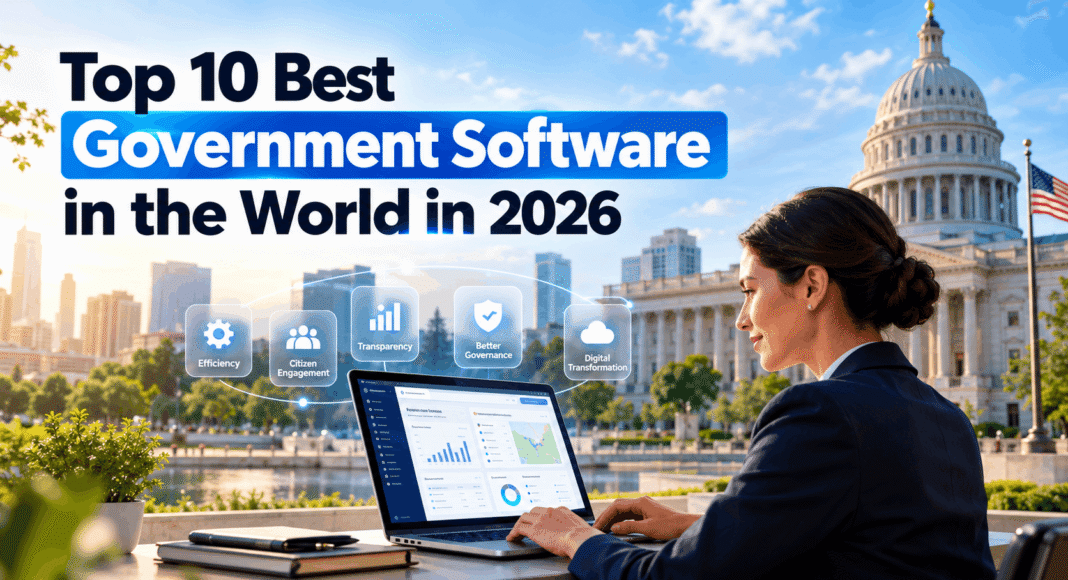
This comprehensive guide to the Top 10 Best Government Software in the World in 2026 explores leading government management platforms, their key features, benefits, use cases, and potential limitations. It also highlights important industry trends and considerations to help public sector decision-makers compare solutions and identify technologies that align with their organizational objectives.
Whether an agency is searching for the best government ERP software, municipal management software, government CRM platform, citizen engagement solution, public safety system, or cloud-based government software, this guide provides practical insights into the technologies supporting modern digital governance.
Ultimately, adopting the right government software in 2026 is not simply about replacing legacy systems. It is about building a more efficient, transparent, secure, and citizen-focused public sector capable of delivering sustainable improvements in government operations and public services.
Before we venture further into this article, we would like to share who we are and what we do.
About 9cv9
9cv9 is a business tech startup based in Singapore and Asia, with a strong presence all over the world.
With over ten years of startup and business experience, and being highly involved in connecting with thousands of companies and startups, the 9cv9 team has listed some of the top and best companies/tools in this review.
If you like to get your company listed in our top B2B software reviews, check out our world-class 9cv9 Media and PR service and pricing plans here.
Top 10 Best Government Software To Know in 2026
- Tyler Technologies
- OpenGov
- Granicus
- Esri ArcGIS
- Salesforce Public Sector Solutions
- CentralSquare Technologies
- Accela
- Workday for Public Sector
- ClearPoint Strategy
- Jotform Government
1. Tyler Technologies
Tyler Technologies is a prominent provider of government software, specializing in enterprise resource planning (ERP), financial management, public administration, judicial systems, public safety, and citizen services. Its extensive presence across the United States makes it a leading contender among the best government software providers in 2026, particularly for municipalities, counties, courts, and public sector agencies seeking integrated digital solutions.
Unlike general-purpose enterprise software vendors, Tyler Technologies focuses primarily on the operational, regulatory, and administrative requirements of government organizations. Its software ecosystem helps public institutions modernize legacy infrastructure, automate administrative processes, improve financial transparency, and deliver more accessible public services.
Market Position and Financial Performance
Tyler Technologies has established a strong competitive position in the government technology market through long-term public sector relationships, specialized software products, and recurring subscription revenue.
Its transition from traditional perpetual software licensing toward cloud-based Software-as-a-Service (SaaS) delivery is central to its business strategy. Cloud subscriptions provide government agencies with ongoing software updates, managed infrastructure, and more predictable technology expenditure.
The company’s financial performance also reflects the increasing demand for government digital transformation, particularly in public financial management, court administration, and citizen engagement.
| Business Indicator | Reported Performance | Significance |
|---|---|---|
| Market specialization | State and local government technology | Strong public sector industry focus |
| Estimated market share | Approximately 17% in a defined municipal and county software segment | Indicates substantial competitive presence, subject to market definition |
| Annual revenue | Approximately $2.40 billion to $2.43 billion on a reported trailing basis | Demonstrates significant operating scale |
| Revenue forecast | Approximately $2.68 billion | Indicates expectations for continued expansion |
| Annual recurring revenue | More than $2.05 billion, as reported | Highlights the importance of recurring contracts |
| SaaS growth | More than 20% across 22 consecutive reported quarters | Reflects sustained cloud adoption |
| Gross customer retention | Approximately 98% to 99% | Suggests strong customer continuity |
| Cloud conversion economics | Approximately 1.7 times legacy contract revenue | Illustrates the potential value of SaaS migrations |
These figures represent reported metrics and estimates from different measurement periods rather than a single synchronized financial snapshot. Market share and forecasts should be interpreted according to their original reporting definitions.
Extensive Government Client Network
Tyler Technologies serves a broad range of government organizations, from major metropolitan administrations to small rural counties. Its substantial installed customer base demonstrates the importance of specialized software in supporting public sector operations.
| Government Client Indicator | Reported Coverage |
|---|---|
| Software installations | Nearly 47,000 |
| Client locations | Approximately 15,000 |
| Cloud-based solution clients | More than 17,500 |
| Largest 25 US counties served | 22 |
| Largest 25 US cities served | All 25 |
| Smallest government client example | Loving County, Texas |
| Customer retention rate | Approximately 98% |
These figures illustrate Tyler’s established presence in the US government software market. Its high customer retention also reflects the long-term nature of government technology contracts, where replacing mission-critical systems often requires extensive planning, data migration, employee training, and regulatory review.
Core Government Software Solutions and Capabilities
Tyler Technologies offers an integrated portfolio designed to support essential government functions, including public financial management, judicial administration, tax collection, and citizen engagement.
| Software Category | Core Functionality | Government Benefits |
|---|---|---|
| Enterprise ERP | Accounting, budgeting, procurement, and human resources | Centralized financial and administrative management |
| Court and Justice Software | Case management, electronic filing, and judicial workflows | Improved case processing and documentation |
| Public Safety Software | Emergency dispatch, records, and operational coordination | More efficient public safety administration |
| Tax and Revenue Management | Property taxation, assessment, and revenue collection | Improved revenue accuracy and collection |
| Digital Government Services | Online applications, payments, and citizen portals | Greater accessibility to government services |
| Data and Analytics | Reporting, data integration, and performance monitoring | Better evidence-based decision-making |
| Budgeting and Planning | Financial forecasting and resource allocation | Improved fiscal oversight and transparency |
The breadth of these solutions makes Tyler particularly relevant to public institutions seeking to consolidate fragmented administrative systems under a more connected government technology environment.
Cloud SaaS Transformation and Revenue Growth
Cloud modernization remains a major component of Tyler Technologies’ growth strategy in 2026.
In the second quarter of 2026, the company reported $645.1 million in quarterly revenue, representing an 8.2% year-over-year increase. Annualized recurring revenue reached approximately $2.24 billion, while SaaS revenue increased by 21.7% to $230.6 million.
This marked 22 consecutive quarters of SaaS revenue growth of at least 20%, highlighting continued demand for subscription-based government software.
For government organizations, cloud adoption can provide several operational advantages, including reduced dependence on locally managed infrastructure, centralized software maintenance, improved scalability, and more consistent access to updated applications.
However, agencies must also evaluate data sovereignty, cybersecurity requirements, service availability, contractual obligations, and long-term subscription costs before migrating critical government systems.
Artificial Intelligence and Government Process Automation
Tyler Technologies is expanding its use of artificial intelligence and automation to support government workflows.
Its technology initiatives include document processing, administrative automation, financial analysis, and tools designed to reduce repetitive manual tasks.
| AI and Automation Application | Government Use Case | Potential Operational Impact |
|---|---|---|
| Judicial Document Automation | Processing and organizing court documents | Reduced manual document handling |
| Intelligent Financial Workflows | Automating accounting entries and reconciliation | Improved processing efficiency |
| Budget Analysis | Supporting financial planning and expenditure reviews | More informed resource allocation |
| Workflow Automation | Routing administrative tasks and approvals | Faster internal processing |
| Data Analytics | Identifying patterns across government records | Improved operational visibility |
The practical value of these capabilities depends on implementation quality, data integrity, employee adoption, and appropriate human oversight.
Real-World Case Study: Washtenaw County, Michigan
An example of Tyler Technologies’ operational impact can be found in Washtenaw County, Michigan, where the government used Tyler Enterprise ERP and automation to improve deposit processing.
The initiative focused on reducing repetitive general ledger entries, improving the accuracy of financial records, and minimizing administrative workloads.
| Performance Area | Reported Outcome |
|---|---|
| Government organization | Washtenaw County, Michigan |
| Software solution | Tyler Enterprise ERP |
| Primary process | Deposit and general ledger processing |
| Administrative time savings | Approximately 4 hours daily |
| Estimated labor cost savings | Approximately $2,000 monthly |
| Processing accuracy | Errors reduced to nearly zero |
| Main benefit | Faster and more reliable financial administration |
The case demonstrates how government ERP software can deliver measurable efficiency improvements by automating routine financial activities.
Although results vary across organizations, the example highlights the potential return on investment from replacing manual public sector processes with integrated digital workflows.
Tyler Technologies: Strengths and Considerations
| Evaluation Criteria | Assessment |
|---|---|
| Public sector specialization | Strong focus on government operations |
| Software portfolio | Broad coverage across government departments |
| Cloud capabilities | Established and expanding SaaS offerings |
| Customer retention | High, at approximately 98% |
| AI and automation | Growing capabilities across administrative workflows |
| Implementation complexity | May require substantial planning and migration |
| Pricing transparency | Generally dependent on customized contracts |
| International suitability | Requires evaluation against local government regulations |
Overall Assessment
Tyler Technologies remains one of the leading government software providers in 2026, particularly for US municipalities, counties, courts, and state agencies seeking comprehensive public sector technology solutions.
Its extensive customer network, specialized software portfolio, strong recurring revenue performance, and expanding cloud capabilities reinforce its position in the government technology industry.
For public institutions prioritizing financial management, administrative automation, judicial modernization, and digital citizen services, Tyler Technologies represents a compelling enterprise software option. However, procurement decisions should account for implementation costs, system interoperability, cybersecurity, regulatory compliance, and long-term operational requirements.
2. OpenGov
OpenGov is a leading cloud-based government software provider specializing in public sector budgeting, financial management, procurement, permitting, licensing, and enterprise asset management. Designed specifically for state and local government agencies, the platform helps public institutions modernize administrative operations, improve financial transparency, and deliver more efficient public services.
In 2026, OpenGov continues to strengthen its position in the government technology market through its integrated Public Service Platform, which connects financial planning, operational management, and community services within a unified cloud environment.
Unlike traditional enterprise software providers that adapt commercial applications for government use, OpenGov develops solutions around the regulatory, financial, and operational requirements of public sector organizations.
Market Position and Strategic Investment
OpenGov’s expansion accelerated following a majority investment by Cox Enterprises in February 2024, which valued the company at approximately $1.8 billion. The investment strengthened OpenGov’s financial backing and supported its long-term strategy of developing integrated government technology solutions.
By 2026, OpenGov reported serving more than 2,000 government agencies across the United States, including cities, counties, state agencies, and special districts.
| Business Indicator | Reported Performance | Market Significance |
|---|---|---|
| Company specialization | Cloud-based government software | Dedicated public sector technology provider |
| Enterprise valuation | Approximately $1.8 billion in 2024 | Significant private-sector investment |
| Majority investor | Cox Enterprises | Long-term strategic and financial support |
| Government customers | More than 2,000 agencies | Established national customer base |
| Geographic coverage | United States | Strong domestic government market presence |
| Primary customers | Cities, counties, state agencies, and special districts | Broad public administration applications |
| Technology strategy | Cloud-native, AI-enabled platform | Integrated digital government operations |
| Core market segments | Budgeting, procurement, permitting, financial management, and asset management | Comprehensive government software portfolio |
The company’s strategic direction increasingly emphasizes connected government operations, reducing reliance on disconnected software systems and manual administrative processes.
Core OpenGov Software Solutions and Features
OpenGov offers a comprehensive portfolio of government management software designed to address essential public administration functions.
| Software Solution | Key Features | Government Benefits |
|---|---|---|
| Budgeting and Planning | Budget preparation, forecasting, workforce planning, and reporting | Improved financial planning and budget transparency |
| Procurement and Contract Management | Vendor management, bid evaluation, solicitation, and contract tracking | More efficient and compliant public purchasing |
| Permitting and Licensing | Online applications, approvals, inspections, and digital payments | Faster permit processing and improved citizen experience |
| Enterprise Asset Management | Infrastructure tracking, maintenance scheduling, and work orders | Better management of public infrastructure |
| Financial Management | Government accounting, expenditure monitoring, and financial reporting | Stronger financial oversight |
| Reporting and Analytics | Dashboards, performance monitoring, and data visualization | More informed public sector decision-making |
| AI-Assisted Workflows | Budget analysis, narrative generation, and administrative assistance | Reduced repetitive work and improved productivity |
These capabilities make OpenGov particularly suitable for municipalities seeking to consolidate government software applications while maintaining visibility across departmental operations.
Customer Reviews and Software Ratings
OpenGov has received generally positive evaluations across established software review platforms, particularly for its government budgeting, procurement, and permitting solutions.
| Software Product | Review Platform | Reported Rating |
|---|---|---|
| OpenGov Budgeting and Planning | Capterra | 4.6/5 |
| OpenGov Permitting and Licensing | G2 | 4.5/5 |
| OpenGov overall product portfolio | G2 | 4.4/5 |
| OpenGov overall software portfolio | Aggregated review platforms | Approximately 4.2/5 |
These ratings indicate favorable customer perceptions of OpenGov’s functionality, usability, and public sector specialization. However, individual product ratings may differ from vendor-wide averages, and review scores can change as additional customer feedback becomes available.
Government agencies evaluating OpenGov should consider product-specific reviews alongside implementation requirements, integration capabilities, technical support, and total ownership costs.
Government Software Pricing and Contract Value
OpenGov generally follows a customized enterprise pricing model, with subscription costs determined by agency size, selected modules, implementation requirements, and contractual arrangements.
Public procurement records provide useful examples of how government software contracts can vary substantially in value.
| Contract Example | Reported Contract Value | Procurement Context |
|---|---|---|
| Maryland Transportation Authority | Approximately $2.05 million | Reported five-year enterprise budgeting software agreement |
| Maryland Transportation Authority renewal option | Approximately $348,402 annually | Reported annual renewal pricing |
| Fox Valley Park District | Approximately $162,903 annually | Reported government software expenditure |
These contract figures are indicative examples rather than standardized OpenGov subscription prices. The precise amounts and contractual terms should be independently verified against the relevant procurement records before being used as definitive pricing benchmarks.
The differences in reported expenditure illustrate why government organizations should assess implementation services, subscription modules, user requirements, maintenance arrangements, and renewal provisions when comparing government software providers.
Cloud Integration and Artificial Intelligence Capabilities
OpenGov’s cloud-based architecture is designed to connect government departments that traditionally operate through separate financial, procurement, permitting, and infrastructure management systems.
Its evolving AI capabilities include automated budget analysis, financial variance explanations, reporting assistance, and administrative workflow support.
| Technology Capability | Practical Application | Expected Benefit |
|---|---|---|
| Cloud-Based Infrastructure | Centralized access to government applications | Reduced dependence on fragmented local systems |
| AI Budget Assistance | Financial comparisons and budget summaries | Faster analysis and reporting |
| Procurement Automation | Digital solicitations and vendor evaluations | Reduced administrative delays |
| Digital Permitting | Online submissions and approval workflows | Improved service accessibility |
| Integrated Financial Data | Connecting budgets, procurement, and expenditure records | Better financial visibility |
| Asset Management Integration | Connecting infrastructure records with operational planning | More informed maintenance decisions |
For government organizations, these capabilities can improve operational coordination while supporting more transparent and data-driven public administration.
OpenGov Strengths and Limitations
| Evaluation Criteria | Assessment |
|---|---|
| Public sector specialization | Strong focus on US government agencies |
| Cloud architecture | Modern cloud-native delivery |
| Budgeting capabilities | Comprehensive planning and financial reporting tools |
| Procurement management | Integrated purchasing and contract workflows |
| Permitting and licensing | Configurable digital application processes |
| Enterprise asset management | Supports infrastructure and maintenance operations |
| AI capabilities | Expanding administrative and analytical functionality |
| Pricing transparency | Customized quotations generally required |
| Implementation complexity | Depends on agency size and selected modules |
| International suitability | Primarily designed around US government requirements |
Overall Assessment
OpenGov stands among the best government software solutions in 2026 for municipalities, counties, state agencies, and special districts seeking cloud-based public administration technology.
Its combination of government budgeting software, procurement management, digital permitting, financial administration, and enterprise asset management provides a comprehensive foundation for public sector digital transformation.
Supported by substantial strategic investment and an expanding government customer base, OpenGov is particularly well positioned for agencies seeking to modernize legacy systems, improve financial accountability, and streamline administrative operations.
Nevertheless, prospective government customers should carefully evaluate implementation costs, regulatory requirements, integration compatibility, data security, and long-term subscription commitments before adopting the platform.
3. Granicus
Granicus is a leading government software provider specializing in digital citizen engagement, public sector communications, government website management, public meeting administration, and online service delivery. Its integrated technology solutions help government agencies improve communication with residents, increase public participation, automate administrative workflows, and deliver more accessible digital services.
In 2026, Granicus continues to strengthen its position in the global government technology market through its Government Experience Cloud, an integrated platform connecting communications, digital services, public records, and operational management.
Unlike conventional customer relationship management software, Granicus focuses on the specialized requirements of public institutions, including government transparency, regulatory compliance, public accessibility, and large-scale constituent communications.
Market Position and Global Government Reach
Granicus has established a substantial international presence through its govDelivery communications platform and broader portfolio of digital government solutions.
The company’s subscriber network exceeds 300 million people worldwide, including more than 16 million subscribers associated with government organizations in the United Kingdom. These figures represent the scale of the communications network rather than a count of unique individuals actively engaging with every participating agency.
| Business Indicator | Reported Performance | Market Significance |
|---|---|---|
| Primary specialization | Government communications and digital services | Dedicated public sector technology focus |
| Global subscriber network | More than 300 million subscribers | Extensive government communications reach |
| United Kingdom subscriber network | More than 16 million subscribers | Strong presence in UK public sector communications |
| Government customers | More than 7,000 organizations in reported govDelivery materials | Established government adoption |
| Annual email volume | Approximately 10 billion messages in historical company reporting | Large-scale communications infrastructure |
| Technology model | Cloud-based government software | Scalable digital service delivery |
| Primary customers | National, state, regional, and local governments | Broad public sector applications |
The scale of Granicus’s communications network makes it particularly relevant for agencies responsible for public health information, emergency alerts, community announcements, regulatory updates, and citizen outreach.
Core Granicus Government Software Solutions
Granicus provides an extensive software portfolio designed to support public engagement, administrative efficiency, and government transparency.
| Software Solution | Core Functionality | Government Benefits |
|---|---|---|
| govDelivery | Email campaigns, SMS notifications, subscriptions, and audience segmentation | Improved constituent communications |
| govAccess | Government websites and content management | Accessible public information and online services |
| govService | Digital service requests and workflow automation | Reduced manual administration |
| EngagementHQ | Community consultation, surveys, and public feedback | Greater citizen participation |
| Agenda Management | Meeting agendas, minutes, and legislative workflows | More efficient public meeting administration |
| Government Video Solutions | Live streaming, recording, and meeting archives | Increased transparency and accessibility |
| GovQA | Public records requests and information management | Streamlined records administration |
| OpenForms | Online forms and digital workflow management | Faster citizen transactions |
Together, these products support government agencies seeking to modernize citizen-facing services while reducing dependence on paper-based processes and disconnected administrative systems.
Government Communications Performance and Engagement
One of Granicus’s strongest competitive advantages is its specialized government communications infrastructure.
Its govDelivery platform enables public institutions to distribute targeted information through email, text messaging, and other digital channels while monitoring subscriber engagement.
Historical government communications benchmarks demonstrate that public sector messaging can achieve substantial engagement, particularly when information is timely, relevant, and delivered to audiences that have voluntarily subscribed.
| Performance Metric | Reported Government Communications Performance | Interpretation |
|---|---|---|
| Email open rates | Approximately 40% to 50% in selected historical benchmarks | Strong engagement with public information |
| UK public sector median open rate | Approximately 44% in a historical benchmark | Indicates substantial subscriber attention |
| Email deliverability | More than 98% to 99% in published service materials | High reported message delivery performance |
| Subscriber network | More than 300 million globally | Large potential audience reach |
| Audience segmentation | Supported | More relevant and personalized communications |
| Automated campaigns | Supported | Reduced repetitive communication tasks |
| Real-time reporting | Supported | Better visibility into engagement outcomes |
These figures should not be interpreted as guaranteed performance across every government organization. Actual open rates, click-through rates, and delivery outcomes vary according to audience characteristics, message content, communication frequency, and measurement methodology.
Cloud Infrastructure and Digital Communication Capabilities
Granicus operates cloud-based solutions designed to support high-volume public sector communications and digital government services.
Its technology infrastructure emphasizes scalability, message delivery, workflow integration, and the ability to coordinate communications across multiple government departments.
| Technology Capability | Practical Application | Operational Benefit |
|---|---|---|
| Cloud Communications | Large-scale government email and SMS campaigns | Scalable public information delivery |
| Audience Segmentation | Targeted messaging based on subscriber interests | More relevant communications |
| Automated Notifications | Service updates, alerts, and reminders | Reduced manual communication workloads |
| Digital Forms | Online applications and service submissions | Less paper-based processing |
| Workflow Automation | Routing requests to responsible departments | Faster administrative handling |
| Engagement Analytics | Monitoring message performance and public responses | Better communication strategies |
| Website Integration | Connecting public websites with subscription services | Improved digital accessibility |
Government agencies evaluating these capabilities should also consider cybersecurity, privacy requirements, accessibility standards, service-level agreements, and integration with existing public administration systems.
Real-World Case Study: Durham County Council
Durham County Council in England provides a practical example of how Granicus software can support government digital transformation.
Through its digital service modernization initiative, the council implemented govService to move routine administrative transactions away from paper-based and in-person processes toward online self-service.
The project expanded digital service availability, improved public accessibility, and reduced administrative expenditure.
| Performance Indicator | Reported Outcome |
|---|---|
| Government organization | Durham County Council, England |
| Software solution | Granicus govService |
| Population served | Approximately 800,000 residents |
| Annual administrative savings | More than $309,000 |
| Digital services introduced | Approximately 90 |
| Registered digital service users | More than 100,000 |
| Daily user growth | Approximately 300 additional users |
| Main operational improvement | Reduced reliance on telephone and face-to-face service channels |
The case demonstrates how digitizing government transactions can generate measurable financial savings while improving service accessibility.
However, these outcomes reflect a specific government implementation rather than guaranteed results for every Granicus customer.
Government Cost Savings and Operational Efficiency
Granicus’s digital service solutions can help government agencies reduce the administrative burden associated with routine inquiries, paper forms, manual data entry, and in-person transactions.
The financial benefits depend on transaction volumes, existing service costs, resident adoption, and the complexity of government workflows.
| Operational Area | Traditional Government Process | Digital Improvement Opportunity |
|---|---|---|
| Citizen Inquiries | Telephone calls and office visits | Online information and self-service |
| Service Applications | Paper forms and manual processing | Digital forms and automated workflows |
| Public Notifications | Manual distribution and fragmented communication | Centralized multichannel messaging |
| Public Meetings | Manual agenda preparation and document distribution | Digital meeting management |
| Records Requests | Email-based and paper-based tracking | Structured online request management |
| Community Consultation | Physical meetings and limited feedback collection | Digital surveys and engagement platforms |
By consolidating these functions, government organizations can improve administrative consistency, reduce processing delays, and allocate employee resources toward more complex public service responsibilities.
Granicus Strengths and Limitations
| Evaluation Criteria | Assessment |
|---|---|
| Government communications | Strong specialization and large subscriber network |
| Citizen engagement | Comprehensive digital participation tools |
| Government website management | Dedicated content management capabilities |
| Public meeting administration | Established agenda, video, and records solutions |
| Digital service automation | Configurable forms and service workflows |
| Global market reach | Significant international government presence |
| Reporting and analytics | Communications and service performance monitoring |
| Pricing transparency | Generally requires product-specific quotations |
| Implementation complexity | Varies by modules and government requirements |
| Integration requirements | May require coordination with legacy government systems |
Overall Assessment
Granicus stands among the best government software providers in 2026 for public institutions prioritizing citizen engagement, government communications, digital service delivery, and administrative transparency.
Its extensive govDelivery subscriber network, specialized public sector applications, and integrated Government Experience Cloud distinguish it from general-purpose enterprise software platforms.
Granicus is particularly suitable for national agencies, municipalities, regional authorities, and public institutions seeking to improve communication effectiveness, expand online self-service, and modernize public meeting administration.
The Durham County Council implementation further illustrates the potential financial benefits of digital government transformation. Nevertheless, government organizations should evaluate subscription costs, accessibility, data protection, implementation requirements, and measurable service outcomes before selecting Granicus as their long-term technology provider.
4. Esri ArcGIS
Esri ArcGIS is one of the world’s leading Geographic Information System (GIS) software platforms, providing advanced mapping, spatial analytics, infrastructure management, and location intelligence capabilities for government organizations. Developed by Esri, the platform enables public institutions to visualize geographic information, manage critical infrastructure, analyze environmental conditions, and support data-driven urban planning.
In 2026, ArcGIS remains a prominent solution for government digital transformation, particularly in smart city development, transportation planning, emergency management, land administration, and digital twin technology.
Unlike conventional government enterprise software that primarily manages financial or administrative processes, ArcGIS specializes in the geographic relationships between people, infrastructure, resources, and public services.
Market Position and Government Adoption
Esri has established a substantial presence in the global GIS software market, serving government agencies, engineering organizations, utility providers, environmental institutions, and infrastructure operators.
Government administration represents an important segment of the ArcGIS customer base, reflecting the growing importance of geospatial intelligence in public sector decision-making.
| Industry Segment | Reported Share of ArcGIS Users | Primary Applications |
|---|---|---|
| Government Administration | 15.3% | Urban planning, public safety, and land management |
| Civil Engineering | 9.3% | Infrastructure design and construction planning |
| Public Utilities | 6.2% | Water, electricity, and telecommunications infrastructure |
| Environmental Management | Varies by dataset | Conservation, climate analysis, and environmental monitoring |
| Transportation | Varies by dataset | Traffic analysis and transport network planning |
The reported industry percentages are indicative estimates from customer profiling datasets rather than verified global market shares.
ArcGIS’s broad industry adoption also supports collaboration between government departments and external organizations involved in public infrastructure projects.
Core ArcGIS Government Software Solutions
ArcGIS provides a comprehensive ecosystem of desktop, cloud, enterprise, and mobile applications designed to support government geographic information management.
| Software Solution | Core Functionality | Government Benefits |
|---|---|---|
| ArcGIS Online | Cloud-based mapping, spatial analysis, and collaboration | Accessible geographic information across departments |
| ArcGIS Pro | Advanced desktop GIS analysis and visualization | Detailed spatial modeling and technical analysis |
| ArcGIS Enterprise | Self-hosted GIS infrastructure and data management | Greater control over government geospatial systems |
| ArcGIS Urban | Urban development modeling and scenario planning | Improved land-use and city planning |
| ArcGIS CityEngine | Three-dimensional city modeling | Advanced urban visualization |
| ArcGIS Field Maps | Mobile data collection and field operations | More efficient infrastructure inspections |
| ArcGIS Dashboards | Interactive geographic performance dashboards | Real-time operational monitoring |
| ArcGIS Hub | Public data sharing and community engagement | Greater transparency and citizen participation |
| ArcGIS GeoBIM | Integration of GIS and building information modeling | Better infrastructure project coordination |
These capabilities make ArcGIS particularly suitable for governments seeking to connect geographic datasets with operational systems, infrastructure records, and public service information.
Customer Reviews and Software Performance
ArcGIS maintains strong customer satisfaction ratings across established enterprise software review platforms.
Its geographic visualization, spatial analysis, and data management capabilities are frequently recognized as major strengths.
| Evaluation Indicator | Reported Performance | Interpretation |
|---|---|---|
| G2 customer rating | 4.5/5 | Strong overall customer satisfaction |
| G2 review volume | Approximately 500 or more reviews | Established independent review history |
| Data visualization score | 9.1/10 | Strong mapping and visualization capabilities |
| Spatial analysis score | 9.2/10 | Advanced geographic analytical functionality |
| Data capture score | 9.0/10 | Effective spatial data collection |
| Ease-of-use score | 7.3/10 | Indicates a learning curve for some users |
These evaluation results highlight ArcGIS’s strengths in sophisticated geospatial analysis while also indicating that advanced functionality may require specialized training.
For government agencies, successful implementation depends on staff expertise, data quality, infrastructure readiness, and integration with existing information systems.
ArcGIS Pricing and Licensing Structure in 2026
Esri uses a role-based licensing structure, allowing organizations to purchase software access according to employee responsibilities and required GIS capabilities.
ArcGIS Online operates through annual subscriptions, while ArcGIS Enterprise provides self-hosted deployment options.
| Licensing Category | Intended Users | Main Capabilities |
|---|---|---|
| Viewer | Government executives and decision-makers | View maps, dashboards, and geographic reports |
| Contributor | Administrative and operational employees | Review and update geographic information |
| Mobile Worker | Inspectors and field personnel | Collect geographic data and perform field assignments |
| Creator | GIS analysts and government planners | Develop maps, applications, and spatial analysis |
| Professional | Advanced GIS specialists | Perform sophisticated editing and data management |
| Professional Plus | Expert GIS professionals | Advanced spatial modeling and comprehensive GIS analysis |
Government organizations may also require additional licensing for specialized extensions, cloud storage, premium geographic datasets, and enterprise infrastructure.
Enterprise GIS Pricing Considerations
| Cost Component | Pricing Consideration |
|---|---|
| ArcGIS Online | Annual subscriptions based on user types |
| ArcGIS Enterprise | Enterprise licensing based on deployment requirements |
| ArcGIS Pro | Access determined by applicable professional user licenses |
| Cloud Hosting | Additional infrastructure costs for self-managed cloud deployments |
| Premium GIS Services | Usage-based credits for selected analytical services |
| Implementation | Data migration, configuration, and integration expenses |
| Training and Support | Dependent on organizational requirements and support agreements |
Although third-party listings sometimes advertise annual GIS packages ranging from approximately $11,900 to $60,200, these figures should not be treated as universal ArcGIS subscription prices. Such packages may include specialized infrastructure, managed services, or additional software components.
Government agencies should obtain tailored quotations based on the number of users, deployment architecture, geographic data requirements, and selected applications.
Smart City Digital Twins and Urban Planning
One of ArcGIS’s most significant government applications is the development of smart city digital twins.
A digital twin represents a virtual model of physical infrastructure, urban environments, or geographic systems. By integrating GIS data with three-dimensional modeling, infrastructure information, and operational datasets, governments can evaluate development scenarios before implementing changes in the physical environment.
| Smart City Application | ArcGIS Capability | Government Benefit |
|---|---|---|
| Urban Development | Three-dimensional city modeling | Improved development planning |
| Transportation Management | Geographic network analysis | Better traffic and mobility planning |
| Infrastructure Maintenance | Asset mapping and condition monitoring | More efficient maintenance prioritization |
| Flood Risk Management | Terrain and environmental analysis | Improved disaster preparedness |
| Public Safety | Emergency mapping and incident visualization | Faster situational assessment |
| Environmental Planning | Land-use and ecological analysis | More informed sustainability decisions |
| Utilities Management | Geographic asset and network mapping | Improved infrastructure reliability |
These applications help government organizations evaluate geographic relationships, coordinate infrastructure investments, and make more informed long-term planning decisions.
Cloud Infrastructure and Enterprise Deployment
ArcGIS supports multiple deployment environments, enabling government organizations to select architectures aligned with their cybersecurity, regulatory, and operational requirements.
| Deployment Model | Infrastructure Approach | Suitable Government Use Case |
|---|---|---|
| ArcGIS Online | Esri-managed cloud infrastructure | Collaborative mapping and digital public services |
| ArcGIS Enterprise | Government-managed servers or cloud infrastructure | Sensitive geographic datasets and enterprise GIS |
| ArcGIS Pro | Desktop application | Advanced technical analysis and geographic modeling |
| Hybrid GIS Deployment | Combination of cloud and self-hosted systems | Agencies requiring flexibility and data governance |
ArcGIS Online reduces the need for agencies to maintain their own GIS hosting infrastructure, while ArcGIS Enterprise provides additional deployment control.
However, implementation timelines, system availability, and return on investment depend on project complexity and contractual arrangements. Reported averages of four months for deployment, fourteen months for investment recovery, and 99.9% uptime should not be interpreted as universal or guaranteed ArcGIS performance benchmarks.
Esri ArcGIS Strengths and Limitations
| Evaluation Criteria | Assessment |
|---|---|
| Geographic Information Systems | Comprehensive enterprise GIS capabilities |
| Spatial Analytics | Advanced geographic modeling and analysis |
| Smart City Technology | Strong three-dimensional visualization and planning tools |
| Government Infrastructure Management | Extensive mapping and asset analysis capabilities |
| Cloud Deployment | Flexible hosted and self-hosted options |
| Data Visualization | Highly rated interactive mapping capabilities |
| Enterprise Integration | Supports geographic data sharing across applications |
| Pricing Complexity | Multiple licensing levels and additional service costs |
| Learning Curve | Advanced functions require technical expertise |
| Small Government Suitability | Costs and implementation requirements need careful evaluation |
Overall Assessment
Esri ArcGIS stands among the best government software platforms in 2026 for public institutions requiring advanced geographic information systems, spatial analytics, infrastructure management, and smart city planning capabilities.
Its comprehensive GIS ecosystem, established government adoption, strong customer ratings, and flexible deployment options make it particularly valuable for municipalities, transportation authorities, utility providers, environmental agencies, and national planning institutions.
ArcGIS is especially suitable for governments seeking to transform geographic information into actionable intelligence, improve infrastructure planning, strengthen disaster preparedness, and develop digital representations of urban environments.
Nevertheless, government organizations should carefully assess licensing expenses, technical expertise, data governance, system integration, and long-term maintenance requirements before adopting ArcGIS as their primary geospatial technology platform.
5. Salesforce Public Sector Solutions
Salesforce Public Sector Solutions is a leading cloud-based government software platform designed to help public institutions modernize constituent relationship management (CRM), automate administrative workflows, and improve digital service delivery. Built on the Salesforce ecosystem, the platform provides specialized applications for government case management, licensing, permitting, social services, benefits administration, and citizen engagement.
In 2026, Salesforce continues to expand its public sector capabilities through artificial intelligence, intelligent workflow automation, and secure government cloud infrastructure. Its integrated architecture enables agencies to consolidate constituent information, coordinate services across departments, and provide more personalized public assistance.
Unlike traditional government software systems that operate through disconnected databases and manual administrative processes, Salesforce Public Sector Solutions emphasizes unified constituent records, configurable digital workflows, and AI-assisted service management.
Market Position and Government Software Capabilities
Salesforce has established a significant position in government technology through its enterprise CRM infrastructure, extensive integration ecosystem, and purpose-built public sector applications.
The platform is designed for national, state, regional, and local government organizations seeking to improve service accessibility, operational efficiency, and constituent engagement.
| Business Indicator | Reported Position | Government Significance |
|---|---|---|
| Software provider | Salesforce | Established enterprise cloud technology company |
| Primary specialization | Government CRM and digital service management | Dedicated constituent service capabilities |
| G2 customer rating | 4.3/5 | Positive customer evaluation |
| Review volume | 19 reviews in the October 2026 listing | Relatively limited product-specific review sample |
| Deployment model | Cloud-based SaaS | Scalable government applications |
| Government infrastructure | Government Cloud Plus and other supported environments | Security-focused deployment options |
| Primary customers | National, state, and local government agencies | Broad public sector applicability |
| AI capabilities | Agentforce and workflow automation | Intelligent administrative assistance |
| Core applications | Case management, licensing, permitting, and social services | Integrated government operations |
Salesforce’s public sector strategy focuses on connecting constituent information with government workflows, allowing agencies to improve service coordination without relying entirely on separate departmental applications.
Core Salesforce Public Sector Software Solutions
Salesforce Public Sector Solutions includes specialized applications designed to support essential government functions.
| Software Solution | Core Functionality | Government Benefits |
|---|---|---|
| Constituent Relationship Management | Centralized citizen profiles and interaction histories | Improved constituent service coordination |
| Case Management | Case intake, assignment, tracking, and resolution | Faster and more consistent case handling |
| Licensing and Permitting | Digital applications, approvals, and inspections | Reduced administrative processing |
| Benefit Management | Eligibility screening, applications, and benefit administration | More accessible public assistance |
| Social Program Management | Service plans, referrals, and participant tracking | Better coordination of social services |
| Grants Management | Grant applications, reviews, awards, and reporting | Improved funding administration |
| Provider Management | Provider records, referrals, and service coordination | Stronger collaboration with external providers |
| Agentforce for Public Sector | AI agents and automated administrative assistance | Reduced repetitive workloads |
| Experience Cloud | Digital portals and self-service applications | Improved citizen accessibility |
These capabilities make Salesforce particularly suitable for government organizations managing complex constituent relationships and high volumes of service requests.
AI-Powered Government Workflow Automation
Artificial intelligence is an increasingly important component of Salesforce’s government software offering in 2026.
Through Agentforce and related platform capabilities, government agencies can automate selected administrative tasks, assist employees with case research, and improve the consistency of constituent interactions.
| AI Capability | Government Application | Potential Operational Benefit |
|---|---|---|
| Intelligent Case Classification | Categorizing incoming constituent requests | Faster case assignment |
| Document Processing | Extracting information from submitted records | Reduced manual data entry |
| AI-Assisted Intake | Guiding citizens through applications | More complete submissions |
| Knowledge Recommendations | Suggesting relevant policies and service information | Faster employee responses |
| Automated Case Summaries | Summarizing case histories and interactions | Reduced administrative preparation |
| Benefit Discovery | Helping constituents identify relevant programs | Improved access to assistance |
| Complaint Management | Identifying jurisdictions and potential duplicate reports | More efficient complaint processing |
| Workflow Recommendations | Suggesting appropriate next actions | More consistent case handling |
These capabilities can help government employees focus on complex cases requiring professional judgment rather than repetitive administrative activities.
However, AI-generated recommendations should remain subject to appropriate human review, particularly when government decisions affect eligibility, public benefits, legal rights, or access to essential services.
Omnichannel Constituent Communications
Salesforce enables government agencies to manage constituent interactions through multiple communication channels within a centralized service environment.
Depending on the products and integrations deployed, agencies can coordinate communications across email, telephone, live chat, messaging services, and digital portals.
| Communication Channel | Government Use Case | Service Advantage |
|---|---|---|
| Application updates and case notifications | Documented communication history | |
| SMS | Appointment reminders and service alerts | Timely constituent notifications |
| Telephone | Complex inquiries and case assistance | Personalized support |
| Live Chat | Website-based service inquiries | Faster digital assistance |
| Messaging-based constituent support where configured | Additional communication accessibility | |
| Self-Service Portals | Applications, document submissions, and status tracking | Reduced dependence on physical offices |
Centralizing these interactions provides employees with a more complete view of constituent service histories, reducing the need for citizens to repeatedly provide the same information.
Government Cloud Security and Compliance
Salesforce offers government-focused cloud environments designed to address demanding public sector security and compliance requirements.
Government Cloud Plus and Government Cloud Plus Defense provide specialized infrastructure options for eligible United States government organizations and contractors.
| Security Capability | Government Application |
|---|---|
| FedRAMP High Authorization | Supports eligible government workloads requiring elevated security controls |
| Role-Based Access Controls | Restricts access according to employee responsibilities |
| Multifactor Authentication | Strengthens account protection |
| Data Encryption | Protects sensitive information |
| Audit Trails | Supports accountability and compliance monitoring |
| Government Cloud Plus Defense | Supports eligible defense-related workloads |
| Configurable Data Governance | Helps agencies manage access and retention requirements |
Government organizations must verify that their specific Salesforce products, configurations, integrations, and intended workloads fall within the relevant authorization boundaries.
Operational Efficiency and Digital Transformation
Salesforce Public Sector Solutions is designed to improve government productivity by reducing fragmented information systems and automating repetitive service processes.
The platform can also support employee onboarding by providing centralized case histories, guided workflows, and accessible knowledge resources.
| Operational Area | Traditional Challenge | Salesforce Improvement Opportunity |
|---|---|---|
| Employee Onboarding | Learning disconnected systems and manual procedures | Guided workflows and centralized knowledge |
| Document Retrieval | Searching multiple databases and physical records | Searchable digital case records |
| Case Assignment | Manual routing between departments | Automated case classification and assignment |
| Application Processing | Paper forms and repeated data entry | Digital intake and workflow automation |
| Constituent Support | Fragmented communication histories | Unified constituent profiles |
| Performance Reporting | Manual reporting and inconsistent datasets | Centralized analytics and dashboards |
Reported improvements of up to 50% in employee onboarding time and 80% in document retrieval time should be treated as implementation-specific claims rather than guaranteed outcomes. These percentages were not independently established as representative averages across Salesforce government customers.
Actual efficiency improvements depend on existing processes, implementation quality, employee training, data migration, and organizational adoption.
Salesforce Public Sector Solutions Strengths and Limitations
| Evaluation Criteria | Assessment |
|---|---|
| Government CRM | Comprehensive constituent relationship management |
| Case Management | Strong workflow and service coordination capabilities |
| AI and Automation | Expanding Agentforce functionality |
| Citizen Engagement | Multiple communication and self-service channels |
| Social Services | Specialized benefits and program management |
| Licensing and Permitting | Configurable digital application workflows |
| Security | Specialized government cloud infrastructure |
| Customization | Extensive low-code and enterprise development options |
| Pricing | Subscription and implementation costs require evaluation |
| Implementation Complexity | May require specialized Salesforce expertise |
| International Suitability | Depends on local regulations and deployment availability |
Overall Assessment
Salesforce Public Sector Solutions stands among the best government software platforms in 2026 for public institutions seeking advanced constituent relationship management, AI-powered case management, and integrated digital service delivery.
Its combination of government-specific applications, configurable workflows, omnichannel communications, and specialized cloud infrastructure makes it particularly suitable for agencies managing large volumes of citizen interactions and complex administrative processes.
The platform is especially valuable for social service departments, licensing authorities, public assistance programs, and government contact centers seeking to improve operational efficiency and constituent satisfaction.
Nevertheless, government organizations should carefully evaluate subscription costs, implementation complexity, data privacy requirements, AI governance, and long-term integration needs before adopting Salesforce Public Sector Solutions as their primary government CRM platform.
6. CentralSquare Technologies
CentralSquare Technologies is a leading government software provider specializing in public safety technology, enterprise resource planning (ERP), financial management, and municipal administration. Its integrated software solutions help local governments, law enforcement agencies, emergency response organizations, and public utilities modernize operations, coordinate critical services, and improve administrative efficiency.
In 2026, CentralSquare remains a prominent provider of mission-critical government technology across North America, particularly in Computer-Aided Dispatch (CAD), Records Management Systems (RMS), emergency communications, and local government financial management.
Unlike general-purpose enterprise software vendors, CentralSquare develops applications around the operational requirements of public safety agencies and municipal governments, where system reliability, information accuracy, and uninterrupted service delivery are essential.
Market Position and Government Customer Base
CentralSquare Technologies has established a substantial presence in the North American government technology market, supporting thousands of public sector organizations through its specialized software portfolio.
Its customers include municipalities, counties, police departments, fire departments, emergency medical services, public safety answering points, and government administrative agencies.
| Business Indicator | Reported Position | Market Significance |
|---|---|---|
| Primary specialization | Public safety and local government software | Dedicated government technology provider |
| Public sector customers | More than 7,500 organizations | Extensive North American presence |
| Primary geographic market | United States and Canada | Strong regional government specialization |
| Overall G2 seller rating | Approximately 4.0/5 | Generally positive customer evaluations |
| Public Safety CAD and RMS rating | Approximately 3.9/5 | Established user feedback |
| Deployment model | Cloud, hosted, and supported on-premises environments | Flexible infrastructure options |
| Core customers | Municipalities, counties, and emergency service agencies | Broad government operational coverage |
| Main software categories | CAD, RMS, ERP, financial management, and public administration | Integrated public sector capabilities |
CentralSquare’s established customer relationships reflect the specialized nature of government software procurement, where technology systems frequently remain operational for many years and must integrate with existing administrative and emergency response infrastructure.
Core CentralSquare Government Software Solutions
CentralSquare offers an integrated portfolio of public safety and public administration software designed to support emergency response operations, financial management, and municipal services.
| Software Solution | Core Functionality | Government Benefits |
|---|---|---|
| Computer-Aided Dispatch (CAD) | Emergency call processing, unit assignment, and dispatch coordination | Faster and more coordinated emergency response |
| Records Management Systems (RMS) | Incident reports, investigations, and law enforcement records | Improved information accessibility and documentation |
| Next-Generation 911 | Emergency communications and location information | Modernized emergency call handling |
| Mobile Public Safety | Field reporting and mobile access to dispatch information | Better communication between dispatchers and responders |
| Jail Management | Inmate records, booking, and correctional administration | More efficient detention facility operations |
| Government ERP | Accounting, budgeting, procurement, and financial reporting | Centralized municipal financial management |
| Human Resources and Payroll | Employee administration and payroll processing | Reduced administrative workloads |
| Enterprise Asset Management | Infrastructure records, maintenance, and work orders | Improved public infrastructure management |
| Community Development | Permitting, inspections, and regulatory workflows | More efficient municipal services |
The breadth of these applications makes CentralSquare particularly relevant to municipalities seeking to connect public safety operations with broader government administration systems.
Public Safety CAD and Records Management Capabilities
CentralSquare’s Public Safety Suite is designed to support emergency communications centers, law enforcement agencies, fire departments, and emergency medical services.
Its integrated CAD and RMS capabilities allow agencies to coordinate incidents, exchange operational information, and maintain structured records throughout the emergency response lifecycle.
| Public Safety Capability | Practical Application | Operational Advantage |
|---|---|---|
| Emergency Call Management | Processing incoming 911 calls | Organized incident intake |
| Computer-Aided Dispatch | Assigning police, fire, and medical response units | Improved dispatch coordination |
| Geographic Information Integration | Mapping incidents and responder locations | Better situational awareness |
| Multi-Agency Coordination | Sharing incident information across jurisdictions | Improved interagency collaboration |
| Incident Records Management | Creating and maintaining incident reports | More consistent documentation |
| Mobile Data Access | Providing field personnel with incident information | Improved responder connectivity |
| Operational Analytics | Monitoring dispatch activity and incident trends | Better resource planning |
CentralSquare also offers different public safety configurations for agencies with varying operational requirements, including smaller departments and large metropolitan emergency communications networks.
Mission-Critical Infrastructure and 24/7 Emergency Operations
Public safety software must support continuous operations because emergency incidents can occur at any time.
CentralSquare’s CAD and RMS solutions are designed for environments where interruptions can affect emergency communications, responder coordination, and access to critical information.
The company supports cloud-hosted and on-premises deployment options, allowing agencies to select infrastructure arrangements that align with their operational and security requirements.
| Infrastructure Requirement | CentralSquare Capability | Government Significance |
|---|---|---|
| Continuous Operations | Software designed for 24/7 emergency services | Supports uninterrupted public safety workflows |
| Deployment Flexibility | Cloud-hosted and on-premises options | Accommodates different infrastructure requirements |
| Multi-Jurisdictional Coordination | Information sharing across participating agencies | Improves regional emergency response |
| Geographic Integration | Incident mapping and location information | Supports responder deployment |
| Mobile Connectivity | Field access to operational records | Improves communication outside dispatch centers |
| System Integration | Connections between dispatch and records applications | Reduces fragmented operational information |
Although CentralSquare designs its public safety systems for high availability, government organizations should verify contractual uptime commitments, disaster recovery arrangements, redundancy, and incident response procedures before deployment.
Customer Reviews and Software Ratings
CentralSquare maintains generally positive customer evaluations across independent enterprise software review platforms.
Its public safety products receive recognition for dispatch functionality, configurable workflows, and integrated records management.
| Evaluation Indicator | Reported Performance |
|---|---|
| Overall G2 seller rating | 4.0/5 |
| CentralSquare Public Safety and Justice rating | 3.9/5 |
| Public Safety and Justice review count | 17 |
| Main customer segment in product reviews | Mid-market organizations |
| Commonly highlighted strengths | Dispatch functionality, customization, and operational coordination |
| Reported improvement areas | Interface complexity, performance, integration, and maintenance costs |
These ratings reflect a relatively small review sample and should not be interpreted as a comprehensive measure of performance across CentralSquare’s entire customer base.
Government agencies should evaluate product demonstrations, reference customers, support arrangements, and implementation requirements alongside published customer ratings.
Government Software Pricing and Contract Structure
CentralSquare generally uses customized enterprise pricing rather than a universal public subscription schedule.
Contract costs vary according to agency size, population served, number of dispatch positions, selected software modules, infrastructure requirements, and implementation services.
| Pricing Factor | Influence on Government Software Costs |
|---|---|
| Agency Population | Determines the scale of operational requirements |
| Dispatch Workstations | Influences CAD licensing and infrastructure needs |
| Software Modules | Additional applications increase contract scope |
| Deployment Architecture | Cloud and on-premises models have different cost structures |
| Data Migration | Legacy records conversion may require additional services |
| System Integration | Connections with external public safety systems affect implementation costs |
| Technical Support | Maintenance and service-level requirements influence recurring expenditure |
| Contract Duration | Multiyear agreements may affect pricing and renewal conditions |
Municipal Government Contract Examples
Public procurement records illustrate the substantial financial commitments associated with enterprise public safety and municipal software.
| Government Organization | Reported Contract Value | Contract Context |
|---|---|---|
| City of Dubuque, Iowa | Approximately $376,372 annually | Reported FY2026 CentralSquare software subscription |
| City of Naperville, Illinois | Approximately $178,252 | Public administration software maintenance and support |
| City of Naperville, Illinois | Approximately $142,903 | Public safety software maintenance and support for a shorter contract period |
The Dubuque figure is a reported contract amount that requires confirmation against the underlying FY2026 procurement documentation. The Naperville figures relate to specified maintenance periods rather than equivalent full-year enterprise subscriptions.
These examples demonstrate that government software expenditure depends heavily on contract scope, service requirements, and existing technology infrastructure.
Cloud Modernization and Public Safety Integration
CentralSquare continues to expand its cloud-based government technology offerings, helping agencies modernize legacy systems and improve operational flexibility.
Its cloud strategy includes collaboration with Amazon Web Services to support the migration of public safety applications from traditional on-premises environments.
The company has outlined an initiative involving more than 1,000 public safety agency workloads, reflecting the growing importance of cloud infrastructure in emergency communications and records management.
| Modernization Area | Traditional Challenge | Potential Improvement |
|---|---|---|
| Emergency Dispatch | Aging local infrastructure | Modernized dispatch environments |
| Records Management | Fragmented databases | More accessible operational records |
| Software Maintenance | Locally managed updates | Centralized maintenance processes |
| Interagency Coordination | Disconnected communications systems | Better information sharing |
| Infrastructure Scalability | Fixed hardware capacity | More flexible resource allocation |
| Disaster Recovery | Dependence on local facilities | Additional recovery and resilience options |
However, public safety cloud migration requires careful planning to preserve system availability, protect sensitive information, and maintain emergency response capabilities throughout the transition.
CentralSquare Strengths and Limitations
| Evaluation Criteria | Assessment |
|---|---|
| Public Safety Software | Comprehensive CAD, RMS, and emergency communications capabilities |
| Government ERP | Established financial and administrative applications |
| Multi-Agency Coordination | Supports regional emergency response workflows |
| Continuous Operations | Designed for mission-critical public safety environments |
| Cloud Capabilities | Expanding hosted deployment options |
| Government Specialization | Strong North American public sector focus |
| Customer Reviews | Generally positive, with a limited review sample |
| Pricing Transparency | Customized quotations required |
| Implementation Complexity | Can be substantial for enterprise deployments |
| Integration and Performance | Require product-specific evaluation |
| International Suitability | Primarily focused on North American government requirements |
Overall Assessment
CentralSquare Technologies stands among the best government software providers in 2026 for municipalities, counties, law enforcement agencies, and emergency service organizations requiring specialized public safety and administrative technology.
Its combination of Computer-Aided Dispatch, Records Management Systems, emergency communications, government ERP, and municipal management applications provides a comprehensive foundation for public sector digital transformation.
CentralSquare is particularly suitable for government organizations seeking to modernize emergency response infrastructure, improve interagency coordination, and connect operational information across public safety departments.
Nevertheless, agencies should carefully assess implementation expenses, recurring licensing commitments, interoperability, cybersecurity, system availability, and technical support before selecting CentralSquare as their long-term government software provider.
7. Accela
Accela is a leading government software provider specializing in digital permitting, land management, business licensing, code enforcement, and regulatory compliance. Its cloud-based Accela Civic Platform helps municipalities, counties, and regulatory authorities modernize development services, automate approval workflows, and improve access to government services.
In 2026, Accela remains a prominent provider of government permitting software, particularly for public institutions managing building permits, planning applications, inspections, professional licenses, and community development regulations.
Unlike general-purpose enterprise resource planning systems, Accela focuses on regulatory administration and the complex approval processes associated with construction, land use, environmental compliance, and business operations.
Market Position and Government Adoption
Accela has established a substantial presence in the government technology market, serving more than 600 public sector customers through its specialized civic applications and configurable software infrastructure.
Its government-focused architecture supports agencies seeking to replace paper-based procedures and fragmented legacy systems with centralized digital workflows.
| Business Indicator | Reported Position | Market Significance |
|---|---|---|
| Primary specialization | Permitting, licensing, and regulatory management | Dedicated government software provider |
| Government customer base | More than 600 customers | Established public sector adoption |
| Primary market | State and local government agencies | Strong municipal and regional focus |
| Software architecture | Cloud-based SaaS platform | Scalable government service delivery |
| Core product | Accela Civic Platform | Integrated regulatory administration |
| Customer review rating | Approximately 3.9/5 on G2, as reported | Indicates generally favorable feedback |
| Main applications | Building permits, licensing, inspections, and code enforcement | Broad regulatory workflow coverage |
| Technology strategy | Configurable civic applications and digital automation | Supports government modernization |
Accela’s specialization makes it particularly relevant for governments seeking to improve regulatory efficiency without developing entirely customized permitting and licensing systems.
Core Accela Government Software Solutions
Accela offers a comprehensive portfolio of government management applications designed to support the complete lifecycle of regulatory and development services.
| Software Solution | Core Functionality | Government Benefits |
|---|---|---|
| Building Permitting | Permit applications, approvals, and tracking | Faster building permit administration |
| Planning and Land Management | Zoning reviews, land-use applications, and development approvals | Improved development coordination |
| Business Licensing | License applications, renewals, and compliance monitoring | More efficient business regulation |
| Code Enforcement | Violation reporting, investigations, and case tracking | Stronger regulatory compliance |
| Environmental Health | Inspections, permits, and environmental compliance workflows | Improved public health oversight |
| Inspection Management | Scheduling, mobile inspections, and reporting | Reduced administrative workloads |
| Citizen Access | Online applications, payments, and application tracking | Greater public service accessibility |
| Digital Plan Review | Electronic construction document review and collaboration | Reduced manual plan processing |
These solutions enable government departments to coordinate regulatory processes while providing residents, contractors, and businesses with more convenient digital service channels.
Digital Permitting and Workflow Automation
Accela’s primary competitive advantage is its ability to digitize complex government permitting processes involving multiple departments, approval stages, and regulatory requirements.
Traditional permitting workflows often depend on paper submissions, manual document reviews, disconnected databases, and repeated communication between applicants and government employees.
Accela addresses these challenges through centralized case records, configurable workflows, digital document management, and online application portals.
| Permitting Process | Traditional Challenge | Accela Improvement |
|---|---|---|
| Application Submission | Paper forms and in-person visits | Online permit applications |
| Document Verification | Manual completeness checks | Structured digital intake |
| Plan Review | Physical drawings and sequential reviews | Electronic document collaboration |
| Departmental Approvals | Disconnected review procedures | Configurable approval workflows |
| Inspection Scheduling | Telephone and email coordination | Digital inspection scheduling |
| Permit Payments | Manual payment processing | Integrated online payment options |
| Application Tracking | Limited status visibility | Centralized permit status information |
| Regulatory Reporting | Fragmented administrative records | Consolidated reporting and analytics |
By connecting these activities, government agencies can reduce repetitive administrative tasks and provide greater transparency throughout the permitting lifecycle.
Real-World Case Study: Pinellas County, Florida
Pinellas County provides a strong example of how Accela can improve government permitting efficiency through digital transformation.
The county implemented the Accela Civic Platform alongside the ePermitHub Digital Plan Room to modernize electronic plan submissions, document reviews, and departmental coordination.
The initiative significantly reduced review timelines between 2022 and 2024, particularly for commercial and residential development applications.
| Performance Indicator | Reported Improvement |
|---|---|
| Government organization | Pinellas County, Florida |
| Software implementation | Accela Civic Platform with ePermitHub Digital Plan Room |
| Commercial first-review processing time | 77.8% reduction |
| Residential first-review processing time | 78.4% reduction |
| Commercial review cycles required for permit issuance | 24.4% reduction |
| Initial application intake processing time | 50% reduction |
| Time required to determine application completeness | Reduced by approximately 3 days |
| Time required to return first reviews | Improved by approximately 7 days |
| Measurement period | 2022 to 2024 |
These improvements demonstrate the potential benefits of digital plan review systems in reducing administrative delays and accelerating government development approval processes.
The implementation also enabled simultaneous reviews, automated document routing, and improved communication between applicants and regulatory departments.
Importantly, the reported results reflect the combined Accela and ePermitHub implementation rather than Accela software operating independently.
Government Software Pricing and Enterprise Contract Value
Accela follows a customized enterprise pricing model, with licensing costs determined by government agency size, selected modules, number of users, hosting requirements, and professional services.
Public procurement records provide useful examples of the financial commitments associated with government permitting and regulatory management software.
| Government Organization | Reported Contract Value | Contract Scope |
|---|---|---|
| City of Detroit, Michigan | Approximately $3.40 million | Multiyear Accela Civic Platform agreement extending to July 2026 |
| City of Menlo Park, California | Approximately $1.50 million | Five-year land management software subscription |
| Pinellas County, Florida | Approximately $599,843 annually | Expanded Accela licensing for 265 users in a 2024 procurement report |
| County of San Mateo, California | Up to $1.11 million | Five-year specialized software subscription agreement |
| County of Santa Barbara, California | Up to $5.71 million | Five-year Accela licensing and services agreement approved in 2026 |
These figures represent individual government contracts rather than standardized software subscription prices. Differences in contract value reflect the number of users, application modules, professional services, hosting arrangements, and implementation requirements.
City of Menlo Park: Five-Year Subscription Breakdown
Menlo Park’s agreement provides an example of Accela’s multiyear subscription structure.
| Contract Year | Annual Subscription Cost |
|---|---|
| Year 1 | $270,846.42 |
| Year 2 | $284,388.74 |
| Year 3 | $298,608.18 |
| Year 4 | $313,538.59 |
| Year 5 | $329,215.51 |
| Total | $1,496,597.44 |
The agreement incorporated a fixed annual price increase of 5%, demonstrating the importance of evaluating long-term subscription escalation when procuring government software.
Cloud Infrastructure and Government System Integration
Accela supports cloud-based regulatory administration through configurable applications, centralized data management, and integration with external government systems.
Its architecture enables agencies to connect permitting, licensing, inspection, and compliance processes while maintaining access to shared records.
| Technology Capability | Government Application | Operational Benefit |
|---|---|---|
| Cloud Hosting | Centralized regulatory applications | Reduced dependence on local infrastructure |
| Workflow Automation | Routing applications between departments | Faster administrative coordination |
| Geographic Information Integration | Connecting permits with property and zoning records | Improved land management |
| Digital Plan Review | Reviewing construction documents electronically | Reduced paper handling |
| Mobile Inspections | Recording inspection results in the field | Faster reporting |
| Online Payment Integration | Collecting permit and licensing fees | More convenient public transactions |
| Regulatory Analytics | Monitoring application volumes and processing times | Better operational oversight |
Government organizations should assess data protection, cybersecurity, accessibility, disaster recovery, and interoperability when implementing Accela across multiple departments.
Accela Strengths and Limitations
| Evaluation Criteria | Assessment |
|---|---|
| Government Permitting | Comprehensive digital permitting capabilities |
| Land Management | Strong development and planning workflows |
| Business Licensing | Supports applications, renewals, and compliance |
| Code Enforcement | Configurable violation and investigation management |
| Digital Plan Review | Supports integration with specialized review systems |
| Citizen Services | Online applications, payments, and tracking |
| Cloud Architecture | Enterprise SaaS delivery |
| Workflow Customization | Flexible configuration for regulatory processes |
| Pricing Transparency | Customized quotations required |
| Implementation Complexity | Can require extensive configuration and migration |
| Long-Term Costs | Subscription increases and professional services require evaluation |
Overall Assessment
Accela stands among the best government software solutions in 2026 for municipalities, counties, and regulatory authorities seeking to modernize permitting, licensing, code enforcement, and land management.
Its specialized Civic Platform, digital workflow capabilities, and integration with electronic plan review technologies make it particularly valuable for public institutions managing complex development approval processes.
The Pinellas County implementation demonstrates how digital permitting systems can substantially reduce review timelines and administrative workloads, while municipal procurement agreements illustrate the enterprise-level investment required for comprehensive deployment.
Accela is especially suitable for building departments, planning authorities, environmental regulators, and licensing agencies seeking greater efficiency, transparency, and accessibility.
However, government organizations should carefully evaluate licensing expenses, implementation complexity, integration requirements, cybersecurity, and long-term subscription commitments before adopting Accela as their primary regulatory management platform.
8. Workday for Public Sector
Workday for Public Sector is a leading cloud-based government software solution specializing in Human Capital Management (HCM), enterprise financial management, payroll administration, workforce planning, and position control. Its integrated enterprise platform helps government agencies modernize legacy administrative systems, automate employee management processes, and improve financial accountability.
In 2026, Workday remains a prominent enterprise technology provider for state governments, federal agencies, counties, municipalities, and public institutions managing complex workforce structures and substantial public budgets.
Unlike conventional HR software designed primarily for private businesses, Workday offers capabilities that address public sector requirements, including civil service regulations, collective bargaining agreements, government fund accounting, position-based budgeting, and regulatory reporting.
Market Position and Government Software Capabilities
Workday has established a significant presence in enterprise cloud software through its unified approach to human resources, finance, payroll, and organizational planning.
Its public sector solutions are particularly relevant for large government organizations seeking to replace fragmented legacy systems with a centralized administrative platform.
| Business Indicator | Reported Position | Government Significance |
|---|---|---|
| Software provider | Workday | Established enterprise cloud software company |
| Primary specialization | Human capital and financial management | Integrated government administration |
| Capterra customer rating | Approximately 4.4/5 | Positive overall user feedback |
| G2 rating | Approximately 4.1/5 in selected product categories | Established enterprise software adoption |
| Deployment model | Cloud-based SaaS | Centralized enterprise infrastructure |
| Target customers | State, local, and selected federal government organizations | Supports complex public institutions |
| Core applications | HCM, financial management, payroll, and planning | Broad administrative capabilities |
| Technology strategy | AI-enabled enterprise management | Increasing workflow automation |
| Pricing model | Customized enterprise contracts | Tailored to organizational requirements |
The reported review ratings may represent different Workday products rather than a single public sector-specific application. Consequently, government buyers should evaluate individual modules and public sector customer experiences when comparing alternatives.
Core Workday Government Software Solutions
Workday provides an integrated portfolio of enterprise applications designed to manage government employees, public finances, workforce budgets, and administrative operations.
| Software Solution | Core Functionality | Government Benefits |
|---|---|---|
| Workday Human Capital Management | Employee records, recruitment, talent management, and benefits | Centralized public sector workforce management |
| Workday Financial Management | Accounting, expenditures, financial reporting, and fund tracking | Improved financial transparency |
| Workday Payroll | Payroll calculations, deductions, and employee compensation | More efficient government payroll administration |
| Workday Adaptive Planning | Budget forecasting, workforce planning, and scenario modeling | Better financial and staffing decisions |
| Position Control | Authorized positions, staffing budgets, and payroll commitments | Stronger control over government headcount |
| Workday Grants Management | Grant expenditure tracking and financial administration | Improved oversight of public funding |
| Workday Time Tracking | Employee attendance, working hours, and overtime | More accurate labor cost management |
| Workday Procurement | Purchasing, supplier management, and expenditure controls | Greater procurement accountability |
These applications enable government agencies to connect workforce information with financial records, reducing dependence on disconnected HR, payroll, and accounting systems.
Public Sector Human Capital Management and Workforce Compliance
Government workforce management presents challenges that differ substantially from those of private-sector organizations.
Public institutions must accommodate civil service classifications, authorized staffing positions, collective bargaining agreements, public sector compensation structures, and detailed audit requirements.
Workday addresses these requirements through configurable business processes, position management, workforce reporting, and payroll integrations.
| Government Workforce Requirement | Workday Capability | Administrative Benefit |
|---|---|---|
| Civil Service Classification | Position and job profile management | More consistent employee administration |
| Collective Bargaining Agreements | Configurable compensation and payroll rules | Supports negotiated employment conditions |
| Position Control | Authorized headcount and staffing budgets | Helps prevent unauthorized staffing expenditure |
| Shift Differentials | Time tracking and payroll configurations | Supports complex employee compensation |
| Employee Recruitment | Digital recruitment and onboarding | Reduces manual hiring administration |
| Personnel Changes | Automated approval workflows | Improves documentation and processing |
| Workforce Reporting | Centralized employee analytics | Better staffing and expenditure visibility |
| Audit Compliance | Transaction histories and access controls | Stronger administrative accountability |
Workday’s position control functionality is particularly valuable for agencies that must ensure staffing decisions remain consistent with approved budgets and authorized positions.
Government Financial Management and Budget Control
Workday Financial Management helps public institutions monitor expenditure, manage accounting records, administer grants, and improve financial reporting.
Its integrated architecture allows government finance departments to connect employee compensation, procurement transactions, and budget allocations within a shared financial environment.
| Financial Management Area | Government Application | Operational Advantage |
|---|---|---|
| Fund Accounting | Tracking restricted and unrestricted public funds | Improved financial accountability |
| Budget Management | Monitoring appropriations and expenditure | Greater budget visibility |
| Grants Management | Tracking grant-funded activities | More consistent grant administration |
| Procurement | Managing purchasing and supplier transactions | Stronger spending controls |
| Payroll Commitments | Monitoring current and projected personnel costs | Better workforce budgeting |
| Financial Reporting | Preparing financial statements and audit information | More efficient reporting |
| Scenario Planning | Modeling budget and staffing changes | Improved long-term planning |
Workday supports government accounting and reporting requirements, including relevant Governmental Accounting Standards Board standards. However, agencies must configure their accounting structures and reporting processes according to their applicable regulations.
Artificial Intelligence and Government HR Automation
Workday continues to expand its AI capabilities to reduce repetitive administrative tasks and improve workforce decision-making.
In April 2026, Workday Government announced a Personnel Action Request Agent designed to automate federal HR transactions, including hiring, promotions, reassignments, compensation changes, and employee separations.
The company estimated that this technology could reduce selected personnel action processing times by up to 60%, although the agent was scheduled for availability in 2027 rather than being generally available in 2026.
| AI and Automation Capability | Government Use Case | Potential Benefit |
|---|---|---|
| Personnel Action Automation | Processing employee status changes | Reduced administrative delays |
| Policy Validation | Checking personnel requests against configured rules | Fewer processing errors |
| Automated Approvals | Routing HR transactions to authorized personnel | Faster internal coordination |
| Workforce Analytics | Analyzing staffing and labor costs | Better workforce planning |
| Payroll Monitoring | Identifying anomalies and inconsistencies | Improved payroll accuracy |
| Budget Forecasting | Modeling financial and staffing scenarios | More informed resource allocation |
Government organizations should maintain appropriate human oversight of AI-assisted employment and financial decisions, particularly when these affect compensation, eligibility, employee rights, or public expenditure.
Real-World Government Implementation Examples
Workday’s public sector adoption includes large statewide modernization programs and smaller municipal deployments.
| Government Organization | Implementation Scope | Reported Outcome |
|---|---|---|
| State of Georgia | HR and financial management modernization | Deployment across more than 200 agencies and over 70,000 employees |
| City of Bell Gardens, California | Workday HCM and Financial Management | Implemented both systems in approximately five months |
| City of Akron, Ohio | Government HR and financial modernization | Improved access to operational information |
| State of Delaware | Government enterprise modernization | Selected Workday for public sector applications |
| Commonwealth of Massachusetts | Government enterprise technology | Selected Workday as part of modernization efforts |
Georgia’s implementation is particularly significant because it demonstrates Workday’s ability to support large government organizations operating across numerous departments.
The state’s modernization program replaced a legacy platform approximately 25 years old, enabling more centralized workforce information, improved grants tracking, and greater access to financial data.
Government Cloud Security and Compliance
Workday Government Cloud provides a specialized environment for eligible United States government agencies and contractors.
Its government cloud offering includes applications for human resources, financial management, planning, payroll, procurement, and analytics.
| Security Capability | Government Application |
|---|---|
| FedRAMP Authorization | Supports applicable federal cloud security requirements |
| Role-Based Access Controls | Restricts access according to employee responsibilities |
| Audit Trails | Records administrative and financial activities |
| Data Encryption | Protects sensitive government information |
| Segregation of Duties | Helps prevent conflicting financial and administrative permissions |
| Configurable Approvals | Supports controlled government workflows |
| Centralized Data Governance | Improves consistency across enterprise applications |
Agencies must verify the authorization status and scope of the specific cloud services they intend to deploy rather than assuming that every Workday application or integration has identical security certifications.
Workday Strengths and Limitations
| Evaluation Criteria | Assessment |
|---|---|
| Government HR Management | Comprehensive enterprise workforce capabilities |
| Financial Management | Integrated accounting and budget administration |
| Position Control | Supports authorized staffing and payroll commitments |
| Payroll Processing | Configurable compensation and payroll workflows |
| Workforce Planning | Advanced forecasting and scenario analysis |
| AI and Automation | Expanding intelligent administrative capabilities |
| Government Security | Specialized government cloud environment |
| Enterprise Scalability | Suitable for large, complex public institutions |
| Pricing Transparency | Customized enterprise quotations required |
| Implementation Complexity | Can require substantial configuration and change management |
| Small Government Suitability | May be less practical for agencies with limited budgets |
Overall Assessment
Workday stands among the best government software solutions in 2026 for public institutions seeking integrated human resources, payroll, financial management, and workforce planning capabilities.
Its unified enterprise architecture is particularly valuable for state governments, large counties, public agencies, and other institutions managing complex employee structures, substantial operating budgets, and demanding compliance obligations.
Workday’s strengths include position-based budgeting, configurable personnel workflows, integrated financial reporting, and cloud-based enterprise administration. Its expanding AI capabilities also offer opportunities to reduce manual HR processing and improve operational efficiency.
However, government organizations should carefully evaluate implementation costs, collective bargaining requirements, payroll configurations, regulatory compliance, integration complexity, and long-term subscription commitments before selecting Workday as their primary enterprise management platform.
9. ClearPoint Strategy
ClearPoint Strategy is a cloud-based strategic planning and performance management software platform designed to help government organizations monitor strategic objectives, measure departmental performance, manage capital improvement projects, and improve public accountability.
In 2026, ClearPoint remains a notable government software solution for municipalities, counties, public utilities, and other public institutions seeking to connect long-term strategic plans with measurable operational outcomes.
Unlike conventional project management software, ClearPoint emphasizes strategy execution, performance scorecards, Key Performance Indicators (KPIs), automated reporting, and organizational accountability. Its platform enables government leaders to monitor progress across departments and communicate results to elected officials, employees, and residents.
Market Position and Customer Satisfaction
ClearPoint Strategy serves government agencies and other organizations requiring structured strategic planning and performance reporting.
The platform is particularly relevant to city managers, county administrators, strategic planning departments, and public sector executives responsible for translating policy objectives into measurable results.
| Business Indicator | Reported Performance | Government Significance |
|---|---|---|
| Primary specialization | Strategic planning and performance management | Dedicated strategy execution capabilities |
| Government adoption | More than 150 cities and counties | Established municipal presence |
| G2 customer rating | 4.6/5 across 179 reviews | Strong customer satisfaction |
| Capterra overall rating | 4.8/5 across 53 reviews | Positive independent user feedback |
| Capterra customer service rating | 4.9/5 | Highly rated customer support |
| Deployment model | Cloud-based SaaS | Centralized strategy management |
| Core applications | Strategic plans, KPIs, scorecards, and capital projects | Integrated performance oversight |
| Technology capabilities | AI-assisted reporting and workflow automation | Reduced manual reporting requirements |
These ratings reflect review platform snapshots and may change as additional customer evaluations become available.
Core ClearPoint Government Software Solutions
ClearPoint provides an integrated portfolio of strategic management applications designed to improve government planning, reporting, and execution.
| Software Capability | Core Functionality | Government Benefits |
|---|---|---|
| Strategic Planning | Define objectives, initiatives, and organizational priorities | Better alignment with government policies |
| Performance Management | Monitor KPIs, targets, and operational outcomes | Improved accountability |
| Balanced Scorecards | Organize objectives and performance measures | Consistent departmental evaluation |
| Capital Project Tracking | Monitor project budgets, ownership, milestones, and progress | Greater infrastructure investment oversight |
| Automated Reporting | Generate executive and council reports | Reduced administrative preparation |
| Public Dashboards | Publish performance information | Improved transparency |
| Initiative Management | Assign responsibilities and monitor deliverables | Stronger project ownership |
| AI-Assisted Analysis | Generate summaries and identify performance trends | More efficient strategic reporting |
These capabilities allow government organizations to connect strategic objectives with departmental activities, financial commitments, and measurable service outcomes.
Government Strategic Planning and Performance Analytics
ClearPoint’s platform design is supported by analysis of government strategic planning and performance management data.
The company has examined more than 20,000 strategic plans to identify common challenges affecting strategy execution, reporting consistency, and organizational accountability.
| Research Indicator | Reported Finding | Strategic Implication |
|---|---|---|
| Strategic plans analyzed | 20,582 | Extensive historical planning dataset |
| Historical dataset period | 2017 to 2024 | Longitudinal performance analysis |
| Median government KPI portfolio | 405 measures | Substantial reporting complexity |
| Median active initiatives | 155 | Significant project oversight requirements |
| Median plans per local government | 20 | Multiple departmental planning obligations |
| Strategic elements without an active named owner | 80.2% | Widespread accountability gaps |
| Projects recorded as completed | Approximately 12.5% | Potential weaknesses in completion tracking |
These findings come from ClearPoint’s aggregated platform data. They describe observed records within its customer datasets rather than statistically representative results for all governments worldwide.
The low recorded completion percentage also does not necessarily mean that every remaining project failed. Some projects may still be active, completed outside the system, or missing updated status information.
The Relationship Between KPI Volume and Government Accountability
One of ClearPoint’s notable research findings concerns the relationship between the number of performance measures assigned to strategic objectives and how frequently those objectives receive formal evaluations.
Government agencies often assume that monitoring more indicators automatically improves accountability. However, ClearPoint’s analysis suggests that excessive scorecard complexity may be associated with less consistent performance reviews.
| KPIs per Strategic Objective | Objectives Actively Scored | Interpretation |
|---|---|---|
| Fewer than 3 | 57.1% | Higher evaluation frequency |
| 12 or more | 8.8% | Significantly lower evaluation frequency |
| Relative difference | Approximately 6.5 times | Leaner scorecards associated with more frequent scoring |
The findings suggest that government performance management systems may be more effective when agencies prioritize a manageable number of meaningful indicators.
However, this relationship is observational and does not establish that reducing KPI counts alone will cause better performance.
Capital Improvement Project Tracking and Accountability
ClearPoint also provides capital improvement project tracking software for municipalities managing infrastructure investments, public facilities, transportation improvements, and community development projects.
Its analysis of 3,131 capital projects across approximately 100 local governments identified significant gaps in project ownership and completion reporting.
| Capital Project Indicator | Reported Finding |
|---|---|
| Capital projects analyzed | 3,131 |
| Government organizations represented | Approximately 100 |
| Projects marked completed | 13% |
| Projects without a named owner | 54% |
| Completion rate with a named owner | 19.7% |
| Completion rate without a named owner | 9.0% |
| Relative completion rate | 2.2 times higher with an owner |
| Overdue projects remaining open | 79% |
The findings highlight the importance of assigning clear responsibility for capital projects and maintaining consistent reporting procedures.
Projects with named owners demonstrated substantially higher recorded completion rates, suggesting that accountability structures are associated with stronger project follow-through.
Government Reporting and Workflow Automation
ClearPoint helps government organizations replace fragmented spreadsheets, manual status updates, and repetitive reporting processes with centralized performance management workflows.
| Administrative Process | Traditional Challenge | ClearPoint Improvement |
|---|---|---|
| Strategic Plan Monitoring | Disconnected departmental spreadsheets | Centralized performance tracking |
| KPI Reporting | Manual data collection and consolidation | Automated scorecard updates |
| Council Reporting | Time-consuming report preparation | Standardized executive reports |
| Capital Project Oversight | Limited visibility into project ownership | Assigned responsibilities and progress tracking |
| Performance Reviews | Inconsistent evaluation schedules | Structured reporting cycles |
| Public Transparency | Static annual reports | Digital performance dashboards |
| Strategic Alignment | Departmental objectives disconnected from citywide priorities | Linked organizational goals |
The platform’s automation capabilities can reduce administrative reporting burdens, allowing government employees to devote more attention to performance analysis and service improvement.
ClearPoint Strengths and Limitations
| Evaluation Criteria | Assessment |
|---|---|
| Strategic Planning | Comprehensive goal and initiative management |
| Performance Management | Strong KPI and scorecard capabilities |
| Capital Project Tracking | Centralized project ownership and status reporting |
| Government Reporting | Automated executive and council reporting |
| Public Transparency | Supports citizen-facing dashboards |
| AI Capabilities | Assisted reporting and performance analysis |
| Customer Satisfaction | Strong ratings across major review platforms |
| Pricing Transparency | Customized quotations generally required |
| Implementation Complexity | Initial configuration and data organization required |
| Financial Management | Not a replacement for a full government ERP |
| Project Execution | Does not replace specialized construction management systems |
Overall Assessment
ClearPoint Strategy stands among the best government software solutions in 2026 for municipalities, counties, and public institutions prioritizing strategic planning, performance measurement, capital project oversight, and administrative accountability.
Its combination of centralized scorecards, automated reporting, strategic initiative management, and public dashboards helps government organizations move beyond documenting strategic objectives toward systematically monitoring their execution.
The company’s research highlights two important considerations for public sector leaders: excessive performance metrics may be associated with weaker reporting discipline, while clearly assigned project ownership is associated with higher recorded completion rates.
ClearPoint is particularly suitable for city managers, county executives, strategic planning teams, and performance management departments seeking better visibility into organizational priorities.
However, government agencies should evaluate implementation requirements, reporting workflows, integration capabilities, subscription costs, and internal accountability practices before selecting ClearPoint as their primary strategic execution platform.
10. Jotform Government
Jotform Government is a specialized cloud-based government software platform designed to help public sector organizations digitize forms, automate administrative workflows, collect constituent information, and modernize public service delivery. Built on Jotform’s enterprise technology, the platform provides government-focused security controls, no-code form creation, electronic signatures, online payments, and centralized data management.
In 2026, Jotform Government is a practical solution for municipalities, counties, public education institutions, special districts, and government agencies seeking to replace paper-based processes with secure digital services.
Unlike comprehensive government enterprise resource planning systems, Jotform Government focuses on the collection, processing, and routing of information. Its no-code architecture allows authorized government employees to create digital applications and automate routine processes without extensive programming expertise.
Market Position and Government Software Capabilities
Jotform Government occupies a specialized position within the government technology market, particularly in digital data collection, constituent intake, and administrative workflow automation.
The platform combines enterprise form-building capabilities with additional security measures aligned with government requirements.
| Business Indicator | Platform Position | Government Significance |
|---|---|---|
| Software provider | Jotform | Established digital forms and workflow software company |
| Primary specialization | Government forms and workflow automation | Supports digital public services |
| Product architecture | Government-focused enterprise SaaS | Centralized cloud-based administration |
| Target customers | Federal, state, local, and special district agencies | Broad public sector applications |
| Form creation | No-code drag-and-drop builder | Reduces dependence on technical teams |
| Government security framework | NIST 800-53 Revision 5 aligned controls | Supports public sector security requirements |
| GovRAMP status | Progressing Snapshot Program | Security authorization process underway |
| Digital accessibility | Accessibility-focused form functionality | Supports inclusive government services |
| Pricing model | Customized annual or multiyear contracts | Enterprise procurement structure |
Jotform Government is especially relevant to agencies seeking faster digital transformation without replacing their existing financial management, human resources, or government ERP infrastructure.
Core Jotform Government Software Features
Jotform Government provides an integrated set of applications for digital forms, administrative workflows, and constituent information management.
| Software Capability | Core Functionality | Government Benefits |
|---|---|---|
| Government Form Builder | Create digital forms using drag-and-drop tools | Faster digitization of public services |
| Smart PDF Forms | Convert existing PDF documents into online forms | Reduced paper processing |
| Workflow Automation | Route submissions through configurable approval processes | Improved administrative efficiency |
| Electronic Signatures | Collect signatures on applications and agreements | Faster document authorization |
| Online Payments | Accept applicable fees through supported payment integrations | More convenient transactions |
| Jotform Tables | Organize and manage submission records | Centralized data administration |
| Mobile Forms | Collect information through smartphones and tablets | Greater constituent accessibility |
| Reporting and Analytics | Monitor submissions and generate reports | Improved operational visibility |
| Role-Based Permissions | Control employee access to forms and records | Stronger information governance |
These capabilities allow government departments to digitize administrative services while maintaining centralized oversight of form creation, submission management, and employee permissions.
Government Digital Forms and Constituent Service Automation
Jotform Government helps agencies replace manual application processes with accessible online forms and automated approval workflows.
The platform supports various government use cases, including permit applications, public service requests, employee administration, community registrations, and grant applications.
| Government Department | Digital Form Application | Operational Benefit |
|---|---|---|
| Building and Planning | Permit applications and inspection requests | Reduced manual submissions |
| Human Resources | Employee onboarding and personnel requests | Faster administrative processing |
| Public Health | Health information collection and registration | More organized records |
| Finance | Payment requests and reimbursement forms | Improved transaction management |
| Community Services | Program registrations and assistance requests | Greater public accessibility |
| Public Works | Maintenance requests and incident reports | Better service coordination |
| Procurement | Vendor registration and document collection | Streamlined supplier administration |
| Education | Student registration and consent forms | Reduced paperwork |
Government employees can configure forms with conditional logic, required fields, document uploads, and automated notifications.
This flexibility enables departments to introduce digital services without commissioning a separate custom application for every administrative process.
Government Security, Compliance, and Data Protection
Security is a central consideration for Jotform Government because public institutions frequently collect sensitive personal, financial, and administrative information.
The platform incorporates security controls based on NIST 800-53 Revision 5 and operates within an isolated cloud environment designed for government use.
| Security Standard or Capability | Reported Status | Government Relevance |
|---|---|---|
| NIST 800-53 Revision 5 | Security controls aligned with the framework | Supports government risk management |
| GovRAMP | Progressing Snapshot Program | Authorization process underway |
| FedRAMP | Authorization not yet achieved | Requires verification for federal procurement |
| HIPAA | Compliance-supporting functionality available | Supports appropriate health information workflows |
| SOC 2 Type II | Separate qualifying environment available | Independent security assurance |
| PCI DSS Level 1 | Payment security capabilities | Supports secure fee collection |
| Single Sign-On | SAML 2.0 support | Centralized employee authentication |
| Role-Based Access | Configurable user and administrator permissions | Limits access to sensitive records |
| Data Encryption | Encrypted transmission and protected storage | Supports information confidentiality |
Importantly, security framework alignment should not be confused with formal government authorization. As of the reviewed 2026 product information, Jotform Government was progressing through GovRAMP and had not achieved FedRAMP Authorized status.
Similarly, SOC 2 Type II and HIPAA capabilities depend on the selected environment, contractual arrangements, and configuration rather than automatically applying identically to every deployment.
Centralized Government Administration and Access Control
Jotform Government enables central IT administrators to oversee form creation, employee access, and submission management across participating departments.
Its permission structure allows agencies to delegate routine form-building responsibilities while maintaining organizational governance.
| Administrative Capability | Practical Application | Government Benefit |
|---|---|---|
| Central Administration | Manage users and organizational settings | Consistent platform oversight |
| Departmental Access | Assign forms to authorized employees | Controlled collaboration |
| Single Sign-On | Integrate with enterprise identity providers | Simplified authentication |
| Individual User Accounts | Assign unique employee credentials | Improved accountability |
| Shared Form Access | Grant permissions to selected users | Better cross-department coordination |
| Submission Management | Search and review collected information | Faster administrative processing |
| Performance Monitoring | Review form activity and reporting | Improved operational visibility |
These features support least-privilege access principles, although a complete zero-trust security architecture also requires appropriate identity policies, monitoring, device security, and network controls.
Government Cloud Infrastructure and Integration
Jotform Government uses an isolated cloud deployment model, with application hosting and backup infrastructure designed to support public sector requirements.
The platform also provides integration capabilities for connecting digital forms with external business systems, although available integrations may differ from the broader Jotform Enterprise offering.
| Technology Capability | Government Application | Operational Advantage |
|---|---|---|
| Isolated Cloud Environment | Dedicated government data processing | Stronger environment separation |
| Cloud Hosting | Managed application infrastructure | Reduced local hosting requirements |
| API Connectivity | Integration with approved government systems | Improved information exchange |
| Automated Workflows | Submission routing and notifications | Reduced manual coordination |
| Digital Signatures | Electronic document authorization | Faster approvals |
| Payment Integration | Permit fees and service payments | Convenient digital transactions |
| Mobile Compatibility | Online forms across devices | Improved accessibility |
Government agencies planning to connect Jotform with ERP, permitting, or records management systems should verify integration availability, data handling requirements, and security compatibility before deployment.
Jotform Government Pricing and Licensing
Jotform Government follows a customized enterprise subscription model based on user requirements, selected features, and organizational needs.
Its government offering is purchased through annual or multiyear agreements rather than monthly subscriptions.
| Pricing Component | Licensing Structure |
|---|---|
| Base Package | Includes up to 5 permitted users |
| Additional Users | Available in bundles of 5 |
| Maximum User Count | No stated limit |
| Form Submissions | No stated platform limit |
| Number of Forms | No stated platform limit |
| API Calls | No stated platform limit |
| Storage | No stated platform limit |
| Billing Frequency | Annual or multiyear, paid upfront |
| Service-Level Agreement | Included with the government agreement |
| Enterprise Pricing | Customized quotation required |
The platform’s licensing model is based on employees who create forms, manage workflows, or access submission data. Residents and other external individuals who complete forms do not count as licensed users.
This distinction can make Jotform Government attractive to agencies serving large populations with relatively small administrative teams.
Real-World Government Applications
Jotform has documented public sector use cases involving municipal administration, public health, parks management, and citizen services.
| Government Organization | Application Area | Reported Use Case |
|---|---|---|
| City of Chandler, Arizona | Municipal digital transformation | Replacing paper-based administrative workflows |
| Three Rivers Park District | Parks administration | Managing information across approximately 27,000 acres |
| Park County, Montana | Public health administration | Digital information collection and operational coordination |
| County of Marin, California | Constituent services | Improving digital interactions with residents |
These examples demonstrate the platform’s versatility across different government departments.
However, operational savings and efficiency improvements depend on each agency’s implementation and should not be treated as guaranteed outcomes.
Jotform Government Strengths and Limitations
| Evaluation Criteria | Assessment |
|---|---|
| Digital Form Creation | Strong no-code form-building capabilities |
| Workflow Automation | Configurable approvals and administrative processes |
| Government Security | Specialized controls aligned with government frameworks |
| Accessibility | Supports accessible digital form development |
| Electronic Signatures | Integrated document signing functionality |
| Online Payments | Supports government fee collection |
| Centralized Administration | Multi-user access and permission management |
| Implementation Speed | Relatively straightforward for standard form workflows |
| Pricing Transparency | Enterprise quotation required |
| FedRAMP Authorization | Not yet authorized in reviewed 2026 information |
| Integration Availability | More limited than the broader Enterprise product |
| Enterprise ERP Functionality | Not a replacement for comprehensive government ERP software |
Overall Assessment
Jotform Government stands among the best government software solutions in 2026 for public institutions seeking secure digital forms, constituent information collection, and administrative workflow automation.
Its no-code form builder, electronic signatures, payment integrations, centralized administration, and government-focused security architecture make it particularly suitable for municipalities, counties, public health departments, and special districts seeking to reduce paper-based processes.
The platform’s main advantage is its ability to digitize routine government interactions without requiring extensive custom software development.
Nevertheless, government organizations should carefully evaluate formal security authorization requirements, data residency, accessibility compliance, integration availability, subscription costs, and administrative controls before selecting Jotform Government as their primary digital forms and workflow automation platform.
Conclusion
As governments worldwide accelerate digital transformation, adopting the right technology has become essential for improving public service delivery, increasing operational efficiency, strengthening transparency, and enhancing citizen engagement. The Top 10 Best Government Software in the World in 2026 highlights leading platforms that help public institutions modernize administrative processes, automate complex workflows, manage public resources, and deliver more accessible digital services.
Each government software solution offers distinct capabilities tailored to different public sector requirements. Tyler Technologies provides comprehensive municipal management and financial administration solutions, while OpenGov specializes in cloud-based budgeting, procurement, and permitting. Granicus strengthens citizen communications and digital engagement, whereas Esri ArcGIS delivers advanced geographic information systems, spatial analytics, and smart city planning capabilities.
Meanwhile, Salesforce Public Sector Solutions supports constituent relationship management and AI-powered case management, while CentralSquare Technologies focuses on public safety, emergency dispatch, and municipal administration. Accela simplifies regulatory compliance, permitting, and licensing, and Workday for Public Sector provides integrated human resources, payroll, and financial management capabilities. ClearPoint Strategy helps government leaders monitor strategic objectives and organizational performance, while Jotform Government enables secure digital forms and workflow automation.
In 2026, the government software industry is increasingly shaped by several important developments, including artificial intelligence, cloud-based Software-as-a-Service (SaaS), predictive analytics, cybersecurity, process automation, and integrated digital government platforms. These technologies are helping government agencies reduce administrative burdens, improve data-driven decision-making, and respond more effectively to evolving public expectations.
However, selecting the best government management software requires more than comparing features and pricing. Public institutions must carefully evaluate scalability, regulatory compliance, data security, interoperability, implementation complexity, vendor reliability, accessibility, and total cost of ownership. The most suitable solution ultimately depends on an agency’s operational responsibilities, available budget, existing infrastructure, and long-term digital transformation objectives.
For municipalities, counties, national government agencies, and other public sector organizations, investing in modern government software solutions in 2026 can create opportunities to improve productivity, strengthen financial accountability, enhance citizen satisfaction, and build more resilient public services.
Ultimately, the best government software is not necessarily the platform with the most extensive features, but the one that most effectively addresses an organization’s specific challenges while delivering measurable improvements in efficiency, transparency, security, and service quality. As public sector digital transformation continues to evolve, government agencies that prioritize adaptable, secure, and citizen-focused technology will be better positioned to meet the demands of modern governance.
If you find this article useful, why not share it with your hiring manager and C-level suite friends and also leave a nice comment below?
We, at the 9cv9 Research Team, strive to bring the latest and most meaningful data, guides, and statistics to your doorstep.
To get access to top-quality guides, click over to 9cv9 Blog.
To hire top talents using our modern AI-powered recruitment agency, find out more at 9cv9 Modern AI-Powered Recruitment Agency.
People Also Ask
What is the best government software in 2026?
Tyler Technologies, OpenGov, Granicus, Esri ArcGIS, and Salesforce Public Sector Solutions are among the best government software platforms in 2026. The ideal choice depends on an agency’s budget, operational needs, security requirements, and digital transformation goals.
What is government software?
Government software refers to digital platforms designed to help public sector organizations manage administrative operations, financial processes, citizen services, regulatory compliance, public safety, and government resources efficiently.
What are the top 10 best government software platforms in 2026?
The top 10 include Tyler Technologies, OpenGov, Granicus, Esri ArcGIS, Salesforce Public Sector Solutions, CentralSquare Technologies, Accela, Workday for Public Sector, ClearPoint Strategy, and Jotform Government.
Why is government software important in 2026?
Government software helps public agencies automate administrative tasks, improve service delivery, strengthen transparency, reduce operational costs, and meet growing expectations for accessible, secure, and efficient digital government services.
What are the main features of government management software?
Common features include financial management, budgeting, procurement, human resources, permitting, licensing, citizen engagement, document management, workflow automation, reporting, analytics, and regulatory compliance tools.
Which government software is best for local governments?
Tyler Technologies, OpenGov, and CentralSquare Technologies are popular options for local governments. They offer solutions for municipal administration, financial management, budgeting, public safety, and other essential government operations.
What is the best government ERP software in 2026?
Tyler Technologies and Workday for Public Sector are notable government ERP options. They provide financial management, payroll, human resources, budgeting, and administrative capabilities for public sector organizations.
Which government software is best for citizen engagement?
Granicus and Salesforce Public Sector Solutions are strong options for citizen engagement. Their platforms support digital communications, service requests, constituent interactions, and more accessible government services.
What is the best government budgeting software?
OpenGov is a leading government budgeting software platform offering financial planning, budget development, reporting, and performance management capabilities for municipalities and public sector organizations.
Which government software is best for permitting and licensing?
Accela and OpenGov offer government permitting and licensing solutions. These platforms help agencies manage applications, automate approvals, track inspections, and improve regulatory service delivery.
What is the best government software for public safety?
CentralSquare Technologies and Tyler Technologies provide public safety software solutions covering emergency dispatch, records management, law enforcement operations, and other critical public safety functions.
Which government software is best for smart cities?
Esri ArcGIS is a leading smart city software platform. Its geographic information systems support urban planning, infrastructure management, spatial analysis, environmental monitoring, and data-driven city development.
How much does government software cost in 2026?
Government software pricing varies by vendor, agency size, user count, deployment model, and required features. Many enterprise platforms use customized quotations that may include licensing, implementation, training, integration, and support costs.
Is cloud-based government software better than on-premise software?
Cloud-based government software can offer easier updates, scalability, and remote accessibility. On-premise solutions may provide greater infrastructure control. The best deployment model depends on security policies, regulatory requirements, and agency resources.
What are the benefits of cloud-based government software?
Cloud-based government software can reduce infrastructure maintenance, improve accessibility, support collaboration, simplify updates, and provide scalable digital services. Security, data residency, and vendor reliability remain important considerations.
How does artificial intelligence improve government software?
AI-powered government software can automate document processing, assist with citizen inquiries, analyze operational data, identify workflow bottlenecks, and support administrative decision-making while maintaining appropriate human oversight.
Which government software offers AI-powered automation?
Salesforce Public Sector Solutions and several other government technology platforms offer AI-assisted capabilities. Available features vary and may include case management assistance, workflow automation, analytics, and service request processing.
What is the best government CRM software in 2026?
Salesforce Public Sector Solutions is a leading government CRM platform. It helps public agencies manage constituent relationships, service requests, case management, communications, and digital government interactions.
Which government software is best for human resources management?
Workday for Public Sector provides human resources, payroll, workforce planning, and financial management capabilities designed to support government agencies and public sector workforce operations.
What is the best government performance management software?
ClearPoint Strategy specializes in strategic planning and performance management. Government organizations can use it to monitor key performance indicators, track strategic initiatives, and communicate organizational progress.
Which government software is best for digital forms?
Jotform Government provides digital forms, electronic signatures, data collection, and workflow automation capabilities. It can help public agencies replace paper-based processes with accessible online services.
Is government software secure?
Government software can include encryption, access controls, audit logs, and security monitoring. However, security varies by vendor and deployment. Agencies should verify certifications, compliance requirements, and data protection practices before purchasing.
What compliance standards should government software meet?
Relevant requirements may include FedRAMP, FISMA, GDPR, accessibility standards, and applicable national or regional data protection laws. Specific obligations depend on the agency’s jurisdiction, data sensitivity, and software deployment.
How do government agencies choose the right software?
Government agencies should evaluate functionality, pricing, cybersecurity, scalability, accessibility, integration capabilities, implementation timelines, vendor support, and regulatory compliance before selecting a government software platform.
Can government software integrate with existing systems?
Many government software platforms support integrations through APIs, data connectors, and third-party applications. Compatibility depends on the vendor, software edition, legacy infrastructure, and available integration tools.
What is the difference between government ERP and government CRM software?
Government ERP software manages internal operations such as finance, payroll, procurement, and human resources. Government CRM software focuses on constituent relationships, service requests, case management, and public communications.
How does government software improve transparency?
Government software can improve transparency through public dashboards, financial reporting, performance tracking, open data portals, and accessible digital records. These capabilities help citizens understand government activities and spending.
Can small municipalities afford government software?
Yes. Some government software vendors offer modular products and subscription-based pricing suitable for smaller municipalities. Agencies should compare total ownership costs, implementation requirements, and essential features before purchasing.
What are the biggest government software trends in 2026?
Major government software trends include AI-powered automation, cloud migration, cybersecurity modernization, digital citizen services, predictive analytics, smart city technology, interoperable platforms, and data-driven public administration.
What is the future of government software beyond 2026?
Government software is expected to become more integrated, automated, secure, and citizen-focused. Advances in artificial intelligence, cloud computing, geospatial analytics, and digital identity may further transform public administration and service delivery.
Sources
Kingpin Market Research
Apps Run The World
Trefis
Forbes
Investing.com
Tyler Technologies
Sacra
Jotform
Maryland Transportation Authority
Fox Valley Park District
UK Government Digital Marketplace
Granicus
Mailsoftly
G2
StrategyDriven
BatchGeo
Amazon Web Services
Tectonic
RFP Wiki
Guideflow
City of Dubuque
ePermitHub
City of Detroit
City of Menlo Park
Internet Archive
ClearPoint Strategy
Q4 Inc.