
























Key Takeaways
- The global desk booking software market is expanding rapidly, driven by hybrid work, shared seating, workplace analytics, and growing demand for smarter office space optimization.
- Office utilization and desk-sharing trends are transforming workplace management, with 62% of global organizations already using shared or unassigned seating models.
- AI, IoT sensors, QR check-ins, predictive scheduling, and real-time occupancy analytics are shaping the future of desk booking software in 2026 and beyond.
Desk booking software helps organizations manage hybrid workplaces by coordinating shared desks, improving office utilization, and reducing wasted space. In 2026, adoption continues to grow as companies move away from fixed seating and use booking data, occupancy analytics, AI, and workplace integrations to balance employee flexibility with real estate efficiency.
The desk booking software market is entering a new phase in 2026 as hybrid work, shared seating, workplace analytics, and office space optimization become standard parts of corporate real estate strategy. Organizations are no longer simply deciding whether employees should work remotely or in the office. They are increasingly focused on a more practical question: how can they make every desk, meeting room, and square foot of office space work more efficiently?
Also, read our guide on the Top 10 Best Desk Booking Software.

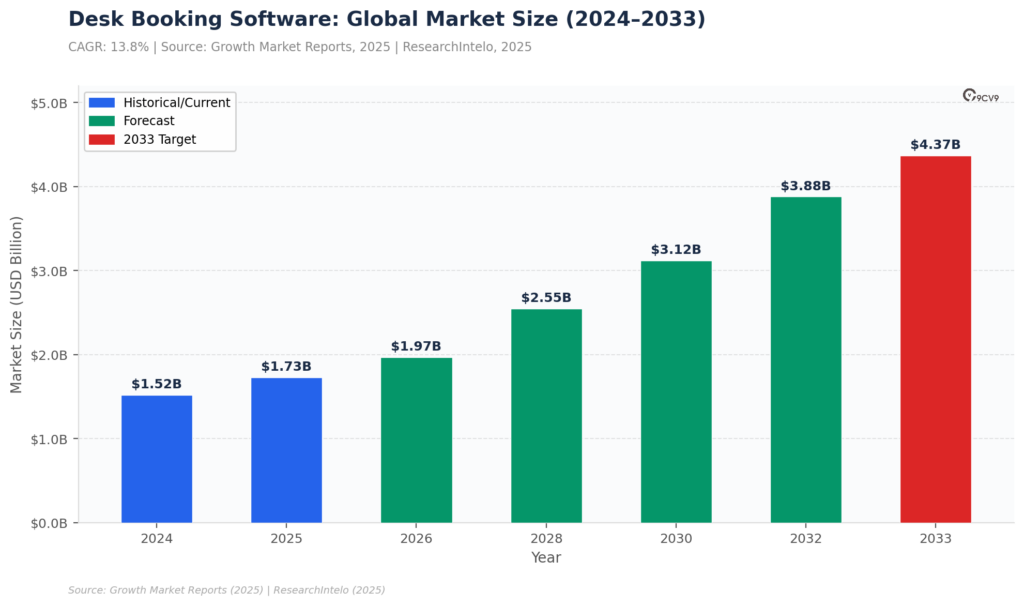
The numbers show why this matters. The broader global desk booking software market was valued at approximately $1.52 billion in 2024 and is projected to reach $4.37 billion by 2033, representing a 13.8% compound annual growth rate. Alternative market definitions produce smaller estimates, highlighting differences in how researchers classify standalone desk booking platforms versus broader integrated workplace management systems. Regardless of methodology, the research points toward continued expansion as companies invest in technology for managing increasingly flexible workplaces.
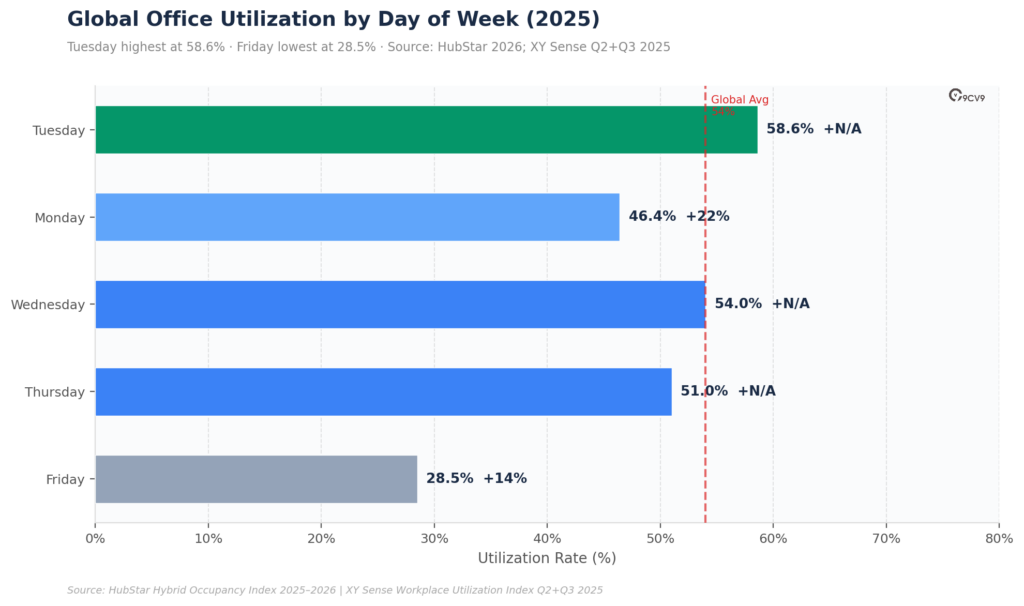
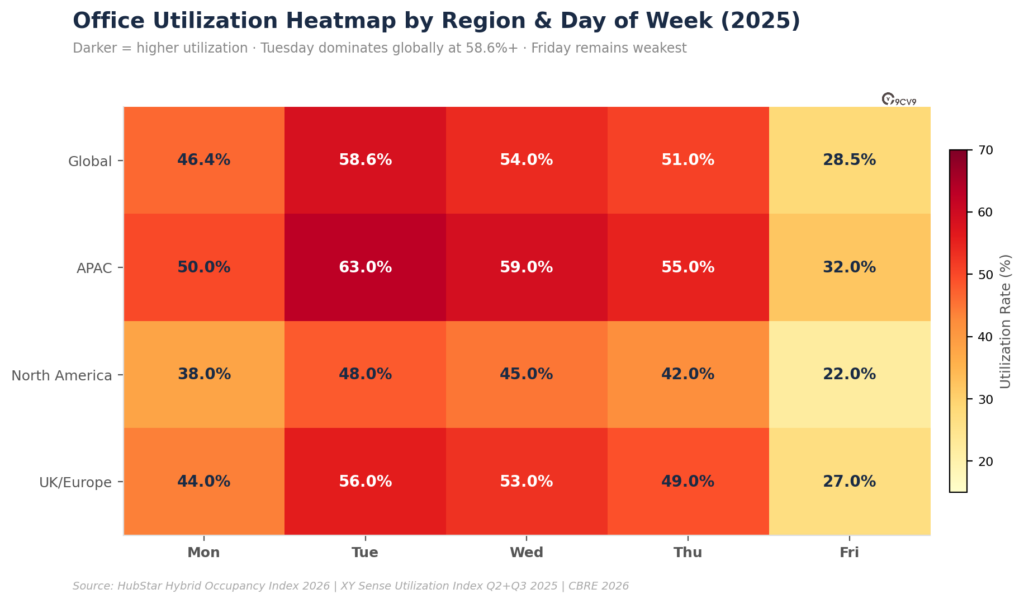
Workplace utilization is also changing rapidly. Global office utilization reached 54% in 2025, compared with 49% in 2024 and 41% in 2023, while another 2026 benchmark places average building utilization at 53%. Yet attendance remains highly uneven throughout the week. Tuesday utilization reached 58.6% in 2025, compared with only 28.5% on Fridays. These midweek peaks create practical challenges around desk availability, meeting rooms, employee coordination, and capacity planning.

At the same time, the traditional one-employee-one-desk office is disappearing. Only 40% of companies maintain a 1:1 employee-to-desk ratio, while 62% of global organizations have introduced shared or unassigned seating. Desk-sharing ratios of 1.5 employees per seat or higher have grown 93% since 2023. As more employees share fewer workstations, spreadsheets and informal reservation systems become increasingly difficult to manage at scale.
The financial case for workplace optimization is equally significant. The research indicates that organizations can potentially reduce real estate costs by 20–40% through better desk utilization, while booking data can help companies identify opportunities to reduce desk counts by 20–30%.
Some estimates suggest organizations implementing desk booking software can achieve 200–400% first-year ROI through space optimization, although actual returns depend heavily on portfolio size, utilization patterns, implementation costs, and the ability to consolidate real estate.
Technology is also making desk booking software more sophisticated. Modern platforms increasingly combine mobile and QR-code check-ins, IoT occupancy sensors, AI-driven scheduling, digital twins, employee sentiment analytics, Microsoft 365 and Google Workspace integrations, and energy-management capabilities.
These technologies help organizations move beyond simply reserving desks toward understanding how offices are actually being used.
This collection of the top 102 desk booking software statistics, data, and trends in 2026 examines the market from multiple angles, including market size and growth, regional adoption, office utilization benchmarks, desk-sharing ratios, ROI and cost savings, hybrid work patterns, employee satisfaction, emerging workplace technology, and operational challenges such as ghost bookings.
Together, these statistics provide a data-driven view of how desk booking software is evolving from a basic reservation tool into an increasingly important component of modern workplace management.
Before we venture further into this article, we would like to share who we are and what we do.
About 9cv9
9cv9 is a business tech startup based in Singapore and Asia, with a strong presence all over the world.
With over ten years of startup and business experience, and being highly involved in connecting with thousands of companies and startups, the 9cv9 team has listed some important and crucial software tools in this review.
If you like to get your company listed in our top B2B software reviews, check out our world-class 9cv9 Media and PR service and pricing plans here.
Top 102 Desk Booking Software Statistics, Data & Trends in 2026
🏦 Market Size & Growth
- The global desk booking software market reached USD 1.52 billion in 2024, reflecting robust demand across diverse industries worldwide.
- The market is projected to grow at a CAGR of 13.8% from 2025 to 2033, propelling it to an estimated USD 4.37 billion.
- An alternative market segment estimate puts the value at USD 153.35 million in 2024, growing to USD 242.06 million by 2030 at a 7.90% CAGR (narrower definition excluding broader IWMS).
- The desk booking software market size was estimated at USD 163.92 million in 2025, expected to reach USD 181.15 million in 2026 at 8.28% CAGR.
- By 2032, the market is forecast to reach USD 286.08 million under the narrower 360iResearch segmentation methodology.
- A third forecast projects the market at $1.25 billion in 2024, scaling to $3.45 billion by 2033 at a CAGR of 12.5%.
- ResearchIntelo’s model projects the market at $1.2 billion in 2024, reaching $4.8 billion by 2033 at a CAGR of 16.7%.
- The Smart Desk Booking Panel hardware market reached USD 1.38 billion in 2024 and is forecast to hit USD 4.68 billion by 2033 at a CAGR of 15.2%.
- The Meeting Room Booking Software market was valued at USD 904.4 million in 2024, projected to reach USD 1,359.88 million by 2033.
- The desk booking software market grew exponentially post-pandemic, driven primarily by accelerating adoption of hybrid work models globally.
🌍 Regional Market Data
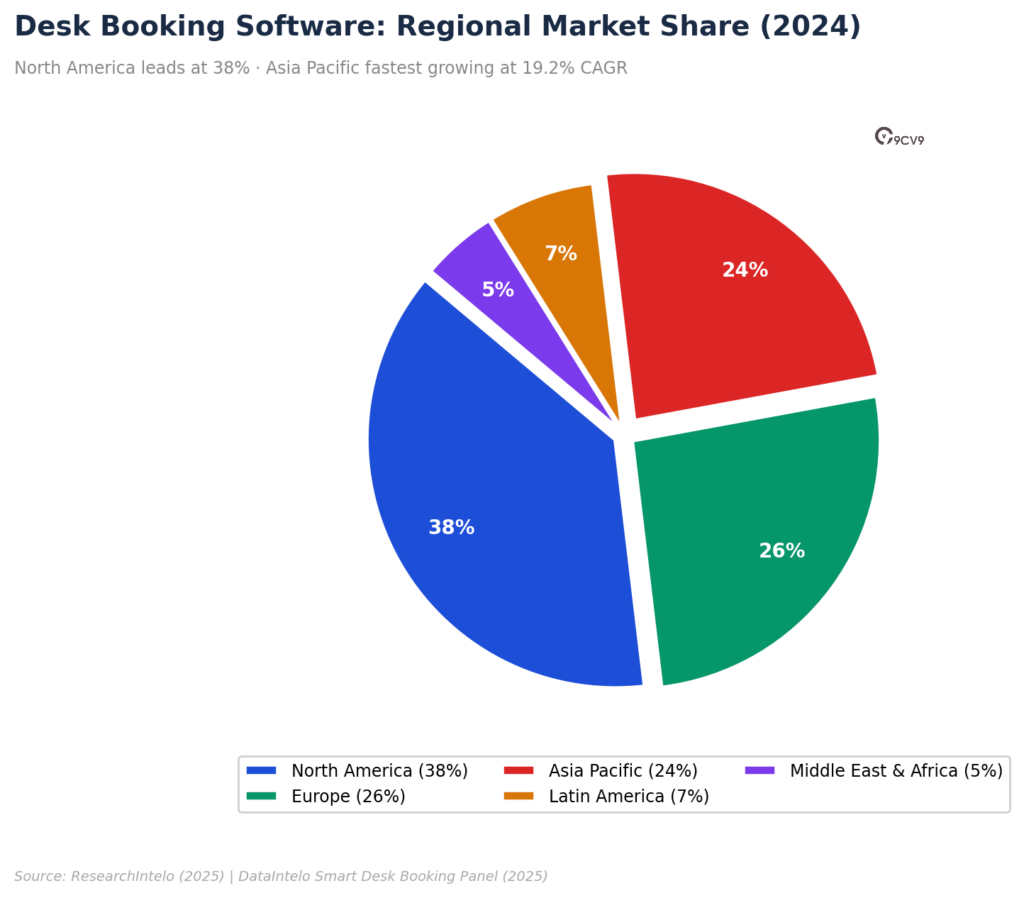
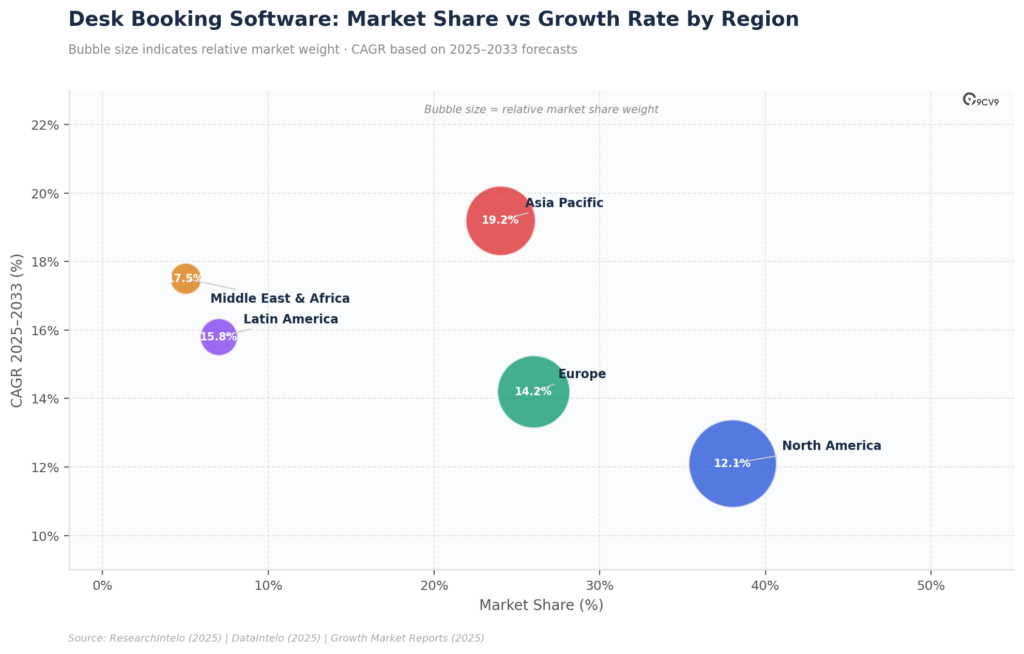
- North America holds the largest regional market share at 38% (2024), driven by mature corporate ecosystems and early hybrid work adoption.
- Europe is the second-largest market at 26%, with a market size of approximately USD 362 million in 2024.
- Asia Pacific is the fastest-growing region, with a projected CAGR of 19.2% from 2025 to 2033 — fueled by rapid urbanization and digital transformation.
- India stands out as the fastest-growing individual country in APAC, backed by a large IT-enabled services sector and rapid enterprise SaaS adoption.
- APAC recorded the highest workplace utilization rate at 47% in Q2+Q3 2025, leading all global regions.
- North America workplace utilization reached 36% in Q2+Q3 2025 — a substantial 9.5 percentage point increase from the prior year.
- The UK maintained a 44% average utilization through Q2+Q3 2025, consistent with broader European hybrid stabilization.
- The Middle East & Africa region is emerging as a significant growth area, driven by UAE’s Smart Government initiatives and Saudi Arabia’s Vision 2030 strategy.
- Latin America is gradually developing, with Brazil and Mexico emerging as key players as enterprise awareness of space optimization grows.
- 65% of enterprises in Asia Pacific plan to increase tech investments by 2026, indicating sustained demand for workspace optimization tools.
📈 Office Utilization Benchmarks
- Global office utilization reached 54% in 2025, up from 49% in 2024 and 41% in 2023 — approaching pre-pandemic levels of 61%.
- The global average building utilization rate reached 53% in 2026, its highest level since before March 2020, per CBRE’s benchmarking program.
- Global average utilization in Q2+Q3 2025 was 43%, with July and September reaching peaks of 46% each.
- Tuesday is the most popular office day globally, recording the highest utilization at 58.6% in 2025 — making it the peak booking day.
- Monday utilization reached 46.4%, recording the strongest year-over-year gain at +22% — signalling a lengthening of the in-office week.
- Friday utilization was just 28.5% — still 44% lower than Tuesday’s average, though growing 14% year-over-year.
- Conference rooms hit 80–90% utilization on core Tuesday–Thursday days, creating real capacity constraints requiring proactive booking management.
- The typical meeting room utilization benchmark is 60–75% booked hours vs. available hours; rates below 50% suggest over-provisioning.
- Small meeting rooms (1–3 people) averaged just 43.8% fill rate when occupied, with most being used by a single person — a major driver of wasted space.
- A “vibrant day” benchmark of ≥67% capacity has emerged as the industry standard for measuring an effective workspace on any given day.
- 61% of companies reported office utilization rates of 41–80%, an improvement from prior years reflecting maturing hybrid strategies.
- Pre-pandemic offices ran at 60–70% utilization on average; hybrid work has reset the global average downward to 43–54%, depending on the source.
- 77.9% of desks are in open-plan or bullpen-style layouts in 2025, while only 20.1% are in cubicle or focus configurations — contributing to privacy-seeking behavior.
- The XY Sense global sensor network captures 200 billion+ data points across 59,000+ workspaces globally to benchmark workplace utilization.
🏢 Desk Sharing & Seating Models
- Only 40% of companies maintain a 1:1 employee-to-desk ratio — down from 56% in 2023 — as desk sharing becomes the norm.
- That 1:1 ratio is expected to drop to one-third of organizations over the next two years as hybrid planning continues to evolve.
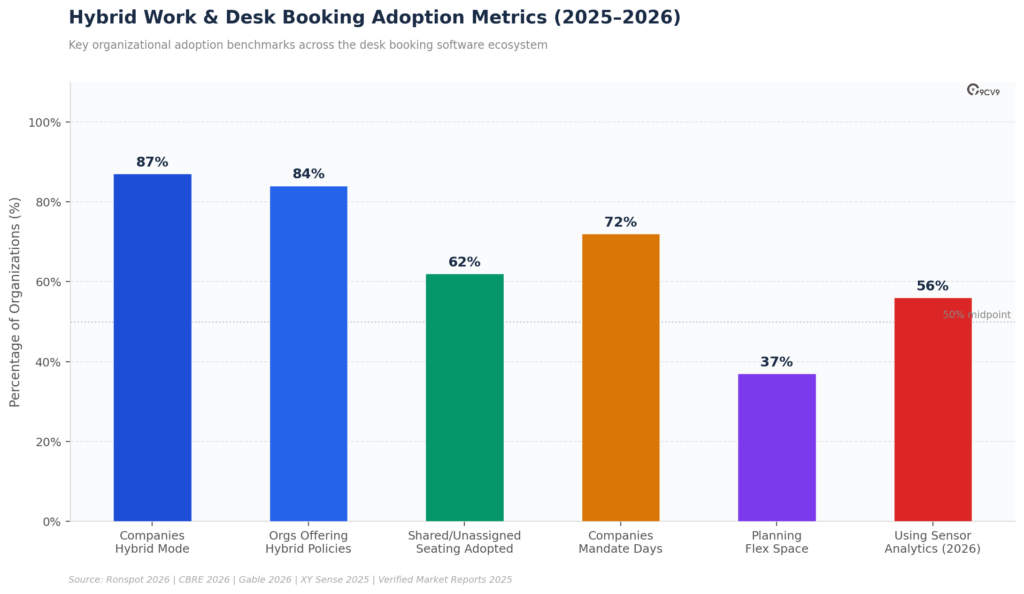
- 62% of global organizations have implemented shared or unassigned seating models as part of their hybrid work programs.
- Desk-sharing ratios of 1.5 employees per seat or higher have grown 93% since 2023, drastically increasing the complexity of manual allocation.
- 48% of organizations are now targeting a sharing ratio of 1.01–1.49 people per desk, up significantly from just 21% in 2024.
- Only 33% of organizations now target sharing ratios greater than 1.5:1, a substantial decline from 62% in 2024 — indicating a pull-back from aggressive hot-desking.
- No organizations report a 1:1 seating target in CBRE’s 2026 benchmarking, confirming desk sharing as universal across enterprises.
- 73% of organizations now expect more than 1.5 employees per desk by 2027, making booking software essential for managing allocation.
- Only 25% of companies still use exclusively assigned seating — down from 40% just the prior year — confirming hot-desk booking as the dominant model.
💰 ROI & Cost Savings
- Organizations typically achieve 200–400% ROI within the first year through space optimization alone after implementing desk booking software.
- Real estate costs can be reduced by 20–40% through optimized desk utilization enabled by booking analytics and data-driven decisions.
- Most companies see full ROI within 6–12 months due to reduced real estate costs and improved collaboration efficiency.
- Full real estate payback typically occurs in 12–18 months, depending on portfolio size and lease renegotiation opportunities.
- One documented hoteling case study achieved $180,000/year in avoided real estate costs, net of ~$12K software costs and ~$20K one-time setup.
- A Fortune 500 firm saved millions in operating costs by reducing its portfolio by nearly half using space utilization data from booking systems.
- Automated booking and analytics reduce time spent on manual coordination by up to 50%, freeing facility teams for higher-value work.
- Overcrowded environments diminish productivity by 15–30% per affected employee, while mismatched workspace types lower it by up to 25%.
- Employee-perceived workplace flexibility improves by 30% or more after transparent desk booking systems are implemented.
- Cloud-based desk booking SaaS pricing typically ranges from $2–$10 per user per month, making it accessible even for mid-sized companies.
- Companies can reduce desk counts by 20–30% by using booking data to identify peak occupancy and underutilized zones.
- Tech companies use desk booking to cut real estate costs by up to 30% while simultaneously boosting cross-team collaboration.
🔧 Technology & Features
- IoT sensor integration is a leading trend, with real-time desk occupancy tracking and auto-release of no-show reservations (typically after 15 minutes).
- AI-driven predictive scheduling engines analyze historical data, employee preferences, and usage patterns to minimize booking conflicts and maximize space use.
- Mobile-first contactless QR code check-in is now a standard feature, eliminating ghost bookings and confirming actual desk occupancy.
- Digital twin simulations are being deployed to model office layout changes and optimize capacity planning before physical implementation.
- GDPR and CCPA compliance features are now mandatory in enterprise desk booking platforms, with audit-ready occupancy records a standard requirement.
- Integration with Microsoft 365, Google Workspace, Slack, and Teams is essential for adoption, embedding booking into existing daily workflows.
- AI analytics push weekly digests to real estate managers, scoring each floor/zone on utilization efficiency with one-click recommended actions.
- Subscription-based and pay-per-use pricing models are emerging as the dominant commercial structure, decoupling licensing from hardware costs.
- Employee sentiment analytics are being embedded in booking platforms to guide desk allocation and measure workspace satisfaction over time.
- Energy management integration links booking data to building management systems to reduce energy consumption in unoccupied zones.
- In 2025, desk.ly acquired Sedeo, integrating AI-driven desk booking capabilities into a unified hybrid-work platform.
- Sign In Solutions completed a take-private acquisition of SmartSpace Software PLC, merging desk management, meeting room booking, and analytics.
- Tango launched a Crestron Desk Touch integration, enabling seamless desk booking via physical touchscreen interface.
- 2025 US tariffs on hardware accelerated migration from on-premise to cloud-hosted desk booking platforms across enterprises.
- Deployment mode is shifting toward cloud-first, with organizations choosing cloud implementations for scalability, security, and reduced hardware dependency.
👥 Hybrid Work & Employee Behaviour
- 87% of organizations now operate in hybrid mode, making desk booking software a foundational operational tool rather than an optional add-on.
- 73% of U.S. organizations offer hybrid policies as of Q2 2025, per U.S. labor department datasets — a primary driver of desk booking adoption.
- 45% of employees globally currently work in hybrid mode, down from 62% in 2022 — reflecting a stabilization of hybrid arrangements.
- 72% of companies mandate specific attendance days, directly driving demand for tools that coordinate when and where employees come in.
- 73% of employees report higher productivity under hybrid models, with an average 19% performance gain over fully office-based work.
- 46% of organizations updated hybrid or attendance policies in 2024 to rebalance seat supply with employee flexibility needs.
- 28.2% of full-time employees globally work a hybrid model (OfficeRnD 2024 Hybrid Work Trends data), compared to 12.7% fully remote.
- The three-day in-office / two-day remote model is the most common hybrid schedule globally (IFEBP), reinforcing midweek booking peaks.
- Hybrid job postings increased to 24% of all listings in early 2025, up from just 9% in 2023 — reflecting rising employer demand for flex-ready workplaces.
- 57% of global organizations have reduced office space due to hybrid operations, enabled by booking data informing portfolio right-sizing decisions.
- 30% of global office space will be flex or hot-desk-enabled by 2030, requiring sophisticated booking platforms to manage dynamic allocation.
- 37% of companies globally plan to increase the use of flexible or co-working space in the next three years, sustaining long-term booking software demand.
🏆 Employee Satisfaction & Retention
- 69% of employers have seen retention increase since adopting hybrid policies, per Ronspot’s 2026 Workplace Benchmarks Report.
- Companies that only required employees to come in once per week saw retention increase by 41% on average (Cisco Global Hybrid Work Study 2025).
- Hybrid work reduces resignations by 33%, with desk booking enabling the seamless flexibility that drives retention improvement.
- Offering hybrid work can cut turnover rates by 25%, representing significant savings given that replacing an employee costs at least 50% of annual salary.
- 72% of hybrid workers globally say their work-life balance improved significantly under flexible working arrangements.
- 67% of employees report improved job satisfaction when they have more control over their work environment — directly enabled by booking systems.
- 73% of hybrid employees felt more connected to their company when in-office with colleagues, validating the value of coordinated booking strategies.
- Remote and hybrid employees were 22% happier than full-time office workers, per Owl Labs’ landmark study, justifying investment in flexible workspace tools.
- 66% of hybrid workers would prefer to continue hybrid, and nearly three-quarters say their workplace became more attractive due to flexible work policies.
- 61% of workers are more likely to apply for a job if there is an option to work hybrid — making desk booking a talent acquisition competitive advantage.
🚨 Ghost Bookings & Operational Challenges
- 15–20% of office capacity is typically unused due to ghost booking no-shows and poor real-time visibility — a direct cost to organizations.
- 45–50% of meeting rooms are used by just one person, regardless of room size — a systemic inefficiency that booking systems with auto-release can correct.
- Ghost meetings (bookings that never materialize) are identified as a key cause of space inefficiency alongside room-size mismatches with actual attendance.
- Auto-release features free no-show reservations, with an industry standard of a 15-minute grace period before a desk or room is released automatically.
- Booking-to-show rate — measuring the percentage of bookings where someone actually checked in — is now a primary KPI tracked by 83% of CRE teams.
- High no-show rates indicate a culture of space hoarding, where employees reserve desks “just in case” but never use them — driving false scarcity signals.
- 90% of occupiers measure utilization via security badging, but only 52% also use reservation systems — a gap that booking software fills with richer data.
- 56% of organizations plan to add sensor or Wi-Fi analytics in 2026 to complement booking system data with passive occupancy signals.
- Phone booths and phone rooms take up less than 1% of available global space, forcing employees to use meeting rooms as makeshift private spaces — creating booking conflicts.
- Companies using live occupancy intelligence eliminate ghost bookings and optimize space in real time, rather than relying on quarterly utilization reports.
Conclusion
The latest desk booking software statistics for 2026 point to a workplace environment that is becoming more flexible, data-driven, and dependent on technology. Hybrid work is no longer simply a temporary response to changing employee expectations. It is reshaping how organizations determine office capacity, allocate desks, manage meeting spaces, measure utilization, and make long-term corporate real estate decisions.
Market forecasts reinforce this direction. One broader estimate values the global desk booking software market at $1.52 billion in 2024 and projects it to reach $4.37 billion by 2033 at a 13.8% CAGR. Other research methodologies produce considerably smaller market values but still forecast continued growth. Asia Pacific is identified as the fastest-growing region, with a projected CAGR of 19.2% between 2025 and 2033, while North America accounted for the largest regional share at 38% in 2024.
Changing office utilization patterns provide another major reason for adoption. Global office utilization reached 54% in 2025 according to one benchmark, up from 49% in 2024 and 41% in 2023. However, utilization remains highly concentrated around particular days. Tuesday reached 58.6% utilization in 2025 compared with just 28.5% on Friday, demonstrating why companies need better visibility into when employees actually require workspace.
The shift toward desk sharing is equally important. Only 40% of companies maintain a 1:1 employee-to-desk ratio, while 62% of global organizations have implemented shared or unassigned seating models. Desk-sharing ratios of at least 1.5 employees per seat have increased 93% since 2023. These trends suggest that permanently assigning a workstation to every employee is becoming less common as businesses adapt their offices around variable attendance.
For employers, the potential financial impact extends well beyond easier reservations. The statistics indicate that optimized desk utilization can potentially reduce real estate costs by 20–40%, while booking data can help organizations reduce desk counts by 20–30%. Automated booking and analytics may also cut manual coordination time by as much as 50%. These potential efficiencies help explain why desk booking platforms are increasingly being evaluated as workplace optimization systems rather than simple scheduling applications.
The next stage of desk booking software development is likely to be shaped by AI, IoT occupancy sensors, QR-code check-ins, predictive scheduling, digital twins, employee sentiment analytics, energy management, and deeper integrations with platforms such as Microsoft 365, Google Workspace, Slack, and Teams. These capabilities can connect reservations with actual occupancy data, helping organizations identify ghost bookings, understand demand patterns, and make better-informed space planning decisions.
Ultimately, the 102 desk booking software statistics and trends examined here show that the workplace is moving away from fixed seating and static capacity planning toward dynamic, measurable workspace management. For business leaders, HR teams, workplace managers, facilities professionals, and corporate real estate decision-makers, the central challenge in 2026 is not simply providing enough desks. It is ensuring that the right workspace is available at the right time while controlling costs and maintaining a productive employee experience.
As hybrid work continues to mature, organizations that combine desk booking data with real occupancy and utilization insights will be better positioned to understand how their offices are actually used. Desk booking software is therefore becoming an increasingly important source of workplace intelligence—helping companies balance flexibility, employee experience, space efficiency, and real estate costs in the evolving world of work.
If you find this article useful, why not share it with your hiring manager and C-level suite friends and also leave a nice comment below?
We, at the 9cv9 Research Team, strive to bring the latest and most meaningful data, guides, and statistics to your doorstep.
To get access to top-quality guides, click over to 9cv9 Blog.
To hire top talents using our modern AI-powered recruitment agency, find out more at 9cv9 Modern AI-Powered Recruitment Agency.
People Also Ask
What is desk booking software?
Desk booking software helps employees reserve available workstations in shared or hybrid offices. It can also provide utilization data that helps organizations manage office capacity and workspace demand.
How big is the desk booking software market in 2026?
Market estimates vary by definition. One narrower estimate values the market at $181.15 million in 2026, while broader studies covering more workplace-management functionality report substantially larger market sizes.
How fast is the desk booking software market growing?
Growth estimates vary significantly by market definition. The research includes forecasts ranging from about 7.9% to 16.7% CAGR, demonstrating strong expected demand for desk booking and workplace optimization technology.
What is driving desk booking software market growth?
Hybrid work is a major growth driver. Companies increasingly need technology to coordinate shared desks, manage variable office attendance, measure utilization, and optimize corporate real estate.
Which region has the largest desk booking software market?
North America held the largest regional share at 38% in 2024, supported by mature corporate technology ecosystems and relatively early adoption of hybrid workplace strategies.
Which region is growing fastest for desk booking software?
Asia Pacific is identified as the fastest-growing region, with a projected CAGR of 19.2% from 2025 to 2033, supported by urbanization, digital transformation, and enterprise SaaS adoption.
What percentage of organizations operate in hybrid mode?
The research reports that 87% of organizations operate in hybrid mode, helping make desk booking and workplace coordination technology increasingly important for managing flexible offices.
What percentage of employees work in hybrid mode?
The sources provide different measurements. One statistic places global hybrid work at 45%, while another reports 28.2% of full-time employees working under a hybrid model.
What is the average global office utilization rate?
One benchmark reports global office utilization at 54% in 2025, up from 49% in 2024 and 41% in 2023. Another 2026 benchmark places average building utilization at 53%.
Which day has the highest office utilization?
Tuesday is the most popular office day globally, reaching 58.6% utilization in 2025. This concentration of attendance makes midweek desk availability and capacity management especially important.
Which day has the lowest office utilization?
Friday utilization was only 28.5%, making it substantially quieter than Tuesday. The difference illustrates how hybrid schedules can create significant fluctuations in workspace demand during the week.
What is desk sharing?
Desk sharing allows multiple employees to use the same workstation at different times rather than assigning every employee a permanent desk. Booking software helps coordinate availability and reservations.
How common is shared seating in 2026?
The research reports that 62% of global organizations have implemented shared or unassigned seating as part of their hybrid workplace programs.
How many companies still maintain one desk per employee?
Only 40% of companies maintain a 1:1 employee-to-desk ratio, down from 56% in 2023. The data indicates that shared workstations are becoming increasingly common.
Are employee-to-desk ratios increasing?
Yes. Desk-sharing ratios of 1.5 employees per seat or higher have grown 93% since 2023, increasing the need for effective reservation and workplace capacity management.
Can desk booking software reduce real estate costs?
The research indicates that organizations may reduce real estate costs by 20–40% through better desk utilization and data-driven workspace optimization, although actual savings vary by organization.
What is the ROI of desk booking software?
The research reports potential first-year ROI of 200–400% through space optimization, with many companies achieving full ROI within 6–12 months. Actual returns depend on implementation and real estate conditions.
How much does desk booking software cost?
Cloud-based desk booking SaaS typically costs around $2–$10 per user per month according to the research, although pricing can vary by platform, features, integrations, and organization size.
Can companies reduce the number of desks with booking software?
The research suggests companies can potentially reduce desk counts by 20–30% by analyzing booking data to understand peak occupancy, demand patterns, and underutilized office zones.
What are ghost bookings in desk booking software?
Ghost bookings occur when employees reserve desks or rooms but do not actually use them. They can create false scarcity, distort utilization data, and prevent other employees from accessing available space.
How much office capacity is wasted by ghost bookings?
The research estimates that 15–20% of office capacity is typically unused because of ghost booking no-shows and inadequate real-time visibility into actual workspace occupancy.
How does desk booking software prevent ghost bookings?
Modern platforms can use QR check-ins, occupancy sensors, and automatic reservation releases. A 15-minute grace period before releasing an unused desk or room is cited as an industry standard.
What is a booking-to-show rate?
Booking-to-show rate measures the percentage of reservations where someone actually checks in. The research reports that 83% of CRE teams track it as a key workplace performance indicator.
How is AI used in desk booking software?
AI-driven scheduling can analyze historical utilization, employee preferences, and usage patterns to predict demand, reduce booking conflicts, improve desk allocation, and support workspace planning.
How are IoT sensors used with desk booking systems?
IoT sensors provide real-time occupancy information that can confirm whether reserved desks are actually being used and support automatic release of unused reservations.
Does desk booking software integrate with Microsoft 365 and Google Workspace?
Yes. Integration with Microsoft 365, Google Workspace, Slack, and Teams is identified as important because it allows employees to incorporate workspace booking into their existing workflows.
Why are QR codes used for desk booking?
QR codes provide mobile, contactless check-in at reserved workstations. They help confirm actual occupancy, improve booking-to-show data, and reduce problems caused by unused reservations.
Can desk booking software improve employee satisfaction?
The research reports that employee-perceived workplace flexibility can improve by 30% or more after transparent desk booking systems are introduced, although outcomes depend on implementation.
How does hybrid work affect employee retention?
The research reports that 69% of employers have seen retention increase since adopting hybrid policies, while another cited study found hybrid work reduced resignations by 33%.
What is the future of desk booking software beyond 2026?
Desk booking platforms are evolving toward AI scheduling, IoT occupancy sensing, digital twins, real-time analytics, sentiment analysis, energy management, and deeper workplace software integrations.
Sources
Growth Market Reports 360iResearch ResearchIntelo Verified Market Reports DataIntelo CBRE XY Sense Ronspot HubStar Skedda Joan Workplace Gable OfficeRnD deskbird Archie App WorkInsiders Zoom Reworked INSIGHTS Robin Powered People Managing People Cisco