



























Key Takeaways
- The cryptocurrency exchange software market is experiencing rapid growth in 2026, driven by rising trading volumes, institutional adoption, stablecoin expansion, and increasing global cryptocurrency ownership.
- Leading exchanges such as Binance, Coinbase, Bybit, and OKX continue to dominate market share, while decentralized exchanges (DEXs) and DeFi platforms are capturing a growing portion of global trading activity.
- Regulatory developments, cybersecurity investments, artificial intelligence integration, and tokenized real-world assets are reshaping the future of cryptocurrency exchange software and digital asset infrastructure worldwide.
Cryptocurrency exchange software powers the platforms that enable users to buy, sell, trade, and manage digital assets securely. In 2026, the industry continues to expand rapidly as exchanges process trillions of dollars in trading volume, support growing institutional adoption, and drive innovation across cryptocurrency, stablecoin, and decentralized finance markets worldwide.
The cryptocurrency industry has evolved far beyond its early reputation as a niche market driven by speculative trading and technological experimentation. In 2026, cryptocurrency exchange software sits at the center of a rapidly expanding digital asset economy that now serves hundreds of millions of users, processes trillions of dollars in annual trading volume, and attracts growing participation from retail investors, institutional funds, governments, and multinational corporations. What was once considered an alternative financial ecosystem has transformed into a major pillar of global finance, with cryptocurrency exchanges functioning as the gateways through which users buy, sell, trade, store, and manage digital assets across virtually every region of the world.
Also, read our list of the Top 10 Best Cryptocurrency Exchange Software.

The pace of growth within the cryptocurrency exchange sector has been remarkable. Industry forecasts indicate that the global cryptocurrency exchange market is expanding at a double-digit annual growth rate, with market values projected to reach tens of billions of dollars in 2026 and potentially hundreds of billions in the years ahead. At the same time, the total cryptocurrency market capitalization has climbed into multi-trillion-dollar territory, reinforcing the importance of exchange infrastructure that can support increasing levels of liquidity, security, compliance, and user demand. These developments have elevated cryptocurrency exchange software from a simple trading platform into a sophisticated financial technology ecosystem encompassing spot trading, derivatives, staking, lending, institutional custody, decentralized finance integrations, stablecoin settlements, tokenized assets, and advanced portfolio management tools.
One of the most significant developments shaping the industry in 2026 is the growing convergence between traditional finance and digital assets. Major financial institutions, investment managers, and publicly traded corporations are now participating directly in cryptocurrency markets through regulated products such as Bitcoin exchange-traded funds (ETFs), digital asset treasury strategies, tokenized investment products, and institutional trading services. This institutional adoption has increased demand for enterprise-grade cryptocurrency exchange software capable of meeting strict compliance, security, reporting, and operational requirements. As a result, modern exchanges are investing heavily in regulatory infrastructure, anti-money laundering systems, identity verification technologies, proof-of-reserve mechanisms, and advanced risk management frameworks to satisfy both regulators and institutional clients.
The competitive landscape among cryptocurrency exchanges has also intensified considerably. Industry giants such as Binance, Coinbase, Bybit, OKX, Kraken, Bitget, and MEXC continue to dominate global trading activity, collectively processing trillions of dollars in annual volume. These leading exchanges compete aggressively on trading fees, liquidity depth, product offerings, mobile user experience, geographic expansion, and technological innovation. At the same time, emerging exchanges are attempting to differentiate themselves through specialized services, localized market strategies, zero-fee trading models, enhanced customer support, and innovative integrations with decentralized finance ecosystems. The result is a dynamic and highly competitive market where technology innovation often determines long-term success.
Decentralized exchanges (DEXs) have become another powerful force influencing the future of cryptocurrency exchange software. Platforms such as Uniswap, PancakeSwap, Hyperliquid, and numerous blockchain-native trading protocols have demonstrated that decentralized infrastructure can handle increasingly large trading volumes while offering users greater control over their assets. The rise of decentralized perpetual futures, automated market makers, self-custody trading solutions, and on-chain liquidity networks is creating new opportunities and challenges for centralized exchanges. As decentralized finance continues to mature, many industry observers expect hybrid models that combine the efficiency of centralized platforms with the transparency and ownership benefits of decentralized systems to become increasingly common.
Stablecoins represent another transformative trend that continues to reshape the cryptocurrency exchange ecosystem. Digital dollar assets such as USDT and USDC now facilitate trillions of dollars in annual transaction volume and have emerged as essential components of global crypto trading infrastructure. Stablecoins serve as settlement layers for exchange transactions, cross-border payments, remittances, treasury management, decentralized finance applications, and digital commerce. Their rapid adoption highlights how cryptocurrency exchange software is increasingly being used not only for investment purposes but also for practical financial activities such as payments, international transfers, and liquidity management.
Security remains one of the most critical priorities for cryptocurrency exchange operators in 2026. Despite substantial investments in cybersecurity, the industry continues to face sophisticated threats ranging from phishing attacks and social engineering campaigns to smart contract exploits and nation-state-sponsored hacking operations. Several high-profile exchange breaches have demonstrated the financial and reputational risks associated with digital asset custody, prompting exchanges to strengthen security frameworks through multi-factor authentication, multi-party computation, cold storage systems, real-time monitoring tools, audit trails, and advanced threat detection technologies. As digital asset adoption grows, security excellence has become one of the most important competitive differentiators for exchange software providers.
Regulation is another defining factor shaping the future of cryptocurrency exchanges worldwide. Governments and regulatory authorities across North America, Europe, Asia-Pacific, the Middle East, and Latin America are implementing increasingly comprehensive frameworks governing digital asset activities. Landmark developments such as the European Union’s Markets in Crypto-Assets (MiCA) regulation, stablecoin legislation in the United States, and expanding anti-money laundering requirements globally are creating a more structured operating environment for cryptocurrency exchanges. While compliance obligations continue to increase, many industry participants view regulatory clarity as a positive development that can accelerate institutional adoption, improve consumer trust, and support long-term market growth.
The technological foundations supporting cryptocurrency exchange software are also advancing at an unprecedented pace. Artificial intelligence, machine learning, blockchain analytics, zero-knowledge proofs, multi-party computation, Layer 2 scaling solutions, quantum-resistant cryptography, automated compliance monitoring, and blockchain-native identity systems are rapidly becoming core components of modern exchange infrastructure. These innovations are helping exchanges improve scalability, reduce operational costs, enhance security, streamline customer support, and deliver more sophisticated trading experiences to users around the world.
User adoption trends further reinforce the extraordinary growth potential of the cryptocurrency exchange industry. Global cryptocurrency ownership has expanded dramatically over the past several years, with hundreds of millions of individuals now participating in digital asset markets. Emerging economies in Asia, Africa, and Latin America have become major growth drivers as consumers increasingly utilize cryptocurrencies and stablecoins for savings, remittances, inflation hedging, and cross-border commerce. Mobile-first trading experiences, localized payment methods, and improved accessibility continue to lower barriers to entry, enabling exchanges to reach entirely new populations of users.
Against this backdrop, understanding the latest cryptocurrency exchange software statistics has never been more important for investors, entrepreneurs, fintech executives, software developers, blockchain startups, regulators, researchers, and market analysts. Data-driven insights provide valuable context for evaluating market opportunities, identifying emerging trends, benchmarking competitors, assessing risks, and making informed strategic decisions. Whether you are planning to launch a cryptocurrency exchange, invest in blockchain infrastructure, evaluate industry growth potential, or simply stay informed about the future of digital finance, reliable statistics offer a clear window into the forces shaping this rapidly evolving sector.
In this comprehensive guide, we examine the Top 105 Cryptocurrency Exchange Software Statistics, Data & Trends in 2026. These carefully curated insights cover every major aspect of the industry, including market growth, trading volumes, exchange market share, decentralized finance adoption, stablecoin expansion, institutional investment, cybersecurity developments, regulatory changes, user behavior, technological innovation, and future industry projections. Together, these statistics reveal not only where the cryptocurrency exchange market stands today, but also where it is likely headed over the coming decade as digital assets continue their transformation from a disruptive technology into a mainstream component of the global financial system.
Before we venture further into this article, we would like to share who we are and what we do.
About 9cv9
9cv9 is a business tech startup based in Singapore and Asia, with a strong presence all over the world.
With over nine years of startup and business experience, and being highly involved in connecting with thousands of companies and startups, the 9cv9 team has listed some important learning points in this overview of the Top 105 Cryptocurrency Exchange Software Statistics, Data & Trends in 2026.
If you like to get your company listed in our top B2B software reviews, check out our world-class 9cv9 Media and PR service and pricing plans here.
Top 105 Cryptocurrency Exchange Software Statistics, Data & Trends in 2026
📊 Market Size & Growth
1. The global cryptocurrency exchange platform market is projected to reach $68.85 billion in 2026, up from $54.8 billion in 2025, representing a CAGR of 25.6%.
The exchange platform market’s near-30% annual growth signals that digital asset infrastructure has become a core pillar of modern finance, not merely a speculative sideshow.
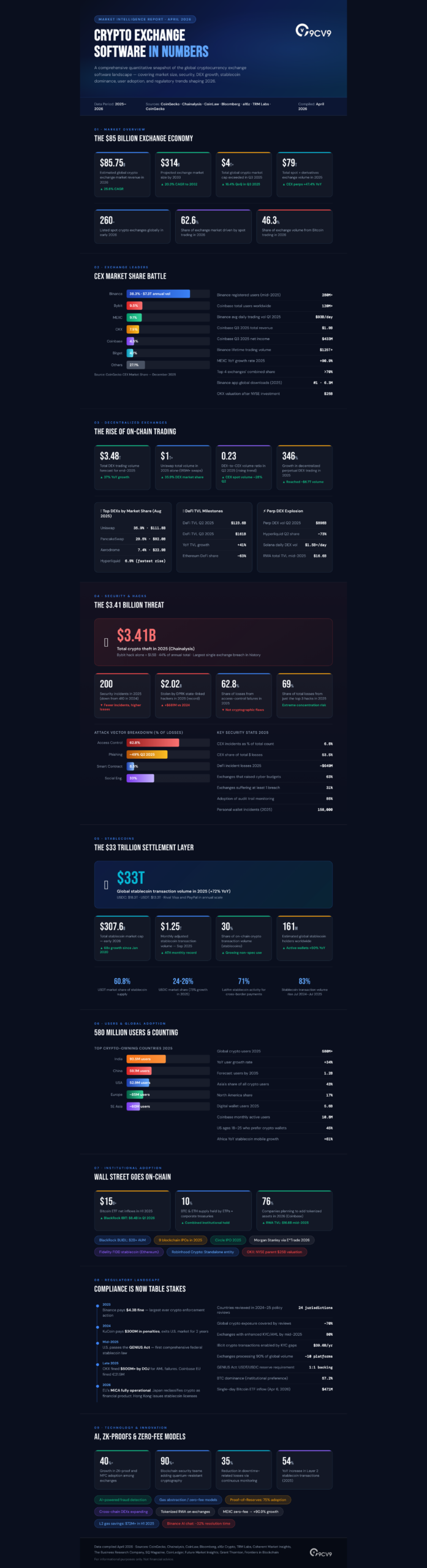
2. The broader crypto exchange market is estimated at $85.75 billion in 2026 revenue, with projections reaching $314 billion by 2033.
This near-quadrupling over seven years reflects structural demand from retail traders, institutions, and emerging-market populations adopting digital assets for the first time.
3. The crypto trading platform market was valued at $54.1 billion in 2025 and is forecast to grow to $200.5 billion by 2035 at a 14% CAGR.
Sustained double-digit growth underlines how exchanges have evolved from simple order books into full financial ecosystems offering staking, lending, and derivatives.
4. The global cryptocurrency exchange market grew from $43.8 billion in 2024 to $71.35 billion in 2025, and is projected to reach $260.17 billion by 2032 at a CAGR of 20.3%.
The 63% single-year jump from 2024 to 2025 reflects a bull market rerating, institutional inflows via Bitcoin ETFs, and expanding regulatory legitimacy.
5. North America is expected to dominate the crypto exchange market in 2026, holding a 37.2% market share.
The U.S. regulatory shift under the Trump administration — including the GENIUS Act and CFTC spot trading authorization — has cemented North American exchanges as the leading global revenue center.
6. North America’s exchange platform revenues could exceed $60 billion by 2029, led primarily by U.S.-based platforms.
Coinbase, Kraken, and Gemini stand to capture the lion’s share as institutional capital continues rotating into compliant, regulated digital asset platforms.
7. Asia-Pacific is the fastest-growing region for crypto exchange software investment through 2033.
Countries such as South Korea, Hong Kong, and India are launching crypto-friendly regulatory sandboxes, creating a fertile environment for both domestic and global exchange operators.
8. The global crypto exchange market is projected to grow at a CAGR of 20.3% from 2025 to 2032.
This sustained growth rate — above most traditional financial sectors — reflects the early-stage nature of the market and the continuing conversion of legacy finance users to digital assets.
9. The crypto exchange software market is expected to grow from ~$50 billion in 2025 to over $160 billion by 2035.
Exchanges that diversify into tokenized real-world assets, cross-border payments, and DeFi yield products will likely capture a disproportionate share of this decade-long expansion.
10. The global cryptocurrency market cap surpassed $4 trillion in Q3 2025 for the first time.
Breaching the $4 trillion threshold signals crypto’s maturation as an asset class comparable in scale to some major global equity markets, further legitimizing exchange infrastructure spending.
🏆 Exchange Market Share & Leaders
11. Binance dominated global centralized exchanges in 2025 with a 38.3% spot trading market share in December 2025, according to CoinGecko.
Despite regulatory headwinds and a $4.3 billion U.S. fine, Binance’s scale advantage and deep liquidity have proven extraordinarily difficult for rivals to erode.
12. In Q1 2025, Binance accounted for 36.5% of total global CEX market share, processing approximately $8.39 trillion in trading volume.
Even after a 12.5% decline in overall market trading volumes in Q1, Binance grew its spot market share to 45%, illustrating resilience through market cycles.
13. In 2025 overall, Binance dominated with a 39.2% share of the top 10 exchanges’ combined volume, pushing $7.3 trillion of the sector’s $18.7 trillion total.
The gap between Binance and its nearest competitors remains enormous, though challengers like Bybit and MEXC are making incremental gains.
14. Binance’s lifetime trading volume surpassed $125 trillion by mid-2025, with a user base approaching 280 million registered users.
These figures make Binance arguably the most influential financial platform globally by raw transaction volume, ahead of many traditional brokerage systems.
15. Bybit ended December 2025 as the second-largest centralized exchange with a 9.5% market share and $90 billion in monthly spot trading volume.
Bybit’s recovery from the $1.4–$1.5 billion February 2025 hack — which temporarily cut its market share to 6% — is a remarkable demonstration of institutional resilience.
16. MEXC ranked third among CEXs in December 2025 with a 9.1% market share and $86 billion in monthly volume.
MEXC’s zero-fee strategy drove 90.9% year-over-year growth in 2025, proving that fee disruption can rapidly capture market share in commodity trading platforms.
17. Binance, OKX, Bybit, and Bitget together accounted for over 70% of spot trading among leading centralized exchanges by late 2025.
The intense consolidation at the top of the market creates significant barriers for new entrants and signals that liquidity network effects are the dominant competitive moat.
18. Coinbase’s global spot market share has slipped to approximately 4.5%, even as its quarterly trading volume reached multi-year highs.
Despite reduced global share, Coinbase remains the most trusted platform in the U.S. market, a position reinforced by its Nasdaq listing and institutional-grade compliance.
19. Coinbase generated approximately $1.9 billion in total revenue in Q3 2025, up 54% year-over-year.
This revenue growth illustrates how exchanges can scale profitability during bull markets by combining fee income with staking services, subscription products, and institutional custody fees.
20. Coinbase’s Q1 2025 fee revenue reached $935 million, up 12% year-over-year.
Fee revenue resilience even in a slower quarter signals that Coinbase’s diversified income model — spanning retail fees, derivatives, and prime brokerage — is maturing effectively.
21. Coinbase now serves more than 120 million users worldwide, marking a 20% growth from 2024.
The 20% annual growth rate in an already large user base suggests significant room remains for additional retail and institutional adoption, particularly in non-U.S. markets.
22. Binance counts over 280 million registered users globally as of mid-2025, with daily new registrations exceeding 150,000 during peak periods.
The sheer scale of Binance’s user base creates self-reinforcing liquidity dynamics, making it increasingly difficult for smaller exchanges to offer competitive pricing.
23. By April 2025, Binance had onboarded over 30 million new users from Latin America and Africa combined.
Emerging-market expansion is Binance’s most important long-term growth engine, as these regions often lack strong domestic banking alternatives for savings and remittances.
24. KuCoin has over 41 million registered users spanning more than 200 countries as of mid-2025.
KuCoin’s global footprint illustrates the borderless nature of crypto exchange software, which can reach users in jurisdictions where traditional financial infrastructure is limited.
📈 Trading Volume
25. Global spot plus derivatives exchange trading volume exceeded $79 trillion in 2025.
This staggering figure demonstrates that crypto exchange software is now processing volumes comparable to several major global commodity and equity markets combined.
26. Centralized perpetual futures volume reached $862 trillion in 2025, a 47.4% increase year-over-year.
The explosion of perpetual futures trading reflects growing appetite for leveraged crypto exposure among both retail traders and increasingly sophisticated institutional participants.
27. The top 10 centralized exchanges processed $18.7 trillion in combined spot volume throughout 2025.
Concentration in the top tier is stark: just 10 platforms accounted for the vast majority of global ordered exchange activity, reflecting the winner-take-most dynamics of financial infrastructure.
28. Binance’s average daily trading volume in Q1 2025 was $93 billion, compared to Coinbase’s $5.5 billion.
The 17x difference in daily volumes between the two largest players illustrates the dramatic polarization in global crypto exchange market structure.
29. Spot trading in crypto exchange platforms is expected to contribute the highest share of 62.6% of the overall exchange market in 2026.
Spot dominance persists because the majority of new crypto entrants are buyers of actual tokens for long-term holding, not speculators seeking leveraged derivatives exposure.
30. The Bitcoin segment is expected to account for 46.3% of total crypto exchange market volume in 2026.
Bitcoin’s unrivaled brand recognition, regulatory clarity (especially after spot ETF approvals), and institutional grade status keep it as the cornerstone asset for exchange volume generation.
🔄 Decentralized Exchanges (DEX)
31. DEX trading volume rose approximately 37% in 2025, with an average monthly volume of around $412 billion.
The consistent rise in DEX activity — even as CEX volumes fluctuated — points to growing user preference for self-custody and non-custodial trading, especially post-FTX fallout.
32. Total DEX trading volumes were forecast to reach $3.48 trillion by the end of 2025.
This trajectory, roughly tripling from 2023 levels, signals that decentralized exchange software is graduating from a DeFi curiosity to critical financial market infrastructure.
33. Uniswap handled over 915 million swaps and more than $1 trillion in volume during 2025 alone.
Processing over a trillion dollars in non-custodial swaps in a single year cements Uniswap’s status as one of the most consequential financial applications in the history of the internet.
34. Uniswap reclaimed the leading DEX position in August 2025 with a 35.9% market share and $111.8 billion in monthly trading volume.
Uniswap’s v4 upgrade with custom “Hooks” functionality improved capital efficiency and attracted liquidity providers back from competing protocols throughout 2025.
35. PancakeSwap was the second-largest DEX in August 2025, with a 29.5% market share and $92 billion in monthly volume.
PancakeSwap’s surge to temporary market leadership in mid-2025 — driven by Binance Alpha 2.0 integration — illustrated how CEX-DEX partnerships can rapidly reshape competitive dynamics.
36. The DEX-to-CEX trading volume ratio rose to 0.23 in Q2 2025, while centralized exchange spot volume dropped nearly 28%.
This ratio is a closely watched indicator of DeFi maturation; its continued rise suggests decentralized exchange software is compressing the competitive advantage of centralized incumbents.
37. The global DeFi protocols’ TVL reached $123.6 billion in Q2 2025, up 41% year-over-year, rising further to $161 billion by end of Q3 2025.
Rising total value locked across DeFi protocols directly drives DEX exchange volume, as users increasingly deploy idle assets into yield-generating liquidity pools.
38. Ethereum remains dominant, holding approximately 63% of total DeFi protocol TVL (~$78.1 billion) in mid-2025.
Ethereum’s enduring DeFi dominance reflects its battle-tested security model and the deep network effects built by thousands of dApps and billions in liquidity over seven years.
39. Decentralized perpetual DEX trading grew 346% to approximately $6.7 trillion in 2025.
The near-quadrupling of decentralized perpetuals, led largely by Hyperliquid, signals a genuine threat to centralized derivatives exchanges from on-chain alternatives.
40. Perpetual futures trading volume on DEXs hit $898 billion in Q2 2025, with Hyperliquid securing approximately 73% market share in that segment.
Hyperliquid’s command of decentralized perp trading demonstrates that purpose-built, high-performance DEX infrastructure can genuinely challenge centralized alternatives on execution quality.
41. Hyperliquid surged to become the fourth-largest DEX by market share in August 2025, marking the first time its market share exceeded 3%.
Hyperliquid’s ascent is the defining DEX success story of 2025 — a platform that combined the transparency of decentralized settlement with the performance of a centralized order book.
42. Solana DEXs processed over $1.5 billion in daily trades in mid-2025, establishing themselves as a major competitive threat to Ethereum-based DEXs.
Solana’s sub-second finality and low transaction costs make it the preferred chain for retail-oriented DEX activity, memecoins, and real-time token launches.
🛡️ Security & Hacks
43. Cryptocurrency theft totaled over $3.41 billion in 2025, an increase from $3.38 billion in 2024, according to Chainalysis.
The marginal year-on-year increase masks a dramatic shift in attack composition — fewer incidents but much larger individual breaches, particularly at centralized platforms.
44. The Bybit hack in February 2025 resulted in a loss of approximately $1.4–$1.5 billion, making it the largest single crypto exchange hack in history.
Bybit’s ability to survive a $1.5 billion breach without insolvency demonstrated unprecedented capital resilience, but also highlighted that nation-state-level attackers now target top-tier platforms.
45. The top three hacks in 2025 accounted for 69% of all service-related crypto losses for the year.
This concentration of losses highlights the critical importance of security investment at the largest platforms, where a single breach can set the entire industry back years in institutional trust.
46. North Korea’s DPRK-linked hackers stole at least $2.02 billion in cryptocurrency in 2025, a record and an increase of $681 million from 2024.
State-sponsored crypto theft has become a geopolitical issue: Chainalysis estimates DPRK actors have cumulatively stolen $6.75 billion, reportedly to fund weapons development.
47. There were approximately 200 security incidents across the crypto ecosystem in 2025, down from 410 in 2024, yet total losses climbed to $2.935 billion.
Fewer-but-larger attacks represent a maturation of attacker sophistication — criminal groups are concentrating resources on high-value centralized targets rather than spraying small protocol exploits.
48. Access control failures caused 62.8% of all crypto hack losses in 2025.
The dominance of access control as the primary attack vector underscores that the weakest link in exchange security is often internal privilege management, not cryptographic vulnerabilities.
49. Phishing attacks accounted for approximately 49.3% of losses by value in Q2 2025.
The persistence of phishing as a top loss driver despite sophisticated technical defenses illustrates that exchange security must invest equally in user education and behavioral fraud prevention.
50. Centralized exchanges accounted for just 6.8% of incident count in 2025, yet were responsible for 53.5% of total financial losses.
This asymmetry quantifies the systemic risk of centralized custody: CEX incidents are rare but catastrophic, while DeFi incidents are frequent but smaller in individual scale.
51. DeFi hack losses remained suppressed in 2025 despite the recovery in TVL, with DeFi absorbing 126 incidents resulting in ~$649 million in losses.
The divergence between rising TVL and stable DeFi hack losses represents a genuine security improvement — a signal that years of auditing culture and formal verification are paying off.
52. A 2025 global survey showed 63% of exchanges raised cybersecurity budgets, yet 31% still reported at least one successful breach.
Increased security spending alone does not guarantee protection: organizational culture, incident response readiness, and key management practices remain equally critical.
53. Smart contract vulnerabilities in 2025 caused losses of approximately $500 million across the cryptocurrency ecosystem.
While declining relative to prior cycles, smart contract exploits remain a significant systemic risk for any DEX or DeFi-adjacent exchange software deploying complex on-chain logic.
54. Industry adoption of audit trails and transaction monitoring rose to 85% among crypto exchanges globally in 2025.
The near-universal adoption of monitoring tools reflects regulatory pressure from MiCA, GENIUS Act, and FATF travel rule requirements, transforming compliance from optional to mandatory.
55. Personal wallet compromises surged to 158,000 incidents in 2025, affecting at least 80,000 unique victims, though average loss per victim declined.
The democratization of attack tooling means individual retail users are increasingly targeted, making wallet security education a critical responsibility for exchange platforms.
💰 Stablecoins on Exchanges
56. Global stablecoin transactions reached $33 trillion in 2025, a 72% increase from 2024, according to Artemis Analytics and Bloomberg.
This volume — roughly equivalent to two years of Visa’s global transaction value — cements stablecoins as the de facto settlement layer for the global digital economy.
57. Tether (USDT) processed approximately $13.3 trillion in transaction volume in 2025, while USDC processed around $18.3 trillion.
USDC’s higher transactional volume despite a smaller market cap suggests increasing institutional and corporate preference for the more regulated, U.S.-compliant stablecoin.
58. The total stablecoin market cap reached $307.57 billion by early 2026, with USDT holding approximately 60.8% and USDC approximately 24–26%.
Stablecoins now represent a meaningful fraction of global dollar-denominated liquidity, raising serious questions about their impact on monetary policy and dollar internationalization.
59. Stablecoins accounted for approximately 30% of crypto on-chain transaction volume between January and July 2025, per TRM Labs.
The structural shift of stablecoin activity away from speculative use toward payments, payroll, and cross-border settlements represents the most important trend in crypto utility expansion.
60. Monthly adjusted stablecoin transaction volume approached $1.25 trillion in September 2025, according to a16z Crypto.
Monthly stablecoin volumes at this scale rival major global payment networks, fundamentally challenging the assumption that traditional rails are necessary for international value transfer.
61. The stablecoin market cap grew from $4.17 billion in January 2020 to $283.7 billion in September 2025 — a 68-fold increase in five years.
Few asset classes or financial products in history have grown 68x in five years; this trajectory underscores the structural demand for programmable, dollar-denominated liquidity.
62. Stablecoins facilitated approximately $46 trillion in total transaction volume in the last year (as reported by a16z), rivaling Visa and PayPal in scale.
The comparison to Visa and PayPal is no longer merely aspirational — stablecoin networks are processing volumes that place them firmly in the tier of global systemically important financial infrastructure.
63. The stablecoin market cap could exceed $2 trillion by 2026, according to forward-looking projections cited in CoinLaw research.
Reaching $2 trillion would represent a further 6x increase from late-2025 levels, likely requiring institutional treasury adoption, sovereign digital dollar programs, and CBDC integration.
🏛️ Institutional Adoption
64. Regulated Bitcoin ETF products have attracted nearly $15 billion in net inflows during the first half of 2025, according to TRM Labs and MarketWatch.
Institutional capital flowing into regulated Bitcoin ETFs represents the clearest evidence yet of mainstream portfolio allocation to digital assets at scale.
65. Bitcoin ETF inflows reached $471 million in a single day on April 6, 2026 — the highest single-day total since February 2026 — with BlackRock’s IBIT drawing $8.4 billion in Q1 2026 net inflows.
BlackRock’s dominance of Bitcoin ETF flows, accounting for over 45% of total spot Bitcoin ETF AUM, reflects its unmatched distribution network among institutional and wealth management clients.
66. Publicly traded digital asset treasury companies now collectively hold approximately 4% of total Bitcoin and Ethereum in circulation.
Corporate Bitcoin treasury adoption, pioneered by MicroStrategy, has spawned an entire category of listed vehicles that further institutionalize exchange demand for spot Bitcoin.
67. Exchange-traded products and digital asset treasury companies combined now hold around 10% of both Bitcoin’s and Ethereum’s token supplies.
Concentrated institutional ownership at this scale fundamentally changes market microstructure, reducing circulating supply and increasing sensitivity to institutional flow decisions.
68. OKX received a major investment from the parent company of the New York Stock Exchange in 2026, giving it a valuation of $25 billion.
NYSE’s strategic investment in OKX signals that traditional exchange infrastructure operators view crypto exchanges as direct competitive threats rather than adjacent markets.
69. Robinhood Crypto separated into a standalone entity in 2025, while 9 blockchain companies completed IPOs including Circle.
The wave of blockchain sector IPOs in 2025 reflects capital market appetite for public exposure to exchange infrastructure, custody, and stablecoin issuance businesses.
70. Morgan Stanley plans to onboard crypto trading via E*Trade in 2026, illustrating the accelerating convergence of traditional brokerage and crypto exchange infrastructure.
Traditional wealth management platforms entering crypto exchange services will dramatically expand the total addressable market and raise the competitive bar for pure-play crypto exchanges.
71. 76% of companies plan to add tokenized assets in 2026, according to a Coinbase report.
Corporate interest in tokenized equities, real estate, and commodities on exchange platforms represents the next major growth frontier for exchange software beyond native cryptocurrency trading.
72. Real-world asset (RWA) total value locked reached $16.6 billion by mid-2025, roughly 14% of total DeFi TVL.
The integration of real-world assets into exchange software is the bridge between traditional finance and DeFi — a $100+ trillion opportunity when bond, equity, and real estate tokenization reaches mainstream adoption.
👥 User Base & Adoption
73. Global crypto users surpassed 580 million in 2025, up approximately 34% year-over-year.
While 580 million is already a remarkable figure, it represents less than 8% of the global population, indicating that the vast majority of the potential user base has yet to be onboarded.
74. Global digital wallet users hit approximately 5.6 billion in 2025, with forecasts of 6.2 billion by 2026.
The near-universal adoption of digital wallets globally (many of which increasingly include crypto functionality) creates an enormous ready-made distribution channel for crypto exchange services.
75. The total number of crypto users could rise from around 600 million in 2026 to over 1.2 billion by 2035.
A doubling of the user base over a decade implies roughly 65 million new users per year — a pace consistent with smartphone adoption curves in emerging markets.
76. India leads global crypto ownership with approximately 93.5 million crypto owners, followed by China (59.1 million) and the USA (52.9 million).
India’s enormous crypto user base, driven by a young population and limited traditional investment options, represents the single largest untapped opportunity for exchange platform growth.
77. Asia accounts for approximately 43% of all crypto users, North America 17%, and Europe 15%.
Asia’s outsized share of global crypto users reflects both population scale and structural factors like currency volatility, limited banking access, and high retail investment culture in countries like South Korea.
78. There are an estimated 161 million stablecoin holders worldwide, reflecting deep penetration of dollar-linked tokens beyond speculative traders.
The large and growing stablecoin holder base represents exchange users who are already comfortable with digital dollar products, making them the lowest-friction conversion targets for broader exchange adoption.
79. Around 45% of U.S. users aged 18–25 prioritize cryptocurrency integration when choosing a mobile or digital wallet.
Generational preference data is a leading indicator: as Gen Z ages into peak earning and investing years, exchanges offering seamless crypto integration will have significant competitive advantages.
80. Coinbase reported a Q1 2025 peak of 9.7 million monthly transacting users and approximately 10.8 million monthly active users.
Coinbase’s monthly active user base, while small relative to its 120 million registered users, reflects a core of highly engaged traders generating the majority of fee revenue.
🌐 Regulatory Environment
81. The U.S. passed the GENIUS Act in mid-2025, representing the first comprehensive federal stablecoin law, requiring 1:1 reserve backing and monthly public disclosures.
Regulatory clarity through the GENIUS Act removes one of the most significant barriers to institutional stablecoin adoption, directly benefiting exchanges that already support stablecoin trading pairs.
82. The EU’s Markets in Crypto-Assets Regulation (MiCA) is fully operational in 2026, setting comprehensive compliance standards for all crypto asset service providers in the EU.
MiCA’s full enforcement is a defining moment for European crypto exchanges: platforms that successfully achieve compliance gain access to the EU’s 450 million-person single market under a unified license.
83. The DOJ fined OKX over $500 million for AML failures in late 2025, including weak KYC checks and billions in suspicious transactions.
The OKX fine, the largest crypto AML penalty since Binance’s $4.3 billion settlement, signals that global regulators are committed to enforcing bank-equivalent compliance standards on crypto exchanges.
84. In November 2025, regulators fined Coinbase Europe 21.5 million euros (~$25 million) for breaching AML and transaction monitoring obligations between 2021 and 2025.
Even the most reputable Western exchange was not immune to enforcement — reinforcing that historical compliance gaps can create future regulatory liability even for market leaders.
85. Global policy reviews in 2024–2025 covered regulations in 24 jurisdictions, touching approximately 70% of global crypto exposure.
The breadth of regulatory engagement signals that the fragmented patchwork era is ending: a converging global framework is emerging, which will reward exchanges that invested early in compliance infrastructure.
86. 80% of global crypto firms adopted enhanced KYC/AML protocols by mid-2025.
Near-universal KYC/AML adoption is a double-edged sword: it increases regulatory legitimacy but also raises compliance costs, driving consolidation toward well-capitalized exchange platforms.
87. KYC/AML compliance gaps in the crypto industry still enable approximately $39.6 billion in annual illicit transactions globally.
Despite widespread adoption of compliance tools, the persistence of $39.6 billion in illicit flows provides the continued regulatory justification for stricter exchange oversight across all major jurisdictions.
88. Approximately 10 exchanges process roughly 90% of global trading volume, with Binance often accounting for close to half alone.
This extreme concentration gives regulators significant systemic leverage: forcing compliance on just 10 entities effectively covers the vast majority of the global crypto exchange economy.
💻 Technology & Innovation
89. By mid-2025, zero-knowledge proof and multi-party computation adoption grew by 40%+ among crypto exchange software providers.
Privacy-preserving cryptographic techniques are transitioning from academic research into production exchange software, enabling compliance-compatible private transactions — a previously contradictory goal.
90. Over 90% of blockchain security teams are adding quantum-resistant cryptography to their exchange infrastructure in preparation for future attack surfaces.
The proactive adoption of quantum-resistant algorithms in exchange software today is a $0-cost insurance policy against a cryptographic threat that, if it materializes, would be catastrophic.
91. Continuous monitoring tools have reduced average downtime-related losses by 35% in 2025, enhancing operational stability for crypto exchange operators.
Operational resilience has become a key competitive differentiator: exchanges that can maintain service during market stress events capture disproportionate volumes from users abandoning less reliable platforms.
92. MEXC achieved 90.9% year-over-year growth in 2025, demonstrating the explosive power of a zero-fee trading strategy.
MEXC’s growth story is the most compelling case study in exchange competitive strategy in 2025: eliminating trading fees and monetizing through alternative models can generate enormous user acquisition advantages.
93. Binance launched AI-powered chat support that reduced bot resolution times by 32% year-over-year, setting new customer service benchmarks.
AI integration in exchange customer support is rapidly shifting from a nice-to-have feature to a table-stakes expectation, with measurable impact on user retention and satisfaction scores.
94. Blockchain-native identity controls and proof-of-reserve protocols are now applied by 75% of crypto security teams, improving verification standards.
Proof-of-reserves has evolved from a marketing tool to a standard auditing practice, with cryptographic Merkle-tree verification allowing users to independently verify exchange solvency.
95. Layer 2 stablecoin transactions increased by 54% YoY, led by Optimism and Base, with users saving over $72 million in gas fees in H1 2025.
The Layer 2 fee savings benefit exchanges directly: lower on-chain costs enable micro-transaction business models and improve unit economics for high-frequency trading operations.
📱 Mobile & Regional
96. Binance leads the fintech app download rankings globally with 6.3 million downloads, ahead of Revolut (6.0M), Bybit (5.2M), OKX (4.8M), and Crypto.com (4.3M).
Binance’s app dominance reinforces its user acquisition engine: consistent top placement in global app stores translates directly into wallet share in emerging markets where mobile is the primary access point.
97. Africa saw a 61% year-over-year increase in mobile-based stablecoin transfers in 2025, led by Kenya and Nigeria.
Africa’s stablecoin surge reflects genuine financial utility: in countries with high inflation and weak banking infrastructure, exchange-accessible stablecoins are functioning as practical savings and payment tools.
98. In Latin America, 71% of stablecoin activity is tied to cross-border payments — the highest share globally compared to 39% in North America.
Latin America’s payment-centric stablecoin use case is driving exchange software demand in the region for cross-border settlement features, FX on-ramps, and local currency withdrawal options.
99. Daily transactions on BNB Chain average approximately 8.865 million per day, up 146% year-over-year, reflecting the platform’s exchange ecosystem activity.
BNB Chain’s transaction volume growth is a proxy for the vitality of Binance’s overall ecosystem: high chain activity supports DEX volume, DeFi applications, and the long-term utility of the BNB token.
100. Crypto.com’s trading volume dropped approximately 61.4% quarter-on-quarter in Q2 2025.
Volume volatility of this magnitude — even at a major exchange — illustrates the thin moats in the crypto exchange industry and the speed at which user flows can shift in response to fee changes, security incidents, or competitor promotions.
🎯 Bonus Statistics
101. Active stablecoin wallets grew over 50% year-over-year globally in 2025.
Wallet growth outpacing transaction volume growth suggests that new cohorts of stablecoin users are being onboarded — a positive leading indicator for exchange user acquisition pipelines.
102. The global crypto wallet market was valued at $12.20 billion in 2025 and is projected to reach approximately $98.57 billion by 2032.
The 8x projected wallet market growth is tightly correlated with exchange software growth: wallets are the primary user interface through which most users interact with exchange platforms.
103. Approximately 200 security incidents occurred across the crypto ecosystem in 2025, down from 410 in 2024, reflecting improved security practices industry-wide.
The halving of incident frequency while total losses increased proves the “quality over quantity” shift in attacker strategy: targeting fewer, larger custodians for maximum financial impact.
104. Social engineering attacks now account for 33% of exchange breaches in 2025, targeting human error over technical flaws.
The rise of AI-powered deepfakes and synthetic social engineering campaigns means that exchange security investments in human awareness training are now as important as technical infrastructure.
105. The ratio between the largest hack and median incident in 2025 crossed the 1,000x threshold for the first time, reflecting extreme concentration of losses in a few major events.
This 1,000x ratio is a critical risk management signal for the industry: the rare catastrophic breach now poses greater systemic risk than the aggregate of hundreds of smaller incidents.
Conclusion
As the data throughout this report clearly demonstrates, the cryptocurrency exchange software industry has entered a new phase of maturity, scale, and global significance in 2026. What was once viewed as an emerging technology sector driven primarily by speculative trading has evolved into a sophisticated financial infrastructure ecosystem that now supports trillions of dollars in annual transaction volume, hundreds of millions of users worldwide, and an expanding range of services that extend far beyond simple cryptocurrency buying and selling.
The 105 statistics presented in this report collectively paint a compelling picture of an industry experiencing sustained expansion despite market volatility, regulatory scrutiny, cybersecurity challenges, and increasing competition. Cryptocurrency exchanges are no longer operating on the fringes of global finance. Instead, they have become critical gateways connecting retail investors, institutional traders, corporations, fintech companies, governments, and decentralized financial networks. Their role in facilitating digital asset adoption continues to grow as cryptocurrencies, stablecoins, tokenized assets, and blockchain-based financial products become increasingly integrated into mainstream economic activity.
One of the most important insights emerging from the data is the extraordinary growth trajectory of the global cryptocurrency exchange market. Forecasts projecting market valuations into the hundreds of billions of dollars over the coming decade indicate that the industry remains in the early stages of a much larger transformation. The combination of rising cryptocurrency ownership, expanding institutional participation, growing stablecoin adoption, and increasing demand for digital financial services suggests that exchange platforms will continue serving as foundational infrastructure for the broader digital asset economy.
The statistics also highlight the increasing concentration of market power among leading exchanges. Industry giants such as Binance, Coinbase, Bybit, OKX, Bitget, Kraken, and MEXC continue to dominate trading activity, user acquisition, and liquidity generation. Their scale advantages create significant barriers to entry for new competitors, particularly in areas such as regulatory compliance, cybersecurity, liquidity provision, institutional services, and global expansion. However, the rapid growth of innovative challengers demonstrates that opportunities still exist for platforms capable of delivering differentiated products, superior user experiences, lower fees, stronger security frameworks, or access to underserved regional markets.
Another major theme revealed by the data is the accelerating rise of decentralized exchanges and decentralized finance infrastructure. DEX trading volumes, decentralized perpetual futures markets, and blockchain-native liquidity networks have expanded significantly over the past year, demonstrating growing demand for self-custody solutions and permissionless financial services. While centralized exchanges continue to dominate overall trading activity, decentralized platforms are steadily capturing market share and pushing the industry toward greater transparency, user ownership, and on-chain financial innovation. The future of exchange software may ultimately be defined not by a competition between centralized and decentralized models, but by the emergence of hybrid ecosystems that combine the strengths of both approaches.
Stablecoins have emerged as one of the most transformative forces within the cryptocurrency exchange landscape. The enormous transaction volumes processed by USDT, USDC, and other stablecoin networks illustrate how digital dollars have evolved into essential components of global financial infrastructure. Their growing use in payments, remittances, treasury operations, cross-border settlements, and decentralized finance applications demonstrates that cryptocurrency adoption is increasingly being driven by practical utility rather than speculation alone. As stablecoin regulation becomes more established and institutional adoption accelerates, exchange platforms that effectively support stablecoin ecosystems will likely gain significant competitive advantages.
Institutional participation represents another defining trend shaping the future of cryptocurrency exchanges. The continued success of Bitcoin ETFs, increasing corporate treasury allocations, growing participation from traditional financial institutions, and rising demand for tokenized real-world assets all signal that digital assets are becoming a permanent component of global capital markets. This institutional shift is raising expectations around compliance, security, transparency, reporting standards, and operational reliability. Exchanges that can successfully meet these requirements will be well-positioned to capture a growing share of institutional trading activity and long-term investment flows.
At the same time, the security statistics serve as a powerful reminder that cybersecurity remains one of the industry’s most critical challenges. While the number of incidents has declined in many areas, the increasing size and sophistication of major attacks highlight the importance of continuous investment in security infrastructure, access controls, threat monitoring, employee training, and incident response capabilities. Trust remains one of the most valuable assets for any cryptocurrency exchange, and maintaining that trust will require ongoing innovation in both technical and organizational security practices.
The regulatory landscape also continues to evolve rapidly. The implementation of comprehensive frameworks such as MiCA in Europe, stablecoin legislation in the United States, and enhanced compliance standards across major jurisdictions marks a significant step toward greater industry legitimacy. Although compliance requirements increase operational complexity and costs, regulatory clarity ultimately benefits the sector by encouraging institutional participation, protecting consumers, reducing systemic risks, and creating a more stable environment for long-term growth. Exchanges that proactively embrace compliance rather than treat it as a burden are likely to emerge as long-term winners.
Technology remains at the heart of industry transformation. Artificial intelligence, machine learning, blockchain analytics, proof-of-reserve systems, Layer 2 scaling solutions, multi-party computation, zero-knowledge proofs, and blockchain-native identity systems are fundamentally reshaping how exchanges operate and compete. These innovations are improving security, scalability, operational efficiency, customer experience, and regulatory compliance while opening new possibilities for digital asset trading and financial services. The exchanges that continue investing aggressively in technological innovation will likely define the next generation of industry leaders.
The geographic distribution of growth also deserves special attention. Emerging markets across Asia, Africa, Latin America, and parts of the Middle East are becoming increasingly important drivers of cryptocurrency adoption. In many regions, cryptocurrencies and stablecoins provide solutions to real-world challenges such as inflation, currency instability, limited banking access, and expensive cross-border transactions. As mobile internet penetration increases and financial inclusion expands, these markets are expected to contribute significantly to the next wave of global user growth for cryptocurrency exchange platforms.
Ultimately, the data presented in this report reinforces a central conclusion: cryptocurrency exchange software is no longer merely a tool for accessing digital assets. It has become a critical layer of modern financial infrastructure that supports trading, payments, wealth management, lending, settlement, custody, tokenization, and decentralized finance across a global user base. The industry’s continued expansion reflects a broader shift toward digitally native financial systems that are faster, more accessible, more programmable, and increasingly interconnected.
For investors, entrepreneurs, software developers, fintech executives, regulators, researchers, and industry observers, these 105 cryptocurrency exchange software statistics provide valuable insights into where the market stands today and where it is likely headed tomorrow. The trends identified throughout this report suggest that while challenges remain, the long-term growth story for cryptocurrency exchanges remains exceptionally strong. As adoption continues to accelerate, technology continues to advance, and regulatory frameworks continue to mature, cryptocurrency exchange software will play an increasingly important role in shaping the future of global finance.
The years ahead are likely to bring further innovation, deeper institutional integration, stronger regulatory oversight, greater market competition, and broader mainstream adoption. Organizations that understand these trends early and position themselves strategically will be best equipped to capitalize on the opportunities emerging within one of the fastest-growing sectors of the global digital economy. The statistics presented here are more than historical data points—they are indicators of a financial transformation that is still unfolding and that may ultimately redefine how value is exchanged, stored, invested, and transferred around the world.
If you find this article useful, why not share it with your hiring manager and C-level suite friends and also leave a nice comment below?
We, at the 9cv9 Research Team, strive to bring the latest and most meaningful data, guides, and statistics to your doorstep.
To get access to top-quality guides, click over to 9cv9 Blog.
To hire top talents using our modern AI-powered recruitment agency, find out more at 9cv9 Modern AI-Powered Recruitment Agency.
People Also Ask
What is cryptocurrency exchange software?
Cryptocurrency exchange software is a platform that enables users to buy, sell, trade, and manage digital assets such as Bitcoin, Ethereum, and stablecoins through centralized or decentralized exchanges.
How large is the cryptocurrency exchange software market in 2026?
The cryptocurrency exchange software market is valued at tens of billions of dollars in 2026 and is projected to grow significantly over the next decade due to increasing crypto adoption and institutional participation.
Why is cryptocurrency exchange software growing so rapidly?
Growth is driven by rising crypto ownership, institutional investment, stablecoin adoption, tokenized assets, and expanding use cases across payments, trading, and decentralized finance.
Which cryptocurrency exchange has the largest market share in 2026?
Binance remains the largest cryptocurrency exchange by trading volume and market share, serving hundreds of millions of users worldwide.
What are the leading cryptocurrency exchanges in 2026?
Major exchanges include Binance, Coinbase, Bybit, OKX, Bitget, Kraken, MEXC, Crypto.com, KuCoin, and Gate.io.
How much trading volume do cryptocurrency exchanges process annually?
Global cryptocurrency exchanges process tens of trillions of dollars in annual spot and derivatives trading volume, making them major financial infrastructure providers.
What is the difference between centralized and decentralized exchanges?
Centralized exchanges manage user funds and transactions, while decentralized exchanges allow users to trade directly from their wallets without intermediaries.
Why are decentralized exchanges becoming more popular?
Users increasingly prefer decentralized exchanges for greater asset control, transparency, self-custody, and access to DeFi services.
What is a stablecoin in cryptocurrency trading?
A stablecoin is a digital asset pegged to a fiat currency such as the U.S. dollar, helping traders reduce volatility and transfer value efficiently.
How important are stablecoins to crypto exchanges?
Stablecoins are critical because they facilitate trading, liquidity management, cross-border payments, and settlements across the cryptocurrency ecosystem.
How many people use cryptocurrency globally in 2026?
Global cryptocurrency users number in the hundreds of millions, with adoption continuing to grow across both developed and emerging markets.
Which region has the most cryptocurrency users?
Asia leads global cryptocurrency adoption, accounting for the largest share of users due to its population size and growing digital asset participation.
How does institutional adoption affect crypto exchanges?
Institutional adoption increases trading volumes, liquidity, compliance standards, and demand for advanced exchange infrastructure and services.
What role do Bitcoin ETFs play in exchange growth?
Bitcoin ETFs attract institutional capital into digital assets, increasing market activity and strengthening demand for exchange-related services.
What are tokenized real-world assets?
Tokenized real-world assets represent physical or traditional financial assets on a blockchain, including real estate, bonds, commodities, and equities.
Why are tokenized assets important for exchanges?
They expand revenue opportunities and enable exchanges to offer a broader range of investment products beyond cryptocurrencies.
How secure are cryptocurrency exchanges in 2026?
Most major exchanges invest heavily in cybersecurity, cold storage, multi-factor authentication, monitoring systems, and compliance controls.
What are the biggest security threats facing crypto exchanges?
Common threats include phishing attacks, social engineering, insider risks, access-control failures, smart contract exploits, and sophisticated hacking campaigns.
How are exchanges improving cybersecurity?
Exchanges use AI monitoring, multi-party computation, audit trails, proof-of-reserves, advanced threat detection, and enhanced identity verification systems.
What is proof-of-reserves?
Proof-of-reserves allows exchanges to demonstrate that customer assets are fully backed and available through cryptographic verification methods.
How does regulation impact cryptocurrency exchanges?
Regulation increases consumer protection, transparency, compliance obligations, and institutional confidence in digital asset markets.
What is MiCA and why is it important?
MiCA is the European Union’s crypto regulatory framework that establishes standardized rules for crypto asset service providers across member states.
How does AI help cryptocurrency exchanges?
Artificial intelligence improves fraud detection, customer support, compliance monitoring, risk management, and operational efficiency.
What are Layer 2 blockchain solutions?
Layer 2 networks improve transaction speed and reduce costs by processing transactions outside the primary blockchain while maintaining security.
How do mobile apps contribute to exchange growth?
Mobile apps make cryptocurrency trading more accessible, helping exchanges acquire users and increase engagement globally.
What factors drive cryptocurrency exchange revenue?
Revenue comes from trading fees, derivatives, staking services, subscriptions, custody solutions, lending products, and institutional services.
Will cryptocurrency exchanges continue growing after 2026?
Most industry forecasts predict continued growth due to expanding adoption, institutional investment, technological innovation, and regulatory clarity.
What industries benefit from cryptocurrency exchange software?
Finance, payments, banking, fintech, remittances, gaming, e-commerce, asset management, and blockchain startups all benefit from exchange infrastructure.
What trends will shape cryptocurrency exchanges in the future?
Key trends include stablecoin growth, tokenized assets, AI integration, institutional adoption, decentralized finance expansion, and stronger regulatory frameworks.
Why should businesses monitor cryptocurrency exchange statistics?
Exchange statistics help businesses understand market trends, identify growth opportunities, evaluate risks, and make informed investment and strategic decisions.
Sources
CoinLaw The Business Research Company SQ Magazine Coherent Market Insights Future Market Insights Grand View Research RevInfoTech HashCodeX CoinGecko BingX Phemex Grayscale Research Chainalysis The Block CryptoSlate FX Leaders CoinLedger TRM Labs a16z Crypto Bloomberg Grant Thornton Gate.io SpotedCrypto Frontiers in Blockchain