





























Key Takeaways
- Credentialing software is projected to grow into a multi-billion-dollar industry by the early 2030s, driven by healthcare digitization, AI-powered verification, cloud adoption, and increasing compliance requirements.
- Healthcare organizations are investing heavily in credentialing automation to reduce onboarding delays, prevent revenue leakage, improve compliance, and accelerate provider enrollment across complex healthcare networks.
- Emerging technologies such as artificial intelligence, blockchain verification, digital credentials, and skills-based hiring are transforming credential management, making credentialing software a critical component of the future digital trust ecosystem.
Credentialing software helps organizations automate provider verification, license tracking, compliance management, and workforce onboarding. In 2026, healthcare organizations, educational institutions, and enterprises increasingly adopt credentialing platforms to reduce administrative costs, accelerate verification processes, improve regulatory compliance, and strengthen digital trust across rapidly expanding professional networks.
Credentialing software has rapidly evolved from a niche administrative tool into a critical component of modern compliance, workforce management, healthcare operations, and digital identity ecosystems. As organizations across healthcare, education, finance, government, and professional services face growing regulatory requirements and increasing workforce complexity, credentialing platforms have emerged as essential infrastructure for verifying qualifications, managing licenses, reducing compliance risks, and accelerating onboarding processes. In 2026, credentialing software is no longer viewed as a back-office function. Instead, it is becoming a strategic technology investment that directly impacts revenue generation, operational efficiency, workforce mobility, and organizational trust.
Also, read our list of the Top 11 Best Credentialing Software.

The market’s remarkable growth reflects this transformation. Global credentialing software spending has surpassed the multi-billion-dollar mark, with industry forecasts projecting sustained double-digit expansion throughout the remainder of the decade. Analysts estimate that the credentialing software market will continue growing at annual rates ranging from 8% to over 10%, driven by increasing demand for automation, cloud-based platforms, artificial intelligence, digital identity verification, and real-time compliance monitoring. As organizations seek to eliminate manual processes and reduce administrative burdens, credentialing technology has become one of the fastest-growing segments within the broader compliance and healthcare technology sectors.
Healthcare remains the largest and most influential market for credentialing software adoption. Hospitals, clinics, healthcare systems, insurance networks, and telehealth providers rely heavily on credentialing platforms to verify licenses, certifications, education records, sanctions histories, malpractice coverage, and provider eligibility. The stakes are exceptionally high. Delays in provider credentialing can result in significant revenue losses, claim denials, onboarding bottlenecks, compliance violations, and patient care disruptions. As a result, healthcare organizations increasingly view credentialing automation as a revenue protection strategy rather than simply an administrative necessity.
The rise of telehealth has further accelerated demand for advanced credentialing systems. As healthcare professionals increasingly provide services across state and national boundaries, organizations must manage more complex licensing requirements and ongoing compliance obligations. Automated credentialing platforms help healthcare providers navigate these challenges by streamlining primary source verification, tracking renewals, monitoring sanctions, and maintaining audit-ready records. These capabilities are becoming increasingly important as healthcare organizations expand provider networks and pursue more flexible workforce models.
Beyond healthcare, credentialing software is transforming the way organizations manage trust and verification. Educational institutions are issuing digital diplomas, certificates, and micro-credentials that can be instantly verified by employers. Professional associations are adopting automated systems to manage memberships, certifications, continuing education requirements, and accreditation programs. Financial institutions are implementing credential verification tools to strengthen compliance and reduce fraud. Government agencies are investing in digital identity initiatives that rely on secure credential management frameworks. Together, these developments are expanding the credentialing software market well beyond its traditional healthcare roots.
Cloud technology continues to play a central role in this evolution. Organizations increasingly prefer cloud-based credentialing solutions because they offer greater scalability, lower infrastructure costs, automatic updates, improved accessibility, and easier integration with existing enterprise systems. Cloud deployment has become the dominant model across many credentialing categories, enabling organizations to support distributed workforces, remote verification processes, and multi-location operations. The shift toward software-as-a-service platforms is also creating recurring revenue op
portunities for vendors while accelerating innovation across the industry.
Artificial intelligence is emerging as another major force reshaping credentialing workflows. AI-powered verification systems can automatically scan licensing boards, validate certifications, identify discrepancies, monitor sanctions databases, and flag potential compliance risks. These technologies reduce manual workloads, improve accuracy, and accelerate verification timelines. As machine learning capabilities continue to mature, organizations are increasingly deploying AI-enabled credentialing tools to manage larger volumes of credentials while maintaining regulatory compliance and audit readiness.
At the same time, blockchain technology is opening new possibilities for secure and tamper-proof credential verification. Governments, universities, employers, and professional organizations are exploring blockchain-based systems that enable instant verification of educational qualifications, certifications, and professional credentials. Digital credentials secured through decentralized technologies offer enhanced security, fraud prevention, and interoperability across institutions and geographic borders. As standards mature and adoption expands, blockchain-based credential verification is expected to become an increasingly important component of the broader credentialing ecosystem.
The growing popularity of skills-based hiring is creating additional demand for credentialing and verification solutions. Employers increasingly prioritize verified skills and competencies over traditional degree requirements, leading to rapid growth in digital badges, micro-credentials, and competency-based certifications. Organizations need reliable systems to issue, track, verify, and manage these credentials at scale. Credentialing software platforms are becoming central to this shift, enabling employers and educational institutions to establish trusted verification frameworks that support modern workforce development initiatives.
Financial considerations are also accelerating adoption. Organizations increasingly recognize the substantial costs associated with manual credentialing processes, onboarding delays, claim denials, compliance failures, and administrative inefficiencies. Studies show that credentialing delays can result in significant revenue losses per provider, while automated systems can dramatically reduce onboarding times, improve productivity, and lower operational costs. For many organizations, the return on investment from credentialing software can be realized within months, making it one of the most financially compelling categories of compliance technology.
Regional adoption patterns reveal both maturity and opportunity across global markets. North America continues to lead credentialing software adoption, supported by complex regulatory requirements, advanced healthcare systems, and strong technology investment. Europe is experiencing robust growth driven by regulatory harmonization, workforce mobility, and data privacy requirements. Meanwhile, Asia-Pacific represents one of the fastest-growing regions as governments, healthcare providers, educational institutions, and enterprises embrace digital transformation initiatives. Emerging markets across the Middle East, Africa, and Latin America are also increasing investments in credentialing technologies as part of broader modernization efforts.
Looking ahead, the credentialing software industry stands at the intersection of compliance, digital identity, workforce management, cybersecurity, and artificial intelligence. Regulatory developments such as the European Union’s digital identity initiatives, advances in verifiable credentials standards, and increasing demand for secure digital verification systems are expected to further accelerate market growth. Organizations that invest early in modern credentialing platforms will be better positioned to improve operational efficiency, strengthen compliance, reduce risk, and support increasingly mobile and digital workforces.
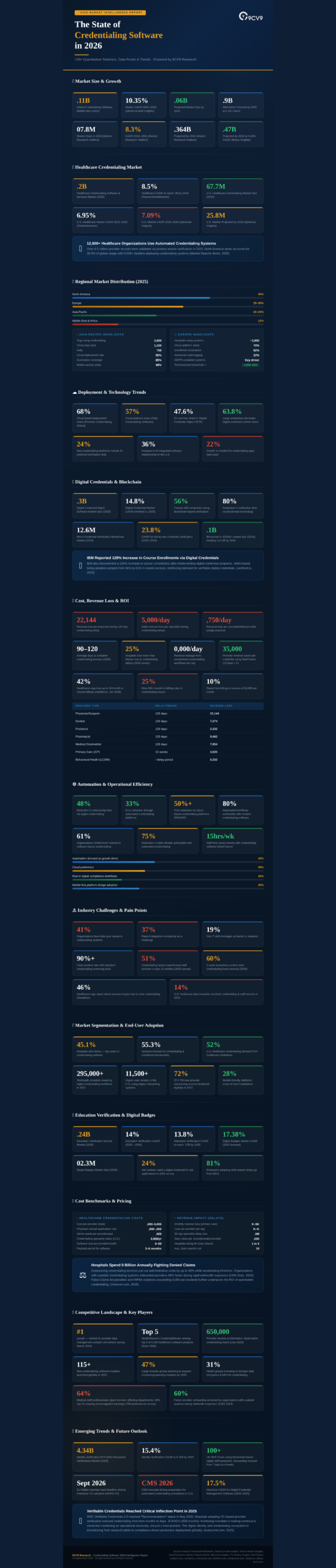
In this comprehensive guide, we examine the top 110 credentialing software statistics, data points, and trends shaping the industry in 2026. From market size forecasts and healthcare adoption rates to AI innovation, blockchain verification, revenue impact, automation benefits, cloud deployment trends, and emerging digital credential ecosystems, these statistics provide a detailed picture of one of the most important and rapidly evolving sectors in enterprise software today.
Before we venture further into this article, we would like to share who we are and what we do.
About 9cv9
9cv9 is a business tech startup based in Singapore and Asia, with a strong presence all over the world.
With over nine years of startup and business experience, and being highly involved in connecting with thousands of companies and startups, the 9cv9 team has listed some important learning points in this overview of the Top 110 Credentialing Software Statistics, Data & Trends in 2026.
If you like to get your company listed in our top B2B software reviews, check out our world-class 9cv9 Media and PR service and pricing plans here.
Top 110 Credentialing Software Statistics, Data & Trends in 2026
🏦 MARKET SIZE & GROWTH
1. $2.11 Billion — Global Credentialing Software Market Size in 2025.
The credentialing software sector has crossed the $2 billion threshold as of 2025, signaling a mature yet rapidly evolving industry increasingly driven by healthcare digitization, AI integration, and regulatory mandates.
2. 10.35% CAGR (2025–2033) — Projected growth rate of the global credentialing software market.
A sustained double-digit growth trajectory reflects the structural tailwinds behind credentialing automation, including regulatory pressure, workforce complexity, and the accelerating shift from paper-based processes.
3. $5.06 Billion — Projected global credentialing software market by 2033.
The market is set to more than double in size within a decade, driven by demand across healthcare, education, and professional services sectors seeking scalable compliance solutions.
4. $4.9 Billion — Alternative forecast by 2031 at a 9.1% CAGR (ResearchAndMarkets).
Multiple independent analysts converge on a high-confidence growth projection, reinforcing the investment case for enterprise credentialing platforms entering the next market cycle.
5. $807.8 Million — Market value in 2023 (Market Research Intellect).
The credentialing software market more than doubled from 2023 to 2025, making it one of the fastest-growing subsectors within healthcare IT and compliance technology.
6. 8.3% CAGR (2024–2031) — Growth rate per Market Research Intellect.
Steady compound growth over the forecast period reflects recurring revenue dynamics and the sticky, compliance-driven nature of credentialing software contracts.
7. $1.364 Billion — Market size forecast for 2031 per Market Research Intellect.
Even the most conservative analysts project the credentialing software market to nearly double from current levels, underscoring the durability of this sector’s growth story.
8. $6.47 Billion — Projected by 2032 at 9.43% CAGR (The Brainy Insights).
Brainy Insights forecasts the market will hit $6.47 billion by 2032, driven by rising institutional demand for robust verification technologies across healthcare, education, and finance.
9. $2.63 Billion — Global credentialing software market value in 2022 (The Brainy Insights).
The historical baseline value demonstrates a compounding growth pattern that accelerated post-pandemic, especially as telehealth and hybrid work models increased credentialing complexity.
10. $1.85 Billion — Market size in 2024 (Global Growth Insights).
The 2024 figure establishes the most recent annual baseline, anchoring forecasts that project robust expansion over the remainder of the decade.
🏥 HEALTHCARE CREDENTIALING MARKET
11. $1.2 Billion — Healthcare Credentialing Software & Services Market in 2025 (ResearchAndMarkets).
The healthcare sub-market commands the largest single-sector share of credentialing software, reflecting the complexity of provider networks and the life-or-death stakes of healthcare compliance.
12. 8.5% CAGR — Healthcare market growth rate to reach $2.5 billion by 2034.
Healthcare credentialing is set to sustain above-average growth as payer-provider networks grow more complex and telehealth expands into new state jurisdictions requiring fresh credentialing cycles.
13. $267.72 Million — U.S. Healthcare Credentialing Software & Services Market size in 2024.
The U.S. market alone accounts for a material portion of the global healthcare credentialing sector, reflecting the country’s fragmented, regulation-intensive healthcare system.
14. 6.95% CAGR (2025–2033) — U.S. healthcare credentialing market growth rate (GlobeNewswire, Nov 2025).
Regulatory mandates from bodies like NCQA, The Joint Commission, and CMS are direct catalysts for this growth, ensuring predictable long-term demand for credentialing software in U.S. healthcare.
15. 7.09% CAGR (2025–2035) — Alternative U.S. forecast (Spherical Insights).
Multiple research firms confirm mid-single-digit to high-single-digit growth for the U.S. healthcare market, with drivers including AI adoption, network complexity, and telehealth expansion.
16. $625.78 Million — U.S. Healthcare Credentialing Market projected by 2035 (Spherical Insights).
The U.S. market will more than double from its 2024 level to $625 million by 2035, rewarding early movers in the automated credentialing space with significant recurring revenue opportunities.
17. 12,600+ — Healthcare organizations using automated credentialing systems globally as of 2023.
Widespread adoption across hospitals, clinics, and payer networks globally reflects the universal pressure to automate what was once a labor-intensive, error-prone paper-based process.
18. 8.5 Million+ — Provider records validated via primary source verification in 2023.
The sheer volume of records requiring validation annually makes manual credentialing economically unviable, justifying the business case for automated systems even at smaller healthcare organizations.
19. 5,000+ — Healthcare facilities in North America deploying credentialing systems as of 2023.
North American adoption leads globally, supported by mature regulatory frameworks and a high density of accreditation-seeking healthcare organizations requiring continuous compliance monitoring.
20. 72% — Share of 4.7 million new provider onboarding records facilitated digitally in 2023.
The majority of new provider onboarding is now handled through digital credentialing platforms, a tipping point that validates the mainstreaming of software-driven provider verification workflows.
🌍 REGIONAL DISTRIBUTION
21. 36% — North America’s share of global credentialing software market (2025).
North America dominates the global market, fueled by complex insurance networks, strict NCQA and Joint Commission standards, and high technology adoption among healthcare systems.
22. 29–30% — Europe’s share of global credentialing software deployment.
European adoption is underpinned by GDPR compliance requirements and cross-border healthcare workforce mobility, creating distinct demand for credentialing systems that align with EU regulations.
23. 20–23% — Asia-Pacific’s share of the global market.
Asia-Pacific is the fastest-growing region, with China, India, Japan, and Australia driving adoption, often in conjunction with national health ID systems and cloud-first deployment models.
24. 12% — Middle East & Africa’s market share.
While currently the smallest region, the Middle East & Africa market is gaining momentum through healthcare modernization programs, government digital health mandates, and increasing foreign investment in health infrastructure.
25. 2,600 — Healthcare organizations in Asia-Pacific using credentialing software.
Led by China with 1,100 users and India with 700, the Asia-Pacific market is scaling rapidly as governments formalize provider verification standards across national healthcare systems.
26. 3,800 — Hospitals and clinics using credentialing systems in Europe in 2023.
European healthcare organizations are rapidly deploying credentialing platforms that combine GDPR-compliant data management with regulatory reporting, reflecting the continent’s dual focus on privacy and compliance.
27. 55% — Cloud deployment rate for credentialing in Asia-Pacific.
The rapid rise of cloud adoption in Asia-Pacific markets signals a leapfrog effect, with newer adopters bypassing legacy on-premise infrastructure in favor of scalable SaaS credentialing solutions.
28. 48% — Mobile access share of credentialing activities in Asia-Pacific.
Mobile-first credentialing tools are gaining ground across Asia-Pacific, reflecting the region’s mobile-centric workforce habits and the growing need for remote primary source verification capabilities.
29. 70% — Cloud platform share of credentialing systems in Europe.
European healthcare organizations are embracing cloud-based credentialing at a higher rate than the global average, driven by the need for interoperability across member states and GDPR compliance features.
30. 22% — European systems that include advanced audit logging for regulatory reporting.
Audit-ready credentialing tools are becoming a compliance differentiator in Europe, particularly as healthcare regulators tighten requirements around provider record-keeping and verification trails.
☁️ DEPLOYMENT & TECHNOLOGY
31. 68% — Global share of cloud-based provider credentialing deployment.
Cloud-based platforms dominate the healthcare credentialing deployment landscape, offering advantages in scalability, automatic updates, and remote accessibility that legacy on-premise systems cannot match.
32. 57% — Total credentialing software market adopting cloud platforms (2025).
More than half of all credentialing software deployments globally are now cloud-based, a structural shift that reduces total cost of ownership and enables faster response to regulatory changes.
33. 47.6% — On-premise share in Digital Credential Management Software market (2025).
Despite cloud’s rise, on-premise solutions retain nearly half the digital credential management market, particularly among enterprises in finance, healthcare, and government requiring maximum data sovereignty and control.
34. 63.8% — Share of large enterprises in the digital credential management software market.
Large organizations dominate digital credential management adoption, driven by the scale and complexity of credential management needs across multinational employee, partner, and customer networks.
35. 24% — New credentialing platforms incorporating AI-powered verification bots.
AI-powered verification is transitioning from a premium feature to an expected standard, enabling platforms to simultaneously scan multiple licensing boards, automate background checks, and flag discrepancies in real time.
36. 36% — Increase in AI-integrated software deployments in the U.S. credentialing market.
The U.S. leads the global charge in AI-driven credentialing deployments, with healthcare organizations investing heavily in tools that reduce human error and automate continuous sanctions monitoring.
37. 22% — Growth in mobile-first credentialing apps over the past year.
Mobile-first credentialing is emerging as a key differentiator, particularly for organizations managing traveling or locum tenens clinicians who need real-time, on-the-go credential verification.
38. 17.5% — Historical CAGR of Digital Credential Management Software from 2020 to 2025.
Five consecutive years of near-20% annual growth establishes digital credential management as one of the most dynamic segments within the broader identity and compliance technology landscape.
39. 115+ — New credentialing software modules launched globally in 2023.
The pace of product innovation in credentialing software accelerated dramatically in 2023, as vendors competed to add AI verification, telehealth-specific workflows, and mobile enrollment capabilities.
40. 28% — Share of new installations represented by mobile-friendly credentialing platforms in the U.S.
Mobile adoption in U.S. credentialing is growing rapidly, particularly among clinics and corporate HR systems seeking to reduce friction in provider onboarding and license renewal workflows.
🔐 DIGITAL CREDENTIALS & BLOCKCHAIN
41. $6.3 Billion — Global Digital Credential Management Software market size (2025, verifyed.io citing market research).
The digital credential management market has reached a scale that signals mainstream enterprise adoption, with applications spanning education, healthcare, HR, and government identity verification.
42. 14.8% CAGR — Global digital credential market growth rate.
A robust compound annual growth rate confirms sustained investment in digital credentialing infrastructure across all major economic sectors, driven by the collapse of manual verification processes.
43. 56% — Fortune 500 companies using blockchain-based credential verification.
More than half of America’s largest corporations have adopted blockchain-based verification, reflecting the growing enterprise recognition that tamper-proof, instantly verifiable credentials reduce fraud and speed up hiring.
44. 80% — Reduction in credential verification time achieved via blockchain technology.
Blockchain’s ability to provide cryptographically-secured, near-instant verification represents a generational improvement over paper-based or manual verification processes that routinely take days or weeks.
45. $412.6 Million — Global Micro-Credential Verification Blockchain Market size in 2024.
The blockchain micro-credential market is scaling rapidly as universities, professional bodies, and employers demand tamper-proof, granular proof of skills that can be verified across borders and platforms.
46. 23.8% CAGR (2025–2033) — Growth rate for blockchain-based credential verification market.
Blockchain credentialing is one of the fastest-growing sub-segments in identity technology, with governments, universities, and enterprises converging on decentralized verification as a global standard.
47. $2.1 Billion — Blockchain in EdTech market size in 2024.
The education technology sector is emerging as a major early adopter of blockchain credentialing, seeking to combat diploma fraud, enable global credential portability, and streamline graduate hiring.
48. 30.4% CAGR (2025–2034) — Blockchain in EdTech market growth rate, projected to reach $30.3 billion by 2034.
The explosive growth trajectory of blockchain in educational technology reflects the global urgency to replace paper diplomas with tamper-proof, instantly verifiable digital credentials.
49. 19% — Increase in permissioned blockchain deployment in regulated sectors due to EU/APAC data privacy mandates.
Permissioned blockchain solutions, which offer enterprise-grade privacy controls, are gaining ground in sectors like healthcare and finance where public blockchain transparency conflicts with regulatory requirements.
50. $14.34 Billion — Global Identity Verification market size (KYC, AML, Document Verification) in 2025 (everycred.com).
The identity verification ecosystem underpinning credentialing systems has reached a scale that reflects the central economic importance of trust infrastructure in digital-first economies.
51. 15.4% CAGR — Identity Verification market growth rate to reach $29.32 billion by 2030.
Sustained high-growth dynamics in identity verification are driven by regulatory mandates, cybersecurity investments, and the ongoing digitization of government and enterprise identity management systems.
52. 129% — Increase in course enrollments IBM reported after implementing digital credential programs.
IBM’s data offers compelling evidence that digital credentialing drives measurable engagement improvements, making it both a compliance tool and a strategic lever for organizational learning outcomes.
53. 226% — Increase in course completions IBM documented via digital credential programs.
The dramatic jump in completion rates associated with digital credentials suggests that micro-credential programs create strong behavioral incentives that traditional certification programs lack.
54. 81% — Employer adoption of skills-based hiring (up from 56% in prior survey).
The rapid rise of skills-based hiring is directly fueling demand for granular, verified digital credentials that demonstrate specific competencies rather than broad academic qualifications.
💸 COST, REVENUE LOSS & ROI
55. $122,144 — Revenue lost by a physician/surgeon during a 120-day credentialing delay.
The six-figure revenue loss per physician during a credentialing delay makes the business case for automated credentialing unambiguous: even mid-range software investment pays back within weeks of faster onboarding.
56. $87,274 — Revenue lost per dentist during a 120-day credentialing delay.
Dental practices face the same structural revenue risk as hospital systems, making credentialing software adoption a strategic financial priority for even small multi-dentist practices.
57. $72,332 — Revenue lost per podiatrist during a 120-day credentialing delay.
Podiatry practices are particularly exposed to credentialing delay losses given the high volume of routine appointments that cannot be billed until payer enrollment is complete.
58. $83,520 — Revenue lost by a primary care physician during a 12-week credentialing delay.
The 12-week window represents the realistic minimum timeline for many credentialing processes, making even “quick” onboarding scenarios costly enough to justify software investment.
59. $20,332 — Revenue lost per behavioral health provider (LCSW) during credentialing delays.
While lower in absolute terms, revenue losses for behavioral health providers represent a disproportionate share of practice revenue given lower average billing rates, making timely credentialing critical for viability.
60. $15,000/day — Daily revenue loss per specialist during credentialing delays.
High-earning specialists represent the sharpest edge of the credentialing delay problem, with daily revenue losses that make even a two-week delay equivalent to a mid-range software subscription’s annual cost.
61. $2,750/day — Revenue leakage per uncredentialed provider at the practice level.
Even at the practice level, the daily cost of an uncredentialed provider represents a significant financial drain, particularly for smaller practices where each provider’s productivity is essential to operational sustainability.
62. $10,000/day — Revenue leakage from unoptimized credentialing workflows per organization (2025 industry research).
Organizations operating with manual or partially automated credentialing workflows leak approximately $10,000 daily in deferred or lost revenue, a figure that dwarfs the cost of any commercially available credentialing platform.
63. 25% (1 in 4) — Healthcare organizations losing more than $1 million annually due to credentialing delays (2026 industry report).
One in four healthcare organizations is experiencing million-dollar revenue losses annually from credentialing delays alone, establishing this as a board-level financial risk rather than an administrative inconvenience.
64. 42% — Healthcare organizations losing up to $50,000/month in missed billings from credentialing delays (Intelliworx survey, Jan 2026).
Nearly half of U.S. healthcare organizations are experiencing five-figure monthly revenue losses attributable to credentialing inefficiencies, a finding that validates widespread underinvestment in this critical process.
65. 25% — Healthcare organizations losing $100,000+/month in missed billings.
The quarter of organizations experiencing six-figure monthly losses from credentialing delays represent the clearest candidates for immediate automation investment, with ROI achievable within a single billing cycle.
66. $135,000 — Provider revenue saved per credential using MedTrainer (15 days × $9,000/day saved).
MedTrainer customers report saving 15 working days per provider credentialed, translating to $135,000 in recoverable revenue per provider — a return that makes the software cost negligible by comparison.
67. $1,000–$5,000 — Revenue lost per provider per day while payer enrollment remains incomplete.
The daily cost of incomplete credentialing varies by specialty but consistently falls within a range that makes automation investments justifiable across all provider types and practice sizes.
68. $90,000–$450,000 — Unrecoverable revenue over a standard 90-day delay per provider.
The permanently unrecoverable nature of much of this revenue — due to payer timely filing limits — magnifies the true cost of credentialing delays beyond simple deferred income calculations.
69. $20 Billion — Amount hospitals collectively spend annually fighting denied claims.
Credential-related claim denials are a major component of this staggering administrative cost burden, reinforcing the strategic value of upfront automated credentialing in preventing downstream revenue cycle failures.
70. $118 — Average cost to rework a single denied claim.
At $118 per reworked claim, the cumulative cost of credential-related denials can rapidly exceed the total annual investment in a credentialing automation platform.
⚙️ AUTOMATION & OPERATIONAL EFFICIENCY
71. 48% — Reduction in provider onboarding time achieved via digital credentialing.
Nearly halving the onboarding timeline represents a transformative operational improvement that accelerates revenue generation, improves provider experience, and reduces administrative staffing costs.
72. 33% — Error reduction achieved through automated credentialing platforms.
Eliminating a third of credentialing errors through automation directly reduces compliance violations, claim denials, and the legal liability associated with unqualified providers accessing patient care too early.
73. 50%+ — Time reduction achievable via cloud-based credentialing platforms with RPA/API integration.
Robotic process automation and API-driven primary source verification are collapsing verification timelines from weeks to hours, fundamentally changing the economics of provider onboarding.
74. 80% — Share of workflows that can be automated with modern credentialing software.
While true “no-touch” credentialing remains elusive, automating 80% of workflows frees credentialing teams to focus exclusively on exceptions, escalations, and the nuanced judgment calls that require human expertise.
75. 61% — Organizations that have shifted from manual to software-based credentialing.
A clear majority of healthcare organizations have made the transition from paper-based processes to digital platforms, though a significant minority still rely on legacy manual workflows that represent immediate automation targets.
76. 75% — Reduction in claim denials achievable with fully automated credentialing (SpryPT).
Cutting claim denials by three-quarters through credentialing automation is a compelling financial outcome that speaks directly to CFOs and revenue cycle leaders evaluating software investment decisions.
77. 15 hours/week — Staff time saved per week by organizations using MedTrainer credentialing software.
Fifteen hours of weekly staff time savings per organization translates to significant annual labor cost reductions, allowing credentialing teams to manage larger provider networks without proportional headcount increases.
78. 43% — Automation demand cited as a key growth driver for the credentialing software market.
The market’s primary growth driver is the universal desire to eliminate manual credentialing bottlenecks, signaling that vendors who fail to deliver genuine automation will struggle to maintain competitive positioning.
79. 38% — Cloud preference cited as a key growth driver.
The strong preference for cloud-based credentialing solutions reflects organizations’ desire for lower IT overhead, automatic compliance updates, and the ability to support remote credentialing teams.
80. 60% — Faster provider onboarding achieved by organizations with scalable credentialing systems during telehealth expansion (CMS data, 2023).
The 60% onboarding speed advantage held by organizations with scalable systems during the telehealth surge created measurable competitive differentiation in provider recruitment and revenue ramp-up.
⚠️ CHALLENGES & PAIN POINTS
81. 41% — Organizations experiencing data synchronization issues in credentialing systems.
Data sync failures remain the top technical challenge in credentialing software, often resulting from fragmented data sources across EHR, HRIS, and payer systems that have not been properly integrated.
82. 37% — Organizations citing integration complexity as a major challenge.
The difficulty of integrating modern credentialing platforms with legacy systems is a persistent barrier to full automation, underscoring the need for open API architectures and dedicated implementation support.
83. 19% — Organizations citing IT skill shortages as a barrier to credentialing software adoption.
The skills gap in healthcare IT creates a secondary market for managed credentialing services, as organizations without adequate internal IT resources increasingly outsource the technical complexity of deployment.
84. 90%+ — False positive rate with standard credentialing screening tools.
The overwhelming false positive rate in standard screening tools forces credentialing staff to spend the majority of their time investigating records that are not real matches, a massive drain on team productivity.
85. 51% — Credentialing teams that experienced staff turnover in the past 12 months (2025 industry survey of 500+ organizations).
Staff turnover in credentialing teams creates compounding operational risk, as departing specialists take with them payer-specific institutional knowledge that is rarely documented in any software system.
86. 60% — C-suite executives who confirm that slow credentialing processes are directly hurting revenue (2025 survey).
Credentialing is finally receiving board-level attention as a revenue risk, driven by growing awareness of the seven-figure revenue losses organizations absorb from delayed provider enrollment.
87. 64% — Medical staff professionals reporting that turnover is affecting their departments.
A supermajority of credentialing departments are feeling the operational impact of staff turnover, with 30% describing the situation as causing unmanageable backlogs in day-to-day operations.
88. 46% — Healthcare organizations that report direct revenue impacts due to slow credentialing workflows (Medallion survey).
Nearly half of all healthcare organizations have directly experienced revenue losses attributable to credentialing inefficiency, a finding that dramatically elevates the strategic priority of credentialing optimization.
89. 14% — U.S. healthcare data breaches in 2023 that involved credentialing and staff records.
Credentialing data represents a significant cybersecurity exposure surface, containing sensitive provider information that is attractive to bad actors and must be protected with bank-grade security protocols.
90. 31% — Healthcare organizations investing in stronger data encryption, MFA, and redundant backups for credentialing platforms.
Security investment in credentialing infrastructure is growing as organizations recognize that credential data breaches carry both regulatory and reputational consequences that far exceed the cost of preventive controls.
💰 COST BENCHMARKS
91. $5,000–$15,000 — Total cost to credential a single provider including labor, fees, and revenue lost during enrollment gap.
The full-cost accounting of manual credentialing, including hidden revenue losses, makes the cost-benefit analysis for credentialing software decisively favorable for any organization onboarding more than a handful of providers annually.
92. $2,000–$3,000 — Amount physicians spend annually submitting credentialing applications to payers (MedTrainer/GlobeNewswire).
The direct out-of-pocket cost of credentialing falls on physicians as well as organizations, creating a shared financial incentive for more efficient, software-assisted application processes.
93. $7,500/provider/year — Administrative waste from inefficient credentialing, excluding delayed billing (Assured Healthcare).
Even when ignoring the revenue impact of delays, the pure administrative waste of inefficient credentialing justifies automation investment at an organizational level for any network with more than a handful of active providers.
94. $43,558/year — Average salary of a medical staff credentialing specialist in the U.S. in 2023 (GlobeNewswire).
Understanding the labor cost baseline for credentialing teams helps organizations calculate the workforce efficiency gains that automated platforms deliver through reduced manual verification workloads.
95. $50–$200/provider/month — Typical range for healthcare credentialing software pricing.
The relatively modest per-provider monthly cost of credentialing software, compared to daily revenue loss during delays, makes the ROI calculation straightforward for any healthcare organization regardless of size.
96. 3–6 months — Typical software payback period for credentialing platforms (SpryPT).
A three-to-six-month payback period for credentialing software investments places it among the highest-ROI enterprise software categories in healthcare, comparable to revenue cycle management and scheduling systems.
97. $8,000–$15,000/month — Average monthly revenue loss per uncredentialed provider (primary care practice).
The monthly revenue exposure per uncredentialed provider in primary care is large enough to fund a multi-year credentialing software subscription, making inaction the most expensive possible choice.
98. 40% — Administrative cost reduction achievable by outsourcing to professional credentialing services.
Outsourcing or co-sourcing credentialing to specialized providers reduces costs while accelerating timelines and introducing payer-specific expertise that in-house teams may lack.
🎓 EDUCATION VERIFICATION
99. $1.24 Billion — Education Verification Service Market size in 2025 (ResearchAndMarkets).
The education verification segment has emerged as a billion-dollar market in its own right, reflecting the global need to combat academic fraud and support international workforce mobility through reliable credential validation.
100. 14% CAGR (2025–2026) — Education verification market growth rate.
Double-digit annual growth in education verification reflects the rapid global expansion of cross-border hiring and the growing corporate shift toward skills-based employment requiring verified educational credentials.
101. $2.37 Billion — Education verification market projected size by 2030.
The education verification market is set to nearly double by 2030, driven by AI-based verification tools, real-time verification services, and the international expansion of credential fraud detection systems.
102. $202.3 Million — Digital Badges Market size in 2025.
Digital badges are transitioning from a novelty to a mainstream credentialing mechanism, with educational institutions and professional bodies issuing millions of verifiable micro-credentials annually.
103. 17.38% CAGR — Digital Badges Market growth rate.
Among the highest-growth niches in credentialing technology, digital badges benefit from the concurrent trends of online learning expansion, skills-based hiring, and blockchain verification adoption.
104. 24% — Job seekers who used a digital credential at least once for a job application process (Morning Consult, 2025).
Nearly a quarter of job seekers are already leveraging digital credentials in their applications, a figure that will increase sharply as employer verification platforms integrate digital credential reading capabilities.
🌐 EMERGING TRENDS
105. September 2026 — EU Wallet hard deadline driving enterprise adoption of verifiable credentials (eIDAS 2.0).
The EU Wallet mandate represents a regulatory forcing function that will standardize digital credential formats across European government and enterprise systems, creating interoperability at continental scale.
106. May 2025 — Month W3C Verifiable Credentials 2.0 reached “Recommendation” status, legitimizing the ecosystem.
The W3C VC 2.0 standard provides the technical foundation for global credential interoperability, enabling any issuer and verifier to exchange credentials using a common, open standard.
107. 100+ UK NHS Trusts — Using blockchain-based digital staff passports for healthcare worker verification.
The NHS digital staff passport deployment reduced temporary healthcare staff onboarding from 7 days to minutes, proving that verifiable credential technology delivers dramatic real-world efficiency gains in high-volume healthcare environments.
108. 7 days to minutes — Reduction in temporary healthcare staff onboarding time via NHS Digital Staff Passport.
The transformation from day-scale to minute-scale onboarding represents a qualitative shift in workforce agility, enabling healthcare systems to respond to staffing shortages with unprecedented speed and compliance confidence.
109. 47% — Large hospital groups planning to expand monitoring and reporting modules by 2025 to pass payer audits faster.
Proactive investment in compliance monitoring reflects a strategic shift toward treating credentialing as a revenue assurance function rather than a reactive administrative task.
110. $9,000/day — Estimated daily provider revenue value while credentialing is pending (MedTrainer).
This benchmark figure, used to calculate credentialing software ROI, underscores the premium on speed in the credentialing process and the revenue implications of every day saved.
Conclusion
The credentialing software industry stands at the forefront of one of the most significant transformations in compliance, workforce verification, healthcare administration, and digital identity management. As the 110 statistics and trends highlighted throughout this report demonstrate, credentialing has evolved far beyond a routine administrative process. In 2026, it has become a strategic business function that directly influences revenue growth, operational efficiency, regulatory compliance, provider onboarding, workforce mobility, and organizational trust.
The market’s impressive expansion reflects the growing recognition that manual credentialing processes are no longer sustainable in an increasingly digital and highly regulated environment. With the global credentialing software market projected to grow from just over $2 billion today to more than $5 billion by the early 2030s, organizations across healthcare, education, government, finance, and professional services are making substantial investments in modern credentialing platforms. These investments are not simply about improving administrative workflows—they are about building scalable systems capable of supporting long-term growth, reducing risk, and maintaining competitive advantage.
Healthcare remains the largest and most influential driver of credentialing software adoption. The industry’s reliance on accurate provider verification, payer enrollment, licensing compliance, and ongoing monitoring creates a continuous demand for sophisticated credentialing solutions. The statistics reveal that delayed credentialing can result in significant financial losses, ranging from thousands of dollars per day to millions annually for larger healthcare organizations. As healthcare systems continue to face staffing shortages, increasing regulatory oversight, and expanding telehealth services, automated credentialing platforms have become essential tools for protecting revenue and accelerating provider productivity.
One of the clearest themes emerging from the data is the growing importance of automation. Organizations that continue to rely on manual credentialing processes face increasing challenges related to staff shortages, human error, workflow bottlenecks, and compliance risks. By contrast, organizations implementing automated credentialing systems are achieving faster onboarding times, lower administrative costs, reduced claim denials, and improved operational efficiency. The ability to automate up to 80% of credentialing workflows represents a fundamental shift in how organizations manage compliance and workforce verification activities.
Artificial intelligence is expected to accelerate this transformation even further. AI-powered verification tools are already helping organizations automate primary source verification, monitor sanctions databases, identify discrepancies, and streamline complex approval processes. As AI capabilities continue to mature, credentialing platforms will become increasingly intelligent, proactive, and predictive. Rather than simply managing credential records, future systems will help organizations anticipate compliance risks, identify credential gaps, and optimize workforce planning decisions before problems arise.
Cloud computing is another defining force shaping the future of credentialing software. The rapid migration toward cloud-based platforms reflects organizations’ growing demand for scalability, flexibility, accessibility, and lower infrastructure costs. Cloud credentialing solutions enable distributed teams to collaborate more effectively while ensuring that critical compliance data remains accessible, secure, and continuously updated. As digital transformation initiatives continue across industries, cloud-based credentialing is likely to become the standard deployment model worldwide.
The emergence of blockchain and verifiable credential technologies represents one of the most exciting long-term developments in the market. Digital credentials secured through blockchain technology offer unprecedented levels of security, portability, transparency, and fraud prevention. Universities, employers, professional associations, and government agencies are increasingly exploring decentralized verification frameworks that allow credentials to be verified instantly and globally. As standards such as W3C Verifiable Credentials 2.0 gain wider adoption and regulatory initiatives like the European Union Digital Identity Wallet move forward, digital credential ecosystems are expected to expand dramatically.
Another major trend reshaping the market is the rise of skills-based hiring. Employers are placing greater emphasis on verified competencies, certifications, digital badges, and micro-credentials rather than relying exclusively on traditional educational qualifications. This shift is creating new opportunities for credentialing software providers to support workforce development, talent verification, and lifelong learning initiatives. The growing adoption of digital credentials by both employers and job seekers signals a broader transformation in how professional qualifications are earned, managed, and verified.
Regional trends also point toward a highly promising future for the industry. While North America remains the largest market due to its complex healthcare ecosystem and mature regulatory environment, Europe and Asia-Pacific are experiencing rapid growth driven by digital transformation initiatives, workforce mobility, healthcare modernization, and evolving compliance requirements. Emerging markets across the Middle East, Africa, and Latin America are also increasing investments in credentialing technologies as governments and organizations prioritize digital infrastructure and workforce verification capabilities.
Cybersecurity will remain a critical area of focus moving forward. Credentialing platforms contain highly sensitive information, including licenses, certifications, educational records, personal identification data, and employment histories. As cyber threats continue to evolve, organizations will increasingly prioritize platforms that offer advanced encryption, multi-factor authentication, comprehensive audit trails, and robust data protection capabilities. Vendors that successfully combine security, compliance, automation, and user experience will be best positioned to capture market share in the coming years.
Perhaps the most important takeaway from these statistics is that credentialing is no longer merely a compliance exercise—it is becoming a strategic business asset. Organizations that embrace modern credentialing technologies gain measurable advantages in speed, efficiency, revenue protection, workforce management, and regulatory readiness. Those that delay modernization risk falling behind competitors while continuing to absorb unnecessary operational costs and compliance risks.
As we move deeper into the digital economy, trust will become an increasingly valuable currency. Credentialing software serves as the foundation upon which that trust is built, enabling organizations to verify identities, validate qualifications, ensure compliance, and create secure pathways for workforce participation. Whether through AI-powered automation, blockchain-based verification, cloud-native infrastructure, or digital credential ecosystems, the future of credentialing is becoming faster, smarter, more secure, and more interconnected.
The 110 credentialing software statistics, data points, and trends presented in this report provide a comprehensive snapshot of an industry undergoing rapid innovation and expansion. For healthcare executives, compliance leaders, HR professionals, educators, technology vendors, investors, and policymakers, these insights offer a valuable roadmap for understanding where the market stands today—and where it is heading next. As credentialing technology continues to evolve, organizations that invest in modern verification and compliance solutions will be best positioned to thrive in an increasingly digital, regulated, and trust-driven world.
If you find this article useful, why not share it with your hiring manager and C-level suite friends and also leave a nice comment below?
We, at the 9cv9 Research Team, strive to bring the latest and most meaningful data, guides, and statistics to your doorstep.
To get access to top-quality guides, click over to 9cv9 Blog.
To hire top talents using our modern AI-powered recruitment agency, find out more at 9cv9 Modern AI-Powered Recruitment Agency.
People Also Ask
What is credentialing software?
Credentialing software is a digital platform that automates the verification, tracking, and management of professional licenses, certifications, education records, and compliance requirements for healthcare providers, employees, and organizations.
How large is the credentialing software market in 2026?
The credentialing software market is worth more than $2 billion globally and is projected to grow significantly through the next decade as organizations invest in automation and compliance technologies.
Why is credentialing software important in healthcare?
Healthcare organizations use credentialing software to verify provider qualifications, maintain regulatory compliance, reduce onboarding delays, and prevent revenue losses caused by credentialing errors.
What are the main benefits of credentialing software?
Key benefits include faster provider onboarding, reduced administrative workloads, improved compliance management, lower claim denial rates, and enhanced operational efficiency.
How fast is the credentialing software market growing?
Industry forecasts estimate annual growth rates ranging from approximately 8% to over 10%, making credentialing software one of the fastest-growing compliance technology sectors.
What industries use credentialing software?
Healthcare, education, government, financial services, insurance, professional associations, and enterprise HR departments all use credentialing software to verify qualifications and maintain compliance.
What is provider credentialing?
Provider credentialing is the process of verifying healthcare professionals’ licenses, education, certifications, work history, and qualifications before they can provide patient care or join insurance networks.
How does credentialing software reduce onboarding time?
Credentialing software automates verification workflows, tracks requirements, sends reminders, and integrates with data sources, allowing organizations to onboard professionals much faster.
What role does AI play in credentialing software?
AI helps automate license verification, sanctions monitoring, document review, risk detection, and compliance tracking, reducing manual work and improving accuracy.
What percentage of credentialing platforms are cloud-based?
Cloud deployment dominates the industry, with most modern credentialing platforms offering cloud-based infrastructure for scalability, accessibility, and lower maintenance costs.
Why are healthcare organizations investing in credentialing automation?
Automation helps reduce administrative costs, improve compliance, accelerate provider enrollment, and prevent significant revenue losses caused by credentialing delays.
How much revenue can be lost due to credentialing delays?
Credentialing delays can cost healthcare organizations thousands of dollars per provider per day and may result in substantial annual revenue losses.
What is primary source verification?
Primary source verification is the process of validating credentials directly with issuing authorities, such as licensing boards, universities, and certification organizations.
What are digital credentials?
Digital credentials are electronic versions of certifications, licenses, diplomas, or qualifications that can be securely stored, shared, and verified online.
How is blockchain used in credential verification?
Blockchain creates tamper-proof credential records that can be instantly verified, helping reduce fraud and improve trust in educational and professional qualifications.
What are verifiable credentials?
Verifiable credentials are digital credentials that follow standardized formats, allowing organizations to verify qualifications securely and instantly across different systems.
Why is skills-based hiring driving credentialing growth?
Employers increasingly value verified skills and certifications, creating greater demand for platforms that manage and validate digital credentials.
Which region leads the credentialing software market?
North America currently leads the global credentialing software market due to strong healthcare regulations, advanced technology adoption, and complex compliance requirements.
Is credentialing software only for healthcare organizations?
No. Credentialing software is widely used by educational institutions, government agencies, corporations, professional associations, and certification bodies.
What are digital badges?
Digital badges are verified online credentials that demonstrate specific skills, achievements, certifications, or competencies earned by an individual.
How does credentialing software improve compliance?
It tracks credential expiration dates, automates monitoring, maintains audit trails, and ensures organizations meet regulatory requirements consistently.
What is the future of credentialing software?
The future includes greater adoption of AI, blockchain verification, digital identity systems, cloud platforms, and automated compliance monitoring.
How does credentialing software reduce claim denials?
By ensuring providers are properly credentialed and enrolled before delivering services, credentialing software helps prevent billing and reimbursement issues.
What is the ROI of credentialing software?
Many organizations achieve ROI within months through reduced labor costs, faster onboarding, lower compliance risks, and improved revenue capture.
How does cloud-based credentialing software differ from on-premise systems?
Cloud solutions offer easier updates, remote access, lower infrastructure costs, and greater scalability compared to traditional on-premise software.
What cybersecurity features are important in credentialing software?
Organizations should look for encryption, multi-factor authentication, audit logging, access controls, secure backups, and compliance with data protection regulations.
How does credentialing software support telehealth providers?
It helps manage licenses across jurisdictions, automate compliance tracking, and verify provider eligibility for multi-state telehealth operations.
What challenges do credentialing teams face today?
Common challenges include staff shortages, data integration issues, manual processes, compliance complexity, and growing verification workloads.
What is digital credential management software?
Digital credential management software helps organizations issue, store, verify, track, and manage digital credentials throughout their lifecycle.
Why should organizations invest in credentialing software in 2026?
Organizations can improve efficiency, strengthen compliance, accelerate onboarding, reduce costs, support digital transformation, and build greater trust through automated credential management.
Sources
Global Growth Insights ResearchAndMarkets GlobeNewswire Spherical Insights Market Reports World Market Research Intellect The Brainy Insights Future Market Insights The Business Research Company LLCBuddy VerifyEd EveryCred DataIntelo Bayelsawatch MedTrainer Distilinfo Neolytix Intelliworx Survey Medviz AI Ethico Assured Healthcare MBW RCM KLAS Research SpryPT PayerReady