





























Key Takeaways
- The Customer Communications Management (CCM) software market is growing at a double-digit CAGR, driven by AI, cloud adoption, omnichannel engagement, and rising demand for personalised customer experiences.
- Artificial intelligence is transforming CCM platforms through automation, real-time personalisation, faster response times, lower operational costs, and significantly improved customer satisfaction and retention rates.
- Cloud-based CCM solutions, compliance automation, and integrated omnichannel communication strategies are becoming essential for enterprises seeking competitive advantage, scalability, and regulatory compliance in 2026 and beyond.
Customer Communications Management (CCM) software helps organisations create, personalise, manage, and deliver customer communications across email, SMS, mobile apps, chat, print, and digital channels. In 2026, businesses increasingly adopt CCM platforms to improve customer experience, automate communications, strengthen compliance, and drive higher engagement through AI-powered omnichannel interactions.
Customer Communications Management (CCM) software has evolved from a specialised document-generation solution into one of the most strategically important technologies within the modern customer experience ecosystem. In 2026, organisations are no longer competing solely on products, pricing, or service quality. They are competing on communication. Every bill, policy document, account statement, marketing message, onboarding email, SMS notification, chatbot interaction, customer service response, and personalised recommendation shapes how customers perceive a brand. As customer expectations continue to rise, enterprises are increasingly investing in Customer Communications Management platforms to deliver seamless, personalised, compliant, and omnichannel experiences at scale.
Also, read our list of the Top 11 Customer Communications Management Software.

The numbers tell a compelling story. The global Customer Communications Management market is experiencing sustained double-digit growth across virtually every major analyst forecast. Depending on the scope and methodology used, the market is projected to reach anywhere between approximately $2 billion and nearly $6 billion in 2026, with long-term forecasts indicating expansion toward $8 billion, $11 billion, and even $12 billion-plus over the next decade. Most industry analysts consistently project annual growth rates between 10% and 14%, making CCM one of the fastest-growing categories within enterprise software. This growth is being fuelled by digital transformation initiatives, rising demand for personalised customer engagement, expanding regulatory requirements, and the widespread adoption of artificial intelligence technologies.
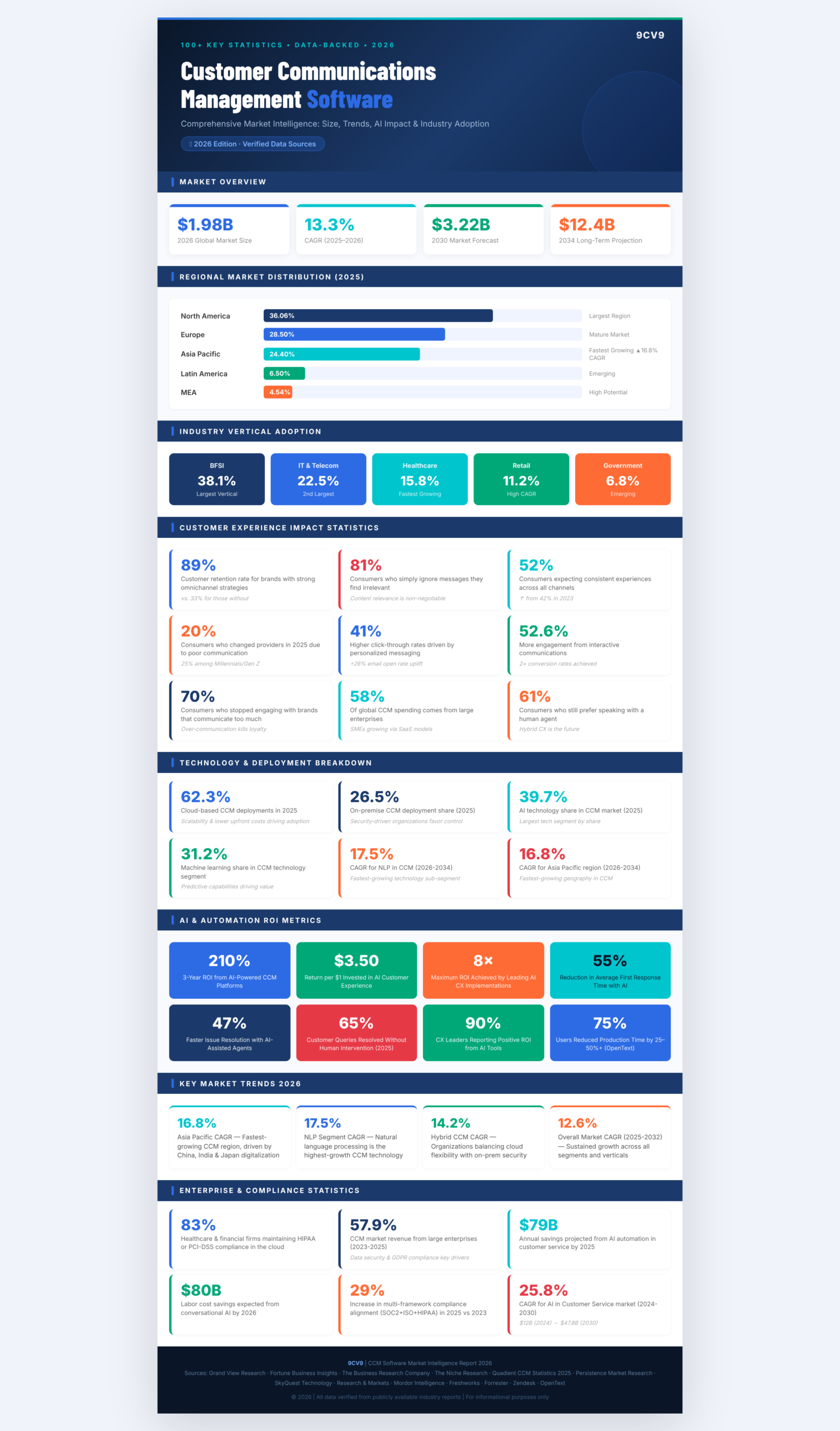
At the heart of this expansion is a fundamental shift in how organisations interact with customers. Consumers increasingly expect communications to be timely, relevant, personalised, and available across multiple channels. Research shows that more than half of customers now expect consistent experiences across every touchpoint they engage with. Meanwhile, over 80% of consumers ignore communications they consider irrelevant, and nearly one in five customers have switched providers because of poor communication experiences. These trends highlight a new reality for businesses: communication quality is no longer a support function—it has become a direct driver of customer retention, loyalty, revenue growth, and competitive differentiation.
The rise of omnichannel engagement has accelerated this transformation. Today’s customer journey rarely occurs within a single channel. Consumers move fluidly between email, websites, mobile applications, live chat, SMS, social media, digital documents, and voice interactions. Studies indicate that nearly three-quarters of consumers use multiple channels during a single customer service interaction. Yet only a small percentage of organisations successfully maintain customer context across these channels. This disconnect creates friction, frustration, and missed opportunities. Modern CCM platforms solve this challenge by enabling unified customer communication strategies that preserve context, personalise messaging, and coordinate interactions across every customer touchpoint.
Artificial intelligence has become one of the most significant catalysts driving the next phase of CCM innovation. AI-powered communication platforms are transforming how organisations create, manage, optimise, and deliver customer interactions. From real-time personalisation and predictive messaging to automated content generation and conversational AI, intelligent communication technologies are helping enterprises achieve unprecedented efficiency and customer satisfaction improvements. Industry research indicates that AI-enabled CCM initiatives can generate returns exceeding 200% over three years, while dramatically reducing response times, increasing agent productivity, and lowering operational costs. Many organisations now report that AI resolves a majority of incoming customer inquiries without human intervention, signalling a major shift in the economics of customer engagement.
Cloud adoption is further accelerating market growth. Cloud-based CCM deployments now dominate the industry, accounting for the majority of implementations worldwide. Businesses are increasingly favouring cloud-native platforms due to their scalability, flexibility, lower upfront investment requirements, and ability to support global communication operations. At the same time, hybrid deployment models continue gaining momentum among large enterprises seeking to balance security, compliance, and operational agility. This shift toward cloud and hybrid architectures is enabling organisations of all sizes to access advanced communication capabilities that were once available only to the largest enterprises.
The demand for Customer Communications Management solutions is especially strong within highly regulated industries. Banking, financial services, insurance, healthcare, telecommunications, government, and utilities remain among the largest adopters of CCM technologies. These sectors manage massive communication volumes while operating under strict compliance obligations. Every customer-facing document must be accurate, secure, auditable, and compliant with evolving regulatory frameworks. As a result, CCM platforms have become essential infrastructure for ensuring regulatory compliance while simultaneously improving customer experiences.
Regional market dynamics further reinforce the industry’s growth trajectory. North America continues to lead global CCM adoption due to its mature enterprise software ecosystem, advanced cloud infrastructure, and strong investment in digital transformation initiatives. Europe remains a major market driven by regulatory requirements such as GDPR and growing demand for customer-centric engagement strategies. Meanwhile, Asia-Pacific has emerged as the fastest-growing region globally, fuelled by rapid digitisation, expanding financial services sectors, rising smartphone adoption, and increasing enterprise technology investment across countries such as China, India, and Japan.
Another major trend shaping the future of CCM is the convergence of communication management with broader customer experience technologies. Modern platforms increasingly integrate with CRM systems, ERP software, marketing automation tools, customer data platforms, analytics solutions, and AI engines. This integration enables organisations to move beyond simple document generation and embrace real-time, context-aware customer engagement. Industry experts now describe this evolution as a transition from traditional Customer Communications Management toward Interactive Experience Management (IXM), where organisations orchestrate personalised conversations across the entire customer lifecycle rather than simply delivering static communications.
The competitive landscape reflects the strategic importance of the market. Global technology leaders such as Adobe, Microsoft, IBM, Oracle, SAP, Salesforce, OpenText, and Quadient continue investing heavily in AI-driven communication capabilities, cloud infrastructure, automation, compliance tools, and omnichannel engagement technologies. At the same time, emerging vendors are introducing innovative approaches that leverage machine learning, natural language processing, conversational AI, and predictive analytics to redefine customer communication experiences.
For business leaders, technology buyers, customer experience professionals, marketers, compliance teams, and digital transformation strategists, understanding the latest Customer Communications Management statistics has never been more important. The data reveals not only where the market stands today but also where it is heading over the next decade. From market size forecasts and industry adoption trends to AI-driven automation metrics, customer engagement benchmarks, compliance developments, deployment patterns, and future technology innovations, these statistics provide valuable insight into one of the most dynamic and rapidly evolving segments of enterprise software.
In this comprehensive guide, we present the Top 105 Customer Communications Management Software Statistics, Data & Trends in 2026. These carefully selected insights offer a data-driven view of the global CCM landscape, helping organisations understand the technologies, market forces, customer expectations, and strategic opportunities that are shaping the future of customer communications worldwide.
Before we venture further into this article, we would like to share who we are and what we do.
About 9cv9
9cv9 is a business tech startup based in Singapore and Asia, with a strong presence all over the world.
With over nine years of startup and business experience, and being highly involved in connecting with thousands of companies and startups, the 9cv9 team has listed some important learning points in this overview of the Top 105 Customer Communications Management Software Statistics, Data & Trends in 2026.
If you like to get your company listed in our top B2B software reviews, check out our world-class 9cv9 Media and PR service and pricing plans here.
Top 105 Customer Communications Management Software Statistics, Data & Trends in 2026
📊 MARKET SIZE & GROWTH
1. The global CCM market will reach $1.98 billion in 2026, up from $1.75 billion in 2025 — a CAGR of 13.3%.
This steady double-digit growth underscores CCM’s transition from a niche document automation tool to a core enterprise technology stack investment, driven by digital transformation mandates and rising customer experience standards.
2. The global CCM software market was valued at $2.07 billion in 2023 and is projected to reach $4.80 billion by 2030 at a CAGR of 13.2% (2024–2030).
Grand View Research’s long-range forecast points to sustained structural demand for CCM platforms, making this a reliable, recession-resistant software category for enterprise IT budgets.
3. One market research study values the global CCM market at $5.8 billion in 2025, projecting it will reach $12.4 billion by 2034 at a CAGR of 12.6%.
Multiple analysts arrive at different absolute valuations due to varying scope definitions, but all converge on a consistent growth narrative, affirming the market’s fundamental strength.
4. Another major forecast projects CCM software market size at $4.8 billion in 2024, growing to $11.2 billion by 2033 at a CAGR of approximately 11.3%.
The remarkable range of market forecasts reflects differing definitions of what constitutes “CCM software,” from pure document output management to broader customer engagement platforms — all pointing solidly upward.
5. The global CCM market was valued at $2.31 billion in 2025 and is expected to reach $5.29 billion by 2032 (CAGR 12.6%), per Fortune Business Insights.
This Fortune-tracked trajectory highlights CCM’s importance as a sustained, category-defining software segment rather than a passing trend.
6. The global CCM software market (SkyQuest) was valued at $2.51 billion in 2024 and is projected to reach $8.3 billion by 2033 at a CAGR of 14.2% (2026–2033).
SkyQuest’s higher CAGR of 14.2% suggests accelerating adoption as cloud-native CCM platforms make enterprise-grade personalization accessible to mid-market companies.
7. The global CCM market (Research & Markets) grew from $2.43 billion in 2024 to $2.66 billion in 2025 and is expected to reach $4.26 billion by 2030 at a 9.78% CAGR.
Even the most conservative forecasters confirm solid growth in CCM, as this Research & Markets study shows, reflecting the baseline tailwind from digital-first customer engagement strategies.
8. The global Enterprise CCM market is valued at $2.8 billion in 2026 and expected to reach $5.6 billion by 2033, at a CAGR of 10.5%.
Persistence Market Research’s enterprise-focused view emphasises that large organisations are the primary growth driver of CCM investment, with cloud infrastructure and AI embedding accelerating spend.
9. The global CCM market is expected to reach $3.22 billion by 2030, growing at a 12.9% CAGR, driven by smartphone penetration and digital engagement.
The role of mobile in CCM cannot be overstated — as smartphone usage grows globally, demand for mobile-first, omnichannel communication solutions will sustain high single- to double-digit growth rates.
10. Pre-CCM historical data shows the market grew from $1.3 billion in 2021 to an estimated $2.2 billion by 2026, at an 11.2% CAGR in the post-COVID era.
The post-pandemic digitisation wave permanently expanded the CCM addressable market, as businesses accelerated migration from paper-based communications to digital and hybrid delivery models.
🌍 REGIONAL DISTRIBUTION
11. North America dominated the global CCM market with a 36.06% share in 2024.
The United States and Canada lead CCM adoption globally, fuelled by mature cloud infrastructure, strong enterprise IT spending, and a vendor ecosystem anchored by Adobe, OpenText, and Pitney Bowes.
12. North America holds 26.5% global value share in the Enterprise CCM market in 2025, maintaining leadership.
Even within the enterprise sub-segment, North America’s advanced regulatory framework and digital-first corporate culture make it the default testing ground for next-generation CCM capabilities.
13. Asia Pacific is the fastest-growing region for CCM software, with a CAGR of 16.8% from 2026 to 2034.
Countries like China, India, and Japan are investing heavily in digital infrastructure, making APAC the single highest-opportunity geography for CCM vendors seeking international expansion.
14. Europe holds approximately 28.5% of the global CCM market in 2025.
Europe’s strong GDPR compliance requirements and regulated financial services sector create a natural demand for enterprise-grade CCM platforms with robust audit trails and data governance features.
15. Latin America accounts for approximately 6.5% of global CCM market share in 2025.
While currently a smaller share, Latin America’s rapidly digitising financial and retail sectors offer compelling growth opportunities for CCM vendors targeting emerging markets.
16. The Middle East and Africa (MEA) region holds approximately 4.54% of the global CCM market in 2025.
MEA’s share is small today but growing fast, with Vision 2030 initiatives in Saudi Arabia and similar national digital transformation programs driving enterprise communication investment.
17. The U.S. CCM market alone is projected to reach $947.2 million by 2032.
The world’s largest software market offers CCM vendors a rich pool of regulated industries — banking, insurance, healthcare — that require compliance-grade, omnichannel communication platforms.
18. Asia Pacific CCM investment is driven by rapid digitalization in China, India, and Japan, with accelerating BFSI adoption.
As APAC’s banking and insurance sectors leapfrog legacy system architectures, they are emerging as the most dynamic and high-value customer segment for global CCM software companies.
🏭 INDUSTRY VERTICALS
19. BFSI (Banking, Financial Services & Insurance) leads the CCM market with a 38.1% share in 2025.
The financial services sector’s stringent regulatory environment — GDPR, PCI DSS, local data laws — combined with enormous customer communication volumes makes it the natural largest buyer of CCM software.
20. In 2023, the BFSI segment accounted for a 17.8% share of CCM software global revenue (Grand View Research).
Different methodologies produce different share figures, but all point to BFSI as the undisputed dominant vertical, often with the most complex document generation and compliance requirements.
21. IT & Telecom represents approximately 22.5% of the global CCM market in 2025.
Telecommunications companies manage billions of customer touchpoints — bills, notifications, service changes — making them a natural, high-volume consumer of automated CCM platforms.
22. Healthcare is the fastest-growing vertical in CCM, with its CAGR projected to outpace the overall market through 2026.
As healthcare organisations replace paper-based patient communications with digital equivalents — appointment reminders, compliance notices, care plans — CCM demand is surging across this vertical.
23. Retail & eCommerce accounts for approximately 11.2% of the global CCM market and has the highest projected CAGR among Fortune Business Insights verticals.
Omnichannel retail demands consistent, personalised communications across email, SMS, app push, and print — an exactly the kind of multi-channel coordination where modern CCM platforms excel.
24. Government vertical holds approximately 6.8% of global CCM market share in 2025.
Government modernisation programs — particularly digital citizen services — are creating entirely new demand for accessible, compliant, multilingual customer communications at scale.
25. Travel & Hospitality represents approximately 3.2% of the CCM market, with utilisation growing post-pandemic.
Booking confirmations, loyalty communications, itinerary updates, and personalised offers place travel brands among the higher-complexity use cases for CCM automation platforms.
💻 TECHNOLOGY & DEPLOYMENT
26. Cloud-based solutions dominate CCM deployments, with a 62.3% market share in 2025.
The shift to cloud CCM is fundamentally driven by economics — lower upfront costs, elastic scalability, and SaaS subscription pricing — making it the default choice for both large enterprises and fast-growing SMEs.
27. On-premise CCM solutions retain a 26.5% market share in 2025, driven by data sovereignty and security requirements.
While cloud is growing, on-premise CCM remains strategically important for heavily regulated industries and jurisdictions where customer data cannot leave the organisation’s own infrastructure.
28. Hybrid CCM solutions are growing at a CAGR of 14.2%, as organisations seek to balance cloud flexibility with on-premise security.
The hybrid model is becoming the pragmatic default for large enterprises in transition — maintaining legacy system integrations while progressively moving new workloads to cloud-based CCM platforms.
29. AI technology leads the CCM technology segment with a 39.7% market share in 2025.
Artificial intelligence is no longer an optional add-on in CCM — it is the dominant technology layer, enabling advanced analytics, real-time personalisation, and content governance at enterprise scale.
30. Machine learning holds a 31.2% share of the CCM technology segment in 2025.
Machine learning’s predictive capabilities — anticipating the right message, the right channel, and the right timing — are transforming CCM from a reactive broadcast tool to a proactive customer engagement platform.
31. Natural Language Processing (NLP) holds an 18.6% share of the CCM technology segment, with a projected CAGR of 17.5% (2026–2034).
NLP is positioned to become the fastest-growing CCM technology, enabling human-like communication quality at machine scale, particularly critical for multilingual global enterprises.
32. Cloud and hybrid deployments collectively account for just over 50% of all CCM implementations worldwide.
The crossover of cloud-first deployments past the 50% threshold marks a structural inflection point in the CCM industry, signalling that cloud is now the mainstream rather than the exception.
🤝 CUSTOMER EXPERIENCE STATISTICS
33. Brands with strong omnichannel strategies achieve 89% customer retention compared to 33% for those without.
This stark 56-percentage-point gap in retention rates is perhaps the single most compelling business case for investing in a comprehensive CCM platform with true omnichannel delivery capabilities.
34. 81% of consumers ignore messages they find irrelevant.
Relevance is the prerequisite for engagement — and with four-in-five customers filtering out noise, the ROI case for AI-driven CCM personalisation has never been more financially compelling.
35. 52% of consumers now expect brands to deliver consistent experiences across all channels — up from 42% in 2023.
Customer expectations for channel consistency are rising year-on-year, meaning companies that delay omnichannel CCM investment are not just standing still — they are falling behind.
36. 20% of consumers changed providers in 2025 because of poor communication.
One-in-five customers walking out due to communication failures represents enormous preventable revenue loss, making CCM a direct anti-churn investment with measurable financial returns.
37. The provider-switching rate due to poor communication rises to 25% among 18-to-43-year-olds (Millennials and Gen Z).
Younger consumer cohorts — who represent the future of customer spending — are disproportionately sensitive to communication quality, raising the strategic stakes for modern CCM investment.
38. Personalisation raises click-through rates by 41% and email open rates by 26%.
These measurable engagement uplifts demonstrate that CCM personalisation is not just a “nice to have” — it delivers direct, quantifiable return on marketing and customer communication investments.
39. Interactive communications drive 52.6% more engagement and double conversion rates.
Moving beyond static PDFs and text-based messages to interactive, data-rich communications produces compounding conversion and engagement benefits that justify CCM platform upgrades.
40. 70% of consumers recently stopped engaging with brands they felt communicate too much.
The dual challenge for CCM platforms — combatting irrelevance while also preventing communication fatigue — highlights why AI-driven frequency and timing optimisation is now a critical platform capability.
41. 61% of consumers still prefer speaking with a human agent by phone, chat, or in-store.
This finding is a critical check on over-automating customer communications — the winning CCM strategy blends AI efficiency with accessible human escalation pathways.
🤖 AI & AUTOMATION ROI
42. AI-powered CCM platforms achieve 210% ROI over three years with a payback period of under 6 months, per a Forrester Consulting study.
A sub-six-month payback period puts AI-powered CCM investments in the top tier of enterprise software ROI, making the business case clearcut even for budget-constrained organisations.
43. AI-powered customer service systems deliver an average of $3.50 return for every $1 invested.
This 3.5:1 return ratio makes CCM automation one of the most financially efficient enterprise software investments available, particularly when combined with reduced agent headcount requirements.
44. Leading AI CX implementations achieve up to 8× ROI.
Best-in-class deployments — particularly in high-volume financial services and telecoms — demonstrate that CCM automation can generate outsized returns when deeply integrated with customer data platforms.
45. 90% of CX leaders report positive ROI from implementing AI tools for their customer service teams (Zendesk, 2025).
Near-universal positive ROI among early AI adopters signals that the technology has crossed the inflection point from experimental to reliably value-generating for enterprise CCM programs.
46. AI-assisted agents resolve customer issues 47% faster than teams without automation.
Speed of resolution is a direct customer satisfaction driver — and nearly halving resolution time through AI-assisted CCM represents a compounding competitive advantage as customer expectations accelerate.
47. AI has driven a 55% reduction in the average first response time for CX teams.
Cutting first response time by more than half through CCM automation directly addresses the most common customer complaint — waiting too long to hear back — with measurable satisfaction impacts.
48. 65% of incoming support queries were resolved without human intervention in 2025 — up from 52% in 2023.
This 13-percentage-point autonomous resolution increase in just two years reflects the rapid maturation of AI capabilities within CCM platforms, compressing costs while expanding service capacity.
49. First response time has dropped from over 6 hours to less than 4 minutes with AI-powered CCM support.
The 98% reduction in first response time enabled by AI-driven CCM is not an incremental improvement — it is a categorical transformation in the customer service experience.
50. AI has reduced issue resolution times from approximately 32 hours to just 32 minutes in some deployments.
A 98% reduction in resolution time through automated CCM workflows fundamentally changes the economics of customer service, enabling lean teams to deliver premium service standards.
51. 75% of CX leaders expect 80% of customer interactions to be resolved without a human agent in the near future (Zendesk, 2025).
This expectation from C-suite CX leaders signals massive ongoing investment in AI-powered CCM automation, creating a significant multi-year growth tailwind for platform vendors.
52. Generative AI is expected to produce cost-to-serve savings exceeding 20% with $4.4 trillion in annual economic value potential (McKinsey).
The scale of McKinsey’s value estimate places AI-driven customer communication optimisation among the highest-priority enterprise technology investments of the current decade.
53. AI automation is expected to save businesses $79 billion annually in customer service by 2025.
The sheer scale of this savings projection illustrates why AI-powered CCM has transitioned from an IT project to a board-level strategic priority across regulated industries.
54. Conversational AI is projected to save $80 billion in labor costs by 2026.
The near-term labour cost savings from conversational AI embedded in CCM platforms provide a compelling financial imperative for organisations still operating legacy communication infrastructure.
📈 ENTERPRISE & DEPLOYMENT METRICS
55. Large enterprises account for 58% of global CCM spending in 2025.
Enterprise organisations’ outsized share of CCM spending reflects their complexity of communication needs — regulatory compliance, multi-system integration, multilingual delivery at scale.
56. Large enterprises dominated CCM with a 57.9% revenue share in 2023 (Grand View Research).
The consistency of enterprise dominance across multiple analyst reports confirms that CCM software will remain primarily an enterprise-grade technology category for the foreseeable future.
57. SMEs are growing their CCM adoption, projected to grow at an 11.8% CAGR in the business software segment through 2030.
The democratisation of CCM through SaaS and cloud-based subscription models is progressively lowering the entry barrier for mid-market companies seeking enterprise-grade communication capabilities.
58. 75% of OpenText CCM users reduced production time by 25–50% or more after adopting the platform.
This striking operational efficiency gain from a major enterprise CCM vendor validates the fundamental productivity case for replacing legacy communication workflows with modern, automated platforms.
59. Companies implementing AI chatbots and routing tools have successfully reduced support teams by 20–40% while maintaining service quality.
Controlled headcount reduction combined with sustained service quality represents the holy grail of operational efficiency — and modern CCM automation platforms are reliably delivering it.
60. Manual customer service costs $8–$15 per interaction; automated CCM responses cost under $0.50.
This 16x–30x cost differential per interaction is the core economic engine driving CCM automation investment, particularly for high-volume businesses in financial services, telecoms, and utilities.
🔐 COMPLIANCE & REGULATORY
61. 83% of healthcare and financial services firms maintain HIPAA or PCI-DSS compliance in the cloud.
As cloud CCM adoption grows, so does compliance sophistication — and the near-universal compliance rates among regulated cloud adopters suggest cloud CCM is maturing as a compliance-grade platform.
62. Multi-framework compliance alignment (SOC2 + ISO + HIPAA) adoption increased by 29% in 2025 compared to 2023.
The rapid acceleration of multi-framework compliance adoption reflects the growing complexity of global regulatory requirements — and the corresponding demand for CCM platforms with built-in compliance orchestration.
63. CCPA and NIST 800-53 frameworks are now integrated into compliance programs of 56% of U.S.-based cloud adopters.
As U.S. data privacy regulations proliferate, CCM platforms with native compliance automation capabilities are becoming non-negotiable for organisations operating in multiple U.S. jurisdictions.
64. By 2026, over 50% of enterprises will require cloud vendors to provide API-based compliance attestation as part of SLAs.
The shift toward programmatic compliance attestation reflects enterprises’ growing expectation that CCM platforms will proactively prove compliance, not merely claim it.
65. By 2026, over 60% of enterprises will adopt integrated risk-compliance dashboards combining CSPM, GRC, and data lineage tracking.
The convergence of compliance, risk, and security monitoring into unified dashboards aligns directly with enterprise CCM requirements for audit trails and cross-channel communication governance.
66. AI-based policy mapping has reduced compliance gap identification times by 55%.
In regulated industries where compliance failures carry significant financial and reputational penalties, a 55% acceleration in compliance gap identification makes AI-powered CCM a direct risk management tool.
67. Organisations using centralised compliance orchestration tools reduce policy deviation rates by 38%.
Centralised CCM platforms — rather than siloed communication tools by channel — deliver measurable compliance benefits by enforcing consistent policy templates across all customer touchpoints.
68. By 2027, compliance automation will be standard practice for 80% of regulated industries.
The rapid normalisation of compliance automation within the CCM space signals that non-automated compliance processes will soon be a material competitive and regulatory disadvantage.
📱 CHANNEL & ENGAGEMENT METRICS
69. Email remains the leading CCM channel segment in terms of market adoption and revenue contribution.
Despite the proliferation of messaging channels, email’s unmatched deliverability, audit trail, and regulatory acceptance keep it the anchor channel in enterprise CCM architectures globally.
70. Live chat has emerged as the leading consumer support preference, with 41% of consumers favouring it over phone (32%) and email (23%).
Live chat’s dominance in consumer preference reflects the broader shift toward asynchronous, text-based communication — a shift that modern CCM platforms must accommodate with real-time messaging capabilities.
71. Live chat achieves a 73% customer satisfaction score, compared to 51% for email and 44% for phone.
The 29-point satisfaction gap between live chat and phone demonstrates the importance of building synchronous digital channel capabilities into enterprise CCM deployment strategies.
72. 87% customer satisfaction score is achieved by best-in-class live chat implementations.
Near-nine-in-ten customer satisfaction through live chat confirms that digital-first communication, when executed with relevant, personalised messaging, can significantly outperform traditional service channels.
73. 73% of consumers use multiple channels in a single customer interaction.
With nearly three-quarters of customers channel-switching within a single interaction, true omnichannel CCM — where context travels seamlessly across channels — is a business necessity, not a premium feature.
74. Only 13% of businesses fully carry customer context across channels, leaving 87% creating frustrating disjointed experiences.
The enormous gap between customer expectations and current organisational capability represents both a warning and an opportunity — the businesses that close this gap with modern CCM will earn disproportionate loyalty.
75. 56% of customers say they have to repeat themselves during support interactions because channels are disconnected.
More than half of customers experiencing channel disconnection is a damning indictment of siloed communication tools — and the most powerful argument for unified, CCM-platform-driven omnichannel delivery.
💡 PERSONALIZATION & AI-DRIVEN ENGAGEMENT
76. 66% of customer service leaders using generative AI apply it for real-time personalisation (IBM).
The majority of generative AI deployments in CCM are focused on personalisation rather than cost reduction — signalling a maturing understanding that AI’s highest-value CCM application is relevance, not just efficiency.
77. Hyper-personalisation delivers an average 20% lift in customer loyalty and 15% revenue growth (Forrester).
The double-digit loyalty and revenue impact of hyper-personalised CCM makes investment in AI-driven content personalisation among the most financially productive enterprise software upgrades available today.
78. 84% of customer service representatives using AI say it makes responding to customer communications significantly easier.
The strong endorsement of AI CCM tools from frontline agents — the most sceptical audience for automation — confirms that modern CCM platforms are genuinely augmenting human productivity rather than creating friction.
79. AI assistance increases agent productivity by approximately 14% in real-world CCM deployments.
While 14% may seem modest compared to full automation scenarios, it represents a compounding efficiency gain that, at enterprise scale, translates into millions of dollars in annual labour cost savings.
80. 74% of agents say AI copilots helped them feel more confident in resolving complex customer communication cases (Zendesk 2025).
Agent confidence is a leading indicator of service quality — and CCM platforms that embed AI assistance directly into agent workflows are delivering measurable performance improvements beyond raw efficiency metrics.
🔮 FUTURE TRENDS & FORECASTS
81. The global AI for customer service market is projected to grow from $12.06 billion in 2024 to $47.82 billion by 2030, at a CAGR of 25.8% (MarketsandMarkets).
The AI customer service market growing nearly 4× in six years confirms that CCM platforms with deep AI integration are positioned in one of enterprise technology’s highest-growth sub-sectors.
82. The AI-driven customer support agents market will grow from $2.5 billion in 2024 to $53.3 billion by 2034, at a CAGR of 35.8%.
A 35.8% CAGR places AI-driven customer support agents among the highest-growth enterprise software categories of the 2020s — directly relevant to CCM platform positioning and investment decisions.
83. Gartner predicts organisations will replace 20–30% of service agents with generative AI by 2026.
The Gartner prediction creates enormous urgency for enterprises to invest in CCM platforms with robust generative AI capabilities now — before the talent market and competitive pressures intensify.
84. By 2025, 95% of customer interactions were expected to be AI-powered across both voice and text channels (Fullview research).
The near-total penetration of AI into customer interaction channels signals a fundamental shift in how CCM platforms must be architected — with AI as the default intelligence layer, not an optional module.
85. 80% of customer service leaders say voice-centric AI is ushering in the next era of customer service interactions (Zendesk 2025).
The emergence of voice AI as a primary CCM channel marks the next frontier for platform vendors — organisations that integrate conversational voice AI into their CCM architecture will capture a significant first-mover advantage.
86. The top CCM trends for 2026 are AI-driven personalisation, true omnichannel delivery, real-time communications, stronger data security, and cloud-based platforms — per Quadient’s 2026 CCM trend analysis.
These five trends collectively define the strategic investment roadmap for enterprise CCM programmes — organisations should evaluate their platforms against all five to identify modernisation gaps.
87. In 2026, CCM software is integrating intelligent omnichannel communication into existing ERP/CRM systems to deliver contextually connected experiences (MHC Automation).
The deep integration of CCM with core enterprise systems — not just standalone deployment — marks CCM’s evolution from a communication tool to a foundational layer of enterprise customer experience architecture.
88. Interactive Xperience Management (IXM) is emerging in 2026 as the next evolution beyond CCM, unifying inbound and outbound communication with real-time journey orchestration.
IXM represents the natural evolution of CCM philosophy — moving from document production and delivery to holistic, bi-directional conversation management across the entire customer lifecycle.
89. February 2026: OpenText enhanced its CCM platform with AI-driven personalisation and omnichannel delivery capabilities.
OpenText’s rapid 2026 platform enhancement reflects the competitive pressure among tier-one CCM vendors to embed AI capabilities across the full communication lifecycle to defend market share.
90. January 2026: Quadient introduced advanced cloud-based CCM solutions to streamline customer interactions across digital and print channels.
Quadient’s continued investment in cloud-native CCM capabilities reinforces its position as the global market leader, and signals the ongoing convergence of print and digital communication management.
📉 COST & OPERATIONAL METRICS
91. Customer service automation can deliver technology consolidation savings of $50,000 to $200,000 annually for enterprises replacing multiple point solutions.
The direct savings from consolidating fragmented communication tools into a unified CCM platform represent a fast, quantifiable ROI driver that CFOs and procurement teams can validate within the first year.
92. Companies using CCM automation can save $80,000–$140,000 annually for every 10,000 monthly customer inquiries handled.
This per-inquiry savings model provides a scalable ROI framework — the higher an organisation’s communication volume, the more compelling the financial case for CCM automation investment.
93. CSAT scores increase by 15–25% within the first six months of implementing AI-powered CCM automation, based on data from 500+ businesses.
A 15–25% satisfaction uplift in under six months is an exceptional outcome — and helps explain why AI-powered CCM adoption is accelerating across industries despite the initial platform investment required.
94. Virtual assistants and automated CCM workflows can decrease contact volume by 70%.
A 70% deflection rate from automated CCM tools fundamentally changes support team economics — enabling organisations to handle dramatically higher customer volumes without linear headcount growth.
95. 92% of organisations say generative AI in CCM improves service quality, while 90% report time and cost savings, and 83% plan to increase AI investment.
The near-universal quality and cost improvements reported by generative AI adopters in CCM create an overwhelming consensus that continued investment in AI-native communication platforms is the rational strategic choice.
96. 90% of leading CX organisations believe AI and automation will soon resolve 8 out of 10 customer issues without human intervention (Zendesk 2025).
When nine-in-ten CX leaders share the same near-term automation expectation, it signals an impending structural shift in how CCM platforms must be designed, sold, and operated.
97. AI automation in CCM reduces first response time from an average of 6+ hours to under 4 minutes.
This ~99% reduction in first response time transforms the customer experience from frustrating to delightful — and is achievable through modern CCM automation without proportional increases in staffing costs.
98. Each automated CCM agent position eliminates $80,000–$120,000 in annual salary and benefits costs for enterprises.
The direct headcount savings from CCM automation, combined with service quality improvements, create a financial justification that scales directly with organisational size.
🌐 MARKET DYNAMICS
99. The CCM market in 2026 is characterised by increasing adoption of omnichannel platforms, AI-driven personalisation tools, and cloud-based solutions as the top three growth drivers.
These three convergent trends are creating compounding demand for modern CCM platforms, as enterprises simultaneously demand personalisation, channel breadth, and scalability from a single integrated solution.
100. In 2025, BFSI represented 26% of the whole CCM market in Quadient’s market analysis — a consistent signal of financial services’ structural leadership in CCM investment.
Financial services’ consistent leadership in CCM investment reflects a sector where the regulatory cost of poor communication — regulatory fines, customer churn, reputational damage — is existentially high.
101. Major CCM players include Adobe, OpenText, Quadient, Hyland, FIS Global, IBM, Microsoft, SAP, Nuance, DocuSign, Salesforce, Oracle, and Pegasystems.
The presence of global technology giants alongside CCM specialists confirms that the market has reached sufficient scale to attract tier-one software investment and M&A activity.
102. Quadient holds the #1 global market share in Customer Communications Management and is recognised as a Leader in the 2025 QKS SPARK Matrix.
Quadient’s sustained market leadership across multiple analyst frameworks reflects its early investment in cloud-native, AI-enabled CCM capabilities — a model that other CCM vendors are now racing to replicate.
103. December 2025: Smart Communications expanded its SaaS CCM platform with improved automation and real-time customer journey orchestration features.
Smart Communications’ rapid feature expansion highlights the accelerating pace of CCM platform development, driven by enterprise customer demand for real-time, event-driven communication orchestration.
104. Investment in privacy-enhancing technologies (PETs) for cloud compliance in CCM increased by 35% since 2024.
The 35% surge in PET investment within CCM reflects enterprises’ recognition that customer data privacy is both a regulatory obligation and a competitive differentiator in an increasingly data-conscious market.
105. By 2026, the U.S. enterprise software market — of which CCM is a critical segment — is estimated to reach $180.56 billion, driven by cloud, AI, and analytics adoption across BFSI and healthcare.
The context of CCM’s growth within the broader $180 billion U.S. enterprise software market underlines both the scale of the opportunity and the competitive intensity that platform vendors must navigate.
Conclusion
As the statistics throughout this report clearly demonstrate, Customer Communications Management (CCM) software has entered a new era of strategic importance in 2026. What was once viewed primarily as a document generation and delivery solution has evolved into a mission-critical technology category that sits at the intersection of customer experience, digital transformation, compliance, artificial intelligence, and business growth. Across virtually every industry, geography, and enterprise size segment, organisations are recognising that effective communication is no longer merely an operational necessity—it is a competitive advantage that directly influences customer loyalty, retention, revenue, operational efficiency, and long-term business performance.
The market data reveals a remarkably consistent growth narrative. Despite variations in methodology and market definitions among research firms, analysts broadly agree that the global CCM industry is expanding at a double-digit annual growth rate. Forecasts projecting market values ranging from approximately $4 billion to over $12 billion within the next decade reflect both the scale of the opportunity and the increasing importance of communication technologies in enterprise software ecosystems. This sustained growth demonstrates that CCM is not a temporary technology trend but a foundational investment category that will continue attracting enterprise spending for years to come.
One of the most significant insights emerging from these statistics is the growing link between communication quality and customer outcomes. Modern consumers expect highly personalised, timely, and contextually relevant interactions regardless of channel. The data shows that customers increasingly abandon brands that fail to communicate effectively, while organisations with strong omnichannel communication strategies enjoy dramatically higher retention rates. At the same time, consumers are becoming less tolerant of irrelevant messaging, fragmented experiences, and disconnected service channels. These behavioural shifts are forcing organisations to rethink communication as a strategic discipline rather than a tactical function.
The rise of omnichannel engagement further reinforces the need for modern CCM platforms. Customers now move seamlessly between email, SMS, live chat, mobile applications, websites, voice channels, and physical interactions throughout a single journey. Yet many organisations still struggle to maintain continuity across these touchpoints. The statistics showing that most customers must repeat information when switching channels highlight one of the largest gaps in contemporary customer experience strategies. Businesses that successfully unify customer context across channels will be positioned to create significantly stronger customer relationships while differentiating themselves from competitors that continue operating in silos.
Artificial intelligence is emerging as perhaps the most transformative force reshaping the future of Customer Communications Management. Throughout the statistics presented in this report, AI consistently appears as a major driver of growth, efficiency, personalisation, and innovation. Organisations are already achieving measurable benefits through AI-powered communication platforms, including faster response times, higher customer satisfaction scores, improved agent productivity, increased automation rates, and substantial cost reductions. The impressive ROI figures associated with AI-enabled CCM deployments suggest that intelligent automation is rapidly transitioning from an optional enhancement to a core platform requirement.
The rapid adoption of generative AI, machine learning, natural language processing, predictive analytics, and conversational AI is fundamentally changing how organisations design customer communication strategies. Rather than relying on static templates and one-size-fits-all messaging, businesses can now deliver highly personalised experiences at enterprise scale. As AI capabilities continue to mature, the distinction between communication management and intelligent customer engagement will become increasingly blurred, creating new opportunities for organisations that embrace these technologies early.
Cloud transformation represents another defining trend shaping the future of the CCM industry. The dominance of cloud-based deployments demonstrates a broader shift in enterprise software consumption patterns. Businesses increasingly value scalability, flexibility, rapid deployment, and predictable subscription-based pricing models. Meanwhile, hybrid deployment architectures are providing large enterprises with practical pathways to modernisation without compromising security, compliance, or legacy system integration requirements. The continued growth of cloud and hybrid CCM solutions indicates that the future of customer communications will be increasingly agile, scalable, and accessible.
The statistics also highlight the critical role of compliance and governance within the modern communication landscape. Highly regulated industries such as banking, insurance, healthcare, telecommunications, and government remain among the largest adopters of CCM technologies because communication errors can create substantial financial, legal, and reputational risks. As privacy regulations, security standards, and compliance requirements continue evolving globally, organisations will increasingly rely on CCM platforms to ensure consistent, auditable, and compliant communications across all channels and customer touchpoints.
Regional trends provide additional insight into the market’s future trajectory. North America continues to lead global adoption due to its mature enterprise technology ecosystem, while Europe remains a major growth contributor driven by regulatory complexity and customer-centric business models. However, the rapid expansion of Asia-Pacific signals that the next phase of CCM growth may increasingly come from emerging digital economies where financial services, telecommunications, eCommerce, and government digitisation initiatives are accelerating demand for sophisticated communication infrastructure.
Perhaps most importantly, these statistics illustrate the broader evolution of Customer Communications Management itself. The industry is moving beyond traditional document management and communication delivery toward a more holistic vision of customer engagement. Emerging concepts such as Interactive Experience Management (IXM), real-time journey orchestration, AI-driven personalisation, and unified communication ecosystems reflect a future where every customer interaction becomes part of a connected and intelligent experience. In this environment, CCM platforms are no longer simply communication tools—they are becoming foundational layers within enterprise customer experience architectures.
For business leaders evaluating technology investments, the implications are clear. Organisations that continue relying on fragmented communication systems, disconnected channels, and manual processes risk falling behind competitors that embrace modern, AI-powered, omnichannel communication strategies. The gap between customer expectations and organisational capabilities is widening, creating both significant risks and substantial opportunities. Companies that invest strategically in Customer Communications Management technologies today will be better positioned to improve customer satisfaction, strengthen loyalty, reduce operational costs, ensure compliance, and unlock new sources of growth in the years ahead.
Ultimately, the Top 105 Customer Communications Management Software Statistics, Data & Trends in 2026 reveal an industry undergoing profound transformation. The convergence of artificial intelligence, cloud computing, omnichannel engagement, compliance automation, and customer experience management is reshaping how organisations communicate with customers at every stage of the relationship lifecycle. As communication increasingly becomes a primary driver of business success, CCM software will continue evolving from a back-office operational tool into a strategic growth platform that powers the future of customer engagement.
The organisations that thrive in the coming decade will not necessarily be those with the largest marketing budgets or the most extensive customer service teams. Instead, they will be the ones that communicate most effectively, personalise interactions most intelligently, maintain context most consistently, and leverage technology most strategically. The trends and statistics presented throughout this report provide a clear roadmap for understanding that future and preparing for the opportunities it will create.
If you find this article useful, why not share it with your hiring manager and C-level suite friends and also leave a nice comment below?
We, at the 9cv9 Research Team, strive to bring the latest and most meaningful data, guides, and statistics to your doorstep.
To get access to top-quality guides, click over to 9cv9 Blog.
To hire top talents using our modern AI-powered recruitment agency, find out more at 9cv9 Modern AI-Powered Recruitment Agency.
People Also Ask
What is Customer Communications Management (CCM) software?
Customer Communications Management software helps organisations create, manage, personalise, and deliver customer communications across channels such as email, SMS, mobile apps, print, and web platforms.
How large is the Customer Communications Management market in 2026?
Industry forecasts estimate the global CCM market is worth between approximately $2 billion and $6 billion in 2026, depending on market scope and methodology.
What is driving growth in the CCM software market?
Key growth drivers include digital transformation, AI adoption, omnichannel communication, cloud migration, customer experience initiatives, and regulatory compliance requirements.
What is the expected CAGR of the CCM market?
Most market research firms project annual growth rates ranging from approximately 10% to 14% through the next decade.
Why is CCM important for customer experience?
CCM helps organisations deliver consistent, personalised, and timely communications that improve customer satisfaction, engagement, and loyalty.
Which industries use CCM software the most?
Banking, financial services, insurance, healthcare, telecommunications, government, retail, and utilities are among the largest adopters of CCM platforms.
Which industry has the largest CCM market share?
The Banking, Financial Services, and Insurance (BFSI) sector remains the leading adopter due to its high communication volumes and strict compliance requirements.
What role does AI play in Customer Communications Management?
AI improves personalisation, automates workflows, enhances customer support, predicts communication needs, and increases operational efficiency.
How does AI improve customer communications?
AI enables real-time personalisation, faster responses, intelligent routing, automated content creation, and improved customer engagement across channels.
What is omnichannel communication in CCM?
Omnichannel communication ensures customers receive consistent experiences across email, SMS, mobile apps, live chat, websites, and other communication channels.
Why is omnichannel communication important?
Customers increasingly switch between channels during interactions, making consistency and context preservation critical for satisfaction and retention.
Is cloud-based CCM more popular than on-premise CCM?
Yes. Cloud-based CCM solutions now account for most deployments due to scalability, flexibility, lower costs, and faster implementation.
What are the benefits of cloud CCM software?
Cloud CCM offers lower infrastructure costs, automatic updates, scalability, improved accessibility, and faster deployment compared to traditional systems.
What is a hybrid CCM deployment model?
Hybrid CCM combines cloud and on-premise environments, allowing organisations to balance flexibility, compliance, and security requirements.
Which region leads the global CCM market?
North America remains the largest CCM market due to strong enterprise software adoption and advanced digital infrastructure.
Which region is growing fastest in CCM adoption?
Asia-Pacific is the fastest-growing region, driven by digitalisation initiatives and increasing technology investments across major economies.
How does CCM support regulatory compliance?
CCM platforms provide audit trails, document governance, security controls, version management, and compliance automation for regulated industries.
Why do banks invest heavily in CCM software?
Banks manage millions of customer communications and must comply with strict regulations while delivering secure and personalised experiences.
Can CCM software improve customer retention?
Yes. Effective communication strategies supported by CCM platforms help improve customer engagement, satisfaction, and long-term loyalty.
How does personalisation impact customer communications?
Personalised communications increase open rates, click-through rates, customer engagement, and conversion rates compared to generic messaging.
What channels are commonly managed through CCM platforms?
Common channels include email, SMS, mobile apps, websites, live chat, printed documents, social messaging, and customer portals.
How does CCM software reduce operational costs?
Automation reduces manual work, accelerates communication processes, lowers support costs, and minimises document production expenses.
What ROI can organisations expect from CCM software?
Many organisations report significant ROI through improved efficiency, lower service costs, increased retention, and enhanced customer experiences.
How does CCM integrate with CRM systems?
CCM platforms connect with CRM systems to access customer data and deliver personalised communications based on customer behaviour and preferences.
What is Interactive Experience Management (IXM)?
IXM is an emerging evolution of CCM that combines inbound and outbound communications with real-time customer journey orchestration.
Which companies are major CCM software providers?
Leading providers include Adobe, OpenText, Quadient, Salesforce, Oracle, IBM, SAP, Microsoft, Pegasystems, and Hyland.
How does CCM software help healthcare organisations?
Healthcare providers use CCM to automate patient communications, appointment reminders, care plans, billing notices, and compliance-related documents.
What are the top CCM trends in 2026?
Major trends include AI-driven personalisation, cloud adoption, omnichannel engagement, compliance automation, real-time communications, and voice AI integration.
How does generative AI affect the future of CCM?
Generative AI enables automated content creation, intelligent communication recommendations, personalised messaging, and enhanced customer interactions.
What is the future outlook for Customer Communications Management software?
The CCM market is expected to continue strong growth as organisations invest in AI, automation, cloud technologies, and customer experience transformation.
Sources
The Business Research Company Grand View Research The Niche Research Fortune Business Insights SkyQuest Technology Research & Markets Persistence Market Research Quadient Sprinklr Forrester Freshworks Zaapi DataStackHub Salesmate IBM Zendesk UsePylon MHC Automation OpenPR DataM Intelligence FeedGuardians NextPhone Market Trends Analysis