
Key Takeaways
- Sri Lanka’s top 10 recruitment agencies for hiring IT and software employees in 2026 offer specialized expertise in executive search, GCC expansion, EOR compliance, and remote tech talent sourcing.
- IT recruitment fees typically range from 20%–30% of annual salary, with agencies leveraging AI-driven screening, skills-first hiring models, and data-backed salary benchmarking.
- Employers can optimize hiring success in Sri Lanka’s competitive tech market by selecting agencies aligned with cloud, AI, cybersecurity, and high-demand software engineering roles.
Sri Lanka’s Information Technology and Business Process Management (IT-BPM) sector has entered 2026 as a mature, performance-driven, and globally competitive ecosystem. After navigating years of economic restructuring and talent retention challenges, the country’s digital economy is now defined by strategic growth, Global Capability Centre (GCC) expansion, and a strong shift toward skills-based hiring. For organizations seeking to hire IT and software employees in Sri Lanka in 2026, the recruitment landscape is more sophisticated, data-driven, and competitive than ever before.


With a technology workforce exceeding 90,000 professionals and an annual inflow of approximately 7,000 ICT and engineering graduates, Sri Lanka continues to strengthen its position as a cost-effective yet high-quality destination for software development, cloud engineering, cybersecurity services, artificial intelligence projects, and enterprise IT operations. The country’s growing internet penetration, robust mobile connectivity, and strong English proficiency further enhance its appeal for multinational corporations, startups, and scaling tech companies looking to build or expand technology teams.

However, hiring IT and software talent in Sri Lanka in 2026 is not without complexity. Employers must navigate evolving salary benchmarks, mandatory statutory contributions such as EPF and ETF, competitive compensation expectations for high-demand skills, and an increasingly globalized talent pool. At the same time, the rise of Global Capability Centres—now accounting for more than half of the sector’s major participants—has intensified demand for senior engineers, cloud architects, DevOps specialists, AI/ML experts, and technology leaders.

In this environment, recruitment agencies play a critical strategic role. The top recruitment agencies for hiring IT and software employees in Sri Lanka in 2026 are no longer just intermediaries connecting employers with candidates. They function as workforce advisors, compliance guides, compensation benchmarking specialists, and strategic talent partners. Their value lies in delivering access to verified technical talent, reducing time-to-hire, ensuring alignment with labor regulations, and optimizing total cost of employment.

The modern IT recruitment process in Sri Lanka has evolved significantly. With an average time-to-hire of approximately 42 days, organizations are placing greater emphasis on quality, cultural fit, and long-term performance outcomes rather than rapid, high-volume placements. Agencies increasingly leverage AI-powered resume screening, predictive analytics, structured technical assessments, and skills-first evaluation frameworks to improve hiring precision. This technological integration enhances both efficiency and candidate experience, while also reducing hiring risks for employers.
Moreover, the market in 2026 is clearly skills-driven. Traditional degrees have become secondary to demonstrable technical expertise, certifications, and real-world project portfolios. Cloud infrastructure, cybersecurity, DevOps, data engineering, and artificial intelligence roles command premium compensation due to scarcity and global demand. As a result, companies must partner with recruitment agencies that understand stack-specific salary variability, foreign currency compensation models, and remote workforce deployment strategies.
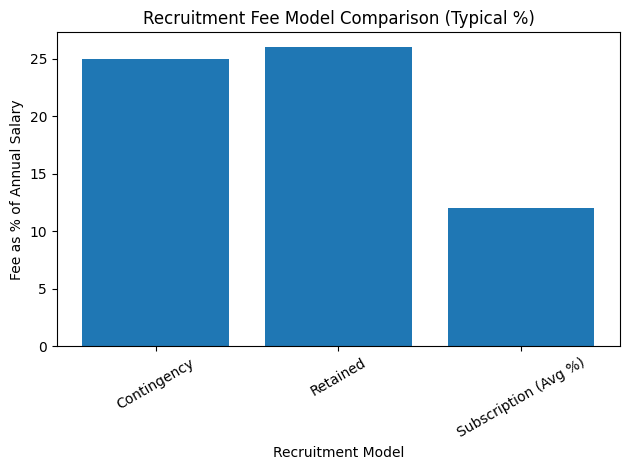
Another defining factor of the 2026 landscape is the diversification of recruitment fee structures. Employers can now choose between contingency, retained search, subscription-based, and flat-fee models depending on hiring complexity and scale. IT recruitment fees typically range from 20% to 30% of annual salary for specialized roles, reflecting the expertise required to source, screen, and secure top-tier technical professionals in a competitive market.
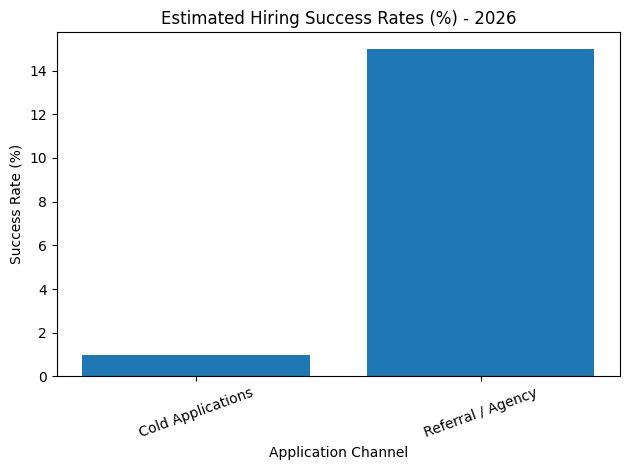
For international organizations expanding into Sri Lanka, additional considerations include Employer of Record (EOR) services, compliance with local employment regulations, and structured onboarding processes. Several leading agencies now provide end-to-end solutions that support cross-border hiring without requiring immediate local entity setup. This has further strengthened Sri Lanka’s appeal as a regional hub for digital operations and technology innovation.

This comprehensive guide to the top 10 recruitment agencies for hiring IT and software employees in Sri Lanka in 2026 explores the firms that are shaping the country’s talent acquisition ecosystem. It examines their specializations, service models, strengths, and strategic positioning within a rapidly evolving digital economy. Whether an organization is building a Global Capability Centre, scaling a SaaS development team, expanding a fintech platform, or hiring senior technology leadership, selecting the right recruitment partner can significantly impact business outcomes.
As Sri Lanka moves toward ambitious IT-BPM export revenue targets and deeper global integration, the importance of structured, intelligent, and compliance-driven IT recruitment cannot be overstated. The agencies featured in this analysis represent the forefront of Sri Lanka’s talent acquisition capabilities, helping employers secure skilled software engineers, IT specialists, and technology leaders in one of South Asia’s most promising digital markets.
For businesses seeking to hire IT employees in Sri Lanka in 2026, understanding the strengths and strategic advantages of these top recruitment agencies is the first step toward building resilient, high-performance technology teams in a highly competitive global environment.
Top 10 IT Recruitment Agencies in Sri Lanka in 2026
- 9cv9 Recruitment Agency
- InTalent Asia
- Exroasia (Pvt) Ltd
- Alp Consulting Ltd
- Eureka Technology Partners
- Avomind
- JFS Holdings
- Formix
- Techjobs.lk
- Emerald Isle Manpower and Travel Services
1. 9cv9 Recruitment Agency

As Sri Lanka strengthens its position as a competitive technology and software development hub in 2026, employers are increasingly seeking recruitment partners that combine speed, data-driven sourcing, and deep industry specialization. 9cv9 has emerged as a top IT recruitment agency for employers hiring IT employees in Sri Lanka, offering structured talent acquisition solutions tailored to modern technology organizations.

With a strong presence across Asia and a focus on technology-driven recruitment strategies, 9cv9 supports startups, scale-ups, and enterprise-level companies in securing high-quality IT professionals across a wide range of technical domains.
Strategic Positioning in Sri Lanka’s IT Recruitment Market
In 2026, the Sri Lankan IT sector is defined by rapid digital transformation, cloud adoption, cybersecurity expansion, and growing demand for remote-ready engineers. 9cv9 positions itself as a technology-focused recruitment partner capable of addressing these evolving hiring needs.
| Market Factor | 9cv9 Strategic Response |
|---|---|
| High Demand for Software Engineers | Targeted sourcing of full-stack and backend developers |
| Remote Work Expansion | Cross-border and remote IT talent acquisition |
| Digital Transformation Projects | Recruitment of cloud, DevOps, and data specialists |
| Competitive Hiring Environment | Accelerated screening and shortlisting processes |
By aligning recruitment processes with market dynamics, 9cv9 supports employers in reducing hiring delays and securing critical technical talent.
Core IT Recruitment Specializations
9cv9 focuses primarily on technology and digital roles, making it highly relevant for companies seeking specialized IT professionals in Sri Lanka.
| IT Role Category | Typical Positions Supported |
|---|---|
| Software Development | Full-Stack Developers, Backend Engineers, Frontend Devs |
| Data and AI | Data Analysts, Data Scientists, ML Engineers |
| Infrastructure and DevOps | Cloud Engineers, DevOps Specialists, SREs |
| Cybersecurity | Security Analysts, Risk and Compliance Specialists |
| IT Leadership | CTOs, IT Managers, Engineering Leads |
This specialization ensures that employers gain access to candidates with validated technical skills and relevant project experience.
Technology-Driven Recruitment Methodology
9cv9 leverages digital recruitment platforms, structured screening frameworks, and candidate analytics to enhance hiring precision. In a competitive IT labor market, structured evaluation is essential to identify both technical competence and cultural alignment.
| Recruitment Capability | Operational Advantage |
|---|---|
| Structured Candidate Screening | Improved technical skill validation |
| Digital Talent Platforms | Access to active and passive IT professionals |
| Market Salary Insights | Competitive compensation benchmarking |
| Fast Shortlisting Cycles | Reduced time-to-hire |
This data-driven model helps employers make informed hiring decisions while maintaining recruitment efficiency.
Employer Value Proposition in 2026
For companies operating in Sri Lanka’s IT ecosystem, 9cv9 offers a combination of speed, specialization, and strategic workforce advisory support.
| Employer Benefit | Business Impact |
|---|---|
| Faster Hiring Cycles | Accelerated product development timelines |
| Access to Niche Skills | Stronger technical team capabilities |
| Cost-Effective Recruitment | Optimized recruitment budget allocation |
| Scalable Hiring Support | Suitable for both startups and enterprise firms |
This makes 9cv9 particularly attractive to technology companies experiencing rapid growth or undertaking digital expansion initiatives.
Support for Startups and Enterprise IT Teams
In 2026, Sri Lanka’s technology landscape includes a mix of emerging startups and established multinational IT firms. 9cv9 adapts its recruitment strategies to suit both segments.
| Client Type | Recruitment Approach |
|---|---|
| Tech Startups | Agile sourcing and rapid team-building |
| Mid-Sized IT Firms | Targeted hiring for project-based scaling |
| Multinational Enterprises | Structured recruitment with governance compliance |
| Remote-First Companies | Distributed workforce sourcing across regions |
This flexibility allows employers to align hiring strategies with their operational scale and growth objectives.
Position Within Sri Lanka’s 2026 IT Recruitment Ecosystem
As Sri Lanka continues to attract global technology investments and expand its digital economy, the need for specialized IT recruitment agencies has intensified. 9cv9 stands out as a top IT recruitment agency for employers hiring IT employees in Sri Lanka in 2026 due to its:
• Technology-focused recruitment model
• Structured and data-driven screening processes
• Strong understanding of regional and global IT hiring trends
• Ability to support remote and cross-border workforce models
• Commitment to delivering qualified technical talent efficiently
For employers seeking reliable, scalable, and performance-oriented IT recruitment solutions in Sri Lanka, 9cv9 represents a strategic partner aligned with the evolving demands of the country’s fast-growing technology sector.
2. InTalent Asia

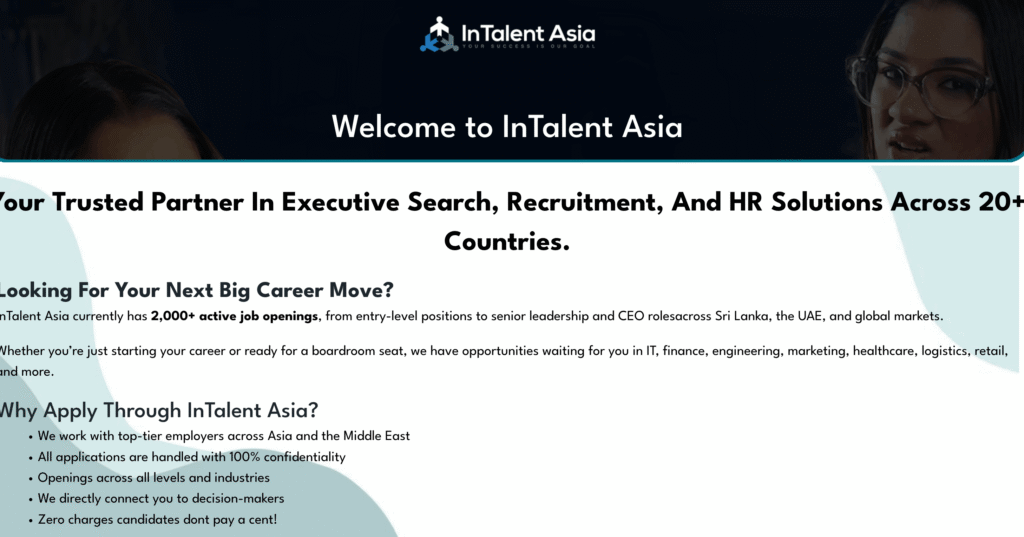
In 2026, Sri Lanka’s technology and software development industry continues to experience accelerated growth, driven by digital transformation initiatives, export-oriented IT services, and startup ecosystem expansion. Within this competitive hiring landscape, InTalent Asia is positioned as a prominent executive search and HR advisory firm supporting IT and software recruitment in Sri Lanka.
Headquartered in Colombo 07 and operating across more than 20 countries, the firm serves both domestic enterprises and international organizations seeking highly skilled technical and leadership talent. Its executive search model is particularly relevant for companies hiring senior technology professionals, specialized engineers, and digital transformation leaders.
Company Profile and Operational Scope
InTalent Asia operates with a focused team structure, allowing it to maintain agility while handling executive and specialized recruitment mandates.
| Category | Details |
|---|---|
| Headquarters | Colombo 07, Sri Lanka |
| International Reach | Operations in 20+ countries |
| Team Size | 10–49 employees |
| Core Specialization | Executive search and HR advisory services |
| Primary Talent Focus | C-level, executive, technical roles |
This lean structure enables targeted engagement in high-value recruitment assignments, particularly within niche IT domains.
Service Portfolio and Functional Distribution
InTalent Asia’s business model integrates recruitment with broader HR and management consulting services. This diversified structure supports organizations that require more than candidate sourcing, including workforce strategy and payroll administration.
| Service Category | Service Share | Strategic Application in IT Hiring |
|---|---|---|
| Recruitment | 25% | Executive and technical talent acquisition |
| Payroll Services | 25% | Contractor payroll and workforce compliance |
| HR Consulting | 30% | Talent strategy and workforce planning |
| Management Consulting | 20% | Organizational transformation and restructuring |
This integrated service mix is particularly relevant in 2026, as IT firms increasingly seek recruitment partners capable of supporting long-term talent planning rather than transactional hiring alone.
IT and Software Recruitment Capabilities
InTalent Asia’s recruitment approach emphasizes proactive headhunting rather than dependence on traditional CV databases. This strategy is highly effective in attracting passive candidates—experienced IT professionals who are not actively applying for jobs but may be open to strategic career moves.
| Recruitment Capability | Methodology Approach | Suitable Role Types |
|---|---|---|
| Executive IT Search | Direct headhunting and confidential outreach | CTOs, IT Directors, Heads of Engineering |
| Specialized Technical Hiring | Industry network mapping | Software Architects, DevOps Leads |
| Leadership Appointments | Board-level and C-suite engagement | Digital Transformation Executives |
| Cross-Border Talent Sourcing | International candidate identification | Regional technology leaders |
| Talent Market Advisory | Compensation benchmarking and market insights | Senior technical decision-makers |
This structured methodology enhances the quality of candidate shortlists, particularly for senior software engineering and enterprise IT leadership roles.
Commercial Structure and Fee Model
The agency operates on a structured fee model aligned with performance-based recruitment outcomes.
| Fee Component | Description |
|---|---|
| Registration Fee | Approximately LKR 5,000 |
| Success Fee | Equivalent to one month’s salary |
| Payment Condition | Charged upon successful placement |
This structure ensures that recruitment costs are tied directly to successful hiring outcomes, offering clarity and predictability for employers.
Candidate Experience and Professional Reputation
Feedback from senior professionals highlights the agency’s strong employer network and its ability to align candidates with competitive salary opportunities. Testimonials frequently reference the firm’s professionalism, strategic candidate matching, and structured evaluation process.
| Evaluation Area | Observed Strength |
|---|---|
| Salary Positioning | Access to attractive compensation packages |
| Employer Network | Strong relationships with top-tier Sri Lankan firms |
| Role Alignment | Qualification-based candidate matching |
| Professional Conduct | Dedicated and structured recruitment process |
Position Within Sri Lanka’s 2026 IT Recruitment Ecosystem
As Sri Lanka strengthens its position as a regional technology hub in 2026, organizations increasingly require recruitment agencies capable of sourcing both strategic technology leaders and high-performing software professionals. InTalent Asia’s executive search orientation, international exposure, and consulting-driven model contribute to its recognition among leading recruitment agencies for IT and software hiring in Sri Lanka.
For companies seeking senior-level IT leadership, digital transformation expertise, and specialized technical professionals, the firm offers a proactive, research-driven recruitment methodology aligned with evolving industry demands.
3. Exroasia (Pvt) Ltd


As global companies continue expanding into South Asia in 2026, Sri Lanka has emerged as a strategic destination for IT outsourcing, remote workforce deployment, and cost-efficient software development. Within this landscape, Exroasia (Pvt) Ltd has established itself as a specialized partner supporting international entities entering and operating in the Sri Lankan market.
The company is particularly recognized for its Employer of Record (EOR) and International Professional Employer Organization (PEO) services, enabling foreign firms to hire Sri Lankan IT professionals without setting up a legal entity locally. This operational flexibility makes Exroasia highly relevant for multinational technology firms, digital agencies, SaaS providers, and European enterprises expanding into Asia.
Corporate Profile and Strategic Positioning
Exroasia positions itself as a compliance-driven outsourcing and HR solutions provider, with a strong focus on regulatory alignment and international data protection standards.
| Category | Details |
|---|---|
| Company Name | Exroasia (Pvt) Ltd |
| Core Focus | EOR, International PEO, IT Staff Augmentation |
| Target Clients | International companies expanding into Sri Lanka |
| Talent Segment | Remote and virtual IT professionals |
| Market Orientation | Cross-border workforce management |
Cybersecurity and Compliance Credentials
One of Exroasia’s distinguishing features is its cybersecurity certification profile. The company became the first Sri Lankan organization to obtain both Cyber Essentials and IASME certifications, aligning its operational standards with UK regulatory expectations and GDPR compliance requirements.
This certification framework enhances trust among European and UK-based companies seeking compliant HR outsourcing and secure workforce management solutions.
| Certification | Strategic Significance |
|---|---|
| Cyber Essentials | UK-recognized cybersecurity compliance framework |
| IASME Certification | Enhanced data security and governance assurance |
| GDPR Alignment | Compliance with EU data protection standards |
For IT companies handling sensitive customer data, intellectual property, and cross-border operations, this compliance positioning offers additional assurance.
Specialization in IT and Software Talent
Exroasia’s specialization lies in remote IT professional deployment and staff augmentation models. Rather than focusing exclusively on traditional recruitment, the firm provides structured workforce solutions that allow foreign companies to build and manage distributed development teams in Sri Lanka.
| Specialization Area | Application in 2026 IT Hiring Landscape |
|---|---|
| Remote IT Professionals | Offshore software developers and engineers |
| IT Staff Augmentation | Flexible team scaling for tech projects |
| HR Outsourcing | End-to-end employee lifecycle management |
| EOR Services | Legal employment without local entity setup |
| International PEO | Multi-country HR and payroll compliance |
This model is particularly attractive for startups and mid-sized enterprises seeking to reduce operational overhead while maintaining access to skilled Sri Lankan software engineers.
Cost Efficiency and Competitive Advantage
In 2026, cost optimization remains a primary driver of outsourcing decisions. Exroasia is noted for offering hourly rates under USD 30, positioning it competitively within the global IT outsourcing market.
| Cost Component | Market Positioning |
|---|---|
| Reported Hourly Rates | Under USD 30 |
| Cost Advantage | Competitive pricing for offshore IT services |
| Ideal Client Profile | Cost-optimization and remote team expansion |
| Value Proposition | Compliance-driven, affordable IT workforce models |
This pricing structure makes Sri Lanka an attractive alternative to higher-cost outsourcing markets while maintaining English proficiency and technical expertise.
Recognition and Industry Performance
In 2025, Exroasia was awarded “Most Dedicated Asian Outsourcing Company – Sri Lanka” by Corporate Vision Awards. This recognition reflects performance consistency, service reliability, and commitment to cross-border HR excellence.
| Award Title | Year | Awarding Body |
|---|---|---|
| Most Dedicated Asian Outsourcing Company – Sri Lanka | 2025 | Corporate Vision Awards |
Such recognition strengthens the firm’s brand credibility among European and international clients evaluating outsourcing partners.
Client Experience and Reputation
Feedback from international leadership teams highlights Exroasia’s capability in handling complex employment and compliance processes. A CEO from a European buying office described the firm as a primary HR partner for Asia-related operations, particularly acknowledging its effectiveness in managing residence visa processes and ensuring regulatory compliance.
| Evaluation Area | Observed Strength |
|---|---|
| Immigration Support | Residence visa facilitation for senior executives |
| Regulatory Compliance | Alignment with local employment laws |
| HR Administration | Efficient handling of employment-related tasks |
| Professional Conduct | High level of responsiveness and reliability |
Role Within Sri Lanka’s 2026 IT Recruitment and Outsourcing Market
As global companies increasingly adopt distributed workforce models, agencies that combine EOR services, IT staff augmentation, and regulatory compliance are becoming central to Sri Lanka’s technology hiring ecosystem. Exroasia’s focus on remote IT professionals, cost-effective engagement models, and international compliance standards positions it as a strategic partner for cross-border technology hiring in 2026.
For international firms seeking to build Sri Lankan software teams without operational complexity, Exroasia provides a structured, secure, and cost-competitive pathway aligned with modern global workforce strategies.
4. Alp Consulting Ltd

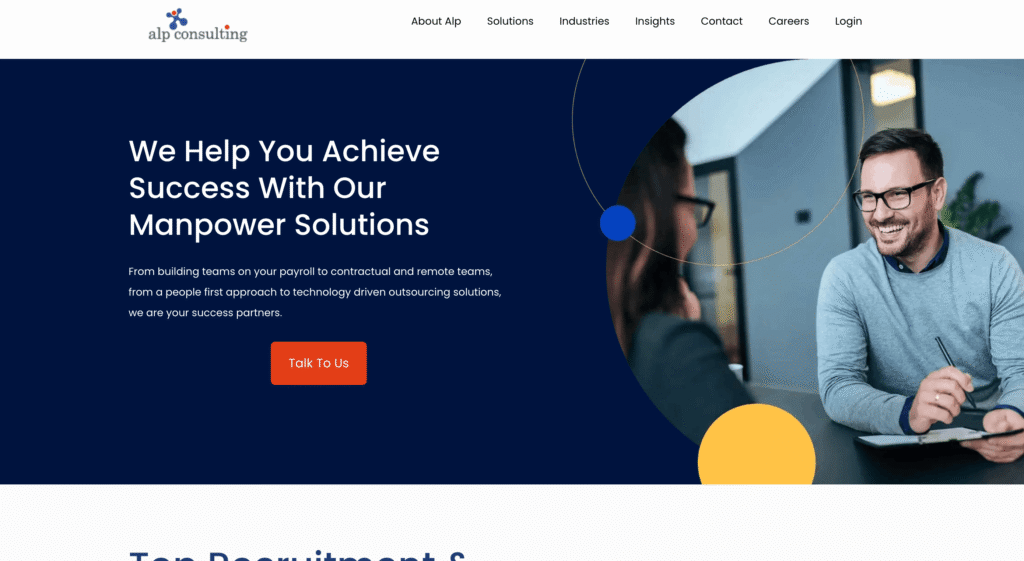
With more than 25 years of operational experience, Alp Consulting Ltd is recognized as a long-standing staffing and Recruitment Process Outsourcing (RPO) provider serving Sri Lanka and India. In 2026, as technology hiring becomes increasingly structured and data-driven, the firm’s global infrastructure and process-oriented recruitment model position it as a major player in IT and software workforce solutions.
Operating across South Asia with a substantial global workforce, Alp Consulting supports multinational corporations, enterprise clients, and large technology firms requiring scalable hiring models and structured recruitment governance.
Corporate Profile and Operational Scale
Alp Consulting’s defining strength lies in its scale and infrastructure. With a team size ranging between 1,000 and 9,999 employees globally, the firm is equipped to manage high-volume hiring projects, multi-location staffing, and enterprise-level workforce programs.
| Category | Details |
|---|---|
| Company Name | Alp Consulting Ltd |
| Years of Operation | 25+ years |
| Geographic Presence | Sri Lanka and India (Global infrastructure) |
| Team Size | 1,000–9,999 professionals |
| Core Market | Enterprise staffing and RPO services |
This large-scale operational footprint allows Alp Consulting to support complex hiring mandates, including multi-country IT recruitment programs and centralized RPO engagements.
Technology-Driven Recruitment Infrastructure
In 2026, data security and recruitment automation are critical components of enterprise hiring. Alp Consulting leverages advanced technology stacks, including Applicant Tracking Systems (ATS), to enhance recruitment efficiency, ensure data protection, and improve candidate tracking accuracy.
| Technology Capability | Operational Benefit |
|---|---|
| Applicant Tracking Systems | Structured candidate management and workflow control |
| Data Security Frameworks | Protection of client and candidate information |
| Recruitment Analytics | Improved hiring accuracy and reporting |
| Process Automation | Faster screening and onboarding cycles |
The integration of technology-driven systems strengthens compliance, transparency, and scalability—key factors for multinational IT clients.
Service Portfolio and Staffing Capabilities
Alp Consulting provides a diversified staffing portfolio tailored to organizations with varying workforce needs. This broad service range supports both short-term project staffing and long-term workforce transformation strategies.
| Service Category | Application in IT and Software Hiring |
|---|---|
| Permanent Recruitment | Full-time software engineers and IT specialists |
| Temporary Staffing | Project-based developers and technical contractors |
| RPO Services | End-to-end outsourced recruitment management |
| Master Vendor Services | Centralized vendor coordination for large clients |
This flexible service structure makes the firm suitable for organizations requiring scalable technology hiring models, particularly in large enterprise environments.
Pricing and Commercial Model
Alp Consulting operates at a premium pricing tier, reflecting its enterprise positioning and large-scale service capabilities.
| Cost Component | Market Positioning |
|---|---|
| Hourly Rate Range | USD 150 – USD 250 |
| Client Segment | Large enterprises and multinational corporations |
| Value Proposition | Structured, technology-enabled recruitment at scale |
The higher hourly rate typically aligns with managed services, RPO programs, and enterprise-level staffing solutions rather than small business recruitment projects.
IT Recruitment Focus and Talent Segments
Given its scale and infrastructure, Alp Consulting is particularly effective in handling:
| Talent Segment | Suitable Client Type |
|---|---|
| Software Developers | Large IT services firms |
| Enterprise IT Specialists | Multinational corporations |
| Infrastructure and Support | Global operations teams |
| IT Recruitment Professionals | Internal recruitment function outsourcing |
Its RPO and Master Vendor models are especially valuable for companies with ongoing, high-volume technology hiring requirements.
Work Culture and Professional Development
Employee feedback highlights structured management practices, balanced work environments, and professional growth opportunities within the IT recruitment domain. An Associate IT Recruiter described the organization as supportive, offering exposure to multinational clients and professional corporate cultures.
| Evaluation Area | Observed Strength |
|---|---|
| Management Quality | Structured and supportive leadership |
| Work Environment | Balanced workload without excessive pressure |
| Professional Exposure | Access to multinational client engagements |
| Learning Opportunities | Growth in IT recruitment expertise |
Such internal culture indicators suggest operational stability and standardized recruitment frameworks.
Position Within Sri Lanka’s 2026 IT Staffing Ecosystem
As Sri Lanka continues to strengthen its position as a regional IT outsourcing and development hub in 2026, large enterprises increasingly require structured recruitment partners capable of delivering high-volume and multi-location staffing solutions. Alp Consulting Ltd stands out as a scalable, technology-enabled staffing and RPO provider serving enterprise clients across Sri Lanka and India.
For multinational corporations, global capability centers, and IT service providers requiring process-driven recruitment at scale, Alp Consulting represents a mature and infrastructure-backed solution within Sri Lanka’s IT and software hiring ecosystem.
5. Eureka Technology Partners


As the global demand for managed IT services and high-performing technical teams continues to grow in 2026, Eureka Technology Partners stands out as a veteran Managed Service Provider (MSP) with deep roots in infrastructure support and global IT talent deployment. Founded in 1996, the company has developed a reputation for identifying, vetting, and deploying world-class IT professionals to international clients.
With a service portfolio spanning more than 80 global clients, Eureka Technology Partners operates at the intersection of managed services, IT support, and technical team augmentation, making it highly relevant within Sri Lanka’s IT and software employment ecosystem.
Corporate Profile and Industry Position
Eureka Technology Partners has built its operational model around delivering high-performance IT teams with strong process discipline and technical depth.
| Category | Details |
|---|---|
| Company Name | Eureka Technology Partners |
| Founded | 1996 |
| Core Model | Managed Service Provider (MSP) |
| Client Base | 80+ global clients |
| Primary Focus | IT support, infrastructure, and technical teams |
With nearly three decades of experience, the firm combines operational maturity with technical specialization, particularly in enterprise support environments.
Technology Focus and Specialization
Eureka Technology Partners supports both Microsoft and Open Source technology ecosystems, enabling flexibility across enterprise and cloud-based environments.
| Technology Domain | Application Area |
|---|---|
| Microsoft Technologies | Enterprise infrastructure, support, and systems |
| Open Source Technologies | Cloud environments, development platforms, DevOps |
| Infrastructure Services | Network management and system administration |
| Technical Support | Multi-tier IT helpdesk and incident resolution |
This dual-technology expertise allows the company to serve clients operating hybrid technology stacks.
Structured Vetting and Talent Screening Framework
A defining feature of Eureka Technology Partners is its rigorous vetting process. In 2026, where quality and reliability are critical for global IT support operations, the company applies a multi-layer screening methodology to ensure candidate competence and alignment.
| Vetting Stage | Purpose |
|---|---|
| Multiple Interview Rounds | Assessment of technical and behavioral capability |
| Technical Skill Verification | Validation of hands-on expertise |
| Language Proficiency Tests | Ensuring effective communication in global settings |
| Cultural Fit Evaluation | Alignment with client organizational values |
This structured evaluation process reduces hiring risks and strengthens service consistency across international engagements.
Operational Efficiency and Performance Metrics
Performance outcomes are a key indicator of a Managed Service Provider’s effectiveness. Eureka Technology Partners has reported a 55% reduction in average resolution time for client IT incidents, demonstrating measurable improvements in operational efficiency.
| Performance Indicator | Reported Outcome |
|---|---|
| Incident Resolution Time | 55% reduction |
| Service Delivery Model | Process-driven and SLA-focused |
| Client Satisfaction | High approval from global users |
| Operational Scalability | Plans for extended service hours |
Such metrics highlight the firm’s ability to optimize technical support workflows and enhance service-level performance.
Client Experience and Global Reputation
Feedback from international leadership reinforces the company’s emphasis on process excellence and talent quality. A Director from a United States-based technology firm noted strong global user satisfaction and expressed intentions to expand operational hours based on service reliability.
| Evaluation Area | Observed Strength |
|---|---|
| Service Quality | Consistently high global user satisfaction |
| Process Excellence | Structured and world-class operational frameworks |
| Talent Quality | Skilled and experienced technical professionals |
| Scalability | Capacity to expand service hours and coverage |
These insights suggest a stable and mature service delivery framework suited for enterprise environments.
Position Within Sri Lanka’s 2026 IT Talent and MSP Ecosystem
In 2026, Sri Lanka’s IT sector is increasingly integrated into global service delivery networks. Companies seeking managed technical support, infrastructure specialists, and scalable IT teams often require partners capable of combining structured vetting with operational excellence.
Eureka Technology Partners occupies a strategic position within this ecosystem by offering:
• Long-standing operational experience
• Multi-technology expertise
• Process-driven managed services
• Proven efficiency improvements
• Rigorous talent screening frameworks
For global enterprises seeking reliable technical support teams and infrastructure expertise from Sri Lanka, Eureka Technology Partners represents a mature, performance-oriented MSP aligned with international service standards and measurable operational outcomes.
6. Avomind

As the demand for specialized software engineers, data professionals, and digital commerce experts intensifies in 2026, organizations increasingly prioritize recruitment partners capable of delivering speed without compromising quality. Avomind operates as a global recruitment services company with a presence in Asia, supporting technology-driven sectors including software, healthcare, and eCommerce.
Within Sri Lanka’s expanding IT ecosystem, Avomind is recognized for its agile sourcing model, cross-border recruitment capabilities, and structured hiring processes that support companies operating under compressed hiring timelines.
Corporate Profile and Market Position
Avomind’s operational framework is designed for high-performance recruitment across multiple global markets, making it suitable for companies hiring remote or regionally based IT professionals.
| Category | Details |
|---|---|
| Company Name | Avomind |
| Core Industry Focus | Software, Healthcare, eCommerce |
| Geographic Presence | Global operations with Asia presence |
| Recruitment Model | High-speed, performance-driven talent sourcing |
| Client Profile | Growth-stage and enterprise technology companies |
This international positioning enables access to broader talent pools while supporting companies with regional hiring requirements in Sri Lanka and Asia.
Service Portfolio and Functional Distribution
Avomind’s service structure reflects a strong focus on direct recruitment and scalable staffing solutions, supported by executive search capabilities.
| Service Category | Service Share | Strategic Application in IT Hiring |
|---|---|---|
| Recruiting | 40% | Direct sourcing of software and technical talent |
| Staffing | 25% | Short-term and project-based IT placements |
| Executive Search | 15% | Senior leadership and strategic technology hires |
This balanced distribution allows the firm to handle both operational-level hiring and executive-level appointments within software and technology domains.
Speed and Time-to-Hire Capabilities
In 2026, time-to-hire has become a critical performance metric in technology recruitment. Avomind reports the capability to fill roles within a 2–4 month window, even in constrained or highly competitive hiring environments.
| Hiring Timeline Indicator | Performance Benchmark |
|---|---|
| Typical Time-to-Fill | 2–4 months |
| Suitable for | Urgent or high-demand tech roles |
| Recruitment Approach | Accelerated sourcing and screening |
| Competitive Advantage | Reduced hiring cycle duration |
This efficiency is particularly valuable for startups and scaling tech firms where delayed hiring can impact product development cycles and market expansion strategies.
Quality Assurance and Market Intelligence
Avomind’s recruitment model emphasizes not only candidate sourcing but also market trend analysis and alignment with client workforce strategies. Feedback from senior HR leaders highlights the firm’s ability to provide actionable insights into salary trends, skill availability, and competitive hiring dynamics.
| Evaluation Area | Observed Strength |
|---|---|
| Market Insights | Strategic understanding of hiring trends |
| Candidate Quality | Qualified and skill-aligned professionals |
| Responsiveness | Timely communication and process efficiency |
| Client Collaboration | Willingness to exceed standard service expectations |
Such attributes strengthen its value proposition in competitive IT hiring markets.
Reputation and Verified Ratings
Avomind holds a reported rating of 4.9 out of 5 based on verified client reviews. High ratings are commonly attributed to responsiveness, value for cost, and result-oriented execution.
| Rating Metric | Reported Outcome |
|---|---|
| Overall Rating | 4.9 / 5 |
| Client Satisfaction | High responsiveness and cost efficiency |
| Service Orientation | Results-driven recruitment approach |
| Industry Recognition | Strong performance in global hiring |
This level of client approval reflects consistent delivery standards across multiple sectors, particularly within software and digital commerce.
Position Within Sri Lanka’s 2026 IT Recruitment Ecosystem
As Sri Lanka continues to supply skilled software engineers, data analysts, and digital specialists to global markets, recruitment partners capable of combining speed, strategic insight, and cross-border sourcing are increasingly valuable. Avomind’s agile recruitment framework and high-speed talent acquisition model align well with technology companies seeking rapid team expansion.
For organizations requiring:
• Accelerated hiring cycles
• Market-driven candidate insights
• Cost-effective recruitment solutions
• Cross-border talent sourcing capabilities
Avomind represents a performance-focused recruitment partner within Sri Lanka’s 2026 IT and software hiring ecosystem, supporting both scaling startups and established enterprises with structured, results-oriented talent acquisition strategies.
7. JFS Holdings

As Sri Lanka’s technology ecosystem continues to expand in 2026, organizations increasingly seek recruitment partners capable of delivering speed, cost control, and operational efficiency. JFS Holdings has positioned itself as a service-oriented recruitment and training provider, particularly active in IT staff augmentation, corporate training, and workforce support services.
The company is recognized within the Colombo market for combining structured recruitment delivery with supportive client engagement, making it relevant for organizations seeking both technical talent and workforce development solutions.
Corporate Profile and Market Focus
JFS Holdings operates with a service model centered on efficiency, client responsiveness, and cost optimization.
| Category | Details |
|---|---|
| Company Name | JFS Holdings |
| Core Services | Recruitment, Corporate Training, IT Staff Augmentation |
| Market Focus | Colombo and surrounding commercial sectors |
| Client Type | Corporate and professional service firms |
| Positioning | Cost-effective workforce solutions provider |
This positioning makes the firm particularly attractive to mid-sized enterprises and industry-specific clients seeking localized recruitment support.
Service Portfolio and IT Hiring Capabilities
JFS Holdings provides a multi-service model that combines talent acquisition with training and workforce augmentation, allowing clients to manage both hiring and employee development under one provider.
| Service Category | Application in IT and Corporate Hiring |
|---|---|
| Recruitment | Permanent and contract IT placements |
| Corporate Training | Workforce skill development and upskilling programs |
| IT Staff Augmentation | Project-based technical team expansion |
| HR Support Services | Administrative workforce management assistance |
This integrated model supports organizations that require not only talent acquisition but also structured onboarding and performance development frameworks.
Performance and Project Management Outcomes
Client feedback indicates strong satisfaction with delivery timelines and project management standards. Notably, 100% of reviewers referenced timely delivery and efficient coordination as core strengths.
| Performance Indicator | Reported Outcome |
|---|---|
| Timely Delivery | 100% positive reviewer feedback |
| Project Management | Structured and responsive execution |
| Recruitment Speed | Noted for fast turnaround times |
| Service Support | Friendly and client-focused engagement |
Such performance indicators suggest consistency in execution and adherence to client expectations.
Cost Efficiency and Financial Impact
In 2026, organizations increasingly measure recruitment partners not only by speed and quality but also by measurable financial impact. JFS Holdings has reportedly supported partners in reducing employee administration costs by up to 10%, strengthening its reputation as a cost-conscious workforce partner.
| Cost Component | Reported Impact |
|---|---|
| Employee Administration Costs | Up to 10% reduction |
| Hourly Rate Range | USD 50 – USD 99 |
| Value Proposition | Balanced pricing with operational efficiency |
| Target Client Segment | Cost-optimization focused organizations |
The hourly rate range positions the firm within a mid-tier pricing segment, suitable for companies seeking structured recruitment without enterprise-level cost structures.
Client Experience and Market Reputation
A corporate client from the legal industry highlighted the firm’s proficiency in recruitment, particularly noting the speed and quality of hires. The supportive approach and efficiency were cited as reinforcing the company’s standing as a cost-effective solution within the Colombo market.
| Evaluation Area | Observed Strength |
|---|---|
| Recruitment Quality | Strong candidate matching and hire standards |
| Speed of Delivery | Fast turnaround in recruitment cycles |
| Client Service | Supportive and relationship-driven approach |
| Market Reputation | Recognized as cost-effective within Colombo |
These insights reflect a service culture oriented toward responsiveness and consistent delivery.
Position Within Sri Lanka’s 2026 IT and Workforce Solutions Ecosystem
As Sri Lanka strengthens its position as a regional IT services hub in 2026, demand continues to grow for recruitment agencies that offer practical, budget-conscious, and reliable hiring solutions. JFS Holdings occupies a strategic position within this segment by providing:
• Efficient IT recruitment services
• Corporate training and workforce development
• Measurable cost optimization
• Strong client satisfaction in project management
For organizations operating within Colombo and beyond, particularly those seeking balanced pricing and dependable recruitment delivery, JFS Holdings represents a structured and cost-effective partner within Sri Lanka’s evolving IT and software hiring landscape.
8. Formix


In 2026, as remote work models and distributed engineering teams continue to dominate the global software development landscape, organizations increasingly seek recruitment partners that specialize in remote IT talent and structured team management solutions. Formix operates within this niche, focusing exclusively on the Information Technology sector and supporting technology-driven companies with remote developer sourcing and workforce coordination.
Within Sri Lanka’s expanding software export ecosystem, Formix has positioned itself as a focused, tech-centric recruitment partner for organizations that require speed, flexibility, and specialized IT talent.
Corporate Profile and Operational Scope
Formix maintains a lean organizational structure, enabling agile recruitment processes and close client collaboration.
| Category | Details |
|---|---|
| Company Name | Formix |
| Industry Focus | Information Technology |
| Core Services | Remote tech talent sourcing and team management |
| Team Size | 10–49 employees |
| Target Client Segment | Tech-heavy and software-focused organizations |
This compact team structure allows the firm to concentrate on specialized IT hiring mandates rather than broad, multi-industry recruitment.
Service Portfolio and Functional Distribution
Formix’s service mix demonstrates a strong emphasis on direct recruitment for technical roles, supported by staffing and employee leasing solutions.
| Service Category | Service Share | Application in IT Hiring |
|---|---|---|
| Recruiting | 60% | Direct sourcing of remote software developers |
| Staffing | 15% | Contract-based and short-term tech placements |
| PEO / Employee Leasing | 10% | Employment management for distributed teams |
This distribution reflects a recruitment-first approach, with complementary workforce management services to support international and remote operations.
Impact on Project Delivery and Hiring Speed
Formix is recognized for contributing to improved project delivery timelines by accelerating recruitment cycles and securing qualified developers more efficiently. In technology-intensive environments, delays in hiring can directly impact product releases, system upgrades, and client commitments.
| Performance Indicator | Reported Impact |
|---|---|
| Recruitment Time Reduction | Faster candidate identification and placement |
| Project Delivery Speed | Improved timelines for tech-heavy organizations |
| Response Time | Quick communication and client coordination |
| Reliability of Talent Supply | Consistent delivery of skilled developers |
By reducing recruitment bottlenecks, Formix supports smoother project execution for software development teams.
Specialization in Remote Developer Management
As remote engineering teams become the norm in 2026, structured team management is as important as recruitment itself. Formix emphasizes both sourcing and ongoing coordination of remote IT professionals.
| Capability Area | Operational Advantage |
|---|---|
| Remote Developer Sourcing | Access to geographically distributed IT talent |
| Software Development Focus | Alignment with technical stack requirements |
| Team Management Support | Coordination and communication oversight |
| Client Collaboration | Clear and responsive engagement model |
This dual focus on recruitment and management enhances continuity in remote team environments.
Client Experience and Professional Feedback
Feedback from software development leaders highlights Formix’s suitability for organizations seeking reliable remote developers. A Tech Team Lead described the firm as responsive, communicative, and highly focused on software development recruitment.
| Evaluation Area | Observed Strength |
|---|---|
| Developer Quality | Skilled remote software professionals |
| Communication Efficiency | Clear and timely updates |
| Sector Specialization | Strong focus on IT and software |
| Service Reliability | Consistent and dependable talent delivery |
Such feedback reinforces the company’s positioning as a focused IT recruitment and remote workforce partner.
Position Within Sri Lanka’s 2026 IT Recruitment Ecosystem
As Sri Lanka continues to supply remote-ready software engineers and technical professionals to global markets in 2026, recruitment firms that specialize in distributed workforce solutions play an increasingly strategic role. Formix occupies a niche position within this ecosystem by offering:
• IT-exclusive recruitment focus
• High percentage of direct recruiting services
• Remote team management support
• Accelerated hiring processes
• Agile and responsive service delivery
For technology companies seeking skilled remote developers and structured team coordination support, Formix represents a specialized recruitment partner aligned with modern software development and remote workforce trends in Sri Lanka.
9. Techjobs.lk

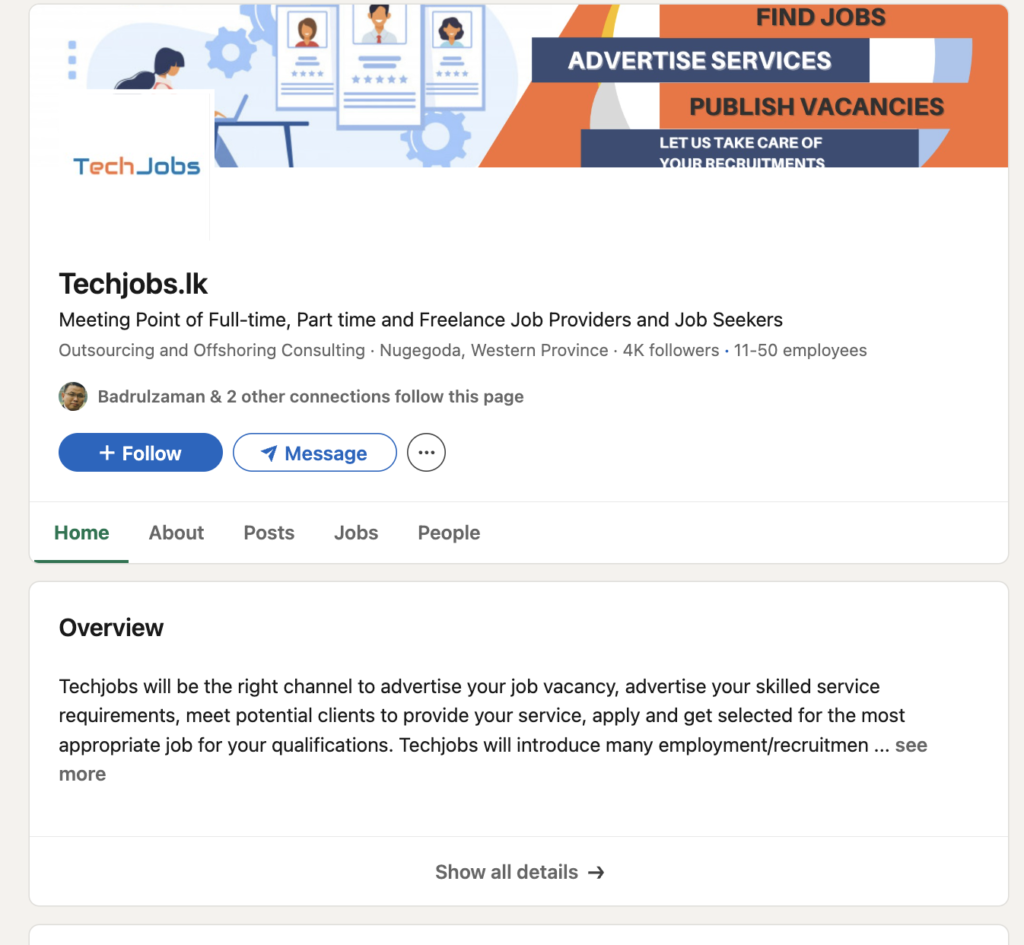
As Sri Lanka’s ICT and engineering sectors continue to expand in 2026, niche recruitment platforms have become increasingly important for connecting employers with specialized technical professionals. Techjobs.lk operates as a dedicated employment service provider focused exclusively on ICT and Project Management talent within Sri Lanka.
Founded in 2020 and headquartered in Nugegoda, the platform was established to address the growing demand for structured, sector-specific hiring support in a fast-moving technology market. By concentrating solely on IT and engineering professionals, Techjobs.lk serves as a focused bridge between employers and the local technical workforce.
Corporate Profile and Market Position
Techjobs.lk maintains a mid-sized operational team and concentrates on industry-specific recruitment engagement rather than broad, multi-sector hiring.
| Category | Details |
|---|---|
| Company Name | Techjobs.lk |
| Founded | 2020 |
| Headquarters | Nugegoda, Sri Lanka |
| Team Size | 11–50 employees |
| Core Focus | ICT and Project Management recruitment |
This focused positioning allows the organization to tailor its services specifically to Sri Lanka’s technology and engineering community.
Service Model and Recruitment Approach
Techjobs.lk functions as a recruitment support platform that enables employers to directly publish vacancy advertisements targeted at ICT and engineering professionals. This model enhances employer visibility within a specialized talent pool.
| Service Capability | Application in IT Recruitment |
|---|---|
| Vacancy Advertisement Publishing | Direct employer access to ICT talent |
| Sector-Specific Talent Targeting | Focus on IT and engineering professionals |
| Recruitment Support Services | Assistance in candidate sourcing and engagement |
| Project Management Talent Access | Specialized outreach for PM roles |
By allowing organizations to post opportunities directly to a concentrated technical audience, the platform supports faster market exposure for urgent hiring needs.
Community Engagement and Industry Reach
A defining characteristic of Techjobs.lk is its engagement with the IT and engineering community. Rather than operating solely as a traditional recruitment agency, the platform functions as a sector-specific employment hub.
| Community Feature | Strategic Benefit |
|---|---|
| Direct Vacancy Publishing | Increased transparency and speed of hiring |
| ICT-Focused Audience | Higher relevance of applicant pool |
| Engineering Community Access | Improved targeting of technical roles |
| Market Responsiveness | Adaptation to fast-moving tech hiring trends |
This community-centered approach supports employers in reaching professionals who are actively engaged within the Sri Lankan ICT ecosystem.
Client Feedback and Market Perception
Feedback from senior IT professionals highlights the platform’s strong understanding of Sri Lanka’s ICT sector and its practical recruitment support capabilities. A Senior IT Support Professional noted that Techjobs.lk offers comprehensive recruitment services tailored to the needs of a buoyant and rapidly evolving technology market.
| Evaluation Area | Observed Strength |
|---|---|
| Sector Understanding | Deep familiarity with Sri Lankan ICT landscape |
| Recruitment Support | Structured assistance for technical hiring |
| Talent Targeting | Effective matching of specific technical skills |
| Market Adaptability | Responsiveness in fast-paced hiring environments |
Such feedback reinforces the platform’s credibility within the specialized IT recruitment space.
Position Within Sri Lanka’s 2026 IT Recruitment Market
In 2026, Sri Lanka’s ICT and project management sectors are characterized by rapid innovation, competitive hiring, and demand for specialized skills. Platforms that provide direct access to concentrated technical communities play a critical role in improving hiring efficiency.
Techjobs.lk occupies a strategic niche within this ecosystem by offering:
• Dedicated ICT and engineering recruitment focus
• Direct vacancy publishing to specialized talent pools
• Community-driven engagement with IT professionals
• Structured recruitment support for employers
For organizations seeking targeted exposure to Sri Lanka’s ICT and Project Management workforce, Techjobs.lk represents a specialized employment platform aligned with the evolving demands of the country’s technology-driven economy.
10. Emerald Isle Manpower and Travel Services


Established in 1995, Emerald Isle Manpower and Travel Services is regarded as one of Sri Lanka’s pioneering recruitment agencies with a strong international placement record. As global workforce mobility increases in 2026, the firm continues to play a significant role in sourcing skilled professionals from Sri Lanka and the broader South Asian region for overseas employers.
With nearly three decades of experience, Emerald Isle has developed a structured international recruitment model, particularly in sectors such as IT, Engineering, and Hospitality. Its reputation is reinforced by multiple national awards and regulatory recognition.
Corporate Profile and Industry Standing
Emerald Isle operates as a full-scale international recruitment agency with extensive cross-border capabilities.
| Category | Details |
|---|---|
| Company Name | Emerald Isle Manpower and Travel Services |
| Founded | 1995 |
| Core Focus | International recruitment and overseas placements |
| Key Sectors | IT, Engineering, Hospitality |
| Market Position | Pioneer in foreign employment recruitment in Sri Lanka |
Its longevity in the market reflects operational stability and long-term client relationships across multiple industries.
Recognition and Awards
Emerald Isle has consistently received national recognition for its performance in overseas job placements and employer branding excellence.
| Award / Recognition | Achievement Details |
|---|---|
| SLBFE Five Star Award | Received for consecutive years |
| No. 01 Ranking for Foreign Job Placement | National recognition for overseas placement |
| Best Employer Brand Award | Awarded nine consecutive years (2016–2024) |
These accolades indicate sustained performance, regulatory compliance, and industry credibility.
Sector Expertise and Talent Sourcing Capabilities
While the agency serves multiple industries, its expertise in sourcing IT and engineering professionals for global clients is particularly relevant in 2026, when demand for skilled technical talent continues to rise internationally.
| Sector Focus | Recruitment Application |
|---|---|
| Information Technology | Software developers, IT support, infrastructure specialists |
| Engineering | Mechanical, civil, and technical engineering roles |
| Hospitality | Skilled professionals for international hospitality groups |
By combining industry-specific consultants with structured candidate screening, Emerald Isle supports employers seeking reliable, deployment-ready professionals.
Regional and International Network
Emerald Isle’s international reach is strengthened by its branch and partner offices across South Asia and Southeast Asia.
| Country Network | Operational Presence |
|---|---|
| Sri Lanka | Head operations and recruitment coordination |
| Nepal | Partner and branch office support |
| Bangladesh | Regional sourcing network |
| India | Cross-border recruitment collaboration |
| Pakistan | Talent sourcing partnership |
| Philippines | Regional manpower coordination |
This network allows the firm to access diverse talent pools while maintaining centralized coordination for international clients.
Consultant Expertise and Recruitment Model
A key differentiator of Emerald Isle is its dedicated industry-specific consultant structure. Senior recruitment consultants with years of experience manage sector-focused hiring, ensuring both compliance and quality control in international placements.
| Capability Area | Strategic Advantage |
|---|---|
| Industry-Specific Teams | Specialized knowledge in IT and engineering fields |
| Senior Consultant Oversight | Experienced leadership in international recruitment |
| Structured Candidate Screening | Quality assurance and compliance management |
| Global Employer Support | End-to-end recruitment coordination |
This approach supports high-performing team placements for international employers.
Client Feedback and Professional Reputation
International client representatives have highlighted Emerald Isle’s professional teams, industry specialization, and experienced senior consultants. The firm is regarded as a trusted partner for both employers and candidates, particularly in cross-border recruitment engagements.
| Evaluation Area | Observed Strength |
|---|---|
| Professional Expertise | Dedicated and experienced consultant teams |
| International Placement | Strong overseas hiring outcomes |
| Client Trust | Reliable and long-term recruitment partnerships |
| Candidate Support | Balanced focus on employer and employee needs |
Position Within Sri Lanka’s 2026 IT Recruitment Ecosystem
In 2026, Sri Lanka continues to serve as a source of skilled IT and engineering talent for international markets. Agencies with established regulatory credentials, cross-border networks, and award-winning placement records play a crucial role in facilitating this workforce mobility.
Emerald Isle Manpower and Travel Services occupies a leading position within this ecosystem by offering:
• Nearly three decades of recruitment experience
• Strong international employer network
• Award-winning overseas placement performance
• Industry-specialized recruitment teams
• Regional sourcing partnerships across South Asia
For global organizations seeking reliable IT and engineering professionals from Sri Lanka and neighboring regions, Emerald Isle represents a mature, accredited, and internationally recognized recruitment partner aligned with global workforce demands in 2026.
Strategic IT Talent Acquisition and Global Capability Scaling: A Comprehensive Report on the Top 10 Recruitment Agencies in Sri Lanka for 2026
In early 2026, Sri Lanka’s Information Technology and Business Process Management (IT-BPM) sector has entered a performance-driven, stabilized growth phase. Following years of economic disruption and talent-retention pressures, the industry has transitioned away from reactive salary inflation toward skill-based, performance-linked compensation systems. This structural shift reflects both global market correction and local maturity.
At the same time, employers face a dual mandate:
• Competing for high-demand technology skills in a global talent shortage environment
• Preserving Sri Lanka’s cost-competitive positioning in the offshore services landscape
Against this backdrop, recruitment agencies play a strategic role in enabling Global Capability Centre (GCC) expansion, remote workforce deployment, executive IT leadership hiring, and specialized technical placements.
This comprehensive 2026 report analyzes the top ten recruitment agencies in Sri Lanka facilitating IT workforce optimization, cost control, and international capability scaling.
The Economic and Workforce Landscape of Sri Lanka in 2026
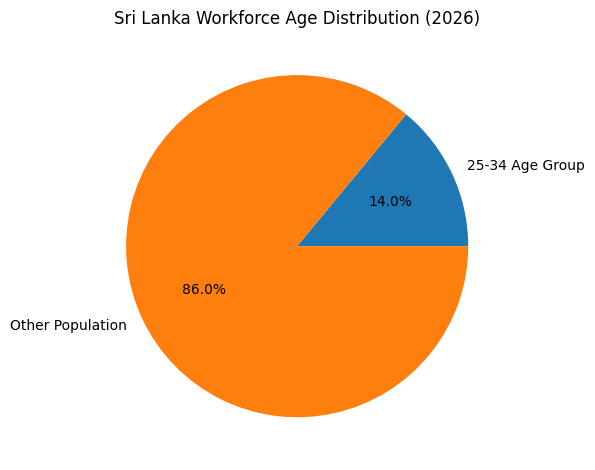
Sri Lanka’s digital economy rests on a growing and relatively youthful workforce foundation. The country’s total population stands at 23.3 million, with approximately 14% within the critical 25–34 age bracket—an essential demographic for technology sector sustainability.
The ICT and Engineering talent pool now comprises approximately 90,000 professionals, supported by an annual graduate inflow of around 7,000 individuals. This continuous supply pipeline reinforces Sri Lanka’s positioning as a scalable offshore technology hub.
Digital Infrastructure Indicators
| Metric | 2025 / 2026 Value | Growth / Share |
|---|---|---|
| Total Population | 23.3 Million | — |
| IT-BPM Workforce | 90,000 Professionals | — |
| Annual ICT/Engineering Graduates | 7,000 | — |
| Internet Users | 13.9 Million | 59.7% Penetration |
| Mobile Connections | 30.3 Million | 130% of Population |
The 59.7% internet penetration rate and strong mobile connectivity indicate a digitally enabled workforce ecosystem, critical for remote engineering and GCC operations.
IT-BPM Revenue and Industry Composition in 2026
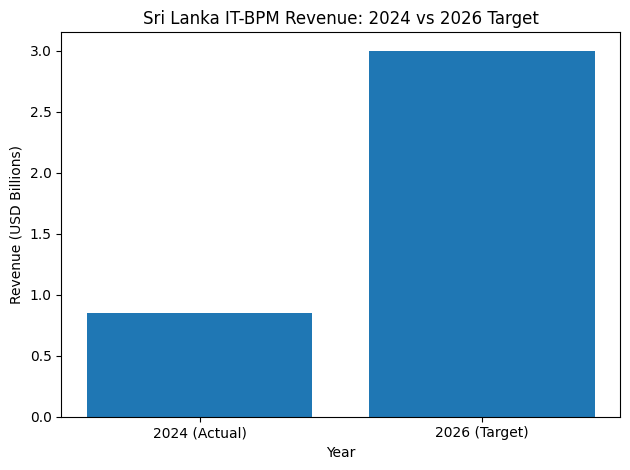
Export earnings from Sri Lanka’s IT-BPM sector reached USD 848 million in 2024, reflecting 6.7% year-on-year growth. Entering 2026, the industry has set a bold export revenue target exceeding USD 3.0 billion, supported by structural expansion in service exports, cloud engineering, cybersecurity, and AI-driven development.
A defining characteristic of the 2026 market is the maturity of Global Capability Centres (GCCs). These strategic delivery units now account for 52% of firms participating in major compensation surveys, highlighting their dominance in shaping salary benchmarks and hiring patterns.
Industry Revenue and Market Indicators
| Market Metric | 2025 / 2026 Value | Growth / Share |
|---|---|---|
| Target IT-BPM Export Revenue | USD 3.0 Billion+ | — |
| Global Capability Centre Share | 52% of Firms | — |
| IT Service Market Growth (2024) | 11.1% | — |
| Export Earnings (2024) | USD 848 Million | 6.7% YoY Growth |
| Internet Penetration Growth | 59.7% | 12% YoY Increase |
This GCC-led expansion mirrors India’s development trajectory, positioning Sri Lanka as a secondary strategic hub for global corporations diversifying operations.
Compensation Normalization and Performance-Linked Rewards
During the crisis years, salary increases were often applied broadly to retain talent. In 2026, however, organizations have shifted toward differentiated compensation models.
Key Trends in 2026 Compensation Strategy
| Compensation Trend | Market Implication |
|---|---|
| Skill-Based Pay Differentiation | Higher premiums for cybersecurity, AI, DevOps |
| Performance-Linked Increments | Rewards tied to measurable output |
| Reduced Across-the-Board Raises | Controlled payroll cost growth |
| Targeted Retention Incentives | Focus on top 10–20% performers |
Demand for traditional design and publishing roles has declined, while hiring for AI/ML engineers, cybersecurity analysts, cloud architects, and data scientists has accelerated significantly.
Despite reduced outward migration compared to 2023 peaks, professional mobility remains a concern—especially among individuals pursuing higher education abroad. Recruitment agencies therefore play a crucial retention and redeployment function.
Strategic Role of Recruitment Agencies in 2026
The top ten recruitment agencies in Sri Lanka facilitate:
• Executive search for GCC leadership
• IT staff augmentation for offshore delivery centers
• Remote workforce deployment under EOR and PEO models
• Data-driven candidate screening and salary benchmarking
• Cross-border talent mobility for international clients
Their strategic relevance extends beyond hiring into advisory services, workforce planning, and compliance management.
Comparative Overview of Top 10 Recruitment Agencies in Sri Lanka (2026)
| Agency Name | Core Strength in IT Hiring | Target Client Segment | Strategic Advantage in 2026 |
|---|---|---|---|
| InTalent Asia | Executive IT search | GCCs, Enterprises | C-level headhunting expertise |
| Exroasia (Pvt) Ltd | EOR and IT staff augmentation | International firms | Compliance-driven remote hiring |
| Alp Consulting Ltd | Enterprise RPO and high-volume staffing | Multinationals | Large-scale infrastructure |
| Eureka Technology Partners | MSP and infrastructure teams | Global IT support operations | 55% faster incident resolution metrics |
| Avomind | High-speed global tech recruitment | Startups and scaling firms | Accelerated 2–4 month hiring cycles |
| JFS Holdings | Cost-efficient IT recruitment and training | Mid-sized firms | Up to 10% admin cost reduction |
| Formix | Remote developer sourcing | Tech-heavy companies | Faster recruitment turnaround |
| Techjobs.lk | ICT-focused employment platform | Domestic IT employers | Direct vacancy exposure to tech community |
| Emerald Isle Manpower and Travel Services | International IT placements | Overseas employers | Multi-country sourcing network |
| 9cv9 | Data-driven tech recruitment | Startups to enterprises | Structured digital talent sourcing |
Cost Structures and Hiring Models in 2026
Recruitment pricing in Sri Lanka varies significantly depending on service model.
| Hiring Model | Typical Cost Structure | Suitable For |
|---|---|---|
| Contingency Recruitment | One-month salary equivalent | Mid-level IT roles |
| Executive Search | Retained fee structure | CTOs, Engineering Directors |
| RPO (Recruitment Process Outsourcing) | Hourly or managed-service contract | GCC and enterprise scale hiring |
| IT Staff Augmentation | USD 30–99 hourly (varies by provider) | Project-based software teams |
| Premium Enterprise RPO | USD 150–250 hourly | Large multinational programs |
Cost optimization remains central to Sri Lanka’s value proposition compared to Western hiring markets, while maintaining high English proficiency and technical competency.
Global Capability Centre (GCC) Expansion and Recruitment Demand
With 52% of firms in compensation surveys classified as GCCs, these centers are the dominant drivers of hiring in 2026.
GCC Hiring Priorities
| Role Category | Strategic Importance |
|---|---|
| Cloud and DevOps | Infrastructure modernization |
| Cybersecurity | Risk mitigation and compliance |
| Data Engineering | Analytics and AI enablement |
| AI/ML Engineers | Automation and product intelligence |
| IT Governance Leaders | Regulatory and operational oversight |
Recruitment agencies capable of supporting structured, large-scale hiring pipelines are critical to sustaining this growth.
Conclusion: Sri Lanka’s Competitive Edge in 2026
Sri Lanka’s IT-BPM sector in 2026 reflects stabilization, structural maturity, and strategic global integration. With:
• A 90,000-strong technology workforce
• 7,000 annual ICT graduates
• A USD 3.0 billion export revenue target
• 52% GCC market participation
• Performance-linked compensation normalization
The country has transitioned from crisis management to strategic optimization.
The top ten recruitment agencies play a decisive role in enabling this transformation—bridging global demand with local capability, optimizing cost structures, accelerating hiring cycles, and ensuring compliance across borders.
For international corporations, Global Capability Centres, and scaling technology firms, Sri Lanka remains a compelling destination for IT workforce expansion in 2026—supported by an increasingly sophisticated recruitment ecosystem capable of delivering both strategic leadership and high-performance technical talent at competitive cost structures.
Compensation Benchmarking and Employer Overheads in Sri Lanka’s IT Sector (2026)
Understanding the True Cost of Employment (TCOE) in 2026
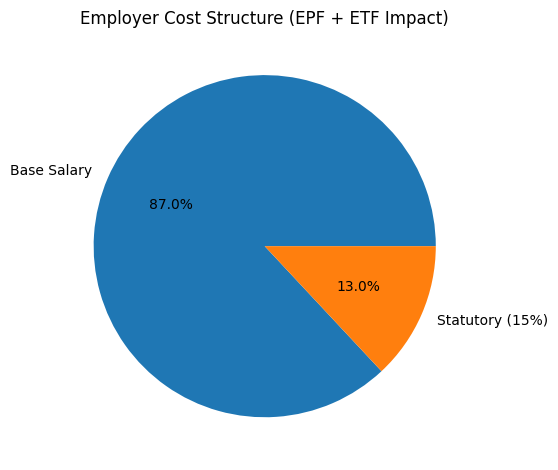
In Sri Lanka’s performance-driven IT-BPM environment in 2026, employers must evaluate hiring decisions based on Total Cost of Employment (TCOE) rather than base salary alone. While salary benchmarking remains central to talent attraction and retention, statutory contributions and structured allowances materially impact workforce budgeting.
The two mandatory employer-side statutory contributions are:
• Employees’ Provident Fund (EPF): 12% of gross salary
• Employees’ Trust Fund (ETF): 3% of gross salary
Together, these create a 15% statutory burden on gross earnings, which directly increases employer overheads.
Statutory Cost Calculation Framework
The total monthly employment cost for an IT professional can be calculated using the following formula:
C_total = S_base + S_fixed_allowance + (S_gross × 0.15)
Where:
• S_base = Basic salary
• S_fixed_allowance = Regular monthly allowances
• S_gross = Basic salary + fixed allowances
• 0.15 = Combined EPF (12%) + ETF (3%) contribution
This means that for every LKR 100,000 in gross salary, the employer incurs an additional LKR 15,000 in statutory costs.
Mid-Level IT Hiring Budget Range in 2026
For mid-level IT professionals, employers typically budget between LKR 175,000 and LKR 425,000 per month in total compensation packages. However, once statutory obligations are factored in, the effective monthly outlay increases substantially.
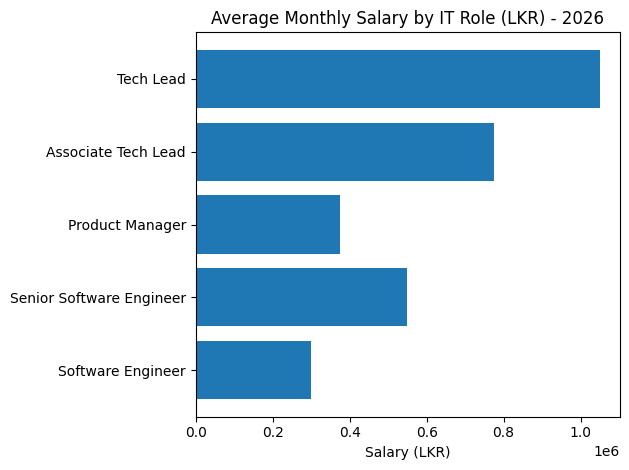
Salary Benchmarking with Employer Cost Impact
| Job Title | Average Monthly Salary (LKR) | Estimated Total Employer Cost (LKR) |
|---|---|---|
| Software Engineer | 300,000 | 345,000 |
| Senior Software Engineer | 450,000 – 650,000 | 517,500 – 747,500 |
| Product Manager | 375,000 | 431,250 |
| Associate Tech Lead | 650,000 – 900,000 | 747,500 – 1,035,000 |
| Tech Lead (6+ Years) | 900,000 – 1,200,000 | 1,035,000 – 1,380,000 |
These figures reflect base salary plus statutory contributions, excluding bonuses, variable pay, health insurance, and performance incentives.
Remote IT Salary Positioning in 2026
Sri Lanka remains a cost-competitive destination for remote software engineering talent when compared to broader Asian averages. However, remote compensation benchmarks are increasingly influenced by foreign currency pegging and global pay transparency trends.
Average remote annual salary expectation for software engineers:
USD 47,736
High-demand specialist roles command significantly higher averages:
| Role Category | Average Annual Remote Salary (USD) |
|---|---|
| DevOps Engineer | 79,600 |
| Data Scientist | 74,222 |
These figures reflect global demand pressures, especially for cloud automation, infrastructure-as-code, and AI-driven analytics roles.
Technology Stack Salary Variability in 2026
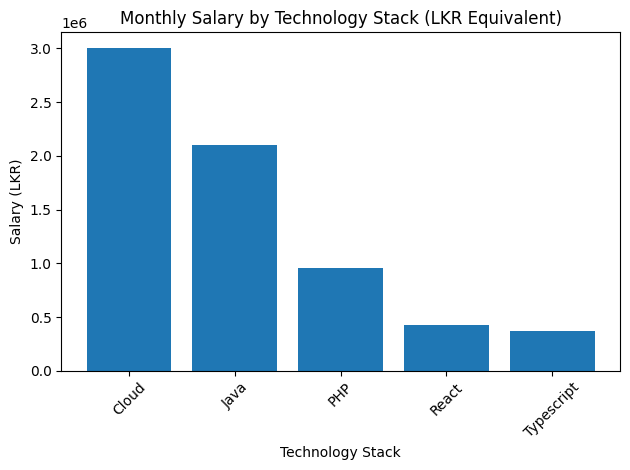
Salary dispersion in Sri Lanka’s IT market is increasingly stack-dependent. Scarcity, enterprise complexity, and cross-border project exposure significantly influence compensation bands.
Notably, foreign currency-linked employment contracts or compensation from non-resident entities can dramatically increase salary equivalents.
Technology Stack Compensation Matrix
| Technology Stack | Average Experience (Years) | Reported Monthly Salary (LKR Equivalent) |
|---|---|---|
| Cloud Infrastructure | 4 | ~3,000,000 |
| Java / Enterprise | 6 | ~2,100,000 |
| PHP / Full Stack | 2 | ~960,000 |
| Javascript / React | 3 | ~425,000 |
| Typescript | 1 | ~370,000 |
Cloud infrastructure specialists command premium compensation due to:
• Multi-cloud deployment complexity
• Infrastructure automation demand
• Security compliance requirements
• GCC-driven modernization projects
Similarly, senior Java enterprise developers remain highly valued due to legacy system modernization and banking-sector digital transformation initiatives.
Employer Budgeting Considerations in 2026
Beyond salary and statutory contributions, employers must account for:
| Cost Component | Typical Impact on TCOE |
|---|---|
| EPF and ETF (15%) | Mandatory statutory addition |
| Annual Performance Bonuses | 1–3 months equivalent (varies) |
| Health and Insurance Benefits | Fixed annual overhead |
| Training and Certification | Strategic upskilling investment |
| Recruitment Fees | 1 month salary or % of annual CTC |
| Remote Infrastructure Support | Equipment and connectivity allowances |
As the market shifts toward performance-linked increments, employers increasingly allocate differentiated salary adjustments to top-performing 10–20% of employees rather than uniform raises.
Strategic Implications for Employers
In 2026, compensation benchmarking in Sri Lanka’s IT sector reflects three defining realities:
• Statutory contributions materially increase real hiring costs
• Technology stack scarcity creates extreme salary dispersion
• Remote and foreign-currency pegged roles disrupt local benchmarks
For organizations expanding Global Capability Centres or building distributed software teams, workforce planning must incorporate:
• Skill-based compensation mapping
• EPF and ETF statutory modeling
• Foreign currency risk assessment
• Retention-driven variable compensation design
Sri Lanka continues to offer strong cost-to-skill value relative to Western markets. However, employers who rely solely on base salary comparisons without accounting for statutory obligations and stack-based variability risk underestimating true hiring costs.
In a performance-driven 2026 environment, successful IT talent acquisition strategies combine competitive salary structures, statutory compliance, differentiated rewards, and targeted investment in high-demand technology capabilities.
Recruitment Agency Fee Structures in Sri Lanka’s IT Sector (2026)
In 2026, recruitment agency pricing models in Sri Lanka have evolved to provide greater transparency, predictability, and flexibility for employers. As the IT-BPM sector matures and Global Capability Centres (GCCs) scale operations, organizations increasingly seek fee structures aligned with hiring complexity, risk allocation, and long-term workforce planning.
While the contingency model remains widely used for mid-level and volume hiring, retained and subscription-based models are gaining prominence for executive search, niche technology roles, and startup scaling mandates.
Fee Model Comparison in 2026
The following table outlines the most common recruitment pricing structures used in Sri Lanka’s IT hiring market:
| Model | Typical Fee (2026) | Best For | Payment Schedule |
|---|---|---|---|
| Contingency | 15% – 30% of annual salary | Mid-level / Volume hiring | Payable only upon successful placement |
| Retained Search | 22% – 30% of annual salary | Senior / Specialized IT roles | 30% upfront, 30% at shortlist, 40% at placement |
| Subscription | £500 – £2,500 per month + 10%–15% fee | Startups / Scaleups | Monthly retainer + reduced placement fee |
| Flat Fee | Fixed amount per hire (role dependent) | Specialized or standardized roles | Fixed payment regardless of salary |
Each model distributes risk differently between employer and agency, influencing both candidate quality and search intensity.
Contingency Recruitment Model
The contingency model continues to dominate mid-level IT recruitment and high-volume hiring. Agencies are compensated only if a candidate is successfully placed.
Advantages:
• No upfront cost for employers
• Lower financial risk
• Suitable for competitive hiring environments
Limitations:
• Agencies may prioritize speed over depth
• Less suitable for confidential or executive roles
In the IT sector, contingency fees typically range between 20% and 30% of annual salary due to the specialized expertise required to source qualified technical candidates.
Retained Search Model
Retained search is preferred for senior leadership, CTO appointments, engineering directors, and niche technology specialists such as AI/ML architects or cybersecurity leads.
Payment is structured in milestones:
• 30% upon engagement
• 30% upon shortlist delivery
• 40% upon successful placement
Advantages:
• Dedicated consultant focus
• In-depth market mapping
• Higher candidate quality assurance
This model is common in Global Capability Centre expansions and enterprise-level hiring programs.
Subscription-Based Recruitment
Subscription recruitment has gained popularity among startups and scaleups in 2026, particularly those requiring continuous hiring rather than isolated placements.
Under this model:
• Employers pay a monthly retainer (£500 – £2,500)
• Placement fees are reduced (typically 10%–15%)
Advantages:
• Predictable monthly budgeting
• Ongoing candidate pipeline development
• Cost efficiency for multiple hires
This model is well-suited for product-led tech startups expanding development teams over several quarters.
Flat Fee Recruitment
Flat fee structures apply to standardized or repeatable roles where salary variation is minimal. The employer pays a fixed amount per hire regardless of compensation level.
Advantages:
• Full cost predictability
• Simplicity in budgeting
• Suitable for recurring hiring patterns
However, flat fee models are less common in high-variance IT roles where salary ranges differ significantly.
Why IT Recruitment Fees Sit at the Higher End
In Sri Lanka’s 2026 market, IT recruitment fees typically cluster at the upper band of 20% to 30% due to:
• Scarcity of experienced engineers in high-demand stacks
• Technical screening requirements
• Access to passive candidate networks
• Cross-border talent sourcing complexity
• Salary benchmarking and market intelligence services
The additional expertise required to validate technical skills, cultural alignment, and remote readiness increases agency effort and therefore fee levels.
Recruitment Fee Cost Illustration
To understand fee impact, consider the following example:
If a Senior Software Engineer earns LKR 600,000 per month:
Annual Salary = LKR 7,200,000
At a 25% contingency fee:
Recruitment Fee = LKR 1,800,000
This cost must be factored into the broader Total Cost of Employment (TCOE), especially when scaling teams rapidly.
Strategic Implications for Employers in 2026
As Sri Lanka’s IT sector moves toward performance-based compensation and structured workforce planning, recruitment fee model selection becomes a strategic decision rather than an administrative one.
Organizations should align fee models with:
• Hiring volume forecasts
• Role criticality and confidentiality
• Speed-to-hire requirements
• Budget predictability needs
• GCC expansion timelines
In 2026, the diversification of recruitment pricing models provides employers with flexibility, but successful IT hiring strategies depend on selecting the right structure for organizational growth stage and technical complexity.
Ultimately, recruitment agency fees in Sri Lanka remain competitive relative to global markets, while reflecting the growing sophistication and specialization of the country’s IT talent acquisition ecosystem.
The Modern Recruitment Process in 2026: Automation, Data Intelligence, and Methodological Precision
Evolution from Manual Hiring to Intelligent Lifecycle Management
By 2026, recruitment in Sri Lanka’s IT-BPM sector has transformed into a data-centric, technology-enabled discipline. Traditional resume screening and reactive hiring methods have been replaced by structured lifecycle management frameworks that prioritize precision, speed, scalability, and candidate experience.
Recruitment agencies now operate as workforce intelligence partners rather than resume brokers. Their methodologies integrate automation, predictive modeling, behavioral analytics, and structured assessment workflows to optimize both time-to-hire and long-term retention outcomes.
The 42-Day Average Time-to-Hire
The average time-to-hire in 2025/2026 has extended to approximately 42 days. This increase does not reflect inefficiency; rather, it signals a deliberate shift toward quality-focused hiring practices.
Several factors contribute to this timeline:
• Expanded technical assessment stages
• Cultural and behavioral alignment screening
• Compensation benchmarking validation
• Multi-stakeholder interview coordination
• Risk mitigation in senior and specialized roles
Time-to-Hire Drivers in 2026
| Hiring Factor | Impact on Timeline |
|---|---|
| Technical Skill Assessments | Adds structured evaluation stages |
| Cultural Fit Interviews | Multi-panel reviews extend cycles |
| Executive Approvals | Governance layers increase decision time |
| Compensation Negotiation | Market benchmarking validation required |
| Candidate Availability | Notice periods of 1–3 months common |
While 42 days is now considered average, senior and niche technology roles often extend beyond 60 days, especially in cybersecurity, AI/ML, and cloud engineering.
Cold Applications vs Referral Success Rates
Online job applications have become increasingly competitive. In 2026, the success rate for cold applications ranges between 0.1% and 2%, reflecting oversupply in application volume and automated filtering thresholds.
In contrast, referral-based candidates demonstrate significantly higher success rates due to:
• Pre-validated trust signals
• Faster interview scheduling
• Higher cultural alignment confidence
• Reduced screening friction
Candidate Success Probability Comparison
| Application Channel | Estimated Success Rate |
|---|---|
| Cold Online Applications | 0.1% – 2% |
| Referral-Based Hiring | Significantly Higher |
| Agency-Shortlisted | Moderately High |
This dynamic reinforces the importance of recruitment agencies with strong technical networks and passive candidate access.
AI and Automation in Talent Sourcing
Leading recruitment agencies such as Emerald Isle and Alp Consulting now integrate AI across multiple phases of the recruitment lifecycle. Automation enhances efficiency without replacing human judgment, particularly in complex IT hiring.
AI-Enabled Recruitment Functions in 2026
| AI Application Area | Operational Purpose |
|---|---|
| Resume Screening | Rapid filtering of large candidate pools |
| Bias Reduction Algorithms | Anonymized initial screening |
| Predictive Analytics | Retention and performance forecasting |
| Video Interview Analysis | Behavioral and communication pattern assessment |
Resume Screening and Intelligent Filtering
AI-powered systems scan thousands of resumes in seconds, identifying the top 5% of candidates based on predefined criteria such as:
• Technical stack alignment
• Years of experience
• Certification credentials
• Project exposure
• Industry relevance
This reduces manual screening burden while improving shortlist quality.
Bias Reduction and Inclusive Hiring
Modern recruitment platforms anonymize candidate information—including name, gender, and age—during initial screening phases. This reduces unconscious bias and supports merit-based evaluation frameworks.
Inclusive screening mechanisms contribute to:
• Improved diversity outcomes
• Fairer shortlisting decisions
• Stronger employer brand positioning
Predictive Analytics and Attrition Modeling
AI systems analyze historical hiring and performance data to forecast:
• Candidate success probability in specific roles
• Likelihood of retention beyond 12–24 months
• Skills correlated with high productivity
• Teams vulnerable to attrition risk
This predictive intelligence enables proactive workforce planning rather than reactive replacement hiring.
Video Interview Analysis and Behavioral Insight
AI-assisted video interview tools evaluate:
• Speech cadence and clarity
• Engagement indicators
• Behavioral confidence markers
• Non-verbal communication signals
While these tools provide supplementary insight, final hiring decisions remain human-led to ensure contextual interpretation and ethical oversight.
Recruitment Lifecycle in 2026
Modern IT recruitment now follows a structured, analytics-driven pipeline:
| Recruitment Stage | Automation Integration Level |
|---|---|
| Talent Sourcing | High |
| Resume Screening | Very High |
| Technical Assessment | Moderate (Hybrid AI + Human) |
| Behavioral Interview | Moderate |
| Final Decision & Offer | Human-Led |
| Post-Placement Tracking | Data-Driven Analytics |
This hybrid model balances algorithmic efficiency with human judgment.
Strategic Implications for Employers
The automation-driven recruitment environment of 2026 presents several advantages:
• Reduced administrative screening time
• Higher shortlisting precision
• Improved diversity metrics
• Data-backed hiring decisions
• Enhanced candidate experience
However, employers must remain mindful of:
• Ethical AI governance
• Data privacy compliance
• Over-reliance on algorithmic scoring
In Sri Lanka’s evolving IT landscape, recruitment is no longer transactional—it is predictive, analytical, and strategically aligned with long-term capability scaling.
The 42-day hiring cycle, AI-enabled screening systems, and referral-dominant success patterns collectively define the modern recruitment process in 2026. Organizations that integrate these methodologies effectively gain a measurable advantage in securing high-performing IT talent within a globally competitive marketplace.
Market Dynamics in 2026: GCC Expansion and the Skills-First Hiring Revolution
Structural Stabilization and Strategic Talent Differentiation
By 2026, Sri Lanka’s IT-BPM industry has entered a stabilized compensation phase following several years of volatility. Salary increments have normalized, and organizations have moved away from broad-based pay adjustments toward targeted, performance-linked reward systems.
The most transformative market forces shaping this environment are:
• The dominance of Global Capability Centres (GCCs)
• The transition to skills-first hiring frameworks
These developments are redefining workforce planning, recruitment methodologies, and employer value propositions across the country’s technology sector.
The Expanding Footprint of Global Capability Centres (GCCs)
Global Capability Centres now represent 52% of firms within Sri Lanka’s IT-BPM landscape. Unlike earlier offshore models that primarily supported transactional back-office operations, modern GCCs function as strategic innovation hubs fully integrated into global corporate ecosystems.
These centres deliver:
• Advanced software engineering
• Cybersecurity operations
• Financial technology systems
• Artificial intelligence and analytics research
• Enterprise IT governance and compliance
GCC Market Influence in 2026
| GCC Market Indicator | 2026 Positioning |
|---|---|
| Share of IT-BPM Firms | 52% |
| Strategic Function | Innovation and core capability delivery |
| Talent Demand Focus | Senior management and specialized engineers |
| Compensation Impact | Premium salaries for niche expertise |
| Recruitment Priority | Talent quality over hiring volume |
The expansion of GCCs has increased demand for high-level management roles, including Engineering Directors, Cloud Architects, AI Program Leads, and IT Governance Heads. As a result, recruitment agencies are shifting from volume-driven hiring metrics to quality-optimized talent acquisition models.
From Volume Hiring to Quality Optimization
In earlier growth phases, recruitment success was often measured by the number of placements completed. In 2026, however, success is defined by:
• Long-term retention rates
• Performance outcomes
• Technical depth alignment
• Cultural integration within global teams
This shift compels recruitment agencies to refine candidate screening, introduce multi-stage assessments, and adopt predictive analytics to forecast candidate success.
The Rise of Skills-First Hiring
One of the most significant structural shifts in 2026 is the move toward skills-first hiring. Traditional academic credentials are increasingly viewed as secondary to demonstrable technical capability.
More than 70% of employers now prioritize:
• Verified work experience
• Portfolio-based evidence of impact
• Recognized technical certifications
• Real-world project contributions
Degree-only qualifications without applied technical depth no longer guarantee interview progression, particularly in high-demand areas such as Cloud Infrastructure, Cybersecurity, and Artificial Intelligence.
Employer Hiring Priorities in 2026
| Evaluation Factor | Relative Importance in 2026 |
|---|---|
| Demonstrable Technical Skills | Very High |
| Industry Certifications | High |
| Portfolio and Practical Projects | High |
| Academic Degree | Moderate |
| Institutional Prestige | Low to Moderate |
In highly technical fields, hiring managers now assess:
• GitHub repositories and open-source contributions
• Cloud deployment case studies
• Security incident management experience
• Machine learning model performance outcomes
Technology Domains Driving the Skills-First Shift
Certain skill categories command exceptional demand due to global digital transformation acceleration.
High-Priority Skill Areas in 2026
| Skill Domain | Primary Employer Demand Driver |
|---|---|
| Cloud Engineering | Infrastructure modernization and scalability |
| Cybersecurity | Regulatory compliance and risk mitigation |
| Artificial Intelligence | Automation and product innovation |
| Data Engineering | Enterprise analytics enablement |
| DevOps and SRE | Operational resilience and uptime management |
In these domains, employers frequently require vendor certifications such as cloud provider credentials, security frameworks, and platform-specific technical validation.
Implications for Recruitment Agencies
The GCC-driven and skills-first market landscape has redefined recruitment agency mandates in Sri Lanka.
Modern agency optimization priorities include:
• Advanced technical screening frameworks
• Certification verification mechanisms
• Skill-mapping analytics
• Candidate upskilling advisory services
• Data-driven performance prediction models
Agencies that continue to focus solely on resume quantity risk irrelevance in a market increasingly defined by precision and performance metrics.
Compensation Stabilization and Differentiation
As increments stabilize, employers are allocating higher salary adjustments specifically to top-performing professionals and niche skill holders rather than applying uniform pay increases.
Compensation Differentiation Trends
| Compensation Strategy | Market Effect |
|---|---|
| Performance-Linked Rewards | Encourages measurable output |
| Skill-Based Premiums | Rewards scarce technical capabilities |
| Targeted Retention Incentives | Reduces outward professional mobility |
| Reduced Across-the-Board Raises | Controls long-term payroll growth |
This strategic allocation reflects a mature market mindset, where compensation is directly tied to value creation rather than tenure alone.
Conclusion: A Quality-Driven, Skills-Centric Market
In 2026, Sri Lanka’s IT-BPM sector is no longer defined by crisis-era retention or aggressive salary inflation. Instead, it is shaped by:
• GCC-led innovation expansion
• Skills-first hiring frameworks
• Performance-driven compensation models
• Talent quality prioritization
The dominance of Global Capability Centres and the widespread adoption of skills-based evaluation have permanently altered recruitment expectations. Organizations that align with this paradigm—prioritizing demonstrable capability over credentials and strategic impact over volume hiring—are best positioned to succeed in Sri Lanka’s increasingly sophisticated technology marketplace.
Strategic Outlook: IT Recruitment in Sri Lanka’s Digital Economy (2026)
A Mature and Competitive Talent Acquisition Ecosystem
By 2026, Sri Lanka’s IT recruitment landscape has evolved into a structured, performance-oriented, and technologically advanced ecosystem. The market is no longer characterized by reactive hiring or crisis-driven retention strategies. Instead, it reflects disciplined workforce planning, compliance awareness, and data-enabled recruitment precision.
For organizations seeking to hire software engineers, cloud specialists, cybersecurity analysts, AI professionals, and technology leaders, the top recruitment agencies operating in Sri Lanka provide critical expertise in navigating:
• Complex local labor regulations
• Mandatory statutory cost structures (EPF and ETF contributions)
• Competitive salary benchmarking
• Global talent mobility dynamics
• GCC-driven workforce expansion
Recruitment agencies have transitioned from transactional intermediaries to strategic workforce advisors capable of supporting long-term capability scaling.
Diverse Agency Strengths Across the Market
The recruitment ecosystem in 2026 is segmented by specialization, with different agencies addressing distinct employer needs.
International Compliance and Executive Search Leaders
Agencies such as Exroasia and InTalent Asia play a leading role in supporting international companies establishing or expanding operations in Sri Lanka. Their expertise includes:
• Employer of Record (EOR) and PEO services
• Executive-level IT recruitment
• Cross-border workforce compliance
• Structured HR advisory and consulting support
These agencies are particularly valuable for multinational corporations and Global Capability Centres requiring compliant hiring frameworks and high-touch recruitment processes.
Technology-Focused Talent Platforms and Veteran Providers
Technology-specific platforms such as Techjobs.lk provide targeted access to Sri Lanka’s ICT and engineering community, improving visibility for specialized roles. Their direct engagement model enhances employer exposure within a highly relevant candidate base.
At the same time, established providers like Emerald Isle and Eureka Technology Partners offer:
• Deep pools of pre-vetted technical professionals
• Strong international placement networks
• Structured screening methodologies
• Managed service delivery capabilities
These agencies combine experience, credibility, and global client integration—key attributes in a skills-scarce market.
Market Readiness for the $3 Billion Revenue Target
As Sri Lanka advances toward its $3 billion IT-BPM export revenue target, recruitment efficiency becomes directly tied to national competitiveness. Global Capability Centres now account for over half of sector participation, reinforcing demand for:
• High-level technical specialists
• Engineering management leaders
• Innovation-driven product teams
• Cloud and AI infrastructure experts
Recruitment agencies that can align talent quality with enterprise-grade expectations will be central to sustaining this growth trajectory.
Technology and AI as Differentiators
The integration of AI-driven recruitment delivery models represents a defining competitive advantage in 2026. Agencies leveraging automation and predictive analytics can:
• Shorten screening cycles
• Improve candidate-role alignment
• Reduce unconscious bias
• Forecast retention probabilities
• Enhance overall hiring accuracy
Technology-enabled recruitment not only improves operational speed but also supports more strategic, data-backed hiring decisions.
Total Rewards Optimization as a Strategic Lever
As compensation stabilization takes hold, organizations are increasingly focused on optimizing total rewards rather than relying solely on base salary increases. Successful employers now combine:
• Skill-based pay differentiation
• Performance-linked incentives
• Structured career progression pathways
• Professional development investments
• Flexible and remote work arrangements
Recruitment agencies that understand total cost of employment (TCOE) modeling and statutory implications are better positioned to advise employers on sustainable hiring strategies.
Key Strategic Success Factors in 2026
The defining elements of successful IT talent acquisition in Sri Lanka’s digital economy include:
• Precision hiring over volume recruitment
• Skills-first evaluation frameworks
• GCC-aligned workforce planning
• AI-enhanced recruitment processes
• Compliance-driven international hiring models
• Differentiated compensation structures
Conclusion
Sri Lanka’s IT recruitment environment in 2026 reflects maturity, sophistication, and strategic alignment with global digital transformation trends. The top recruitment agencies operating within this ecosystem provide the infrastructure, compliance expertise, and technological capability required to compete for high-value technical talent.
As the industry scales toward ambitious export targets and deeper global integration, the agencies that combine AI-driven sourcing, structured assessment methodologies, and total rewards optimization will shape the future of talent acquisition in Sri Lanka’s expanding digital economy.
Conclusion
As Sri Lanka advances deeper into 2026, its Information Technology and Business Process Management (IT-BPM) sector stands at a defining moment of maturity, specialization, and global integration. The country is no longer viewed merely as an emerging outsourcing destination but as a structured, performance-driven digital economy with growing Global Capability Centre (GCC) dominance, expanding cloud infrastructure adoption, and increasing demand for AI, cybersecurity, and advanced software engineering expertise.
Within this evolving environment, identifying the top 10 recruitment agencies for hiring IT and software employees in Sri Lanka in 2026 is not simply a matter of brand recognition. It is a strategic decision that directly influences workforce quality, time-to-hire efficiency, compliance management, and long-term cost optimization.
Sri Lanka’s IT Hiring Landscape in 2026: A Competitive, Skills-First Market
The Sri Lankan technology sector now operates under a skills-first hiring paradigm. Employers prioritize demonstrable technical capability, certifications, real-world project portfolios, and cloud or cybersecurity specialization over purely academic credentials. More than 70% of hiring managers emphasize verifiable experience and impact over degree prestige.
At the same time, the total cost of employment (TCOE) must account for statutory contributions such as EPF (12%) and ETF (3%), meaning employers must budget an additional 15% over gross salary. Salary dispersion has widened significantly, especially for professionals in cloud infrastructure, DevOps, artificial intelligence, and data engineering.
In this highly nuanced hiring environment, recruitment agencies play a critical advisory role. The best agencies do not merely submit CVs. They provide:
• Compensation benchmarking aligned with 2026 market rates
• Compliance guidance on statutory employer obligations
• Access to passive and referral-based technical talent
• Structured screening and technical validation
• Executive search capability for GCC leadership roles
• Remote workforce deployment models
Why the Right Recruitment Partner Matters More Than Ever
With an average time-to-hire of approximately 42 days and cold application success rates as low as 0.1% to 2%, employers can no longer rely on generic job postings alone. The competition for skilled IT professionals in Sri Lanka has intensified, particularly for cloud architects, AI/ML engineers, cybersecurity specialists, and experienced full-stack developers.
The top recruitment agencies identified in this report offer differentiated strengths:
• Executive search expertise for CTOs, Tech Leads, and Engineering Directors
• EOR and PEO services for international companies entering Sri Lanka
• IT-specific talent platforms targeting the ICT community
• Managed service provider (MSP) models for infrastructure and support teams
• RPO and subscription-based hiring models for startups and scaleups
Each agency contributes to the broader ecosystem in a unique way, enabling employers to scale intelligently rather than reactively.
Navigating Cost, Compliance, and Capability Scaling
Sri Lanka’s strategic ambition to surpass USD 3 billion in IT-BPM export revenue reinforces the need for structured talent acquisition. With GCCs accounting for over half of sector participation, recruitment agencies are increasingly evaluated on their ability to deliver high-quality talent rather than sheer hiring volume.
Key considerations for employers selecting a recruitment agency in 2026 include:
• Fee model alignment (contingency, retained, subscription, flat fee)
• Industry specialization in IT and software roles
• Technical assessment rigor
• Market salary intelligence
• Speed-to-hire efficiency
• Retention and performance outcomes
IT recruitment fees typically range between 20% and 30% of annual salary for specialized technical roles. While this may appear substantial, the cost of a mis-hire in a high-impact technology role far exceeds recruitment investment. Therefore, agencies that prioritize quality assurance, predictive analytics, and structured screening frameworks offer measurable long-term value.
The Role of AI and Automation in Modern Recruitment
The integration of artificial intelligence into recruitment workflows has transformed hiring precision. Resume parsing, anonymized screening to reduce bias, predictive retention modeling, and video interview analysis tools now enhance decision-making.
However, automation is not a substitute for human expertise. The most successful recruitment agencies in Sri Lanka combine data-driven tools with industry-experienced consultants who understand local labor laws, global client expectations, and sector-specific technical requirements.
This hybrid approach ensures:
• Faster shortlisting without compromising quality
• Inclusive and merit-based candidate evaluation
• Reduced hiring risk for specialized roles
• Stronger long-term workforce alignment
Sri Lanka’s Competitive Edge in the Global IT Market
Compared to regional peers, Sri Lanka offers a compelling cost-to-skill ratio. While remote software engineers may earn an average of USD 47,736 annually, this remains highly competitive relative to Western markets. Meanwhile, high-demand specialists command premium compensation, especially when paid in foreign currency or through non-resident contracts.
Recruitment agencies that understand these cross-border dynamics are essential partners for multinational corporations, startups expanding distributed teams, and enterprises building innovation hubs.
Strategic Recommendations for Employers in 2026
To maximize hiring outcomes when working with the top recruitment agencies in Sri Lanka, employers should:
• Define clear technical competency frameworks before engaging agencies
• Align compensation budgets with statutory cost modeling
• Choose fee structures suited to hiring volume and role seniority
• Prioritize agencies with demonstrated IT specialization
• Evaluate agencies based on retention and placement quality metrics
Hiring in 2026 is no longer transactional. It is strategic capability building.
Final Perspective: Building the Future of Sri Lanka’s Digital Workforce
The top 10 recruitment agencies for hiring IT and software employees in Sri Lanka in 2026 collectively represent a sophisticated, diversified talent acquisition ecosystem. From executive search and EOR compliance to tech-focused platforms and global MSP providers, these agencies enable organizations to compete in a rapidly evolving digital economy.
As the industry moves beyond crisis-era stabilization into structured growth, the defining success factors for employers will include:
• Skills-first hiring alignment
• Data-driven recruitment processes
• Cost transparency and statutory compliance
• High-quality technical vetting
• Strategic workforce planning
Sri Lanka’s technology sector is no longer emerging; it is accelerating with purpose. Organizations that partner with the right recruitment agencies will not only secure qualified software employees but will also position themselves for sustainable innovation, global competitiveness, and long-term digital leadership.
In 2026 and beyond, strategic IT talent acquisition in Sri Lanka is not just about filling roles. It is about building high-performance technology teams that shape the future of the country’s digital economy.
If you find this article useful, why not share it with your hiring manager and C-level suite friends and also leave a nice comment below?
We, at the 9cv9 Research Team, strive to bring the latest and most meaningful data, guides, and statistics to your doorstep.
To get access to top-quality guides, click over to 9cv9 Blog.
To hire top talents using our modern AI-powered recruitment agency, find out more at 9cv9 Modern AI-Powered Recruitment Agency.
People Also Ask
What are the top recruitment agencies for hiring IT and software employees in Sri Lanka in 2026?
The top recruitment agencies in Sri Lanka for 2026 specialize in IT staffing, executive search, GCC hiring, and remote tech talent sourcing, offering structured screening, salary benchmarking, and compliance support.
Why should companies use IT recruitment agencies in Sri Lanka?
IT recruitment agencies provide access to pre-vetted tech talent, reduce time-to-hire, ensure compliance with local labor laws, and offer market salary insights for competitive hiring.
How much do IT recruitment agencies charge in Sri Lanka in 2026?
Fees typically range from 15% to 30% of annual salary for contingency roles, with retained and subscription models available for executive or high-volume hiring.
What is the average time-to-hire for IT roles in Sri Lanka?
The average time-to-hire in 2026 is around 42 days, depending on role complexity, seniority, and technical assessment requirements.
Are recruitment agencies in Sri Lanka suitable for hiring remote developers?
Yes, many agencies specialize in remote IT hiring, offering cross-border talent sourcing and Employer of Record services for global companies.
What IT roles are most in demand in Sri Lanka in 2026?
High-demand roles include cloud engineers, DevOps specialists, AI/ML engineers, cybersecurity analysts, and senior full-stack developers.
Do Sri Lankan recruitment agencies offer executive IT search services?
Yes, leading agencies provide retained executive search for CTOs, Engineering Directors, and senior technology leadership positions.
What is the average salary for software engineers in Sri Lanka in 2026?
Mid-level software engineers earn around LKR 300,000 per month, while senior roles can exceed LKR 900,000 depending on skills and experience.
How do recruitment agencies screen IT candidates?
Agencies use technical interviews, skills assessments, AI-based resume screening, certification verification, and culture-fit evaluations.
What is the total employer cost of hiring IT employees in Sri Lanka?
Employers must account for a 15% statutory contribution covering EPF and ETF, increasing total cost beyond gross salary.
Are Sri Lankan recruitment agencies experienced with Global Capability Centres?
Yes, many agencies support GCC hiring, focusing on quality, compliance, and senior technical talent acquisition.
Is Sri Lanka cost-effective for hiring software developers in 2026?
Sri Lanka remains cost-competitive compared to Western markets while offering strong English proficiency and skilled tech professionals.
Do recruitment agencies in Sri Lanka use AI in hiring?
Yes, AI is used for resume screening, bias reduction, predictive analytics, and video interview assessments.
What is the success rate of cold online job applications?
Cold applications have a low success rate of 0.1% to 2%, making agency sourcing and referrals more effective.
Can startups use recruitment agencies in Sri Lanka?
Yes, subscription and flexible hiring models are available for startups and scaleups building tech teams.
What industries hire IT talent through recruitment agencies in Sri Lanka?
Key sectors include fintech, eCommerce, SaaS, telecommunications, healthcare tech, and enterprise IT services.
Do agencies provide salary benchmarking for IT roles?
Most top agencies offer up-to-date salary benchmarking to help employers design competitive compensation packages.
Are recruitment agencies helpful for compliance and labor laws?
Yes, agencies guide employers on contracts, statutory contributions, and employment regulations.
What is the benefit of retained search for tech hiring?
Retained search ensures dedicated consultant focus, deeper market mapping, and higher-quality shortlists for niche roles.
Do Sri Lankan agencies support international companies?
Yes, many agencies provide EOR, PEO, and cross-border recruitment support for global firms expanding into Sri Lanka.
What skills are prioritized in Sri Lanka’s IT hiring market?
Employers prioritize cloud certifications, cybersecurity expertise, DevOps automation, AI development, and demonstrable project experience.
How competitive is the IT job market in Sri Lanka in 2026?
The market is highly competitive, particularly for senior and specialized tech roles driven by GCC expansion.
Do recruitment agencies assist with IT staff augmentation?
Yes, many agencies offer contract staffing and staff augmentation for short-term and project-based hiring.
What are the advantages of using a tech-focused recruitment platform?
Tech-focused platforms provide direct access to ICT communities, improving targeting and candidate relevance.
Is executive IT hiring more expensive than mid-level recruitment?
Yes, executive search fees typically range from 22% to 30% of annual salary due to complexity and confidentiality.
How do agencies reduce hiring bias?
AI-powered anonymized screening and structured evaluation frameworks help ensure merit-based selection.
What is a Global Capability Centre in Sri Lanka?
A GCC is a strategic offshore unit delivering IT, finance, or innovation services for global parent companies.
Do recruitment agencies verify certifications and experience?
Yes, leading agencies verify technical certifications, employment history, and project portfolios.
Can agencies help reduce employee turnover?
Through predictive analytics and cultural alignment assessments, agencies improve retention and reduce mis-hire risk.
Why is skills-first hiring important in Sri Lanka in 2026?
Skills-first hiring ensures employers secure capable, impact-driven professionals in a market where practical expertise outweighs academic credentials.
Sources
Adaderana Biz English
- Daily FT
- GigaBPO
- DataReportal
- Daily Mirror
- Inquirer Business
- Scribd
- Playroll
- Arc
- TechSalary
- Clutch
- ExroAsia
- GoodFirms
- Trustpilot
- i-Recruit
- G2
- Wanderlog
- TechBehemoths
- Alp Consulting
- Indeed
- Eureka Technology Partners
- Ensun
- Avomind
- Emerald Isle Manpower
- JIFCO Recruitment
- GIIHire
- Alcor BPO
- SearchX Recruitment
- PG Rec
- HiringThing Blog
- AnitaB
- BPM