





























Key Takeaways
- Strong Market Growth: The global hostel management software market is projected to reach USD 500 million by 2033, driven by cloud adoption, digital transformation, and rising demand for automated hospitality solutions.
- AI and Automation Are Transforming Hostel Operations: AI-powered dynamic pricing, mobile check-in, automated bed allocation, and predictive analytics are reshaping operational efficiency, revenue management, and guest experiences.
- Direct Bookings and Revenue Optimisation Are Critical: With OTAs accounting for 73.7% of hostel bookings in 2025, integrated channel management, direct booking engines, and data-driven pricing strategies are increasingly important for improving profitability.
Hostel management software streamlines accommodation operations through automated reservations, bed allocation, channel management, dynamic pricing, and digital guest services. In 2026, key industry trends include cloud adoption, artificial intelligence, contactless check-in, and direct booking optimisation, with a projected global software market value of USD 500 million by 2033.
The global hostel industry is undergoing a significant technological transformation in 2026, driven by the rapid adoption of cloud computing, artificial intelligence (AI), automated reservation systems, digital payment solutions, and data-driven revenue management. As international tourism expands and traveller expectations evolve, hostel management software is becoming an essential investment for independent hostels, youth hostels, backpacker accommodation providers, boutique hostels, and international hostel chains seeking to improve operational efficiency, maximise profitability, and deliver exceptional guest experiences.

Traditional hostel management methods, including manual reservation tracking, spreadsheets, paper-based guest registration, and disconnected booking systems, are increasingly inadequate in a highly competitive hospitality environment. Modern hostel management software provides a centralised digital infrastructure that enables accommodation providers to manage individual bed reservations, private rooms, occupancy levels, online distribution channels, guest communications, housekeeping operations, financial transactions, and business performance analytics.
The growing demand for these solutions reflects a broader shift towards digital transformation across the hospitality industry. Hostel operators are increasingly recognising that effective technology adoption is not simply a means of reducing administrative workloads but a strategic opportunity to strengthen competitiveness, improve revenue performance, and build scalable accommodation businesses.
The Rapid Growth of the Global Hostel Management Software Market
The global hostel management software market is experiencing substantial expansion as accommodation providers increasingly invest in specialised digital solutions.
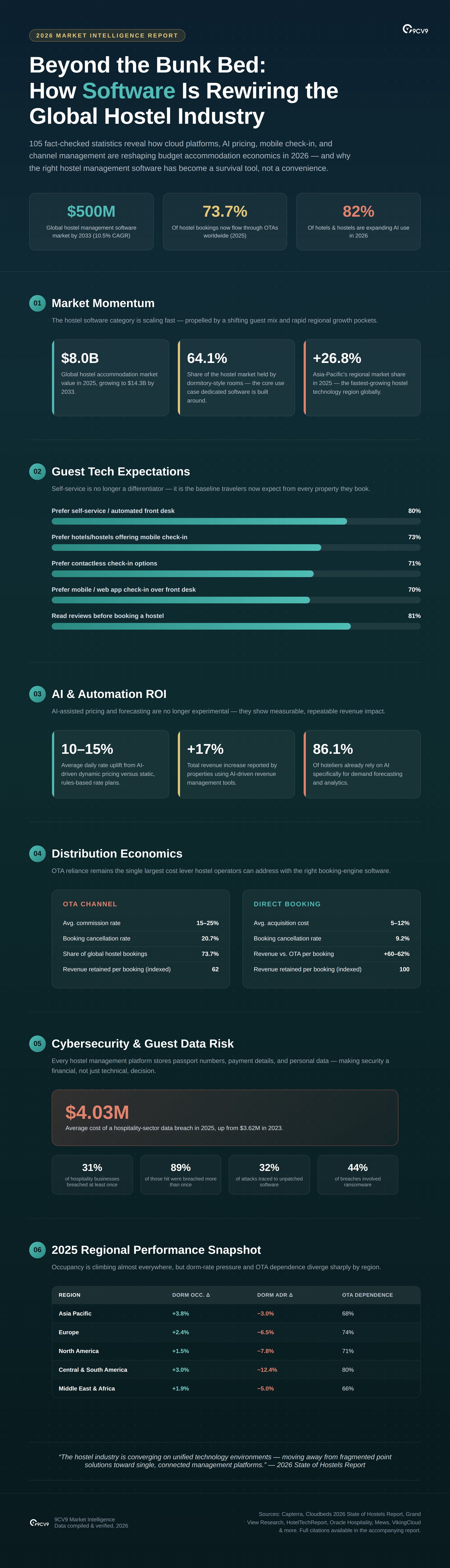
Industry estimates indicate that the global hostel management software market was valued at approximately USD 200 million in 2024 and is projected to reach USD 500 million by 2033, growing at a compound annual growth rate (CAGR) of 10.5%. An alternative market forecast estimates that the sector could expand from USD 285 million in 2024 to USD 720 million by 2033, representing a CAGR of 9.7%.
Although these market valuations differ according to research methodologies and industry definitions, both forecasts indicate strong long-term growth potential for hostel management technology.
The expansion of the software market is closely connected to the growth of the global hostel accommodation industry. The worldwide hostel market was valued at approximately USD 8 billion in 2025 and is projected to reach USD 14.3 billion by 2033, expanding at a CAGR of 7.8%.
Several important market developments are contributing to the increasing demand for hostel management software:
- Europe accounted for approximately 35.5% of global hostel market revenue in 2025.
- Central and South America’s hostel market is projected to grow at a CAGR of 8.4% between 2026 and 2033.
- Dormitory rooms represented approximately 64.1% of the global hostel market by accommodation type in 2025.
- Backpackers and solo travellers accounted for approximately 55.7% of hostel market share by guest type in 2025.
- Asia-Pacific continues to emerge as a high-growth region for hospitality technology and budget accommodation.
- The youth hostel accommodation segment is projected to experience substantial growth over the coming decade.
These developments highlight the increasing commercial importance of specialised hostel property management systems capable of supporting diverse accommodation models, international travellers, and expanding hospitality operations.
Why Hostel Management Software Is Becoming Essential in 2026
Unlike traditional hotels, hostels operate within a distinctive business model that frequently combines shared dormitories, individual bed reservations, private rooms, group accommodation, communal facilities, and flexible lengths of stay.
These operational characteristics create unique management challenges that conventional hotel property management systems may not always address effectively.
For example, a hostel operating multiple dormitory rooms must manage individual bed availability rather than simply tracking whether an entire room is occupied. Reservations may involve different arrival dates, departure schedules, room configurations, guest preferences, and pricing arrangements within the same shared accommodation space.
Furthermore, approximately 90% of hostel properties reportedly offer private-room accommodation, demonstrating the increasing diversification of modern hostel business models.
Purpose-built hostel management software addresses these complexities through integrated functionality that supports both bed-level and room-level inventory management.
Modern hostel management platforms increasingly combine reservation management, automated bed allocation, real-time occupancy tracking, online booking engines, channel management, dynamic pricing, guest relationship management, digital payments, housekeeping coordination, and financial reporting.
By consolidating these operational functions into a connected technology environment, hostel operators can potentially reduce administrative inefficiencies, minimise reservation errors, improve resource allocation, and maintain greater visibility into business performance.
Cloud-Based Hostel Management Software Is Driving Digital Transformation
Cloud computing represents one of the most significant technological developments influencing hostel management software adoption in 2026.
More than 55% of hospitality property management software providers have reportedly shifted towards cloud-based delivery models to improve operational flexibility, scalability, and cost efficiency. Cloud deployment within the broader hospitality PMS market is also advancing at a CAGR of approximately 12.38%.
The transition from traditional on-premises systems to cloud-based hostel management platforms is particularly important for independent accommodation providers that operate with limited financial resources and technical expertise.
Cloud-based hostel management software enables operators to access reservation information, occupancy data, financial reports, and operational dashboards remotely without maintaining extensive local server infrastructure.
Additionally, cloud-based platforms can support automated software updates, centralised multi-property management, integrated booking channels, real-time data synchronisation, and more flexible subscription-based pricing arrangements.
The increasing adoption of software-as-a-service (SaaS) business models is also transforming how hostel operators evaluate, purchase, and implement hospitality technology.
As cloud infrastructure becomes more accessible, smaller hostel businesses can increasingly benefit from advanced management capabilities that were previously associated primarily with large hotel groups and enterprise hospitality organisations.
Artificial Intelligence and Automation Are Reshaping Hostel Operations
Artificial intelligence is rapidly emerging as a major driver of innovation across the hospitality technology sector.
In 2026, AI-powered hostel management software is increasingly associated with intelligent demand forecasting, automated guest communications, predictive analytics, dynamic pricing, personalised recommendations, revenue optimisation, and administrative workflow automation.
Broader hospitality industry statistics indicate that approximately 82% of hotels are expanding their use of artificial intelligence in 2026, while 86.1% of surveyed hoteliers report relying on AI for demand forecasting and analytics.
AI-powered dynamic pricing has also been associated with improvements of approximately 10% to 15% in average daily rates compared with static pricing approaches. Meanwhile, hotels using AI-driven revenue management have reported estimated revenue improvements of approximately 17% compared with non-adopters.
Although these findings originate from the broader hospitality industry rather than hostel-exclusive research, they provide valuable insights into the potential applications of artificial intelligence within budget accommodation operations.
For hostel businesses, AI-powered management systems can help analyse seasonal booking patterns, identify fluctuations in accommodation demand, recommend pricing adjustments, automate routine communications, and improve operational decision-making.
These capabilities are particularly relevant for hostels operating in tourism destinations characterised by fluctuating demand, seasonal occupancy patterns, competitive pricing pressures, and rapidly changing traveller preferences.
Online Travel Agencies and Direct Bookings Are Transforming Hostel Distribution Strategies
Online booking distribution remains one of the most influential factors shaping the hostel management software market.
Hostels frequently depend on online travel agencies (OTAs), including Hostelworld, Booking.com, and Expedia, to attract international travellers, increase accommodation visibility, and maintain occupancy levels.
According to Cloudbeds’ 2026 State of Hostels Report, which draws on an analysis of 32 million bookings across 180 countries, OTAs accounted for approximately 73.7% of hostel bookings globally in 2025.
However, this substantial dependence on third-party booking platforms introduces several financial and operational challenges.
OTA-generated hostel reservations recorded a cancellation rate of approximately 20.7% in 2025, compared with just 9.2% for direct bookings. Accommodation providers also typically face OTA commission rates ranging from 15% to 25% per reservation, with certain promotional and preferred-placement programmes potentially increasing distribution costs further.
These statistics demonstrate the growing importance of hostel management software equipped with integrated channel managers, direct booking engines, automated reservation synchronisation, and distribution analytics.
Effective hostel channel management software enables accommodation providers to maintain consistent availability and pricing across multiple booking platforms while reducing the risk of double bookings and manual reservation errors.
At the same time, direct booking technology provides opportunities for hostel operators to reduce intermediary expenses, strengthen guest relationships, improve customer retention, and retain a greater proportion of accommodation revenue.
As competition intensifies, developing a balanced distribution strategy that combines OTA visibility with profitable direct reservations is becoming an increasingly important business objective.
Changing Traveller Expectations Are Accelerating Hospitality Technology Adoption
Modern travellers increasingly expect convenient, personalised, and digitally connected accommodation experiences throughout their entire journey.
From researching accommodation options and completing online reservations to checking in, making payments, accessing facilities, and submitting reviews, digital technology is becoming deeply integrated into the contemporary hostel guest experience.
Hospitality technology research indicates that approximately 73% of surveyed guests prefer accommodation providers offering mobile check-in services, while 70% of travellers prefer completing check-in through mobile or web applications rather than traditional in-person procedures.
Furthermore, approximately 71% of guests prefer accommodation providers offering self-service technology, while 58% believe artificial intelligence can meaningfully improve their hospitality experience.
The global smart contactless hotel check-in technology market was valued at approximately USD 3.8 billion in 2025 and is projected to grow at a CAGR of 12.1% through 2034.
These developments highlight the increasing relevance of mobile-first hostel management software, automated guest registration, contactless payment processing, digital access management, and personalised guest communications.
Online reputation management is also becoming increasingly important. Approximately 81% of travellers reportedly read accommodation reviews before completing a reservation, making guest feedback collection and reputation monitoring valuable components of modern hostel management platforms.
For independent hostels competing against numerous accommodation providers within popular tourism destinations, delivering consistently positive guest experiences can contribute to stronger online visibility, improved booking conversion, and greater customer loyalty.
Revenue Management and Data Analytics Are Becoming Critical for Hostel Profitability
The increasing complexity of the global hostel market is making data-driven revenue management more important than ever.
Although improving occupancy remains a fundamental objective for accommodation providers, higher occupancy does not necessarily guarantee stronger financial performance.
Industry data indicates that global hostel occupancy increased by approximately 2.8% for private rooms and 2.6% for dormitory accommodation in 2025. However, global dormitory average daily rates declined by approximately 8.2% during the same period.
This divergence between occupancy growth and declining dormitory pricing highlights the importance of sophisticated revenue management strategies.
Hostel operators increasingly require management software capable of monitoring key performance indicators such as occupancy rates, average daily rates (ADR), Revenue Per Available Bed (RevPAB), booking lead times, cancellation rates, distribution expenses, ancillary revenue, and operating costs.
The average hostel booking lead time remained approximately 24 days in 2025, further emphasising the importance of real-time pricing adjustments, accurate inventory visibility, and responsive demand forecasting.
By integrating these performance indicators into centralised reporting dashboards, hostel management software enables operators to identify emerging revenue opportunities, evaluate distribution strategies, optimise accommodation pricing, and make more informed operational decisions.
Cybersecurity and Data Protection Are Increasingly Important Considerations
As hostel management software becomes more interconnected, cybersecurity and guest data protection are emerging as critical priorities for hospitality businesses.
Modern hostel management platforms frequently process sensitive personal information, identification documents, payment records, contact details, and reservation histories. The increasing volume of digitally stored information creates additional responsibilities for accommodation providers and technology vendors.
Broader hospitality industry statistics indicate that approximately 31% of hospitality businesses have experienced at least one data breach, with 89% of affected organisations reportedly experiencing repeat breaches within a single year.
Additionally, approximately 32% of hospitality cyberattacks in 2025 were attributed to outdated systems and unpatched software.
These statistics highlight the importance of evaluating hostel management software according to its security infrastructure, access control mechanisms, data encryption capabilities, software maintenance practices, backup procedures, and third-party integration standards.
While cloud-based hostel management systems can help reduce certain infrastructure and software maintenance risks, effective cybersecurity also requires appropriate system configuration, employee training, secure operational practices, and continuous monitoring.
Emerging Trends Shaping the Future of Hostel Management Software
Beyond traditional reservation management and operational automation, several emerging trends are expected to influence the future development of hostel management software.
The increasing popularity of digital nomadism, flexible working arrangements, extended international travel, and long-stay accommodation is creating demand for more adaptable reservation and billing systems.
Hostel management platforms must increasingly support flexible accommodation durations, recurring payments, monthly-stay discounts, mixed inventory configurations, and personalised guest services.
Sustainable hospitality operations are also becoming an important area of innovation. Paperless registration, digital invoicing, energy management integrations, automated resource monitoring, and more efficient operational workflows can support broader environmental sustainability objectives.
Meanwhile, the growing demand for unified hospitality technology environments reflects a shift away from fragmented software applications towards integrated platforms that combine property management, reservations, payments, distribution, guest engagement, and business analytics.
These developments are expected to create new opportunities for hostel management software providers capable of delivering affordable, scalable, secure, and intelligent technology solutions.
Why Hostel Management Software Statistics Matter in 2026
Understanding the latest hostel management software statistics, market data, and technology trends is essential for hostel owners, hospitality executives, accommodation managers, software developers, technology investors, and tourism industry professionals.
Reliable industry data can help stakeholders understand market growth opportunities, evaluate software investments, identify emerging technologies, benchmark operational performance, assess distribution costs, and develop more effective business strategies.
This comprehensive guide to the Top 105 Hostel Management Software Statistics, Data & Trends in 2026 explores the most significant developments shaping the global hostel management technology landscape, including:
- Global hostel management software market size and growth forecasts.
- Regional hostel accommodation market trends.
- Cloud-based property management software adoption.
- Artificial intelligence and hospitality automation.
- Mobile check-in and contactless guest technologies.
- Online travel agency distribution and commission structures.
- Direct booking trends and reservation management.
- Traveller behaviour and online reputation management.
- Hospitality cybersecurity and data protection.
- Hostel occupancy, dynamic pricing, and revenue management.
- SaaS adoption and software purchasing trends.
- Hostel management software vendor performance.
- Sustainable hospitality and emerging operational technologies.
The guide combines hostel-specific market statistics with relevant research from the broader hospitality technology, accommodation, and SaaS industries. As research methodologies, survey populations, and market definitions vary, these statistics should be interpreted as industry benchmarks rather than universally applicable outcomes for individual hostel businesses.
Ultimately, the future of hostel management will increasingly depend on the effective integration of digital technology, intelligent automation, hospitality expertise, and data-driven decision-making.
As the global hostel industry continues to expand, understanding these 105 hostel management software statistics, data points, and emerging trends can help businesses identify valuable growth opportunities, select suitable technology solutions, improve operational efficiency, strengthen revenue performance, and deliver more competitive guest experiences in 2026 and beyond.
Before we venture further into this article, we would like to share who we are and what we do.
About 9cv9
9cv9 is a business tech startup based in Singapore and Asia, with a strong presence all over the world.
With over ten years of startup and business experience, and being highly involved in connecting with thousands of companies and startups, the 9cv9 team has listed some of the top and best companies/tools in this review.
If you like to get your company listed in our top B2B software reviews, check out our world-class 9cv9 Media and PR service and pricing plans here.
Top 105 Hostel Management Software Statistics, Data & Trends in 2026
Market Size & Growth
- The global hostel management software market was valued at approximately $200 million in 2024 and is projected to reach $500 million by 2033, growing at a CAGR of 10.5%. This steady double-digit growth trajectory signals that budget accommodation operators are rapidly digitizing operations once run on spreadsheets and paper logbooks.
- A separate market analysis pegs the hostel management software market at $285 million in 2024, projected to reach $720 million by 2033 at a 9.7% CAGR. Even with methodology differences between analysts, every major forecast agrees the category is expanding nearly twice as fast as the broader hospitality software market.
- The global hostel market (accommodation revenue, not software) was valued at $8.0 billion in 2025 and is projected to reach $14.3 billion by 2033 at a 7.8% CAGR. As the underlying hostel industry itself scales, demand for purpose-built management software to run those properties efficiently scales in parallel.
- Europe holds the largest regional share of the global hostel market, accounting for 35.5% of revenue in 2025. Hostel management software vendors targeting European multi-lingual, multi-currency, and GDPR-compliant features are positioned closest to the market’s center of gravity.
- The youth hostel market alone reached an estimated $4.32–4.59 billion in 2025–2026 and is forecast to grow to $6.7–8.1 billion by 2030–2035. This dedicated sub-segment underscores that youth and student-focused hostels are a durable, investable niche distinct from general budget lodging.
- The broader hospitality property management software (PMS) market — which hostel-specific tools compete and integrate within — was valued between $1.31 billion and $3.87 billion in 2025 depending on methodology, with most forecasts agreeing on 5.7–8.3% CAGR through 2030–2032. Hostel software buyers benefit from innovation spillover as this larger PMS category funds R&D in cloud infrastructure, mobile apps, and AI features.
- The Hotel Property Management Software market overall was estimated at $8.71 billion in 2025, expected to reach $9.59 billion in 2026, en route to $17.18 billion by 2032 (10.17% CAGR). This scale illustrates how much capital is flowing into property management technology that hostel platforms are increasingly built on or interoperate with.
- Asia-Pacific is consistently flagged as the fastest-growing region for hotel and hostel management software, with some forecasts citing a 26.8% regional market share in 2025 and 12%+ CAGR. Rapid tourism infrastructure growth and leapfrog cloud adoption make APAC the highest-growth theatre for hostel software vendors expanding internationally.
- Central & South America’s hostel market is projected to grow at an 8.4% CAGR from 2026 to 2033, among the fastest of any region. Emerging backpacker corridors in Latin America represent a comparatively underserved market for dedicated hostel management platforms.
- Dormitory rooms accounted for 64.1% of the global hostel market by accommodation type in 2025. Because dorm-style, bed-level inventory is fundamentally different from whole-room hotel bookings, this is precisely why generic hotel PMS platforms fall short and dedicated hostel software (with per-bed allocation) commands a loyal niche.
- Backpackers and solo travelers represented 55.7% of hostel market share by guest type in 2025. Software built around solo-traveler workflows — flexible short stays, social features, and dorm bed management — aligns with the majority demographic hostels actually serve.
- Travel agents and OTAs accounted for 44.6% of hostel bookings by booking mode in 2025, the largest single channel. This makes native, reliable OTA channel-manager integration a non-negotiable feature for any hostel management software purchase decision.
Cloud, Deployment & Core Software Adoption
- More than 55% of hospitality PMS service providers were reported shifting to cloud-based delivery models for greater agility and cost efficiency. The pivot away from on-premise servers directly benefits small, independent hostels that lack in-house IT staff.
- Cloud-based PMS deployment is projected to exceed 65% adoption by 2025 among hospitality operators broadly. For hostel operators specifically, cloud delivery removes the upfront hardware cost that historically kept smaller budget properties on manual systems.
- Cloud deployment models are advancing at a 12.38% CAGR within the hospitality PMS market, faster than on-premise alternatives. This is the clearest quantitative signal that the entire category — hostels included — is migrating decisively to SaaS delivery.
- On-premises hospitality PMS deployments were valued at roughly $2.57 billion versus $2.78 billion for cloud-based systems as of 2024, showing cloud has already overtaken legacy infrastructure in value terms. Hostel operators evaluating software today are choosing between a shrinking legacy category and a growing cloud-native one.
- 72.5% of hotels (a category hostels sit within) use a PMS connected to a channel manager for distribution efficiency. Hostels that lack this integration are manually re-keying availability across Hostelworld, Booking.com, and other channels — a high-risk, time-intensive process automated software eliminates.
- 61% of hotels globally integrated five or more OTAs simultaneously through channel managers as of 2024. Given hostels rely on OTAs for a larger share of bookings than hotels typically do, multi-channel connectivity is arguably even more mission-critical for hostel-specific software.
- One leading connectivity provider links over 191,000 properties to 700+ demand partners through channel manager technology. The sheer scale of these networks shows how deeply automated distribution has become embedded in day-to-day hospitality operations, hostels included.
- A 150-room property managing OTA distribution manually can lose 15–20 staff hours per week to manual rate and availability updates. For a hostel running lean with minimal front-desk staff, this labor cost alone frequently justifies the price of a channel-manager-equipped management system.
- The hotel channel management software market is projected to grow from $3.14 billion in 2025 to $7.93 billion by 2035, a 9.7% CAGR. As channel management becomes a built-in module of hostel management platforms rather than a standalone purchase, this growth directly benefits all-in-one hostel software vendors.
- 51% of hoteliers plan to replace or upgrade their technology stack within the next 12–24 months, according to a November 2025 survey of 300+ hospitality professionals. This signals a wide-open replacement market for hostel management software vendors able to demonstrate clear ROI over incumbent systems.
- Best-in-class (specialized) PMS users report 70% satisfaction versus 55% among all-in-one platform users, and 30% of all-in-one users intend to switch to best-in-class tools versus only 14% moving the other way. This trend favors purpose-built hostel management software over generic, one-size-fits-all hospitality suites.
- HotelTechReport’s 2026 PMS Impact Study surveyed 450 vetted hoteliers across all property types and regions with a ±4.9% margin of error. The scale and rigor of this ongoing benchmarking shows how mainstream and data-driven PMS/software purchase decisions have become across the accommodation sector.
Mobile, Contactless Check-In & Guest Technology
- 73% of guests actively prefer hotels and hostels that offer mobile check-in services, according to Oracle’s Hospitality Technology Report. Hostel software without a self-check-in module is increasingly out of step with baseline traveler expectations.
- Properties offering mobile check-in report 23% higher guest satisfaction rates compared to those relying on traditional front-desk-only check-in. For hostels running on thin staff margins, this satisfaction lift also compounds into better OTA review scores, which directly drives future bookings.
- 70% of travelers say they prefer checking in through mobile or web apps rather than in person. This is a strong signal that self-service check-in functionality should be treated as a baseline software requirement rather than a premium add-on.
- Digital check-in processes are associated with 15–20% more revenue through targeted upselling — room upgrades, late checkout, and add-on packages — at the point of mobile check-in. Hostel software with built-in upsell prompts turns a routine administrative step into an active revenue channel.
- 71% of guests prefer hotels and hostels with self-service technology, and 80% say they favor properties offering a fully automated or self-service front desk. Guest expectations have shifted decisively toward automation, making self-check-in kiosks and mobile-first software a competitive differentiator rather than a novelty.
- 54% of hospitality executives say they plan to keep mobile check-in and checkout as a standard, long-term operational option rather than a temporary pandemic-era workaround. This confirms contactless technology has permanently graduated from crisis response to core software requirement.
- 58% of hotel and hostel guests believe AI can meaningfully improve their stay. Positive guest sentiment toward AI gives hostel software vendors room to introduce chat-based concierge and automated guest communication features without alienating budget-conscious travelers.
- Almost half of surveyed guests say they prefer to check out using their own smartphone rather than visiting the front desk. Mobile checkout functionality reduces morning bottlenecks that are especially disruptive in high-turnover dorm-style hostels.
- The global smart contactless hotel check-in technology market was valued at $3.8 billion in 2025 and is projected to grow at a 12.1% CAGR through 2034. As this hardware-and-software ecosystem matures and becomes cheaper, contactless check-in becomes increasingly accessible for budget-tier hostel operators.
- Mobile applications account for approximately 29.6% of technology-segment revenue within the contactless check-in market, the single largest share. This confirms that smartphone-based check-in — rather than dedicated kiosks or hardware — is the primary interface hostel software needs to support.
- Over 5.6 billion people globally used smartphones in 2026, underpinning near-universal guest readiness for app-based and NFC-enabled check-in. With this level of device penetration among travelers, hostel operators have little practical excuse left to avoid mobile-first management software.
- 58% of US hotel guests say they prefer to book accommodation online rather than by phone or in person. Hostel software with a strong direct-booking engine captures this preference without paying OTA commission on every reservation.
- 71% of North American travelers report using mobile devices during trip planning. Hostel booking engines and management dashboards that are not mobile-optimized risk losing bookings before a guest even reaches the payment page.
Artificial Intelligence & Automation
- 82% of hotels report they are expanding their use of artificial intelligence in 2026, according to industry survey data. Hostel management platforms that lack any AI-assisted forecasting or messaging features risk appearing outdated to increasingly tech-savvy operators.
- 86.1% of hoteliers say they already rely on AI for demand forecasting and analytics. For hostels — where demand is volatile and driven heavily by seasonal backpacker traffic — AI-assisted forecasting can materially reduce both overbooking and empty-bed losses.
- AI-powered dynamic pricing is associated with a 10–15% uplift in average daily rate (ADR) relative to static, rules-based pricing. Even modest per-bed rate optimization compounds meaningfully across a hostel’s hundreds of dorm-bed nights sold per month.
- Hotels using AI-driven revenue management report an estimated 17% increase in total revenue compared to non-adopters. This scale of uplift makes a strong quantitative case for hostel software vendors to prioritize AI pricing modules on their roadmaps.
- 71% of hospitality technology decision-makers say AI is already having a significant or transformative impact on their industry. This sentiment, drawn from a survey of 400+ decision-makers across North America, EMEA, and APAC, indicates AI adoption in hostel-adjacent software is now mainstream rather than experimental.
- 85% of hoteliers plan to allocate at least 5% of their IT budget specifically to AI tools this year. Hostel software vendors that can demonstrate measurable AI-driven ROI are well positioned to capture this growing, ring-fenced spending category.
- Predictive analytics-driven pricing can increase hotel and hostel occupancy rates by 5–10% through smarter rate optimization. For hostels operating on thin per-bed margins, this scale of occupancy gain can be the difference between a profitable month and a break-even one.
- AI-driven personalized marketing solutions in hospitality are projected to exceed $1 billion in value by 2026. As this technology matures and becomes embedded into affordable SaaS tools, personalized guest marketing becomes newly accessible to independent hostels, not just large chains.
- In a documented case study, a small independent hotel group saw a 7.7% sales increase via AI-driven upselling after implementing an AI operations platform, alongside an 11% increase in booking conversion. These measured — not projected — outcomes from an independent operator closely mirror the scale hostels could realistically expect.
- AI adoption among small-to-medium hospitality businesses was projected to grow 15–20% year-over-year. This growth rate specifically targeting smaller operators suggests AI features are trickling down from enterprise hotel chains into the affordable software tier hostels typically purchase from.
Distribution Economics: OTAs vs. Direct Booking
- OTA share of hostel bookings rose to 73.7% globally in 2025, with several markets surpassing 80% intermediary reliance, according to Cloudbeds’ analysis of 32 million bookings across 180 countries. This level of OTA dependence makes reliable channel-manager software — rather than manual multi-platform updates — an operational necessity for virtually every hostel.
- OTA bookings for hostels recorded a 20.7% cancellation rate globally in 2025, compared with just 9.2% for direct bookings. Software that helps hostels drive direct reservations doesn’t just save on commission — it also meaningfully reduces the forecasting chaos caused by high OTA cancellation volumes.
- Average OTA commission rates for accommodation providers in 2026 typically range from 15% to 25% per booking, with some preferred-placement programs pushing effective rates above 30%. For a hostel operating on already-thin dorm-bed margins, this commission load makes booking-engine software a direct profitability lever, not just a convenience.
- Direct bookings generate an estimated 60–62% higher revenue per booking than OTA-sourced reservations. This gap illustrates why hostel management software with an integrated, commission-free direct booking engine delivers outsized value relative to its subscription cost.
- Shifting just 10–15 percentage points of bookings from OTA to direct channels can add over $64,000 in annual net operating income for a typical 100-room independent property at 70% occupancy. While hostels are smaller-ticket than hotels, the same proportional logic applies directly to bed-night revenue at scale.
- On average, direct bookings cost only 5–12% of revenue to acquire (via SEO, PPC, and email), compared with a 15–25% OTA commission. This cost differential is precisely the gap hostel booking-engine and CRM software is designed to help operators close over time.
- 18% of travelers who begin their accommodation search on an OTA ultimately complete their booking directly with the property — up 3.3 percentage points year-over-year. This rising “OTA-to-direct” conversion trend rewards hostels whose management software makes direct booking frictionless once a guest reaches their website.
- Booking.com’s typical commission for accommodation partners runs approximately 15–18%, while Expedia Group properties typically face an 18–22% commission range. Understanding these baseline rates by platform helps hostel operators quantify exactly how much software-enabled distribution optimization is worth pursuing.
- Hostelworld specifically applies a predictable, comparatively lower commission structure near 15% and reports an 8–12% cancellation rate — both lower than many general OTAs. This reinforces why niche, hostel-specific booking platforms remain complementary to, rather than replaceable by, general hotel OTAs.
- Reservations in the budget accommodation segment grew 34% over a recent two-year period, driven largely by Gen Z and young millennial travelers. This growth trajectory underlines the expanding addressable market that hostel management software vendors are ultimately building for.
- Repeat booking rates run approximately 22% higher among travelers using hostel-specialist booking platforms compared with general OTAs. Software that captures and nurtures this specialist-platform guest data gives hostels a meaningful loyalty and remarketing advantage.
Traveler Behavior, Reviews & Reputation
- Hostelworld reported approximately 7 million net bookings in 2025 as it repositions itself from a traditional OTA into a social travel platform. For hostel software vendors, this level of platform-side booking volume is a strong argument for airtight, real-time API integration with Hostelworld specifically.
- 85% of Hostelworld bookings now originate from the platform’s in-app social community, with app bookings up 11% year-over-year in early 2025. Hostel management software that syncs guest social-profile and messaging data from this ecosystem can meaningfully improve pre-arrival guest engagement.
- Hostelworld’s social network comprises roughly 3 million active members engaging with the platform pre- and during-trip. This scale of community engagement demonstrates that modern hostel guests expect social discovery features well beyond a basic booking transaction.
- There are an estimated 45 million backpacking trips taken globally each year. This figure represents the addressable travel volume that hostel operators — and by extension, hostel management software vendors — are ultimately competing to serve.
- 23% of international arrivals globally are classified as youth or student travelers under age 30. This demographic concentration validates why hostel-specific software (rather than generalist hotel PMS) continues to command a loyal, differentiated customer base.
- The average spend on a young traveler’s most recent international trip was just under €3,000, with 69% of that spend occurring in-destination rather than pre-booked. Hostel software with integrated point-of-sale and on-site upsell tools is well positioned to capture a meaningful share of this in-destination spending.
- The average duration of a young traveler’s international trip was 41 days in the most recent survey period, down from 52 days in 2017. This shortening trip length pattern means hostel software needs to handle higher turnover and more frequent check-in/check-out cycles than in previous years.
- A one-point improvement in an accommodation’s online review score has been associated with the ability to increase room rates by up to 11.2%. Because dorm-style hostels compete heavily on OTA search ranking, review-management features within hostel software translate almost directly into pricing power.
- Around 81% of travelers say they read reviews before booking a hotel or hostel. This makes automated review solicitation and reputation-monitoring tools a high-leverage feature category for hostel management platforms to prioritize.
- Review score carries disproportionate weight in OTA search ranking algorithms for independent hostels compared with branded hotel chains, since hostels lack the loyalty-program and brand-recognition signals larger chains rely on. This makes review score effectively the primary “brand” signal for most independent hostels, elevating the importance of software-driven guest satisfaction tracking.
- A hostel with a 90% guest rating built on only 50 total reviews can fall to 78.3% after just ten poor reviews — nearly double the drop experienced by a hostel with 100 existing reviews facing the same negative feedback. This mathematical sensitivity of small review pools is a strong practical argument for software that actively drives review volume, not just review quality.
Cybersecurity & Data Protection
- 31% of hospitality businesses have experienced at least one data breach, and 89% of those experienced repeat breaches within a single year. Because hostel management software stores passport numbers, payment details, and personal traveler data, this repeat-breach pattern underscores the need for built-in, continuously updated security — not a one-time setup.
- The average cost of a hospitality-sector data breach reached approximately $3.82–4.03 million in 2025, with major incidents exceeding $5 million. For small independent hostels, a breach of this scale would be catastrophic relative to annual revenue, making vendor-managed cloud security a major, quantifiable risk-reduction benefit of modern hostel software.
- 32% of cyberattacks against hospitality businesses in 2025 were caused by unpatched software and outdated systems. Cloud-based hostel management software that pushes automatic security updates directly eliminates a documented root cause behind roughly a third of sector breaches.
- 70% of hospitality staff have access to sensitive guest systems without receiving regular cybersecurity training. Software with role-based access controls and permission tiers can meaningfully reduce this internal exposure even where staff training remains inconsistent.
- Researchers identified over 14,000 publicly exposed vulnerabilities across hospitality technology systems, with 61.5% of breaches traced back to these known openings. This finding reinforces that choosing an actively maintained, regularly patched software vendor is a measurable security decision, not a mere technical preference.
- 58% of surveyed North American hotels were attacked five or more times in a single peak season, with nearly half reporting downtime exceeding 12 hours. For a hostel, 12+ hours of system downtime during peak check-in periods would directly translate into lost bookings and guest disruption — a strong argument for redundant, cloud-hosted infrastructure.
- Ransomware featured in 44% of hospitality-sector data breaches analyzed in a recent industry threat report. This concentration of ransomware risk makes automated cloud backup — a standard feature in modern SaaS hostel software — a critical operational safeguard rather than a nice-to-have.
- Third-party vendor involvement in hospitality breaches has climbed sharply in recent threat reports, reflecting growing risk from connected reservation platforms and payment processors. Hostel operators should treat their choice of software vendor’s own security certifications as an extension of their property’s overall risk posture.
Occupancy, Pricing & Hostel-Specific KPIs
- Global hostel occupancy increased across both private rooms (+2.8%) and dormitory rooms (+2.6%) in 2025, based on Cloudbeds’ analysis of 32 million bookings in 180 countries. Rising occupancy against a backdrop of falling dorm pricing power signals that operational efficiency — the core value proposition of management software — matters more than ever to protect margins.
- Global dormitory average daily rate (ADR) declined 8.2% in 2025 even as occupancy rose, while private room ADR remained comparatively stable. This growing pricing pressure on dorm beds specifically makes software-driven dynamic pricing and ancillary revenue tools especially valuable for the traditional dorm-heavy hostel business model.
- Travelers booked hostel stays an average of 24 days in advance in 2025, a figure that has remained stable compared to 2024. This relatively short, consistent booking window means hostel software needs to support fast, near-real-time rate and availability adjustments rather than long-range static pricing.
- Asia Pacific emerged as one of the strongest-performing hostel regions in 2025, with growth recorded across both private rooms and dorms. This regional outperformance makes APAC a priority market for hostel software vendors seeking their next phase of geographic expansion.
- Latin America experienced significant hostel rate compression in 2025 despite rising occupancy, reflecting an uneven global recovery. Software-enabled yield management is particularly valuable in markets like this, where operators need to protect revenue even as raw occupancy numbers look healthy.
- A benchmark hostel financial model cites an initial target occupancy rate of roughly 65%, with an ambition to reach 87% by 2030. Reaching and sustaining occupancy at this level requires the kind of granular, bed-level booking visibility that spreadsheet-based management simply cannot provide at scale.
- Revenue Per Available Bed (RevPAB) has emerged as a primary hostel-specific KPI, distinct from the RevPAR metric used in traditional hotels. The existence of a dedicated metric underscores why hostel operators need purpose-built reporting dashboards rather than repurposed hotel software that reports only at the room level.
- OTA commissions can represent as much as 50% of variable operating costs for some hostel business models when starting out. This scale of commission drag is a powerful financial argument for prioritizing hostel software with a strong, easy-to-use direct booking engine from day one.
- A benchmark hostel model shows a path to operational break-even in as little as 5 months when occupancy, pricing, and cost tracking are actively managed. Achieving this speed to profitability is far more attainable when an operator has real-time visibility into occupancy, ADR, and cost KPIs — precisely what management software dashboards provide.
- Hostels added an estimated 15% more dormitory beds globally in a recent measured period, pushing total dorm capacity past 1.5 million beds, while private-room capacity grew 25% to 1.1 million beds. This capacity growth on both fronts means hostel software must flexibly support mixed dorm-and-private-room inventory models, not a single rigid room type.
- Private-room offerings are now present in roughly 90% of hostel properties, reflecting broad diversification beyond the traditional pure-dormitory model. Software built exclusively around dorm-bed logic risks becoming obsolete; modern hostel platforms need equally strong private-room booking and rate management.
SaaS & Software Purchasing Trends (Broader Context)
- Businesses now spend an estimated $10,800 per employee per year on SaaS subscriptions overall, up from roughly $8,500 in 2023. This rising baseline software spend suggests hostel operators’ overall technology budgets are also trending upward, creating room for more sophisticated management platforms.
- SaaS now accounts for 35–45% of the average organization’s total IT budget, up from roughly a quarter of the budget in 2020. As software spending claims a growing share of operating budgets across every industry, hostel operators are increasingly primed to treat management software as a core line item rather than a discretionary expense.
- Roughly 58% of SaaS products retain a per-seat pricing component, while about 67% now use some form of tiered pricing structure. Hostel software buyers evaluating vendors should expect — and can negotiate around — tiered plans scaled to property size, bed count, or number of staff logins.
- Hybrid SaaS pricing models (combining subscription and usage-based elements) grew from 27% to 41% adoption in a recent 12-month period. Hostel operators may increasingly encounter usage-based pricing components tied to booking volume rather than flat monthly fees as vendors adopt this broader industry trend.
- The average small business manages between 25 and 55 separate SaaS applications. This proliferation of point solutions is precisely the fragmentation that all-in-one hostel management software — combining PMS, channel manager, booking engine, and POS — is designed to consolidate.
Software Marketplace & Vendor Landscape (Capterra & Peer Review Platforms)
- Capterra has verified over 2.5 million user reviews across its software marketplace, providing a large, credibility-checked evaluation pool for hostel management software buyers. This scale of independent, human-moderated review verification gives hostel operators far more purchasing confidence than vendor-supplied testimonials alone.
- Leading hostel management software platforms on Capterra typically post ratings in the 4.2–4.5 range out of 5, consistent across Capterra, G2, and Software Advice. This cross-platform consistency suggests genuine, broadly shared satisfaction levels rather than platform-specific review bias.
- One prominent hostel-focused PMS vendor reports serving over 2,000 properties across 45 countries, having operated continuously since 2003. Longevity and multi-country deployment at this scale demonstrate that dedicated hostel software has moved well beyond a niche, unproven product category.
- A leading channel manager embedded within hospitality software serves over 28,000 properties worldwide. This scale of adoption for a single distribution module illustrates how deeply automated, software-driven distribution has penetrated the accommodation sector, hostels included.
- Hostel management software listings on Capterra are explicitly cross-referenced with adjacent categories including Hospitality Property Management Software, Vacation Rental Software, and Reservations Software. This overlap confirms that most hostel operators are effectively comparison-shopping across several adjacent software categories before settling on a hostel-specific solution.
- Software Advice, G2, and Capterra collectively function as the three dominant peer-review platforms hostel software buyers consult before purchase, according to vendor comparison guides published in 2026. The consistent appearance of the same three platforms across nearly every buyer’s guide indicates a mature, well-established review ecosystem specific to this software category.
- HotelTechReport’s ongoing hotel and hostel technology rankings are informed by digital interviews with over 8,192 verified hoteliers across 146 countries. This breadth of verified respondent data gives hostel operators an unusually rigorous, global benchmark for comparing management software vendors before committing to a purchase.
Sustainability & Emerging Operational Trends
- Sustainability-driven operations were flagged as one of seven major emerging trends expected to shape the hostel industry through 2026, alongside AI-driven transformation and rising demand from digital nomads. Hostel software vendors adding energy-usage tracking or paperless-operations modules are responding directly to this documented industry-wide shift.
- The 2026 State of Hostels Report specifically identifies growing demand for unified technology environments, as hostel operators move away from fragmented point solutions toward single connected platforms. This trend is the clearest possible market validation for all-in-one hostel management software over stitched-together combinations of separate booking, PMS, and payment tools.
- Over 65% of European hotels had adopted PMS integrations with IoT devices by 2023 to improve energy management and guest experience, according to European Hospitality Association data. As IoT-PMS integration matures in the broader hotel sector, hostel software platforms are well positioned to extend similar smart-building efficiencies to budget accommodation.
- Independent hotels report double-digit revenue lifts after implementing cloud PMS platforms that bundle channel management and guest-experience functions together. This bundled-platform revenue benefit applies directly to hostels adopting similarly consolidated, cloud-based management software rather than piecemeal legacy tools.
- Demand from long-stay travelers and digital nomads was explicitly named as a growth driver for the hostel sector heading into 2026. Hostel software supporting flexible, longer-duration billing cycles and monthly-stay discounting is directly aligned with this documented shift in guest demand patterns.
Conclusion
The Top 105 Hostel Management Software Statistics, Data & Trends in 2026 reveal an increasingly digital, interconnected, and data-driven global hostel industry. As international tourism continues to expand, traveller expectations evolve, and competition among budget accommodation providers intensifies, hostel management software is becoming a fundamental component of operational efficiency, revenue optimisation, guest satisfaction, and sustainable business growth.
The statistics demonstrate that hostel management technology is no longer limited to basic reservation processing and administrative recordkeeping. Modern hostel management systems are evolving into comprehensive hospitality technology platforms that integrate property management, bed-level inventory control, online booking engines, channel management, artificial intelligence, automated guest communications, digital payments, cybersecurity, and advanced performance analytics.
For hostel owners, accommodation managers, hospitality technology providers, and investors, these developments highlight the growing strategic importance of digital transformation across the global budget accommodation sector.
Strong Market Growth Signals Increasing Demand for Hostel Management Software
The global hostel management software market is positioned for substantial long-term expansion. Market estimates indicate that the industry could grow from approximately USD 200 million in 2024 to USD 500 million by 2033, representing a compound annual growth rate of 10.5%. Alternative market projections suggest that the sector could reach USD 720 million by 2033, further reinforcing expectations of sustained demand for specialised hostel management solutions.
Pasted markdown(20261129-155302).md
This technological expansion is supported by the growth of the underlying hostel accommodation industry, which was valued at approximately USD 8 billion in 2025 and is projected to reach USD 14.3 billion by 2033.
Pasted markdown(20261129-155302).md
The increasing popularity of affordable international travel, backpacking, solo tourism, youth travel, and flexible accommodation models is creating considerable opportunities for hostel management software providers.
Furthermore, with dormitory accommodation accounting for 64.1% of the global hostel market and backpackers and solo travellers representing 55.7% of market share by guest type in 2025, specialised hostel property management systems remain particularly relevant.
Pasted markdown(20261129-155302).md
Unlike conventional hotel management platforms, dedicated hostel software must accommodate individual bed reservations, shared dormitories, private rooms, flexible accommodation arrangements, and frequent guest turnover.
Cloud-Based Hostel Management Software Is Reshaping Hospitality Operations
Cloud computing remains one of the most significant technological forces influencing hostel management software adoption in 2026.
More than 55% of hospitality property management software providers have reportedly shifted towards cloud-based delivery models, while cloud deployment within the hospitality PMS market is advancing at a CAGR of 12.38%.
Pasted markdown(20261129-155302).md
These developments indicate a broader transition away from traditional on-premises infrastructure towards flexible, scalable, and remotely accessible software solutions.
For independent hostels and small accommodation businesses, cloud-based hostel management software can deliver considerable operational advantages, including reduced infrastructure requirements, simplified maintenance, centralised reservation management, automated software updates, and improved accessibility across multiple devices and locations.
As cloud technology continues to mature, hostel operators are likely to increasingly favour integrated software platforms capable of consolidating multiple operational functions within a unified digital environment.
Artificial Intelligence and Automation Are Becoming Essential Competitive Tools
Artificial intelligence is rapidly transforming the hospitality technology landscape, creating new opportunities for hostel operators to improve productivity, optimise pricing, and enhance guest experiences.
Broader hospitality industry statistics indicate that 82% of hotels are expanding their use of AI in 2026, while 86.1% of surveyed hoteliers report relying on artificial intelligence for demand forecasting and analytics. AI-powered dynamic pricing has also been associated with average daily rate improvements of approximately 10% to 15% compared with static pricing approaches.
Pasted markdown(20261129-155302).md
Although these findings relate to the wider hospitality sector rather than hostels exclusively, they illustrate the potential value of intelligent automation for budget accommodation businesses.
The continued integration of artificial intelligence into hostel management software is expected to support several important operational capabilities:
- Automated demand forecasting and occupancy prediction.
- Dynamic bed and private-room pricing optimisation.
- Intelligent reservation and inventory management.
- Automated guest communications and personalised messaging.
- Predictive revenue management and financial analytics.
- Personalised accommodation recommendations and upselling.
- Automated administrative workflows and reporting.
- Improved identification of seasonal demand patterns.
Hostel businesses that successfully integrate these technologies may be better positioned to reduce repetitive workloads, improve operational responsiveness, and protect profitability in increasingly competitive markets.
Online Booking Distribution Remains a Major Profitability Challenge
One of the most important findings from the hostel management software statistics is the industry’s substantial dependence on online travel agencies.
Industry booking data indicates that OTAs accounted for 73.7% of hostel reservations globally in 2025. However, OTA-generated hostel bookings experienced a cancellation rate of 20.7%, compared with only 9.2% for direct reservations. Accommodation providers also typically face OTA commission rates ranging from 15% to 25%.
Pasted markdown(20261129-155302).md
These figures demonstrate why effective distribution management has become a strategic priority for hostel operators.
Integrated hostel channel management software enables businesses to synchronise availability, pricing, and reservations across multiple booking platforms while reducing the risk of double bookings and administrative errors.
At the same time, direct booking engines provide hostel operators with opportunities to reduce intermediary expenses, strengthen customer relationships, collect first-party guest data, and improve long-term revenue retention.
Rather than eliminating OTAs entirely, successful hostel businesses should aim to develop balanced distribution strategies that combine the international visibility of established booking marketplaces with the financial advantages of direct reservations.
Digital Guest Experiences Are Redefining Hostel Service Standards
Changing traveller preferences are another major factor influencing the development of hostel management software in 2026.
Hospitality technology research indicates that 73% of surveyed guests prefer accommodation providers offering mobile check-in services, while 70% of travellers favour mobile or web-based check-in over traditional in-person processes.
Pasted markdown(20261129-155302).md
These findings highlight the increasing importance of mobile-first hospitality experiences, self-service technologies, contactless payments, and automated guest interactions.
For hostel operators, digital guest management solutions can help reduce front-desk congestion, simplify arrival and departure procedures, improve communication efficiency, and provide greater convenience for international travellers.
Online reputation management is equally important. Approximately 81% of travellers reportedly read accommodation reviews before completing a booking, while improvements in online review scores have been associated with greater accommodation pricing power.
Pasted markdown(20261129-155302).md
Consequently, hostel management platforms that integrate guest feedback collection, automated review requests, personalised communication, and service performance monitoring can support both operational improvements and stronger online visibility.
Data-Driven Revenue Management Is Critical for Long-Term Profitability
The latest hostel industry statistics demonstrate that increasing occupancy does not necessarily translate into stronger financial performance.
In 2025, global hostel occupancy increased by 2.8% for private rooms and 2.6% for dormitory rooms within a major hospitality booking dataset. However, global dormitory average daily rates declined by 8.2%, reflecting significant pricing pressure despite improving occupancy levels.
Pasted markdown(20261129-155302).md
This divergence reinforces the importance of sophisticated hostel revenue management software capable of monitoring financial and operational performance in real time.
Hostel operators should increasingly prioritise software solutions that provide visibility into essential performance indicators such as occupancy rates, average daily rates, revenue per available bed (RevPAB), booking lead times, cancellation rates, distribution costs, and ancillary revenue.
By analysing these metrics collectively, hostel businesses can make more informed decisions regarding pricing strategies, promotional campaigns, staffing requirements, accommodation configurations, and distribution investments.
The ability to translate operational data into actionable business insights will remain an important competitive advantage as the hostel industry becomes increasingly sophisticated.
Cybersecurity and Data Protection Must Remain Strategic Priorities
As hostel management software becomes more interconnected, cybersecurity and guest data protection are becoming increasingly important considerations for accommodation providers.
Broader hospitality industry statistics indicate that 31% of hospitality businesses have experienced at least one data breach, with 89% of affected businesses experiencing repeat breaches within a single year. Additionally, approximately 32% of hospitality cyberattacks in 2025 were attributed to unpatched software and outdated systems.
Pasted markdown(20261129-155302).md
These findings highlight the potential financial, operational, and reputational consequences of inadequate cybersecurity practices.
Hostel operators should therefore evaluate software providers not only on pricing, usability, and functionality but also on their security infrastructure, data protection policies, access management capabilities, software maintenance practices, backup systems, and disaster recovery procedures.
Cloud-based hostel management software can help address certain infrastructure and maintenance risks, but effective cybersecurity still requires appropriate configuration, employee training, vendor oversight, and continuous monitoring.
The Future of Hostel Management Software Beyond 2026
Looking ahead, the hostel management software industry is expected to become increasingly intelligent, integrated, automated, and guest-centric.
The growing demand for unified hospitality technology environments indicates that hostel operators are moving away from fragmented software ecosystems towards connected platforms that combine reservations, property management, distribution, payments, guest engagement, and operational analytics.
Emerging trends such as sustainable hospitality operations, Internet of Things (IoT) integrations, AI-powered revenue optimisation, digital nomad accommodation, flexible long-stay billing, and mobile-first guest services are likely to influence future software development.
The increasing diversification of hostel accommodation models will also shape technology requirements. With approximately 90% of hostel properties reportedly offering private rooms, future hostel management systems must effectively support both traditional dormitory accommodation and private-room inventory.
Pasted markdown(20261129-155302).md
Software providers capable of delivering flexible, affordable, secure, and scalable solutions will be well positioned to address the evolving requirements of independent hostels, youth accommodation providers, backpacker establishments, boutique hostels, and international hostel chains.
Final Thoughts
The 105 hostel management software statistics, data points, and industry trends examined in this guide collectively demonstrate that technology is becoming a central driver of competitiveness within the global hostel industry.
From expanding software market valuations and accelerating cloud adoption to artificial intelligence, automated booking distribution, contactless guest experiences, cybersecurity, and advanced revenue analytics, the hostel management software landscape is undergoing substantial transformation.
For hostel owners and hospitality professionals, selecting the right hostel management software should involve a comprehensive evaluation of operational requirements, accommodation inventory structures, distribution strategies, integration capabilities, security standards, scalability, and total cost of ownership.
The most suitable hostel management system is not necessarily the platform offering the greatest number of features. Instead, it is the solution that effectively addresses the property’s specific operational challenges while supporting measurable improvements in productivity, guest satisfaction, revenue performance, and long-term business resilience.
It is also important to recognise that some of the statistics presented in this guide originate from the broader hospitality technology and SaaS markets rather than hostel-specific research. Market forecasts may differ according to research methodology, geographic coverage, and market definitions. These figures should therefore be interpreted as strategic industry benchmarks rather than guaranteed outcomes for individual hostel businesses.
Ultimately, the future of hostel management will increasingly depend on the effective combination of hospitality expertise, intelligent automation, reliable digital infrastructure, and data-driven decision-making.
Hostel businesses that embrace appropriate technology investments, continuously optimise their operational processes, strengthen direct booking capabilities, and adapt to changing traveller expectations will be better positioned to navigate the evolving hospitality landscape.
As the global hostel accommodation industry continues to expand, hostel management software will remain an increasingly important strategic investment for businesses seeking to improve operational efficiency, maximise profitability, enhance guest experiences, and achieve sustainable growth in 2026 and beyond.
If you find this article useful, why not share it with your hiring manager and C-level suite friends and also leave a nice comment below?
We, at the 9cv9 Research Team, strive to bring the latest and most meaningful data, guides, and statistics to your doorstep.
To get access to top-quality guides, click over to 9cv9 Blog.
To hire top talents using our modern AI-powered recruitment agency, find out more at 9cv9 Modern AI-Powered Recruitment Agency.
People Also Ask
“Give a list of 30 Seo-optimised FAQ questions and answers that people will ask for the blog topic “”Top 105 Hostel Management Software Statistics, Data & Trends in 2026″”. Please write each answer in under 320 characters. – Remove all the “”Q:”” and “”A:””. – Format the questions in H4 and remove all bullet points. – Bold the questions only – Remove all numberings, if any. – Do not bold the answers – Write 30 questions/answers – Do not write any HTML tag in the answer – Do not write the “”H4″” word in it”
What is hostel management software?
Hostel management software is a digital platform that helps hostel operators manage reservations, bed allocation, guest check-ins, payments, housekeeping, online distribution, and revenue management through a centralised system.
What is the global hostel management software market size in 2026?
The global hostel management software market was valued at approximately USD 200 million in 2024 and is projected to reach USD 500 million by 2033, growing at a CAGR of 10.5%.
How fast is the hostel management software market growing?
Market forecasts estimate that the hostel management software industry is growing at a CAGR of approximately 9.7% to 10.5%, driven by cloud adoption, automation, digital reservations, and hospitality technology investments.
What are the biggest hostel management software trends in 2026?
Major trends include cloud-based property management, AI-powered dynamic pricing, contactless check-in, automated bed allocation, integrated channel management, predictive analytics, cybersecurity, and direct booking optimisation.
How large is the global hostel accommodation market?
The global hostel accommodation market was valued at approximately USD 8 billion in 2025 and is projected to reach USD 14.3 billion by 2033, expanding at a CAGR of 7.8%.
Which region has the largest hostel market share?
Europe accounted for approximately 35.5% of global hostel market revenue in 2025, making it the largest regional market and an important opportunity for hostel management software providers.
Which region is experiencing rapid hostel management software growth?
Asia-Pacific is among the fastest-growing regions for hospitality management software, supported by expanding tourism infrastructure, increasing digital adoption, and growing demand for affordable accommodation.
Why is cloud-based hostel management software becoming popular?
Cloud-based hostel management software offers remote accessibility, automated updates, lower infrastructure costs, real-time reservation management, and scalable functionality without requiring expensive on-premises servers.
What percentage of hospitality software providers are adopting cloud technology?
More than 55% of hospitality PMS service providers have reportedly shifted towards cloud-based delivery models to improve scalability, operational flexibility, and cost efficiency.
How is artificial intelligence transforming hostel management software?
AI transforms hostel management software through demand forecasting, dynamic pricing, automated guest communications, predictive analytics, personalised recommendations, intelligent upselling, and administrative workflow automation.
What percentage of hotels are expanding AI adoption in 2026?
Broader hospitality industry data indicates that approximately 82% of hotels are expanding their use of artificial intelligence in 2026, reflecting growing demand for intelligent hospitality management solutions.
How does AI-powered dynamic pricing benefit hostels?
AI-powered dynamic pricing adjusts accommodation rates according to demand, occupancy, seasonality, and market conditions. Hospitality research associates this technology with average daily rate improvements of approximately 10% to 15%.
What percentage of hostel bookings come from online travel agencies?
According to a major hospitality booking dataset, online travel agencies accounted for 73.7% of global hostel bookings in 2025, highlighting the importance of integrated channel management software.
What is the average OTA commission rate for hostels?
Online travel agency commissions typically range from 15% to 25% per accommodation booking, although premium placement programmes and additional promotional services may increase effective commission costs.
Why are direct booking engines important for hostels?
Direct booking engines help hostels reduce OTA commissions, strengthen guest relationships, collect first-party customer data, manage reservations independently, and improve revenue retention.
How do OTA cancellation rates compare with direct hostel bookings?
In 2025, OTA-generated hostel bookings recorded a cancellation rate of approximately 20.7%, compared with 9.2% for direct reservations in a major global hospitality booking dataset.
What is a hostel channel management system?
A hostel channel management system automatically synchronises bed availability, accommodation rates, and reservations across multiple online booking platforms, reducing manual updates and minimising double bookings.
What percentage of hotels use integrated PMS and channel management software?
Approximately 72.5% of hotels reportedly use a property management system connected to a channel manager, demonstrating the importance of automated distribution technology across the hospitality industry.
How popular is mobile check-in among hospitality guests?
Hospitality technology research indicates that approximately 73% of surveyed guests prefer accommodation providers offering mobile check-in, while 70% favour mobile or web-based check-in over traditional in-person procedures.
How does hostel management software improve guest satisfaction?
Hostel management software improves guest satisfaction through faster check-ins, accurate reservations, automated communications, convenient payments, personalised services, and efficient responses to guest requests.
What percentage of travellers read accommodation reviews before booking?
Approximately 81% of travellers reportedly read accommodation reviews before making a reservation, making reputation management and automated guest feedback collection important hospitality software features.
What is Revenue Per Available Bed in hostel management?
Revenue Per Available Bed (RevPAB) measures accommodation revenue generated per available hostel bed over a specific period. It helps operators evaluate occupancy, pricing effectiveness, and overall revenue performance.
How did global hostel occupancy change in 2025?
Global hostel occupancy increased by approximately 2.8% for private rooms and 2.6% for dormitory accommodation in 2025, according to a major international hospitality booking dataset.
How did hostel dormitory pricing change in 2025?
Global dormitory average daily rates declined by approximately 8.2% in 2025 despite increasing occupancy, highlighting the importance of dynamic pricing and hostel revenue management software.
What is the average hostel booking lead time?
Travellers booked hostel accommodation approximately 24 days in advance in 2025. This relatively short booking window highlights the value of real-time inventory management and flexible pricing strategies.
What percentage of hostel accommodation consists of dormitory rooms?
Dormitory rooms accounted for approximately 64.1% of the global hostel market by accommodation type in 2025, reinforcing the importance of specialised bed-level inventory management software.
What percentage of hostel guests are backpackers and solo travellers?
Backpackers and solo travellers represented approximately 55.7% of the global hostel market by guest type in 2025, making them a major customer segment for hostel operators.
What are the biggest cybersecurity risks for hostel management software?
Major risks include ransomware, unauthorised access, payment fraud, outdated software, data breaches, insecure third-party integrations, phishing attacks, and inadequate employee cybersecurity training.
How should hostel operators choose the best hostel management software in 2026?
Hostel operators should evaluate bed-level inventory management, cloud accessibility, channel integrations, direct booking capabilities, AI features, cybersecurity, customer support, scalability, usability, and total ownership costs.
What is the future of hostel management software beyond 2026?
The future of hostel management software is expected to involve greater AI integration, intelligent automation, unified hospitality platforms, sustainable operations, predictive revenue analytics, mobile-first guest services, and flexible long-stay management.
Sources
- Capterra
- Grand View Research
- Mordor Intelligence
- The Business Research Company
- ReportPrime
- DataHorizzon Research
- Verified Market Reports
- Market Research Intellect
- MarkWide Research
- 360iResearch
- Market Growth Reports
- Cloudbeds
- Hospitality Net
- eHotelier
- Hostelworld
- PR Newswire
- Travel and Tour World
- The Traveler
- HotelAgio
- WYSE Travel Confederation
- OtelCiro
- HotelTechReport
- Oracle Hospitality
- Guestara
- TechMagic
- Jengu
- Hotel Tech Insight
- WifiTalents
- Oysterlink
- DataIntelo
- Mews
- BookingWhizz
- Stayntouch
- NYU SPS Jonathan M. Tisch Center of Hospitality
- HotelsSEO
- RevPARGenius
- ZUZU Hospitality
- Marketing LTB
- Coursera
- Trustwave
- IBM
- Asimily
- Verizon
- Help Net Security
- VikingCloud
- DigitalDefynd
- Hospitality Career Profile
- The AI Consulting Network
- HospitalityOS
- Hotel Technology News
- CareerTrainer
- Financial Models Lab
- Instituto Nacional de Estadística (INE)
- Guideflow
- HotelRunner
- eviivo
- HotelFriend
- RateGain
- JetstreamTech
- Zylo
- SaaS Goodies
- Quash
- RoomMaster
- G2
- Software Advice