



























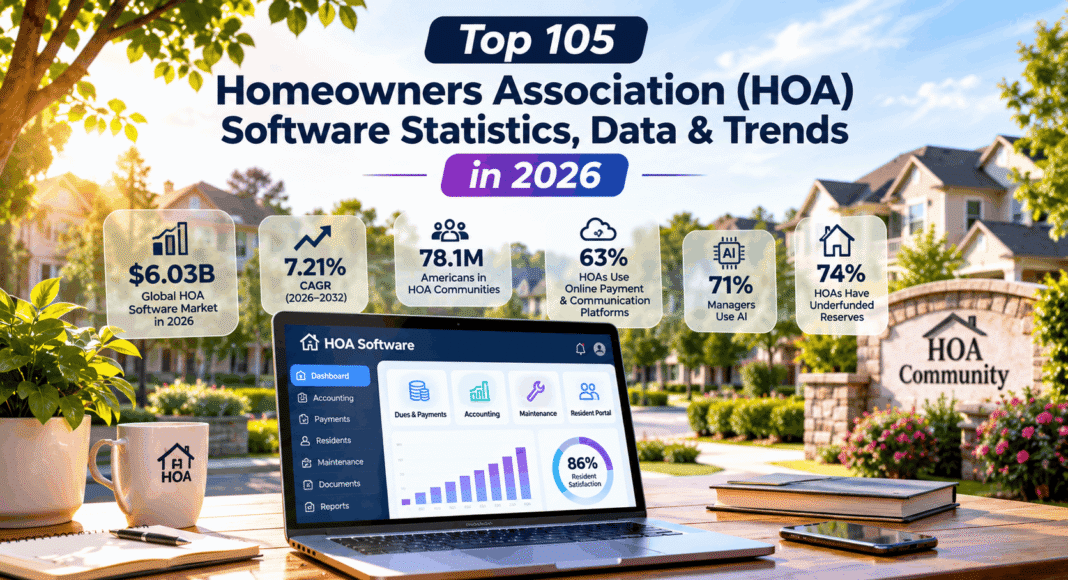

Key Takeaways
- Rapid HOA Software Market Growth: The global homeowners association (HOA) software market is estimated at $6.03 billion in 2026 and projected to reach $9.15 billion by 2032, driven by digital transformation and increasing community management demands.
- Accelerating AI and Automation Adoption: With 71% of community association managers already using AI, intelligent automation, cloud-based HOA software, and digital payment platforms are transforming operational efficiency and resident engagement.
- Growing Demand for HOA Financial Management Software: With 74% of U.S. HOAs facing underfunded reserves and 91% reporting increased operating budgets, automated accounting, reserve fund forecasting, and financial reporting are becoming increasingly essential.
Homeowners association (HOA) software streamlines community management through automated accounting, digital payments, resident communication, and artificial intelligence. In 2026, one market estimate values the global HOA software market at $6.03 billion, with a projected value of $9.15 billion by 2032, reflecting growing demand for efficient and transparent community management solutions.
The homeowners association (HOA) software market is undergoing a significant digital transformation in 2026, driven by the growing number of residential communities, rising operational costs, evolving regulatory requirements, and increasing demand for efficient community management solutions. As homeowners associations, condominium associations, housing cooperatives, and property management companies face increasingly complex administrative and financial responsibilities, HOA software has become an essential technology for improving operational efficiency, financial transparency, resident engagement, and regulatory compliance.
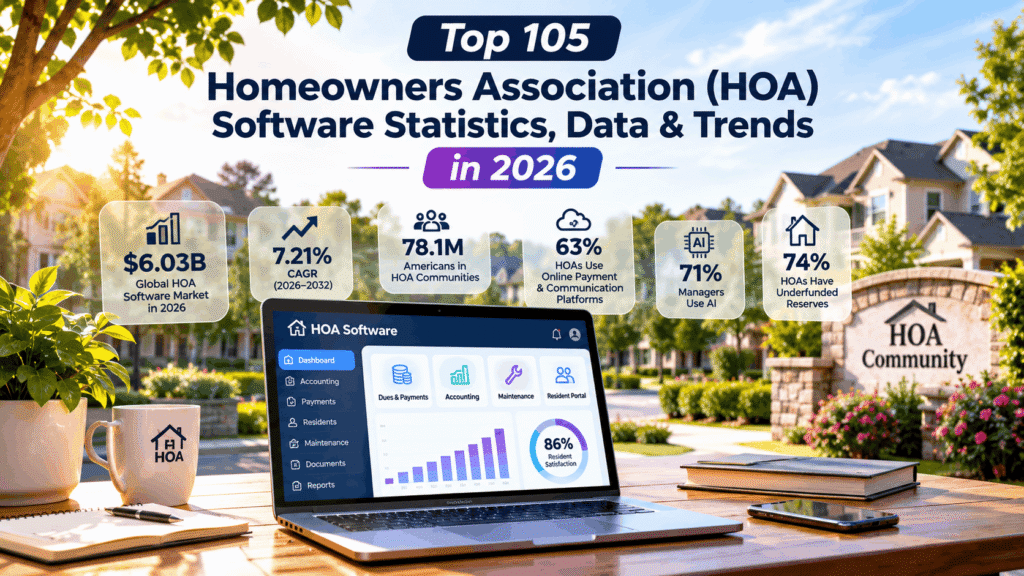
The global HOA software market is estimated to be worth approximately $6.03 billion in 2026 and is projected to reach $9.15 billion by 2032, growing at a compound annual growth rate (CAGR) of 7.21%, according to one market forecast. North America accounts for approximately 70–75% of the global HOA software market, supported by the extensive network of professionally managed and self-managed residential communities across the United States.
In 2026, the United States is home to approximately 373,000–377,000 community associations, with an estimated 78.1 million Americans living in HOA-governed communities, condominium associations, and housing cooperatives. These communities collectively manage residential properties valued at approximately $9.2 trillion, while homeowners contribute more than $112 billion in annual association assessments. The enormous financial and operational scale of this industry highlights the growing importance of reliable HOA accounting software, automated payment systems, financial reporting tools, and centralized community management platforms.
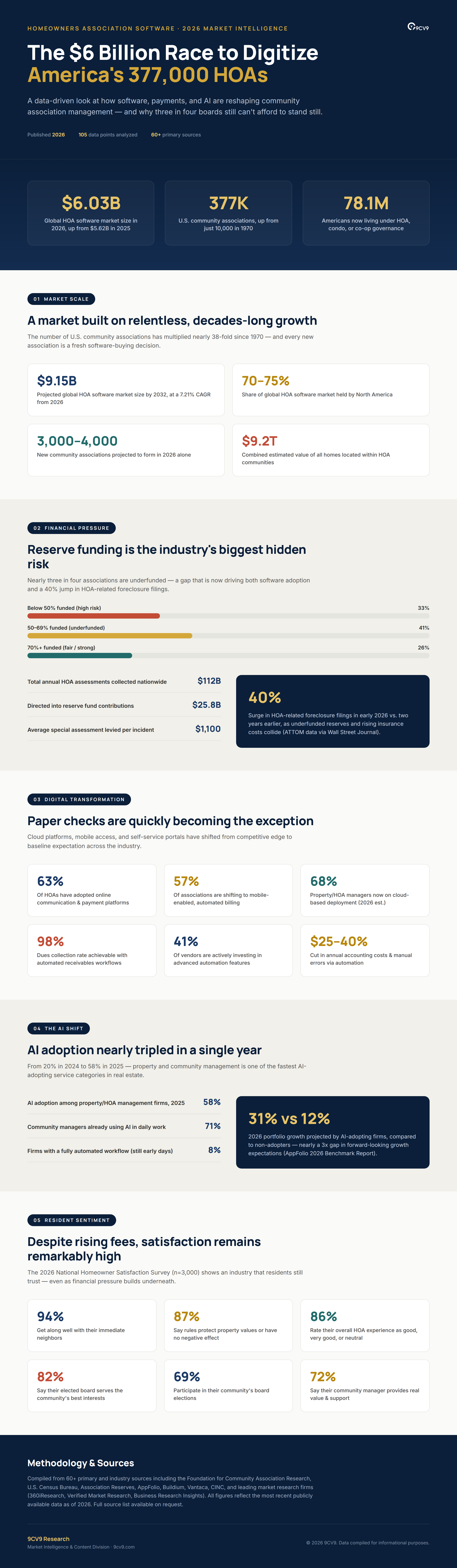
Digital adoption is accelerating across the homeowners association industry. Approximately 63% of HOAs have already adopted online communication and payment platforms, while 57% of associations are transitioning toward mobile-enabled access and automated billing modules. Furthermore, 41% of HOA software vendors are actively investing in advanced automation capabilities, reflecting the increasing demand for intelligent, scalable, and integrated community management solutions.
Artificial intelligence (AI) is also reshaping the future of HOA management software. AI adoption among property management companies increased from approximately 20% in 2024 to 58% in 2025, while 71% of community association managers report using AI in some capacity in their daily operations. From automated invoice processing and financial forecasting to resident communications, maintenance coordination, and delinquency tracking, AI-powered HOA software is creating new opportunities to reduce administrative workloads and improve management productivity.
However, significant financial and operational challenges continue to affect the industry. Approximately 74% of U.S. HOAs are classified as having underfunded reserve accounts, 91% of community associations have reported increased operating budgets, and 93% of surveyed associations have experienced rising property and casualty insurance premiums. These pressures are strengthening demand for HOA financial management software capable of supporting accurate budgeting, reserve fund planning, expense monitoring, and long-term financial sustainability.
Modern homeowners association software is increasingly designed to support a comprehensive range of functions, including:
- Automated HOA accounting, bookkeeping, and financial reporting.
- Online dues collection, recurring payments, and delinquency management.
- Reserve fund forecasting and association budget planning.
- Resident communication portals and mobile applications.
- Maintenance requests and work order management.
- Architectural review and community violation tracking.
- Document management and regulatory compliance.
- Board governance, meeting coordination, and resident engagement.
- AI-powered workflow automation and predictive analytics.
- Multi-community management for professional HOA management companies.
Cloud-based HOA management software is becoming particularly important as associations seek to replace fragmented spreadsheets, manual accounting processes, paper-based records, and disconnected communication systems with centralized digital platforms. Meanwhile, evolving software pricing models, subscription-based services, and increasingly accessible automation tools are lowering technology adoption barriers for smaller and self-managed communities.
Understanding the latest homeowners association software statistics is essential for HOA board members, community association managers, property management companies, real estate professionals, software developers, technology investors, and business decision-makers seeking to navigate this rapidly evolving market.
This comprehensive guide to the Top 105 Homeowners Association (HOA) Software Statistics, Data & Trends in 2026 examines the latest market size estimates, growth forecasts, software adoption rates, financial management benchmarks, reserve funding challenges, digital payment trends, artificial intelligence adoption, resident satisfaction levels, and competitive developments shaping the global HOA software industry.
By exploring these data-driven insights, industry stakeholders can better understand the current state of HOA management technology, identify emerging opportunities, evaluate software investment priorities, and make more informed decisions about the future of residential community management in 2026 and beyond.
Before we venture further into this article, we would like to share who we are and what we do.
About 9cv9
9cv9 is a business tech startup based in Singapore and Asia, with a strong presence all over the world.
With over ten years of startup and business experience, and being highly involved in connecting with thousands of companies and startups, the 9cv9 team has listed some of the top and best companies/tools in this review.
If you like to get your company listed in our top B2B software reviews, check out our world-class 9cv9 Media and PR service and pricing plans here.
Top 105 Homeowners Association (HOA) Software Statistics, Data & Trends in 2026
Market Size, Growth & Investment
- The global HOA software market is valued at approximately $6.03 billion in 2026. Sustained double-digit demand for centralized community-management platforms is pushing the HOA software category well past the $6 billion mark this year alone.
- The HOA software market is forecast to reach $9.15 billion by 2032, at a 7.21% CAGR. Steady, compounding growth through the early 2030s signals that boards and management companies see digital tools as a permanent operating requirement, not a temporary upgrade.
- A separate market model places 2026 HOA software revenue at $2.31 billion, projected to reach $6.23 billion by 2035 (13.2% CAGR). Even the more conservative market estimates still point to the sector nearly tripling in size within a decade.
- North America accounts for roughly 70–75% of global HOA software market share. The sheer density of U.S. community associations makes North America the undisputed epicenter of HOA software demand and innovation.
- The broader HOA and condo association management software market is valued at $1.76 billion in 2026, heading toward $3.53 billion by 2034. Segment-level data confirms that condo-specific and HOA-specific platforms are scaling at a comparable pace to the wider market.
- 63% of HOAs have already adopted online communication and payment platforms. A clear majority of associations have crossed the digital adoption threshold, making paper-based dues collection increasingly the exception rather than the rule.
- 57% of associations are shifting toward mobile-enabled access and automated billing modules. Mobile-first functionality has become a baseline expectation rather than a premium feature in modern HOA platforms.
- 41% of HOA software vendors are actively investing in advanced automation capabilities. Nearly half the competitive landscape is racing to embed automation, signalling where product roadmaps are headed through the late 2020s.
- The cloud accounting software market underpinning many HOA finance modules is projected to grow from $5.36 billion in 2025 to $5.88 billion in 2026 (9.6% CAGR). The infrastructure layer that HOA financial tools depend on is itself expanding rapidly, reinforcing the shift to cloud-based association bookkeeping.
- Global PropTech investment reached $16.7 billion in 2025, a 67.9% year-on-year jump. Capital continues to flood into property and community-management technology, with HOA-focused platforms positioned to capture a growing share of that funding wave.
Scale of the U.S. HOA Industry
- There are approximately 373,000–377,000 community associations across the United States in 2026. The addressable market for HOA software has effectively quadrupled since the 1970s, when fewer than 10,000 associations existed nationwide.
- Community associations are projected to add 3,000–4,000 new organizations in 2026 alone. Every new association represents a fresh software-buying decision, keeping the market’s growth engine running.
- An estimated 78.1 million Americans now live in a community governed by an HOA, condo association, or housing cooperative. Nearly a quarter of the entire U.S. population now falls within the addressable resident base for HOA management software.
- Community associations make up roughly 35% of all U.S. housing stock. More than one in three American homes now sits inside a governance structure that software can either streamline or, if absent, leave stuck in spreadsheets and paper ledgers.
- 82.4% of new homes sold in 2023 were part of an HOA community. The overwhelming majority of new residential construction is being delivered pre-wired for association governance, virtually guaranteeing continued software demand.
- 64.7% of newly constructed homes were part of HOA communities in 2023, down slightly year over year. Even with a modest dip, roughly two-thirds of freshly built homes still enter the market under HOA rules.
- HOAs form at a rate of roughly 8,000–10,000 new communities per year, or about 22 new associations every day. The pace of new-association formation alone creates a continuous pipeline of first-time software buyers.
- California and Florida together account for more than 100,000 community associations and 24 million residents. These two states alone represent a software market larger than most entire countries’ HOA sectors combined.
- Florida leads the nation with roughly 822 registered homeowners’ association business entities, the highest of any state. Florida’s outsized HOA density, combined with recent post-Surfside legislation, is driving some of the most aggressive software adoption in the country.
- HOAs make up about 60% of U.S. community-association types, with condominiums at 38% and cooperatives at 2%. The overwhelming majority of association software demand originates specifically from single-family and planned HOA communities rather than condo or co-op structures.
- There are an estimated 55,000–60,000 professional community association managers operating in the U.S. This is the core professional user base that HOA software vendors design their manager-facing dashboards and workflows around.
- Roughly 8,000–9,000 HOA management companies employ 100,000–105,000 people nationwide. The management-company segment represents the highest-value, multi-portfolio customer tier for enterprise-grade HOA software platforms.
- Between 6,000 and 9,000 large-scale community associations exist in the U.S., each managing over 1,000 homes or budgets exceeding $2 million. This small but high-value segment drives demand for the most sophisticated, enterprise-tier HOA software features.
- Homes in HOA communities are collectively valued at an estimated $9.2 trillion. The financial stakes riding on accurate, well-managed HOA software are enormous when measured against the total asset value under association governance.
- HOA-governed homes are typically valued 5–6% higher than comparable non-HOA homes. Well-run associations — often powered by transparent, software-driven financial reporting — appear to translate into measurable property-value premiums.
HOA Fees, Financial Management & Assessments
- The national median HOA or condo fee is $135 per month, per U.S. Census Bureau data. Even at the modest median, multiplied across tens of millions of paying households, HOA assessments represent an enormous recurring cash flow that software must track precisely.
- A separate industry analysis puts the national average HOA fee closer to $355 per month based on over 161,000 fee reports. The wide gap between median and average figures underscores how unevenly HOA costs are distributed — precisely the kind of variance automated reporting tools are built to manage.
- New York holds the highest average HOA fees in the country at roughly $886 per month. High-cost, amenity-dense markets like New York place the greatest financial-reporting burden on HOA software, given the scale of dollars flowing through each account.
- Washington, D.C. ranks second nationally for HOA fees, averaging around $787 per month. Dense urban condo markets consistently post some of the steepest monthly assessments in the nation.
- Florida generates the largest volume of HOA fee data of any state, averaging $463 per month across more than 25,000 reports. Florida’s scale and cost pressure make it one of the most closely tracked and software-intensive HOA markets in America.
- Homeowners nationwide pay more than $112 billion in total annual HOA assessments. Software that can’t reliably reconcile a revenue stream this large exposes boards to serious financial and legal risk.
- About $25.8 billion of annual assessments are directed specifically into association reserve funds. Reserve-fund tracking has become one of the single highest-stakes accounting functions modern HOA software must get right.
- Well-managed associations typically direct 15–40% of their annual budget toward reserves. This wide recommended range highlights why flexible, configurable budgeting tools matter more than rigid, one-size-fits-all templates.
- 91% of community associations reported an increased operating budget this year. Nearly universal budget growth is intensifying the pressure on boards to adopt tools that can model, forecast, and explain rising costs to residents.
- 58% of associations increased their budgets by up to 10%, while 30% raised budgets by 11–25%. The scale of these increases means even small forecasting errors can translate into thousands of dollars of variance — a strong case for automated budget-vs-actual reporting.
- 73% of HOAs facing unexpected cost increases plan to raise assessments rather than cut services. Boards are increasingly leaning on dues increases over service cuts, making transparent, software-driven communication of fee changes essential for resident trust.
- Only 41% of community associations plan to reduce expenses in response to rising costs. The relatively low appetite for cost-cutting suggests most associations are choosing to grow revenue rather than shrink services — a trend that raises the bar for financial-reporting accuracy.
- The average special assessment levied on U.S. HOAs came to roughly $1,100 in a recent year. Special assessments are increasingly becoming a routine budgeting tool rather than a rare emergency measure.
- Nearly one in ten U.S. HOAs (about 9.8%) levied a special assessment last year, up from 7.8% in 2021. The rising frequency of special assessments is pushing more boards toward software with dedicated assessment-tracking and disclosure features.
- Some Florida condominium communities have faced special assessments as high as $40,000–$60,000 per unit. Extreme, headline-grabbing assessment cases illustrate why accurate reserve modeling inside HOA software has become a financial necessity, not a convenience.
- HOA board and committee members collectively contribute nearly 97.6 million volunteer hours annually. Software that saves even a few hours per board member per month compounds into an enormous nationwide time-savings opportunity.
- The estimated value of HOA volunteer labor is approximately $2.9 billion per year, at roughly $28.54 per hour. Every hour of manual, spreadsheet-driven admin work that software eliminates carries a real, quantifiable economic value for volunteer boards.
- Modern HOA accounting platforms are reported to cut annual accounting costs by up to 25% through automation. Automated invoicing, reconciliation, and reporting are translating directly into measurable savings for associations.
- Manual accounting errors in HOA financial management can be reduced by up to 40% through purpose-built software. Replacing manual ledger entry with automated posting materially lowers the risk of costly bookkeeping mistakes.
Reserve Funds, Insurance & Financial Risk
- Approximately 74% of U.S. HOAs are currently classified as underfunded on their reserve accounts. This is the highest underfunding rate ever recorded by major reserve-study analysts, intensifying demand for software that models long-range reserve health.
- The 74% underfunding rate is drawn from an analysis of more than 100,000 individual reserve studies dating back to 1986. The scale of this dataset makes it one of the most authoritative benchmarks available on the true state of HOA financial health.
- One in three associations reports reserves below 50% funded, a level considered high risk. A substantial minority of communities are operating with a financial cushion thin enough to trigger emergency special assessments at any time.
- 48% of associations report reserves below 60% funded or say they don’t know their funding level at all. Nearly half of all HOAs either have weak reserves or lack visibility into their own financial position — a gap purpose-built software is directly designed to close.
- The underfunded-reserve rate has climbed from about 62% in the early 1990s to roughly 74% today. Reserve health has been deteriorating for three decades, not improving, despite the proliferation of financial software tools.
- HOA-related foreclosure filings surged nearly 40% in early 2026 compared to two years earlier. Rising foreclosure activity tied to unpaid dues and special assessments underscores the growing financial strain software-driven collections tools are being asked to manage.
- There were 6,376 properties with HOA-related foreclosure filings in Q1 2026 alone. This single-quarter figure illustrates just how material collections and delinquency-tracking functionality has become to association software.
- A condominium building with more than 15% of units 60+ days delinquent on dues becomes ineligible for Fannie Mae or Freddie Mac-backed financing. This single compliance threshold has turned real-time delinquency dashboards from a nice-to-have into a mission-critical software feature.
- 93% of surveyed associations reported increases in property and casualty insurance premiums. Nearly universal insurance-cost inflation is forcing boards to lean more heavily on software-based budget forecasting to absorb the impact.
- More than half of associations facing insurance increases saw hikes between 11% and 25%. Mid-range premium increases of this magnitude can materially alter an association’s entire annual budget in a single renewal cycle.
- Roughly 10% of associations reported insurance premium increases exceeding 100%. A meaningful minority of communities are facing insurance cost shocks large enough to force immediate fee hikes or service cuts.
- Some Florida associations have reported insurance premium increases of 50–200% over a three-year period. Extreme regional insurance inflation, concentrated in coastal and hurricane-exposed markets, is a leading driver of HOA financial software adoption in the Southeast.
- Beginning January 1, 2026, Florida condominium associations with 25 or more units must maintain a secure online portal for owners. New state-level digital-disclosure mandates are directly converting regulatory compliance into a driver of software purchasing decisions.
- Florida’s new portal mandate requires associations to publish governing documents, budgets, financial reports, and meeting minutes online. This single regulation effectively requires every qualifying Florida association to operate some form of resident-facing HOA software.
Delinquency & Collections
- A widely cited industry estimate places the nationwide HOA dues delinquency rate at around 12%, or roughly one in eight homeowners. Chronic delinquency at this scale represents a persistent cash-flow risk that automated aging reports and payment-reminder workflows are designed to mitigate.
- 74% of HOAs report having dues-collection problems of some kind. The prevalence of collection friction across the industry highlights why automated invoicing and late-fee enforcement have become standard software features rather than optional add-ons.
- A 10% delinquency rate in a 100-unit HOA charging $200 per month equates to roughly $24,000 in lost annual revenue. This simple math shows how even moderate delinquency can strip an association of the funds needed for basic maintenance.
- Some professionally managed associations report achieving a 98% dues collection rate using automated receivables workflows. Purpose-built software-driven collections processes can push recovery rates close to the theoretical maximum.
- Delinquency aging reports in modern HOA software are typically segmented into five buckets: current, 1–30, 31–60, 61–90, and 90+ days past due. Standardized aging-bucket reporting has become the industry norm for how boards monitor financial risk in real time.
Cloud, Mobile & Digital Payment Adoption
- 68% of North American property managers, a category that includes HOA managers, now use property management software of some kind. A clear majority of the professional management workforce has already made the shift to digital tools.
- Cloud-based deployment now dominates the HOA software category, with vendors overwhelmingly favoring SaaS delivery over on-premise installs. The shift to cloud has removed most of the infrastructure and IT-maintenance barriers that once slowed smaller associations from adopting software.
- All major HOA software platforms compared in recent 2026 buyer’s guides are cloud-based SaaS products rather than self-hosted systems. On-premise HOA software has effectively become a legacy category, with virtually every modern vendor building exclusively for the cloud.
- Online payment portals are now widely regarded as an essential, not optional, feature of HOA software. Homeowner expectations have shifted decisively toward self-service digital payment as the default way to pay dues.
- Autopay and recurring-payment features are cited by property managers as one of the single most impactful tools for reducing late payments. Automating the payment step removes the most common point of human failure in the dues-collection process.
- A vendor case study found that transitioning residents to an integrated payment portal reliably spikes account activation around the next dues cycle. Deadline-driven urgency, not marketing alone, appears to be the strongest lever for driving portal adoption among residents.
- One HOA-focused platform’s public benchmark targets processing 90% of dues payments online, alongside a 40% cut in administrative hours. Ambitious digital-payment adoption targets like this reflect how far the industry has shifted away from paper checks.
- 61% of HOA residents in a recent survey reported waiting three to five days or longer for a reply to an emailed question. Slow email-based communication remains a widespread pain point that dedicated resident portals and messaging tools are specifically built to solve.
- 43% of HOA residents in the same survey said they rarely used their community’s homeowner portal, and 14% reported having no portal at all. Even where technology exists, meaningful usage gaps persist — underscoring that software rollout alone doesn’t guarantee adoption without deliberate onboarding.
- 43% of surveyed residents rated their association’s violation-enforcement process as unfair, versus 38% who called it fair. Perceived inconsistency in rule enforcement is a resident-trust problem that automated, rules-based violation-tracking software is designed to reduce.
Artificial Intelligence & Automation in Community/Property Management
- AI adoption among property management companies, a category encompassing HOA managers, jumped from roughly 20% in 2024 to 58% in 2025. Nearly triple the number of firms are now using some form of AI compared to just a year earlier.
- Despite rapid AI adoption, only about 8% of property management companies report having fully automated any single workflow. The gap between experimenting with AI and achieving true end-to-end automation remains wide across the industry.
- 71% of community association managers report already using AI in some capacity in their day-to-day work. A strong majority of the professional HOA management workforce has moved from AI curiosity to active daily use.
- AI-adopting property management firms project average portfolio growth of 31% in 2026, compared to just 12% for non-adopters. Firms embracing AI are forecasting nearly triple the growth of those that haven’t, a substantial competitive gap.
- 34% of AI-adopting property firms plan to increase headcount, compared to 25% of non-adopters. Contrary to fears of job displacement, AI adoption in this sector appears correlated with staffing growth rather than reduction.
- 53% of property management professionals reported using general-purpose generative AI tools like ChatGPT in their daily work by late 2025. General AI assistants have become a mainstream, everyday tool for property and association management staff.
- 43% of property managers reported using AI features specifically embedded within their property management software. Purpose-built, in-platform AI is gaining nearly as much traction as general-purpose AI tools among management professionals.
- 78% of property management survey respondents said they still cannot fully rely on the AI features in their legacy software. Despite fast-rising adoption, trust in embedded AI functionality remains a significant unresolved barrier for many operators.
- One major community-management platform reports its AI system can process thousands of invoices in minutes and complete a full budget in under two minutes. Task-level automation benchmarks like these illustrate the scale of time savings AI-driven HOA platforms are beginning to deliver.
- The same platform reports customers saving 750+ hours monthly and generating $10,000+ in departmental labor savings through AI-driven automation. Concrete, quantified productivity gains are becoming a key differentiator vendors use to justify premium HOA software pricing.
- Organizations using AI in property and community management report a 20–30% improvement in overall operational efficiency. Efficiency gains at this scale represent a meaningful competitive advantage for early AI adopters in the HOA space.
- AI-driven automation can reduce lease and administrative errors by up to 42% in property management contexts. Error-reduction benefits of this magnitude directly translate into fewer financial disputes and compliance headaches for associations.
- AI-enabled property and community managers report saving up to 10 hours per week through automation. A full workday’s worth of time recovered weekly represents a substantial capacity gain for chronically understaffed HOA management teams.
- 90% of real estate and property-adjacent firms report they are now actively testing some form of AI. Near-universal experimentation confirms that AI evaluation has become a standard item on every management company’s technology roadmap.
- Morgan Stanley projects AI adoption could unlock $34 billion in efficiency gains for the real estate sector by 2030. Industry-wide financial modeling suggests the economic upside of AI adoption in property-adjacent sectors, including HOA management, is substantial and still largely untapped.
- Analysts estimate autonomous “agentic AI” workflows could eventually automate up to 70% of tasks currently performed by junior real estate and community-management staff. The next wave of AI in this sector is expected to move well beyond simple chatbots into fully autonomous, multi-step task execution.
Resident & Board Satisfaction, Governance
- 86% of community association residents rate their overall HOA experience as very good, good, or neutral. The overwhelming majority of homeowners report a broadly positive or at least acceptable living experience under association governance.
- 82% of residents say their elected HOA board serves the community’s best interests. Strong majority confidence in board leadership provides a stable foundation on which software-driven transparency tools can build even greater trust.
- 72% of residents say their community manager provides real value and meaningful support. Professional management continues to be viewed favorably by a clear majority of the residents it serves.
- 94% of community association residents report getting along well with their immediate neighbors. Neighbor relationships remain overwhelmingly positive, suggesting that governance friction, where it exists, tends to center on process and communication rather than personal conflict.
- 87% of residents say association rules protect property values or have no negative effect on them. Nearly nine in ten homeowners view community standards enforcement as neutral-to-beneficial for their property investment.
- 69% of community association residents participate in their community’s board elections. Board election turnout at this level significantly outpaces many local municipal elections, underscoring genuine resident engagement in HOA governance.
- 88% of community association residents vote in national elections and 83% vote in state and local elections. HOA residents are demonstrably more civically engaged than many broader population benchmarks, a notable finding for community-engagement software providers targeting this demographic.
- Only 63% of residents currently prefer no change or less government regulatory involvement in community associations, down from 86% in 2014. A decade-long decline in resistance to regulation suggests growing homeowner acceptance of the disclosure and reporting mandates that software increasingly needs to support.
- 59% of residents still favor holding delinquent homeowners strictly accountable over softer alternatives like raising everyone’s assessments. Majority resident sentiment continues to favor firm collections enforcement, reinforcing demand for consistent, automated delinquency workflows.
Vendor Landscape & Competitive Positioning
- Leading HOA/community-management platform CINC reports serving over 50,000 communities and 6 million individual housing units. Market-leading platforms are now operating at a scale that touches a meaningful share of all U.S. community associations.
- Competing platform Vantaca reports serving 550+ management companies representing more than 6.5 million homes. Enterprise-tier HOA software vendors are increasingly measuring their reach in the millions of doors rather than thousands.
- PayHOA offers a free software tier for HOA communities of up to 30 homes, scaling to roughly $0.99 per home per month for 31–100 homes. Freemium and micro-pricing models are lowering the adoption barrier for the smallest self-managed associations.
- Some competitively priced HOA platforms charge as little as $3 per home per month for full general-ledger accounting and governance workflows. Flat, predictable per-door pricing has become a common model that makes budgeting for software straightforward for volunteer treasurers.
- Major HOA software licensing tiers span roughly $2,900 (single-user) to $5,800 (enterprise) per year, according to industry pricing benchmarks. The wide spread between entry-level and enterprise licensing reflects the diversity of association sizes the software market must serve.
- The number of Homeowners’ Associations operating as registered U.S. business entities has declined roughly 1% per year on average over the past five years, even as total community associations grow. This apparent contradiction reflects industry consolidation, with more self-managed associations shifting toward professional management companies rather than the underlying number of governed communities shrinking.
- AI-powered “systems of action” are increasingly positioned by leading vendors as the successor category to traditional “systems of record” HOA software. The competitive narrative in 2026 is shifting from simple digital record-keeping toward software that actively executes tasks on the board’s behalf.
Conclusion
The homeowners association (HOA) software industry is experiencing a fundamental transformation in 2026 as digital technologies, artificial intelligence, cloud computing, automated financial management, and evolving regulatory requirements reshape how residential communities operate. The findings presented in these 105 homeowners association software statistics, data, and trends demonstrate that technology is becoming increasingly integral to efficient, transparent, financially sustainable, and resident-focused community management.
With one market forecast valuing the global HOA software market at approximately $6.03 billion in 2026 and projecting growth to $9.15 billion by 2032, the industry presents substantial opportunities for software providers, property management companies, technology investors, and community association professionals. North America’s estimated 70–75% share of the global market further highlights the region’s importance in driving HOA software innovation, adoption, and commercial expansion.
The enormous scale of the homeowners association industry provides a strong foundation for continued software market growth. With approximately 373,000–377,000 community associations across the United States, 78.1 million residents living in association-governed communities, and more than $112 billion collected in annual assessments, the demand for reliable, scalable, and comprehensive HOA management software is likely to remain strong throughout the coming decade.
Digital Transformation Is Redefining HOA Management
The increasing adoption of cloud-based HOA software, mobile applications, online payment portals, and automated billing systems demonstrates a significant shift away from traditional community management practices.
Approximately 63% of HOAs have already adopted online communication and payment platforms, while 57% are transitioning toward mobile-enabled access and automated billing capabilities. These statistics highlight the growing importance of digital accessibility, operational convenience, and centralized information management.
Modern homeowners association management software enables associations to streamline administrative processes, improve financial visibility, reduce manual workloads, and deliver more accessible services to homeowners. As resident expectations continue to evolve, digital platforms are likely to become increasingly important for maintaining effective communication, strengthening community engagement, and improving overall resident satisfaction.
However, software adoption alone does not guarantee successful digital transformation. With 43% of surveyed HOA residents reporting that they rarely use their homeowner portals and another 14% indicating that their communities have no portal, associations must also prioritize user-friendly interfaces, resident onboarding, accessibility, and consistent communication.
Financial Management and Risk Mitigation Remain Critical Priorities
Financial management represents one of the most significant drivers of HOA software adoption in 2026. Rising insurance premiums, increasing operating expenses, reserve fund deficiencies, homeowner delinquency, and special assessments are placing considerable financial pressure on community associations.
The statistics reveal several important financial challenges:
- Approximately 74% of U.S. HOAs are classified as having underfunded reserve accounts.
- Around 91% of community associations reported increased operating budgets.
- Approximately 93% of surveyed associations experienced rising property and casualty insurance premiums.
- Around 74% of HOAs reported experiencing dues collection problems.
- Approximately $25.8 billion in annual assessments is allocated to association reserve funds.
- Modern HOA accounting software can reportedly reduce annual accounting costs by up to 25%.
- Purpose-built financial management software can reportedly reduce manual accounting errors by up to 40%.
These findings reinforce the importance of implementing comprehensive HOA accounting software that supports automated bookkeeping, budget forecasting, reserve fund management, financial reporting, delinquency tracking, and payment reconciliation.
Associations that establish effective digital financial management processes may be better positioned to identify emerging financial risks, maintain accurate records, improve cash flow visibility, and communicate financial decisions transparently to homeowners.
Nevertheless, software cannot independently resolve reserve funding deficiencies or rising operational costs. Effective financial governance, realistic budgeting, professional reserve studies, and responsible board oversight remain essential components of long-term association sustainability.
Artificial Intelligence and Automation Are Shaping the Future of HOA Software
Artificial intelligence is emerging as one of the most influential technology trends within the homeowners association and property management software industries.
AI adoption among property management companies increased from approximately 20% in 2024 to 58% in 2025, while 71% of community association managers report using AI in some capacity in their daily operations. Furthermore, organizations implementing AI in property and community management have reported operational efficiency improvements of 20–30%.
AI-powered HOA software is increasingly capable of supporting automated invoice processing, intelligent financial forecasting, resident communications, document management, administrative workflows, and operational decision-making.
The productivity potential is particularly significant for an industry in which HOA board and committee members collectively contribute approximately 97.6 million volunteer hours annually, representing an estimated $2.9 billion in volunteer labor value.
However, the transition toward intelligent automation remains incomplete. Only approximately 8% of property management companies report having fully automated an individual workflow, while 78% of surveyed property management professionals indicate that they cannot fully rely on the AI capabilities embedded within their legacy software.
These findings suggest that the next phase of HOA software development will increasingly focus on improving AI reliability, workflow integration, data accuracy, human oversight, and measurable business outcomes rather than simply introducing additional AI-powered features.
Regulatory Compliance and Governance Will Drive Further Software Adoption
Evolving regulatory requirements are creating additional incentives for homeowners associations and condominium communities to invest in digital management platforms.
For example, Florida’s 2026 digital disclosure requirements for qualifying condominium associations with 25 or more units illustrate how secure online portals and accessible electronic documentation are becoming increasingly important components of community governance.
HOA software that incorporates secure document storage, financial disclosure capabilities, meeting records, access controls, and transparent communication tools can help associations manage their administrative and regulatory responsibilities more efficiently.
Resident trust also remains a central consideration. Approximately 82% of community association residents believe their elected boards serve the community’s best interests, while 72% believe their community managers provide meaningful value.
By supporting consistent rule enforcement, accessible financial information, transparent decision-making, and timely communication, HOA management platforms can help associations strengthen these existing foundations of trust and accountability.
The Future Outlook for the HOA Software Market
Looking beyond 2026, the homeowners association software market is expected to become increasingly competitive, intelligent, integrated, and focused on delivering measurable operational value.
Cloud-based HOA management platforms will likely continue to evolve from traditional systems of record into intelligent systems capable of supporting and executing increasingly complex administrative workflows. Automated financial management, AI-powered assistance, mobile-first resident experiences, digital payments, predictive analytics, and centralized multi-community management are expected to remain important areas of product development.
For HOA board members and community association managers, selecting the best HOA software will increasingly require evaluating more than basic accounting and communication functionality. Long-term considerations such as scalability, ease of use, data security, regulatory compliance, integration capabilities, automation reliability, customer support, and total cost of ownership will play important roles in software purchasing decisions.
For HOA software developers and technology providers, substantial opportunities exist in addressing persistent industry challenges, including reserve fund underfunding, dues delinquency, administrative inefficiencies, fragmented communication, and low resident portal engagement. Vendors capable of delivering practical, accessible, secure, and reliable solutions may be better positioned to establish sustainable competitive advantages.
For investors and industry stakeholders, the combination of recurring association revenues, expanding residential community networks, increasing digital adoption, and emerging AI capabilities highlights the long-term commercial potential of the HOA software sector.
Ultimately, the Top 105 Homeowners Association (HOA) Software Statistics, Data & Trends in 2026 reveal an industry moving toward a more digitally connected, automated, transparent, and data-driven future. While market size estimates vary across research methodologies and reported software performance improvements should not be interpreted as guaranteed outcomes, the broader direction of technological adoption remains evident.
As homeowners associations continue to navigate rising financial pressures, evolving resident expectations, increasing regulatory responsibilities, and growing operational complexity, investing in appropriate HOA management software will become an increasingly important strategic priority.
Associations that successfully combine modern technology with responsible financial management, effective governance, professional oversight, and meaningful resident engagement will be better positioned to improve operational efficiency, strengthen financial resilience, protect property values, and build sustainable residential communities in 2026 and beyond.
If you find this article useful, why not share it with your hiring manager and C-level suite friends and also leave a nice comment below?
We, at the 9cv9 Research Team, strive to bring the latest and most meaningful data, guides, and statistics to your doorstep.
To get access to top-quality guides, click over to 9cv9 Blog.
To hire top talents using our modern AI-powered recruitment agency, find out more at 9cv9 Modern AI-Powered Recruitment Agency.
People Also Ask
What is homeowners association (HOA) software?
HOA software is a digital platform that helps homeowners associations manage accounting, dues collection, resident communication, maintenance requests, documents, regulatory compliance, and community governance.
How big is the global HOA software market in 2026?
One market estimate values the global HOA software market at approximately $6.03 billion in 2026, driven by increasing digital adoption, automation, and demand for centralized community management solutions.
What is the projected growth rate of the HOA software market?
The global HOA software market is projected to grow at a compound annual growth rate of 7.21%, reaching approximately $9.15 billion by 2032, according to one market forecast.
Which region dominates the global HOA software market?
North America dominates the global HOA software market, accounting for approximately 70–75% of market share due to its extensive network of homeowners associations and community management companies.
How many homeowners associations are there in the United States in 2026?
The United States has approximately 373,000–377,000 community associations in 2026, including homeowners associations, condominium associations, and housing cooperatives.
How many Americans live in HOA communities?
Approximately 78.1 million Americans live in communities governed by homeowners associations, condominium associations, or housing cooperatives, representing nearly one-quarter of the U.S. population.
What percentage of HOAs use digital communication and payment platforms?
Approximately 63% of HOAs have adopted online communication and payment platforms, reflecting growing demand for digital accessibility, automated collections, and efficient resident engagement.
What are the biggest HOA software trends in 2026?
Major HOA software trends include artificial intelligence, cloud-based platforms, automated accounting, mobile applications, digital payments, predictive analytics, reserve fund forecasting, and regulatory compliance automation.
How is artificial intelligence transforming HOA software?
AI-powered HOA software supports automated invoice processing, financial forecasting, resident communications, document management, and administrative workflows, helping associations reduce manual workloads.
What percentage of community association managers use AI?
Approximately 71% of community association managers report using artificial intelligence in some capacity during their daily operations, highlighting the growing importance of AI-powered management tools.
How fast is AI adoption growing in property management?
AI adoption among property management companies increased from approximately 20% in 2024 to 58% in 2025, reflecting rapid technological transformation across the property and community management industries.
What are the benefits of using HOA management software?
HOA management software improves financial transparency, automates administrative tasks, simplifies dues collection, centralizes documents, strengthens resident communication, and supports efficient community governance.
How much money do homeowners associations collect annually?
Homeowners across the United States pay more than $112 billion in annual association assessments, highlighting the importance of accurate accounting, automated billing, and reliable financial management software.
What is the average HOA fee in the United States?
One industry analysis estimates the average monthly HOA fee at approximately $355, while U.S. Census Bureau data places the national median HOA or condominium fee at $135 per month.
What percentage of HOAs have underfunded reserve accounts?
Approximately 74% of U.S. HOAs are classified as having underfunded reserve accounts, highlighting the growing need for reserve fund forecasting, financial planning, and HOA accounting software.
How much money do HOAs allocate to reserve funds annually?
Approximately $25.8 billion in annual association assessments is allocated to reserve funds, supporting long-term maintenance, infrastructure replacement, repairs, and community financial sustainability.
Can HOA software reduce accounting costs?
Modern HOA accounting software can reportedly reduce annual accounting costs by up to 25% through automated invoicing, payment reconciliation, bookkeeping, and financial reporting.
Can HOA accounting software reduce financial errors?
Purpose-built HOA accounting software can reportedly reduce manual accounting errors by up to 40% through automated data entry, transaction processing, reconciliation, and standardized financial workflows.
What percentage of HOAs experience dues collection problems?
Approximately 74% of HOAs report experiencing dues collection problems, emphasizing the importance of automated payment reminders, recurring billing, delinquency tracking, and online payment portals.
What is the average HOA dues delinquency rate?
A widely cited industry estimate places the nationwide HOA dues delinquency rate at approximately 12%, highlighting the financial risks associated with unpaid homeowner assessments.
How does HOA software improve dues collection?
HOA software improves dues collection through automated invoices, recurring payments, payment reminders, delinquency reports, late-fee management, and convenient online payment options.
Why is cloud-based HOA software becoming popular?
Cloud-based HOA software offers remote accessibility, centralized data management, automatic updates, scalable infrastructure, and reduced IT maintenance requirements, making it attractive to associations of different sizes.
What percentage of associations are adopting mobile HOA software?
Approximately 57% of associations are transitioning toward mobile-enabled access and automated billing modules, reflecting growing demand for convenient and accessible community management technology.
How much time can AI-powered HOA software save?
AI-enabled property and community managers report saving up to 10 hours per week through automation of administrative tasks, financial workflows, document processing, and routine communications.
How much can AI improve HOA operational efficiency?
Organizations using AI in property and community management report operational efficiency improvements of approximately 20–30%, although actual results depend on implementation quality and workflow complexity.
What percentage of HOA residents are satisfied with their communities?
Approximately 86% of community association residents rate their overall experience as very good, good, or neutral, indicating broadly favorable or acceptable perceptions of association-governed communities.
How does HOA software improve resident engagement?
HOA software supports resident engagement through homeowner portals, mobile applications, community announcements, online voting, maintenance requests, document access, and centralized communication tools.
How much does HOA management software cost in 2026?
HOA software pricing varies by community size, features, and deployment requirements. Some platforms offer low-cost per-home subscriptions, while annual licensing benchmarks range from approximately $2,900 to $5,800.
What features should the best HOA management software include?
The best HOA management software should include automated accounting, online payments, reserve fund management, resident portals, maintenance tracking, document storage, financial reporting, security, and workflow automation.
What is the future of homeowners association software beyond 2026?
The future of HOA software will increasingly emphasize AI-powered automation, intelligent financial forecasting, mobile-first resident experiences, integrated digital payments, predictive analytics, and proactive community management.
Sources
- 360iResearch
- Verified Market Research
- Verified Market Reports
- Business Research Insights
- OpenPR
- Access Management Group
- Vantaca
- IBISWorld
- iPropertyManagement
- SimplyInsurance
- Foundation for Community Association Research
- ManageCasa
- HOAReviewer
- FixMyHOA
- This Old House
- The Warren Group
- National Association of Realtors (NAR)
- DoorLoop
- MagicDoor
- GetApp
- Capterra
- Condo Control
- citybiz
- Silvercreek
- Effortless HOA
- PayHOA
- Software Advice
- CheckThat
- GoverningDocs
- Association Property Managers
- Sperlonga Data
- CommunityPay
- Community Collection Service
- TechTimes
- Association Reserves
- Governance Center
- AmeriSave
- HomeLight
- HOA Costs
- Investors Hangout
- RentPost
- TechnBrains
- Buildium
- HavenAI
- AppFolio
- Barchart
- Lula
- Far Out Solutions
- RevenueMemo
- Blott
- Frontdesk Research
- ExactEstate
- Yardi Breeze