



























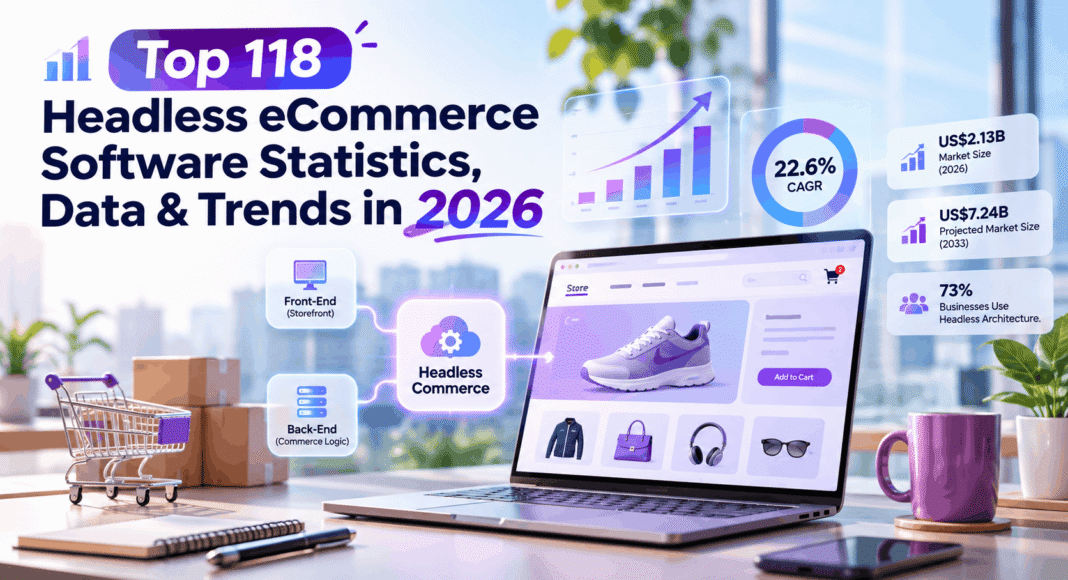

Key Takeaways
- Rapid Market Growth: The global headless eCommerce software market is projected to grow from US$2.13 billion in 2026 to US$7.24 billion by 2033, driven by increasing demand for flexible, API-first commerce solutions.
- Improved ROI and Business Performance: Headless commerce adoption reportedly delivers an average 24% sales increase, 42% higher conversion rates, and faster website performance, strengthening its appeal to online retailers.
- AI and Omnichannel Commerce Drive Innovation: Artificial intelligence, agentic commerce, MACH architecture, and composable commerce are accelerating headless eCommerce software adoption, enabling personalized, scalable, and seamless shopping experiences.
Headless eCommerce software enables businesses to deliver faster, more flexible, and personalized online shopping experiences through decoupled architecture. In 2026, the global headless commerce market stands at an estimated US$2.13 billion, with projected growth to US$7.24 billion by 2033, alongside reported average sales growth of 24% following adoption.
The global eCommerce industry is undergoing a fundamental transformation as businesses increasingly move away from traditional monolithic platforms toward flexible, scalable, and API-driven digital commerce architectures. In 2026, headless eCommerce software has emerged as a significant technology shaping the future of online retail, enabling businesses to deliver personalized shopping experiences, improve website performance, streamline operations, and expand across multiple digital channels.
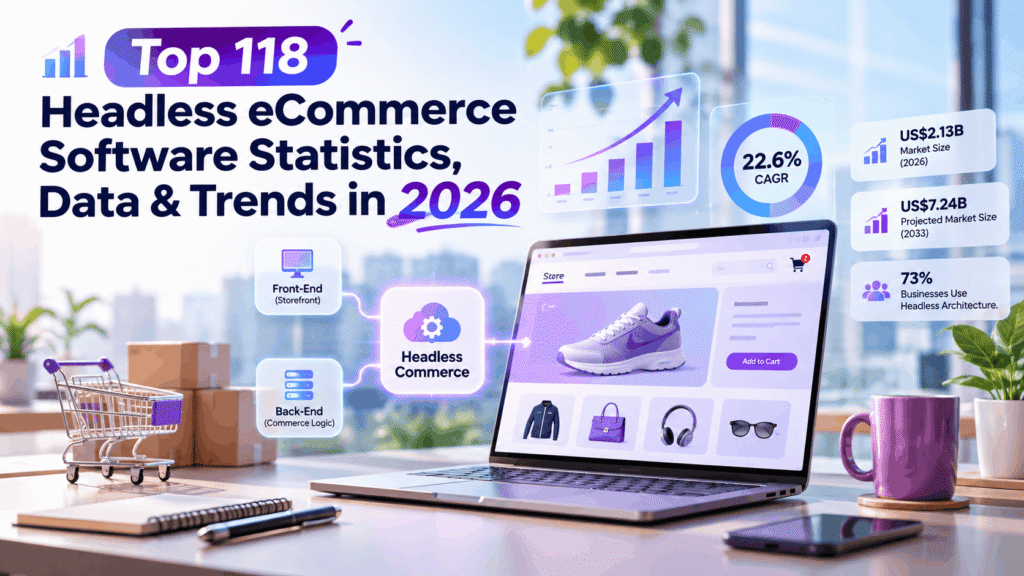
Unlike traditional eCommerce platforms, headless eCommerce software separates the front-end presentation layer from back-end commerce functionality. This decoupled architecture allows businesses to independently manage storefronts, product catalogs, payment systems, inventory management, content delivery, and third-party integrations. As consumer expectations evolve and digital competition intensifies, headless commerce is becoming an increasingly important component of modern enterprise technology strategies.
The latest headless eCommerce software statistics highlight the remarkable growth potential of this rapidly expanding industry. The global headless commerce market is valued at an estimated US$2.13 billion in 2026 and is projected to reach US$7.24 billion by 2033, representing a compound annual growth rate (CAGR) of 22.6%. Meanwhile, the headless commerce platform market is projected to expand from US$2.41 billion in 2026 to US$6.17 billion by 2031, reflecting growing demand for flexible and API-first commerce infrastructure.
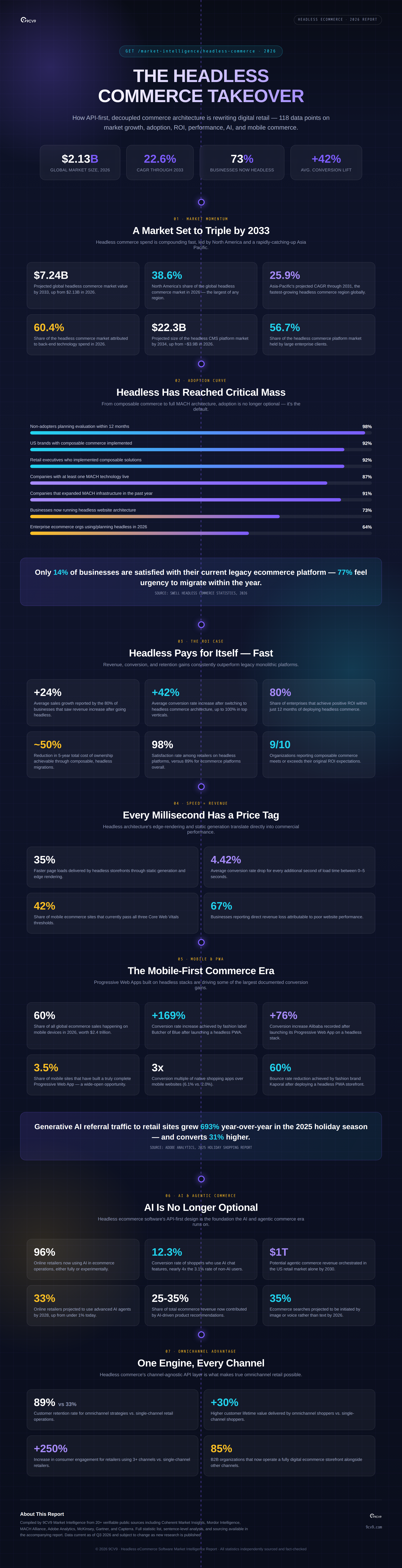
Enterprise adoption is also accelerating. Approximately 64% of enterprise eCommerce organizations are using or planning to implement headless commerce in 2026, while 77% of enterprises intend to increase their use of API-driven eCommerce platforms. Furthermore, 87% of surveyed companies have implemented at least one MACH technology, encompassing microservices, API-first architecture, cloud-native infrastructure, and headless technology.
Beyond market expansion and adoption, headless eCommerce software offers substantial potential commercial and operational benefits. Reported industry findings indicate that:
- 80% of businesses experience revenue growth following headless commerce implementation.
- Businesses report an average conversion rate increase of 42% after transitioning to headless architecture.
- 80% of enterprises achieve positive return on investment within the first 12 months of headless commerce deployment.
- Headless storefronts can deliver 35% faster page loading through static generation and edge rendering.
- 60% of eCommerce websites using headless platforms report reduced maintenance costs.
- Composable commerce migrations can reduce five-year total cost of ownership by approximately 47% compared with legacy commerce suites.
The growing importance of mobile commerce, omnichannel retailing, artificial intelligence (AI), and agentic commerce is further accelerating demand for headless eCommerce solutions. With mobile commerce accounting for an estimated 60% of global eCommerce sales in 2026 and 96% of online retailers reportedly using or experimenting with AI, businesses increasingly require adaptable commerce infrastructure capable of supporting emerging technologies and evolving customer expectations.
Headless eCommerce software also plays an important role in improving search engine optimisation (SEO), Core Web Vitals, customer engagement, international expansion, and digital experience management. By integrating headless content management systems, progressive web applications, AI-powered recommendation engines, and composable commerce technologies, retailers can build more adaptable digital ecosystems without being constrained by the limitations of traditional eCommerce platforms.
However, implementing headless commerce is not without challenges. Development complexity, integration requirements, technical expertise, implementation costs, and ongoing infrastructure management remain important considerations. Businesses must carefully evaluate their technology requirements, available resources, scalability objectives, and anticipated return on investment before transitioning to a headless commerce architecture.
This comprehensive guide to the top 118 headless eCommerce software statistics, data, and trends in 2026 explores the key developments shaping the global headless commerce industry, including:
- Global headless commerce market size, growth forecasts, and regional trends
- Enterprise and small business adoption rates
- Revenue growth, conversion rates, and return on investment
- Website performance, page loading speeds, and Core Web Vitals
- Mobile commerce and progressive web application adoption
- Artificial intelligence, personalization, and agentic commerce trends
- Composable commerce, MACH architecture, and headless CMS integration
- Implementation costs, operational efficiency, and total cost of ownership
- Omnichannel commerce and evolving consumer behaviour
- Leading headless eCommerce software platforms and vendor performance
Whether an organization is evaluating headless eCommerce platforms, modernizing its existing technology stack, developing an omnichannel retail strategy, or researching emerging digital commerce opportunities, understanding these statistics can support more informed technology investment and business decisions.
As the digital commerce landscape becomes increasingly interconnected, intelligent, and customer-centric, headless eCommerce software is positioned to remain an important driver of technological innovation and business transformation. These 118 headless eCommerce software statistics provide a comprehensive overview of the industry’s current landscape, emerging opportunities, implementation challenges, and future growth prospects in 2026 and beyond.
Before we venture further into this article, we would like to share who we are and what we do.
About 9cv9
9cv9 is a business tech startup based in Singapore and Asia, with a strong presence all over the world.
With over ten years of startup and business experience, and being highly involved in connecting with thousands of companies and startups, the 9cv9 team has listed some of the top and best companies/tools in this review.
If you like to get your company listed in our top B2B software reviews, check out our world-class 9cv9 Media and PR service and pricing plans here.
Top 118 Headless eCommerce Software Statistics, Data & Trends in 2026
1. Market Size & Growth
- The global headless commerce market is valued at US$2.13 billion in 2026 and is forecast to reach US$7.24 billion by 2033. This 22.6% CAGR trajectory confirms headless ecommerce software is one of the fastest-growing categories in digital commerce infrastructure.
- The headless commerce platform market alone is worth US$2.41 billion in 2026, projected to hit US$6.17 billion by 2031. A 20.69% CAGR underscores how enterprises are replacing tightly coupled commerce stacks with API-first headless ecommerce systems.
- North America commands a 36.71% share of the headless commerce platform market as of 2025. The region’s dominance reflects the concentration of headless ecommerce software vendors and early enterprise adopters based there.
- Asia-Pacific is projected to expand at a 25.92% CAGR through 2031, the fastest of any region. Rising digital-native retail and mobile-first shopping behavior are accelerating headless ecommerce software adoption across the region.
- The headless CMS for commerce market is set to grow from US$2.11 billion in 2025 to US$2.55 billion in 2026, a 20.8% CAGR. This growth illustrates how content-driven personalization needs are pushing commerce and CMS layers to merge under headless architectures.
- The same headless CMS for commerce segment is expected to reach US$5.49 billion by 2030 at a 21.1% CAGR. Composable commerce stack investment and omnichannel personalization demand are the primary long-term growth drivers.
- Web-based commerce is projected to hold a 53.4% share of the headless commerce market in 2026. This confirms that while omnichannel expansion is rising, the web storefront remains the anchor use case for headless ecommerce software.
- Back-end technologies are expected to account for 60.4% of the headless commerce market share in 2026. The dominance of back-end spend signals heavy enterprise investment in API-driven commerce engines over front-end tooling alone.
- North America is projected to lead the overall headless commerce market with a 38.6% share in 2026. The presence of major cloud and tech ecosystems continues to fuel regional headless ecommerce software innovation.
- Asia Pacific holds a 23.7% share of the headless commerce market in 2026 and is the fastest-growing region. Rapid urbanization and a surge of digital-savvy consumers are driving this expansion.
- An alternate market estimate places the headless commerce market at approximately US$4.35 billion in 2026. Differing analyst methodologies produce a wide valuation range, but all point to strong double-digit growth for headless ecommerce software.
- Web-based commerce represented 52.4% of headless commerce market share in 2025. This figure closely tracks 2026 projections, showing consistent channel-mix stability for headless ecommerce software deployments.
- Large enterprises make up 56.7% of the headless commerce platform market. This concentration highlights that headless ecommerce software remains disproportionately adopted by resource-rich organizations, though SMB uptake is accelerating.
- The headless CMS software market (a closely related category) is projected to grow from US$1.56 billion in 2025 to US$1.82 billion in 2026, reaching US$4.42 billion by 2031. A 19.40% CAGR reflects sustained enterprise demand for API-driven content layers that pair with headless ecommerce software.
- The headless CMS platform market could expand from roughly US$3.94 billion in 2026 to US$22.28 billion by 2034, a CAGR above 21%. This dramatic long-term outlook reflects headless technology becoming critical infrastructure rather than an experimental choice.
- Contentful, Kentico Kontent, Strapi, and Sanity together capture an estimated 50–55% of the global headless CMS market. This vendor concentration shows a maturing but still competitive ecosystem adjacent to headless ecommerce software.
- Tier-2 headless CMS vendors such as ButterCMS, Agility CMS, and Prismic collectively hold 15–20% of the market. Smaller vendors are carving out cost-effective niches for SMBs building headless ecommerce software stacks.
- Government portal adoption of headless CMS technology is projected to grow 25.3% annually through the end of 2026. Public-sector digitalization mandates are extending headless architecture demand beyond traditional retail.
- The AI-powered ecommerce market reached US$8.65 billion in 2025 and is projected to exceed US$50 billion by 2033. This overlapping growth curve reinforces why AI-readiness has become a core evaluation criterion for headless ecommerce software buyers.
- The omnichannel retailing market is estimated at US$11.57 billion in 2026, growing to US$29.30 billion by 2033 (14.2% CAGR). Headless ecommerce software is a foundational enabler of this omnichannel expansion.
2. Adoption Rates
- 73% of businesses now use headless website architecture. This majority-adoption figure confirms headless ecommerce software has moved from early-adopter status to mainstream infrastructure.
- 98% of businesses not yet on headless architecture plan to evaluate it within the next 12 months. Near-universal evaluation intent signals that legacy monolithic platforms are losing favor industry-wide.
- Around 64% of enterprise ecommerce organizations are currently using or planning to use headless commerce in 2026. This shift shows headless ecommerce software has become a core strategic choice rather than a niche experiment for larger retailers.
- 77% of enterprises plan to increase their use of API-driven ecommerce platforms, including headless solutions. This intent-to-expand statistic points to compounding future demand for headless ecommerce software.
- Headless commerce adoption among small and medium-sized businesses increased by 35% over the past two years. SMBs are increasingly able to access headless ecommerce software once reserved for enterprise budgets.
- 60% of major retailers in North America were predicted to adopt a headless platform by 2025. This retailer-level adoption trend validates headless ecommerce software as the emerging standard for serious digital commerce operations.
- Headless commerce adoption grew by 50% over the last two years. The pace of growth illustrates accelerating market maturity for headless ecommerce software beyond its early-adopter phase.
- 92% of US brands have implemented some form of composable commerce. This near-universal figure demonstrates that modular, MACH-based headless ecommerce software architecture is now the default expectation.
- 87% of companies have implemented at least one MACH (Microservices, API-first, Cloud-native, Headless) technology. MACH adoption is a strong proxy for how deeply headless principles have penetrated enterprise commerce stacks.
- 91% of companies expanded their MACH infrastructure over the past year. Continued investment, rather than one-time adoption, shows organizations are doubling down on headless ecommerce software strategies.
- The average enterprise tech stack is expected to be 61% MACH-based by the start of 2026. This majority composition indicates headless components have become the structural norm, not the exception.
- 82% of companies have already implemented an API-first approach to commerce. API-first design is the technical backbone that makes headless ecommerce software interoperable across channels.
- 79% of IT leaders are interested in incorporating more MACH principles into their technology stack. Strong IT-leadership interest suggests continued budget allocation toward headless ecommerce software over the coming years.
- 92% of retail executives report having implemented composable commerce solutions. Executive-level buy-in confirms headless ecommerce software has crossed from a technical decision to a boardroom priority.
- 73% of mid-market and enterprise ecommerce operators had adopted at least some elements of headless or MACH architecture by 2026. This broad base of partial adopters represents a large addressable market for further headless ecommerce software expansion.
- 72% of commerce decision-makers plan to adopt composable commerce. Forward-looking adoption intent signals sustained momentum for headless ecommerce software purchases.
- 72% of retailers have already adopted composable architecture, with 99% either using or planning to use it. This near-total planned adoption underlines composable, headless ecommerce software as an industry-wide inevitability.
- 85% of B2B organizations now operate ecommerce storefronts. The rise of digital-first B2B buying is a major growth vector for headless ecommerce software built to handle complex catalogs and pricing.
- 80% of B2B sales interactions were expected to occur digitally by the end of 2025. This digital-first B2B shift increases demand for the flexible, API-driven capabilities that headless ecommerce software provides.
- 38% of retail organizations began their MACH implementation journey more than seven years ago. Retail’s early-mover advantage has helped establish many of today’s headless ecommerce software best practices.
3. ROI & Revenue Impact
- 80% of businesses report a revenue increase after implementing headless commerce, with an average 24% sales growth. This documented uplift makes a strong quantitative case for investing in headless ecommerce software.
- Businesses report an average 42% increase in conversion rates after switching to headless architecture, with case studies as high as 100% in competitive verticals. Conversion gains of this magnitude are among the most compelling ROI arguments for headless ecommerce software.
- 80% of enterprises see a positive ROI within the first 12 months of deploying a headless commerce solution. A sub-one-year payback period significantly de-risks headless ecommerce software investment for finance teams.
- 39% of ecommerce businesses experienced a 25% boost in organic traffic after migrating to headless architecture. Improved Core Web Vitals scores from headless ecommerce software directly translate into stronger organic search performance.
- Businesses using omnichannel strategies enabled by headless flexibility retain 89% of customers, compared to 33% for single-channel operations. This retention gap illustrates the compounding value headless ecommerce software delivers over time.
- The average revenue increase for businesses after adopting headless commerce is 15%. Even conservative estimates show headless ecommerce software delivering measurable top-line growth.
- 60% of ecommerce sites on headless platforms report reduced maintenance costs over traditional builds. Lower ongoing maintenance burden is a key operational benefit of decoupled, headless ecommerce software.
- 55% of retailers using headless commerce report improved internationalization capabilities. The decoupled front end makes it easier to localize experiences, a critical advantage of headless ecommerce software for global expansion.
- Businesses adopting headless commerce report 10–20% reductions in website downtime during peak sales events. Improved resilience during high-traffic periods is a direct operational benefit of headless ecommerce software.
- 61% of online stores using headless commerce report improved customer retention. Faster, more personalized storefronts built on headless ecommerce software help keep shoppers coming back.
- 45% of digital shops using headless commerce experienced a reduction in bounce rates. Improved performance and user experience directly reduce the abandonment typical of monolithic ecommerce platforms.
- Businesses report an average of 25% faster time-to-market for new features with headless architecture. Faster feature releases give brands using headless ecommerce software a real competitive edge.
- Companies utilizing headless commerce see an average 24% increase in revenue. This independent figure corroborates other studies showing consistent revenue upside from headless ecommerce software adoption.
- Headless commerce platforms enable businesses to switch technologies 25% faster than traditional counterparts. Reduced vendor lock-in is a structural advantage baked into headless ecommerce software design.
- 54% of businesses say they are more productive when using APIs. API-centric workflows, core to headless ecommerce software, measurably improve team efficiency.
- Retailers with headless platforms report 98% satisfaction, compared to 89% overall satisfaction among all ecommerce platform users. This satisfaction gap is a strong qualitative endorsement of headless ecommerce software.
- 9 out of 10 organizations report that composable commerce meets or exceeds their ROI expectations. High expectation-fulfillment rates suggest headless ecommerce software investment decisions are consistently sound.
- 90% of recent platform migrators experienced sales and revenue improvements after switching platforms. Migration to headless ecommerce software correlates strongly with measurable commercial gains.
- Only 14% of businesses report being satisfied with their current legacy ecommerce platform. Widespread dissatisfaction with monolithic systems is a primary demand driver for headless ecommerce software.
- 77% of businesses feel urgency to migrate to a new platform within the next year. This urgency reflects mounting competitive pressure to adopt headless ecommerce software sooner rather than later.
4. Performance & Core Web Vitals
- Headless storefronts deliver 35% faster page loads through static generation and edge rendering. Speed gains of this scale are one of the clearest technical justifications for headless ecommerce software.
- Headless architecture drives up to 25% higher conversion rates compared to coupled ecommerce platforms. Performance improvements from headless ecommerce software translate directly into commercial outcomes.
- Every additional second of load time between 0–5 seconds reduces conversion rates by an average of 4.42%. This statistic quantifies exactly why the performance gains of headless ecommerce software matter financially.
- 67% of businesses report revenue loss directly attributable to poor site performance. Slow, monolithic platforms create a measurable revenue drag that headless ecommerce software is designed to eliminate.
- 53% of mobile users abandon sites that take longer than 3 seconds to load. Mobile-speed sensitivity makes the edge-optimized delivery of headless ecommerce software especially valuable.
- A 0.1-second mobile speed improvement produced up to a 10.1% conversion lift in travel and 8.4% in retail. Even marginal speed gains delivered by headless ecommerce software can meaningfully move conversion metrics.
- Ecommerce pages loading in under 2 seconds convert at 3.05%, versus 1.94% for pages loading in 3–4 seconds. This roughly 57% conversion gap highlights the commercial stakes of the performance architecture headless ecommerce software enables.
- Only 42% of mobile ecommerce sites currently pass all three Core Web Vitals thresholds. This performance gap represents a significant opportunity for brands adopting headless ecommerce software to gain a competitive edge.
- Desktop Core Web Vitals pass rates stand at 63%, compared to just 42% on mobile. The mobile performance gap is where headless ecommerce software’s edge-rendering advantages matter most.
- Mobile traffic now accounts for more than 62% of all ecommerce site visits. Given this mobile-majority reality, the mobile-first performance benefits of headless ecommerce software are increasingly business-critical.
- Every 100 milliseconds of load time costs approximately 1% in lost conversions. This granular benchmark shows why even small latency reductions from headless ecommerce software carry outsized revenue implications.
- A site loading in 1 second converts roughly 2.5–3 times better than one loading in 5 seconds for ecommerce specifically. This dramatic multiplier reinforces the business case for the speed-optimized architecture of headless ecommerce software.
- 45% of ecommerce site speed improvements are directly attributed to headless architecture. This figure positions headless ecommerce software as the single most impactful infrastructure decision for performance.
- 47% of consumers abandon shopping carts due to slow-loading pages. Headless ecommerce software addresses this friction point at the infrastructure level rather than through surface-level fixes.
- 68% of mobile commerce sites on headless platforms report increased load speed, boosting conversions. This mobile-specific performance data further validates headless ecommerce software for phone-first shopping journeys.
5. Mobile Commerce & Progressive Web Apps
- Mobile devices accounted for 55.9% of global web traffic as of March 2026. This mobile-majority landscape makes the app-like experiences enabled by headless ecommerce software increasingly essential.
- Only 3.5% of mobile sites and 3.3% of desktop sites have built a complete Progressive Web App. This low adoption rate represents significant whitespace for brands using headless ecommerce software to differentiate through PWA experiences.
- The global PWA market is projected to grow from US$2.08 billion in 2024 to US$21.24 billion by 2033. This roughly 10x expansion tracks closely with the rise of headless ecommerce software, which underpins most modern PWA storefronts.
- Alibaba increased conversions by 76% after launching its Progressive Web App. This case study remains one of the most cited proof points for the commercial power of headless, PWA-driven ecommerce.
- Fashion brand Kaporal’s headless PWA delivered a 60% reduction in bounce rate and a 15% increase in desktop conversions. Mid-market brands, not just enterprise giants, are seeing outsized results from headless ecommerce software.
- Fashion label Butcher of Blue saw a 169% conversion rate increase and pages loading 85% faster after adopting a PWA. This result demonstrates headless ecommerce software benefits scale down effectively to smaller retailers.
- PWAs see a 70% increase in session length and a 20% increase in page views per session compared to traditional web apps. Deeper engagement metrics reflect the smoother experience headless ecommerce software architectures make possible.
- Mobile commerce accounts for 60% of all global ecommerce sales in 2026, en route to US$2.4 trillion in revenue. This mobile-dominant reality places a premium on the mobile-optimized delivery that headless ecommerce software provides.
- The average mobile ecommerce conversion rate reached 2.8% in 2026, finally matching desktop conversion rates. Improved mobile performance, partly driven by headless ecommerce software adoption, is closing a long-standing conversion gap.
- Shopping apps convert three times better than mobile websites, at 6.1% versus 2.0%. This gap underscores why headless ecommerce software’s ability to power native-app-like experiences carries real commercial weight.
6. AI, Personalization & Agentic Commerce
- 96% of online retailers now use AI in their ecommerce operations, either fully (59%) or experimentally (37%). This near-universal AI usage increasingly depends on the flexible API layer that headless ecommerce software provides.
- AI-driven product recommendations contribute an estimated 25–35% of total ecommerce revenue. Headless ecommerce software’s composable architecture makes it easier to plug in best-of-breed recommendation engines.
- AI personalization leaders see up to a 40% revenue increase versus competitors. This performance gap illustrates why real-time personalization capability has become a top selection criterion for headless ecommerce software.
- Generative AI traffic to retail sites grew 693% year-over-year during the 2025 holiday season. This surge highlights the urgency for headless ecommerce software to support AI-driven discovery channels.
- AI referrals convert 31% higher and show 27% lower bounce rates than other traffic sources. These figures reinforce why AI-readiness is now central to evaluating headless ecommerce software platforms.
- Agentic commerce could generate as much as US$1 trillion in orchestrated US retail revenue by 2030, and US$3–5 trillion globally. This scale of projected disruption makes agent-compatible, headless ecommerce software a strategic imperative.
- 33% of online retailers are expected to use advanced AI agents by 2028, up from under 1% today. This rapid projected growth curve favors merchants already running flexible, API-first headless ecommerce software.
- Shoppers who engage with an AI chatbot convert at 12.3%, compared to 3.1% for those who do not — a nearly 4x lift. Conversational commerce integrations are far easier to build on API-driven headless ecommerce software than on monolithic platforms.
- By 2026, an estimated 35% of ecommerce searches are expected to be initiated by image or voice rather than text. Headless ecommerce software’s channel-agnostic delivery model is better suited to handle this shift than traditional platforms.
- Agent-mediated transactions could represent 15–25% of total ecommerce revenue by 2027. This projection reinforces why headless ecommerce software’s API-first foundation is becoming essential infrastructure for the agentic commerce era.
- 78% of fully composable organizations achieve measurable AI ROI, making them roughly six times more likely to see results than early-stage peers. This gap shows how far ahead composable, headless ecommerce software adopters are in the AI race.
7. Composable Commerce, MACH & Headless CMS
- 61% of organizations expect to achieve a fully composable architecture by 2026. This majority intent signals composable, MACH-based headless ecommerce software is fast becoming the industry default.
- 61% of CMS teams operate two or more content management systems simultaneously. This fragmentation highlights the growing need for the unified, API-driven content layer that pairs with headless ecommerce software.
- Salesforce signed a definitive agreement in June 2026 to acquire headless CMS vendor Contentful. This landmark acquisition signals major enterprise platform vendors are consolidating around headless, API-first commerce and content technology.
- React is used by 83.6% of developers per the State of JavaScript 2025 survey, with Next.js specifically used by 59%. This developer-tooling dominance explains why most modern headless ecommerce software storefronts are built on the React/Next.js stack.
- WordPress still powers 41.5% of all websites globally, yet posts the lowest Core Web Vitals pass rate among major platforms. This performance gap is a key argument used by headless ecommerce software vendors targeting WordPress-based merchants.
8. Cost, TCO & Implementation
- Organizations typically invest an average of US$2.6 million to implement a full headless architecture. This upfront figure reflects the significant engineering investment required to properly deploy headless ecommerce software at enterprise scale.
- Enterprise headless implementations can achieve a three-year total cost of ownership advantage of US$500,000 to US$1 million versus legacy platforms. Long-term savings help justify the higher initial cost of headless ecommerce software.
- Headless commerce reduces administrative overhead by roughly 30% through automation. Operational efficiency gains are a frequently underweighted benefit of migrating to headless ecommerce software.
- Headless implementations deliver a 40% reduction in development cycles and up to 90% faster content publishing. These efficiency multipliers make a strong operational case for headless ecommerce software investment.
- 80% of businesses plan to implement headless commerce within the next two years. This forward-looking adoption pipeline confirms sustained market demand for headless ecommerce software over the near term.
- Composable migrations can cut five-year total cost of ownership by roughly 47% compared to legacy commerce suites. This is one of the strongest quantified long-term financial arguments for headless ecommerce software.
- Mid-market retailers with $10M–$50M in revenue typically spend $300,000–$800,000 on headless implementations, with 3–6 month timelines. This scaled-down cost structure shows headless ecommerce software is increasingly accessible beyond pure enterprise budgets.
9. Omnichannel & Customer Behavior
- Businesses with strong omnichannel engagement retain 89% of customers, compared to just 33% for single-channel operations. This retention gap is one of the strongest business cases for the multi-touchpoint flexibility of headless ecommerce software.
- Omnichannel customers spend an average of 16% more per order than single-channel shoppers. Higher average order values reward brands that use headless ecommerce software to unify channels seamlessly.
- Omnichannel shoppers deliver up to 30% higher lifetime value than single-channel shoppers. This LTV premium strengthens the long-term ROI case for headless ecommerce software’s omnichannel capabilities.
- Retailers using three or more channels see consumer engagement increase by 250% compared to single-channel retailers. Headless ecommerce software’s ability to serve unlimited front-end touchpoints directly supports this engagement multiplier.
- Retailers with unified commerce systems see 18% lower cart abandonment rates. Consistent cross-channel experiences, easier to deliver via headless ecommerce software, measurably reduce checkout friction.
- 73% of consumers use multiple channels during their shopping journey, engaging 6+ touchpoints before purchasing. This touchpoint complexity is precisely the scenario headless ecommerce software’s channel-agnostic API layer is built to handle.
10. Platform & Vendor Landscape (Capterra & Peer Review Data)
- Shopify holds a 4.5-star rating across 6,667 reviews on Capterra. As one of the most reviewed ecommerce platforms with headless (Hydrogen) capabilities, this rating reflects broad market trust.
- BigCommerce shows an 89% positive sentiment rate among its Capterra reviewers. Strong sentiment scores support BigCommerce’s positioning as a flexible, API-first headless ecommerce software option.
- Enterprises make up 41% of commercetools reviewers on Capterra, with retail as its leading industry vertical at 41%. This reviewer profile confirms commercetools’ strong positioning within the enterprise-grade headless ecommerce software segment.
- commercetools holds a 4.4-star rating across 147 reviews on Gartner Peer Insights. Consistent high ratings from verified enterprise users reinforce commercetools’ reputation as a leading MACH-based headless ecommerce software vendor.
Conclusion
The top 118 headless eCommerce software statistics, data, and trends in 2026 highlight a significant transformation in the global digital commerce landscape. As businesses increasingly prioritize flexibility, scalability, personalization, and operational efficiency, headless commerce is evolving from a specialized technological solution into an important component of modern eCommerce infrastructure.
The impressive growth of the global headless commerce market reflects this ongoing transformation. With an estimated market valuation of US$2.13 billion in 2026 and a projected value of US$7.24 billion by 2033, representing a CAGR of 22.6%, headless eCommerce software demonstrates substantial long-term commercial potential. North America continues to lead market adoption, while Asia-Pacific is emerging as the fastest-growing region, supported by expanding digital retail ecosystems and mobile-first consumer behaviour.
Headless eCommerce Software Is Becoming a Strategic Business Investment
The increasing adoption of headless commerce, composable commerce, and MACH architecture demonstrates a broader shift toward modular and API-driven technology ecosystems. Approximately 64% of enterprise eCommerce organizations are using or planning to implement headless commerce in 2026, while 77% of enterprises intend to increase their use of API-driven eCommerce platforms.
These statistics indicate that businesses are increasingly recognizing the limitations of traditional monolithic eCommerce systems. By separating front-end customer experiences from back-end commerce functionality, headless eCommerce software enables organizations to innovate more efficiently, integrate emerging technologies, and respond to changing market conditions.
The commercial and operational benefits reported in the available industry data further reinforce the business case for headless commerce:
- 80% of businesses report revenue growth after implementing headless commerce, with average sales growth of 24%.
- Businesses report an average conversion rate improvement of 42% following a transition to headless architecture.
- 80% of enterprises reportedly achieve positive ROI within the first 12 months of implementation.
- 60% of eCommerce websites using headless platforms report reduced maintenance costs.
- Businesses report an average 25% improvement in time-to-market for new features.
- Composable commerce migrations can reduce five-year total cost of ownership by approximately 47% compared with legacy commerce suites.
Although individual outcomes depend on implementation quality, business requirements, and existing technology infrastructure, these findings demonstrate the potential of headless eCommerce software to generate measurable financial, operational, and competitive advantages.
Website Performance and Customer Experience Remain Critical Growth Drivers
Website speed, mobile responsiveness, and seamless digital experiences remain essential factors influencing eCommerce success in 2026. With mobile traffic accounting for more than 62% of eCommerce website visits and mobile commerce representing an estimated 60% of global eCommerce sales, businesses must prioritize performance across devices and digital touchpoints.
Headless storefronts can deliver 35% faster page loading through static generation and edge rendering, creating opportunities to improve customer engagement, conversion rates, and search engine performance.
The importance of these improvements becomes particularly evident when considering that 53% of mobile users abandon websites that take longer than three seconds to load. Furthermore, only 42% of mobile eCommerce websites currently meet all three Core Web Vitals thresholds, highlighting considerable opportunities for performance optimization.
Through flexible front-end frameworks, progressive web applications, headless content management systems, and optimized content delivery infrastructure, businesses can leverage headless eCommerce software to create faster, more responsive, and more engaging shopping experiences.
However, headless architecture alone does not guarantee improved SEO rankings or website performance. Effective technical implementation, structured data, crawlability, rendering strategies, and continuous performance monitoring remain essential.
Artificial Intelligence and Agentic Commerce Are Shaping the Future of Headless eCommerce
Artificial intelligence represents another major growth opportunity for the headless eCommerce software industry. With 96% of online retailers reportedly using or experimenting with AI technologies, intelligent automation and personalized customer experiences are becoming increasingly important components of digital commerce strategies.
Headless commerce architecture provides a flexible foundation for integrating emerging AI-powered capabilities, including:
- Personalized product recommendations
- Conversational commerce and intelligent chatbots
- Automated customer service
- Visual and voice-based product discovery
- AI-powered search and merchandising
- Intelligent shopping agents
- Real-time customer experience personalization
- Agent-mediated commerce transactions
The potential scale of agentic commerce is particularly significant. Industry projections suggest that agentic commerce could generate between US$3 trillion and US$5 trillion in orchestrated global retail revenue by 2030.
Furthermore, agent-mediated transactions could represent between 15% and 25% of total eCommerce revenue by 2027, illustrating the potential speed at which intelligent shopping technologies may reshape consumer purchasing behaviour.
Businesses operating on flexible, API-first commerce architectures may be better positioned to integrate these emerging technologies without undertaking extensive platform redevelopment.
Omnichannel Commerce Will Continue to Accelerate Headless Software Adoption
The growing complexity of consumer purchasing journeys is strengthening the demand for headless eCommerce software. Approximately 73% of consumers use multiple channels during their shopping journey, demonstrating the importance of consistent customer experiences across websites, mobile applications, physical stores, marketplaces, and other digital touchpoints.
The available omnichannel commerce statistics also highlight substantial commercial opportunities:
- Businesses with strong omnichannel engagement retain 89% of customers, compared with 33% for single-channel operations.
- Omnichannel customers spend an average of 16% more per order.
- Omnichannel shoppers deliver up to 30% higher customer lifetime value.
- Retailers using unified commerce systems experience 18% lower cart abandonment rates.
By enabling multiple customer-facing channels to connect with shared back-end commerce infrastructure, headless eCommerce software can help organizations deliver more consistent shopping experiences, improve customer retention, and support long-term revenue growth.
Businesses Must Carefully Evaluate Implementation Costs and Challenges
Despite its numerous potential advantages, headless eCommerce software is not necessarily the most suitable solution for every organization. Implementation complexity, development resources, integration requirements, infrastructure management, and ongoing maintenance costs remain important considerations.
The reported average investment of US$2.6 million for full enterprise headless architecture implementation demonstrates the financial commitment that large-scale deployments can require. Meanwhile, mid-market retailers generating between US$10 million and US$50 million in revenue typically face implementation costs ranging from US$300,000 to US$800,000, with deployment timelines of three to six months.
Before selecting a headless eCommerce platform, organizations should carefully assess their:
- Business objectives and long-term growth strategy
- Existing eCommerce technology infrastructure
- Development capabilities and technical expertise
- Implementation budget and total cost of ownership
- API integration and customization requirements
- Mobile and omnichannel commerce requirements
- Artificial intelligence and personalization capabilities
- SEO and website performance objectives
- Vendor reliability and scalability
- Expected return on investment
A well-planned migration strategy can help businesses minimize implementation risks while maximizing the long-term value of headless commerce technology.
The Future Outlook for Headless eCommerce Software Beyond 2026
Looking beyond 2026, the headless eCommerce software industry is positioned for continued expansion as businesses increasingly embrace composable architecture, artificial intelligence, cloud-native infrastructure, and omnichannel digital commerce.
The convergence of headless CMS platforms, API-first commerce engines, progressive web applications, AI-powered personalization, and agentic commerce is creating a more interconnected and adaptable digital retail ecosystem.
Leading headless commerce platforms, including Shopify, BigCommerce, and commercetools, are operating within an increasingly competitive technology landscape where flexibility, developer experience, integration capabilities, performance, and scalability are becoming critical differentiators.
For retailers, enterprise organizations, B2B companies, and digital commerce professionals, understanding the latest headless eCommerce software statistics is essential for identifying emerging opportunities, evaluating technology investments, benchmarking performance, and developing sustainable digital transformation strategies.
Ultimately, the top 118 headless eCommerce software statistics, data, and trends in 2026 demonstrate that headless commerce represents more than a technological shift. It reflects a broader evolution toward flexible, intelligent, customer-centric, and performance-driven digital commerce ecosystems.
Organizations that successfully align headless commerce investments with their business objectives, customer expectations, and technological capabilities will be better positioned to improve operational efficiency, accelerate innovation, strengthen customer relationships, and establish sustainable competitive advantages in the rapidly evolving global eCommerce industry.
If you find this article useful, why not share it with your hiring manager and C-level suite friends and also leave a nice comment below?
We, at the 9cv9 Research Team, strive to bring the latest and most meaningful data, guides, and statistics to your doorstep.
To get access to top-quality guides, click over to 9cv9 Blog.
To hire top talents using our modern AI-powered recruitment agency, find out more at 9cv9 Modern AI-Powered Recruitment Agency.
People Also Ask
What is headless eCommerce software?
Headless eCommerce software separates the front-end storefront from back-end commerce functionality, allowing businesses to create flexible, personalized, and scalable shopping experiences across multiple digital channels using APIs.
What is the global headless eCommerce market size in 2026?
The global headless commerce market is estimated at US$2.13 billion in 2026 and is projected to reach US$7.24 billion by 2033, reflecting growing demand for flexible digital commerce solutions.
How fast is the headless eCommerce software market growing?
The global headless commerce market is projected to grow at a compound annual growth rate of 22.6% through 2033, driven by enterprise adoption, digital transformation, and API-first commerce technologies.
What percentage of businesses use headless architecture in 2026?
Industry estimates indicate that 73% of surveyed businesses use headless website architecture, reflecting increasing demand for flexible digital experiences and independently managed front-end and back-end systems.
How many enterprises are adopting headless commerce in 2026?
Approximately 64% of enterprise eCommerce organizations are reportedly using or planning to implement headless commerce in 2026, highlighting its growing importance in enterprise digital transformation.
Which region leads the global headless commerce market?
North America is projected to lead the global headless commerce market with a 38.6% market share in 2026, supported by established technology ecosystems and strong enterprise adoption.
Which region has the fastest-growing headless commerce market?
Asia-Pacific is projected to be the fastest-growing headless commerce platform market, with a CAGR of 25.92% through 2031, driven by mobile commerce and expanding digital retail ecosystems.
What are the main benefits of headless eCommerce software?
Headless eCommerce software offers greater customization, faster website performance, flexible integrations, improved scalability, omnichannel capabilities, and greater control over digital customer experiences.
How does headless commerce increase eCommerce revenue?
Approximately 80% of businesses reportedly experience revenue growth after implementing headless commerce, with average sales growth of 24%. Faster storefronts and improved personalization can contribute to these gains.
Does headless eCommerce software improve conversion rates?
Businesses report an average conversion rate increase of 42% after transitioning to headless architecture. Actual improvements depend on website design, performance optimization, implementation quality, and customer behaviour.
What is the average ROI of headless commerce implementation?
Industry findings suggest that 80% of enterprises achieve positive ROI within 12 months of implementing headless commerce. Returns vary according to implementation costs, operational savings, and revenue improvements.
How does headless commerce improve website loading speed?
Headless storefronts can reportedly achieve 35% faster page loading through static generation, edge rendering, optimized content delivery, and modern front-end development frameworks.
Is headless eCommerce software good for SEO?
Headless eCommerce software can support SEO through faster loading speeds, flexible metadata management, structured data, and improved Core Web Vitals. However, effective rendering, crawlability, and technical optimization remain essential.
How does headless commerce affect Core Web Vitals?
Headless commerce can improve Core Web Vitals through optimized rendering, reduced front-end complexity, and faster content delivery. Only 42% of mobile eCommerce websites reportedly meet all three Core Web Vitals thresholds.
What is the difference between headless commerce and traditional eCommerce?
Traditional eCommerce combines front-end and back-end functionality within a single platform. Headless commerce separates these layers, enabling independent development, greater customization, and flexible API integrations.
What is the difference between headless commerce and composable commerce?
Headless commerce separates the storefront from the commerce back end, while composable commerce extends this approach by assembling independent, interchangeable technology components into a customized commerce ecosystem.
What is MACH architecture in headless eCommerce?
MACH stands for Microservices, API-first, Cloud-native, and Headless. It provides a modular technology framework that enables businesses to build flexible, scalable, and independently managed digital commerce systems.
How popular is MACH architecture in 2026?
Approximately 87% of surveyed companies have implemented at least one MACH technology, while 91% reportedly expanded their MACH infrastructure over the previous year, reflecting growing interest in modular commerce systems.
How much does headless eCommerce software implementation cost?
Full enterprise headless architecture implementations reportedly average US$2.6 million. Mid-market implementations can range from US$300,000 to US$800,000, depending on complexity, integrations, and development requirements.
How long does headless commerce implementation take?
Mid-market headless commerce implementations typically take three to six months. Enterprise projects may require longer timelines depending on migration complexity, integrations, customization, and organizational readiness.
Does headless commerce reduce total cost of ownership?
Composable commerce migrations can reportedly reduce five-year total cost of ownership by approximately 47% compared with legacy commerce suites, although initial development and integration expenses can be substantial.
Is headless eCommerce software suitable for small businesses?
Headless eCommerce software can benefit small businesses requiring customization, scalability, and multichannel capabilities. Adoption among small and medium-sized businesses reportedly increased by 35% over a two-year period.
How does headless commerce support mobile eCommerce?
Headless commerce enables mobile-optimized storefronts, progressive web applications, and native mobile integrations. These capabilities are increasingly important as mobile commerce accounts for an estimated 60% of global eCommerce sales in 2026.
What role do progressive web apps play in headless commerce?
Progressive web apps provide app-like shopping experiences through web browsers. Combined with headless commerce, they can improve loading speeds, customer engagement, accessibility, and mobile conversion rates.
How is artificial intelligence transforming headless eCommerce software?
AI enhances headless eCommerce software through personalized recommendations, intelligent search, conversational commerce, automated customer support, and predictive analytics. Approximately 96% of online retailers reportedly use or experiment with AI.
What is agentic commerce in headless eCommerce?
Agentic commerce involves autonomous AI agents that assist consumers with product discovery, purchasing decisions, and transactions. Headless commerce provides flexible API infrastructure that can support these emerging shopping experiences.
How does headless commerce support omnichannel retailing?
Headless commerce connects multiple customer-facing channels to shared back-end systems, enabling consistent product information, inventory management, pricing, and shopping experiences across websites, apps, marketplaces, and physical stores.
Does headless eCommerce software improve customer retention?
Approximately 61% of online stores using headless commerce report improved customer retention. Faster storefronts, personalized experiences, and consistent omnichannel interactions can contribute to stronger customer loyalty.
What are the leading headless eCommerce software platforms in 2026?
Leading headless eCommerce platforms include Shopify, BigCommerce, and commercetools. These platforms offer API-driven commerce capabilities, flexible storefront development, third-party integrations, and scalable digital commerce infrastructure.
What is the future of headless eCommerce software beyond 2026?
Headless eCommerce software is expected to expand through AI integration, agentic commerce, composable architecture, cloud-native infrastructure, and omnichannel personalization, with the global market projected to reach US$7.24 billion by 2033.
Sources
- Coherent Market Insights
- Mordor Intelligence
- The Business Research Company
- Swell
- Future Market Insights
- Wcart
- Gitnux
- Jobera
- MACH Alliance
- XICTRON
- Netguru
- Laioutr
- Webandcrafts
- Webyking
- DigitalApplied
- Naturaily
- Hashmeta
- Web.dev
- Portent
- Mirasvit
- StatCounter
- HTTP Archive
- Fortune Business Insights
- Alibaba
- Mobiloud
- Straits Research
- Ringly
- ConvertCart
- Searchlab
- App Annie
- Cubeo AI
- Market.us
- Resourcera
- Elogic
- SQ Magazine
- Adobe Analytics
- McKinsey
- Shopify
- Morgan Stanley
- Datarefs
- Gartner
- commercetools
- Dinarys
- Storyblok
- EggKnite
- State of JavaScript
- Presta
- Elastic Path
- Salesforce
- Capital One Shopping
- Marketing LTB
- Harvard Business Review
- Capterra
- Gartner Peer Insights