


























Key Takeaways
- Rapid Gamification Software Market Growth: The global gamification market is projected to grow from USD 46.69 billion in 2026 to USD 308.85 billion by 2034, at a CAGR of 26.64%, driven by digital transformation and enterprise adoption.
- Higher Employee Engagement and Training Effectiveness: Gamification software enhances workplace productivity, employee motivation, and learning outcomes, with 89% of employees reporting improved productivity and gamified e-learning courses achieving completion rates of up to 90%.
- Expanding Adoption Across Industries: Gamification software is transforming customer loyalty, sales performance, recruitment, and corporate training, while cloud-based platforms, AI-powered personalization, and Asia-Pacific market growth create new business opportunities.
Gamification software is transforming employee engagement, corporate training, customer loyalty, and sales performance in 2026. The global gamification market is projected to reach USD 308.85 billion by 2034, growing at a 26.64% CAGR. Explore 105 key statistics covering market growth, adoption rates, productivity improvements, and emerging industry trends.
Gamification software is rapidly transforming how businesses engage employees, motivate customers, improve learning outcomes, and drive measurable business performance. As organizations increasingly prioritize digital engagement, employee productivity, customer retention, and personalized experiences, gamification has evolved from an experimental marketing technique into an important component of modern enterprise technology strategies.
Also, read our article on the Top 10 Best Gamification Software To Try.
In 2026, the global gamification software market is experiencing substantial growth, fueled by advancements in artificial intelligence (AI), cloud computing, mobile applications, behavioral analytics, and digital transformation. Businesses across industries are integrating game-inspired elements such as points, badges, leaderboards, challenges, rewards, achievement systems, and progress tracking into everyday workflows to encourage participation, strengthen motivation, and improve user experiences.
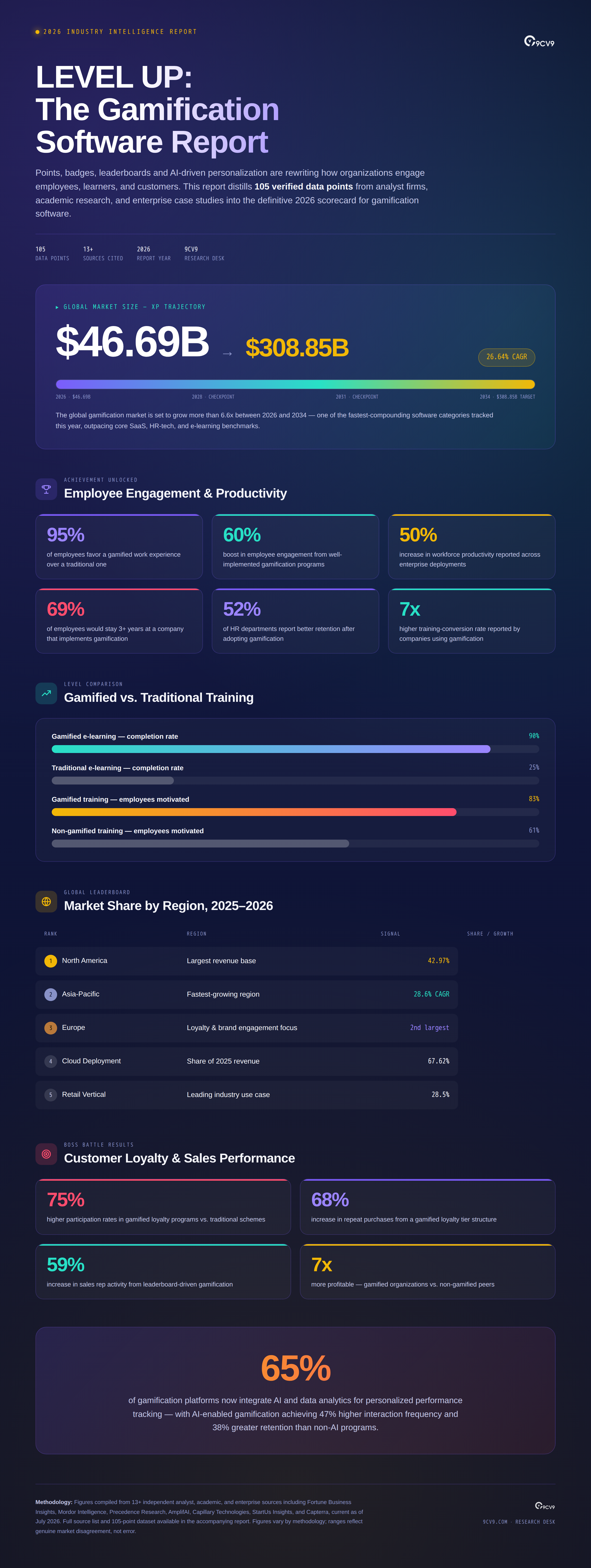
According to market research estimates, the global gamification market is valued at approximately USD 46.69 billion in 2026 and is projected to reach USD 308.85 billion by 2034, representing a compound annual growth rate (CAGR) of 26.64%. Although market valuations vary significantly depending on research methodologies and industry definitions, analysts consistently forecast strong double-digit growth, highlighting the expanding commercial importance of gamification technology.
The adoption of gamification software is particularly evident across employee engagement, corporate training, sales enablement, customer loyalty programs, recruitment, and digital education. Organizations are increasingly recognizing that incorporating game mechanics into business processes can encourage desirable behaviors, improve participation, and create more engaging experiences for employees and customers alike.
Workplace gamification statistics illustrate this growing opportunity. Research cited in industry reports suggests that 89% of employees feel more productive in a gamified workplace, while 78% believe gamification makes their work more enjoyable and engaging. Additionally, gamified training programs have been associated with employee engagement improvements of up to 48%, demonstrating the potential of well-designed engagement strategies to support organizational performance.
Corporate learning and development represents another major growth opportunity for gamification software providers. Traditional training programs frequently struggle with low participation, limited knowledge retention, and declining learner motivation. Gamification addresses these challenges by introducing interactive learning experiences, achievement-based rewards, personalized progression, and immediate feedback.
Industry research suggests that gamified e-learning courses can achieve completion rates of up to 90%, compared with 25% for non-gamified courses in certain reported comparisons. Other findings indicate that gamified training environments can improve knowledge retention, increase learner motivation, and reduce training completion times. While outcomes depend on implementation quality and learning context, these statistics help explain why organizations are incorporating gamification into learning management systems (LMS), employee onboarding, professional development, and compliance training.
Beyond workforce development, gamification software is reshaping customer engagement and loyalty strategies. Retailers, financial institutions, e-commerce businesses, and consumer technology companies are leveraging interactive rewards, loyalty tiers, personalized challenges, and achievement systems to strengthen customer relationships and encourage repeat purchases.
For example, research referenced in the 2026 industry data indicates that gamified loyalty programs can increase customer engagement by up to 47%. A 2025 study involving Mastercard and CataBoom also reported that brands incorporating casual games into their platforms experienced a 50% increase in average session duration and a 22% reduction in customer churn. These findings highlight the potential commercial benefits of integrating gamification into digital customer experiences.
Sales performance is another important application of gamification technology. Organizations are introducing competitive leaderboards, performance challenges, milestone rewards, and real-time recognition systems to motivate sales representatives and improve productivity. Some reported implementations have achieved substantial improvements in sales activity, task completion, and conversion performance, making gamification an increasingly relevant consideration for sales operations and revenue enablement teams.
The recruitment and human resources sector is also exploring gamification software to modernize candidate assessments, improve applicant engagement, and streamline hiring processes. Gamified recruitment assessments can provide employers with additional insights into candidate capabilities while creating more interactive application experiences. Reported enterprise case studies, including Unilever’s adoption of gamified recruitment assessments, illustrate how these technologies may contribute to more efficient talent acquisition processes.
From a geographical perspective, North America remains a leading market for gamification software, with some estimates placing its global market share above 40% in 2025. Meanwhile, Asia-Pacific is emerging as a particularly fast-growing region, with projected annual growth reaching approximately 28.6%. Increasing smartphone penetration, digital education initiatives, enterprise technology investments, and mobile-first consumer behavior are supporting regional adoption.
Cloud-based deployment is another defining trend shaping the gamification software industry in 2026. Research estimates suggest that cloud platforms account for approximately 68% of gamification software deployments, reflecting growing demand for scalable, accessible, and integration-friendly solutions. Organizations increasingly prefer platforms that connect with existing customer relationship management (CRM), human resource information systems (HRIS), learning management systems, and enterprise productivity applications.
However, despite the promising growth outlook, implementing gamification software successfully requires more than introducing points, badges, or competitive leaderboards. Organizations must align game mechanics with meaningful business objectives, understand user motivations, maintain fair reward structures, and continuously measure engagement outcomes. Poorly designed gamification programs can struggle to deliver sustainable improvements, making implementation strategy, user experience, and performance measurement essential considerations.
Looking ahead, the gamification software landscape is expected to become increasingly sophisticated as artificial intelligence, predictive analytics, adaptive learning, and personalized engagement technologies influence product development. Businesses are likely to place greater emphasis on measurable returns on investment (ROI), employee experience, customer lifetime value, and long-term behavioral engagement rather than superficial participation metrics.
Understanding these developments is essential for business leaders, HR professionals, learning and development teams, sales managers, marketing executives, software developers, and investors seeking to evaluate the opportunities associated with gamification technology.
This comprehensive guide to the Top 105 Gamification Software Statistics, Data & Trends in 2026 examines the latest market estimates, growth forecasts, adoption patterns, employee engagement benchmarks, corporate training outcomes, customer loyalty trends, sales performance indicators, and recruitment applications.
By exploring these 105 gamification software statistics, organizations can gain valuable insights into the industry’s evolving competitive landscape, identify emerging growth opportunities, benchmark potential performance improvements, and make more informed decisions about investing in gamification solutions.
Whether an organization is evaluating its first gamification platform, optimizing an existing employee engagement program, improving digital learning experiences, or developing a more effective customer loyalty strategy, these statistics provide a data-driven foundation for understanding the current state and future direction of the global gamification software market in 2026 and beyond.
Before we venture further into this article, we would like to share who we are and what we do.
About 9cv9
9cv9 is a business tech startup based in Singapore and Asia, with a strong presence all over the world.
With over ten years of startup and business experience, and being highly involved in connecting with thousands of companies and startups, the 9cv9 team has listed some of the top and best companies/tools in this review.
If you like to get your company listed in our top B2B software reviews, check out our world-class 9cv9 Media and PR service and pricing plans here.
Top 105 Gamification Software Statistics, Data & Trends in 2026
Section 1: Global Market Size & Growth Trajectory
1. The global gamification market is valued at USD 46.69 billion in 2026, projected to reach USD 308.85 billion by 2034 at a CAGR of 26.64%. This explosive multi-year trajectory confirms gamification software has moved from a novelty add-on to a core enterprise engagement infrastructure category.
2. The gamification software market specifically was valued at USD 36.88 billion in 2025 and is estimated to reach USD 302.14 billion by 2033, growing at a CAGR of 26.94%. Buyers evaluating gamification software in 2026 are entering a market still in its early-growth innings despite its already substantial size.
3. North America’s gamification market alone was worth USD 5.22 billion in 2025. This regional concentration highlights why most leading gamification software vendors are headquartered in the United States and Canada.
4. The U.S. gamification market was valued at USD 5.98 billion in 2025 and is predicted to reach USD 66.40 billion by 2035 at a CAGR of 27.22%. American enterprises are clearly the single largest buyer segment for gamification software worldwide.
5. The global sales gamification software market alone is projected to grow from USD 4.55 billion in 2025 to USD 15.42 billion by 2035 at a 12.98% CAGR. This sub-segment underscores how specialized, function-specific gamification tools are carving out dedicated market share.
6. One analyst places the 2026 gamification software market at USD 16.45 billion, forecasting USD 115.66 billion by 2035 at a 24.2% CAGR. The wide variance between market estimates (from $16B to $46B) reflects differing methodologies but consistently signals aggressive double-digit growth.
7. The broader gamification market is estimated at USD 36.46 billion in 2026, projected to hit USD 112.32 billion by 2031 at a 25.24% CAGR. Cloud-first delivery models are the primary driver behind this compounding expansion.
8. Another estimate places the 2026 gamification market at USD 16.04 billion, expected to cross USD 79.09 billion by 2033 at a 25.6% CAGR. Mobile device penetration continues to be cited as a key growth accelerant across nearly every market report.
9. The sales gamification software market specifically was valued at USD 6.8 billion in 2026, projected to expand to USD 22.46 billion by 2035 at a 14.20% CAGR. Financial services firms are accelerating adoption as they modernize legacy incentive structures.
10. A more conservative estimate pegs the 2026 gamification market at USD 15.73 billion, growing to USD 45.70 billion by 2035 at a 12.59% CAGR. Even the most conservative projections still represent a tripling of market value within a decade.
11. The gamification market reached USD 19.42 billion in 2025 and is projected to hit USD 92.5 billion by 2030. This near-5x growth window is being driven heavily by contact center and customer experience gamification deployments.
12. One market report values the gamification sector at USD 34.43 billion in 2026, projected to reach USD 92.37 billion by 2030 at a 28% CAGR — among the highest growth rates cited across all sources reviewed. This reflects accelerating enterprise urgency around workforce and customer engagement software.
13. The global gamification ecosystem includes roughly 30,600 companies and 2,400 active startups worldwide, collectively employing 1.4 million professionals. This scale illustrates how gamification software has matured into a genuine multi-sector technology industry rather than a fringe trend.
14. The gamification industry recorded annual company growth of 8.45%. New entrants continue launching gamification software products at a pace that outstrips many adjacent SaaS categories.
15. The global game-based learning market — a close cousin of gamification software — is projected to grow from USD 36.21 billion in 2026 to USD 181.8 billion by 2034 at a 22.35% CAGR. Corporate training buyers increasingly blend game-based learning platforms with broader gamification software suites.
16. A separate estimate places the game-based learning market at USD 29.34 billion in 2026, rising to USD 175.63 billion by 2035 at a 22% CAGR. Venture capital inflows into edtech gamification are a primary catalyst behind this scaling.
Section 2: Regional & Deployment-Model Breakdown
17. North America commanded a 42.97% market share of the global gamification market in 2025. Established SaaS infrastructure and deep enterprise IT budgets make it the epicenter of gamification software adoption.
18. North America generated 38.74% of total 2025 gamification market revenue, driven by rapid integrations with HRIS and CRM suites. Corporations in the region prioritize gamification software that plugs directly into existing tech stacks.
19. Asia-Pacific records the highest regional CAGR at 28.6%, outpacing every other geography tracked. Mobile-first enterprise strategies and supportive government digital-skills programs are fueling this surge in gamification software uptake.
20. Asia-Pacific represents approximately 25% of the global gamification market. Countries including China, India, Japan, and South Korea are rapidly expanding gamification software use across education, retail, and enterprise applications.
21. Cloud-based platforms capture 67.62% of 2025 gamification market revenue and continue expanding faster than on-premises alternatives. This confirms cloud-native gamification software is now the default purchasing preference for most organizations.
22. Cloud implementations account for approximately 68% of all gamification software deployments globally. On-premises solutions retain relevance mainly within highly regulated industries with strict data-residency requirements.
23. Retail accounted for a 28.5% revenue share of the gamification market in 2025 — the single largest industry vertical. Loyalty-driven gamification software remains retail’s dominant use case for customer retention.
24. The SME segment of the gamification market is expected to grow at a CAGR of 27.65%, outpacing large-enterprise growth rates. Lower-cost, low-code gamification software platforms are democratizing access for small and mid-sized businesses.
25. More than 64% of digital learning platforms in major Asia-Pacific markets now incorporate achievement-based engagement mechanics. This signals gamification software features have become a baseline expectation rather than a premium add-on in e-learning.
26. More than 70% of Global 2000 companies already deploy gamified solutions across training, sales, and customer engagement. Enterprise-grade gamification software adoption has effectively become mainstream at the largest corporations globally.
27. 72% of Global 2000 enterprises have adopted at least one gamification-based application to boost participation and retention. This adoption rate places gamification software firmly alongside CRM and HRIS as standard enterprise infrastructure.
28. Gamification software benefits from a base of over 7 billion global mobile subscriptions, which supports gamified applications across virtually every consumer and enterprise touchpoint. Mobile accessibility remains a foundational growth pillar for the category.
Section 3: Employee Engagement & Workplace Productivity
29. Enterprise gamification case studies show 20–60% increases in employee productivity and engagement. This wide but consistently positive range demonstrates gamification software delivers measurable ROI across industries.
30. Documented enterprise gamification case studies report a combined $1.06 billion in measurable business impact. This figure gives procurement teams a data point for justifying gamification software investment to finance stakeholders.
31. Gamified learning experiences can boost employee engagement by up to 48%. Organizations struggling with disengaged workforces increasingly cite gamification software as a direct intervention.
32. 89% of employees say they feel more productive in a gamified workplace. This overwhelming majority underscores how strongly game mechanics resonate with modern workforce expectations.
33. Gamified learning experiences can increase retention rates by as much as 90%. Gamification software’s impact on information retention is one of its most consistently replicated benefits in workplace training research.
34. 78% of employees say gamification makes their work more enjoyable and engaging. Employee experience teams are using this statistic to justify gamification software rollouts as a retention and satisfaction lever.
35. 72% of employees claim gamification inspires them to work harder. This motivational effect is central to why gamification software is increasingly embedded in performance management tools.
36. 83% of employees undergoing gamified training feel motivated, compared to just 61% receiving regular, non-gamified training. This 22-point gap makes a compelling case for L&D teams evaluating gamification software for training programs.
37. Gamification implementation can lead to a 50% increase in workforce productivity alongside a 60% boost in employee engagement. These paired figures are among the most frequently cited ROI benchmarks in gamification software vendor pitches.
38. 90% of employees report that gamification makes them more productive at work. Near-universal agreement on this point makes productivity the single strongest selling proposition for enterprise gamification software.
39. Companies with highly engaged employees report being 22% more profitable and 21% more productive. Gamification software is frequently positioned as a direct mechanism for driving this kind of engagement uplift.
40. A striking 95% of employees favor a gamified work experience over a non-gamified one. This near-unanimous preference gives HR leaders strong justification for adopting gamification software company-wide.
41. 78% of job seekers say gamification in recruitment makes a company appear more attractive. Talent acquisition teams are increasingly using gamification software as an employer-branding differentiator.
42. 89% of surveyed workers report that gamification contributes to their overall happiness and productivity at work. This dual benefit — happiness plus output — is a rare combination that strengthens the business case for gamification software.
43. 69% of employees say they would remain with a company for over three years if gamification were implemented. Retention-focused HR leaders are citing this figure when budgeting for gamification software.
44. Gamification improves skill assessment scores by 14% on average. This measurable competency lift makes gamification software attractive for compliance and certification training programs.
45. Gamification boosts user engagement by 100–150% compared to traditional non-gamified approaches to recognition. This is among the largest documented uplifts in the entire gamification software research landscape.
46. Despite strong benefits, 43% of employees report they have never noticed any gamification at their workplace. This gap between potential and actual deployment represents significant untapped opportunity for gamification software vendors and buyers alike.
47. Organizations with well-implemented gamification see workforce productivity rise 50% and employee engagement climb 60%. Consistency across multiple independent reports strengthens confidence in these gamification software performance benchmarks.
48. 52% of HR departments report better employee retention after integrating gamification into workforce programs. HR technology stacks increasingly treat gamification software as retention infrastructure rather than a discretionary perk.
49. Companies implementing gamification see a 36% average increase in employee engagement participation rates. This figure specifically measures active contribution rather than passive login activity, a more rigorous engagement metric.
50. Enterprises adopting gamified experiences report up to an 89% increase in employee happiness. Employee wellbeing metrics are becoming a formal KPI tracked within gamification software dashboards.
51. Gamified work environments can increase employee engagement by 48% and improve task completion rates by 34%. Task-completion lift is a particularly compelling metric for operations leaders evaluating gamification software ROI.
Section 4: Corporate Training & E-Learning
52. E-learning courses with gamified elements achieve a 90% completion rate, compared to just 25% for non-gamified courses. This 3.6x completion differential is arguably the single most cited statistic justifying gamification software adoption in corporate L&D.
53. Employees retain 22% more information when trained using gamified solutions. Knowledge-retention improvements make gamification software especially valuable for regulated industries requiring compliance certification.
54. Knowledge retention increases by 45% in gamified training environments according to industry analysis. This retention boost compounds over time, reducing the need for costly retraining cycles.
55. Gamified training programs take 50% less time to complete while improving long-term engagement, according to Deloitte research. Time-efficiency gains directly reduce the total cost of enterprise training delivered through gamification software.
56. 91% of employees say gamification features make them feel more engaged with learning content. This overwhelming approval rate reflects why L&D platforms increasingly bundle gamification software natively.
57. Digital learning platforms with gamification see 70% higher course completion rates than non-gamified platforms. This statistic is frequently used to benchmark gamification software vendors during procurement evaluations.
58. 92% of employees acknowledge that gamification elements make training more engaging. Nearly universal agreement here signals gamification software has crossed from experimental to expected in corporate learning.
59. 80% of learners say receiving badges and rewards makes them more likely to complete training. Achievement-based mechanics remain the most requested feature set within gamification software platforms.
60. 88% of employees say gamification makes them feel happier at work overall. This wellbeing dividend extends gamification software’s value proposition beyond pure productivity metrics.
61. 93% of employees believe gamification helps them better understand training content. Comprehension gains, not just completion, make a strong case for gamification software in technical and compliance training.
62. Companies using gamification experience a 7x higher conversion rate for training initiatives. This multiplier effect is a headline statistic in vendor sales materials for enterprise gamification software.
63. Organizations report a 45% improvement in knowledge retention specifically attributable to gamified learning design. Instructional designers increasingly cite this figure when advocating for gamification software budgets.
64. 62% of organizations plan to increase their gamification budgets over the next two years. This forward-looking spending intent signals continued strong demand growth for gamification software vendors.
65. Gamification elements — points, badges, leaderboards, streaks, and progress bars — increase course completion rates by 25–40%. This is one of the more conservative but well-corroborated ranges across independent gamification software research.
66. Duolingo users maintaining 7+ day streaks complete courses at 6x the rate of non-streak users. Streak mechanics have become the gold-standard feature within consumer-facing gamification software.
67. AstraZeneca achieved a 99% completion rate for gamified medicine training deployed across its agent network. This near-perfect completion rate demonstrates gamification software’s effectiveness even in highly technical, regulated training contexts.
68. Sales teams using gamification hit targets 78% faster than non-gamified peers. Speed-to-target is a critical KPI that sales enablement teams track when evaluating gamification software ROI.
69. Beat the GMAT increased student time-on-site by 370% through gamification implementation. This case study remains one of the most dramatic engagement multipliers documented in gamification software literature.
70. Online courses with charging for certificates alongside gamification report 8x higher completion when combined with short-format design. Bundling gamification software with credentialing mechanics compounds completion-rate benefits.
Section 5: Customer Engagement, Loyalty & Retail
71. Brands leveraging gamification reported a 22% increase in customer loyalty. Loyalty and rewards teams increasingly treat gamification software as core infrastructure rather than a marketing gimmick.
72. A gamified tier structure increased repeat purchases by 68% for one major loyalty platform client. Progression mechanics embedded in gamification software directly shift long-term buying behavior.
73. A seasonal gamification strategy delivered a 55% increase in active users for a super-app client. Time-bound campaigns built on gamification software are effective at re-engaging dormant user segments.
74. Gamification strategies increased monthly active users (MAUs) by 15% for enterprise conglomerate clients. Sustained in-app engagement gains like this justify ongoing investment in gamification software platforms.
75. Gamification delivered 75% incremental retail sales for one retail client case study. This is among the largest single-brand sales lifts attributed directly to gamification software deployment.
76. Gamified digital treasure hunts drove a 35% increase in in-store visits for participating retail brands. Physical-world footfall gains demonstrate gamification software’s impact extends beyond purely digital engagement.
77. Gamified loyalty programs can boost customer engagement by up to 47%. This figure is frequently cited when building the ROI case for adopting gamification software in customer loyalty programs.
78. A 2025 Mastercard and CataBoom study found brands weaving casual games into their platforms saw a 50% increase in average session times and a 22% drop in customer churn. Churn reduction of this magnitude gives strong quantitative backing to gamification software investment cases.
79. Customers participate at rates up to 75% higher in gamified loyalty programs than in traditional, non-gamified schemes. Participation-rate lift is one of the clearest, most measurable outcomes attributed to gamification software.
80. 87% of loyalty programs still use points as their primary reward mechanism. Point-based systems remain the most universally adopted feature within gamification software despite the category’s broader mechanic diversity.
81. Nine in ten loyalty members say they want the flexibility to redeem rewards across multiple favorite brands. This preference is pushing gamification software vendors toward multi-brand and coalition loyalty architectures.
82. Habit formation through streak mechanics takes an average of 66 days to solidify. This behavioral-science benchmark informs how gamification software designers structure long-term engagement campaigns.
83. Retail leads gamification adoption, accounting for 28.5% of total market revenue. No other single vertical commands a larger share of gamification software spending.
84. 78% of consumers aged 25–34 say they would use gamified elements in their healthcare treatments. This demographic openness signals significant untapped opportunity for healthcare-focused gamification software.
85. Tyson Foods implemented VR-based safety training and saw a 20% year-over-year reduction in workplace injuries. This case study demonstrates gamification software’s applicability well beyond marketing and sales use cases.
86. Duolingo grew to 300 million users averaging 10 minutes of daily engagement, built largely on streak-based gamification mechanics. Few consumer products demonstrate the retention power of gamification software as clearly as this case.
87. Commonwealth Bank’s “Investorville” gamified property-investing game generated 600 new loans. This shows gamification software can drive high-value financial conversions, not merely superficial engagement metrics.
88. 85% of consumers say they prefer brands offering gamified loyalty programs. Consumer preference at this scale makes gamification software a near-essential differentiator in competitive retail markets.
89. Starbucks Rewards’ gamification features increased visit frequency by 23% among its 15 million members. Frequency lift of this scale translates directly into incremental revenue for large loyalty programs powered by gamification software.
90. Nike+ Run Club’s gamification approach led to 30% more user-generated content and a 28% sales uplift. Community-driven gamification software features can simultaneously drive marketing content and direct revenue.
Section 6: Sales Performance & Revenue Impact
91. Companies implementing gamification tools including leaderboards report up to a 59% increase in rep activity and a 30% increase in bottom-line sales margin. Sales operations leaders frequently cite these dual metrics when building the case for gamification software.
92. A Harvard Business School study found gamified sales training drove a 35.8% rise in overall sales performance. Academic validation of this magnitude adds significant credibility to gamification software’s sales-enablement claims.
93. SAP’s gamified sales training program increased quota attainment by 15% across a cohort of 10,000 sales representatives. Large-scale enterprise deployments like this provide statistically robust evidence for gamification software effectiveness.
94. Gamified organizations are reported to be 7x more profitable than their non-gamified peers. This multiplier represents one of the strongest financial arguments found across all gamification software research.
95. Sales teams using gamified contests and leaderboards see a 3.5x increase in performance output. Competitive mechanics embedded in gamification software consistently outperform static incentive structures.
96. Gamification is associated with a 50% increase in conversion rates across deploying organizations. Marketing and sales teams increasingly treat gamification software as a direct conversion-optimization tool.
97. Sales conversion improvements of 25.3% have been documented across organizations that deploy gamification consistently. Consistency of application, not just initial rollout, appears critical to realizing gamification software’s full benefit.
98. 80% of gamification programs fall short of expectations when organizations rely on surface-level point systems rather than designing for genuine behavioral outcomes. This cautionary statistic highlights that gamification software alone isn’t sufficient — implementation strategy matters equally.
99. 45% of organizations cite integration and scalability challenges as a barrier to gamification software success. Buyers should prioritize platforms offering robust CRM, HRIS, and LMS integrations during procurement.
100. US sales teams report a 40% productivity increase through gamified workflows. Domestic enterprise sales organizations remain the earliest and heaviest adopters of gamification software for performance management.
101. A Salesforce gamification deployment drove a 42% increase in engagement and a 33% improvement in sales task completion rates. This case study is frequently referenced as a benchmark for CRM-integrated gamification software.
Section 7: Recruitment & HR Applications
102. Gen Z and Millennial candidates are 58% more likely to complete a gamified job application than a traditional one. This completion-rate gap makes gamification software an increasingly essential recruitment marketing tool.
103. 78% of applicants report feeling more motivated to work for a company after completing a gamified assessment. Employer branding teams are leveraging this statistic to justify gamification software investment in talent acquisition.
104. Unilever cut its time-to-hire from four months to four weeks after adopting gamified recruitment assessments. This dramatic efficiency gain is among the most cited enterprise recruitment case studies for gamification software.
105. Traditional CVs predict job performance with only about 14% accuracy, while gamified assessments reach accuracy rates of 65% or higher. This predictive-validity gap is reshaping how talent acquisition teams evaluate gamification software for hiring decisions.
Conclusion
The top 105 gamification software statistics, data, and trends in 2026 demonstrate how gamification is evolving into an increasingly important technology for improving employee engagement, enhancing customer experiences, accelerating learning outcomes, and strengthening business performance. As organizations continue investing in digital transformation, gamification software is becoming a valuable tool for encouraging participation, influencing user behavior, and creating more interactive experiences across multiple industries.
The global gamification software market is positioned for substantial expansion. According to one market research estimate, the global gamification market is expected to reach USD 308.85 billion by 2034, growing from USD 46.69 billion in 2026 at a CAGR of 26.64%. Although market forecasts differ depending on research methodologies, the consistently strong growth projections indicate increasing demand for gamification solutions across enterprise software, education, retail, healthcare, financial services, and human resources.
One of the most significant findings from the 2026 gamification software statistics is the technology’s potential impact on workforce productivity and employee engagement. Industry research suggests that 89% of employees feel more productive in gamified workplaces, while 78% report that gamification makes their work more enjoyable. These findings highlight the growing importance of incorporating meaningful rewards, achievement systems, performance recognition, and interactive challenges into workplace experiences.
Corporate training and e-learning remain among the most promising applications of gamification software. Reported comparisons show that gamified learning programs can achieve course completion rates of up to 90%, compared with 25% for traditional non-gamified courses. Additional research suggests that gamification can improve knowledge retention, increase employee motivation, and enhance training efficiency. These benefits make gamification particularly relevant for organizations seeking to modernize employee onboarding, professional development, compliance training, and digital learning programs.
Customer engagement and loyalty represent another major growth opportunity. Businesses are increasingly integrating gamified loyalty programs, personalized challenges, interactive rewards, and progression-based incentives into their customer engagement strategies. Research highlighted in this report indicates that gamified loyalty programs can increase customer engagement by up to 47%, while certain implementations have demonstrated improvements in repeat purchases, customer retention, and digital platform engagement.
The sales and marketing sectors are also recognizing the potential of gamification software to support revenue growth. By introducing performance leaderboards, achievement-based incentives, interactive sales challenges, and real-time recognition, organizations can create more engaging environments for sales professionals. Reported case studies demonstrate improvements in sales productivity, conversion rates, and task completion, although actual results vary according to implementation quality, organizational culture, and business objectives.
From a regional perspective, North America continues to lead the global gamification software market, supported by established enterprise technology infrastructure and substantial investments in digital engagement solutions. Meanwhile, Asia-Pacific is emerging as one of the fastest-growing regional markets, with projected annual growth reaching approximately 28.6%. Increasing digital adoption, mobile-first business models, and expanding enterprise technology investments are expected to create additional opportunities for gamification software providers throughout the region.
Cloud-based gamification platforms are also shaping the industry’s future. With approximately 68% of gamification software deployments associated with cloud-based solutions, organizations are increasingly prioritizing scalability, accessibility, integration capabilities, and cost-effective implementation. This transition is particularly important for small and medium-sized enterprises seeking flexible gamification tools without substantial infrastructure investments.
Looking toward 2027 and beyond, several technological developments are expected to influence the evolution of gamification software. Artificial intelligence, machine learning, predictive analytics, adaptive learning systems, and personalized engagement technologies could enable businesses to deliver increasingly sophisticated gamified experiences. Rather than relying exclusively on traditional points, badges, and leaderboards, future gamification platforms are likely to emphasize individualized motivation, behavioral insights, dynamic rewards, and measurable business outcomes.
However, the statistics also highlight an important consideration: gamification software does not automatically guarantee higher engagement, productivity, or profitability. Successful implementations require clearly defined objectives, thoughtful user experience design, meaningful incentives, continuous performance monitoring, and alignment with organizational goals. Businesses that prioritize sustainable behavioral engagement over superficial reward mechanisms are better positioned to generate long-term value from their gamification investments.
For business leaders, HR professionals, marketing teams, learning and development specialists, and technology decision-makers, the findings reinforce the importance of evaluating gamification software as part of a broader digital engagement strategy. Selecting the right platform, identifying relevant performance indicators, and understanding the motivations of employees or customers are essential steps toward achieving measurable results.
Ultimately, the 105 gamification software statistics and trends for 2026 reveal an industry characterized by strong market growth, expanding enterprise adoption, and increasingly diverse applications. From improving employee motivation and corporate learning outcomes to strengthening customer loyalty and sales performance, gamification technology offers organizations new opportunities to create engaging, interactive, and results-oriented digital experiences.
As competition intensifies and user expectations continue to evolve, businesses that strategically integrate gamification into their operations may gain meaningful advantages in engagement, retention, productivity, and customer experience.
The future of gamification software will be defined not simply by how effectively organizations make activities more entertaining, but by how successfully they translate engagement into measurable, sustainable business value.
If you find this article useful, why not share it with your hiring manager and C-level suite friends and also leave a nice comment below?
We, at the 9cv9 Research Team, strive to bring the latest and most meaningful data, guides, and statistics to your doorstep.
To get access to top-quality guides, click over to 9cv9 Blog.
To hire top talents using our modern AI-powered recruitment agency, find out more at 9cv9 Modern AI-Powered Recruitment Agency.
People Also Ask
What is gamification software?
Gamification software uses game-inspired elements such as points, badges, leaderboards, challenges, and rewards to improve user engagement, motivation, and participation in business, education, employee training, and customer loyalty programs.
What is the global gamification software market size in 2026?
The global gamification market is estimated at USD 46.69 billion in 2026, according to one industry forecast. Market valuations vary across research firms due to differences in definitions, methodologies, and industry coverage.
How fast is the gamification software market growing in 2026?
The global gamification market is projected to grow at a compound annual growth rate (CAGR) of 26.64% between 2026 and 2034, driven by enterprise digital transformation, cloud adoption, and demand for interactive engagement solutions.
What is the projected gamification software market size by 2034?
The global gamification market is forecast to reach approximately USD 308.85 billion by 2034, up from USD 46.69 billion in 2026, reflecting substantial growth in enterprise engagement, digital learning, and customer loyalty applications.
What are the biggest gamification software trends in 2026?
Major gamification software trends in 2026 include AI-powered personalization, cloud-based platforms, mobile gamification, employee engagement tools, interactive learning, gamified loyalty programs, and data-driven performance tracking.
Which industries use gamification software the most?
Retail, education, healthcare, financial services, human resources, and enterprise technology are major users of gamification software. Retail accounted for approximately 28.5% of global gamification market revenue in 2025.
How does gamification software improve employee engagement?
Gamification software improves employee engagement through achievement systems, recognition, challenges, and rewards. Industry research suggests gamified workplace experiences can increase employee engagement by up to 48%.
What percentage of employees prefer gamification at work?
Industry statistics suggest that up to 95% of employees prefer gamified workplace experiences, while 78% report that gamification makes their work more enjoyable and engaging. Results vary depending on survey populations and methodologies.
Does gamification software increase employee productivity?
Yes, gamification software can support productivity improvements by encouraging participation and goal achievement. Survey findings indicate that 89% of employees feel more productive in gamified workplaces, although actual performance gains vary.
How effective is gamification in corporate training?
Gamification can improve corporate training effectiveness through interactive challenges, immediate feedback, and achievement rewards. Reported studies suggest improvements in learner motivation, knowledge retention, and course completion rates.
What are the benefits of gamification in e-learning?
Gamification in e-learning can improve learner engagement, course completion, knowledge retention, and motivation. Points, badges, progress tracking, and interactive challenges encourage learners to participate consistently in educational activities.
What is the course completion rate for gamified learning?
Some industry comparisons report gamified e-learning completion rates of up to 90%, compared with 25% for traditional non-gamified courses. These figures represent specific reported findings rather than universal completion benchmarks.
How much does gamification improve knowledge retention?
Industry research cited in gamification reports suggests knowledge retention improvements ranging from 22% to 45% in certain training environments. Results depend on instructional design, learner characteristics, and implementation quality.
How does gamification software improve customer loyalty?
Gamification software strengthens customer loyalty through reward points, achievement levels, personalized challenges, and interactive incentives. Some industry reports associate gamified loyalty programs with customer engagement increases of up to 47%.
What are the benefits of gamified loyalty programs?
Gamified loyalty programs can increase customer participation, repeat purchases, brand engagement, and retention. Interactive rewards, loyalty tiers, and personalized challenges encourage customers to maintain ongoing relationships with brands.
Can gamification software reduce customer churn?
Yes, gamification may help reduce customer churn by encouraging repeat engagement. A 2025 Mastercard and CataBoom study reported a 22% reduction in customer churn among brands incorporating casual games into their platforms.
How does gamification increase sales performance?
Sales gamification uses leaderboards, performance challenges, milestone rewards, and recognition systems to motivate sales teams. Reported implementations show improvements in sales activity, task completion, and conversion performance.
What is the market size of sales gamification software in 2026?
One industry estimate values the global sales gamification software market at USD 6.8 billion in 2026, with projections reaching USD 22.46 billion by 2035 at a CAGR of approximately 14.20%.
How is gamification software used in recruitment?
Recruitment gamification incorporates interactive assessments, simulations, challenges, and rewards into hiring processes. Employers use these tools to improve candidate engagement, evaluate skills, and create more interactive application experiences.
Does gamification improve recruitment efficiency?
Gamification can improve recruitment efficiency through interactive assessments and streamlined candidate evaluation. Unilever reportedly reduced its time-to-hire from four months to four weeks after introducing gamified recruitment assessments.
What percentage of job seekers prefer gamified recruitment?
Industry survey findings suggest that 78% of job seekers consider companies using gamification in recruitment more attractive. Gamified hiring experiences may also improve candidate motivation and application completion rates.
Which region dominates the gamification software market?
North America leads the global gamification software market, with one industry estimate placing its market share at approximately 42.97% in 2025. Strong enterprise technology adoption and established SaaS infrastructure support regional demand.
How fast is the Asia-Pacific gamification software market growing?
Asia-Pacific is among the fastest-growing gamification software markets, with a projected CAGR of approximately 28.6%. Growth is supported by mobile technology adoption, digital education, and expanding enterprise software investments.
What percentage of gamification software is cloud-based?
Industry estimates suggest that cloud-based platforms account for approximately 68% of gamification software deployments. Businesses increasingly prefer cloud solutions because of scalability, accessibility, and integration capabilities.
Why are businesses investing in gamification software in 2026?
Businesses invest in gamification software to improve employee motivation, customer engagement, training effectiveness, sales productivity, and retention. Growing demand for measurable digital engagement supports continued investment across industries.
How does artificial intelligence improve gamification software?
AI-powered gamification software can personalize challenges, recommend rewards, analyze user behavior, and adapt experiences to individual preferences. These capabilities may improve engagement and help organizations optimize performance strategies.
What are the most popular gamification software features?
Popular gamification software features include points, badges, leaderboards, achievement levels, progress bars, streaks, challenges, rewards, real-time feedback, and performance analytics. Feature selection depends on organizational goals and user needs.
What challenges do businesses face when implementing gamification software?
Common gamification software challenges include system integration, scalability, employee adoption, ineffective rewards, and difficulty measuring ROI. Industry findings suggest that 45% of organizations encounter integration or scalability barriers.
How can businesses measure gamification software ROI?
Businesses can measure gamification ROI using employee productivity, training completion, customer retention, conversion rates, sales performance, and engagement metrics. Comparing implementation costs against measurable improvements helps determine financial value.
What is the future of gamification software beyond 2026?
The future of gamification software includes AI-driven personalization, adaptive learning, predictive analytics, mobile-first engagement, and deeper enterprise integrations. Strong market growth forecasts suggest expanding adoption across business functions through 2034 and beyond.
Sources
- Fortune Business Insights
- Verified Market Reports
- Precedence Research
- Spherical Insights
- Business Research Insights
- Mordor Intelligence
- Coherent Market Insights
- MarkWide Research
- MarketReportsWorld
- AmplifAI
- Research and Markets
- StartUs Insights
- Visu Network
- CrustLab
- Yu-kai Chou
- Octalysis Group
- BuildEmpire
- Zippia
- Ideawake
- Careertrainer
- Skillademia
- LearnyBox
- Engageli
- Capillary Technologies
- EditorialGE
- Mastercard
- Open Loyalty
- WifiTalents
- SPOTIO
- Novigem
- Skima
- Jobful
- The Talent Games
- TalentLitmus