




























Key Takeaways
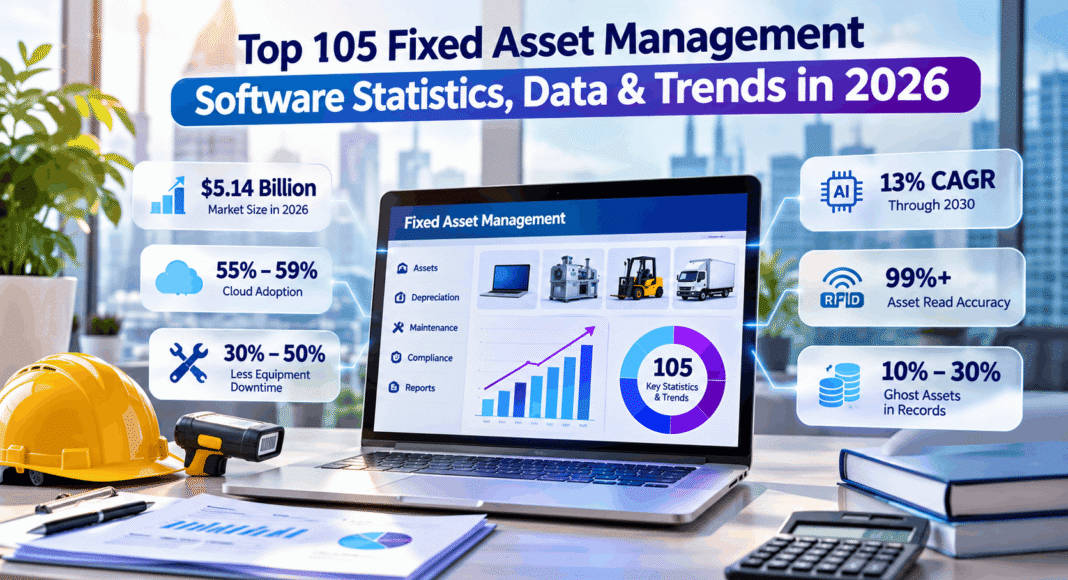
- Fixed Asset Management Software Market Growth: The global fixed asset management software market is estimated at $5.14 billion in 2026 and projected to reach $8.39 billion by 2030, driven by digital transformation, automation, and increasing demand for efficient asset lifecycle management.
- Cloud Adoption, AI, and Predictive Maintenance: Cloud-based solutions account for approximately 55%–59% of the fixed asset management software market, while AI-powered predictive maintenance can reduce unplanned equipment downtime by 30%–50% and extend asset lifespans by 20%–40%.
- Asset Tracking Accuracy, Compliance, and ROI: With an estimated 10%–30% of recorded fixed assets classified as ghost assets, businesses are increasingly adopting RFID, IoT, automated depreciation, and real-time asset tracking software to improve financial accuracy, reduce operational costs, strengthen compliance, and maximize ROI.
Fixed asset management software is transforming how businesses track, manage, and optimize physical assets in 2026. The global market is estimated at $5.14 billion, with projections reaching $8.39 billion by 2030. Key trends include cloud adoption, AI-powered predictive maintenance, automated depreciation, RFID tracking, and improved regulatory compliance.
Fixed asset management software has become an essential component of modern business operations as organizations seek greater visibility, accuracy, and control over their physical assets. From tracking equipment and managing depreciation to ensuring regulatory compliance and optimizing asset lifecycles, businesses are increasingly adopting digital solutions to replace manual spreadsheets, reduce operational costs, and improve financial reporting.
In 2026, the global fixed asset management software market continues to experience significant growth, driven by accelerating digital transformation, cloud adoption, artificial intelligence (AI), and the Internet of Things (IoT). According to industry market estimates, the global fixed asset management software market is valued at approximately $5.14 billion in 2026, with projections suggesting it could reach $8.39 billion by 2030, representing a compound annual growth rate (CAGR) of approximately 13%. Although market valuations differ depending on research methodologies and software classifications, the overall outlook indicates sustained demand for automated asset tracking and management solutions.
One of the biggest challenges facing organizations is maintaining accurate fixed asset records. Industry estimates suggest that 10% to 30% of recorded fixed assets may be classified as ghost assets, referring to equipment, machinery, or other assets that remain on financial records despite being lost, disposed of, or no longer owned. These discrepancies can lead to inaccurate depreciation calculations, unnecessary tax expenses, compliance risks, and inefficient capital allocation. Consequently, businesses are investing in fixed asset management platforms that provide centralized asset registers, automated depreciation schedules, real-time tracking, and comprehensive audit trails.
Cloud-based fixed asset management software is also transforming how organizations monitor and maintain their assets. Market estimates indicate that cloud-based deployments account for approximately 55% to 59% of the fixed asset management software market, reflecting growing demand for scalable, accessible, and cost-effective solutions. Meanwhile, technologies such as RFID, barcode scanning, IoT sensors, and AI-powered predictive maintenance are helping businesses improve asset visibility, minimize human errors, and make more informed operational decisions.
The financial benefits of modern asset management technologies are particularly compelling. Industry research indicates that predictive maintenance can reduce unplanned equipment downtime by 30% to 50%, while potentially extending equipment lifespans by 20% to 40%. These improvements are especially valuable for asset-intensive industries such as manufacturing, healthcare, construction, transportation, energy, and utilities, where equipment reliability directly influences productivity, profitability, and business continuity.
Regional adoption patterns further demonstrate the growing importance of fixed asset management software. North America remains a major market, supported by established enterprise technology infrastructure and stringent financial reporting requirements. At the same time, Asia-Pacific is emerging as a significant growth region, fueled by industrial expansion, smart manufacturing initiatives, and increasing investment in cloud-based enterprise software.
As businesses navigate rising operational costs, evolving accounting standards, and growing pressure to maximize returns on capital investments, understanding the latest fixed asset management software statistics, market trends, adoption rates, and industry forecasts for 2026 is becoming increasingly important.
This comprehensive guide explores the top 105 fixed asset management software statistics, data, and trends in 2026, covering global market size, industry growth forecasts, enterprise asset management adoption, RFID and IoT technologies, cloud deployment, AI-powered automation, depreciation management, regulatory compliance, regional market developments, and return on investment (ROI).
Whether the reader is a business owner, CFO, finance professional, IT manager, asset management specialist, software vendor, or technology investor, these data-driven insights provide a clearer understanding of how the fixed asset management software industry is evolving, which technologies are shaping its future, and where the most significant opportunities for operational efficiency and business growth may emerge in 2026 and beyond.
Before we venture further into this article, we would like to share who we are and what we do.
About 9cv9
9cv9 is a business tech startup based in Singapore and Asia, with a strong presence all over the world.
With over ten years of startup and business experience, and being highly involved in connecting with thousands of companies and startups, the 9cv9 team has listed some of the top and best companies/tools in this review.
If you like to get your company listed in our top B2B software reviews, check out our world-class 9cv9 Media and PR service and pricing plans here.
Top 105 Fixed Asset Management Software Statistics, Data & Trends in 2026
📊 Section 1: Market Size & Growth
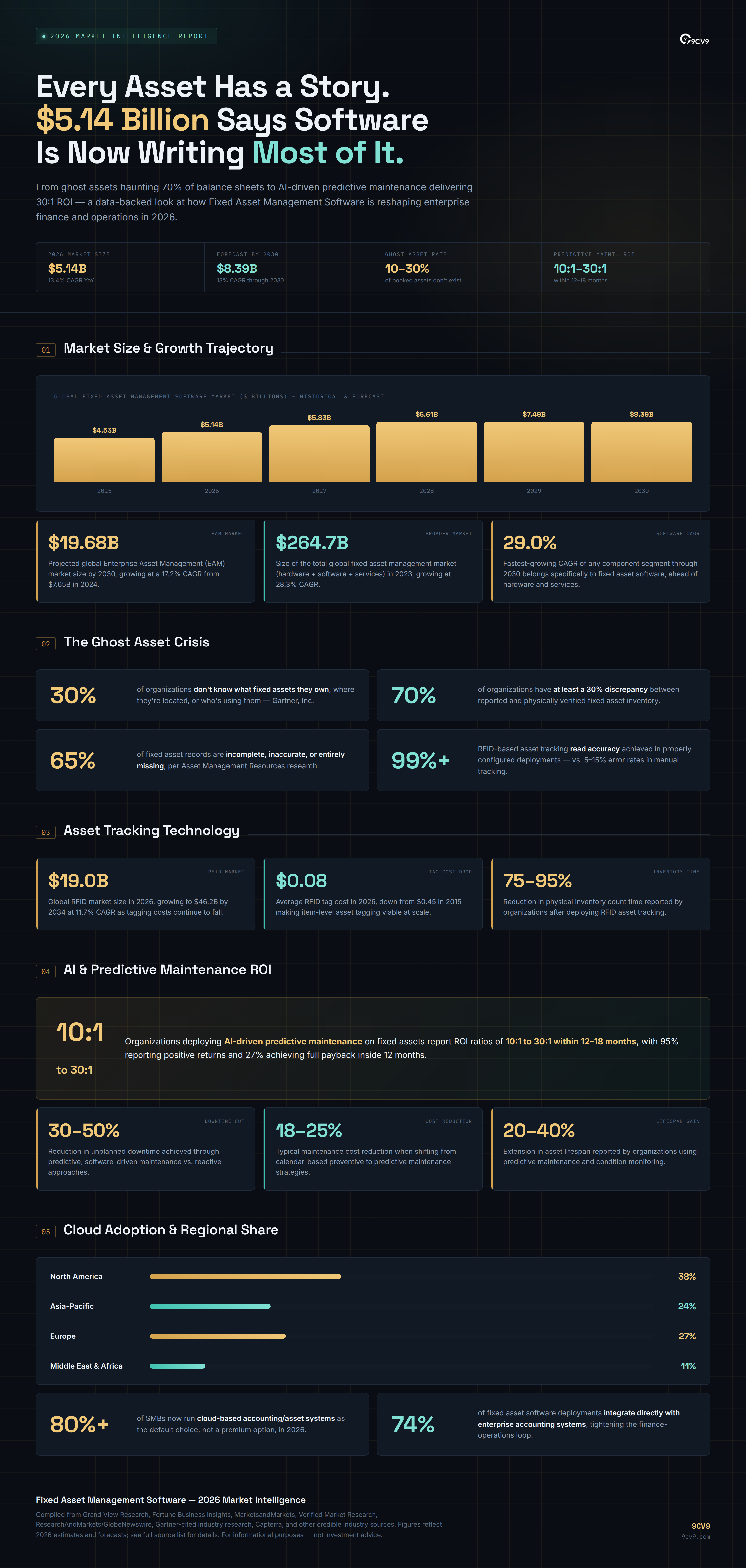
1. The global fixed asset management software market is valued at approximately $5.14 billion in 2026, up from $4.53 billion in 2025. This steady climb underscores how enterprises are prioritizing centralized, automated asset visibility over fragmented manual processes.
2. Analysts project the fixed asset management software market will reach $8.39 billion by 2030, growing at a 13% CAGR. This double-digit growth trajectory signals sustained enterprise investment in digital asset infrastructure through the decade’s end.
3. One market report pegs the 2026 fixed asset management software valuation even higher, at $5.99 billion, with a forecast of $30.11 billion by 2035 (19.65% CAGR) — reflecting how divergent methodologies still agree on aggressive long-term expansion.
4. A separate global forecast estimates the market at $7.45 billion by 2029, growing at 13.2% CAGR, driven by rising investment in fixed assets across asset-intensive industries.
5. By 2031, the fixed asset management software market could swell to $9.96 billion, representing a CAGR of 13.02% — nearly doubling the current market size within five years.
6. The global fixed asset management (hardware + software + services) market was estimated at $264.68 billion in 2023, growing at a striking 28.3% CAGR through 2030 — a reminder that software is only one slice of a much larger asset ecosystem.
7. Within that broader market, the pure software segment is forecast to grow at the fastest CAGR of ~29.0% through 2030, outpacing both hardware and services components.
8. A more conservative estimate places the fixed asset management software market at $3.99 billion in 2026, growing to $8.15 billion by 2035 at a 6.7% CAGR — highlighting how vendor definitions of “fixed asset software” materially shift market-size figures.
9. The fixed asset management software market is expected to reach $11.4 billion by 2032, growing at a 10.6% CAGR, according to Adroit Market Research’s global forecast.
10. Global demand for fixed asset (FAM) software specifically is anticipated to reach $7 billion by 2028, driven by the need to reduce operational expenses through efficient asset management.
11. One 2026 market report values the segment at $23.47 billion, reaching $35.86 billion by 2031 (8.85% CAGR) when the broader accounting software category — inclusive of fixed asset modules — is measured together.
🏭 Section 2: Enterprise Asset Management (EAM) Market
12. The global enterprise asset management (EAM) market was estimated at $7.65 billion in 2024 and is projected to reach $19.68 billion by 2030, growing at a robust 17.2% CAGR — nearly triple the market size within six years.
13. A separate EAM valuation places 2026 revenue at $8.22 billion, expected to reach $17.46 billion by 2035 at a 9.7% CAGR, reinforcing EAM’s role as a maturing, high-growth software category.
14. The EAM software market specifically is forecast to grow from $6.84 billion in 2025 to $7.50 billion in 2026, en route to $17.25 billion by 2035.
15. Approximately 65% of EAM demand comes from industries with a heavy focus on asset performance and maintenance optimization, such as manufacturing and utilities.
16. Nearly 52% of new EAM adoption is now driven specifically by AI, IoT, and cloud integration — evidence that “smart” capabilities have become a primary purchase driver rather than a nice-to-have.
17. North America and Asia-Pacific together account for roughly 68% of the global EAM market, reflecting concentrated industrial digitalization in these two regions.
18. Manufacturing commands approximately 29% of EAM market share, the single largest vertical, driven by complex multi-machine asset ecosystems requiring constant monitoring.
19. Large enterprises hold 60%+ of EAM market share, as complex, multi-site asset portfolios demand enterprise-grade solutions beyond what spreadsheets or basic tools can support.
20. Approximately 75% of asset-intensive industries have already adopted EAM solutions to streamline operations and maximize returns on physical assets.
21. Over 60% of EAM users report improved maintenance scheduling after adopting predictive maintenance features — a direct efficiency dividend of digital asset management.
22. Roughly 70% of organizations adopting IoT-enabled EAM systems report enhanced asset tracking and operational visibility compared to legacy tracking methods.
23. IoT-enabled EAM system adoption has grown by 65% over the past five years, reflecting accelerating sensor-driven asset monitoring across industrial sectors.
24. Approximately 55% of businesses are transitioning from on-premises EAM systems to cloud platforms, favoring scalability and remote collaboration over legacy infrastructure.
25. AI and machine learning integration within EAM systems has risen by 40%, enabling predictive analytics and automated maintenance scheduling at scale.
📡 Section 3: Asset Tracking Technology — RFID, Barcode & IoT
26. The global RFID market is projected to grow from $14.58 billion in 2025 to $30.47 billion by 2034, at an 8.5% CAGR, as businesses increasingly deploy tags for real-time asset identification.
27. A separate RFID forecast places the 2026 market at $19.01 billion, reaching $46.2 billion by 2034 at an even faster 11.70% CAGR.
28. RFID tags alone account for approximately 51–54% of total RFID market share, driven by large-scale item-level and asset-level tagging deployments.
29. RFID tag costs have declined dramatically, from roughly $0.45 per tag in 2015 to just $0.08–$0.12 per tag by 2026, making item-level asset tagging economically viable even for mid-value assets.
30. The global asset tracking market (covering RFID, GPS, barcode and IoT/M2M technologies collectively) is valued at $28.97 billion in 2026, projected to reach $71.55 billion by 2034 at a 11.97% CAGR.
31. North America dominates the asset tracking market with a 36.27% share, reflecting mature enterprise adoption of tracking technologies in the region.
32. Barcode technology still leads asset tracking deployments, contributing 25.33% of the global asset tracking market in 2026 thanks to low cost and widespread cloud-software compatibility.
33. Organizations deploying RFID for asset tracking report 75–95% reductions in physical inventory count time, turning multi-week manual audits into multi-day automated verifications.
34. Manual barcode scanning and spreadsheet-based asset tracking produce error rates of 5–15% in typical enterprise environments — a key argument for automated fixed asset software adoption.
35. By contrast, RFID-based asset tracking systems achieve read accuracy rates exceeding 99% in properly configured deployments, virtually eliminating manual counting errors.
36. Companies that adopt RFID for asset tracking see inventory count accuracy improve from an average of 63% to 95%, according to GS1 US benchmarking data.
37. For a mid-sized organization with 25,000 fixed assets, RFID-based tracking can generate estimated annual savings of $145,000 in labor costs alone, with payback typically achieved within 12 months.
38. Global IoT connections reached 16.7 billion active endpoints in 2023, growing 16% year-over-year, and are projected to exceed 29 billion connections by 2027 — a foundational driver of connected asset monitoring.
39. Roughly 84% of businesses report they could achieve significant cost savings and efficiency improvements by adopting IoT technologies for asset tracking, according to Inmarsat research.
40. Barcode and RFID asset-tagging usage collectively reaches approximately 52% adoption among organizations using fixed asset management software today.
👻 Section 4: Ghost Assets & Fixed Asset Data Accuracy
41. Up to 30% of organizations don’t know what fixed assets they own, where those assets are located, or who is currently using them, according to Gartner research.
42. Approximately 70% of organizations have at least a 30% discrepancy between their reported fixed asset inventory and what is physically verifiable — a staggering data integrity gap.
43. As many as 65% of fixed asset records are incomplete, inaccurate, or entirely missing, according to longstanding research from Asset Management Resources.
44. Industry estimates consistently find that 10–30% of listed fixed assets are “ghost assets” — items still on the books that are lost, stolen, or no longer owned.
45. Ghost hardware assets carrying active depreciation charges represent an estimated 12–25% of fixed asset records in the average organization, according to 2026 ITAM research.
46. Eliminating ghost assets can reduce a company’s tax bill by an estimated 20–30%, since organizations often overpay property tax on assets they no longer physically possess.
47. Alarmingly, 49% of small business owners don’t know what a “ghost asset” is, and 25% don’t understand how ghost assets distort their financial records.
48. In IT specifically, as much as 25% of IT expenditure is claimed to be wasted managing underutilized or non-existent assets, compounding the ghost-asset problem in technology-heavy organizations.
49. Software license waste alone averages $19.8 million annually per organization, illustrating how asset visibility gaps extend beyond physical hardware into digital and software assets.
50. Complete IT visibility has actually declined from 47% to 43% year-over-year, meaning more assets are going untracked even as AI-driven operations raise the stakes for data accuracy.
☁️ Section 5: Cloud Adoption & Deployment Trends
51. Cloud-based fixed asset deployments represent roughly 55–59% of the fixed asset management software market, and are expected to capture the maximum share through 2026 and beyond.
52. Cloud-based platforms account for nearly 68–69% of new EAM implementations in the United States, driven by demand for scalable, multi-location asset visibility.
53. Around 45% of enterprises are now shifting to cloud-based EAM solutions specifically to reduce infrastructure costs and improve scalability.
54. Despite the cloud shift, on-premises deployment still holds a notable 58.66% share of the broader EAM market in 2026, as many large enterprises prioritize direct data control for sensitive asset records.
55. Over 80% of small and mid-sized businesses (SMBs) now run cloud-based accounting and financial systems, making cloud the default rather than the premium choice heading into 2026.
56. In North America specifically, about 67% of SMEs had adopted cloud financial tools by 2024, driven largely by remote-work and mobile-access requirements.
57. 75% of US small and mid-sized businesses have now adopted cloud accounting software, reflecting a broader shift away from spreadsheet-based financial tracking.
58. Cloud deployment commands roughly 68% of the accounting software market’s revenue share, prized for remote access, automatic updates, and reduced IT overhead.
59. SMBs report that migrating to cloud-based financial and accounting tools can cut bookkeeping time by up to 50% while simultaneously improving data accuracy.
60. Finance teams now conduct roughly 60% of all real-time bookkeeping activity inside cloud platforms rather than spreadsheets or legacy desktop software.
🤖 Section 6: AI, Automation & Predictive Maintenance
61. Organizations implementing AI-driven predictive maintenance on physical assets report 10:1 to 30:1 ROI ratios within 12–18 months of deployment — one of the strongest cost-justification cases in enterprise software.
62. Predictive maintenance strategies reduce unplanned equipment downtime by 30–50% compared to purely reactive maintenance approaches, directly protecting asset uptime and revenue.
63. Maintenance cost reductions of 18–25% are commonly documented when organizations shift from calendar-based preventive maintenance to predictive, data-driven scheduling.
64. Compared to purely reactive maintenance, predictive strategies can cut total maintenance costs by as much as 40%, according to McKinsey-aggregated industry benchmarks.
65. 95% of organizations that implement predictive maintenance report a positive return on investment, with 27% achieving full payback within just 12 months.
66. Fortune 500 companies could collectively save an estimated 2.1 million hours of downtime and $233 billion in annual maintenance costs with full adoption of condition-monitoring and predictive maintenance technology.
67. Predictive maintenance can extend equipment/asset lifespan by 20–40%, delivering compounding value beyond immediate downtime and repair-cost savings.
68. Unplanned equipment downtime costs the average Fortune 500 company $2.8 billion annually — roughly 11% of revenue — underscoring the financial stakes of poor asset visibility.
69. The average cost of unplanned downtime in discrete manufacturing has risen to approximately $260,000 per hour in 2026, a figure that has grown roughly 50% since 2019.
70. Approximately 65% of maintenance teams plan to adopt AI-driven asset and maintenance tools by the end of 2026, though only 32% have fully or partially implemented AI so far.
71. AI-driven depreciation automation has been integrated into roughly 31% of newly launched fixed asset management platforms, streamlining what was historically a manual accounting task.
72. Automated depreciation tools are now adopted by around 71% of finance departments globally, reflecting how depreciation calculation has become a baseline software expectation rather than a differentiator.
73. 97% of finance departments report having adopted at least some AI tooling in 2026, up sharply from 76% the prior year — a rapid acceleration in AI-assisted financial operations.
74. AI automation is estimated to save individual accounting professionals roughly 240 hours per year, time increasingly redirected toward strategic financial analysis rather than manual data entry.
🏢 Section 7: Enterprise Adoption, Deployment & Organization Size
75. Approximately 68% of organizations manage over 5,000 fixed assets annually, a scale that makes spreadsheet-based tracking increasingly untenable.
76. Enterprises managing over 5,000 assets represent roughly 61% of all fixed asset management software use cases, reinforcing that scale is a primary driver of software adoption.
77. In the United States specifically, nearly 69% of enterprises track more than 4,000 fixed assets per fiscal year, requiring systematic digital tracking infrastructure.
78. Integration with enterprise accounting systems occurs in about 74% of fixed asset software deployments, highlighting how tightly asset management is now woven into core financial operations.
79. Compliance-driven asset audits influence nearly 63% of fixed asset software procurement decisions, showing regulatory pressure as a leading purchase trigger.
80. Regulatory audit requirements influence approximately 66% of US software procurement decisions in the fixed asset space specifically.
81. Large enterprises are expected to account for 60–66% of fixed asset management software market share through 2026, though SME adoption is growing at a faster relative rate.
82. High initial implementation and integration costs restrict fixed asset software adoption for roughly 28% of SMEs, representing the primary barrier to smaller-business adoption.
83. Legacy infrastructure dependency delays fixed asset management software implementation for an estimated 47% of organizations, particularly those with deeply embedded ERP systems.
84. Difficulty integrating modern fixed asset tools with legacy ERP systems remains a top-cited barrier to market growth, frequently prolonging implementation timelines and inflating costs.
🌍 Section 8: Regional Market Breakdown
85. North America holds approximately 38% of the global fixed asset management software market, the largest regional share, reflecting mature compliance regimes and high digital adoption.
86. Asia-Pacific was the largest and fastest-growing region in the fixed asset management software market as of 2025, fueled by rapid industrialization and enterprise digitalization in China, India, and Japan.
87. Europe holds an estimated 27% share of the fixed asset management software market, supported by strong public-sector usage and IFRS/GAAP-aligned accounting standard requirements.
88. Asia-Pacific specifically contributes approximately 24% of global fixed asset management software adoption, with nearly 69% of regional deployments tied to enterprise digital-transformation initiatives.
89. Cloud-based platforms represent around 63% of fixed asset software installations across Asia-Pacific, supporting the scalability needs of rapidly expanding regional enterprises.
90. In the Asia-Pacific EAM market specifically, adoption is expected to grow at the highest CAGR of 14.3% globally, driven by smart-factory investment and IoT-enabled predictive maintenance rollouts.
🔒 Section 9: IT Asset Disposition (ITAD) & Compliance
91. The global IT Asset Disposition (ITAD) market — covering secure disposal of retired fixed IT assets — is estimated at approximately $12.1 billion in 2026, projected to reach $27.8 billion by 2035 at a 9.6% CAGR.
92. A separate ITAD forecast places the 2025 market even higher, at $29.39 billion, growing at a 14.9% CAGR between 2026 and 2034.
93. 64% of organizations now prioritize compliance as their primary driver for adopting certified ITAD practices when retiring fixed IT assets.
94. Over 80% of regulated industries now mandate NIST-compliant data sanitization standards when disposing of retired IT hardware assets.
95. Global e-waste reached 62 million metric tonnes in 2022 and is projected to climb to 82 million metric tonnes by 2030 — yet only 22.3% is formally recycled in an environmentally sound manner.
96. The average cost of a data breach has climbed to $10.22 million, a key factor pushing organizations toward certified, auditable IT asset disposition programs.
⭐ Section 10: Software Vendor Landscape & User Sentiment
97. Capterra’s fixed asset management software directory has aggregated over 2.5 million verified user reviews across its broader software categories, giving buyers substantial peer-validated insight before purchase.
98. Top vendors collectively control approximately 54% of the fixed asset management software market, reflecting moderate — not extreme — market concentration among category leaders.
99. Key players named across multiple 2026 market reports include IBM, Oracle, SAP, Sage, Infor, AssetWorks, and Ramco Systems, spanning both dedicated fixed asset tools and broader ERP-embedded modules.
100. Depreciation-calculation accuracy and tax-law update automation are consistently cited as the most-valued features among verified fixed asset software reviewers on Capterra.
💰 Section 11: Financial Impact & ROI
101. Organizations report that fixed asset mismanagement — through ghost assets, misvalued depreciation, and audit failures — is among the top ten reasons cited for business financial distress, according to longstanding accounting-industry research.
102. Businesses using dedicated fixed asset software instead of spreadsheets reduce the risk of the broken-formula and manual-entry errors that plague Excel-based asset registers, particularly as asset counts scale into the thousands.
103. Enterprise software audits cost more than $1 million over a three-year window for 45% of organizations, with 23% facing audit costs exceeding $5 million — costs directly tied to poor asset-tracking discipline.
104. Cloud computing waste — often stemming from poorly tracked digital assets — accounts for roughly 27% of total cloud spend, an estimated $182 billion in global waste in 2025 alone.
105. Reactive (unplanned) maintenance costs organizations 3–5 times more than proactive, software-scheduled preventive maintenance once lifetime damage and downtime value are factored in.
Conclusion
The top 105 fixed asset management software statistics, data, and trends in 2026 highlight an industry undergoing significant transformation as businesses increasingly prioritize operational efficiency, financial accuracy, regulatory compliance, and intelligent asset lifecycle management. With the global fixed asset management software market estimated at approximately $5.14 billion in 2026 and projected to reach $8.39 billion by 2030, the industry is positioned for sustained growth as organizations accelerate their adoption of digital asset management solutions.
One of the most important findings is the growing financial and operational impact of ineffective asset tracking. Industry estimates suggest that 10% to 30% of recorded fixed assets may be ghost assets, creating potential challenges involving inaccurate depreciation, unnecessary expenses, financial reporting discrepancies, and compliance risks. These findings reinforce the importance of implementing centralized fixed asset management systems that provide accurate asset records, automated depreciation calculations, comprehensive audit trails, and improved visibility throughout the asset lifecycle.
The continued expansion of cloud-based fixed asset management software represents another defining trend in 2026. With cloud deployments estimated to account for approximately 55% to 59% of the market, organizations are increasingly moving away from traditional spreadsheets and fragmented on-premises systems toward scalable, integrated platforms. Cloud technology enables businesses to manage assets across multiple locations, access financial information in real time, streamline reporting processes, and support collaboration between finance, accounting, IT, and operations teams.
Meanwhile, emerging technologies such as artificial intelligence (AI), machine learning, RFID, barcode scanning, and the Internet of Things (IoT) are fundamentally changing how businesses track, maintain, and optimize their fixed assets. Predictive maintenance technologies are particularly promising, with industry research suggesting they can reduce unplanned equipment downtime by 30% to 50% and extend asset lifespans by 20% to 40%. These capabilities demonstrate how modern asset management software can evolve beyond basic recordkeeping to become a strategic tool for improving productivity, reducing maintenance expenses, and maximizing returns on capital investments.
Regional market developments also indicate substantial opportunities for software vendors and enterprise technology providers. While North America remains a major market for fixed asset management solutions, Asia-Pacific is emerging as an important growth region, supported by industrial expansion, smart manufacturing initiatives, increasing cloud adoption, and enterprise digital transformation. Industries such as manufacturing, healthcare, construction, transportation, energy, and utilities are expected to remain important drivers of demand because of their extensive physical asset portfolios and complex operational requirements.
However, businesses must also address several challenges when implementing fixed asset management software, including high initial deployment costs, integration difficulties with legacy enterprise resource planning (ERP) systems, data migration complexities, cybersecurity considerations, and employee training requirements. Selecting the right solution requires careful evaluation of functionality, scalability, accounting integrations, regulatory compliance capabilities, implementation costs, and long-term return on investment.
Looking ahead, the future of fixed asset management software beyond 2026 will likely be shaped by greater automation, AI-powered asset analytics, predictive maintenance, cloud-native platforms, real-time IoT monitoring, and tighter integration with enterprise financial systems. Organizations that successfully adopt these technologies may gain significant competitive advantages through improved asset utilization, more accurate financial reporting, reduced operational risks, and better-informed capital investment decisions.
Ultimately, the fixed asset management software statistics and trends for 2026 demonstrate that effective asset management is no longer simply an administrative or accounting function. It is becoming an increasingly important component of enterprise financial strategy, operational resilience, and sustainable business growth.
For business leaders, CFOs, finance professionals, IT managers, and asset management specialists, the key takeaway is clear: investing in accurate, automated, and data-driven fixed asset management capabilities can help organizations reduce costs, strengthen compliance, optimize asset performance, and maximize the long-term value of their investments.
As the fixed asset management software market continues to evolve, businesses that prioritize digital transformation, intelligent automation, and comprehensive asset visibility will be better positioned to navigate emerging challenges and capitalize on new opportunities in 2026 and the years ahead.
If you find this article useful, why not share it with your hiring manager and C-level suite friends and also leave a nice comment below?
We, at the 9cv9 Research Team, strive to bring the latest and most meaningful data, guides, and statistics to your doorstep.
To get access to top-quality guides, click over to 9cv9 Blog.
To hire top talents using our modern AI-powered recruitment agency, find out more at 9cv9 Modern AI-Powered Recruitment Agency.
People Also Ask
What is the global fixed asset management software market size in 2026?
The global fixed asset management software market is estimated at approximately $5.14 billion in 2026, driven by increasing demand for automated asset tracking, depreciation management, regulatory compliance, and cloud-based solutions.
How fast is the fixed asset management software market growing?
The fixed asset management software market is projected to grow at approximately 13% CAGR, reaching $8.39 billion by 2030. Growth is supported by enterprise digital transformation, cloud adoption, and automated asset lifecycle management.
What are the key fixed asset management software trends in 2026?
Major trends include cloud-based asset management, AI-powered predictive maintenance, RFID tracking, IoT integration, automated depreciation, real-time asset monitoring, and stronger regulatory compliance capabilities.
What is fixed asset management software?
Fixed asset management software helps businesses track, monitor, depreciate, maintain, and manage physical assets throughout their lifecycle. It improves financial reporting accuracy, asset visibility, operational efficiency, and regulatory compliance.
Why is fixed asset management software important for businesses in 2026?
Fixed asset management software reduces manual errors, improves asset visibility, automates depreciation, supports regulatory compliance, and helps organizations maximize asset utilization while minimizing unnecessary operational expenses.
What percentage of businesses use cloud-based fixed asset management software?
Cloud-based deployments represent approximately 55% to 59% of the fixed asset management software market. Businesses increasingly prefer cloud solutions for scalability, remote accessibility, automated updates, and centralized asset management.
How does AI improve fixed asset management software?
Artificial intelligence improves fixed asset management through predictive maintenance, automated depreciation, anomaly detection, asset performance forecasting, and intelligent analytics that help businesses reduce downtime and optimize asset utilization.
What is the role of IoT in fixed asset management software?
IoT technology connects physical assets to digital management platforms through sensors and connected devices. It enables real-time monitoring, automated asset tracking, equipment condition analysis, and predictive maintenance.
How does RFID technology improve fixed asset tracking?
RFID technology enables automated asset identification and tracking without manual barcode scanning. Properly configured RFID systems can achieve read accuracy exceeding 99%, improving inventory accuracy and reducing physical asset verification time.
What are ghost assets in fixed asset management?
Ghost assets are physical assets that remain on financial records despite being lost, stolen, disposed of, or no longer owned. Industry estimates suggest that 10% to 30% of recorded fixed assets may fall into this category.
How can fixed asset management software reduce ghost assets?
Fixed asset management software reduces ghost assets through centralized asset registers, RFID and barcode tracking, automated reconciliation, regular physical audits, and accurate asset disposal records.
What is the enterprise asset management software market size in 2026?
One industry estimate values the enterprise asset management software market at approximately $8.22 billion in 2026, with projections reaching $17.46 billion by 2035 at a CAGR of 9.7%.
What industries use fixed asset management software the most?
Manufacturing, healthcare, construction, transportation, utilities, energy, education, and government organizations commonly use fixed asset management software to track equipment, manage depreciation, maintain assets, and meet compliance requirements.
How does predictive maintenance reduce equipment downtime?
Predictive maintenance uses AI, IoT sensors, and equipment performance data to identify potential failures before they occur. Industry research suggests it can reduce unplanned equipment downtime by 30% to 50%.
What is the ROI of fixed asset management software?
ROI depends on implementation costs, asset volumes, and operational improvements. Benefits may include reduced labor expenses, fewer ghost assets, improved depreciation accuracy, lower maintenance costs, and increased equipment availability.
How much can predictive maintenance reduce maintenance costs?
Predictive maintenance can reduce maintenance costs by approximately 18% to 25% compared with traditional scheduled maintenance. Some industry benchmarks indicate savings of up to 40% compared with reactive maintenance.
What percentage of enterprises integrate fixed asset software with accounting systems?
Approximately 74% of fixed asset management software deployments include integration with enterprise accounting systems, enabling automated depreciation calculations, financial reconciliation, and more accurate asset reporting.
What are the benefits of automated depreciation software?
Automated depreciation software calculates asset depreciation, maintains accounting records, supports multiple depreciation methods, reduces manual errors, and simplifies financial reporting and regulatory compliance.
What is the difference between fixed asset management software and enterprise asset management software?
Fixed asset management software focuses on asset tracking, depreciation, valuation, and financial reporting. Enterprise asset management software emphasizes equipment maintenance, operational performance, reliability, and asset lifecycle optimization.
Which region has the largest fixed asset management software market?
Market estimates identify North America as a leading region, with approximately 38% market share. Other research identifies Asia-Pacific as the largest and fastest-growing region, reflecting differences in market definitions and methodologies.
Why is Asia-Pacific a growing market for fixed asset management software?
Asia-Pacific growth is driven by industrial expansion, smart manufacturing, enterprise digital transformation, cloud adoption, and increasing investment in IoT-enabled asset monitoring and predictive maintenance technologies.
What are the biggest challenges in implementing fixed asset management software?
Common challenges include implementation costs, legacy ERP integration, inaccurate asset records, data migration, employee training, cybersecurity requirements, and compatibility with existing accounting and financial systems.
How does fixed asset management software support regulatory compliance?
Fixed asset management software supports compliance through accurate depreciation schedules, centralized asset records, audit trails, automated financial reporting, asset valuation, and documentation of acquisitions, transfers, and disposals.
What percentage of companies face fixed asset software integration challenges?
Industry estimates suggest that legacy infrastructure dependencies delay fixed asset management software implementation for approximately 47% of organizations, particularly enterprises operating complex ERP and accounting systems.
How does fixed asset management software improve financial reporting?
Fixed asset management software improves financial reporting by automating depreciation, tracking asset acquisitions and disposals, maintaining accurate valuations, reducing manual reconciliation, and supporting consistent accounting records.
What is the future of AI-powered fixed asset management software?
AI-powered fixed asset management software is expected to expand predictive maintenance, automated depreciation, intelligent asset analytics, anomaly detection, and real-time monitoring to improve operational efficiency and financial decision-making.
How much does RFID asset tracking reduce inventory counting time?
Organizations implementing RFID asset tracking report reductions of approximately 75% to 95% in physical inventory counting time, allowing businesses to complete asset audits faster and reduce manual verification workloads.
What is the global asset tracking market size in 2026?
The global asset tracking market is estimated at approximately $28.97 billion in 2026 and projected to reach $71.55 billion by 2034, driven by growing adoption of RFID, GPS, barcode systems, and IoT technologies.
How does fixed asset management software help small businesses?
Fixed asset management software helps small businesses automate depreciation, track equipment, reduce spreadsheet errors, prepare financial reports, improve tax recordkeeping, and manage growing asset portfolios without extensive manual processes.
What should businesses look for when choosing fixed asset management software in 2026?
Businesses should evaluate automated depreciation, cloud accessibility, RFID and barcode support, accounting integrations, asset lifecycle tracking, reporting capabilities, regulatory compliance, scalability, security, pricing, and implementation requirements.
Sources
- Research and Markets
- The Business Research Company
- Grand View Research
- Fortune Business Insights
- MarketsandMarkets
- Verified Market Research
- Verified Market Reports
- Business Research Insights
- 360 Research Reports
- Global Growth Insights
- GII Research
- Adroit Market Research
- IndustryARC
- Micromarket Insights
- Mordor Intelligence
- Data Insights Market
- Polaris Market Research
- Technavio
- Capterra
- Gartner
- Wasp Barcode
- Asset Management Resources
- Verdantis
- MaintainX
- TeepTrak
- iFactoryApp
- Wiss
- WorkTrek
- OxMaint
- CPCON Group
- CYBRA
- Atidiv
- WifiTalents
- eInvoice Blog
- ERP Peers
- WebProNews
- Virima