





























Key Takeaways
- Firewall Software Market Growth: The global network security firewall market is projected to reach $66.13 billion by 2035, growing at a 22.70% CAGR, driven by rising cybersecurity threats, cloud adoption, and enterprise security investments.
- Cloud Firewalls and AI-Powered Security: Next-generation firewalls (NGFWs), Firewall-as-a-Service (FWaaS), artificial intelligence, and zero-trust security are transforming network protection, with the FWaaS market forecast to reach $14.21 billion by 2035.
- Cybersecurity Threats and Firewall Adoption: With average global data breach costs reaching $4.44 million in 2025, businesses are prioritizing advanced firewall software, ransomware prevention, DDoS protection, and automated threat detection to strengthen cybersecurity resilience.
Firewall software remains essential for cybersecurity in 2026, with the global network security firewall market projected to reach $66.13 billion by 2035, growing at a 22.70% CAGR. Businesses increasingly adopt AI-powered protection, cloud firewalls, and zero-trust security to defend against ransomware, data breaches, DDoS attacks, and evolving network threats.
As cyber threats become increasingly sophisticated, firewall software has emerged as one of the most essential components of modern cybersecurity infrastructure. From protecting corporate networks against ransomware and unauthorized access to securing cloud applications, remote workforces, and connected devices, firewall technologies continue to evolve in response to an expanding digital threat landscape. In 2026, organizations of all sizes are investing in advanced network security solutions to safeguard sensitive information, maintain regulatory compliance, and strengthen their overall cybersecurity resilience.
Also, read our article on the Top 10 Best Firewall Software To Try.

The global firewall software market is experiencing significant growth, driven by rising cyberattack volumes, widespread cloud adoption, artificial intelligence (AI), and increasing demand for zero-trust security architectures. According to industry research compiled for this report, the global network security firewall market was valued at approximately $8.55 billion in 2025 and is projected to reach $66.13 billion by 2035, expanding at a compound annual growth rate (CAGR) of 22.70%. Although market estimates vary depending on how firewall products and services are categorized, the broader outlook indicates sustained demand for enterprise firewalls, next-generation firewalls (NGFWs), and cloud-based security solutions.
One of the most significant firewall software trends in 2026 is the rapid adoption of cloud-delivered security technologies. The Firewall-as-a-Service (FWaaS) market is projected to grow from $1.48 billion in 2025 to $1.85 billion in 2026, potentially reaching $14.21 billion by 2035. Meanwhile, the global next-generation firewall market is estimated at $7.48 billion in 2026, reflecting continued investment in advanced capabilities such as deep packet inspection, intrusion prevention, application awareness, and intelligent threat detection.
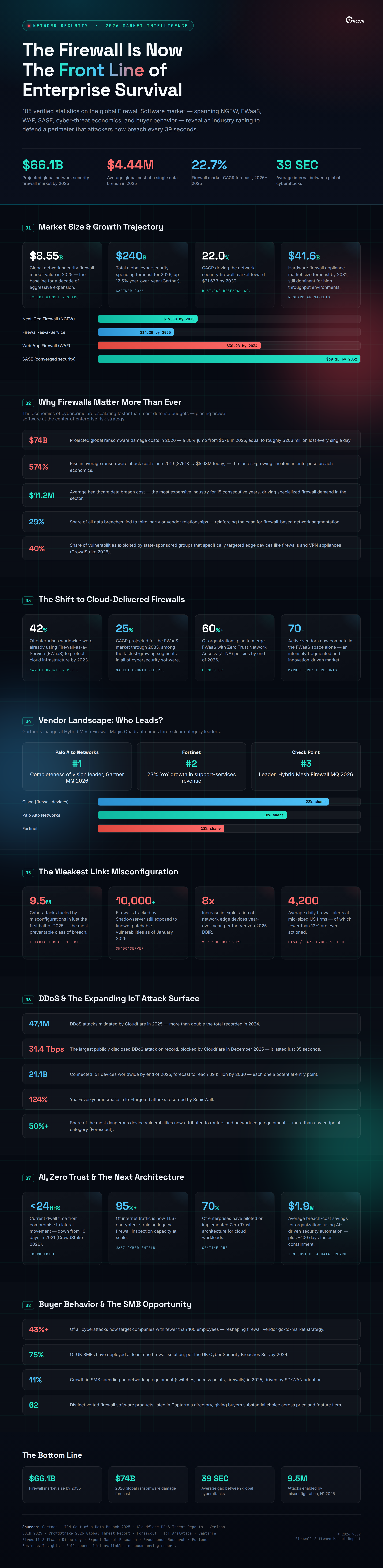
The growing financial consequences of cybercrime are also accelerating firewall software adoption. Research indicates that the global average cost of a data breach reached $4.44 million in 2025, while organizations in the United States experienced average breach costs of approximately $10.22 million. At the same time, ransomware attacks, network vulnerabilities, and increasingly sophisticated distributed denial-of-service (DDoS) attacks are placing additional pressure on businesses to modernize their cybersecurity defenses. Cloudflare reportedly mitigated 47.1 million DDoS attacks in 2025, highlighting the importance of scalable network protection and cloud-based security infrastructure.
Beyond traditional perimeter protection, AI-powered firewalls, zero-trust network access (ZTNA), Secure Access Service Edge (SASE), and automated threat intelligence are reshaping how organizations approach network security. As enterprises transition toward hybrid cloud environments and distributed workforces, firewall solutions are increasingly integrated into broader cybersecurity platforms capable of providing centralized visibility, real-time monitoring, and adaptive security policies.
The expansion of the Internet of Things (IoT) further reinforces the importance of effective firewall management. With approximately 21.1 billion connected IoT devices worldwide by the end of 2025 and projections approaching 39 billion by 2030, businesses face growing challenges in securing interconnected networks, managing device vulnerabilities, and preventing unauthorized access. These developments are creating new opportunities for firewall software providers while increasing the complexity of enterprise security requirements.
For business leaders, IT professionals, cybersecurity specialists, software vendors, and technology investors, understanding the latest firewall software statistics, market size, adoption rates, and industry trends is essential for making informed decisions about cybersecurity investments and long-term digital infrastructure strategies.
This comprehensive guide explores the top 105 firewall software statistics, data, and trends in 2026, covering global market growth, next-generation firewall adoption, Firewall-as-a-Service, web application firewalls (WAFs), leading cybersecurity vendors, ransomware threats, AI-driven security innovations, zero-trust architectures, DDoS protection, and regional market developments.
By examining these statistics and emerging trends, readers will gain valuable insights into the current state of the firewall software industry, the technologies driving its transformation, and the key opportunities and challenges shaping the future of network security in 2026 and beyond.
Before we venture further into this article, we would like to share who we are and what we do.
About 9cv9
9cv9 is a business tech startup based in Singapore and Asia, with a strong presence all over the world.
With over ten years of startup and business experience, and being highly involved in connecting with thousands of companies and startups, the 9cv9 team has listed some of the top and best companies/tools in this review.
If you like to get your company listed in our top B2B software reviews, check out our world-class 9cv9 Media and PR service and pricing plans here.
Top 105 Firewall Software Statistics, Data & Trends in 2026
Section 1: Market Size & Overall Growth
- The global network security firewall market reached approximately $8.55 billion in 2025. This figure confirms that firewall software remains one of the largest and most mature segments within the broader cybersecurity industry, anchoring enterprise network defense budgets worldwide.
- The network security firewall market is projected to grow at a CAGR of 22.70% between 2026 and 2035, reaching nearly $66.13 billion by 2035. This explosive growth rate signals that firewall technology is far from commoditized, with vendors continuously innovating to keep pace with evolving threats.
- An alternate market model places the firewall market at $10.91 billion in 2025, rising to $13.52 billion in 2026. The variance across analyst firms underscores how differently “firewall market” is scoped, ranging from hardware-only to fully bundled software-and-service definitions.
- That same model forecasts the market will hit $50.21 billion by 2032 at a 24.35% CAGR. Such acceleration reflects the industry-wide pivot from static perimeter hardware toward software-defined, subscription-based firewall platforms.
- A separate 2026 report estimates the network security firewall market will grow from $7.98 billion in 2025 to $9.77 billion in 2026, a 22.3% CAGR. This consistent double-digit growth across multiple independent research houses validates firewall software as a resilient, high-priority IT spending category.
- The same source projects the market will expand to $21.67 billion by 2030 at a 22.0% CAGR. Sustained five-year growth of this magnitude illustrates how digital transformation and remote work have permanently expanded the addressable firewall market.
- Another market model values the global network security firewall industry at $6.91 billion in 2024, rising to $16.96 billion by 2033 at a 10.5% CAGR. Even the more conservative growth estimates still point to the market more than doubling within a decade.
- The global Firewall Devices market alone is estimated at $2.51 billion in 2026, projected to reach $12.57 billion by 2035 at a 19.3% CAGR. This narrower hardware-device segment shows that even physical firewall appliances continue to see robust demand despite the shift to cloud.
- A Spherical Insights model projects the network security firewall market growing from $8.95 billion in 2025 to $24.4 billion by 2035 at a 10.55% CAGR. The consistency of double-digit CAGR projections across nearly every analyst house confirms firewall software’s status as a durable long-term growth category.
- Global cybersecurity spending overall is forecast to reach $240 billion in 2026, up 12.5% from $213 billion in 2025. Firewall and network security investments represent a foundational slice of this broader security budget expansion.
- IDC estimates global cybersecurity spending could reach as high as $308 billion in 2026, climbing to $430 billion by 2029. The wide range between forecasting houses ($240B–$308B) illustrates just how quickly AI-driven threats are reshaping security budget planning.
Section 2: Next-Generation Firewall (NGFW) Segment
- The global NGFW market is calculated at $6.73 billion in 2025, rising to $7.48 billion in 2026. NGFWs, which combine deep packet inspection with application awareness, have become the default standard rather than a premium upsell.
- NGFW is forecast to reach approximately $19.47 billion by 2035 at an 11.21% CAGR. This steady, sustained growth trajectory reflects NGFW’s transition from an enterprise luxury to a baseline compliance requirement across industries.
- North America held the largest NGFW market share at 45.4% in 2025. Heavy government and enterprise cybersecurity investment continues to anchor North America as the epicenter of next-gen firewall deployment.
- The North America NGFW market alone is valued at $3.06 billion in 2025, projected to reach $8.86 billion by 2035. This regional figure alone would rank among the largest national cybersecurity software markets in the world.
- A competing analyst estimate puts the global NGFW market at $6.59 billion in 2025, growing to $15.28 billion by 2033 at an 11.1% CAGR. The convergence of multiple independent forecasts around the $15–19 billion mark by the mid-2030s reinforces confidence in NGFW’s long-term trajectory.
- By deployment type, on-premises NGFW is expected to command 61.0% of global market share in 2026. Despite the cloud shift, many regulated industries still prioritize on-premises control for compliance and data sovereignty reasons.
- Hardware NGFW held 58.5% of the product/type market share in 2025. Physical appliances remain dominant for high-throughput data center and campus environments where latency and raw performance are critical.
- Europe is projected to contribute 40.0% of the global NGFW market share in 2026. Strict regulatory frameworks like GDPR and NIS2 make Europe a disproportionately large driver of advanced firewall adoption relative to its economic size.
- The Asia Pacific NGFW market is expected to grow at the fastest regional CAGR of approximately 10.5%–12.67% through 2035. Rapid digital economy expansion and government-mandated cybersecurity initiatives across China, India, Japan, and Southeast Asia are fueling this acceleration.
- The cloud-native NGFW/FWaaS segment is growing at a notable 9.3% CAGR between 2025 and 2035. While hardware still leads in absolute revenue, cloud-delivered NGFW capacity is the clear long-term growth engine of the category.
Section 3: Firewall-as-a-Service (FWaaS) & Cloud Firewall
- The Firewall-as-a-Service market is projected to reach $1.85 billion in 2026, up from $1.48 billion in 2025. FWaaS has emerged as one of the fastest-growing subsegments as businesses shed physical appliance dependency.
- FWaaS is forecast to reach $14.21 billion by 2035, a 25% CAGR. This is among the highest growth rates in the entire cybersecurity software landscape, driven by the scalability advantage of cloud-delivered security.
- A separate report values the FWaaS market at $6.29 billion in 2026, projected to reach $13.14 billion by 2031 at a 15.89% CAGR. Even under more conservative modeling, FWaaS is set to roughly double within five years.
- By 2023, approximately 42% of all enterprises worldwide were already using FWaaS solutions to protect cloud infrastructure and sensitive data. This adoption rate demonstrates that cloud-delivered firewalls have crossed from early-adopter status into mainstream enterprise practice.
- More than 35% of small-to-medium businesses reported using cloud firewall services as of 2023, citing lower upfront hardware investment. FWaaS is proving to be a democratizing force, giving smaller organizations access to enterprise-grade protection without capital expenditure.
- Over 60% of organizations plan to merge FWaaS with Zero Trust Network Access (ZTNA) policies by 2026, according to Forrester research. This convergence trend signals that standalone firewall products are increasingly being absorbed into unified security platforms.
- More than 70 active vendors now compete in the FWaaS space, including Palo Alto Networks, Zscaler, and Check Point. Such intense competitive density is accelerating feature innovation and pushing prices down for buyers.
- North America accounts for over 40% of total FWaaS deployments globally. Aggressive cybersecurity spending and early mid-market adoption have kept North America as the largest single regional FWaaS buyer base.
- A separate forecast projects the FWaaS market reaching $11.41 billion by 2029 at a 28.9% CAGR. Rising cyberattack and fraud incident volumes are cited as the single biggest catalyst behind this exceptionally fast growth rate.
- The U.S. federal government’s zero-trust mandate under Executive Order 14028 is channeling billions in incremental cybersecurity procurement directly into cloud-delivered firewall spending. Government compliance deadlines are proving to be a powerful, non-discretionary demand driver for FWaaS vendors.
- The EU’s NIS2 Directive now imposes breach-notification and risk-management obligations on critical-infrastructure operators across 27 member states. This regulatory pressure is expected to keep European FWaaS and firewall spending elevated well beyond typical market cycles.
Section 4: Web Application Firewall (WAF)
- The global WAF market was valued at $8.60 billion in 2025 and is projected to reach $10.13 billion in 2026. As e-commerce and API-driven applications proliferate, WAF has become a non-negotiable layer of the modern security stack.
- The WAF market is forecast to reach $30.86 billion by 2034 at a 14.90% CAGR. This near-quadrupling within a decade reflects how application-layer attacks have overtaken network-layer attacks as a primary enterprise concern.
- North America dominated the WAF market with a 36.10% share in 2025. A concentration of major e-commerce and SaaS platforms in North America continues to drive outsized WAF spending in the region.
- The UK WAF market alone is projected to reach $0.42 billion by 2026, while Germany’s market is projected to reach $0.54 billion. These country-level figures highlight how European digital transformation is translating into concrete WAF procurement.
- WAF vendors named among market leaders include Barracuda, F5, Palo Alto Networks, Check Point, Cisco, Imperva, Citrix, Cloudflare, Qualys, Akamai, and others. The breadth of established players competing in WAF illustrates how central application security has become to enterprise vendor strategy.
Section 5: Enterprise Firewall & Hardware Firewall Market
- The global enterprise firewall market was valued at $2.40 billion in 2025, projected to grow to $2.61 billion in 2026. Enterprise-grade firewalls continue to see steady growth as organizations refresh aging perimeter infrastructure.
- The enterprise firewall market is projected to reach $5.77 billion by 2034 at a 10.2% CAGR. This more than doubling of market size demonstrates sustained enterprise appetite for unified, policy-driven firewall architecture.
- In 2026, the U.S. enterprise firewall market alone is estimated to reach $4.20 billion. High-frequency attacks on critical infrastructure and government networks are the primary driver cited for this concentrated regional demand.
- Europe’s enterprise firewall market is expected to grow at a 9.3% CAGR, reaching $3.68 billion in 2026. Strict regulatory frameworks continue to push European enterprises toward next-generation and SASE-aligned firewall upgrades.
- The Middle East & Africa enterprise firewall market is estimated to reach $0.90 billion in 2026. This emerging-market growth signals that firewall adoption is no longer confined to traditionally mature cybersecurity economies.
- The global hardware firewall market was valued at $22.87 billion in 2025, forecasted to reach $41.62 billion by 2031 at a 10.52% CAGR. Despite predictions of cloud cannibalizing hardware demand, physical firewall appliances remain a massive standalone market.
- Large enterprises accounted for 68.12% of hardware firewall market share in 2025. Data center refresh cycles at major financial and telecom institutions continue to anchor hardware firewall revenue.
- SME engagement with hardware firewalls is growing at a 12.94% CAGR, aided by cloud-managed consoles and flexible vendor financing. This narrowing gap between enterprise and SME adoption rates shows firewall vendors successfully democratizing advanced protection for smaller buyers.
- North America retained 38.20% of hardware firewall market revenue in 2025. Extensive federal cybersecurity investment continues to make North America the anchor market for hardware-based network defense.
- Fortinet reported a 23% year-over-year increase in support-services revenue. This growth in managed-services adoption reflects rising integration complexity as AI-accelerated firewall appliances become more sophisticated to operate.
- 75% of UK SMEs deployed at least one firewall, according to the UK Cyber Security Breaches Survey 2024. This high baseline adoption rate confirms that firewall software has become table-stakes even among the smallest business segments.
Section 6: Vendor Landscape & Competitive Positioning
- Fortinet FortiGate holds a 16.02% market share among Palo Alto Networks’ competitors in the perimeter security and firewalls category. This tight competitive gap illustrates how contested the NGFW leadership position remains between the top vendors.
- Cisco ASA holds a 15.30% share in the same competitive comparison, with SiteLock at 13.03%. The presence of legacy networking giants alongside newer entrants shows the firewall market spans both established incumbents and specialized challengers.
- Palo Alto Next-Generation Firewall itself holds a 7.65% share of the broader perimeter-security-and-firewalls category, competing against 123 rival tools. The fragmented nature of this share distribution demonstrates just how many viable firewall alternatives buyers must now evaluate.
- Over 7,289 companies were tracked using Palo Alto Next-Generation Firewall as of 2026, with 64.39% based in the United States. This concentration highlights the continued dominance of U.S. enterprises in premium NGFW adoption.
- Cisco holds an estimated 22% share, Palo Alto Networks 18%, and Fortinet 12% of the firewall device segment specifically. These three vendors alone account for over half of the physical firewall appliance market.
- North America dominates the firewall devices market with a 45% regional share, followed by Europe at 35% and Asia-Pacific at 15%. This regional distribution shows meaningful headroom for Asia-Pacific growth as digital infrastructure investment accelerates there.
- Gartner’s inaugural Magic Quadrant for Hybrid Mesh Firewalls named Palo Alto Networks, Fortinet, and Check Point Software as the top-ranked leaders. The creation of an entirely new Gartner category for “hybrid mesh” firewalls signals a fundamental architectural shift in how the industry defines firewall products.
- Palo Alto Networks led in Gartner’s completeness-of-vision ranking, with Cisco second, Fortinet third, and Check Point fourth. This ranking underscores that vision and innovation, not just installed base, now differentiate top-tier firewall vendors.
- Five major players — Palo Alto Networks, Cisco, Fortinet, Check Point, and Trend Micro — collectively account for roughly 15–20% of the global network security market. The relatively modest combined share of even the largest vendors reveals just how fragmented and competitive the broader network security landscape remains.
Section 7: Cyberattacks, Data Breaches & Threat Landscape
- A cyberattack occurs approximately every 39 seconds globally. This relentless attack frequency is the single strongest driver behind sustained firewall software investment across every industry vertical.
- The global average cost of a data breach was $4.44 million in 2025, the first year-over-year decline in five years. Even with this decline, breach costs remain high enough to justify continued and increasing firewall spending as a preventive control.
- US data breaches averaged a record $10.22 million per incident in 2025, nearly 2.3 times the global average. This stark regional gap illustrates why U.S. organizations disproportionately drive premium firewall and network security procurement.
- Healthcare has topped breach-cost rankings for 15 consecutive years, averaging $11.2 million globally, with projections reaching $12.6 million in 2026. This persistent vulnerability makes healthcare one of the fastest-growing verticals for specialized firewall deployment.
- 93%+ of healthcare organizations experienced at least one cyberattack in 2024. Near-universal exposure in this sector explains the intense regulatory pressure pushing healthcare IT budgets toward next-generation firewall upgrades.
- 460 ransomware attacks and 182 data breaches hit the healthcare and public health sector in 2025 alone — the highest count of any critical infrastructure sector. This concentration of attacks validates healthcare’s position as a top-priority firewall software buyer segment.
- Supply-chain breaches cost an average of $4.91 million per incident, above the global breach average. Third-party risk is increasingly pushing firewall vendors to add supply-chain-aware policy controls to their platforms.
- At least 29% of all data breaches involve third-party software or vendor relationships. This finding reinforces why firewall segmentation and vendor-access policy management have become core purchasing criteria.
- Global ransomware attacks reached roughly 7,419 in 2025, up 32% year-over-year. This sustained double-digit growth in ransomware incidents keeps intrusion prevention a top firewall feature priority for buyers.
- Global ransomware damage costs are projected to reach $74 billion in 2026, a 30% increase from $57 billion in 2025. This works out to roughly $203 million lost every single day, underscoring the enormous economic stakes riding on effective perimeter defense.
- The average total cost of a ransomware attack has risen to $5.08 million, up 574% since 2019 when it stood at $761,000. This dramatic multi-year cost escalation is one of the clearest financial justifications for continuous firewall modernization budgets.
- The ransom payment itself represents only about 15% of the total cost of a ransomware attack. Operational downtime, recovery, and legal costs dwarf the ransom itself, reinforcing that prevention through firewall controls is far cheaper than remediation.
- About 63% of ransomware victims refused to pay the ransom in 2025. This growing resistance trend places even more pressure on preventive network security tools like firewalls to stop attacks before encryption occurs.
- Financial services organizations face an average breach cost of $6.08 million, ranking as the second most expensive industry. Financial firms absorbed 18.3% of all phishing attacks in mid-2025, reinforcing the sector’s need for layered firewall and email security controls.
- Organizations with high cybersecurity skill shortages pay $5.22 million per breach versus the $4.44 million global average, a 17.6% premium. This gap highlights how automated, AI-assisted firewall platforms are becoming essential for under-staffed security teams.
- Organizations using AI security automation save an average of $1.9–$2.22 million in breach costs and contain incidents roughly 100 days sooner. This measurable ROI is accelerating enterprise investment in AI-enhanced next-generation firewall platforms.
- Stolen or compromised credentials are the most common breach vector, appearing in 29% of breaches at a cost of $4.81 million per incident. Firewall vendors are increasingly bundling identity-aware access controls to address this dominant attack pattern.
- Global cybercrime costs are projected to reach as high as $10.5 trillion in 2026. This staggering aggregate figure frames the entire firewall software market as a comparatively small but critical investment relative to the risk it mitigates.
Section 8: Firewall Misconfiguration, Vulnerabilities & Edge-Device Risk
- Misconfigurations fueled more than 9.5 million cyberattacks in the first half of 2025 alone. This statistic reveals that human error in firewall configuration remains one of the largest and most preventable security gaps in the industry.
- 40% of vulnerabilities exploited by state-sponsored groups targeted edge devices like firewalls and VPN appliances, according to CrowdStrike’s 2026 Global Threat Report. This finding elevates firewall patch management from routine maintenance to a national-security-level concern.
- Verizon’s 2025 DBIR reported an 8x increase in exploitation of network edge devices year-over-year. This dramatic rise confirms attackers are deliberately pivoting away from endpoints toward perimeter infrastructure as their primary entry point.
- Shadowserver has tracked over 10,000 firewalls still exposed to known vulnerabilities as of January 2026, despite patches being available for years. This persistent patching gap represents one of the most cost-effective risk-reduction opportunities available to any organization.
- Exploitation of VPN and remote access vulnerabilities increased by over 40% year-over-year. This trend directly correlates with the surge in firewall vendors bundling VPN replacement technologies like ZTNA into their platforms.
- Attacks targeting network appliances and edge devices, including firewalls, rose by nearly 30% year-over-year. This consistent upward trajectory across multiple independent threat reports confirms firewalls have become a primary attacker target, not just a defensive tool.
- 48,185 CVEs were published in 2025 alone, a 20.6% increase over 2024’s 39,962 vulnerabilities — roughly 133 new vulnerabilities every day. This accelerating vulnerability disclosure rate makes automated patch orchestration a must-have firewall management feature.
- 69% of modern malware now targets zero-day vulnerabilities. This shift toward zero-day exploitation underscores why signature-based firewall rules alone are no longer sufficient without behavioral and AI-driven detection layers.
- Security teams at mid-sized US firms report receiving an average of 4,200 firewall alerts per day, of which fewer than 12% are actioned. This alert fatigue statistic is one of the strongest arguments driving demand for AI-powered firewall alert triage and automation.
Section 9: AI, Zero Trust & Next-Generation Capabilities
- Dwell time from initial compromise to lateral movement has shrunk from 10 days in 2021 to under 24 hours in 2026. This compression of the attacker timeline means traditional rule-based firewalls increasingly cannot react fast enough without AI augmentation.
- Over 95% of internet traffic is now TLS-encrypted, straining traditional NGFW inspection capacity. This near-universal encryption is pushing vendors to invest heavily in high-performance encrypted traffic inspection without introducing latency.
- 70% of enterprises have implemented or piloted zero-trust architecture for at least some cloud workloads. This widespread adoption confirms zero trust has moved from buzzword to standard operating procedure within firewall and network security strategy.
- 65%+ of enterprises globally have initiated SASE adoption strategies to replace legacy VPN and firewall infrastructure. This shift illustrates how firewall functionality is increasingly being absorbed into broader, cloud-delivered security platforms.
- Gartner projects that 60% of SD-WAN deployments will be integrated with SASE offerings by the end of 2026, up from just 35% in 2024. This rapid convergence trend shows standalone network firewalls giving way to unified security architectures.
- The SASE market is projected to grow from approximately $15.5–$19.19 billion in 2025/2026 to as much as $45–$68 billion by 2030–2032. Regardless of which analyst estimate is used, this represents one of the fastest-growing adjacent categories to traditional firewall software.
- Machine identities now outnumber human employees by more than 80 to 1 in most enterprises. This explosive growth in non-human identities is forcing firewall vendors to rethink policy enforcement models built originally around human users.
- Enterprises are reportedly investing 17 times more in AI-powered security tools than in securing the AI systems those tools run on. This imbalance highlights an emerging governance gap that firewall and network security vendors are racing to address.
Section 10: DDoS Threats & Firewall’s Role in Mitigation
- Cloudflare mitigated 47.1 million DDoS attacks in 2025, more than double the 2024 total. This dramatic year-over-year doubling underscores why DDoS mitigation has become an essential bundled feature within modern firewall and edge security platforms.
- The largest publicly disclosed DDoS attack on record reached 31.4 Tbps, blocked by Cloudflare in December 2025 and lasting just 35 seconds. Attacks of this magnitude are only mitigable through cloud-scale infrastructure, reinforcing the shift toward cloud-delivered firewall and DDoS protection.
- Network-layer DDoS attacks tripled to 34.4 million in 2025, according to Cloudflare’s Q4 2025 report. This volumetric growth continues to strain traditional on-premises firewall appliances not built for cloud-scale traffic absorption.
- Hyper-volumetric DDoS attacks (exceeding 1 Tbps) grew 40% quarter-over-quarter in Q4 2025 and more than 700% versus the largest attacks seen in late 2024. This exponential curve illustrates why DDoS-resilient firewall architecture has become a board-level infrastructure concern.
- North America accounts for 63.1% of global DDoS attacks, followed by the Middle East at 16.1% and Europe at 13.7%. This regional concentration data helps firewall buyers prioritize DDoS mitigation investment based on their geographic risk exposure.
Section 11: IoT, Cloud Adoption & SMB/Enterprise Firewall Buying Behavior
- Global connected IoT devices reached 21.1 billion by the end of 2025, on pace to hit 39 billion by 2030. This expanding device footprint is one of the largest structural drivers of demand for network segmentation and IoT-aware firewall policies.
- Routers and network equipment now account for over 50% of the most dangerous device vulnerabilities, according to Forescout research — more than any other IT asset category. This finding effectively reverses a decade of security spending focus, elevating network edge and firewall devices as the top enterprise risk priority.
- SonicWall recorded a 124% year-over-year increase in IoT-targeted attacks. This surge is prompting firewall vendors to expand IoT-specific traffic inspection and anomaly detection capabilities.
- 94% of enterprises now use cloud services in some form, with only 3% reporting no plans to move to the cloud. Near-universal cloud adoption has made cloud-native firewall capability a baseline procurement requirement rather than an optional add-on.
- SMB spending on networking equipment, including firewalls, grew 11% in 2025, driven by Wi-Fi 6E/7 upgrades and SD-WAN adoption. This growth confirms that even smaller organizations are prioritizing network security hardware refresh cycles.
- 68% of SMBs plan to replace or eliminate at least one on-premises server in 2026, migrating those workloads to the cloud. This migration wave is a direct tailwind for cloud-delivered and FWaaS firewall adoption among smaller businesses.
- Over 43% of cyberattacks target companies with fewer than 100 employees. This disproportionate targeting of small businesses is a powerful argument for affordable, easy-to-deploy firewall solutions tailored to the SMB segment.
- The Capterra Firewall Software directory currently lists 62 distinct vetted products, with top-rated solutions like GoodAccess (4.9 stars, 103 reviews) and WatchGuard Firebox (4.8 stars, 446 reviews) leading buyer satisfaction. This breadth of vetted, independently reviewed options gives buyers substantial choice when evaluating firewall software against their specific budget and feature requirements.
Conclusion
The top 105 firewall software statistics, data, and trends in 2026 reveal an industry undergoing significant transformation as businesses confront increasingly sophisticated cyber threats, expanding cloud infrastructure, and evolving cybersecurity requirements. Firewall software is no longer limited to traditional network perimeter protection. Instead, it has become a critical component of modern cybersecurity strategies, integrating artificial intelligence, cloud-native security, zero-trust architectures, and automated threat detection to protect organizations against an increasingly complex digital threat landscape.
One of the most important findings is the sustained growth of the global firewall software market. With the network security firewall market estimated at approximately $8.55 billion in 2025 and projected to reach $66.13 billion by 2035 at a compound annual growth rate (CAGR) of 22.70%, industry forecasts indicate substantial long-term investment opportunities. Although market estimates differ across research providers, the overall direction remains consistent: organizations are prioritizing advanced network security solutions to address emerging vulnerabilities, regulatory requirements, and the growing financial consequences of cyberattacks.
The rapid expansion of next-generation firewalls (NGFWs) and Firewall-as-a-Service (FWaaS) represents another defining trend. The global NGFW market is projected to reach approximately $19.47 billion by 2035, while the FWaaS market could expand to $14.21 billion over the same period. These developments highlight the increasing demand for flexible, scalable, and centrally managed firewall solutions capable of securing hybrid networks, remote employees, cloud applications, and distributed enterprise environments.
Cybersecurity threats remain a major catalyst for firewall software adoption. With the global average cost of a data breach reaching $4.44 million in 2025 and ransomware attacks continuing to disrupt businesses worldwide, organizations face mounting pressure to strengthen their security infrastructure. The reported 47.1 million DDoS attacks mitigated by Cloudflare in 2025 further demonstrate the scale of modern cyber threats and the importance of combining traditional firewall capabilities with cloud-based DDoS mitigation, intrusion prevention, and continuous security monitoring.
Another significant development shaping the firewall software industry in 2026 is the growing integration of artificial intelligence and automation. AI-powered threat detection, behavioral analytics, automated firewall policy management, and intelligent security monitoring are helping organizations identify suspicious activities, reduce manual workloads, and respond more efficiently to potential breaches. At the same time, the adoption of zero-trust network access (ZTNA) and Secure Access Service Edge (SASE) architectures is transforming how businesses manage network access and protect sensitive information across multiple environments.
The increasing number of connected devices also presents both challenges and opportunities. With global IoT connections projected to increase from approximately 21.1 billion devices in 2025 to 39 billion by 2030, businesses must address growing risks associated with device vulnerabilities, unauthorized network access, and complex security configurations. Consequently, demand for advanced firewall solutions offering network segmentation, IoT visibility, and centralized policy enforcement is expected to remain strong.
From a regional perspective, North America continues to lead several major firewall market segments, supported by substantial enterprise cybersecurity spending, advanced digital infrastructure, and regulatory requirements. Meanwhile, Asia-Pacific is emerging as an important growth market as organizations accelerate digital transformation, cloud migration, and cybersecurity modernization. European businesses are also strengthening their security investments in response to evolving regulatory frameworks, including GDPR and the NIS2 Directive.
For businesses evaluating firewall software in 2026, these statistics emphasize the importance of adopting a proactive, comprehensive, and adaptable cybersecurity strategy. Organizations should prioritize solutions that provide advanced threat prevention, real-time network visibility, cloud compatibility, automated security management, and integration with existing IT infrastructure. Equally important are regular security updates, effective firewall configuration management, employee cybersecurity awareness, and continuous vulnerability assessments.
Looking ahead, the future of firewall software will increasingly revolve around AI-driven cybersecurity, cloud-delivered protection, zero-trust security models, and unified network security platforms. As cyber threats evolve and digital environments become more interconnected, firewall vendors will need to deliver solutions that combine strong security capabilities with operational simplicity, scalability, and cost efficiency.
Ultimately, the 105 firewall software statistics and trends for 2026 demonstrate that firewall technology remains a fundamental pillar of enterprise cybersecurity and digital resilience. Whether organizations are modernizing legacy firewalls, adopting cloud-native security solutions, protecting IoT ecosystems, or strengthening defenses against ransomware and DDoS attacks, investing in effective firewall protection will remain an essential business priority.
The key takeaway is clear: organizations that continuously modernize their firewall infrastructure, embrace intelligent security technologies, and implement comprehensive cybersecurity practices will be better positioned to manage emerging threats, protect critical digital assets, and maintain business continuity in 2026 and beyond.
If you find this article useful, why not share it with your hiring manager and C-level suite friends and also leave a nice comment below?
We, at the 9cv9 Research Team, strive to bring the latest and most meaningful data, guides, and statistics to your doorstep.
To get access to top-quality guides, click over to 9cv9 Blog.
To hire top talents using our modern AI-powered recruitment agency, find out more at 9cv9 Modern AI-Powered Recruitment Agency.
People Also Ask
What is the global firewall software market size in 2026?
The global network security firewall market is estimated at $9.77 billion to $13.52 billion in 2026, depending on the research provider and market definition.
How fast is the firewall software market growing in 2026?
The global network security firewall market is projected to grow at a CAGR of up to 22.70% between 2026 and 2035, driven by cybersecurity threats, cloud adoption, and advanced security technologies.
What is the projected firewall software market size by 2035?
One industry forecast projects the global network security firewall market will reach approximately $66.13 billion by 2035, reflecting sustained investment in network protection.
What are the biggest firewall software trends in 2026?
Major trends include AI-powered threat detection, cloud-native firewalls, Firewall-as-a-Service (FWaaS), zero-trust security, automated policy management, and SASE integration.
What is firewall software, and why is it important?
Firewall software monitors and controls network traffic based on security rules. It helps prevent unauthorized access, block malicious connections, and protect business networks from cyber threats.
What is the next-generation firewall market size in 2026?
The global next-generation firewall (NGFW) market is estimated at approximately $7.48 billion in 2026, with projections reaching $19.47 billion by 2035.
What is a next-generation firewall (NGFW)?
A next-generation firewall combines traditional network filtering with advanced capabilities such as deep packet inspection, intrusion prevention, application awareness, and threat intelligence.
How big is the Firewall-as-a-Service market in 2026?
One forecast values the global Firewall-as-a-Service market at approximately $1.85 billion in 2026, with projected growth to $14.21 billion by 2035.
What is Firewall-as-a-Service (FWaaS)?
Firewall-as-a-Service is a cloud-delivered security solution that provides firewall protection without requiring organizations to manage traditional on-premises firewall appliances.
What is the expected growth rate of the FWaaS market?
The global FWaaS market is projected to grow at approximately 25% annually through 2035 in one industry forecast, supported by cloud migration and demand for scalable network security.
What is the web application firewall market size in 2026?
The global web application firewall (WAF) market is projected to reach approximately $10.13 billion in 2026, increasing to $30.86 billion by 2034.
What is the difference between a firewall and a web application firewall?
Traditional firewalls protect networks by filtering traffic, while web application firewalls focus on HTTP and HTTPS traffic to protect websites, APIs, and applications against application-layer attacks.
Which companies are leading the firewall software market in 2026?
Major firewall vendors include Palo Alto Networks, Fortinet, Cisco, Check Point, Cloudflare, Sophos, WatchGuard, and SonicWall, offering network security and cloud firewall solutions.
Which region dominates the firewall software market?
North America leads several firewall market segments, including next-generation firewalls, where it held approximately 45.4% of global market share in 2025.
How is the Asia-Pacific firewall software market growing?
The Asia-Pacific next-generation firewall market is projected to grow at approximately 10.5%–12.67% annually through 2035, supported by digital transformation and cybersecurity investment.
How is artificial intelligence transforming firewall software in 2026?
AI enhances firewall software through automated threat detection, behavioral analytics, intelligent alert prioritization, anomaly detection, and faster cybersecurity incident response.
What is zero-trust security in firewall software?
Zero-trust security requires continuous verification of users, devices, and access requests. Modern firewalls support this approach through identity-aware policies and network segmentation.
What is Secure Access Service Edge (SASE)?
SASE combines networking and cloud-delivered security capabilities, including firewall protection, secure web gateways, and zero-trust network access, into a unified architecture.
How many businesses are adopting zero-trust security in 2026?
Research cited in the industry data indicates that approximately 70% of enterprises have implemented or piloted zero-trust architecture for at least some cloud workloads.
What is the average cost of a data breach in 2026?
The latest historical figure cited in the research is $4.44 million globally in 2025. The average U.S. data breach cost reached approximately $10.22 million that year.
How do ransomware attacks affect firewall software demand?
Ransomware threats encourage businesses to invest in advanced firewalls with intrusion prevention, network segmentation, malicious traffic detection, and automated security controls.
How many DDoS attacks occurred globally in 2025?
Cloudflare reported mitigating approximately 47.1 million DDoS attacks in 2025, highlighting the growing importance of cloud-based DDoS protection and network security.
Can firewall software prevent DDoS attacks?
Advanced firewall platforms can detect and filter malicious traffic. However, large-scale DDoS attacks often require dedicated cloud-based mitigation services and distributed security infrastructure.
What percentage of businesses use cloud firewall solutions?
The research indicates that approximately 42% of enterprises worldwide used Firewall-as-a-Service solutions by 2023, while more than 35% of SMBs used cloud firewall services.
Why are small businesses investing in firewall software?
Small businesses use firewall software to protect customer data, reduce cyberattack exposure, secure remote access, and access advanced cybersecurity capabilities without large infrastructure investments.
What are the biggest firewall security vulnerabilities in 2026?
Major vulnerabilities include outdated firmware, misconfigured security policies, exposed management interfaces, unpatched VPN appliances, weak credentials, and insufficient network segmentation.
How does firewall software protect IoT devices?
Firewall software protects IoT environments through network segmentation, traffic monitoring, access restrictions, intrusion prevention, and detection of suspicious device communications.
What is the difference between hardware and software firewalls?
Hardware firewalls are dedicated physical appliances protecting network traffic, while software firewalls run on devices, servers, or virtual environments to enforce security policies.
What features should businesses look for in firewall software in 2026?
Important features include intrusion prevention, application control, threat intelligence, cloud integration, VPN or ZTNA support, centralized management, automated updates, and detailed security reporting.
What is the future of firewall software beyond 2026?
Firewall software will increasingly integrate AI-driven threat detection, cloud-native protection, zero-trust access, automated security management, and unified cybersecurity platforms through 2035.
Sources
- Expert Market Research
- The Business Research Company
- Precedence Research
- Fortune Business Insights
- MarketsandMarkets
- Research and Markets
- Spherical Insights
- Gartner
- IDC
- Market Growth Reports
- Forrester Research
- IBM
- Verizon
- CrowdStrike
- Shadowserver Foundation
- Cloudflare
- SonicWall
- Forescout
- IoT Analytics
- UK Government
- Titania
- StationX
- SLCyber
- Business Research Insights
- Capterra