



























Key Takeaways
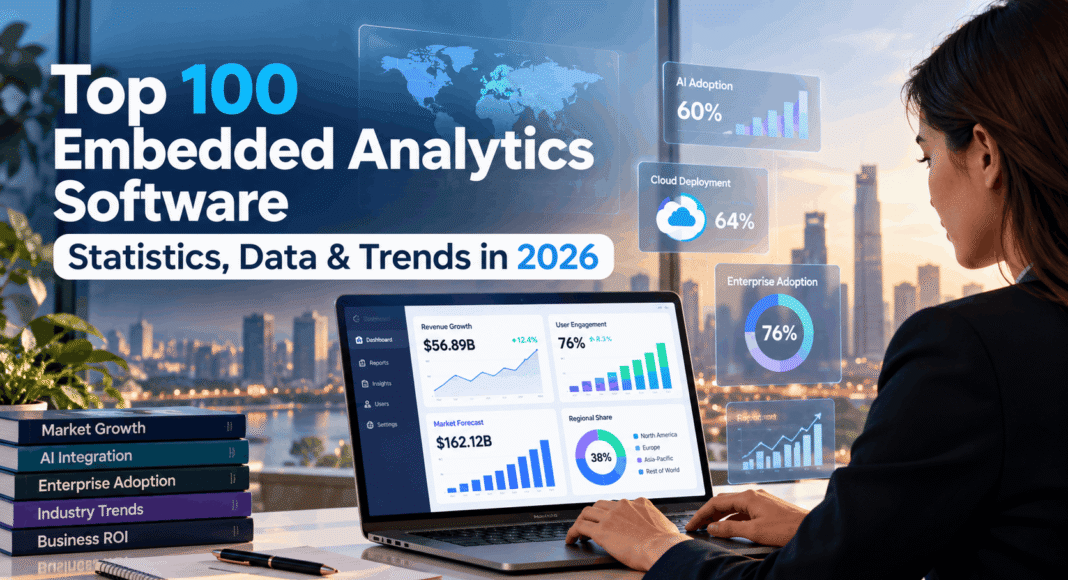
- Embedded Analytics Market Growth: The global embedded analytics software market is projected to reach $56.89 billion in 2026 and $162.12 billion by 2035, driven by rising demand for real-time business intelligence and data-driven decision-making.
- Enterprise Adoption and AI Integration: Approximately 76% of organisations use embedded analytics internally, while 84% expect to increase their focus on business intelligence and embedded analytics in 2026, accelerating AI-powered analytics adoption.
- Cloud Analytics and Business ROI: Cloud-based embedded analytics accounted for 64% of market share in 2025, while successful implementations have reported revenue increases of up to 30%, highlighting opportunities for SaaS innovation and operational efficiency.
Embedded analytics software enables businesses to access real-time insights, interactive dashboards, and AI-powered reporting directly within existing applications. In 2026, the global embedded analytics market is projected to reach $56.89 billion, driven by growing enterprise adoption, cloud integration, and demand for data-driven decision-making across industries.
Embedded analytics software is transforming how businesses access, analyse, and act on data in 2026. As organisations increasingly prioritise real-time business intelligence, artificial intelligence (AI), and data-driven decision-making, embedded analytics has emerged as an essential component of modern enterprise software. By integrating interactive dashboards, predictive analytics, and reporting capabilities directly into existing applications, businesses can gain actionable insights without switching between multiple platforms.
Also, read our article on the Top 10 Embedded Analytics Software System.
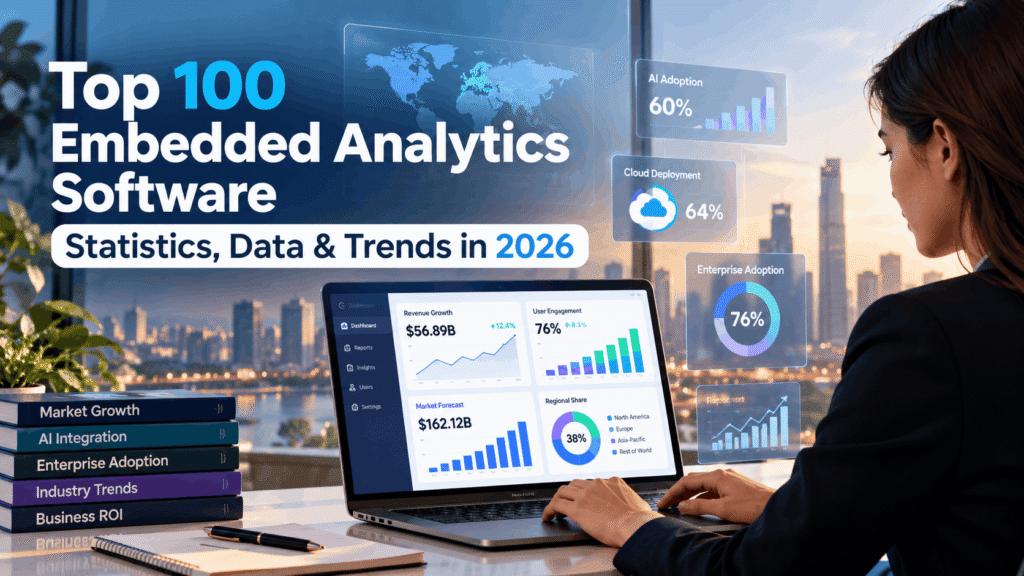
The global embedded analytics software market is projected to reach $56.89 billion in 2026, with one market forecast estimating growth to $162.12 billion by 2035. Other industry research providers offer different market valuations and growth projections, reflecting variations in market definitions, research methodologies, and the scope of embedded analytics solutions. Nevertheless, these forecasts collectively indicate substantial long-term growth opportunities for embedded business intelligence platforms, software-as-a-service (SaaS) providers, and enterprise technology vendors.
Enterprise adoption is another major driver shaping the embedded analytics software market in 2026. According to industry statistics compiled in this report, approximately 76% of organisations already use embedded analytics internally, while more than 70% of software vendors are integrating built-in analytics features into their SaaS offerings. Additionally, 84% of organisations expect to increase their focus on business intelligence and embedded analytics in 2026, highlighting the growing importance of accessible, contextual data insights across business operations.

Artificial intelligence and machine learning are also accelerating innovation in embedded analytics platforms. AI-powered dashboards, automated insights, natural language querying, and predictive modelling are enabling organisations to move beyond traditional reporting towards more intelligent and proactive decision-making. Gartner forecasts cited in the industry research suggest that 40% of enterprise applications could integrate task-specific AI agents by the end of 2026, illustrating the broader shift towards AI-enhanced enterprise software.
Cloud adoption, self-service analytics, and industry-specific applications are further influencing embedded analytics trends. Cloud-based deployment accounted for approximately 64% of the embedded analytics market in 2025, while industries such as banking, healthcare, manufacturing, retail, and telecommunications continue to expand their use of integrated analytics capabilities. Businesses are increasingly seeking scalable solutions that combine data visualisation, workflow automation, security, and advanced analytics within a unified software environment.
Beyond technology adoption, embedded analytics software is becoming an important driver of business performance and revenue growth. Industry findings suggest that some organisations implementing embedded analytics have achieved revenue improvements of up to 30%, while predictive maintenance applications have been associated with equipment downtime reductions of 30% to 50%. Although these outcomes vary significantly depending on implementation quality, industry, and organisational maturity, they demonstrate the potential business value of integrating analytics directly into operational workflows.
However, the rapid expansion of embedded analytics also introduces challenges involving data integration, cybersecurity, regulatory compliance, implementation costs, and technical skills shortages. Organisations must carefully evaluate their analytics infrastructure, data governance strategies, and AI readiness to maximise returns on technology investments.
This comprehensive guide to the Top 100 Embedded Analytics Software Statistics, Data & Trends in 2026 examines the latest industry estimates, market growth forecasts, enterprise adoption rates, AI integration trends, cloud deployment statistics, regional market developments, industry applications, and business performance indicators. Whether you are a SaaS founder, software developer, business intelligence professional, IT decision-maker, or enterprise technology investor, these statistics provide valuable insights into the evolving embedded analytics landscape and the opportunities shaping the future of data-driven business applications.Before we venture further into this article, we would like to share who we are and what we do.
About 9cv9
9cv9 is a business tech startup based in Singapore and Asia, with a strong presence all over the world.
With over ten years of startup and business experience, and being highly involved in connecting with thousands of companies and startups, the 9cv9 team has listed some of the top and best companies/tools in this review.
If you like to get your company listed in our top B2B software reviews, check out our world-class 9cv9 Media and PR service and pricing plans here.
Top 100 Embedded Analytics Software Statistics, Data & Trends in 2026
Market Size & Growth
- The global embedded analytics market is projected to reach $56.89 billion in 2026. As enterprises race to integrate real-time intelligence directly into their operational platforms, the embedded analytics software market is forecast to hit $56.89 billion in 2026 — a milestone that underscores just how central in-app data intelligence has become to enterprise competitiveness.
- The embedded analytics market will grow to $162.12 billion by 2035 at a 12.34% CAGR. Organisations evaluating long-term BI investments should note that the embedded analytics market is on track to nearly triple from its 2026 base of $56.89 billion to $162.12 billion by 2035, making early platform adoption a strategic imperative rather than an optional upgrade.
- The embedded analytics market CAGR is forecast at 16.20% from 2026 to 2035 (Evolvance). With a compound annual growth rate of 16.20%, embedded analytics software is outpacing overall enterprise software growth by a wide margin, making it one of the most attractive segments in the global technology investment landscape for the next decade.
- Market Research Future values the embedded analytics industry at $47.57 billion in 2025, growing to $159.25 billion by 2035 at a 12.84% CAGR. Independent validation from MRFR confirms that embedded analytics is entering a sustained hypergrowth phase, driven by the convergence of AI, cloud scalability, and enterprise demand for contextual, real-time decision support.
- Fortune Business Insights projects the embedded analytics market to grow at an 18.4% CAGR from $19.80 billion in 2024 to $74.98 billion by 2032. For software vendors and ISVs evaluating platform investment horizons, Fortune Business Insights’ 18.4% CAGR projection signals that embedded analytics is among the highest-growth segments in enterprise software — with demand accelerating, not plateauing.
- Mordor Intelligence values the 2025 embedded analytics market at $78.53 billion, projected to reach $150.40 billion by 2030. With the market already a $78.53 billion industry in 2025 per Mordor Intelligence, organisations that delay embedding analytics into their applications risk ceding competitive advantage to data-native rivals who have already operationalised real-time intelligence.
- Expert Market Research values the 2025 market at $70.71 billion, forecasting $264.45 billion by 2035 at a 14.10% CAGR. Under Expert Market Research’s bull-case scenario, the embedded analytics software market could reach $264.45 billion by 2035, reflecting an industry trajectory that rewards early platform standardisation and deep analytics embedding strategies.
- Verified Market Research projects the embedded analytics market at $54.95 billion in 2024, reaching $149 billion by 2032 at a 14.65% CAGR. Verified Market Research’s forecast of $149 billion by 2032 confirms that embedded analytics is not a niche technology play but a mainstream enterprise infrastructure investment with durable, multi-decade growth dynamics.
- The global embedded analytics market was valued at approximately $24.45 billion in 2025 (Evolvance). Evolvance Market Research’s 2025 valuation of $24.45 billion reflects the segment of focused, pure-play embedded analytics platforms — a number that, growing at 16.2% annually, represents one of enterprise software’s most compelling organic expansion stories.
- The U.S. embedded analytics market is estimated at $6.25 billion in 2025, rising to $7.25 billion in 2026. The United States remains the world’s single largest embedded analytics market, with its $7.25 billion 2026 projection driven by SaaS proliferation, AI adoption among Fortune 500 enterprises, and the federal push toward data-driven government operations.
- IMARC Group projects the embedded analytics market to reach $182.72 billion by 2033 at a 12.82% CAGR. IMARC Group’s projection of $182.72 billion by 2033 positions embedded analytics as one of the defining enterprise technology trends of the 2020s, with sustained double-digit CAGR reflecting structural demand rather than cyclical hype.
- The embedded analytics market could exceed $30 billion in valuation by 2026 under one forecast scenario (MRFR). Even conservative analytical models confirm the embedded analytics software market is crossing the $30 billion threshold in 2026, a landmark that signals the industry’s transition from emerging technology to established enterprise infrastructure.
- The embedded analytics market is growing from $78.53 billion in 2024 to over $150 billion by 2030 (Mordor Intelligence). The near-doubling of the embedded analytics market between 2024 and 2030 confirms that businesses across every sector are prioritising the seamless integration of analytics capabilities into their core operational workflows — no separate tools required.
Enterprise Adoption & Usage
- 81% of data analytics users use embedded analytics in 2025. With 81% of all analytics users now relying on embedded rather than standalone tools, the shift toward in-context intelligence is essentially complete — signalling that standalone BI dashboards are fast becoming legacy infrastructure for modern enterprises.
- 76% of organisations already use embedded analytics internally. The fact that three-quarters of organisations have already deployed embedded analytics internally confirms that this technology has crossed the enterprise adoption chasm, making it a baseline capability expectation rather than a differentiating feature for software vendors.
- Over 68% of organisations have adopted embedded analytics tools to enhance operational visibility. More than two-thirds of global organisations are now using embedded analytics to improve operational transparency, reflecting a structural shift in how enterprises monitor performance — from periodic reporting cycles to continuous, embedded intelligence streams.
- Over 66% of enterprises prioritise embedded analytics to improve decision-making and workflow efficiency. Two-thirds of enterprises actively prioritise embedded analytics as a mechanism for better decision-making, confirming that the technology has graduated from a “nice-to-have” reporting tool to a board-level strategic priority with measurable operational impact.
- Over 70% of software vendors are integrating built-in analytics features into SaaS offerings. With more than 70% of SaaS vendors embedding native analytics, the market is rapidly shifting toward analytics-as-standard — meaning that SaaS products without embedded intelligence capabilities face increasing product-market-fit challenges and elevated churn risk.
- 75% of customer-facing applications now include embedded analytics. By 2025, three-quarters of all customer-facing applications incorporate embedded analytics, transforming user-facing software from passive transaction tools into proactive intelligence platforms that continuously surface actionable insights.
- Adoption rates for embedded analytics exceed 64% among U.S. enterprise platforms. U.S. enterprise platforms have crossed a 64% embedded analytics adoption threshold, indicating that integrated data intelligence is now the de facto standard for competitive enterprise software — and that the remaining 36% represents the next wave of addressable market.
- 84% of organisations expect their focus on business intelligence and embedded analytics to increase in 2026. Nearly nine in ten organisations are planning to intensify their BI and embedded analytics investments in 2026, making this one of the most consensus-driven technology priorities across industries, company sizes, and geographies.
- 47% of BI users leverage embedded analytics for productivity tracking. Productivity tracking is the single most common embedded analytics use case, cited by 47% of BI users — confirming that organisations are deploying in-app intelligence primarily to eliminate reporting lag and enable continuous performance monitoring at every organisational layer.
- 42% of analytics users utilise embedded BI for trend analytics. Trend analytics and pattern detection represent the second most popular embedded analytics use case, with 42% of users relying on in-app intelligence to identify emerging patterns in real time — a capability that traditional scheduled reporting fundamentally cannot replicate.
- 39% of organisations use embedded analytics to monitor and improve productivity. More than one-third of all organisations specifically deploy embedded analytics to actively improve workforce productivity, highlighting how analytics-embedded workflows are closing the gap between data generation and corrective operational action.
- 31.4% of organisations use embedded analytics to generate higher revenue. Nearly one in three organisations has monetised its embedded analytics capability — either through premium product features, analytics-as-a-service offerings, or data-driven upsell strategies — confirming that analytics investment delivers measurable top-line returns, not just operational efficiency.
- 29.6% of survey respondents cite understanding business problems as the top reason for using embedded analytics. Understanding complex business problems remains the primary motivator for embedded analytics adoption, reinforcing that the technology’s core value proposition is not data visualisation but decision intelligence — helping organisations diagnose and resolve operational challenges faster.
- 24.8% of respondents use embedded analytics primarily for informed business decision-making. For nearly a quarter of organisations, embedded analytics is deployed specifically to improve the quality and speed of strategic decisions, confirming that real-time in-context intelligence has become the preferred decision support infrastructure for modern enterprises.
AI & Technology Integration
- By 2026, more than 80% of software vendors will have embedded GenAI capabilities in their products (Gartner). Gartner’s confirmation that over 80% of software vendors will embed GenAI by 2026 represents the most significant product architecture shift since cloud migration — signalling that AI-native analytics is transitioning from differentiator to baseline product expectation virtually overnight.
- By 2025, context-driven analytics and AI models will replace 60% of analytics models built on traditional data (Gartner). Gartner’s forecast that 60% of traditional analytics models will be displaced by context-driven AI by 2025 confirms that organisations still running legacy rule-based reporting are now operating with a structural competitive disadvantage in analytics maturity.
- Over 75% of enterprises will embed AI-oriented analytics within business applications by 2026 (IMARC). With three-quarters of enterprises set to embed AI-powered analytics by 2026, artificial intelligence is cementing its role as the intelligence layer of enterprise software — shifting analytics from descriptive to predictive and prescriptive as the default mode of operation.
- Gartner predicts 40% of enterprise applications will integrate task-specific AI agents by the end of 2026, up from less than 5% in 2025. The near-tenfold increase in AI agent integration within enterprise applications — from under 5% to 40% in a single year — represents the fastest organisational technology adoption rate Gartner has recorded, with profound implications for how embedded analytics interfaces are designed and consumed.
- Gartner’s best-case projection predicts agentic AI could drive 30% of enterprise software revenue by 2035, surpassing $450 billion. The potential for agentic AI to command $450 billion in enterprise software revenue by 2035 confirms that organisations investing now in AI-native embedded analytics platforms are positioning themselves at the epicentre of the next decade’s most lucrative enterprise technology market.
- Nearly 60% of new embedded analytics deployments incorporate AI-powered insights, predictive modelling, and real-time dashboards. The fact that AI capabilities are now standard in 60% of new deployments — not optional upgrades — signals that the market has structurally shifted: organisations evaluating analytics platforms without native AI features are effectively evaluating last-generation technology.
- Embedded analytics tools integrated with AI and ML capabilities have increased in usage by 58%. The 58% increase in AI/ML-enabled embedded analytics adoption confirms that enterprises are not just experimenting with intelligent analytics but actively operationalising it — embedding automated insight generation into the workflows that drive their most business-critical decisions.
- 77% of organisations plan to increase their use of AI within organisations in 2026. With more than three-quarters of organisations planning to expand AI usage in 2026, embedded analytics platforms — as the primary delivery vehicle for AI-driven insights within existing applications — are positioned to capture the majority of this investment wave.
- 66% of organisations report productivity gains from incorporating AI into their workflows. Two-thirds of organisations report concrete productivity improvements from AI integration, validating that AI-embedded analytics is delivering measurable operational returns — and establishing a clear business case for analytics platform upgrades that include native AI capabilities.
- Gartner predicts that by 2025, 95% of decisions currently using data will be at least partially automated. Gartner’s forecast that 95% of data-driven decisions will be partially automated by 2025 effectively defines embedded analytics as critical infrastructure: the platforms that embed intelligence at the point of decision are those that will automate the enterprise.
- 80% of executives believe automation can be applied to any business decision (Gartner). The fact that 80% of C-suite executives believe automation is universally applicable to business decisions signals an extraordinary mandate for embedded analytics investment — as automated decision systems require the real-time, contextual intelligence that only embedded platforms can deliver.
- 42% of organisations struggle with incorporating AI into their operations. Despite strong intent, 42% of organisations face significant challenges in operationalising AI — a friction point that purpose-built embedded analytics platforms with native AI features are uniquely positioned to resolve by abstracting the complexity of AI deployment from business users.
- 73% of technology leaders plan to expand AI use within organisations in the next year. The overwhelming consensus among tech leaders to accelerate AI adoption creates a direct tailwind for embedded analytics vendors: as AI expands, the need for platforms that surface AI-generated insights within existing workflows — rather than requiring context-switching — becomes essential.
Cloud & Deployment Models
- Cloud-based embedded analytics deployment accounted for 64% of market share in 2025. Cloud deployment models now command nearly two-thirds of the embedded analytics market, reflecting enterprises’ preference for scalable, API-integrated analytics infrastructure that avoids the capital expenditure and maintenance overhead of on-premise deployments.
- The cloud embedded analytics segment is growing at a 15.9% CAGR through 2030. The cloud segment’s 15.9% CAGR through 2030 confirms that cloud-native embedded analytics is not just the dominant deployment model but also one of the fastest-growing — compounding the advantage of organisations that have already migrated from legacy on-premise analytics infrastructure.
- On-premise embedded analytics deployment is projected to expand at the fastest CAGR among deployment models (2026–2035). Despite cloud dominance, on-premise deployment is forecast to be the fastest-growing segment — driven by data sovereignty requirements, financial services compliance mandates, and enterprises operating in industries where data cannot leave controlled infrastructure.
- 85% of organisations are expected to have adopted cloud by 2025. With cloud adoption essentially reaching saturation at 85% by 2025, embedded analytics vendors with cloud-first architectures are positioned to serve virtually the entire enterprise market — while legacy on-premise-only vendors face a rapidly shrinking addressable audience.
- Over 60% of embedded analytics tools now include real-time dashboards, self-service features, and AI-based predictive functions. Real-time dashboards, self-service capabilities, and AI-powered prediction have become standard features in over 60% of embedded analytics platforms — confirming that the market baseline has permanently shifted from static reporting to dynamic, intelligent, self-directed analytics experiences.
- 55% of new compliance solutions are delivered as SaaS or API-integrated platforms. The majority of new analytics and compliance solutions are now delivered as SaaS or API integrations, validating the embedded analytics model: organisations no longer deploy separate tools but integrate intelligence directly into their existing application ecosystems.
- 80% of organisations are moving away from traditional dashboards to self-service analytics. The mass migration away from IT-generated static dashboards — with 80% of organisations embracing self-service analytics — is fundamentally reshaping embedded analytics product requirements, placing user experience, flexibility, and business-user empowerment at the centre of platform evaluation criteria.
- Self-service embedded analytics implementations see 41% higher feature adoption rates. Product teams embedding self-service analytics see 41% higher feature adoption — a powerful data point for ISVs evaluating whether to invest in self-service capabilities, confirming that user autonomy translates directly into deeper platform engagement and reduced churn.
- Nearly 65% of U.S.-based companies emphasise self-service and drag-and-drop functionalities as core analytics requirements. The dominant U.S. embedded analytics buyer requirement is intuitive self-service — with 65% of companies prioritising drag-and-drop functionality — confirming that no-code analytics interfaces are no longer premium features but procurement table-stakes.
- The ERP/CRM segment is expected to expand at the fastest CAGR of 17.2% during 2026–2035. ERP and CRM platforms embedding analytics capabilities are set to grow at 17.2% annually — the fastest segment CAGR — driven by the enterprise desire to eliminate context-switching between operational systems and analytics tools in finance, sales, and customer management workflows.
Regional Market Breakdown
- North America holds 38% of the global embedded analytics market share. North America’s commanding 38% market share reflects the region’s combination of mature digital infrastructure, high SaaS penetration, and intense regulatory-driven demand for real-time compliance analytics across financial services, healthcare, and technology sectors.
- Europe holds 28% of the global embedded analytics market. Europe’s 28% market share is underpinned by GDPR compliance requirements that make secure, auditable embedded analytics a regulatory necessity rather than a business choice — particularly in Germany, France, and the United Kingdom where data governance standards are most stringent.
- Asia-Pacific holds 24% of the global embedded analytics market and is the fastest-growing region. Asia-Pacific’s 24% market share combined with fastest-region growth status makes it the most strategically attractive expansion opportunity for global embedded analytics vendors, as digital manufacturing, fintech innovation, and cloud adoption accelerate across China, India, and Southeast Asia.
- North America generated $29.06 billion in embedded analytics revenue in 2025. North America’s $29.06 billion in embedded analytics revenue in 2025 — representing 37% of global revenue — confirms that U.S. and Canadian enterprises are the world’s most aggressive adopters of integrated data intelligence, setting the standard for analytics maturity that other regions are now following.
- Asia-Pacific is forecast to grow at a 15.5% CAGR through 2030 in embedded analytics. Asia-Pacific’s 15.5% CAGR through 2030 makes it the fastest-growing embedded analytics region globally — driven by India’s digital public infrastructure, China’s Industry 4.0 investments, and Southeast Asia’s rapidly maturing SaaS ecosystem creating first-mover opportunities for embedded analytics vendors.
- The U.S. embedded analytics market is projected to grow at a 16.03% CAGR from 2026 to 2035. The United States embedded analytics market’s 16.03% CAGR through 2035 — growing from $7.25 billion in 2026 — reflects sustained enterprise investment in AI-native BI, cloud ERP analytics, and the operationalisation of real-time decision intelligence at scale.
- Middle East & Africa accounts for approximately 10% of global embedded analytics market share. While currently representing 10% of global market share, the Middle East and Africa embedded analytics segment is emerging rapidly as governments and enterprises in banking, energy, and logistics invest in data-driven digital modernisation programmes.
- In 2023, 33% of EU businesses conducted data analytics internally or externally, with Hungary (53%), Croatia (52%), Denmark (50%), and Netherlands (49%) leading adoption (Eurostat). Eurostat data reveals significant intra-European disparities in analytics adoption — with Northern and Eastern European nations outpacing Western counterparts — creating differentiated market opportunities for embedded analytics vendors targeting specific EU sub-markets.
Industry Vertical Adoption
- IT & Telecommunications captured the highest end-user market share at 29.79% in 2025. The IT and telecommunications sector’s leading 29.79% share of embedded analytics end-user revenue reflects the industry’s inherent data intensity — where network performance monitoring, subscriber analytics, and real-time infrastructure intelligence are embedded directly into operational management platforms.
- BFSI applications represented $16.49 billion or 21% of embedded analytics market revenue in 2025. The banking, financial services, and insurance sector’s $16.49 billion in embedded analytics spend reflects the industry’s critical dependency on real-time fraud detection, credit risk scoring, and regulatory reporting capabilities embedded within core banking platforms.
- Supply chain management accounts for 35–36% of embedded analytics applications. Supply chain management leads all application categories with a 35–36% share, confirming that logistics, inventory, and procurement analytics embedded within ERP and SCM platforms deliver the most operationally critical real-time intelligence across the enterprise analytics ecosystem.
- 61% of retail and e-commerce platforms leverage embedded analytics for personalised marketing and customer engagement. More than three-fifths of retail platforms have embedded personalisation analytics into their customer-facing applications, recognising that real-time behavioural intelligence is a direct driver of conversion rates, average order value, and customer lifetime value.
- Financial institutions account for over 59% of embedded analytics adoption for fraud detection and customer insights. With fraud losses mounting globally, nearly 60% of financial institutions have embedded analytics directly into transaction monitoring and customer profiling workflows — turning real-time data intelligence into a frontline defence mechanism against financial crime.
- Healthcare platforms have adopted embedded analytics at a 53% rate for enhancing clinical outcomes. Over half of healthcare platforms have integrated clinical analytics directly into patient management workflows, enabling real-time monitoring of patient outcomes, population health trends, and operational efficiency metrics without requiring clinicians to leave their primary care systems.
- Manufacturing platforms have adopted embedded analytics at a 49% rate for operational enhancement. Nearly half of manufacturing platforms have embedded operational analytics to monitor production quality, predict equipment failures, and optimise supply chains in real time — with embedded intelligence replacing the periodic reporting cycles that historically delayed corrective action.
- Manufacturing-sector embedded analytics revenue grew from $41.1 billion in 2020 to $77.3 billion in 2025. Manufacturing’s near-doubling of embedded analytics spend in just five years reflects the Industry 4.0 transition, where operational technology and information technology convergence has made real-time, embedded production intelligence a competitive necessity rather than an innovation initiative.
- Healthcare embedded analytics is advancing at a 15.8% CAGR through 2030 (Mordor Intelligence). Healthcare’s 15.8% embedded analytics CAGR through 2030 makes it one of the fastest-growing industry verticals, driven by value-based care models, precision medicine requirements, and regulatory mandates for real-time clinical data quality and outcomes reporting.
- Retail and consumer goods embedded analytics is expected to expand at the fastest CAGR of 16.8% during 2026–2035. Retail’s projected 16.8% CAGR — the fastest among all end-user verticals — reflects the industry’s intensifying demand for real-time customer analytics, personalised recommendation engines, and inventory intelligence embedded directly within e-commerce and in-store management systems.
- Government, healthcare, retail, and manufacturing sectors together account for 62% of embedded analytics usage. These four operationally intensive sectors represent nearly two-thirds of all embedded analytics deployment, confirming that industries where real-time decision-making is most consequential — public service delivery, clinical care, retail experience, and industrial production — are the technology’s primary demand engine.
Business Function Analytics
- Finance and accounting commands 34% of embedded analytics usage by business function in 2025. Finance and accounting’s leading 34% function share reflects CFOs’ urgent need for real-time FP&A dashboards, cash flow visibility, and regulatory compliance reporting embedded within ERP platforms — eliminating the spreadsheet-based reporting cycles that delay financial decision-making.
- Sales and marketing analytics functions are growing at an 18.2% CAGR through 2030 — the fastest business function segment. Sales and marketing represents the fastest-growing embedded analytics business function, with an 18.2% CAGR driven by demand for customer 360° intelligence, pipeline analytics, and marketing attribution models embedded directly within CRM and marketing automation platforms.
- Descriptive analytics held 48% of the analytics type market share in 2025. Despite the rise of predictive and prescriptive capabilities, descriptive analytics — reporting what happened — still commands 48% of the analytics type market, confirming that the foundational layer of data intelligence remains the dominant deployed capability in enterprise embedded analytics ecosystems.
- Prescriptive analytics is projected to expand at a 20.4% CAGR through 2030 — the fastest analytics type. Prescriptive analytics — which recommends specific actions — is the highest-value and fastest-growing analytics tier at a 20.4% CAGR, as enterprises move beyond understanding what happened and diagnosing why, toward systems that automatically recommend the optimal response.
- In-application/workflow integration leads with 45% share of integration modes in 2025. Nearly half of all embedded analytics deployments use in-application workflow integration as the primary delivery mode — confirming that the market has matured beyond simple dashboard embedding toward deeper, contextual intelligence that surfaces insights within the specific workflow steps where decisions are made.
- In-application workflow analytics are forecast to rise at a 17.6% CAGR to 2030. The 17.6% CAGR for in-application workflow analytics confirms that the market is gravitating toward intelligence that is contextually embedded within business processes — not just visualised in dashboards — positioning agentic and process-embedded analytics as the next platform frontier.
Business Impact & ROI
- Companies implementing embedded analytics see up to 30% revenue increases. The up-to-30% revenue uplift documented in embedded analytics implementations is among the strongest ROI evidence in enterprise software — confirming that organisations treating analytics as a product feature, not just an internal tool, can generate material top-line growth from their data assets.
- Successful SaaS companies drive up to 20% of total annual revenue from analytics-based product offerings. Leading SaaS vendors are generating up to 20% of total revenue from analytics-based offerings — transforming embedded intelligence from a product feature into a standalone revenue stream that justifies dedicated analytics product management and engineering investment.
- Enterprises anticipate embedded analytics to deliver up to 4% business growth (Sisense Survey). Sisense’s survey of business leaders confirms that enterprises tangibly expect their embedded analytics investments to translate into 4% business growth — a modest but directly attributable revenue impact that makes embedded analytics one of the highest-confidence technology ROI categories.
- Predictive maintenance via embedded analytics cuts equipment downtime by 30–50%. The 30–50% reduction in equipment downtime delivered by predictive maintenance analytics represents one of the most quantifiable ROI cases in embedded analytics — directly translating sensor data and ML model outputs into millions of dollars in prevented production losses.
- 49% of Gartner-surveyed finance executives identify self-service analytics as a key driver of employee productivity. The endorsement of self-service analytics as a productivity driver by 49% of finance executives — the most-cited technology-value combination in Gartner’s survey — confirms that analytics democratisation directly translates into measurable organisational output improvements in the finance function.
- Gartner predicts embedded AI in cloud ERP will drive a 30% faster financial close by 2028. Gartner’s prediction of a 30% faster financial close from embedded AI in ERP platforms provides finance teams with a compelling, time-bound ROI case for embedded analytics investment — translating platform capability directly into operational cycle time reduction.
- Companies see up to 4% business growth from analytics-driven product offerings (ScaleUpAlly). Independent research corroborates Sisense’s findings: organisations that package embedded analytics as a premium product feature generate up to 4% incremental business growth — confirming analytics monetisation as a validated, repeatable enterprise growth strategy.
- Organisations implementing compliance and security analytics on a unified platform experience 30% fewer regulatory violations. Enterprises that consolidate compliance monitoring within their embedded analytics platforms see 30% fewer regulatory violations — providing a compelling risk-reduction ROI that makes embedded compliance analytics a compelling investment even in cost-constrained environments.
Challenges & Barriers
- 57% of organisations identify integrating AI into development workflows as their biggest software development challenge for 2026. The dominant challenge heading into 2026 — cited by more than half of all organisations — is embedding AI into development workflows, confirming that the gap between AI ambition and AI-embedded software delivery is the defining execution challenge for embedded analytics platform teams.
- 50% of technology leaders cite recruiting and retaining skilled tech workers as the biggest business challenge heading into 2026. With half of all technology leaders flagging talent as their top challenge, and IDC warning that skill shortages could cost $5.5 trillion by 2026, embedded analytics platforms with low-code and self-service capabilities are positioned as the solution to the data talent gap.
- 49% of organisations flag security threats as a top software development concern. Nearly half of all organisations cite security as a primary development concern — creating significant demand for embedded analytics platforms with enterprise-grade security architectures including SSO, row-level security, end-to-end encryption, and multi-tenant data governance built in by design.
- 48% of organisations identify data privacy and regulatory compliance as major development challenges in 2026. Data privacy and compliance complexity is cited by nearly half of all organisations as a critical challenge — driving demand for embedded analytics platforms with native GDPR, HIPAA, and CCPA compliance capabilities that minimise the engineering overhead of building compliant analytics features.
- 47% of sales operations and RevOps leaders cite data integration across systems as their top data quality challenge. The dominant data quality barrier — cited by 47% of RevOps leaders — is fragmented integration across platforms, a challenge that embedded analytics solutions directly address by creating a unified analytics layer on top of heterogeneous enterprise data sources.
- 40% of organisations report inaccurate data from user input as a data quality issue. User input error remains a significant data quality challenge for 40% of organisations, highlighting the need for embedded analytics platforms with intelligent data validation, anomaly detection, and automated data quality monitoring capabilities integrated into the analytics workflow.
- 42% of tech leaders will incorporate or increase the use of AI to effectively utilise resources in 2025. Despite the challenges of AI deployment — cited as the biggest challenge by 55% of organisations — 42% of tech leaders are actively increasing AI use to drive resource efficiency, confirming that the ROI case for AI-embedded analytics is compelling enough to justify the implementation friction.
- 35% of organisations cite shifting analytics needs as the main challenge in embedded analytics adoption. Evolving business requirements — cited by 35% of organisations as their primary adoption challenge — confirm that embedded analytics platforms must prioritise configurability, modular architecture, and rapid deployment capabilities to keep pace with the dynamic intelligence needs of modern enterprises.
Strategic & Forward-Looking Indicators
- 84% of organisations expect their BI and embedded analytics focus to increase in 2026. The near-universal consensus that BI and embedded analytics investment will intensify in 2026 makes this one of the most broadly confirmed enterprise technology budget priorities — providing embedded analytics vendors with exceptional market visibility and demand predictability heading into the year.
- 74% of Chief Data and Analytics Officers report executive leadership confidence in their D&A function. The 74% rate of executive confidence in data and analytics functions confirms that senior leadership is increasingly aligned with analytics investment — creating the organisational mandate needed for ambitious embedded analytics deployments across enterprise platforms.
- Gartner predicts that 75% of CDAOs who fail to create organisation-wide analytical influence will be assimilated into technology functions by 2026. Gartner’s stark warning to CDAOs confirms that embedded analytics is now an organisational power lever: those who can demonstrate pervasive, measurable analytics influence will maintain independent strategic value, while those who cannot will be absorbed into IT operations.
- By 2025, synthetic data and transfer learning will reduce the volume of real data needed for AI model training by over 50%. The 50%+ reduction in real data requirements from synthetic data and transfer learning dramatically lowers the barrier to AI-enhanced embedded analytics — enabling organisations with limited data assets to deploy sophisticated predictive intelligence capabilities at a fraction of historical implementation cost.
- 46% of organisations plan to increase revenue as part of their 2026 expansion strategy. With 46% of organisations focused on revenue expansion in 2026 — and embedded analytics confirmed to deliver up to 30% revenue uplift — the alignment between corporate growth objectives and embedded analytics ROI creates exceptional conditions for continued accelerated market adoption.
- 40% of organisations plan to adopt or purchase new analytics technologies or applications in 2026. Planned new technology adoption among 40% of organisations in 2026 represents the immediate addressable market for embedded analytics platform vendors — a cohort of active buyers with confirmed budget and intent, representing billions in pipeline opportunity.
- Global spending on cloud compliance and governance tools surpassed $8 billion in 2025. The $8 billion-plus in cloud compliance spending confirms that data governance is a strategic enterprise investment — and that embedded analytics platforms offering integrated compliance analytics and audit trails are well-positioned to capture a significant share of this adjacent market.
- By 2026, over 60% of enterprises will adopt integrated risk-compliance dashboards combining CSPM, GRC, and data lineage tracking. The projected 60%+ adoption of integrated risk-compliance dashboards by 2026 confirms that embedded analytics is expanding beyond operational intelligence into governance, risk, and compliance — creating entirely new platform categories and monetisation opportunities.
- Cloud-native compliance platforms with AI automation are expected to grow by 22% annually through 2027. The 22% annual growth in AI-automated compliance platforms confirms that embedded analytics vendors who successfully integrate governance, regulatory reporting, and security intelligence into their platforms will access a fast-growing, high-value market adjacent to their core analytics offering.
Conclusion
The Top 100 Embedded Analytics Software Statistics, Data & Trends in 2026 highlight the growing importance of integrated business intelligence, artificial intelligence, and real-time data analytics in modern enterprise software. As organisations increasingly demand faster insights, improved operational efficiency, and seamless access to business-critical information, embedded analytics is evolving from an optional software feature into a strategic capability for businesses across industries.
The global embedded analytics software market is projected to reach $56.89 billion in 2026, with one industry forecast estimating growth to $162.12 billion by 2035. Although market research providers report different valuations and compound annual growth rates, their projections consistently point towards substantial long-term expansion. This growth reflects increasing investments in cloud-based analytics, AI-powered business intelligence, self-service reporting, and data-driven enterprise applications.
Enterprise adoption statistics further demonstrate the importance of embedded analytics in today’s digital economy. According to the research compiled in this report, 76% of organisations already use embedded analytics internally, while more than 70% of software vendors are incorporating built-in analytics capabilities into their SaaS products. Additionally, 84% of organisations expect to increase their focus on business intelligence and embedded analytics in 2026, suggesting continued demand for integrated reporting, interactive dashboards, and contextual data insights.
Artificial intelligence is expected to play an increasingly influential role in the future of embedded analytics software. Machine learning algorithms, predictive analytics, automated reporting, natural language processing, and AI-powered recommendations are enabling businesses to move beyond descriptive reporting towards proactive decision-making. With Gartner forecasting that 40% of enterprise applications could incorporate task-specific AI agents by the end of 2026, the convergence of AI and embedded analytics represents a significant opportunity for software developers, technology providers, and enterprise decision-makers.
Cloud computing and self-service business intelligence are also reshaping the competitive landscape. Cloud-based embedded analytics accounted for approximately 64% of market share in 2025, while demand for flexible, scalable, and user-friendly analytics solutions continues to expand. Businesses increasingly expect employees and customers to access relevant insights directly within their existing applications, reducing dependence on separate reporting systems and specialised technical teams.
The business impact of embedded analytics extends beyond operational visibility. Industry findings suggest that successful implementations can contribute to revenue increases of up to 30%, while predictive maintenance analytics can help reduce equipment downtime by 30% to 50% in certain applications. These potential benefits illustrate how embedded analytics can support productivity improvements, cost optimisation, customer engagement, and new revenue opportunities. However, actual returns depend on factors such as data quality, implementation strategy, organisational readiness, and industry-specific requirements.
Despite these opportunities, organisations must address several challenges to achieve sustainable success. Data integration complexity, cybersecurity threats, privacy regulations, technical skills shortages, and evolving business requirements remain significant barriers to embedded analytics adoption. Investing in secure infrastructure, effective data governance, intuitive user experiences, and scalable analytics architectures will be essential for businesses seeking to maximise long-term value.
Looking ahead, the future of embedded analytics software will be shaped by AI-driven insights, predictive and prescriptive analytics, cloud-native architectures, self-service capabilities, and deeper integration into everyday business workflows. Industries including financial services, healthcare, manufacturing, retail, and telecommunications are particularly well-positioned to benefit from these developments as they continue modernising their digital infrastructure.
Ultimately, the embedded analytics software statistics and trends for 2026 demonstrate that the competitive advantage increasingly lies not simply in collecting data, but in making that data accessible, understandable, and actionable at the point of decision-making. Businesses that successfully integrate analytics into their software products and operational processes will be better positioned to improve efficiency, enhance customer experiences, identify growth opportunities, and respond to changing market conditions.
For SaaS companies, enterprise software providers, business intelligence professionals, and technology investors, 2026 represents an important period for evaluating embedded analytics strategies. Organisations that prioritise intelligent, secure, and user-centric analytics solutions today can establish a stronger foundation for sustainable innovation, operational excellence, and long-term digital competitiveness.
If you find this article useful, why not share it with your hiring manager and C-level suite friends and also leave a nice comment below?
We, at the 9cv9 Research Team, strive to bring the latest and most meaningful data, guides, and statistics to your doorstep.
To get access to top-quality guides, click over to 9cv9 Blog.
To hire top talents using our modern AI-powered recruitment agency, find out more at 9cv9 Modern AI-Powered Recruitment Agency.
People Also Ask
What is embedded analytics software?
Embedded analytics software integrates business intelligence, interactive dashboards, reporting, and data visualisation directly into existing applications. It allows users to access insights without switching between different software platforms.
How big is the global embedded analytics software market in 2026?
The global embedded analytics software market is projected to reach $56.89 billion in 2026, according to one industry forecast. Market estimates vary across research providers due to differences in methodology and market definitions.
What is the projected growth rate of the embedded analytics market?
Industry forecasts estimate compound annual growth rates ranging from approximately 12% to 18%. One projection expects the embedded analytics market to grow from $56.89 billion in 2026 to $162.12 billion by 2035.
What are the biggest embedded analytics software trends in 2026?
Major embedded analytics trends in 2026 include AI-powered business intelligence, real-time dashboards, predictive analytics, cloud-native deployment, self-service reporting, natural language querying, and deeper integration with enterprise applications.
How many organisations use embedded analytics software?
According to industry statistics compiled for 2026, approximately 76% of organisations use embedded analytics internally, while more than 68% have adopted embedded analytics tools to improve operational visibility.
Why is embedded analytics important for businesses in 2026?
Embedded analytics helps businesses access actionable insights within everyday workflows. It supports faster decision-making, improves operational visibility, reduces manual reporting, and enables employees to use data without relying entirely on technical specialists.
What percentage of SaaS companies use embedded analytics?
Industry research suggests that more than 70% of software vendors are integrating built-in analytics features into SaaS offerings. This reflects growing demand for reporting, dashboards, and business intelligence within software products.
How is artificial intelligence transforming embedded analytics software?
Artificial intelligence enhances embedded analytics through predictive modelling, automated insights, anomaly detection, natural language queries, and intelligent recommendations. These capabilities help organisations identify patterns and make informed decisions.
What percentage of embedded analytics deployments include AI capabilities?
The compiled industry statistics suggest that nearly 60% of new embedded analytics deployments incorporate AI-powered insights, predictive modelling, and real-time dashboards, reflecting increasing demand for intelligent analytics capabilities.
What is the market share of cloud-based embedded analytics software?
Cloud-based embedded analytics accounted for approximately 64% of the global market in 2025. Cloud deployment supports scalability, remote accessibility, API integration, and reduced infrastructure management requirements.
What is the difference between embedded analytics and traditional business intelligence?
Traditional business intelligence often requires users to access separate reporting platforms. Embedded analytics integrates dashboards, reports, and insights directly into existing applications, allowing users to analyse data within their normal workflows.
Which industries use embedded analytics software the most?
Embedded analytics is widely used in IT and telecommunications, banking, healthcare, manufacturing, retail, and supply chain management. IT and telecommunications represented approximately 29.79% of end-user market revenue in 2025.
Which region dominates the embedded analytics software market?
North America leads the global embedded analytics market, accounting for approximately 38% of market share in the compiled research. Europe follows with 28%, while Asia-Pacific represents approximately 24%.
How fast is the embedded analytics market growing in Asia-Pacific?
The Asia-Pacific embedded analytics market is forecast to grow at a compound annual growth rate of approximately 15.5% through 2030, supported by expanding cloud adoption, digital transformation, and enterprise software investments.
What are the benefits of embedded analytics for SaaS businesses?
Embedded analytics helps SaaS companies improve customer engagement, increase product value, introduce premium reporting features, and create additional revenue opportunities. It also allows customers to access relevant business insights without leaving the application.
Can embedded analytics software increase business revenue?
Industry findings suggest that some companies implementing embedded analytics have achieved revenue increases of up to 30%. Actual results depend on implementation quality, business strategy, customer adoption, and analytics capabilities.
What is the ROI of embedded analytics software?
Embedded analytics ROI can include higher revenue, reduced reporting costs, improved productivity, and faster decisions. The compiled research cites potential business growth of up to 4% and equipment downtime reductions of 30% to 50% in predictive maintenance applications.
What is self-service embedded analytics?
Self-service embedded analytics allows nontechnical users to create reports, explore datasets, customise dashboards, and analyse business performance directly within applications without requiring extensive programming knowledge or dedicated IT support.
How does embedded analytics improve employee productivity?
Embedded analytics reduces time spent switching applications, manually preparing reports, and searching for information. It provides employees with relevant insights directly within their workflows, supporting faster decisions and more efficient operations.
What percentage of organisations prioritise business intelligence in 2026?
According to the compiled industry research, 84% of organisations expect to increase their focus on business intelligence and embedded analytics in 2026, reflecting growing interest in data-driven operations and enterprise reporting capabilities.
What are the biggest challenges facing embedded analytics adoption?
Major challenges include data integration, cybersecurity, regulatory compliance, implementation complexity, technical skills shortages, and changing business requirements. Organisations must also maintain data quality and appropriate access controls.
How does embedded analytics support data security and compliance?
Embedded analytics platforms can support security and compliance through role-based access, encryption, audit trails, data governance, and controlled reporting permissions. Organisations must configure these capabilities appropriately to meet applicable regulatory requirements.
What is the role of predictive analytics in embedded analytics software?
Predictive analytics uses historical data and statistical models to forecast future outcomes. When embedded into business applications, it can help organisations anticipate customer behaviour, equipment failures, demand fluctuations, and operational risks.
What is prescriptive analytics, and how fast is it growing?
Prescriptive analytics recommends actions based on data, forecasts, and business constraints. The compiled industry research projects a 20.4% compound annual growth rate for prescriptive analytics through 2030.
How is embedded analytics used in healthcare?
Healthcare organisations use embedded analytics for patient monitoring, clinical performance reporting, operational efficiency, and population health analysis. The compiled statistics suggest a 53% adoption rate among healthcare platforms.
How does embedded analytics benefit manufacturing companies?
Manufacturers use embedded analytics to monitor production, improve quality control, optimise supply chains, and predict equipment failures. Predictive maintenance applications have been associated with equipment downtime reductions of 30% to 50%.
What is the role of embedded analytics in financial services?
Financial institutions use embedded analytics for fraud detection, credit risk assessment, regulatory reporting, customer insights, and financial performance monitoring. These capabilities integrate data analysis directly into banking and financial workflows.
How does embedded analytics improve customer experience?
Embedded analytics improves customer experience by providing personalised insights, transparent performance reporting, interactive dashboards, and relevant recommendations. SaaS providers can also offer customers greater control over their data and reporting preferences.
What should businesses look for when choosing embedded analytics software in 2026?
Businesses should evaluate integration capabilities, scalability, security, dashboard customisation, AI features, self-service reporting, deployment flexibility, pricing, and vendor support. The best solution should align with existing infrastructure and business objectives.
What is the future of embedded analytics software beyond 2026?
The future of embedded analytics will likely feature greater AI integration, automated decision support, predictive insights, cloud-native architectures, and contextual analytics. One industry forecast projects the global market could reach $162.12 billion by 2035.
Sources
Precedence Research
Global Growth Insights
Evolvance Market Research
IMARC Group
Market Research Future (MRFR)
Fortune Business Insights
Mordor Intelligence
Expert Market Research
Verified Market Research
Reveal BI
Gartner
ScaleUpAlly
SRAnalytics
Luzmo
Research and Markets
DataStackHub
Eurostat
Data Insights Market
Mark Wide Research
ResearchNester