



























Key Takeaways
- Myanmar’s 2026 recruitment market faces persistent talent shortages driven by migration, brain drain, conscription pressures and declining workforce participation.
- High inflation and falling real wages are reshaping Myanmar salary trends, forcing employers to strengthen compensation, retention and workforce planning strategies.
- Technology remains a key hiring growth area, with rising demand for software, data science, cloud and cybersecurity talent despite broader labour market challenges.
Myanmar’s recruitment market in 2026 faces significant pressure from talent shortages, migration, declining real wages and workforce disruption. With a labour force of about 22.74 million, Myanmar shows how employers must adapt hiring strategies to manage skills gaps, employee retention, rising salary expectations and growing demand for digital talent.
Myanmar’s recruitment landscape in 2026 is being reshaped by a combination of economic pressure, workforce migration, skills shortages, political instability, changing employment patterns, and rapid growth in selected digital occupations. For employers, recruiters, HR professionals, investors, and job seekers, understanding the latest Myanmar recruitment statistics is essential for navigating a labour market where headline employment figures reveal only part of the story.
Also, read our top articles on recruitment and hiring here:
The State of Recruitment and Hiring in Myanmar (Burma)
Top 10 Best Recruitment Agencies in Myanmar

Myanmar has a substantial labour force of approximately 22.74 million people, yet the availability of workers does not necessarily translate into an abundant supply of employable talent. Youth unemployment reached 10.04% in 2024, while the country’s employment rate remained 7.4 percentage points below its 2017 level. Between 2017 and 2022, only 3.3 million of approximately 9 million new working-age adults entered the labour force, while the number of people not in employment, education or training increased by around 6 million.
Recruitment conditions have become even more challenging as employers contend with declining purchasing power and intense pressure on salaries. Real wages fell by approximately 15% between 2017 and 2022, while inflation subsequently remained exceptionally high. Employers have faced recommendations to increase salaries by 25–35% simply to preserve employees’ existing living standards. These conditions make compensation, employee retention and workforce planning increasingly important parts of recruitment strategy in Myanmar.
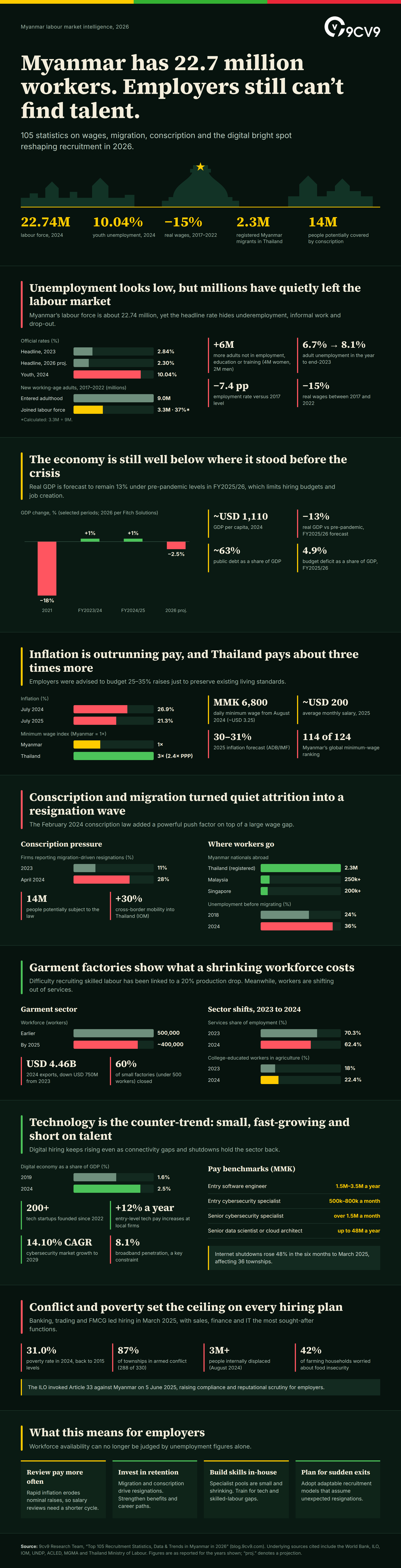
Migration and brain drain represent another defining recruitment trend. Thailand alone has approximately 2.3 million registered Myanmar migrants, while substantial Myanmar communities are also present in Singapore and Malaysia. The wage gap remains a powerful incentive for migration, with minimum wages in Thailand estimated to be around three times higher than those in Myanmar. Following the introduction of Myanmar’s conscription law in February 2024, businesses also reported a sharp increase in migration-related resignations, further reducing the domestic supply of working-age talent.
These workforce pressures are particularly visible in Myanmar’s garment industry. The sector’s workforce declined from roughly 500,000 to around 400,000 workers by 2025, while recruitment difficulties for skilled labour have been associated with a 20% decline in production. The loss of approximately 70,000 garment workers in a single year further demonstrates how worker shortages can directly affect business capacity, productivity and exports.
However, Myanmar’s recruitment outlook is not uniformly negative. Technology and digital employment represent important areas of potential growth. The digital economy increased from 1.6% of GDP in 2019 to 2.5% in 2024, more than 200 technology startups have emerged since 2022, and demand for skills in software development, data science, cloud computing and cybersecurity is creating new recruitment opportunities. Local technology companies have also been increasing entry-level salaries as competition for qualified digital talent intensifies.
The Top 105 Recruitment Statistics, Data & Trends in Myanmar in 2026 provide a detailed view of these developments across employment, unemployment, salaries, inflation, migration, brain drain, manufacturing, technology, poverty and hiring demand. Together, these statistics reveal a labour market undergoing profound structural change, where employers must compete not only against domestic businesses for talent but also against overseas opportunities, demographic disruption and rapidly evolving worker expectations.
Before we venture further into this article, we would like to share who we are and what we do.
About 9cv9
9cv9 is a business tech startup based in Singapore and in Asia, with a strong presence all over the world.
With over ten years of startup and business experience, and being highly involved in connecting with thousands of companies and startups, the 9cv9 team has access to some of the best talents in the world.
If your company needs recruitment and headhunting services to hire top-quality employees, you can use 9cv9 headhunting and recruitment services to hire top talents and candidates. Email us at hello@9cv9.com.
Top 105 Recruitment Statistics, Data & Trends in Myanmar in 2026
A. Workforce Size & Unemployment
#1 — Labor force of 22.74 million (2024)
With a labor force of approximately 22.74 million in 2024, Myanmar represents one of Southeast Asia’s larger workforces, though ongoing conflict, displacement, and migration continue to reduce the effective supply of workers available to domestic employers.
#2 — Unemployment projected at 2.30% by 2026
While Myanmar’s headline unemployment rate appears low at 2.84% (2023) and is projected to ease to 2.30% by 2026, economists caution that this figure masks widespread underemployment, informal work, and labour force dropout — meaning the true extent of joblessness is significantly higher than the official statistic suggests.
#3 — Youth unemployment at 10.04% in 2024
Youth unemployment in Myanmar climbed to 10.04% in 2024, a concerning trend that signals a widening gap between the skills produced by Myanmar’s education system and the needs of a rapidly shifting labour market, with implications for long-term hiring pipelines across all sectors.
#4 — Youth unemployment 9.71% in 2023
The gradual but consistent rise in Myanmar’s youth unemployment rate — from 9.62% in 2022 to 9.71% in 2023 — reflects a structural misalignment between graduate output and available formal job opportunities, a challenge that recruiters and policymakers alike must address to prevent a lost generation of talent.
#5 — Adult unemployment rose from 6.7% to 8.1% in year to end-2023
A jump in adult unemployment from 6.7% to 8.1% within a single year points to accelerating labour market deterioration in Myanmar, driven by business closures, conflict-induced disruption, and the departure of foreign investors — all of which are directly contracting the availability of formal employment.
#6 — Employment rate 7.4 pp below 2017 levels
Although Myanmar’s employment rate saw a modest 2.3 percentage point recovery between 2022 and 2023, the fact that it remains 7.4 percentage points below 2017 levels illustrates the deeply entrenched structural damage the labour market has sustained since the onset of political instability — a recovery that remains incomplete and fragile.
#7 — Labor force participation fell 1.6 pp; employment fell 4.8 pp (2017–2022)
The steeper decline in employment (4.8 pp) compared to labour force participation (1.6 pp) between 2017 and 2022 suggests that many Myanmar workers who entered the labour force were unable to secure jobs, reflecting not just a demand-side failure but significant skill mismatches and geographic barriers to employment.
#8 — Only 3.3 million of 9 million new working-age adults entered the labour force (2017–2022)
The fact that only 3.3 million out of 9 million new working-age adults entered Myanmar’s labour force between 2017 and 2022 reveals a deeply worrying trend of economic discouragement, where the combination of conflict, conscription risk, and poor job prospects has caused millions to disengage entirely from seeking formal employment.
#9 — NEET adults grew by 6 million (4M female, 2M male)
A 6 million increase in Myanmar’s NEET population — disproportionately affecting women — underscores a significant gender dimension to the country’s labour crisis, as insecurity, restricted mobility, and the collapse of female-dominated industries such as garments have pushed millions of women out of the formal workforce.
#10 — Real wages fell 15% between 2017–2022
A 15% decline in real wages between 2017 and 2022 has significantly eroded the purchasing power of Myanmar’s salaried workforce, making talent retention an acute challenge for employers who must compete with the lure of overseas wages — particularly in Thailand — that can be two to three times higher.
B. Economy & GDP Context
#11 — GDP per capita ~USD 1,110 (2024)
At approximately USD 1,110 GDP per capita in 2024, Myanmar ranks among the lower-income economies in Southeast Asia, constraining domestic consumer spending, limiting employer budgets for competitive compensation packages, and keeping Myanmar’s labour market vulnerable to brain drain toward higher-wage neighbouring countries.
#12 — GDP growth at 1% in FY2023/24 and FY2024/25
Myanmar’s near-stagnant GDP growth of just 1% reflects an economy in sustained distress, where political instability, sanctions, and capital flight have suppressed the business expansion and foreign investment that typically drive job creation and hiring demand.
#13 — Real GDP remains 9% below FY2018/19 levels
The persistent 9% gap between Myanmar’s current real GDP and its pre-crisis baseline is a stark indicator of how far the economy has yet to recover, translating into fewer formal employment opportunities, lower corporate hiring budgets, and a reduced incentive for skilled workers to remain in the country.
#14 — 2.5% contraction projected, no recovery in 2026 (Fitch)
Fitch Solutions’ projection of a further 2.5% economic contraction with no meaningful recovery in 2026 paints a sobering picture for Myanmar’s hiring outlook, suggesting businesses should plan for continued workforce constraint and a labour market shaped more by survival than growth.
#15 — GDP contracted ~18% in 2021 after the coup
The approximately 18% GDP contraction Myanmar experienced in 2021 — one of the sharpest collapses globally that year — triggered mass business closures, widespread layoffs, and a fundamental restructuring of the labour market that continues to reverberate through hiring practices in 2026.
#16 — GDP forecast to be 13% below pre-pandemic levels in FY2025/26
With real GDP projected to remain 13% below pre-pandemic levels, Myanmar’s employers face a compounding cycle of reduced revenues, tighter hiring budgets, and heightened difficulty in justifying salary increases — further accelerating the departure of skilled workers to more economically stable markets.
#17 — Budget deficit widening to 4.9% of GDP in FY2025/26
A widening budget deficit constrains the government’s ability to invest in public sector hiring, social protection, job training, and the infrastructure improvements that would otherwise support private sector employment growth.
#18 — Public debt ~63% of GDP
Public debt at approximately 63% of GDP limits Myanmar’s fiscal headroom to stimulate economic recovery through public investment or employment programmes, placing the burden of job creation squarely on a private sector operating under severe resource and regulatory constraints.
#19 — Skilled worker loss contributed to 9–11% GDP contraction since 2020
The documented link between skilled worker exodus and a 9–11% GDP contraction makes a compelling economic case that Myanmar’s talent drain is not merely an HR challenge but a macroeconomic crisis — one that requires structural policy intervention, not just reactive wage adjustments, to reverse.
#20 — Health and education spending fell from ~4% to 2.2% of GDP
The near-halving of public spending on health and education directly undermines workforce quality and pipeline development in Myanmar, as fewer resources for schools and vocational training translate into a less skilled future labour force, compounding existing talent shortages.
C. Wages & Minimum Wage
#21 — Minimum wage adjusted to MMK 6,800/day (~USD 3.25) from August 2024
Myanmar’s minimum wage adjustment to MMK 6,800/day represents a nominal gain for workers, though at this level Myanmar’s legal wage floor remains one of the lowest in ASEAN, offering limited protection against the cost-of-living pressures created by persistent double-digit inflation.
#22 — Base wage MMK 4,800/day unchanged since 2018; allowances reaching MMK 7,800/day by October 2025
The structural rigidity of Myanmar’s wage-setting process — with the base wage frozen from 2018 to 2024 — has failed to keep pace with compounding inflation, leaving real earnings in consistent decline for the majority of formal workers.
#23 — Average monthly salary ~USD 200 in 2025
An average monthly salary of approximately USD 200 positions Myanmar as one of the lowest-cost labour markets in Southeast Asia — attracting labour-intensive industries but creating persistent challenges in retaining skilled professionals who can command significantly higher wages abroad.
#24 — Employer payroll contributions ~3%
Myanmar’s relatively low employer payroll contribution rate keeps statutory labour costs competitive for investors, though critics argue this limited social protection framework leaves workers highly vulnerable in the event of illness, injury, or job loss — vulnerabilities especially pronounced in conflict-affected areas.
#25 — Real wages declining despite nominal increases as inflation exceeds 30%
With inflation consistently exceeding 30%, nominal wage increases in Myanmar are being eroded in real terms — meaning workers are receiving less purchasing power year after year despite salary adjustments, fuelling discontent, increasing turnover, and accelerating outmigration.
#26 — Employers advised to budget 25–35% salary increases just to preserve living standards
The recommendation that employers budget 25–35% nominal salary increases just to maintain existing living standards — without any real improvement in worker welfare — underscores how the inflationary environment is placing enormous pressure on business operating costs, particularly for SMEs with limited pricing power.
#27 — 20–30% factory wage increases failed to offset a 160% rise in basic diet costs
Even factories that proactively raised wages by 20–30% between 2020 and 2024 have been unable to prevent a dramatic deterioration in worker welfare, illustrating how macroeconomic instability can nullify employer efforts to maintain competitive compensation.
#28 — 85% of garment workers want higher wages; 48% want improved overtime pay
The near-universal desire among garment workers for better pay signals deep dissatisfaction within Myanmar’s largest manufacturing employer base, and suggests that without structural wage reform, labour retention and productivity in the sector will remain critically at risk.
#29 — Only 7% of garment workers earned more than USD 100/month
The finding that only 7% of Myanmar’s garment workers earned above USD 100 per month raises legitimate questions about the sustainability of a business model that relies on extreme cost competitiveness at the direct expense of worker living standards and long-term workforce stability.
#30 — Myanmar ranks 114th out of 124 countries in minimum wage rankings
Myanmar’s 114th-place ranking in global minimum wage comparisons reflects a labour market where the statutory wage floor offers minimal protection, reinforcing the economic rationale for migration to higher-wage markets such as Thailand and Singapore.
D. Inflation & Currency
#31 — Inflation forecast at 30–31% in 2025 (ADB/IMF)
A sustained inflation rate of 30–31% makes Myanmar one of the most inflationary economies in Asia, creating a challenging environment for both employers — who face rising operational costs — and employees, whose purchasing power continues to decline despite nominal wage adjustments.
#32 — CPI inflation above 25% for two consecutive financial years
Two consecutive financial years of inflation above 25% have created a compounding cost-of-living crisis that disproportionately burdens low and middle-income workers, making it increasingly difficult for employers to offer salary packages that feel meaningful when measured against rapidly rising food, housing, and transport costs.
#33 — Inflation moderated from 26.9% (July 2024) to 21.3% (July 2025)
The moderation of Myanmar’s inflation from 26.9% to 21.3% provides a cautiously encouraging signal that price pressures may be slowly easing, though at 21.3%, real wage growth remains unachievable — meaning most workers’ living standards are still being eroded year-on-year.
#34 — Myanmar Kyat fell to one-third of pre-coup value; central bank sold USD 600 million to stabilise
The collapse of the Myanmar Kyat to approximately one-third of its pre-coup value has severely diminished the international competitiveness of Myanmar-based salaries in foreign currency terms, accelerating the financial calculation of migration for workers weighing domestic versus overseas employment options.
E. Garment Sector Employment
#35 — Workforce fell from 500,000 to ~400,000 garment workers by 2025
The loss of approximately 100,000 garment workers represents a significant contraction in Myanmar’s single largest manufacturing employer, with consequences for export revenues, female employment, and hundreds of rural communities that depend on factory wages as their primary source of cash income.
#36 — Approximately 600 garment factories currently operating
With approximately 600 factories still operational, the sector retains a meaningful industrial base despite significant attrition, though each remaining facility now faces intensifying pressure from labour shortages, rising input costs, and brand-risk concerns among international buyers evaluating whether to maintain Myanmar sourcing relationships.
#37 — Garment exports earned USD 4.46 billion in 2024, down USD 750 million from 2023
The USD 750 million decline in Myanmar’s garment export revenue reflects the combined impact of factory closures, worker shortages, brand withdrawals, and global trade uncertainties — underscoring how labour market instability translates directly into lost foreign exchange earnings for the national economy.
#38 — MGMA projects USD 5 billion by 2025 and USD 15 billion by 2034
MGMA’s ambitious projection of tripling sector value to USD 15 billion by 2034 reflects industry optimism, though achieving this target will require resolving structural labour shortages, improving worker conditions, and restoring the confidence of international brands that have partially or fully exited the market.
#39 — MGMA targets employment growth from 1.2 million to 1.6 million workers by 2034
The MGMA’s employment growth target contrasts sharply with current workforce decline and outmigration trends — achieving it will require substantive improvements in wages, working conditions, and political stability that go well beyond current industry initiatives.
#40 — 298 MGMA member factories closed by December 2023; non-operational share rose to 36%
The closure of 298 MGMA member factories — pushing 36% of the membership into non-operational status — signals that Myanmar’s garment sector risks losing critical mass in global supply chains that could take a generation to rebuild without urgent intervention.
#41 — 60% of small garment factories (under 500 workers) have closed
The disproportionate closure rate among smaller garment factories highlights how SMEs in manufacturing are most vulnerable to labour shortages, financing constraints, and order cancellations, while larger facilities are better positioned to absorb shocks through economies of scale.
#42 — 20% production drop due to difficulty recruiting skilled labour
A 20% production decline caused by chronic recruitment difficulties illustrates how labour shortages can impose real economic costs comparable to — and sometimes exceeding — the costs of wage increases, making proactive compensation reform a business efficiency measure as much as a welfare imperative.
#43 — 85% of garment workers and 56% of managers are women
The strongly female composition of Myanmar’s garment workforce means that labour market disruptions in this sector carry an outsized gender impact, affecting women’s economic independence, household incomes, and career trajectories across some of Myanmar’s most economically active female populations.
#44 — Industry accounted for 2.3% of total employment and 23% of manufacturing jobs (January 2022)
Accounting for 23% of all manufacturing employment as recently as 2022, Myanmar’s garment sector is not just an export earner but a cornerstone of formal employment — making its ongoing contraction a labour market issue of national significance extending well beyond factory walls.
#45 — 55% of workers report overtime; daily hours average 12, reaching 21
The prevalence of excessive working hours — with daily shifts reaching up to 21 hours — indicates that labour supply shortages are being compensated by intensifying demands on remaining workers, a short-term fix that accelerates burnout and ultimately drives further worker attrition.
#46 — 59% physical injuries; 58% mental stress; 20% respiratory; 35% eye strain
The high rates of occupational health problems among Myanmar’s garment workers reveal a systemic threat to workforce productivity, absenteeism rates, and long-term sector recruitment capacity that cannot be addressed without fundamental improvements to factory working conditions.
#47 — 556+ human rights violations flagged in garment factories by mid-2024
Documentation of over 556 human rights violations in Myanmar’s garment factories creates tangible reputational and compliance risks for international brands sourcing from the country, contributing to the ongoing reassessment of whether Myanmar can remain a viable, ethically defensible manufacturing partner.
#48 — 70,000 garment workers lost in one year; sector struggling to train replacements
The net loss of 70,000 garment workers in a single year — combined with the acknowledged inability to train replacements at pace — signals a structural recruitment deficit that threatens the viability of remaining factories, as experienced workers take institutional knowledge and quality standards with them when they leave.
F. Conscription & Brain Drain
#49 — Conscription law enacted February 10, 2024; 2–5 years service for men 18–45 and women 18–35
Myanmar’s February 2024 conscription law has introduced an acute and unprecedented risk for employers, who now face the prospect of losing productive employees of prime working age to mandatory military enlistment with no certainty of return.
#50 — Conscription law potentially affects 14 million individuals
With an estimated 14 million individuals potentially subject to Myanmar’s conscription law, the policy fundamentally alters the risk calculus for employers planning recruitment, workforce planning, and investment in employee development across the entire economically active population.
#51 — 28% of businesses reported migration-driven resignations by April 2024, up from 11% in 2023
The near-tripling of businesses reporting staff resignations due to migration — from 11% to 28% in one year — reveals the speed at which the conscription law has accelerated talent flight, leaving HR teams scrambling to fill vacancies faster than new talent can be sourced or trained domestically.
#52 — 12% of firms reported resignations due to conflict, disasters, and conscription in April/May 2025
The finding that 12% of Myanmar firms experienced such resignations in mid-2025 confirms that workforce attrition driven by external security factors remains an ongoing and material operational risk — not a one-off shock — for businesses in Myanmar.
#53 — 77% of studied townships (85 of 110) reported consistent worker outflow in 2023
The finding that 77% of studied townships were experiencing consistent outflows confirms that Myanmar’s labour exodus is not limited to urban centres or border regions but is a geographically widespread phenomenon, depleting workforce availability from agriculture to manufacturing across the entire country.
#54 — Junta targeted 5,000 recruits monthly; 60,000 annually from April 2024
A monthly conscription target of 5,000 individuals places Myanmar’s military in direct competition with the private sector for working-age adults — and given that enlistment is compulsory rather than voluntary, employers have no mechanism to protect productive employees from being drafted.
#55 — Evasion punishable by 3–5 years imprisonment; feigning illness carries 5 years
The severe legal penalties for conscription evasion have driven many Myanmar citizens toward the only viable alternative — emigration — converting a domestic compliance risk into a permanent international talent loss for Myanmar’s economy.
#56 — An estimated one-fifth of Myanmar’s population has left their communities
The displacement of approximately one-fifth of Myanmar’s population from their home communities represents a profound disruption to the social and economic networks underpinning local labour markets, reducing the density of skilled workers in specific industries and geographies.
#57 — 3 million+ internally displaced; 18 million need humanitarian assistance (August 2024)
With over 3 million internally displaced persons and 18 million requiring humanitarian assistance, Myanmar’s humanitarian crisis is intersecting directly with its labour market crisis — as displaced populations are unable to participate productively in the formal economy, further reducing the supply of workers available to employers.
#58 — Myanmar citizens invested USD 111 million in Thai condominiums after the conscription law
The decision by Myanmar citizens to invest USD 111 million in Thai real estate signals long-term settlement intentions rather than temporary economic migration — suggesting that a significant cohort does not expect to return, constituting a permanent rather than cyclical brain drain.
#59 — 1,500 men drafted in Mon State across 6 rounds (February–October 2024), causing widespread business shortages
The documented labour shortages caused by just six conscription rounds in Mon State provide a localised but instructive case study in how mandatory enlistment policy is directly translating into immediate operational disruption for businesses across all sectors.
#60 — IOM observed a 30% increase in cross-border mobility into Thailand following the conscription law
IOM’s observation of a 30% rise in cross-border movement quantifies the direct and near-immediate impact of the conscription law on Myanmar’s labour supply, confirming it has functioned as a powerful migration push factor rather than achieving its stated objective.
G. Labor Migration
#61 — 2.3 million registered Myanmar migrants in Thailand (70% of all documented migrants)
The concentration of 2.3 million registered Myanmar migrants in Thailand illustrates the degree to which Myanmar’s domestic labour supply is being continuously depleted by economically driven migration, and highlights Thailand’s structural dependence on Myanmar workers as a persistent bilateral dynamic.
#62 — ~75% of Thailand’s 3.14 million regular migrants are from Myanmar (January 2024)
Myanmar’s dominant 75% share of Thailand’s regular migrant population reflects years of established labour corridors and wage differentials, but also signals significant exposure for Myanmar’s domestic economy to shifts in Thai immigration policy or bilateral relations.
#63 — Thailand hosts 3,342,990 legally employed migrants as of January 2025, majority from Myanmar
Thailand’s 3.34 million legally employed migrants serve as a barometer for relative economic conditions between the two countries — as long as Thailand’s wages and security environment remain superior, the migration pressure from Myanmar is unlikely to ease.
#64 — Political instability since the 2021 coup drove over 2.3 million citizens to Thailand
The direct causal link between Myanmar’s 2021 coup and the departure of over 2.3 million citizens demonstrates how political events can fundamentally reshape cross-border labour markets, with consequences not just for Myanmar’s workforce but also for Thailand’s industries that have become structurally dependent on Myanmar labour.
#65 — Nearly 100,000 additional Myanmar nationals in border camps as of November 2024
The presence of nearly 100,000 Myanmar nationals in border camps — beyond formally registered workers — represents a pool of workers existing in legal and employment limbo, unable to fully participate in either country’s formal labour market.
#66 — Pre-migration unemployment among Myanmar migrants rose from 24% (2018) to 36% (2024)
The rise in pre-migration unemployment confirms that an increasing share of those emigrating are doing so out of genuine joblessness rather than upward mobility ambition — suggesting migration is becoming a necessity-driven survival strategy for a growing portion of Myanmar’s workforce.
#67 — Thailand’s minimum wages are 3× (or 2.4× PPP-adjusted) higher than Myanmar’s
A wage differential of 2.4 to 3 times higher in Thailand creates an extremely powerful economic incentive for Myanmar workers to migrate — one that domestic employers cannot realistically match without a fundamental improvement in Myanmar’s macroeconomic conditions and the foreign investment climate.
#68 — 39% of Myanmar migrants in Thailand are paid on piece-rate basis
The prevalence of piece-rate payment for 39% of Myanmar migrants in Thailand highlights the precarious nature of much of this employment, where income is tied to output volume with no guaranteed base wage, leaving workers highly vulnerable to income volatility.
#69 — 200,000+ Burmese in Singapore; 250,000+ in Malaysia
The sizeable Myanmar communities in Singapore and Malaysia demonstrate that Myanmar’s labour diaspora extends well beyond Thailand — representing a diverse talent pool whose skills and international experience could, under improved political conditions, be channelled back into Myanmar’s economic reconstruction.
#70 — Remittances reduce Myanmar poverty by approximately 11%
The estimated 11% poverty-reduction effect of remittances highlights a paradox where Myanmar’s development has become structurally dependent on workers leaving the country rather than being employed productively within it — a sustainable development strategy only if accompanied by parallel domestic economic recovery.
H. Poverty & Social Indicators
#71 — Poverty rate at 31.0% in 2024, back to 2015 levels
A poverty rate of 31.0% in 2024 — effectively reversing a decade of progress — signals that a large and growing share of Myanmar’s population is unable to meet basic needs through formal employment alone, creating conditions where informal and exploitative work arrangements become more prevalent.
#72 — Nearly 50% below the national poverty line in 2023 versus 27% in 2017
The near-doubling of Myanmar’s poverty headcount represents one of the most dramatic poverty reversals in recent Southeast Asian history, with profound labour market consequences — as higher poverty rates correlate with greater willingness to accept informal, low-wage, or exploitative employment arrangements.
#73 — Poverty from 24.8% (2017) to ~50% (2023), erasing decades of progress
This reversal of 20 years of development gains has created a labour market environment where subsistence concerns now dominate employment decisions — prioritising immediate cash income over skill development, career advancement, or sector-specific expertise.
#74 — 42% of farming households worried about food insecurity (June 2024)
Food insecurity among 42% of farming households reflects a crisis that extends into the rural workforce — as hunger and nutritional stress reduce worker productivity, cognitive capacity, and the physical ability to perform demanding manual labour, with cascading effects on agricultural hiring.
#75 — 19.9 million people needed humanitarian assistance in 2025
The scale of humanitarian need — nearly 20 million people — underscores that millions of potential workers are consumed by survival challenges rather than economic participation, representing a massive untapped productive capacity that remains inaccessible under current conditions.
#76 — March 2025 earthquake could add 2.8 pp more to poverty
World Bank projections of a further 2.8 percentage point poverty increase following the March 2025 earthquake add a natural disaster dimension to Myanmar’s compounding employment crisis, further disrupting supply chains and reducing the absorption capacity of affected labour markets.
I. Sectoral Employment Shifts
#77 — Industry at 18.73% of total employment (2023)
Industry’s 18.73% employment share reflects a manufacturing and construction base that has been contracting under the weight of business closures, export decline, and skilled worker shortages — raising questions about Myanmar’s capacity to maintain industrial sector hiring without substantial investment in workforce stabilisation.
#78 — College-educated workers in agriculture increased from 18% to 22.4% (2023–2024)
The increase of college-educated workers in agriculture is a compelling indicator of human capital misallocation — degree holders are being pushed into lower-productivity rural roles not by aptitude or preference but because conflict, conscription, and business closures have eliminated their intended career pathways.
#79 — Services employment fell from 70.3% to 62.4% (2023–2024)
The sharp decline in services sector employment in just one year signals a rapid reversal in Myanmar’s economic structure, with workers being pushed out of higher-value service roles and back into agriculture and informal work — undermining both productivity and long-term workforce skill development.
#80 — Agricultural employment share dropped 6.6 pp (2017–2022) as workers moved to informal roles
The shift away from agricultural employment into informal retail, construction, and mining reflects a structural transition that remains incomplete and fragile, with many informal roles offering lower job security, fewer benefits, and less skills development than the roles being vacated.
#81 — Private sector salaried employment diminished since 2017; casual and self-employed roles proliferated
The shift away from salaried private sector employment toward casual and self-employed work represents a deterioration in job quality, as gig and informal roles typically offer no benefits, no career progression, and no pathway toward the skilled workforce development Myanmar’s economy requires to recover.
#82 — Goods exports fell 13%; imports fell 20% (six months to March 2024)
The simultaneous decline in Myanmar’s goods exports and imports reflects a contracting trade economy that directly reduces demand for transport, logistics, trade finance, and warehousing workers — sectors that are typically significant sources of formal employment in developing economies.
#83 — Manufacturing and services workers experienced sharper welfare declines than agricultural workers
The disproportionate welfare deterioration experienced by manufacturing and services workers — counterintuitively worse than for subsistence farmers — reflects that formal sector incomes depend on market activity that has collapsed more severely than food production, challenging assumptions about the benefits of formalisation in unstable economies.
J. Technology Sector & Digital Economy
#84 — Digital economy at 2.5% of GDP (2024), up from 1.6% (2019)
The growth of Myanmar’s digital economy from 1.6% to 2.5% of GDP is one of the more encouraging trends in an otherwise difficult labour market story — indicating that technology-driven activity is expanding even amid broader economic contraction, creating a relatively resilient pocket of hiring demand for digitally skilled workers.
#85 — Tech job openings expected to grow 25% (2022–2024)
A projected 25% increase in tech job openings signals that demand for digital skills in Myanmar is growing at a pace that significantly outstrips most other sectors, creating meaningful career opportunities for workers who have invested in technical education — though supply remains constrained by limited training infrastructure and ongoing outmigration.
#86 — 200+ tech startups emerged in Myanmar since 2022
The emergence of over 200 tech startups in Myanmar despite one of the most challenging operating environments in the region demonstrates the entrepreneurial resilience of the country’s technology community, and signals a nascent ecosystem that could become a meaningful source of high-quality employment with appropriate support.
#87 — Software market projected to grow at 7.24% annually to USD 231 million by 2029
A projected 7.24% annual growth rate for Myanmar’s software market suggests sustained commercial viability that could support stable, well-paying employment for software professionals — provided that internet infrastructure, political stability, and investment conditions improve sufficiently to attract the development activity these projections assume.
#88 — IT services market projected at USD 887.60 million by 2029
The projection of Myanmar’s IT services market approaching USD 888 million by 2029 positions technology as one of the highest-growth employment segments in the country, with hiring demand likely to accelerate as businesses across all sectors increase their technology dependency.
#89 — Cybersecurity market projected to grow at 14.10% CAGR to USD 37.44 million by 2029
A 14.10% CAGR in Myanmar’s cybersecurity market presents a specific recruitment opportunity for businesses that can identify and develop cybersecurity talent before the market becomes as competitive as in more mature regional economies.
#90 — Internet penetration projected at 64.7% by 2026
Projected internet penetration of 64.7% by 2026 creates a significantly larger digital user base that will underpin demand for e-commerce, digital finance, and tech-enabled services — translating into broader employment opportunities across sectors that depend on connected consumers.
#91 — Mobile connections growth fell to 1.3% by December 2024; broadband at 8.1%
The deceleration of mobile connection growth combined with stubbornly low broadband penetration of 8.1% highlights a critical infrastructure constraint, limiting remote work opportunities, restricting access to online job platforms, and slowing the digital skills adoption that would support technology sector employment growth.
#92 — Internet shutdowns increased 48% in six months to March 2025, affecting 36 townships
A 48% increase in internet shutdowns across 36 townships directly undermines the viability of digital-sector employment in affected areas, demonstrating how political instability can negate the economic benefits of Myanmar’s technology growth trajectory.
#93 — Four-day internet blackout after March 2025 earthquake caused USD 10.2 million GDP loss
The USD 10.2 million GDP loss from just four days of internet disruption provides a concrete quantification of how critically Myanmar’s economy — and the livelihoods of digitally connected workers — depends on reliable connectivity, making resilient telecommunications infrastructure both an economic and employment priority.
#94 — Entry-level software engineers earn MMK 1,500,000–3,500,000 annually
Entry-level software engineering salaries position tech as one of the better-compensated entry points into Myanmar’s formal economy, though these figures still compare unfavourably to regional peers in Thailand or Vietnam — meaning software talent retention requires more than salary: career development, project quality, and stability all factor into a professional’s decision to stay.
#95 — Senior data scientists and cloud architects can earn up to MMK 48,000,000 annually
Senior data scientists commanding up to MMK 48,000,000 annually represent the premium tier of Myanmar’s technology talent market — a cohort in especially short supply given limited postgraduate training, high international demand, and the ongoing outmigration of technically advanced professionals to more resource-rich markets.
#96 — Cybersecurity specialists earn MMK 500,000–800,000/month at entry; over MMK 1,500,000 at senior level
The salary progression for cybersecurity specialists makes this one of the most financially rewarding career pathways within Myanmar’s domestic technology sector, reflecting a supply shortage that is driving compensation to levels unusual for the broader Myanmar labour market.
#97 — Local companies increasing entry-level tech salaries by 12% annually
The 12% annual entry-level salary increases offered by Myanmar’s technology companies reflect a genuinely competitive hiring environment and indicate that demand for digital skills is consistently outpacing domestic supply — a skills gap that could constrain sector growth ambitions if not addressed through expanded education and training pathways.
#98 — Government targets 15% annual growth in cybersecurity workforce
A government target of 15% annual cybersecurity workforce growth signals official recognition of the sector’s strategic importance, though the credibility of this target must be weighed against reduced public education spending, ongoing brain drain, and limited institutional capacity to deliver specialist training at scale.
K. Hiring Trends & Macro Indicators
#99 — ILO unanimously invoked Article 33 against Myanmar on June 5, 2025
The ILO’s unanimous invocation of its most powerful enforcement mechanism marks a significant escalation in international labour accountability, signalling to global businesses that Myanmar’s labour practices are under unprecedented institutional scrutiny — and that reputational and compliance risks for organisations hiring in Myanmar have materially increased.
#100 — Top hiring industries: banking, trading, FMCG; top functions: sales, finance, IT (March 2025)
The dominance of banking, trading, and FMCG as Myanmar’s top hiring industries — with sales, finance, and IT as most in-demand functions — reflects the sectors that have retained enough structural resilience to continue recruiting despite widespread economic contraction, offering practical guidance for job seekers identifying where formal employment opportunities are most accessible.
#101 — Data scientist roles grew 35% (2022–2032); cybersecurity grew 25% by end-2024
The high-double-digit growth in data science and cybersecurity job openings reinforces the technology sector as Myanmar’s most dynamic hiring environment, and underscores the commercial return available to individuals and training institutions that invest in developing these specialised skill sets within the domestic talent pipeline.
#102 — Digital economy projected to grow 18.2% annually, reaching USD 4.5 billion by 2025
A projected 18.2% annual growth rate for Myanmar’s digital economy presents one of the most compelling opportunities for employment generation in the country, though realising this potential requires addressing the connectivity gaps, internet shutdowns, and skills shortages that currently limit digital sector participation to a small, geographically concentrated share of the workforce.
#103 — Population ~54.5 million in 2024, growing at 0.7% annually
Myanmar’s large population of 54.5 million represents a significant workforce demographic in absolute terms, but slow growth combined with high rates of migration, displacement, and labour market disengagement means population size alone does not translate into an abundant, readily employable domestic workforce for businesses operating in the country.
#104 — Cyber scam centres linked to Myanmar caused ~USD 75 billion in global losses (2020–2024)
The USD 75 billion in global losses attributed to cyber scam operations linked to Myanmar’s border regions reflects a shadow economy that has become one of the country’s most significant — and most coercive — sources of digital employment, creating reputational damage that complicates legitimate technology sector hiring and international partnerships.
#105 — Armed conflict in 288 of 330 townships (87%); 12,739 conflict incidents since the 2021 coup
The documentation of armed conflict in 87% of Myanmar’s townships confirms that insecurity is not a localised challenge but a near-universal operating condition, fundamentally shaping every aspect of workforce planning — from recruitment geography and staff retention to the physical safety provisions that responsible employers must factor into their hiring and people management strategies.
Conclusion
Myanmar’s recruitment landscape in 2026 reflects a labour market under significant structural pressure. Economic weakness, declining real wages, high inflation, political instability, displacement, conscription and sustained outward migration are reshaping how businesses attract, compensate and retain workers. At the same time, changing sector demand and the expansion of the digital economy are creating new pockets of opportunity for employers and skilled professionals.
The Top 105 Recruitment Statistics, Data & Trends in Myanmar in 2026 highlight a particularly important contradiction: Myanmar has a large working-age population, yet employers can still face serious talent shortages. The country’s labour force stood at approximately 22.74 million, but labour-force disengagement, migration and displacement have reduced the effective pool of workers available to many businesses. Youth unemployment exceeding 10% also demonstrates that labour shortages can coexist with unemployment when available skills, locations and employment opportunities do not align.
Compensation will remain one of the biggest recruitment and retention challenges. Real wages have fallen substantially, while prolonged inflation has weakened employees’ purchasing power. Employers therefore face pressure to review salaries more frequently, strengthen benefits and develop retention strategies that account for rising living costs. For skilled workers who can access opportunities abroad, domestic employers must also compete with substantially higher wages in markets such as Thailand.
Brain drain and labour migration are likely to remain central to Myanmar recruitment trends. Millions of Myanmar nationals are already working abroad, particularly in Thailand, while the introduction of conscription has added another powerful incentive for working-age people to leave. For recruiters, this means that workforce planning increasingly needs to account for unexpected resignations, smaller specialist talent pools and the potential loss of trained employees.
Myanmar’s garment industry illustrates the business consequences of these pressures. A shrinking workforce, factory closures, difficulties recruiting skilled employees and substantial worker turnover show how recruitment shortages can translate directly into lower production and weaker competitiveness. Similar pressures could increasingly affect other labour-intensive industries if migration and skills shortages continue.
Technology offers a more positive countertrend. Myanmar’s digital economy has expanded its share of GDP, more than 200 technology startups have emerged since 2022, and demand is growing for software engineering, data science, cloud and cybersecurity expertise. Rising technology salaries further indicate that businesses are competing for a limited supply of digital talent. However, connectivity limitations, internet disruptions and continued skilled-worker migration could constrain this potential.
Ultimately, the Myanmar recruitment statistics for 2026 point toward a labour market where workforce availability can no longer be assessed through unemployment figures alone. Employers need to consider migration, real wages, skills availability, employee security, geographic accessibility and sector-specific workforce trends when developing hiring strategies. Companies that respond with competitive compensation, stronger retention programmes, workforce development and adaptable recruitment models will be better positioned to secure talent in one of Southeast Asia’s most complex employment environments.
If you find this article useful, why not share it with your hiring manager and C-level suite friends and also leave a nice comment below?
We, at the 9cv9 Research Team, strive to bring the latest and most meaningful data, guides, and statistics to your doorstep.
To get access to top-quality guides, click over to 9cv9 Blog.
To hire top talents using our modern AI-powered recruitment agency, find out more at 9cv9 Modern AI-Powered Recruitment Agency.
People Also Ask
What are the key recruitment trends in Myanmar in 2026?
Myanmar recruitment trends in 2026 are shaped by talent shortages, migration, declining real wages, economic uncertainty, conscription pressures and growing demand for technology skills.
How large is Myanmar’s labor force?
Myanmar’s labor force was approximately 22.74 million in 2024, making it one of Southeast Asia’s larger workforces despite migration, displacement and declining workforce participation.
What is Myanmar’s unemployment rate in 2026?
Myanmar’s unemployment rate is projected at around 2.30% in 2026, although headline unemployment may understate underemployment, informal work and people leaving the labor force.
What is the youth unemployment rate in Myanmar?
Youth unemployment reached approximately 10.04% in 2024, highlighting challenges in connecting younger workers with suitable formal employment opportunities.
Is Myanmar experiencing a labor shortage?
Yes. Employers face labor shortages caused by migration, displacement, conscription, skills mismatches and workers leaving certain industries, despite Myanmar’s relatively large labor force.
Why is recruitment difficult in Myanmar in 2026?
Recruitment is challenging because businesses must navigate worker migration, skills shortages, falling purchasing power, economic instability, conflict and competition from better-paying overseas jobs.
How have real wages changed in Myanmar?
Real wages fell approximately 15% between 2017 and 2022. Continued high inflation has further pressured purchasing power even when employers provide nominal salary increases.
What is the minimum wage in Myanmar?
Myanmar’s minimum wage was adjusted to MMK 6,800 per day from August 2024, while subsequent allowances increased daily compensation further by October 2025.
What is the average salary in Myanmar?
Average monthly salary was estimated at approximately USD 200 in 2025, making Myanmar a relatively low-cost labor market while contributing to difficulties retaining highly skilled workers.
How is inflation affecting recruitment in Myanmar?
High inflation reduces employees’ purchasing power and increases salary expectations. Employers may need more frequent compensation reviews to attract and retain workers effectively.
Why are Myanmar workers migrating overseas?
Higher wages, employment opportunities, political instability, conflict and conscription pressures are major migration drivers, particularly toward neighboring Thailand.
How many Myanmar workers are in Thailand?
Approximately 2.3 million registered Myanmar migrants are in Thailand, illustrating the scale of the established labor corridor between Myanmar and Thailand.
How much higher are wages in Thailand than Myanmar?
Thailand’s minimum wages are estimated to be around three times higher than Myanmar’s, or approximately 2.4 times higher when adjusted for purchasing power parity.
Is Myanmar experiencing brain drain?
Yes. Skilled-worker migration is reducing domestic talent availability and making recruitment and retention harder, particularly for employers seeking experienced or specialized professionals.
How has conscription affected Myanmar recruitment?
Conscription has increased workforce uncertainty and migration pressure. By April 2024, 28% of businesses reported migration-driven resignations, compared with 11% in 2023.
How many people could be affected by Myanmar’s conscription law?
An estimated 14 million people could potentially be subject to Myanmar’s conscription law, creating significant implications for recruitment, retention and long-term workforce planning.
Which industries are hiring the most in Myanmar?
Banking, trading and FMCG were among Myanmar’s leading hiring industries in March 2025, while sales, finance and IT were among the most in-demand job functions.
What is happening to Myanmar’s garment workforce?
Myanmar’s garment workforce declined from around 500,000 to approximately 400,000 workers by 2025, highlighting significant recruitment and retention pressures within manufacturing.
How are labor shortages affecting Myanmar’s garment industry?
Difficulty recruiting skilled labor has been associated with a 20% production decline, demonstrating how worker shortages can directly affect factory output and competitiveness.
How many garment factories operate in Myanmar?
Approximately 600 garment factories were operating, preserving an important manufacturing base despite factory closures, labor shortages and challenging economic conditions.
Are technology jobs growing in Myanmar?
Technology remains a comparatively promising employment sector, with demand emerging across software development, data science, cloud computing and cybersecurity.
How large is Myanmar’s digital economy?
Myanmar’s digital economy represented approximately 2.5% of GDP in 2024, up from 1.6% in 2019, indicating expanding economic activity linked to technology and digital services.
Are tech salaries increasing in Myanmar?
Yes. Local companies have been increasing entry-level technology salaries by around 12% annually, reflecting competition for a limited pool of digitally skilled workers.
What are cybersecurity salaries in Myanmar?
Entry-level cybersecurity specialists can earn around MMK 500,000–800,000 monthly, while senior professionals can earn more than MMK 1,500,000 per month.
What can senior technology professionals earn in Myanmar?
Senior data scientists and cloud architects can earn up to approximately MMK 48 million annually, placing specialized technology professionals among Myanmar’s higher-paid workers.
How is internet access affecting Myanmar’s job market?
Internet penetration supports digital employment, but low broadband penetration and recurring shutdowns can restrict remote work, online recruitment and technology-sector growth.
How has employment participation changed in Myanmar?
Between 2017 and 2022, labor force participation fell 1.6 percentage points while employment fell 4.8 points, indicating substantial deterioration in employment opportunities.
How is poverty affecting Myanmar’s labor market?
Myanmar’s poverty rate reached approximately 31% in 2024. Financial hardship can push workers toward informal, casual and lower-security employment as households prioritize immediate income.
Is formal salaried employment declining in Myanmar?
Private-sector salaried employment has diminished since 2017 while casual and self-employed roles have expanded, signaling a broader shift toward less secure forms of work.
What should employers know about recruiting in Myanmar in 2026?
Employers should prioritize competitive compensation, retention, skills development and flexible workforce planning while accounting for migration, inflation, security risks and shortages of specialized talent.
Sources
World BankInternational Labour OrganizationFRED St. Louis FedInternational Organization for MigrationUnited Nations Development ProgrammeTransnational InstituteTrading EconomicsMacrotrendsCountry EconomyLibrary of CongressKhaosod EnglishThailand Ministry of LabourInstitute for Strategy and Policy – MyanmarEast Asia ForumACLEDMigration Policy InstituteEurasia ReviewThe IrrawaddyBurma News InternationalThe StarThai NewsKohan Textile JournalMyanmar Garment Manufacturers AssociationHRTech EdgeGlobal Work SuiteSCM Legal9cv9 BlogPlayrollNucampWikipedia