



























Key Takeaways
- Singapore’s recruitment market remains resilient in 2026, supported by low unemployment, continued employment growth and demand across key industries.
- AI, cybersecurity, finance, healthcare and advanced manufacturing are driving talent demand, with specialised digital skills commanding significant salary premiums.
- Salary expectations, hybrid work, skills shortages and upskilling are reshaping Singapore recruitment strategies as employers compete for high-demand talent.
Singapore shows a resilient but increasingly selective recruitment market in 2026, with low unemployment, continued employment growth and strong demand for specialised talent. Employers are prioritising AI, cybersecurity, finance, healthcare and digital skills while using competitive salaries, flexible work and upskilling strategies to attract and retain qualified professionals.
Singapore’s recruitment market is entering 2026 from a position of resilience, but the hiring landscape is becoming more selective, skills-driven and competitive. Total employment grew by 57,300 jobs in 2025, accelerating significantly from the 44,500 jobs added in 2024. At the same time, Singapore maintained an overall unemployment rate of just 2.0%, reinforcing its position as one of Asia’s tightest labour markets.
Also, read our top articles on recruitment and hiring here:
Top 10 Best Recruitment Agencies in Singapore

However, strong headline employment figures do not mean hiring will be easy in 2026. Singapore’s Net Employment Outlook for Q1 2026 stands at +15%, its weakest level since Q1 2022, while 46% of employers expect to maintain rather than expand their headcount. Another 32% still plan to hire, showing that recruitment demand remains healthy but is increasingly concentrated in industries and occupations where employers need specific capabilities.
Technology is one of the clearest examples of this shift. Demand for AI talent surged 40% in 2025, while 74% of employers reported difficulty finding qualified candidates. Demand for AI Engineers, Data Scientists and MLOps Engineers is projected to grow by 20–30% annually through 2026. Cybersecurity hiring demand also jumped 45%, while Singapore faces an estimated shortage of more than 3,000 cybersecurity specialists. These shortages are translating directly into compensation premiums, with AI-skilled professionals potentially earning 25–35% more than comparable technology professionals without AI expertise.
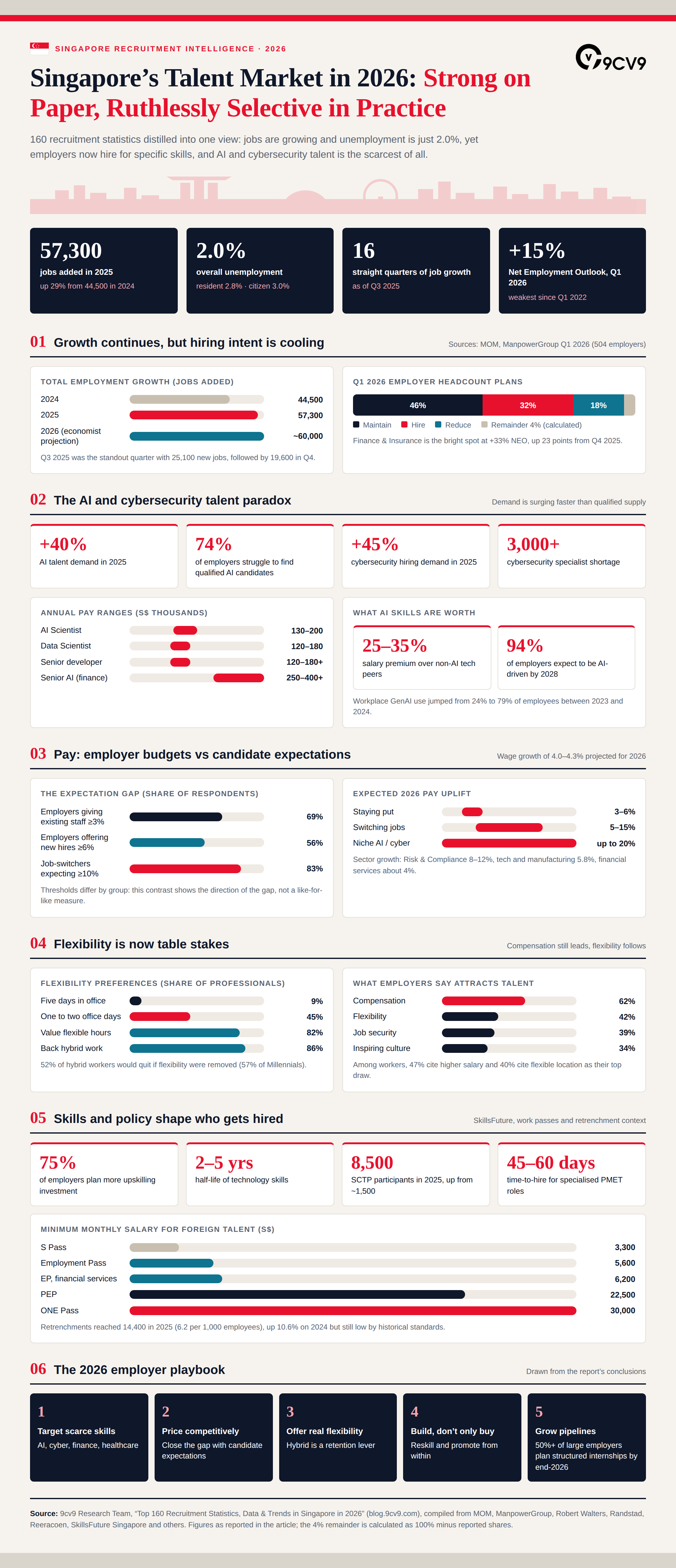
Salary expectations are another defining recruitment trend in Singapore in 2026. Overall wage growth is projected at approximately 4.0–4.3%, while 69% of employers plan salary increases of at least 3% for existing employees. For new hires, 56% of employers are prepared to offer increments of at least 6%, yet 83% of job switchers expect increases of 10% or more. This gap between employer budgets and candidate expectations could become an increasingly important challenge for recruiters.
Flexibility is also reshaping how companies compete for talent. Some 82% of Singapore professionals consider flexible hours a top workplace priority, while 52% of hybrid workers say they would quit if flexible working arrangements were removed. Only 9% want to work in the office five days a week, compared with 45% who prefer just one or two office days. Compensation may remain the strongest career-attraction factor, but flexibility has become a critical component of the employer value proposition.
Meanwhile, recruitment strategies are evolving beyond simply competing for experienced candidates. Around 75% of Singapore employers planned to increase investment in upskilling, reflecting the growing difficulty and expense of sourcing specialised talent externally. SkillsFuture programmes, structured internships and internal reskilling are becoming increasingly important as organisations shift from purely hiring capabilities to developing them internally.
These 160 recruitment statistics, data and trends in Singapore for 2026 provide a detailed picture of where the labour market is heading. From employment growth, unemployment and retrenchment to salaries, AI jobs, finance, healthcare, hybrid work, foreign talent, SkillsFuture and emerging skills shortages, the data reveals a recruitment market that remains fundamentally strong but is becoming more specialised. For employers, recruiters, HR leaders and job seekers, understanding these shifts will be essential for making better hiring, workforce planning and career decisions throughout 2026.
Before we venture further into this article, we would like to share who we are and what we do.
About 9cv9
9cv9 is a business tech startup based in Singapore and in Asia, with a strong presence all over the world.
With over ten years of startup and business experience, and being highly involved in connecting with thousands of companies and startups, the 9cv9 team has access to some of the best talents in the world.
If your company needs recruitment and headhunting services to hire top-quality employees, you can use 9cv9 headhunting and recruitment services to hire top talents and candidates. Email us at hello@9cv9.com.
Top 160 Recruitment Statistics, Data & Trends in Singapore in 2026
🏙️ 1. Overall Labour Market & Employment
- Singapore’s total employment grew by 57,300 jobs in 2025, marking a significant 29% acceleration from the 44,500 jobs added in 2024 and signalling a strengthening labour market recovery heading into 2026.
- The 44,500 jobs added in 2024 served as a modest but stable baseline, and while positive, it reflected a more cautious hiring environment compared to the accelerated growth that followed in 2025.
- Q3 2025 recorded 25,100 new jobs — comprising 5,600 resident and 19,500 non-resident roles — making it one of the strongest single quarters for Singapore employment growth in recent years.
- With 19,600 new jobs created in Q4 2025, Singapore ended the year on a moderating but still-positive note, outperforming the same quarter in the two preceding years and suggesting sustainable, if measured, momentum.
- The slower pace of 10,400 new jobs in Q2 2025 highlighted Singapore’s vulnerability to global economic headwinds, though the sharp rebound in Q3 demonstrated the labour market’s underlying resilience.
- Sixteen consecutive quarters of employment growth as of Q3 2025 underscores the remarkable durability of Singapore’s post-pandemic labour market, which has not recorded a quarterly decline since Q3 2021.
- Economists projecting approximately 60,000 new roles in 2026 suggest that Singapore’s job market will remain broadly constructive, though the anticipated moderation in growth pace reflects increasing global uncertainty.
- Singapore’s 4.2% GDP growth in Q3 2025 provided a solid macroeconomic foundation for hiring activity, reinforcing the link between economic expansion and sustained labour demand across key industries.
- The addition of approximately 5,300 jobs in Financial & Insurance Services — mostly filled by local hires — demonstrates the sector’s continued importance as a pillar of Singapore’s resident employment strategy.
- With roughly 70% of vacancies in Professional Services, ICT, Financial & Insurance, and Health & Social Services filled by locals, Singapore appears to be making meaningful progress on its fair hiring and local workforce development agenda.
- The decline in job vacancies from 76,900 to 69,200 in Q3 2025 should not be interpreted as a weakening labour market but rather as a natural normalisation following two years of exceptionally elevated post-pandemic demand.
- The widening gap between job seeker growth (11%) and job opening growth (3%) in 2025 intensified competition for mid-level roles, placing a premium on differentiated skills and making specialisation increasingly important for career advancement.
- Singapore’s overall resignation rate of 1.1% in 2025 reflects a workforce that is largely choosing stability over change, likely influenced by global economic uncertainty and a more selective job market.
- The F&B sector’s elevated resignation rate of 2.2% in 2025 points to persistent structural challenges around pay, working conditions, and career progression that continue to drive talent away from the industry.
- A retail trade resignation rate of 1.9% in 2025 confirms that consumer-facing sectors continue to struggle with employee retention, an issue that may compound talent shortages as consumer activity grows.
- Retail and hospitality’s involuntary turnover rate of 7.3% — the highest of any industry per Aon data — reflects the difficult labour dynamics in sectors that are simultaneously struggling with high attrition and high replacement costs.
- Manufacturing’s overall turnover rate of approximately 26%, according to Reeracoen Singapore’s internal data, signals a significant workforce stability challenge for a sector that is simultaneously trying to attract talent for Industry 4.0 transformation.
- The record-high proportion of permanent employees in Singapore’s workforce in 2025 suggests that employers and workers alike are prioritising job security and stability in an uncertain global economic environment.
- The rising PMET share among Singapore’s employed resident workforce, confirmed by MOM’s 2025 Labour Force report, reflects the ongoing structural shift toward higher-skilled, higher-value work across the economy.
- A time-related underemployment rate of 1.9% among residents in Q3 2025 — unchanged from Q2 and lower than the prior year — suggests that Singaporeans who are employed are largely working their desired hours, a positive sign for labour market quality.
📈 2. Hiring Outlook & Employer Sentiment
- Singapore’s Net Employment Outlook of +15% for Q1 2026 — the weakest since Q1 2022 — signals a market-wide recalibration toward selective, strategic hiring rather than the broad-based expansion seen in prior years.
- The fact that 46% of Singapore employers plan to maintain rather than grow headcount in Q1 2026 reflects a “hold steady” posture that is characteristic of periods of economic uncertainty, where business leaders prefer caution over commitment.
- With 32% of employers still planning to add staff in Q1 2026 — concentrated in Finance & Insurance and Healthcare — Singapore retains pockets of genuine hiring strength even as the overall outlook softens.
- The 18% of employers expecting to reduce staffing in Q1 2026, while notable, remains a minority and does not yet suggest a broad-based retrenchment wave comparable to past economic downturns.
- Finance & Insurance’s sector-specific NEO of +33% in Q1 2026 — rising 23 points from Q4 2025 — stands out as the most bullish hiring signal in Singapore and reflects the sector’s growing demand for specialised financial and AI talent.
- The ManpowerGroup Q1 2026 survey’s rigorous sample of 504 Singapore employers (drawn from a global pool of 39,063 across 41 countries) lends strong credibility to its findings as a reliable barometer of near-term hiring intentions.
- The slight dip from 44.1% to 43.3% of firms expecting to hire in Q1 2026 is statistically modest but directionally consistent with the broader cooling narrative, suggesting employers are adopting a more deliberate approach to workforce planning.
- The doubling of firms expecting to retrench — from 2.3% to 4.3% in Q1 2026 — warrants monitoring but remains at historically low levels, suggesting that cautious sentiment has not yet translated into widespread workforce reductions.
- Robert Walters’ finding that 37% of Singapore employers plan to grow headcount, mostly by 5–10%, in 2026 paints a picture of modest, targeted expansion rather than aggressive hiring — a pragmatic response to ongoing cost pressures.
- The 38% of companies that planned to increase technical hiring in 2025 despite budget constraints illustrates how critical digital capability has become, with organisations prioritising tech talent even when overall headcount budgets are tight.
- The marginal uptick in firms planning redundancies — from 1.6% to 1.9% — between March and June 2025 suggests a slow-moving shift in employer confidence, though the figures remain far too low to indicate systemic distress.
- The slight decline in firms planning to hire in Q3 2025 (from 44.0% to 43.7%) is a minor but consistent signal that hiring momentum is gradually easing, likely reflecting heightened caution about global economic conditions.
- Randstad’s finding that 41% of Singapore talent are open to switching jobs “if the right opportunity arises” reflects a workforce that is broadly satisfied with current employment but remains quietly opportunistic — a market dynamic that employers cannot afford to ignore.
- The fact that 53% of Singapore workers would actively job-hunt if dissatisfied with their pay outcomes is a clear reminder that compensation remains the primary lever for retention, even in a market where many employees prefer stability.
- With 43% of job seekers considering lateral moves over upward advancement in 2026, Singapore’s workforce appears to be recalibrating expectations in a tighter market, prioritising breadth of experience or work-life balance over immediate promotion.
- The dominance of replacement and restructuring-driven hiring over expansion-driven hiring in 2025 means that job openings are available but are more competitive, as employers are replacing specific capability rather than simply adding bodies.
📉 3. Unemployment & Retrenchment
- Singapore’s stable overall unemployment rate of 2.0% throughout 2025 — matching the 2024 figure — confirms that despite global headwinds, the city-state has maintained one of the tightest labour markets in Asia for a third consecutive year.
- The resident unemployment rate holding at 2.8% in 2025 reflects consistent demand for Singapore’s resident workforce across key industries, though it also highlights the ongoing employment gap between residents and overall employed headcount.
- The marginal rise in citizen unemployment from 2.9% to 3.0% in 2025 is within normal statistical fluctuation, but its sustained presence above the 2% overall rate highlights the structural challenges some citizens — particularly older PMETs — continue to face in job search.
- Full-year retrenchments of 14,400 in 2025, while slightly above 2024’s figure, remain low by historical standards and are broadly concentrated in restructuring activities rather than distressed business closures.
- The 13,020 retrenchments recorded in 2024 now serve as an important benchmark — and the 10.6% increase in 2025 retrenchments suggests a gradual uptick in workforce optimisation activity, rather than a sudden deterioration.
- A retrenchment rate of 6.2 per 1,000 employees in 2025 — up from 5.9 in 2024 — is a modest increase that reflects evolving business models and cost pressures rather than an economic shock, keeping Singapore well within its historically low retrenchment range.
- The 3,500 retrenchments in Q3 2025, largely attributed to business reorganisation, reflect the ongoing trend of employers reshaping workforces around automation, AI integration, and changing strategic priorities.
- Q1 2025’s 3,300 retrenchments — down from 3,680 in Q4 2024 — marked a promising early-year easing of workforce reductions, with the retrenchment rate of 1.3 per 1,000 employees indicating an improving trend at the start of the year.
- The absence of any single industry driving Singapore’s 2025 retrenchments is a constructive signal, suggesting that workforce adjustments are broad-based and strategic rather than concentrated in any one sector undergoing crisis.
- MOM’s confirmation that long-term unemployment for Singapore citizens remained within historical ranges in 2025 is reassuring, indicating that most retrenched workers are finding re-employment without becoming chronically displaced.
💰 4. Wages, Salaries & Compensation
- Reeracoen Singapore’s projected overall wage growth of 4.0–4.3% in 2026, derived from 140,000 data points across 15 industries, points to a market where compensation is rising but at a more measured and sustainable pace than in the post-pandemic boom years.
- With 69% of Singapore employers planning salary increases of at least 3% for current employees in 2026, the majority of the workforce can expect their pay to at least keep pace with inflation, though the scale of increases varies significantly by sector and role.
- The fact that 56% of employers are likely to offer new hires at least a 6% increment — with 27% willing to go above 10% — reflects the competitive pressure companies face to attract talent externally in a tight labour market for specialised roles.
- The expectation among 83% of Singapore job-switchers for at least a 10% pay rise — with nearly a quarter expecting above 20% — reveals a significant gap between employee expectations and the market’s ability to consistently deliver large salary jumps in 2026.
- The market-aligned projection that job-switchers can expect 5–15% salary increments (rising to 20% for AI and cybersecurity niches) provides a useful benchmark for professionals evaluating whether a career move is financially worthwhile.
- Employees choosing to remain with their employers can anticipate a 3–6% salary increase in 2026 — enough to partially offset inflation but likely insufficient to match the gains available to those willing to move, perpetuating the “job-hopping premium” dynamic.
- The sharp drop in firms planning wage increases from 32% (December 2024) to 19.3%–26.4% (December 2025) signals a meaningful cooling in employers’ wage generosity, which may intensify retention challenges if employee expectations remain elevated.
- Singapore’s real median income growth of 3.4% in 2024, coupled with a narrowing wage gap between lower and median earners, reflects the positive impact of minimum wage initiatives and progressive wage models on income equity.
- Projected salary growth of 5.8% in technology and manufacturing sectors outpaces the overall market average, reinforcing these industries as premium employment destinations for skills-driven professionals in Singapore.
- The potential for up to a 20% salary increment in niche AI and cybersecurity roles when switching jobs demonstrates just how severely scarce these skill sets remain — and how that scarcity directly translates into extraordinary compensation premiums.
- A median monthly wage of approximately S$7,500 for Financial Analysts in Singapore positions the role as a well-compensated career path, though the figure also reflects the substantial academic and professional requirements demanded by the industry.
- Software Engineers in Singapore commanding S$6,000–S$9,500 per month depending on seniority confirms that technical talent remains among the most generously rewarded in the market, with a premium that continues to widen relative to non-technical peers.
- Healthcare Specialists earning S$4,800–S$7,000 per month reflect both the specialised nature of allied health work and the sustained government investment in Singapore’s public healthcare system, though the range also highlights significant variation by specialisation.
- Flying Instructors topping Singapore’s highest-paid occupation list with monthly wages exceeding S$20,000 is a striking data point that illustrates how extreme scarcity in a highly technical and safety-critical profession can produce outsised compensation outcomes.
- The National Wages Council’s recommended 3–5% wage growth guidance for 2025/2026 provides a benchmark that balances employee purchasing power against business competitiveness, though individual outcomes will diverge significantly based on sector and performance.
- The financial services sector’s expected average salary growth of approximately 4% in 2026 — with specialist contractors earning 20–25% premiums — highlights a widening compensation split between permanent and project-based employment in the industry.
- Senior software developers in Singapore earning S$120,000–S$180,000+ annually in 2026 reflect a sustained talent shortage that has kept developer compensation elevated well above most other professional disciplines.
- Junior developer salaries of S$4,500–S$6,000 per month in Singapore represent a strong entry point for new graduates, though these figures also highlight the steep competition among early-career tech professionals entering an increasingly crowded lower end of the market.
- The projected 8–12% salary growth for Risk & Compliance professionals — the highest of any Banking & Finance job family — reflects both regulatory complexity and the growing emphasis on governance in Singapore’s financial sector as global compliance standards tighten.
🤖 5. Technology, AI & Digital Jobs
- The 40% surge in AI talent demand in 2025, set against 74% of employers struggling to find qualified candidates, encapsulates the defining talent paradox of Singapore’s tech sector — extraordinary demand colliding with critically insufficient supply.
- LinkedIn’s data showing a 38% rise in AI job postings across banking, insurance, and tech in 2024 confirms that AI hiring is no longer purely a technology sector phenomenon — it has become a cross-industry imperative in Singapore.
- The projected 20–30% annual growth in demand for AI Engineers, Data Scientists, and MLOps Engineers through 2026 makes AI-related careers among the most assured growth trajectories available to Singapore tech professionals today.
- With 94% of Singapore employers expecting to be AI-driven by 2028, the pressure on businesses to hire, train, or contract AI talent is becoming existential — making workforce AI readiness one of the most consequential HR challenges of the decade.
- The 25–35% salary premium for AI-skilled professionals above their non-AI tech counterparts is a powerful and measurable signal to workers considering upskilling — the financial return on AI competency development is among the highest in any discipline.
- IT professionals with demonstrable AI skills seeing salary increases of up to 35% highlights that AI is not just a new job category but a performance multiplier that is rapidly repricing existing technical roles upward.
- Singapore’s ambition to triple its AI workforce from 5,000 to 15,000 practitioners under the S$25 billion RIE 2025 plan represents one of the most targeted national AI talent strategies in Southeast Asia, with direct implications for hiring volumes and skills pipelines.
- The 45% surge in cybersecurity hiring demand in 2025, driven in part by a 69.4% increase in cybercrimes, reflects a direct and urgent correlation between Singapore’s escalating threat landscape and its talent acquisition needs in the security space.
- Singapore’s identified shortfall of 3,000+ cybersecurity specialists by 2026 represents a critical national vulnerability — one that has direct implications for financial stability, data protection, and public trust in digital systems.
- AI Scientists in Singapore starting at S$130,000 annually — with a ceiling around S$200,000 — positions the role as one of the most lucrative entry-level technical positions in the market, reflecting the extraordinary premium placed on cutting-edge AI research capability.
- Data Scientists earning S$120,000–S$180,000 per year in Singapore confirm that data-driven decision-making has become a core business function, with compensation levels that reflect both the strategic importance and ongoing talent scarcity in the field.
- Senior AI scientists in Singapore’s financial sector regularly commanding S$250,000–S$400,000+ annually is less a story about pay inflation and more a reflection of how directly these professionals are tied to measurable revenue outcomes in trading and investment.
- The expectation of 25,000+ new roles in advanced manufacturing and robotics driven by Industry 4.0 investments signals that Singapore’s manufacturing transformation is creating genuine employment opportunities rather than simply displacing existing workers.
- The ICT Industry Transformation Map’s target of 80,000 well-paying jobs by 2025, backed by a 5–7% CAGR in value-added contributions, reflects a deliberate and policy-backed effort to position Singapore as a high-value digital economy, not just a regional tech hub.
- The normalisation of tech job-switch salary increments to 5–8% in 2025 — down sharply from the 20–40% seen in previous years — marks a meaningful correction in the tech talent market after years of exceptional demand-driven salary inflation.
- The persistence of up to 20% salary premiums for niche tech roles in AI, cloud architecture, and cybersecurity, even as the broader tech market cools, illustrates how heterogeneous Singapore’s technology talent landscape has become.
- Singapore’s AI market growing at a 28.10% CAGR toward US$4.64 billion by 2030 provides an important economic backdrop for understanding why AI talent demand is not a passing trend but a structural, long-duration shift in the market.
- The leap from 24% to 79% of Singapore employees using GenAI at work between 2023 and 2024 is one of the most dramatic single-year shifts in workplace technology adoption ever recorded — fundamentally changing what hiring managers expect from virtually all professional candidates.
- The fact that 70% of Singapore employees are using GenAI primarily for content creation tasks such as writing emails and reports signals that AI adoption is currently broad and shallow, with deeper, more transformative applications still emerging across industries.
- MAS’s S$150 million FSTI 3.0 injection to accelerate AI adoption in financial institutions directly creates downstream hiring demand for AI engineers, data scientists, and implementation specialists across Singapore’s banking and insurance sectors.
🏦 6. Finance, Banking & Fintech Hiring
- Singapore’s Financial Services ITM target of 3,000–4,000 net new jobs annually between 2021 and 2025 reflects a government-backed vision for the sector’s role as a primary employer of resident talent, though actual outcomes will vary with global market conditions.
- The fact that 36% of Singapore’s finance professionals are open to switching industries suggests that traditional finance career paths may be losing some of their appeal, potentially driven by the allure of technology roles or broader work-life balance considerations.
- The 20–25% salary uplift available to specialist contractors in governance, finance, and operations roles in 2026 reflects a structural shift where firms are finding project-based arrangements preferable to permanent headcount for specialised expertise.
- The increase of the EP minimum salary for financial services to S$6,200/month from January 2025 reinforces Singapore’s strategy of using salary thresholds as a mechanism to attract only high-quality foreign talent while protecting employment prospects for skilled local professionals.
- MAS’s five-year, S$100 million green finance grant is not just an environmental initiative — it is also a significant talent catalyst, creating dedicated hiring demand for sustainable finance professionals, ESG analysts, and green fintech developers in Singapore.
- McKinsey’s projection of global digital payments revenue reaching US$3.6 trillion by 2030 provides a powerful commercial rationale for why Singapore’s fintech hiring market will remain structurally robust, as firms position themselves to capture share in this rapidly expanding ecosystem.
- The projection of 1,500 new engineering roles in Singapore’s semiconductor and advanced manufacturing sectors by 2027 is a targeted but significant contributor to total employment growth, underpinned by strategic investments from global chipmakers expanding regional capacity.
- Junior HFT developers in Singapore starting at approximately S$120,000 annually — typically the domain of only the most elite software engineers globally — highlights the extraordinary concentration of financial technology expertise in Singapore’s capital markets infrastructure.
🏥 7. Healthcare & Nursing Hiring
- MOH’s March 2025 announcement of base salary adjustments of up to 4% for 26,000 public healthcare nurses is a meaningful but incremental step in addressing long-standing compensation concerns in a profession facing both high demand and high attrition pressure.
- The average registered nurse salary of S$3,424/month reported by Indeed in February 2026 — based on 173 salary reports — provides a credible real-world benchmark, though it represents the midpoint of a range that varies significantly by specialisation and experience level.
- Glassdoor’s reported RN salary range of S$3,417–S$5,200/month (with top earners at S$7,180) illustrates the considerable upside available to nurses who specialise, take on senior roles, or move into critical care — making nursing a financially progressive career path with the right trajectory.
- PayScale’s average annual RN salary of S$46,920 in 2026, drawn from 106 salary profiles, offers a complementary data point to other surveys and reinforces that Singapore nurses are reasonably compensated relative to regional peers, though global comparisons still reveal a significant gap.
- The projected 5–10% annual nurse salary growth — with specialised ICU, oncology, and cardiology nurses seeing 15%+ — signals that healthcare employers are increasingly willing to differentiate compensation by specialisation to address targeted talent shortages.
- Consistent employment growth in Health & Social Services throughout 2025, driven by Singapore’s ageing demographic and biomedical expansion, makes healthcare one of the most structurally secure and demand-resilient sectors for job seekers in 2026.
- The MOH’s ANGEL scheme, launched in September 2024, represents a long-term retention strategy that goes beyond salary — recognising nursing as a vocation and attempting to build institutional loyalty through non-monetary recognition and career development support.
🏠 8. Flexible Work, Hybrid & Remote
- The finding that 82% of Singapore professionals value flexible hours as a top workplace priority is a clear mandate for employers: flexibility is no longer a perk or differentiator but a baseline expectation that materially influences talent attraction and retention outcomes.
- The statistic that 52% of Singapore hybrid workers would quit if flexible work were removed — rising to 57% among Millennials — is a powerful warning for organisations pushing aggressive return-to-office mandates without adequate employee consultation or phased implementation.
- With 48% of hiring managers identifying flexible working arrangements as crucial for talent attraction, flexibility has cemented its place in Singapore’s employer value proposition toolkit, sitting alongside compensation and career development as a core offering.
- Singapore’s 61% rate of companies mandating increased office presence — higher than the global average of 56% — suggests that many employers here are navigating a delicate balance between operational preferences and the flexibility expectations of a workforce that has broadly adapted to hybrid arrangements.
- The fact that only 9% of Singapore professionals want a full five-day office week — versus 45% preferring just 1–2 office days — illustrates the scale of the gap between employee preferences and many employers’ current office attendance policies.
- The rise of employers allowing 2–4 remote workdays per week (from 54% in 2023 to 76% in 2024) shows that Singapore’s corporate approach to flexibility is evolving rapidly, though the simultaneous decline in full remote support (from 42% to 16%) suggests a clear preference for structured rather than unconstrained flexibility.
- The sharp drop from 42% to 16% of employers supporting full remote work between 2023 and 2024 reflects a broader global return-to-office push, though Singapore’s approach appears more nuanced than outright office mandates — with most employers settling on a structured hybrid model.
- The finding that 40% of Singapore workers cite flexible work location as a top career-attraction factor — second only to salary at 47% — confirms that workplace flexibility has effectively become the second most important determinant of employment decisions in the market.
- The fact that over 60% of Singapore companies now offer some form of flexible work arrangement reflects how dramatically the employment landscape has shifted since 2020, as flexibility has transitioned from exception to expectation across industries and company sizes.
- The 70% preference for hybrid work among Singapore employees post-pandemic represents a durable attitudinal shift that is unlikely to reverse fully, meaning employers who fail to accommodate hybrid preferences risk losing access to a significant share of available talent.
- Half of Singapore employees indicating they would forgo a pay raise in exchange for preferred flexibility is a remarkable data point that employers can leverage strategically — flexible work arrangements are not just employee-friendly but also cost-effective retention tools.
- The statistic that 86% of Singapore’s workforce advocates for continued hybrid arrangements makes it one of the most consistent and broadly held employee preferences in the labour market — one that HR leaders and policymakers cannot responsibly ignore in workforce design.
- The introduction of mandatory FWA Tripartite Guidelines from December 2024 marks a significant policy shift in Singapore, moving flexible work from a discretionary employer offering to a structured employee right with formal consideration requirements.
- With only 2% of Singapore employers expecting fully on-site arrangements — versus 5% globally — Singapore is among the world’s most progressive major economies when it comes to normalising flexible work, though this may also reflect the relatively compact geography and commute-sensitive nature of the Singapore workforce.
🛵 9. Gig Economy & Platform Workers
- Singapore’s platform worker population growing to 88,400 (3.6% of the labour force) in 2022 — up 21% from 2021 — establishes a clear upward trajectory that, combined with 2025 legislative changes, is reshaping how work and employment protections are defined in the city-state.
- The Platform Workers Act coming into effect in January 2025 represents one of the most significant labour policy reforms in Singapore’s recent history, acknowledging that gig workers occupy a distinct and growing segment of the workforce that requires dedicated legal protections.
- The pre-2025 estimate of approximately 70,500 gig workers representing 3% of Singapore’s total workforce provides important context for the scale of the gig economy — large enough to warrant dedicated policy attention, but still a minority of the overall labour force.
- The dominance of senior-level professionals (over 60%) within Singapore’s independent workforce challenges the common perception of gig work as a last resort — it is increasingly a deliberate career choice by experienced professionals who value autonomy over employment security.
- Singapore freelancers’ relatively low platform dependency (29% vs 34% in the US) suggests a more relationship-driven, direct-engagement model of freelancing, where reputation and professional networks matter more than marketplace algorithms.
- The growing appeal of contract roles in Banking & Finance in 2025 reflects a broader structural shift where both employers seeking flexibility and professionals seeking premium project-based rates are finding common ground in non-permanent employment arrangements.
🎓 10. Skills, Upskilling & SkillsFuture
- The decline of training participation to 40.7% of the resident labour force in 2024 is a concerning signal in a market where skills obsolescence is accelerating — suggesting that nearly 60% of Singapore’s resident workforce may not be actively updating their capabilities.
- Over 36,000 citizens utilising SkillsFuture Credit (Mid-Career) in the Level-Up Programme’s first year demonstrates meaningful uptake, though the figure also suggests significant room for growth given that hundreds of thousands of mid-career Singaporeans are eligible.
- The S$24 million in SkillsFuture Mid-Career Credit claims committed in Year 1 is a substantial initial activation of the programme’s financial support mechanism, though the ultimate measure of success will be in long-term employment outcomes rather than training enrolment numbers.
- Over 3,200 citizens receiving training allowances within the first three months of implementation — totalling over S$30 million committed — signals that income-replacement support is a critical enabler of mid-career training participation, removing one of the biggest practical barriers to full-time reskilling.
- The 55% job placement rate for previously unemployed SCTP trainees within six months is a credible outcome metric, though it also implies that nearly half of participants face longer job search timelines, highlighting the importance of job matching support alongside training provision.
- The six-fold growth in SCTP take-up in 2025 — from approximately 1,500 to 8,500 participants — is one of the most dramatic single-year expansions in Singapore’s workforce development ecosystem and demonstrates the impact of combined financial support and programme accessibility improvements.
- The availability of 330 SkillsFuture Career Transition Programmes across 21 sectors by July 2025 provides a breadth of reskilling pathways that is genuinely impressive, though the quality, employer recognition, and placement outcomes of individual programmes will ultimately determine their real-world value.
- The 2.5-fold increase in SkillsFuture Credit users pursuing full qualifications reflects a growing willingness among Singapore workers to invest in credential-level learning — a more intensive commitment than short courses and one with potentially greater long-term career impact.
- The 75% of Singapore employers planning to invest more in upskilling in 2025 reflects a pragmatic acknowledgement that hiring qualified external talent is increasingly difficult and expensive, making internal capability development an essential complementary strategy.
- The shortening of the technology skills half-life to 2–5 years makes continuous learning not just a career advantage but a professional necessity for Singapore workers — and places enormous responsibility on both individuals and employers to maintain current, market-relevant competencies.
- The SkillsFuture Credit (Mid-Career) top-up of S$4,000 combined with subsidies of up to 90% of course fees dramatically reduces the out-of-pocket cost of upskilling for mid-career Singaporeans, though awareness and motivation to use these benefits remain important adoption barriers.
- The SkillsFuture Training Allowance providing 50% of average monthly income for eligible full-time trainees from May 2025 addresses one of the most fundamental obstacles to mid-career reskilling — the financial risk of taking time out of employment — making longer-duration programmes more accessible.
- The identification of 146 job roles with strong career mobility potential in SkillsFuture’s SDFE 2025 report gives workers a concrete, evidence-based framework for identifying adjacent career moves, reducing the risk and ambiguity that often deters lateral transitions.
- Training budgets outpacing recruitment spend in 2026 would represent a meaningful strategic shift for Singapore employers — from “hire for capability” to “build for capability” — with significant long-term implications for the structure and culture of workplace learning.
🌍 11. Foreign Talent, Work Passes & Fair Hiring
- The increase of the general Employment Pass minimum salary to S$5,600/month from January 2025 reflects Singapore’s ongoing effort to calibrate foreign talent thresholds to market rates, ensuring that EP holders genuinely complement rather than substitute for the local workforce.
- The financial sector EP minimum of S$6,200/month acknowledges the higher wage benchmarks in Singapore’s banking and insurance industries, creating a sector-specific floor that both attracts premium foreign talent and preserves salary competitiveness for local finance professionals.
- The progressive age-scaling of EP thresholds — reaching S$10,700 (general) and S$11,800 (financial) for candidates aged 45 and above — reflects Singapore’s deliberate policy to protect senior local professionals, who are statistically most vulnerable to displacement by younger foreign hires at lower salary points.
- COMPASS’s 40-point minimum threshold across six criteria represents a more holistic and transparent assessment framework than pure salary floors, recognising that complementarity encompasses education, diversity, and skills shortage considerations beyond just compensation levels.
- The COMPASS salary criterion’s 10–20 point allocation based on 65th–90th percentile benchmarks creates a clear incentive for employers to hire foreign professionals who are genuinely premium earners, aligning EP approvals with the objective of raising the overall quality of Singapore’s foreign workforce.
- The COMPASS exemption for EP applicants earning S$22,500/month or more creates a practical fast-track for genuinely exceptional global talent, balancing the framework’s protective intent with Singapore’s economic need to attract world-class professionals without excessive procedural friction.
- The S Pass minimum salary rise to S$3,300/month from September 2025 — with S$3,800 for financial services — maintains Singapore’s policy of incrementally raising the floor for mid-skilled foreign workers, progressively narrowing the cost advantage of foreign hiring over local employment.
- The ONE Pass’s S$30,000/month salary threshold targets a truly elite global tier of talent whose contributions to Singapore’s arts, academia, business, and sports sectors are expected to be transformative rather than simply additive to existing capability.
- The PEP’s dual requirement of S$22,500/month and S$270,000/year in fixed salary creates one of the most stringent talent qualification bars of any work pass globally, reflecting Singapore’s intent to use this scheme exclusively for top-tier professionals with demonstrated and sustained high earnings.
- The September 2025 revision of the PMET threshold to S$3,300/month addresses concerns about outdated wage brackets and ensures that COMPASS diversity scoring better reflects the actual composition of Singapore’s skilled workforce.
🔍 12. Sector-Specific & Cross-Industry Trends
- Singapore’s resident unemployment rate of 2.8% — one of the lowest in Southeast Asia — reinforces the city-state’s position as the region’s most mature and stable labour market, though it also reflects an economy that has largely reached full employment and may face structural talent constraints ahead.
- The identified need for 1.2 million additional digitally skilled workers under the Smart Nation initiative represents an enormous structural demand signal that will shape Singapore’s education system, SkillsFuture programming, and immigration policy for years to come.
- Over 80,000 job vacancies reported in late 2024 confirms that Singapore’s talent gap is not a media narrative but a quantifiable market reality — one that creates genuine opportunities for skilled professionals while imposing real costs on businesses unable to fill critical roles.
- The concentration of non-resident employment growth in Construction and Manufacturing (Work Permit holders) in Q4 2025 reflects the continued dependence of Singapore’s physical infrastructure and industrial sectors on foreign workers for roles that remain challenging to fill with residents.
- Muted employment changes in ICT and Professional Services in 2025 despite continued resident hiring growth reflects the sector’s cautious navigation between global tech sector corrections and Singapore’s own domestic demand for digital capability.
- The Employment Diffusion Index showing more sectors expanding than contracting in Q3 2025 is a broadly positive signal, indicating that Singapore’s job market growth is relatively diversified rather than concentrated in a narrow range of industries.
- The improving Labour Force Participation Rate for females aged 25–64 — confirmed by MOM’s 2025 Labour Force Advance Release — reflects the cumulative impact of progressive workplace policies, expanded childcare infrastructure, and increased representation of women in higher-value professional roles.
- The hierarchy of employer value factors — compensation (62%), flexibility (42%), job security (39%), and inspiring culture (34%) — gives HR leaders a clear, data-driven prioritisation framework for designing competitive employment propositions in Singapore’s 2026 talent market.
- The finding that 47% of Singapore workers cite higher salary as their top career-attraction factor — marginally ahead of flexible work location at 40% — confirms that while flexibility is increasingly important, compensation remains the primary driver of labour market mobility.
- The potential for advanced digital skills to deliver salary increases of up to 120% for workers transitioning into tech roles is the single most compelling ROI argument for personal upskilling investment in Singapore today, dwarfing the returns available through conventional career progression.
- Projected growth of 12–18% in Supply Chain & Logistics hiring in 2026, driven by e-commerce expansion and regional trade activity, positions the sector as one of the more dynamic and broadly accessible hiring opportunities for Singaporeans across a range of skill levels.
- The planned tightening of Work Permit quotas in the Construction sector for 2026 reflects Singapore’s long-term strategy to reduce structural dependency on low-wage foreign labour through productivity improvement, automation, and mechanisation — a necessary but potentially disruptive transition for the industry.
- The 30%+ surge in sustainability and green role hiring as ESG mandates intensify confirms that environmental and governance considerations are no longer peripheral to Singapore’s corporate hiring agenda — they are becoming core business functions requiring dedicated headcount.
- The record employment rate for residents aged 55–64 in 2025, driven by Senior Worker Support Package incentives, demonstrates that Singapore’s investment in extending working lives is delivering measurable outcomes, contributing to labour supply resilience in an ageing society.
- The stretching of average time-to-hire for specialised PMET roles to 45–60 days in 2025 has real business costs — delayed project delivery, strained team capacity, and heightened risk of losing candidates to competing offers — making proactive talent pipeline management a strategic imperative.
- The commitment of over 50% of large Singapore employers to structured internship programmes by end of 2026 reflects a forward-looking approach to talent acquisition, recognising that building long-term pipelines through education partnerships is more sustainable than competing in an increasingly crowded market for experienced professionals.
Conclusion
Singapore’s recruitment landscape in 2026 is defined by resilience, selectivity and an accelerating shift toward skills-based hiring. Despite global economic uncertainty, the labour market enters the year on relatively strong foundations. Total employment expanded by 57,300 jobs in 2025, unemployment remained at just 2.0%, and Singapore recorded 16 consecutive quarters of employment growth by Q3 2025. Yet employers are becoming more deliberate about where and how they add headcount.
The 160 recruitment statistics and trends highlighted throughout this report show that hiring opportunities are increasingly concentrated in areas where specialised talent remains scarce. Artificial intelligence, cybersecurity, financial services, healthcare, advanced manufacturing, robotics, supply chain and sustainability are among the areas showing particularly important recruitment signals. AI talent demand alone surged 40% in 2025, while 74% of employers struggled to find qualified candidates, demonstrating the widening gap between technological ambitions and available workforce capabilities.
Compensation will remain central to recruitment and retention strategies. Overall wage growth is projected at around 4.0–4.3% in 2026, while specialised AI and cybersecurity professionals can command significantly larger premiums. At the same time, the expectations of job seekers are putting pressure on hiring budgets, with 83% of job switchers expecting salary increases of at least 10%. Employers will therefore need to compete on more than salary alone.
Flexible working arrangements have become another critical part of Singapore’s talent market. With 82% of professionals valuing flexible hours and 52% of hybrid workers indicating they would quit if flexibility disappeared, companies that combine competitive compensation with meaningful flexibility could hold a significant recruitment advantage. Upskilling is becoming equally important, particularly as employers confront persistent shortages and the rapid obsolescence of technology skills.
For recruiters and HR leaders, the broader message is clear: Singapore does not simply face a shortage of workers, but increasingly a mismatch between available skills and the capabilities businesses require. Recruitment strategies in 2026 will need to combine targeted talent acquisition, competitive compensation, flexible work, internal mobility, reskilling and stronger long-term talent pipelines.
Ultimately, Singapore remains one of Southeast Asia’s most mature and competitive employment markets, but successful recruitment is becoming more sophisticated. Employers that understand the latest Singapore recruitment statistics, salary trends, candidate expectations and emerging skill shortages will be better positioned to attract and retain talent. For job seekers, meanwhile, continued investment in AI, digital, technical and other high-demand capabilities could open some of the strongest career and salary opportunities available in Singapore in 2026.
If you find this article useful, why not share it with your hiring manager and C-level suite friends and also leave a nice comment below?
We, at the 9cv9 Research Team, strive to bring the latest and most meaningful data, guides, and statistics to your doorstep.
To get access to top-quality guides, click over to 9cv9 Blog.
To hire top talents using our modern AI-powered recruitment agency, find out more at 9cv9 Modern AI-Powered Recruitment Agency.
People Also Ask
What are the key recruitment trends in Singapore in 2026?
Singapore recruitment trends in 2026 include selective hiring, growing demand for specialised skills, moderate salary growth, greater investment in upskilling and continued competition for AI, cybersecurity, finance and healthcare talent.
Is Singapore’s job market growing in 2026?
Singapore entered 2026 with positive momentum after total employment increased by 57,300 jobs in 2025, compared with 44,500 in 2024. Economists project approximately 60,000 new roles in 2026.
What is Singapore’s unemployment rate?
Singapore’s overall unemployment rate remained at 2.0% throughout 2025, while resident unemployment stood at 2.8% and citizen unemployment was approximately 3.0%.
What is the hiring outlook for Singapore in 2026?
Singapore recorded a Net Employment Outlook of +15% for Q1 2026. Around 32% of employers planned to add employees, while 46% expected to maintain their existing headcount.
Which industries are hiring the most in Singapore in 2026?
Strong recruitment opportunities are emerging across finance and insurance, healthcare, AI, cybersecurity, advanced manufacturing, robotics, supply chain, logistics and sustainability-related roles.
Is Singapore experiencing a skills shortage in 2026?
Yes. Skills shortages are particularly evident in technology. Around 74% of employers struggled to find qualified AI candidates, while Singapore faces a shortage of more than 3,000 cybersecurity specialists.
How strong is demand for AI jobs in Singapore?
AI talent demand surged 40% in 2025. Demand for AI Engineers, Data Scientists and MLOps Engineers is projected to grow by 20–30% annually through 2026.
How much do AI professionals earn in Singapore?
AI Scientists can start at around S$130,000 annually and reach approximately S$200,000, while senior AI scientists in financial services can command S$250,000–S$400,000 or more.
Do AI skills increase salaries in Singapore?
Yes. AI-skilled professionals can command salary premiums of 25–35% over non-AI technology counterparts, while IT professionals demonstrating AI capabilities may receive salary increases of up to 35%.
What is the cybersecurity hiring outlook in Singapore?
Cybersecurity hiring demand increased 45% in 2025. Singapore is also projected to face a shortage of more than 3,000 cybersecurity specialists by 2026, supporting continued demand for qualified professionals.
How much will salaries increase in Singapore in 2026?
Overall wage growth is projected at approximately 4.0–4.3% in 2026. Around 69% of employers plan salary increases of at least 3% for existing employees.
What salary increase can job switchers expect in Singapore?
Job switchers can generally expect salary increases of around 5–15% in 2026, with increments potentially reaching 20% for scarce AI and cybersecurity talent.
What salary increase do Singapore job seekers expect when changing jobs?
Around 83% of Singapore job switchers expect a salary increase of at least 10%, while nearly one-quarter expect increases exceeding 20%.
How much do Software Engineers earn in Singapore?
Software Engineers can earn approximately S$6,000–S$9,500 per month depending on seniority. Senior software developers can command around S$120,000–S$180,000 or more annually.
How much do junior developers earn in Singapore?
Junior developers can earn approximately S$4,500–S$6,000 per month, providing a relatively strong starting salary despite increasing competition among early-career technology professionals.
Is finance hiring strong in Singapore in 2026?
Yes. Finance and Insurance recorded a +33% Net Employment Outlook for Q1 2026, making it one of Singapore’s strongest sectors for hiring intentions.
What are the recruitment trends in Singapore’s healthcare sector?
Healthcare remains a structurally resilient employment sector due to Singapore’s ageing population and biomedical expansion. Demand continues for nurses, healthcare specialists and other skilled healthcare professionals.
How much do registered nurses earn in Singapore in 2026?
The average registered nurse salary was reported at approximately S$3,424 per month in February 2026, while other salary data showed ranges of roughly S$3,417–S$5,200 monthly.
Is hybrid work still popular in Singapore in 2026?
Yes. Around 70% of employees prefer hybrid work, while 86% advocate for continued hybrid arrangements. Only 9% of professionals want a full five-day office week.
How important is flexible work for recruitment in Singapore?
Flexible work is a major recruitment factor. Around 82% of professionals value flexible hours, while 40% identify flexible work location as a top career-attraction factor.
Would Singapore employees quit if hybrid work was removed?
Around 52% of Singapore hybrid workers say they would quit if flexible work arrangements were removed. The proportion rises to 57% among Millennials.
What attracts employees to jobs in Singapore?
Compensation remains the leading factor, followed by flexibility and job security. Around 47% cite higher salary as their top career-attraction factor, compared with 40% citing flexible work location.
Are Singapore employers investing in employee upskilling?
Yes. Around 75% of employers planned to invest more in upskilling, reflecting the increasing cost and difficulty of recruiting specialised external talent.
How important is SkillsFuture to Singapore’s workforce?
SkillsFuture plays an important role in reskilling. Around 36,000 citizens used SkillsFuture Credit (Mid-Career) during the Level-Up Programme’s first year, while SCTP participation expanded substantially.
What are the Employment Pass salary requirements in Singapore?
The general Employment Pass minimum salary increased to S$5,600 per month from January 2025, while the financial services minimum increased to S$6,200.
What is the S Pass minimum salary in Singapore?
The S Pass minimum salary increased to S$3,300 per month from September 2025, while the minimum for financial services increased to S$3,800.
How large is Singapore’s gig economy?
Singapore had approximately 88,400 platform workers in 2022, equivalent to 3.6% of the labour force. The Platform Workers Act subsequently came into effect in January 2025.
What are Singapore’s fastest-growing recruitment areas?
AI, cybersecurity, advanced manufacturing, robotics, sustainability, supply chain and logistics show notable growth signals, alongside continuing opportunities in finance and healthcare.
How long does it take to hire specialised professionals in Singapore?
Average time-to-hire for specialised PMET positions stretched to approximately 45–60 days in 2025, highlighting the difficulty employers face when recruiting scarce professional talent.
What do Singapore recruitment statistics suggest for employers in 2026?
The data points toward a competitive, skills-driven market. Employers will increasingly need targeted recruitment, competitive compensation, flexible work, upskilling and stronger talent pipelines to secure scarce professionals.
Sources
Ministry of Manpower (MOM)Ministry of Education (MOE) SingaporeSkillsFuture SingaporeManpowerGroup SingaporeRobert Walters SingaporeRandstad SingaporeReeracoen SingaporeMorgan McKinley SingaporeNala EmploymentMyCareersFutureWorkforce Singapore (WSG)Ministry of Health (MOH)Indeed SingaporeGlassdoor SingaporePayScale SingaporeeFinancialCareersEY SingaporeMavenside ConsultingHuntingCubeStemgenic GlobalThe Peak MagazineHR AsiaHR Focus SGNucampKaopizTerraternHawksfordPiloto AsiaAlitiumSlasifySterlingFlexOSDeskimoFastGig SGThe Financial CoconutPeopleCentralLifelong Learning SG