



























Key Takeaways
- The best job description generator software in 2026 uses AI to create accurate, engaging, inclusive, and role-specific job descriptions faster.
- Leading AI job description generators combine writing automation with ATS integration, bias detection, compliance, candidate sourcing, and recruitment analytics.
- Choosing the right job description generator depends on hiring volume, budget, company size, technical requirements, integrations, and recruitment workflow needs.
Textio leads the best job description generator software in 2026 by combining AI-powered job description creation with predictive writing guidance, inclusive language analysis, recruitment data, and enterprise hiring workflows. It helps employers create clearer, more consistent job postings while improving content quality and supporting more structured recruitment processes.
Creating an effective job description in 2026 requires far more than listing responsibilities, qualifications, and years of experience. Employers must communicate role expectations clearly, attract qualified candidates, maintain consistent employer branding, address inclusive language and pay transparency requirements, and increasingly structure job information so that both candidates and AI-powered recruitment systems can understand it.
This shift has made the best job description generator software increasingly valuable to recruiters, HR teams, hiring managers, recruitment agencies, and growing businesses. Modern AI job description generators can transform basic role information into structured job advertisements, rewrite outdated descriptions, improve readability, identify potentially biased language, recommend relevant skills, standardize job titles, and maintain consistent writing standards across large organizations.
The market has also expanded beyond simple AI writing tools. Some platforms specialize in predictive recruitment language and inclusive hiring, while others combine job description generation with applicant tracking systems, candidate sourcing, interview intelligence, technical assessments, job architecture, compensation benchmarking, compliance monitoring, and enterprise approval workflows.
| Job Description Software Capability | Value for Employers in 2026 |
|---|---|
| AI job description generation | Creates complete first drafts faster |
| Job description optimization | Improves clarity, structure, and candidate appeal |
| Inclusive language analysis | Identifies potentially exclusionary wording |
| Employer brand controls | Maintains consistent company messaging |
| ATS integration | Connects job creation with recruitment workflows |
| Job architecture | Standardizes roles, levels, skills, and responsibilities |
| Compliance monitoring | Supports pay transparency and hiring requirements |
| Candidate sourcing | Connects job requirements with relevant talent |
| Recruitment analytics | Measures job and hiring performance |
| Enterprise governance | Controls templates, approvals, versions, and job data |
Artificial intelligence is also changing what organizations should expect from a job description generator. General-purpose AI models can now produce highly customized job descriptions using employer brand guidelines, competency frameworks, hiring-manager notes, and historical job content. Specialized HR platforms go further by applying recruitment-specific data, language analysis, compliance rules, and organizational job architecture.
Choosing the right software therefore depends heavily on the organization’s hiring model. A small business may prioritize an affordable AI job description generator that creates professional vacancies within minutes. A recruitment agency may need speed, reusable templates, and candidate sourcing integrations. Large enterprises may place greater importance on bias detection, approval workflows, ATS connectivity, job architecture, audit trails, and large-scale content governance.
This guide examines the Top 10 Best Job Description Generator Software in the world in 2026, comparing leading solutions based on their AI capabilities, job description quality, recruitment features, integrations, usability, scalability, compliance functionality, and suitability for different hiring environments. The objective is to help employers identify which platform can turn job description creation from a repetitive writing task into a more intelligent, consistent, and scalable part of the recruitment process.
Before we venture further into this article, we would like to share who we are and what we do.
About 9cv9
9cv9 is a business tech startup based in Singapore and Asia, with a strong presence all over the world.
With over ten years of startup and business experience, and being highly involved in connecting with thousands of companies and startups, the 9cv9 team has listed some of the top and best companies/tools in this review.
If you like to get your company listed in our top B2B software reviews, check out our world-class 9cv9 Media and PR service and pricing plans here.
Top 10 Best Job Description Generator Software To Use in 2026
- InstantJD by 9cv9
- Textio
- Datapeople
- Metaview
- Workable
- Ongig Text Analyzer
- Claude
- HackerEarth
- Develop Diverse
- JDXpert
1. InstantJD by 9cv9
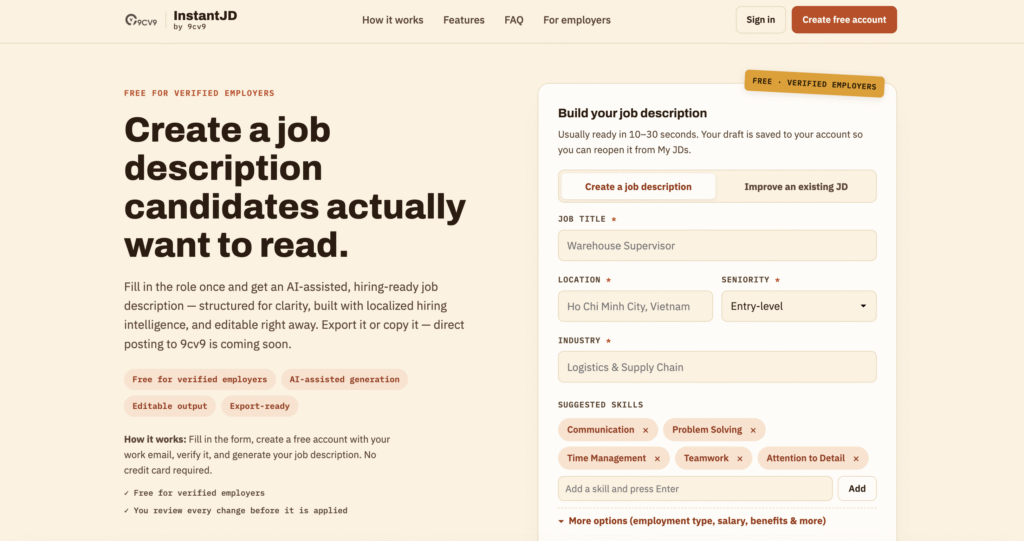
InstantJD by 9cv9 is an AI-powered job description generator designed to help recruiters, employers, HR professionals, and hiring managers create structured, professional job descriptions quickly. Developed within the 9cv9 recruitment ecosystem, InstantJD focuses specifically on job description creation rather than treating it as a secondary feature inside a broader HR platform.
For organizations comparing the best job description generator software in 2026, InstantJD stands out for combining AI generation with job description analysis, optimization, salary intelligence, recommendations, and practical export capabilities. Its focused workflow makes it suitable for users who want to move rapidly from basic role information to a publishable job description.
Why InstantJD Ranks as a Top Job Description Generator in 2026
InstantJD is built around a straightforward objective: reduce the time and complexity required to create a high-quality job description while giving recruiters tools to evaluate and improve the result.
Rather than stopping after AI generates the first draft, the platform provides additional analysis and improvement capabilities. This allows users to treat the generated description as a working recruitment document that can be reviewed, scored, optimized, and prepared for publication.
| InstantJD Capability | Recruitment Value |
|---|---|
| AI job description generation | Produces structured JD drafts rapidly |
| Job description analysis | Evaluates existing recruitment content |
| JD scoring | Provides measurable content feedback |
| AI improvement | Refines weak or incomplete descriptions |
| Recommendations | Identifies opportunities for improvement |
| Salary estimation | Adds compensation context to role planning |
| PDF export | Creates portable recruitment documents |
| Word export | Supports further editing and collaboration |
| Role-specific pages | Supports common job-description requirements |
| Recruitment focus | Keeps the workflow centered on hiring |
AI-Powered Job Description Generation
InstantJD uses generative AI to transform role information into structured job descriptions. This can substantially reduce the blank-page problem faced by recruiters and hiring managers who know what position they need to fill but do not want to manually construct every section.
The generated content can organize important information such as the role overview, responsibilities, qualifications, skills, and other candidate-facing details into a professional structure.
This makes InstantJD particularly useful for businesses that recruit frequently but do not require the complexity or cost of enterprise job information management systems.
Analyze, Score and Improve Job Descriptions
A major strength of InstantJD is that generation is only the first stage of the workflow.
Users can analyze job descriptions and receive scoring and recommendations designed to highlight areas requiring attention. The Improve functionality can then help refine the content rather than forcing the recruiter to manually rewrite the entire description.
| Workflow Stage | InstantJD Function |
|---|---|
| Create | Generate an AI-powered first draft |
| Review | Examine the complete job description |
| Analyze | Evaluate the quality of the content |
| Score | Identify the current JD performance level |
| Recommend | Surface potential improvements |
| Improve | Apply AI-assisted refinements |
| Preview | Review the final candidate-facing version |
| Export | Save the JD in practical document formats |
Salary Intelligence
Compensation is increasingly important to both candidate attraction and job-posting transparency. InstantJD incorporates salary estimation into its workflow, helping employers consider compensation while developing a vacancy.
This can be particularly useful during the early stages of hiring when recruiters or hiring managers are defining a position and need additional context about an appropriate salary range.
Salary estimates should still be reviewed against current market data, geographic requirements, internal compensation structures, and applicable pay-transparency regulations before publication.
Practical Export Options
InstantJD supports exporting completed job descriptions into PDF and Word formats.
This is a practical feature for recruiters who need to circulate descriptions internally, obtain stakeholder approval, retain standardized documentation, or transfer content into other recruitment systems.
The Word option supports additional editing, while PDF provides a more consistent format for sharing finalized job descriptions.
Built Specifically for Recruitment
InstantJD benefits from being developed by 9cv9, a recruitment technology company and recruitment agency. This gives the product a recruitment-specific context rather than approaching job descriptions solely as a generic text-generation problem.
The result is a product focused on the workflow recruiters actually need: generate, analyze, improve, review, and export.
| General AI Writing Tool | InstantJD by 9cv9 |
|---|---|
| Requires detailed prompting | Purpose-built JD workflow |
| Generates general text | Generates structured job descriptions |
| Limited built-in JD analysis | Dedicated Analyze functionality |
| No native JD scoring workflow | Integrated scoring |
| Manual improvement prompts | Dedicated Improve workflow |
| Generic recommendations | Recruitment-focused recommendations |
| Separate salary research | Salary estimation capability |
| Copy-and-paste output | PDF and Word export |
Best Use Cases
InstantJD is particularly suitable for recruiters, recruitment agencies, startup founders, HR professionals, hiring managers, and small-to-medium-sized businesses that need to create professional job descriptions without deploying a complicated enterprise HR platform.
It can also be useful for teams modernizing older job descriptions. Existing content can be analyzed and improved rather than recreated entirely from scratch.
InstantJD Assessment for 2026
| Evaluation Category | Assessment |
|---|---|
| AI job description generation | Excellent |
| Ease of use | Excellent |
| JD analysis | Excellent |
| JD improvement | Excellent |
| Content scoring | Strong |
| Salary estimation | Strong |
| Recommendations | Strong |
| PDF and Word export | Excellent |
| Recruitment specialization | Excellent |
| Enterprise job architecture | Developing |
| Enterprise ATS ecosystem | Developing |
| Overall accessibility | Excellent |
Why InstantJD Is a Strong Choice in 2026
InstantJD’s strongest proposition is its focus. Large enterprise platforms can provide extensive job architecture, governance, analytics, and HRIS integrations, but that sophistication can be unnecessary for employers whose immediate objective is simply to create better job descriptions efficiently.
InstantJD concentrates the workflow around that core problem while adding useful intelligence after generation. Recruiters can create a draft, evaluate its quality, identify weaknesses, improve the content, consider salary information, preview the result, and export the finished job description.
Overall Assessment
InstantJD by 9cv9 earns its position among the top job description generator software in 2026 by combining AI-powered generation with a practical recruitment-focused workflow. Its Analyze, Improve, scoring, recommendation, salary estimation, preview, and document export capabilities provide significantly more utility than a basic one-click text generator.
Its connection to the wider 9cv9 recruitment ecosystem also gives InstantJD a foundation for deeper recruitment intelligence as the platform evolves.
For recruiters and employers seeking a focused alternative to generic AI writers or complex enterprise job description management systems, InstantJD offers a compelling balance of simplicity, AI assistance, recruitment specialization, and practical functionality.
2. Textio
Textio is an AI-powered recruiting writing and job description optimization platform designed for organizations that want to improve the quality, consistency, inclusiveness, and expected performance of their hiring content. Rather than operating as a general-purpose AI writer, Textio specializes in HR communications and uses proprietary data derived from more than one billion HR documents and millions of real-world hiring outcomes.
For companies evaluating the best job description generator software in 2026, Textio stands out for combining generative AI with predictive language analysis. Recruiters and hiring managers can generate job posts from a small set of role details, improve existing descriptions, maintain reusable job-description libraries, and receive real-time recommendations intended to make hiring content clearer and more inclusive.
Textio’s Position in the Job Description Generator Market
| Capability | Textio Approach | Business Value |
|---|---|---|
| Job description generation | Purpose-built generative AI for recruiting | Accelerates creation of new job postings |
| Job description optimization | Real-time language and writing guidance | Improves clarity and consistency |
| Predictive analysis | Uses historical hiring outcome data | Connects writing decisions with hiring outcomes |
| Bias detection | Identifies potentially exclusionary language | Supports more inclusive recruitment practices |
| Employer branding | Adapts content to organizational brand voice | Creates more consistent candidate experiences |
| Job description library | Stores trusted and reusable job content | Reduces repetitive writing across hiring teams |
| Enterprise integration | Works within selected recruiting workflows | Reduces switching between HR systems |
| Team governance | Centralizes approved hiring content | Helps standardize recruitment communications |
Purpose-Built AI for Recruiting
One of Textio’s primary differentiators is its specialized AI architecture. The company reports that more than 30 AI models support its generative capabilities and real-time guidance, while its algorithms draw on more than one billion HR documents, with millions of additional records incorporated over time.
This specialization allows Textio to evaluate hiring language according to factors that generic AI writing tools may not prioritize. These include clarity, formatting, potentially harmful terminology, inclusive language, employer-brand consistency, and patterns associated with real hiring outcomes.
Textio also applies multiple bias-mitigation processes to its AI development. These include balancing datasets across demographic groups, testing classification models for inconsistent outcomes, evaluating generated content for demographic bias, and masking names in certain generative AI workflows to reduce the potential influence of gender or racial associations.
Job Description Scoring and Optimization
Textio’s predictive writing capabilities are built around analyzing the characteristics of recruitment content while it is being written. Its scoring and guidance system can examine multiple dimensions of a job post rather than simply checking grammar.
The platform has historically included tools such as the Textio Score, gender-tone guidance, age-related language analysis, and contextual writing recommendations. These features allow hiring teams to identify wording or structural choices that could affect how candidates interpret a vacancy.
| Analysis Area | What Textio Evaluates | Recruitment Objective |
|---|---|---|
| Writing quality | Overall effectiveness of the content | Produce stronger job advertisements |
| Language clarity | Readability and communication quality | Make roles easier for candidates to understand |
| Inclusive language | Potentially exclusionary terminology | Broaden candidate appeal |
| Gender tone | Gender-associated language patterns | Reduce unintended gender signaling |
| Age-related language | Terms that may discourage age groups | Improve age inclusiveness |
| Formatting | Structure and presentation | Improve readability |
| Brand voice | Alignment with employer language | Maintain organizational consistency |
| Hiring performance | Patterns associated with outcome data | Improve recruiting effectiveness |
Generative Job Description Capabilities
Textio has expanded beyond analyzing existing job descriptions into generating optimized job posts from basic role information. This makes the platform relevant not only as a writing assistant but also as job description generator software.
Recruiters can use AI to produce an initial job post and then refine the content using Textio’s specialized recruiting guidance. Organizations can subsequently store successful or approved descriptions within a centralized library, allowing hiring teams to reuse trusted content instead of recreating every vacancy from scratch.
The combination of generation, optimization, governance, and reusable content is particularly useful for companies recruiting across many departments or locations.
Bias Reduction and Inclusive Hiring
Textio places considerable emphasis on responsible AI and bias mitigation. Its technology is designed to identify language patterns that may unintentionally discourage particular groups of candidates and provide alternative wording during the writing process.
This approach makes Textio particularly relevant for larger organizations where hundreds or thousands of hiring managers may contribute to recruitment content. Instead of relying entirely on individual recruiters to recognize potentially problematic wording, organizations can introduce standardized guidance throughout the job-description workflow.
Enterprise Recruitment Integrations
Textio is designed to fit into established recruitment environments rather than requiring every job description to be written in a separate application. Documented integrations and workflow support have included platforms and channels such as Workday Recruiting, Greenhouse, LinkedIn Recruiter, Gmail, and Outlook.
For example, its Workday integration can surface writing guidance, scoring, gender-tone information, and age-related analysis while recruiters work within their existing recruiting environment. Similar integration strategies have been used to bring Textio guidance into ATS and candidate-communication workflows.
| Workflow Stage | Textio Function | Potential Benefit |
|---|---|---|
| Role creation | AI-generated job-post draft | Faster initial drafting |
| Job description editing | Real-time writing recommendations | Higher-quality recruitment content |
| Inclusion review | Bias and language analysis | More inclusive candidate communication |
| Approval | Standardized content guidance | Greater governance |
| ATS workflow | Embedded writing assistance | Less application switching |
| Candidate sourcing | Recruiting-message optimization | Stronger candidate communication |
| Content reuse | Central job-description library | Faster future hiring |
| Employer branding | Brand-aligned writing | More consistent candidate experience |
Recruitment Performance
Textio’s value proposition extends beyond writing speed. The company has historically linked its predictive language technology with improvements in applicant quality, diversity, candidate response, and time-to-fill.
Earlier company research reported that organizations using Textio attracted applicant pools that were, on average, 24% more qualified and 12% more diverse, while positions were filled approximately 17% faster. Historical customer examples have also reported substantial improvements in candidate response and applicant composition after implementing optimized hiring language.
These figures should be interpreted as vendor-reported or customer case-study outcomes rather than guaranteed performance for every organization. Actual results will depend on factors such as employer reputation, compensation, labor-market conditions, job location, seniority, and recruitment strategy.
Textio Performance Snapshot
| Metric | Reported Information |
|---|---|
| G2 rating | Approximately 4.2 out of 5 |
| AI models | More than 30 |
| HR documents powering algorithms | More than 1 billion |
| Fortune 500 adoption | Textio reports usage by 25% of Fortune 500 companies |
| Historical applicant-quality result | Approximately 24% more qualified applicants |
| Historical applicant-diversity result | Approximately 12% more diverse applicant pool |
| Historical hiring-speed result | Approximately 17% faster role filling |
| Primary specialization | Recruiting and HR writing intelligence |
User Experience and Market Reputation
Textio holds an approximately 4.2 out of 5 rating on G2 based on a relatively small pool of published reviews. Reviewers commonly highlight its intuitive interface, automated writing suggestions, bias-reduction capabilities, and ability to standardize job descriptions.
The relatively limited number of public reviews should be considered when comparing the rating against job description platforms with substantially larger review volumes. Nevertheless, Textio’s long operating history and enterprise-oriented customer base distinguish it from many newer generative AI job-description tools.
Pricing and Target Customers
Textio primarily follows an enterprise sales model rather than presenting itself as a low-cost, self-service job description generator. Current public product information directs prospective organizations toward demonstrations and sales discussions rather than publishing standardized subscription tiers.
Consequently, precise annual pricing estimates should not be treated as universally applicable unless supplied directly through a current Textio proposal.
| Organization Type | Textio Suitability |
|---|---|
| Individual recruiter | Moderate |
| Small business | Moderate |
| Recruitment agency | High |
| Growing company | High |
| Mid-market employer | Very High |
| Large enterprise | Very High |
| Global talent acquisition team | Very High |
| Diversity-focused employer | Very High |
Best Use Cases for Textio
Textio is particularly well suited to organizations that need more than basic AI-generated job descriptions. Its strongest proposition lies in combining generation with predictive recruiting intelligence, inclusive-language guidance, employer-brand consistency, centralized content management, and enterprise workflows.
It can be especially valuable for large talent acquisition teams that produce significant volumes of job advertisements and need consistent writing standards across recruiters, hiring managers, departments, and geographical markets.
Textio Assessment for 2026
| Evaluation Category | Assessment |
|---|---|
| AI job description generation | Strong |
| Job description optimization | Excellent |
| Bias detection | Excellent |
| Inclusive hiring support | Excellent |
| Predictive writing intelligence | Excellent |
| Employer branding | Strong |
| Enterprise scalability | Excellent |
| Recruitment workflow integration | Strong |
| Small-business accessibility | Moderate |
| Transparent public pricing | Limited |
Overall Assessment
Among the best job description generator software in 2026, Textio occupies a specialized position as an enterprise-grade recruiting intelligence and writing platform rather than a simple AI text generator. Its principal advantage is the combination of purpose-built HR AI, large-scale recruitment data, predictive writing analysis, bias mitigation, job-post generation, and organizational content governance.
Companies that merely need inexpensive AI-generated job descriptions may find simpler alternatives more practical. However, employers seeking to standardize recruitment language, improve job-post quality, support inclusive hiring, and use historical hiring data to guide writing decisions are likely to find Textio particularly compelling.
3. Datapeople
Datapeople is an enterprise-focused job description management, recruitment content optimization, and hiring compliance platform designed to help organizations create consistent, effective, and inclusive job content at scale. Founded in 2015, the company combines natural language processing, data science, behavioral science, and purpose-built artificial intelligence to improve how employers create and manage job descriptions.
In 2026, Datapeople is particularly relevant to organizations comparing the best job description generator software because it extends well beyond basic AI writing. Its platform covers AI-assisted job creation, real-time writing guidance, job architecture, compliance monitoring, content governance, applicant funnel analytics, and integrations with major applicant tracking systems. Datapeople has also been acquired by Payscale, strengthening its connection with compensation and job architecture workflows.
Datapeople’s Position in Job Description Generation
| Capability | Datapeople Approach | Business Value |
|---|---|---|
| AI job description generation | First Draft AI creates recruitment content | Reduces manual drafting work |
| Job content optimization | Smart Editor provides real-time guidance | Improves job-post quality |
| Inclusive language | Identifies potentially biased language | Supports broader candidate attraction |
| Pay transparency | Monitors compensation-related compliance | Helps manage regulatory requirements |
| Employer branding | Applies company-specific standards | Creates consistent recruitment messaging |
| Job architecture | Templates, taxonomy and job standards | Standardizes roles across organizations |
| Content governance | Repository, versioning and audit trails | Improves enterprise control |
| Hiring analytics | Analyzes job and recruitment funnel data | Identifies hiring-process problems |
| ATS integration | Works inside established HR workflows | Reduces duplicate work |
AI-Powered Job Description Creation
Datapeople’s First Draft AI transforms the platform from a job-description analyzer into a genuine AI job description generator. It can produce an initial job description while applying organizational standards and recruitment-specific guidance, reducing the need for recruiters to construct every posting manually.
Its Smart Editor complements generation with real-time recommendations. Rather than treating a job description as ordinary marketing copy, Datapeople evaluates recruitment-specific considerations such as job requirements, clarity, compliance, inclusivity, employer branding, and content structure.
The underlying platform states that its real-time guidance draws on more than 100 million job data points.
Job Description Management and Governance
A major differentiator for Datapeople is its emphasis on enterprise governance. Large employers frequently have thousands of job descriptions created across different departments, countries, business units, and recruiters. Without centralized controls, job content can become inconsistent, outdated, duplicated, or non-compliant.
Datapeople addresses this problem through centralized repositories, templates, job taxonomies, version control, audit trails, company-specific guidelines, and reusable standards.
| Governance Function | Purpose | Enterprise Benefit |
|---|---|---|
| Central job repository | Consolidates job content | Creates a searchable source of truth |
| Templates | Standardizes job structures | Improves consistency |
| Version control | Records content changes | Strengthens accountability |
| Audit trails | Maintains historical records | Supports governance and compliance |
| Brand guidelines | Applies company writing standards | Protects employer branding |
| Job taxonomy | Organizes roles and levels | Supports job architecture |
| Locked content | Protects required sections | Prevents unauthorized changes |
| Compliance monitoring | Detects potential issues | Reduces publishing risk |
Datapeople Anywhere
Datapeople Anywhere is the company’s browser-based recruiting co-pilot. It brings content management, collaboration, compliance controls, AI assistance, and hiring insights into the systems recruiters already use.
This is important for enterprise adoption because recruiters and hiring managers do not necessarily need to leave their established ATS workflow to use Datapeople. The browser overlay can expose job editing capabilities and synchronize changes with supported recruiting systems.
ATS and HR Technology Integrations
Datapeople supports integrations with major recruiting systems and describes its platform as compatible with major applicant tracking systems. Its documented workflows include Greenhouse, Workday and SmartRecruiters, among other HR environments.
| Recruitment Environment | Datapeople Function |
|---|---|
| Greenhouse | Job editing, synchronization and permissions |
| Workday | Embedded job-description editing and synchronization |
| SmartRecruiters | Job creation and optimization workflow |
| Other major ATS platforms | Integration or browser-overlay workflows |
| Web browsers | Datapeople Anywhere recruiting co-pilot |
For Greenhouse specifically, Datapeople can synchronize job content and user permissions. Greenhouse documentation confirms that recruiters can edit job posts through Datapeople and synchronize the updated job title and description back into Greenhouse.
Hiring Compliance and Pay Transparency
Compliance has become an increasingly important part of job description management. Datapeople includes tools for monitoring pay transparency, employer branding, inclusive language, and other hiring requirements before job advertisements are published.
Its Guidance and Compliance AI can identify potential pay-transparency issues and provide recommendations relating to local and national regulations. The same system can help organizations enforce employer value propositions, templates, brand voice, benefits information, and job-board-specific requirements.
Hiring Analytics and Insights
Datapeople Insights expands the platform beyond writing assistance into recruitment analytics. Organizations can examine job content and applicant pipeline performance to identify friction, missing information, compliance concerns, and underperforming requisitions.
The system can also analyze individual requisitions while providing broader visibility across multiple job advertisements. This makes Datapeople useful to talent acquisition leadership as well as individual recruiters.
| Analytics Area | Potential Question Answered |
|---|---|
| Job performance | Which job advertisements need improvement? |
| Recruitment funnel | Where are candidates dropping out? |
| Content completeness | Which postings are missing important information? |
| Compliance | Which jobs violate defined standards? |
| Pay transparency | Which postings require compensation information? |
| Brand consistency | Which jobs deviate from employer guidelines? |
| In-flight requisitions | Which active vacancies require intervention? |
Security and Enterprise Readiness
Datapeople is SOC 2 Type II certified and states that it complies with global privacy laws. These controls are particularly important for multinational organizations because recruitment platforms can process sensitive organizational and applicant-related information.
The platform is also used across international hiring environments. Datapeople reports customers creating job advertisements across approximately 80 countries, illustrating its focus on distributed and multinational recruitment operations.
G2 Ratings and User Feedback
Datapeople maintains a 4.4 out of 5 rating on G2 from 323 reviews in available 2026 data. Approximately 60% of reviewers awarded five stars and 36% awarded four stars.
G2’s review summary highlights ease of use, inclusive-language recommendations, actionable recruitment insights, and improvements to job-description quality among frequently cited strengths. Some reviewers, however, report that its scoring methodology can occasionally feel strict or that individual recommendations may not always recognize contextual information correctly.
Datapeople Performance Snapshot
| Metric | Available Information |
|---|---|
| G2 rating | 4.4 out of 5 |
| G2 review volume | 323 reviews |
| Five-star reviews | Approximately 60% |
| Company founded | 2015 |
| Job data supporting guidance | More than 100 million data points |
| International reach | Job advertising across approximately 80 countries |
| Security | SOC 2 Type II certified |
| Pricing | Custom enterprise pricing |
| Hiring-manager access | Typically unlimited collaboration |
| Current ownership | Acquired by Payscale |
Pricing and Plans
Datapeople follows a custom pricing model rather than publishing fixed self-service subscription prices. Its current offering includes capabilities organized around Comply, Architect and Attract, with functionality expanding from compliance monitoring into job architecture, AI job creation, collaboration, recruitment marketing optimization and hiring insights.
| Offering | Primary Focus | Key Capabilities |
|---|---|---|
| Comply | Governance and compliance | Pay transparency, brand guidelines, audit repository, anti-bias monitoring |
| Architect | Job architecture | Comply features plus market data, First Draft AI, repository and version control |
| Attract | Talent acquisition | Architect features plus job-ad creation, templates, collaboration and funnel insights |
An important enterprise advantage is that Datapeople states its plans typically support unlimited hiring-manager collaboration rather than charging organizations for every participating hiring manager. Training, support and integration are also included without separate implementation fees according to its published pricing information.
Datapeople Assessment for 2026
| Evaluation Category | Assessment |
|---|---|
| AI job description generation | Excellent |
| Job description optimization | Excellent |
| Inclusive language guidance | Excellent |
| Hiring compliance | Excellent |
| Pay transparency monitoring | Excellent |
| Job architecture | Excellent |
| Recruitment analytics | Excellent |
| ATS integration | Excellent |
| Enterprise governance | Excellent |
| Small-business accessibility | Moderate |
| Public pricing transparency | Limited |
Overall Assessment
Among the best job description generator software in the world in 2026, Datapeople stands out as an enterprise job-content intelligence platform rather than a simple generative AI writing tool. Its combination of First Draft AI, Smart Editor, Datapeople Anywhere, compliance monitoring, job architecture, recruitment analytics, and centralized content governance makes it particularly suitable for organizations managing large or geographically distributed hiring operations.
Its strongest advantage is the ability to connect job description creation with the broader recruitment lifecycle. Hiring teams can generate content, optimize language, enforce organizational standards, monitor regulatory requirements, synchronize content with existing HR systems, and analyze downstream hiring performance within the same ecosystem.
For smaller employers that only need an inexpensive AI job description generator, Datapeople may provide more functionality than necessary. For mid-market and enterprise organizations seeking standardized, compliant, data-driven job content across multiple recruiters, hiring managers, departments, and locations, however, Datapeople represents one of the more comprehensive job description management solutions available in 2026.
4. Metaview
Metaview takes a different approach to job description generation from conventional AI writing software. Instead of beginning primarily with a job title and a short text prompt, Metaview is built around capturing the recruiting conversations that define what an organization actually needs from a role.
The platform operates as an AI-powered recruiting system that records, transcribes, summarizes, and structures information from conversations between recruiters, hiring managers, and candidates. This conversation-first model makes Metaview particularly relevant to organizations seeking to connect job requirements, interview criteria, recruiter notes, and Applicant Tracking System data within a unified workflow.
In 2026, Metaview has expanded beyond its original AI notetaking proposition toward what the company describes as an agentic recruiting platform, covering areas such as sourcing, application review, recruiting notes, and reports.
Metaview’s Position in Job Description Generation
| Capability | Metaview Approach | Recruitment Value |
|---|---|---|
| Role intake capture | Records recruiter and hiring-manager discussions | Preserves detailed role requirements |
| AI transcription | Converts conversations into searchable text | Eliminates extensive manual note-taking |
| Structured summaries | Extracts relevant information into templates | Creates organized role intelligence |
| Custom templates | Defines information the AI should extract | Aligns output with company processes |
| Interview intelligence | Captures candidate conversations | Improves evaluation consistency |
| Scorecards | Connects interview evidence with ATS feedback | Standardizes candidate assessment |
| ATS synchronization | Writes structured recruiting information into ATS workflows | Reduces duplicate administration |
| Recruiting analytics | Aggregates conversational recruiting data | Provides broader hiring intelligence |
Conversation-First Role Intelligence
Metaview’s major differentiator is the way it captures information before and during the hiring process.
Traditional job description generators generally require recruiters to enter details such as the job title, seniority, skills, responsibilities, and company information. The AI then expands these inputs into a complete job advertisement.
Metaview can instead capture richer information from actual recruiting conversations. Its AI processes transcripts and can use customizable templates to extract specific information from those discussions.
This model can be particularly useful during role-intake meetings, where recruiters and hiring managers frequently discuss details that are difficult to capture through a conventional job-description form.
| Traditional Job Description Workflow | Metaview-Oriented Workflow |
|---|---|
| Recruiter receives hiring request | Recruiter conducts detailed role discussion |
| Manual notes are taken | Conversation is automatically captured |
| Notes are reorganized | AI produces structured information |
| Requirements are manually summarized | Important details are extracted automatically |
| Job content is drafted separately | Captured context can support downstream content |
| Interview criteria are created later | Structured context can inform evaluation |
| Information is copied into ATS | ATS integrations reduce duplicate administration |
AI Notetaker for Recruiting
Metaview’s AI Notes product remains central to the platform. It automatically records recruiting conversations and generates structured notes and insights afterward.
The technology is specifically designed for recruitment rather than being a general meeting transcription application. This distinction matters because recruiting conversations contain specialized information relating to competencies, candidate evidence, motivations, compensation, experience, interview criteria, and hiring decisions.
Recruiters can create customized templates that instruct Metaview to organize transcripts according to their preferred structure. Verified users frequently highlight transcription accuracy, configurable templates, automated summaries, and reduced manual note-taking as important advantages.
Structured Interview Scorecards
Metaview also connects conversational intelligence with structured candidate evaluation.
When integrated with compatible Applicant Tracking Systems, interview recordings can be matched with the relevant candidate and interview. Recruiters can then use the captured information when completing structured feedback forms and scorecards.
Metaview specifically documents scorecard workflows for systems including Ashby and Lever. This creates continuity between the information collected during interviews and the formal evaluation records stored within the ATS.
| Hiring Stage | Metaview Function | Operational Benefit |
|---|---|---|
| Role intake | Captures stakeholder discussions | Preserves detailed hiring requirements |
| Candidate screening | Generates structured interview notes | Reduces recruiter administration |
| Interviewing | Records and transcribes conversations | Allows interviewers to focus on candidates |
| Evaluation | Supports structured scorecard completion | Improves consistency |
| ATS documentation | Connects interview data with ATS records | Reduces manual data entry |
| Hiring review | Makes previous conversations accessible | Improves evidence-based decisions |
| Recruitment reporting | Aggregates recruiting intelligence | Supports hiring-team analysis |
ATS Integration
ATS integration is one of Metaview’s strongest characteristics. The company positions structured scorecards written back into recruitment systems as an important component of an effective recruiting technology stack.
Instead of leaving interview intelligence isolated inside a standalone transcription platform, Metaview can associate calls with corresponding interviews and recruiting records. This makes captured information considerably more useful for larger recruitment teams.
Its broader integration philosophy focuses on keeping the ATS as the central system of record while Metaview automates information capture around it.
Recruiter Productivity
Metaview’s principal productivity advantage comes from eliminating repetitive note-taking and post-interview administration.
Recruiters traditionally divide their attention between listening, questioning, typing notes, reorganizing those notes, completing scorecards, updating the ATS, and communicating findings to hiring managers. Automating several of these activities can allow recruiters to concentrate more heavily on the conversation itself.
This benefit is consistently reflected in independent user feedback. G2 reviewers frequently mention accurate note-taking, automated summaries, customizable templates, ATS integration, and time savings among Metaview’s useful capabilities.
Metaview Performance Snapshot
| Metric | Available 2026 Information |
|---|---|
| G2 rating | 4.8 out of 5 |
| G2 review volume | 132 reviews |
| Five-star G2 reviews | Approximately 95% |
| Company founded | 2018 |
| Free plan | Available |
| Free monthly allowance | 25 calls per user |
| Pro plan | US$60 per user per month |
| Pro call allowance | Unlimited calls |
| Enterprise plan | Custom pricing |
| Primary specialization | AI recruiting intelligence and notetaking |
| Enterprise focus | Custom volume, security, support and training |
User Ratings and Market Reception
Metaview maintains a 4.8 out of 5 rating on G2 from 132 reviews in available 2026 data, with approximately 95% of reviewers awarding five stars.
The review data is more useful than an unsupported proprietary score such as an “8.8 out of 10 workflow efficiency” rating. Unless such a score can be tied to a transparent testing methodology, it should not be presented as an established industry benchmark.
Verified reviewers commonly praise Metaview for transcription accuracy, ease of implementation, customizable templates, interview summaries, and the ability to remain focused on candidates rather than continuously taking notes.
Pricing
Metaview provides a more accessible entry point than many enterprise recruiting intelligence platforms.
Its Free plan costs US$0 per user per month and currently includes 25 calls per month with basic transcription. The Pro plan is listed at US$60 per user per month and includes unlimited calls, automated notes and insights, and priority processing.
Larger organizations can select Enterprise plans with tailored pricing, custom usage volumes, dedicated support and training, and additional enterprise security functionality. Metaview also offers its broader Agentic Recruiting Platform under custom pricing.
| Plan | Published Price | Primary Offering |
|---|---|---|
| Free | US$0 per user/month | 25 calls per month and basic transcription |
| Pro | US$60 per user/month | Unlimited calls, automated notes and insights |
| Enterprise | Custom pricing | Custom usage, support, training and security |
| Agentic Recruiting Platform | Custom pricing | Broader AI-powered recruiting suite |
Where Metaview Differs From Conventional JD Generators
Metaview should not be viewed as a direct substitute for every dedicated job description generator. Its strongest competitive advantage lies upstream and downstream of conventional job-post writing.
Dedicated JD generators typically excel at transforming structured form inputs into polished advertisements. Metaview’s strength is capturing the actual conversations and evidence surrounding a hiring process and turning that unstructured information into reusable recruiting intelligence.
| Evaluation Area | Metaview Strength |
|---|---|
| Basic one-click JD generation | Moderate |
| Role intake intelligence | Excellent |
| Meeting transcription | Excellent |
| Recruiting-specific summaries | Excellent |
| Custom information extraction | Excellent |
| Interview intelligence | Excellent |
| Structured scorecards | Excellent |
| ATS workflow integration | Excellent |
| Recruiter productivity | Excellent |
| Free entry-level access | Excellent |
Best Use Cases
Metaview is particularly attractive for recruitment agencies, internal talent acquisition teams, high-growth companies, and enterprises conducting significant numbers of candidate and hiring-manager conversations.
It is especially useful where the quality of a job description depends heavily on information gathered during intake meetings. Capturing those conversations can reduce the information loss that occurs when recruiters rely on abbreviated handwritten notes or memory.
The same underlying intelligence can subsequently support candidate evaluation, scorecards, stakeholder collaboration, and ATS documentation.
Overall Assessment
Among the best job description generator software options to consider in 2026, Metaview represents a distinctive conversation-first approach. Its primary strength is not simply generating polished paragraphs from a job title. Instead, it captures the detailed human conversations that define a vacancy and converts them into structured recruiting intelligence.
Its 4.8 out of 5 G2 rating, free 25-call monthly plan, configurable recruiting templates, structured interview workflows, and ATS connectivity strengthen its position as a recruitment productivity platform.
Organizations primarily seeking instant standalone job descriptions may prefer a dedicated JD generator. Recruitment teams seeking to improve the entire workflow from role intake through interviews, scorecards, ATS documentation, and hiring analysis, however, may find Metaview significantly more valuable because it addresses the information-gathering process behind the job description rather than only the final text.
5. Workable
Workable is an all-in-one recruiting and HR platform that combines an Applicant Tracking System, AI-powered job description generation, candidate sourcing, applicant screening, interview management, job-board distribution, onboarding, and broader workforce management capabilities.
For organizations comparing the best job description generator software in 2026, Workable differs from standalone writing tools because job description creation is directly connected to the rest of the recruitment lifecycle. A company can generate a job description, publish it across hundreds of job boards, source candidates, screen applicants, coordinate interviews, make offers, and onboard successful hires without moving between disconnected systems.
AI Job Description Generator
Workable’s AI job description generator creates structured job advertisements from a job title and additional role information. Generated descriptions can include a role overview, responsibilities, requirements, and benefits.
A significant advantage is personalization. When generating a new description inside Workable, the system can examine similar jobs previously created by the organization and use that information to produce content that better reflects its established recruiting style.
Recruiters can also select different tones, regenerate entire descriptions, rewrite individual sentences, expand or shorten sections, and revise generated content before publication.
| AI Writing Capability | Workable Function | Recruitment Benefit |
|---|---|---|
| Initial JD generation | Generates complete job descriptions | Eliminates blank-page drafting |
| Historical job context | References similar company jobs | Produces more personalized content |
| Tone adjustment | Supports different writing styles | Aligns posts with employer branding |
| Sentence rewriting | Regenerates selected content | Speeds up editing |
| Content expansion | Makes selected sections longer | Adds missing detail |
| Content shortening | Condenses selected sections | Improves readability |
| Interview generation | Produces role-specific questions | Connects JD creation with evaluation |
| AI sourcing | Uses job criteria to identify candidates | Connects writing with talent discovery |
Free Job Description Generator
Workable also provides a free AI job description generator outside its complete recruitment platform.
Users can specify a job title, industry, and preferred tone to generate a description. Workable additionally maintains a library containing more than 1,000 curated job description templates.
This gives smaller businesses and hiring managers an accessible entry point even when they are not yet ready to adopt a complete ATS.
Integrated Recruitment Workflow
Workable’s major competitive advantage is what happens after a job description has been generated.
The finalized advertisement can become the foundation for candidate sourcing, matching, screening, interview preparation, and recruitment automation. This creates a more connected workflow than standalone AI job description generators.
| Recruitment Stage | Workable Capability |
|---|---|
| Role definition | AI-assisted job requirements |
| Job description | AI-generated and editable content |
| Job advertising | Distribution across 200+ job boards |
| Candidate sourcing | Search across 400M+ profiles |
| Candidate matching | AI-powered recommendations |
| Applicant screening | Semantic candidate matching |
| Outreach | Personalized candidate communication |
| Interview preparation | AI-generated interview questions |
| Interview scheduling | Recruitment workflow automation |
| Offers | Offer management |
| Onboarding | Integrated employee onboarding |
| HR management | Employee records and workforce tools |
Job Distribution Across 200+ Job Boards
Workable supports simultaneous distribution across more than 200 free and premium job boards.
This is an important distinction when evaluating job description software. Generating a strong advertisement is only the first step; organizations still need to distribute it effectively. Workable connects content creation directly with job syndication, reducing the administrative burden of manually publishing the same vacancy across multiple channels.
The platform supports recruitment across more than 100 countries and provides nine native language options for international hiring workflows.
AI Candidate Sourcing
Once a job description has been created, Workable can use its requirements to search for relevant candidates.
Its candidate sourcing infrastructure provides access to more than 400 million searchable profiles. AI-generated candidate recommendations are included across its plans, allowing recruiters to identify potential candidates based on the requirements contained within a vacancy.
Workable can also resurface previous applicants from an employer’s existing talent database when their experience appears relevant to a newly opened position.
| AI Capability | Primary Function |
|---|---|
| Job description generation | Creates recruitment content |
| Candidate recommendations | Identifies potentially suitable candidates |
| Passive sourcing | Searches more than 400 million profiles |
| Candidate rediscovery | Finds suitable previous applicants |
| Semantic screening | Evaluates candidates against job requirements |
| Interview question generation | Creates role-specific interview content |
| Email generation | Produces personalized candidate communication |
| AI recruiting agent | Automates sourcing, screening and engagement |
Workable Agent
Workable’s capabilities have expanded substantially with Workable Agent, its agentic recruiting system.
Instead of functioning only as a writing assistant, the Agent can help define job requirements through conversation. It asks questions about a vacancy and converts the resulting information into job requirements, priorities, dealbreakers, an optimized job description, hiring criteria, and interview questions.
The Agent can subsequently source potential candidates, conduct outreach, collect missing information, evaluate candidates against defined criteria, and deliver prioritized shortlists.
This makes Workable increasingly comparable with AI recruiting agents rather than conventional job description generators alone.
Recruitment Scale and AI Infrastructure
Workable reports substantial recruitment data and AI infrastructure behind its platform.
| Platform Metric | Reported Scale |
|---|---|
| Searchable candidate profiles | More than 400 million |
| Candidates processed annually | More than 100 million |
| Job-board distribution | More than 200 boards |
| International recruitment reach | More than 100 countries |
| Native language options | 9 |
| AI development history | More than 10 years |
| AI processing volume | Approximately 930 billion tokens annually |
| JD template library | More than 1,000 templates |
These resources give Workable an advantage when job description generation needs to connect with real recruitment data and downstream candidate-matching workflows.
Pricing
Workable provides relatively transparent public pricing compared with many enterprise recruiting platforms. Pricing scales according to company size, meaning actual costs can increase substantially for larger organizations.
For organizations with 1 to 20 employees, current published annual pricing starts at US$299 per month for Standard, US$599 per month for Premier, and US$719 per month for Enterprise.
| Plan | Starting Monthly Price | Annual Equivalent | Key Positioning |
|---|---|---|---|
| Free Trial | US$0 | Temporary trial | Evaluate the complete platform |
| Standard | US$299 | US$3,588 | Core recruiting and HR |
| Premier | US$599 | US$7,188 | Advanced recruiting capabilities |
| Enterprise | US$719 | US$8,628 | Enterprise controls and services |
The Standard plan includes unlimited active jobs subject to fair-usage limits, candidate sourcing, the ATS, HR functionality, reporting, and related recruiting tools.
Premier additionally bundles capabilities such as texting, video interviews, assessments, referrals, and performance and engagement functionality. Enterprise expands the offering with additional enterprise-oriented features and services.
Workable Agent operates using AI credits. Paid accounts currently receive 3,000 introductory AI credits, with additional credit packages available separately.
Job Description to Candidate Pipeline
One of Workable’s strongest attributes for 2026 is the ability to transform a job description into an operational recruiting workflow.
| JD Generator Only | Workable |
|---|---|
| Generates job description | Generates personalized job description |
| User copies content elsewhere | Job remains inside ATS |
| Manual job-board publishing | Distribution to 200+ boards |
| Separate sourcing platform | Integrated 400M+ profile database |
| Separate candidate screening | AI-assisted screening |
| Separate interview preparation | AI interview-question generation |
| Separate communication tools | Candidate outreach capabilities |
| Limited post-generation value | Full recruitment lifecycle |
Best Use Cases
Workable is particularly suitable for small and mid-sized organizations that want job description generation as part of a complete recruitment platform rather than as an isolated AI utility.
It can also support larger organizations requiring centralized applicant tracking, recruitment analytics, structured hiring workflows, global job distribution, candidate sourcing, and HR functionality.
Companies hiring frequently receive considerably more value from Workable than organizations that simply need to generate an occasional job description.
Workable Assessment for 2026
| Evaluation Category | Assessment |
|---|---|
| AI job description generation | Excellent |
| JD customization | Excellent |
| Job description templates | Excellent |
| Job-board distribution | Excellent |
| AI candidate sourcing | Excellent |
| Applicant tracking | Excellent |
| Candidate screening | Excellent |
| Interview workflow | Excellent |
| Recruitment automation | Excellent |
| Global hiring capabilities | Excellent |
| Standalone JD simplicity | Good |
| Public pricing transparency | Very Good |
Overall Assessment
Among the best job description generator software in the world in 2026, Workable stands out because job description generation is only the beginning of its workflow. The platform can transform role requirements into a polished job advertisement and then use those same requirements to distribute the vacancy, source candidates, evaluate applicants, prepare interviews, manage hiring decisions, and onboard employees.
Its integration of AI writing with more than 200 job boards, a database exceeding 400 million candidate profiles, AI-powered matching, an established ATS, and increasingly autonomous Workable Agent capabilities gives it considerably broader functionality than a standalone job description generator.
Organizations requiring only occasional AI-generated job descriptions can use simpler or free tools. Companies seeking to turn a generated job description directly into an end-to-end recruitment pipeline, however, are likely to find Workable one of the strongest all-in-one options available in 2026.
6. Ongig Text Analyzer
Ongig Text Analyzer is an AI-powered job description generator, optimization, and management platform designed primarily for organizations that create and maintain large volumes of recruitment content. Rather than functioning only as a one-click AI writer, Ongig combines job description generation with readability analysis, bias detection, compliance monitoring, content standardization, bulk updates, and ATS or HRIS integration.
For companies comparing the best job description generator software in 2026, Ongig is particularly relevant to larger recruitment teams that need to control hundreds or thousands of job descriptions across departments, locations, brands, and hiring systems.
Ongig’s Position in Job Description Generation
| Capability | Ongig Approach | Business Value |
|---|---|---|
| AI job description generation | Generates drafts from roles and templates | Accelerates initial JD creation |
| Text optimization | Analyzes and rewrites existing content | Improves job-post quality |
| Bias detection | Flags 12+ categories of potential bias | Supports inclusive recruitment |
| Readability analysis | Evaluates language complexity | Makes vacancies easier to understand |
| JD scoring | Scores descriptions from 0 to 100 | Provides measurable content benchmarks |
| SEO title scoring | Evaluates job titles for search visibility | Improves job discoverability |
| Bulk management | Updates large JD libraries | Supports enterprise-scale standardization |
| Compliance | Monitors pay transparency and job content | Reduces regulatory risk |
| ATS integration | Supports one-way and two-way workflows | Reduces duplicate administration |
| Centralized library | Stores and manages job descriptions | Creates a controlled source of truth |
AI Job Description Generation
Ongig can generate a new job description after a user enters a role and selects an appropriate template. The resulting AI-generated draft can then be customized for the organization’s specific responsibilities, department, location, employer brand, and hiring requirements.
Its AI functionality also supports rewriting existing descriptions. Recruiters can optimize content rather than replacing it entirely, which is useful for organizations with established job architectures and large libraries of legacy descriptions.
This combination of generation and optimization makes Ongig more suitable for enterprise content management than basic AI generators that produce a new job advertisement without managing what happens afterward.
Text Analyzer and Job Description Scoring
Text Analyzer evaluates job descriptions using a proprietary scoring framework ranging from 0 to 100.
The Total Score considers factors including gender neutrality, readability, job title, description length, and additional content criteria. Ongig categorizes scores below 50 as poor, 51 to 80 as good, and 81 to 100 as strong.
The software also provides a Gender Score that evaluates masculine and feminine-coded terminology.
| Scoring Area | What Ongig Evaluates |
|---|---|
| Total Score | Overall job description effectiveness |
| Gender Score | Gender-associated wording |
| Readability | Complexity of sentences and terminology |
| Job title | Quality and search suitability |
| Length | Overall content length |
| Inclusive language | Potentially exclusionary terminology |
| SEO title | Job-title search optimization |
| Content quality | Candidate-friendly writing characteristics |
Bias and Inclusive Language Detection
Inclusive-language analysis is one of Ongig’s most developed capabilities.
Current product documentation states that Text Analyzer detects more than 12 categories of potential bias rather than limiting analysis to masculine and feminine terminology. Categories include gender, age, race, disability, ethnicity, LGBTQ+ status, mental health, religion, elitism, and other potentially exclusionary language.
When problematic wording is detected, the software can recommend more inclusive or plain-language alternatives.
This is particularly valuable for enterprises because inconsistent wording can emerge when thousands of hiring managers and recruiters independently create job descriptions.
Readability and Candidate Experience
Ongig recommends writing job descriptions at approximately an eighth-grade reading level. Its Text Analyzer identifies unnecessarily complicated language, lengthy sentences, jargon, adverbs, and other content that can make vacancies difficult to understand.
The objective is not simply to make job descriptions shorter. Instead, Ongig attempts to make role expectations easier for candidates to interpret while maintaining the information necessary to evaluate whether they should apply.
| Content Problem | Ongig Response | Intended Outcome |
|---|---|---|
| Complex sentences | Readability recommendations | Easier comprehension |
| Gender-coded language | Inclusive alternatives | Broader candidate appeal |
| Exclusionary terminology | Bias detection and replacement | More inclusive job content |
| Poor job titles | SEO title analysis | Better discoverability |
| Inconsistent formatting | Templates and standardization | Consistent employer presentation |
| Outdated descriptions | Bulk updating and rewriting | More current job libraries |
| Missing salary information | Pay transparency controls | Improved compliance |
| Organizational jargon | Plain-language recommendations | Candidate-friendly content |
Enterprise Job Description Management
Ongig becomes particularly differentiated when organizations need to manage job descriptions at scale.
The platform provides a centralized cloud-based job library where companies can store, search, edit, standardize, and govern their recruitment content. Templates and consistency controls can then be applied across different teams, departments, and locations.
Ongig also supports updating thousands of job descriptions simultaneously. This capability can be valuable following a regulatory change, employer-brand refresh, organizational restructuring, compensation-policy change, or introduction of new inclusive-language standards.
Bulk Job Description Automation
Large-scale automation is one of Ongig’s strongest enterprise features.
Rather than requiring recruiters to open thousands of descriptions individually, organizations can standardize and reformat content across large repositories. Ongig also offers a separate bulk JD rewriting service for companies that need extensive legacy content modernization.
A documented Ongig customer implementation demonstrates the potential scale of this model: Supplemental Health Care uses automated workflows to support job-posting volumes exceeding 100,000 jobs per month.
ATS and HRIS Integration
Ongig can integrate with Applicant Tracking Systems and Human Resource Information Systems so that job descriptions do not have to remain isolated inside another content-management environment.
Professional subscriptions provide one-way ATS or HRIS job imports, while Enterprise subscriptions add two-way integration.
| Integration Level | Capability |
|---|---|
| Lite | Standalone JD management |
| Professional | One-way ATS or HRIS import |
| Enterprise | Two-way ATS or HRIS synchronization |
| API | Programmatic job-description scoring |
| Career Site Builder | ATS-connected candidate experience |
Ongig states that its career-site technology can work with ATS environments including Workday, Greenhouse, and custom recruitment systems.
Compliance and Pay Transparency
Job-posting compliance has become an increasingly important component of Ongig’s platform.
Professional subscriptions include pay-transparency compliance capabilities, while Ongig’s broader software can flag salary disclosure requirements, exclusionary terminology, accessibility concerns, and other job-content issues.
This makes the platform relevant to organizations operating across jurisdictions where job-advertising regulations differ by state, country, or region.
Ongig Pricing in 2026
Unlike many enterprise HR technology vendors, Ongig publishes starting prices for its principal product tiers.
| Plan | Starting Price | Main Capabilities |
|---|---|---|
| Lite | US$4,900/year | 100 jobs, 3 users, JD library, readability guidance, SEO scoring |
| Professional | US$14,900/year | Unlimited jobs and users, AI writing, templates, one-way ATS integration, compliance |
| Enterprise | US$39,900/year | Two-way integration, automation, SSO, reporting, translation |
| JD Bias Audit | US$6,900 | Full-library analysis and recommendations |
| JD Rewrite Service | US$9,900 | Bulk rewriting and standardization |
| Career Site Builder | US$12,900 | Hosted career site, job search, ATS integration and SEO |
The Lite tier provides a comparatively accessible starting point for smaller recruiting teams, although its 100-job and three-user limits mean organizations with larger job libraries will generally require Professional or Enterprise.
The Professional tier supports unlimited jobs and users, while Enterprise adds advanced workflow automation, two-way ATS integration, custom permissions, SSO, synchronization monitoring, and job-language translation.
AI and Enterprise Feature Matrix
| Feature | Lite | Professional | Enterprise |
|---|---|---|---|
| Cloud JD library | Yes | Yes | Yes |
| Readability suggestions | Yes | Yes | Yes |
| SEO title scoring | Yes | Yes | Yes |
| AI writing and editing | Limited | Yes | Yes |
| Unlimited jobs | No | Yes | Yes |
| Unlimited users | No | Yes | Yes |
| Templates | Limited | Yes | Yes |
| Pay transparency | Limited | Yes | Yes |
| ATS or HRIS integration | No | One-way | Two-way |
| Workflow automation | No | Limited | Yes |
| SSO | No | No | Yes |
| Job translation | No | No | Yes |
Career Site and SEO Capabilities
Ongig also extends job description management into candidate-facing career sites.
Its Career Site Builder provides mobile-optimized experiences, AI-powered job search, custom landing pages, ATS and job-board integration, SEO optimization, analytics, and performance optimization.
This creates a useful connection between job content creation and candidate acquisition. Organizations can optimize descriptions internally and then present that standardized content through an employer-branded career environment.
Best Use Cases
Ongig is especially suitable for companies managing significant job-description inventories.
Recruitment teams with hundreds or thousands of existing descriptions can gain more value from its centralized library, templates, bulk editing, compliance controls, ATS synchronization, and reporting than organizations that only generate occasional vacancies.
It is also particularly relevant to organizations prioritizing inclusive recruitment, pay-transparency compliance, employer-brand consistency, and large-scale job-content governance.
Ongig Assessment for 2026
| Evaluation Category | Assessment |
|---|---|
| AI job description generation | Excellent |
| Job description optimization | Excellent |
| Bias detection | Excellent |
| Readability analysis | Excellent |
| Bulk JD management | Excellent |
| Enterprise standardization | Excellent |
| Pay transparency compliance | Excellent |
| ATS and HRIS integration | Excellent |
| Career-site capabilities | Strong |
| SEO optimization | Strong |
| Small-business affordability | Moderate |
| Pricing transparency | Excellent |
Overall Assessment
Among the best job description generator software in the world in 2026, Ongig Text Analyzer distinguishes itself through the combination of AI writing, job description scoring, inclusive-language analysis, readability optimization, compliance management, and enterprise-scale content governance.
Its biggest advantage is scalability. Organizations are not restricted to optimizing one job description at a time. Ongig can help standardize and update large repositories, maintain templates, enforce organizational standards, integrate content with ATS and HRIS platforms, and manage candidate-facing job content.
The current published pricing of US$4,900 per year for Lite, US$14,900 for Professional, and US$39,900 for Enterprise also makes cost comparisons more straightforward than with competitors that rely entirely on custom quotations.
For a small employer that occasionally needs an AI-generated vacancy, Ongig may be more sophisticated than necessary. For enterprises managing hundreds or thousands of job descriptions while prioritizing consistency, inclusion, compliance, and automation, it represents one of the more comprehensive job description management platforms available in 2026.
7. Claude
Claude is a general-purpose artificial intelligence assistant developed by Anthropic rather than dedicated recruitment software. However, its strong long-form writing capabilities, large context capacity, document analysis, customizable Projects, and instruction-following make it a compelling option for organizations seeking flexible AI job description generation in 2026.
Claude is also used for recruitment internally by Anthropic. The company states that its hiring teams use Claude to create job descriptions, develop interview questions, refine candidate communications, analyze hiring metrics, transcribe interviews, and identify sourcing candidates.
For job description creation, Claude’s main advantage is flexibility. Recruiters can provide considerably more organizational context than they typically can with a conventional form-based JD generator.
Claude’s Position in Job Description Generation
| Capability | Claude Approach | Recruitment Value |
|---|---|---|
| Job description generation | Generates customized long-form content | Produces complete JD drafts rapidly |
| Writing quality | Natural-language generation and rewriting | Creates polished candidate-facing copy |
| Organizational context | Projects store relevant company knowledge | Reduces repetitive prompting |
| Brand voice | Project instructions define writing standards | Improves consistency |
| Document analysis | Processes uploaded HR documents | Incorporates internal policies and frameworks |
| JD optimization | Rewrites and critiques existing descriptions | Improves clarity and structure |
| Interview design | Generates questions and evaluation frameworks | Extends JD context into interviews |
| Recruitment communications | Drafts candidate-facing content | Supports broader hiring workflows |
| Native ATS functionality | Not a dedicated ATS | Requires integrations or external workflows |
Projects for Recruitment Teams
Claude Projects is particularly useful for repeatable job description generation. Each Project operates as a dedicated workspace with its own knowledge base, instructions, and conversations.
Recruitment teams can upload relevant internal material such as competency frameworks, approved job descriptions, employer-brand guidelines, organizational information, benefits documentation, hiring policies, and writing standards.
Project instructions can then establish permanent requirements for how Claude should approach new job descriptions. When the stored knowledge becomes large, Claude can automatically use retrieval-augmented generation to expand the effective capacity of the Project knowledge base.
| Project Knowledge | How It Can Influence a JD |
|---|---|
| Employer brand guide | Maintains company tone and terminology |
| Competency framework | Aligns requirements with organizational standards |
| Previous job descriptions | Provides established structural patterns |
| Benefits documentation | Adds accurate employee benefits |
| Salary framework | Provides compensation context |
| DEI writing guidelines | Establishes inclusive-writing requirements |
| Department information | Adds team-specific context |
| Role architecture | Aligns titles, levels and responsibilities |
| Hiring policies | Maintains organizational requirements |
Job Description Generation Workflow
Claude does not constrain recruiters to a rigid job-description template. Instead, users can provide detailed instructions and supporting context before generating the vacancy.
This flexibility makes it possible to produce substantially different job descriptions depending on seniority, location, department, candidate audience, employer brand, or hiring objective.
A recruitment team could maintain one Project containing approved organizational standards and then create separate conversations for individual requisitions.
| Recruitment Stage | Claude Capability |
|---|---|
| Role intake | Organizes hiring-manager notes |
| Requirements analysis | Separates essential and preferred requirements |
| JD drafting | Produces complete job descriptions |
| Content review | Identifies unclear or excessive requirements |
| Rewriting | Changes tone, length or structure |
| Employer branding | Applies stored brand instructions |
| Interview preparation | Generates interview questions |
| Evaluation design | Creates competency-based assessment criteria |
| Candidate communication | Drafts recruitment messages |
| Hiring analysis | Analyzes supplied recruitment information |
Writing Quality
Claude’s strongest competitive characteristic as a job description generator is the quality and flexibility of its writing.
It can produce concise or detailed descriptions, adjust tone for different candidate audiences, restructure existing job advertisements, remove repetitive language, transform internal specifications into candidate-facing content, and maintain complex formatting requirements.
Independent G2 analysis in 2026 also highlights natural-sounding writing and tone control as frequently mentioned strengths among reviewers. G2 currently places Claude at approximately 4.6 out of 5 across more than 450 reviews.
This provides stronger independent evidence than proprietary benchmark scores such as 9.5 out of 10 for speed or 8.9 out of 10 for control unless those figures are accompanied by a documented testing methodology.
Claude Performance Snapshot
| Metric | Available 2026 Information |
|---|---|
| G2 rating | Approximately 4.6 out of 5 |
| G2 review volume | More than 450 reviews |
| G2 Ease of Use score | 9.3 out of 10 |
| G2 Understanding score | 8.9 out of 10 |
| G2 Reliability score | 8.9 out of 10 |
| Current mainstream model | Claude Sonnet 5 |
| Sonnet 5 context | Up to 1 million tokens |
| Projects | Available on paid Claude plans |
| Project knowledge | Supports documents, text and code |
| Large Project knowledge | Automatic RAG support |
| Primary category | General-purpose AI assistant |
Large Context for HR Knowledge
Claude Sonnet 5 provides a context window reaching one million tokens, giving recruitment teams substantial capacity for working with organizational information.
This can be valuable when job descriptions must reflect multiple internal documents rather than a simple role title. For example, Claude can work with competency matrices, hiring-manager notes, organizational policies, existing JDs, employer-brand standards, and role-specific documentation during the drafting process.
This contextual approach is one of Claude’s strongest advantages over basic free job description generators.
Contextual JD Generation Matrix
| Basic AI JD Generator | Claude with Project Context |
|---|---|
| Job title | Job title plus organizational context |
| Generic responsibilities | Company-specific responsibilities |
| Generic requirements | Internal competency framework |
| Standard tone | Employer-specific brand voice |
| Generic benefits | Supplied company benefits |
| Isolated generation | Persistent Project knowledge |
| Limited supporting material | Extensive uploaded documentation |
| Fixed output structure | Highly customizable structure |
Recruitment Use at Anthropic
Claude’s relevance to recruitment is not merely theoretical.
Anthropic publicly states that it uses Claude within its own hiring operations for creating job descriptions, developing interview questions, drafting and refining candidate communications, analyzing hiring metrics, transcribing interviews, and identifying candidates for sourcing.
Importantly, Anthropic also states that Claude does not make its hiring decisions. This represents a useful distinction for employers considering AI-assisted recruitment: generative AI can support content creation and administrative workflows while human decision-makers retain responsibility for consequential hiring decisions.
General-Purpose AI Versus Dedicated JD Software
Claude’s flexibility also creates its primary limitation.
Dedicated platforms such as Textio, Datapeople, and Ongig contain recruitment-specific scoring systems, standardized bias analysis, compliance controls, ATS workflows, job libraries, and specialized recruitment analytics.
Claude does not automatically provide all of these functions merely because it can generate a high-quality job description.
| Evaluation Area | Claude |
|---|---|
| Natural-language quality | Excellent |
| Job description generation | Excellent |
| Custom instructions | Excellent |
| Long-context understanding | Excellent |
| Organizational customization | Excellent |
| Document analysis | Excellent |
| General HR writing | Excellent |
| Dedicated JD scoring | Limited |
| Built-in recruitment compliance | Limited |
| Specialized bias scoring | Limited |
| Native ATS workflow | Limited |
| Enterprise content governance | Moderate |
ATS Integration Considerations
Claude should not be characterized as having no integration capabilities whatsoever. The broader Claude ecosystem increasingly supports integrations, connectors, APIs, and enterprise workflows.
Nevertheless, it is not fundamentally an Applicant Tracking System or specialized job description management platform.
Recruitment teams using the standard Claude interface may therefore need to transfer generated content into their ATS or establish an integration workflow. Organizations with technical resources can build more automated recruitment workflows using the Claude API and other integration capabilities.
This distinction matters when comparing Claude with platforms where JD generation, approval, publication, candidate sourcing, and ATS synchronization occur within one recruitment product.
Best Use Cases
Claude is particularly suitable for recruiters, founders, hiring managers, HR professionals, and smaller talent acquisition teams that prioritize writing quality and flexibility without requiring a dedicated enterprise job description management platform.
It can also be valuable for larger organizations when deployed with carefully constructed Projects containing approved HR knowledge and organizational instructions.
Teams with complex compliance, bulk job-library management, automated ATS synchronization, or recruitment-specific analytics requirements may prefer specialized software or combine Claude with their existing recruitment technology stack.
Claude Assessment for 2026
| Evaluation Category | Assessment |
|---|---|
| AI job description generation | Excellent |
| Writing quality | Excellent |
| Customization | Excellent |
| Brand voice adaptation | Excellent |
| Organizational context | Excellent |
| Long-document processing | Excellent |
| Interview-content generation | Excellent |
| Ease of use | Excellent |
| Dedicated JD analytics | Limited |
| Built-in ATS functionality | Limited |
| Recruitment-specific governance | Limited |
| Flexibility | Excellent |
Overall Assessment
Among the best job description generator software and AI tools in 2026, Claude occupies an unusual position. It is not purpose-built job description management software, yet its sophisticated writing capabilities, large context window, Projects architecture, customizable instructions, and ability to work with extensive organizational documentation make it a powerful alternative to conventional JD generators.
Its greatest strength is contextual generation. Instead of producing a generic vacancy from a job title, recruitment teams can provide Claude with the organization’s competency frameworks, employer-brand standards, successful historical job descriptions, benefits information, role architecture, and internal hiring guidance. Claude can then use that context when creating and refining new job descriptions.
However, organizations should distinguish excellent AI writing from complete recruitment infrastructure. Claude does not inherently replace the ATS, dedicated job-content governance, compliance monitoring, or specialized recruitment analytics offered by enterprise HR platforms.
For recruiters primarily seeking high-quality, customizable and context-aware job descriptions, Claude is one of the strongest general-purpose AI options to consider in 2026.
8. HackerEarth
HackerEarth is a technical hiring and developer assessment platform designed for organizations recruiting software engineers, AI professionals, developers, and other technology specialists. Its core strength is not conventional job description management but connecting technical role requirements with skills-based assessments, coding challenges, AI-supported screening, structured interviews, and developer sourcing.
For companies comparing the best job description generator software in 2026, HackerEarth is therefore a specialized option. It is most valuable when the job description needs to translate into a measurable technical hiring process rather than simply produce polished recruitment copy.
HackerEarth’s Position in Technical Recruitment
| Capability | HackerEarth Approach | Recruitment Value |
|---|---|---|
| Technical role definition | Skills-oriented hiring framework | Establishes measurable role requirements |
| Assessment creation | Role-specific technical tests | Converts requirements into evaluations |
| Skills library | Covers 1,000+ technical skills | Supports diverse engineering positions |
| Programming environments | Supports 40+ programming languages | Enables practical coding evaluation |
| AI-assisted evaluation | Analyzes candidate performance | Reduces manual technical screening |
| Live coding interviews | FaceCode technical interviewing | Supports deeper candidate assessment |
| AI interviews | OnScreen structured AI interviews | Automates early technical interviews |
| Proctoring | Automated integrity controls | Supports remote assessments |
| Developer sourcing | Access to a 10M+ developer community | Expands technical talent discovery |
| ATS integration | Connects assessments with hiring workflows | Reduces recruitment administration |
Technical Hiring Rather Than Generic JD Writing
HackerEarth differs significantly from platforms such as Textio, Datapeople, and Ongig.
Its principal specialization is evaluating whether candidates possess the technical capabilities described by a role. The platform covers more than 1,000 skills and over 40 programming languages, including contemporary areas such as generative AI, full-stack development, DevOps, and other engineering disciplines.
Consequently, its value becomes more apparent after technical requirements have been established. Recruiters can transform those requirements into coding tests, project-based exercises, structured evaluations, and technical interviews.
Job Requirements to Skills Assessment
One of HackerEarth’s strongest characteristics is the connection between role requirements and candidate evaluation.
A common problem in technical recruiting occurs when a job description requests one set of competencies while the subsequent assessment measures something substantially different. HackerEarth’s skills-oriented framework can help organizations create a more coherent relationship between the capabilities expected from candidates and the exercises used to evaluate them.
| Hiring Requirement | HackerEarth Evaluation Method |
|---|---|
| Programming proficiency | Coding assessment |
| Algorithmic reasoning | Problem-solving exercises |
| Full-stack development | Role-specific technical assessment |
| DevOps knowledge | Specialized skills questions |
| Generative AI capabilities | GenAI assessments |
| Practical engineering | Project-based evaluation |
| Technical communication | Structured technical interview |
| Problem-solving ability | Aptitude and scenario assessments |
| Code quality | Automated code evaluation |
| Candidate authenticity | Proctoring and plagiarism detection |
Large Technical Skills Library
HackerEarth provides one of the broader assessment libraries for developer recruitment.
Its current platform covers more than 1,000 skills, while the size of the available question library varies by subscription tier. Current pricing information lists more than 5,000 questions for Growth, more than 20,000 for Scale, and a larger library for customized enterprise deployments.
Therefore, claims that every customer automatically receives a library exceeding 36,000 questions should be treated cautiously. Available content depends on the product configuration and subscription.
Technical Assessment Capabilities
HackerEarth goes substantially beyond multiple-choice screening.
Candidates can complete coding exercises using real execution environments, while recruiters can assess correctness, efficiency, problem-solving ability, and code quality. The platform also supports project-oriented assessments designed to resemble real engineering work.
Remote assessment capabilities include plagiarism detection, tab monitoring, copy-and-paste controls, and other behavioral or integrity signals.
| Assessment Capability | Purpose |
|---|---|
| Coding questions | Test programming ability |
| Project-based assessments | Evaluate practical engineering |
| Role-specific assessments | Match testing with job requirements |
| Automated code evaluation | Accelerate candidate scoring |
| Plagiarism detection | Protect assessment integrity |
| Remote proctoring | Support distributed recruitment |
| Skill-gap analysis | Identify strengths and weaknesses |
| Benchmarking | Compare candidate performance |
| Live coding | Observe problem-solving in real time |
| Structured reporting | Support evidence-based shortlisting |
AI-Powered Technical Screening
Artificial intelligence increasingly plays a central role within HackerEarth’s technical recruiting platform.
AI-assisted evaluation can analyze candidate solutions and produce structured reports, while HackerEarth’s newer OnScreen product provides AI-led technical interviews.
OnScreen uses role-calibrated AI interviewers to conduct structured candidate conversations without requiring a human interviewer for every initial interview. Candidates can therefore complete technical screening at different times, which can be useful for high-volume or internationally distributed recruitment.
HackerEarth reports examples of more than 2,000 candidates being screened during a single weekend using AI-supported workflows, demonstrating the potential scalability of automated early-stage technical assessment.
FaceCode Live Technical Interviews
Candidates who progress beyond initial screening can be evaluated using FaceCode, HackerEarth’s technical interviewing environment.
FaceCode supports live coding and structured technical evaluation, allowing interviewers to observe how candidates approach engineering problems rather than relying solely on final answers.
This creates a connected technical hiring sequence.
| Recruitment Stage | HackerEarth Capability |
|---|---|
| Technical requirements | Skills-based role definition |
| Applicant screening | Automated assessments |
| High-volume filtering | AI-supported candidate evaluation |
| Initial interview | OnScreen AI interviewing |
| Technical interview | FaceCode live coding |
| Candidate comparison | Structured assessment reports |
| Hiring decision support | Skills and performance evidence |
| ATS workflow | Integrated assessment results |
Developer Community and Talent Sourcing
HackerEarth also differentiates itself through its global developer community.
The company currently reports a community exceeding 10 million developers. Organizations can use HackerEarth’s ecosystem for hiring challenges, hackathons, technical engagement, employer branding, and talent discovery.
This creates an important advantage over standalone job description generators: employers can move from defining a technical vacancy toward finding and evaluating developers within the same broader ecosystem.
HackerEarth Platform Scale
| Platform Metric | Reported Scale |
|---|---|
| Developer community | 10M+ |
| Skills covered | 1,000+ |
| Programming languages | 40+ |
| Organizations using platform | 3,000+ |
| Growth question library | 5,000+ |
| Scale question library | 20,000+ |
| Technical hiring specialization | Engineering and technology roles |
ATS Integration
HackerEarth is designed to operate alongside Applicant Tracking Systems rather than replace them.
ATS connectivity allows recruiters to initiate assessments and move resulting candidate information through established recruitment workflows. Documented integrations include systems such as Jobvite, while higher subscription tiers provide broader ATS and calendar integration capabilities.
This is especially useful for enterprises where the ATS remains the system of record but HackerEarth supplies the specialized technical assessment layer.
Pricing
HackerEarth provides relatively transparent entry-level pricing for its Skill Assessments product.
The Growth plan starts at US$99 per month and includes 10 assessment credits. Scale starts at US$399 per month and provides 25 credits together with a larger skills library and more advanced functionality. Enterprise deployments use custom pricing.
| Plan | Starting Price | Included Capacity | Positioning |
|---|---|---|---|
| Growth | US$99/month | 10 assessment credits | Smaller technical hiring teams |
| Scale | US$399/month | 25 assessment credits | Growing and high-volume teams |
| Enterprise | Custom | Custom capacity | Large organizations |
Annual billing can reduce the effective monthly price. Current pricing information indicates approximately US$82.50 per month for Growth and US$332.50 per month for Scale when billed annually.
Importantly, the US$99 Growth price should not be described as US$99 per user per month. The published pricing is primarily assessment-volume based.
Where HackerEarth Excels
HackerEarth becomes significantly more valuable when viewed as a technical hiring platform rather than merely a writing application.
| Evaluation Category | Assessment |
|---|---|
| General JD writing | Good |
| Technical role specialization | Excellent |
| Technical skills assessment | Excellent |
| Coding assessments | Excellent |
| AI technical interviewing | Excellent |
| Live coding interviews | Excellent |
| Candidate screening | Excellent |
| Developer sourcing | Excellent |
| Assessment integrity | Excellent |
| ATS connectivity | Strong |
| Non-technical hiring | Moderate |
| Recruitment content governance | Limited |
Best Use Cases
HackerEarth is particularly suitable for software companies, technology startups, IT service providers, engineering organizations, and enterprises recruiting developers at scale.
It can be especially valuable when hiring for positions such as software engineers, full-stack developers, DevOps engineers, data professionals, AI engineers, machine learning specialists, and other technically demanding roles.
Organizations that merely need polished job descriptions will probably find a dedicated JD generator simpler. Organizations that need to establish technical requirements and then verify whether candidates genuinely possess those capabilities can extract considerably greater value from HackerEarth.
Overall Assessment
Among the best job description generator and recruitment software options in 2026, HackerEarth occupies a specialized position. Its strongest proposition is not generating candidate-facing prose in isolation but connecting technical role requirements with skills-based candidate evaluation.
Its ecosystem of more than 1,000 skills, support for over 40 programming languages, large assessment libraries, 10-million-plus developer community, AI-assisted evaluation, OnScreen AI interviews, FaceCode live coding, proctoring, and ATS connectivity creates an end-to-end technical assessment layer for engineering recruitment.
The distinction is important when comparing HackerEarth with conventional AI job description generators. A general-purpose generator can explain what skills a software engineer should possess. HackerEarth is designed to help an employer test whether an applicant actually possesses those skills.
For organizations hiring technical talent at scale, that connection between job requirements, assessment, screening, interviewing, and hiring evidence makes HackerEarth a strong specialized choice in 2026.
9. Develop Diverse
Develop Diverse is an AI-powered inclusive writing and job description optimization platform designed to help employers identify and remove exclusionary language from recruitment content. The technology behind Develop Diverse is now incorporated into the broader HR-ON ecosystem, where its research also supports HR-ON’s recruitment and pay-transparency capabilities.
For organizations comparing the best job description generator software in 2026, Develop Diverse is best understood as an optimization and governance tool rather than a conventional one-click JD generator. Its strength lies in analyzing existing job descriptions, identifying problematic wording, improving readability, and helping recruitment teams create content that appeals to broader candidate populations.
Develop Diverse’s Position in Job Description Software
| Capability | Develop Diverse Approach | Recruitment Value |
|---|---|---|
| Inclusive writing | Detects exclusionary language | Broadens candidate appeal |
| Bias detection | Evaluates multiple demographic dimensions | Goes beyond basic gender decoding |
| Sentence rewriting | AI generates improved alternatives | Accelerates JD editing |
| Inclusivity scoring | Scores recruitment content | Creates measurable writing standards |
| Readability analysis | Identifies difficult or unclear content | Improves candidate comprehension |
| Corporate terminology | Accommodates approved organizational language | Supports employer branding |
| Templates | Stores reusable recruitment content | Improves consistency |
| Collaboration | Supports unlimited users | Enables hiring-manager participation |
| Analytics | Tracks content and team performance | Provides governance visibility |
| ATS integration | Connects with recruitment systems | Reduces workflow fragmentation |
Science-Based Bias Detection
Develop Diverse differentiates itself through a methodology grounded in sociology, psycholinguistics, and machine learning.
Its framework evaluates language across five principal demographic dimensions: gender, age, ethnicity, neurodiversity, and physical disability. Rather than relying exclusively on fixed lists of prohibited words, Develop Diverse uses contextual language models trained to recognize stereotypes and potentially exclusionary patterns.
The company states that its multilingual model incorporates a fine-tuned BERT architecture together with internally developed datasets and expert-reviewed linguistic research.
| Bias Dimension | Analysis Objective |
|---|---|
| Gender | Reduce gender-associated exclusion |
| Age | Identify age-related stereotypes |
| Ethnicity | Detect potentially exclusionary cultural language |
| Neurodiversity | Improve accessibility across cognitive differences |
| Physical disability | Reduce ability-related exclusion |
| Corporate clichés | Remove vague or overused terminology |
| Readability | Improve clarity and comprehension |
| Context | Recommend alternatives appropriate to the sentence |
Inclusive Editor
The Inclusive Editor is the core Develop Diverse writing environment.
Recruiters can enter a job advertisement or employer-branding text and receive immediate visual feedback. The software highlights potentially biased, vague, or exclusionary wording and provides replacement suggestions.
Users can replace individual terms or ask the platform to improve an entire sentence. An inclusivity score and readability analysis provide an overall indication of content quality.
The editor currently supports multiple European languages, including English, Danish, Swedish, French, German, and Polish.
Job Description Optimization Workflow
| Writing Stage | Develop Diverse Function |
|---|---|
| Existing JD imported | Content enters Inclusive Editor |
| Language analysis | AI identifies potentially exclusionary wording |
| Bias classification | Issues are evaluated across demographic groups |
| Recommendations | Alternative wording is suggested |
| Sentence improvement | Complete sentences can be rewritten |
| Inclusivity scoring | Overall content receives measurable feedback |
| Readability review | Complexity and clarity are evaluated |
| Collaboration | Hiring teams review content together |
| Publication monitoring | Published advertisements can be continuously analyzed |
Recruitment Performance Analytics
Develop Diverse goes beyond editing individual job descriptions by monitoring recruitment content after publication.
Its Inclusivity Monitor can automatically scan publicly available job advertisements and measure whether they remain aligned with organizational inclusivity targets. Professional customers receive daily monitoring, detailed job-level analysis, assignment capabilities, automated follow-up, and recurring reporting.
Analytics dashboards can also provide information about team performance and organizational benchmarks.
This gives larger employers visibility into recruitment language across the organization rather than requiring HR leaders to inspect each advertisement manually.
Measured Recruitment Outcomes
Develop Diverse reports substantial differences between highly inclusive and less-inclusive job advertisements.
Its 2025 analysis compared advertisements with inclusivity scores above and below 90. The company reported applicant increases across each of the demographic dimensions it measures.
| Inclusive Toward | Reported Increase in Applicants |
|---|---|
| All genders | 52% |
| All ethnicities | 49% |
| All ages | 47% |
| All neurodiversities | 34% |
| All physical abilities | 31% |
These figures are more appropriate than unsupported claims of fixed improvements for every employer. They represent Develop Diverse’s own research findings and should not be interpreted as guaranteed outcomes for every recruitment campaign.
The company separately reports that customers have experienced a 54% increase in qualified candidates and a 68% increase in qualified female candidates.
Microsoft Word and ATS Integration
Develop Diverse is designed to integrate inclusive writing into existing recruitment workflows.
Its Microsoft Word integration brings the editor directly into documents, allowing recruiters and hiring managers to receive language guidance without continuously moving between applications.
Professional subscriptions also support ATS integration. Documented support resources include integrations with recruitment platforms such as Greenhouse, Teamtailor, and HR-ON.
| Integration | Primary Benefit |
|---|---|
| Microsoft Word | Inclusive editing inside documents |
| ATS integration | Synchronizes recruitment content |
| Greenhouse | Creates, edits and synchronizes inclusive jobs |
| Teamtailor | Connects job-post optimization with ATS workflows |
| HR-ON | Integrates inclusive content into HR-ON recruiting |
| SAML 2.0 | Enterprise authentication |
| SSO | Simplifies organizational access |
Collaboration and Enterprise Governance
Develop Diverse is particularly well suited to organizations where job descriptions are created by many different recruiters and hiring managers.
The platform supports unlimited users, collaborative editing, organizational teams, permissions, templates, corporate terminology controls, content histories, and performance monitoring.
Corporate Terminology is especially useful for companies operating in specialist industries. Organizations can preserve necessary technical or brand-specific terminology rather than having the software repeatedly identify approved words as problematic.
Essential and Professional Plans
Develop Diverse follows a quote-based pricing model rather than publishing fixed subscription prices.
| Capability | Essential | Professional |
|---|---|---|
| Inclusive Editor | Yes | Yes |
| Unlimited text edits | Yes | Yes |
| Unlimited users | Yes | Yes |
| Team collaboration | Yes | Yes |
| Corporate terminology | Yes | Yes |
| Template library | Yes | Yes |
| Inclusivity Monitor | Monthly | Daily and advanced |
| Analytics and benchmarks | Yes | Advanced |
| Activity history | No | Yes |
| SSO and SAML 2.0 | No | Yes |
| Microsoft Word integration | No | Yes |
| ATS integration | No | Yes |
| Pricing | Custom quote | Custom quote |
This corrects the assumption that pricing is necessarily calculated directly from headcount or posting volume. Develop Diverse currently provides customized quotations but does not publicly disclose a universal pricing formula.
User Reviews
Develop Diverse currently holds a 4.8 out of 5 rating on G2 from 12 reviews, rather than the previously cited 4.6 rating.
The review volume is relatively small, so its rating should be interpreted with appropriate caution when comparing Develop Diverse with recruitment products possessing hundreds or thousands of reviews.
Users frequently highlight ease of use, actionable language recommendations, inclusivity education, and real-time feedback as strengths. Some reviewers identify limited language availability, contextual inaccuracies, and integration requirements as potential limitations.
Develop Diverse Performance Snapshot
| Metric | Available 2026 Information |
|---|---|
| G2 rating | 4.8 out of 5 |
| G2 review count | 12 |
| Supported bias dimensions | 5 principal demographic groups |
| Qualified candidate improvement | 54% reported average |
| Qualified female candidate improvement | 68% reported average |
| Gender-inclusive applicant increase | 52% in 2025 analysis |
| Ethnicity-inclusive applicant increase | 49% |
| Age-inclusive applicant increase | 47% |
| Neurodiversity-inclusive applicant increase | 34% |
| Physical ability-inclusive applicant increase | 31% |
| Pricing | Custom quotation |
| Product tiers | Essential and Professional |
Where Develop Diverse Excels
| Evaluation Category | Assessment |
|---|---|
| Inclusive JD optimization | Excellent |
| Bias detection | Excellent |
| Sentence rewriting | Excellent |
| Readability analysis | Excellent |
| Inclusivity scoring | Excellent |
| Recruitment analytics | Excellent |
| Enterprise governance | Excellent |
| Team collaboration | Excellent |
| ATS integration | Strong |
| Multilingual capabilities | Strong |
| One-click JD generation | Moderate |
| Public pricing transparency | Limited |
Best Use Cases
Develop Diverse is particularly suitable for medium-sized and enterprise employers that want to standardize inclusive recruitment communication across large hiring teams.
It can be valuable for multinational organizations, regulated employers, talent acquisition departments, employer-branding teams, and organizations with formal diversity and inclusion objectives.
The software is also useful when hiring managers participate heavily in job-description creation because real-time guidance can help establish consistent writing standards without requiring every manager to become an expert in inclusive recruitment language.
Overall Assessment
Among the best job description generator software options in 2026, Develop Diverse occupies a specialized position focused on inclusive job-description optimization rather than basic text generation.
Its principal strength is the depth of its language analysis. The platform evaluates recruitment content across gender, ethnicity, age, neurodiversity, and physical disability while simultaneously examining readability, vague language, stereotypes, and corporate clichés. AI-assisted sentence rewriting then helps recruiters transform identified problems into more inclusive candidate-facing content.
The platform’s unlimited-user model, templates, corporate terminology controls, Inclusivity Monitor, analytics, Microsoft Word functionality, and ATS integrations make it particularly suitable for enterprise-wide adoption.
For employers that simply want an AI tool to generate a basic job description in seconds, simpler alternatives may be more appropriate. For organizations seeking to systematically improve inclusivity, readability, governance, and candidate attraction across their recruitment communications, Develop Diverse represents a differentiated option in the 2026 job description software market.
10. JDXpert
JDXpert is an enterprise Job Information Management platform designed to centralize, standardize, govern, and synchronize job descriptions and structured job data across an organization. Rather than functioning as a lightweight AI copy generator, JDXpert focuses on the complete lifecycle of a job, including creation, approvals, compensation alignment, compliance, version management, HRIS synchronization, and ongoing maintenance.
For organizations evaluating the best job description generator software in 2026, JDXpert is particularly relevant to HR, Compensation, Total Rewards, and talent management teams that need a governed source of truth for job information. The company reports more than 450 customers, including more than 80 Fortune 500 organizations, and approximately 45,000 monthly users.
JDXpert’s Position in Job Description Management
| Capability | JDXpert Approach | Enterprise Value |
|---|---|---|
| AI job description drafting | Generates and enhances JD content | Accelerates initial creation |
| Centralized JD repository | Stores governed job information | Establishes a single source of truth |
| Job architecture | Structures titles, levels, skills and families | Improves organizational consistency |
| Templates | Uses configurable standardized fields | Creates consistent job profiles |
| Approval workflows | Routes changes through designated reviewers | Strengthens governance |
| Version control | Maintains historical job versions | Provides traceability |
| Audit trails | Records job and AI-assisted changes | Supports compliance |
| Compensation integration | Connects structured jobs with market pricing | Improves compensation decisions |
| HRIS integration | Synchronizes approved job information | Reduces duplicate administration |
| Bias detection | Identifies potentially biased language | Supports inclusive job descriptions |
AI-Powered Job Description Creation
JDXpert has evolved beyond traditional job description storage and management. Its current platform includes AI-assisted drafting that can create an initial job description or enhance existing content.
JDX+ takes this further with context-aware AI workflows grounded in governed organizational job information. Rather than generating content independently of existing HR data, the system can use structured information already maintained by the organization.
AI-assisted changes remain subject to human review, version histories, and audit trails, an important distinction for enterprises that need control over AI-generated HR content.
Structured Job Templates
Standardization is one of JDXpert’s strongest capabilities.
The platform provides more than 100 configurable best-practice fields covering information such as titles, levels, locations, skills, and compensation inputs. Organizations can configure these fields and reuse the resulting structure throughout their job architecture.
| Job Information | Governance Purpose |
|---|---|
| Job title | Maintains standardized naming conventions |
| Job level | Supports career architecture |
| Responsibilities | Defines expected work |
| Qualifications | Establishes candidate requirements |
| Skills | Creates structured competency information |
| Job family | Organizes related positions |
| Location | Supports geographic requirements |
| Compensation grade | Connects jobs with pay structures |
| Compliance fields | Supports regulatory requirements |
| Organizational metadata | Connects jobs with HR systems |
Approval Workflows and Governance
JDXpert is particularly strong when multiple stakeholders participate in job creation.
A job description can move through configurable approval processes involving hiring managers, HR professionals, compensation teams, and other authorized stakeholders. The objective is to replace uncontrolled document exchanges and email attachments with one governed workflow.
Only approved information needs to move downstream into connected HR systems. This approach helps organizations maintain consistent job data while preserving a record of how and why descriptions changed.
Job Description Lifecycle
| Lifecycle Stage | JDXpert Function |
|---|---|
| Job creation | Templates and AI-assisted drafting |
| Editing | Centralized controlled editor |
| Collaboration | Multi-stakeholder participation |
| Review | Configurable approval workflows |
| Approval | Governance checkpoint |
| Publication | Approved information moves downstream |
| HRIS synchronization | Structured job data enters HR systems |
| Compensation analysis | Job information supports market pricing |
| Revision | Existing job is updated |
| Audit | Historical versions remain traceable |
Workday Integration
JDXpert provides a particularly sophisticated integration with Workday and is a Silver-level Workday Marketplace partner.
Approved Job Profile information can flow from JDXpert into Workday through a near-real-time web-service integration, with an additional nightly synchronization. Reference information such as job families, levels, locations, and supervisory organizations can flow back into JDXpert. Worker-to-job mapping information can also be synchronized.
| Data Flow | Direction | Purpose |
|---|---|---|
| Job Profile | JDXpert to Workday | Sends approved structured job information |
| Job descriptions | JDXpert to Workday | Maintains approved content downstream |
| Qualifications | JDXpert to Workday | Synchronizes job requirements |
| Compensation grade | JDXpert to Workday | Aligns job and compensation information |
| Job families | Workday to JDXpert | Maintains reference structures |
| Levels | Workday to JDXpert | Aligns organizational hierarchy |
| Locations | Workday to JDXpert | Maintains location information |
| Worker mapping | Workday to JDXpert | Connects employees with governed jobs |
Enterprise HR Technology Integrations
JDX+ currently highlights turnkey bidirectional HRIS integrations with Workday, SAP SuccessFactors, and Oracle HCM.
Its positioning is important: JDXpert acts as the system of entry for governed job information, while an HRIS remains the system of record for employee information. Once a job has been approved, structured information can move downstream into HR, recruiting, and compensation applications.
Compensation and Market Pricing
The connection between job descriptions and compensation is another major JDXpert differentiator.
Poorly structured or outdated job descriptions can create problems when compensation teams attempt to benchmark positions against market data. JDXpert addresses this by maintaining structured job information upstream of compensation analysis.
Current JDX+ documentation specifically identifies integrations with MarketPay by Payscale and BetterComp. JDXpert’s long-standing partnership with Payscale also supports synchronization between job-description management and market-pricing workflows.
Job Description to Compensation Workflow
| Stage | Business Function |
|---|---|
| Job responsibilities defined | Establishes actual scope of work |
| Job architecture assigned | Determines family and level |
| Skills documented | Clarifies required capabilities |
| Description approved | Creates governed job record |
| Compensation integration | Transfers structured information |
| Market benchmarking | Compares job against external market |
| Pay grade alignment | Connects role with compensation structure |
| Ongoing governance | Keeps job and compensation information aligned |
Compliance and Bias Management
JDXpert includes functionality intended to support job-description compliance and reduce organizational risk.
Its debiasing capabilities identify potentially biased terminology during job-description creation. Version histories and audit trails provide additional governance by allowing organizations to determine what changed and maintain historical job records.
These capabilities make JDXpert particularly relevant to regulated organizations where job descriptions serve purposes beyond recruitment, including compensation analysis, performance management, employee classification, accessibility requirements, and workforce planning.
G2 Ratings and User Feedback
JDXpert currently holds a 4.2 out of 5 rating on G2 from 12 reviews. Although the review sample is small, 66% of reviewers award the platform five stars.
Enterprise reviewers frequently highlight centralized job-description management, configurable workflows, collaboration, templates, and the ability to replace fragmented manual processes.
One verified enterprise review published in March 2026 specifically praised JDXpert for organizing job descriptions across a large organization, although it also identified search and interface usability as areas for improvement.
JDXpert Performance Snapshot
| Metric | Available 2026 Information |
|---|---|
| G2 rating | 4.2 out of 5 |
| G2 reviews | 12 |
| Five-star G2 reviews | 66% |
| Customers | 450+ |
| Fortune 500 customers | 80+ |
| Monthly users | 45,000 |
| Security | SOC 2 certified |
| Workday relationship | Silver-level Marketplace partner |
| Pricing | Custom quotation |
| Primary specialization | Job Information Management |
Pricing
JDXpert does not publicly provide standardized subscription pricing. G2 similarly reports that public pricing information is unavailable.
Organizations therefore need to request a customized proposal based on their implementation and requirements.
This makes JDXpert less immediately transparent than self-service job description generators, but its target market is substantially different. Pricing needs to account for enterprise job architecture, integrations, governance workflows, organizational configuration, and deployment requirements.
JDXpert Versus Basic AI Job Description Generators
| Basic AI JD Generator | JDXpert |
|---|---|
| Generates text | Generates and governs job information |
| Individual job descriptions | Enterprise-wide job repository |
| Prompt-based inputs | Structured organizational job architecture |
| Limited approval processes | Configurable workflows |
| Little version governance | Version histories and audit trails |
| Standalone content | HRIS-connected job information |
| Generic compensation content | Compensation-system integration |
| Manual organizational standards | Governed templates and field logic |
| Primarily recruitment focused | Recruitment, compensation, compliance and HR |
JDXpert Assessment for 2026
| Evaluation Category | Assessment |
|---|---|
| AI job description generation | Strong |
| Job description management | Excellent |
| Job architecture | Excellent |
| Workflow management | Excellent |
| Version control | Excellent |
| Auditability | Excellent |
| Compensation integration | Excellent |
| Workday integration | Excellent |
| Enterprise governance | Excellent |
| Bias management | Strong |
| Small-business accessibility | Moderate |
| Public pricing transparency | Limited |
Best Use Cases
JDXpert is particularly suitable for medium-sized and large organizations where job descriptions affect multiple HR functions.
Compensation and Total Rewards teams can use structured job information for benchmarking and pay decisions. HR departments can establish consistent job architectures. Hiring managers can collaborate through controlled workflows. Legal and compliance stakeholders can maintain stronger auditability, while HRIS teams can synchronize approved job data with downstream systems.
Its value becomes especially apparent when an organization has hundreds or thousands of positions and can no longer manage job information effectively through spreadsheets, shared drives, PDFs, and disconnected HR systems.
Overall Assessment
Among the best job description generator software platforms in 2026, JDXpert stands out as an enterprise Job Information Management solution rather than simply an AI writing assistant.
Its combination of AI-assisted drafting, configurable templates, more than 100 structured fields, approval workflows, audit trails, version control, bias detection, job architecture, compensation connectivity, and bidirectional enterprise HR integrations addresses the complete lifecycle of organizational job information.
The platform is therefore most compelling for organizations that need job descriptions to function as governed business data. Smaller companies seeking only inexpensive AI-generated recruitment copy may find JDXpert unnecessarily sophisticated. For enterprises that need a reliable source of truth connecting job descriptions with recruiting, compensation, compliance, and HR systems, however, JDXpert represents a strong specialist option in 2026.
Conclusion
The best job description generator software in 2026 has evolved far beyond simple tools that turn a job title into a generic list of responsibilities and requirements. Modern platforms increasingly combine generative AI, recruitment intelligence, inclusive-language analysis, job architecture, compliance controls, candidate sourcing, skills assessment, ATS integrations, and enterprise content governance.
Solutions such as Textio and Datapeople focus heavily on data-driven writing optimization and inclusive recruitment, while Metaview takes a conversation-first approach by capturing valuable context from hiring discussions. Workable connects AI job description creation with a broader recruitment and applicant tracking ecosystem, while Ongig Text Analyzer specializes in job content optimization, standardization, and bias detection at scale.
General-purpose AI platforms such as Claude provide exceptional flexibility for creating highly customized job descriptions using company-specific context, while HackerEarth is particularly valuable for technical recruitment where job requirements need to translate into measurable skills assessments. Develop Diverse emphasizes inclusive recruitment communication, whereas JDXpert provides sophisticated job description management, job architecture, approval workflows, and enterprise governance.
Ultimately, there is no single best job description generator for every employer. The right choice depends on hiring volume, company size, recruitment workflows, integration requirements, compliance needs, budget, and the complexity of the organization’s job architecture.
| Business Requirement | Best-Fit Software Type |
|---|---|
| AI-powered JD writing | Generative AI job description software |
| Inclusive recruitment | Bias and language optimization platforms |
| High-volume hiring | ATS-integrated recruitment platforms |
| Enterprise JD governance | Job information management software |
| Technical recruitment | Skills-based technical hiring platforms |
| Highly customized writing | General-purpose AI assistants |
| Global recruitment | Multilingual and compliance-focused platforms |
| Job architecture | Enterprise job management systems |
| Recruitment analytics | Data-driven hiring platforms |
| Small-team affordability | Free or lower-cost AI generators |
For employers selecting the best job description generator software in 2026, the most important consideration is therefore not simply how quickly a platform can generate a job description. Greater long-term value comes from software that helps organizations create accurate roles, communicate expectations clearly, attract relevant candidates, maintain consistent hiring standards, and integrate job content into the wider recruitment process.
As artificial intelligence becomes increasingly embedded in HR technology, job description generators are likely to become an important starting point for broader AI-powered recruitment workflows. Organizations that select software based on their actual hiring objectives, rather than AI generation alone, will be better positioned to create clearer job advertisements, improve candidate experiences, and build more efficient and scalable recruitment operations.
If you find this article useful, why not share it with your hiring manager and C-level suite friends and also leave a nice comment below?
We, at the 9cv9 Research Team, strive to bring the latest and most meaningful data, guides, and statistics to your doorstep.
To get access to top-quality guides, click over to 9cv9 Blog.
To hire top talents using our modern AI-powered recruitment agency, find out more at 9cv9 Modern AI-Powered Recruitment Agency.
People Also Ask
What is the best job description generator software in 2026?
The best job description generator software depends on hiring needs. Textio, Datapeople, Workable, Ongig, Claude, Metaview, HackerEarth, Develop Diverse, and JDXpert offer different strengths for AI writing, optimization, compliance, and recruitment.
What is an AI job description generator?
An AI job description generator uses artificial intelligence to create job descriptions from information such as job titles, responsibilities, skills, seniority, location, and company requirements.
How does job description generator software work?
Job description generator software analyzes role information provided by recruiters and converts it into structured content covering responsibilities, qualifications, skills, benefits, company information, and other hiring requirements.
What are the benefits of using a job description generator?
Job description generators can reduce writing time, standardize job postings, improve clarity, identify biased language, maintain employer branding, and help recruitment teams create consistent descriptions across multiple roles.
Can ChatGPT or Claude generate job descriptions?
Yes. General-purpose AI tools can generate detailed job descriptions from prompts and company information. Claude is particularly useful when recruiters provide organizational context, brand guidelines, competency frameworks, and previous job descriptions.
Is Textio a good job description generator?
Yes. Textio combines AI-assisted writing with predictive recruitment intelligence, inclusive-language guidance, employer-brand controls, and job-content optimization, making it particularly suitable for larger hiring teams.
Is Datapeople good for writing job descriptions?
Datapeople is designed for creating, optimizing, standardizing, and governing recruitment content. It combines AI-assisted job creation with writing guidance, compliance tools, job architecture, and recruitment analytics.
Can Workable generate job descriptions with AI?
Yes. Workable provides AI-assisted job description generation within its recruitment platform. Employers can create a vacancy and then connect it with job-board distribution, candidate sourcing, applicant tracking, screening, and interviews.
What is the best free AI job description generator?
The best free option depends on requirements. General AI assistants and recruitment platforms with free tools can generate job descriptions without an enterprise subscription, although usage limits and advanced recruitment features may apply.
What is the best job description software for enterprises?
Enterprise employers should consider platforms such as Textio, Datapeople, Ongig, and JDXpert. These solutions emphasize governance, standardized job content, integrations, compliance, collaboration, and large-scale job-description management.
What is the best job description generator for small businesses?
Small businesses may benefit from affordable AI assistants or free JD generators rather than enterprise platforms. The best choice should provide fast generation, customizable templates, straightforward editing, and minimal implementation requirements.
What is the best job description generator for recruiters?
Recruiters should choose software based on workflow requirements. Workable supports end-to-end recruitment, Textio emphasizes writing optimization, Datapeople provides job-content intelligence, and Claude offers highly flexible AI writing.
What is the best job description generator for technical jobs?
HackerEarth is particularly relevant to technical hiring because role requirements can connect with coding assessments, technical screening, skills evaluation, and developer interviews rather than ending with the job description.
Can AI write professional job descriptions?
Yes. Modern generative AI can produce professional job descriptions covering role summaries, responsibilities, qualifications, skills, benefits, and candidate expectations. Human review remains important for accuracy, compliance, and company-specific requirements.
Can AI improve an existing job description?
Yes. AI job description tools can rewrite existing content, simplify complicated language, improve structure, remove unnecessary requirements, adjust tone, identify potentially biased wording, and align descriptions with employer-brand standards.
Can job description software detect biased language?
Yes. Specialized platforms such as Textio, Ongig, Datapeople, and Develop Diverse analyze recruitment language for potentially exclusionary or biased wording and can recommend more inclusive alternatives.
What is inclusive job description software?
Inclusive job description software analyzes recruitment content for wording that may discourage certain candidates. It can identify issues involving gender, age, disability, ethnicity, neurodiversity, readability, and other dimensions.
Can job description generators integrate with an ATS?
Yes. Many enterprise job description platforms integrate with Applicant Tracking Systems and HR platforms. Integration can synchronize approved job content, reduce duplicate data entry, and connect job creation with downstream recruitment workflows.
What features should a job description generator have?
Useful features include AI generation, customizable templates, rewriting, inclusive-language analysis, readability scoring, compliance checks, employer-brand controls, collaboration, version management, ATS integration, and recruitment analytics.
How accurate are AI-generated job descriptions?
Accuracy depends on the quality of the information provided to the AI. Detailed role requirements, competency frameworks, salary information, employer guidelines, and human review generally produce more accurate and useful job descriptions.
Do AI job description generators save recruiters time?
Yes. They can significantly reduce time spent creating first drafts, rewriting descriptions, formatting content, checking language, and standardizing repetitive sections. The largest efficiency gains usually occur in high-volume recruitment.
Can job description generators create SEO-friendly job postings?
Yes. Some platforms help optimize job titles, readability, keywords, structure, and content clarity. These improvements can make vacancies easier for candidates and search engines or job-board search systems to understand.
Can AI job description generators create interview questions?
Some can. General-purpose AI assistants and integrated recruitment platforms can transform job requirements into interview questions, competency frameworks, screening criteria, scorecards, and structured candidate evaluation plans.
Can job description software help with pay transparency?
Yes. Some enterprise platforms include pay-transparency checks that help employers identify when compensation information should appear in job advertisements and maintain standardized salary-related content across postings.
What is job description management software?
Job description management software centralizes organizational job information and provides tools for creation, templates, approvals, collaboration, version control, compliance, job architecture, audit trails, and HR-system synchronization.
What is the difference between a JD generator and JD management software?
A JD generator primarily creates job-description text. JD management software governs descriptions throughout their lifecycle, including creation, approvals, templates, versioning, compliance, job architecture, integrations, and organizational standards.
Can AI generate job descriptions for multiple industries?
Yes. AI can generate job descriptions for technology, healthcare, finance, retail, manufacturing, marketing, sales, hospitality, professional services, and many other industries when supplied with accurate role and industry context.
Should recruiters review AI-generated job descriptions?
Yes. Recruiters or hiring managers should verify responsibilities, qualifications, salary information, legal requirements, company policies, and terminology before publishing any AI-generated job description.
How do I choose the best job description generator software?
Compare software based on hiring volume, company size, budget, AI quality, ATS compatibility, templates, bias detection, compliance, collaboration, analytics, integrations, security, job architecture, and recruitment automation requirements.
Are AI job description generators worth using in 2026?
Yes, particularly for organizations that regularly hire. The strongest tools reduce repetitive writing while improving consistency, clarity, governance, inclusive language, and integration between job creation and wider recruitment workflows.
Sources
Zekai Matchr Datapeople Truffle Index.dev SourceForge Metaview HR DataHub HR AI Tools Kit People Managing People HackerEarth SaaSRat Best AI Tool For 100Hires Workwize Lead with AI G2 iMocha Slashdot ClickUp Recruiterflow Prepzo Pin HR-ON Develop Diverse Skima AI GetApp Guideflow LXL Capital OneTeam