Key Takeaways
- The best gamification software in 2026 combines AI, rewards, leaderboards, competitions, analytics, and personalized engagement to improve measurable business performance.
- Leading gamification platforms such as Centrical, SalesScreen, Spinify, Axonify, and Smile.io serve different needs across sales, employee learning, customer loyalty, and workforce engagement.
- Choosing the right gamification software requires comparing pricing, integrations, scalability, customization, analytics, AI capabilities, and alignment with specific business goals.
Centrical leads the best gamification software in 2026 by combining employee engagement, performance management, personalized learning, AI-powered coaching, real-time analytics, challenges, rewards, and enterprise integrations. The wider market also includes specialized platforms for sales gamification, frontline training, customer advocacy, e-commerce loyalty, KPI tracking, and community engagement.
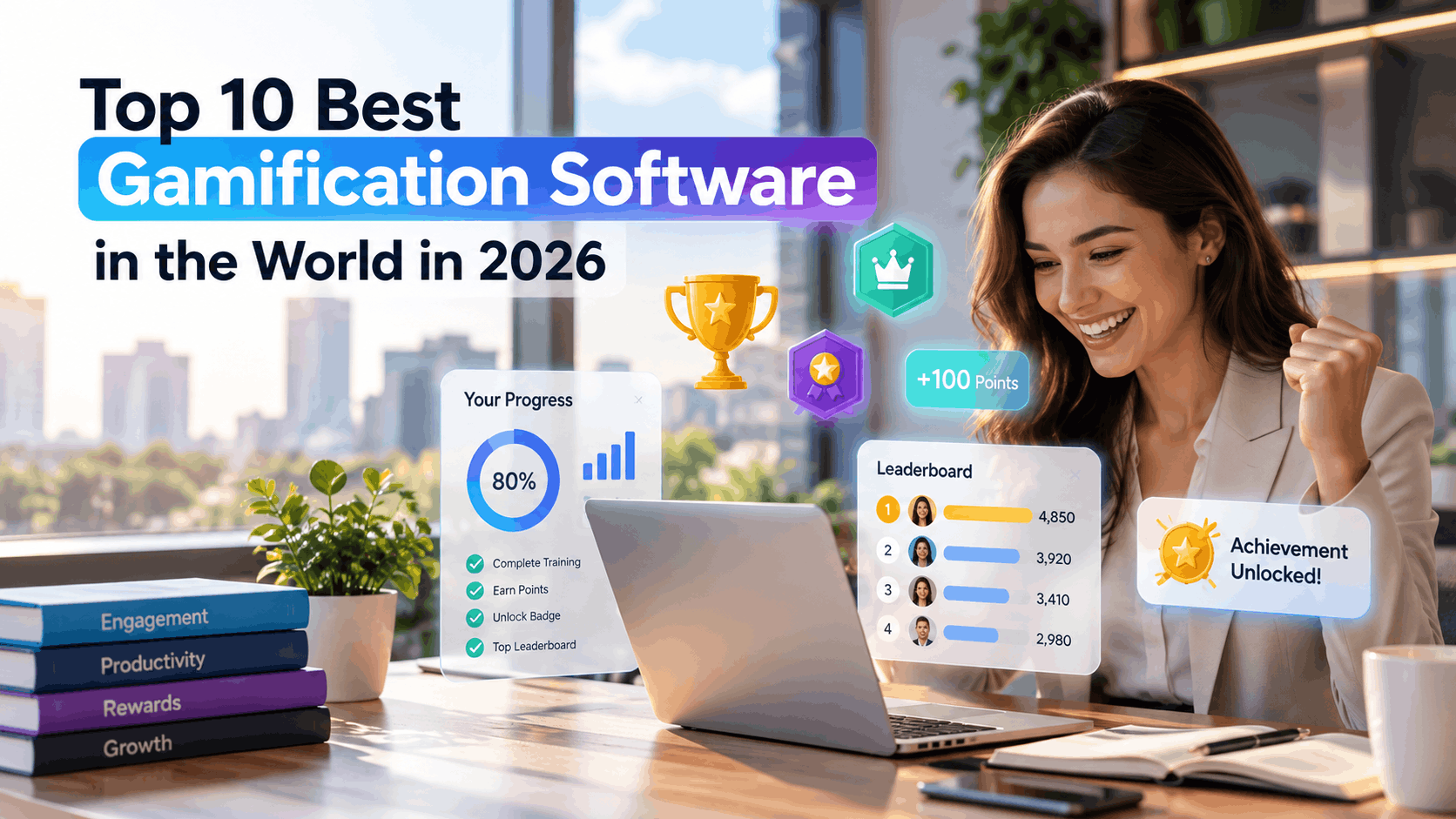
Gamification software has evolved from simple points, badges, and leaderboards into a sophisticated technology category for improving employee engagement, sales performance, learning, customer loyalty, and behavioral change. In 2026, organizations increasingly use gamification platforms to transform routine activities into measurable and rewarding experiences that encourage users to participate, compete, learn, achieve goals, and remain engaged.
The best gamification software in the world in 2026 combines traditional game mechanics with technologies such as artificial intelligence, real-time analytics, personalized learning, automated coaching, CRM integrations, performance dashboards, loyalty programs, and behavioral insights. Instead of adding game elements simply for entertainment, modern platforms connect gamification directly with measurable business outcomes.
Different platforms address very different requirements. Sales organizations can use gamification software to turn calls, meetings, pipeline generation, and closed deals into competitions and achievements. Employers can use it to improve workforce training, onboarding, recognition, and productivity. E-commerce businesses can introduce points, VIP tiers, referrals, and rewards to encourage repeat purchases, while B2B companies can gamify customer advocacy, reviews, referrals, and community participation.
The global gamification market is also expanding as businesses seek new ways to maintain engagement across increasingly digital and distributed experiences. Artificial intelligence is accelerating this development by enabling platforms to personalize challenges, identify performance gaps, generate learning content, recommend coaching interventions, and adapt engagement strategies to individual users.
However, choosing the best gamification platform requires more than comparing the number of available badges or leaderboard designs. Organizations should consider integrations, customization, analytics, scalability, mobile accessibility, security, AI capabilities, reward management, pricing, and the types of behaviors each platform is designed to influence.
This guide examines the top 10 best gamification software in the world in 2026: Centrical, SalesScreen, Spinify, Ambition, LevelEleven, Axonify, Influitive, Plecto, Smile.io, and Gametize. Each platform serves a distinct part of the market, ranging from enterprise workforce engagement and sales gamification to frontline learning, customer advocacy, KPI visualization, and e-commerce loyalty.
By comparing their core features, gamification mechanics, integrations, pricing models, strengths, limitations, and ideal use cases, businesses can identify the platform that best aligns gamification with their broader performance and engagement objectives.
Before we venture further into this article, we would like to share who we are and what we do.
About 9cv9
9cv9 is a business tech startup based in Singapore and Asia, with a strong presence all over the world.
With over ten years of startup and business experience, and being highly involved in connecting with thousands of companies and startups, the 9cv9 team has listed some of the top and best companies/tools in this review.
If you like to get your company listed in our top B2B software reviews, check out our world-class 9cv9 Media and PR service and pricing plans here.
Top 10 Best Gamification Software To Try in 2026
1. Centrical
Centrical is an enterprise employee performance, engagement, and gamification platform built primarily for frontline workforces, contact centers, customer service teams, and sales operations. In the 2026 gamification software market, the platform stands out for connecting game mechanics directly with operational performance data, personalized learning, coaching, and measurable business KPIs.
Rather than functioning as a standalone rewards or leaderboard application, Centrical acts as a workforce performance layer. Organizations can connect employee activities and results from CRM, contact center, HR, and other enterprise systems with gamified challenges, learning missions, competitions, recognition, and coaching workflows.
Centrical at a Glance
| Category | Centrical Capabilities |
|---|---|
| Primary Market | Enterprise workforce gamification and employee performance |
| Best Suited For | Contact centers, customer service, sales and frontline teams |
| Core Functions | Gamification, performance management, microlearning and coaching |
| Gamification Mechanics | Points, badges, levels, challenges, competitions and rewards |
| Learning Model | Personalized, AI-assisted microlearning |
| Performance Data | Real-time employee and operational KPI tracking |
| Enterprise Integrations | CRM, contact center, HR and business applications |
| Deployment | Cloud-based enterprise platform |
| Pricing Approach | Customized enterprise pricing |
| G2 Rating | 4.6 out of 5 from 128 reviews |
| Key Strength | Connecting gamification with measurable employee performance |
Performance-Driven Gamification
A major differentiator for Centrical is its emphasis on business performance rather than gamification in isolation. Organizations can connect operational metrics to employee goals and use those metrics to automatically drive challenges, competitions, recognition, learning activities, and coaching interventions.
For contact center environments, this approach can help organizations manage performance indicators such as customer satisfaction, resolution quality, productivity, sales results, compliance, and other operational targets.
Employees receive continuous feedback on their progress while managers gain greater visibility into individual and team performance. This creates a feedback loop in which gamification becomes a mechanism for reinforcing desired behaviors rather than simply distributing points or badges.
Gamification and Employee Engagement
Centrical incorporates multiple game mechanics into everyday workflows. Employees can participate in individual or team challenges, progress through levels, earn badges, collect rewards, receive recognition, and compete against defined performance targets.
| Gamification Feature | Business Application |
|---|---|
| Points | Reward desired activities and performance |
| Badges | Recognize milestones and achievements |
| Levels | Visualize employee progression |
| Individual Challenges | Encourage employees to reach personalized goals |
| Team Competitions | Promote collaboration and friendly competition |
| Rewards | Reinforce high-value employee behaviors |
| Recognition | Highlight achievements and successful performance |
| Real-Time Feedback | Show employees how they are progressing against targets |
The platform can therefore support both competitive and achievement-oriented engagement strategies. Organizations can configure gamification around their own objectives instead of forcing employees into a standardized gaming structure.
AI-Powered Microlearning
Centrical combines gamification with personalized microlearning, making employee development an important part of its value proposition.
Performance and knowledge data can be used to identify areas where individual employees need additional development. Relevant learning activities can then be delivered in the flow of work rather than requiring every employee to complete identical training programs.
Microlearning formats can include short learning activities, quizzes, simulations, knowledge refreshers, and other targeted content. Employees can earn points, advance through levels, complete learning challenges, and receive recognition as they improve their proficiency.
Centrical reports that customers using its learning capabilities have achieved outcomes including 50% faster onboarding and a 22% improvement in SLA compliance in a customer implementation.
Enterprise Integrations and Real-Time Data
Centrical’s integration capabilities are particularly important for large organizations because gamification can be linked to actual operational data.
The platform supports connections with enterprise technologies including Salesforce, Microsoft Dynamics, Genesys, NICE, and Zendesk. Its Genesys integration, for example, can pull employee KPIs into a unified environment and use performance information to support personalized learning, coaching, challenges, and feedback.
| Enterprise System | Potential Role Within Centrical |
|---|---|
| Salesforce | Sales activities, CRM adoption and performance tracking |
| Genesys | Contact center KPIs and agent performance |
| NICE | Contact center and workforce performance data |
| Microsoft Dynamics | CRM and operational performance information |
| Zendesk | Customer service and support performance |
| LMS Platforms | Learning content and employee development |
This integration model allows companies to build gamification around existing business processes instead of requiring employees to manually report activities.
Contact Center and Frontline Workforce Use Cases
Centrical is particularly well positioned for organizations managing large numbers of frontline employees. Contact centers often face challenges involving employee attrition, inconsistent performance, lengthy onboarding processes, knowledge gaps, and fluctuating customer satisfaction.
Centrical combines performance management, learning, coaching, and gamification to address these issues within a single employee experience.
| Workforce Challenge | Centrical Approach |
|---|---|
| Employee Attrition | Recognition, engagement and personalized development |
| Slow Onboarding | Guided and gamified learning missions |
| Performance Variability | Real-time KPI visibility and personalized goals |
| Knowledge Gaps | Targeted microlearning and refresher activities |
| Low Engagement | Competitions, badges, levels and rewards |
| Manager Coaching Workload | Data-driven coaching recommendations |
| Weak CRM Adoption | Gamified reinforcement of desired CRM behaviors |
Customer Results and Business Impact
Published Centrical customer examples demonstrate that the platform’s gamification model can extend beyond employee engagement metrics.
One hospitality customer reported a 50% reduction in early attrition after introducing a personalized and gamified onboarding experience. Another published customer example involving Ness Digital Engineering reports 50% faster onboarding alongside a 22% increase in SLA compliance.
These results should be interpreted as individual customer outcomes rather than guaranteed performance benchmarks. Nevertheless, they demonstrate how enterprise gamification can be connected with operational measures such as retention, productivity, proficiency, service quality, and onboarding efficiency.
User Experience and Implementation Considerations
Centrical receives a 4.6 out of 5 rating on G2 based on 128 reviews. Review feedback frequently highlights gamification, employee engagement, performance visibility, CRM integration, dashboards, and real-time feedback as useful capabilities.
However, its flexibility can also introduce implementation complexity. Some reviewers indicate that configuring the platform around specific organizational requirements can require considerable setup and assistance. G2 reports an average implementation time of approximately two months based on available review data.
For enterprises, this means Centrical is better viewed as a configurable performance and engagement platform than as a lightweight plug-and-play gamification tool.
Centrical Strengths and Considerations
| Strengths | Considerations |
|---|---|
| Strong enterprise gamification capabilities | Initial configuration can require significant planning |
| Real-time performance management | May be excessive for very small organizations |
| Personalized microlearning | Full value depends on quality of integrated data |
| AI-assisted coaching and learning | Enterprise deployment requires KPI design |
| Broad enterprise integrations | Pricing is generally customized |
| Strong contact center specialization | Less suited to simple consumer loyalty programs |
| Gamification tied directly to KPIs | Requires organizational adoption and governance |
Why Centrical Is a Leading Gamification Software Option in 2026
Centrical represents the increasingly performance-oriented direction of the global gamification software market in 2026. Instead of treating gamification as a collection of superficial rewards, the platform connects employee motivation with performance data, personalized learning, coaching, recognition, and business outcomes.
Its strongest use cases are found in large contact centers, sales organizations, customer service operations, and other frontline environments where organizations already collect substantial employee performance data.
For enterprises seeking gamification software that can connect points, challenges, competitions, learning, and recognition with measurable workforce KPIs, Centrical is a particularly comprehensive option. Its combination of enterprise integrations, real-time performance management, AI-assisted microlearning, and configurable game mechanics makes it a strong contender among the best gamification software platforms in the world in 2026.
2. SalesScreen
SalesScreen is a sales gamification and performance management platform designed to help inside sales, remote, hybrid, and distributed revenue teams improve motivation, visibility, accountability, and sales execution. In the 2026 gamification software market, SalesScreen differentiates itself by connecting live CRM data with competitions, recognition, rewards, performance dashboards, coaching, and AI-driven recommendations.
Instead of treating gamification as a separate employee engagement activity, SalesScreen integrates game mechanics directly into everyday sales workflows. Sales activities, pipeline movements, quota attainment, and closed deals can automatically trigger leaderboards, competitions, achievements, and celebrations without requiring representatives to manually update another system.
SalesScreen at a Glance
| Category | SalesScreen Capabilities |
|---|---|
| Primary Market | Sales gamification and performance management |
| Best Suited For | Inside sales, revenue, insurance and distributed sales teams |
| Core Functions | Gamification, performance tracking, recognition and coaching |
| Gamification Mechanics | Competitions, battles, missions, achievements, XP and rewards |
| AI Capabilities | Scout AI performance insights and recommended actions |
| Performance Data | CRM-driven metrics, activities, pipeline and quota data |
| CRM Integrations | Salesforce, HubSpot, Microsoft Dynamics and other systems |
| Visual Engagement | Dashboards, interactive feeds and office TV displays |
| Pricing Model | Per-user subscription with enterprise options |
| G2 Rating | 4.7 out of 5 from approximately 485 reviews |
| Key Strength | Turning real-time sales performance into gamified experiences |
Sales Gamification Built Around CRM Data
One of SalesScreen’s strongest capabilities is its ability to transform existing CRM activity into gamification events. Integrations with major platforms such as Salesforce, HubSpot, and Microsoft Dynamics allow sales activity and performance information to flow into SalesScreen.
For example, Salesforce opportunity, activity, and quota information can automatically populate dashboards and leaderboards. Closing a deal can trigger an immediate celebration, while calls, meetings, pipeline creation, sales volume, or other activities can contribute toward competitions and individual targets.
| CRM Activity | Potential SalesScreen Experience |
|---|---|
| Deal Closed | Automatic celebration and recognition |
| Calls Completed | Competition progress and leaderboard movement |
| Meetings Booked | Achievement or activity target progression |
| Pipeline Created | Performance dashboard and competition scoring |
| Quota Attainment | Recognition, rankings and rewards |
| Sales Milestone | Achievement or customized celebration |
This automation helps reduce the administrative burden normally associated with running sales contests because results can be calculated directly from existing operational data.
Competitions, Battles and Rewards
SalesScreen offers several gamification formats designed to accommodate different sales cultures and performance objectives.
Organizations can run competitions based on sales outcomes or leading indicators such as calls, meetings, opportunities, or pipeline generation. More advanced plans provide access to the broader competition library alongside Battles, Missions, XP, levels, achievements, and customizable rewards.
| Gamification Feature | Primary Purpose |
|---|---|
| Competitions | Encourage performance against specific sales targets |
| Battles | Create direct competitive challenges |
| Missions | Break objectives into achievable activities |
| Achievements | Recognize milestones and accomplishments |
| XP and Levels | Visualize longer-term employee progression |
| Reward Shop | Convert earned virtual currency into incentives |
| Leaderboards | Provide transparent performance rankings |
| Interactive Feed | Share achievements across the organization |
The customizable reward shop adds another incentive layer by allowing employees to spend earned digital coins on company-defined rewards.
Visual Sales Recognition
SalesScreen places significant emphasis on making performance visible.
SalesSurround can display sales performance and achievements across office television screens, while dashboards and interactive feeds provide employees with continuous visibility into individual and team progress.
This approach is particularly useful for hybrid and distributed sales organizations because it attempts to reproduce some of the energy and recognition traditionally associated with physical sales floors.
Employees do not have to wait for weekly meetings or monthly performance reviews to see results. Achievements can become visible shortly after the underlying CRM activity occurs.
Scout AI and Agentic Gamification
Scout AI expands SalesScreen beyond conventional leaderboard-based gamification. The AI system analyzes sales performance information and converts it into personalized insights, recommendations, and suggested actions.
For managers, Scout can help identify performance changes and recommend interventions involving coaching, recognition, or competitions. This makes gamification more adaptive because managers do not necessarily have to determine manually when and how every motivational intervention should occur.
SalesScreen reports that during Scout’s beta testing, 71% of users considered its performance insights useful or very useful, 68% considered its recommendations accurate and relevant, and 61% received insights they either did not already know or would not have had time to identify themselves.
SalesScreen AI Framework
| Scout AI Capability | Potential Management Value |
|---|---|
| Performance Insights | Identify important changes in sales performance |
| Suggested Actions | Recommend appropriate managerial responses |
| AI Assist | Reduce manual analysis and administrative work |
| Coaching Support | Identify opportunities for targeted intervention |
| Gamification Recommendations | Match motivational activities with performance needs |
| Chat and Voice | Provide conversational access to performance information |
Pricing and Plans
SalesScreen uses a tiered per-user subscription structure. Current published information indicates that Scale starts at approximately $30 per user per month for teams of at least 10 users, while Pro costs approximately $45 per user per month for teams of at least 15.
Enterprise pricing is customized. Coaching and Scorecards can also be purchased as add-ons at approximately $5 per user per month each.
| Plan | Indicative 2026 Pricing | Positioning |
|---|---|---|
| Essentials | Trial and entry-level offering | Basic gamification and performance visibility |
| Scale | $30 per user/month | Growing sales teams |
| Pro | $45 per user/month | Full-featured sales gamification |
| Enterprise | Custom pricing | Large organizations requiring greater control |
| Coaching Add-On | $5 per user/month | Structured sales coaching |
| Scorecards Add-On | $5 per user/month | Additional performance measurement |
Actual enterprise costs can vary according to deployment size, package selection, integrations, add-ons, and commercial terms.
User Ratings and Market Reception
SalesScreen holds a 4.7 out of 5 rating on G2 from approximately 485 reviews, placing it among the more extensively reviewed products in the sales gamification category.
Review feedback frequently highlights competitions, real-time performance tracking, leaderboards, rewards, visual presentation, and ease of use. Some users report limitations involving data management, integrations, customization, or specific interface capabilities, indicating that organizations with unusual sales metrics should evaluate configuration requirements before deployment.
SalesScreen Strengths and Considerations
| Strengths | Considerations |
|---|---|
| Deep focus on sales gamification | Primarily designed for sales-oriented organizations |
| Real-time CRM-driven performance tracking | Advanced deployments can require configuration |
| Wide range of competition mechanics | Costs increase with team size and add-ons |
| Highly visual recognition experiences | Specialized metrics may need additional setup |
| Scout AI recommendations | AI value depends on available performance data |
| Customizable rewards | Incentives require ongoing program management |
| Strong G2 rating and review volume | Smaller teams may not require the full feature set |
| Salesforce, HubSpot and Dynamics integrations | Integration requirements vary by CRM |
Why SalesScreen Is a Leading Gamification Software Option in 2026
SalesScreen represents a specialized approach to enterprise gamification in which motivation is directly connected with measurable sales performance. Its combination of live CRM integrations, leaderboards, competitions, Battles, Missions, achievements, rewards, visual celebrations, coaching, and Scout AI creates a comprehensive performance environment for revenue teams.
The platform is particularly suitable for organizations seeking to increase the visibility of sales activity and maintain motivation across office-based, remote, and hybrid teams. SalesScreen reports a 30% increase in KPIs within the first six months among teams using its platform, although such vendor-reported outcomes should be treated as customer performance indicators rather than guaranteed results.
For companies evaluating the best gamification software in the world in 2026, SalesScreen is therefore a strong contender when the primary objective is sales performance. Its ability to convert CRM activity into immediate recognition and targeted gamification distinguishes it from broader employee engagement platforms that are not specifically designed around revenue-team workflows.
3. Spinify
Spinify is an AI-powered sales gamification and performance management platform designed to turn everyday sales activities, KPIs, and revenue targets into competitions, recognition programs, coaching opportunities, and highly visible performance experiences. In the 2026 gamification software market, Spinify is particularly suited to sales organizations seeking stronger motivation, accountability, KPI visibility, and engagement across office-based, remote, and hybrid teams.
The platform connects directly with business systems and converts live operational data into leaderboards, competitions, achievements, rewards, goals, and automated recognition. Spinify reports that its platform has powered more than 1.5 million leaderboards and competitions globally.
Spinify at a Glance
| Category | Spinify Capabilities |
|---|---|
| Primary Market | Sales gamification and performance management |
| Best Suited For | Sales, revenue, recruiting and KPI-driven teams |
| Core Functions | Competitions, leaderboards, recognition, rewards and coaching |
| Gamification Mechanics | 20+ competition types, goals, tiers, badges and achievements |
| AI Capabilities | Sidekick, Recognition AI and AI Coaching Agent |
| Performance Data | Real-time CRM and business KPI tracking |
| Key Integrations | Salesforce, HubSpot, Dynamics, Microsoft Teams and other business systems |
| Visual Engagement | Live dashboards, TV leaderboards and personalized displays |
| Enterprise Security | SOC 2 Type 2, SSO, encryption and GDPR compliance |
| G2 Rating | 4.6 out of 5 from 1,000+ reviews |
| Key Strength | Combining AI, sales gamification and real-time performance visibility |
Real-Time Sales Gamification
Spinify is designed around real-time performance visibility. Data generated inside CRM and other business systems can automatically update competitions, leaderboards, individual goals, achievements, and recognition experiences.
This approach allows organizations to gamify both leading sales activities and final outcomes.
| Performance Metric | Potential Spinify Application |
|---|---|
| Calls Completed | Activity competition |
| Meetings Booked | Individual or team leaderboard |
| Opportunities Created | Pipeline-generation challenge |
| Revenue Generated | Sales performance competition |
| Deals Closed | Automated achievement and celebration |
| Target Attainment | Goal and tier progression |
| Custom KPI | Personalized competition or performance metric |
The platform offers more than 20 competition formats and over 250 competition designs, giving managers considerable flexibility when creating programs around different sales objectives.
AI-Powered Competition Creation
One of Spinify’s important differentiators is Sidekick, its generative AI assistant.
Sidekick can use competition data, company information, metrics, and industry context to generate customized gamification content. Managers can use it across competitions, multimetrics, badges, announcements, rewards, channels, teams, tiers, prize wheels, and other elements.
This reduces the amount of manual work required to continuously develop new competitions and engagement programs.
Spinify AI Framework
| AI Capability | Primary Function |
|---|---|
| Sidekick | Assists with competitions and gamification content |
| Recognition AI | Helps automate employee recognition |
| Coaching AI | Delivers data-driven coaching and performance insights |
| Performance Analysis | Identifies individual performance patterns |
| Coaching Prioritization | Helps managers identify employees needing attention |
| AI Recommendations | Supports more targeted performance interventions |
AI Coaching and Performance Development
Spinify extends beyond competitions through its AI Coaching Agent. The system analyzes performance information to provide managers with a clearer view of individual progress, goals, and areas requiring attention.
Personalized coaching can be based on live performance data rather than relying exclusively on periodic reviews. The system is also designed to automate routine coaching activities, allowing managers to concentrate on higher-value interventions.
Spinify additionally incorporates employee wellness check-ins that can provide managers with signals about engagement and stress.
Leaderboards, Recognition and Rewards
Visual performance management is central to the Spinify experience. Live leaderboards can make team and individual results visible throughout the working day, while automated achievements recognize milestones when they occur.
Organizations can customize displays using their own branding, logos, fonts, designs, celebrations, and reward structures.
| Gamification Feature | Business Purpose |
|---|---|
| Live Leaderboards | Increase KPI visibility |
| Competitions | Encourage targeted behaviors |
| Achievements | Recognize employee milestones |
| Tiers | Create longer-term progression |
| Personal Goals | Keep employees focused on individual targets |
| Reward Stores | Connect performance with incentives |
| TV Displays | Make achievements visible across teams |
| Automated Recognition | Celebrate performance without manual administration |
This combination can be especially useful for distributed organizations seeking to recreate the visibility and shared energy traditionally associated with physical sales floors.
Enterprise Integrations
Spinify supports a broad integration ecosystem, with G2 listing more than 40 integrations. Supported systems include Salesforce, HubSpot, Microsoft Dynamics, Microsoft Teams, Slack, Outreach, Salesloft, Pipedrive, Bullhorn, Snowflake, Power BI, Google Workspace and several industry-specific CRM platforms.
| Integration Category | Business Application |
|---|---|
| CRM Systems | Sales activities, opportunities and revenue |
| Recruiting Platforms | Recruitment and placement performance |
| Collaboration Tools | Notifications and team engagement |
| Data Platforms | Additional operational KPI sources |
| Sales Engagement Tools | Prospecting and outreach activities |
| Analytics Platforms | Broader reporting and performance analysis |
Pricing and Plans
Spinify’s 2026 pricing structure has changed from some older listings. Current G2 pricing information lists four main packages: Sardine at $29 per user per month, Goldfish at $49, Shark at $69, and Whale with customized pricing.
| Plan | Indicative Pricing | Positioning |
|---|---|---|
| Sardine | $29 per user/month | Self-service deployment |
| Goldfish | $49 per user/month | Guided implementation and support |
| Shark | $69 per user/month | Strategic performance optimization |
| Whale | Custom pricing | Fully managed enterprise deployment |
Spinify’s current pricing strategy increasingly differentiates packages according to the level of implementation, strategic assistance, and ongoing management rather than simply restricting core software functionality. Its official pricing materials state that plans provide broad access to the platform, while higher tiers add increasingly extensive implementation and performance-management services.
Security and Enterprise Readiness
Spinify positions itself for larger organizations as well as growing sales teams. The platform states that it is SOC 2 Type 2 audited and GDPR compliant, while its pricing information also identifies enterprise security capabilities including SSO and encryption.
| Enterprise Requirement | Spinify Support |
|---|---|
| SOC 2 Type 2 | Supported |
| GDPR Compliance | Supported |
| Single Sign-On | Available |
| Encryption | Enterprise security capability |
| Large-Team Deployment | Supported |
| Dedicated Strategy Support | Available on higher service tiers |
| Fully Managed Deployment | Available through Whale |
User Ratings and Market Reception
Spinify holds a 4.6 out of 5 rating on G2. As of September 2026, G2’s Spinify seller profile reports more than 1,000 reviews and identifies the product across Gamification, Sales Gamification, Sales Coaching, and Sales Performance Management categories.
Reviewers frequently highlight ease of use, real-time leaderboards, customization, healthy competition, CRM connectivity, KPI visibility, and employee motivation. Some users report limitations involving integrations, deeper analytics, technical issues, or specialized configuration requirements.
Spinify Strengths and Considerations
| Strengths | Considerations |
|---|---|
| Strong sales gamification functionality | Primarily optimized for KPI-driven teams |
| 20+ competition formats | Higher service tiers increase cost |
| Extensive leaderboard customization | Complex integrations may require configuration |
| AI-assisted competition creation | Results depend on reliable underlying CRM data |
| AI-powered coaching | Advanced analytics may not satisfy every use case |
| Automated achievements and recognition | Competition programs require thoughtful KPI selection |
| Large integration ecosystem | Specialized workflows should be tested before rollout |
| SOC 2 Type 2 and GDPR positioning | May be excessive for teams needing basic leaderboards |
Why Spinify Is a Leading Gamification Software Option in 2026
Spinify has evolved beyond a conventional sales leaderboard application into a broader sales performance and gamification platform. Its combination of real-time leaderboards, more than 20 competition formats, hundreds of designs, automated recognition, personalized rewards, AI-assisted competition creation, and AI coaching gives organizations multiple ways to influence employee behavior.
Its strongest use cases remain sales and other performance-driven teams where activities can be measured through CRM or operational systems. Rather than requiring managers to manually operate every competition, Spinify increasingly uses automation and AI to help create challenges, recognize achievements, analyze performance, and support coaching.
For organizations evaluating the best gamification software in the world in 2026, Spinify is therefore a strong option when sales motivation, real-time KPI visibility, employee recognition, and AI-powered coaching are central requirements. Its 4.6 out of 5 G2 rating across more than 1,000 reviews also provides substantial independent user feedback supporting its established position within the sales gamification category.
4. Ambition
Ambition is an enterprise sales performance management, coaching, and gamification platform designed for revenue organizations that want to connect daily sales activities with broader pipeline and revenue objectives. In the 2026 gamification software market, Ambition stands out for combining competitive game mechanics with real-time performance scorecards, automated alerts, structured coaching, and sales analytics.
Rather than functioning solely as a leaderboard application, Ambition provides sales representatives, frontline managers, and revenue leaders with a shared system for monitoring performance, reinforcing desired behaviors, recognizing achievements, and identifying coaching opportunities.
Ambition at a Glance
| Category | Ambition Capabilities |
|---|---|
| Primary Market | Sales performance management and gamification |
| Best Suited For | Mid-market and enterprise revenue organizations |
| Core Functions | Scorecards, competitions, coaching, dashboards and analytics |
| Gamification Mechanics | Leaderboards, contests, fantasy competitions and incentives |
| Performance Management | Activity and objective scorecards |
| Coaching | Structured one-to-one coaching and action plans |
| Performance Visibility | Real-time dashboards, alerts and TV displays |
| Primary Users | Sales representatives, managers and RevOps leaders |
| G2 Rating | 4.6 out of 5 from approximately 590 reviews |
| Key Strength | Connecting gamification, performance measurement and coaching |
Sales Gamification Built Around Business Metrics
Ambition’s gamification system allows organizations to build competitions around measurable sales behaviors and outcomes rather than generic engagement activities.
Managers can create contests around calls, meetings, opportunities, revenue, pipeline creation, quota attainment, or other metrics captured by connected sales systems. Results can then appear through leaderboards, dashboards, alerts, and competition experiences.
| Sales Metric | Potential Ambition Application |
|---|---|
| Outbound Calls | Activity competition |
| Meetings Booked | Leaderboard or contest |
| Opportunities Created | Pipeline-generation challenge |
| Revenue Closed | Results-based competition |
| Quota Attainment | Objective scorecard |
| Pipeline Generated | Team or individual contest |
| Custom Sales KPI | Personalized scorecard or competition |
This structure makes Ambition particularly useful for organizations that want gamification to reinforce specific behaviors associated with revenue generation.
Fantasy Sales Competitions
One of Ambition’s best-known gamification capabilities is its fantasy-style competition system.
Organizations can create fantasy competitions that divide employees into teams and allow them to compete over defined periods using actual sales performance data. This introduces a team-oriented dimension that differs from conventional individual leaderboards.
| Competition Format | Engagement Objective |
|---|---|
| Individual Contest | Encourage personal performance |
| Team Competition | Promote collaboration |
| Fantasy Competition | Create longer-term team engagement |
| Leaderboard | Increase performance visibility |
| KPI Challenge | Reinforce specific sales activities |
| Short-Term Sprint | Generate momentum around immediate objectives |
Fantasy competitions can be particularly effective for longer campaigns because employees are encouraged to contribute toward collective team performance instead of focusing exclusively on individual rankings.
Activity and Objective Scorecards
Ambition’s scorecards provide a structured framework for measuring both employee activity and business outcomes.
Activity scores can measure controllable behaviors such as calls, emails, meetings, or prospecting activities. Objective scores can represent outcomes such as opportunities, pipeline, revenue, or quota attainment.
This distinction allows managers to identify why performance may be changing.
| Performance Situation | Potential Interpretation |
|---|---|
| High Activity, High Objectives | Strong overall performance |
| High Activity, Low Objectives | Possible efficiency or conversion issue |
| Low Activity, High Objectives | Strong efficiency but potentially insufficient volume |
| Low Activity, Low Objectives | Coaching or performance intervention may be required |
This model gives Ambition greater analytical depth than gamification platforms focused primarily on points, badges, and rewards.
Structured Sales Coaching
Coaching is another major component of the Ambition platform. Performance information from scorecards and dashboards can provide context for structured manager-representative conversations.
Managers can conduct and document one-to-one coaching sessions within the platform, creating greater continuity between performance measurement and employee development.
| Coaching Capability | Management Benefit |
|---|---|
| Scheduled One-to-Ones | Creates consistent coaching cadence |
| Performance Data | Provides objective discussion context |
| Coaching Notes | Maintains development history |
| Action Plans | Converts feedback into measurable next steps |
| Performance Trends | Identifies recurring strengths and weaknesses |
| Automated Alerts | Highlights situations requiring intervention |
For larger sales organizations, this combination can help standardize coaching practices across multiple teams and managers.
Real-Time Performance Visibility
Ambition provides dashboards, leaderboards, pacing alerts, and other performance displays that help employees understand their current position against individual and organizational targets.
Real-time visibility can reduce dependence on periodic pipeline reviews because employees and managers can identify performance gaps earlier.
G2 reviewers frequently highlight performance visibility, accountability, dashboards, real-time tracking, and competitive elements as important benefits of the platform. Current reviews also indicate that employees value being able to connect daily activities with broader performance goals.
Integrations and Revenue Technology Stack
Ambition is designed to operate alongside existing sales technologies rather than replace them. G2 identifies integrations including Salesforce, Microsoft 365, Microsoft Teams, Outreach, and other sales applications.
Data from connected systems can become the foundation for scorecards, dashboards, competitions, alerts, and coaching workflows.
| Technology Category | Role Within Ambition |
|---|---|
| CRM | Provides sales activity and outcome data |
| Sales Engagement | Supplies prospecting and outreach metrics |
| Communication Platforms | Supports alerts and team engagement |
| Productivity Software | Connects performance workflows |
| Revenue Operations Systems | Provides additional sales performance signals |
Pricing and Deployment
Ambition should primarily be considered a quote-based enterprise platform in 2026. Current public G2 information states that Ambition has not published standardized pricing and advises prospective customers to contact the vendor for package and per-user pricing.
Therefore, previously circulated figures such as $45, $65, and $75 per user per month should not be presented as confirmed current 2026 pricing without a direct commercial quotation.
| Pricing Factor | Likely Cost Consideration |
|---|---|
| Number of Users | Larger deployments affect subscription cost |
| Product Package | Features vary according to selected capabilities |
| Coaching Requirements | Advanced coaching can affect deployment scope |
| Integrations | Complex data environments may require additional work |
| Enterprise Requirements | Support and organizational complexity influence pricing |
| Implementation | Configuration requirements vary by organization |
G2 currently reports an average implementation period of approximately two months based on user feedback.
User Ratings and Market Reception
Ambition holds a 4.6 out of 5 rating on G2. As of September 2026, its G2 seller profile lists approximately 590 reviews across Sales Performance Management, Sales Gamification, Sales Coaching, and Customer Revenue Optimization categories.
| Review Indicator | Current Position |
|---|---|
| G2 Rating | 4.6 out of 5 |
| G2 Reviews | Approximately 590 |
| Sales Performance Management | Major product category |
| Sales Gamification | Major product category |
| Sales Coaching | Major product category |
| Typical Customers | Mid-market and enterprise organizations |
Recent reviewers praise its ability to make sales metrics visible, encourage healthy competition, improve accountability, and provide real-time performance tracking. Some users also report that configuration, navigation, integrations, or specialized data requirements can introduce complexity.
Ambition Strengths and Considerations
| Strengths | Considerations |
|---|---|
| Strong sales gamification capabilities | Primarily designed for revenue organizations |
| Fantasy-style sales competitions | Requires meaningful KPI selection |
| Activity and objective scorecards | Data quality depends on connected systems |
| Integrated coaching workflows | Manager participation remains important |
| Real-time performance visibility | Advanced configuration can require setup work |
| Enterprise-oriented analytics | May be excessive for very small teams |
| Automated alerts and performance tracking | Current pricing requires a vendor quotation |
| Strong G2 rating | Some users report integration or navigation challenges |
Why Ambition Is a Leading Gamification Software Option in 2026
Ambition represents a more performance-oriented form of gamification software. Instead of simply awarding points and badges, the platform combines competition with measurable sales activities, objective attainment, real-time analytics, accountability, and structured manager coaching.
Its fantasy competitions and leaderboards provide the motivational layer, while scorecards help organizations understand whether employees are completing the activities required to achieve revenue objectives. Coaching workflows then give managers a mechanism for acting on those insights.
For organizations evaluating the best gamification software in the world in 2026, Ambition is particularly relevant for enterprise and mid-market sales organizations seeking to combine gamification with serious performance management. Its 4.6 out of 5 G2 rating across approximately 590 reviews further establishes it as a mature option within the sales gamification and sales performance management categories.
5. LevelEleven
LevelEleven is a Salesforce-native sales performance management, gamification, and coaching platform developed by Ascent Cloud. Designed for revenue and customer-facing teams, the software helps organizations translate high-level sales objectives into measurable daily behaviors through scorecards, competitions, real-time recognition, goal pacing, and structured coaching.
In the 2026 gamification software market, LevelEleven is particularly relevant to organizations already operating within Salesforce. Its native architecture allows performance management and gamification to remain closely connected with CRM workflows rather than requiring sales representatives to work continuously across a separate engagement platform.
LevelEleven at a Glance
| Category | LevelEleven Capabilities |
|---|---|
| Primary Market | Sales performance management and gamification |
| Best Suited For | Salesforce-based revenue and customer-facing teams |
| Core Functions | Scorecards, contests, recognition, coaching and goal tracking |
| Gamification Focus | Sales behaviors, KPI attainment and competitions |
| CRM Architecture | Salesforce-native |
| Performance Visibility | Real-time scorecards, dashboards and pacing |
| Coaching | Structured one-to-one coaching workflows |
| Starting Price | Approximately $45 per user per month with annual commitment |
| G2 Rating | 4.4 out of 5 from 276 reviews |
| Key Strength | Native Salesforce performance management and gamification |
Salesforce-Native Sales Gamification
One of LevelEleven’s primary differentiators is its close relationship with Salesforce. The application operates natively within the Salesforce ecosystem and uses existing CRM information to measure activities, goals, and outcomes.
Organizations can therefore gamify behaviors that directly contribute to pipeline development and revenue generation.
| Salesforce Metric | Potential LevelEleven Application |
|---|---|
| Calls Completed | Activity target and competition |
| Meetings Booked | Scorecard metric |
| Opportunities Created | Pipeline performance tracking |
| Deals Closed | Results-based recognition |
| Revenue Generated | Outcome measurement |
| Pipeline Created | Goal pacing |
| Custom CRM Metric | Personalized performance KPI |
This architecture is particularly valuable for organizations seeking to improve Salesforce adoption because representatives can see performance expectations and progress within their existing workflow.
Performance Scorecards and Goal Pacing
Performance Scorecards form a central component of LevelEleven. They provide representatives and managers with a continuously updated view of the activities and outcomes that contribute to sales performance.
Organizations can configure four primary metrics and up to 16 secondary metrics, allowing each scorecard to contain as many as 20 performance indicators.
Color-coded pacing provides an immediate visual indication of whether a representative is behind, on pace, ahead of pace, or has already achieved a target.
| Scorecard Element | Management Purpose |
|---|---|
| Primary Metrics | Highlight the most important performance indicators |
| Secondary Metrics | Provide additional operational context |
| Goal Tracking | Measure progress toward targets |
| Pacing Indicators | Identify whether employees are on track |
| Real-Time Updates | Reveal performance changes earlier |
| Comparative Visibility | Show performance relative to teammates |
This approach shifts performance management away from reviewing results only after a reporting period has ended. Managers can identify behavioral gaps while there is still time to intervene.
Sales Competitions and Gamification
LevelEleven allows managers to create competitions around Salesforce metrics and use those contests to reinforce specific behaviors.
Rather than running competitions purely for entertainment, organizations can connect contests with strategic priorities such as prospecting, opportunity creation, CRM adoption, product launches, or pipeline development.
| Competition Objective | Example Gamified Behavior |
|---|---|
| Increase Prospecting | Calls or outbound activities |
| Generate Pipeline | Opportunities created |
| Improve CRM Adoption | Required activities recorded |
| Accelerate Sales | Deals progressed or closed |
| Launch New Initiative | Targeted product activities |
| Improve Consistency | Weekly KPI attainment |
This makes LevelEleven particularly useful for organizations seeking purposeful competition rather than standalone points-and-badges gamification.
Real-Time Recognition
Recognition complements LevelEleven’s competition functionality by making successful performance visible across the organization.
Employees can receive immediate acknowledgment when meaningful goals or milestones are achieved. This creates a stronger connection between completing an important sales behavior and receiving organizational recognition.
Combined with scorecards and competitions, recognition helps create a continuous performance cycle:
Sales Activity → CRM Data → Scorecard Progress → Recognition → Coaching → Improved Execution
Structured Sales Coaching
LevelEleven extends beyond gamification into structured sales coaching. Managers can use performance information from scorecards to guide one-to-one conversations and identify behaviors requiring improvement.
The Coach package includes structured coaching cadences, customizable coaching templates, onboarding plans, CRM-integrated coaching notes, and other tools designed to make manager-representative development more consistent.
| Coaching Capability | Business Value |
|---|---|
| Structured One-to-Ones | Creates consistent manager coaching |
| Performance Snapshots | Provides objective discussion context |
| Coaching Templates | Standardizes coaching across managers |
| Coaching Notes | Maintains performance history |
| Onboarding Plans | Supports new representative development |
| KPI Visibility | Identifies behaviors requiring intervention |
This combination differentiates LevelEleven from simpler gamification platforms that focus mainly on contests and leaderboards.
Ascent Cloud Ecosystem
LevelEleven is part of the broader Ascent Cloud portfolio alongside Geopointe and Territory Planner.
This ecosystem extends Ascent Cloud beyond conventional sales gamification into areas such as location intelligence, territory planning, account prioritization, field sales execution, routing, performance management, and coaching.
| Ascent Cloud Solution | Primary Function |
|---|---|
| LevelEleven | Sales performance, gamification and coaching |
| Geopointe | Salesforce mapping and location intelligence |
| Territory Planner | Territory design and optimization |
| Ascent Cloud Insights | Performance and operational analytics |
For organizations managing both inside and field sales teams, this broader ecosystem can provide advantages over standalone gamification applications.
Pricing and Plans
Current Salesforce AppExchange information lists LevelEleven as starting at approximately $45 per user per month with an annual commitment. Quantity-based and multi-year discounts may also be available.
The currently listed Motivate package costs approximately $50 per user per month, while Coach costs approximately $60 per user per month.
| Package | Indicative Pricing | Primary Focus |
|---|---|---|
| Starting Price | From $45/user/month | Annual commitment |
| Motivate | $50/user/month | Gamification, scorecards and recognition |
| Coach | $60/user/month | Coaching and broader performance development |
| Enterprise Deployment | Variable | Volume and multi-year arrangements |
Pricing should be verified directly during procurement because discounts, contract length, deployment scale, and packaging can affect the final cost.
User Ratings and Market Reception
LevelEleven holds a 4.4 out of 5 rating on G2 from 276 reviews. Approximately 61% of reviewers award the platform five stars, while another 33% provide four-star ratings.
Review feedback frequently highlights ease of use, real-time performance visibility, competitions, leaderboards, sales motivation, and Salesforce integration. Some users report that configuring competitions or specialized Salesforce workflows can require additional effort, particularly for administrators unfamiliar with the platform.
LevelEleven Strengths and Considerations
| Strengths | Considerations |
|---|---|
| Native Salesforce architecture | Best suited to Salesforce-centered organizations |
| Real-time performance scorecards | Specialized configuration may require setup |
| Strong sales gamification capabilities | Pricing may be high for smaller teams |
| Up to 20 scorecard metrics | KPI selection requires careful planning |
| Structured coaching workflows | Manager participation remains important |
| Real-time recognition | Less suitable for consumer-facing gamification |
| Broader Ascent Cloud ecosystem | Full ecosystem increases deployment scope |
| Established user review history | Primarily focused on sales and revenue teams |
Business Performance and Customer Results
Ascent Cloud publishes several measurable customer outcomes associated with LevelEleven.
Rogers Communications implemented LevelEleven while transitioning from Microsoft Dynamics to Salesforce. According to the published case study, the organization achieved a 20% increase in sales productivity while using scorecards and gamification to improve Salesforce adoption and reinforce important sales behaviors.
Ascent Cloud also reports that LevelEleven users improved tracked KPIs by 67% during their first quarter, while Rogers increased opportunities created by 27%. Average customers reportedly experienced approximately a 23.75% increase in quarterly revenue following implementation. These figures should be treated as vendor-reported customer outcomes rather than guaranteed results.
| Reported Performance Indicator | Published Result |
|---|---|
| Rogers Sales Productivity | +20% |
| Rogers Opportunities Created | +27% |
| Tracked KPI Improvement | +67% in first quarter |
| Average Quarterly Revenue | +23.75% post-implementation |
Why LevelEleven Is a Leading Gamification Software Option in 2026
LevelEleven represents a performance-oriented approach to enterprise gamification. Instead of separating employee engagement from operational systems, the platform embeds scorecards, competitions, recognition, goal pacing, and coaching directly into the Salesforce environment.
Its strongest differentiator is the connection between gamification and measurable sales behaviors. Representatives can see what activities matter, determine whether they are on pace, receive recognition when targets are achieved, and obtain structured coaching when performance falls behind.
For companies evaluating the best gamification software in the world in 2026, LevelEleven is therefore particularly compelling for Salesforce-centric sales organizations. Its combination of native CRM integration, real-time scorecards, targeted competitions, recognition, coaching, and the wider Ascent Cloud ecosystem makes it a strong option for businesses seeking to turn everyday sales activity into consistent and measurable performance improvement.
6. Axonify
Axonify is an AI-powered frontline enablement and gamified microlearning platform designed for large, distributed workforces across industries such as retail, logistics, hospitality, financial services, grocery, telecommunications, and other frontline-intensive sectors.
In the 2026 gamification software market, Axonify differentiates itself by using gamification primarily as a mechanism for building knowledge, reinforcing behaviors, increasing training participation, and improving operational execution. Instead of relying on lengthy periodic training courses, the platform delivers short, personalized learning experiences that employees can complete within their everyday workflows.
Axonify at a Glance
| Category | Axonify Capabilities |
|---|---|
| Primary Market | Frontline employee enablement and microlearning |
| Best Suited For | Large, distributed frontline workforces |
| Core Functions | Microlearning, communications, tasks, insights and coaching |
| Gamification Mechanics | Games, points, leaderboards, rewards and recognition |
| Learning Approach | Short-form personalized daily reinforcement |
| AI Capabilities | Adaptive reinforcement, content generation and AI coaching |
| Operational Tools | Tasks, checklists, communications and inspections |
| Device Support | Mobile, tablet, kiosk and desktop |
| Pricing Model | Customized enterprise quotation |
| G2 Rating | 4.7 out of 5 from 163 reviews |
| Key Strength | Combining gamification with adaptive frontline learning |
Adaptive Microlearning and Knowledge Reinforcement
Axonify’s central differentiator is its approach to continuous microlearning. Instead of expecting frontline workers to complete long training courses periodically, the platform delivers short learning sessions that can fit into the beginning of a shift or another convenient point in the working day.
Its adaptive reinforcement technology identifies individual knowledge gaps and adjusts subsequent learning accordingly. Employees who already understand a subject can progress more quickly, while employees struggling with particular concepts receive additional reinforcement.
This creates a personalized learning cycle:
Knowledge Assessment → Personalized Questions → Knowledge Gap Detection → Reinforcement → Improved Retention → Workplace Application
The approach is particularly relevant for large organizations where employees have different experience levels and training requirements.
Gamification and Employee Engagement
Gamification is integrated directly into the Axonify learning experience. Employees can participate in games, accumulate points, appear on leaderboards, earn rewards, and receive recognition while completing training.
Axonify reports an average engagement rate of approximately 83% across its platform.
| Gamification Feature | Employee Engagement Purpose |
|---|---|
| Learning Games | Make repetitive reinforcement more engaging |
| Points | Reward continued participation |
| Leaderboards | Create friendly competition |
| Rewards | Provide incentives for participation |
| Recognition | Reinforce accomplishments |
| Daily Questions | Build recurring learning habits |
| Personalized Progress | Show individual knowledge development |
| Knowledge Challenges | Reinforce important workplace information |
The gamification mechanics are therefore not isolated entertainment features. They are designed to encourage employees to return regularly enough for continuous learning and reinforcement to become habitual.
AI-Powered Frontline Learning
Axonify has substantially expanded its AI capabilities in 2026. Its current platform combines adaptive learning with AI-assisted content creation, frontline guidance, readiness intelligence, and personalized coaching.
Co-Creator can transform existing courses, procedures, and organizational materials into learning and reinforcement content. Max Assistant provides frontline employees with AI-powered workplace guidance, while the platform’s intelligence capabilities identify knowledge and operational gaps.
In September 2026, Axonify also introduced Max Coach, an AI-powered roleplay system that allows employees to practice realistic workplace conversations and receive personalized scorecards without requiring a manager to supervise every session.
| AI Capability | Primary Application |
|---|---|
| Adaptive Reinforcement | Personalizes learning around knowledge gaps |
| Co-Creator | Generates learning content from existing materials |
| Max Assistant | Provides frontline workplace guidance |
| Max Coach | Enables AI-powered conversational practice |
| Readiness Intelligence | Identifies knowledge and confidence gaps |
| AI Recommendations | Helps managers determine appropriate interventions |
Frontline Communications and Operational Execution
Axonify has evolved beyond conventional learning management into a broader frontline enablement platform.
Its current architecture combines three primary areas: Immersive Microlearning, Guided Execution, and Insights & Action. This allows organizations to connect employee knowledge with communications, tasks, operational execution, and management insights.
| Platform Pillar | Primary Function |
|---|---|
| Immersive Microlearning | Personalized training and knowledge reinforcement |
| Guided Execution | Communications, tasks and frontline guidance |
| Insights & Action | Readiness data, analytics and recommendations |
Organizations can distribute announcements, assign tasks, create checklists, conduct inspections, provide workplace guidance, and monitor execution from the same environment used for employee learning.
This broader functionality makes Axonify particularly relevant for organizations attempting to consolidate multiple frontline applications.
Frontline Industry Applications
Axonify is designed primarily for organizations where large numbers of employees do not spend their working day sitting behind conventional office computers.
| Industry | Potential Axonify Application |
|---|---|
| Retail | Product knowledge, customer service and store execution |
| Logistics | Safety, procedures and operational consistency |
| Hospitality | Service standards and onboarding |
| Financial Services | Compliance, knowledge and customer interactions |
| Grocery | Product knowledge and operational procedures |
| Telecommunications | Product training and customer conversations |
| Distribution | Safety, onboarding and task execution |
Employees can access the platform through smartphones, tablets, kiosks, and desktops, making it suitable for workforces that do not necessarily have individual corporate computers or email accounts.
Pricing and Enterprise Deployment
Axonify does not publish standardized per-user subscription prices. Organizations instead request a customized quotation based on their deployment requirements.
| Pricing Factor | Potential Cost Consideration |
|---|---|
| Workforce Size | Number of employees requiring access |
| Platform Requirements | Required learning and operational capabilities |
| Implementation Scope | Organizational complexity |
| Integrations | Existing enterprise systems |
| Content Requirements | Training and reinforcement requirements |
| Support | Enterprise service requirements |
This quote-based approach reflects Axonify’s positioning toward larger frontline organizations rather than small businesses looking for inexpensive standalone gamification software.
Customer Ratings
Axonify maintains strong ratings across major enterprise software review platforms.
| Review Platform | Rating | Review Volume |
|---|---|---|
| G2 | 4.7 out of 5 | 163 reviews |
| Capterra | 4.7 out of 5 | Approximately 80 reviews |
| Gartner Peer Insights | Approximately 4.4 out of 5 | 22 ratings |
G2 reviewers frequently highlight Axonify’s engaging learning experience, daily questions, knowledge reinforcement, gamification, and ease of use for learners. However, some reviewers identify administration, navigation, customization, and the learning curve associated with more advanced functionality as potential limitations.
Measurable Business Impact
Axonify publishes several significant customer performance results. These should be interpreted as individual customer outcomes rather than guaranteed results for every implementation.
Floor & Decor provides one of the platform’s most notable examples. The retailer estimates that improved product knowledge contributed to approximately $40 million in additional annual sales while generating approximately $7.5 million in onboarding cost savings. The implementation also achieved a 95% platform participation rate.
| Published Customer Metric | Reported Result |
|---|---|
| Floor & Decor Estimated Annual Sales Impact | Approximately $40 million |
| Floor & Decor Onboarding Savings | Approximately $7.5 million |
| Floor & Decor Platform Participation | 95% |
| Safety Incident Reduction | 22.9% |
| Faster New-Hire Readiness | 50% |
| Customer Satisfaction Improvement | 9-point CSAT increase |
Other current Axonify examples demonstrate how outcomes can differ significantly by industry. The company reports a 92% reduction in onboarding time for goeasy, a 41% reduction in safety claims at Bloomingdale’s, and 127% KPI growth within 60 days at AT&T.
Axonify Strengths and Considerations
| Strengths | Considerations |
|---|---|
| Highly developed gamified microlearning | Pricing requires an enterprise quotation |
| Personalized adaptive reinforcement | More extensive than simple gamification tools |
| Strong frontline workforce specialization | Administration can require training |
| Points, games, leaderboards and rewards | Requires continuous organizational content management |
| AI-powered content and coaching | Business impact depends on implementation quality |
| Communications and task management | Smaller organizations may not need the full platform |
| Strong multi-device accessibility | Advanced customization may require additional configuration |
| Demonstrated enterprise customer outcomes | Primarily designed for frontline workforce use cases |
Why Axonify Is a Leading Gamification Software Option in 2026
Axonify represents a different segment of the gamification software market from sales-focused platforms such as SalesScreen, Spinify, Ambition, and LevelEleven. Its primary objective is not to make sales quotas competitive but to use game mechanics to make continuous workforce learning and operational execution more engaging.
Its combination of adaptive microlearning, games, points, leaderboards, rewards, personalized reinforcement, AI-generated learning content, communications, task management, frontline insights, and AI coaching creates a comprehensive employee enablement environment.
For organizations evaluating the best gamification software in the world in 2026, Axonify is particularly compelling for large frontline workforces. Retailers, logistics operators, hospitality companies, financial institutions, and other distributed employers can use the platform to transform training from an occasional compliance exercise into an ongoing, personalized, and measurable employee experience.
7. Influitive
Influitive is an enterprise customer advocacy, community engagement, and gamification platform designed to help organizations transform satisfied customers, partners, employees, and other stakeholders into active brand advocates. Within the 2026 gamification software market, Influitive occupies a distinctive position because its game mechanics are primarily aimed at customer engagement rather than employee sales performance or workforce training.
The platform enables organizations to create structured advocacy programs where members complete targeted activities, earn points and badges, progress through recognition levels, receive rewards, and participate in exclusive communities. These activities can contribute directly to business outcomes such as referrals, customer reviews, references, testimonials, product feedback, event participation, and user-generated content.
Influitive at a Glance
| Category | Influitive Capabilities |
|---|---|
| Primary Market | Customer advocacy and community engagement |
| Best Suited For | B2B technology, SaaS and enterprise organizations |
| Core Functions | Advocacy, community, referrals, reviews and engagement |
| Gamification Mechanics | Challenges, points, badges, levels and rewards |
| Primary Participants | Customers, partners, employees and brand advocates |
| Advocacy Activities | Reviews, referrals, references, surveys and content |
| CRM Connectivity | Salesforce and other enterprise systems |
| Marketing Connectivity | Marketing automation and customer platforms |
| Pricing Model | Enterprise subscription and customized quotation |
| Key Strength | Turning customer engagement into measurable advocacy |
Customer Advocacy Through Gamification
Influitive applies gamification to activities that would traditionally require customer marketing teams to recruit participants manually.
Organizations create Challenges that ask advocates to perform specific activities. These can range from relatively simple engagement tasks to high-value advocacy activities such as becoming a customer reference or referring a prospective buyer.
| Advocacy Challenge | Potential Business Outcome |
|---|---|
| Submit Product Review | Increase third-party review coverage |
| Refer a Prospect | Generate referral pipeline |
| Participate in Case Study | Produce customer marketing content |
| Speak at an Event | Strengthen customer-led thought leadership |
| Complete a Survey | Generate customer insights |
| Share Content | Expand organic brand reach |
| Join Product Research | Generate product feedback |
| Act as Customer Reference | Support enterprise sales opportunities |
Influitive reported that customers completed more than 5.9 million Challenges during 2022 alone, illustrating the scale at which structured advocacy programs can operate.
Points, Badges, Levels and Rewards
Gamification provides the motivational layer behind Influitive’s advocacy model.
Members can receive points for completing designated activities. Points can contribute toward badges, levels, status recognition, rewards, professional opportunities, or other incentives determined by the organization.
| Gamification Mechanism | Engagement Purpose |
|---|---|
| Points | Reward participation and advocacy |
| Badges | Recognize accomplishments |
| Levels | Establish longer-term progression |
| Challenges | Encourage specific customer actions |
| Rewards | Provide tangible or experiential incentives |
| Leaderboards | Introduce friendly competition |
| Recognition | Highlight valuable community members |
| Personalized Activities | Match opportunities with relevant advocates |
Influitive reported that users across customer programs accumulated more than 118 million points and redeemed more than 75,000 rewards during 2022.
Customer Reviews and Social Proof
One of Influitive’s strongest applications is generating authentic customer reviews and other forms of social proof.
Advocates can be invited to provide reviews on independent software platforms, participate in reference calls, produce testimonials, contribute to case studies, or discuss their experiences with prospective customers.
During 2022, Influitive reported more than 20,000 customer reviews generated through its customer programs, alongside more than 64,000 referrals and approximately 3,000 reference activities.
| Advocacy Output | Marketing or Sales Value |
|---|---|
| Customer Reviews | Strengthen third-party social proof |
| Testimonials | Support marketing campaigns |
| Case Studies | Provide detailed customer evidence |
| Customer References | Assist complex B2B sales |
| Referrals | Generate qualified opportunities |
| Social Sharing | Expand organic reach |
| Product Feedback | Support product development |
This makes Influitive particularly relevant for B2B organizations where customer validation plays an important role during lengthy purchasing processes.
Referral and Pipeline Generation
Gamification can also be connected directly with revenue-generating customer advocacy.
A published customer example involving Built demonstrates this model. The company used Influitive to develop a structured referral program and reported a 363% ROI from closed-won opportunities and a 1,400% ROI from pipeline generation.
Another historical example involving Namely reported more than $1.8 million in sales generated through an advocate community of over 500 members, alongside more than 90 third-party reviews and a tenfold increase in its customer reference pool.
These figures represent individual customer outcomes rather than guaranteed performance benchmarks.
Community Engagement
Influitive extends beyond individual Challenges by providing community functionality that allows customers to communicate with brands and other members.
Organizations can use these environments for discussions, education, product announcements, feedback programs, networking, events, and customer support initiatives.
| Community Activity | Organizational Benefit |
|---|---|
| Peer Discussions | Encourage customer-to-customer knowledge sharing |
| Product Feedback | Generate development insights |
| Educational Content | Increase product knowledge |
| Events | Strengthen customer relationships |
| Q&A Activities | Facilitate knowledge exchange |
| Product Announcements | Increase awareness and adoption |
| Advocate Networking | Strengthen community relationships |
Gamification can reinforce these behaviors by awarding additional points, badges, or recognition for valuable contributions.
Salesforce and Enterprise Integration
Influitive can connect advocacy activity with enterprise CRM and marketing systems.
Its Salesforce integration can transfer Acts of Advocacy into Salesforce as structured records. These activities can include Challenge responses, discussions, referrals, advocacy types, points awarded, ROI values, and participating contacts.
| Integrated Data | Potential Business Application |
|---|---|
| Referral Activity | Pipeline attribution |
| Customer References | Sales enablement |
| Reviews | Advocacy reporting |
| Challenge Completion | Engagement measurement |
| Points Earned | Advocate segmentation |
| Discussion Participation | Customer engagement analysis |
| Advocacy ROI | Executive reporting |
Advocacy information stored in Salesforce can subsequently contribute to reports, dashboards, workflows, and integrations with systems such as Marketo and Gainsight.
Measuring Advocacy ROI
Influitive emphasizes measurable advocacy rather than treating community engagement exclusively as a soft marketing metric.
A commissioned Forrester Total Economic Impact study reported a three-year ROI of 355% for its composite organization. The analysis also found that the investment paid for itself in less than six months, saved customer-facing teams more than 1,000 hours annually, and contributed to an improvement in customer retention exceeding 5%.
| Published Economic Indicator | Reported Outcome |
|---|---|
| Three-Year ROI | 355% |
| Payback Period | Less than 6 months |
| Annual Time Savings | More than 1,000 hours |
| Customer Retention Improvement | More than 5% |
| Marketing Spend Optimization | Up to 15% |
These figures are study-specific results and should not be interpreted as guaranteed outcomes for every deployment.
Influitive Strengths and Considerations
| Strengths | Considerations |
|---|---|
| Strong customer advocacy specialization | Less focused on employee performance gamification |
| Flexible Challenge framework | Programs require continuous content and management |
| Points, badges, levels and rewards | Poorly designed incentives can reduce engagement |
| Referral and review generation | Enterprise implementation requires planning |
| Community engagement functionality | Value depends on recruiting active advocates |
| Salesforce integration | Complex integrations may require administration |
| Advocacy ROI measurement | Pricing should be confirmed directly with the vendor |
| Strong B2B use cases | Smaller companies may not need a full advocacy platform |
Why Influitive Is a Leading Gamification Software Option in 2026
Influitive demonstrates how gamification can extend beyond employee productivity and learning into customer marketing, advocacy, community building, and revenue generation.
Its Challenge-based model gives organizations a structured method for encouraging valuable customer behaviors. Points, badges, levels, rewards, recognition, and community participation provide the motivational framework, while CRM integration and advocacy measurement help connect those activities with tangible marketing and revenue outcomes.
For organizations comparing the best gamification software in the world in 2026, Influitive is particularly relevant for B2B companies seeking customer-facing gamification. It can help businesses systematically convert customer enthusiasm into reviews, referrals, references, product feedback, community participation, and customer-generated marketing content while providing a framework for measuring the resulting business impact.
8. Plecto
Plecto is a real-time KPI dashboard, performance visualization, and gamification platform designed to help organizations make operational data more visible, actionable, and engaging. In the 2026 gamification software market, Plecto differentiates itself by placing live business intelligence at the center of the gamification experience.
Rather than functioning primarily as a conventional points-and-badges platform, Plecto connects information from CRM, telephony, helpdesk, sales, and other business systems to customizable dashboards. Organizations can then layer contests, achievements, notifications, rewards, and other motivational mechanics over their existing KPIs.
Plecto at a Glance
| Category | Plecto Capabilities |
|---|---|
| Primary Market | KPI dashboards, performance management and gamification |
| Best Suited For | Sales, customer service, call center and operational teams |
| Core Functions | Dashboards, reporting, gamification, coaching and KPI tracking |
| Gamification Mechanics | Contests, achievements, rewards, notifications and prize wheels |
| Data Connectivity | More than 150 integrations |
| Dashboard Model | Real-time customizable KPI visualization |
| Data Sources | CRM, helpdesk, telephony, SQL, API and business applications |
| Coaching Tools | One-to-ones, quizzes and performance agreements |
| Mobile Access | Desktop and mobile support |
| Pricing Model | Per tracked license with a 10-license minimum |
| Key Strength | Combining real-time dashboards with performance gamification |
Real-Time KPI Visualization
Plecto’s primary strength is its ability to consolidate performance information from multiple business applications into centralized dashboards.
The platform currently advertises more than 150 integrations. Organizations can combine information from CRM, telephony, helpdesk, spreadsheets, databases, APIs, and other operational systems rather than requiring managers to manually assemble performance reports.
| Data Category | Potential Plecto Application |
|---|---|
| CRM Data | Revenue, opportunities and pipeline |
| Telephony Data | Calls, talk time and call-center activity |
| Helpdesk Data | Tickets, response times and resolutions |
| Sales Data | Deals, meetings and quota attainment |
| SQL Data | Custom operational KPIs |
| API Data | Organization-specific performance metrics |
| Spreadsheet Data | Manually maintained business information |
Dashboards can then display these metrics on office televisions, desktops, and mobile devices, giving employees continuous visibility into individual and team performance.
Gamification Built Around Business KPIs
Plecto’s gamification functionality operates directly on the performance information already being tracked by the organization.
Managers can transform KPIs into contests and use achievements, notifications, rewards, prize wheels, and other mechanics to encourage employees to reach defined targets.
| Gamification Feature | Primary Purpose |
|---|---|
| Contests | Create competition around business KPIs |
| Achievements | Recognize important milestones |
| Instant Notifications | Celebrate accomplishments immediately |
| Reward Store | Convert performance into incentives |
| Spinning Wheel | Introduce randomized rewards |
| Leaderboards | Increase performance visibility |
| Coin Rewards | Create an internal reward economy |
| TV Displays | Share progress and celebrations across teams |
This approach means that gamification can be applied to virtually any measurable KPI available within Plecto rather than being restricted to predefined sales activities.
Contests and Performance Challenges
Plecto provides visually oriented contests that transform KPI progress into competitive experiences.
Teams can compete through themed formats such as space races, mountain races, jungle challenges, and other visual environments. In 2026, Plecto introduced a Milestone Contest that allows participants to progress through checkpoints as their KPI performance increases.
| Contest Application | Example KPI |
|---|---|
| Sales Race | Revenue generated |
| Prospecting Competition | Calls completed |
| Pipeline Challenge | Opportunities created |
| Customer Support Contest | Tickets resolved |
| Service Competition | Customer satisfaction |
| Milestone Challenge | Progressive target attainment |
| Team Competition | Combined departmental KPI |
Because contests can be built around custom formulas, organizations can gamify more complex business objectives rather than relying exclusively on simple activity counts.
Performance Recognition and Notifications
Immediate recognition is another important component of Plecto’s gamification model.
Organizations can configure notifications that trigger when particular performance events occur. A completed sale, achieved target, resolved support case, or other measurable milestone can therefore produce an immediate visual celebration.
This creates a simple motivational cycle:
Employee Activity → Operational System → Plecto KPI → Achievement → Real-Time Recognition → Continued Performance
For office-based teams, dashboards and slideshows can display these achievements on shared television screens. Distributed employees can access performance information through desktop and mobile interfaces.
Reward Store and Incentives
Plecto’s Reward Store connects virtual performance rewards with tangible incentives.
Employees can earn virtual coins based on achievements or competition performance and subsequently redeem those coins for rewards selected by the organization.
| Reward Mechanism | Engagement Function |
|---|---|
| Virtual Coins | Quantify performance rewards |
| Reward Store | Provide employee-selected incentives |
| Achievement Rewards | Recognize milestones |
| Contest Prizes | Encourage competitive participation |
| Spinning Wheel | Add randomized incentive mechanics |
| Milestone Rewards | Maintain motivation throughout longer contests |
The ability to reward intermediate milestones can be particularly useful because it gives employees outside the top leaderboard positions continued reasons to participate.
Dashboard Creation and Custom KPIs
Plecto is designed to make performance dashboards accessible without requiring every manager to be a business intelligence specialist.
Users can create custom KPI formulas and arrange performance information through configurable dashboards. This allows organizations to measure relatively simple metrics or develop more sophisticated formulas combining multiple data sources.
Plecto also introduced an MCP server in June 2026. This allows compatible AI assistants to interact with Plecto data and help create dashboards through natural-language instructions, reducing some of the manual work involved in dashboard configuration.
Coaching and Employee Development
Plecto has expanded beyond visualization and gamification into employee performance development.
Coaching functionality includes one-to-one meetings, quizzes, and Performance Agreements. These features allow managers to move from identifying a KPI problem to discussing and managing the employee behaviors behind it.
| Performance Stage | Plecto Capability |
|---|---|
| Measure | Real-time KPI dashboards |
| Compare | Leaderboards and reports |
| Motivate | Contests and gamification |
| Recognize | Notifications and achievements |
| Reward | Coins and Reward Store |
| Develop | One-to-ones and quizzes |
| Monitor | Performance Agreements |
This combination positions Plecto between traditional dashboard software and dedicated employee performance platforms.
Pricing and Plans
Plecto’s current 2026 pricing differs from some older listings. Its official pricing currently starts at $24 per tracked license per month when billed annually, with a minimum of 10 tracked licenses.
The Large plan costs $37.20 per tracked license per month when billed annually, while Enterprise pricing is customized.
| Plan | 2026 Pricing | Primary Capabilities |
|---|---|---|
| Medium | $24 per tracked license/month | Dashboards, data sources, achievements and notifications |
| Large | $37.20 per tracked license/month | Contests, rewards, reports, SQL and advanced controls |
| Enterprise | Custom | Custom integrations, setup and volume discounts |
With the 10-license minimum, the current entry point is approximately $240 per month when billed annually. Pricing can vary according to billing arrangements, additional licenses, modules, and enterprise requirements.
Plecto also provides a 14-day free trial.
Integrations and Data Connectivity
Plecto currently advertises more than 150 integrations, making connectivity one of its major competitive strengths.
| Integration Type | Example Application |
|---|---|
| CRM | Sales and pipeline performance |
| Helpdesk | Customer support KPIs |
| Telephony | Call-center performance |
| SQL | Internal business databases |
| API | Custom organizational systems |
| Spreadsheet | Operational and manually maintained data |
| Sales Platforms | Prospecting and revenue activity |
The platform’s documentation also supports importing information through integrations, APIs, SQL, and manual sources.
User Ratings and Market Reception
Current 2026 review data differs from the ratings in some older Plecto profiles.
| Review Platform | Current Rating | Review Volume |
|---|---|---|
| G2 | 4.2 out of 5 | 42 reviews |
| Capterra | 4.3 out of 5 | 33 reviews |
Reviewers commonly highlight Plecto’s real-time visibility, office TV dashboards, performance transparency, integrations, and ability to celebrate employee achievements. Potential considerations include pricing, setup complexity, and the learning curve associated with building more sophisticated dashboards and formulas.
Plecto Strengths and Considerations
| Strengths | Considerations |
|---|---|
| More than 150 integrations | Minimum of 10 tracked licenses |
| Real-time KPI dashboards | Advanced gamification requires the Large plan |
| Highly customizable performance metrics | Complex formulas may require configuration |
| Contests and achievement mechanics | Dashboard-first approach may not suit every use case |
| Reward Store and virtual coins | Some capabilities can require additional modules |
| Real-time TV recognition | Smaller teams may find the entry cost relatively high |
| Coaching and training functionality | Requires reliable underlying business data |
| AI-compatible MCP capability | Not primarily an AI-native gamification platform |
Why Plecto Is a Leading Gamification Software Option in 2026
Plecto stands out among the best gamification software platforms in 2026 because it begins with operational data and then adds motivational mechanics around it.
Organizations can centralize KPIs from more than 150 integrations, visualize performance in real time, create competitions around almost any measurable metric, recognize achievements immediately, distribute rewards, and connect performance insights with coaching.
This makes Plecto particularly compelling for sales teams, customer service departments, call centers, and other KPI-intensive organizations that need both sophisticated performance dashboards and employee gamification. Rather than maintaining separate business intelligence and motivational systems, organizations can use Plecto to connect measurement, visualization, competition, recognition, and employee development within a single performance environment.
9. Smile.io
Smile.io is an e-commerce loyalty, rewards, and customer engagement platform designed to help online retailers increase repeat purchases, customer lifetime value, referrals, and long-term retention. Within the 2026 gamification software market, Smile.io stands apart from employee-focused platforms by applying gamification directly to the customer purchasing journey.
The platform enables merchants to create loyalty ecosystems based on points, referrals, rewards, VIP tiers, bonus events, and personalized incentives. Customers receive progressively greater value as they shop and interact with a brand, giving merchants a structured alternative to relying continuously on discounts and paid customer acquisition.
Smile.io at a Glance
| Category | Smile.io Capabilities |
|---|---|
| Primary Market | E-commerce loyalty and customer engagement |
| Best Suited For | Online retailers and direct-to-consumer brands |
| Core Functions | Points, rewards, referrals, VIP programs and loyalty analytics |
| Gamification Mechanics | Points, tiers, milestones, bonus events and rewards |
| Primary Objective | Increase retention, repeat purchases and customer lifetime value |
| Major Ecosystem | Shopify and Shopify Plus |
| POS Support | Shopify POS |
| Integrations | Klaviyo, Judge.me and other e-commerce applications |
| Starting Price | Free |
| Paid Plans | From $15 per month |
| G2 Rating | 4.6 out of 5 from more than 460 reviews |
| Key Strength | Accessible e-commerce loyalty gamification |
Points-Based Loyalty Programs
Points form the foundation of Smile.io’s gamification model. Merchants can reward customers for purchases and other valuable activities, creating an incentive for customers to return to the same store.
Customers can subsequently exchange accumulated points for discounts, free shipping, free products, and other merchant-defined rewards.
| Customer Activity | Potential Loyalty Incentive |
|---|---|
| Make a Purchase | Earn loyalty points |
| Create an Account | Receive introductory points |
| Refer a Customer | Receive referral rewards |
| Participate in Promotion | Earn bonus points |
| Reach Spending Target | Progress toward VIP status |
| Redeem Points | Receive discount or free product |
| Repeat Purchase | Continue accumulating loyalty value |
This creates a recurring engagement cycle in which customers gain additional value by maintaining their relationship with the merchant.
Referral Programs
Smile.io also provides referral functionality designed to turn existing customers into acquisition channels.
Brands can reward customers for successfully introducing new buyers while simultaneously offering incentives to referred shoppers. This creates a customer acquisition mechanism that complements paid advertising, influencer marketing, and other acquisition channels.
| Referral Stage | Gamification Mechanism |
|---|---|
| Customer Joins Program | Receives access to referral tools |
| Referral Shared | Advocate promotes the brand |
| New Customer Converts | Referral is validated |
| Advocate Rewarded | Points or incentive issued |
| New Customer Rewarded | Welcome incentive applied |
| Repeat Cycle | New customer can become an advocate |
For growing e-commerce brands, this combination of loyalty and referrals allows retention and acquisition programs to operate within the same system.
VIP Tiers and Customer Progression
VIP tiers introduce longer-term progression into Smile.io’s gamification framework.
Rather than rewarding only individual transactions, merchants can establish customer levels based on spending or other qualifying criteria. Customers who progress into higher tiers can receive additional benefits, stronger earning rates, exclusive offers, early access, or other differentiated experiences.
| VIP Mechanism | Customer Engagement Effect |
|---|---|
| Spending Threshold | Encourages continued purchasing |
| Tier Progression | Creates visible customer status |
| Higher Point Multipliers | Rewards valuable customers |
| Exclusive Rewards | Differentiates premium members |
| Early Product Access | Creates experiential value |
| Member-Only Benefits | Strengthens customer relationships |
| Points Expiration | Encourages customers to return |
VIP functionality is currently included from Smile.io’s Growth plan upward.
Bonus Events and Gamified Campaigns
Smile.io can also support temporary campaigns that create urgency around loyalty participation.
For example, merchants can offer double-points events to encourage purchases during a specific period without relying exclusively on conventional store-wide discounts.
Gamification can become considerably more sophisticated when loyalty data is combined with email marketing and community campaigns.
Death Wish Coffee provides a strong example. Its baseball-inspired Swig League campaign divided customers into competing teams and rewarded behaviors such as referrals and marketing opt-ins. This demonstrates how the underlying points and VIP infrastructure can support more creative branded experiences.
E-Commerce Integrations
Smile.io integrates loyalty information with other components of the e-commerce technology stack. Connections with marketing, reviews, subscriptions, and commerce applications allow loyalty information to become part of broader customer lifecycle campaigns.
| Integration Category | Potential Application |
|---|---|
| E-Commerce Platform | Orders and customer information |
| Email Marketing | Points reminders and personalized campaigns |
| Review Platform | Reward customer-generated reviews |
| Subscription Platform | Reward recurring customers |
| Shopify Flow | Automate loyalty workflows |
| Shopify POS | Connect online and physical purchases |
| API | Build customized enterprise experiences |
For example, Klaviyo integrations can insert customer point balances, referral information, and loyalty properties into personalized marketing communications.
Pricing and Plans
Smile.io offers one of the more accessible pricing structures among the gamification platforms considered for 2026. Current pricing begins with a free tier supporting up to 200 monthly orders.
The original $49 entry-level estimate is outdated. Smile.io currently offers an Essential plan for $15 per month.
| Plan | 2026 Price | Monthly Order Allowance |
|---|---|---|
| Free | $0 | 200 orders |
| Essential | $15 per month | 500 orders |
| Standard | $79 per month | 1,000 orders |
| Growth | $199 per month | 2,500 orders |
| Plus | $999 per month | 7,500 orders |
| Enterprise | Custom pricing | Unlimited orders |
The Free plan already includes points, referrals, discounts, free-shipping rewards, branding customization, and multi-language functionality.
Essential adds capabilities including a dedicated loyalty page, free-product rewards, on-site Nudges, reporting, Shopify Flow triggers, and one integration.
Standard introduces capabilities such as bonus-point events, subscription rewards, loyalty segments, and ROI and customer lifetime value insights.
Growth adds VIP programs, performance benchmarks, deeper reporting, and unlimited integrations, while Plus introduces enterprise-oriented implementation assistance, API access, priority support, and greater order capacity.
Enterprise Loyalty Capabilities
Smile.io is not limited to small Shopify merchants. Its Plus and Enterprise tiers target substantially larger retailers.
The Enterprise package is positioned toward retailers generating more than $40 million in annual revenue and includes unlimited monthly orders, advanced security, custom reporting, data warehouse synchronization, and customized API limits.
| Enterprise Requirement | Smile.io Capability |
|---|---|
| High Order Volume | Enterprise supports unlimited monthly orders |
| Advanced Security | Enterprise capabilities available |
| Custom Reporting | Supported |
| API Access | Available on advanced plans |
| Data Warehouse Sync | Enterprise capability |
| Launch Assistance | Available on Plus |
| Priority Support | Available on advanced plans |
| Multi-Store Requirements | Preferred multi-shop pricing available |
User Ratings and Market Reception
Smile.io maintains a 4.6 out of 5 rating on G2 based on more than 460 reviews as of September 2026.
| Review Indicator | Current Position |
|---|---|
| G2 Rating | 4.6 out of 5 |
| G2 Review Volume | More than 460 reviews |
| Five-Star Reviews | Approximately 76% |
| Four-Star Reviews | Approximately 20% |
| Primary Category | Loyalty management |
| Market Focus | E-commerce customer retention |
Users frequently highlight ease of setup, loyalty program management, points functionality, customer engagement, and integrations. Its comparatively accessible entry point also makes Smile.io relevant to businesses that want to introduce gamification gradually before investing in an enterprise loyalty infrastructure.
Customer Retention and Revenue Impact
Death Wish Coffee provides one of Smile.io’s strongest documented customer examples.
After refreshing its loyalty strategy and incorporating gamification and personalized communications, Death Wish Coffee recorded a 186% year-over-year increase in Smile-generated value.
| Death Wish Coffee Metric | Reported Result |
|---|---|
| Smile-Generated Value | +186% year over year |
| Repeat Customer AOV | 4.8x higher |
| Loyalty Member Purchase Frequency | 2.63x higher |
| Rewards Redemption Rate | 70% |
| Customer Lifetime Value for Smile Members | Approximately 900% higher |
The company combined points, referrals, VIP functionality, gamified campaigns, and personalized loyalty communications rather than relying on any single gamification mechanic.
Smile.io also reports that customers who redeem rewards across its platform spend approximately 31% more per order and purchase around 7% more frequently annually. These figures should be interpreted as vendor-reported platform benchmarks rather than guaranteed outcomes.
Smile.io Strengths and Considerations
| Strengths | Considerations |
|---|---|
| Free entry-level plan | Advanced functionality requires higher tiers |
| Strong e-commerce specialization | Primarily designed around commerce use cases |
| Points and referral programs | Program effectiveness depends on reward design |
| VIP tiers and progression mechanics | VIP functionality begins on Growth |
| Easy Shopify integration | Less suitable for employee gamification |
| Extensive loyalty customization | High-volume brands can face higher costs |
| Strong email marketing connectivity | Requires ongoing customer communication |
| Enterprise options available | Complex brands may require API customization |
Why Smile.io Is a Leading Gamification Software Option in 2026
Smile.io demonstrates how gamification can directly influence the customer lifecycle rather than internal employee behavior. Points encourage repeat purchases, referral incentives turn customers into acquisition channels, VIP tiers create progression, and rewards give customers tangible reasons to maintain their relationship with a brand.
Its scalable pricing is another important advantage. Small merchants can begin with a free program, growing stores can adopt progressively more sophisticated loyalty functionality, and major retailers can move toward Plus or Enterprise deployments.
For businesses evaluating the best gamification software in the world in 2026, Smile.io is therefore particularly compelling for e-commerce customer loyalty. Its combination of points, referrals, VIP progression, bonus campaigns, integrations, analytics, and enterprise scalability makes it a strong alternative to the employee-oriented gamification platforms that dominate other parts of the market.
10. Gametize
Gametize is a cloud-based, AI-enabled gamification and community engagement platform designed to help organizations transform training, employee engagement, education, customer marketing, events, and community programs into interactive experiences.
Within the 2026 gamification software market, Gametize differentiates itself through accessibility and flexibility. Organizations can create challenges, quizzes, minigames, rewards, achievements, team competitions, and social experiences without developing a dedicated gamification application from scratch. The company reports that its technology has engaged more than one million users and powered more than 20 million completed challenges.
Gametize at a Glance
| Category | Gametize Capabilities |
|---|---|
| Primary Market | Gamification and community engagement |
| Best Suited For | Training, education, HR, marketing and community programs |
| Core Functions | Challenges, minigames, rewards, achievements and analytics |
| Gamification Mechanics | Points, badges, rewards, teams and leaderboards |
| Content Formats | Quizzes, photos, open responses, QR scans and minigames |
| Social Features | Comments, voting, discussions and team participation |
| AI Capabilities | AI Assistant and AI-supported content creation |
| Deployment | Web, mobile, white-label and enterprise deployments |
| Enterprise Options | Cloud, private cloud and on-premises |
| G2 Rating | 4.5 out of 5 |
| Key Strength | Flexible no-code creation of gamified experiences |
Flexible Challenge-Based Gamification
Challenges form the foundation of the Gametize experience. Administrators can create interactive activities without programming knowledge and organize them into structured Topics and Projects.
The platform supports multiple challenge formats, allowing organizations to design experiences that extend beyond conventional multiple-choice quizzes.
| Challenge Format | Potential Application |
|---|---|
| Multiple-Choice Quiz | Training and knowledge assessment |
| Open-Ended Question | Feedback and reflection |
| Photo Submission | Events and marketing campaigns |
| QR Code Challenge | Location-based activities |
| Fill-in-the-Blank | Learning reinforcement |
| Minigames | Employee or student engagement |
| Flashcards | Knowledge reinforcement |
| Polls and Feedback | Community research and engagement |
Administrators can assign points, provide feedback, schedule content, and lock activities until users complete prerequisite challenges. This enables sequential experiences such as onboarding journeys, training programs, educational courses, and campaign missions.
Points, Achievements and Rewards
Gametize provides a conventional but highly configurable gamification framework built around points, achievements, leaderboards, and rewards.
Players earn points by completing challenges and participating in other designated activities. Those points influence leaderboard positions and can also function as virtual currency within the Rewards Store.
| Gamification Mechanism | Primary Purpose |
|---|---|
| Points | Reward desired activities |
| Achievements | Recognize milestones with badges |
| Leaderboards | Encourage friendly competition |
| Team Leaderboards | Promote collaborative competition |
| Rewards | Convert accumulated points into incentives |
| Minigames | Increase interaction and entertainment |
| Content Unlocking | Create progression through campaigns |
| Bonus Points | Recognize exceptional participation |
Achievements differ from conventional rewards. Achievements operate as badges unlocked when predefined conditions are satisfied, whereas rewards can be redeemed using accumulated points.
Team Competition and Social Engagement
Gametize combines individual gamification with community functionality.
Players can participate in teams and compete collectively through team leaderboards. They can also interact with other participants by commenting on activities, voting on submissions, participating in discussion boards, and viewing community content.
| Social Mechanism | Engagement Objective |
|---|---|
| Teams | Encourage collaboration |
| Team Leaderboards | Create group competition |
| Comments | Facilitate participant interaction |
| Voting | Encourage peer participation |
| Discussion Boards | Develop community engagement |
| User Submissions | Generate participant-created content |
| Messaging | Support direct communication |
This social layer makes Gametize useful for programs where community participation is as important as individual achievement.
Employee Training and Onboarding
One of Gametize’s strongest applications is employee learning and development.
Organizations can transform conventional training materials into progressive challenges, quizzes, flashcards, minigames, and practical assignments. Points, badges, rewards, and leaderboards can then encourage employees to continue participating.
A typical gamified onboarding sequence can operate as:
Employee Registration → Introductory Content → Learning Challenge → Knowledge Quiz → Points → Achievement → New Content Unlock → Reward
Gametize reports enterprise use cases involving organizations such as P&G, DBS, McDonald’s, and Ford. P&G has stated that Gametize supported its Selling School for several years, using interactive functionality, customization, and progress tracking to maintain learner engagement.
Customer Engagement and Marketing
Gametize can also be deployed externally for customer-facing campaigns.
Brands can create challenges that encourage customers to refer friends, participate in discussions, submit product reviews, complete quizzes, share content, or interact with campaigns.
| Customer Activity | Potential Gamification Incentive |
|---|---|
| Complete a Quiz | Points |
| Submit Product Review | Reward or achievement |
| Refer a Friend | Bonus points |
| Participate in Discussion | Community recognition |
| Complete Campaign Challenge | Badge |
| Attend Event Activity | Points or reward |
| Submit User Content | Achievement |
| Reach Engagement Target | Prize redemption |
This flexibility differentiates Gametize from platforms that specialize exclusively in sales teams or employee learning.
Analytics and Program Management
Administrators can monitor participant behavior through built-in analytics.
Available information includes challenge completions, player activity, team performance, application activity, participation levels, and other engagement indicators. Reports can also be exported for additional analysis.
| Analytics Area | Potential Insight |
|---|---|
| Challenge Completions | Content participation |
| Player Activity | Individual engagement |
| Team Performance | Group participation |
| Leaderboard Position | Competitive performance |
| Reward Redemption | Incentive effectiveness |
| Discussion Activity | Community engagement |
| Project Analytics | Overall campaign performance |
These capabilities allow organizations to evaluate which activities generate participation and adjust campaigns accordingly.
AI-Assisted Gamification
Gametize has expanded its positioning beyond traditional no-code gamification and now describes itself as an AI-native community engagement solution.
Its current plans include an AI Assistant alongside templates, challenges, minigames, analytics, project customization, digital credentials, teams, leaderboards, and other core functionality.
AI-assisted creation can reduce the effort required to develop gamified campaigns, particularly for organizations that need to launch multiple training, community, education, or marketing experiences.
Pricing and Plans
Gametize’s current 2026 pricing is more flexible than the original $100-per-month starting point suggests. A free Basic plan is available for up to 10 players, while paid subscriptions begin at $45 per month when billed annually.
| Plan | Annual-Billing Price | Player Capacity |
|---|---|---|
| Basic | Free | Up to 10 players |
| Starter | $45 per month | Up to 50 players |
| Light | $90 per month | Up to 100 players |
| Regular | $180 per month | Higher-capacity standard campaigns |
| Premium | $450 per month | Up to 500 players, upgrade to 1,000 included |
| Premium Plus | $950 per month | Up to 1,000 players, upgrade to 2,000 included |
| Enterprise | Custom | Large and customized deployments |
Monthly billing is slightly higher. For example, Light costs $100 when purchased monthly, while Premium costs $500.
Enterprise and White-Label Deployment
Gametize provides considerably more deployment flexibility than many lightweight gamification applications.
Enterprise customers can obtain custom branding, white-label mobile and web applications, customized reports, specialized rewards and achievements, dedicated dashboards, and custom workflows.
| Enterprise Requirement | Gametize Capability |
|---|---|
| White-Label Web Application | Supported |
| White-Label Mobile Application | Supported |
| Custom Branding | Supported |
| Custom Reports | Supported |
| Custom Features | Supported |
| REST API | Supported |
| Dedicated Infrastructure | Supported |
| Private Cloud | Supported |
| On-Premises Deployment | Supported |
| Dedicated Project Team | Available |
Its REST-based API and alternative hosting arrangements make the platform relevant to enterprises that require deeper integration or greater infrastructure control.
User Ratings and Market Reception
Gametize holds a 4.5 out of 5 rating on G2 based on 11 verified reviews.
| Review Indicator | Current Position |
|---|---|
| G2 Rating | 4.5 out of 5 |
| G2 Reviews | 11 |
| Five-Star Reviews | 63% |
| Four-Star Reviews | 36% |
| Main Category | Gamification |
| Secondary Category | Microlearning Platforms |
Reviewers frequently highlight the platform’s straightforward interface, ease of implementation, flexible gamification functionality, and ability to make ordinary activities more engaging. Potential drawbacks mentioned by reviewers include pricing for smaller independent users and limitations in certain areas of design and functionality.
Gametize Strengths and Considerations
| Strengths | Considerations |
|---|---|
| No-code gamification creation | Smaller G2 review sample than major competitors |
| Wide variety of challenge formats | Advanced deployments can become relatively expensive |
| Free entry-level plan | Basic plan supports only small campaigns |
| Points, badges, rewards and leaderboards | Visual customization varies by plan |
| Strong community functionality | Complex programs still require thoughtful game design |
| AI-assisted creation | AI is supplementary to the core gamification platform |
| White-label applications | White-label capabilities require higher-level plans |
| Cloud and on-premises options | Enterprise customization requires implementation planning |
Why Gametize Is a Leading Gamification Software Option in 2026
Gametize stands out among the best gamification software platforms in 2026 because it is not confined to a single business function. The same underlying platform can support employee onboarding, corporate learning, educational programs, marketing campaigns, customer communities, events, and other engagement initiatives.
Its combination of interactive challenges, quizzes, minigames, points, achievements, rewards, leaderboards, teams, social interaction, analytics, and AI-assisted creation provides organizations with a flexible framework for designing gamified experiences without building custom software.
For organizations that prioritize rapid deployment and versatility, Gametize is particularly compelling. Small programs can begin with the free or lower-cost plans, while larger organizations can progress toward white-label applications, APIs, dedicated infrastructure, custom workflows, and enterprise deployment. This scalability makes Gametize a strong general-purpose contender in the global gamification software market in 2026.
Conclusion
The best gamification software in the world in 2026 demonstrates how gamification has evolved beyond simple points, badges, and leaderboards. Modern platforms increasingly combine real-time performance data, artificial intelligence, personalized learning, rewards, competitions, customer loyalty, employee recognition, and behavioral analytics to create more meaningful engagement experiences.
The ten platforms covered in this guide—Centrical, SalesScreen, Spinify, Ambition, LevelEleven, Axonify, Influitive, Plecto, Smile.io, and Gametize—address distinctly different gamification requirements. Centrical and Axonify are particularly strong for workforce development and frontline engagement, while SalesScreen, Spinify, Ambition, and LevelEleven focus heavily on sales motivation and performance management. Influitive applies gamification to customer advocacy, Plecto combines gamification with real-time KPI visualization, Smile.io specializes in e-commerce loyalty, and Gametize provides a flexible framework for training, education, marketing, and community engagement.
Choosing the Best Gamification Software in 2026
There is no single gamification platform that will be the best choice for every organization. Businesses should select software according to the behaviors they want to encourage, the users they need to engage, their existing technology stack, integration requirements, available budget, and the business outcomes they intend to measure.
| Business Requirement | Gamification Software to Consider |
|---|---|
| Enterprise Workforce Engagement | Centrical |
| Sales Gamification | SalesScreen, Spinify |
| Sales Performance Management | Ambition |
| Salesforce-Based Sales Teams | LevelEleven |
| Frontline Employee Learning | Axonify |
| Customer Advocacy | Influitive |
| KPI Dashboards and Gamification | Plecto |
| E-Commerce Loyalty | Smile.io |
| Flexible General-Purpose Gamification | Gametize |
Organizations should also look beyond the number of available game mechanics. The strongest gamification software should integrate with existing workflows, provide measurable performance data, support meaningful incentives, remain easy for participants to use, and give administrators sufficient flexibility to adapt programs over time.
As AI becomes increasingly embedded within gamification platforms in 2026, personalization is also becoming more important. AI-powered coaching, adaptive learning, automated competition creation, performance recommendations, and personalized engagement can help organizations move from standardized incentive programs toward experiences tailored to individual users.
Ultimately, successful gamification depends as much on program design as the technology itself. Points, competitions, rewards, and leaderboards are most effective when connected to meaningful goals and behaviors. Organizations that establish clear KPIs, select appropriate incentives, continuously analyze participation, and refine their programs are more likely to generate sustainable improvements in engagement and performance.
Whether the objective is increasing sales productivity, accelerating employee learning, improving frontline performance, generating customer referrals, strengthening e-commerce loyalty, or making business KPIs more engaging, the best gamification software in 2026 provides organizations with increasingly sophisticated ways to turn everyday activities into measurable, motivating, and rewarding experiences.
If you find this article useful, why not share it with your hiring manager and C-level suite friends and also leave a nice comment below?
We, at the 9cv9 Research Team, strive to bring the latest and most meaningful data, guides, and statistics to your doorstep.
To get access to top-quality guides, click over to 9cv9 Blog.
To hire top talents using our modern AI-powered recruitment agency, find out more at 9cv9 Modern AI-Powered Recruitment Agency.
People Also Ask
What is the best gamification software in 2026?
Centrical is a strong overall enterprise option in 2026, while SalesScreen, Spinify, Ambition, Axonify, Smile.io, and others specialize in sales, learning, loyalty, customer advocacy, and performance management.
What is gamification software?
Gamification software uses game mechanics such as points, badges, challenges, rewards, leaderboards, levels, and competitions to encourage specific behaviors, increase engagement, and improve measurable performance.
What are the top 10 best gamification software platforms in 2026?
Leading options include Centrical, SalesScreen, Spinify, Ambition, LevelEleven, Axonify, Influitive, Plecto, Smile.io, and Gametize.
How does gamification software work?
Gamification software connects activities or goals with points, rewards, competitions, achievements, levels, or recognition. Users receive feedback and incentives as they complete desired actions or reach performance targets.
What is the best gamification software for businesses?
The best platform depends on the use case. Centrical suits enterprise workforce engagement, SalesScreen and Spinify target sales teams, Axonify focuses on frontline learning, and Smile.io specializes in e-commerce loyalty.
What is the best gamification software for employee engagement?
Centrical is a strong option for enterprise employee engagement because it combines gamification with performance management, personalized learning, recognition, coaching, and real-time workforce insights.
What is the best gamification software for sales teams?
SalesScreen, Spinify, Ambition, and LevelEleven are strong sales gamification platforms. They combine competitions, leaderboards, KPI tracking, recognition, coaching, and CRM integrations.
What is the best sales gamification software in 2026?
SalesScreen is a leading sales gamification option in 2026, particularly for teams wanting CRM-driven competitions, visual recognition, leaderboards, rewards, performance insights, and AI-assisted coaching.
What is the best gamification software for Salesforce?
LevelEleven is particularly suitable for Salesforce-centric organizations because it provides Salesforce-native scorecards, competitions, performance tracking, recognition, goal pacing, and sales coaching.
What is the best gamification software for frontline employees?
Axonify is designed specifically for frontline workforces. It combines personalized microlearning, games, points, leaderboards, rewards, communications, operational tasks, and AI-assisted employee development.
What is the best gamification software for customer loyalty?
Smile.io is a strong e-commerce loyalty platform offering points, referral programs, VIP tiers, rewards, bonus events, and integrations that help online retailers encourage repeat purchases and retention.
What is the best gamification software for customer advocacy?
Influitive specializes in customer advocacy gamification. Businesses can reward customers for referrals, reviews, references, case studies, feedback, event participation, and other valuable advocacy activities.
What is the best gamification software for training?
Axonify is well suited to enterprise frontline training, while Gametize offers flexible gamified training experiences using quizzes, challenges, points, badges, rewards, minigames, and leaderboards.
What is the best gamification software for e-commerce?
Smile.io is designed for e-commerce brands seeking to gamify customer retention through loyalty points, rewards, referrals, VIP tiers, bonus campaigns, and personalized loyalty experiences.
What is the best gamification software for small businesses?
Gametize and Smile.io provide accessible entry points for smaller organizations. The right choice depends on whether the company needs employee or community gamification, training, marketing campaigns, or customer loyalty.
Is there free gamification software available in 2026?
Yes. Some gamification platforms provide free plans or trials. Smile.io offers a free loyalty tier for smaller e-commerce stores, while Gametize provides a free Basic plan for small gamification projects.
How much does gamification software cost?
Pricing ranges from free entry-level plans to customized enterprise contracts. Costs typically depend on user volume, features, integrations, analytics, support, customization, security, and deployment requirements.
What features should the best gamification software have?
Important features include points, rewards, challenges, leaderboards, achievements, analytics, integrations, customization, real-time feedback, mobile access, security, scalable administration, and measurable performance tracking.
Does gamification software use artificial intelligence?
Yes. Leading platforms increasingly use AI for personalized learning, coaching recommendations, content generation, performance analysis, competition creation, employee guidance, and automated engagement.
What is AI-powered gamification software?
AI-powered gamification software combines game mechanics with artificial intelligence to personalize challenges, learning, coaching, rewards, recommendations, or engagement according to individual behavior and performance.
Can gamification software improve employee productivity?
Gamification can improve productivity when incentives are connected to meaningful behaviors and measurable goals. Real-time feedback, recognition, competitions, learning, and progress tracking can reinforce productive activities.
Can gamification software improve employee engagement?
Yes. Well-designed gamification can increase engagement by providing immediate feedback, recognition, progression, achievable goals, competition, collaboration, rewards, and greater visibility into accomplishments.
Can gamification software increase sales performance?
Sales gamification platforms can encourage activities such as calls, meetings, opportunities, pipeline creation, and closed revenue. Performance results depend on appropriate KPIs, incentives, management, and implementation.
Can gamification software improve customer retention?
Yes. Customer-facing gamification can encourage repeat purchases, referrals, community participation, reviews, and loyalty. Points, VIP tiers, rewards, milestones, and personalized incentives can support retention strategies.
What is the difference between gamification and loyalty software?
Gamification applies game mechanics to influence many types of behavior, while loyalty software primarily focuses on customer retention and repeat purchases. Modern loyalty platforms often incorporate gamification features.
What is the difference between gamification software and employee engagement software?
Gamification software emphasizes game mechanics such as challenges, points, competitions, and rewards. Employee engagement software has a broader scope that may include surveys, recognition, communications, feedback, and workforce analytics.
What integrations should gamification software support?
Useful integrations include CRM, HR, LMS, e-commerce, helpdesk, collaboration, marketing automation, sales engagement, analytics, telephony, and productivity platforms depending on the organization’s use case.
How do companies choose the right gamification platform?
Companies should define their target behaviors and KPIs, identify required integrations, establish a budget, compare gamification mechanics, evaluate analytics and AI capabilities, and test whether the platform can scale.
What are the benefits of enterprise gamification software?
Enterprise gamification can improve engagement, performance visibility, training participation, recognition, sales motivation, customer loyalty, behavioral reinforcement, and data-driven coaching across large organizations.
Is gamification software worth it in 2026?
Gamification software can be worthwhile when it supports clear business objectives and measurable behaviors. The strongest implementations connect engaging experiences with meaningful KPIs rather than using points and rewards without strategic purpose.
Sources
Roots Analysis Flarie AmplifAI Research and Markets G2 Open Loyalty SalesScreen Axonify Ascent Cloud Straits Research Fortune Business Insights Precedence Research IMARC Group Mordor Intelligence Technavio Guideflow CustomerGauge Alpharun Kendo AI Plecto Spinify Salesforce AppExchange RFP Wiki SCMDOJO High Advocacy Deeto Smile.io Mage Loyalty PlayTours ConvertSite Kayvon Ocasta Rivo US Tech Automations AkoHub Smartico Trophy Weflow