


























Key Takeaways
- Global ecommerce sales are projected to surpass $7.41 trillion in 2026, creating significant growth opportunities for small businesses selling online.
- Mobile commerce, AI personalization and social commerce are reshaping ecommerce in 2026, making mobile-first experiences, automation and omnichannel selling increasingly important.
- Choosing the best ecommerce platform for small businesses requires looking beyond price to conversion tools, SEO, payments, scalability, integrations and total cost of ownership.
Ecommerce platforms empower small businesses to sell, scale, and compete in a global online market projected to surpass $7.41 trillion in 2026. The latest statistics show that mobile commerce, AI personalization, social commerce, digital payments, conversion optimization, and platform costs are increasingly shaping how small businesses choose ecommerce technology.
The global ecommerce landscape is entering another pivotal year in 2026, creating both enormous opportunities and increasingly complex decisions for small businesses. Global ecommerce sales are projected to surpass $7.41 trillion in 2026, representing roughly 8% year-over-year growth, while approximately 21.8% of all retail purchases are expected to take place online. With more than 28 million ecommerce stores already operating worldwide, simply having an online presence is no longer enough. Small businesses increasingly need ecommerce platforms that combine affordability, scalability, mobile performance, payment flexibility, marketing capabilities, SEO tools, analytics, automation, and seamless customer experiences.
Also, read our article on the Top 10 Ecommerce Platforms for Small Businesses.
The competition among ecommerce platforms is equally significant. WooCommerce accounts for 38.76% of tracked ecommerce platform sites in the research dataset, while Shopify represents 10.32% of the global ecommerce platform market and powers approximately 29% of ecommerce platforms in the United States. Shopify had around 4.8 million active stores worldwide as of 2025, while WooCommerce was estimated to power between 4.53 million and 6 million active stores. Meanwhile, platforms such as Wix and Squarespace continue to compete for entrepreneurs, startups, creators, retailers, and other small businesses seeking simpler ways to sell online.
Mobile commerce is also reshaping what businesses should expect from the best ecommerce platforms for small businesses in 2026. Mobile commerce accounted for approximately 59% of total ecommerce sales in 2025, while mobile devices generated an estimated 75% of ecommerce website traffic. Smartphones accounted for 78% of online purchases during Q3 2025 according to the compiled research. These figures demonstrate why mobile-first storefronts, fast page loading, digital wallets, streamlined checkout experiences and responsive product pages have become essential ecommerce capabilities rather than optional features.
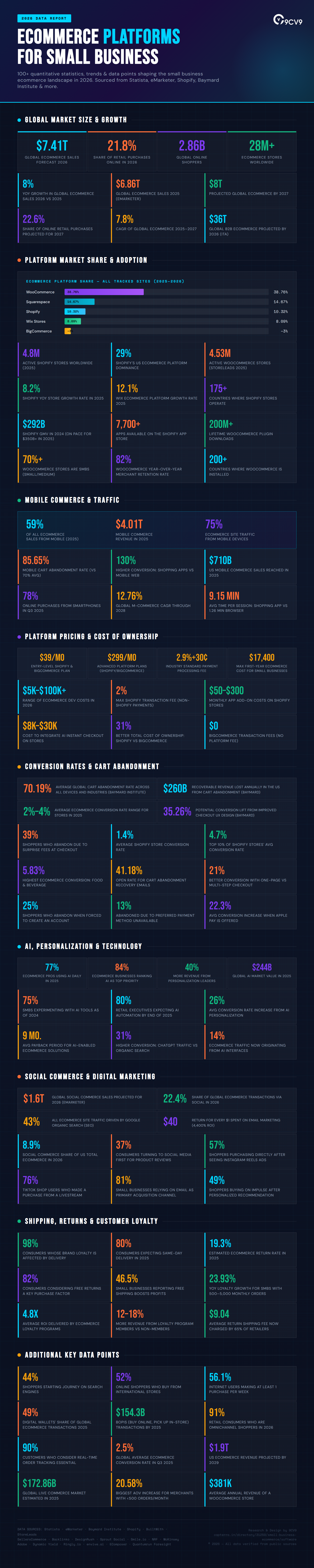
Conversion performance presents another major opportunity. The global average shopping cart abandonment rate stands at approximately 70.19%, while mobile abandonment can reach 85.65%. At the same time, research cited in the dataset indicates that resolving major checkout usability problems can potentially increase ecommerce conversions by as much as 35.26%. Additional fees, mandatory account creation and unavailable payment methods remain important sources of checkout friction. For small businesses, choosing an ecommerce platform with guest checkout, express payments, abandoned-cart recovery and flexible payment integrations can therefore have a direct impact on revenue.
Artificial intelligence is adding another dimension to the ecommerce platform market. According to the compiled statistics, 77% of ecommerce professionals were using AI tools daily in 2025, while 75% of small and medium-sized businesses were at least experimenting with AI tools as of 2024. AI-powered personalization, product recommendations, customer support, inventory forecasting and automation are increasingly becoming embedded directly into ecommerce software, making sophisticated capabilities accessible to businesses that previously lacked enterprise-level technology budgets.
Customer acquisition is evolving at the same time. Organic search reportedly generates 43% of ecommerce traffic, global social commerce sales are projected to exceed $1.6 trillion in 2026, and 52% of online shoppers have purchased products from retailers located in other countries. Digital wallets represented approximately 49%–56% of global ecommerce transaction value in 2025. Together, these trends show that modern ecommerce platforms must do considerably more than process online orders: they increasingly function as the central infrastructure connecting search, social commerce, mobile shopping, international sales, payments, shipping, loyalty and customer data.
In this guide to the Top 105 Ecommerce Platforms for Small Businesses Statistics, Data & Trends in 2026, we examine the most important numbers shaping the industry, from global ecommerce growth and platform market share to mobile commerce, pricing, conversion rates, cart abandonment, artificial intelligence, social commerce, shipping, returns and customer loyalty. These 105 ecommerce statistics provide small business owners, entrepreneurs, marketers, ecommerce professionals and decision-makers with a data-driven view of where online retail stands in 2026, where it is heading next, and which trends matter most when choosing and optimizing an ecommerce platform for sustainable growth.
Before we venture further into this article, we would like to share who we are and what we do.
About 9cv9
9cv9 is a business tech startup based in Singapore and Asia, with a strong presence all over the world.
With over ten years of startup and business experience, and being highly involved in connecting with thousands of companies and startups, the 9cv9 team has listed some of the top and best companies/tools in this review.
If you like to get your company listed in our top B2B software reviews, check out our world-class 9cv9 Media and PR service and pricing plans here.
Top 105 Ecommerce Platforms for Small Businesses Statistics, Data & Trends in 2026
🌐 Global Market Size & Growth
- Global eCommerce sales will surpass $7.41 trillion in 2026. This 8% year-over-year surge signals that small business owners who invest in robust ecommerce platforms today are positioning themselves to capture a growing slice of a multi-trillion dollar market. (Source: SellersCommerce/eMarketer)
- In 2026, 21.8% of all retail purchases are expected to happen online. For small businesses still reliant on physical storefronts, this data point makes a compelling case for prioritising a digital sales channel before competitors do. (Source: Statista via SellersCommerce)
- Global eCommerce sales reached $6.86 trillion in 2025, growing 8.3% year-over-year. This consistent double-digit growth trajectory reinforces the urgency for small businesses to adopt scalable ecommerce platforms capable of handling increasing demand. (Source: eMarketer via Webandcrafts)
- There are over 28 million eCommerce stores globally. With competition this dense, choosing the right small business ecommerce platform — one with strong SEO, UX, and conversion tools — is no longer optional, it’s a survival imperative. (Source: SellersCommerce)
- Global eCommerce is projected to reach $8 trillion by 2027. The sustained upward trajectory, growing at a 7.8% CAGR, offers small businesses a long-term runway to scale if they start building their digital infrastructure now. (Source: Webandcrafts/eMarketer)
- eCommerce sales in 2026 will represent an 8% increase from 2025. Even amid economic headwinds, digital retail continues to outpace physical retail growth by more than 2x, making ecommerce the highest-ROI channel for most SMBs. (Source: SellersCommerce)
- By 2027, online retail will account for 22.6% of all global retail transactions. The growing normalisation of online purchasing — even in categories like grocery and automotive — means small businesses must ensure their platforms support multiple product verticals. (Source: Statista)
- Global B2B eCommerce sales are projected to reach $36 trillion by 2026. For small businesses operating in the wholesale or B2B space, investing in platforms with native B2B features (like BigCommerce or Shopify Plus) is increasingly a strategic necessity. (Source: International Trade Administration)
- 2.86 billion people globally are making purchases from eCommerce platforms or social media stores. This massive and still-growing shopper base represents an unprecedented opportunity for small businesses to reach customers beyond their local geographies. (Source: SellersCommerce)
- Shopify and Wix together power a combined 49% of all online stores. Their joint dominance underscores how hosted, easy-to-use platforms have become the default infrastructure for entrepreneurs entering ecommerce. (Source: Flowlu)
🛒 Platform Market Share & Adoption
- WooCommerce holds a 38.76% share of all tracked eCommerce platform sites. Its deep integration with WordPress and free open-source model make it the dominant choice globally, especially for content-driven small businesses. (Source: MageComp/StoreLeads 2025)
- Shopify accounts for 10.32% of the global eCommerce platform market. While smaller by install count than WooCommerce, Shopify’s share among high-revenue merchants and its $292B GMV in 2024 highlight its outsized commercial impact. (Source: Electroiq/W3Techs)
- Shopify powers 29% of all US eCommerce platforms, making it the clear domestic leader. For small businesses targeting the American market, Shopify’s integrated payments, extensive app ecosystem, and merchant support offer unmatched advantages. (Source: Redstagfulfillment)
- There are 4.8 million active Shopify stores worldwide as of 2025. This scale translates into a mature developer and agency ecosystem, meaning small businesses can easily find qualified help to build and optimise their stores. (Source: Quantumrun)
- WooCommerce powers between 4.53 and 6 million active online stores globally. The wide variance reflects different measurement methodologies, but by any measure, WooCommerce is a cornerstone of the global small business ecommerce ecosystem. (Source: StoreLeads/BuiltWith 2025)
- Shopify grew its store count at 8.2% year-over-year in 2025. This continued growth signals strong merchant confidence in the platform, driven by improvements in checkout performance, AI tools, and the Shop Pay ecosystem. (Source: Redstagfulfillment)
- Wix eCommerce grew at 12.1% in 2025, the fastest among major hosted platforms. Wix’s growing share reflects its appeal to micro-businesses and solopreneurs who prioritise design flexibility and a low barrier to entry. (Source: Redstagfulfillment)
- WooCommerce experienced a -3.2% year-over-year decline in active stores in 2025. This contraction reflects a broader market shift toward hosted, managed platforms as small businesses seek simpler, lower-maintenance alternatives to self-hosted setups. (Source: Redstagfulfillment)
- Shopify’s GMV reached $292 billion in 2024 and is on pace to exceed $350 billion in 2025. This figure dwarfs WooCommerce’s estimated $30–35B GMV, highlighting Shopify’s dominance among high-volume, high-growth small and mid-market brands. (Source: Mobiloud)
- Shopify operates stores in over 175 countries worldwide. Its global infrastructure, multi-currency support, and international payment integrations make it the go-to platform for small businesses with cross-border ambitions. (Source: Colorwhistle)
- The Shopify App Store offers over 7,700 apps. This vast ecosystem enables small businesses to extend their store’s functionality — from subscriptions to loyalty programmes — without custom development. (Source: Colorwhistle)
- WooCommerce has been downloaded over 200 million times lifetime. This staggering adoption figure reflects its cost-effectiveness and the trust it has built across millions of small business developers and merchants. (Source: MarketingLTB)
- Over 70% of WooCommerce stores are operated by small to medium-sized businesses. This makes WooCommerce the platform most purpose-built by community usage for the SMB segment, even if it lacks Shopify’s native SMB-focused marketing. (Source: MarketingLTB)
- WooCommerce retains approximately 82% of its merchants year-over-year. This high retention rate suggests that despite competitive pressure, merchants who invest in WooCommerce tend to stick with it — likely due to switching costs and deep WordPress integration. (Source: MarketingLTB)
- WooCommerce is installed in over 200 countries. Its unmatched geographic reach, supported by 93 language localisations, makes it the most globally inclusive ecommerce platform for small businesses. (Source: MarketingLTB)
- Among the top 1 million eCommerce websites, Shopify holds 28.8% market share vs WooCommerce’s 18.2%. This gap reveals that Shopify disproportionately serves more established, higher-traffic businesses, making it the platform of choice for growth-oriented SMBs. (Source: Mobiloud/BuiltWith)
- Squarespace holds 14.67% of the eCommerce platform market. Its design-forward approach appeals to creative small businesses — photographers, boutiques, and service providers — who prioritise aesthetics alongside commerce. (Source: Electroiq)
- Wix Stores accounts for 8.09% of eCommerce platform usage. Wix’s drag-and-drop simplicity and competitive pricing make it a strong entry-level option, particularly for small businesses launching their first online store. (Source: Electroiq)
- The average conversion rate for Shopify stores is 1.4%. While this baseline lags behind the 2–4% industry average, stores that invest in checkout optimisation, personalisation, and abandoned cart recovery can close this gap significantly. (Source: Colorwhistle)
- The top 10% of Shopify stores achieve an average conversion rate of 4.7%. These top performers typically invest heavily in UX, speed optimisation, social proof, and AI-powered product recommendations to outperform the market. (Source: Colorwhistle)
📱 Mobile Commerce & Traffic
- Mobile commerce accounted for 59% of total eCommerce sales in 2025, generating approximately $4.01 trillion. For small businesses, this data makes mobile-first store design — not just mobile-responsive — a non-negotiable requirement. (Source: Statista via Backlinko)
- 75% of all eCommerce site traffic comes from mobile devices. Three-quarters of every potential customer visit happens on a phone, which means platform selection must prioritise mobile page speed, UX, and checkout flow above all else. (Source: SeoProfy via Ringly.io)
- US mobile commerce sales reached $710 billion in 2025. The scale of mobile-driven purchasing in the US market alone means that any small business ecommerce platform without robust mobile capabilities is leaving significant revenue on the table. (Source: Statista via Backlinko)
- Mobile cart abandonment stands at 85.65%, well above the 70.19% average. This elevated abandonment rate reveals the friction-heavy nature of mobile checkout, making one-tap payment options like Apple Pay and Google Pay essential for SMBs targeting mobile shoppers. (Source: Quantumrun)
- Shopping apps convert at 130% higher rates than mobile websites. Small businesses investing in branded mobile apps or progressive web apps (PWAs) can nearly double their conversion rates compared to standard mobile browser experiences. (Source: Quantumrun)
- In Q3 2025, smartphones accounted for 78% of total online purchases. The gap between mobile traffic and mobile conversions is narrowing rapidly — driven by improvements in one-click checkout and digital wallets. (Source: Ringly.io)
- The global m-Commerce market is growing at a 12.76% CAGR through 2028. This accelerating growth rate means the small businesses that optimise for mobile commerce today will benefit from compounding advantages as the market matures. (Source: Quantumrun)
- Shopping app users spend an average of 9.15 minutes per session, compared to just 1.26 minutes on mobile browsers. The dramatic difference in session depth underscores why app-first commerce drives higher engagement, basket sizes, and brand loyalty. (Source: Quantumrun)
- The Asia-Pacific region held the largest mobile commerce market share in 2025 at $954.65 billion. Small businesses with export or cross-border ambitions should ensure their ecommerce platforms support APAC-relevant payment methods and currencies. (Source: Quantumrun)
- Desktop and mobile conversion rates have reached parity at approximately 2.8% in 2025. After years of mobile underperforming, this convergence signals that investments in mobile checkout optimisation are finally paying dividends across the industry. (Source: Smart Insights via Ringly.io)
💰 Platform Pricing & Cost of Ownership
- Entry-level plans for Shopify and BigCommerce both start at $39/month. While this price point is accessible for most small businesses, the true cost of ownership — including apps, payment processing, and themes — often triples within the first year. (Source: Printify/Wizcommerce)
- Advanced platform plans for Shopify and BigCommerce range from $299 to $399/month. Businesses scaling past $1M in annual revenue will find these tiers necessary, and should factor in added app costs when comparing total investment. (Source: Datafeedwatch)
- The industry standard payment processing fee is 2.9% + 30¢ per transaction. For small businesses with tight margins, this fee compounds quickly at scale — making platforms that offer reduced rates through native payment solutions (like Shopify Payments) commercially significant. (Source: PremierDigitalMarketers)
- Small businesses can expect total first-year eCommerce costs between $3,600 and $17,400. This range accounts for platform fees, apps, themes, and setup costs — and underscores the importance of accurate budgeting before platform selection. (Source: PremierDigitalMarketers)
- eCommerce development costs in 2026 range from $5,000 to over $100,000. The wide range reflects platform complexity, custom feature requirements, and AI integrations — with Shopify-based builds typically at the lower end and custom headless architectures at the top. (Source: Dbsoftware)
- Shopify charges up to a 2% transaction fee when not using Shopify Payments. For high-volume small businesses using third-party processors, this fee can represent thousands of dollars annually — making BigCommerce’s zero-transaction-fee model an attractive alternative. (Source: Datafeedwatch)
- Shopify app add-ons can add $50 to $300 per month to operating expenses. Small businesses should audit their app stack quarterly to eliminate redundancies and ensure each tool delivers measurable ROI. (Source: Platter)
- Integrating AI Instant Checkout (e.g. for ChatGPT agents) adds $8,000 to $30,000 to development costs. While expensive, this investment positions small businesses at the forefront of agentic commerce — a channel that currently converts 31% higher than standard organic traffic. (Source: Dbsoftware)
- Shopify delivers 31% better total cost of ownership than BigCommerce, with 88% lower implementation costs. This finding challenges the assumption that BigCommerce is the more cost-effective choice, particularly when accounting for faster deployment and lower developer fees. (Source: Platter)
- BigCommerce charges zero platform transaction fees, regardless of the payment processor used. This distinguishing feature can save growing small businesses thousands of dollars annually compared to Shopify’s transaction fee structure. (Source: Wizcommerce)
🔄 Conversion Rates & Cart Abandonment
- The global average cart abandonment rate is 70.19% across all industries and devices. Meaning nearly 7 in 10 shoppers who add items to their cart never complete a purchase — representing the single largest untapped revenue opportunity for most small ecommerce businesses. (Source: Baymard Institute via Opensend)
- An estimated $260 billion in revenue is recoverable annually in the US from cart abandonment alone. Baymard Institute’s research suggests that improving checkout UX design — without discounts — is sufficient to recapture a significant portion of this lost revenue. (Source: Baymard Institute)
- The overall eCommerce conversion rate ranges between 2% and 4% in 2025. Small businesses falling below this benchmark should prioritise checkout simplification, trust signals, and personalisation before investing in traffic acquisition. (Source: Swell.is)
- Fixing major checkout UX issues can increase eCommerce conversions by up to 35.26%. Baymard’s decade of large-scale testing confirms that the average ecommerce site has 39 addressable UX failure points — many of which are free to fix. (Source: Baymard Institute)
- 39% of shoppers abandon carts when surprised by additional fees at checkout. Full cost transparency — displaying shipping, taxes, and fees early in the shopping journey — is one of the highest-ROI changes any small business can make to its checkout flow. (Source: Baymard via Redstagfulfillment)
- 25% of shoppers abandon when forced to create an account during checkout. Offering guest checkout is among the most impactful single optimisations a small business can implement, with essentially zero cost and immediate conversion improvement. (Source: Yaguara)
- 13% of shoppers abandon specifically because their preferred payment method is unavailable. Expanding to include digital wallets, BNPL options, and regional payment methods is increasingly a baseline expectation rather than a nice-to-have. (Source: Growth-engines.com)
- Abandoned cart recovery emails achieve open rates of 41.18%. This is extraordinarily high compared to standard marketing emails, making cart recovery automation one of the most cost-effective tools in any small business ecommerce stack. (Source: Triple Whale)
- Sites using one-page or express checkout see up to 21% better conversion than multi-step flows. For small businesses on Shopify, enabling Shop Pay or another express checkout method is a low-effort, high-return optimisation. (Source: Triple Whale)
- Businesses offering Apple Pay saw an average 22.3% increase in conversion rates. The frictionless, biometric-authenticated checkout experience removes one of the biggest mobile conversion barriers, making digital wallet integration critical for SMBs. (Source: Growth-engines.com)
- Food and beverage eCommerce achieves the highest conversion rate at 5.83%. Low price points, consumable nature, and repeat purchase behaviour make this one of the most accessible verticals for small business ecommerce success. (Source: Dynamic Yield via Ringly.io)
- Luxury and jewellery eCommerce has the lowest conversion rate at 0.87%. High consideration, trust barriers, and price sensitivity in this vertical mean small businesses must invest heavily in social proof, photography, and personalised service. (Source: Dynamic Yield)
- BNPL (Buy Now, Pay Later) services drive a 2.1% increase in average conversion rates for brands offering them. For small businesses selling higher-ticket items, integrating a BNPL option through their ecommerce platform can meaningfully increase transaction completion. (Source: Live Sell Academy)
🤖 AI, Personalization & Technology
- 77% of eCommerce professionals use AI tools daily in 2025, up from 69% in 2024. AI has rapidly shifted from experimental to essential, and small businesses that haven’t integrated AI into their ecommerce operations risk falling behind more tech-forward competitors. (Source: EComposer)
- 84% of eCommerce businesses now rank AI as their top technology priority. This near-universal consensus reflects AI’s proven impact on personalisation, inventory management, fraud detection, and customer service automation. (Source: Quantumrun)
- 75% of small and medium-sized businesses (SMBs) are at least experimenting with AI tools as of 2024. Encouragingly, AI adoption is no longer an enterprise-only phenomenon — affordable tools integrated directly into platforms like Shopify are making AI accessible to even micro-businesses. (Source: Shopify)
- 80% of retail executives expect their companies to adopt AI-powered automation by the end of 2025. The executive alignment on AI investment signals that competitive pressure will make AI adoption unavoidable for SMBs looking to retain parity with larger rivals. (Source: EComposer)
- AI personalization drives an average 26% increase in conversion rates. Platforms and apps that serve AI-powered product recommendations — dynamically adjusted for each visitor — deliver one of the strongest measurable ROI lifts available to small ecommerce businesses. (Source: envive.ai)
- Companies leveraging AI personalization generate 40% more revenue than average players. This staggering revenue gap underscores the compounding commercial advantage of personalisation at scale — a capability now available to small businesses through affordable SaaS tools. (Source: envive.ai)
- The payback period for AI-enabled eCommerce solutions averages just 9 months. With 89% of companies reporting positive ROI from AI investments, the financial case for small businesses to adopt AI-powered tools has never been stronger. (Source: envive.ai)
- ChatGPT-referred eCommerce traffic converts 31% higher than non-branded organic search. This emerging channel — AI-driven product discovery — represents a significant new acquisition opportunity for small businesses that optimise their product listings for AI-mode visibility. (Source: Ringly.io)
- 14% of eCommerce traffic now originates from AI interfaces. A channel that didn’t exist 18 months ago is already material — small businesses that optimise for agentic storefronts and AI-powered search are accessing traffic their competitors cannot. (Source: Digitalapplied.com)
- The global AI market is valued at $244 billion in 2025 and projected to exceed $1 trillion by 2031. The scale of AI investment signals that AI-powered ecommerce capabilities will continue improving rapidly, making now the right time for small businesses to start building AI literacy. (Source: Shopify)
- Machine learning investment in retail is projected to reach $20 billion by 2026. Retail’s leading role in ML adoption reflects how concretely data-driven AI delivers measurable results in product recommendations, demand forecasting, and fraud prevention. (Source: envive.ai)
📲 Social Commerce & Digital Marketing
- Global social commerce sales are projected to surpass $1.6 trillion in 2026, a 33% year-over-year increase. The explosive growth of in-app purchasing across TikTok, Instagram, and Facebook has transformed social media from a discovery channel into a full-stack commerce platform. (Source: eMarketer via Amraandelma)
- Social commerce will represent 22.4% of all global eCommerce transactions in 2026, up from 17% in 2025. For small businesses, integrating native shop features into their social channels is no longer optional — it’s where nearly a quarter of online purchases will happen. (Source: Statista via Amraandelma)
- Social commerce will account for 8.9% of all US eCommerce sales in 2026. While the US trails Southeast Asia in social commerce adoption, the trajectory is clear — and small businesses that build creator and influencer partnerships now will have a first-mover advantage. (Source: SellersCommerce)
- Organic search drives 43% of all eCommerce traffic, making SEO the single largest traffic channel. For budget-conscious small businesses that can’t afford aggressive paid media campaigns, investing in platform-native SEO tools and content marketing remains the highest long-term ROI strategy. (Source: Flowlu)
- Email marketing generates $40 for every $1 spent, a 4,400% ROI. For small businesses, email remains the most cost-effective retention and re-engagement tool — particularly when segmented and automated through ecommerce platform integrations. (Source: Yaguara)
- 81% of small businesses still rely on email as their primary customer acquisition channel. The continued dominance of email — despite the rise of social and AI channels — reflects its unmatched ROI and direct ownership of customer relationships. (Source: Yaguara)
- 37% of consumers turn to social media first when looking for product reviews and recommendations. Small businesses that build strong social proof through user-generated content and creator partnerships are meeting consumers at their primary discovery touchpoint. (Source: Sprout Social)
- 57% of shoppers have purchased directly after seeing Instagram Reels ads. This strikingly high purchase intent from short-form video content makes Reels one of the most commercially potent formats available to small business ecommerce advertisers. (Source: MarketingLTB)
- 76% of TikTok Shop users who engaged with a livestream made a purchase from it. Live commerce — still nascent in Western markets — delivers extraordinary purchase intent, making it a powerful channel for small businesses with charismatic founders or content creators. (Source: TikTok via Sprout Social)
- 49% of shoppers say they bought a product on impulse after receiving a personalised recommendation. For small businesses, this data validates the ROI of personalisation engines and recommendation tools — consumers don’t just tolerate personalisation, they respond to it commercially. (Source: Flowlu)
- The global live commerce market was estimated at $172.86 billion in 2025. The scale of this relatively young format — dominated by Asian markets but growing rapidly in the West — signals a major upcoming opportunity for small businesses willing to invest in livestream commerce. (Source: Sprout Social)
🚚 Shipping, Returns & Customer Loyalty
- 98% of consumers say the delivery experience affects their brand loyalty. Shipping is not a back-office function — it is a front-line brand touchpoint, and small businesses that partner their ecommerce platform with reliable fulfilment solutions will see direct loyalty dividends. (Source: Ringly.io)
- 80% of consumers expect same-day delivery in 2025. While this expectation is challenging for most small businesses to meet independently, platform integrations with local delivery partners and fulfilment networks are increasingly making same-day shipping achievable. (Source: Ringly.io)
- eCommerce return rates are estimated at 19.3% in 2025, with projections of up to 24.5% by 2026. Nearly 1 in 5 online orders is returned, making returns management capability a critical criterion when evaluating ecommerce platforms for small businesses. (Source: Return Prime via Ringly.io)
- 82% of consumers consider free returns a key purchase factor. Yet 65% of merchants now charge return shipping fees averaging $9.04 — creating a strategic tension that small businesses must resolve based on their margin structure and customer lifetime value. (Source: eFulfillment Service via Ringly.io)
- 46.5% of small businesses report that offering free shipping boosts their profits. Despite the upfront cost, free shipping reduces abandonment, increases average order values, and drives repeat purchase rates — delivering net positive economics for most SMBs. (Source: Yaguara)
- 90% of customers consider real-time order tracking essential. Small businesses that integrate their ecommerce platform with branded tracking notifications and delivery updates will see meaningful improvements in post-purchase satisfaction and repeat rates. (Source: Ringly.io)
- SMBs processing 500–5,000 monthly orders saw the greatest loyalty program growth at 23.93% YoY. This growth bracket — the classic “scaling SMB” — demonstrates that loyalty programs deliver their strongest returns precisely at the stage when businesses need retention most. (Source: Smile.io)
- Merchants with fewer than 500 orders per month saw the biggest average order value increase at 20.58%. Even at small scale, customer loyalty programs and personalised engagement strategies are driving measurable uplift in basket size. (Source: Smile.io)
- Loyalty programs deliver an average 4.8x ROI, with top-performing programs achieving 7.2x. For small businesses deploying loyalty tools through their ecommerce platform, the compounding effect on retention, referral rates, and lifetime value is substantial. (Source: envive.ai)
- Loyalty program members generate 12–18% more revenue than non-members. The revenue premium from engaged loyalty members — which rises to 23% for premium tier members — makes loyalty program investment one of the highest-return line items in a small business marketing budget. (Source: Accenture via envive.ai)
- Each eCommerce return costs retailers between $10 and $65. At a 19.3% return rate, a small business doing $500K in annual revenue may be absorbing $15,000–$50,000 in return costs — making returns management a significant financial lever. (Source: eFulfillment Service)
🔗 Additional Key Data Points
- 44% of shoppers begin their product search on a search engine. SEO-optimised product pages, structured data, and fast page loads on ecommerce platforms are essential for capturing this high-intent search traffic before it reaches a competitor. (Source: SellersCommerce)
- 52% of online shoppers have purchased products from retailers in other countries. Cross-border commerce represents a massive incremental opportunity for small businesses — enabled by ecommerce platforms with multi-currency, multi-language, and international shipping integrations. (Source: Flowlu)
- 56.1% of internet users make at least one online purchase per week. The normalisation of frequent online purchasing means that customer retention — not just acquisition — is increasingly the primary growth lever for small business ecommerce operators. (Source: DesignRush)
- Digital wallets accounted for 49–56% of global eCommerce transaction value in 2025. The dominance of Apple Pay, Google Pay, and PayPal means small businesses without digital wallet integrations are creating friction for the majority of their shoppers at the final step. (Source: Stripe/Growth-engines.com)
- BOPIS (Buy Online, Pick Up In-Store) transactions are projected to reach $154.3 billion by 2025. For small businesses with physical locations, integrating BOPIS through their ecommerce platform creates a powerful omnichannel advantage that pure-play online competitors cannot match. (Source: envive.ai)
- 91% of retail consumers are omnichannel shoppers in 2026. The overwhelming majority of customers expect a seamless experience across social, mobile, and web — making platform selection that supports unified inventory and customer data critical for SMBs. (Source: Sprout Social)
- The average annual revenue of a WooCommerce store is approximately $381,000. This benchmark helps small businesses using WooCommerce calibrate growth expectations and identify whether they’re outperforming or underperforming their peer group. (Source: Aftership via Uptek)
- The US eCommerce market is projected to reach $1.9 trillion by 2029. The domestic runway for small business ecommerce growth remains vast — particularly as traditionally offline categories like healthcare, automotive, and food services continue their digital transformation. (Source: Digital Silk via GoFTX)
- Headless eCommerce adoption has grown from 6% in 2024 to 14% in 2026, with projections of 25% by 2028. While currently an enterprise technology, headless architecture’s 18% conversion lift and 31% page speed improvement signal the direction of the market for ambitious SMBs. (Source: Digitalapplied.com)
Conclusion
The Top 105 Ecommerce Platforms for Small Businesses Statistics, Data & Trends in 2026 reveal an ecommerce market that continues to expand rapidly while becoming more competitive, mobile-driven, AI-enabled and customer-centric. With global ecommerce sales projected to surpass $7.41 trillion in 2026 and online transactions expected to represent 21.8% of worldwide retail purchases, ecommerce is increasingly becoming a fundamental sales channel rather than an optional extension of a physical business. For small businesses, the opportunity is enormous, but capturing it requires the right combination of technology, customer experience and digital strategy.
Platform competition illustrates how diverse those technology requirements have become. WooCommerce holds 38.76% of tracked ecommerce platform sites in the compiled research, while Shopify accounts for 10.32% of the global ecommerce platform market and approximately 29% of ecommerce platforms in the United States. Shopify, WooCommerce, Wix, Squarespace, BigCommerce and other solutions are competing not simply on website-building capabilities, but increasingly on payments, automation, international commerce, mobile experiences, integrations, marketing and scalability. The best ecommerce platform for a small business in 2026 therefore depends less on which provider is universally “best” and more on which platform aligns with the company’s budget, technical capabilities, growth plans and customer journey.
Mobile commerce is one of the clearest priorities emerging from the data. Mobile commerce generated approximately 59% of ecommerce sales in 2025, while mobile devices accounted for an estimated 75% of ecommerce website traffic. Yet mobile cart abandonment can reach 85.65%, highlighting the enormous gap between attracting mobile shoppers and successfully converting them. Small businesses should consequently prioritize mobile-first design, fast storefront performance, simple navigation, guest checkout, digital wallets and frictionless payment experiences when evaluating ecommerce software.
Conversion optimization may be equally important. The global cart abandonment rate stands at approximately 70.19%, representing a substantial pool of potentially recoverable revenue. The research also indicates that addressing major checkout usability problems can improve ecommerce conversions by as much as 35.26%. With additional fees, forced account creation and missing payment methods contributing to abandonment, seemingly small improvements to checkout design can potentially produce significant commercial results without requiring businesses to spend more on customer acquisition.
Artificial intelligence is meanwhile becoming embedded throughout the ecommerce technology stack. The dataset shows that 77% of ecommerce professionals used AI tools daily in 2025, while 75% of SMBs were at least experimenting with AI tools as of 2024. From personalized product recommendations and customer service automation to inventory management and marketing optimization, AI is increasingly giving smaller merchants access to capabilities that were previously concentrated among large retailers. This shift could make the AI capabilities and integrations offered by ecommerce platforms an increasingly important selection criterion throughout 2026 and beyond.
The customer journey itself is also becoming increasingly fragmented across search engines, social platforms, mobile devices, marketplaces and international storefronts. Global social commerce sales are projected to exceed $1.6 trillion in 2026, organic search reportedly generates 43% of ecommerce traffic, and 52% of online shoppers have purchased from retailers in other countries. Small businesses therefore need ecommerce platforms capable of supporting omnichannel discovery, cross-border transactions, multiple payment methods and consistent customer experiences across an expanding number of digital touchpoints.
Ultimately, the ecommerce statistics and trends for 2026 point toward one central conclusion: the ecommerce platform is becoming the operating foundation of the modern small retail business. Price remains important, but businesses should evaluate total cost of ownership alongside mobile performance, conversion tools, SEO capabilities, payments, AI functionality, social commerce integrations, international selling, shipping, returns, analytics and customer retention features.
For entrepreneurs and small business owners planning their next stage of growth, these 105 ecommerce platform statistics for 2026 provide more than a snapshot of the market. They offer a data-driven framework for understanding where customers are shopping, how purchasing behavior is changing, which technologies are gaining importance and where ecommerce growth opportunities are emerging. Businesses that use these trends to select adaptable platforms, reduce purchasing friction and continuously improve the customer experience will be better positioned to compete as global ecommerce moves toward the projected $8 trillion mark by 2027.
If you find this article useful, why not share it with your hiring manager and C-level suite friends and also leave a nice comment below?
We, at the 9cv9 Research Team, strive to bring the latest and most meaningful data, guides, and statistics to your doorstep.
To get access to top-quality guides, click over to 9cv9 Blog.
To hire top talents using our modern AI-powered recruitment agency, find out more at 9cv9 Modern AI-Powered Recruitment Agency.
People Also Ask
What are the best ecommerce platforms for small businesses in 2026?
Shopify, WooCommerce, Wix, Squarespace and BigCommerce are among the major ecommerce platforms used by small businesses. The best choice depends on budget, technical skills, scalability, payment options and required features.
How big is the global ecommerce market in 2026?
Global ecommerce sales are projected to surpass $7.41 trillion in 2026, representing approximately 8% growth from 2025. This expanding market creates significant opportunities for small businesses selling products online.
What percentage of retail purchases will happen online in 2026?
Approximately 21.8% of global retail purchases are expected to occur online in 2026. By 2027, online retail is projected to represent about 22.6% of global retail transactions.
How many ecommerce stores are there worldwide?
There are more than 28 million ecommerce stores globally. This large competitive landscape makes platform selection, SEO, user experience, mobile optimization and conversion performance increasingly important for small businesses.
What is the most popular ecommerce platform in 2026?
WooCommerce holds 38.76% of tracked ecommerce platform sites in the research, giving it the largest share by this measure. Its WordPress integration and open-source model make it particularly popular with smaller businesses.
What is Shopify’s ecommerce market share?
Shopify accounts for approximately 10.32% of the global ecommerce platform market in the dataset. Among US ecommerce platforms, its share reaches approximately 29%, making Shopify especially prominent in the American market.
How many Shopify stores are there worldwide?
Approximately 4.8 million active Shopify stores operated worldwide as of 2025. Shopify also supports merchants across more than 175 countries, giving small businesses extensive infrastructure for domestic and international ecommerce.
How many WooCommerce stores are there worldwide?
WooCommerce powers an estimated 4.53 million to 6 million active online stores globally, depending on the measurement methodology. It has also accumulated more than 200 million lifetime downloads.
Is Shopify or WooCommerce more popular among high-traffic ecommerce websites?
Among the top one million ecommerce websites, Shopify holds approximately 28.8% market share compared with WooCommerce at 18.2%, according to the research dataset. This indicates Shopify has particularly strong representation among larger ecommerce sites.
How important is mobile commerce for small businesses in 2026?
Mobile commerce accounted for approximately 59% of total ecommerce sales in 2025, generating around $4.01 trillion. Mobile-first design, fast loading and frictionless checkout are therefore essential considerations for small businesses.
What percentage of ecommerce traffic comes from mobile devices?
Approximately 75% of ecommerce website traffic comes from mobile devices, according to the compiled research. This means small businesses should prioritize mobile usability, page speed, product discovery and checkout performance.
What is the average mobile cart abandonment rate?
Mobile cart abandonment stands at approximately 85.65%, significantly above the overall ecommerce average. Simplifying checkout and supporting convenient digital payment methods can help small businesses address mobile purchasing friction.
What is the average ecommerce cart abandonment rate?
The global average ecommerce cart abandonment rate is approximately 70.19%. This means nearly seven out of every ten shopping carts are abandoned before purchase, creating a major conversion opportunity for online retailers.
Why do customers abandon their ecommerce carts?
Common reasons include unexpected additional costs, mandatory account creation and unavailable payment methods. The research reports that 39% abandon because of additional fees and 25% because they are forced to create an account.
What is a good ecommerce conversion rate in 2026?
Overall ecommerce conversion rates ranged between approximately 2% and 4% in 2025. Conversion performance varies considerably by industry, device, traffic quality, product pricing and the quality of the shopping experience.
What is the average Shopify conversion rate?
The average Shopify store conversion rate is approximately 1.4% in the compiled research. However, the top 10% of Shopify stores achieve an average conversion rate of about 4.7%.
Can improving ecommerce checkout increase conversion rates?
Yes. Research cited in the dataset indicates that resolving major checkout UX issues can increase ecommerce conversion rates by as much as 35.26%, making checkout optimization a potentially powerful growth strategy.
How much does an ecommerce platform cost for a small business?
Entry-level Shopify and BigCommerce plans start at $39 per month in the dataset. However, small businesses can face total first-year ecommerce costs ranging from approximately $3,600 to $17,400 after setup, apps and other expenses.
How much does ecommerce website development cost in 2026?
Ecommerce development costs in 2026 can range from approximately $5,000 to more than $100,000. Costs vary significantly depending on platform choice, customization, integrations, AI functionality and technical complexity.
How much do Shopify apps cost small businesses?
Shopify app add-ons can contribute approximately $50 to $300 per month in additional operating expenses. Businesses should therefore evaluate total platform costs rather than comparing ecommerce platforms solely by their advertised subscription prices.
How is AI changing ecommerce in 2026?
AI is increasingly used for personalization, recommendations, automation, customer service and inventory management. The dataset reports that 77% of ecommerce professionals used AI tools daily in 2025, up from 69% in 2024.
Are small businesses using AI for ecommerce?
Yes. Approximately 75% of small and medium-sized businesses were at least experimenting with AI tools as of 2024, indicating that AI adoption is no longer limited to large ecommerce companies.
Does AI personalization improve ecommerce conversions?
The research dataset reports that AI personalization can produce an average 26% increase in conversion rates. Personalized recommendations can help ecommerce businesses present more relevant products and experiences to individual shoppers.
How big will social commerce be in 2026?
Global social commerce sales are projected to surpass $1.6 trillion in 2026, representing approximately 33% year-over-year growth. Social platforms are increasingly becoming direct shopping and transaction channels.
How important is SEO for ecommerce businesses?
Organic search generates approximately 43% of ecommerce traffic according to the dataset. Strong SEO, optimized product pages, structured data, useful content and fast website performance can therefore be important acquisition drivers for small businesses.
What percentage of ecommerce transactions use digital wallets?
Digital wallets accounted for approximately 49% to 56% of global ecommerce transaction value in 2025. Supporting options such as Apple Pay, Google Pay and PayPal can reduce payment friction for online shoppers.
How important is international ecommerce for small businesses?
Cross-border ecommerce represents a substantial opportunity, with 52% of online shoppers having purchased products from retailers in other countries. Multi-currency, multilingual and international shipping capabilities can help small businesses reach these customers.
What is the average ecommerce return rate?
Ecommerce return rates were estimated at approximately 19.3% in 2025, with projections reaching as high as 24.5% in 2026. Returns management is therefore an important consideration when selecting ecommerce technology.
Do loyalty programs help small ecommerce businesses?
Yes. The research reports an average 4.8x ROI for loyalty programs, while top-performing programs can reach 7.2x. Loyalty members are also reported to generate 12% to 18% more revenue than non-members.
What ecommerce trends should small businesses watch in 2026?
Key ecommerce trends include mobile-first shopping, AI personalization, social commerce, digital wallets, cross-border selling, omnichannel retail, loyalty programs and headless commerce. Businesses should prioritize trends that improve conversion, retention and scalability.
Sources
SellersCommerce Backlinko Quantumrun Foresight DesignRush Bluehost Red Stag Fulfillment ColorWhistle ElectroIQ MobiLoud MarketingLTB Swell Opensend Triple Whale Growth Engines Shopify EComposer Envive Amra & Elma Sprout Social Flowlu Smile Ringly Digital Applied Printify WizCommerce Premier Digital Marketers Platter DBB Software Yaguara Webandcrafts