



























Key Takeaways
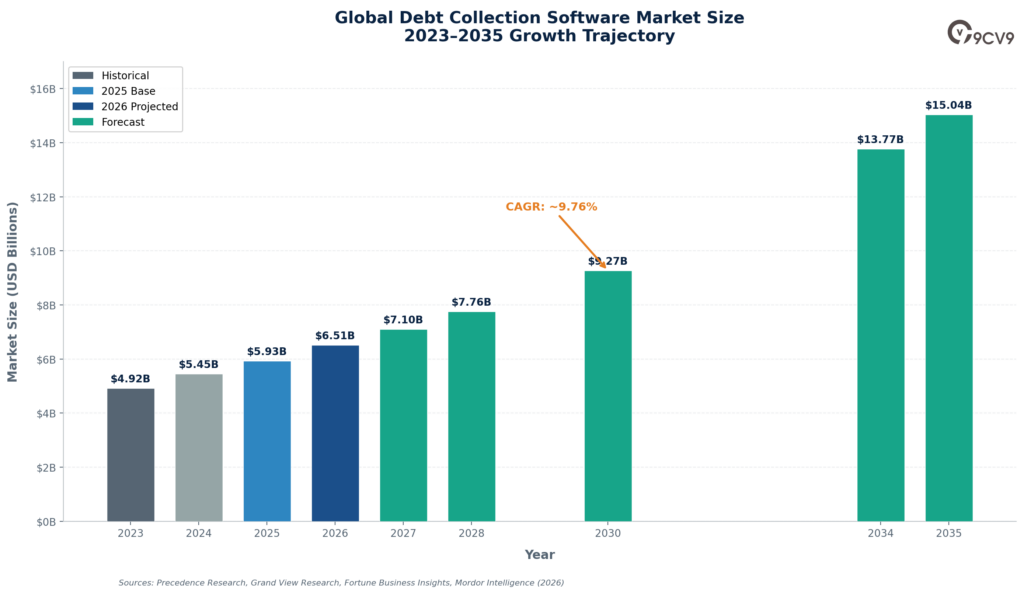
- The global debt collection software market is valued at $6.51 billion in 2026 and is projected to reach $15.04 billion by 2035, driven by AI, automation and digital collections.
- AI is transforming debt collection performance, with automation capable of reducing debtor coverage costs by up to 70%, improving recovery rates and delivering 2–4× higher collector productivity.
- Cloud and omnichannel debt collection are becoming industry standards, with cloud platforms accounting for about 69% of global usage and digital collections improving recovery by 20–30% over traditional methods.
Debt collection software is transforming financial recovery in 2026 as AI, automation, cloud platforms, and predictive analytics help organizations manage rising delinquency more efficiently. The global market stands at approximately $6.51 billion in 2026, while digital collections can improve recovery rates by 20–30% compared with traditional methods.
Debt collection software is entering a major growth cycle in 2026 as rising household debt, higher delinquency rates, artificial intelligence, cloud adoption, regulatory complexity, and digital-first repayment behavior reshape how organizations recover outstanding balances. The global debt collection software market is valued at approximately $6.51 billion in 2026 and is projected to reach $15.04 billion by 2035, representing a compound annual growth rate of 9.76%. Other market forecasts in the dataset point in a similar direction, including projections of $9.27 billion by 2030, $12.45 billion by 2033, and $13.2 billion by 2035.
Also, read our top guide on the Top 10 Best Debt Collection Software.

These debt collection software statistics reveal an industry moving well beyond traditional call-center operations. Modern platforms increasingly combine artificial intelligence, predictive analytics, workflow automation, omnichannel communications, compliance monitoring, payment processing, self-service portals, machine learning, and API integrations. Instead of simply providing collectors with databases of overdue accounts, debt collection technology is becoming an intelligent decision-making layer capable of determining which accounts should receive attention, when borrowers should be contacted, which communication channel should be used, and when human intervention is necessary.
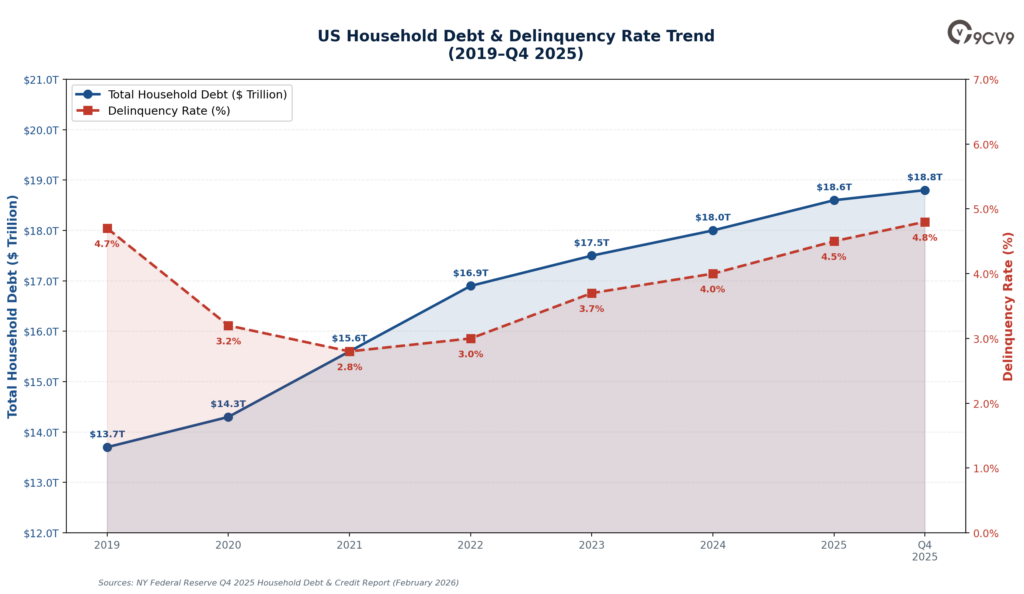
The economic environment is strengthening the business case for these technologies. Total US household debt reached $18.8 trillion in Q4 2025 after increasing by another $191 billion during the quarter. Aggregate delinquency rates climbed to 4.8%, their highest level in nearly a decade. Credit card balances exceeded $1.21 trillion, outstanding student loan debt reached $1.66 trillion, auto loan balances stood at approximately $1.66 trillion, and mortgage debt reached $13.17 trillion. Non-mortgage consumer credit also crossed $5 trillion by the end of 2025.

Student loans illustrate the scale of the emerging collection challenge particularly clearly. According to the statistics compiled for this report, student loan serious delinquency of 90 days or more increased from 0.70% in Q4 2024 to 16.19% in Q4 2025. Approximately 25% of student loan borrowers were estimated to be delinquent in early 2026, while roughly one million borrowers more than 120 days past due had their accounts transferred to the Department of Education Default Resolution Group. Such dramatic changes in delinquency volumes increase the operational burden on creditors and demonstrate why scalable collection infrastructure is becoming increasingly important.
The trend is not limited to consumers. US non-financial business debt had already reached $21.55 trillion in Q4 2024, representing an increase of 27% since 2019. There were 23,107 US business bankruptcy filings in 2024, compared with 18,926 in 2023, while approximately $1.8 trillion of commercial real estate loans were expected to mature by 2026. At the same time, 55% of US B2B sales were reportedly paid late in 2023, with average Days Sales Outstanding reaching 49 days. Together, these indicators broaden the potential market for collection and receivables software beyond consumer lenders into commercial credit, B2B receivables, real estate, healthcare, telecommunications, government and other industries.
AI Is Becoming Central to Debt Collection Software in 2026
Artificial intelligence represents one of the most consequential debt collection software trends in 2026. The statistics compiled in this report indicate that AI can reduce debtor coverage costs by as much as 70%, eliminate more than 90% of manual collection efforts in certain workflows, and enable operations to run up to eight times faster than manual processes. AI-driven predictive scoring has been associated with an average 25% improvement in recovery rates, while conversational AI and chatbots can manage as much as 80% of routine debtor queries.
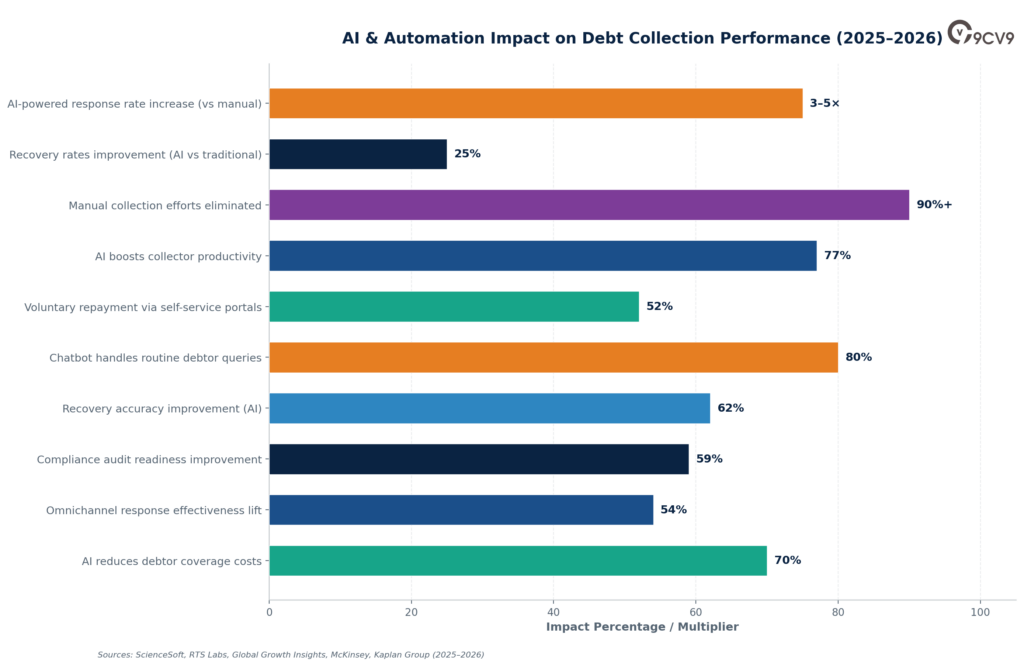
The potential improvement in engagement is equally significant. AI-powered outreach is reported to generate response rates as much as 10 times higher than manual approaches, while machine-learning personalization of communication timing and channels can produce three to five times better response rates. AI-driven solutions have also reported a 46% improvement in collection rates compared with traditional systems, alongside two to four times greater collector productivity.
These improvements help explain why the AI segment of debt collection technology is expanding considerably faster than the overall software category. The global AI for debt collection market is projected to grow from $3.34 billion in 2024 to $15.9 billion by 2034. More than 40% of debt collection agencies are expected to adopt AI-powered software by 2026, while estimates in the dataset place growth in the AI debt collection market at approximately 16% to 25% annually.
Predictive analytics is already becoming mainstream. Fifty-eight percent of service providers use predictive analytics to anticipate debtor behavior and optimize recovery strategies, while 62% of organizations report improved recovery accuracy through predictive analytics. Another 63% of enterprises consider data-driven recovery prioritization a core platform requirement, and 62% of financial institutions emphasize the adoption of AI-driven recovery analytics. These figures suggest that the competitive battleground is shifting from basic workflow digitization toward the quality of the intelligence embedded within collection platforms.
Cloud Debt Collection Software Is Becoming the Default
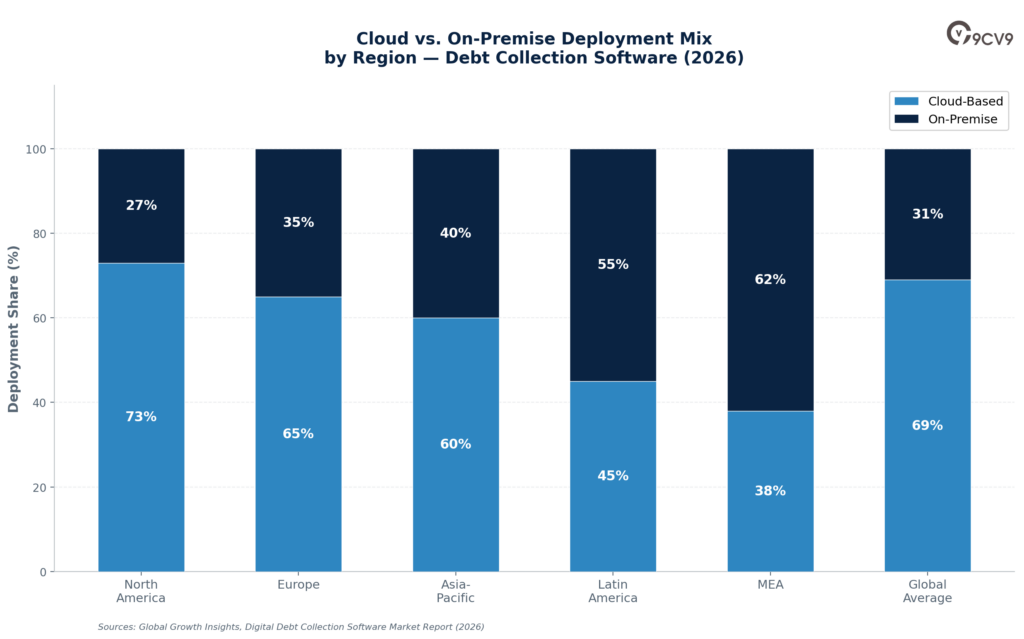
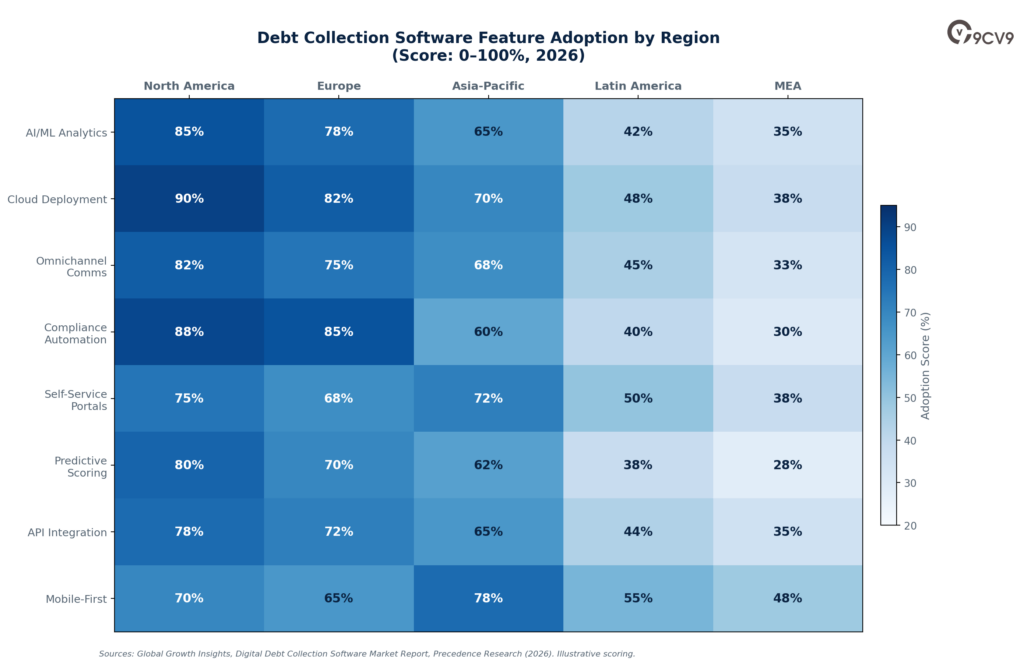
Cloud migration represents another defining debt collection software trend for 2026. Approximately 69% of global debt collection software usage is associated with cloud-based deployment, while the proportion reaches approximately 73% in the United States. Cloud deployments are expanding at a reported 13.60% CAGR, considerably faster than the overall debt collection software market.
This migration reflects more than infrastructure modernization. Cloud-based collection software gives organizations greater flexibility to deploy AI capabilities, integrate external systems, support distributed teams, introduce new communication channels and scale collection volumes without maintaining large amounts of internal infrastructure.
Approximately 68% of financial institutions are transitioning toward automated digital collection platforms, while more than 65% had already integrated automated collection solutions by 2024. Among leading collection software vendors, 78% undertook cloud upgrades in 2026, 72% recorded API enhancements, and 65% launched self-service portals.
API connectivity has consequently become an important purchasing consideration. API-based integration capability influences 58% of deployment preferences according to the dataset. This matters because collection software rarely operates independently. Enterprise platforms increasingly need to exchange information with CRM systems, banking infrastructure, accounting software, loan management systems, payment gateways, customer databases, analytics platforms and communications services.
Digital and Omnichannel Collections Are Replacing Phone-First Strategies
The shift from telephone-heavy debt recovery toward digital collections is another major theme running through the 108 debt collection software statistics examined in this report.
Omnichannel capabilities are associated with 54% higher debtor response effectiveness, while omnichannel communication usage has expanded by 56% across the industry. Omnichannel strategies can lift recovery rates by approximately 25%, and digital collections are reported to improve recovery by 20% to 30% over traditional methods.
Self-service technology is becoming particularly important. Self-service repayment portals can drive 52% higher voluntary settlement participation, allowing borrowers to review balances, arrange repayment plans and make payments without necessarily interacting directly with collection agents. Mobile-first engagement tools meanwhile improve accessibility for 56% of debtor interactions, reflecting the central role smartphones now play in consumer financial activity.
The deterioration of traditional telephone engagement further accelerates this transition. More than 50 billion spam robocalls are made annually in the United States, contributing to answer rates below 15% for unknown numbers according to the statistics in the dataset. For collection agencies, this creates a fundamental communication problem: simply increasing outbound calling volume may no longer produce proportional improvements in debtor contact.
Email, SMS, chat, conversational AI, mobile experiences and self-service repayment portals therefore increasingly complement or replace repetitive outbound calls. The most competitive debt collection platforms are becoming orchestration systems that determine the appropriate combination of channels for individual accounts rather than treating every debtor identically.
Compliance Is Becoming a Core Debt Collection Software Requirement
Debt collection remains an unusually compliance-sensitive area of financial services, making regulatory automation another important driver of software investment.
The CFPB received approximately 207,800 debt collection complaints in 2024, nearly double the approximately 109,900 recorded in 2023. Debt collection represented around 7% of all CFPB consumer complaints that year. The dataset also notes that the CFPB has returned more than $21 billion to consumers through enforcement actions since 2011.
These pressures are influencing technology purchasing decisions directly. Regulatory compliance automation features affect 69% of enterprise collection software purchasing decisions, while 71% of enterprises prefer platforms offering real-time compliance tracking. Seventy-eight percent of collection agencies report that compliance costs have increased in recent years.
Automation becomes particularly valuable when regulations impose precise operational limits. Regulation F’s “7-in-7” rule, for example, limits collectors to seven telephone calls to a particular person regarding a particular debt within seven consecutive days, creating a need for reliable contact tracking. Collection platforms can embed such requirements directly into workflows, helping prevent agents or automated systems from initiating communications that exceed configured limits.
Compliance automation is also associated with a 59% improvement in audit readiness and a reported 45% reduction in disputes globally. As collection agencies operate across more communication channels and jurisdictions, the ability to enforce policies automatically becomes increasingly important. More than 40 countries have their own debt collection laws, meaning multinational operations must manage substantially different regulatory environments simultaneously.
Regulatory expansion is also creating new software requirements. California’s SB 1286, effective from July 2025, extended collection protections to certain commercial debts of $500,000 or less. Meanwhile, the EU Consumer Credit Directive brings BNPL under enhanced supervision beginning in 2026, increasing reporting and consumer-protection requirements for organizations operating in the rapidly expanding buy-now-pay-later market.
Recovery Economics Explain the Push Toward Automation
Perhaps the strongest argument for modern debt collection software comes from the underlying economics of recovery.
The US collection industry averages a collection rate of approximately 20% on delinquent debt, compared with roughly 30% several decades ago. Third-party collections recover approximately 19% of placed debt, while debt collectors recover only about $0.20 for every $1 of delinquent debt on average. US agencies also face an estimated average cost of $0.45 to collect each dollar.
Timing has an enormous influence on those results.
First-party collections can recover approximately 85% of early-stage delinquencies, whereas recovery falls to around 11% for debts more than 180 days past due. Only about 10% of invoices more than 12 months old are likely to be collected. The dataset identifies the first 90 days as the optimal collection window for maximizing recovery.
This recovery curve helps explain why predictive analytics and automated early intervention are strategically important. Software can identify accounts entering delinquency, prioritize them according to repayment probability, automatically initiate compliant outreach, adjust communication frequency based on engagement, present self-service payment options and escalate high-value or complex cases to human agents.
Instead of increasing collector headcount whenever account volumes rise, organizations can use automation to increase the number of accounts each employee can manage. The statistics in this report indicate a 47% reduction in dependency on manual processing following automation adoption and 48% cost optimization among collection agencies globally. AI automation can deliver two to four times greater collector productivity, while 77% of financial institutions report productivity gains and many collectors save at least two hours per day through AI tools.
Debt Collection Software Market Trends Point Toward Intelligent, Automated Recovery
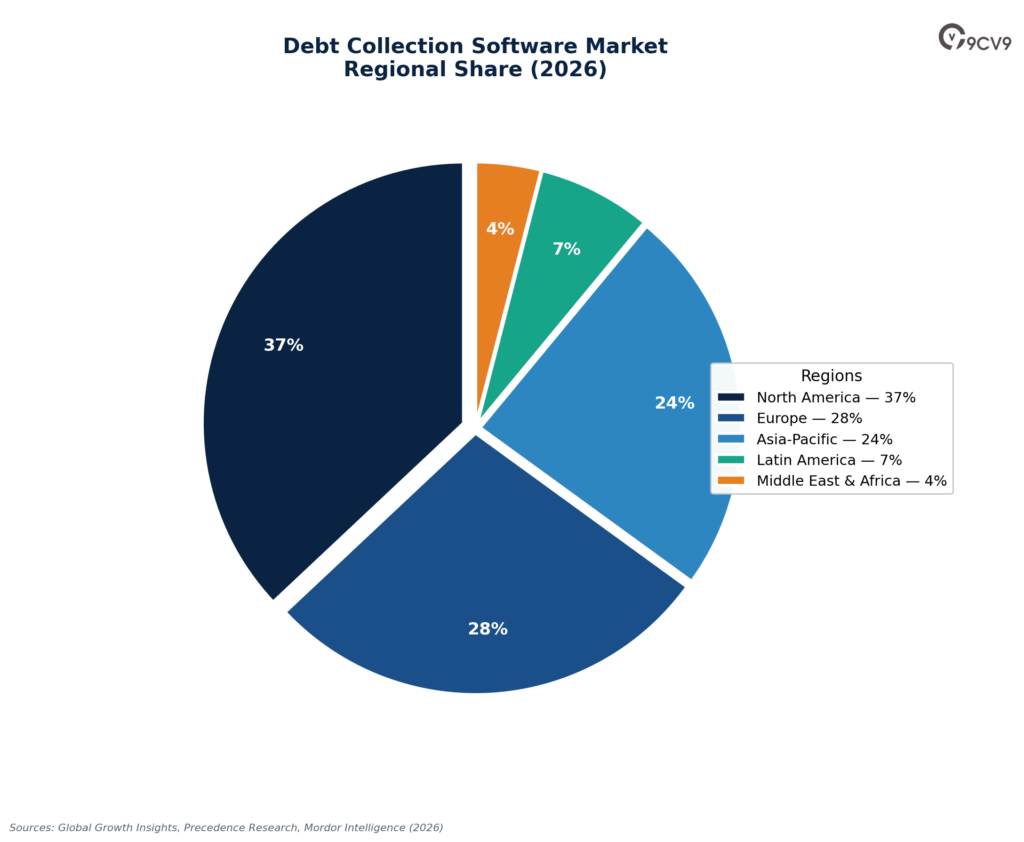
The broader market statistics reinforce this transformation. North America represented approximately 33% to 38% of the global debt collection software market in 2025, while the US market alone was valued at approximately $1.47 billion and is projected to reach $3.80 billion by 2035. North America’s market could increase from $1.96 billion in 2025 to $5.04 billion by 2035.
Asia-Pacific, however, represents the fastest-growing regional opportunity, with a projected CAGR of 14.7%. Expanding digital banking, alternative lending, mobile financial services and consumer credit markets across Asia are creating substantial opportunities for cloud-native collection technologies capable of supporting large, mobile-first borrower populations.
Small and medium-sized enterprises are important participants in this transition as well, representing 51.7% of the debt collection software market by organization size. Subscription-based SaaS pricing and increasingly preconfigured automation capabilities are making technologies that were once primarily accessible to large banks and major collection agencies available to smaller organizations.
New categories of receivables will further expand the software opportunity. Global BNPL receivables were approaching $576 billion in 2025, creating a rapidly growing pool of post-purchase payment obligations. Healthcare collections, commercial receivables, government debt, telecommunications bills, utility payments and other specialized collection environments similarly require workflows that differ significantly from conventional consumer credit card recovery.
The result is a debt collection software market that is becoming larger, more technologically sophisticated and increasingly central to the financial infrastructure surrounding credit.
The Top 108 Debt Collection Software Statistics, Data & Trends in 2026 compiled below examine this transformation from multiple angles, including global market size and growth forecasts, US household debt and delinquency, AI adoption, predictive analytics, automation, cloud deployment, APIs, omnichannel communications, self-service payments, regulatory compliance, recovery rates, collection costs and enterprise technology adoption.
Taken together, the data points toward a clear structural shift: debt collection software in 2026 is no longer simply a back-office system for recording accounts and scheduling collector activity. It is evolving into an AI-enabled financial operations platform designed to identify risk earlier, prioritize recovery opportunities, automate routine interactions, personalize debtor engagement, enforce regulatory requirements and reduce the cost of recovering each dollar.
With the global market projected to potentially exceed $15 billion by 2035, AI-specific debt collection technology projected to approach $15.9 billion by 2034, cloud deployment already accounting for the majority of software usage, and delinquency pressures increasing across several major debt categories, the next stage of competition will increasingly center on intelligence, automation, integration, compliance and digital engagement. Organizations that can combine these capabilities effectively will be better positioned to improve recovery performance while managing the rapidly increasing scale and complexity of modern debt portfolios.
Before we venture further into this article, we would like to share who we are and what we do.
About 9cv9
9cv9 is a business tech startup based in Singapore and Asia, with a strong presence all over the world.
With over ten years of startup and business experience, and being highly involved in connecting with thousands of companies and startups, the 9cv9 team has listed some important and crucial software tools in this review.
If you like to get your company listed in our top B2B software reviews, check out our world-class 9cv9 Media and PR service and pricing plans here.
Top 108 Debt Collection Software Statistics, Data & Trends in 2026
SECTION 1 — MARKET SIZE & GROWTH PROJECTIONS
- The global debt collection software market is valued at $6.51 billion in 2026. This milestone projection signals the accelerating shift by financial institutions and collection agencies toward automated, digital-first recovery platforms across all major global economies.
- The market is projected to reach $15.04 billion by 2035 at a CAGR of 9.76%. Sustained double-digit expansion driven by AI adoption and rising delinquencies makes debt collection software one of the most resilient sectors in financial technology.
- The 2025 market baseline was $5.93 billion. This base figure reflects the recovery from pandemic-era disruptions and marks the onset of a new growth phase fuelled by cloud migration and predictive analytics adoption.
- Research and Markets valued the 2024 market at $4.11 billion, growing to $4.51 billion in 2025 at a CAGR of 9.9%. The strong year-on-year growth demonstrates consistent demand for compliance-driven, omnichannel debt recovery solutions across multiple industry verticals.
- Grand View Research projects the market will reach $9.27 billion by 2030 at a 9.6% CAGR. This trajectory underlines the long-run structural demand as consumer and commercial debt volumes remain elevated globally well into the decade.
- DataM Intelligence pegs the 2033 market at $12.45 billion, with a CAGR of 9.8% (2026–2033). Consistent CAGR estimates across multiple reputable research firms validate the robustness of this sector’s growth narrative.
- Future Market Insights forecasts a $13.2 billion market by 2035 at 9.7% CAGR. The convergence of cross-industry adoption — from healthcare to telecom — will sustain this trajectory far beyond traditional banking and financial services.
- Mordor Intelligence estimates the market at $5.24 billion in 2025, reaching $7.21 billion by 2030 at a 9.23% CAGR. The more conservative estimate still reflects a 37.6% market expansion within five years, underscoring the sector’s structural tailwinds.
- North America held a dominant 33–38% share of the global market in 2025. The region’s clear regulatory framework, high digitisation rates, and presence of major vendors like Experian and FICO reinforces its leadership position.
- Asia-Pacific is the fastest-growing region with a projected 14.7% CAGR. Rapid digital banking expansion, mobile-first consumer behaviour, and rising alternative credit access across Southeast Asia and India are catalysing regional momentum.
- The software component accounted for 54–68% of total market revenue in 2025. Specialised platforms managing case workflows, payment processing, and compliance monitoring dominate spend over professional services counterparts.
- SMEs represent 51.7% of the debt collection software market by organisation size. Subscription pricing models and pre-configured AI modules have lowered entry barriers for smaller agencies that previously relied on manual processes.
- The services segment is expected to grow at the fastest CAGR through 2035. As implementation complexity grows with AI and API integration, managed services and consulting will capture an increasingly large share of vendor revenues.
- The US debt collection software market was valued at $1.47 billion in 2025, expected to reach $3.80 billion by 2035 at a 9.96% CAGR. The US market’s growth outpaces the global average, driven by AI integration into banking, compliance investment, and customer-centric engagement mandates.
- North America’s market is projected to grow from $1.96 billion (2025) to $5.04 billion by 2035 at a 9.90% CAGR. Federal regulatory clarity and an advanced credit ecosystem mean North American agencies have the clearest ROI case for sophisticated collection platforms.
SECTION 2 — US HOUSEHOLD DEBT & DELINQUENCY LANDSCAPE
- Total US household debt reached $18.8 trillion in Q4 2025, an increase of $191 billion (+1.0%). The consistent growth in household debt creates an ever-expanding addressable portfolio for debt collection software vendors across all consumer credit categories.
- Aggregate delinquency rates hit 4.8% in Q4 2025 — the highest level in nearly a decade. This sharp rise signals mounting consumer financial stress and presents a critical demand driver for automated, scalable debt recovery platforms.
- US credit card debt crossed $1.21 trillion, the fastest-growing debt category at +14.7% YoY. Elevated APR levels (22–24%) and record utilisation rates are pushing serious delinquency in the lowest-income ZIP codes above 20%.
- Outstanding student loan debt stood at $1.66 trillion in Q4 2025. The resumption of federal loan payment reporting created a surge in visible delinquencies, with the student loan delinquency rate elevated at 9.6% of balances 90+ days past due.
- Student loan serious delinquency (90+ days) surged to 16.19% in Q4 2025, up from 0.70% in Q4 2024 — a 23× increase in one year. This staggering spike represents the single largest driver of the increase in overall household delinquency rates, underscoring a systemic collection challenge.
- An estimated 25% of all student loan borrowers were delinquent in early 2026, roughly triple the 9.2% pre-pandemic rate. Approximately 1 million borrowers over 120 days past due had their loans transferred to the Department of Education Default Resolution Group.
- Mortgage debt reached $13.17 trillion in Q4 2025, with $524 billion in newly originated mortgage debt in that quarter. Despite macro stress, mortgage originations remain elevated — but rising delinquencies in lower-income areas signal pockets of systemic risk.
- Auto loan balances reached $1.66 trillion, with delinquencies elevated and most concentrated in Sun Belt states. Rising insurance premiums and repair costs in these regions have stretched household budgets, increasing the urgency of targeted auto loan recovery campaigns.
- US non-mortgage consumer credit crossed $5 trillion for the first time by end of 2025. This milestone, after a brief 2024 dip, confirms the resumption of a long-term consumer credit expansion cycle.
- US non-financial business debt surged to $21.55 trillion in Q4 2024 — up 27% since 2019. Commercial debt management has become a critical growth segment for enterprise collection software, particularly for commercial real estate and SME portfolios.
- 23,107 business bankruptcies were filed in the US in 2024, up from 18,926 in 2023. This 22% increase in corporate bankruptcies reflects widening financial distress, creating both demand and complexity for collection agencies managing commercial debt portfolios.
- $1.8 trillion in commercial real estate loans are set to mature by 2026. With refinancing costs 75–100% higher than original terms, distressed CRE sales and defaults are driving urgent demand for enterprise-grade commercial collection software.
- The delinquency rate on consumer loans at all commercial banks was 2.62% in Q4 2025 (FRED/Federal Reserve). While lower than the aggregate figure, this bank-specific measure underscores systemic stress across the commercial lending ecosystem.
- HELOC balances reached $433 billion in Q4 2025, with their 15th consecutive quarterly increase. The expansion of home equity credit creates new receivables categories that specialist collection platforms are beginning to address.
- Gen X carries the most household debt on average at $149,105 in 2025; Gen Z debt grew 7.8% in a single year. The divergent debt profiles across generations require collection platforms to support segmented, demographic-sensitive engagement strategies.
SECTION 3 — AI & AUTOMATION
- AI reduces debtor coverage costs by up to 70%. This dramatic cost reduction, validated by ScienceSoft, is the primary financial argument driving AI adoption across collection agencies of all sizes.
- AI systems can eliminate 90%+ of manual collection efforts. By automating outreach, scheduling, compliance checks, and reporting, AI platforms free human agents to focus exclusively on complex negotiations and edge cases.
- AI enables 8× faster operations compared to manual debt collection processes. The speed advantage compounds recovery rates while allowing agencies to scale operations without proportional headcount increases.
- AI-driven predictive scoring models improved recovery rates by an average of 25% (Kaplan Group, 2025). Personalised collection strategies built on machine learning outperform generic outreach by targeting debtors at their highest propensity-to-pay moments.
- Conversational AI and chatbots manage up to 80% of routine debtor queries. This automation reduces strain on contact centres while delivering consistent, compliant messaging to debtors across all communication channels 24/7.
- AI delivers a 10× increase in response rates compared to manual outreach. The combined effect of optimal channel selection, personalised messaging, and 24/7 availability makes AI-driven engagement dramatically more effective than traditional phone-centric models.
- ML-based personalisation of timing and channels drives up to 3–5× better response rates (Smallest.ai). Selecting the right moment and channel for each debtor using predictive models is the key differentiator between average and top-performing collection operations.
- AI-driven solutions report a 46% improvement in collection rates compared to traditional systems. By combining behavioural analytics, real-time decisioning, and automated follow-ups, AI platforms consistently outperform legacy rule-based collection software.
- AI automation delivers 2–4× growth in collector productivity. With routine tasks automated, human agents handle a larger volume of high-value interactions, directly improving both recovery performance and job satisfaction.
- AI-supported optimisation reduces loan delinquencies by 25%+ and decreases bad debt by up to 20%. Proactive intervention guided by predictive risk scoring prevents delinquency before it escalates to costly default and write-off scenarios.
- 77% of financial institutions report productivity gains, with most collectors saving at least 2 hours per day through AI tools (Zipdo, 2025). This measurable time savings translates directly to capacity gains across the collections workforce without additional hiring.
- The Global AI for Debt Collection Market is expected to reach $15.9 billion by 2034, up from $3.34 billion in 2024. The near-5× expansion in the AI-specific market segment signals that intelligent automation is becoming the dominant paradigm in debt recovery globally.
- Over 40% of debt collection agencies are expected to adopt AI-powered software by 2026. Early adopters have demonstrated measurable ROI, and peer pressure combined with regulatory demands is accelerating industry-wide AI uptake.
- McKinsey’s 2024 report found AI-driven automation can reduce human labour by up to 70% in early-stage debt collection. This capacity for radical labour optimisation makes AI a strategic imperative rather than an optional upgrade for collection agencies facing volume pressures.
- AI-led organisations achieve results 3.8× superior to market average (McKinsey operational AI trends report). The performance gap between AI leaders and laggards is widening rapidly, creating competitive urgency for agencies yet to fully embrace intelligent automation.
- NLP capabilities for debtor communication have been adopted by 33% of collection companies. Natural language processing enables more empathetic, contextually aware conversations that improve debtor cooperation and reduce escalations.
- 58% of service providers use predictive analytics to anticipate debtor behaviour and optimise recovery strategies. Data-driven debtor segmentation enables precise resource allocation, ensuring that the right approach is deployed at the right time.
- The AI Debt Collection market is expected to grow at 16–25% CAGR — significantly outpacing overall industry growth (Kaplan Group). This acceleration reflects the compounding benefits of AI adoption: lower costs, higher recovery, and better compliance simultaneously.
- Attunely, a US-based AI collection fintech, trained its platform on 4B+ debtor interaction records. This scale of training data enables default risk assessment and outreach strategy recommendations with substantially higher precision than traditional models.
- Neowise’s NeoBot and NeoSight (Oct 2025) boosted recovery efficiency by 15% and reduced costs by 33%. These newly launched AI tools exemplify the wave of purpose-built collection AI entering the market as established players compete on performance metrics.
SECTION 4 — CLOUD DEPLOYMENT & TECHNOLOGY
- Cloud-based deployment accounts for approximately 69% of total global debt collection software usage in 2026. The decisive shift to cloud reflects agencies’ need for scalability, remote access, and reduced infrastructure complexity in post-pandemic operating models.
- Cloud-based platforms represent approximately 73% of US debt collection software deployments in 2026. The US market is the most advanced in cloud adoption, enabled by robust digital infrastructure and vendor availability of SaaS-native collection platforms.
- Cloud-based deployments are expanding at a 13.60% CAGR — outpacing overall market growth (Mordor Intelligence). The premium growth rate for cloud over on-premise reflects the structural preference for flexible, scalable infrastructure in rapidly evolving collections environments.
- Approximately 68% of financial institutions are transitioning toward automated digital collection software platforms. This critical mass of institutional adoption signals that automation has moved from early-adopter territory to mainstream operations expectation.
- Omnichannel capabilities contribute to 54% higher debtor response effectiveness. By enabling engagement across email, SMS, chat, phone, and self-service portals simultaneously, omnichannel platforms dramatically increase the probability of debtor contact and resolution.
- Compliance automation improves audit readiness by 59%. Automated compliance monitoring, call tracking, and reporting tools provide real-time protection against FDCPA and Reg F violations while streamlining regulatory examination processes.
- Self-service repayment portals drive 52% higher voluntary settlement participation. Giving debtors control over payment timing and plan structure removes friction from the resolution process and reflects consumer preference for self-directed digital interaction.
- API-based integration capability impacts 58% of deployment preferences. The ability to connect collection platforms with CRMs, core banking systems, and payment gateways is a non-negotiable requirement for enterprise buyers in 2026.
- Omnichannel communication usage has expanded by 56% across the industry. This growth reflects both debtor preference for digital engagement and regulatory frameworks like Reg F that formalised email and SMS as compliant collection channels.
- 78% of leading collection software vendors undertook cloud upgrades in 2026. This near-universal upgrade cycle confirms that cloud-native architecture has become the platform standard, with legacy on-premise systems increasingly uncompetitive.
- Machine-learning fraud detection modules improved anomaly identification efficiency by 46%. As collections data becomes richer, ML-powered fraud detection provides a critical layer of protection against fraudulent disputes and false payment claims.
- 65% of self-service portal launches occurred among top collection software vendors in 2026. The proliferation of debtor-facing self-service tools reflects growing evidence that borrower autonomy in the repayment process improves voluntary compliance and reduces collection costs.
- BNPL global receivables are approaching $576 billion in 2025, driving merchants to formalise post-purchase recovery strategies. The explosive growth of buy-now-pay-later creates an entirely new category of delinquent accounts that require purpose-built collection platform capabilities.
- 72% of API enhancements were recorded among leading vendors in 2026. As collection ecosystems become more interconnected, API depth and reliability have become the primary technical differentiators between enterprise-grade and mid-market collection platforms.
- Starting in 2026, the EU Consumer Credit Directive brings BNPL under formal supervision, requiring enhanced reporting and consumer-protection features within collection platforms. European platform vendors face a significant compliance engineering burden as BNPL collection enters regulated territory for the first time.
SECTION 5 — COMPLIANCE, REGULATION & LEGAL RISK
- The CFPB received approximately 207,800 debt collection complaints in 2024 — nearly double the 109,900 received in 2023. This doubling of complaints reflects both intensified enforcement scrutiny and the growing complexity of multi-channel debtor communications that require automated compliance guardrails.
- Debt collection comprised 7% of all CFPB consumer complaints received in 2024. Collections remains one of the most complaint-intensive areas of consumer finance, making compliance automation a strategic necessity rather than a discretionary investment.
- 69% of enterprise purchasing decisions for collection software are influenced by regulatory compliance automation features. Compliance-by-design has become the dominant purchasing criterion, overtaking cost and feature functionality in enterprise RFP evaluations.
- 71% of enterprises prefer software platforms with real-time compliance tracking capabilities. Instantaneous compliance monitoring across all debtor communication channels has emerged as a foundational requirement for agencies managing large-volume portfolios under FDCPA and Reg F.
- More than 40 countries have implemented unique debt collection laws, making cross-border compliance a major challenge. Global collection agencies require platforms with configurable compliance rules engines capable of adapting to divergent national regulatory frameworks simultaneously.
- 78% of collection agencies report increased compliance costs in recent years. As regulatory intensity rises and multi-channel communications multiply, the cost of manual compliance management has become unsustainable without automated support tools.
- The CFPB has returned over $21 billion to consumers through enforcement actions since 2011. The regulator’s sustained enforcement track record sends a clear signal that systematic compliance failures carry financial consequences that far exceed the cost of robust compliance software.
- Regulation F’s “7-in-7” rule limits collectors to 7 calls per debtor within any 7-day period. This rule requires systematic contact tracking across accounts — a task that is impractical to manage manually at scale and practically mandates software-based enforcement.
- California’s SB 1286, effective July 2025, extended consumer-style collection protections to B2B debts of $500,000 or less. This landmark shift is the first to apply FDCPA-equivalent standards to commercial debt collection, expanding the compliance surface area for agencies operating in the California market.
- 49% of financial institutions report difficulties integrating new software with existing IT infrastructure. Legacy system integration remains the #1 technical barrier to collection software adoption, contributing to a 32% increase in implementation times and a 28% rise in integration costs.
- 50+ billion spam robocalls are made annually in the US (FCC/YouMail), causing unknown numbers to receive answer rates below 15%. This digital trust deficit, driven by consumer desensitisation to unsolicited calls, is forcing collection agencies to shift from outbound calling toward digital-first engagement.
- CFPB complaint volumes nearly doubled year-over-year (from ~109,900 in 2023 to ~207,800 in 2024) per the annual FDCPA report. The surge reinforces why compliance-by-design coding — embedding FDCPA rules as technical guardrails rather than agent training — is gaining rapid traction as a collection technology standard.
- The CFPB has the authority to impose civil penalties under 12 U.S.C. §5565 for violations of federal consumer financial laws including Regulation F. Penalties can escalate based on severity and frequency of violations, making automated compliance critical for protecting against compounding legal exposure.
- In 2024, the FTC was the only agency to announce public FDCPA enforcement actions beyond CFPB. As the CFPB’s enforcement capacity remains constrained by legal battles, state attorneys general and the FTC are expected to fill the enforcement gap in 2026.
- Agent tenure in collections has declined to under 18 months on average, creating perpetual training costs. This high turnover rate, combined with the risk of human error in compliance-sensitive communications, further accelerates the case for AI-augmented or fully automated collection workflows.
SECTION 6 — RECOVERY RATES & BENCHMARKS
- The US collections industry averages a 20% collection rate on delinquent debt — a decrease from 30% a few decades ago. Declining recovery rates despite rising debt volumes underscore the urgency of deploying AI-powered strategies that precisely target debtors most likely to repay.
- Average recovery rate for third-party collections is 19% of placed debt. This below-20% average reflects the challenge of collecting aged accounts where debtor engagement has already deteriorated — reinforcing the value of early-stage digital intervention.
- First-party collections recover 85% of early-stage delinquencies. Creditor-managed early-out programs dramatically outperform third-party placements, making a strong case for investing in in-house collection software before accounts age beyond the recovery curve.
- Recovery rates drop to 11% for debts over 180 days past due. The precipitous decline in recoverability with age — from 85% in early stage to 11% at 180+ days — quantifies the cost of collection delays and underlines the ROI of automated early engagement.
- US agencies collected $15.3 billion from consumer debts in 2022. This figure represents only a fraction of the total placed debt, highlighting significant opportunity for technology-enhanced recovery improvements to translate into billions of additional recovered value.
- Debt collectors recover just $0.20 per $1 of delinquent debt on average. The dramatic gap between outstanding and recovered amounts represents the core business problem that modern AI-driven collection software is designed to close.
- Digital collections improve recovery by 20–30% over traditional methods. The measurable outperformance of digital-first strategies validates the ROI case for migrating from phone-centric, agent-heavy collection models to software-driven automation.
- Omnichannel strategies lift recovery rates by 25%. Meeting debtors on their preferred channels — whether email, SMS, chat, or self-service portal — reduces friction and increases the probability of voluntary resolution compared to single-channel approaches.
- Commercial recovery rates average 28% versus 18% for consumer debt. The higher success rate in commercial collections reflects the relative transparency of business financial positions and the greater leverage available through supplier relationships and credit reporting.
- Only 10% of invoices over 12 months old are likely to be collected. This stark statistic on aged receivables makes the economic case for early-stage digital engagement tools that prevent accounts from reaching a point of near-certain write-off.
- Legal collections achieve 25–30% recovery on judgments, but only half of those judgments are successfully enforced. The legal collection pathway is both expensive and uncertain, reinforcing the economic logic of preventative AI-driven engagement before accounts reach litigation stage.
- Healthcare self-pay recovery in digital collections stands at 28%. As medical debt affects 41% of Americans with accounts in collections, purpose-built healthcare collection software with HIPAA-compliant workflows is a high-growth niche within the broader market.
- Average cost to collect $1 is $0.45 for US agencies. This near-50% collection cost ratio creates enormous pressure to reduce operational expenses through automation while maintaining or improving recovery performance.
- 90 days is the optimal collection window for maximum recovery rates. Collection platforms that enable intensive, multi-channel engagement within the first 90 days of delinquency deliver substantially better outcomes than agencies that wait for accounts to season.
- In 2023, 55% of US B2B sales were paid late, with average Days Sales Outstanding rising to 49 days. Chronic late payment in business-to-business commerce is fuelling demand for commercial receivables management software that can automate follow-up and early intervention.
SECTION 7 — ENTERPRISE ADOPTION & FEATURE USAGE
- More than 65% of financial institutions had integrated automated collection solutions as of 2024. This majority adoption by the most regulated sector validates the maturity of debt collection software as an enterprise-grade technology category.
- 62% of organisations report improved recovery accuracy via predictive analytics adoption. Moving from intuition-based to data-driven collection prioritisation is proving to be the most impactful operational change available to collection agencies in 2026.
- 63% of enterprises emphasise data-driven recovery prioritisation as a core platform requirement. Real-time portfolio analytics that surface the highest-probability accounts for immediate engagement are now table stakes for enterprise collection software buyers.
- 58% of service providers use predictive analytics to anticipate debtor behaviour. Anticipatory intelligence — knowing when and how a debtor is most likely to engage before making contact — is rapidly becoming a standard feature rather than a premium differentiator.
- 47% reduction in manual processing dependency is reported from automation adoption. Collection platforms that eliminate manual data entry, reporting, and scheduling free operations teams to focus on value-added activities like debtor negotiation and portfolio strategy.
- Multilingual interface availability enhances engagement effectiveness by 53%. As collection agencies manage increasingly diverse debtor populations, multilingual AI agents and platforms unlock engagement with segments that were historically difficult to reach through English-only collection operations.
- Mobile-first engagement tools improve accessibility for 56% of debtor interactions. With smartphones the primary internet access device for many debtors, collection platforms that are fully optimised for mobile self-service capture recoveries that desktop-first or phone-only systems miss.
- 62% of financial institutions emphasise AI-driven recovery analytics adoption. The near-ubiquity of AI analytics interest across the financial services sector signals that the technology is shifting from competitive advantage to category standard.
- 45% reduction in disputes is reported globally from compliance automation. Automated compliance guardrails prevent the procedural errors that generate the majority of FDCPA-related disputes, protecting agencies from both legal exposure and reputational damage.
- 48% cost optimisation is reported from automation adoption by collection agencies globally. Nearly half of all measurable cost savings in collection operations can be attributed to automation — reinforcing AI and cloud software as the primary lever for operational efficiency improvement.
- 64% of financial firms planned to increase AI spending in 2025. This investment intention, supported by measurable recovery gains and compliance benefits, confirms that AI is moving from pilot to production investment across the financial services industry.
- CGI’s New York City system routes nearly $1 billion in parking fines annually. This public-sector deployment demonstrates that government entities are equally capable of achieving large-scale, technology-driven collection modernisation alongside private financial institutions.
- The McKinsey operational AI report indicates organisations leading in agentic technology achieve results 3.8× superior to market average. The widening performance gap between AI-native and traditional collection operations means that software investment decisions made today will determine competitive positioning for the next decade.
Conclusion
The 108 debt collection software statistics, data points, and trends examined throughout this report show an industry undergoing a fundamental transformation in 2026. Debt collection is moving away from labor-intensive, phone-first recovery models toward cloud-based, AI-powered, data-driven platforms capable of automating large portions of the collection lifecycle. Rising consumer debt, increasing delinquency, stricter compliance requirements, changing borrower communication preferences, and pressure to reduce collection costs are accelerating this transition.
The scale of the opportunity is substantial. The global debt collection software market is valued at approximately $6.51 billion in 2026 and is projected to reach $15.04 billion by 2035 at a CAGR of 9.76%. Other market forecasts included in the dataset reinforce the same long-term direction, with estimates reaching $9.27 billion by 2030, $12.45 billion by 2033, and $13.2 billion by 2035. Even more conservative projections point toward sustained expansion, suggesting that debt collection technology is developing into an increasingly important category within the wider financial technology ecosystem.
The underlying debt environment helps explain why demand for these platforms continues to increase. Total US household debt reached $18.8 trillion in Q4 2025, while aggregate delinquency climbed to 4.8%, its highest level in nearly a decade. Credit card balances exceeded $1.21 trillion, mortgage debt reached $13.17 trillion, student loan balances stood at $1.66 trillion, and auto loan balances also reached approximately $1.66 trillion. Non-mortgage consumer credit surpassed $5 trillion by the end of 2025.
These are not simply large headline numbers. They translate directly into millions of accounts requiring increasingly sophisticated risk assessment, communication, payment processing, compliance monitoring, and recovery strategies.
Student loans provide one of the clearest examples of this changing environment. Serious student loan delinquency of 90 days or more increased from 0.70% in Q4 2024 to 16.19% in Q4 2025 according to the dataset, while approximately one-quarter of student loan borrowers were estimated to be delinquent in early 2026. Such rapid changes demonstrate how quickly collection volumes can increase and why organizations dependent on heavily manual workflows may struggle to scale efficiently.
Commercial debt presents another significant opportunity. US non-financial business debt reached $21.55 trillion in Q4 2024, up 27% since 2019. Business bankruptcies increased from 18,926 in 2023 to 23,107 in 2024, while approximately $1.8 trillion in commercial real estate loans were expected to mature by 2026. The collection software opportunity therefore extends well beyond consumer credit into B2B receivables, commercial lending, real estate, healthcare, telecommunications, government and other industries managing outstanding payments.
AI Is Redefining Debt Collection Economics
Artificial intelligence stands out as perhaps the most important debt collection software trend of 2026.
The statistics examined throughout this report suggest that AI has the potential to change both the economics and operational capacity of collections. AI can reduce debtor coverage costs by as much as 70%, eliminate more than 90% of manual collection efforts in applicable workflows, and enable operations to run up to eight times faster than traditional manual processes. AI automation can also produce two to four times greater collector productivity.
The benefits are not limited to cost reduction.
AI-driven predictive scoring models have been associated with an average 25% improvement in recovery rates. AI-driven solutions report collection-rate improvements of 46% compared with traditional systems, while machine-learning personalization of timing and communication channels can produce three to five times better response rates. AI-powered outreach has also been associated with response rates as much as 10 times higher than manual outreach.
Conversational AI represents another major development. Chatbots can manage as much as 80% of routine debtor queries, potentially allowing human collectors to concentrate on negotiations, disputes, vulnerable customers, complex repayment arrangements, and other situations requiring judgment.
The market projections reflect this growing importance. The global AI for debt collection market is expected to expand from approximately $3.34 billion in 2024 to $15.9 billion by 2034. More than 40% of debt collection agencies are expected to adopt AI-powered software by 2026, while the AI debt collection segment is projected to grow at approximately 16% to 25% annually.
The implication is significant: AI is moving from an experimental feature toward a central component of modern debt collection infrastructure.
Predictive Analytics Is Shifting Collections From Reactive to Proactive
The evolution of predictive analytics reinforces this transformation.
Fifty-eight percent of service providers already use predictive analytics to anticipate debtor behavior and optimize recovery strategies. Sixty-two percent of organizations report improved recovery accuracy after adopting predictive analytics, while 63% of enterprises identify data-driven recovery prioritization as a core platform requirement. Another 62% of financial institutions emphasize AI-driven recovery analytics.
These capabilities are particularly important because debt recovery deteriorates rapidly as accounts age.
First-party collections can recover approximately 85% of early-stage delinquencies, but recovery rates fall to approximately 11% once debts are more than 180 days past due. Only around 10% of invoices more than 12 months old are likely to be collected, while the dataset identifies the first 90 days as the optimal collection window for maximizing recovery.
The strategic objective is therefore increasingly clear: identify risk earlier and intervene before an account reaches the point where recovery becomes significantly more difficult.
Predictive debt collection software can potentially determine which accounts have the greatest probability of repayment, identify appropriate communication timing, prioritize collector workloads, automate low-complexity accounts, and escalate higher-risk cases before their recovery probability deteriorates.
That transition could ultimately prove more important than simple workflow automation. The future of debt collection technology is not merely about doing the same tasks faster; it is increasingly about determining which actions should be taken in the first place.
Cloud-Based Debt Collection Software Has Become the New Standard
Cloud deployment is another structural change shaping the debt collection software market in 2026.
Approximately 69% of global debt collection software usage is cloud-based, rising to around 73% in the United States. Cloud deployments are growing at a reported CAGR of 13.60%, faster than the broader debt collection software market. Approximately 68% of financial institutions are transitioning toward automated digital collection platforms, while more than 65% had already integrated automated collection solutions as of 2024.
Vendor investment reflects the same trend. Among leading debt collection software providers, 78% undertook cloud upgrades in 2026, 72% recorded API enhancements, and 65% launched self-service portals. API integration capability now influences 58% of deployment preferences.
This matters because collection platforms increasingly operate as part of broader financial technology ecosystems.
Modern systems need to exchange data with core banking platforms, accounting systems, CRMs, payment gateways, communication providers, credit systems, analytics platforms, loan management tools and customer databases. As these ecosystems become more interconnected, integration capabilities may become almost as important as the collection functionality itself.
Digital and Omnichannel Collections Are Changing Debtor Engagement
One of the clearest conclusions from the 2026 debt collection statistics is that traditional telephone-based collection strategies are no longer sufficient on their own.
Omnichannel capabilities contribute to 54% higher debtor response effectiveness, while omnichannel communication usage has expanded by 56%. Omnichannel collection strategies can improve recovery rates by approximately 25%, and digital collections can deliver recovery improvements of approximately 20% to 30% compared with traditional methods.
Self-service repayment is becoming particularly important. Digital self-service portals can generate 52% higher voluntary settlement participation, while mobile-first engagement tools improve accessibility across 56% of debtor interactions.
These statistics point toward a broader change in philosophy.
The future of collections is increasingly about making repayment easier rather than simply increasing contact attempts.
A debtor who can securely open a mobile payment page, review an outstanding balance, choose an affordable payment plan, ask questions through digital channels and make a payment without waiting for an agent may be more likely to resolve an account voluntarily.
Collection software is consequently becoming as much an engagement and payment experience platform as an internal productivity system.
Compliance Automation Will Remain a Major Software Investment Driver
Technology adoption is also being shaped by the increasingly complex regulatory environment surrounding debt collection.
The CFPB received approximately 207,800 debt collection complaints during 2024, almost twice the approximately 109,900 received in 2023. Debt collection represented around 7% of all CFPB consumer complaints that year. Meanwhile, 78% of collection agencies report increasing compliance costs.
Software purchasing decisions increasingly reflect this risk.
Regulatory compliance automation influences 69% of enterprise collection software purchasing decisions, and 71% of enterprises prefer platforms with real-time compliance tracking. Compliance automation is associated with a 59% improvement in audit readiness and a reported 45% reduction in disputes globally.
Regulatory complexity also extends beyond the United States. More than 40 countries have implemented distinct debt collection laws, meaning international agencies and financial institutions need configurable systems capable of applying different communication, documentation and consumer-protection requirements across jurisdictions.
The expansion of consumer protections into emerging credit categories will further increase these requirements. BNPL receivables were approaching $576 billion globally in 2025, while regulatory changes such as the EU Consumer Credit Directive bring BNPL under greater formal supervision beginning in 2026.
Compliance-by-design is therefore likely to become a fundamental product requirement rather than a premium feature.
The Recovery Rate Gap Creates a Massive Technology Opportunity
Perhaps the strongest long-term opportunity for debt collection software comes from the persistent gap between the amount of delinquent debt outstanding and the amount successfully recovered.
The US collection industry averages a recovery rate of approximately 20% on delinquent debt, down from roughly 30% several decades ago. Third-party collections recover approximately 19% of placed debt, and collectors recover only around $0.20 for every $1 of delinquent debt on average.
Collection itself is expensive. US agencies spend an estimated $0.45 to collect each $1, placing enormous pressure on operating margins.
These economics create a straightforward technology challenge: recover more while spending less.
Automation is already demonstrating the potential to address both sides of that equation. Organizations report a 47% reduction in manual processing dependency following automation adoption and 48% cost optimization from collection automation globally. AI can deliver two to four times greater collector productivity, while 77% of financial institutions report productivity improvements and many collectors save at least two hours per day through AI tools.
Even modest improvements become economically significant when applied across billions of dollars of receivables.
Debt Collection Software in 2026 Is Becoming Financial Infrastructure
The central conclusion from these Top 108 Debt Collection Software Statistics, Data & Trends in 2026 is that the category is evolving from specialized back-office software into increasingly important financial infrastructure.
Traditional collection systems primarily helped organizations record debts, manage cases, schedule calls, document interactions and process payments. Modern platforms are being expected to do considerably more.
They must predict repayment probability, prioritize accounts, personalize communications, select channels, automate routine conversations, facilitate self-service repayment, monitor regulatory compliance, detect anomalies, integrate external systems, analyze portfolio performance and determine when human intervention is most valuable.
This transition also changes how organizations should evaluate debt collection software.
Price and basic workflow functionality remain important, but the strongest platforms of the coming years are increasingly likely to compete on AI performance, predictive accuracy, automation depth, API connectivity, omnichannel orchestration, self-service capabilities, regulatory intelligence, scalability and measurable recovery outcomes.
The regional growth outlook reinforces the size of the opportunity. North America controlled approximately 33% to 38% of the global market in 2025, while the US debt collection software market is expected to increase from approximately $1.47 billion in 2025 to $3.80 billion by 2035. Asia-Pacific is expected to expand even faster, with a projected CAGR of 14.7%.
SMEs are participating in this transformation as well, accounting for approximately 51.7% of the market by organization size. Cloud-based subscription models and preconfigured AI functionality are reducing the infrastructure and capital requirements historically associated with sophisticated collection technology.
Ultimately, the debt collection software trends of 2026 point toward a future in which successful recovery operations depend less on the sheer number of collectors making calls and more on how effectively technology can determine who to contact, when to contact them, which channel to use, what repayment options to present, and when a human collector can create the greatest incremental value.
With global debt collection software potentially growing from $6.51 billion in 2026 to $15.04 billion by 2035, AI-specific collection technology projected to reach $15.9 billion by 2034, cloud platforms already representing the majority of deployments, and trillions of dollars in consumer and commercial debt creating persistent recovery demand, debt collection technology is positioned for sustained expansion well beyond 2026.
For banks, lenders, collection agencies, healthcare providers, fintech companies, BNPL providers, telecommunications companies, commercial creditors and other organizations managing receivables, the strategic question is increasingly shifting from whether debt collection should be digitized to how intelligently that digital collection infrastructure can operate.
The 108 statistics examined in this report collectively suggest that AI, predictive analytics, automation, cloud computing, omnichannel engagement, self-service repayment, API connectivity and compliance automation will define the next generation of debt collection software. Organizations capable of combining these technologies effectively will be positioned not only to process more accounts, but to intervene earlier, communicate more efficiently, reduce operational costs, strengthen compliance and ultimately recover a greater proportion of outstanding debt.
If you find this article useful, why not share it with your hiring manager and C-level suite friends and also leave a nice comment below?
We, at the 9cv9 Research Team, strive to bring the latest and most meaningful data, guides, and statistics to your doorstep.
To get access to top-quality guides, click over to 9cv9 Blog.
To hire top talents using our modern AI-powered recruitment agency, find out more at 9cv9 Modern AI-Powered Recruitment Agency.
People Also Ask
What is debt collection software?
Debt collection software helps organizations manage overdue accounts, automate debtor outreach, process payments, prioritize recovery cases, monitor compliance, and analyze collection performance through centralized digital workflows.
How large is the debt collection software market in 2026?
The global debt collection software market is valued at approximately $6.51 billion in 2026, reflecting growing demand for automated, cloud-based, and AI-powered debt recovery technology.
How fast is the debt collection software market growing?
The market is projected to reach approximately $15.04 billion by 2035, representing a CAGR of 9.76% as financial institutions and collection agencies accelerate digital transformation.
What are the biggest debt collection software trends in 2026?
Major trends include AI automation, predictive analytics, cloud deployment, omnichannel communication, self-service repayment portals, API integration, mobile engagement, and automated compliance monitoring.
How is AI changing debt collection in 2026?
AI automates outreach, prioritization, scheduling, compliance checks, and debtor communications. The data indicates AI can reduce debtor coverage costs by up to 70% and significantly increase operational productivity.
Can AI improve debt collection recovery rates?
Yes. AI-driven predictive scoring models have been associated with an average 25% improvement in recovery rates by helping collectors prioritize accounts and personalize collection strategies.
How much manual debt collection work can AI automate?
AI systems can eliminate more than 90% of manual collection efforts in applicable workflows by automating outreach, scheduling, compliance checks, reporting, and routine interactions.
How much can AI increase debt collector productivity?
AI automation can generate approximately two to four times greater collector productivity by handling repetitive tasks and allowing human collectors to concentrate on higher-value cases.
How common is AI adoption in debt collection?
More than 40% of debt collection agencies are expected to adopt AI-powered software by 2026 as organizations pursue higher recovery rates, lower operating costs, and greater automation.
How large is the AI debt collection market?
The global AI for debt collection market is expected to increase from approximately $3.34 billion in 2024 to $15.9 billion by 2034, demonstrating rapid adoption of intelligent collection technology.
How does predictive analytics help debt collection?
Predictive analytics identifies debtor behavior and repayment probability, helping organizations prioritize accounts and optimize outreach. About 58% of service providers use predictive analytics.
How popular is cloud-based debt collection software?
Cloud-based deployment accounts for approximately 69% of global debt collection software usage in 2026, demonstrating the industry’s shift toward scalable SaaS collection platforms.
How common is cloud debt collection software in the US?
Approximately 73% of US debt collection software deployments are cloud-based in 2026, making cloud infrastructure the dominant deployment model in the American collections market.
How fast is cloud debt collection software growing?
Cloud-based debt collection software deployments are expanding at approximately 13.60% CAGR, outpacing the overall market as organizations prioritize scalability and digital integration.
Why is omnichannel debt collection important?
Omnichannel collection combines SMS, email, chat, phone, and self-service channels. The data associates omnichannel capabilities with 54% higher debtor response effectiveness.
Do digital debt collection methods improve recovery rates?
Yes. Digital collections can improve recovery by approximately 20–30% over traditional collection methods by making communication and repayment more accessible to debtors.
Do self-service repayment portals improve debt collection?
Self-service repayment portals can drive 52% higher voluntary settlement participation by allowing debtors to manage payments and repayment arrangements through convenient digital interfaces.
What is the average debt collection recovery rate?
The US collections industry averages approximately a 20% collection rate on delinquent debt, while third-party collections recover about 19% of placed debt.
How much of every delinquent dollar do debt collectors recover?
Debt collectors recover approximately $0.20 for every $1 of delinquent debt on average, illustrating the significant gap between outstanding balances and successful recoveries.
When is the best time to collect delinquent debt?
The first 90 days represent the optimal collection window for maximizing recovery. Recovery becomes substantially more difficult as delinquent accounts continue to age.
What happens to recovery rates after 180 days?
Recovery rates fall to approximately 11% for debts more than 180 days past due, highlighting the financial importance of early intervention and automated collection workflows.
How effective are first-party debt collections?
First-party collections can recover approximately 85% of early-stage delinquencies, substantially outperforming recovery rates associated with older third-party collection placements.
How much does debt collection cost?
US collection agencies spend an estimated $0.45 to collect every $1 of debt, creating strong incentives to adopt automation and AI technologies that can reduce operating costs.
How much US household debt exists in 2026?
US household debt reached approximately $18.8 trillion in Q4 2025, increasing by $191 billion during the quarter and expanding the volume of consumer credit requiring management.
What is the US delinquency rate entering 2026?
Aggregate US delinquency rates reached approximately 4.8% in Q4 2025, the highest level in nearly a decade and an important demand driver for modern collection technology.
How much credit card debt do Americans have?
US credit card debt exceeded approximately $1.21 trillion, making revolving credit an important source of collection volume as borrowers face elevated interest rates and repayment pressures.
Why is compliance important in debt collection software?
Collection software can automate communication rules, tracking, reporting, and audits. Regulatory compliance automation influences 69% of enterprise software purchasing decisions.
How important is real-time compliance tracking?
Approximately 71% of enterprises prefer debt collection platforms with real-time compliance tracking, reflecting the growing importance of automated regulatory controls across communication channels.
Which region is growing fastest for debt collection software?
Asia-Pacific is the fastest-growing debt collection software region, with a projected CAGR of 14.7%, supported by digital banking, mobile finance, and expanding consumer credit markets.
What is the future of debt collection software after 2026?
Debt collection software is moving toward AI-powered, cloud-based recovery platforms combining predictive analytics, automated compliance, omnichannel engagement, APIs, and digital self-service capabilities.
Sources
Precedence Research Fortune Business Insights Grand View Research Mordor Intelligence Global Growth Insights DataM Intelligence Future Market Insights Research and Markets Market Growth Reports New York Federal Reserve DontPayFull The Mortgage Point FRED / Federal Reserve Consumer Financial Protection Bureau Consumer Finance Monitor Moveo.AI ScienceSoft RTS Labs Kaplan Group Gitnux Bridgeforce Smallest.ai OpenMIC AI Symend Southwest Recovery Services Tratta FusionCX Prodigal Tech