



























Key Takeaways
- Database software is surging in 2026, driven by enterprise data growth, cloud migration, DBaaS adoption, real-time analytics and AI-powered workloads.
- AI and vector databases are reshaping data infrastructure, as generative AI, RAG, automation and semantic search accelerate demand for AI-ready database platforms.
- Cloud, NoSQL and open-source databases are gaining momentum, while relational databases remain essential as enterprises prioritize scalability, security, hybrid cloud and automation.
Database software drives the data infrastructure market in 2026, with global spending reaching hundreds of billions of dollars as businesses adopt cloud databases, DBaaS, AI automation, NoSQL and vector databases. The strongest trends center on cloud migration, generative AI workloads, real-time analytics, database security and increasingly automated data management.
Database software is becoming one of the most important layers of the global digital economy in 2026. As enterprises generate larger volumes of structured and unstructured data, migrate critical workloads to the cloud, deploy generative AI applications, and demand real-time analytics, databases are evolving from traditional systems of record into intelligent infrastructure that powers applications, automation, artificial intelligence, cybersecurity, and business decision-making.
Also, read our top guide on the Top 10 Best Database Software To Try.
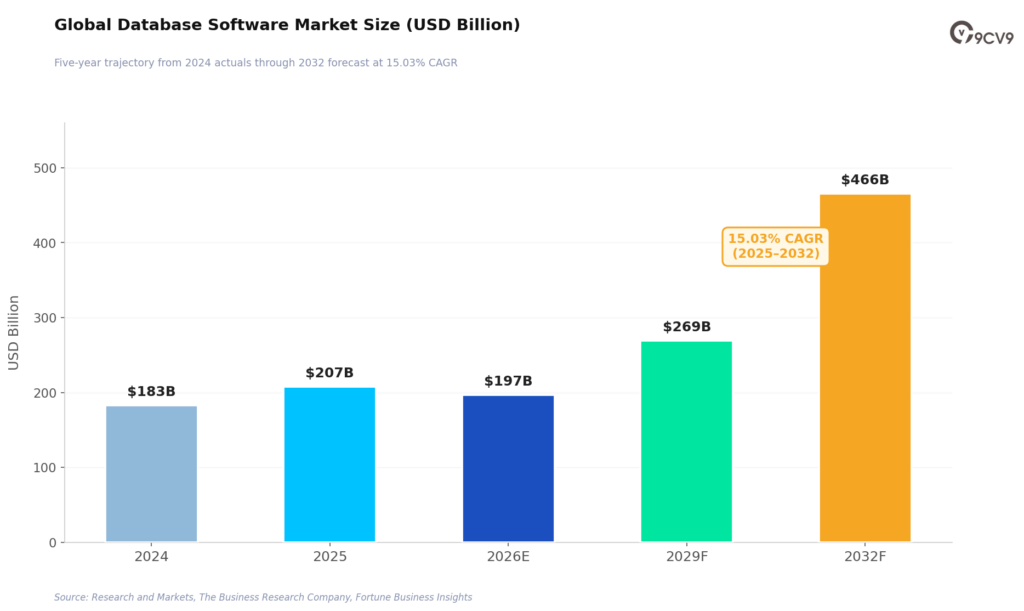
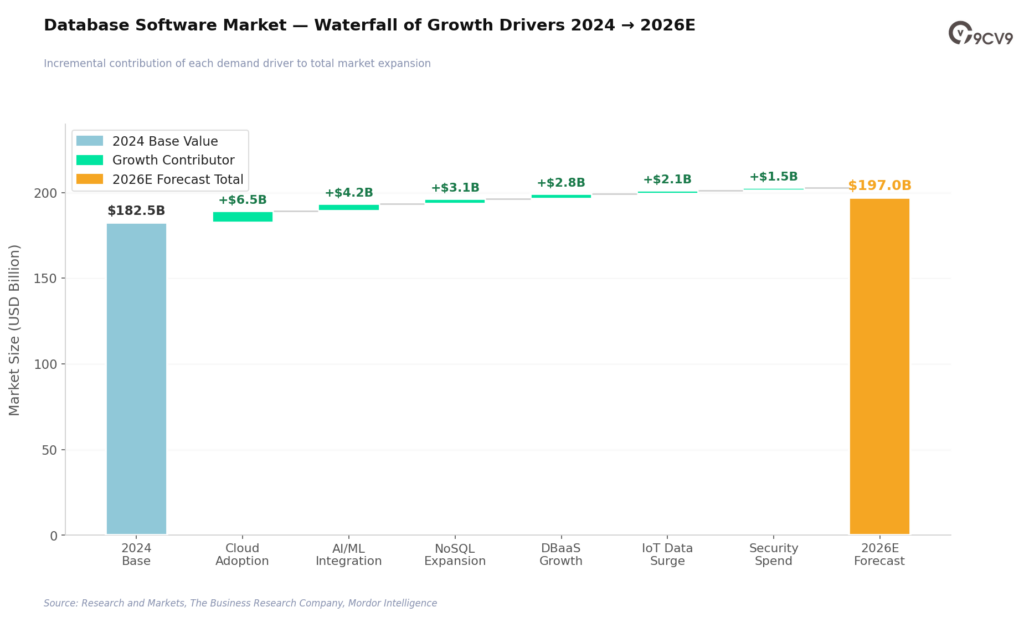
The scale of this transformation is reflected in the numbers. One estimate cited in the data places the global database software market at $197.16 billion in 2026, compared with $174.68 billion in 2025, with the market projected to reach $465.66 billion by 2032 at a compound annual growth rate of 15.03%. Another estimate values the broader database market at $171.36 billion in 2026, rising toward $329.05 billion by 2031 at a 13.95% CAGR.
Differences between market estimates are significant because research firms may measure different categories, vendors, deployment models, and definitions of database software. However, the overall direction across the statistics is remarkably consistent: database infrastructure is expanding rapidly as cloud computing, artificial intelligence, automation, cybersecurity, IoT, e-commerce, and real-time applications create greater demand for scalable data management.

Database management systems, or DBMS platforms, represent a particularly important part of this expansion. The statistics compiled for this report include estimates ranging from $91.99 billion to $161 billion for the DBMS market in 2026, depending on methodology and market definition. Gartner’s cited estimate is among the most aggressive, forecasting a $161 billion DBMS market in 2026 with 18.4% annual growth, while Fortune Business Insights projects approximately $149.65 billion in 2026 and $406.03 billion by 2034.
Enterprise database management is expanding even faster according to some estimates. The enterprise DBMS market is cited at $69.31 billion in 2025 and $84.34 billion in 2026, representing exceptionally strong growth. The accompanying forecast puts its CAGR at 21.7% between 2025 and 2034, illustrating how deeply databases have become embedded in mission-critical enterprise technology stacks.

Cloud computing is one of the clearest forces reshaping database software in 2026.
The cloud database and Database-as-a-Service market was valued at approximately $19.95 billion in 2024 and is projected to reach $49.78 billion by 2030, representing a 16.7% CAGR. Another statistic shows cloud deployments accounting for 56.4% of database revenue in 2025, while the cloud database segment itself is growing at approximately 18.3% annually.
Database-as-a-Service is becoming especially important within this transition. According to the compiled figures, 64.2% of database spending was associated with DBaaS in 2025. Subscription-based database deployments increased by 26%, while 25% of organizations completed or began moving from purely on-premise databases toward hybrid infrastructure during 2024–2025.
These numbers point toward a fundamental change in how businesses consume database technology. Instead of purchasing infrastructure, provisioning servers and manually maintaining every database environment, organizations increasingly use managed platforms that can automate backups, scaling, availability, replication, monitoring and maintenance.
Serverless architecture is pushing this shift further. Serverless database utilization increased 21%, while the wider serverless computing market reached approximately $28 billion in 2025 and could exceed $90 billion by 2034. Serverless databases are particularly relevant for applications with unpredictable workloads because infrastructure can scale dynamically as demand changes.
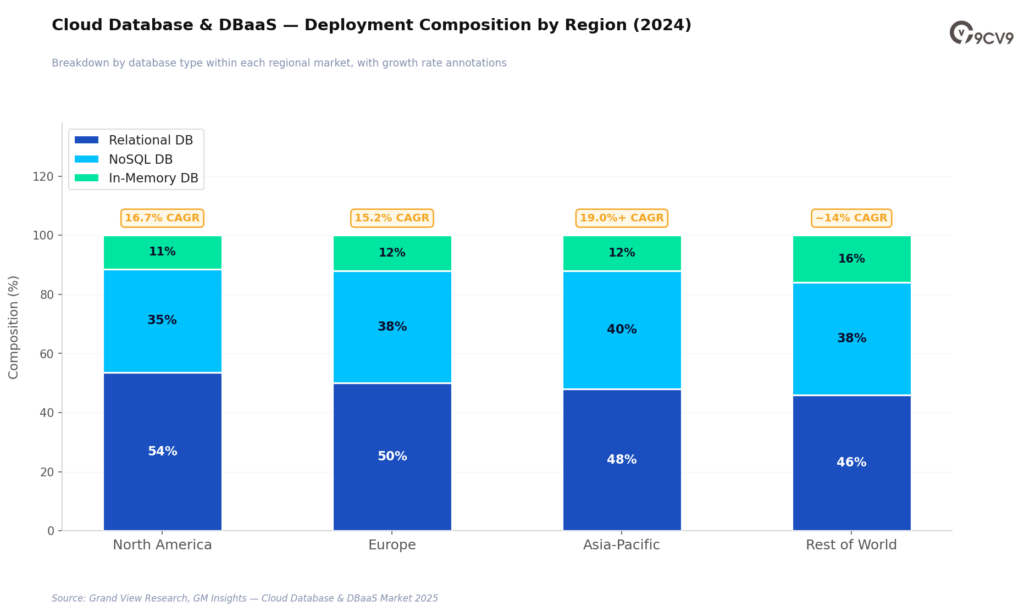
Hybrid cloud remains important as well. Approximately 47% of cloud database deployments were hybrid in 2024, while 48% of IT leaders reportedly prioritize hybrid-cloud strategies for database rollouts. Rather than eliminating private infrastructure completely, many enterprises are combining local databases with public-cloud services to address latency, regulatory requirements, security considerations and data sovereignty.
At the same time, the underlying database landscape is becoming more diverse.
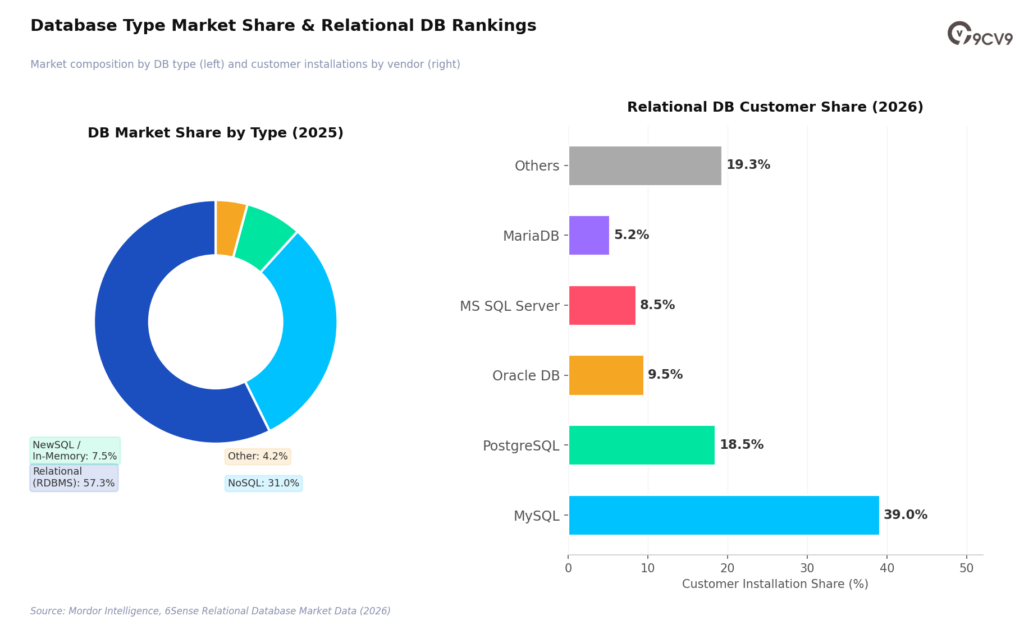
Relational databases remain the foundation of enterprise data management, accounting for 57.3% of the overall database market in 2025 according to the statistics collected for this report. Within cloud databases specifically, relational systems represented an even larger 83.2% of revenue in 2024.
Developer adoption reinforces the continued relevance of SQL databases. PostgreSQL was used by 55.6% of developers in the cited 2025 Stack Overflow Developer Survey, compared with 40.5% for MySQL. Separate customer-installation data gives MySQL a 39.05% share of relational database installations, PostgreSQL 18.47%, and Oracle Database 9.48%. These statistics use different methodologies, so they should not be interpreted as directly comparable market shares, but together they demonstrate the continued strength of established relational database ecosystems.
However, relational dominance does not mean the database market is standing still.
NoSQL databases are expanding rapidly as businesses manage growing volumes of documents, events, user interactions, sensor information and other forms of semi-structured or unstructured data. One forecast puts NoSQL growth at 17.8% annually through 2031, while another projects an even higher 31.2% CAGR between 2025 and 2033. Under the latter forecast, the NoSQL market grows from $16.13 billion in 2025 to $141.62 billion by 2033.
Within NoSQL, specialization is increasing. Key-value databases accounted for 37.85% of the NoSQL segment in 2025, while graph databases are projected to grow at a 29.05% CAGR. Hybrid NoSQL architectures are growing at 26.74%, and cloud-deployed NoSQL databases generated 65.25% of segment revenue in 2025.
One of the biggest database software trends in 2026, however, is not simply cloud migration or NoSQL adoption. It is artificial intelligence.
Generative AI has created a new category of database requirements. Large language models and AI applications need infrastructure capable of storing embeddings, retrieving semantically related information, supporting retrieval-augmented generation, and connecting proprietary organizational knowledge with AI models. That requirement has moved vector databases rapidly into the mainstream technology conversation.
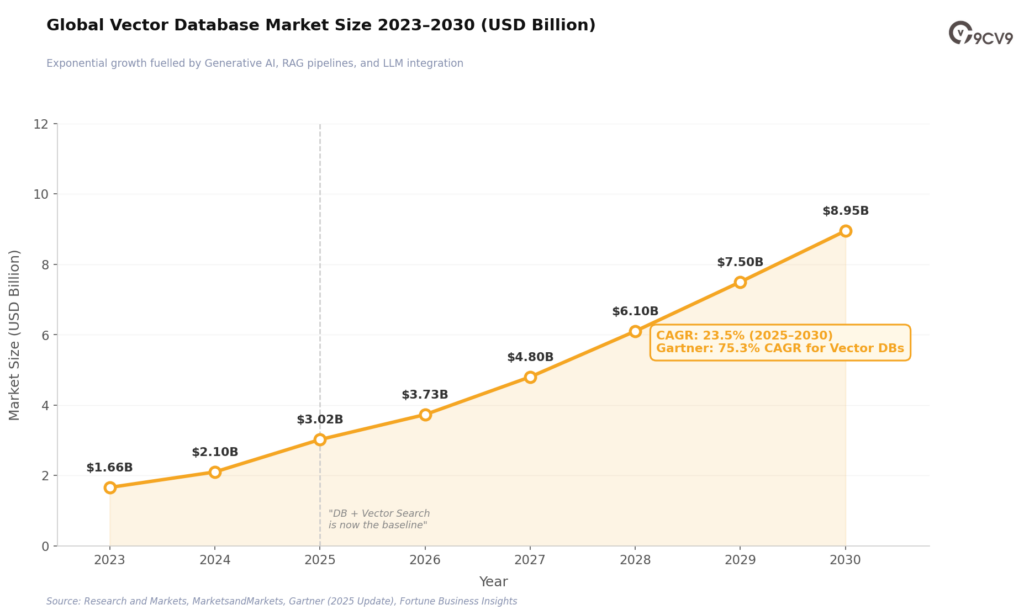
The vector database market was worth an estimated $3.02 billion in 2025 and $3.73 billion in 2026, with one forecast projecting it to reach $8.71 billion by 2030 at a 23.5% CAGR. MarketsandMarkets provides another estimate of 27.5% CAGR through 2030, while the Gartner figure cited in the dataset projects an extraordinary 75.3% CAGR for vector databases.
The range of forecasts again reflects differences in market definitions, but the underlying trend is unmistakable: AI workloads are creating a new growth engine for database infrastructure.
Vector databases allow AI applications to retrieve information based on semantic similarity rather than relying exclusively on traditional keyword or structured SQL queries. This makes them particularly valuable for retrieval-augmented generation, enterprise search, recommendation engines, AI assistants and agentic AI applications.
Agentic AI is already emerging as another database demand driver. The dataset values agentic AI applications within the vector database market at $460 million in 2025, potentially reaching $1.45 billion by 2030 at a 25.97% CAGR. Cloud-managed deployments account for 63.3% of this segment, indicating that AI-native database adoption is developing alongside the broader transition toward managed cloud infrastructure.
Artificial intelligence is also changing how databases themselves operate.
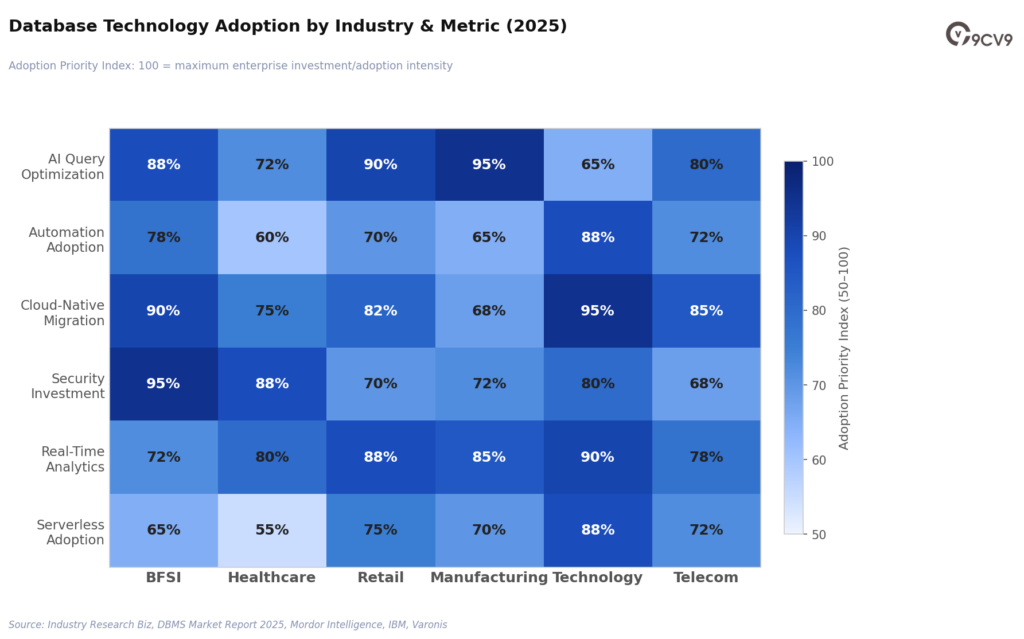
AI-driven query optimization reportedly improved database performance by 32% across active enterprise installations in 2024. AI and machine-learning automation reduced manual DBA workloads by 29%, while approximately 21% of organizations use machine learning for automated database indexing and tuning. Meanwhile, 45% of new database investments reportedly target automation, scalability and AI integration.
This development could gradually redefine the database administrator role. Routine tasks such as indexing, tuning, capacity management, anomaly detection and optimization can increasingly be automated, allowing database professionals to concentrate more heavily on architecture, governance, security, reliability and data strategy.
The rise of AI does not eliminate traditional database priorities, however. It makes database security even more consequential.
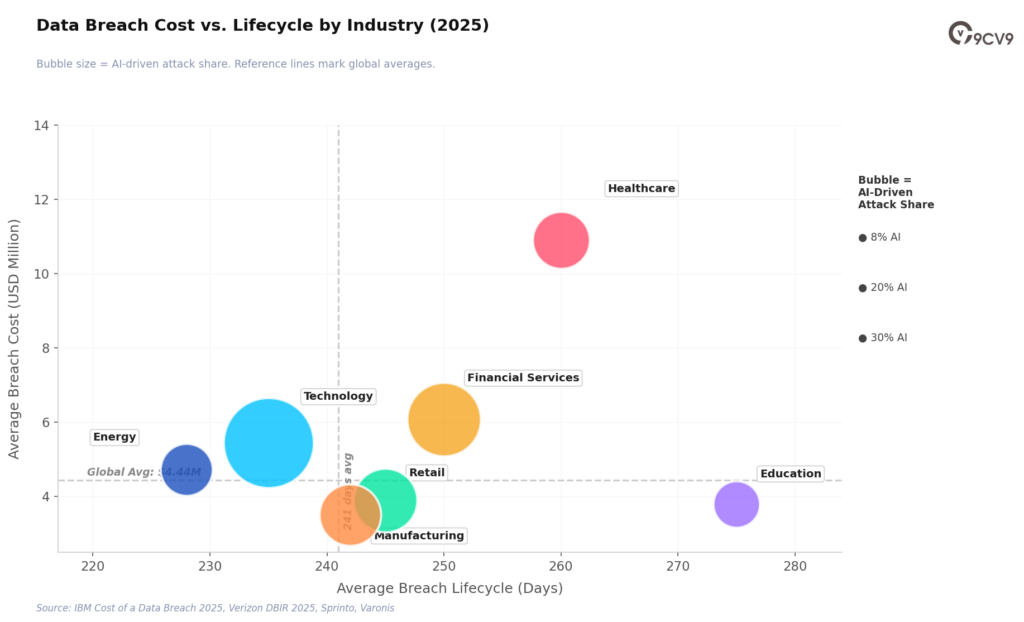
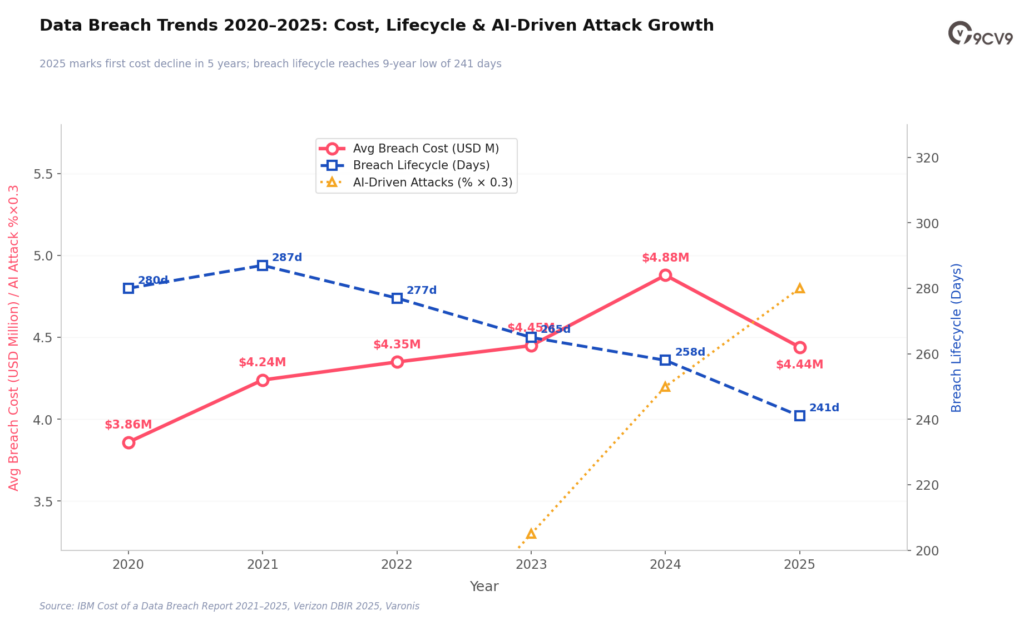
The global average cost of a data breach stood at $4.44 million in 2025, while the average cost in the United States reached $10.22 million. Organizations required an average of 181 days to identify a breach and another 60 days to contain it, producing an average breach lifecycle of 241 days.
Database environments remain particularly attractive targets because they can contain customer identities, financial records, intellectual property, authentication information, operational data and other high-value assets. According to the compiled statistics, 43% of organizations experienced database-related security incidents in 2024, while 29% experienced unauthorized database access attempts.
AI is adding another dimension to this security challenge. Approximately 16% of breaches in 2025 involved AI-driven attacks, while organizations extensively using security AI and automation reportedly saved nearly $1.9 million per breach and detected incidents 80 days faster than organizations without comparable capabilities. At the same time, shadow AI-related breaches added an estimated $670,000 to average breach costs.
Database security therefore increasingly intersects with broader AI governance. As organizations connect internal databases to AI assistants, agents, vector stores and retrieval systems, access control and data governance become essential parts of database architecture rather than separate compliance exercises.
The competitive database software landscape is changing alongside these technological shifts.
The statistics identify AWS as the leading DBMS vendor by revenue in 2026 based on the cited Gartner market-share ranking, ahead of Microsoft, Oracle and Google Cloud. Oracle, Microsoft and IBM collectively account for approximately 42% of the enterprise DBMS market, while AWS, Google, IBM, Microsoft, Oracle, SAP and Alibaba collectively control more than 40% of the cloud database and DBaaS market according to another cited estimate.
Yet the industry remains highly fragmented and innovative. More than 190 new database solutions were reportedly launched between 2023 and 2025, while venture capital funding for DBMS startups increased 19%. Open-source DBMS projects attracted approximately 22% of software development investment, and nearly 40% of SMEs reportedly prefer open-source database systems because of their cost advantages.
Open source is therefore another defining database software trend to watch in 2026. The compiled data suggests open-source database systems account for more than half of market share when measured through popularity metrics. PostgreSQL’s strong developer adoption provides perhaps the clearest example of how open-source database technology has moved from an alternative option to mainstream enterprise infrastructure.
Geographically, database growth is also becoming more distributed.
North America accounted for approximately 40.5% of global database revenue in 2025, maintaining its position as the industry’s largest regional market. But Asia-Pacific is expanding faster, with the region projected to grow at approximately 17.6% CAGR. North America and Asia-Pacific together account for 71% of AI-related database capital expenditure according to the statistics compiled for this report.
The Asia-Pacific opportunity is being strengthened by 5G infrastructure, cloud adoption, e-commerce, digital financial services, IoT deployments, smart cities and rapidly expanding digital economies. Similar trends are visible in the cloud database market, where APAC is projected to grow at more than 19% annually between 2025 and 2030.
Industry demand is equally broad. Banking, financial services and insurance represented 20.6% of database end-user revenue in 2025, making BFSI the largest vertical in the dataset. Financial institutions require highly available databases for payments, transaction processing, fraud detection, customer information, regulatory reporting and increasingly AI-powered financial services.
Behind virtually every one of these trends sits an even larger structural force: the relentless expansion of digital data.
The compiled statistics estimate that global digital data volume is increasing by approximately 28% annually, while more than 120 zettabytes of data were generated globally in 2024. Real-time analytics adoption increased 37% during 2024–2025, while active enterprise database deployments exceeded 7.6 million worldwide in 2024.
This explains why database software remains strategically important despite decades of technological evolution. Every new digital application produces information. Every AI agent needs context. Every e-commerce transaction creates records. Every connected device generates telemetry. Every personalization engine needs customer data. Every analytics platform needs reliable storage and retrieval. And every organization attempting to extract value from these systems ultimately depends on databases somewhere within its technology architecture.
For businesses evaluating database software in 2026, the conversation is therefore no longer simply about choosing between SQL and NoSQL or deciding which database can store the most records.
The strategic questions are becoming broader: Should workloads run on-premise, in the public cloud or across hybrid infrastructure? Should organizations operate databases themselves or adopt DBaaS? How should relational, document, graph, key-value and vector databases coexist? Which workloads require serverless architecture? How should proprietary enterprise information be connected securely to generative AI? And how much database administration can safely be automated?
The answers will differ by organization, but the direction of the market is becoming increasingly clear. Cloud-native infrastructure, DBaaS, open-source databases, NoSQL, vector search, AI-assisted database management, automation, hybrid deployment and stronger database security are collectively defining the database software landscape in 2026.
The following 113 database software statistics, data points and trends for 2026 provide a quantitative view of that transformation. They cover global database market size and growth, DBMS forecasts, cloud database adoption, DBaaS, relational and NoSQL market share, PostgreSQL and MySQL adoption, vector databases, artificial intelligence, database automation, cybersecurity, leading vendors, regional growth and enterprise adoption.
Together, these database software statistics show an industry moving beyond its traditional role as a storage layer. In 2026, the database is increasingly becoming the operational foundation connecting cloud computing, enterprise applications, real-time analytics and artificial intelligence—making database software one of the most consequential infrastructure markets of the AI era.
Before we venture further into this article, we would like to share who we are and what we do.
About 9cv9
9cv9 is a business tech startup based in Singapore and Asia, with a strong presence all over the world.
With over ten years of startup and business experience, and being highly involved in connecting with thousands of companies and startups, the 9cv9 team has listed some important and crucial software tools in this review.
If you like to get your company listed in our top B2B software reviews, check out our world-class 9cv9 Media and PR service and pricing plans here.
Top 113 Database Software Statistics, Data & Trends in 2026
🌐 MARKET SIZE & GROWTH
- $197.16 billion — The global database software market is forecast to reach $197.16B in 2026, up from $174.68B in 2025, demonstrating the sector’s resilience and growth momentum. (Research and Markets)
- 15.03% CAGR (2025–2032) — The database software market is expanding at a 15.03% compound annual growth rate, driven by surging data volumes and heightened demand for real-time business insights. (Research and Markets)
- $465.66 billion by 2032 — Continued CAGR of 15.03% means the database software market will nearly triple in size by 2032, underscoring the long-term investment case. (Research and Markets)
- $182.52 billion (2024 base) — The database software market stood at $182.52B in 2024, offering a solid baseline against which 2025–2026 growth can be benchmarked. (Research and Markets)
- $207.37 billion (2025) — The database software market hit $207.37B in 2025, a 13.6% jump from 2024 — one of the fastest expansions recorded in a single year. (Research and Markets)
- 13.6% YoY growth (2024→2025) — Year-on-year growth of 13.6% in database software revenues signals accelerating enterprise dependence on data infrastructure. (Research and Markets)
- $269.19 billion by 2029 — The global database software market is projected to reach $269.19B by 2029 at a 9.7% CAGR, driven by data-driven business transformation. (The Business Research Company)
- $101.98 billion DBMS market (2026) — The DBMS market grows from $92B in 2025 to $101.98B in 2026 at a 10.8% CAGR, reflecting rapid enterprise data adoption. (The Business Research Company)
- $91.99 billion DBMS market (2026, RSFM) — Research and Markets separately estimates the DBMS market at $91.99B in 2026, growing to $173.42B by 2032 at a 10.82% CAGR. (Research and Markets)
- $161 billion DBMS market (2026, Gartner) — Gartner forecasts the DBMS market to hit $161B in 2026, an 18.4% annual growth rate — the most bullish major analyst estimate. (Gartner, 2025 Update)
- 18.4% DBMS growth in 2026 (Gartner) — Gartner’s 18.4% growth forecast for 2026 is driven by rising data volumes, AI adoption, and cloud-native expansion. (Gartner)
- $149.65 billion DBMS market (2026, FortuneBi) — Fortune Business Insights projects the DBMS market at $149.65B in 2026, growing at a 13.29% CAGR to reach $406.03B by 2034. (Fortune Business Insights)
- $406.03 billion DBMS market by 2034 — The database management system market will more than quadruple in a decade, making it one of the largest software segments. (Fortune Business Insights)
- $132.09 billion DBMS market (2025) — Fortune Business Insights values the DBMS market at $132.09B in 2025, setting the stage for sustained double-digit growth. (Fortune Business Insights)
- $69.31 billion enterprise DBMS (2025) — The global enterprise DBMS market reached $69.31B in 2025, dominated by cloud-first multinationals and regulated industries. (Business Research Insights)
- $84.34 billion enterprise DBMS (2026) — Enterprise DBMS expands to $84.34B in 2026, advancing at a 21.7% CAGR — the fastest growth rate among major DBMS segments. (Business Research Insights)
- 21.7% enterprise DBMS CAGR (2025–2034) — No other enterprise software segment matches the 21.7% CAGR of enterprise DBMS, reflecting organizations’ mission-critical data dependency. (Business Research Insights)
- $150.38 billion total database market (2025) — Mordor Intelligence values the total database market at $150.38B in 2025, encompassing relational, NoSQL, and in-memory solutions. (Mordor Intelligence)
- $171.36 billion total database market (2026) — The combined database market (all types) reaches $171.36B in 2026, growing at a 13.95% CAGR to 2031. (Mordor Intelligence)
- $329.05 billion database market by 2031 — By 2031, the global database market will exceed $329B, compounding at 13.95% as generative AI workloads and IoT data proliferate. (Mordor Intelligence)
☁️ CLOUD & DEPLOYMENT
- $19.95 billion cloud DB & DBaaS market (2024) — The cloud database and DBaaS market was valued at $19.95B in 2024, nearly doubling expected in six years. (Grand View Research)
- $49.78 billion cloud DB & DBaaS by 2030 — Cloud database spending will reach $49.78B by 2030 at a 16.7% CAGR, driven by cost savings and remote-work infrastructure. (Grand View Research)
- 16.7% CAGR cloud DB market (2025–2030) — The cloud database market’s 16.7% CAGR reflects a structural shift from CapEx hardware to OpEx managed services. (Grand View Research)
- 56.40% of database revenue from cloud (2025) — Cloud deployment accounts for more than half of all database revenue in 2025, advancing at an 18.3% CAGR. (Mordor Intelligence)
- 18.3% CAGR for cloud database segment — Cloud databases grow faster than the overall market at 18.3% CAGR, leaving on-premise systems far behind in investment priority. (Mordor Intelligence)
- 73% of enterprises run at least one cloud database — Nearly three-quarters of global enterprises now operate at least one database in a public cloud environment. (Industry Research Biz)
- 54% of enterprises use cloud databases for operations — More than half of enterprises have adopted cloud databases specifically for core operational workloads, not just analytics. (Industry Research Biz)
- 53% of new enterprise databases launched in public cloud (2025) — A majority of newly deployed enterprise databases were cloud-based in 2025, confirming cloud as the default. (Industry Research Biz)
- 37% North America cloud DB revenue share (2024) — North America dominates cloud database spending with a 37% revenue share, backed by advanced IT infrastructure. (Grand View Research)
- 19%+ APAC cloud DB CAGR (2025–2030) — Asia-Pacific is the fastest-growing cloud database market, driven by 5G rollouts, smart city investments, and e-commerce growth. (Grand View Research)
- 15.2% Europe cloud DB CAGR — European cloud database adoption accelerates at 15.2% CAGR, shaped by GDPR compliance requirements pushing secure cloud migration. (Grand View Research)
- 47% hybrid cloud DB deployment share (2024) — Hybrid cloud databases held 47%+ share in 2024, as enterprises balance data sovereignty regulations with cloud elasticity. (Grand View Research)
- 64.20% of database spend on DBaaS (2025) — Database-as-a-Service accounts for nearly two-thirds of all database expenditure, reflecting a clear preference for managed, subscription-based models. (Mordor Intelligence)
- 26% increase in DBaaS subscriptions — The rise of DBaaS led to a 26% increase in subscription-based deployments as enterprises embrace consumption-based IT models. (Industry Research Biz)
- 25% of enterprises moved from on-premise to hybrid — A quarter of organizations completed or began migrations from pure on-premise to hybrid database infrastructure in 2024–2025. (Industry Research Biz)
- 21% growth in serverless database utilization — Serverless database usage jumped 21% as elastic, auto-scaling platforms prove ideal for unpredictable AI-driven workloads. (Industry Research Biz)
- $28 billion serverless computing market (2025) — The global serverless computing market reached $28B in 2025, directly fuelling growth in serverless database adoption. (Precedence Research via RTInsights)
- $90 billion serverless computing market by 2034 — Serverless computing will grow to $90B+ by 2034, making it one of the most powerful tailwinds for cloud database services. (Precedence Research)
- 18% YoY growth in cloud-based DBMS adoption — Cloud DBMS adoption grew 18% year-over-year as enterprises realized cost efficiencies and performance improvements over on-premise systems. (Industry Research Biz)
- 83.2% relational DB share in cloud (2024) — Relational databases still command 83.2% of the cloud database market by revenue in 2024, demonstrating enduring enterprise trust. (Grand View Research)
🗄️ DATABASE TYPE & MARKET SHARE
- 57.30% relational database market share (2025) — Relational platforms retained 57.3% of the total database market in 2025, underpinned by their maturity for structured transactional workloads. (Mordor Intelligence)
- 17.8% NoSQL CAGR through 2031 — NoSQL engines post the strongest growth of any database category at 17.8% CAGR as social media, IoT, and user-generated content explode. (Mordor Intelligence)
- 31.2% NoSQL market CAGR (2025–2033) — Straits Research projects the global NoSQL market at a stunning 31.2% CAGR, making it one of the fastest-growing software segments. (Straits Research)
- $16.13 billion NoSQL market (2025) — The NoSQL market reached $16.13B in 2025, growing to $141.62B by 2033 as big data complexity accelerates enterprise adoption. (Straits Research)
- $141.62 billion NoSQL market by 2033 — The global NoSQL market will grow nearly ninefold in eight years, positioning it as a transformative force in data infrastructure. (Straits Research)
- 45% of organizations rely on relational DBMS — Over 45% of global organizations still rely primarily on relational DBMS for core data management, reflecting RDBMS dominance. (Industry Research Biz)
- 31% use non-relational or hybrid solutions — 31% of enterprises now deploy NoSQL or hybrid database solutions, a number growing rapidly as data types diversify. (Industry Research Biz)
- 18% growth in multi-model database deployments — Multi-model databases supporting document, key-value, and graph data experienced 18% growth in enterprise adoption. (Industry Research Biz)
- 39.05% MySQL customer market share — MySQL holds 39.05% of the relational database customer installations market in 2026 — the most widely deployed relational database. (6Sense)
- 18.47% PostgreSQL market share — PostgreSQL commands 18.47% of relational database installations, with the fastest growth trajectory among open-source databases. (6Sense)
- 9.48% Oracle Database market share — Oracle Database holds 9.48% of relational database customer share despite its #1 DB-Engines popularity ranking. (6Sense)
- 55.6% of developers use PostgreSQL (2025) — PostgreSQL topped the 2025 StackOverflow Developer Survey at 55.6%, ahead of MySQL (40.5%) for the second consecutive year. (StackOverflow Developer Survey 2025)
- 37.85% key-value store share in NoSQL — Key-value stores held the largest NoSQL segment at 37.85% in 2025, driven by caching, session management, and e-commerce needs. (Mordor Intelligence)
- 29.05% CAGR for graph databases — Graph databases are the fastest-growing NoSQL segment as organizations mine relationship data for cybersecurity, fraud detection, and supply chain. (Mordor Intelligence)
- 26.74% CAGR for hybrid NoSQL deployments — Hybrid NoSQL architectures combining local nodes with cloud replicas are growing at 26.74% CAGR, reflecting data sovereignty needs. (Mordor Intelligence)
- 65.25% of NoSQL revenue from cloud (2025) — Cloud-deployed NoSQL databases delivered 65.25% of 2025 revenue, confirming enterprise preference for fully managed elastic NoSQL. (Mordor Intelligence)
- Open-source databases hold 50%+ market share — Open-source database systems account for just over half of total market share by popularity metrics in 2026. (DB-Engines via Linuxiac)
🤖 AI INTEGRATION & VECTOR DATABASES
- 75.3% CAGR for vector databases (Gartner) — Vector databases will lead all database segments with a 75.3% CAGR, powered by generative AI, RAG pipelines, and hybrid semantic search. (Gartner, 2025 Update)
- $3.02 billion vector DB market (2025) — The vector database market stood at $3.02B in 2025, growing at a 23.5% CAGR as AI-native architectures become enterprise standard. (Research and Markets)
- $3.73 billion vector DB market (2026) — Vector databases hit $3.73B in 2026 — a market that barely existed three years ago, now considered baseline AI infrastructure. (Research and Markets)
- 23.5% vector DB CAGR (2025–2030) — The vector database market grows at 23.5% CAGR from 2025 to 2030, driven by LLM integrations and retrieval-augmented generation adoption. (Research and Markets)
- $8.71 billion vector DB market by 2030 — Vector databases will reach $8.71B by 2030 as enterprise AI applications require fast, scalable embedding retrieval. (Research and Markets)
- $2.55 billion vector DB market (2025, GMINSIGHTS) — GM Insights values the vector database market at $2.55B in 2025, growing at 22.3% CAGR through 2034. (GM Insights)
- 27.5% vector DB CAGR (MarketsandMarkets) — MarketsandMarkets projects vector database growth at 27.5% CAGR from 2025 to 2030, to reach $8.95B. (MarketsandMarkets)
- 81% of vector DB revenue from the US — The United States dominates vector database adoption with 81% of global revenue, backed by a strong AI startup ecosystem. (GM Insights)
- $0.46 billion agentic AI in vector DB market (2025) — Agentic AI applications in vector databases represent $0.46B in 2025, growing to $1.45B by 2030 at a 25.97% CAGR. (Mordor Intelligence)
- 63.3% cloud-managed vector DB deployments (2024) — Cloud-managed vector database offerings account for 63.3% of the agentic AI segment, easing procurement and scaling. (Mordor Intelligence)
- 32% AI query performance improvement — AI-driven query optimization improved database performance by 32% across active enterprise installations in 2024. (Industry Research Biz)
- 29% reduction in DBA manual workload — Automation through AI and machine learning reduced manual database administrator workload by 29%, freeing teams for strategic work. (Industry Research Biz)
- 28% growth in AI/cloud database investment (2023–2024) — Global investments in cloud and AI database solutions increased 28% from 2023 to 2024, signalling a structural IT spending shift. (Industry Research Biz)
- 45% of new database investments target automation — Over 45% of all new database investments focus specifically on automation, scalability, and AI integration capabilities. (Industry Research Biz)
- 44% of enterprises investing in cloud-native databases — 44% of enterprises are actively investing in cloud-native databases for greater flexibility and cost efficiency in 2024–2025. (Industry Research Biz)
- 38% of enterprises plan autonomous database migration by 2026 — More than a third of enterprises plan to migrate from legacy systems to AI-managed, autonomous databases by 2026. (Industry Research Biz)
- 21% of organizations use ML for automated indexing — Approximately 21% of organizations now employ machine learning for automated database indexing and tuning. (Industry Research Biz)
- $13 trillion AI economic impact by 2030 — AI applications across data-driven operations — enabled by advanced DBMS — are projected to generate ~$13 trillion in economic value by 2030. (Expert Market Research, citing McKinsey)
🔐 SECURITY & RISK
- $10.5 trillion global cybercrime cost (2025) — Cybercrime costs the global economy $10.5 trillion in 2025, growing 15% annually — with database breaches as a major vector. (Cybersecurity Ventures)
- $4.44 million average data breach cost (2025) — The global average cost of a data breach fell slightly to $4.44M in 2025 — the first decline in five years, reflecting faster AI-aided detection. (IBM Cost of a Data Breach 2025)
- $10.22 million US average breach cost (2025) — The United States remains the world’s most expensive region for data breaches at $10.22M average — more than double the global average. (IBM)
- 241 days average breach lifecycle (2025) — The average data breach lifecycle dropped to 241 days in 2025 — a 9-year low, down from 287 days in 2021. (IBM)
- 181 days to identify + 60 days to contain — It takes organizations an average of 181 days to identify a breach and 60 additional days to contain it, totaling 241 days. (IBM 2025)
- 43% of organizations experienced DB security incidents (2024) — 43% of organizations reported database-related security incidents in 2024, underscoring urgent need for database-level security controls. (Industry Research Biz)
- 95% of breaches involve human error — Despite advanced AI security tools, human error remains the root cause of 95% of all data breaches — training and governance remain paramount. (Sprinto, Verizon DBIR)
- 16% of 2025 breaches involved AI-driven attacks — One in six data breaches in 2025 involved AI-driven attack methods, including phishing (37%) and deepfakes (35%). (IBM 2025)
- $1.9 million saved via security AI and automation — Organizations with extensive security AI and automation save nearly $1.9M per breach and detect incidents 80 days faster than peers. (IBM 2025)
- $670,000 extra cost from shadow AI breaches — Shadow AI-related breaches add an average of $670,000 above the standard breach cost — and affected 20% of organizations in 2025. (Reco AI / IBM)
- 97% of AI-related breach organizations lacked access controls — 97% of organizations that experienced AI-related breaches lacked proper access controls — a critical governance gap. (IBM 2025)
- 19% growth in database security tools — Database security tool adoption grew 19% in 2024–2025, primarily within financial services and defense institutions. (Industry Research Biz)
- 29% of organizations experienced unauthorized DB access attempts (2024) — Nearly a third of organizations faced unauthorized database access attempts in 2024, highlighting persistent attacker interest in data stores. (Industry Research Biz)
- $150 average cost per compromised record — Each compromised data record costs an average of $150, with database breaches exposing thousands to millions of records per incident. (IBM / Sprinto)
- $375 million breach cost for 50M-record incidents — IBM research shows breaches involving 50 million records carry an average cost of $375M — catastrophic for any organization. (IBM, cited in Deepstrike)
- $1.38 million lost business cost per breach — Organizations estimated $1.38M in lost business value per breach in 2025, including revenue from system downtime, customer churn, and reputational damage. (IBM 2025)
- 45% of breached organizations increased product prices — Nearly half of organizations that suffered data breaches increased their product or service prices — passing breach costs to consumers. (IBM 2025)
🏢 COMPETITIVE LANDSCAPE
- AWS #1 DBMS vendor by revenue (2026) — Gartner’s DBMS Market Share Ranks for 2011–2025 shows AWS leading by revenue in 2026, ahead of Microsoft, Oracle, and Google Cloud. (Gartner via The Register, April 2026)
- 42% enterprise DBMS share by Oracle + Microsoft + IBM — Oracle, Microsoft, and IBM collectively control approximately 42% of the enterprise DBMS market share globally. (Business Research Insights)
- 40%+ cloud DB share by top vendors — AWS, Google, IBM, Microsoft, Oracle, SAP, and Alibaba collectively hold over 40% of the cloud database and DBaaS market. (GM Insights)
- 190+ new database solutions launched (2023–2025) — Over 190 new database solutions were launched in just two years, reflecting the sector’s intense innovation and competitive dynamics. (Industry Research Biz)
- 22% of software investment to open-source DBMS — Open-source DBMS projects attracted 22% of total software development investment, particularly among cost-conscious SMEs. (Industry Research Biz)
- 40% of SMEs prefer open-source DBMS — Nearly 40% of small and medium enterprises choose open-source DBMS solutions due to cost constraints, reducing demand for commercial licensed platforms. (Business Research Insights)
- 16% growth in vendor-integrator partnerships — B2B partnerships between database vendors and system integrators increased 16%, expanding managed database services and analytics opportunities. (Industry Research Biz)
- 19% VC funding growth in DBMS startups — Venture capital funding in DBMS startups grew 19%, driven by demand for multi-model, time-series, and AI-native database technologies. (Industry Research Biz)
🌍 REGIONAL & WORKFORCE DYNAMICS
- 40.50% of global database revenue from North America (2025) — North America contributes 40.5% of 2025 database revenue, supported by high IT investment and cloud-first enterprise strategies. (Mordor Intelligence)
- 71% of AI database capex from North America + APAC — North America and Asia-Pacific together account for 71% of AI-related database capital expenditure globally. (Industry Research Biz)
- 17.6% CAGR for Asia-Pacific database market — Asia-Pacific is the fastest-growing database region at a 17.6% CAGR, fueled by 5G deployment, IoT adoption, and digital-first industries. (Mordor Intelligence)
- 20.6% BFSI database revenue share (2025) — The banking, financial services, and insurance sector holds 20.6% of database end-user revenue in 2025 — the largest vertical globally. (Mordor Intelligence)
- 65% of enterprises globally adopting flexible DBMS — More than 65% of enterprises are adopting flexible, economical DBMS solutions as unstructured data from social media and e-commerce surges. (Business Research Insights)
- 7.6 million+ enterprise DBMS installations (2024) — Active enterprise database deployments exceeded 7.6 million worldwide in 2024 — a 9.2% increase over 2023 figures. (Industry Research Biz)
- 67% of businesses relied on cloud data access for remote work (2023) — The ITU found that 67% of businesses worldwide relied on cloud-based data access for remote work, accelerating DBMS adoption. (ITU, cited by Expert Market Research)
- 28% annual growth in global digital data volume — Global digital data volume grows 28% annually — the single most powerful driver of database investment worldwide. (U.S. Bureau of Labor Statistics)
- 120 zettabytes of data generated globally (2024) — Data generation exceeded 120 zettabytes globally in 2024, creating insatiable demand for scalable, intelligent database infrastructure. (Industry Research Biz)
- 37% real-time analytics adoption growth — Real-time analytics adoption increased 37% in 2024–2025, with manufacturing (45%) and retail as the leading use-case verticals. (Industry Research Biz)
- 55% of large enterprises shifting to cloud DBMS — Over 55% of large enterprises are actively migrating to cloud-based database systems, accelerated by AI and automation integration. (Business Research Insights)
- 26% growth in containerized DBMS environments — Containerized database environments surged 26%, enabling faster, more portable deployments across multi-cloud and hybrid architectures. (Industry Research Biz)
- 48% of IT leaders prioritize hybrid cloud for database rollouts — 48% of IT leaders prioritize hybrid cloud strategies for database deployments to balance local latency with cloud burst capacity. (Rackspace Technology, 2025 State of Cloud Report)
Conclusion
The top 113 database software statistics, data and trends in 2026 reveal an industry undergoing one of the most significant transformations in its history. Databases are no longer simply back-end repositories for storing business records. They are becoming the foundation of cloud applications, real-time analytics, artificial intelligence, automation, cybersecurity, digital commerce and increasingly autonomous enterprise systems.
The sheer size of the database software market demonstrates how important this infrastructure has become. One forecast in the compiled data places the global database software market at $197.16 billion in 2026, up from $174.68 billion in 2025, with a projected 15.03% CAGR through 2032. Under that forecast, the market could reach approximately $465.66 billion by 2032. Another estimate values the broader database market at $171.36 billion in 2026 and projects it to reach $329.05 billion by 2031.
Although individual market estimates vary because research organizations use different definitions and methodologies, virtually every major forecast included in these statistics points toward sustained expansion. The common drivers are equally clear: businesses are producing more data, migrating more workloads to the cloud, demanding faster analytics and integrating artificial intelligence into applications and operations.
The database management system market illustrates the scale of this opportunity particularly well. Estimates included in the dataset range from approximately $91.99 billion to $161 billion for 2026, depending on what is included within the DBMS category. Fortune Business Insights places the market at $149.65 billion in 2026 and projects it to reach $406.03 billion by 2034, while the cited Gartner forecast anticipates 18.4% annual DBMS growth in 2026.
Enterprise DBMS is another high-growth area. The dataset places this segment at $84.34 billion in 2026, up from $69.31 billion in 2025, with a cited CAGR of 21.7% through 2034. Such growth indicates that databases remain deeply embedded in the mission-critical systems organizations use to process transactions, manage customers, operate digital services and support increasingly data-intensive applications.
Cloud Databases Are Becoming the Default
Perhaps the clearest conclusion from the 2026 database software statistics is that the center of gravity continues to shift toward cloud infrastructure.
Cloud deployment accounted for approximately 56.4% of database revenue in 2025, while the cloud database segment is cited as growing at an 18.3% CAGR. The cloud database and Database-as-a-Service market itself was valued at $19.95 billion in 2024 and is projected to reach $49.78 billion by 2030, representing 16.7% annual growth.
The transition is not limited to moving existing databases from company-owned servers into public-cloud virtual machines. The consumption model itself is changing.
Database-as-a-Service accounted for approximately 64.2% of database spending in 2025 according to the compiled figures, while subscription-based database deployments increased 26%. Serverless database utilization increased another 21%, demonstrating growing demand for database infrastructure that can automatically scale according to application requirements.
This transition has important consequences for technology teams. Organizations increasingly expect database platforms to handle infrastructure provisioning, scaling, replication, availability, backups, patching and other operational responsibilities automatically.
At the same time, cloud adoption does not necessarily mean the disappearance of private infrastructure.
Hybrid deployments represented more than 47% of cloud database deployments in 2024, while 48% of IT leaders reportedly prioritize hybrid cloud strategies for database rollouts. This suggests that the future of enterprise database infrastructure may be distributed rather than exclusively public-cloud based, particularly for businesses managing regulatory requirements, data sovereignty, latency constraints and sensitive information.
Relational Databases Remain Strong, but the Market Is Diversifying
Another important takeaway from the database statistics is that established relational database technology remains highly relevant.
Relational databases accounted for approximately 57.3% of the overall database market in 2025, while relational systems represented 83.2% of cloud database revenue in 2024.
PostgreSQL and MySQL remain particularly important within this ecosystem. The cited 2025 Stack Overflow Developer Survey found 55.6% of developers using PostgreSQL, compared with 40.5% using MySQL. Separate installation-based statistics place MySQL at 39.05% of relational database customer installations and PostgreSQL at 18.47%.
These different measurements should not be treated as equivalent market-share calculations, but collectively they demonstrate that SQL databases continue to occupy a central position in modern software development.
The more interesting development is that enterprises increasingly use multiple database technologies rather than expecting one database architecture to solve every problem.
NoSQL databases are growing rapidly alongside relational systems. One forecast included in the dataset projects 17.8% NoSQL CAGR through 2031, while another forecasts 31.2% annual growth between 2025 and 2033. Under the latter estimate, the NoSQL market expands from $16.13 billion in 2025 to $141.62 billion by 2033.
Graph databases are projected to grow at 29.05% annually, hybrid NoSQL deployments at 26.74%, and cloud-based NoSQL already generated 65.25% of segment revenue in 2025. Meanwhile, multi-model database deployments experienced 18% growth.
The resulting database landscape is therefore becoming increasingly heterogeneous. Organizations may simultaneously operate relational databases for transactions, key-value stores for caching, document databases for flexible application data, graph databases for relationship analysis and vector databases for artificial intelligence.
Artificial Intelligence Is Creating a New Database Growth Cycle
Of all the database software trends shaping 2026, artificial intelligence could ultimately prove the most transformative.
Generative AI applications need enormous quantities of accessible information. Retrieval-augmented generation systems need to find relevant knowledge quickly. AI agents need persistent context and enterprise information. Recommendation systems need similarity search. All of these requirements are creating new opportunities for databases designed around AI workloads.
Vector databases sit directly at the center of this transition.
The vector database market is estimated at $3.73 billion in 2026, compared with $3.02 billion in 2025. One forecast projects a 23.5% CAGR through 2030, when the market could reach $8.71 billion. Another projects 27.5% annual growth, while the Gartner statistic included in the dataset forecasts an extraordinary 75.3% CAGR for vector databases.
The exact forecasts differ considerably, but they point toward the same structural trend: vector retrieval is becoming an increasingly important component of AI infrastructure.
Agentic AI could expand this opportunity further. Agentic AI applications within the vector database market were worth an estimated $460 million in 2025 and are projected to reach $1.45 billion by 2030 at a 25.97% CAGR. Cloud-managed vector database deployments already represent 63.3% of the agentic AI segment cited in the data.
AI is simultaneously changing the operation of conventional databases.
AI-driven query optimization reportedly produced a 32% database performance improvement, while AI and machine-learning automation reduced manual DBA workloads by 29%. Approximately 21% of organizations use machine learning for automated indexing and tuning, and 45% of new database investments reportedly focus on automation, scalability and AI integration.
These trends suggest that the database of the future will increasingly optimize itself.
Rather than database administrators manually tuning every workload, intelligent systems may automatically identify performance problems, optimize queries, recommend indexes, predict capacity requirements and automate routine operational tasks. Human database specialists would then spend more time on architecture, governance, security and strategic data management.
Database Security Will Become Even More Important
Greater database intelligence and connectivity also introduce greater risk.
The global average cost of a data breach reached $4.44 million in 2025, while the average breach in the United States cost $10.22 million. Organizations required an average of 241 days to identify and contain a breach, including 181 days for identification and another 60 days for containment.
Database-specific statistics reinforce the severity of the problem. Approximately 43% of organizations experienced database-related security incidents in 2024, while 29% encountered unauthorized database access attempts. Database security tool adoption subsequently increased 19%.
Artificial intelligence makes the relationship between databases and cybersecurity even more complex.
The dataset reports that 16% of 2025 breaches involved AI-driven attacks. Yet AI is also becoming an important defensive technology: organizations extensively deploying security AI and automation reportedly saved nearly $1.9 million per breach and identified incidents 80 days faster than organizations without comparable capabilities.
AI governance will consequently become inseparable from database governance.
Organizations connecting generative AI systems to internal databases must determine exactly what information AI models and agents are permitted to retrieve. Access control, authentication, encryption, data classification, audit trails and least-privilege architectures become increasingly important when machines can automatically discover and synthesize organizational information.
Open Source Will Continue Reshaping Database Economics
The database software statistics also highlight the continuing influence of open-source technology.
Open-source databases represent more than half of the market when measured through the popularity metrics cited in the dataset. Around 40% of SMEs prefer open-source DBMS platforms, while open-source DBMS projects attracted approximately 22% of software development investment.
This dynamic creates substantial competitive pressure on traditional proprietary database vendors.
Organizations increasingly have access to mature open-source platforms that can be deployed internally, consumed through managed cloud services or incorporated into commercial products. This gives businesses greater flexibility when balancing licensing costs, vendor dependence, scalability and technical capabilities.
PostgreSQL’s strong developer adoption demonstrates how far this transition has progressed. Open-source databases are no longer simply low-cost alternatives for small applications. They increasingly support production workloads across startups, technology companies and large enterprises.
Database Competition Is Intensifying
Despite consolidation around several large technology platforms, database software remains an intensely competitive market.
The dataset identifies AWS as the leading DBMS vendor by revenue in the cited 2026 ranking, ahead of Microsoft, Oracle and Google Cloud. Oracle, Microsoft and IBM collectively hold approximately 42% of the enterprise DBMS market, while seven major vendors collectively account for more than 40% of cloud database and DBaaS revenue.
At the same time, more than 190 new database solutions were reportedly launched between 2023 and 2025, and venture capital funding for DBMS startups increased 19%.
This combination of large incumbents and rapidly emerging specialists is likely to keep the market highly dynamic.
Instead of competing exclusively on conventional database performance, vendors increasingly differentiate around AI integration, vector search, serverless architecture, distributed systems, real-time analytics, developer experience, automated management, multi-cloud portability and specialized data models.
Asia-Pacific Could Be One of the Most Important Growth Markets
Database software growth is also becoming increasingly global.
North America generated approximately 40.5% of worldwide database revenue in 2025, reflecting the region’s concentration of cloud providers, technology companies and large enterprise IT budgets. However, Asia-Pacific is projected to grow at approximately 17.6% CAGR, making it the fastest-growing database region in the dataset.
North America and Asia-Pacific collectively account for approximately 71% of AI-related database capital expenditure.
Within cloud databases specifically, Asia-Pacific growth is projected at more than 19% annually between 2025 and 2030. The expansion of digital commerce, financial technology, mobile applications, IoT, 5G infrastructure and cloud computing should continue generating substantial database demand across the region.
Data Growth Remains the Fundamental Driver
Behind cloud databases, AI, NoSQL, vector search and database automation sits one underlying force that connects almost every statistic in this report: the world continues to create enormous quantities of data.
The compiled figures indicate that global digital data volume is growing by approximately 28% annually, while more than 120 zettabytes of data were generated globally in 2024. Active enterprise DBMS installations exceeded 7.6 million during the same year, increasing 9.2% from 2023.
Organizations are not simply storing this information either.
Real-time analytics adoption increased 37% during 2024–2025, while more than 65% of enterprises are adopting flexible DBMS solutions to manage expanding volumes of information. Containerized DBMS environments grew 26%, and more than 55% of large enterprises are actively moving toward cloud-based database systems.
Every additional connected device, customer transaction, AI interaction, financial payment, digital document, application event and online behavior creates more information that needs to be stored, secured, queried and analyzed.
That fundamental relationship makes database infrastructure an enduring part of the digital economy.
What the Database Software Statistics Tell Us About 2026 and Beyond
Taken together, these 113 database software statistics for 2026 point toward a database industry defined by convergence.
Cloud computing is converging with database management.
Database management is converging with artificial intelligence.
Artificial intelligence is converging with enterprise search and analytics.
Automation is converging with database administration.
And database security is converging with broader AI and data governance.
The result is a market in which databases are becoming substantially more intelligent, distributed, automated and specialized.
Relational databases are unlikely to disappear. Instead, they will coexist with document databases, key-value stores, graph databases, vector databases and other specialized systems. On-premise infrastructure is unlikely to disappear completely either, but it will increasingly coexist with public cloud, private cloud and hybrid environments.
Similarly, database administrators are unlikely to be eliminated by AI. Their responsibilities are more likely to shift as automated systems handle greater portions of routine optimization and maintenance.
For database vendors, the competitive opportunity is increasingly about helping organizations manage this complexity without forcing technology teams to operate every component manually.
For enterprises, the challenge is choosing the right architecture rather than simply choosing the most popular database.
Performance, scalability, availability, security, data sovereignty, developer productivity, cloud costs, interoperability, AI readiness and vendor dependence all need to be considered. The appropriate database architecture for a global financial institution may be fundamentally different from the architecture required by a SaaS startup, e-commerce platform, AI application or IoT network.
For developers and technology leaders, one of the most important lessons from the database software trends of 2026 is therefore that database strategy is becoming application strategy.
The database determines how quickly applications retrieve information, how reliably transactions are processed, how easily infrastructure scales, how effectively AI systems access organizational knowledge and how securely sensitive information is protected.
That makes database decisions increasingly consequential at both the technical and business levels.
Looking toward the remainder of 2026 and beyond, cloud databases, DBaaS, PostgreSQL and other open-source platforms, NoSQL databases, vector databases, AI-powered database management, serverless architecture, hybrid cloud deployments and stronger database security are likely to remain among the most important trends to watch.
The numbers ultimately tell a straightforward story.
Database software is not becoming less important as artificial intelligence advances. It is becoming more important because artificial intelligence itself depends on data infrastructure.
As global data volumes continue expanding, enterprises migrate more workloads to managed cloud platforms, real-time analytics becomes standard and AI applications require immediate access to trusted organizational knowledge, databases will remain at the center of the modern technology stack.
The Top 113 Database Software Statistics, Data & Trends in 2026 therefore capture more than the growth of another software category. They document the evolution of the infrastructure responsible for organizing the world’s rapidly expanding digital information.
And if current market, cloud and AI adoption trends continue, the next stage of database software will increasingly be defined not simply by how efficiently systems can store data, but by how securely, intelligently and automatically they can turn that data into usable information for applications, businesses and artificial intelligence.
If you find this article useful, why not share it with your hiring manager and C-level suite friends and also leave a nice comment below?
We, at the 9cv9 Research Team, strive to bring the latest and most meaningful data, guides, and statistics to your doorstep.
To get access to top-quality guides, click over to 9cv9 Blog.
To hire top talents using our modern AI-powered recruitment agency, find out more at 9cv9 Modern AI-Powered Recruitment Agency.
People Also Ask
What is the database software market size in 2026?
The global database software market is forecast at $197.16 billion in 2026 in one estimate, while other forecasts use different market definitions and produce different values.
How fast is the database software market growing?
One forecast projects the database software market to grow at a 15.03% CAGR from 2025 to 2032, potentially reaching $465.66 billion by 2032.
What is the DBMS market size in 2026?
DBMS market estimates vary significantly. The compiled data includes 2026 forecasts ranging from $91.99 billion to $161 billion, reflecting differences in research methodology and market definitions.
What are the biggest database software trends in 2026?
Major trends include cloud databases, DBaaS, serverless infrastructure, NoSQL, vector databases, AI-powered optimization, automation, hybrid cloud deployments and stronger database security.
Are cloud databases growing in 2026?
Yes. Cloud databases are among the fastest-growing database segments, with the compiled data citing an 18.3% CAGR and cloud accounting for 56.4% of database revenue in 2025.
What percentage of database revenue comes from cloud deployments?
Cloud deployments accounted for approximately 56.4% of database revenue in 2025, showing how cloud infrastructure has become central to enterprise database strategies.
How large will the cloud database market become?
The cloud database and DBaaS market is projected to grow from $19.95 billion in 2024 to approximately $49.78 billion by 2030 at a 16.7% CAGR.
What percentage of enterprises use cloud databases?
The compiled statistics report that 73% of enterprises run at least one database in a public cloud, while 54% use cloud databases for core operational workloads.
What is Database-as-a-Service adoption in 2026?
DBaaS is becoming a dominant consumption model. The dataset reports that Database-as-a-Service accounted for 64.2% of database spending in 2025.
Are serverless databases becoming more popular?
Yes. Serverless database utilization increased 21%, reflecting demand for elastic database infrastructure that can automatically scale for changing application and AI workloads.
What is the relational database market share?
Relational databases accounted for approximately 57.3% of the total database market in 2025, demonstrating their continued importance for structured and transactional workloads.
Are relational databases still relevant in 2026?
Yes. Relational databases remain central to enterprise technology, and they accounted for 83.2% of cloud database revenue in 2024 according to the compiled statistics.
How popular is PostgreSQL in 2026?
PostgreSQL recorded 55.6% developer usage in the cited 2025 Stack Overflow Developer Survey, placing it ahead of MySQL’s 40.5% among surveyed developers.
What is MySQL’s relational database market share?
The dataset cites MySQL at 39.05% of relational database customer installations, making it the most widely deployed relational database under that measurement.
How fast is the NoSQL database market growing?
NoSQL growth forecasts vary. The compiled statistics include a 17.8% CAGR through 2031 and a separate 31.2% CAGR forecast for 2025–2033.
How large could the NoSQL market become?
One forecast projects the NoSQL market to expand from $16.13 billion in 2025 to approximately $141.62 billion by 2033, representing a 31.2% CAGR.
What is the fastest-growing type of NoSQL database?
Graph databases are cited as the fastest-growing NoSQL segment, with a projected 29.05% CAGR as businesses use relationship data for fraud detection, cybersecurity and supply chains.
What is the vector database market size in 2026?
The vector database market is estimated at approximately $3.73 billion in 2026, up from $3.02 billion in 2025 under one forecast included in the dataset.
Why are vector databases growing so quickly?
Vector databases support semantic retrieval for generative AI, RAG and other AI applications, making them increasingly important as businesses integrate large language models with enterprise data.
How fast is the vector database market growing?
Forecasts vary considerably. The dataset includes vector database growth estimates of 23.5%, 27.5% and, in the cited Gartner figure, 75.3% CAGR.
How is AI changing database software in 2026?
AI is supporting query optimization, automated indexing, tuning and administration. The dataset reports a 32% performance improvement from AI-driven query optimization.
Can AI reduce database administrator workloads?
The compiled data reports that AI and machine-learning automation reduced manual DBA workloads by 29%, potentially allowing database teams to focus more on strategic responsibilities.
How many organizations use machine learning for database indexing?
Approximately 21% of organizations in the compiled statistics use machine learning for automated database indexing and tuning.
How important is database security in 2026?
Database security remains critical. The dataset reports that 43% of organizations experienced database-related security incidents in 2024 and 29% faced unauthorized database access attempts.
What is the average cost of a data breach?
The global average cost of a data breach was $4.44 million in 2025, while the average breach cost in the United States reached $10.22 million.
How long does it take organizations to contain a data breach?
The average breach lifecycle was 241 days in 2025, consisting of approximately 181 days to identify a breach and another 60 days to contain it.
Which region has the largest database software market?
North America accounted for approximately 40.5% of global database revenue in 2025, making it the largest regional database market in the compiled data.
Which region has the fastest-growing database market?
Asia-Pacific is cited as the fastest-growing database region, with a projected 17.6% CAGR driven by cloud adoption, 5G, IoT and expanding digital industries.
How much data is generated worldwide?
The compiled statistics report that more than 120 zettabytes of data were generated globally in 2024, while global digital data volume is cited as growing approximately 28% annually.
What is the future of database software beyond 2026?
Database software is moving toward cloud-native, managed, automated and AI-ready infrastructure, with DBaaS, NoSQL, vector search, serverless databases and hybrid deployments driving future growth.
Sources
Research and Markets The Business Research Company EIN Presswire Gartner Fortune Business Insights Expert Market Research Business Research Insights Industry Research Biz Mordor Intelligence Grand View Research GM Insights RTInsights Cloud Data Insights Straits Research MarketsandMarkets The Register 6Sense Linuxiac Redgate IBM Varonis Sprinto Brightdefense Secureframe Reco AI Cybersecurity Ventures Rackspace Technology