



























Key Takeaways
- Customer satisfaction software is experiencing rapid global growth, driven by AI, cloud computing, omnichannel customer engagement, and increasing enterprise investment in customer experience (CX) platforms.
- AI-powered customer satisfaction software is transforming customer service with faster response times, personalized interactions, predictive analytics, higher CSAT scores, and stronger customer retention across industries.
- Businesses that leverage modern customer satisfaction software, real-time customer feedback, and data-driven CX strategies consistently achieve higher customer loyalty, increased revenue, lower churn, and stronger long-term competitive advantage.
Customer satisfaction software helps businesses collect customer feedback, measure customer experience, and improve service quality using AI-powered insights and automation. This guide explores the top 105 customer satisfaction software statistics, data, and trends for 2026 to help organizations make smarter customer experience and technology investment decisions.
Customer satisfaction has evolved from a simple performance metric into one of the most influential drivers of business growth, customer loyalty, and long-term competitive advantage. In an increasingly digital and customer-centric economy, organizations are no longer judged solely by the quality of their products or services. Instead, they are evaluated by every interaction customers have with their brand—from the speed of customer support and the effectiveness of self-service portals to personalized recommendations, omnichannel experiences, and AI-powered engagement. As a result, customer satisfaction software has become a mission-critical investment for businesses seeking to improve customer experience (CX), increase retention, reduce churn, and maximize customer lifetime value.
Also, read our top guide on the Top 10 Best Customer Satisfaction Software.

The customer satisfaction software industry is experiencing remarkable growth in 2026, fueled by rapid advances in artificial intelligence, automation, cloud computing, predictive analytics, and omnichannel customer engagement. Businesses across industries—including retail, SaaS, banking, healthcare, hospitality, manufacturing, telecommunications, and e-commerce—are investing heavily in platforms that collect customer feedback, measure satisfaction, analyze sentiment, and provide actionable insights for continuous improvement. These solutions now extend far beyond traditional surveys, incorporating AI-powered chatbots, conversational analytics, voice-of-the-customer programs, Net Promoter Score (NPS) tracking, Customer Satisfaction Score (CSAT) measurement, Customer Effort Score (CES), real-time sentiment analysis, and customer journey analytics.
The business landscape has also shifted dramatically over the past few years. Customers expect faster responses, seamless experiences across multiple channels, personalized interactions, and immediate issue resolution. Organizations that fail to meet these expectations risk losing customers to competitors that can deliver superior service. Meanwhile, companies that successfully leverage customer satisfaction software are seeing measurable improvements in customer retention, brand advocacy, operational efficiency, revenue growth, and profitability. This growing emphasis on experience-driven business strategies has transformed customer satisfaction software from an optional business tool into a strategic necessity.
Artificial intelligence is playing an especially transformative role in reshaping customer satisfaction management. AI-powered customer service assistants, generative AI, predictive analytics, machine learning algorithms, and intelligent automation are enabling businesses to resolve customer issues faster, personalize interactions at scale, detect churn risks before they materialize, and uncover insights hidden within millions of customer conversations. These technologies are allowing organizations to move beyond reactive customer support toward proactive customer success strategies that anticipate customer needs before problems arise. As AI capabilities continue to mature, customer satisfaction software is becoming smarter, more autonomous, and increasingly capable of delivering highly personalized experiences that strengthen customer relationships.
The rapid rise of omnichannel customer engagement has further accelerated software adoption. Today’s customers interact with brands through websites, mobile apps, email, live chat, social media, messaging platforms, voice assistants, call centers, and physical locations. Modern customer satisfaction platforms consolidate these touchpoints into a unified view of the customer journey, enabling organizations to deliver consistent experiences regardless of communication channel. Businesses that successfully implement omnichannel customer satisfaction strategies consistently outperform competitors in customer retention, customer lifetime value, and overall brand loyalty.
At the same time, customer expectations continue to reach new heights. Consumers increasingly expect companies to respond within minutes, provide 24/7 support availability, remember previous interactions across channels, and deliver personalized recommendations based on their individual preferences. The willingness of customers to pay premium prices for exceptional service has made customer experience one of the strongest competitive differentiators in virtually every industry. In many markets, superior customer experience now influences purchasing decisions as much as product quality or pricing, placing customer satisfaction software at the center of modern business strategy.
The software ecosystem itself has expanded significantly. Today’s market includes customer feedback management platforms, customer experience management software, customer success platforms, customer service software, help desk solutions, self-service knowledge bases, survey platforms, sentiment analysis tools, live chat systems, AI-powered virtual assistants, and integrated customer relationship management (CRM) solutions. Leading vendors continue to innovate by embedding advanced AI capabilities, predictive insights, workflow automation, and deeper integrations with enterprise business applications, creating comprehensive platforms capable of managing the entire customer lifecycle.
Cloud computing has also accelerated widespread adoption. Cloud-based customer satisfaction software enables organizations of all sizes—from startups and small businesses to multinational enterprises—to deploy enterprise-grade customer experience capabilities without significant infrastructure investments. Subscription-based SaaS delivery models, continuous software updates, enhanced scalability, improved security, and seamless third-party integrations have made cloud deployment the preferred choice for businesses seeking flexibility and rapid innovation. As digital transformation initiatives continue across global markets, cloud-native customer satisfaction platforms are becoming the standard deployment model.
The financial case for investing in customer satisfaction software has never been stronger. Numerous studies demonstrate that organizations prioritizing customer experience consistently outperform competitors across key business metrics, including revenue growth, customer retention, operational efficiency, brand loyalty, and shareholder value. AI-driven customer service implementations are reducing operating costs while improving resolution speed, companies acting on customer feedback are achieving significantly higher retention rates, and organizations embracing customer-centric strategies are realizing substantial returns on investment. These measurable business outcomes explain why executive leadership teams increasingly view customer satisfaction initiatives as strategic growth investments rather than operational expenses.
Regional market dynamics also reveal significant opportunities. North America continues to lead global adoption due to its mature enterprise software ecosystem and early embrace of AI-driven customer experience technologies. Europe remains a strong market, driven by customer-centric regulations and growing demand for structured feedback management. Meanwhile, Asia-Pacific is emerging as one of the fastest-growing regions as digital transformation accelerates across countries such as China, India, Japan, Singapore, South Korea, Indonesia, Vietnam, Thailand, and the Philippines. Businesses across these rapidly digitizing economies are recognizing that superior customer satisfaction is essential for sustaining growth in increasingly competitive markets.
As organizations continue shifting from reactive customer support toward proactive customer success, customer satisfaction software is evolving into an intelligent business platform capable of predicting customer behavior, identifying revenue opportunities, preventing churn, and strengthening long-term customer relationships. The integration of AI, automation, predictive analytics, and real-time feedback management is redefining how businesses measure customer happiness and continuously improve every stage of the customer journey.
This comprehensive guide presents the Top 105 Customer Satisfaction Software Statistics, Data & Trends in 2026, bringing together the latest research, market forecasts, customer behavior insights, AI adoption figures, customer experience benchmarks, omnichannel trends, customer expectations, ROI metrics, cloud deployment data, industry performance indicators, and competitive market developments. Whether you are a business leader, customer experience executive, SaaS founder, customer success manager, product manager, marketing professional, investor, technology strategist, or researcher, these carefully curated statistics will provide valuable insights into the rapidly evolving customer satisfaction software landscape and help you understand the technologies, strategies, and trends shaping the future of customer experience worldwide.
Before we venture further into this article, we would like to share who we are and what we do.
About 9cv9
9cv9 is a business tech startup based in Singapore and Asia, with a strong presence all over the world.
With over ten years of startup and business experience, and being highly involved in connecting with thousands of companies and startups, the 9cv9 team has listed some important and crucial software tools in this review.
If you like to get your company listed in our top B2B software reviews, check out our world-class 9cv9 Media and PR service and pricing plans here.
Top 105 Customer Satisfaction Software Statistics, Data & Trends in 2026
🏦 MARKET SIZE & GROWTH
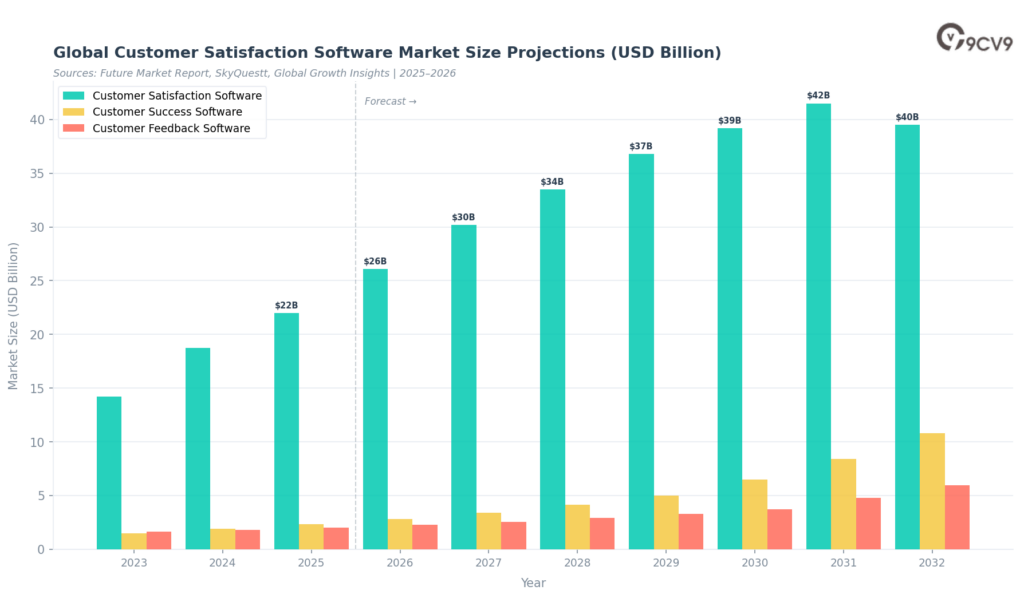
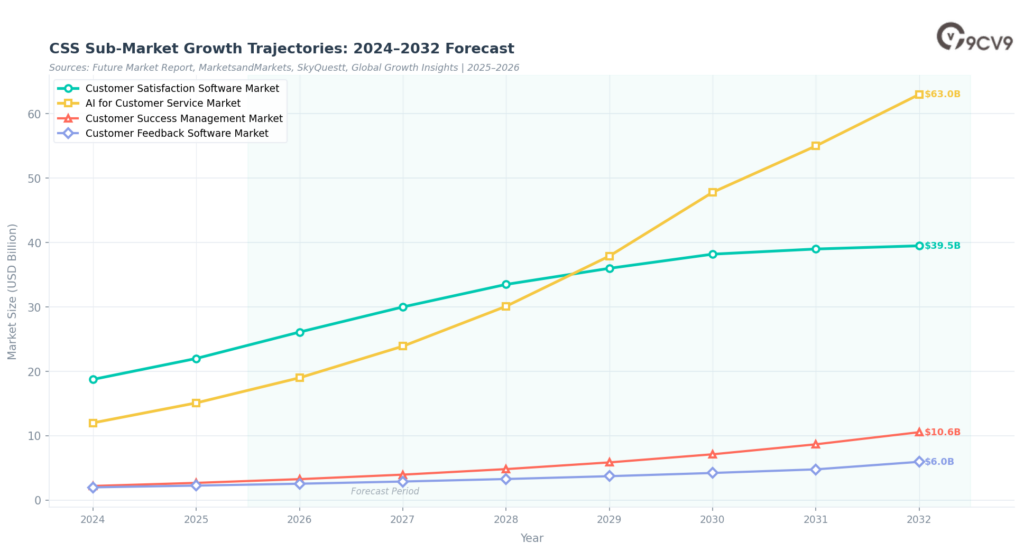
- The global Customer Satisfaction Software (CSS) market was valued at $18.75 billion in 2024 and is projected to reach $39.5 billion by 2032, growing at a CAGR of 9.1%. This steady double-digit growth signals that businesses across every sector are doubling down on tools that measure, track, and act on customer satisfaction data.
- The global customer service software market is currently valued at approximately $14.9 billion, with projections reaching $68.19 billion by 2031 at a CAGR of 20.94%. This extraordinary CAGR makes customer service software one of the fastest-growing enterprise categories — eclipsing many traditional SaaS verticals.
- The Customer Experience (CX) management market was valued at $15.55 billion in 2025 and is projected to reach $47.72 billion by 2033 at a CAGR of 15.2%. The CX management market — a key superset of customer satisfaction software — demonstrates how broadly organizations are investing in experience-driven strategies.
- The CX management market alone is projected to hit $26.11 billion in 2026. The year-over-year magnitude of this figure underscores how CX software has evolved from a support tool into a strategic business imperative.
- The Customer Success Software market was valued at $1.88 billion in 2024 and is set to soar to $13.43 billion by 2033 at a CAGR of 24.43%. Customer success platforms are outpacing even broader CSS tools in growth, reflecting a shift from reactive support to proactive customer lifecycle management.
- The Customer Success Management (CSM) market was estimated at $2.20 billion in 2025 and is forecast to reach $2.68 billion in 2026, growing at a CAGR of 21.7% through 2031. This year-on-year climb underscores growing enterprise investment in software that can predict and prevent customer churn.
- The Customer Feedback Software market was valued at $1.99 billion in 2025 and is projected to reach $6.89 billion by 2035 at a CAGR of 13.2%. As businesses shift toward continuous listening strategies, customer feedback software has grown from a nice-to-have into a core operational tool.
- The Customer Success Platforms market is projected to reach $9.17 billion by 2032 from $1.86 billion in 2024, growing at a 22.1% CAGR. This breakneck growth reflects enterprise urgency around retaining existing customers in an increasingly competitive digital market.
- The Customer Self-Service Software market was valued at $22.02 billion in 2025 and is expected to reach $148.49 billion by 2035 at a CAGR of 21.03%. As customers increasingly prefer resolving issues independently, self-service software is becoming a critical pillar of satisfaction technology stacks.
- The U.S. customer self-service software market alone was valued at $5.28 billion in 2025 and is projected to reach $36.56 billion by 2035 at a CAGR of 21.35%. The United States continues to lead global adoption of self-service CX technology, driven by both consumer demand and enterprise digital transformation.
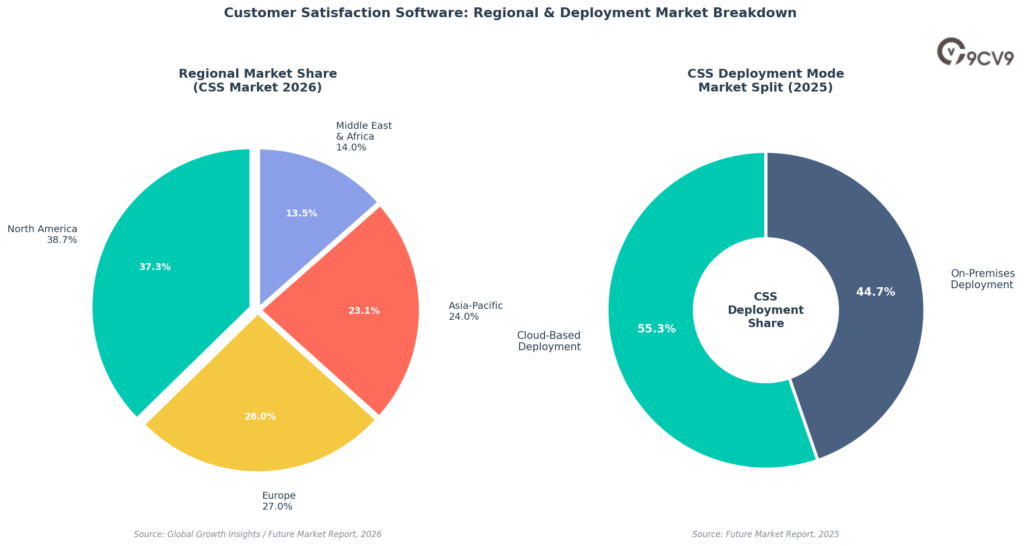
- North America holds the fastest-growing regional position in the CSS market with a 38.7% share. North America’s dominance stems from its early adoption of advanced CX tools, robust tech infrastructure, and the presence of leading vendors like Salesforce, Zendesk, and HubSpot.
- The United States commands a 22.4% share of the global Customer Satisfaction Software market. With deep investment in R&D and a highly competitive enterprise software ecosystem, the U.S. remains the single largest national market for CSS globally.
- Europe accounts for approximately 27% of the Customer Feedback Software market. Europe’s strong focus on customer experience — coupled with GDPR-driven accountability — has accelerated adoption of structured feedback management systems across industries.
- Asia-Pacific holds 24% of the customer feedback software market and is growing rapidly. Driven by the rise of digital-first businesses in markets like India, China, and Southeast Asia, Asia-Pacific is emerging as the next frontier for CSS expansion.
- Middle East & Africa accounts for 14% of the customer feedback software market, with growing awareness of customer engagement solutions. While still a developing market, adoption in MEA is accelerating as businesses recognize that customer satisfaction is a universal growth driver.
🤖 AI & AUTOMATION
- AI for customer service is forecast to grow from $12 billion in 2024 to $47.8 billion by 2030 at a CAGR of 25.8%. This growth trajectory confirms that AI is the single most disruptive force reshaping how organizations measure and act on customer satisfaction data.
- 80% of customer service and support organizations are expected to have integrated generative AI tools by 2025. The rapid adoption of GenAI in customer service marks a fundamental shift — AI is no longer optional but a baseline competitive requirement.
- 90% of CX leaders report positive ROI from implementing AI tools for customer service agents. This near-universal positive return rate makes AI-powered CX tools among the most reliably high-ROI investments in any enterprise technology portfolio.
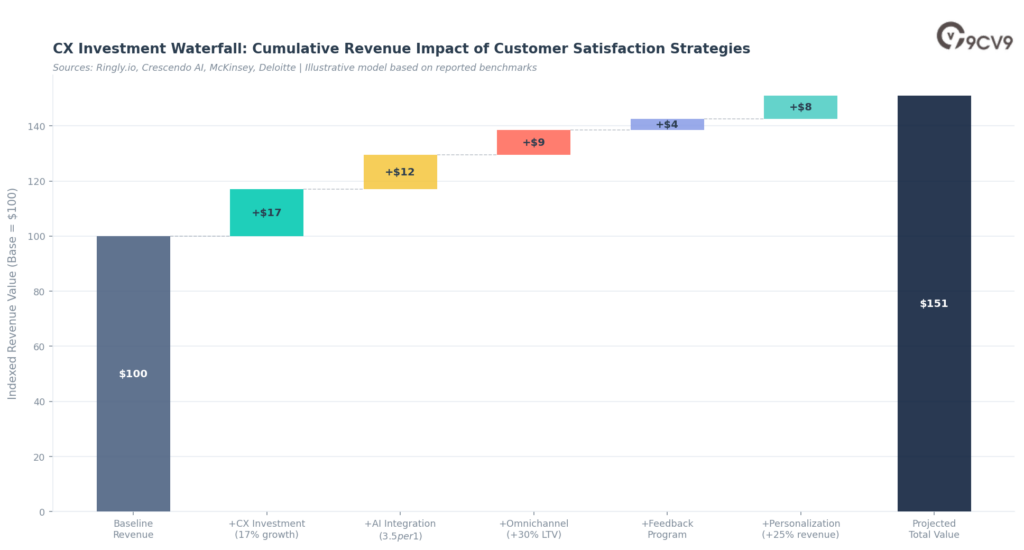
- Companies using AI in CX report a 25% increase in customer satisfaction scores, according to Gartner. A 25% improvement in CSAT from AI adoption represents a significant competitive advantage that directly impacts revenue, retention, and brand equity.
- AI-assisted agents resolve issues 47% faster and achieve 25% higher first-contact resolution rates than teams without automation. These figures reveal that AI augmentation — not just replacement — dramatically improves the speed and quality of human-delivered customer service.
- AI-powered customer service systems can deliver up to 8× ROI, returning an average of $3.50 for every $1 invested. This ROI multiple puts AI-powered CSS among the most financially compelling technology investments available to modern enterprises.
- 30% of all service cases were resolved by AI in 2025, with that figure expected to reach 50% by 2027. The rapid acceleration toward AI-resolved cases signals a fundamental restructuring of customer service operations, cost models, and headcount strategies.
- A chatbot interaction costs approximately $0.50, compared to $6.00 for a human agent interaction — a 12× cost difference. This stark cost gap is driving mass adoption of conversational AI tools, particularly for high-volume, routine query resolution.
- 80% of businesses plan to adopt AI-driven voice technology for customer service by 2026. Voice AI represents the next frontier in automated satisfaction management, enabling personalized, real-time resolution without the cost of human operators.
- By 2025, an estimated 85% of customer interactions will be managed without human intervention, according to Gartner. This milestone marks a historic inflection point in customer service, where AI handles the majority of interactions and humans focus on complex, high-value cases.
- 95% of customer interactions are projected to be AI-powered across both voice and text channels. This near-total AI coverage of customer touchpoints will reshape workforce requirements, training models, and the definition of customer satisfaction itself.
- More than 50% of companies have integrated AI into core customer success workflows, turning it into a strategic driver of engagement, churn prediction, and personalized experience optimization. AI has moved beyond pilot programs — it is now embedded in how high-performing organizations manage their most valuable customer relationships.
- AI reps spend 20% less time on routine cases, freeing up roughly 4 hours per week for complex work. Reclaimed time for human agents translates directly into better handling of escalated issues, stronger customer relationships, and improved satisfaction on high-stakes interactions.
- 64% of customer feedback software tools have adopted AI capabilities as a standard feature. The near-universal integration of AI into feedback platforms has raised the bar: customers now expect intelligent, instantaneous analysis of their input, not manual report-based summaries.
- 66% of customer service leaders using generative AI apply it specifically for real-time personalization. Real-time personalization via GenAI is the most common enterprise application — delivering individualized responses, recommendations, and resolution paths at scale.
👥 CUSTOMER EXPECTATIONS
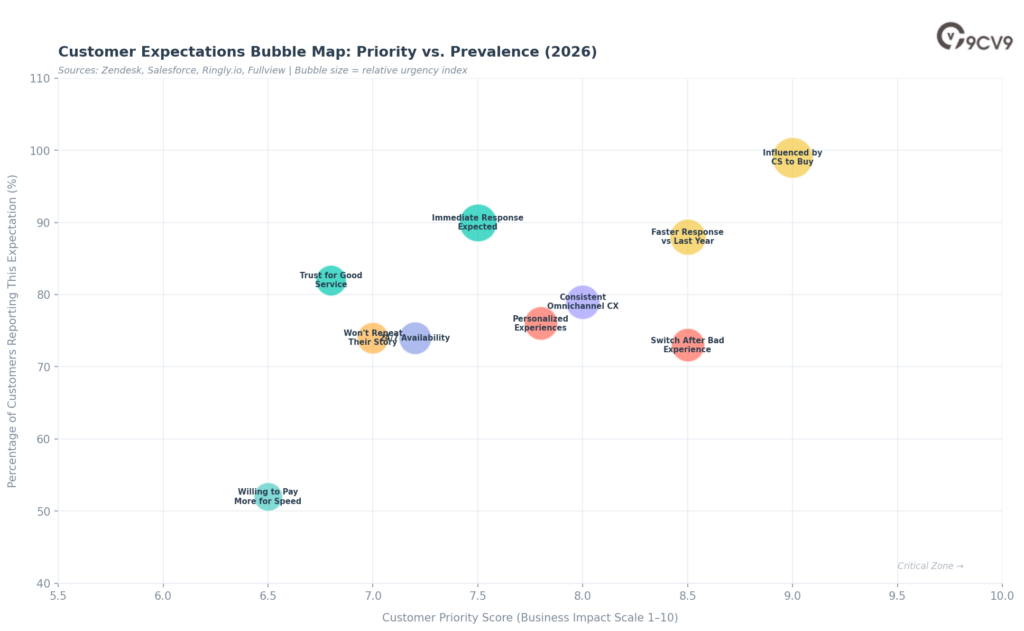
- 99% of consumers say customer service influences their buying decisions. This near-unanimous sentiment confirms that customer satisfaction is not a support function but a core commercial driver — directly influencing purchasing behavior across every industry.
- 90% of customers rate an immediate response as critical when they contact a company. The expectation of immediate response has become the dominant service standard, making real-time CSS tools an operational necessity rather than a competitive differentiator.
- 60% of customers define “immediate” as a response within 10 minutes. A 10-minute response window sets a demanding but measurable benchmark, making AI-powered chat and automated routing capabilities essential for competitive customer satisfaction.
- 83% of consumers say they expect to interact with someone immediately when contacting a brand. This demand for instant human-or-AI connection is reshaping contact center staffing models, chatbot deployment strategies, and SLA expectations across industries.
- 88% of customers expect faster response times than they did just one year ago. Expectations are not static — they are accelerating. This annual escalation in responsiveness benchmarks demands continuous investment in faster, smarter CSS tools.
- 73% of consumers will switch to a competitor after multiple bad experiences. The ease of switching — combined with the rising cost of acquisition — makes proactive satisfaction management a strategic retention imperative for every brand.
- 56% of customers won’t complain after a bad experience — they simply leave and switch brands silently. This “silent churn” phenomenon underscores why proactive feedback collection through CSS tools is critical: most dissatisfied customers never raise their hand voluntarily.
- 52% of consumers are willing to pay more for greater speed and efficiency in customer service. Customers increasingly treat service quality as a pricing factor — opening the door for premium positioning strategies built around superior CX capabilities.
- 74% of consumers find it frustrating when they must repeat their story to different agents. This widespread friction point highlights the business case for unified customer data platforms and omnichannel context continuity — two core features of advanced CSS solutions.
- 74% of consumers expect 24/7 customer service availability. Round-the-clock availability has evolved from a luxury offering into a baseline expectation, making automated self-service and AI chatbot solutions essential infrastructure for satisfaction management.
- 86% of buyers are willing to pay more for a better customer experience. This finding, consistent across multiple studies, confirms that CX is a genuine pricing lever — not just a cost management tool — enabling brands to capture margin through superior satisfaction.
- Customers are willing to pay up to 16% more for a superior customer experience, according to PwC. A 16% price premium for excellent CX translates into significant revenue upside for organizations that invest strategically in satisfaction management tools.
- 76% of customers expect personalized experiences, and an equal 76% feel frustrated when they don’t receive them. This dual finding — equal rates of expectation and frustration — creates an urgent imperative for organizations to deploy personalization-capable CSS platforms.
- 3 in 4 consumers say they will spend more with businesses that provide a great customer experience. Higher spending per customer, driven by satisfaction, is one of the most direct financial arguments for CX investment — making CSS tools revenue-generating assets.
- 82% of consumers trust a company more when it consistently delivers excellent customer service. Trust built through consistent satisfaction is a durable competitive asset — more resilient to pricing pressure and more valuable than short-term marketing campaigns.
📊 CSAT & NPS BENCHMARKS
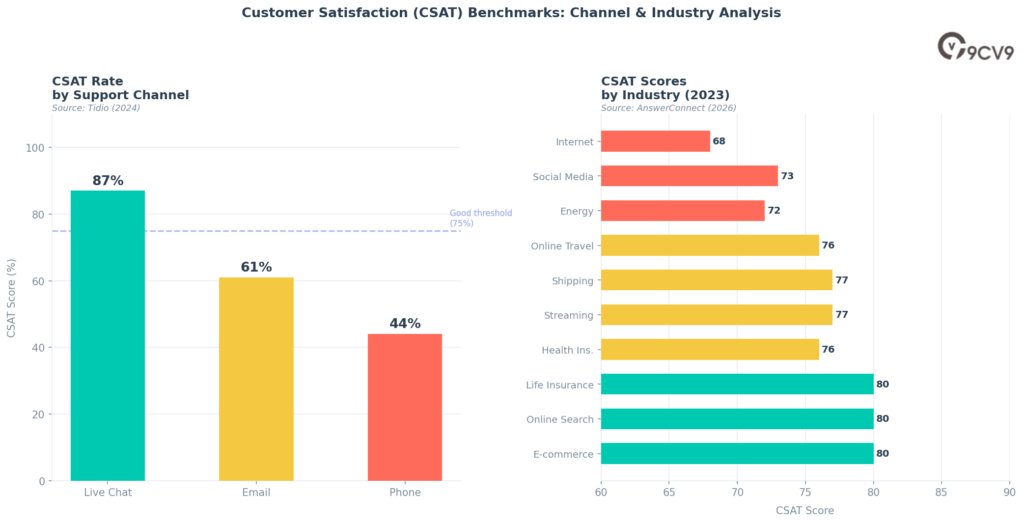
- A good CSAT score in 2025–2026 typically falls between 75% and 85%, with scores above 90% indicating exceptional performance. These benchmark ranges help organizations set realistic targets and identify when performance gaps require urgent investment in satisfaction software or service redesign.
- CSAT scores below 60% signal competitive disadvantage, requiring immediate corrective action. Falling below this threshold is a warning signal that a brand’s customer satisfaction software, processes, or service delivery require urgent intervention.
- Live chat achieves an average CSAT rate of 87%, far outperforming email (61%) and phone support (44%). The dramatic CSAT superiority of live chat confirms why real-time messaging has become the preferred channel for satisfaction-focused customer service teams.
- The SaaS industry averages a CSAT score of 68%, reflecting high customer expectations in software industries. With customer satisfaction benchmarks higher in SaaS than in many other sectors, software companies face heightened pressure to invest in sophisticated CSS tools.
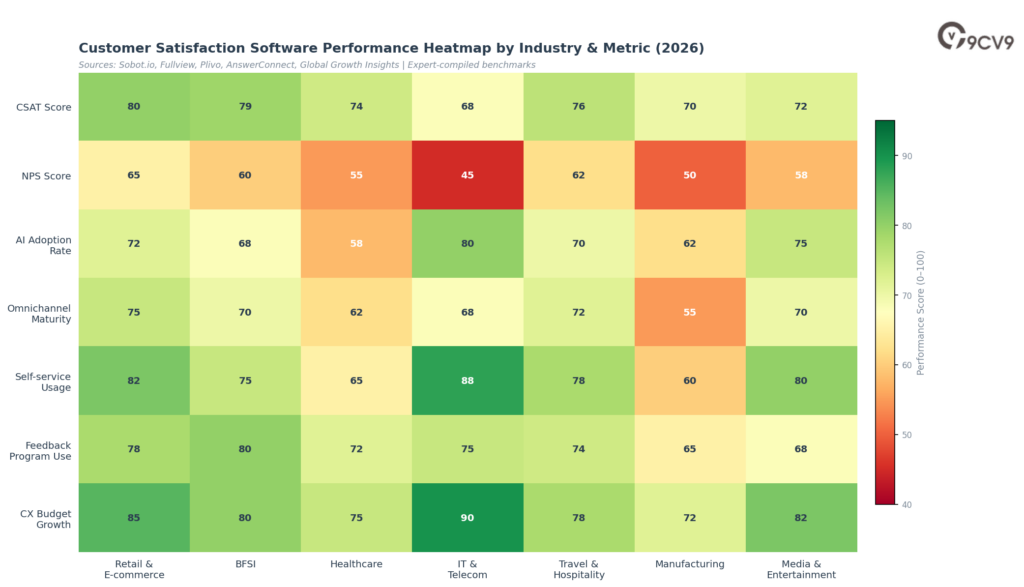
- The e-commerce industry achieved an average CSAT score of 80 in 2023, among the highest across all industries. E-commerce’s high CSAT reflects heavy investment in personalized shopping experiences, efficient returns, and responsive post-sale support — all enabled by CSS platforms.
- Banking and financial services maintain an average CSAT of 79% in 2025. The BFSI sector’s CSAT performance reflects significant investment in digital banking tools, AI-powered support, and proactive communication systems that reduce friction.
- The technology industry achieves an average NPS of 45, compared to the overall industry benchmark of 32. Technology companies consistently outperform cross-industry NPS benchmarks, driven by digital-native service models and AI-powered support capabilities.
- The telecom industry has the lowest average NPS of 31 across all industries. Telecom’s persistently low NPS highlights chronic satisfaction challenges — from billing disputes to service outages — that CSS software alone cannot solve without operational reform.
- The logistics industry maintains a higher average NPS of 38 than telecom, despite equally complex service dynamics. Logistics NPS performance reflects successful investment in real-time tracking, proactive delay communication, and streamlined resolution processes.
- Only 19% of companies act on their CSAT results in a systematic and structured manner. This striking gap between measurement and action represents one of the greatest untapped opportunities in the CSS market — the ability to close the feedback-to-improvement loop.
- Companies with high CSAT scores experience 3–4× higher customer retention rates than those that don’t specifically measure satisfaction. Measurement itself creates accountability — and accountability drives the operational improvements that lead to lasting retention gains.
- CSAT scores above 80% indicate top-quartile customer service quality within most industries. Reaching and sustaining an 80+ CSAT score requires ongoing investment in CSS tools, agent training, process optimization, and real-time feedback collection.
🔗 OMNICHANNEL & PERSONALIZATION
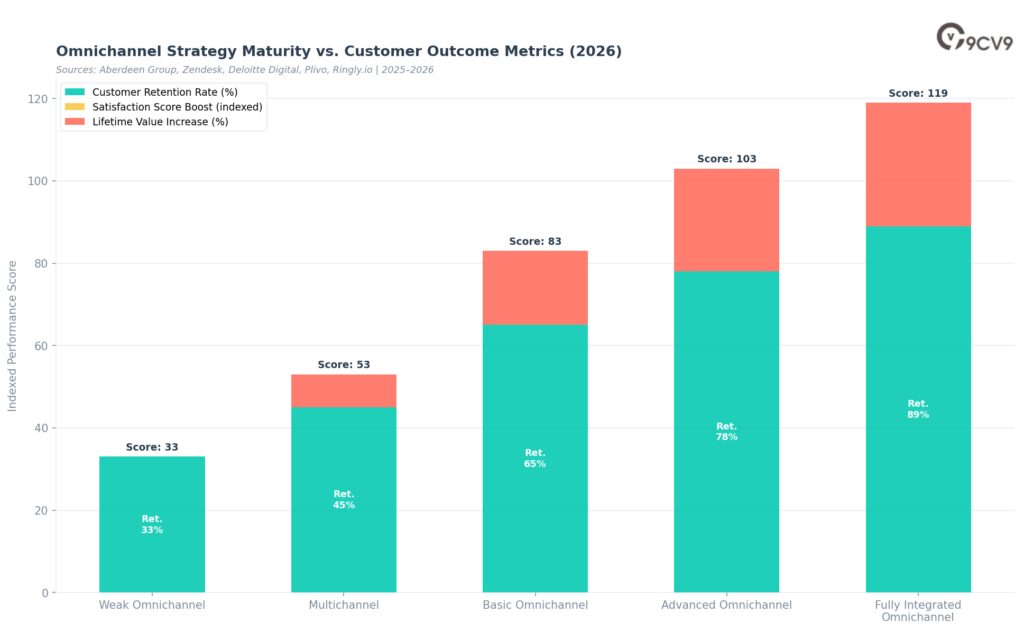
- Companies with strong omnichannel strategies retain 89% of their customers, compared to just 33% for those with weak omnichannel approaches. This 2.7× retention gap between strong and weak omnichannel adopters makes the business case for omnichannel CSS investment effectively irrefutable.
- Companies with omnichannel customer service strategies have 23× higher customer satisfaction rates than single-channel companies. A 23× satisfaction multiplier from omnichannel integration is one of the most powerful statistics in the entire CX industry — and a compelling argument for consolidated CSS platforms.
- Omnichannel shoppers deliver 30% higher lifetime value compared to single-channel customers. Higher LTV from connected-channel customers creates a compounding financial incentive for businesses to invest in omnichannel satisfaction platforms and unified customer data strategies.
- Brands with mature personalization strategies are 71% more likely to report high customer loyalty. Personalization maturity correlates directly with loyalty outcomes — making advanced CSS platforms that support dynamic personalization a strategic growth investment.
- Hyper-personalization delivers an average 20% lift in customer loyalty and 15% revenue growth, according to Forrester. These measured impacts demonstrate that personalization in customer satisfaction is not merely experiential — it is financially quantifiable and strategically essential.
- 76% of customers feel frustrated when they don’t receive personalized experiences from the brands they interact with. Customer frustration over impersonal service is nearly universal — underscoring the urgency of deploying AI-powered personalization engines within CSS platforms.
- Brands with mature personalization achieve 40% higher revenue from personalization efforts. A 40% revenue premium from mature personalization is one of the highest ROI multipliers in the CX space, justifying premium investment in AI-enabled CSS solutions.
- McKinsey research shows hyper-personalized CX strategies can generate up to 25% revenue growth and 50% lower customer acquisition costs. Lower acquisition costs combined with higher revenue make hyper-personalization one of the most financially efficient strategies available to modern businesses.
- Only 13% of businesses fully carry customer context across all channels seamlessly. This stark gap between omnichannel aspiration and execution represents a significant market opportunity for CSS platforms that unify customer data, history, and context.
- An integrated omnichannel solution reduces first-resolution times by 31% and customer wait times by 39%. Operational efficiency gains from omnichannel integration benefit both customers — through faster resolution — and businesses — through lower service delivery costs.
- Companies adopting omnichannel strategies reduce service delivery costs by 3–7%. Cost reduction alongside satisfaction improvement makes omnichannel CSS investment doubly attractive — improving both the customer experience and the operating bottom line.
- Digitizing customer service through proactive omnichannel interactions can enhance satisfaction by 33% while cutting costs by 25–35%. The dual impact of satisfaction improvement and cost reduction from omnichannel CSS represents a rare win-win for enterprise CX investment.
- Customers receiving high-quality omnichannel experiences are 3.6× more likely to make additional purchases. Cross-sell and upsell potential increases dramatically with omnichannel quality — making superior satisfaction management directly revenue-generative.
- One retail company that adopted an omnichannel strategy achieved a 54% increase in its NPS score. Real-world case evidence confirms that omnichannel transformation can produce dramatic NPS improvements — translating directly into advocacy, referrals, and retention.
- 73% of customers engage across multiple channels during their buying journey. Multi-channel buying behavior is now the majority experience — making CSS platforms that track and connect cross-channel interactions essential for accurate satisfaction measurement.
- 79% of customers expect consistent, connected interactions across all departments and touchpoints, according to Salesforce. Consistency expectation is near-universal — creating accountability for businesses to maintain seamless, context-aware service across every channel their CSS platform touches.
💰 ROI & BUSINESS IMPACT
- 94% of organizations that invested in CX saw their investment deliver ROI within five years. This near-universal ROI realization removes the key objection to CSS investment and positions customer satisfaction software as a reliable, long-term financial asset.
- CX leaders grow revenue at 17% annually, compared to just 3% for CX laggards. The 14-percentage-point revenue growth gap between CX leaders and laggards is one of the clearest macro-level arguments for prioritizing customer satisfaction software investment.
- Companies investing in customer support achieve ROI of up to 7.5× their investment. A 7.5× return places CX investment among the most financially productive enterprise technology deployments — rivaling core ERP and analytics platforms.
- AI customer service implementations reduce operational costs by 25–30% while improving resolution times by 87%. Simultaneous cost reduction and resolution improvement from AI-enabled CSS makes a compelling dual case for accelerated AI adoption in satisfaction management.
- Companies acting on customer feedback see 15–25% higher retention rates than competitors that don’t act on feedback. Acting on feedback — not just collecting it — is where CSS platforms deliver their highest retention value, making closed-loop functionality a critical buying criterion.
- Organizations with formal feedback programs reduce customer acquisition costs by 8–12%. Better retention from structured feedback management reduces the need for expensive new customer acquisition — creating a compounding efficiency benefit over time.
- U.S. companies lose an estimated $75 billion annually due to poor customer service through churn and lost sales. This staggering annual loss figure puts the cost of inaction on customer satisfaction into clear financial perspective — dwarfing the cost of even the most comprehensive CSS investment.
- AI-driven churn reductions of up to 25% have been reported in high-performing customer success platforms in 2026. Platforms like Chargebee are delivering measurable churn improvements that directly protect recurring revenue — making AI-enabled CSS a defensive as well as offensive investment.
- First-contact resolution improvements enabled by CSS tools reduce customer churn by 67%. First-contact resolution is one of the highest-leverage satisfaction metrics — and CSS platforms that optimize FCR deliver outsized retention outcomes.
- Bell Canada’s creation of a dedicated customer experience team decreased technical support requests by 51% and improved NPS by 57%. This case study demonstrates the transformative organizational impact of combining CSS tools with structural commitment to customer experience improvement.
- One business that adopted a customer-centric perspective using CSS saw satisfaction levels rise from 72% to over 95%. Moving from below-average to near-perfect satisfaction through systematic CX investment confirms that CSS tools, when implemented with strategic intent, deliver dramatic outcomes.
- Effective churn management enabled by customer success software delivers 16× ROI. A 16× return on churn management investment is exceptional by any enterprise technology benchmark — making proactive retention software one of the highest-value categories in the CSS ecosystem.
☁️ CLOUD & DEPLOYMENT
- Cloud-based deployment accounts for 55.3% of the CSS market, making it the dominant deployment mode. Cloud’s dominance in CSS reflects its superior scalability, lower upfront cost, and ability to support real-time, global feedback collection and analysis.
- 67% of customer feedback software tools are deployed in the cloud, reflecting strong enterprise preference for SaaS models. SaaS delivery enables continuous updates, AI feature releases, and integration flexibility — key advantages that on-premise CSS solutions cannot easily match.
- 68% of the customer feedback software market uses cloud-based infrastructure, driving accessibility and scale. Cloud penetration above two-thirds confirms that the CSS market has decisively moved past the debate over cloud adoption and is now focused on cloud optimization.
- 75% of U.S. companies use feedback software to track customer satisfaction and improve services. American enterprise adoption of CSS tools is near-ubiquitous — suggesting that the market is approaching saturation for basic feedback collection and moving toward advanced analytics differentiation.
- 60% of businesses use real-time feedback systems to support rapid decision-making. Real-time feedback capability has become a core expectation for CSS buyers — with organizations increasingly unwilling to accept batch-processed or delayed insight delivery.
💬 CHANNEL PREFERENCES
- Live chat is the #1 preferred support channel for 41% of consumers, compared to 32% for phone and 23% for email. Live chat’s top-channel status validates the CSS market’s shift toward real-time messaging platforms as the primary venue for satisfaction measurement and recovery.
- 73% of customers were satisfied with their live chat experience, versus 51% for email and 44% for phone support. Live chat’s satisfaction advantage over traditional channels reinforces its strategic importance as both a service channel and a satisfaction measurement touchpoint.
- Nearly 60% of consumers are more likely to return to a website that offers live chat. Live chat’s retention impact on web traffic creates a compelling argument for integrating CSS tools — including in-chat CSAT surveys — directly into website customer experience flows.
- 63% of consumers are more likely to make a purchase when a live chat widget is available on a website. The conversion impact of live chat confirms that satisfaction tools placed at the point of purchase are not just CX investments — they are direct revenue drivers.
- 76% of consumers prefer phone calls for complex support issues, with 71% of Gen Z agreeing. Despite the digital-first narrative, voice remains a critical channel for high-stakes support — meaning CSS platforms must include voice interaction capture and sentiment analysis.
- 89% of service professionals say conversational AI increases self-service resolution rates. Near-universal practitioner endorsement of AI for self-service confirms that investing in conversational AI tools within CSS platforms delivers both customer satisfaction and operational efficiency.
- By 2030, an estimated one billion service tickets will be raised automatically by customer-owned bots. This projection signals a fundamental shift in how customer issues are surfaced — with CSS platforms needing to support bot-initiated, automated resolution at planetary scale.
🏢 MARKET DYNAMICS & COMPETITIVE LANDSCAPE
- In October 2025, Qualtrics acquired Press Ganey Forsta — which had itself acquired InMoment in May 2025 — for $6.75 billion, consolidating three major CX brands. This blockbuster consolidation reshapes the competitive landscape for enterprise CSS buyers, concentrating market power around a handful of AI-enabled mega-platforms.
- 93.7% of companies that measure Customer Success impact use a revenue target (GRR, NRR, or both) as their primary metric. The revenue-linkage of CS measurement confirms that customer success software has moved firmly into the domain of financial accountability — no longer a “soft” metric but a board-level KPI.
- 37% of companies still lack a clearly defined customer success strategy. Despite the market’s explosive growth, more than one-third of organizations have yet to formalize their approach — representing significant untapped demand for CSS platforms, implementation services, and strategic consulting.
- 84% of businesses already using AI in CX plan to invest even more in 2026. Accelerating investment from existing AI adopters signals a positive feedback loop — organizations that invest in AI-enabled CSS see results, and those results drive further investment.
- 89% of businesses will compete primarily on customer experience by 2025, according to Gartner. When nine out of ten businesses choose CX as their primary competitive battlefield, customer satisfaction software becomes the equivalent of enterprise weapons — whoever has the best tools wins.
- 80% of business leaders plan to increase their customer service budgets over the next year, per Zendesk CX Trends 2026. This majority commitment to increased CX spending confirms that 2026 will see another wave of CSS adoption, platform upgrades, and AI integration investment.
- AI went from being a premium differentiator in customer feedback software to a baseline expectation in 2026. The commoditization of AI in CSS platforms means that differentiation has shifted to the quality of AI insights — specifically theme detection, intent classification, and churn risk signals.
- Forrester predicts that proactive customer interactions will outnumber reactive ones by 2026. The shift from reactive to proactive engagement — enabled by predictive CSS platforms — represents a fundamental reimagining of the customer service function and its role in driving satisfaction.
Conclusion
As the customer experience economy continues to accelerate, the role of customer satisfaction software has never been more critical. The 105 customer satisfaction software statistics, data points, and trends explored throughout this report reveal a clear and consistent message: organizations that prioritize customer satisfaction are positioning themselves for stronger growth, higher customer retention, increased profitability, and long-term competitive success. In 2026, customer satisfaction is no longer simply a performance indicator measured after a support interaction—it has become a strategic business capability that influences virtually every aspect of organizational performance.
One of the most significant themes emerging from these statistics is the extraordinary expansion of the global customer satisfaction software market. Billions of dollars are flowing into customer experience platforms, customer feedback management systems, customer success software, AI-powered support solutions, and omnichannel engagement technologies. These investments reflect a broader shift in business priorities, where customer-centricity has become a defining characteristic of high-performing organizations. Companies increasingly recognize that acquiring customers is only the beginning; retaining them through consistently exceptional experiences is where sustainable competitive advantage is created.
Artificial intelligence has emerged as the single most transformative force shaping the future of customer satisfaction software. AI-powered chatbots, generative AI assistants, predictive analytics, sentiment analysis, intelligent routing, automated case resolution, and personalization engines are fundamentally changing how businesses interact with customers. Rather than replacing human agents entirely, AI is augmenting customer service teams by eliminating repetitive work, accelerating response times, improving first-contact resolution, and enabling agents to focus on higher-value interactions that require empathy, creativity, and complex problem-solving. As AI capabilities continue to mature, organizations that effectively combine human expertise with intelligent automation will be best positioned to deliver outstanding customer experiences.
The data also demonstrates that customer expectations continue to rise at an unprecedented pace. Today’s consumers expect immediate responses, seamless omnichannel experiences, personalized interactions, and round-the-clock support. They are increasingly willing to switch brands after poor service experiences while rewarding businesses that consistently exceed expectations with greater loyalty, higher spending, stronger advocacy, and increased trust. This shift reinforces the reality that customer satisfaction software is no longer just a support tool—it has become a core component of modern revenue generation, customer retention, and brand differentiation.
Another defining trend highlighted throughout these statistics is the growing importance of omnichannel customer engagement. Customers no longer interact with businesses through a single touchpoint. Instead, they move fluidly across websites, mobile applications, social media, messaging platforms, email, phone support, live chat, and in-person interactions. Modern customer satisfaction software enables organizations to unify these experiences into a single customer journey, preserving context across channels and delivering consistent service regardless of where the interaction begins. Businesses that invest in integrated omnichannel platforms consistently outperform those relying on fragmented systems, both in customer satisfaction and long-term financial performance.
Personalization has likewise evolved from a desirable feature into an essential business capability. Customers increasingly expect companies to understand their preferences, anticipate their needs, and deliver tailored experiences throughout every stage of the customer lifecycle. AI-driven personalization, predictive recommendations, behavioral analytics, and intelligent segmentation are enabling organizations to move beyond generic service models toward highly individualized customer experiences. The statistics clearly show that companies excelling in personalization achieve stronger customer loyalty, higher lifetime value, improved retention rates, and significant revenue growth.
The report also underscores the importance of measuring customer satisfaction using a broad range of metrics rather than relying solely on traditional indicators. Customer Satisfaction Score (CSAT), Net Promoter Score (NPS), Customer Effort Score (CES), sentiment analysis, customer health scoring, churn prediction, and customer lifetime value collectively provide a more comprehensive understanding of customer relationships. Organizations that integrate these metrics into continuous improvement processes are better equipped to identify emerging issues, prioritize operational improvements, and make informed strategic decisions based on real customer behavior rather than assumptions.
Cloud adoption continues to redefine the customer satisfaction software landscape. Cloud-native platforms provide businesses with greater scalability, lower implementation costs, continuous innovation, and seamless integration with CRM systems, marketing automation platforms, help desks, collaboration tools, and business intelligence solutions. These advantages have made cloud deployment the preferred choice for organizations seeking agility and rapid digital transformation. As customer expectations evolve even faster, cloud-based customer satisfaction platforms will continue to provide the flexibility needed to innovate at scale.
Perhaps one of the most compelling findings throughout this collection of statistics is the measurable financial impact of customer satisfaction. Organizations investing in customer experience consistently report higher revenue growth, improved customer retention, lower acquisition costs, reduced operational expenses, stronger employee productivity, and significantly higher returns on investment. Businesses that actively collect customer feedback, analyze it intelligently, and implement meaningful improvements consistently outperform competitors that treat customer satisfaction as a secondary priority. In an increasingly competitive marketplace, customer experience has become both a defensive strategy for protecting existing revenue and an offensive strategy for accelerating future growth.
The competitive landscape itself continues to evolve rapidly. Major acquisitions, increased AI investment, growing demand for customer success platforms, and rising enterprise budgets all point toward a future where customer satisfaction software becomes even more deeply embedded within business operations. Rather than functioning as isolated support tools, these platforms are evolving into enterprise-wide intelligence systems capable of connecting customer insights with sales, marketing, product development, operations, finance, and executive decision-making. This convergence will further strengthen the strategic importance of customer satisfaction technology over the coming decade.
Looking ahead, several trends are likely to define the next phase of customer satisfaction software evolution. Predictive customer success will become more sophisticated, enabling businesses to intervene before dissatisfaction occurs. Autonomous AI agents will resolve an increasing percentage of customer inquiries without human involvement while maintaining high-quality experiences. Hyper-personalization powered by generative AI will deliver uniquely tailored interactions at scale. Real-time voice analytics, emotion detection, and conversational intelligence will become standard platform capabilities. Meanwhile, customer satisfaction data will play an even greater role in informing product development, pricing strategies, marketing campaigns, and executive planning.
For business leaders, technology buyers, customer success professionals, product managers, marketers, investors, and entrepreneurs, the insights presented throughout these 105 statistics offer more than just an overview of industry performance—they provide a strategic roadmap for navigating the future of customer experience. Understanding these trends enables organizations to benchmark performance, identify emerging opportunities, prioritize technology investments, and develop customer-centric strategies that drive measurable business outcomes.
Ultimately, customer satisfaction software is no longer about simply collecting survey responses or measuring customer happiness after an interaction. It has become an intelligent ecosystem that empowers organizations to predict customer needs, automate personalized engagement, optimize operational efficiency, strengthen customer relationships, and generate sustainable competitive advantage. As digital transformation accelerates across every industry, businesses that embrace data-driven customer experience strategies will be far better positioned to thrive in an increasingly experience-driven global economy.
The statistics presented in this report make one conclusion unmistakably clear: customer satisfaction is rapidly becoming one of the most valuable assets any organization can cultivate. Companies that invest strategically in modern customer satisfaction software, artificial intelligence, omnichannel engagement, real-time analytics, and continuous customer feedback will not only improve service quality but also build stronger brands, create deeper customer loyalty, unlock new revenue opportunities, and establish lasting leadership in their respective markets. In 2026 and beyond, delivering exceptional customer experiences is no longer a competitive advantage alone—it is an essential requirement for sustained business success.
If you find this article useful, why not share it with your hiring manager and C-level suite friends and also leave a nice comment below?
We, at the 9cv9 Research Team, strive to bring the latest and most meaningful data, guides, and statistics to your doorstep.
To get access to top-quality guides, click over to 9cv9 Blog.
To hire top talents using our modern AI-powered recruitment agency, find out more at 9cv9 Modern AI-Powered Recruitment Agency.
People Also Ask
What is customer satisfaction software?
Customer satisfaction software helps businesses collect customer feedback, measure customer experience, analyze satisfaction metrics, and improve service quality through surveys, AI, analytics, and omnichannel support.
Why is customer satisfaction software important in 2026?
It enables businesses to improve customer loyalty, reduce churn, personalize experiences, and increase revenue as customer expectations continue to rise across digital and physical channels.
What are the biggest customer satisfaction software trends in 2026?
Major trends include AI-powered automation, predictive analytics, omnichannel engagement, real-time sentiment analysis, cloud adoption, and hyper-personalized customer experiences.
How large is the customer satisfaction software market in 2026?
The global customer satisfaction software market continues to grow rapidly, driven by digital transformation, AI innovation, cloud computing, and increasing investments in customer experience technologies.
How does AI improve customer satisfaction software?
AI automates customer support, predicts customer behavior, analyzes sentiment, personalizes interactions, and helps businesses resolve issues faster while improving overall customer satisfaction.
What industries use customer satisfaction software?
Retail, healthcare, banking, insurance, hospitality, telecommunications, manufacturing, SaaS, education, and government organizations all rely on customer satisfaction software.
What is a CSAT score?
Customer Satisfaction Score (CSAT) measures how satisfied customers are with a product, service, or interaction, typically using a post-service survey with numerical ratings.
What is Net Promoter Score (NPS)?
Net Promoter Score measures customer loyalty by asking how likely customers are to recommend a business, helping organizations evaluate long-term customer relationships.
What is Customer Effort Score (CES)?
Customer Effort Score measures how easy it is for customers to complete a task or resolve an issue, with lower effort generally leading to higher customer satisfaction.
How does customer satisfaction software reduce churn?
It identifies dissatisfied customers early, analyzes feedback, predicts churn risks, and enables businesses to proactively improve customer experiences before customers leave.
Can small businesses benefit from customer satisfaction software?
Yes. Small businesses can improve customer loyalty, automate feedback collection, enhance support quality, and compete more effectively using affordable cloud-based solutions.
What features should customer satisfaction software include?
Key features include surveys, AI analytics, dashboards, omnichannel support, sentiment analysis, CRM integration, reporting, automation, workflow management, and customer journey tracking.
What is omnichannel customer satisfaction software?
Omnichannel platforms manage customer interactions across email, phone, chat, social media, websites, messaging apps, and mobile applications within a unified system.
How does customer feedback improve business performance?
Customer feedback helps organizations identify weaknesses, improve products and services, increase retention, strengthen loyalty, and make more informed business decisions.
Is cloud-based customer satisfaction software better than on-premise solutions?
Cloud solutions typically offer lower costs, easier scalability, faster deployment, automatic updates, stronger integrations, and greater flexibility than traditional on-premise systems.
How does customer satisfaction software improve customer retention?
By monitoring customer sentiment, resolving issues faster, personalizing experiences, and identifying dissatisfaction early, businesses can significantly improve retention rates.
What role does predictive analytics play in customer satisfaction?
Predictive analytics forecasts customer behavior, identifies satisfaction trends, predicts churn risks, and enables businesses to proactively improve customer experiences.
How does sentiment analysis work in customer satisfaction software?
Sentiment analysis uses AI and natural language processing to evaluate customer emotions from surveys, reviews, emails, chats, and social media conversations.
What is Voice of the Customer (VoC) software?
Voice of the Customer software gathers and analyzes customer opinions from multiple channels to help organizations improve products, services, and customer experiences.
Can customer satisfaction software integrate with CRM systems?
Yes. Most modern platforms integrate with CRM systems, help desks, marketing automation tools, ERP software, and business intelligence platforms.
How often should businesses measure customer satisfaction?
Businesses should measure satisfaction continuously through post-interaction surveys, periodic NPS assessments, ongoing feedback collection, and real-time customer analytics.
What are the benefits of real-time customer feedback?
Real-time feedback enables faster issue resolution, immediate service improvements, better decision-making, higher customer satisfaction, and reduced customer churn.
How does automation improve customer satisfaction?
Automation speeds up responses, reduces repetitive tasks, ensures consistent service, routes inquiries efficiently, and allows agents to focus on complex customer needs.
What is customer experience (CX)?
Customer experience refers to every interaction a customer has with a business across sales, marketing, products, services, and customer support throughout the customer journey.
Why are customer satisfaction statistics valuable for businesses?
Statistics help organizations benchmark performance, identify trends, evaluate technology investments, understand customer expectations, and improve strategic planning.
What is the future of customer satisfaction software?
The future includes generative AI, autonomous customer service agents, predictive customer success, deeper personalization, advanced analytics, and greater workflow automation.
How does customer satisfaction software increase revenue?
Satisfied customers are more likely to stay loyal, purchase again, recommend businesses, and spend more over time, contributing to higher long-term revenue growth.
What challenges do businesses face when improving customer satisfaction?
Common challenges include rising customer expectations, fragmented communication channels, limited customer insights, inconsistent service quality, and integrating multiple systems.
How should businesses choose customer satisfaction software?
Businesses should evaluate features, AI capabilities, integrations, scalability, reporting, security, pricing, ease of use, customer support, and future growth potential.
Why should businesses follow customer satisfaction software trends in 2026?
Keeping up with industry trends helps organizations adopt emerging technologies, improve customer experiences, stay competitive, increase efficiency, and maximize return on technology investments.
Sources
Future Market Report AnswerConnect SkyQuestt Global Growth Insights Precedence Research Ringly Fullview UsePylon Salesmate Plivo Sobot Renascence Onramp Custify G2 Zonka Feedback Marketing LTB InfluenceFlow EverHelp Qualityze Research and Markets DataInsightsMarket