
























Key Takeaways
- Customer retention software is becoming a strategic growth investment in 2026, with AI, personalization, and predictive analytics helping businesses reduce churn, increase customer lifetime value, and improve profitability.
- The latest customer retention statistics reveal that retaining existing customers delivers significantly higher ROI than acquiring new ones, making loyalty programs, omnichannel engagement, and customer success initiatives essential for sustainable business growth.
- These 110 customer retention software statistics and trends provide valuable benchmarks on market growth, SaaS performance, AI adoption, customer experience, and retention strategies, enabling businesses to make data-driven decisions in an increasingly competitive digital economy.
Customer retention software helps businesses reduce customer churn, strengthen customer loyalty, and increase customer lifetime value through automation, AI, and personalized engagement. This guide explores the top 110 customer retention software statistics, data, and trends in 2026 to help organizations make smarter, data-driven decisions that improve long-term growth and recurring revenue.
Customer retention has become one of the defining competitive priorities for businesses in 2026. As customer acquisition costs continue to climb, consumer expectations become increasingly sophisticated, and digital competition intensifies across virtually every industry, organizations are shifting their focus from simply acquiring new customers to maximizing the lifetime value of their existing ones. This strategic transition has elevated customer retention software from a helpful business tool into a mission-critical technology that powers sustainable growth, stronger customer relationships, and long-term profitability. Whether serving startups, fast-growing SaaS companies, global enterprises, eCommerce brands, financial institutions, telecommunications providers, or subscription-based businesses, customer retention platforms are now central to building resilient revenue models in an increasingly competitive marketplace.
Also, read our guide on the Top 10 Best Customer Retention Software.

Modern customer retention software has evolved far beyond traditional loyalty programs and email marketing platforms. Today’s solutions leverage artificial intelligence, predictive analytics, machine learning, customer data platforms, omnichannel engagement, behavioral segmentation, automated workflows, and real-time customer health monitoring to identify at-risk customers before they churn. These advanced platforms enable organizations to deliver highly personalized customer experiences across multiple touchpoints, helping businesses proactively strengthen loyalty, improve customer satisfaction, increase repeat purchases, and unlock higher customer lifetime value.
The importance of customer retention has never been greater. Research consistently demonstrates that retaining an existing customer costs significantly less than acquiring a new one, while even modest improvements in retention rates can dramatically increase profitability. Businesses are increasingly recognizing that their existing customers represent their most valuable asset, contributing the majority of recurring revenue while serving as advocates who generate referrals, positive reviews, and long-term brand equity. In this environment, investing in customer retention software is no longer viewed as a discretionary expense but as a strategic investment capable of producing measurable financial returns.
Artificial intelligence is reshaping virtually every aspect of customer retention in 2026. AI-powered platforms can now analyze millions of customer interactions in real time, accurately predict churn risk, recommend personalized interventions, automate customer communications, optimize pricing strategies, and identify upsell or cross-sell opportunities with remarkable precision. Predictive models enable customer success teams to engage high-risk customers before they consider leaving, while generative AI is transforming personalized marketing campaigns, customer support interactions, and loyalty experiences at unprecedented scale. Organizations that successfully integrate AI into their customer retention strategies are increasingly outperforming competitors across revenue growth, customer satisfaction, and long-term loyalty metrics.
The explosive growth of subscription-based business models has further accelerated the demand for sophisticated retention technologies. Software-as-a-Service (SaaS), streaming services, fintech platforms, membership businesses, telecommunications providers, and digital commerce companies all depend on recurring revenue streams where customer churn directly impacts long-term valuation. Investors, executives, and board members increasingly monitor key performance indicators such as Gross Revenue Retention (GRR), Net Revenue Retention (NRR), Annual Recurring Revenue (ARR), Customer Lifetime Value (CLV), Customer Acquisition Cost (CAC), churn rate, expansion revenue, and customer health scores to assess the strength and sustainability of a company’s business model.
Meanwhile, consumer expectations continue to evolve at a rapid pace. Customers now expect seamless omnichannel experiences across websites, mobile apps, social media, email, messaging platforms, live chat, and customer support channels. They demand personalized recommendations, immediate responses, proactive communication, frictionless onboarding, transparent pricing, flexible subscription management, and consistently exceptional customer service. Organizations that fail to deliver these experiences risk losing customers to competitors that leverage advanced retention technologies to create more engaging and satisfying customer journeys.
Loyalty programs have also undergone significant transformation. Rather than relying solely on points and discounts, today’s loyalty ecosystems incorporate personalized rewards, gamification, exclusive memberships, experiential benefits, AI-powered recommendations, referral incentives, and predictive engagement strategies designed to deepen emotional connections with customers. Businesses are increasingly integrating loyalty platforms directly into their customer retention software, enabling a unified view of customer behavior and more intelligent engagement throughout the entire customer lifecycle.
Another major trend defining customer retention in 2026 is the growing importance of customer data integration. Organizations are investing heavily in Customer Data Platforms (CDPs), CRM systems, business intelligence solutions, marketing automation platforms, and AI analytics tools to consolidate customer information into unified profiles. These comprehensive customer views allow businesses to understand purchasing behavior, engagement patterns, product usage, support interactions, and lifetime value with far greater accuracy. The resulting insights empower companies to deliver highly targeted campaigns, personalized product recommendations, and proactive customer success initiatives that significantly improve retention outcomes.
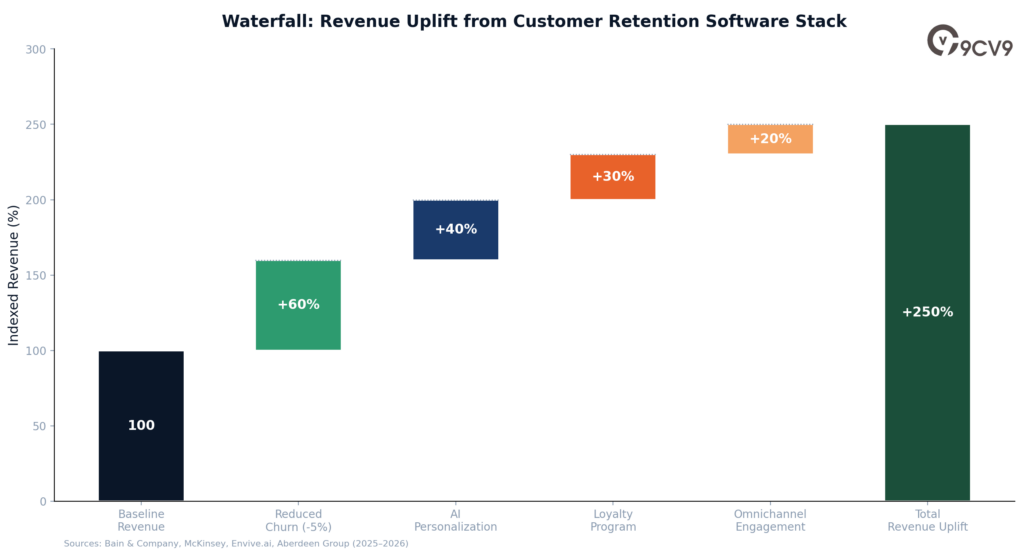
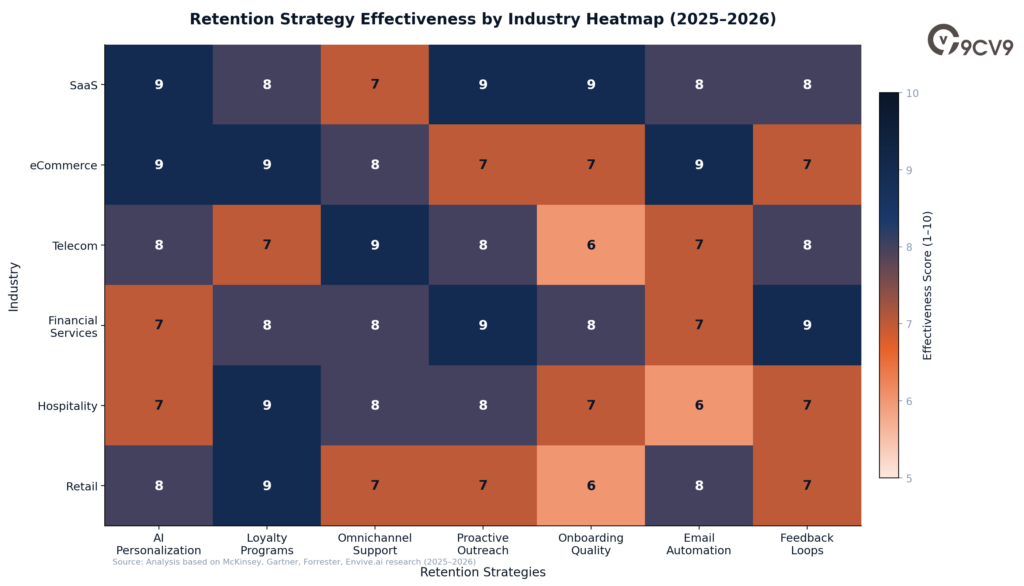
Across industries, retention benchmarks vary considerably, reflecting different customer behaviors, competitive dynamics, and business models. Enterprise software companies often focus on expanding existing accounts through upselling and cross-selling, while telecommunications providers invest heavily in churn prediction models to reduce customer defections. Retailers prioritize repeat purchases and loyalty program engagement, financial institutions emphasize trust and long-term relationships, and hospitality businesses strive to create memorable customer experiences that encourage repeat visits. Understanding these industry-specific benchmarks enables organizations to measure their own performance more effectively and identify opportunities for continuous improvement.
Customer experience has emerged as one of the strongest drivers of long-term loyalty. Numerous studies show that customers are increasingly willing to pay premium prices for exceptional service while abandoning brands after poor experiences. Fast response times, proactive support, effective issue resolution, personalized interactions, and consistent communication all contribute to stronger customer relationships. Modern customer retention software enables businesses to orchestrate these experiences through intelligent automation, AI-powered support, customer journey mapping, and continuous engagement across multiple channels.
Email marketing, marketing automation, SMS campaigns, push notifications, in-app messaging, and behavioral triggers remain among the highest-performing retention channels. However, today’s most successful organizations are moving beyond isolated campaigns toward integrated lifecycle marketing strategies that respond dynamically to customer behaviors and preferences. By leveraging AI-driven segmentation and predictive analytics, businesses can deliver the right message to the right customer at precisely the right moment, maximizing engagement while reducing churn.
The competitive landscape for customer retention software has expanded significantly as both established enterprise vendors and innovative startups introduce increasingly sophisticated platforms. Organizations now have access to solutions offering predictive churn analytics, customer health scoring, sentiment analysis, AI-powered personalization, omnichannel campaign management, subscription management, customer success automation, loyalty management, advanced reporting, and real-time business intelligence. Selecting the right platform requires a thorough understanding of market trends, technology capabilities, implementation considerations, and measurable business outcomes.
This comprehensive guide presents the Top 110 Customer Retention Software Statistics, Data & Trends in 2026, bringing together the latest market research, industry benchmarks, financial insights, AI adoption trends, customer behavior data, SaaS performance metrics, loyalty program statistics, omnichannel engagement findings, and churn reduction strategies shaping the future of customer retention. These carefully curated statistics provide executives, business leaders, marketers, product managers, customer success professionals, SaaS founders, investors, consultants, and technology decision-makers with an authoritative overview of one of the fastest-growing segments of the modern software industry.
Whether you are evaluating customer retention platforms, developing a long-term customer success strategy, benchmarking your organization’s performance, planning digital transformation initiatives, or seeking actionable insights to improve customer loyalty and recurring revenue, the following 110 statistics offer valuable evidence-based perspectives on where the industry stands today and where it is heading in the years ahead. As customer retention becomes an increasingly decisive factor in sustainable business growth, understanding these data-driven trends will help organizations make more informed strategic decisions and build stronger, longer-lasting relationships with their customers in the AI-powered economy of 2026.
Before we venture further into this article, we would like to share who we are and what we do.
About 9cv9
9cv9 is a business tech startup based in Singapore and Asia, with a strong presence all over the world.
With over ten years of startup and business experience, and being highly involved in connecting with thousands of companies and startups, the 9cv9 team has listed some important and crucial software tools in this review.
If you like to get your company listed in our top B2B software reviews, check out our world-class 9cv9 Media and PR service and pricing plans here.
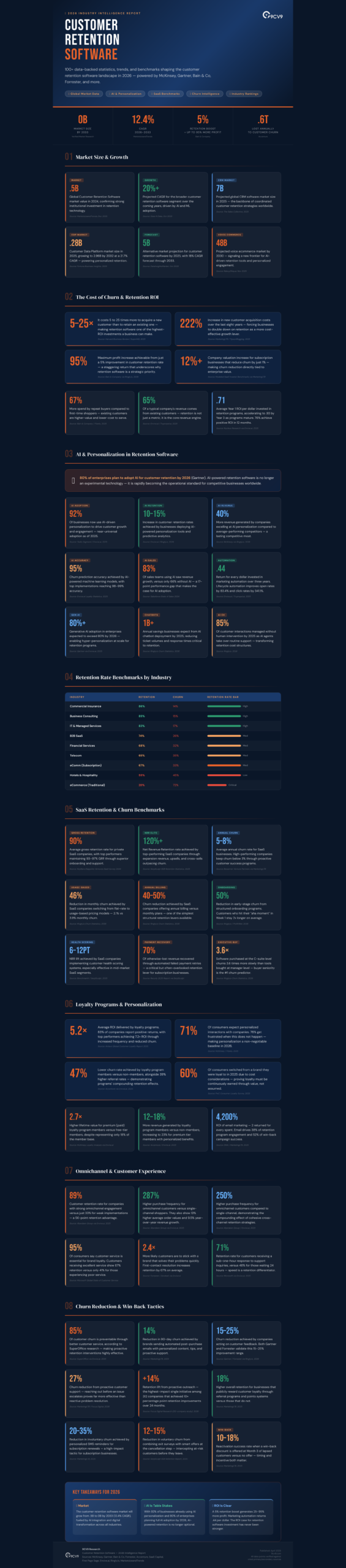
Top 110 Customer Retention Software Statistics, Data & Trends in 2026
🏪 Market Size & Growth
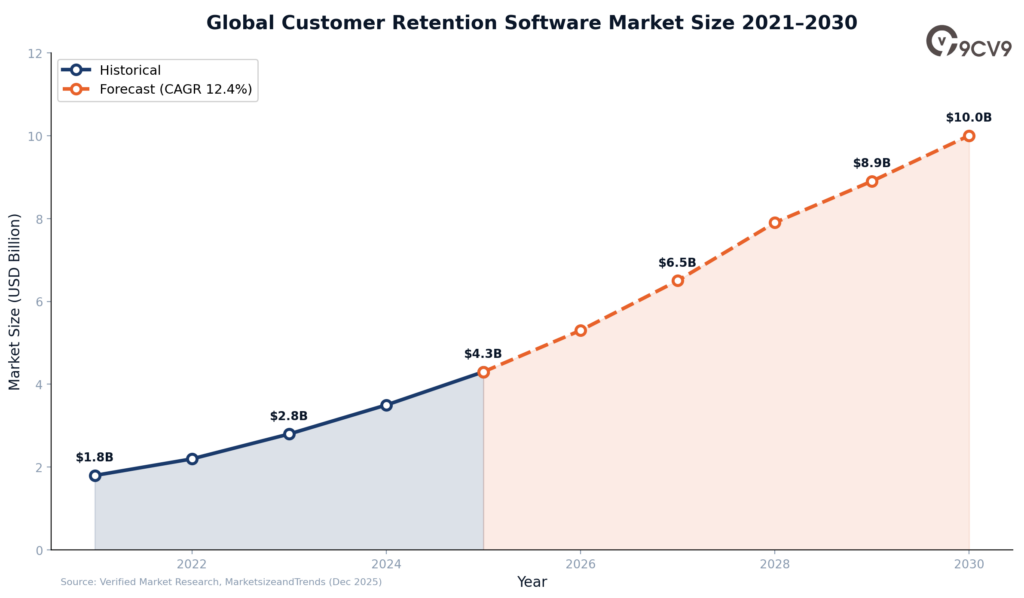
1. $3.5 Billion — The global Customer Retention Software market was valued at USD 3.5 billion in 2024, confirming the sector’s maturity and the urgent corporate appetite for purpose-built retention tools.
2. $10.02 Billion — Verified Market Research projects the Customer Retention Software market will reach USD 10.02 billion by 2033, underscoring the decade-long investment thesis in churn-prevention technology.
3. 12.4% CAGR (2026–2033) — A robust 12.4% compound annual growth rate forecast for the Customer Retention Software market from 2026 to 2033 signals that retention technology is one of the fastest-growing SaaS verticals heading into the next decade.
4. 20%+ CAGR (Broader Segment) — Some analysts project a CAGR of over 20% for the broader customer retention software segment in the coming years, primarily driven by AI, machine learning, and advanced analytics adoption.
5. $57 Billion — The global CRM software market is projected to hit $57 billion in 2025, serving as the foundational infrastructure upon which customer retention strategies are built and executed at scale.
6. $15 Billion — An alternative market projection estimates the Customer Retention Software market could reach $15 billion by 2025 under an 18% CAGR scenario through 2033, reflecting varying adoption velocity by region.
7. $3.28 Billion → $12.96 Billion — The Customer Data Platform (CDP) market is forecast to grow from $3.28 billion in 2025 to $12.96 billion by 2032 at a 21.7% CAGR, directly fuelling the personalization engines that power retention software.
8. $148 Billion — The voice ecommerce market is projected to reach $148 billion by 2030, opening an entirely new channel for AI-driven retention tools to engage and retain customers through conversational interfaces.
9. $233 Billion (AR Market) — ABI Research projects the US augmented reality market will exceed $233 billion by 2030, setting the stage for next-generation immersive retention experiences that go far beyond email and SMS.
💸 Cost of Churn & Retention ROI
10. $1.6 Trillion — Businesses globally lose an estimated $1.6 trillion per year to customer churn, making customer retention software one of the most financially justified investments a company of any size can make.
11. 5–25× More Expensive — Acquiring a new customer costs 5 to 25 times more than retaining an existing one, establishing retention software as the highest-ROI category in the modern marketing technology stack.
12. 222% Cost Increase — New customer acquisition costs have risen 222% over the last eight years, pushing businesses to redirect budget toward retention-focused software solutions that deliver more predictable, compounding returns.
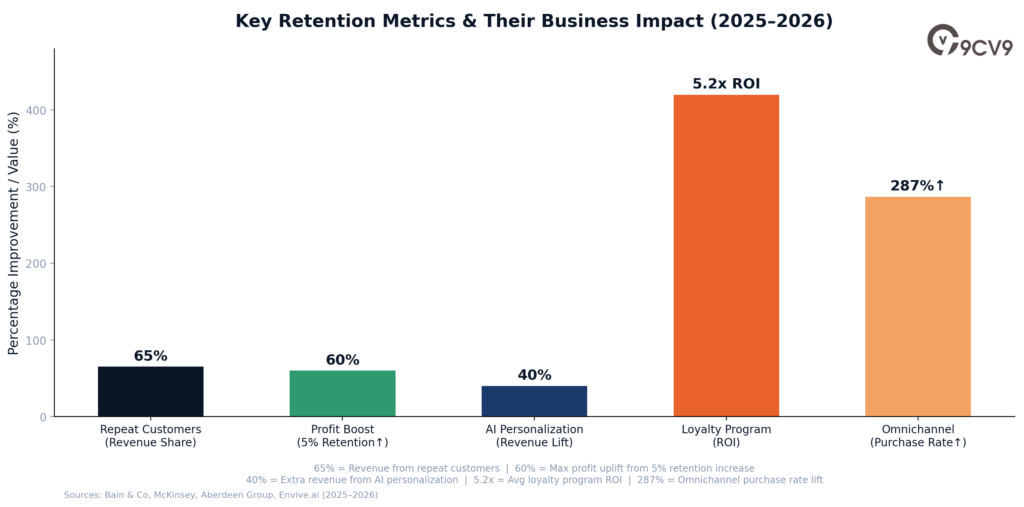
13. 5% → 25–95% Profit — A mere 5% improvement in customer retention rates can increase company profitability by 25% at the low end and up to 95% at the high end, according to landmark Bain & Company research.
14. 1% Churn Reduction = 12%+ Valuation — For subscription businesses, reducing customer churn by just 1% can increase company valuation by more than 12%, making churn reduction a direct lever for enterprise value creation.
15. 60–70% Sell Probability — There is a 60–70% probability of selling to an existing customer versus a 5–20% chance with a new prospect, reinforcing why retention software investment consistently outperforms pure acquisition spend.
16. 67% More Spend — Repeat buyers spend 67% more than first-time customers on average, making the economics of retention dramatically superior to acquisition across virtually every industry vertical.
17. 65% of Revenue from Existing Customers — An estimated 65% of a typical company’s total revenue comes from existing customers, meaning churn is not just a retention metric — it is a direct threat to the entire revenue base.
18. $2.71 Year-1 ROI — Retention programs deliver an average ROI of $2.71 per dollar in Year 1, accelerating to $7.93 by Year 3 as loyalty infrastructure matures and customer lifetime value compounds.
19. 76% ROI Positive within 12 Months — 76% of companies that invest in structured retention programs achieve positive ROI within the first 12 months, with 44% seeing returns in under six months.
20. 20% Revenue Increase — Companies that have successfully increased their customer retention rates report an average 20% increase in total revenue — a direct, measurable commercial outcome of retention software deployment.
🤖 AI & Personalization
21. 80% Enterprise AI Adoption by 2026 — Gartner forecasts that 80% of enterprises will adopt AI specifically for customer retention by 2026, making AI-powered retention the dominant technological paradigm for the year ahead.
22. 92% Use AI Personalization — 92% of businesses now use AI-driven personalization to drive customer growth, reflecting near-universal adoption and raising the bar for what customers consider a minimum-standard experience.
23. 10–15% Retention Rate Increase — AI-powered retention platforms drive a 10–15% increase in customer retention rates, representing a meaningful and measurable uplift that justifies the technology investment.
24. 40% More Revenue (AI Personalization) — Companies excelling at AI personalization generate 40% more revenue than average competitors — a gap that is expected to widen further as AI capabilities advance in 2026.
25. 95% Churn Prediction Accuracy — AI-powered machine learning models now achieve 95% accuracy in predicting customer churn, with top implementations reaching 98–99%, enabling proactive retention interventions before customers disengage.
26. 83% AI-Enabled Sales Teams Grew Revenue — 83% of sales teams using AI reported revenue growth in 2024 versus only 66% of teams without AI — a 17-point performance advantage that compounds over time.
27. $5.44 per Dollar (Automation ROI) — Marketing automation delivers a $5.44 return for every dollar spent over three years, while lifecycle automation simultaneously improves email open rates by 83.4% and click rates by 341.1%.
28. 80%+ Generative AI in Enterprises by 2026 — Generative AI adoption in enterprises is expected to exceed 80% by 2026, unlocking hyper-personalization at scale that was previously only feasible for the largest organizations.
29. $11B+ Chatbot Savings — AI-powered chatbots are expected to save businesses over $11 billion annually by 2025 through reduced ticket volume and faster issue resolution — directly supporting retention by removing friction.
30. 85% Interactions Managed by AI — By 2025, an estimated 85% of customer interactions are managed without human intervention, fundamentally transforming how retention-critical customer service touchpoints are delivered.
31. 41% Better Retention (AI Early Adopters) — Early AI adopters in customer retention software show 41% better retention metrics than companies that lag in AI adoption, demonstrating a rapidly widening competitive gap.
32. 15% Satisfaction Increase (AI Platforms) — McKinsey research shows businesses investing in AI-powered customer retention platforms can achieve up to 15% increases in customer satisfaction scores, a key leading indicator of long-term loyalty.
33. 4,700% Surge in AI-Driven eCommerce Traffic — Traffic to US ecommerce sites from generative AI tools surged 4,700% year-over-year in 2025, signalling that AI agents are now a primary discovery and purchase channel businesses must factor into retention strategies.
🏭 Industry Retention Benchmarks
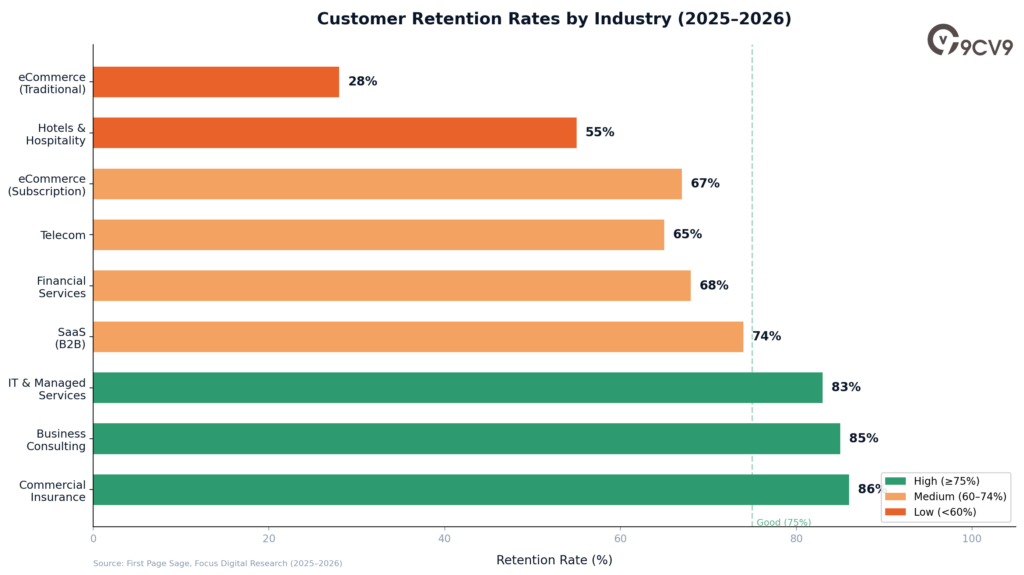
34. 86% — Commercial Insurance — Commercial Insurance leads all industries with an 86% annual customer retention rate, benefitting from high switching costs and long-term contractual relationships that make churn structurally difficult.
35. 85% — Business Consulting — Business Consulting firms achieve 85% average annual customer retention, driven by deeply embedded advisory relationships and the high cost and disruption of switching service providers.
36. 83% — IT & Managed Services — IT and Managed Services providers retain 83% of customers annually, reflecting the mission-critical nature of their services and the deep technical integration that creates natural switching barriers.
37. 74% — B2B SaaS — B2B SaaS companies report an average annual retention rate of 74%, with top performers pushing Net Revenue Retention past 120% through aggressive expansion revenue strategies.
38. 68% — Financial Services — Financial Services firms retain 68% of customers annually, facing growing pressure from fintech disruptors and digital-first competitors who offer lower fees and superior digital experiences.
39. 65% — Telecom — The telecoms sector retains approximately 65% of customers annually, with AI-driven churn intervention tools demonstrating the ability to cut telecom churn by up to 15% through personalized intervention.
40. 67% — eCommerce (Subscription) — Subscription ecommerce achieves an average 67% customer retention rate, significantly outperforming traditional ecommerce, validating the subscription model as a structural retention advantage.
41. 55% — Hotels & Hospitality — Hotels and hospitality companies retain just 55% of customers annually, reflecting the commodity nature of accommodation pricing and the intense competition from OTAs and alternative platforms.
42. 28% — eCommerce (Traditional) — Traditional ecommerce businesses retain only 28% of customers year-over-year, with a 70–75% annual churn rate making retention software an urgent priority for sustainable growth.
43. 2% YoY Improvement (SaaS) — SaaS companies showed the most substantial year-over-year retention improvement at 2 percentage points, driven primarily by enhanced onboarding automation and usage-based pricing models.
44. 18% Higher Retention (Enterprise vs Micro) — Enterprise businesses achieve 18% higher retention than micro-businesses, driven by dedicated customer success teams, sophisticated onboarding, and brand recognition that builds initial trust.
📈 SaaS-Specific Benchmarks
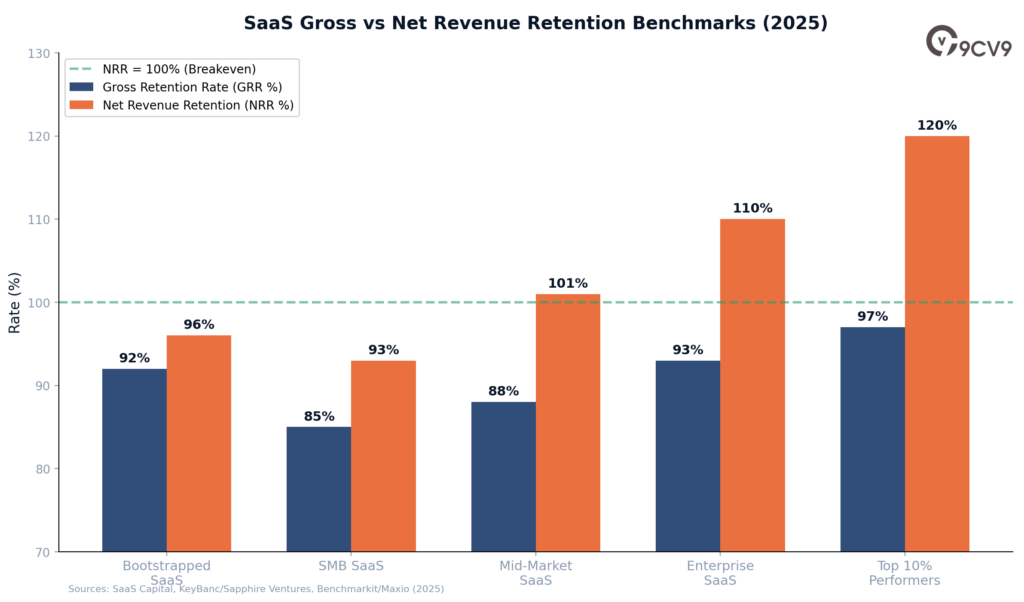
45. 90% Gross Retention Rate — Private SaaS companies report an average gross retention rate of approximately 90%, a critical baseline metric that investors use to assess the health and predictability of recurring revenue.
46. 101% Net Revenue Retention — The median Net Revenue Retention (NRR) for private SaaS companies stands at around 101%, meaning the average company is growing revenue from its existing customer base even before accounting for new sales.
47. 104% NRR (Bootstrapped SaaS) — Bootstrapped SaaS companies with $3M–$20M ARR achieve a median NRR of 104%, with 90th-percentile performers reaching 118% — demonstrating that capital-efficient businesses can excel at retention.
48. 120%+ NRR (Top Performers) — Elite SaaS companies achieve Net Revenue Retention exceeding 120%, generating over 50% of new ARR purely from upsells and cross-sells within the existing customer base.
49. 5–8% Annual Churn (SaaS Average) — The average annual churn rate for SaaS companies ranges from 5–8%, while high-performing companies maintain churn below 3% through rigorous customer success operations.
50. Under 3% Annual Churn (High-Performers) — SaaS companies that maintain annual churn below 3% are classified as high-performers, typically achieving this through superior product stickiness, proactive customer success, and robust health scoring.
51. 6–12 Point NRR Lift (Health Scoring) — Companies implementing customer health scoring systems see NRR lifts of 6–12 percentage points, especially effective in mid-market SaaS where account managers can act on health signals proactively.
52. 70% Revenue Recovery (Failed Payments) — Automated failed payment retry systems recover 70% of otherwise-lost revenue from involuntary churn, making payment automation one of the highest-ROI features in any subscription management platform.
53. 50% Less Early Churn (Structured Onboarding) — Structured onboarding programs reduce early-stage churn by 50%, and customers who achieve their product “aha moment” in Week 1 are twice as likely to remain long-term subscribers.
54. 3.6× Slower Churn (C-Suite Buyers) — Software purchased at the C-suite level churns 3.6 times more slowly than tools purchased at the manager level, making executive sponsorship the single strongest structural predictor of SaaS retention.
55. 46% Monthly Churn Reduction (Usage-Based Pricing) — SaaS companies using usage-based pricing models experience 46% lower monthly churn compared to flat-rate alternatives (2.1% vs 3.9%), as value delivery is more directly aligned with customer spend.
56. 40–50% Churn Reduction (Annual Billing) — Switching customers from monthly to annual billing reduces churn by 40–50%, representing one of the most immediate and structurally simple levers available to SaaS retention teams.
57. 19% ARR Growth (Private SaaS) — Private SaaS companies report median ARR growth of approximately 19%, with this growth rate heavily dependent on maintaining strong gross and net retention to sustain compounding expansion.
🎁 Loyalty Programs
58. 5.2× Average ROI — Loyalty programs deliver an average ROI of 5.2 times the investment, with 83% of companies reporting positive returns and top programs achieving 7.2× ROI through frequency, basket size, and churn improvements.
59. 7.2× ROI (Top-Performing Programs) — Top-performing loyalty programs achieve 7.2× ROI, driven by three success factors: personalization (cited by 82% of high performers), gamification (67%), and experiential rewards (74%).
60. 12–18% More Revenue from Members — Loyalty program members generate 12–18% more revenue than non-enrolled customers, with premium tier members contributing 23% more and showing 47% lower churn rates.
61. 47% Lower Churn for Loyalty Members — Customers enrolled in loyalty programs churn 47% less frequently than non-members, while also referring new customers at 39% higher rates — demonstrating retention programs’ compounding business impact.
62. 2.7× Lifetime Value (Premium Members) — Premium paid loyalty program members achieve 2.7× higher lifetime values than free-tier members, despite representing only 18% of the total member base.
63. 60% More Spend (Premium vs 30% Free) — Premium loyalty members are 60% more likely to increase their spending with a brand, compared to 30% for free program members — validating the economics of paid loyalty tiers.
64. 72% More Likely to Stay (Loyalty Members) — 72% of loyalty program members say they are more likely to remain with a brand than non-members, making well-designed loyalty infrastructure a powerful structural retention tool.
65. 63% of US Purchase Decisions Influenced by Loyalty — Bain & Company reports that 63% of US consumers’ purchasing decisions are directly influenced by loyalty program participation, underscoring the commercial materiality of loyalty platforms.
🌐 Omnichannel & Customer Experience
66. 89% Retention (Strong Omnichannel) vs 33% (Weak) — Companies with strong omnichannel customer engagement retain 89% of customers versus just 33% for businesses with weak cross-channel strategies — a 56-point gap that defines market winners.
67. 287% Higher Purchase Frequency (Omnichannel) — Omnichannel customers purchase 287% more frequently than single-channel shoppers, while also showing 13% higher average order values and 9.5% year-over-year revenue growth.
68. 250% Higher Purchase Rate — Multi-channel marketing campaigns achieve 250% higher purchase rates than single-channel efforts, with the ROI on omnichannel infrastructure investment more than justified by retention and revenue outcomes.
69. 95% Say Customer Service Drives Loyalty — 95% of consumers identify customer service quality as essential for brand loyalty, with customers experiencing excellent service showing 87% retention versus just 41% for those experiencing poor service.
70. 2.4× More Loyal (Fast Problem Resolution) — Customers are 2.4 times more likely to remain with a brand that resolves their problems quickly. First-contact resolution increases overall retention by an average of 67%.
71. 71% Retention (Sub-1-Hour Response) — Customers who receive a response to their support inquiry within one hour show a 71% retention rate, versus 48% for those waiting 24 hours — speed of service is a direct retention variable.
72. 68% Churn from Feeling Unappreciated — 68% of customer churn happens because customers feel “unappreciated” by the brand — a finding that highlights the emotional dimension of retention that software must address beyond pure transactional mechanics.
73. 54% Stop Buying After Bad Service — 54% of consumers say they would stop purchasing from a brand after just one bad customer service experience, making every customer interaction a high-stakes retention moment.
74. 86% Pay More for Better Service — 86% of consumers are willing to pay a premium for superior customer service — demonstrating that experience quality, not just price, is a powerful retention and revenue lever.
75. 77% Stay 10+ Years (Satisfied Customers) — 77% of satisfied customers remain with a brand for 10 or more years, illustrating the extraordinary lifetime value created by consistently excellent customer experiences powered by retention software.
🔄 Churn Reduction Tactics
76. 85% of Churn is Preventable — SuperOffice research reveals that 85% of customer churn is preventable through better, more proactive customer service — a striking finding that puts retention software at the center of churn strategy.
77. 15–25% Churn Reduction (Acting on Feedback) — Companies that actively act on customer feedback see 15–25% reduction in churn, a range validated by both Gartner and Forrester across their respective research programs.
78. 14% Less 90-Day Churn (Post-Purchase Emails) — Automated post-purchase emails reduce 90-day churn by 14%, with first-time buyers receiving personalized post-purchase communications showing 45% higher second-purchase rates.
79. 27% Churn Reduction (Proactive Support) — Proactive outreach — contacting at-risk customers before issues escalate — reduces churn by 27%, significantly outperforming reactive support models across all measured segments.
80. +14% Retention Lift (Proactive Outreach) — Analysis of 312 companies that achieved 10+ percentage point retention improvements identified proactive outreach as the single highest-impact initiative, delivering a +14% retention lift.
81. 20–35% Less Involuntary Churn (SMS Reminders) — Personalized SMS subscription renewal reminders reduce involuntary churn by 20–35%, making SMS automation one of the most cost-efficient retention tools available for subscription businesses.
82. 12–15% Less Voluntary Churn (Exit Surveys + Offers) — Combining exit surveys with smart cancellation-flow offers reduces voluntary churn by 12–15%, intercepting at-risk customers at their highest-intent-to-leave moment.
83. 10–18% Win-Back Rate (Month-3 Discount) — Offering a targeted win-back discount in Month 3 to lapsed customers achieves a 10–18% reactivation success rate compared to no-offer control groups.
84. 8–14% Less Churn (Reactivation Messages) — Sending well-timed reactivation messages reduces churn by 8–14%, with personalized re-engagement campaigns significantly outperforming generic broadcast messages.
85. 15% Telecom Churn Reduction (AI Interventions) — Telecom providers using AI-driven retention interventions cut churn by up to 15%, demonstrating that even structurally high-churn industries can materially move the needle with technology.
86. 18% Higher Retention (Loyalty Reward Programs) — Businesses that publicly reward customer loyalty through referral programs and points systems see 18% higher overall retention rates compared to companies without visible loyalty infrastructure.
87. 11–20% Less Churn (Pause/Skip Options) — Subscription businesses that offer flexible “pause” or “skip” options instead of cancellation reduce churn by 11–20%, as customers opt for temporary breaks rather than permanent departures.
88. 95.6% Paid Rate (Pause Feature) — Subscription businesses offering a pause feature maintain a 95.6% renewal invoice paid rate — demonstrating that giving customers control over their subscription is a powerful anti-churn mechanism.
📧 Email & Automation
89. 4,200% Email ROI — Email marketing delivers a 4,200% ROI — $42 returned for every $1 spent — remaining the most cost-effective single channel for driving retention program engagement and customer win-back campaigns.
90. 52% Win-Back Success via Email — Email drives 52% of win-back campaign success, supported by an 83% open-rate improvement and 341.1% click-rate lift from lifecycle automation flows versus standard broadcast emails.
91. 320% More Revenue (Automated Emails) — Marketing automation-triggered emails produce approximately 320% more revenue than standard broadcast email campaigns, reflecting the power of behavioral triggers in retention communication.
92. 38% Retention Engagement via Email — Email drives 38% of all retention program engagement activity, making it the single most important retention communication channel across virtually all business categories.
93. 29% More Repeat Purchases (Personalized Email) — Personalized email campaigns increase repeat purchases by 29% compared to generic communications, reinforcing the commercial case for segmentation and behavioral personalization in email retention programs.
🛒 eCommerce-Specific Retention
94. 70–75% Annual Churn (Traditional eCommerce) — Traditional ecommerce loses 70–75% of customers every year, creating an ongoing acquisition treadmill that retention software is uniquely positioned to interrupt through personalized re-engagement.
95. 3.4% Monthly Churn (Subscription eCommerce) — Subscription ecommerce businesses average a 3.4% monthly churn rate — far superior to traditional ecommerce, validating subscription models as a structural retention advantage.
96. 94.4% App Churn by Day 30 — Mobile commerce shopping apps lose 94.4% of users by Day 30, retaining only 5.6%, highlighting an acute retention challenge in mobile-first ecommerce that retention software must address through onboarding and push notification strategies.
97. 28.2% Average Repeat Customer Rate — The average repeat customer rate across ecommerce stores is 28.2%, with a healthy 30–35% benchmark for stores aged 1–3 years — a metric directly improved by retention software investment.
98. $3.65 per Abandoned Cart Recovery — Abandoned cart recovery emails generate $3.65 per recipient on average, with three-email sequences recovering 29% of abandoned carts versus 18% for single-email campaigns.
99. 38% Recovery Rate (Abandoned Cart + SMS) — Adding SMS to email abandoned cart sequences increases recovery rates to 38%, demonstrating the measurable omnichannel synergy available through integrated retention platform stacks.
100. 131% More Likely to Return (Content Marketing) — Customers acquired through content marketing are 131% more likely to return for repeat purchases, making content-driven retention a strategically important long-term investment for ecommerce brands.
📊 Additional Data Points
101. 71% Consumers Want Generative AI in Purchasing — 71% of consumers now want generative AI integrated into their purchasing experiences, forcing retention software providers to evolve beyond passive point accumulation toward active, AI-orchestrated personalization.
102. 88% Tried a New Brand in Last 3 Months — 88% of shoppers purchased from a new-to-them brand in the past three months (Attentive, 2026), underscoring the volatility of brand loyalty and the urgency of investing in retention technology to hold customers’ attention.
103. 77% Shop Regularly with 5 or Fewer Brands — 77% of consumers — and 85% of Gen Z — regularly shop with five brands or fewer, meaning retention software must help businesses earn and defend a coveted spot in this small, competitive shortlist.
104. 60% Switched Brands Due to Cost (2025) — 60% of consumers switched from a brand they were loyal to in 2025 due to cost considerations, proving that loyalty cannot be taken for granted and must be continuously reinforced through value delivery.
105. NPS +10 Points = 5–8% Higher Retention — Every 10-point improvement in Net Promoter Score (NPS) correlates with a 5–8% increase in customer retention rate, making NPS tracking within retention software a leading indicator of financial performance.
106. 23% Churn Caused by Ineffective Onboarding — 23% of all customer churn is directly attributable to ineffective onboarding, making retention software’s onboarding automation and in-app guidance capabilities critically important from Day 1.
107. 20–30% Lower Churn (Advanced Lifecycle Segmentation) — Companies using advanced lifecycle segmentation show 20–30% lower churn compared to businesses using broadcast-only marketing approaches, demonstrating the measurable impact of behavioral segmentation tools.
108. 43%+ Annual Revenue from Loyal Customers — Retained, loyal customers contribute 43% or more of annual revenue for most loyalty-focused businesses, making their retention not just commercially important but strategically existential.
109. 48–72% Future Revenue from Repeat Buyers (2+ Purchases) — Customers who have made two or more purchases are responsible for 48–72% of projected future revenue in modeled cohorts — the business case for second-purchase conversion in retention software is overwhelming.
110. 210% Improvement (AI-Targeted At-Risk Customers) — A major US airline achieved a 210% improvement in targeting at-risk customers using AI-powered proactive intervention strategies, while simultaneously reducing churn intention among high-value customers by 59%.
Conclusion
As the customer retention landscape continues to evolve in 2026, one reality has become unmistakably clear: sustainable business growth is no longer determined solely by how many new customers a company acquires, but by how effectively it retains, engages, and expands the value of its existing customer base. Across virtually every industry—from SaaS and eCommerce to financial services, telecommunications, healthcare, retail, and professional services—customer retention has emerged as one of the most important drivers of long-term profitability, operational resilience, and competitive differentiation. The 110 customer retention software statistics, data points, and trends presented throughout this guide collectively illustrate a market undergoing rapid technological transformation while reinforcing timeless business principles centered around customer loyalty, satisfaction, and lifetime value.
One of the strongest themes emerging from these statistics is the growing economic advantage of retention over acquisition. Businesses continue to face escalating customer acquisition costs, increased advertising competition, stricter privacy regulations, and more fragmented digital channels. In contrast, existing customers consistently generate higher lifetime value, purchase more frequently, spend more per transaction, and are significantly more likely to recommend brands to others. This shift in economics explains why organizations across every sector are increasing investment in customer retention software rather than relying exclusively on expensive acquisition campaigns. The data demonstrates that even modest improvements in customer retention rates can translate into substantial increases in profitability, revenue growth, shareholder value, and enterprise valuation.
The remarkable growth of the global customer retention software market further reflects this strategic shift. Strong double-digit annual growth forecasts indicate that organizations worldwide increasingly recognize customer retention platforms as foundational business infrastructure rather than optional marketing tools. Modern retention software now sits alongside CRM systems, ERP platforms, marketing automation suites, customer data platforms, and business intelligence solutions as an essential component of digital transformation initiatives. Businesses are no longer asking whether they should invest in retention technology—they are determining how quickly they can deploy increasingly sophisticated capabilities powered by artificial intelligence and predictive analytics.
Artificial intelligence has become one of the defining forces shaping customer retention strategies in 2026. AI-powered personalization, churn prediction, behavioral segmentation, recommendation engines, automated customer journeys, conversational AI, sentiment analysis, and predictive customer health scoring have fundamentally transformed how organizations interact with customers throughout their lifecycle. Rather than reacting after customers decide to leave, businesses can now identify early warning signals, predict churn with remarkable accuracy, and proactively intervene with personalized experiences that strengthen engagement before dissatisfaction escalates. These capabilities are rapidly becoming standard competitive requirements rather than premium differentiators.
Another major takeaway is the increasing importance of customer experience as a measurable business asset. Exceptional customer service, rapid issue resolution, omnichannel engagement, frictionless onboarding, personalized communications, and consistent brand experiences now have direct and measurable impacts on customer retention, repeat purchases, revenue expansion, and long-term loyalty. The statistics demonstrate that organizations delivering superior customer experiences consistently outperform competitors across virtually every key performance indicator. Customer retention software enables these experiences by connecting data, automation, and customer intelligence into a unified platform capable of supporting meaningful relationships at scale.
The continued rise of subscription-based business models has made retention metrics even more strategically important. Gross Revenue Retention, Net Revenue Retention, Customer Lifetime Value, churn rate, expansion revenue, customer health scores, and renewal rates have become core financial indicators monitored not only by management teams but also by investors, venture capital firms, and public markets. High-performing SaaS companies increasingly generate substantial revenue growth from existing customers through effective onboarding, proactive customer success, intelligent upselling, annual billing strategies, and continuous product adoption. These benchmarks provide valuable targets for organizations seeking to improve recurring revenue while building more predictable and resilient business models.
Loyalty programs also continue to evolve beyond traditional discounts and point accumulation systems. Modern customer retention strategies increasingly focus on creating emotional connections through personalized rewards, exclusive experiences, gamification, AI-powered recommendations, referral incentives, premium membership tiers, and value-added services. Businesses that successfully combine loyalty platforms with customer retention software gain deeper visibility into customer preferences while creating stronger incentives for long-term engagement. These integrated ecosystems allow organizations to reward desirable customer behaviors while continuously reinforcing brand affinity.
Omnichannel engagement has likewise become indispensable. Today’s customers expect consistent experiences regardless of whether they interact through websites, mobile applications, email, social media, messaging platforms, live chat, customer support centers, or physical locations. Customer retention software increasingly serves as the central intelligence layer connecting these channels into cohesive customer journeys. Organizations capable of delivering seamless omnichannel experiences are significantly better positioned to improve customer satisfaction, increase purchase frequency, and reduce churn in highly competitive markets.
The statistics also highlight the growing importance of proactive customer success. Instead of waiting for customers to submit complaints or cancel subscriptions, leading organizations now leverage automated monitoring, predictive analytics, behavioral triggers, lifecycle marketing, health scoring, proactive outreach, and personalized interventions to resolve issues before they become reasons for churn. This shift from reactive customer support to proactive relationship management represents one of the most significant developments in customer retention over the past decade and is expected to accelerate even further as AI capabilities mature.
Another noteworthy trend is the increasing integration of customer retention software with broader business ecosystems. Modern platforms no longer operate in isolation but connect with CRM systems, marketing automation platforms, payment systems, help desk software, analytics tools, Customer Data Platforms, communication platforms, and business intelligence solutions. This interconnected architecture provides organizations with a unified understanding of customer behavior, enabling smarter decision-making across sales, marketing, product development, finance, and customer success teams.
The growing influence of generative AI represents another pivotal development shaping the future of customer retention. Businesses are increasingly deploying AI to create individualized customer communications, generate personalized product recommendations, automate customer support interactions, optimize retention campaigns, analyze customer feedback, and continuously improve engagement strategies. As generative AI becomes more sophisticated, retention software will likely evolve from assisting customer success teams to autonomously orchestrating many aspects of the customer lifecycle while maintaining human oversight for complex interactions.
Looking ahead, customer retention software will continue expanding beyond traditional CRM functionality into comprehensive customer intelligence platforms capable of delivering predictive insights, autonomous decision-making, real-time optimization, and hyper-personalized experiences across every customer touchpoint. Organizations embracing these technologies early will be better positioned to defend market share, increase customer lifetime value, reduce operational costs, and build stronger competitive advantages in increasingly crowded digital markets.
Ultimately, the Top 110 Customer Retention Software Statistics, Data & Trends in 2026 demonstrate that customer retention has evolved into one of the most strategically significant disciplines in modern business. The organizations that consistently outperform their competitors are no longer those with the largest advertising budgets or the fastest customer acquisition engines alone, but those that successfully transform first-time buyers into loyal, engaged, long-term advocates through exceptional customer experiences supported by intelligent technology. As artificial intelligence, predictive analytics, automation, and omnichannel engagement continue reshaping customer relationships, businesses that prioritize customer retention will be better equipped to generate sustainable revenue growth, maximize profitability, strengthen brand loyalty, and create lasting value for customers, shareholders, and stakeholders alike. These statistics provide not only a comprehensive snapshot of the industry’s current state but also a valuable roadmap for executives, marketers, customer success leaders, product managers, SaaS founders, and technology decision-makers seeking to thrive in the increasingly customer-centric business landscape of 2026 and beyond.
If you find this article useful, why not share it with your hiring manager and C-level suite friends and also leave a nice comment below?
We, at the 9cv9 Research Team, strive to bring the latest and most meaningful data, guides, and statistics to your doorstep.
To get access to top-quality guides, click over to 9cv9 Blog.
To hire top talents using our modern AI-powered recruitment agency, find out more at 9cv9 Modern AI-Powered Recruitment Agency.
People Also Ask
What is customer retention software?
Customer retention software helps businesses reduce customer churn, improve customer loyalty, automate engagement, and increase customer lifetime value through analytics, AI, CRM integrations, and personalized customer experiences.
Why is customer retention important in 2026?
Customer retention is critical because retaining existing customers is generally more cost-effective than acquiring new ones, leading to higher profitability, stronger customer loyalty, and sustainable long-term business growth.
What are the latest customer retention software trends in 2026?
Major trends include AI-powered personalization, predictive analytics, customer health scoring, omnichannel engagement, automated workflows, generative AI, and deeper CRM integrations.
How fast is the customer retention software market growing?
The customer retention software market continues to experience strong global growth as businesses invest more in customer experience, automation, AI, and subscription-based business models.
How does customer retention software reduce churn?
It identifies at-risk customers using behavioral data and predictive analytics, enabling businesses to take proactive actions before customers cancel or stop purchasing.
What industries use customer retention software?
Industries including SaaS, eCommerce, retail, finance, healthcare, telecommunications, hospitality, education, and professional services widely use customer retention platforms.
How does AI improve customer retention?
AI analyzes customer behavior, predicts churn, personalizes recommendations, automates communications, and helps businesses deliver more relevant customer experiences.
What is customer churn?
Customer churn refers to the percentage of customers who stop buying from or subscribing to a business during a specific period.
What is customer lifetime value (CLV)?
Customer Lifetime Value measures the total revenue a customer is expected to generate throughout their relationship with a business.
Why is customer lifetime value important?
A higher CLV indicates stronger customer loyalty and greater profitability, helping businesses maximize returns on customer acquisition and retention investments.
What are customer retention benchmarks?
Customer retention benchmarks measure metrics such as retention rate, churn rate, repeat purchase rate, renewal rate, and customer lifetime value against industry averages.
How does customer retention software increase revenue?
It boosts repeat purchases, improves renewals, encourages upselling and cross-selling, reduces churn, and increases customer lifetime value.
What role does personalization play in customer retention?
Personalization delivers relevant recommendations, tailored offers, and customized communications that improve customer satisfaction and long-term loyalty.
What is predictive customer analytics?
Predictive analytics uses historical customer data and AI models to forecast future behaviors such as churn risk, purchase intent, and engagement levels.
How does customer success improve retention?
Customer success teams proactively help customers achieve desired outcomes, increasing satisfaction, product adoption, renewals, and long-term loyalty.
What are loyalty programs?
Loyalty programs reward repeat customers with incentives, discounts, exclusive benefits, or points to encourage continued engagement and repeat purchases.
Why are omnichannel experiences important?
Customers expect consistent experiences across websites, mobile apps, email, social media, and support channels, improving satisfaction and retention.
How does CRM integration improve customer retention?
CRM integration centralizes customer information, enabling personalized communication, better customer support, and more effective retention campaigns.
Can small businesses benefit from customer retention software?
Yes. Small businesses can improve customer loyalty, automate engagement, reduce churn, and compete more effectively using affordable retention solutions.
What metrics should businesses track for customer retention?
Key metrics include retention rate, churn rate, repeat purchase rate, customer lifetime value, Net Revenue Retention, customer satisfaction, and Net Promoter Score.
What is Net Revenue Retention (NRR)?
Net Revenue Retention measures recurring revenue growth from existing customers after accounting for upgrades, downgrades, and churn.
How does automation improve customer retention?
Automation delivers timely emails, reminders, onboarding, loyalty rewards, customer support, and personalized engagement without increasing manual workload.
What is customer engagement software?
Customer engagement software helps businesses communicate with customers across multiple channels while tracking interactions and improving overall relationships.
How does customer retention software support SaaS companies?
It improves onboarding, product adoption, subscription renewals, expansion revenue, customer health monitoring, and churn prevention.
What is customer health scoring?
Customer health scoring evaluates customer engagement, product usage, satisfaction, and support interactions to identify customers who may need assistance.
How do customer retention statistics help businesses?
Retention statistics provide benchmarks, reveal market trends, measure performance, and support better decision-making for improving customer loyalty.
What technologies are shaping customer retention in 2026?
Artificial intelligence, machine learning, predictive analytics, customer data platforms, automation, conversational AI, and advanced CRM technologies are driving innovation.
How can businesses improve customer retention?
Businesses can improve retention by delivering excellent customer service, personalizing experiences, reducing friction, rewarding loyalty, and using AI-driven retention software.
What are the biggest customer retention challenges?
Common challenges include rising customer expectations, increasing competition, fragmented customer data, privacy regulations, and maintaining personalized engagement at scale.
Why should businesses monitor customer retention trends?
Monitoring customer retention trends helps businesses adapt to changing customer behaviors, adopt emerging technologies, benchmark performance, and maintain long-term competitive advantage.
Sources
MarketsizeandTrends Stats N Data The Sales Collective DataInsightsMarket First Page Sage Focus Digital SerpSculpt Envive AI Flowlu MarketingLTB Ringly TipsonBlogging Rivo TryPropel AI SuperAGI Attentive Rebuy PUG Interactive CustomerGauge Currency Alliance TRIFFT Loyalty Qualtrics Netcore Cloud