





























Key Takeaways
- The Creative Management Software market continues to expand rapidly in 2026, driven by growing demand for AI-powered content creation, Digital Asset Management (DAM), workflow automation, and enterprise content operations.
- Generative AI, agentic AI, and creative automation technologies are transforming how organizations produce, manage, and distribute content, delivering measurable gains in productivity, content volume, and marketing ROI.
- Leading platforms such as Adobe, Canva, and next-generation AI creative tools are reshaping the competitive landscape as businesses invest heavily in scalable content management, cloud-based collaboration, and intelligent creative workflows.
Creative Management Software helps organizations create, manage, automate, and distribute digital content more efficiently. In 2026, businesses use these platforms to improve collaboration, accelerate content production, manage digital assets, and leverage AI-powered workflows, making creative operations faster, more scalable, and more cost-effective across marketing and design teams.
Creative management software has evolved from a niche operational tool into one of the most important technology categories powering modern marketing, branding, design, and content production teams. As organizations face unprecedented demands for content creation, personalization, omnichannel marketing, and faster campaign execution, businesses are increasingly investing in platforms that help creative teams plan, produce, manage, distribute, and optimize digital assets at scale. In 2026, creative management software sits at the intersection of artificial intelligence, workflow automation, digital asset management (DAM), content operations, and enterprise collaboration, making it a critical component of the modern digital technology stack.
Also, read our list of the Top 11 Creative Management Software.

The rapid growth of digital channels has fundamentally changed how brands approach creative operations. Marketing teams today must create and manage content for websites, social media platforms, email campaigns, mobile applications, e-commerce marketplaces, video platforms, digital advertising networks, and emerging AI-powered discovery channels. This explosion in content requirements has created enormous pressure on creative teams to deliver more assets in less time while maintaining consistency, quality, compliance, and brand governance. As a result, organizations are turning to creative management software to centralize workflows, streamline collaboration, reduce inefficiencies, and accelerate time-to-market.
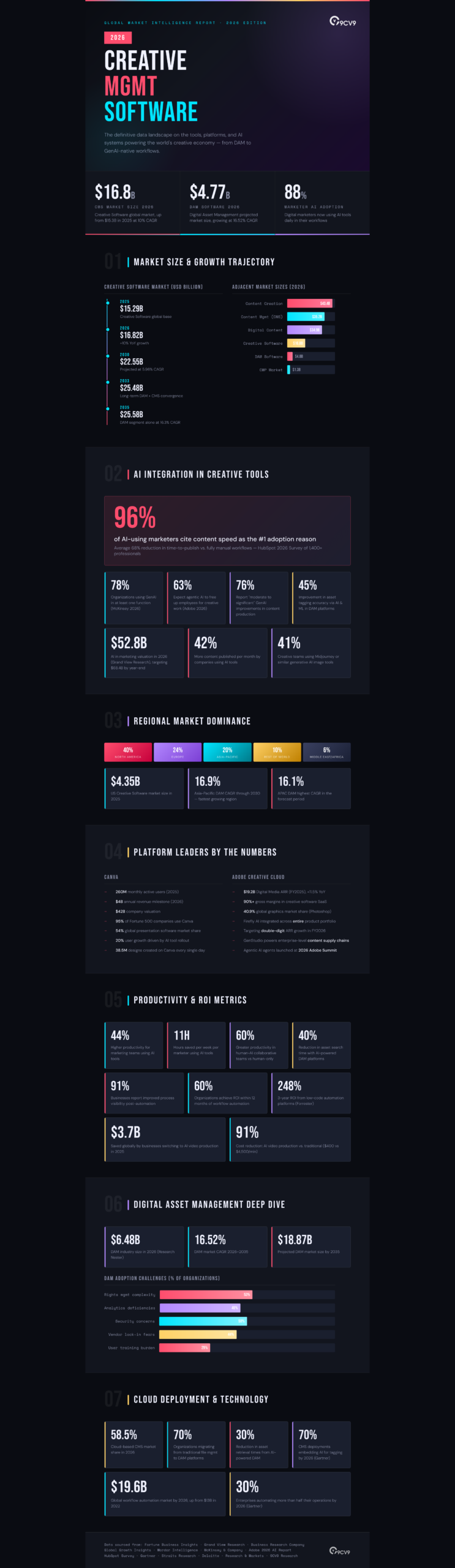
The numbers behind the industry highlight the scale of this transformation. The global creative software market surpassed $15 billion in 2025 and continues to grow at a healthy pace in 2026, while specialized segments such as Digital Asset Management (DAM), Creative Management Platforms (CMPs), workflow automation solutions, AI-powered content tools, and content management systems are expanding even faster. Multiple market forecasts indicate that creative management technologies will experience double-digit growth throughout the remainder of the decade, driven by increasing enterprise adoption, rising content production volumes, and the widespread integration of generative AI capabilities.
One of the strongest growth drivers reshaping the industry is the emergence of artificial intelligence. AI is no longer viewed as an experimental technology within creative operations. Instead, it has become a core capability embedded across leading platforms from Adobe, Canva, Bynder, Contentful, Sitecore, and numerous emerging vendors. Organizations are leveraging AI to automate repetitive tasks, generate content, improve asset tagging, enhance searchability, optimize workflows, personalize customer experiences, and accelerate production cycles. Research shows that marketers and creative professionals increasingly view AI as an essential productivity tool, enabling them to produce significantly more content while freeing up time for strategic and creative work.
The rise of generative AI has further accelerated demand for creative management platforms. Content production volumes have surged dramatically since the introduction of advanced generative AI technologies, creating new challenges around organization, governance, approval workflows, asset retrieval, and brand consistency. Companies that once managed hundreds of creative assets now manage thousands or even millions of files across multiple teams, geographies, and channels. This shift has elevated Digital Asset Management systems from a “nice-to-have” repository into a mission-critical infrastructure layer for modern enterprises. DAM platforms now play a central role in helping organizations control, distribute, and maximize the value of their growing content libraries.
At the same time, workflow automation is transforming how creative teams operate. Businesses increasingly recognize that manual processes, fragmented communication, and inefficient approval cycles are major obstacles to growth. Creative management software addresses these challenges by automating routine workflows, providing visibility across projects, and enabling cross-functional collaboration among marketing, design, product, and executive stakeholders. Organizations implementing automation technologies frequently report substantial productivity improvements, faster project completion times, and measurable returns on investment, making workflow optimization a top priority for digital transformation initiatives.
Video content has become another major catalyst for software adoption. The rapid growth of AI-powered video generation tools is reshaping content production economics, allowing organizations to create high-quality videos in a fraction of the time and cost previously required. Marketing teams can now produce personalized video campaigns, training materials, social media content, and product demonstrations at unprecedented speed. As video continues to dominate digital engagement metrics across industries, creative management platforms are increasingly integrating advanced video creation, editing, storage, and distribution capabilities to support evolving content strategies.
The competitive landscape has also undergone significant change. Established industry leaders such as Adobe continue to dominate professional creative workflows through comprehensive ecosystems that combine design tools, content management, analytics, and AI-powered automation. Meanwhile, platforms such as Canva have successfully democratized design, enabling millions of users and organizations to create professional-quality content without specialized expertise. The rise of AI-native startups and agentic workflow platforms is creating additional competitive pressure, pushing vendors to innovate faster and expand their feature sets to meet rapidly changing customer expectations.
Enterprise spending patterns further illustrate the growing importance of creative management technologies. Organizations are allocating larger portions of their marketing and technology budgets toward AI tools, content operations platforms, workflow automation systems, and digital experience infrastructure. Large enterprises are increasingly viewing creative management software not simply as a productivity tool but as a strategic business investment that directly impacts revenue generation, customer engagement, operational efficiency, and competitive differentiation. As content becomes the primary vehicle through which brands communicate with customers, the systems that manage content production are becoming central to organizational success.
Cloud adoption is another defining trend shaping the market in 2026. Cloud-based creative management, DAM, and content management solutions now account for the majority of deployments worldwide. Organizations are prioritizing cloud-native architectures that support remote collaboration, global accessibility, seamless integrations, AI-driven functionality, and scalable infrastructure. The migration away from legacy on-premises systems reflects broader shifts toward digital-first business models and increasingly distributed workforces. As a result, cloud platforms continue to capture growing market share across virtually every segment of the creative software ecosystem.
Beyond enterprise organizations, the creator economy is also contributing significantly to market growth. Individual creators, freelancers, agencies, influencers, and small businesses now require many of the same content management, workflow automation, and asset management capabilities once reserved for large corporations. This democratization of creative technology has expanded the addressable market for software vendors while driving demand for more intuitive, affordable, and AI-powered solutions. The result is a highly dynamic ecosystem where enterprise-grade capabilities are increasingly accessible to organizations and individuals of all sizes.
As businesses continue to navigate an increasingly content-driven economy, understanding the latest statistics, benchmarks, and market developments has become essential for technology leaders, marketers, creative directors, digital transformation teams, and software buyers. The data presented in this comprehensive collection of the top 110 Creative Management Software Statistics, Data & Trends in 2026 provides valuable insights into market growth, AI adoption, Digital Asset Management expansion, workflow automation performance, content production trends, platform competition, enterprise spending patterns, and the future direction of creative operations. Together, these statistics reveal how creative management software is evolving from a supporting technology into a foundational pillar of modern business strategy, enabling organizations to create, manage, and scale content faster than ever before.
Before we venture further into this article, we would like to share who we are and what we do.
About 9cv9
9cv9 is a business tech startup based in Singapore and Asia, with a strong presence all over the world.
With over nine years of startup and business experience, and being highly involved in connecting with thousands of companies and startups, the 9cv9 team has listed some important learning points in this overview of the Top 10 Engineering CAD Software To Know in 2026.
If you like to get your company listed in our top B2B software reviews, check out our world-class 9cv9 Media and PR service and pricing plans here.
Top 110 Creative Management Software Statistics, Data & Trends in 2026
MARKET SIZE & OVERALL GROWTH
1. The global Creative Software market was valued at $15.29 billion in 2025 and is projected to reach $16.82 billion in 2026 at a 10% CAGR.
The double-digit growth rate signals robust enterprise demand for creative tools, driven largely by digital transformation initiatives and AI-native product upgrades from vendors like Adobe and Canva.
2. The Creative Software market is expected to reach $22.55 billion by 2035, growing at a CAGR of 5.96% from 2026 to 2035.
While the long-term trajectory remains positive, the moderating CAGR compared to adjacent software categories suggests increasing market maturity and possible consolidation among platform vendors.
3. The Creative Management Software market is projected to reach approximately $15 billion by 2033, growing at 12% CAGR from 2025 to 2033.
A 12% CAGR is strong by enterprise software standards, reflecting the expanding role of centralised creative operations platforms in organisations of all sizes.
4. The Creative Management Platform (CMP) market was valued at $1.20 billion in 2025 and is expected to reach $2.07 billion by 2032 at a CAGR of 8.1%.
The narrower CMP sub-segment — focused on dynamic creative and display advertising — is growing more steadily, indicating sustainable demand from performance marketers rather than speculative hype.
5. The CMP market was separately valued at $1.2 billion in 2024 and is projected to reach $4.8 billion by 2033 at a CAGR of approximately 19.5%.
The wide variance in projections across research firms underscores the definitional breadth of “creative management,” with some analysts including AI-native content orchestration tools that others exclude.
6. The Creative Management Software market was valued at $3.5 billion in 2022 and is projected to reach $10.2 billion by 2030, growing at a CAGR of 14.5% from 2024 to 2030.
Compounding CAGRs in the 10–15% range across multiple forecast periods consistently suggest the creative software space is a structurally growing market — not merely a cyclical one.
7. The Creative Management Software market is separately projected to reach $1.78 billion by 2030, growing at a CAGR of 7.8% (2024–2030).
Narrower market definitions that focus strictly on project and creative workflow management show more conservative but still healthy growth, appealing to enterprise procurement teams seeking proven ROI.
8. The global Creative Management Platforms market size was $0.97 billion in 2024, projected to reach $2.91 billion by 2033 at a CAGR of 12.9%.
The CMP market nearly tripling over a decade reflects the growing convergence of design automation, dynamic content generation, and cross-channel ad delivery into unified platforms.
DIGITAL ASSET MANAGEMENT (DAM)
9. The global DAM Software market was $4.09 billion in 2025 and is projected to reach $4.77 billion in 2026, with a long-term target of $18.87 billion by 2035 at a CAGR of 16.52%.
DAM is one of the fastest-growing sub-categories within creative management software, as enterprises grapple with exponential growth in digital asset volumes across omnichannel campaigns.
10. The DAM market was worth $3.8 billion in 2021 and is expected to reach $8.21 billion by 2026.
The near-doubling of the DAM market in five years illustrates how the pandemic-driven shift to digital content production permanently elevated organisational appetite for centralised asset libraries.
11. The DAM market is projected to hit $11.94 billion by 2030 at a 15.0% CAGR.
Double-digit DAM CAGR through 2030 is underpinned by structural demand from media, retail, and healthcare sectors, where consistent brand governance across thousands of assets is a compliance and competitive necessity.
12. The global DAM Software market was valued at $4,589.35 million in 2025, projected to reach $5,259.4 million in 2026 and $18,465.61 million by 2035 at a CAGR of 14.6%.
Slightly varying estimates across firms, ranging from $4.77B to $6.48B for 2026, collectively confirm the DAM market is firmly in its high-growth phase rather than nearing saturation.
13. In 2024, the global DAM market encompassed over 1.2 billion digital assets managed daily.
The sheer volume of daily digital asset activity underlines why manual file management is no longer viable for any enterprise operating across more than two digital channels simultaneously.
14. The DAM market in 2026 is evaluated at $6.48 billion (Research Nester estimate).
Research Nester’s higher estimate reflects the inclusion of adjacent services such as consulting, integration support, and managed DAM operations that platform-only estimates exclude.
15. The Global Digital Asset Management Software Market is projected to grow from $3.64 billion in 2025 to $8.32 billion by 2031, at a CAGR of 14.77%.
The consistent 14–17% CAGR band across multiple research sources provides strong cross-validation that DAM is among the most reliably high-growth enterprise software categories in 2026.
16. Content production volume increased by 56.7% in the year following the widespread launch of generative AI (Bynder, April 2024).
This staggering content surge created an urgent need for DAM platforms capable of ingesting, tagging, and distributing AI-generated assets alongside human-created ones without degrading retrieval quality.
17. Over 70% of surveyed organisations transitioned from traditional file management to dedicated DAM platforms in 2024 (MediaValet, 2025 DAM Trends Report).
The mass migration from shared drives and email-based asset sharing to dedicated DAM platforms represents a meaningful structural shift in how creative operations teams build their technology stack.
18. Approximately 38% of organisations report that consolidated asset libraries reduce duplicate creative spend.
Eliminating duplicate asset creation is one of the most immediately quantifiable ROI drivers for DAM adoption, making it a powerful business case anchor for budget approval in large enterprises.
19. About 33% of marketing teams cite faster time-to-publish as a direct benefit of DAM deployment.
Speed-to-market is increasingly a competitive differentiator in performance marketing, and DAM platforms that reduce publishing friction are earning a measurably larger share of enterprise martech budgets.
20. Approximately 29% of buyers prioritise AI features when evaluating DAM solutions.
While AI is a growing evaluation criterion, the majority of buyers still focus on foundational capabilities — suggesting DAM vendors should treat AI as an enhancer of core workflows rather than a replacement for them.
21. Nearly 29% of organisations state that user training and change management are primary hurdles to DAM adoption.
The human side of DAM implementation consistently outweighs the technical side as a barrier, suggesting vendors that invest in onboarding, in-app guidance, and customer success will see higher net revenue retention.
22. About 24% of organisations note that inconsistent metadata taxonomies across departments reduce DAM effectiveness.
Metadata governance is the unglamorous backbone of any effective DAM deployment; organisations that invest in taxonomy design at the outset consistently outperform those that retrofit it later.
23. AI integration has led to a 45% improvement in asset tagging accuracy and a 30% reduction in retrieval times in DAM platforms.
These measurable gains in discovery speed directly translate to hours recovered per week per creative employee, making AI-powered DAM a straightforward ROI case for operations teams.
24. Cloud-based DAM solutions saw a 70% year-over-year growth in deployments.
The near-universal shift to cloud-native DAM reflects not only cost and scalability advantages but also the reality that distributed creative teams require real-time asset access from anywhere in the world.
25. North America accounts for about 40% of the global DAM market share, with approximately 42% of global enterprise DAM pilots originating there.
North America’s DAM dominance is reinforced by its dense concentration of media, retail, and technology brands that treat digital asset infrastructure as a strategic investment rather than an IT cost.
26. Asia-Pacific DAM market is projected to grow at the highest CAGR of 16.1–17.4% during the forecast period.
APAC’s accelerating DAM adoption is closely tied to the region’s surge in mobile-first e-commerce and social commerce, where the velocity of content production and localisation demands outpaces legacy systems.
27. The DAM market in Europe was valued at $1.2 billion in 2022.
Europe’s DAM market is characterised by regulatory-driven adoption — the EU’s Accessibility Act (effective June 2025) now mandates richer metadata and alt-text, directly incentivising legacy system upgrades.
28. The ROI of using a DAM system is between 8:1 and 14:1 (Bynder).
A return ratio of 8x to 14x is among the highest documented for any enterprise software category, grounded in measurable savings from time recaptured, duplicate work eliminated, and brand compliance maintained.
29. Generative AI pilots are underway at 66% of large organisations, boosting content personalisation at scale (Adobe Digital Trends 2026).
The rapid spread of GenAI experimentation within large enterprises signals that creative management platforms without native AI capabilities risk losing ground during the next major procurement cycle.
30. DAM cloud deployments captured 64% of 2024 revenue and are growing at a 15.8% CAGR.
Cloud revenue dominance in DAM, combined with double-digit CAGR, confirms that on-premises legacy deployments are being actively replaced rather than simply supplemented.
AI & GENERATIVE AI IN CREATIVE SOFTWARE
31. 96% of AI-using marketers cite content speed as their top reason for adoption (HubSpot 2026 Survey, 1,400+ professionals).
Near-universal agreement on speed as the primary benefit clarifies that AI in creative software is primarily a throughput tool at this stage, not yet a substitute for strategic or conceptual creative thinking.
32. Marketers report an average 68% reduction in time-to-publish for blog posts and social media content compared to fully manual workflows (HubSpot 2026).
A 68% time reduction effectively transforms weekly content cycles into daily ones for many teams — a competitive advantage that compounds significantly over a full campaign calendar year.
33. Generative AI usage across at least one organisational function has jumped to 78%, a 7-percentage-point increase in under 12 months (McKinsey 2026).
McKinsey’s rapid adoption tracking confirms that generative AI has crossed the mainstream adoption threshold in enterprise settings, moving well beyond the “pilot project” phase of 2023–2024.
34. 63% of organisations expect agentic AI to give employees more time for strategic and creative work (Adobe 2026 AI and Digital Trends Report).
The shift from task automation to agentic workflow orchestration represents the next major wave of value creation in creative software — and the early movers are already investing in governance frameworks.
35. Adobe’s 2026 AI and Digital Trends Report (Oxford Economics, 3,000 executives) found 76% report “moderate to significant” improvements from GenAI in content production.
Broad satisfaction signals that GenAI tools have passed the proof-of-concept stage, though the range from “moderate” to “significant” indicates wide variance in how deeply organisations have integrated these capabilities.
36. 69% of survey respondents report GenAI improvements in employee productivity and efficiency (Adobe 2026).
Productivity gains from GenAI are now documented at scale — validating the business case for creative management platforms that embed AI natively rather than offering it as a bolt-on add-on.
37. 65% report marketing-driven revenue growth attributable to GenAI tools (Adobe 2026 AI Report).
Revenue attribution to creative AI tools is an emerging discipline; the fact that 65% of respondents already link GenAI to revenue growth suggests measurement frameworks are maturing faster than many expected.
38. 41% of creative teams use Midjourney or similar generative AI image tools (SQ Magazine, 2025).
While AI image generation has achieved meaningful creative team penetration, the majority still rely on traditional tools — indicating that integration into professional workflows remains an ongoing transition rather than a completed shift.
39. The global AI in marketing market was valued at approximately $47 billion in 2025 and is projected to reach $107 billion by 2028.
The more than doubling of AI marketing spend in three years makes this one of the fastest-expanding technology investment areas, creating significant tailwinds for creative management platforms with AI-native capabilities.
40. Grand View Research revised the AI in marketing valuation upward to $52.8 billion in early 2026 after Q4 2025 enterprise spending exceeded projections by 11.6%.
Upward revisions to AI marketing forecasts underscore that analyst models continue to underestimate the speed of enterprise adoption, particularly in North America where infrastructure is already in place.
41. The global AI in marketing market is projected to surpass $68.4 billion by year-end 2026 (MarketsandMarkets).
If $68.4B materialises, it would represent a ~45% year-over-year increase — a pace that challenges conventional SaaS growth assumptions and signals a genuine inflection point in marketing technology investment.
42. Generative AI in the creative industries market is expected to reach $14.03 billion by 2030 at a 27.1% CAGR.
A 27% CAGR in generative AI for creative industries is one of the highest compound growth rates projected for any creative software sub-category, reflecting the speed at which AI is restructuring creative production economics.
43. 25% of customers now use AI platforms like ChatGPT as their primary research tool, surpassing brand sites, reviews, and traditional media (Adobe Consumer Survey 2026).
The emergence of AI as a primary discovery channel has direct implications for creative management — brands must now produce content structured for AI retrieval as well as human readability.
44. Only 16% of organisations have embedded agentic AI organisation-wide for customer support (Adobe 2026).
Low organisation-wide agentic AI adoption contrasts sharply with high enthusiasm, revealing that governance frameworks, data integration, and change management are still significant barriers to full deployment.
45. Fewer than half of surveyed brands have implemented a measurement framework for determining ROI on GenAI investments (Adobe 2026).
The gap between AI adoption and ROI measurement is a critical strategic risk — organisations without clear AI success metrics risk misallocating resources and missing the full value of their creative software investments.
PRODUCTIVITY & WORKFLOW AUTOMATION
46. Marketing teams using AI report 44% higher productivity, saving an average of 11 hours per week (Q1 2026 reports).
Eleven hours per week per marketer is the equivalent of nearly 570 hours per year — or over 14 work weeks — reclaimed from manual tasks and redirected toward strategy and creative ideation.
47. Human–AI collaborative teams demonstrated 60% greater productivity than human-only teams, spending 23% more time on creative content and 60% less time on editing.
The data challenges the false dichotomy between AI replacing and augmenting creatives; teams that integrate AI into their workflow outperform those that resist it while maintaining comparable output quality.
48. AI saves marketers 11 to 13 hours per week, depending on the study.
The consistency of this finding across multiple independent studies strengthens its reliability and provides a defensible basis for calculating ROI when making the business case for AI-powered creative tools.
49. 60% of organisations achieve ROI within 12 months of implementing workflow automation.
The majority achieving positive returns within a year makes workflow automation one of the more financially compelling enterprise software investments, particularly compared to multi-year ERP or CRM payback periods.
50. A 248% three-year ROI is achievable from low-code automation platforms (Forrester Research).
A 248% three-year return is difficult to find in most enterprise software categories, making a compelling case that organisations delaying workflow automation are leaving measurable value on the table.
51. Workflow automation reduces repetitive tasks by 60–95%, leading to time savings of up to 77% on routine activities.
The wide reduction range reflects variation across industries and implementation quality — reinforcing that vendor selection and deployment methodology are as important as the technology itself.
52. 91% of businesses report improved process visibility post-automation.
Near-universal visibility improvements are a secondary but strategically valuable benefit of creative workflow automation — giving creative ops leaders the data they need to continuously optimise team capacity and throughput.
53. The global workflow automation market was projected to reach $19.6 billion by 2026, up from $13 billion in 2022 at a CAGR above 13%.
The workflow automation market’s 13% CAGR broadly mirrors that of creative management software, confirming that both categories are being driven by the same macro forces: remote work, content volume growth, and AI integration.
54. By 2026, 30% of enterprises will have automated more than half of their operations (Gartner).
Gartner’s milestone prediction sets a clear industry benchmark — organisations still running predominantly manual creative operations in 2026 will find themselves competing at a structural disadvantage.
55. Teams spending excessive time on administrative tasks see productivity drop by up to 40% (MarTech, 2026).
The 40% productivity penalty of administrative overhead is a powerful argument for investing in creative workflow software — framing it not as a discretionary tech expense but as a necessary operational investment.
56. 77% of marketing teams report increased project volume year-over-year, while 45% struggle to keep up with increasing content demands.
The widening gap between content demand and team capacity is the primary growth driver for creative management software — making platform adoption a matter of operational survival for many marketing organisations.
57. 54% of office workers spend more time searching for files than on actual work.
File discovery inefficiency remains one of the most persistent and costly drags on creative team productivity — a problem that modern DAM and creative management platforms are specifically designed to eliminate.
58. Automation has boosted marketing productivity by 14.5% and reduced marketing spending by 12.2%.
The combination of productivity gains and cost reduction makes marketing automation a rare double win — improving output quality while simultaneously freeing up budget for higher-value strategic activities.
59. 83% of IT leaders believe workflow automation is necessary for digital transformation.
Overwhelming IT leadership consensus on automation’s strategic necessity means creative management software decisions are increasingly elevated from marketing budgets to enterprise technology roadmaps.
60. The average ROI for companies automating business processes ranges from 30% to 200% in the first year alone.
The wide ROI range reflects meaningful variation in implementation quality, tool choice, and process complexity — underlining that successful creative workflow automation requires strong change management alongside technology deployment.
VIDEO & CONTENT PRODUCTION
61. The global AI video generator market was valued at $716.8 million in 2025 and is projected to grow to $847–946 million in 2026.
AI video generation is rapidly transitioning from experimental to standard practice in marketing departments, supported by cost structures that make previously enterprise-only capabilities accessible to mid-market brands.
62. The broader AI video tools market reached $4.2 billion in 2025 and is projected to nearly triple to $12.8 billion by 2027.
The near-tripling of AI video tools spend in two years reflects both the maturation of generation quality and the expansion of use cases from social media to broadcast, e-commerce, and enterprise training.
63. 78% of marketing teams now incorporate AI-generated video into at least one campaign per quarter.
AI video’s rapid move from novelty to baseline campaign component marks a structural shift in how creative teams plan and resource content production calendars.
64. 75% of enterprises using AI video consider it a baseline capability rather than an innovation (Zebracat / Bonega AI).
When a technology moves from “innovation” to “baseline” in the perception of enterprise buyers, it has achieved mainstream adoption — signalling that AI video tools will increasingly be table stakes in creative platform vendor evaluations.
65. AI tools have compressed the average production timeline for a one-minute marketing video from 13 days to 27 minutes.
Compressing a 13-day production cycle to 27 minutes is not merely an efficiency gain — it fundamentally changes the economics and agility of content marketing, enabling campaign pivots that were previously impossible.
66. Traditional video production averages $4,500 per minute, while AI-generated video costs approximately $400 per minute — a 91% reduction.
The 91% cost reduction in video production democratises high-quality video content for SMBs, levelling the competitive playing field between small businesses and enterprise marketing budgets.
67. 57% of creative agencies report at least a 38% reduction in production timelines after adopting AI video tools.
The widespread timeline compression reported across agencies is not anecdotal — it is a measurable operational shift that has changed how agencies price, staff, and deliver video creative services.
68. The average marketing team saves 34 hours per week previously spent on video production and editing (Zebracat / Vivideo).
Thirty-four hours per week is nearly one full-time employee’s working capacity — a compelling argument for treating AI video tools as a headcount productivity multiplier rather than a line-item tool expense.
69. Globally, businesses saved $3.7 billion by switching to AI video in 2025 (vidBoard.ai / Zebracat).
Aggregate savings of $3.7 billion represent a strong industry-level validation of AI video’s economic value, and set an important baseline as adoption continues to accelerate through 2026.
70. 59% of people report difficulty distinguishing between human-created and AI-generated media (Deloitte / Fortune).
Blurring of the human-vs-AI content distinction is both an opportunity and a responsibility for creative teams — enabling scale but also demanding clearer transparency standards and ethical governance frameworks.
71. The digital content creation market grew from $31.68 billion in 2025 to $34.93 billion in 2026, on track to reach $63.48 billion by 2032 at a CAGR of 10.43%.
Double-digit CAGR in digital content creation confirms that organisations are allocating increasing portions of their technology budgets to tools that facilitate content at the speed and scale demanded by modern audiences.
72. The content creation market was valued at $246.8 billion in 2025 and is expected to reach $277.2 billion in 2026 (including platform, creator economy, and agency revenue).
The broader content creation economy dwarfs the software-only segment, reminding us that creative management software captures only a fraction of total value — and that platforms offering end-to-end monetisation will continue to attract the most investment.
PLATFORM LEADERS & COMPETITIVE LANDSCAPE
73. Canva reached 260 million monthly active users in 2025, up from 220 million in November 2024.
Canva’s 40-million-user gain in under a year, driven largely by AI tool adoption, demonstrates that accessibility-focused creative platforms can achieve user growth trajectories that rival consumer social apps.
74. Canva hit $4 billion in annual revenue in 2026, with a $42 billion company valuation.
Crossing $4B in revenue positions Canva as one of the most valuable private software companies globally — a remarkable trajectory for a business founded in 2013 with a mission to democratise design.
75. Canva’s monthly active users climbed 20% over the past year, directly linked to its AI tool rollout.
The causal link between AI feature adoption and user growth validates the strategic bet Canva made in integrating Magic Studio — and puts pressure on competitors to match its AI-native user experience.
76. 95% of Fortune 500 companies use Canva for design and brand management (Canva, 2025).
Near-universal Fortune 500 penetration transforms Canva’s competitive narrative from “challenger brand” to “enterprise standard” — a positioning that supports premium pricing and reduces churn among its largest accounts.
77. Canva holds an estimated 54.09% share of the global online presentation software market.
Majority market share in presentations — a category previously dominated by Microsoft PowerPoint — represents a significant competitive displacement and signals Canva’s ability to win on usability and AI-powered speed.
78. Over 35 billion total designs have been created on Canva to date, with 38.5 million designs created daily.
38.5 million daily designs is a data point that underscores both the scale of Canva’s platform and the commercial opportunity for the AI-powered templates, stock assets, and brand kit tools that drive revenue per user.
79. Canva’s AI-powered Translate tool recorded over 1.6 million translations in 2023, now supporting 134 languages.
Multilingual creative production at scale is an emerging enterprise priority, and Canva’s translation capability directly addresses the growing need to localise campaigns without proportionally scaling creative headcount.
80. Adobe exited FY2025 with Digital Media ARR of $19.20 billion, marking 11.5% YoY growth.
Adobe’s $19.2B Digital Media ARR — the largest in the creative software industry — remains a formidable moat, even as the growth rate has normalised from the pandemic-era acceleration of Creative Cloud adoption.
81. Adobe targets double-digit ARR growth in FY2026, underpinned by Firefly AI and GenStudio.
Adobe’s confidence in returning to double-digit growth reflects its bet that enterprise content supply chain automation via GenStudio will unlock a new, larger addressable market beyond individual creative subscriptions.
82. Adobe’s Firefly AI is integrated across the entire product portfolio, from Photoshop to Premiere Pro.
End-to-end AI integration across a unified product suite is Adobe’s primary competitive response to point-solution AI tools — offering enterprise buyers a commercially safe, licensed AI platform with indemnification guarantees.
83. Canva’s AI suite now enables users to generate sophisticated designs with simple text prompts — capabilities that previously required Adobe expertise.
The democratisation of professional-grade design capabilities via natural language prompts represents a genuine disruption of the skill-based moat that historically protected Adobe’s customer base.
84. Adobe Photoshop holds 40.94% of the global graphics market share.
Photoshop’s 40%+ market share in graphics represents decades of professional lock-in via file format standards, plugin ecosystems, and industry workflows — a durable advantage that will take sustained disruption to meaningfully erode.
85. Canva owns about 12.47% of the global graphic design and editing software market.
Canva’s 12.47% market share, achieved in just over a decade, demonstrates that the creative software market is not winner-takes-all — there is sustainable room for multiple platforms serving different user sophistication levels.
86. Adobe’s Agentic AI agents, launched at the 2026 Adobe Summit, can autonomously execute marketing workflows with minimal human intervention.
The commercial launch of autonomous AI agents for marketing workflows marks a qualitative leap from AI-assisted creativity to AI-executed campaigns — raising significant questions about governance, brand safety, and creative accountability.
ENTERPRISE ADOPTION & SPENDING
87. 75% of enterprise organisations have adopted AI in marketing, compared to approximately 50% for mid-size companies.
The persistent adoption gap between enterprise and mid-market reflects the reality that AI tools require data infrastructure, governance frameworks, and technical resources that smaller organisations are still building.
88. 9% of total marketing budgets now go to AI tools, representing the fastest-growing category in marketing spend.
Marketing budgets holding flat at 7.7% of revenue while AI’s internal share grows to 9% of that budget reveals a strategic reallocation — AI is crowding out other martech categories rather than adding incremental spend.
89. Martech spending represents 22% of marketing budgets, with a 12% increase projected for the rest of 2026.
The sustained growth in martech investment even in budget-constrained environments confirms that technology-enabled efficiency is a non-negotiable priority for marketing leaders facing increasing content demands with stable team sizes.
90. 28% of CMOs direct more than 40% of their total marketing budget toward AI tools and infrastructure (Gartner CMO Spend Survey, 395 leaders, 2026).
The emergence of a cohort of AI-heavy CMOs — allocating nearly half their budget to AI — signals a bifurcating market where early adopters are accelerating away from the mainstream in terms of operational capability.
91. 68% of sales and marketing professionals now use AI daily at work.
Daily AI usage by a majority of sales and marketing professionals marks the definitive end of the AI “experimentation” era and the beginning of AI as a standard job requirement across commercial functions.
92. Large enterprises are twice as likely to use AI as small businesses.
The enterprise-SMB AI divide creates a compounding competitive advantage for larger organisations, though the gap is beginning to narrow as accessible platforms like Canva and HubSpot AI democratise capability.
93. Only 17% of AI-using marketing professionals received comprehensive, job-specific AI training.
The training deficit — 83% of users learning on the job — is a hidden productivity risk that creative management software vendors can address through better in-product guidance, certification programmes, and customer success resources.
94. Companies using AI publish 42% more content each month.
A 42% content volume increase is not sustainable without also scaling creative management infrastructure — teams that adopt AI generation without corresponding workflow and governance tools risk quality and brand consistency degradation.
95. 68% of businesses report increased content marketing ROI from AI tools; 65% say AI tools improved SEO performance.
Simultaneous gains in content ROI and SEO performance from AI adoption suggest that quality and volume improvements are occurring in tandem — a more balanced outcome than early critics of AI-generated content anticipated.
CLOUD, CMS & CONTENT MANAGEMENT
96. The global Content Management Software market was valued at $34.94 billion in 2025 and is projected to reach $77.77 billion by 2033, growing at a CAGR of 10.6%.
The near-doubling of the CMS market over eight years reflects its centrality to digital experience strategy — as organisations invest in headless, composable architectures that power web, mobile, and emerging channel delivery simultaneously.
97. Cloud-based CMS holds a 58.4–58.5% market share in 2025–2026.
Cloud CMS majority marks the tipping point of a multi-year transition from on-premises deployments — driven by remote work requirements, infrastructure cost reduction, and the superior AI integration capabilities of cloud-native platforms.
98. Large enterprises account for 56.7–67.3% of the CMS market depending on definition.
Enterprise dominance in CMS spending is consistent with the complexity of their content requirements — multi-site, multi-language, multi-channel publishing demands that exceed the capabilities of SMB-oriented platforms.
99. SMEs are the fastest-growing CMS segment, projected at a 14.2% CAGR through 2033.
SME CMS growth outpacing enterprise reflects a broader democratisation trend — as no-code and low-code platforms lower the technical barrier to professional content operations for organisations of any size.
100. The Content Creation Software market is projected to grow from $19.9 billion in 2025 to $48.2 billion by 2035 at a CAGR of 9.3%.
A 9.3% CAGR over a decade for content creation software is a durable, compounding growth story — sustained by the perpetual increase in channels, formats, and personalisation requirements facing modern marketing teams.
101. Content Creation Platforms will dominate with a 57.6% market share of the content creation software market in 2025.
Platform dominance over point solutions confirms the ongoing consolidation preference of enterprise buyers — who increasingly prefer integrated suites that manage the full content lifecycle over best-of-breed tools requiring custom integration.
102. The web content management market was valued at $12.82 billion in 2025 and is projected to grow from $15.25 billion in 2026 to $61.14 billion by 2034 at a CAGR of 18.95%.
Nearly 19% CAGR in web content management — one of the highest in enterprise software — reflects the explosion of AI-powered personalisation, headless architecture adoption, and the proliferation of digital experience channels.
103. By 2026, 70% of CMS deployments will embed AI for content tagging, personalisation, and predictive insights (Gartner).
Gartner’s 70% AI-in-CMS projection is nearly fact at this point, as all major vendors — Sitecore, Adobe, WordPress VIP, and Contentful — have integrated AI capabilities into their core platform releases.
104. Cloud deployment leads with an 18.2% CAGR in the content creation market and already represents nearly 70% of global revenue (Mordor Intelligence, 2026).
The combination of 70% revenue share and 18% growth rate for cloud content creation makes on-premises alternatives increasingly niche — reserved primarily for highly regulated industries with strict data sovereignty requirements.
105. Individual creators represent 58.7% of the content creation market share in 2026, reflecting the “gigification” of media.
Creator economy growth has a direct impact on creative management software demand — as individual content businesses require the same workflow, DAM, and distribution tools that enterprise teams use, but packaged for solo operators.
ADDITIONAL TECHNOLOGY & ADOPTION METRICS
106. 88% of digital marketers use AI in their day-to-day roles; 60% use AI tools daily (April 2026 data).
Near-universal AI use among digital marketers confirms that creative and content tools without AI integration are becoming legacy products — a clear signal to both buyers and vendors about where platform investment must go.
107. AI tools now reach 378 million people worldwide in 2025, a record 64-million-user increase from 2024.
The 64-million annual user gain for AI tools is larger than the population of many countries — illustrating the speed at which AI is being embedded into the professional and personal workflows of the global creative workforce.
108. The global AI agents market is projected to reach $7.6 billion in 2025 and grow at a CAGR of 45.8% to reach $47.1 billion by 2030.
The extraordinary 45.8% CAGR in AI agents reflects the early-stage compounding of a category that barely existed in 2022 — creative management software vendors integrating agentic capabilities today are positioning for a very large future market.
109. Generative AI and automation could inject $2.6–$4.4 trillion into global GDP annually (McKinsey).
McKinsey’s GDP contribution estimate for GenAI and automation puts creative management software in strategic context — it is infrastructure for the productivity revolution that will define the next decade of global economic output.
110. 93% of marketers use AI to generate content faster, with AI-using companies publishing 42% more content monthly.
The pairing of speed and volume gains from AI adoption creates a self-reinforcing competitive cycle — teams producing more content faster accumulate audience, data, and optimisation advantages that compound over time.
Conclusion
As the data throughout this report demonstrates, creative management software has firmly established itself as one of the most strategically important technology categories in the modern digital economy. What was once viewed primarily as a collection of design tools has evolved into a comprehensive ecosystem encompassing digital asset management, workflow automation, content operations, artificial intelligence, video production, collaboration platforms, and enterprise-scale content governance. The statistics from 2026 reveal an industry experiencing sustained growth, rapid innovation, and increasing importance across virtually every sector that depends on digital content to engage customers, build brands, and drive revenue.
One of the clearest takeaways from these 110 statistics is the extraordinary pace at which content creation requirements continue to expand. Organizations are producing significantly more content than they were just a few years ago, while simultaneously being expected to deliver personalized experiences across websites, social media platforms, email campaigns, mobile applications, digital advertising channels, e-commerce ecosystems, and emerging AI-powered discovery platforms. This content explosion is placing unprecedented pressure on marketing and creative teams, making operational efficiency no longer optional but essential. As a result, businesses are increasingly investing in creative management software that enables them to scale content production without proportionally increasing headcount or operational complexity.
The continued growth of Digital Asset Management platforms further highlights how content has become a valuable business asset that requires the same level of governance and strategic oversight as financial, customer, and operational data. Modern enterprises now manage millions of digital assets across multiple regions, languages, campaigns, and channels. The strong growth forecasts for the DAM sector indicate that organizations increasingly recognize the importance of centralizing, organizing, protecting, and maximizing the value of their content libraries. In an era where brand consistency, compliance, and content velocity directly influence competitive performance, effective asset management has become a foundational business capability.
Artificial intelligence emerges throughout the data as perhaps the single most transformative force reshaping the creative management software landscape. The widespread adoption of generative AI, agentic AI, automated tagging, intelligent search, content generation, workflow orchestration, and AI-powered personalization is fundamentally changing how creative work is produced and managed. Organizations are reporting measurable gains in productivity, faster content production cycles, improved marketing performance, and stronger returns on technology investments. Rather than replacing human creativity, the data suggests that AI is increasingly functioning as a force multiplier, enabling creative professionals to focus more on strategy, storytelling, innovation, and brand building while automating repetitive and time-consuming tasks.
The statistics also reveal that workflow automation has become a major competitive differentiator. Businesses are increasingly recognizing that inefficient approval processes, fragmented communication, manual file management, and disconnected systems create significant productivity losses. Creative management platforms that streamline collaboration, automate routine activities, and provide end-to-end visibility across projects are helping organizations reduce operational friction and accelerate campaign execution. The strong ROI figures reported across workflow automation implementations suggest that these investments deliver benefits that extend well beyond cost savings, including improved agility, faster decision-making, and enhanced organizational responsiveness.
Video content represents another area of remarkable transformation. AI-powered video generation technologies are dramatically reducing production costs and timelines while expanding access to high-quality video creation capabilities. Marketing teams can now create and deploy video content at a scale that would have been economically impossible only a few years ago. As video continues to dominate engagement across social media, advertising, e-commerce, and corporate communications, creative management platforms that effectively integrate video production, storage, collaboration, and distribution capabilities will be well positioned to capture growing demand.
The competitive landscape itself provides valuable insights into the future direction of the industry. Companies such as Adobe continue to leverage their deep enterprise relationships, extensive product ecosystems, and integrated AI capabilities to maintain leadership positions. At the same time, platforms like Canva demonstrate how user-friendly experiences, accessibility, and AI-powered design tools can attract hundreds of millions of users and disrupt traditional market structures. The ongoing competition between enterprise-grade platforms, AI-native startups, and democratized creative tools is accelerating innovation and creating significant value for customers across every segment of the market.
Enterprise spending trends further reinforce the strategic importance of creative management software. Marketing leaders are allocating increasing portions of their budgets toward AI-powered tools, content operations platforms, automation technologies, and digital experience infrastructure. The growing willingness of organizations to invest in these technologies reflects a broader understanding that content is no longer merely a marketing output—it is a critical business asset that influences customer acquisition, customer retention, brand perception, search visibility, and revenue growth. As content continues to drive competitive advantage, the systems that support content creation and management will become even more deeply embedded within enterprise technology stacks.
Cloud-based deployment models are also reshaping the market. The majority of organizations now favor cloud-native solutions that offer scalability, accessibility, seamless updates, advanced AI integration, and support for distributed workforces. This shift toward cloud infrastructure is accelerating innovation cycles and enabling software vendors to deliver increasingly sophisticated capabilities while reducing implementation complexity for customers. The continued dominance of cloud-based creative management platforms suggests that on-premises solutions will occupy a progressively smaller niche in the years ahead.
Looking forward, the future of creative management software appears exceptionally promising. Continued advances in artificial intelligence, automation, personalization, content analytics, digital asset management, and agentic workflows are expected to unlock new levels of efficiency and creativity. Organizations that successfully combine human expertise with intelligent software systems will be best positioned to navigate rising content demands, evolving customer expectations, and increasingly complex digital ecosystems. Meanwhile, vendors that prioritize interoperability, AI innovation, workflow optimization, and user experience will likely emerge as the long-term winners in an increasingly competitive market.
Ultimately, the top 110 Creative Management Software Statistics, Data & Trends in 2026 tell a compelling story of an industry undergoing rapid transformation while delivering measurable business value. From accelerating content production and improving workflow efficiency to enabling AI-powered creativity and strengthening digital asset governance, creative management software has become a critical foundation for modern business success. As content continues to drive customer engagement and digital growth worldwide, the importance of creative management platforms will only increase, making this one of the most influential and fastest-evolving software categories to watch throughout the remainder of the decade.
If you find this article useful, why not share it with your hiring manager and C-level suite friends and also leave a nice comment below?
We, at the 9cv9 Research Team, strive to bring the latest and most meaningful data, guides, and statistics to your doorstep.
To get access to top-quality guides, click over to 9cv9 Blog.
To hire top talents using our modern AI-powered recruitment agency, find out more at 9cv9 Modern AI-Powered Recruitment Agency.
People Also Ask
What is Creative Management Software?
Creative Management Software helps organizations plan, create, manage, approve, and distribute digital content, creative assets, and marketing campaigns through centralized workflows and collaboration tools.
Why is Creative Management Software important in 2026?
It helps businesses handle rising content demands, automate repetitive tasks, improve collaboration, and accelerate campaign delivery across multiple digital channels.
How large is the Creative Software market in 2026?
The global Creative Software market is valued at over $16 billion in 2026 and continues to grow as organizations invest in AI-powered content and workflow solutions.
What is driving the growth of Creative Management Software?
Major growth drivers include AI adoption, increasing content production, digital transformation initiatives, workflow automation, and demand for better asset management.
What is a Creative Management Platform (CMP)?
A Creative Management Platform centralizes creative production, asset management, campaign deployment, and performance optimization within a single ecosystem.
How does AI impact Creative Management Software?
AI improves content generation, asset tagging, workflow automation, personalization, search functionality, and productivity across creative operations.
What role does Digital Asset Management play in creative operations?
Digital Asset Management systems organize, store, search, and distribute creative assets, helping teams maintain consistency and reduce duplication.
How fast is the Digital Asset Management market growing?
The DAM market is among the fastest-growing software categories, with many forecasts projecting double-digit annual growth through the next decade.
Why are businesses investing in DAM platforms?
Businesses use DAM platforms to improve asset accessibility, strengthen brand governance, reduce wasted effort, and accelerate content delivery.
What industries use Creative Management Software the most?
Marketing, advertising, retail, media, healthcare, technology, education, and e-commerce organizations are among the largest adopters.
How does Creative Management Software improve productivity?
It automates approvals, simplifies collaboration, centralizes files, and reduces administrative tasks, allowing teams to focus on creative work.
What are the benefits of AI-powered content creation tools?
AI tools help create content faster, reduce production costs, improve efficiency, and support personalization at scale.
How are generative AI tools changing creative workflows?
Generative AI accelerates design, writing, image creation, and video production while helping teams produce more content with fewer resources.
What is workflow automation in creative management?
Workflow automation eliminates manual processes by automating approvals, notifications, asset routing, publishing, and project tracking.
What ROI can companies expect from Creative Management Software?
Many organizations report significant ROI through faster production cycles, reduced costs, better collaboration, and improved content performance.
How does Creative Management Software support remote teams?
Cloud-based platforms enable real-time collaboration, asset sharing, project tracking, and approvals regardless of team location.
Why is cloud deployment becoming the standard?
Cloud solutions offer scalability, lower infrastructure costs, automatic updates, stronger collaboration capabilities, and easier AI integration.
How does Creative Management Software improve brand consistency?
Centralized asset libraries and approval workflows ensure teams use approved content, messaging, and design standards across all channels.
What is the connection between AI and Digital Asset Management?
AI enhances DAM platforms through automated tagging, intelligent search, metadata generation, content classification, and asset recommendations.
How much content are businesses producing today compared to the past?
Organizations are producing significantly more content due to AI tools, omnichannel marketing, and increasing customer demand for personalization.
Which companies lead the Creative Management Software industry?
Adobe, Canva, Bynder, Contentful, Sitecore, and several AI-native platforms are among the leading providers in the market.
Why is Canva growing so rapidly?
Canva combines ease of use, collaboration features, and AI-powered design tools, making professional-quality design accessible to millions of users.
How is Adobe responding to AI disruption?
Adobe has integrated Firefly AI and automation capabilities across its product suite to improve productivity and strengthen enterprise adoption.
What is agentic AI in creative management?
Agentic AI refers to autonomous AI systems that can execute workflows, complete tasks, and support marketing operations with minimal human input.
How does Creative Management Software support marketing teams?
It helps marketing teams plan campaigns, manage assets, collaborate efficiently, automate workflows, and publish content faster.
What role does video play in creative management trends?
Video remains a dominant content format, driving demand for AI-powered video creation, editing, storage, and distribution tools.
How are AI video tools affecting content production?
AI video tools reduce production time and costs while enabling organizations to create more video content at scale.
What challenges do organizations face when adopting creative platforms?
Common challenges include user training, change management, integration complexity, metadata governance, and process standardization.
How does Creative Management Software support SEO and content marketing?
It helps teams create, organize, optimize, and distribute content efficiently, supporting stronger search visibility and content performance.
What is the future of Creative Management Software?
The future will be shaped by AI-driven automation, intelligent workflows, advanced personalization, integrated content operations, and agentic creative systems.
Sources
The Business Research Company Fortune Business Insights Market Trends Analysis Business Research Insights Strategic Revenue Insights Data Insights Market Global Growth Insights Market Growth Reports Research and Markets Market Research Future Research Nester Mordor Intelligence Straits Research Gitnux Amra and Elma Adobe Business AutoFaceless SQ Magazine Daily AI Mail Loop Ex Digital Envato Elements Kissflow Approveit MarTech DemandSage Whop TechBuzz AI Adobe Business Blog Grand View Research Coherent Market Insights Future Market Insights Netguru PwC