



























Key Takeaways
- The global CPQ software market is experiencing rapid growth, with forecasts projecting it to exceed USD 10 billion in the coming decade as businesses accelerate digital sales transformation and revenue automation initiatives.
- AI-powered CPQ platforms are transforming sales operations through intelligent pricing, predictive analytics, automated quoting, and personalized recommendations, helping organizations increase revenue, improve accuracy, and shorten sales cycles.
- Cloud-based CPQ adoption continues to dominate the market, enabling companies to generate quotes faster, reduce pricing errors, improve deal conversion rates, and achieve stronger ROI across manufacturing, technology, healthcare, retail, and other industries.
Configure, Price, Quote (CPQ) software helps businesses automate product configuration, pricing, and quote generation to improve sales efficiency and revenue growth. In 2026, CPQ platforms continue to expand rapidly as companies use cloud technology and AI-powered automation to reduce errors, accelerate deal cycles, and deliver more accurate customer proposals.
Configure, Price, Quote (CPQ) software has rapidly evolved from a specialized sales enablement tool into one of the most important technologies driving modern revenue operations, digital sales transformation, and enterprise growth.
As businesses face increasing product complexity, dynamic pricing models, subscription-based offerings, and heightened customer expectations, CPQ solutions have become indispensable for organizations seeking to streamline their sales processes, improve quote accuracy, accelerate deal cycles, and maximize revenue opportunities.
In 2026, CPQ software sits at the intersection of sales automation, artificial intelligence, customer experience, and revenue optimization, making it a critical investment for companies across manufacturing, technology, telecommunications, healthcare, retail, and many other industries.
Also, read our top list of the Top 11 Best CPQ Software.

The global CPQ software market continues to experience remarkable expansion.
Industry forecasts estimate that the market is valued at approximately USD 3.92 billion in 2026, while multiple research firms project double-digit annual growth rates extending well into the next decade.
Depending on the analyst and methodology used, the market is expected to reach between USD 8 billion and USD 11 billion within the next several years, reflecting widespread adoption among enterprises seeking to automate complex selling environments.
Such sustained growth demonstrates that CPQ is no longer viewed as a niche technology reserved for large corporations. Instead, it has become a strategic platform capable of helping organizations of all sizes improve operational efficiency, increase sales productivity, and enhance customer satisfaction.
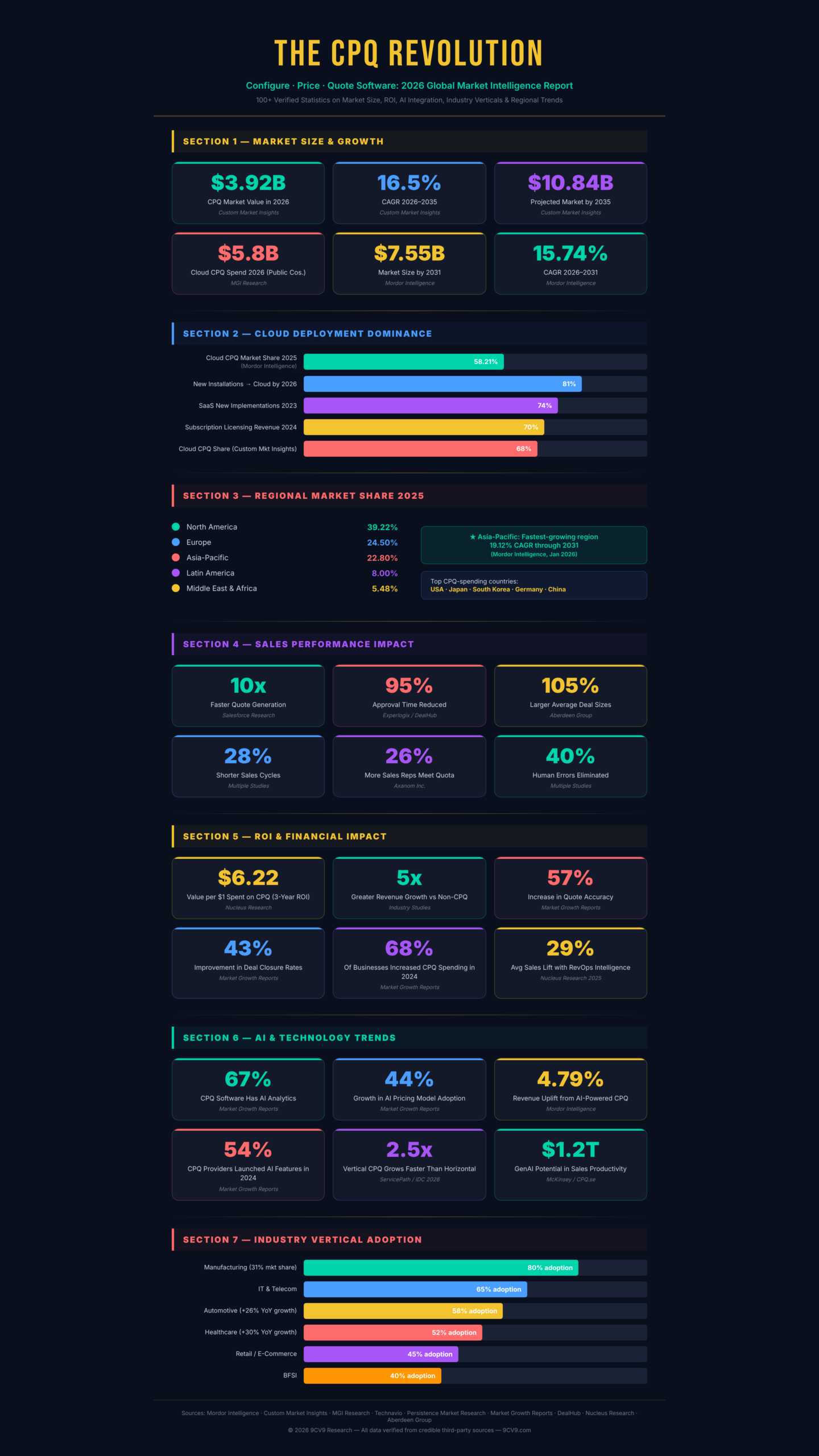
One of the strongest drivers behind CPQ adoption is the growing complexity of modern products and services. Today’s businesses often manage thousands of product configurations, multiple pricing structures, global sales operations, subscription offerings, usage-based billing models, and region-specific compliance requirements. Manual spreadsheets and traditional quoting processes struggle to keep pace with these demands. CPQ software addresses these challenges by automating product configuration, applying pricing rules in real time, generating accurate quotes, and ensuring compliance with company policies. This automation significantly reduces human errors, improves consistency, and empowers sales teams to focus on selling rather than administrative tasks.
The rise of cloud computing has further accelerated CPQ adoption worldwide. Cloud-based CPQ solutions now dominate the market and are expected to account for the vast majority of new deployments in 2026. Organizations increasingly favor Software-as-a-Service (SaaS) delivery models because they offer scalability, flexibility, faster implementation, lower upfront costs, seamless updates, and easier integrations with existing CRM, ERP, e-commerce, and customer success platforms. As digital transformation initiatives continue across industries, cloud-native CPQ solutions are becoming a foundational component of enterprise technology stacks.
Artificial intelligence is also reshaping the CPQ landscape. Modern CPQ platforms increasingly leverage AI-driven pricing recommendations, predictive analytics, intelligent discount management, revenue optimization algorithms, and automated upselling suggestions. These capabilities help organizations generate more profitable quotes while improving customer experiences through personalized recommendations and faster response times. As generative AI continues to mature, CPQ systems are expected to become even more autonomous, enabling conversational quote
Before we venture further into this article, we would like to share who we are and what we do.
About 9cv9
9cv9 is a business tech startup based in Singapore and Asia, with a strong presence all over the world.
With over nine years of startup and business experience, and being highly involved in connecting with thousands of companies and startups, the 9cv9 team has listed some important learning points in this overview of the 103 Configure Price Quote (CPQ) Software Statistics, Data & Trends in 2026.
If you like to get your company listed in our top B2B software reviews, check out our world-class 9cv9 Media and PR service and pricing plans here.
103 Configure Price Quote (CPQ) Software Statistics, Data & Trends in 2026
📊 Market Size & Growth
1. The global CPQ software market is valued at approximately USD 3.92 billion in 2026.
This milestone valuation confirms CPQ software has evolved from a niche sales tool into a mainstream enterprise technology investment, reflecting accelerating B2B digital transformation worldwide.
2. The CPQ market is projected to grow at a CAGR of 16.5% from 2026 to 2035, reaching USD 10.84 billion.
A double-digit compound annual growth rate over nearly a decade underscores sustained demand as companies of all sizes seek to automate complex sales processes and reduce revenue leakage.
3. Cloud CPQ spend among publicly traded companies is projected to reach nearly USD 5.8 billion in 2026, representing a 16% CAGR.
This figure, from MGI Research, captures only publicly listed firms — suggesting the true total market is substantially larger when private and SME adoption is included.
4. One estimate (Technavio) projects the global CPQ market reaching USD 11.3 billion by 2026 with a 13.2% CAGR.
While varying analyst methodologies produce different figures, even the most conservative projections indicate a robust, double-digit growth trajectory that far outpaces most enterprise software categories.
5. The CPQ market was valued at USD 3.14 billion in 2025 and is estimated to grow to USD 3.63 billion in 2026 (Mordor Intelligence).
Year-on-year growth of roughly 15% in absolute dollar terms illustrates strong momentum, with the market adding hundreds of millions in new spend annually.
6. The CPQ market is forecast to reach USD 7.55 billion by 2031 at a 15.74% CAGR (2026–2031).
This six-year horizon forecast from Mordor Intelligence gives enterprise buyers and investors confidence that CPQ is a durable investment rather than a passing trend.
7. The global CPQ market is expected to reach USD 8.9 billion by 2032, growing at a 15.7% CAGR from 2025.
Persistence Market Research’s forecast aligns closely with peer analysts, reinforcing consensus around mid-teens percentage growth through the early 2030s.
8. The CPQ market grew from USD 2.2 billion in 2022 and is projected to reach USD 7.3 billion by 2030.
This nearly 3.5x expansion over eight years reflects how digital selling motions, subscription economics, and AI-driven pricing are fundamentally reshaping the revenue operations landscape.
9. The CPQ Software Market was valued at USD 2.58 billion in 2024 (Verified Market Research).
This baseline provides important context for the rapid acceleration in spending observed in 2025–2026, with the market adding over USD 1 billion in value in just two years.
10. The CPQ market is projected to reach USD 7.96 billion by 2032 at a CAGR of 16.5% from 2026 (Verified Market Research).
Multiple independent research firms converging on similar growth rates strengthens conviction that the mid-teens CAGR is a reliable benchmark for strategic planning.
☁️ Cloud Deployment & Infrastructure
11. Cloud-based CPQ solutions captured 58.21% of CPQ market share in 2025 and are expanding at 18.86% CAGR through 2031.
Cloud dominance is driven by elastic scalability, automatic feature updates, and frictionless integration with modern CRM and ERP ecosystems — benefits that on-premise solutions simply cannot match.
12. Cloud CPQ deployments are projected to account for 81% of all new CPQ installations by 2026.
This near-total shift to cloud-native implementations signals the end of the on-premise-first era in CPQ, as security certifications mature and compliance concerns are resolved through sovereign cloud options.
13. Cloud-based CPQ is expected to account for approximately 59% of total CPQ market share in 2025 (Persistence Market Research).
Consistent cross-analyst data on cloud dominance reflects a fundamental structural shift in how enterprise software is procured, deployed, and maintained in the modern IT estate.
14. Approximately 68% of the CPQ market was held by cloud deployments in 2025 (Custom Market Insights).
Higher estimates from some analysts reflect broader definitions of “cloud” that include hybrid deployments, but the directional message is clear: cloud-first is now the standard.
15. Gartner forecasts that more than 60% of B2B sales organizations will be utilizing cloud CPQ in 2026.
Gartner’s endorsement of this tipping point carries significant weight — when the world’s leading IT research firm calls a majority adoption threshold, enterprise procurement teams take note.
16. The subscription-based licensing model for CPQ software accounts for nearly 70% of revenue in 2024.
Subscription licensing lowers the barrier to entry for smaller organizations and reduces upfront capex, fueling adoption acceleration particularly among growth-stage companies and SMEs.
17. The SaaS model dominated CPQ delivery, accounting for nearly 74% of all new CPQ software implementations globally in 2023.
The near-universal preference for SaaS CPQ reflects buyers’ desire for continuous product improvements, vendor-managed infrastructure, and the ability to scale seats without hardware investments.
🌍 Regional Breakdown
18. North America dominated the CPQ market with a 39.22% share in 2025 (Mordor Intelligence).
North America’s leadership is driven by the concentration of global technology vendors, deep enterprise software adoption culture, and mature integration ecosystems linking CPQ to CRM, ERP, and e-commerce platforms.
19. North America holds approximately 40% of global CPQ software market share in 2025 (Persistence Market Research).
Cross-analyst consensus on North American dominance reflects the region’s structural advantages: advanced cloud infrastructure, large enterprise software budgets, and headquarters of leading CPQ vendors like Salesforce and Oracle.
20. North America holds a 42.6% CPQ market share, driven by early tech adoption in manufacturing, IT, and telecom (Market Growth Reports).
The slight variance across analyst estimates stems from differing market scope definitions, but all agree North America commands the largest regional share by a considerable margin.
21. Asia-Pacific is the fastest-growing CPQ region, advancing at a 19.12% CAGR through 2031 (Mordor Intelligence).
Asia-Pacific’s outpaced growth is fueled by China’s manufacturing digitalization, India’s IT services expansion, and Southeast Asia’s cloud-first business environment — collectively creating the world’s fastest-growing CPQ demand center.
22. Asia-Pacific CPQ adoption is projected to grow at over 14% CAGR from 2025 to 2030 (Virtue Market Research).
Even conservative estimates for Asia-Pacific growth outstrip global averages, confirming the region’s emerging role as a primary driver of future CPQ market expansion.
23. Asia-Pacific CPQ market growth is forecasted to continue expanding by 14.2% between 2026 and 2035.
Sustained double-digit regional CAGR over a decade reflects deep structural tailwinds: rising manufacturing complexity, government digitalization programs, and rapid SME adoption of cloud-based sales tools.
24. Expansion into Asia-Pacific and Latin America accounted for 22% of global CPQ investment growth between 2023 and 2024.
Emerging markets are no longer footnotes in CPQ strategy — they represent a meaningful and growing share of incremental investment, particularly as localization and multi-currency features improve.
25. Top CPQ-spending countries include the US, Japan, South Korea, Germany, and China (MGI Research).
This geographic spread reflects CPQ’s particular strength in manufacturing-intensive economies, where complex product configurations and large sales teams create the highest ROI from automation.
26. The US accounts for 72.95% of Oracle CPQ customers globally (6sense, 2025).
Oracle’s customer concentration in the US reflects both the vendor’s headquarters advantage and the disproportionate enterprise software spending power of American corporations relative to other markets.
🏭 Industry Verticals
27. Manufacturing leads the CPQ software market with a 31% segment share in 2025.
Manufacturing’s dominance is logical: no other sector demands more complex product configurations, tighter pricing controls, and faster quote generation simultaneously — the three core competencies CPQ was built to address.
28. The manufacturing and IT sectors collectively contributed over 40% of CPQ market revenue in 2024.
These two sectors share a common challenge — highly configurable offerings with complex pricing structures — making CPQ an operational necessity rather than a discretionary investment.
29. Industrial machinery, automobile manufacturing, and technology hardware are the highest CPQ-spending industries (MGI Research).
The correlation between product complexity and CPQ spend is clear: industries where a single misconfigured quote can cost millions invest heavily in software that eliminates that risk.
30. Healthcare CPQ software saw a 30% year-over-year rise in demand in 2024.
Regulatory complexity, compliance requirements, and the life-critical nature of medical device configurations are driving healthcare organizations to adopt CPQ at an accelerating pace.
31. The automotive sector recorded a 26% increase in CPQ adoption in 2024 for configuring complex product bundles.
As automotive products evolve to include software-defined features, EV powertrains, and modular accessories, the configuration space has expanded dramatically — driving urgent demand for advanced CPQ capabilities.
32. The retail and e-commerce segment is the fastest-growing CPQ vertical, fueled by dynamic pricing needs.
Online retailers using CPQ for real-time pricing optimization and personalized product bundles report measurably higher conversion rates, creating a compelling ROI case that is accelerating sector-wide adoption.
33. Retailers using SAP CPQ have reported a 20% increase in online sales conversion rates.
This concrete conversion uplift demonstrates CPQ’s direct revenue impact in e-commerce contexts, where pricing accuracy and speed are directly correlated with cart completion and customer lifetime value.
34. In high-tech and manufacturing industries, CPQ adoption rates have reached up to 80% of businesses.
Sector adoption approaching saturation in leading verticals signals a maturation of the CPQ market in its strongest segments, as attention shifts to deepening integration and AI augmentation of existing deployments.
35. CPQ adoption rates in manufacturing are nearly double those in the services sector (Technavio).
This two-fold gap reflects the fundamental difference in configuration complexity: physical products with thousands of possible combinations require automated quoting support far more urgently than standardized service offerings.
🤖 AI & Technology Integration
36. Nearly 67% of CPQ software now incorporates AI-based analytics for better pricing strategies and quote accuracy.
AI integration has moved from differentiator to baseline expectation in competitive CPQ offerings — vendors without meaningful AI capabilities are increasingly viewed as legacy solutions by enterprise buyers.
37. Usage of predictive pricing models and intelligent upsell suggestions grew by 44% among mid-market SaaS vendors in 2024.
Mid-market adoption of AI-powered CPQ features is accelerating faster than enterprise adoption, suggesting that democratization of sophisticated pricing intelligence is well underway.
38. Generative AI could unlock an additional USD 1.2 trillion in sales and marketing productivity across industries.
This McKinsey-cited figure provides the macro context for CPQ’s AI investment wave — when AI can contribute trillions in productivity gains, the ROI case for AI-powered CPQ becomes straightforward.
39. AI-driven pricing strategies have delivered revenue uplifts of 4.79% for early adopters using AI-powered CPQ.
Nearly a 5% revenue uplift from AI pricing alone is a substantial return — for a mid-market company with USD 100 million in revenue, that translates to USD 4.79 million in incremental top-line growth.
40. Vertical CPQ solutions are growing 2.5x faster than horizontal platforms because they come pre-built with 80% of necessary rules and data models.
Industry-specific CPQ solutions dramatically reduce implementation time and risk by encoding domain expertise into the product — a compelling advantage over generic platforms requiring extensive customization.
41. About 54% of CPQ providers launched new AI-enhanced functionalities in 2024, including predictive analytics and intelligent discounting.
A majority of CPQ vendors now ship AI features as part of their core product, signaling an industry-wide inflection point where AI is no longer optional for competitive positioning.
42. Organizations integrating RevOps intelligence into their quoting process see a 29% average sales lift (Nucleus Research, 2025).
This nearly 30% sales improvement from revenue operations intelligence embedded in CPQ represents one of the highest ROI multipliers available to enterprise sales organizations today.
43. By 2028, quoting will be “automated, predictive, and conversational,” fundamentally changing how manufacturers sell.
This prediction from CPQ industry analysts reflects the trajectory toward agentic AI in CPQ — where quotes are generated autonomously based on buyer signals rather than triggered by sales rep actions.
44. SAP introduced a real-time, AI-driven pricing engine within its CPQ suite, improving quote accuracy by 29%.
SAP’s accuracy improvement demonstrates the concrete, measurable impact of AI integration on core CPQ functionality — accuracy improvements of this magnitude directly translate to fewer order corrections and higher customer satisfaction.
45. Salesforce launched a mobile-optimized CPQ platform with voice-activated commands, achieving 23% faster quote generation.
Voice-activated quoting represents the convergence of CPQ with conversational AI — enabling field sales teams to generate quotes hands-free during customer site visits.
📈 Sales Performance Impact
46. Sales reps take 73% more time to produce a quote without CPQ software.
This enormous productivity gap quantifies the hidden cost of spreadsheet-based quoting — a 73% time penalty on one of the most critical revenue-generating activities in the sales process.
47. Companies using CPQ software generate quotes 10x faster than those without it.
A tenfold acceleration in quote generation speed is transformational — it means a sales team can respond to ten opportunities in the time it previously took to respond to one, dramatically expanding addressable pipeline.
48. CPQ software reduces sales cycle lengths by an average of 28%.
Shortening the sales cycle by more than a quarter compresses time-to-revenue, improves sales rep capacity, and reduces the probability that deals are lost during extended evaluation periods.
49. CPQ approval times are reduced by up to 95% after implementation.
Eliminating virtually all approval bottlenecks is one of CPQ’s most transformative impacts — deals that previously languished for days awaiting discount approvals can close the same day the quote is generated.
50. Sales teams using CPQ experience a 30% faster onboarding process for new sales representatives.
Faster rep ramp time is a significant operational benefit that is often overlooked in CPQ ROI calculations — getting new hires to full productivity sooner has a compounding positive impact on revenue per head.
51. Only 34% of a salesperson’s time is actually spent selling; the rest is consumed by manual pricing and administrative tasks.
This sobering statistic reveals the scale of the opportunity: CPQ can redirect the majority of a sales rep’s wasted administrative time back to the high-value activities — prospecting, relationship-building, and closing — that actually generate revenue.
52. Companies using CPQ see 26% more sales representatives meet their quota compared to those without CPQ.
A quota attainment gap of 26 percentage points between CPQ and non-CPQ sales organizations represents an enormous competitive advantage — CPQ users are far more likely to hit their numbers consistently.
53. 67% of all sales reps fail to hit their quota without CPQ tools (Axanom Inc.).
A two-thirds quota failure rate in the absence of CPQ tools starkly illustrates how manual, error-prone quoting processes undermine sales performance — and why CPQ adoption is increasingly mission-critical.
54. The first vendor to respond to prospects wins 50% more deals.
CPQ’s ability to generate quotes in minutes rather than days directly addresses this response speed imperative — giving CPQ users a systematic advantage in competitive procurement situations.
55. Companies using CPQ experience 105% larger average deal sizes (Aberdeen Group research).
Doubling average deal size through CPQ-enabled upselling and cross-selling is the single most impactful financial benefit cited in CPQ research — representing a complete transformation of revenue productivity.
56. CPQ software increases quoting speed by up to 300%.
A 3x improvement in quoting speed means sales teams can handle significantly more pipeline volume with the same headcount — a force multiplier that scales revenue without proportional cost increases.
57. CPQ shortens time-spent waiting on approvals by up to 95%.
Nearly eliminating approval wait times removes one of the most common deal killers in complex B2B sales — giving competitors far less time to intervene while a quote is stuck in internal review.
🎯 Accuracy & Quality
58. CPQ software has been proven to eliminate 40% of human errors in pricing and configuration.
Eliminating 40% of errors means fewer costly corrections, reduced legal exposure from inaccurate contracts, and a meaningfully better customer experience — all with direct financial implications.
59. Companies implementing CPQ systems have reported a 57% increase in quote accuracy.
A 57% accuracy improvement is a fundamental shift in sales operations quality — it means the vast majority of quotes sent to customers are correct on the first attempt, reducing re-work and accelerating deal progression.
60. Watlow Electric Manufacturing reported 98% quote accuracy after deploying Infor CPQ.
A 98% accuracy rate represents near-perfect quoting performance — a benchmark that demonstrates what best-in-class CPQ implementation can achieve in a complex manufacturing environment.
61. CPQ reduces the number of quote revisions by 43% (Experlogix client data).
Fewer revisions mean faster deal cycles, lower administrative overhead, and improved customer confidence — buyers who receive consistent, accurate quotes develop greater trust in the vendor’s operational competence.
62. In manufacturing environments, CPQ has been shown to reduce quoting errors by up to 36%.
Error reduction in manufacturing is particularly high-stakes, where a misconfigured quote can result in products that cannot be built, leading to costly order cancellations and damaged customer relationships.
63. 78% of companies stated that CPQ software reduced quote turnaround times by more than 50% (2024 survey).
More than half of surveyed businesses confirming 50%+ reduction in turnaround time provides statistically robust evidence that CPQ delivers on its core promise of speed improvement across diverse industries.
64. CPQ software freed up 65% of sales team members’ time by allowing instant access to vendor inventories (ConnectWise research).
Freeing up nearly two-thirds of sales team time is a dramatic productivity win — it effectively gives companies the equivalent of additional sales headcount without any incremental hiring cost.
💰 ROI & Financial Impact
65. Companies implementing CPQ generate an average of USD 6.22 in value for every USD 1 spent over three years (Nucleus Research).
A 6.22x return on investment over three years places CPQ among the highest-ROI enterprise software categories — it compares favorably to most marketing technology, HR software, and business intelligence investments.
66. Best-in-class CPQ users report 5x greater year-over-year revenue growth than non-CPQ users.
A fivefold revenue growth differential is the defining competitive consequence of CPQ adoption at scale — it separates market leaders from laggards in CPQ-intensive industries.
67. Organizations that delay CPQ modernization face revenue leakage that erodes competitiveness (Nucleus Research 2025 CPQ Value Matrix).
Revenue leakage — the silent profit drain from pricing errors, unauthorized discounts, and missed upsell opportunities — is CPQ’s most compelling business case because it represents money already being lost, not hypothetical future gains.
68. Approximately 68% of businesses increased their CPQ spending in 2024, targeting upgrades in automation and AI integration.
A strong majority of existing CPQ customers are actively investing in platform improvements, reflecting high satisfaction with core capabilities and confidence in continued ROI from incremental feature adoption.
69. Over 30% of SMEs in emerging economies cite cost as the primary barrier to CPQ adoption.
While cost barriers are real, the growing availability of subscription-based, low-code CPQ solutions is systematically lowering the entry threshold — making enterprise-grade quoting automation accessible to businesses of all sizes.
70. Around 39% of enterprises report delays or added costs during CPQ implementation due to integration issues.
Integration complexity remains the most significant implementation risk for CPQ projects — organizations that invest in pre-planning their CRM/ERP integration architecture before procurement dramatically reduce this risk.
🏢 Enterprise Adoption & Market Dynamics
71. In 2023, approximately 85% of B2B organizations were integrating CPQ solutions into their sales operations.
B2B CPQ adoption approaching near-universality among larger organizations confirms that CPQ has crossed the chasm from early-adopter technology to mainstream enterprise infrastructure.
72. Roughly 58% of B2B companies now rely on CPQ tools to shorten quote turnaround times and reduce pricing errors.
A majority of B2B companies depending on CPQ for operational effectiveness illustrates how deeply embedded these tools have become in the fabric of modern B2B selling processes.
73. In 2024, about 79% of companies initiated digital sales transformation projects, with CPQ identified as critical in 63% of those initiatives.
CPQ’s prominence in nearly two-thirds of digital sales transformation programs confirms its position as a foundational technology — not a bolt-on addition — in enterprise revenue operations architecture.
74. Around 82% of high-growth organizations adopted advanced CPQ technologies in 2023 to streamline quote generation.
The near-universal CPQ adoption among high-growth companies reveals a key insight: CPQ adoption is both a cause and a consequence of growth — the tooling creates the conditions for accelerated scaling.
75. 43% improvement in deal closure rates was reported by companies implementing CPQ systems.
A 43% lift in deal closure rates is one of the most compelling commercial outcomes attributable to CPQ — it means sales teams are converting nearly half again as many opportunities into revenue-generating customers.
76. Mid-sized businesses represent an untapped market, with only 37% currently using advanced CPQ systems.
With 63% of mid-market companies still without advanced CPQ capabilities, the growth opportunity in this segment is enormous — and vendors offering simplified, low-code implementations are best positioned to capture it.
77. Over 60% of enterprises report product lines with over 1,000 distinct SKUs, driving CPQ demand.
The explosion of product complexity across industries is a structural tailwind for CPQ adoption — as SKU counts grow, the mathematical impossibility of manual quoting accuracy becomes increasingly apparent.
78. The 2026 Gartner Magic Quadrant for CPQ evaluates 16 vendors, with the top six controlling approximately 61% of enterprise deployments.
Market concentration at the top of the CPQ vendor landscape reflects the advantages of scale in AI development, integration capabilities, and global support infrastructure.
79. Over 40 key CPQ players operate globally, but the top six vendors control approximately 61% of enterprise-grade deployments.
While the CPQ market supports a diverse ecosystem of specialized vendors, enterprise procurement consistently consolidates around a handful of platform leaders capable of supporting global operations.
80. Salesforce CPQ leads the CPQ market with a 16.05% market share in the configure-price-quote category (6sense).
Salesforce’s CRM dominance provides a powerful distribution advantage for its CPQ product — the ability to add CPQ as a native extension of the world’s most widely deployed sales platform is a structural competitive moat.
📱 Mobile & Self-Service Trends
81. 49% of sales representatives demand mobile-supported CPQ software for remote and field operations.
Mobile CPQ has evolved from a nice-to-have to a genuine requirement for field sales teams — representatives who configure and quote from customer sites need full platform capability on their smartphones or tablets.
82. 48% of CPQ vendors optimized their platforms for smartphone and tablet access in 2024.
Near-parity between demand (49%) and vendor delivery (48%) of mobile CPQ capability confirms the market is responding rapidly to field sales requirements.
83. Mobile accessibility in CPQ solutions is rising, with 49% of sales representatives demanding mobile-supported platforms.
The convergence of remote work expectations, field sales workflows, and always-on buyer responsiveness requirements makes mobile CPQ a strategic necessity for sales organizations in virtually every industry.
84. LTIMindtree’s no-code CPQ offering attracted over 5,000 customers in its first three months after launch in March 2025.
This rapid no-code adoption validates strong latent demand among SMEs and business users who want CPQ capability without IT dependency — a segment historically underserved by complex enterprise platforms.
85. 53% of companies introduced real-time quoting functionalities in CPQ, reducing sales cycle duration by up to 35%.
Real-time quoting — generating accurate, binding quotes instantly during customer conversations — represents the ultimate CPQ capability, compressing the traditional multi-day quote cycle to zero.
🔗 Integration & Ecosystem
86. 76% of companies have fully integrated CPQ with CRM and ERP systems to drive unified sales operations.
Three-quarters of CPQ deployments operating as integrated systems rather than standalone tools reflects the industry’s maturation — CPQ’s full value is only realized when it flows seamlessly with the broader enterprise data ecosystem.
87. Around 27% of businesses require extensive customization to align CPQ platforms with existing sales workflows.
Customization requirements remain a friction point in CPQ implementations, highlighting the commercial opportunity for vendors offering industry-specific templates that reduce time-to-value.
88. Tacton’s Connect to Anything framework offers over 600 pre-built connectors, strengthening system integrator alliances.
The proliferation of pre-built connectors signals a maturing integration ecosystem — reducing implementation time from months to weeks for organizations deploying CPQ alongside common CRM and ERP platforms.
89. The hyperscaler cloud marketplace channel is growing at 20.58% CAGR, the fastest-growing CPQ sales channel.
AWS Marketplace, Microsoft Azure Marketplace, and Google Cloud Marketplace are transforming CPQ procurement — enabling buyers to acquire CPQ software through existing cloud consumption agreements, simplifying budgeting and vendor management.
90. Direct sales accounts for approximately 66–67% of CPQ revenue in 2025 but is being challenged by hyperscaler marketplaces.
The shift from direct sales to marketplace procurement represents a fundamental channel transformation — organizations are increasingly purchasing CPQ as part of broader cloud platform commitments rather than through standalone vendor negotiations.
91. ServiceNow acquired Logik.ai in April 2025 to embed AI-driven CPQ into its CRM and Industry Workflows portfolio.
This high-profile acquisition signals that the CPQ market’s center of gravity is shifting toward comprehensive revenue operations platforms — pure-play CPQ vendors face growing competitive pressure from platform giants.
🚀 Emerging Trends
92. Approximately 42% improvement in forecast accuracy is reported by organizations adopting multi-CRM CPQ architectures.
Better forecast accuracy has cascading benefits across finance, operations, and supply chain planning — making CPQ’s revenue intelligence capabilities increasingly valuable beyond the sales department itself.
93. Salesforce’s SteelBrick entered “End of Sale” in March 2025, creating a mandatory CPQ migration window for thousands of enterprises.
Legacy CPQ platform sunset creates both urgent challenge and significant opportunity — thousands of enterprises must modernize in 2026, driving a wave of CPQ replacement investments across the market.
94. CPQ software “search interest” peaked significantly in September 2025, suggesting growing organizational awareness and procurement activity.
Rising search interest is a leading indicator of market expansion — as more organizations become aware of CPQ capabilities, the pipeline of potential first-time buyers deepens significantly.
95. Advanced analytics in CPQ software, deployed by 48% of organizations, enable data-driven sales strategy improvements.
Nearly half of CPQ deployments now include advanced analytics capabilities — turning the quoting process from a transaction engine into a rich source of sales intelligence and buyer behavior insight.
96. 64% of customers preferred businesses that offered fully customized pricing and quoting options.
Buyer preference for personalized quoting experiences creates a powerful commercial incentive for CPQ adoption — organizations that cannot configure tailored offers risk losing deals to more responsive competitors.
97. CPQ solutions for the manufacturing sector saw 42% of new releases focused on complex, multi-layer product configuration in 2024.
The disproportionate investment in manufacturing-specific CPQ capabilities by software vendors reflects both the complexity of the use case and the willingness of manufacturers to pay premium pricing for specialized solutions.
98. About 35% of new CPQ software updates in 2024 emphasized GDPR and SOC 2 compliance enhancements.
Security and compliance investment in CPQ platforms is accelerating in response to stricter data governance requirements — particularly important as CPQ systems house sensitive customer, pricing, and contract data.
99. 30% of companies planned to adopt CPQ software by 2025, up from 25% in 2021 (Technavio).
The steady climb in planned adoption rates across four years confirms that CPQ is on an inexorable path toward universal adoption among B2B organizations selling complex products or services.
100. CPQ software reduces the risk of promising configurations a company cannot deliver, with accuracy improvements reaching up to 99% error reduction.
Near-total elimination of impossible configurations is perhaps CPQ’s most operationally critical capability — it protects companies from the reputational and financial damage of selling products they cannot fulfill.
101. Oracle CPQ has 7.03% market share in the configure-price-quote category with over 921 global enterprise customers in 2025 (6sense).
Oracle’s enterprise-focused positioning — with the majority of its CPQ customers at 10,000+ employee organizations — reflects its strength as a platform for the largest, most complex global deployments.
102. About 79% of companies prioritized CPQ deployment by end of 2024, driven by digital-first sales strategy imperatives.
The near-universal prioritization of CPQ in corporate digitalization roadmaps confirms that sales automation has become an executive-level strategic imperative, not merely an IT upgrade project.
103. CPQ-enabled companies experience a 17% boost in conversion rates due to speed and professionalism of quoting.
A 17% conversion lift from CPQ adoption means a company closing 100 deals per year would close 117 — a meaningful revenue uplift achievable without additional headcount or marketing spend.
Conclusion
As the 103 Configure, Price, Quote (CPQ) software statistics, data points, and trends presented throughout this report demonstrate, CPQ has firmly established itself as one of the most strategically important technologies in modern revenue operations. What was once viewed as a specialized tool for handling complex product configurations has evolved into a core component of enterprise sales infrastructure, helping organizations improve efficiency, increase profitability, accelerate growth, and deliver superior customer experiences. In 2026, CPQ is no longer merely a sales enablement solution—it has become a critical business platform that connects pricing strategy, product management, sales execution, customer engagement, and digital transformation initiatives.
The market’s impressive growth trajectory highlights the increasing importance of CPQ across industries worldwide. With global market valuations approaching USD 4 billion in 2026 and forecasts projecting expansion toward USD 8–11 billion over the coming decade, CPQ remains one of the fastest-growing segments within enterprise software. The consistency of these forecasts across multiple research firms demonstrates strong market confidence and reflects the growing recognition that manual quoting processes can no longer support the speed, complexity, and scale required by modern businesses.
Cloud adoption continues to reshape the CPQ landscape and serves as one of the strongest indicators of future market growth. The overwhelming majority of new deployments are now cloud-based, while SaaS delivery models dominate new implementations globally. This shift reflects broader enterprise priorities around scalability, flexibility, cost optimization, remote accessibility, and seamless integration. As organizations continue modernizing their technology stacks, cloud-native CPQ solutions are becoming foundational elements of digital sales ecosystems that support both global enterprises and rapidly growing mid-market businesses.
Artificial intelligence represents perhaps the most transformative force influencing the future of CPQ software. The growing adoption of AI-powered pricing recommendations, predictive analytics, intelligent discounting, upselling engines, and revenue optimization capabilities signals a major evolution in how organizations approach selling. Rather than simply automating quote creation, modern CPQ platforms are increasingly helping businesses make smarter decisions, identify revenue opportunities, and improve profitability. The emergence of generative AI and conversational selling technologies suggests that future CPQ systems will become even more autonomous, predictive, and personalized, fundamentally changing how organizations engage customers and manage revenue generation.
The statistics also reveal the substantial operational benefits that organizations can achieve through successful CPQ implementation. Faster quote generation, shorter sales cycles, higher quote accuracy, reduced approval bottlenecks, increased quota attainment, improved onboarding efficiency, and enhanced customer satisfaction collectively contribute to stronger business performance. For many organizations, CPQ adoption delivers measurable improvements across multiple dimensions simultaneously, creating compounding benefits that extend well beyond the sales department. These improvements translate into greater competitiveness, increased revenue opportunities, and stronger customer relationships.
Financial performance data further reinforces the strategic value of CPQ investments. Companies utilizing CPQ solutions consistently report higher conversion rates, larger deal sizes, stronger revenue growth, and impressive return on investment metrics. The ability to generate significant business value for every dollar invested positions CPQ among the highest-impact enterprise software categories available today. In an environment where organizations face increasing pressure to maximize efficiency and drive predictable revenue growth, these financial outcomes make a compelling case for continued CPQ adoption and modernization efforts.
Industry-specific trends illustrate how CPQ is adapting to the unique needs of different sectors. Manufacturing remains the dominant vertical due to its highly configurable products and complex pricing requirements, but adoption is expanding rapidly across healthcare, retail, e-commerce, automotive, telecommunications, and software industries. This diversification demonstrates the growing versatility of CPQ platforms and their ability to address a broad range of business challenges. As product portfolios become more sophisticated and customer expectations continue to rise, demand for advanced configuration and pricing capabilities will likely expand into even more sectors.
Regional market developments provide additional evidence of CPQ’s global momentum. While North America continues to lead in overall market share and enterprise adoption, Asia-Pacific’s rapid growth signals a major shift in future demand patterns. Increasing digitalization, expanding manufacturing capabilities, cloud adoption, and growing investment in sales technology across Asia are creating substantial opportunities for vendors and buyers alike. Emerging markets are expected to contribute an increasingly significant share of future CPQ growth as businesses modernize their commercial operations and embrace digital transformation initiatives.
Another key takeaway from the data is the growing importance of ecosystem integration. Modern CPQ solutions no longer operate as standalone applications. Instead, they function as interconnected components within broader CRM, ERP, billing, contract management, e-commerce, and customer success ecosystems. Organizations that successfully integrate CPQ with their existing technology environments are often able to unlock significantly greater value, improve operational visibility, reduce friction across departments, and create a more seamless customer journey from initial engagement through contract execution and renewal.
Looking ahead, several themes are likely to define the next phase of CPQ evolution. Artificial intelligence will continue to drive innovation. Industry-specific solutions will gain traction as organizations seek faster implementation and greater specialization. Self-service quoting and digital commerce capabilities will become increasingly important as buyers demand more control over purchasing processes. Mobile-first experiences will continue expanding as sales teams operate in increasingly distributed environments. At the same time, compliance, governance, cybersecurity, and data privacy will remain critical priorities as CPQ systems manage larger volumes of sensitive pricing and customer information.
Ultimately, the statistics presented throughout this report point toward a clear conclusion: CPQ software has become an essential strategic investment for organizations seeking to thrive in a digital-first economy. Businesses that continue relying on manual quoting processes, disconnected systems, and outdated pricing methodologies risk falling behind competitors that leverage automation, artificial intelligence, and integrated revenue operations platforms. As sales environments become more complex and customer expectations continue to evolve, CPQ will play an increasingly central role in helping organizations improve efficiency, accelerate growth, and maximize profitability.
For business leaders, technology decision-makers, investors, sales executives, and revenue operations professionals, these 103 Configure, Price, Quote (CPQ) software statistics and trends offer valuable insight into the future of modern selling. The evidence is overwhelming: CPQ is no longer a niche technology category. It is rapidly becoming a cornerstone of enterprise growth strategies, digital transformation initiatives, and next-generation revenue operations. Organizations that understand and embrace this shift will be best positioned to compete, innovate, and grow in the years ahead.
If you find this article useful, why not share it with your hiring manager and C-level suite friends and also leave a nice comment below?
We, at the 9cv9 Research Team, strive to bring the latest and most meaningful data, guides, and statistics to your doorstep.
To get access to top-quality guides, click over to 9cv9 Blog.
To hire top talents using our modern AI-powered recruitment agency, find out more at 9cv9 Modern AI-Powered Recruitment Agency.
People Also Ask
What is Configure, Price, Quote (CPQ) software?
CPQ software automates product configuration, pricing calculations, discount management, and quote generation, helping sales teams create accurate proposals faster and with fewer errors.
How large is the CPQ software market in 2026?
The global CPQ software market is valued at approximately USD 3.92 billion in 2026 and is expected to continue growing rapidly over the next decade.
What is driving CPQ market growth?
Key growth drivers include digital transformation, cloud adoption, AI-powered sales automation, complex product offerings, and increasing demand for faster quoting processes.
What is the projected growth rate of the CPQ market?
Most industry forecasts estimate the CPQ market will grow at a CAGR of around 15% to 17% through the early 2030s.
Why are businesses investing in CPQ software?
Businesses invest in CPQ software to improve sales efficiency, reduce pricing errors, shorten sales cycles, increase revenue, and improve customer experiences.
Which industries use CPQ software the most?
Manufacturing, technology, telecommunications, healthcare, automotive, and retail industries are among the largest users of CPQ software.
Why is manufacturing a major CPQ adopter?
Manufacturers often sell highly configurable products with complex pricing structures, making CPQ essential for accurate quoting and product configuration.
What percentage of CPQ deployments are cloud-based?
Cloud-based CPQ solutions account for the majority of new deployments and represent more than half of the global CPQ market.
Why is cloud CPQ becoming more popular?
Cloud CPQ offers scalability, lower infrastructure costs, faster updates, remote accessibility, and easier integration with business systems.
How does CPQ improve sales productivity?
CPQ automates manual quoting tasks, allowing sales representatives to spend more time selling and less time managing administrative processes.
How much faster can CPQ generate quotes?
Studies show CPQ can generate quotes up to 10 times faster than traditional manual quoting methods.
Does CPQ help reduce sales cycle length?
Yes. Many organizations report average sales cycle reductions of around 28% after implementing CPQ software.
How does CPQ improve quote accuracy?
CPQ uses predefined rules and automated validation to eliminate configuration mistakes and pricing inconsistencies.
Can CPQ reduce pricing errors?
Yes. CPQ solutions can reduce pricing and configuration errors significantly, helping businesses avoid costly mistakes.
How does CPQ support revenue growth?
CPQ improves conversion rates, accelerates deal closure, enables upselling opportunities, and helps optimize pricing strategies.
What role does artificial intelligence play in CPQ?
AI helps automate pricing decisions, predict customer behavior, recommend products, identify upsell opportunities, and improve quote accuracy.
Are AI-powered CPQ solutions becoming common?
Yes. Many leading CPQ vendors now offer AI-driven analytics, predictive pricing, intelligent discounting, and automated recommendations.
Can CPQ improve customer experience?
Yes. Faster and more accurate quotes help customers receive timely proposals and improve overall buying experiences.
What is the ROI of CPQ software?
Research indicates organizations can generate several dollars in business value for every dollar invested in CPQ technology.
How does CPQ help with discount management?
CPQ enforces pricing rules and approval workflows to prevent excessive discounting and protect profit margins.
Which region leads the CPQ software market?
North America currently holds the largest share of the global CPQ software market due to strong enterprise technology adoption.
Which region is growing fastest in CPQ adoption?
Asia-Pacific is the fastest-growing CPQ market, driven by digital transformation and increased investment in sales technologies.
How does CPQ integrate with CRM systems?
CPQ connects directly with CRM platforms to automate data sharing, streamline workflows, and improve sales visibility.
Can CPQ integrate with ERP systems?
Yes. Most enterprise CPQ platforms integrate with ERP systems to synchronize pricing, inventory, product, and order data.
Is CPQ suitable for small and medium-sized businesses?
Yes. Modern cloud-based CPQ solutions make advanced quoting and pricing capabilities accessible to SMEs at lower costs.
How does CPQ support subscription-based businesses?
CPQ helps manage recurring billing models, subscription pricing, contract renewals, and complex service bundles.
What are the biggest challenges in CPQ implementation?
Common challenges include system integration complexity, data quality issues, workflow customization, and change management.
Can CPQ improve sales forecasting accuracy?
Yes. CPQ provides structured pricing and quote data that helps organizations generate more accurate revenue forecasts.
What are the biggest CPQ trends in 2026?
Major trends include AI-powered automation, cloud-first deployments, mobile quoting, self-service configuration, and deeper CRM and ERP integrations.
What is the future outlook for the CPQ software market?
The outlook remains highly positive, with strong growth expected as businesses increasingly adopt AI, automation, and digital sales technologies to improve revenue operations.
Sources
Custom Market Insights Mordor Intelligence Technavio MGI Research Persistence Market Research Market Growth Reports Verified Market Research Virtue Market Research ServicePath Accio DealHub Valorx LLCBuddy Pinkus Partners CPQ Integrations CPQ.se PROS Elixir Solutions Cincom Pierce Washington ConnectWise NetSuite Oracle Business Research Insights 6sense Experlogix ResearchGate IJRCAIT Research and Markets