
Key Takeaways
- Hungary’s Labour Market in 2026: Hungary recorded approximately 4.62 million employed workers and a 4.9% unemployment rate in early 2026, highlighting emerging hiring challenges and workforce imbalances.
- Rising Salaries and Skills Shortages: Average gross monthly wages reached HUF 840,600 in January 2026, while persistent talent shortages in IT, engineering, healthcare, and manufacturing intensified recruitment competition.
- Foreign Investment and Future Hiring Trends: Major investments in electric vehicles, battery manufacturing, and technology are creating new employment opportunities, while demographic pressures and digital transformation reshape Hungary’s recruitment outlook.
Hungary’s recruitment market in 2026 reflects rising salaries, persistent skills shortages, and changing employment trends. With approximately 4.62 million employed workers, a 4.9% unemployment rate, and growing demand for skilled professionals, employers must adapt their hiring strategies. Explore 105 recruitment statistics covering wages, job vacancies, workforce demographics, and future employment opportunities.
Hungary’s recruitment and employment landscape in 2026 is undergoing significant transformation, driven by evolving labour market conditions, rising wages, persistent skills shortages, foreign direct investment, and rapid technological advancements. As one of Central Europe’s important manufacturing and business hubs, Hungary continues to attract multinational corporations, particularly in the automotive, electric vehicle, battery manufacturing, and information technology sectors. However, despite its relatively high employment rates and competitive labour costs, the country faces growing challenges in talent acquisition, workforce availability, demographic changes, and recruitment efficiency.


Understanding the latest recruitment statistics in Hungary in 2026 is essential for employers, HR professionals, recruitment agencies, business leaders, investors, and job seekers navigating this increasingly complex labour market. From unemployment rates and salary benchmarks to hiring trends, workforce shortages, and international recruitment policies, reliable labour market data provides valuable insights into the opportunities and challenges shaping Hungary’s employment outlook.
Hungary’s Labour Market in 2026: High Employment Amid Emerging Challenges
Hungary entered 2026 with a historically strong employment foundation, although signs of labour market weakness have become increasingly apparent. According to the available employment statistics, the country’s unemployment rate reached 4.9% during December 2025–February 2026, representing its highest reading since the April–June 2016 period. Approximately 235,700 people were unemployed, an increase of 11,900 compared with the previous year.

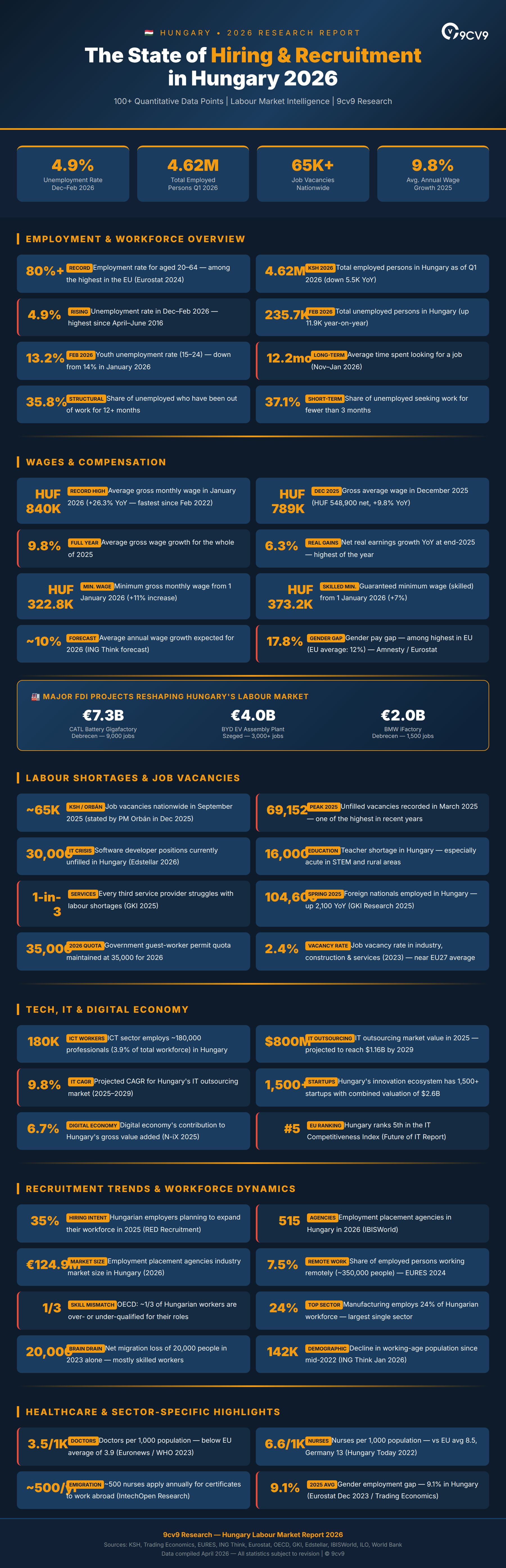
Meanwhile, Hungary’s total employed population stood at approximately 4.62 million workers in early 2026. Although this figure reflects substantial labour market participation, employment declined slightly year-on-year, highlighting the impact of weaker economic activity, structural workforce imbalances, and changing employer demand.
The country’s employment rate among people aged 15–64 reached 75.1% in 2024, reflecting decades of improvements in workforce participation. Nevertheless, high employment levels have created challenges for businesses seeking qualified candidates, particularly in specialised occupations where the available talent pool remains limited.
Youth employment also presents important considerations. Hungary’s youth unemployment rate stood at approximately 13.2% in February 2026, while substantial regional differences continue to affect employment opportunities. For example, the proportion of young people not in employment, education, or training was approximately 5% in Budapest in 2024, compared with 20.8% in Northern Hungary.
These figures illustrate an important characteristic of Hungary’s recruitment market: high overall employment does not necessarily translate into an adequate supply of qualified workers across industries and regions.
Rising Salaries and Wage Growth Are Reshaping Recruitment Strategies
Salary trends represent another major factor influencing recruitment and talent retention in Hungary.
Hungarian employers have experienced sustained wage growth, driven by inflationary pressures, competition for skilled professionals, minimum wage adjustments, and government compensation policies.
In January 2026, Hungary’s average gross monthly wage reached approximately HUF 840,600, representing a substantial 26.3% year-on-year increase. This exceptional rise was influenced heavily by public-sector compensation developments, rather than uniform wage increases across the economy.
By February 2026, average gross monthly earnings had moderated to approximately HUF 725,540, demonstrating the importance of distinguishing temporary compensation effects from underlying salary trends.
The country’s statutory minimum gross monthly wage also increased to HUF 322,800 from January 2026, representing an 11% increase from the previous year. Meanwhile, the guaranteed minimum wage for qualifying skilled positions rose to HUF 373,200.
For recruiters and employers, these developments have important implications for salary benchmarking, recruitment budgets, employee retention, and compensation competitiveness.
Businesses operating in Hungary must increasingly balance the need to attract qualified professionals with rising employment costs, particularly in technology, engineering, manufacturing, and specialised professional services.
Skills Shortages Continue to Challenge Hungarian Employers
Despite an expanding pool of job seekers, talent shortages remain among the most significant recruitment challenges facing Hungary in 2026.
Labour market figures indicate that Hungary recorded approximately 65,000 unfilled positions in September 2025, reflecting continued demand for workers across several major industries.
Skills shortages are particularly evident in information technology, education, healthcare, manufacturing, construction, and engineering.
Some industry estimates suggest that Hungary faces shortages of approximately 30,000 software developers and 16,000 teachers, although these figures should be interpreted as sector-specific estimates rather than directly comparable official vacancy counts.
Research also indicates that approximately one-third of service-sector employers, one-quarter of construction companies, and one-fifth of industrial businesses experience serious difficulties recruiting suitable employees.
These shortages are compounded by demographic pressures. Hungary’s working-age population declined by approximately 142,000 people between mid-2022 and early 2026, placing additional pressure on the country’s long-term labour supply.
For recruitment agencies and HR departments, these trends reinforce the importance of proactive talent sourcing, employee upskilling, workforce planning, employer branding, and effective retention strategies.
Foreign Investment and Technology Are Creating New Recruitment Opportunities
Foreign direct investment continues to influence Hungary’s employment landscape, particularly in automotive manufacturing, electric vehicles, battery production, and advanced industrial technologies.
Major international manufacturers, including CATL, BMW, BYD, Mercedes-Benz, and EVE Energy, have announced or undertaken substantial investments in Hungarian production facilities.
CATL’s approximately €7.3 billion battery manufacturing investment in Debrecen, for example, is expected to support thousands of jobs as production capacity expands. BMW’s approximately €2 billion investment in Debrecen also highlights Hungary’s growing importance within Europe’s electric vehicle manufacturing ecosystem.
These developments are expected to generate recruitment demand for engineers, production specialists, maintenance technicians, supply chain professionals, logistics personnel, and technical managers.
At the same time, Hungary’s digital economy is creating additional opportunities in software development, cybersecurity, cloud computing, artificial intelligence, and IT outsourcing.
Industry estimates place Hungary’s IT outsourcing market revenue at approximately US$800 million in 2025, with further expansion projected over the following years.
However, growing investment does not automatically guarantee immediate employment growth. Recruitment outcomes will depend on production schedules, business conditions, workforce availability, and the ability of employers to secure appropriately qualified talent.
International Recruitment, Demographics, and Regional Differences
Hungary’s recruitment landscape is also shaped by immigration policies, international labour mobility, and substantial differences between regional employment markets.
The government maintained an annual guest worker permit quota of 35,000 for 2026, compared with 65,000 in 2024. These restrictions influence how employers approach international recruitment, particularly in labour-intensive industries facing domestic workforce shortages.
Foreign workers nevertheless remain an important part of Hungary’s employment ecosystem, especially in manufacturing, construction, logistics, and other industries requiring additional labour capacity.
Regional differences further complicate recruitment strategies.
Budapest continues to function as Hungary’s primary centre for professional employment, technology, financial services, and highly skilled occupations. According to regional labour market data, approximately 64.1% of jobs in Budapest are classified as high-skill positions, substantially exceeding the OECD regional benchmark of 44%.
Outside the capital, cities such as Debrecen, Szeged, and Kecskemét are becoming increasingly important recruitment markets because of industrial investments and expanding manufacturing operations.
Consequently, employers must account for differences in regional salary expectations, candidate availability, occupational specialisation, and workforce mobility when developing hiring strategies.
Why These 105 Hungary Recruitment Statistics Matter in 2026
As Hungary navigates economic uncertainty, technological transformation, demographic pressures, and changing workforce expectations, access to comprehensive recruitment data has become increasingly important.
For employers, understanding current hiring statistics can support better workforce planning, salary benchmarking, talent acquisition strategies, and employee retention decisions.
For recruitment agencies, these insights help identify industries experiencing talent shortages, emerging employment opportunities, and changes in candidate supply and demand.
For job seekers, Hungary’s employment statistics provide valuable information about salary expectations, in-demand occupations, regional career opportunities, and the skills required to remain competitive.
For international businesses and investors, labour market data offers an essential foundation for evaluating recruitment costs, workforce availability, business expansion opportunities, and long-term operational sustainability.
This comprehensive guide to the Top 105 Recruitment Statistics, Data & Trends in Hungary in 2026 examines the country’s employment landscape through 105 quantitative indicators covering unemployment, labour force participation, salaries, wage growth, job vacancies, skills shortages, foreign investment, technology employment, immigration, healthcare recruitment, demographic changes, and regional workforce trends.
Drawing on statistics and research associated with organisations such as the Hungarian Central Statistical Office (KSH), Eurostat, OECD, World Bank, EURES, and industry research providers, the article combines recent labour market observations with historical comparisons and forward-looking estimates.
Whether you are an HR manager seeking to optimise recruitment performance, a business owner planning workforce expansion, a recruitment consultant identifying emerging hiring opportunities, or a professional exploring employment prospects, these 105 Hungary recruitment statistics for 2026 provide a data-driven foundation for understanding the country’s evolving job market and making more informed hiring and career decisions.
Before we venture further into this article, we would like to share who we are and what we do.
About 9cv9
9cv9 is a business tech startup based in Singapore and in Asia, with a strong presence all over the world.
With over ten years of startup and business experience, and being highly involved in connecting with thousands of companies and startups, the 9cv9 team has access to some of the best talents in the world.
If your company needs recruitment and headhunting services to hire top-quality employees, you can use 9cv9 headhunting and recruitment services to hire top talents and candidates. Email us at hello@9cv9.com.
Top 105 Recruitment Statistics, Data & Trends in Hungary in 2026
🔢 EMPLOYMENT & LABOUR FORCE
- 4.9% — Hungary’s unemployment rate in December–February 2026, the highest reading since the April–June 2016 period. This uptick signals a modest but concerning reversal after years of near-full employment, driven partly by weak economic demand.
- 4.62 million — Total employed persons in Hungary as of early 2026. Despite this near-record figure, the slight year-on-year decline underscores underlying structural vulnerabilities in the labour market.
- 235,700 — Number of unemployed individuals in Hungary in December–February 2026, up 11,900 year-on-year. The rise reflects both cyclical weakness and structural mismatches between job-seekers’ skills and employer needs.
- 4.6% — Unemployment rate in November–January 2026, up from 4.3% a year earlier, marking the highest since August–October 2025. The acceleration highlights an emerging trend of labour market softening heading into 2026.
- 4.8% — Male unemployment rate in December–February 2026 (125,000 unemployed men), marginally higher than the female rate. Male-dominated sectors such as manufacturing and construction face heightened cyclical volatility.
- 4.9% — Female unemployment rate in December–February 2026 (111,000 unemployed women), slightly exceeding the male rate for the first time in recent periods. This reflects the impact of seasonal job losses in care and services.
- 12.2 months — Average duration of job search in November–January 2026. Prolonged unemployment spells indicate structural mismatch rather than simple cyclical joblessness, complicating policy responses.
- 35.8% — Share of unemployed persons who had been out of work for 12 months or more (Nov–Jan 2026). This long-term unemployment share is a persistent structural concern for social inclusion.
- 37.1% — Share of unemployed who had been seeking work for fewer than 3 months (Nov–Jan 2026). The relatively high short-term entry suggests ongoing labour market churn alongside structural long-term unemployment.
- 80%+ — Employment rate for the 20–64 age group in Hungary in 2024, among the highest in the EU and well above the 75% EU27 average. This near-full-employment status masks acute skills shortages in key industries.
- 75.1% — Hungary’s employment rate in 2024 (ages 15–64), a record high and one of the top performers among EU member states. The 20-percentage-point gain since 2000 is one of Europe’s most dramatic labour market turnarounds.
- 65.03% — Employment rate in November 2025, slightly below October’s 65.17%, indicating modest seasonal moderation heading into winter. The rate remains structurally elevated by historical standards.
- 4.4% — Unemployment rate in October–December 2025, unchanged from the same period in 2024. The stability at 4.4% during H2 2025 reflected continued labour market tightness despite economic stagnation.
- 2.453 million — Male employed persons in early 2026. Employment among men fell by 34,000 year-on-year, partially reflecting reduced capacity in industrial and manufacturing operations.
- 2.169 million — Female employed persons in early 2026. Employment among women declined by 32,000 year-on-year, reflecting the impact of public sector adjustments and seasonal contractions.
- 20%+ — Growth in Hungary’s employment rate (ages 20–64) between 2010 and 2024, one of the most dynamic employment expansions in Europe over that period (EURES).
- 14.2% — Youth unemployment rate (ages 15–24) for 2025 on an annual basis (World Bank / FRED). Despite a headline decline, youth labour market participation remains constrained by education-to-work transition challenges.
- 13.2% — Youth unemployment rate in February 2026, down from 14% in January — a positive but fragile improvement for a demographic acutely sensitive to economic cycles.
- 5% — Youth NEET (Not in Employment, Education or Training) rate in Budapest in 2024, the lowest in Hungary, compared to 20.8% in Northern Hungary, illustrating extreme regional disparities (OECD 2024).
- 13% — Average regional youth NEET rate across Hungary’s 8 regions in 2024, compared to an OECD benchmark of 16.8%, placing Hungary broadly on par with developed-country peers.
💰 WAGES & COMPENSATION
- HUF 840,600 (€2,212) — Record average gross monthly wage in January 2026, surging 26.3% year-on-year — the fastest growth pace since February 2022, driven by a 99% spike in the public sector.
- HUF 789,200 (€2,077) — Average gross wage in December 2025, up 8.5% year-on-year, representing a new monthly high at that time before the January 2026 surge (KSH, Feb 2026).
- HUF 548,900 — Average net wage in December 2025, up 9.8% year-on-year. Net wages rising faster than gross is partly attributable to expanded family tax credits introduced in mid-2025.
- 9.8% — Full-year 2025 average annual wage growth, sustained at around 9% throughout the year across most sectors (KSH, March 2026). This represents the continuation of a multi-year trend of above-inflation compensation gains.
- ~10% — Projected average annual wage growth in 2026 according to ING Think. Structural labour shortages, minimum wage hikes, and armed forces bonuses are key drivers for this elevated forecast.
- 6.3% — Net real earnings growth year-on-year by end of 2025, the highest of the year, confirming that wages were growing faster than consumer prices (ING Think, Jan 2026).
- 4.4% — Full-year 2025 real wage growth (net, adjusted for inflation), meaning the average Hungarian worker could afford ~4–5% more goods and services than the previous year (ING Think).
- HUF 322,800 — Minimum gross monthly wage effective 1 January 2026, an 11% increase from the previous HUF 290,800. This hike is one of the largest among EU countries and is expected to lift wages across the lower income distribution.
- HUF 373,200 — Guaranteed minimum wage for skilled workers from 1 January 2026, up 7% from HUF 348,800. This skilled-tier minimum applies to positions requiring at least a secondary diploma or vocational qualification.
- 66% — Total nominal increase in Hungary’s minimum wage over the past 5 years (Wage.is, Feb 2026). This compresses the gap with Western European wages but also increases cost pressures on employers.
- HUF 600,000 / HUF 417,900 — Median gross and net wages respectively in November 2025, rising 10.1% and 10.5% year-on-year, confirming that mid-distribution earners benefited strongly from the 2025 wage cycle.
- 7.8% — Private sector wage growth in January 2026, the most up-to-date reading for the largest employment segment. While solid, it trailed the public sector’s extraordinary 99% gain for the same period.
- 9.4% — Non-profit sector wage growth in January 2026, sustaining the elevated growth trajectory seen across the non-profit space throughout 2025 (KSH / Trading Economics).
- HUF 725,540 — Average gross wage in February 2026, declining from January’s record of HUF 840,570 as the extraordinary public-sector bonus effect receded (Trading Economics, April 2026).
- €620,000 / ~$1,884 USD — Average gross monthly salary in February 2026, per Wage.is. Hungary remains significantly below Western European salaries but has been closing the gap rapidly.
- 17.8% — Hungary’s gender pay gap — among the highest in the EU, far above the 12% EU average (Amnesty International / Eurostat 2025). Women in Hungary must work approximately 15.5 months to earn what men earn in a year.
🏗️ LABOUR SHORTAGES & JOB VACANCIES
- ~65,000 — Job vacancies nationwide in September 2025, cited directly by Prime Minister Viktor Orbán in December 2025. This figure has remained near historically elevated levels despite a slight easing from the 2022 peak.
- 69,152 — Unfilled vacancies recorded in March 2025, one of the highest figures in recent years (9cv9 Research / KSH). The mismatch between vacancies and unemployed persons underscores deep structural talent gaps.
- 65,000 — Average number of unfilled positions across all of 2024: 39,000 in the private sector, 24,000 in the public sector, and 2,000 in other categories (GKI Research, July 2025).
- ~70,110 — Total job vacancies recorded in Hungary according to recent reports, reflecting persistent demand for skilled workers in both tech and non-tech sectors (Edstellar 2026).
- 30,000 — Unfilled software developer positions in Hungary, reflecting a critical IT talent shortage that constrains Hungary’s ambitions as a digital outsourcing hub (Edstellar 2026).
- 16,000 — Teacher shortage in Hungary’s education sector, particularly acute in STEM disciplines and rural areas. An ageing teaching workforce compounds the challenge of new talent entering the profession.
- 1 in 3 — Share of service providers that face serious labour shortages in Hungary. Every third services company, every fourth construction firm, and every fifth industrial employer struggle to fill open roles (GKI 2025).
- 104,600 — Foreign nationals employed in Hungary in spring 2025, an increase of 2,100 year-on-year. These workers — roughly 2% of total employment — are concentrated in industry, construction, and logistics.
- 35,000 — Guest worker permit quota maintained for 2026, the same as 2025, having been halved from 65,000 in 2024. The government insists on strict prioritisation of Hungarian workers for all open positions.
- 2.4% — Job vacancy rate in Hungary’s industry, construction, and services sectors in 2023, nearly matching the EU27 average and suggesting tight labour conditions across the productive economy (EURES).
- 27% — Proportion of mismatched workforce in Northern Hungary (workers in roles not matching their skill level). This compares to 19% in Transdanubia and a national OECD estimate of ~23% overall mismatch (OECD / Edstellar).
- 35% — Share of Hungarian workers exposed to field-of-study mismatches, according to OECD estimates. This adds an extra dimension of workforce inefficiency beyond just over- or under-qualification (IZA World of Labour 2025).
- 142,000 — Decline in Hungary’s working-age population since mid-2022. The equivalent of Hungary’s fifth-largest city has been lost from the potential labour pool, intensifying all sectoral shortages (ING Think 2026).
- 42,000 — Increase in the number of unemployed since mid-2022, even as the working-age population fell by 142,000 — a paradox illustrating that workforce exit (inactivity) is the dominant trend, not re-employment.
🏭 INDUSTRY & FDI IMPACT ON HIRING
- €7.3 billion — CATL’s total investment in its Debrecen battery gigafactory — Hungary’s single largest foreign investment in history. The plant entered production in early 2026 with capacity fully pre-booked.
- 9,000 jobs — Total employment expected at CATL’s Debrecen plant at full operational capacity across all three phases. The ramp to 3,000 employees by 2026 (Phase 1) is already underway.
- 1,500 — CATL’s Debrecen workforce target for Q1 2026, as the plant initiates early production runs and localised supplier engagement (Carbon Credits, Dec 2025).
- €4.0 billion — BYD’s investment in its passenger car assembly plant in Szeged — its first European car factory, covering 300 hectares with an initial 2026 output of tens of thousands of EVs.
- €2.0 billion — BMW’s iFactory investment in Debrecen, with 150,000-vehicle annual capacity on the “Neue Klasse” EV platform. BMW calls it “the most advanced plant in the world” (JE Bridge 2025).
- €1.0 billion — Mercedes-Benz’s EV line expansion investment in its Kecskemét facility. The existing plant employs ~4,500 and the investment preserves and modernises that workforce.
- 4,000+ — Direct jobs expected from CATL’s Spanish gigafactory project, with thousands of additional indirect positions expected in supplier networks across Southern Europe (Carbon Credits 2025).
- €4.1 billion — CATL’s Spanish gigafactory investment, alongside the Hungarian plant, deepening the company’s dual-hub European battery manufacturing strategy for major OEMs.
- €16 billion — Total value of large-scale Chinese investment projects underway in Hungary as of 2025, spanning 64 major projects — the largest concentration of Chinese FDI in Europe (JE Bridge 2025).
- 31% — Share of Chinese outbound FDI to Europe that went to Hungary in 2024, making Hungary the leading recipient for the second consecutive year (JE Bridge 2025).
- 44% — Share of all Chinese FDI flowing into the EU captured by Hungary in 2023. This extraordinary concentration reflects Hungary’s deliberate policy of welcoming Chinese capital (CEInterim 2026).
- 150,000 — Annual vehicle production capacity of BMW’s new Debrecen factory, dedicated entirely to the Neue Klasse electric vehicle platform from launch in 2025 onward.
- 20 billion euros — Total automotive investment underway in Hungary, expected to produce 750,000+ passenger cars per year across multiple OEM facilities (Trade.gov 2024).
- €1 billion — EVE Energy’s investment in a Debrecen battery plant, its first European manufacturing base, projected to produce ~28 GWh of cylindrical cells annually from 2026.
💻 ICT, DIGITAL & OUTSOURCING
- $800 million — Hungary’s IT outsourcing market revenue in 2025, with a projected CAGR of 9.8% to reach $1.16 billion by 2029 (N-iX / 9cv9 Research 2025).
- 180,000 — ICT sector employees in Hungary (3.9% of the total workforce), generating $2.85 billion in service exports and contributing significantly to the current account balance.
- 6.7% — Digital economy’s share of Hungary’s gross value added. The government targets up to 10% of GDP from the digital economy through its National Digitalization Strategy 2022–2030.
- 1,500+ — Tech startups in Hungary’s innovation ecosystem, with a combined valuation of $2.6 billion — quadrupled over the past five years (N-iX 2025).
- 5th place — Hungary’s ranking in the IT Competitiveness Index (Future of IT Report), underpinned by robust digital infrastructure ranked 2nd in emerging Europe for broadband speed.
- 11.41% — CAGR for Hungary’s ICT market from 2025–2033, supported by government digitalization initiatives, growing cloud adoption, and expanding cybersecurity demand.
- 13.2% — International student enrollment rate (tertiary inbound mobility) — Hungary ranks 16th globally, supporting a diverse, multilingual IT talent pipeline for outsourcing operations.
- 50% — Share of EU companies facing challenges recruiting IT professionals due to skill shortages (Eurostat). Hungary’s 30,000 unfilled developer roles fit squarely into this Europe-wide crisis.
- 45% — Share of EU companies struggling to find qualified cybersecurity experts (Edstellar 2026). Hungary, as a growing digital hub, is acutely exposed to this talent scarcity.
- 90% — Estimated passive rate among DevOps and cloud engineers in Szeged’s ICT market — meaning 9 in 10 qualified candidates are employed and not actively seeking work (KiTalent 2026).
- 8–12% — LinkedIn InMail response rate for DevOps profiles in Szeged’s regional tech market, compared to 25–30% for junior developers, illustrating extreme passive candidate dynamics.
- 22–28% — Budapest salary premium over other Hungarian regional cities for senior tech roles, driving significant talent migration from secondary hubs like Szeged, Debrecen, and Pécs.
- HUF 1.8–2.4 million — Monthly gross salary range for Senior Software Architects in Szeged in 2026, per NoFluffJobs and Randstad Salary Guide 2025.
🌍 IMMIGRATION, FOREIGN WORKERS & POLICY
- 67,000 — New immigrants who obtained a residence permit longer than 12 months in Hungary in 2024 (excluding EU citizens), a 5.9% increase from 2023 (OECD Migration Outlook 2025).
- 72.2% — Share of 2024 immigrants who were labour migrants, with 19.7% coming for education and 7% for family reunification (OECD 2025).
- 54,000 — Intra-EU postings recorded in Hungary in 2023 — a 28% increase from 2022, reflecting growing temporary labour flows within the EU single market (OECD 2025).
- 35,000 — Guest worker quota for both 2025 and 2026, halved from 65,000 in 2024. Only citizens of a narrow list of eligible countries may apply for these permits under the new Immigration Law (Helpers Hungary 2026).
- ~10,000 — Actual number of guest workers who entered Hungary in September 2025, well below the 35,000 quota ceiling, as PM Orbán noted in parliament (Hungary Today Dec 2025).
- 96.6% — Share of Hungary’s active workforce made up of Hungarian nationals in 2023, compared to an EU27 average of 85% for national workers, confirming Hungary’s exceptionally low reliance on foreign labour (EURES 2024).
- 2.1% — Share of Hungary’s workforce from other EU member states in 2023, versus an EU27 average of 4.3% (EURES 2024). This is an indicator of Hungary’s limited integration into EU labour mobility flows.
- 1.3% — Share of Hungary’s workforce from third countries in 2023, far below the EU27 average of 10.5%, underscoring the government’s restrictive immigration posture (EURES 2024).
🏥 HEALTHCARE & SPECIALISED SECTOR HIRING
- 3.5 per 1,000 — Practising doctors per 1,000 population in Hungary, below the EU average of 3.9. Persistent emigration of doctors to Germany, Austria, and the UK has widened this gap over the past decade.
- 6.6 per 1,000 — Nurses per 1,000 population in Hungary, compared to the EU average of 8.5 and Germany’s 13 per 1,000. Budapest hospitals are unable to use full operating room capacity due to nursing shortages.
- ~800 — Hungarian doctors who requested certificates to practise abroad in 2022/2023 alone, bringing the cumulative total to over 8,500 over the past decade (Euronews 2023).
- ~500 — Nurses applying annually for certificates to work abroad, representing a stable but uninterrupted drain on an already understaffed profession (IntechOpen research).
- 33,000 — Total number of doctors in Hungary for a 9.7 million population — a ratio that has been under strain for years and worsened by continued emigration (Euronews 2023).
- ~10% — Projected growth in demand for health and social care workers in Hungary by 2030, driven by rapid population ageing (EU Helpers 2025). Supply is expected to lag substantially behind this demand.
📊 DEMOGRAPHIC, GENDER & REGIONAL DATA
- 9.1% — Hungary’s gender employment gap in December 2023, per Eurostat. Men’s employment rate significantly outpaces women’s, driven partly by long parental leave norms and limited affordable childcare.
- 57.9% — Women’s employment rate in Budapest in 2023, versus 69.3% for men and 24.1% for youth, reflecting the capital’s higher absorption of female professional talent compared to rural regions.
- 63.2% — Employment rate in Budapest in 2023, 4.5 percentage points above the national average, and comparable to 2022 figures, confirming the capital’s continued dominance as an employment hub.
- 2.3% — Unemployment rate in Budapest in 2023, 1.8 percentage points below the national average, confirming the capital’s near-full-employment status (EURES 2024).
- 41.2% — Share of employees working in micro companies (up to 9 employees) in Hungary — the highest proportion of any enterprise size category, reflecting the importance of SMEs in the labour market.
- 64.1% — Share of high-skill jobs in Budapest, well above the OECD regional average of 44%, positioning the capital as a skills-intensive labour market compared to other Hungarian regions.
- 1.6% — Annual labour productivity growth in Hungary over the past decade, above the OECD regional average of 0.9% — a modest positive signal for long-term economic competitiveness.
- 2.5x — Real wages in Hungary in 2025 are 2.5 times higher than in 2000, one of the most dramatic long-run wage gains in Central Europe, though inequality has also risen significantly (IZA World of Labour 2025).
- €124.9 million — Market size of Hungary’s employment placement agencies sector in 2026, with 515 registered businesses and a CAGR of 1.7% between 2020 and 2025 (IBISWorld 2026).
- 35% — Share of Hungarian employers who planned to expand their workforce in 2025 (RED Recruitment). Despite this intent, the structural mismatch between available candidates and required skills slowed actual hiring.
- 7.5% — Share of employed persons working remotely in Hungary (~350,000 employees) in 2023–2024, having more than doubled since the pandemic, though still far below the EU27 average of 13.3%.
- 4.9% — Share of employed persons in Hungary who sometimes worked from home in 2023, compared to 13.3% in the EU27, indicating that remote work adoption remains significantly below the European norm.
- 20,000 — Net population loss from emigration in 2023 alone, predominantly young, skilled, and educated workers. Major destinations include Germany, Austria, and the UK, depleting the domestic talent pool (9cv9 Research 2025).
- 9.1% — Average annual wage growth in 2025, with net real wage growth of 6.3% by year-end — a real-terms improvement that failed to fully stimulate GDP growth, which remained weak across the year.
Conclusion
Hungary’s recruitment and employment landscape in 2026 reflects a labour market undergoing significant transformation, shaped by economic uncertainty, rising wages, persistent skills shortages, demographic pressures, foreign investment, and accelerating digitalisation. As demonstrated by these Top 105 Recruitment Statistics, Data & Trends in Hungary in 2026, the country continues to offer substantial opportunities for employers, recruitment agencies, international investors, and job seekers, despite growing challenges in workforce availability and talent acquisition.
With approximately 4.62 million employed individuals and an unemployment rate of 4.9% in early 2026, Hungary maintains a relatively strong employment foundation. However, the increase in unemployment, combined with persistent vacancies in specialised occupations, highlights a fundamental challenge: the skills and geographical distribution of available workers do not always align with employers’ recruitment requirements.
This imbalance is particularly evident in information technology, engineering, manufacturing, healthcare, education, and construction. With approximately 65,000 job vacancies reported in September 2025 and significant shortages of qualified professionals in several industries, Hungarian businesses must increasingly adopt more targeted and innovative recruitment strategies to remain competitive.
Rising Salaries and Talent Competition Will Influence Hiring Decisions
One of the most important recruitment trends in Hungary in 2026 is the continued increase in employee compensation.
Average gross monthly earnings reached approximately HUF 840,600 in January 2026, although this exceptional figure was heavily influenced by public-sector compensation adjustments. Meanwhile, the statutory minimum gross monthly wage increased to HUF 322,800, placing additional pressure on employers to review salary structures and recruitment budgets.
These developments demonstrate that Hungary’s traditional competitive advantage of relatively affordable labour is evolving. While the country remains an attractive destination for international businesses seeking access to European markets, employers must increasingly compete on more than salary alone.
Competitive compensation packages, career development opportunities, flexible working arrangements, employee benefits, and strong employer branding will play an increasingly important role in attracting and retaining qualified professionals.
Skills Shortages and Demographic Changes Require Long-Term Workforce Planning
Hungary’s recruitment challenges extend beyond short-term economic fluctuations.
The decline of approximately 142,000 working-age individuals since mid-2022 illustrates the demographic pressures affecting the country’s future labour supply. Combined with an ageing population, outward migration, and occupational skills mismatches, this trend creates significant challenges for businesses planning long-term expansion.
At the same time, substantial differences between Budapest and other Hungarian regions continue to influence employment opportunities, salary expectations, and access to qualified candidates.
Employers seeking sustainable recruitment outcomes will need to invest more heavily in workforce development, vocational training, employee reskilling, graduate recruitment, and partnerships with educational institutions.
Recruitment agencies can also play a valuable role by connecting businesses with specialised talent, expanding candidate sourcing networks, and helping employers navigate increasingly competitive regional labour markets.
Foreign Investment and Digital Transformation Will Create New Employment Opportunities
Despite existing recruitment challenges, Hungary’s long-term employment outlook remains supported by major foreign investment projects and industrial transformation.
Large-scale investments by international manufacturers such as CATL, BMW, BYD, Mercedes-Benz, and EVE Energy are strengthening Hungary’s position within Europe’s automotive, electric vehicle, and battery manufacturing industries.
These developments are expected to generate demand for engineers, skilled technicians, production specialists, logistics professionals, and supply chain managers, particularly in emerging industrial centres such as Debrecen, Szeged, and Kecskemét.
Meanwhile, Hungary’s expanding digital economy presents additional recruitment opportunities in software engineering, artificial intelligence, cybersecurity, cloud computing, data analytics, and IT outsourcing.
However, the ability of these industries to generate sustainable employment growth will depend on investment execution, market demand, access to skilled labour, and the effectiveness of workforce development initiatives.
What Employers and Recruitment Agencies Should Prioritise in 2026
The findings from these 105 recruitment statistics highlight several priorities for organisations operating in Hungary’s employment market.
- Strengthen strategic workforce planning: Anticipate future hiring requirements by monitoring employment trends, demographic changes, and industry-specific talent shortages.
- Improve salary competitiveness: Use reliable compensation benchmarks and regional salary data to develop attractive and financially sustainable employment packages.
- Invest in employee retention: Reduce recruitment costs and workforce turnover through career development, competitive benefits, and stronger employee engagement.
- Expand talent sourcing strategies: Explore regional recruitment opportunities, graduate talent pipelines, professional networks, and international hiring where legally permitted.
- Embrace recruitment technology: Adopt AI-powered recruitment tools, applicant tracking systems, recruitment analytics, and automated workflows to improve hiring efficiency.
- Prioritise workforce upskilling: Address occupational skills gaps through professional training, vocational education, and partnerships with universities and training providers.
- Adapt to changing employment regulations: Monitor developments in minimum wage policies, immigration requirements, employment legislation, and workforce compliance.
Organisations that successfully combine these strategies with data-driven recruitment decisions will be better positioned to attract qualified employees, control hiring costs, and maintain long-term workforce stability.
Final Outlook: Hungary’s Recruitment Market Beyond 2026
Looking beyond 2026, Hungary’s recruitment industry is likely to be influenced by several interconnected developments: continued demographic pressures, competition for specialised talent, technological adoption, evolving immigration policies, and the expansion of advanced manufacturing.
While economic uncertainty may temporarily moderate hiring activity in some industries, structural demand for skilled professionals is expected to remain an important feature of the Hungarian labour market.
The growing importance of artificial intelligence, automation, digital skills, and advanced industrial technologies will also change the qualifications employers seek and the recruitment methods they use.
For job seekers, these changes highlight the importance of continuous learning, professional adaptability, technical expertise, and awareness of emerging employment opportunities.
For employers and recruitment agencies, success will increasingly depend on the ability to anticipate workforce requirements, respond quickly to market changes, and develop effective talent acquisition and retention strategies.
Ultimately, the Top 105 Recruitment Statistics, Data & Trends in Hungary in 2026 reveal a labour market characterised by both resilience and structural challenges. Hungary’s strong employment base, significant foreign investment activity, and expanding technology sector provide opportunities for future growth, while workforce shortages, rising labour costs, and demographic constraints require careful planning.
The key takeaway is clear: successful recruitment in Hungary in 2026 and beyond will depend not simply on filling vacancies, but on building adaptable, skilled, and sustainable workforces capable of supporting long-term business growth.
By understanding these Hungary recruitment statistics, employment trends, salary developments, and labour market indicators, employers, HR professionals, recruitment agencies, investors, and job seekers can make more informed decisions and better prepare for the future of work in Hungary.
If you find this article useful, why not share it with your hiring manager and C-level suite friends and also leave a nice comment below?
We, at the 9cv9 Research Team, strive to bring the latest and most meaningful data, guides, and statistics to your doorstep.
To get access to top-quality guides, click over to 9cv9 Blog.
To hire top talents using our modern AI-powered recruitment agency, find out more at 9cv9 Modern AI-Powered Recruitment Agency.
People Also Ask
What is the unemployment rate in Hungary in 2026?
Hungary’s unemployment rate reached 4.9% during December 2025–February 2026, with approximately 235,700 unemployed individuals. This represents a slight deterioration in labour market conditions compared with previous years.
How many people are employed in Hungary in 2026?
Hungary had approximately 4.62 million employed individuals in early 2026. Despite historically strong employment levels, the workforce experienced a modest year-on-year decline due to economic uncertainty and structural labour market challenges.
What is the average salary in Hungary in 2026?
Hungary’s average gross monthly salary reached HUF 840,600 in January 2026, partly due to exceptional public-sector payments. By February 2026, average gross earnings had moderated to approximately HUF 725,540.
What is the minimum wage in Hungary in 2026?
Hungary’s statutory minimum gross monthly wage increased to HUF 322,800 on January 1, 2026, representing an 11% increase from 2025. The guaranteed minimum wage for qualifying skilled positions rose to HUF 373,200.
What are the biggest recruitment challenges in Hungary in 2026?
Hungary’s main recruitment challenges include skills shortages, rising salary expectations, an ageing workforce, regional talent imbalances, and restrictive foreign worker policies. Employers also face growing competition for qualified technical professionals.
How many job vacancies are available in Hungary?
Hungary recorded approximately 65,000 unfilled job positions in September 2025. Vacancies were concentrated across manufacturing, healthcare, information technology, education, construction, and other industries requiring specialised workers.
Which industries are hiring the most workers in Hungary in 2026?
Major recruitment opportunities exist in automotive manufacturing, electric vehicle production, battery manufacturing, IT, engineering, logistics, healthcare, and construction. Foreign investment continues to influence hiring demand.
Is Hungary experiencing a labour shortage in 2026?
Yes. Hungary faces persistent labour shortages in several industries despite rising unemployment. Skills mismatches, demographic decline, and geographical differences between job seekers and available positions contribute to recruitment difficulties.
What is the youth unemployment rate in Hungary in 2026?
Hungary’s youth unemployment rate stood at approximately 13.2% in February 2026, down from 14% in January. Young job seekers continue to face challenges transitioning from education into stable employment.
How fast are salaries increasing in Hungary?
Hungary recorded average annual wage growth of approximately 9.8% in 2025. Wage growth in 2026 remains influenced by minimum wage increases, labour shortages, public-sector compensation changes, and employer competition.
What is the employment rate in Hungary?
Hungary’s employment rate among people aged 15–64 reached 75.1% in 2024, reflecting substantial long-term improvements in workforce participation. However, employment conditions vary considerably across regions and demographic groups.
What jobs are most in demand in Hungary in 2026?
In-demand occupations include software developers, engineers, manufacturing technicians, healthcare professionals, teachers, logistics specialists, cybersecurity experts, and skilled construction workers.
How many software developers are needed in Hungary?
Industry estimates suggest Hungary faces a shortage of approximately 30,000 software developers. Demand for software engineering, cloud computing, cybersecurity, and digital transformation skills continues to challenge technology recruiters.
What is the average IT salary in Hungary in 2026?
Senior Software Architects in Szeged reportedly earn approximately HUF 1.8 million to HUF 2.4 million gross monthly in 2026. Actual IT salaries vary by experience, specialisation, employer, and location.
Is Budapest the best city for finding jobs in Hungary?
Budapest is Hungary’s leading professional employment hub, particularly for technology, finance, and specialised services. Approximately 64.1% of jobs in the capital are classified as high-skill positions, indicating strong demand for qualified professionals.
What is the gender pay gap in Hungary?
Hungary’s reported gender pay gap is approximately 17.8%, exceeding the EU average of around 12% cited in the dataset. Differences in occupational representation, seniority, working patterns, and compensation contribute to wage inequality.
How many foreign workers are employed in Hungary?
Approximately 104,600 foreign nationals were employed in Hungary during spring 2025. Foreign workers represented roughly 2% of total employment and were concentrated in manufacturing, construction, logistics, and related industries.
What is Hungary’s foreign worker quota in 2026?
Hungary maintained a guest worker permit quota of 35,000 for 2026, unchanged from 2025. This represents a reduction from the 65,000 quota in 2024 and reflects tighter government restrictions on foreign labour recruitment.
Can Hungarian companies hire foreign workers in 2026?
Yes. Hungarian employers can recruit eligible foreign workers, subject to immigration regulations, permit requirements, nationality restrictions, and applicable employment conditions. The 2026 guest worker quota is 35,000.
How is foreign investment affecting recruitment in Hungary?
Major investments by CATL, BMW, BYD, Mercedes-Benz, and EVE Energy are supporting demand for engineers, technicians, production workers, and logistics specialists, particularly in Hungary’s automotive and battery manufacturing sectors.
How many jobs will CATL create in Hungary?
CATL’s Debrecen battery manufacturing project is expected to support approximately 9,000 jobs at full operational capacity across three phases. Its workforce expansion depends on production schedules and investment implementation.
What is the outlook for Hungary’s IT outsourcing industry?
Hungary’s IT outsourcing market generated an estimated US$800 million in revenue in 2025. Industry projections suggest continued expansion, supported by demand for software development, cloud services, cybersecurity, and digital transformation.
How does Hungary’s ageing population affect recruitment?
Hungary’s working-age population declined by approximately 142,000 people between mid-2022 and early 2026. This demographic contraction reduces the potential labour supply and increases pressure on employers to improve retention and workforce productivity.
What percentage of Hungarian employees work remotely?
Approximately 7.5% of employed individuals in Hungary worked remotely in 2023–2024, according to the dataset. Remote working remains less common than the EU average, particularly outside technology and professional services.
Which Hungarian cities offer the best recruitment opportunities?
Budapest offers substantial opportunities in technology, finance, and professional services. Debrecen, Szeged, and Kecskemét are important emerging recruitment centres due to automotive manufacturing, battery production, and industrial investment.
What is the healthcare recruitment outlook in Hungary?
Hungary faces healthcare staffing challenges, with approximately 3.5 practising doctors and 6.6 nurses per 1,000 residents. Workforce ageing, international migration, and growing healthcare demand are contributing to recruitment pressures.
How can employers overcome skills shortages in Hungary?
Employers can address skills shortages through competitive salaries, employee training, graduate recruitment, improved employer branding, regional talent sourcing, and retention programmes. International recruitment may also help where legally permitted.
How is artificial intelligence changing recruitment in Hungary?
AI-powered recruitment tools can help Hungarian employers automate candidate screening, improve job matching, analyse hiring data, and streamline recruitment processes. However, the dataset does not quantify AI recruitment adoption in Hungary.
What is the outlook for recruitment agencies in Hungary in 2026?
Hungary’s employment placement agency market is estimated at approximately €124.9 million in 2026, with 515 registered businesses. Persistent talent shortages and specialised hiring requirements create opportunities for recruitment service providers.
What are the future recruitment trends in Hungary beyond 2026?
Hungary’s recruitment outlook will be shaped by demographic decline, rising wages, digital transformation, advanced manufacturing investment, and demand for specialised skills. Employers that prioritise workforce planning, training, and retention will be better positioned for future hiring challenges.
Sources
Trading Economics
Hungarian Central Statistical Office (KSH)
ING Think
Hungary Today
Debrecen Sun
Helpers Hungary
Wage.is
GKI Economic Research
9cv9 Blog
EURES
Edstellar
Y-Axis
OECD
IBISWorld
N-iX
RED Recruitment
JE Bridge
Carbon Credits
CEInterim
Euronews
EU Helpers
World Health Systems Facts
Amnesty International
IZA World of Labour
KiTalent
Hungarian Conservative
Daily News Hungary
FRED
World Bank
Moving2Europe
FOZL Group
International Trade Administration (Trade.gov)