
Key Takeaways
- Austria’s Labour Market and Employment Trends: Austria’s unemployment rate declined from 8.8% in January to 7.5% in March 2026, while employment growth forecasts indicate gradual recovery and evolving recruitment opportunities.
- Skills Shortages and Hiring Challenges: With 87% of Austrian businesses affected by labour shortages and an estimated 272,000 unfilled positions, demand for skilled professionals remains strong in healthcare, IT, engineering, and construction.
- Salary Growth, AI Recruitment and International Hiring: Austria’s median gross annual salary reached approximately €55,678 in 2025, while AI-powered recruitment, competitive compensation, and international talent acquisition are shaping hiring strategies in 2026.
Austria’s recruitment market in 2026 faces persistent skills shortages, changing salary expectations, and growing demand for skilled workers. With unemployment reaching 7.5% in March 2026 and 87% of businesses affected by labour shortages, these 103 recruitment statistics reveal key employment trends, hiring challenges, salary developments, and workforce opportunities across Austria.
Austria’s recruitment landscape in 2026 is undergoing a significant transformation, shaped by persistent skills shortages, evolving employment patterns, rising salary expectations, technological advancements, and changing workforce demographics. As one of Europe’s most developed economies, Austria continues to offer attractive employment opportunities for domestic and international professionals. However, economic uncertainty, labour market imbalances, and intensifying competition for skilled workers are creating new challenges for employers, recruiters, HR professionals, and job seekers.
Also, read some of our top articles here:
Top 10 Best Recruitment Agencies in Austria
The State of Hiring and Recruitment in Austria


Understanding the latest recruitment statistics in Austria in 2026 is essential for businesses looking to attract top talent, optimise hiring strategies, manage workforce costs, and remain competitive in an increasingly complex labour market.
According to Austria’s Public Employment Service (AMS), the country’s national unemployment rate reached 8.8% in January 2026, before declining to 8.3% in February and 7.5% in March. Meanwhile, approximately 322,727 people were registered as unemployed in March 2026, highlighting the continued challenges facing the Austrian employment market despite signs of seasonal recovery.

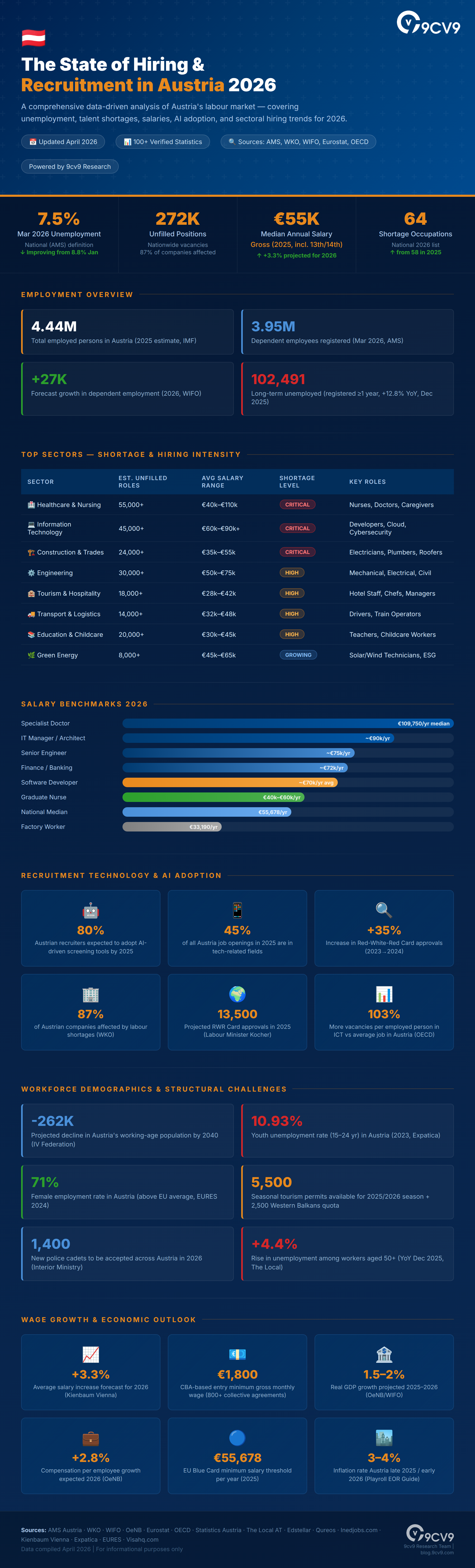
Austria’s workforce remains substantial, with an estimated 4.44 million employed people in 2025 and approximately 3.95 million dependent employees recorded in March 2026. Looking ahead, the Austrian Institute of Economic Research (WIFO) forecast an increase of approximately 27,000 dependent employment positions in 2026, suggesting opportunities for gradual employment growth.
Nevertheless, one of the most pressing issues facing Austria’s recruitment industry is the persistent shortage of qualified workers.
Research from the Austrian Federal Economic Chamber (WKO) indicates that 87% of Austrian companies are affected by labour shortages, with an estimated 272,000 unfilled positions nationwide. These shortages are particularly pronounced in healthcare, construction, engineering, information technology, hospitality, and skilled trades.
To address these challenges, Austria expanded its official shortage occupation framework for 2026 to include 64 nationwide shortage occupations and 66 additional regional shortage occupations. These classifications highlight the growing importance of targeted recruitment, vocational training, international talent acquisition, and workforce development.
Salary expectations and compensation trends are also influencing recruitment decisions across Austria.
Austria’s median gross annual salary for full-time employees was reported at approximately €55,678 in 2025, while average gross monthly salaries in early 2026 were estimated at €3,800 to €4,000. Salary growth projections for 2026 indicate average increases of approximately 3.3%, with skilled professionals potentially receiving slightly higher adjustments of 3.4%.
For employers, these compensation trends reinforce the importance of competitive salary benchmarking, transparent remuneration policies, employee benefits, and effective talent retention strategies.
At the same time, international recruitment is becoming increasingly important to Austria’s long-term workforce sustainability.
The country’s Red-White-Red Card programme provides pathways for qualified non-EU professionals to work in Austria, particularly in occupations experiencing significant labour shortages. With an ageing population and projections suggesting that Austria’s working-age population could decline by approximately 262,000 people by 2040, attracting international talent is likely to remain a strategic priority for Austrian employers.
Technology is another major force reshaping the Austrian recruitment market.
Artificial intelligence, automated candidate screening, digital recruitment platforms, and data-driven hiring solutions are changing how organisations identify, assess, and engage potential employees. AI-powered recruitment tools are becoming increasingly relevant as businesses seek to reduce hiring costs, improve recruitment efficiency, and address persistent talent shortages.
Meanwhile, demand for digital skills continues to outpace supply. OECD research indicates that Austria’s ICT sector experiences substantially greater vacancy pressure than the overall labour market, reinforcing the importance of digital transformation, technical education, and employee upskilling.
Regional differences further complicate Austria’s recruitment landscape. Employment opportunities, unemployment levels, and workforce participation vary considerably between Vienna, Salzburg, Tyrol, Burgenland, Lower Austria, and other federal states. These geographical differences mean that successful recruitment strategies must account for local labour market conditions rather than relying exclusively on national averages.
For HR professionals, recruitment agencies, business owners, policymakers, and international investors, understanding these developments is critical to making informed workforce decisions.
What This Austria Recruitment Statistics Report Covers
This comprehensive guide explores the Top 103 Recruitment Statistics, Data & Trends in Austria in 2026, providing valuable insights into the country’s employment landscape, hiring challenges, salary developments, and future workforce outlook.
The report examines key areas including:
- Employment and unemployment statistics: National unemployment rates, workforce participation, employment growth, youth unemployment, and long-term unemployment trends.
- Labour shortages and job vacancies: Skills gaps, shortage occupations, sector-specific recruitment challenges, and employer hiring demand.
- Salary and compensation trends: Average salaries, median wages, industry-specific earnings, salary growth forecasts, and collective bargaining agreements.
- International recruitment and immigration: Red-White-Red Card requirements, foreign worker recruitment, seasonal employment, and immigration policies.
- Recruitment technology and artificial intelligence: AI-powered hiring tools, digital transformation, recruitment automation, and emerging technology skills.
- Regional recruitment statistics: Employment conditions and workforce trends across Austria’s federal states.
- Industry-specific hiring trends: Recruitment developments in healthcare, construction, tourism, manufacturing, engineering, and technology.
- Workforce demographics and future projections: Population ageing, labour force sustainability, gender employment patterns, and long-term recruitment challenges.
By analysing these 103 recruitment statistics, employers can better understand where talent shortages are most severe, which industries offer the strongest hiring opportunities, how compensation expectations are changing, and what recruitment strategies may prove most effective in 2026.
Whether you are an Austrian employer planning workforce expansion, an international company considering hiring in Austria, a recruitment agency identifying emerging opportunities, or a professional exploring career prospects, this report provides a data-driven overview of the Austrian job market.
As Austria navigates economic recovery, demographic change, digital transformation, and structural skills shortages, organisations that understand and respond to emerging recruitment trends will be better positioned to attract, develop, and retain talent.
Explore the following 103 recruitment statistics, employment data points, and hiring trends to gain a clearer understanding of the state of recruitment in Austria in 2026 and the forces shaping its future labour market.
Before we venture further into this article, we would like to share who we are and what we do.
About 9cv9
9cv9 is a business tech startup based in Singapore and in Asia, with a strong presence all over the world.
With over ten years of startup and business experience, and being highly involved in connecting with thousands of companies and startups, the 9cv9 team has access to some of the best talents in the world.
If your company needs recruitment and headhunting services to hire top-quality employees, you can use 9cv9 headhunting and recruitment services to hire top talents and candidates. Email us at hello@9cv9.com.
Top 103 Recruitment Statistics, Data & Trends in Austria in 2026
🔢 UNEMPLOYMENT & EMPLOYMENT LEVELS
- 7.5% — Austria’s national (AMS) unemployment rate in March 2026. Austria’s unemployment rate eased to 7.5% in March 2026, recovering from an 8.8% peak in January, signalling gradual labour market stabilisation heading into mid-year.
- 8.8% — Austria’s national unemployment rate in January 2026, the highest since March 2021. January 2026 recorded Austria’s highest unemployment in nearly five years at 8.8%, driven by a post-Christmas seasonal spike and weakened industrial demand.
- 8.3% — National unemployment rate in February 2026. Austria’s unemployment rate of 8.3% in February 2026 suggests the early-year peak is receding, though it remains elevated compared to pre-2025 levels.
- 5.7% — Austria’s Eurostat/ILO unemployment rate in Q4 2025. Under the internationally standardised ILO definition, Austria’s Q4 2025 unemployment stood at 5.7%, well below the national AMS figure due to differing methodological criteria.
- 379,771 — Total unemployed persons registered in Austria in January 2026. With nearly 380,000 people registered as unemployed in January 2026, Austria’s labour market faces its most intensive hiring and retraining challenge in several years.
- 322,727 — Total unemployed persons in March 2026, declining from January peak. The drop to approximately 323,000 registered unemployed in March 2026 reflects a seasonal pattern and improving conditions in construction and tourism.
- 4.44 million — Estimated total employed persons in Austria in 2025. Austria’s employed workforce of 4.44 million in 2025 represents a modest but steady increase, consistent with the country’s long-term employment growth trajectory.
- 3,952,000 — Dependent employees registered in Austria in March 2026 (AMS). Austria’s 3.95 million dependent employees in March 2026 reflects a largely stable workforce base, even as unemployment ticked slightly higher year-on-year.
- +4,000 — Estimated net growth in total employment in 2025 vs 2024 (AMS). Despite economic headwinds, Austria managed a net employment gain of approximately 4,000 jobs in 2025, a modest but positive signal for the broader economy.
- +27,000 — WIFO forecast for new dependent employment positions in 2026. Austria’s public research institute WIFO projects a meaningful 27,000 increase in dependent employment in 2026, underpinned by growth in public services, healthcare, and green industries.
- 8.4% — National unemployment rate at December 2025, up from 8.2% in December 2024. Austria ended 2025 with unemployment at 8.4%, the highest December reading since January 2025, reflecting year-long pressures in manufacturing and retail.
- 5.5% — AMS head’s description of 2025 as reflecting a 5.5% increase in average registered unemployed vs 2024. The Austrian Public Employment Service characterised 2025 as a difficult year, with an average of 20,660 more people registered unemployed each month than in 2024.
- 102,491 — People registered with AMS for at least one year (long-term unemployed), up 12.8% YoY, December 2025. Austria’s long-term unemployed pool grew by nearly 13% in 2025, highlighting the need for targeted reintegration and upskilling programmes.
- 7.1% / 7.9% — Female vs male unemployment rate in March 2026 (national definition). Austria’s gender unemployment gap narrowed slightly in early 2026, with women at 7.1% and men at 7.9% under the national definition, reflecting structural differences in sector exposure.
- 10.93% — Youth unemployment rate (15–24) in Austria, 2023 (ILO concept). Austria’s youth unemployment of nearly 11% underscores the need for stronger vocational bridging programmes and apprenticeship incentives for young job seekers.
🏭 SKILL SHORTAGES & VACANCY DATA
- 272,000 — Nationwide unfilled job positions in Austria (WKO). With 272,000 vacant positions nationwide, Austria’s skills gap is both structurally persistent and economically costly, dampening productivity across its most productive sectors.
- 87% — Share of Austrian companies affected by labour shortages (WKO). A striking 87% of Austrian businesses report being affected by workforce shortages, making talent acquisition one of the top strategic priorities for employers in 2026.
- 64 — Nationwide shortage occupations on Austria’s Fachkräfteverordnung 2026. Austria’s federal government expanded its official national shortage occupation list to 64 roles in 2026, up from 58 in 2025, reflecting broadening skills deficits across industries.
- 66 — Additional regional shortage occupations in 2026. Alongside the 64 national shortage roles, Austria designated 66 regional shortage occupations in 2026, acknowledging that skills gaps are geographically uneven across federal states.
- 58 — National shortage occupations on the 2025 list (for reference/growth comparison). The increase from 58 in 2025 to 64 in 2026 represents a nearly 10% expansion, confirming that Austria’s structural talent deficits are intensifying rather than easing.
- <1.5 job seekers per vacancy — AMS threshold defining a “shortage occupation.” Austria officially classifies a role as a shortage occupation when fewer than 1.5 job seekers are available per reported vacancy, a metric that many sectors now fail to meet comfortably.
- 67,647 — Immediately available job vacancies reported by AMS in December 2025. Austria’s immediately available vacancies fell 16.2% year-on-year by December 2025, indicating weaker order books and more cautious hiring in industrial sectors.
- -16.2% — Year-on-year decline in AMS immediate vacancies (December 2025). The 16.2% drop in immediately available vacancies signals reduced short-term hiring appetite, even as structural medium-term demand remains elevated.
- 147,941 — Total number of job vacancies in Austria in June 2025 (Eurostat). Austria recorded nearly 148,000 vacancies in mid-2025 according to Eurostat data, illustrating the sustained gap between labour demand and supply.
- 110 — New shortage occupations added to Austria’s 2025 skill shortage list (announced November 2024). Austria added 110 new occupations to its skill shortage framework for 2025, the most ambitious single-year expansion in the programme’s recent history.
- 103% — More vacancies per employed person in ICT roles vs average Austrian job (OECD, 2024). ICT vacancies in Austria are more than double the national average relative to employed persons, making digital talent the country’s most critical hiring bottleneck.
- 24,000+ — Unfilled construction vacancies in Austria; 81% of construction companies report severe shortages (WKO). Austria’s construction sector alone faces over 24,000 unfilled positions, with four in five firms citing severe shortages that delay infrastructure and housing projects.
- 55,000+ — Estimated unfilled healthcare and nursing vacancies in Austria. Healthcare remains Austria’s most acutely understaffed sector, with over 55,000 unfilled roles spanning nursing, elderly care, and specialist medicine.
- +8% — Year-on-year increase in healthcare demand in Austria in 2025. Healthcare hiring demand in Austria grew 8% year-on-year in 2025, driven by demographic ageing, expanding home care requirements, and post-pandemic catch-up.
- 851 — Annual bachelor-level nursing places available through Austrian Fachhochschulen. Austria’s universities of applied sciences offer only 851 nursing degree places annually — a fraction of actual demand — creating a structural pipeline deficit in the profession.
💶 SALARY & COMPENSATION
- €55,678 — Median gross annual salary for full-time employees in Austria in 2025. Austria’s median full-time salary of €55,678 gross annually includes mandatory 13th and 14th salary payments, making the country’s compensation structure uniquely favourable versus many EU peers.
- €3,713/month — Median gross monthly salary in Austria (2024, Expatica). At €3,713 gross per month, Austria’s median salary ranks comfortably above the EU average, reflecting strong collective bargaining and a high-wage industrial base.
- €3,800–€4,000/month — Average gross monthly salary in Austria in early 2026 (Playroll EOR Guide). Austrian employers budgeting for 2026 should plan for average monthly gross salaries of €3,800–€4,000, with significant upward variance in tech and engineering roles.
- €52,000–€55,000/year — Average gross annual salary range in Austria in 2026 (Inedjobs.com). Austria’s average gross annual salary of €52,000–€55,000 places it well above the EU median, making it an attractive destination for skilled professionals from lower-wage markets.
- €2,200–€2,600/month net — Typical net monthly take-home salary in Austria after tax and social contributions. After taxes and social security, Austrian employees typically retain €2,200–€2,600 monthly — lower than gross figures suggest, but still above EU averages in purchasing power.
- €109,750/year — Median annual salary for specialist doctors in Austria (2025, Stepstone). Specialist physicians earn nearly €110,000 gross annually on median in Austria, sustained by structural shortages and rising private-sector healthcare demand.
- +3.3% — Average salary increase projected for all Austrian employees in 2026 (Kienbaum Vienna). Consultancy firm Kienbaum’s 2026 forecast predicts a 3.3% across-the-board salary increase in Austria, delivering modest real-wage growth above current inflation.
- +3.4% — Salary increase forecast for specialists and skilled workers in 2026 (Kienbaum). Specialists and skilled workers can expect slightly above-average pay rises of 3.4% in 2026, reflecting their scarcity value in Austria’s tight talent market.
- +2.9%–3.1% — Salary increase forecast for managerial roles in 2026 (Kienbaum). Managers in Austria can expect a more moderate pay increase of 2.9–3.1%, as businesses balance competitive retention with tighter cost management post-recession.
- +2.8% — Compensation per employee growth expected in 2026 (OeNB). The Austrian central bank projects overall employee compensation to grow 2.8% in 2026, broadly in line with inflation, indicating modest real-wage improvement.
- €1,800–€2,000/month gross — Collective bargaining minimum wages across most Austrian sectors in 2026. Austria’s sector-specific minimum wages under collective bargaining agreements now generally start at €1,800–€2,000 gross monthly, providing a more equitable base than a single statutory minimum.
- 800+ — Number of sector-specific collective bargaining agreements (Kollektivverträge) in Austria. Austria has over 800 active collective agreements, covering approximately 98% of the workforce and setting binding pay floors, working conditions, and notice periods by industry.
- 14 salary payments/year — Austrian mandatory annual salary structure (12 regular + 13th + 14th). Austria’s legally required 14-month salary structure — where the 13th and 14th salaries are taxed at a favourable 6% flat rate — represents a meaningful earnings advantage for Austrian workers.
- €3,465/month minimum — Red-White-Red Card minimum gross salary for key workers (2026). From January 2026, non-EU workers applying for Austria’s Red-White-Red Card as key workers must be offered a minimum of €3,465 gross per month, ensuring fair pay for internationally recruited talent.
- €55,678/year — EU Blue Card minimum salary threshold in Austria. Austria’s EU Blue Card requires a gross annual salary of at least €55,678, targeting highly qualified international professionals in shortage fields like engineering, IT, and medicine.
- €50,000–€70,000/year — Salary range for engineers in Austria. Engineers in Austria earn between €50,000 and €70,000 annually on average, with specialisations in electrical power and mechanical engineering commanding the higher end of this range.
- €60,000–€90,000+/year — Average annual salary range for IT professionals in Austria (2026). IT professionals remain among Austria’s highest-paid workers, with salaries ranging from €60,000 to over €90,000 annually, driven by demand for cloud, cybersecurity, and AI expertise.
- €40,000–€60,000/year — Annual salary range for healthcare workers (nurses and midwives) in Austria. Nurses and midwives in Austria earn €40,000–€60,000 gross annually, with significant variation between public hospital, private clinic, and home care roles.
- €35,000–€50,000/year — Average annual salary for bus and train drivers in Austria. Transport professionals in Austria can expect solid earnings of €35,000–€50,000 per year, bolstered by the critical shortage of qualified drivers across the country.
- €33,190/year — Average annual salary for factory workers in Austria (ERI). Factory workers in Austria earn an average of €33,190 per year, reflecting the relatively lower-skilled nature of the role compared to technical and professional positions.
🌐 INTERNATIONAL HIRING & IMMIGRATION
- 3,200 — Red-White-Red Card applications approved in the first four months of 2024 (Austrian Immigration Dept). Over 3,200 Red-White-Red Card approvals in just the first four months of 2024 signalled surging demand for fast-tracked international recruitment in shortage occupations.
- +35% — Increase in RWR Card approvals comparing 2024 to 2023. The 35% year-on-year rise in Red-White-Red Card approvals demonstrates Austria’s accelerating reliance on international talent to fill domestic skills gaps.
- 13,500 — Projected Red-White-Red Card approvals for full-year 2025 (Labour Minister Kocher). Austria’s labour minister projected 13,500 annual RWR Card approvals for 2025, a near-tripling from earlier years and a record for the scheme.
- 55 points minimum — Points threshold to qualify for the Red-White-Red Card (Skilled Worker in Shortage Occupation). International applicants must score at least 55 out of a possible 90 points under the RWR Card points system, with qualifications, work experience, language skills, and age all counting toward eligibility.
- 24 months — Validity period of the Red-White-Red Card for shortage-occupation workers. Austria’s RWR Card is initially valid for 24 months and binds the worker to a specific employer, offering a clear pathway to longer-term settlement upon renewal.
- 5,500 — Seasonal tourism permits available for the 2025/2026 season (Federal Ministry for Tourism). Austria allocated 5,500 seasonal work permits for the 2025/2026 tourism season, maintaining international worker flows to meet peak demand in alpine and urban hospitality markets.
- 2,500 — Separate quota of seasonal permits for workers from Western Balkans in 2025/2026. A dedicated 2,500-strong seasonal permit quota for Western Balkan workers reflects Austria’s targeted recruitment of neighbouring region labour to fill hospitality and agricultural gaps.
- 10,000+ — Peak seasonal jobs filled during Austria’s tourism high season. More than 10,000 seasonal positions may be filled during peak periods, underscoring the critical reliance of Austria’s tourism sector on flexible international labour.
- 18,000 — Additional people who joined Austria’s labour force as a result of integrating Ukrainian refugees (OeNB). The integration of Ukrainian refugees added approximately 18,000 workers to Austria’s labour force, partially offsetting structural shortages in lower-skill roles.
- 110 — Shortage occupations added under Austria’s 2025 immigration policy expansion. The addition of 110 new shortage roles to Austria’s 2025 visa framework was the broadest single expansion of the scheme, opening new fast-track pathways in healthcare, transport, education, and engineering.
🤖 RECRUITMENT TECHNOLOGY & AI
- 80% — Proportion of Austrian recruiters expected to adopt AI-driven screening tools by 2025 (Qureos). Four in five Austrian recruiters were projected to use AI-powered resume screening and candidate shortlisting tools by 2025, fundamentally transforming talent acquisition workflows.
- 45% — Share of all Austrian job openings in 2025 in tech-related fields (Qureos). Nearly half of all new job postings in Austria in 2025 were in technology-related roles, demonstrating the outsized impact of digital transformation on hiring composition.
- 300,000 — People Microsoft committed to training in digital skills in Austria by end of 2025 (Microsoft). Microsoft’s commitment to upskilling 300,000 Austrians in digital competencies by end-2025 — tied to its Vienna data centre launch — represents one of the largest corporate digital literacy drives in the country.
- 30% — Share of EU workers now using AI at work (European study, via TNW). Approximately 30% of European workers, including those in Austria, now use AI tools at work for tasks such as writing, translation, and data analysis, with adoption accelerating year-on-year.
- 71% — Share of European firms reconsidering job responsibilities due to AI (European employer survey). Over seven in ten European companies, including many Austrian employers, are actively reassessing job roles as AI adoption reshapes task allocation and skills requirements.
- 90% — Proportion of EU workplaces where digital tools have become universal. Digital tools are now near-universal in European workplaces, reinforcing the need for continuous digital upskilling among Austrian workers across all sectors and age groups.
- 14% — Share of job advertisements for entry-level roles in Austria as of June 2025 (AMS data). Entry-level job advertising in Austria actually rose from 11% to 14% between early 2021 and mid-2025, contradicting the narrative that AI is eliminating early-career opportunities wholesale.
- +80% startups expanding — Share of Austrian startups planning to expand (Austrian Startup Monitor). Over 80% of Austria’s startups are planning expansion in 2026, particularly in fintech, climate tech, and AI, creating a selective but meaningful new pipeline of tech employment.
📍 REGIONAL LABOUR MARKET
- 13.5% — Youth NEET rate in Vienna in 2023, the highest among all Austrian regions (OECD). Vienna carries Austria’s highest rate of young people not in employment, education, or training at 13.5%, reflecting the dual challenge of a concentrated urban labour market and uneven educational attainment.
- 6.5% — Youth NEET rate in Salzburg, the lowest in Austria in 2023 (OECD). Salzburg’s remarkably low 6.5% youth NEET rate reflects its thriving tourism economy and strong vocational training integration with local employers.
- 9% — Average regional youth NEET rate across Austria in 2023 (OECD). Austria’s average regional NEET rate of 9% sits well below the OECD benchmark of 16.8%, indicating that youth exclusion from work and education is a manageable challenge rather than a systemic crisis.
- 107% more ICT vacancies per employed person in Southern Austria vs average — the highest regional ICT tightness. Southern Austria has the tightest ICT labour market in the country, with ICT vacancies exceeding the average by 107%, creating strong incentives for remote tech roles and regional employer branding.
- 99% more ICT vacancies than average in Western Austria — the lowest regional ICT tightness. Even Western Austria, which has the lowest relative ICT shortage, records twice as many ICT vacancies per worker as the national average, confirming that the digital skills gap is nationwide.
- 54.8% — Employment rate in Burgenland in 2023, the lowest of any Austrian state. Burgenland’s employment rate of 54.8% — 3.8 percentage points below the national average — reflects structural disadvantages in its predominantly rural and agricultural economy.
- 5.2% — Unemployment rate in Burgenland in 2023, in line with the national average. Despite its lower employment rate, Burgenland’s unemployment remains comparable to the Austrian average, suggesting that labour market inactivity rather than job displacement is the primary issue.
- 4.3% — Unemployment rate in Lower Austria in 2023, below the national average. Lower Austria’s relatively tight labour market, especially in skilled trades and agriculture, makes it one of the country’s more resilient regional economies from a hiring perspective.
- -2.1 percentage points — Change in Vienna’s age inclusion gap (prime-age vs youth participation) 2013–2023. Vienna is the only Austrian state to have significantly closed the gap in labour market participation between younger and prime-age workers over the past decade, partly due to urban service sector growth.
- +6.4 percentage points — Increase in Tyrol’s age inclusion gap 2013–2023 (OECD). Tyrol’s widening participation gap between youth and prime-age workers suggests that seasonal tourism economies may struggle to deliver stable career pathways for young people over the longer term.
🏥 HEALTHCARE, CONSTRUCTION & GREEN SECTORS
- 55,000+ — Estimated unfilled healthcare and nursing vacancies in Austria. Austria’s healthcare system requires massive recruitment investment, with over 55,000 open positions straining hospital capacity, elderly care facilities, and community health services.
- +8% YoY — Growth in healthcare hiring demand in Austria in 2025. The 8% year-on-year rise in healthcare demand in 2025 is driven by demographic ageing, expanded home care models, and the gradual retirement of baby-boomer healthcare professionals.
- 851 places/year — Annual bachelor nursing capacity at Austrian Fachhochschulen. Austria’s nursing education pipeline produces only 851 bachelor graduates annually — far below what is needed to replace retiring nurses and meet growing demand, pointing to an urgent need for capacity expansion.
- 24,000+ — Unfilled construction vacancies; 81% of construction companies report severe shortages. Austria’s construction sector lacks over 24,000 workers, and with 81% of firms citing severe shortages, delivery timelines and housing targets are increasingly at risk.
- 1,400 — New police cadets to be accepted across Austria in 2026 (Interior Ministry). Austria’s Interior Ministry is recruiting 1,400 new police cadets in 2026 to replace baby-boomer retirements, with the majority placed in Vienna, Lower Austria, Upper Austria, and Tyrol.
- 1,900 — Police trainees expected to complete education and enter active service in 2026. With 1,900 police trainees entering active service in 2026, public safety hiring represents one of the more predictable and large-scale labour market inflows of the year.
- 4% GDP contribution growth — Tourism sector’s projected GDP contribution growth in 2025. Austria’s tourism sector is expected to grow its GDP contribution by 4% in 2025, creating sustained demand for hospitality, hotel management, and food service roles, particularly in Vienna, Salzburg, and Innsbruck.
📊 STRUCTURAL & DEMOGRAPHIC TRENDS
- -262,000 — Projected decline in Austria’s working-age population by 2040 (IV Federation of Austrian Industries). Austria faces a structural workforce contraction of 262,000 working-age individuals by 2040, making proactive immigration, upskilling, and automation strategies non-optional for economic sustainability.
- 71% — Female employment rate in Austria (above EU average, EURES 2024). Austria’s female employment rate of 71% exceeds the EU average, but women remain over-represented in part-time and lower-paid service roles, highlighting persistent structural inequalities.
- 5.24% — ILO-measure unemployment rate in Austria in 2023 (up from 4.99% in 2022). Even under the more conservative international definition, Austria’s unemployment ticked up from 4.99% in 2022 to 5.24% in 2023, reflecting early signs of economic softening pre-dating the 2024–2025 recession.
- ~98% — Share of Austrian workforce covered by collective bargaining agreements. With nearly all workers covered by collective agreements, Austria has one of the most highly unionised wage-setting environments in the EU, providing strong floor wages but limiting employer flexibility.
- ~29% of gross salary — Total employer on-cost burden above gross salary in Austria. Austrian employers face total costs exceeding 29% above gross salary — including social security, FLAF, municipal tax, severance fund contributions — making Austria one of the costlier employment markets in the EU.
- 6 weeks to 5 months — Range of employer notice periods under Austrian law (depending on tenure). Austria’s graduated notice period system — ranging from six weeks for new hires to five months after 25+ years of service — underscores the country’s strong worker protection framework, which employers must factor into workforce planning.
- 13,539 euros — Tax-free personal allowance for income tax in Austria in 2026 (Finanz.at). Austria’s tax-free personal allowance rises to €13,539 in 2026, reducing the tax burden for lower and middle earners and slightly improving net take-home pay relative to 2025.
- 3–4% — Current inflation rate in Austria (late 2025 / early 2026, Playroll). Austria’s inflation running at 3–4% in late 2025 and early 2026 means that nominal wage increases must exceed this threshold to deliver genuine real-wage gains for workers.
- 1.5–2.0% GDP growth — Austria’s real GDP growth projection for 2025–2026 (WIFO/OeNB). Austria’s moderate GDP growth forecast of 1.5–2.0% for the 2025–2026 period provides a stable but unspectacular backdrop for hiring decisions — enough for employment to grow, but not a boom.
- +4,000 — WIFO forecast reduction in unemployment later in 2026. WIFO projects Austria’s unemployment count will fall by around 4,000 as 2026 progresses, suggesting that the early-year peak reflects seasonality rather than a deeper structural deterioration.
- 0.23% — Forecast growth rate in total employed persons in Austria 2024–2025 (IMF). The IMF’s forecast of 0.23% growth in employed persons for Austria in 2024–2025 reflects a resilient but slow-growing employment base, typical of a mature, stable European economy.
- 2.55% — Wage increase in Austria’s retail/trade sector from January 2026 (collective agreement, Finanz.at). Retail sector employees can expect a 2.55% collective wage increase from January 2026, which — while modest — still provides a partial buffer against ongoing cost-of-living pressures.
- 2.2% — Metal industry KV-löhne (collective agreement wage) increase for 2026. Austria’s metal industry wages rise by 2.2% in 2026, a below-inflation increase that may test retention in one of the country’s most technically skilled and internationally competitive sectors.
- €71,000+/year — Threshold for Austria’s top 25% of earners in 2025. Austria’s top quartile of workers earn more than €71,000 gross annually, while the bottom quartile earns below €43,000 — a disparity that is narrowing slowly but reflects persistent sector and gender-based pay gaps.
- €43,000/year — Bottom 25th percentile gross annual salary in Austria in 2025. The lower earnings quartile in Austria sits at €43,000 — still above the EU median — underscoring the relative compression of Austria’s wage distribution compared to more unequal economies.
- 5,500 seasonal + 2,500 Balkans quota — Total annual seasonal worker pipeline for tourism 2025/2026. Austria’s dual seasonal workforce pipeline — 5,500 general permits plus 2,500 dedicated Western Balkans places — ensures the hospitality sector can staff up efficiently during peak alpine tourism seasons.
- +20,660/month average — Additional registered unemployed per month in 2025 compared to 2024 (AMS). An average excess of over 20,000 registered unemployed persons every month in 2025 versus 2024 quantifies the scale of the labour market weakness that recruiters and policymakers must navigate into 2026.
- €3,300/month — Starting salary for Austrian bachelor degree graduates (entry level). Austria’s bachelor graduates can expect to start their careers at approximately €3,300 gross per month, with salaries growing predictably to €4,900 after a decade in the workforce.
Conclusion
The recruitment landscape in Austria in 2026 reflects a labour market undergoing significant structural changes, driven by persistent skills shortages, demographic shifts, evolving salary expectations, technological advancements, and increasing demand for international talent. While Austria remains one of Europe’s most established employment markets, the latest recruitment statistics highlight both the challenges and opportunities facing employers, recruiters, HR professionals, and job seekers.
Austria’s unemployment rate reached 8.8% in January 2026 before declining to 7.5% in March, indicating signs of seasonal labour market stabilisation. Despite these improvements, approximately 322,727 people remained registered as unemployed in March 2026, demonstrating that economic recovery does not automatically eliminate employment challenges or workforce mismatches.
At the same time, Austria continues to face substantial labour shortages, with research indicating that 87% of Austrian businesses are affected by difficulties finding qualified workers. An estimated 272,000 unfilled positions nationwide illustrate the scale of the country’s recruitment challenges, particularly in healthcare, construction, engineering, information technology, hospitality, and skilled trades.
These figures reveal one of the most important characteristics of Austria’s employment market: high unemployment and significant skills shortages can coexist when available workers do not possess the qualifications, experience, or geographical mobility required by employers.
For businesses, this reinforces the importance of moving beyond traditional recruitment methods and investing in skills-based hiring, employee training, workforce planning, and targeted talent acquisition strategies.
Salary and compensation trends represent another critical factor shaping recruitment decisions in 2026. With Austria’s median gross annual salary for full-time employees reported at approximately €55,678 in 2025 and average salary increases projected at 3.3% for 2026, employers must carefully balance competitive remuneration with rising operational costs.
Organisations seeking to attract and retain skilled professionals will increasingly need to offer compelling employment packages that combine competitive salaries, career development opportunities, workplace flexibility, professional training, and long-term job security.
International recruitment will also play an increasingly important role in Austria’s workforce strategy. The expansion of shortage occupation classifications and continued use of the Red-White-Red Card programme demonstrate the country’s efforts to attract qualified professionals from outside the European Union.
This international hiring focus is particularly significant given projections that Austria’s working-age population could decline by approximately 262,000 people by 2040. Without effective immigration policies, workforce participation initiatives, and productivity improvements, demographic pressures could intensify existing labour shortages over the coming decades.
Meanwhile, artificial intelligence and digital transformation are reshaping how Austrian employers approach recruitment. AI-powered candidate screening, recruitment automation, digital job platforms, and workforce analytics offer opportunities to improve hiring efficiency, reduce administrative workloads, and identify qualified candidates more effectively.
However, technology alone cannot resolve structural labour shortages. Employers must also prioritise digital upskilling, vocational education, inclusive recruitment practices, and continuous employee development to build a sustainable workforce.
Regional labour market differences further highlight the need for tailored recruitment strategies. Employment conditions in Vienna, Salzburg, Tyrol, Burgenland, and Lower Austria vary considerably, making local labour market intelligence essential for organisations planning recruitment campaigns, business expansion, or workforce relocation.
Looking ahead, Austria’s recruitment outlook remains cautiously optimistic. WIFO’s forecast of approximately 27,000 additional dependent employment positions in 2026 suggests opportunities for gradual workforce expansion, even as employers continue navigating economic uncertainty and persistent talent shortages.
Key Implications for Employers and Recruiters in Austria
The findings from these 103 recruitment statistics, data points, and hiring trends in Austria in 2026 highlight several strategic priorities for organisations operating in the Austrian labour market.
Employers should focus on developing stronger talent pipelines, improving recruitment efficiency, implementing competitive compensation strategies, and investing in employee retention. Businesses operating in sectors experiencing severe skills shortages should also consider international recruitment, apprenticeship programmes, internal mobility, and partnerships with educational institutions.
Recruitment agencies and HR professionals can strengthen their competitive advantage by adopting data-driven hiring practices, leveraging recruitment technology, understanding regional workforce dynamics, and helping employers identify candidates with transferable skills.
For job seekers, Austria continues to present meaningful career opportunities, particularly in industries facing persistent workforce shortages. Professionals with qualifications in healthcare, engineering, technology, construction, and specialised trades may benefit from sustained demand for their expertise.
International professionals considering employment in Austria should also monitor developments in shortage occupation lists, immigration requirements, salary thresholds, and employer sponsorship opportunities.
Ultimately, the future of recruitment in Austria will depend on how effectively employers, policymakers, educational institutions, and recruitment professionals respond to changing workforce needs.
Companies that prioritise adaptability, workforce development, technological innovation, and inclusive talent acquisition will be better positioned to navigate labour market uncertainty and maintain a competitive advantage.
As Austria moves further into 2026 and beyond, successful recruitment will increasingly require more than simply filling vacant positions. It will involve anticipating future skills requirements, building resilient talent pipelines, creating attractive employment environments, and aligning workforce strategies with long-term economic and demographic trends.
These Top 103 Recruitment Statistics, Data & Trends in Austria in 2026 provide a valuable foundation for understanding the Austrian job market, identifying emerging hiring opportunities, and making informed recruitment and workforce planning decisions.
For employers and recruitment professionals, the central takeaway is clear: organisations that combine reliable labour market data with proactive talent strategies, competitive compensation, and continuous workforce development will be best equipped to attract, recruit, and retain skilled professionals in Austria’s evolving employment landscape.
If you find this article useful, why not share it with your hiring manager and C-level suite friends and also leave a nice comment below?
We, at the 9cv9 Research Team, strive to bring the latest and most meaningful data, guides, and statistics to your doorstep.
To get access to top-quality guides, click over to 9cv9 Blog.
To hire top talents using our modern AI-powered recruitment agency, find out more at 9cv9 Modern AI-Powered Recruitment Agency.
People Also Ask
What is the unemployment rate in Austria in 2026?
Austria’s national unemployment rate reached 8.8% in January 2026 before declining to 8.3% in February and 7.5% in March, according to the Austrian Public Employment Service (AMS).
How many people are employed in Austria in 2026?
Austria had approximately 4.44 million employed people in 2025, with around 3.95 million dependent employees registered in March 2026. Employment is forecast to grow gradually throughout 2026.
What are the biggest recruitment trends in Austria in 2026?
Major recruitment trends in Austria include persistent skills shortages, AI-powered hiring, rising salary expectations, international talent acquisition, digital upskilling, and growing demand for healthcare and technology professionals.
How many job vacancies are there in Austria in 2026?
Austria recorded 67,647 immediately available vacancies through AMS in December 2025. Broader estimates from the Austrian Federal Economic Chamber indicate approximately 272,000 unfilled positions nationwide.
Which industries are hiring the most workers in Austria in 2026?
Healthcare, information technology, engineering, construction, hospitality, tourism, and skilled trades face significant recruitment demand due to workforce shortages, demographic changes, and evolving industry requirements.
What is the average salary in Austria in 2026?
Average gross monthly salaries in Austria are estimated at €3,800–€4,000 in early 2026. Actual earnings vary by occupation, qualifications, experience, industry, and collective bargaining agreements.
What is the median salary in Austria?
Austria’s reported median gross annual salary for full-time employees was approximately €55,678 in 2025. Annual compensation commonly includes 13th and 14th salary payments under applicable collective agreements.
How much are salaries expected to increase in Austria in 2026?
Salary increases in Austria are projected to average approximately 3.3% in 2026. Skilled workers may receive increases of 3.4%, while managerial salary adjustments are forecast at approximately 2.9%–3.1%.
Is Austria experiencing a labour shortage in 2026?
Yes. Research from the Austrian Federal Economic Chamber indicates that 87% of Austrian businesses experience labour shortages, with an estimated 272,000 unfilled positions across multiple industries.
What are the most in-demand jobs in Austria in 2026?
In-demand occupations include nurses, doctors, software developers, IT specialists, engineers, construction workers, electricians, technicians, hospitality employees, and other skilled professionals.
How many shortage occupations are listed in Austria in 2026?
Austria’s 2026 shortage occupation framework includes 64 nationwide shortage occupations and 66 additional regional shortage occupations, reflecting workforce gaps across industries and federal states.
What is the youth unemployment rate in Austria?
Austria’s youth unemployment rate for people aged 15–24 was approximately 10.93% in 2023 under the ILO definition. Youth employment remains an important focus for vocational training and apprenticeship programmes.
What is the employment outlook for Austria in 2026?
Austria’s employment outlook suggests gradual improvement. The Austrian Institute of Economic Research (WIFO) forecast approximately 27,000 additional dependent employment positions in 2026.
How is artificial intelligence changing recruitment in Austria?
AI is transforming Austrian recruitment through automated CV screening, candidate matching, recruitment analytics, and administrative automation. These technologies can help employers improve hiring efficiency and identify qualified candidates.
What percentage of Austrian recruiters use AI recruitment tools?
An industry projection cited in the dataset estimated that 80% of Austrian recruiters would adopt AI-driven screening tools by 2025. This is a forecast rather than a verified nationwide adoption rate.
How much do IT professionals earn in Austria in 2026?
IT professionals in Austria can earn approximately €60,000–€90,000 or more annually, depending on experience and specialisation. Cloud computing, cybersecurity, software engineering, and AI expertise command competitive salaries.
How much do engineers earn in Austria in 2026?
Engineers in Austria typically earn approximately €50,000–€70,000 gross annually. Salaries vary by engineering discipline, experience, employer, and regional demand for specialised technical skills.
How severe is the healthcare worker shortage in Austria?
Austria faces significant healthcare recruitment challenges, with estimates exceeding 55,000 unfilled healthcare and nursing positions. Population ageing and increasing demand for elderly care are contributing factors.
What are the recruitment challenges in Austria’s construction industry?
Austria’s construction industry faces an estimated 24,000 unfilled positions, while 81% of construction companies reportedly experience severe workforce shortages, affecting project delivery and infrastructure development.
Can foreign workers get jobs in Austria in 2026?
Yes. Qualified foreign professionals can pursue employment in Austria through eligible immigration pathways, including the Red-White-Red Card and EU Blue Card, subject to qualifications, salary requirements, and immigration regulations.
What is Austria’s Red-White-Red Card?
Austria’s Red-White-Red Card is a residence and employment permit for eligible non-EU workers. It supports recruitment in shortage occupations and other qualifying employment categories, generally with an initial validity of up to 24 months.
What is the minimum salary for a Red-White-Red Card in Austria in 2026?
The dataset reports a minimum gross monthly salary of €3,465 for the Other Key Workers category in 2026. Salary requirements vary by immigration category, and shortage occupation applicants follow different eligibility rules.
What is the EU Blue Card salary requirement in Austria in 2026?
The dataset reports an annual gross salary threshold of €55,678 for Austria’s EU Blue Card. Applicants should confirm the applicable official threshold and eligibility requirements before applying.
Which Austrian regions have the best employment opportunities?
Vienna, Salzburg, Tyrol, Upper Austria, and Lower Austria offer opportunities across technology, tourism, manufacturing, healthcare, and skilled trades. Employment prospects depend on regional industry demand and qualifications.
What is the unemployment rate in Vienna compared with other Austrian regions?
Vienna experiences distinct labour market challenges, including a youth NEET rate of 13.5% in 2023. Regional unemployment comparisons require consistent reporting periods and definitions across Austrian federal states.
How important is international recruitment to Austria’s economy?
International recruitment helps Austrian employers address shortages in healthcare, engineering, technology, tourism, and skilled trades. It is increasingly important as the country faces an ageing population and long-term workforce constraints.
How many workers will Austria lose due to population ageing?
Austria’s working-age population is projected to decline by approximately 262,000 people by 2040, creating long-term challenges for workforce availability, recruitment, economic productivity, and social services.
What are the biggest challenges facing Austrian employers in 2026?
Major challenges include skilled labour shortages, recruitment costs, rising compensation expectations, workforce ageing, regional talent mismatches, digital skills gaps, and retaining qualified employees in competitive industries.
How can companies improve recruitment in Austria in 2026?
Employers can improve recruitment through competitive salaries, skills-based hiring, AI recruitment tools, employee referrals, apprenticeships, international talent acquisition, professional development, and stronger employer branding.
What is the future of recruitment in Austria beyond 2026?
Austria’s recruitment market will increasingly depend on digital transformation, international hiring, workforce reskilling, demographic adaptation, and AI-assisted recruitment as employers respond to persistent talent shortages and changing labour market demands.
Sources
- AMS Austria (Arbeitsmarktservice)
- Statistics Austria
- Austrian Federal Economic Chamber (WKO)
- Austrian Institute of Economic Research (WIFO)
- Oesterreichische Nationalbank (OeNB)
- Austrian Migration Portal
- WORK in AUSTRIA
- Eurostat
- Trading Economics
- OECD
- The Local Austria
- European Employment Services (EURES)
- Edstellar
- Qureos
- Expatica
- Inedjobs
- Kienbaum Vienna
- 9cv9 Blog
- International Monetary Fund (IMF)
- Statista
- Playroll
- VisaHQ
- Finanz.at
- Federal Reserve Economic Data (FRED)
- Federal Reserve Bank of St. Louis
- Austrian Startup Monitor
- Careerical
- Remote People
- OECD National Policies Platform
- European Education and Culture Executive Agency (EACEA)