Key Takeaways
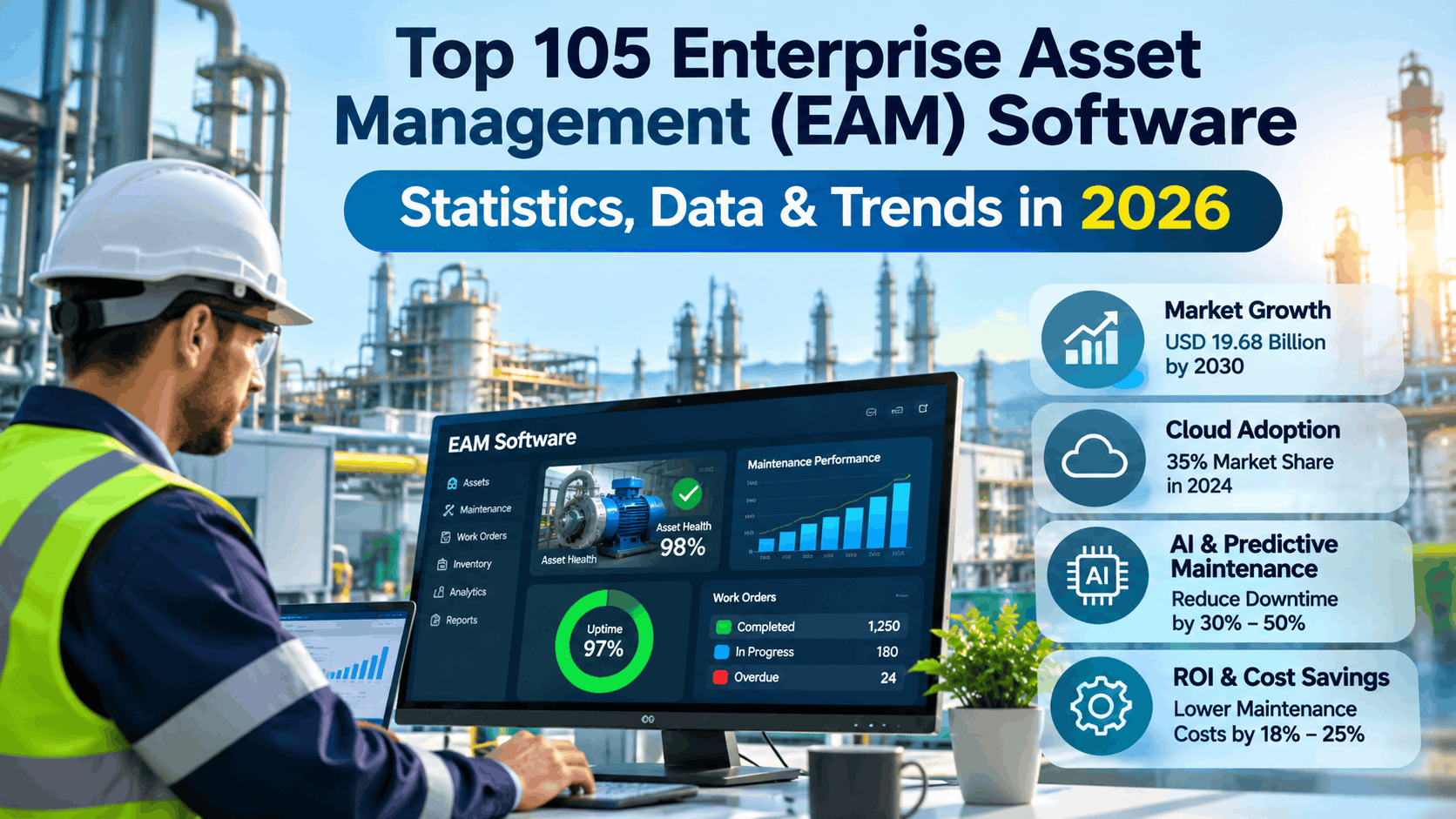
- EAM Software Market Growth: The global Enterprise Asset Management (EAM) software market is projected to reach USD 19.68 billion by 2030, driven by digital transformation, cloud adoption, and increasing demand for intelligent asset management solutions.
- Predictive Maintenance and ROI: AI-powered EAM software and predictive maintenance technologies can reduce unplanned equipment downtime by 30–50% and lower maintenance costs by 18–25%, improving operational efficiency and asset reliability.
- AI, IoT, and Cloud Adoption Trends: Cloud-based EAM platforms, artificial intelligence, IoT integration, and digital twins are transforming enterprise asset management in 2026, enabling real-time asset monitoring, automated maintenance, and data-driven decision-making.
Enterprise Asset Management (EAM) software helps businesses track physical assets, reduce maintenance costs, and prevent equipment downtime. In 2026, the global EAM market continues to grow, with projections reaching USD 19.68 billion by 2030. Key trends include AI-powered predictive maintenance, cloud adoption, IoT integration, and real-time asset monitoring across asset-intensive industries.
Enterprise Asset Management (EAM) software is transforming how businesses monitor, maintain, and optimize their physical assets. As organizations increasingly adopt artificial intelligence (AI), predictive maintenance, cloud computing, and the Internet of Things (IoT), the global EAM software market continues to experience significant growth. According to Grand View Research, the global EAM software market was valued at USD 7.65 billion in 2024 and is projected to reach USD 19.68 billion by 2030, reflecting growing demand for intelligent asset management solutions.
Also, read our article on the Top 10 Enterprise Asset Management (EAM) Software.

In 2026, enterprise asset management software has evolved beyond traditional equipment tracking and maintenance scheduling into a strategic technology for improving operational efficiency, reducing downtime, controlling maintenance costs, and extending asset lifecycles. Industries such as manufacturing, energy, utilities, transportation, healthcare, and construction increasingly rely on EAM platforms to manage complex asset portfolios and support data-driven decision-making.
The financial implications of ineffective asset management are substantial. Siemens estimates that the world’s 500 largest companies lose approximately USD 1.4 trillion annually due to unplanned downtime, highlighting the importance of proactive maintenance strategies. Meanwhile, research cited by McKinsey suggests that predictive maintenance can reduce unplanned downtime by 30% to 50% and lower maintenance costs by 18% to 25%, demonstrating the potential business value of modern EAM technologies.


Cloud-based EAM software, AI-powered predictive analytics, digital twins, and IoT-enabled asset monitoring are among the major trends shaping the enterprise asset management landscape in 2026. Organizations are increasingly moving away from reactive maintenance approaches toward integrated, intelligent asset management systems that provide real-time visibility into equipment performance, automate maintenance workflows, and improve resource allocation.
Regional market dynamics also reveal significant opportunities. North America remains a leading EAM software market, while Asia Pacific is emerging as one of the fastest-growing regions, supported by industrial automation, smart manufacturing initiatives, and infrastructure investment. At the same time, leading EAM software providers such as IBM Maximo, SAP, Oracle, IFS, Infor, and Hexagon continue to expand their capabilities through AI integration, cloud modernization, and advanced asset performance management.
Understanding the latest Enterprise Asset Management (EAM) software statistics, market size, adoption rates, industry benchmarks, and emerging trends is essential for business leaders, IT decision-makers, maintenance managers, and organizations evaluating asset management technology investments.
This comprehensive guide explores the top 105 Enterprise Asset Management (EAM) software statistics, data, and trends in 2026, covering global market growth, regional market shares, cloud adoption, predictive maintenance ROI, AI and IoT integration, equipment downtime costs, sustainability, and competitive developments. These insights provide a data-driven perspective on the evolving EAM software industry and the technologies shaping the future of enterprise asset management.
Before we venture further into this article, we would like to share who we are and what we do.
About 9cv9
9cv9 is a business tech startup based in Singapore and Asia, with a strong presence all over the world.
With over ten years of startup and business experience, and being highly involved in connecting with thousands of companies and startups, the 9cv9 team has listed some of the top and best companies/tools in this review.
If you like to get your company listed in our top B2B software reviews, check out our world-class 9cv9 Media and PR service and pricing plans here.
Top 105 Enterprise Asset Management (EAM) Software Statistics, Data & Trends in 2026
🌐 MARKET SIZE & GROWTH
- The global EAM software market was valued at USD 7.65 billion in 2024, underscoring how mission-critical physical asset management has become for organizations worldwide. (Grand View Research)
- The EAM market is projected to reach USD 19.68 billion by 2030, growing at a CAGR of 17.2%, reflecting rapid industrial digitalization across asset-intensive sectors. (Grand View Research)
- A more conservative projection places the market at USD 10.1 billion by 2032 at a 9.9% CAGR, still signaling strong sustained investment in enterprise asset platforms. (Verified Market Research, Nov 2025)
- The market is valued at USD 7.05 billion in 2025 and is predicted to reach USD 7.99 billion in 2026, confirming near-term momentum even amid macroeconomic uncertainty. (Fortune Data Vista)
- By 2033, the EAM market is forecast to reach USD 19.54 billion, growing at 12.6% CAGR from 2026 onward, as cloud-native EAM platforms broaden their enterprise footprint. (Fortune Data Vista)
- An alternate high-growth scenario projects the EAM market at USD 27.02 billion by 2032 at a 15.4% CAGR, driven by AI integration and industrial IoT proliferation. (Verified Market Research, Sep 2025)
- MarketsandMarkets estimated the global EAM market at USD 4.7 billion in 2023, projected to reach USD 7.6 billion by 2028 at a 9.8% CAGR. (MarketsandMarkets)
- PS Market Research valued the EAM market at USD 6.89 billion in 2024, projecting it will reach USD 15.35 billion by 2032 at a 10.66% CAGR. (PS Market Research)
- Fortune Business Insights valued the market at USD 6.09 billion in 2024, projecting USD 13.69 billion by 2032 at a 10.9% CAGR. (Fortune Business Insights)
- Research Nester valued the EAM market at USD 6.94 billion in 2026, forecasting USD 22.74 billion by 2035 at a 12.6% CAGR. (Research Nester, Sep 2025)
🌍 REGIONAL BREAKDOWN
- North America holds 36.4% of global EAM market share in 2025, reaching USD 2.42 billion, driven by mature enterprise software culture and asset-intensive industrial sectors. (Fortune Business Insights)
- North America’s EAM market is projected at a regional CAGR of 11.8% from 2026 to 2033, reflecting a shift from initial adoption to deep deployment, IoT integration, and AI-driven maintenance. (Fortune Data Vista)
- The U.S. EAM market alone is projected at USD 2.07 billion by 2026, benefiting from the dominant commercial presence of IBM Maximo, SAP, Oracle, Infor, and Hexagon AB. (Fortune Business Insights)
- Europe contributed 25.1% of global EAM revenue in 2025 (USD 1.84 billion), projected to grow to USD 2.03 billion in 2026, supported by enterprise software growth and government SME funding. (Fortune Business Insights)
- The UK EAM market is projected at USD 0.32 billion and Germany at USD 0.25 billion by 2026, reflecting strong industrial manufacturing and regulatory compliance demand. (Fortune Business Insights)
- Asia Pacific holds 19.4% of global market share in 2025 (USD 1.45 billion), projected to reach USD 1.63 billion in 2026, led by China, India, and Japan. (Fortune Business Insights)
- Asia Pacific is the fastest-growing EAM region, at a 15.4% CAGR from 2026 to 2033, fueled by rapid industrialization, smart factory investment, and Industry 4.0 adoption. (Fortune Data Vista)
- China’s EAM market is projected at USD 0.35 billion by 2026, driven by the government’s Made in China 2025 strategy and state-owned enterprise digital transformation mandates. (Fortune Business Insights)
- India’s EAM market is projected at USD 0.24 billion by 2026, with rapid growth expected as manufacturing sector expansion and smart infrastructure investments accelerate. (Fortune Business Insights)
- Middle East & Africa represents 10.3% of global EAM market (USD 0.75 billion in 2025), projected to reach USD 0.83 billion in 2026 as oil & gas digitalization drives adoption. (Fortune Business Insights)
- Latin America contributes 8.8% of global EAM market (USD 0.64 billion in 2025), projected to reach USD 0.71 billion in 2026, supported by infrastructure and manufacturing growth. (Fortune Business Insights)
🏗️ DEPLOYMENT & ENTERPRISE SIZE
- On-premises EAM deployment held 65% market share in 2024, preferred by large enterprises requiring strict data security, regulatory compliance, and legacy system integration. (PS Market Research)
- Cloud-based EAM holds 35% market share but is projected to grow at a significantly higher CAGR, as scalability, cost-effectiveness, and remote access drive SME and enterprise migration. (PS Market Research)
- 71% of new EAM users selected SaaS subscription models in 2024, enabling scalable deployments without heavy capital investment in on-premises hardware. (Market Reports World)
- Over 110,000 companies transitioned from legacy maintenance systems to cloud-first EAM/CMMS platforms in 2024, reflecting a decisive shift toward operational agility. (Market Reports World)
- Large enterprises hold over 60% of EAM market share in 2024 due to complex, multi-site asset portfolios requiring enterprise-grade solutions with high integration depth. (Grand View Research / Research and Markets)
- EAM solution components account for 60% of market revenue vs. services at 40%, as organizations prioritize software-first implementations over managed service models. (PS Market Research)
- Mid-sized businesses face implementation costs of USD 150,000–300,000 for EAM software, hardware, and integrations — a key barrier that cloud models are progressively lowering. (MarketsandMarkets)
🏭 INDUSTRY VERTICALS
- Manufacturing dominates the EAM market with a 38.5% share in 2024, reflecting its reliance on complex machinery, high asset density, and continuous monitoring requirements. (Future Market Report)
- Manufacturing held 27.5% of global EAM market by end-user in 2024 per Fortune Business Insights, confirming the sector’s consistent leadership in enterprise asset investment. (Fortune Business Insights)
- 61,000 of 174,000 global EAM deployments are in manufacturing sectors in 2024, with an additional 38,000 in logistics and retail. (Market Reports World)
- Transportation sector is expected to witness the highest CAGR of 11.5% in the EAM forecast period, driven by fleet optimization and cost control pressures. (IndustryARC)
- Healthcare and life sciences organizations leverage EAM to manage critical medical equipment and ensure regulatory compliance, with patient safety and operational continuity as key drivers. (MarketsandMarkets)
- 29,400 EAM deployments exist across education and government institutions globally in 2024, managing public infrastructure, facilities, and critical civic assets. (Market Reports World)
- Oil & Gas sector EAM adoption focuses on real-time offshore/onshore asset visibility, field equipment service management, and big data analytics for production optimization. (IndustryARC)
- Linear assets (pipelines, railways, roads) represent the fastest-growing asset class within EAM, requiring real-time monitoring and lifecycle optimization at geographic scale. (MarketsandMarkets)
💸 DOWNTIME & FINANCIAL IMPACT
- Top 500 global companies lose USD 1.4 trillion annually to unplanned downtime across industries, with EAM-driven predictive strategies positioned as the primary mitigation tool. (Siemens, 2024)
- Industrial manufacturers lose an estimated USD 50 billion per year to unplanned downtime, with a median cost exceeding USD 125,000 per incident hour. (Deloitte / Siemens, 2024)
- Automotive sector downtime costs USD 2.3 million per hour, a figure that has doubled since 2019, making predictive EAM an existential investment for auto manufacturers. (Siemens, 2024)
- Unplanned downtime can cost industrial plants USD 10,000–260,000 per hour, with Aberdeen Research placing the upper bound at USD 260,000 for high-impact facilities. (Aberdeen Research)
- 82% of companies experienced unplanned downtime over the past three years, highlighting the near-universal business risk that effective EAM is designed to address. (Aberdeen Research)
- Emergency repairs cost 4 to 5 times more than planned maintenance on the same asset, making proactive EAM strategies one of the highest-ROI operational investments available. (McKinsey)
📈 ROI & OPERATIONAL BENEFITS
- Leading organizations achieve 10:1 to 30:1 ROI ratios within 12–18 months of EAM implementation, making it one of the most compelling enterprise software investments. (McKinsey)
- Predictive maintenance delivers 18–25% reduction in maintenance costs compared to reactive strategies, directly improving EBITDA margins across asset-intensive businesses. (McKinsey)
- Unplanned downtime is reduced by 30–50% with EAM-driven predictive maintenance, translating to tens of millions in annual savings for large industrial facilities. (McKinsey)
- 95% of organizations implementing predictive maintenance via EAM report positive ROI, validating the business case across virtually every industry vertical. (IoT Analytics, 2023)
- 27% of EAM adopters achieve full payback within 12 months, and organizations typically achieve a potential return of roughly 10 times the initial implementation cost. (IoT Analytics)
- Predictive maintenance can save up to USD 25,000 per asset annually by avoiding production losses through scheduled rather than emergency repair windows. (Phoenix Strategy Group)
- Facilities often see a 143% ROI within the first year, with payback periods as short as 6 months when asset criticality and failure data are properly leveraged. (Phoenix Strategy Group)
- The U.S. Department of Energy reports predictive maintenance can deliver ROI of up to 10× the initial investment, a benchmark widely cited in EAM business cases. (U.S. DOE)
- In 2024, manufacturing plants using EAM reduced unplanned equipment downtime by 28% and increased mean time between failures (MTBF) by 23% through predictive platform use. (Market Reports World)
- Predictive alerts and dynamic scheduling reduced mean time to repair (MTTR) by an average of 16 hours across industrial sites using smart EAM modules in 2024. (Market Reports World)
- EAM systems reduced maintenance costs by USD 3,200 per asset annually across over 11 million monitored assets in 2024, based on aggregated platform data. (Market Reports World)
- IFS EAM customers report up to 20% more uptime and 16% less unplanned downtime, alongside a 14% reduction in maintenance costs compared to their pre-deployment baseline. (GetApp / IFS, 2026)
- A real estate firm reduced asset downtime by 40% using Facilio’s EAM platform, illustrating the operational improvements possible even outside traditional industrial use cases. (Facilio)
- Initial EAM investment of USD 150,000–800,000 typically generates USD 600,000–4 million in annual economic value, combining cost savings, productivity gains, and risk reduction. (Oxmaint)
🤖 TECHNOLOGY & INNOVATION
- 28,600 EAM and CMMS platforms incorporated AI and machine learning capabilities in 2024, enabling predictive maintenance insights based on historical and real-time performance data. (Market Reports World)
- AI integration improved maintenance forecasting accuracy by up to 29% and reduced critical equipment failure rates by 18% across platforms deploying intelligent modules in 2024. (Market Reports World)
- AI-driven predictive maintenance platforms target 85%+ prediction accuracy through deep learning and natural language processing of maintenance logs, a benchmark leading EAM vendors are approaching. (MarketsandMarkets)
- Over 70% of manufacturers are expected to integrate IoT into their operations by 2025, per IDC, directly driving demand for EAM platforms capable of ingesting real-time sensor data. (IDC via TMA Systems)
- The enterprise IoT market grew 13% year-over-year in 2025 to USD 324 billion, with asset monitoring and maintenance management representing major application categories. (IoT Analytics, Jan 2026)
- 21.1 billion connected IoT devices existed by end-2025, with 45% being enterprise connections — the data streams feeding modern EAM predictive and condition-based maintenance engines. (IoT Analytics)
- Digital twin technology is growing at a 46.3% CAGR, creating virtual replicas of physical assets that enable scenario simulation, lifecycle planning, and real-time failure diagnosis within EAM ecosystems. (MarketsandMarkets / Oxmaint)
- Organizations report 50% operational improvements through digital twin deployment integrated with EAM platforms, spanning reduced downtime, enhanced throughput, and streamlined compliance. (Oxmaint)
- Over 75 million automated preventive maintenance schedules were handled by cloud-native EAM and CMMS platforms in 2024, enabling real-time monitoring across facilities and remote equipment. (Market Reports World)
- Tractian’s AI-driven EAM system runs over 340 million AI model inferences daily, automatically detecting all major failure modes without requiring manual threshold configuration. (Tractian, 2026)
- IBM launched Maximo Application Suite 9.0 in June 2025, consolidating all applications under one version with enhanced AI, IoT, and security capabilities. (MarketsandMarkets)
- In January 2025, TotalEnergies selected IFS Cloud as its unified EAM and service platform, covering its entire worldwide operated asset portfolio using AI-driven composable architecture. (Grand View Research)
- IBM acquired Prescinto in October 2024, integrating renewable energy asset monitoring into the IBM Maximo Application Suite to support net-zero targets and energy storage optimization. (Grand View Research)
📋 ADOPTION & USAGE METRICS
- Over 174,000 organizations globally implemented EAM or CMMS software in 2024, reflecting broad cross-sector adoption from manufacturing to government and healthcare. (Market Reports World)
- More than 25 million assets were tracked and monitored through EAM/CMMS platforms in 2024, spanning equipment, facilities, vehicles, pipelines, and infrastructure. (Market Reports World)
- 82% of companies cited reduced unplanned downtime and improved asset lifecycle visibility as the primary benefits of EAM software adoption. (Market Reports World)
- 88% of manufacturers use preventive maintenance strategies in 2025, while 40% also apply predictive EAM analytics on top — a hybrid that is becoming the new industry standard. (Plant Engineering, 2025)
- 70% of maintenance teams cannot track when equipment is due for service without a centralized EAM or CMMS system, highlighting the operational risk of disconnected maintenance management. (Vanson Bourne / ServiceMax)
- Over 44,000 facilities worldwide relied on automated real-time alert systems to monitor critical asset thresholds in 2024, preventing failures before they escalate. (Market Reports World)
- 68,000+ facilities with remote operations adopted cloud EAM in 2024, enabling centralized maintenance task coordination across different time zones, asset classes, and languages. (Market Reports World)
- 420+ multinational corporations deployed centralized CMMS dashboards across 18,600+ manufacturing sites in 2024, standardizing maintenance KPIs at enterprise scale. (Market Reports World)
- Over 120,000 catastrophic equipment events were prevented globally across oil & gas, pharmaceuticals, and energy sectors by EAM-integrated predictive alert systems in 2024. (Market Reports World)
- 82% of asset failures appear randomly and require predictive rather than schedule-based approaches — a finding that fundamentally validates the EAM shift from preventive to predictive. (EY-IBM / ARC Advisory)
- Up to 40% of scheduled maintenance activities have negligible impact on failure prevention, yet still consume budget — a systemic inefficiency that advanced EAM analytics exposes and eliminates. (EY-IBM)
- Up to 30% of maintenance activities are performed too frequently, resulting in inflated costs without performance benefit, a pattern data-driven EAM scheduling directly resolves. (EY-IBM)
🌿 ESG, SUSTAINABILITY & COMPLIANCE
- ESG assets under management are projected to reach USD 35 trillion by 2025, with EAM platforms increasingly used to track energy consumption, emissions, and equipment efficiency for ESG reporting. (Oxmaint)
- The EU Corporate Sustainability Reporting Directive (CSRD), effective 2025, is compelling asset-intensive organizations to adopt EAM systems for structured Scope 1, 2, and 3 greenhouse gas data capture. (EY-IBM)
- Energy sector organizations achieve 38% maintenance cost savings through predictive EAM analytics, the highest sector-specific savings rate across all industry verticals. (Oxmaint)
- Trimble’s Unity EAM cloud platform enables up to 40% reduction in total asset ownership costs for transportation, utilities, healthcare, and education infrastructure operators. (MarketsandMarkets)
- Electrification and EAM-driven efficiency are projected to reduce global CO₂ emissions by ~20% from 2024 to 2030, decreasing from 58 billion to 47 billion metric tons. (McKinsey)
- The industrial Energy Management System (IEMS) market, integrated with EAM, is projected to grow from USD 41 billion to USD 85 billion by 2030 at over 20% per annum CAGR. (McKinsey)
- EY and IBM jointly developed Sustainable EAM to support decarbonization in civil infrastructure, telecom, energy, mobility, and manufacturing — deployable alongside any EAM platform. (EY Global)
🏢 KEY VENDORS & COMPETITIVE LANDSCAPE
- Leading EAM vendors include IBM (Maximo), SAP SE, Oracle, Infor, IFS AB, Hexagon AB, Siemens, Schneider Electric/AVEVA, AssetWorks, Aptean, and UpKeep Technologies. (Verified Market Research, 2025)
- IFS EAM is the only vendor named as Customers’ Choice in the 2025 Gartner Peer Insights Voice of the Customer for Enterprise Asset Management Software, serving 80+ countries. (GetApp / IFS, 2026)
- IFS EAM is powered by IFS.ai, enabling condition-based monitoring, anomaly detection, and predictive analytics to reduce unplanned downtime and extend asset life across asset-intensive sectors. (GetApp, 2026)
- Aptean acquired SSG Insight in August 2024, expanding its global EAM footprint across the UK, Europe, Australia, and North America through the Agility suite for asset lifecycle management. (MarketsandMarkets)
- In June 2024, Trimble launched Trimble Unity, an end-to-end cloud-first asset lifecycle management suite unifying capital project planning, construction, operations, and maintenance. (MarketsandMarkets)
- Prevas established an exclusive practice for Hexagon EAM and APM in the Nordics in June 2025, strengthening digital transformation and asset performance capabilities across the region. (MarketsandMarkets)
📦 SPARE PARTS, MRO & INVENTORY
- 20% of MRO components are superseded or obsolete before data cleansing, creating redundant purchases and inventory bloat that clean EAM master data prevents. (Verdantis)
- Clean spare parts master data reduces unplanned downtime by up to 50% through improved inventory optimization and accurate part tracking within EAM platforms. (Verdantis)
- Automated data enrichment tools increase manufacturer name accuracy by 36% and part number accuracy by 16%, directly lowering MRO operational costs and eliminating duplicate orders. (Verdantis)
- Predictive EAM allows for “just-in-time” parts ordering, reducing spare parts inventory levels by 15–30% while ensuring parts availability at the moment maintenance is needed. (Hakunamata Tech / McKinsey)
- In most organizations, MRO accounts for a significant share of annual procurement budget, and EAM integration with supply chain systems enables demand-driven procurement that eliminates over-stocking. (IndustryARC)
- Boston Consulting Group found 20% of MRO spending concentrated among 1,600+ suppliers, versus 80% from just 250 suppliers — EAM analytics consolidates this supply base for cost efficiency. (BCG via Verdantis)
⚙️ MAINTENANCE STRATEGY & BENCHMARKS
- Maintenance expenditure constitutes 20–60% of operational costs across asset-intensive industries, making EAM-driven optimization one of the highest-leverage levers for profitability. (McKinsey via Verdantis)
- Digital work order management within EAM reduces planned downtime costs by 15–30% through optimized shutdown planning and resource coordination. (McKinsey)
- The predictive maintenance market reached USD 7.2 billion in 2024 and is projected to reach USD 28.2 billion by 2030, driven by companies achieving 25–30% maintenance cost reductions. (Oxmaint)
- Companies embracing predictive EAM can extend equipment lifespan by 20–40%, deferring capital replacement expenditure while improving asset utilization and throughput. (McKinsey)
- Preventive maintenance yields cost savings of 8–12% over reactive maintenance, while predictive maintenance yields savings of up to 40% over reactive — validating the investment in advanced EAM. (Advanced Tech Services)
Conclusion
The top 105 Enterprise Asset Management (EAM) software statistics, data, and trends in 2026 highlight the growing importance of intelligent asset management solutions in helping organizations improve operational efficiency, reduce maintenance costs, minimize equipment downtime, and maximize asset performance. As businesses accelerate their digital transformation initiatives, EAM software is becoming an essential component of modern enterprise operations across manufacturing, energy, utilities, transportation, healthcare, and other asset-intensive industries.
The global EAM software market demonstrates strong long-term growth potential. According to Grand View Research, the market was valued at USD 7.65 billion in 2024 and is projected to reach USD 19.68 billion by 2030, reflecting increasing investment in cloud-based asset management platforms, predictive maintenance technologies, and integrated enterprise solutions. Although market forecasts vary across research providers, the overall outlook points toward sustained adoption and technological innovation.
One of the most significant findings is the financial impact of effective enterprise asset management. With unplanned downtime costing the world’s 500 largest companies approximately USD 1.4 trillion annually, organizations face considerable pressure to improve equipment reliability and maintenance performance. Research cited by McKinsey indicates that predictive maintenance strategies can reduce unplanned downtime by 30% to 50% and lower maintenance costs by 18% to 25%, demonstrating the potential return on investment from advanced EAM capabilities.
The integration of artificial intelligence (AI), machine learning, Internet of Things (IoT), digital twins, and real-time analytics is also reshaping the EAM software landscape in 2026. These technologies enable organizations to transition from reactive and scheduled maintenance toward condition-based and predictive maintenance strategies. By leveraging real-time equipment data, businesses can identify potential failures earlier, optimize maintenance schedules, improve spare parts inventory management, and extend the useful life of critical assets.
Cloud adoption represents another major development. While traditional on-premises EAM systems remain important for large enterprises with complex infrastructure and regulatory requirements, cloud-based EAM software is gaining momentum due to its scalability, accessibility, and integration capabilities. This shift is making advanced enterprise asset management technologies increasingly accessible to organizations of different sizes.
From a regional perspective, North America continues to lead the global EAM software market, while Asia Pacific offers substantial growth opportunities driven by industrial expansion, smart manufacturing, infrastructure modernization, and Industry 4.0 initiatives. Meanwhile, established EAM software providers such as IBM, SAP, Oracle, IFS, Infor, and Hexagon are strengthening their competitive positions through cloud innovation, AI-powered analytics, and integrated asset lifecycle management solutions.
Looking ahead, the future of Enterprise Asset Management software beyond 2026 will increasingly revolve around intelligent automation, predictive asset intelligence, sustainability, connected industrial ecosystems, and data-driven maintenance optimization. Organizations that successfully integrate these capabilities into their operations will be better positioned to improve asset reliability, reduce operational risks, control costs, and support long-term business resilience.
Ultimately, these 105 EAM software statistics and trends for 2026 demonstrate that enterprise asset management is evolving from a traditional maintenance function into a strategic driver of operational excellence and business competitiveness. For business leaders, maintenance professionals, IT decision-makers, and asset managers, understanding these developments is essential for evaluating EAM software investments, identifying emerging opportunities, and developing future-ready asset management strategies.
If you find this article useful, why not share it with your hiring manager and C-level suite friends and also leave a nice comment below?
We, at the 9cv9 Research Team, strive to bring the latest and most meaningful data, guides, and statistics to your doorstep.
To get access to top-quality guides, click over to 9cv9 Blog.
To hire top talents using our modern AI-powered recruitment agency, find out more at 9cv9 Modern AI-Powered Recruitment Agency.
People Also Ask
What is Enterprise Asset Management (EAM) software?
Enterprise Asset Management (EAM) software helps organizations manage physical assets throughout their lifecycle, including acquisition, maintenance, operation, and disposal. It improves asset reliability, reduces downtime, and optimizes maintenance costs.
What is the global EAM software market size in 2026?
The global Enterprise Asset Management software market is estimated at USD 7.99 billion in 2026, according to Fortune Data Vista. Market estimates vary among research providers due to differences in methodology and market definitions.
How fast is the Enterprise Asset Management software market growing?
Grand View Research projects the global EAM software market will grow at a compound annual growth rate (CAGR) of 17.2%, reaching approximately USD 19.68 billion by 2030.
What are the major EAM software trends in 2026?
Major EAM software trends in 2026 include AI-powered predictive maintenance, cloud-based deployment, IoT asset monitoring, digital twins, automated work orders, real-time analytics, and sustainability-focused asset management.
What is the projected EAM software market size by 2030?
According to Grand View Research, the global Enterprise Asset Management software market is projected to reach USD 19.68 billion by 2030, driven by industrial digitalization and increasing adoption of intelligent asset management technologies.
Which industries use Enterprise Asset Management software the most?
Manufacturing is a leading EAM software adopter, followed by industries such as energy, utilities, transportation, oil and gas, healthcare, construction, and government infrastructure management.
Which region dominates the global EAM software market?
North America leads the global EAM software market, accounting for approximately 36.4% of market share in 2025, according to Fortune Business Insights. Strong industrial infrastructure and enterprise technology adoption support its position.
Which region has the fastest-growing EAM software market?
Asia Pacific is among the fastest-growing EAM software markets, with a projected CAGR of 15.4% from 2026 to 2033, driven by industrialization, smart manufacturing, infrastructure development, and Industry 4.0 adoption.
What is predictive maintenance in EAM software?
Predictive maintenance uses AI, machine learning, sensor data, and equipment performance analytics to identify potential asset failures before they occur. It helps organizations schedule maintenance proactively and reduce unexpected downtime.
How much can EAM software reduce equipment downtime?
Research cited by McKinsey suggests predictive maintenance strategies can reduce unplanned equipment downtime by 30% to 50%, depending on asset conditions, implementation quality, and maintenance practices.
How much can businesses save with EAM software?
Predictive maintenance can reduce maintenance costs by approximately 18% to 25%, according to research cited by McKinsey. Actual savings depend on asset complexity, maintenance processes, software capabilities, and implementation effectiveness.
What is the ROI of Enterprise Asset Management software?
EAM software ROI varies by organization. Research cited by IoT Analytics suggests 27% of adopters achieve full payback within 12 months, while broader benefits include reduced downtime, lower maintenance costs, and improved asset utilization.
How does AI improve Enterprise Asset Management software?
AI improves EAM software through predictive failure detection, automated maintenance scheduling, anomaly identification, equipment performance forecasting, and intelligent asset monitoring. These capabilities support faster, data-driven maintenance decisions.
What is cloud-based EAM software?
Cloud-based EAM software is an asset management platform hosted on remote infrastructure and accessed through the internet. It enables centralized asset tracking, maintenance scheduling, real-time reporting, and collaboration across multiple locations.
What percentage of EAM software is cloud-based?
According to PS Market Research, cloud-based EAM software accounted for approximately 35% of the market in 2024, while on-premises deployments represented 65%. Cloud adoption is expected to increase as organizations modernize their systems.
What is the difference between EAM and CMMS software?
EAM software manages the entire asset lifecycle, including procurement, maintenance, performance, and disposal. Computerized Maintenance Management Systems (CMMS) primarily focus on maintenance scheduling, work orders, and equipment servicing.
How does IoT technology improve EAM software?
IoT technology connects physical assets to EAM platforms through sensors and connected devices. It enables real-time equipment monitoring, condition-based maintenance, automated alerts, and improved asset performance visibility.
What role do digital twins play in Enterprise Asset Management?
Digital twins create virtual representations of physical assets using operational data. When integrated with EAM software, they support equipment performance monitoring, maintenance simulations, failure analysis, and asset lifecycle optimization.
How much does unplanned equipment downtime cost businesses?
According to Siemens, the world’s 500 largest companies experience approximately USD 1.4 trillion in annual losses from unplanned downtime. Costs vary significantly across industries, equipment types, and production environments.
How much does EAM software implementation cost?
EAM implementation costs depend on organization size, asset complexity, deployment model, and integration requirements. The research compilation cites estimated implementation costs of USD 150,000 to USD 300,000 for mid-sized businesses.
What are the benefits of Enterprise Asset Management software?
EAM software improves asset visibility, reduces equipment downtime, optimizes maintenance schedules, controls operating costs, extends equipment lifespan, strengthens compliance, and supports more informed asset investment decisions.
Can EAM software extend equipment lifespan?
Predictive maintenance strategies supported by EAM software can potentially extend equipment lifespan by 20% to 40%, according to research cited by McKinsey. Results depend on asset conditions, maintenance quality, and operational practices.
What are the best Enterprise Asset Management software solutions in 2026?
Leading EAM software providers include IBM Maximo, SAP, Oracle, IFS, Infor, Hexagon, Siemens, AssetWorks, Aptean, and UpKeep. The best solution depends on industry requirements, asset complexity, integration needs, and budget.
How does EAM software help manufacturing companies?
Manufacturing companies use EAM software to monitor production equipment, automate maintenance schedules, reduce machine failures, manage spare parts, improve equipment reliability, and minimize costly production interruptions.
How does EAM software improve spare parts inventory management?
EAM software improves spare parts management through inventory tracking, automated replenishment, demand forecasting, and maintenance integration. The research compilation cites potential inventory reductions of 15% to 30% through predictive ordering.
What is the difference between preventive and predictive maintenance?
Preventive maintenance follows scheduled intervals based on time or equipment usage. Predictive maintenance uses real-time condition data and analytics to estimate when equipment requires servicing, potentially reducing unnecessary maintenance.
How does EAM software support sustainability and ESG goals?
EAM software supports sustainability by tracking equipment efficiency, energy consumption, maintenance performance, and asset lifecycles. These capabilities can help organizations reduce waste, improve resource utilization, and support ESG reporting.
What percentage of manufacturers use preventive maintenance?
According to Plant Engineering data cited in the research compilation, approximately 88% of manufacturers used preventive maintenance strategies in 2025, while 40% also applied predictive maintenance analytics.
What challenges do businesses face when implementing EAM software?
Common EAM implementation challenges include high initial costs, legacy system integration, inaccurate asset data, employee training requirements, organizational resistance, and difficulties connecting multiple operational systems.
What is the future of Enterprise Asset Management software beyond 2026?
The future of EAM software will increasingly emphasize AI-driven predictive maintenance, autonomous workflows, cloud platforms, IoT connectivity, digital twins, and sustainability analytics to improve asset reliability and operational efficiency.
Sources
Grand View Research
Verified Market Research
MarketsandMarkets
Fortune Business Insights
Fortune Data Vista
PS Market Research
Verdantis
Market Reports World
McKinsey
Aberdeen Research
eWorkOrders
Deloitte
Siemens
Hakuna Matata Tech
IoT Analytics
Plant Engineering
Phoenix Strategy Group
Oxmaint
EY
IBM
GetApp
Facilio
Tractian
TMA Systems
IndustryARC
Advanced Tech Services
U.S. Department of Energy