Key Takeaways
- Environmental Software Market Growth: The global EHS software market is projected to reach USD 7.58 billion in 2026 and USD 14.52 billion by 2035, driven by rising environmental regulations, sustainability initiatives, and enterprise digital transformation.
- Carbon Accounting and ESG Software Adoption: The carbon accounting software market is forecast to reach USD 136.44 billion by 2034, fueled by increasing demand for emissions tracking, ESG reporting, carbon footprint management, and automated environmental compliance.
- AI, Cloud Computing, and Sustainability Technology Trends: Cloud-based EHS solutions captured 62% market share in 2025, while AI-powered analytics, IoT monitoring, and predictive environmental intelligence are transforming environmental management software in 2026.
Environmental software is transforming how businesses manage sustainability, carbon emissions, and regulatory compliance in 2026. The global Environmental, Health, and Safety (EHS) software market is projected to reach USD 7.58 billion in 2026 and USD 14.52 billion by 2035, driven by growing demand for AI-powered monitoring, automated reporting, and environmental management solutions.
Environmental software is becoming an essential component of modern business operations as organizations face increasing pressure to reduce carbon emissions, improve sustainability performance, comply with environmental regulations, and optimize resource consumption. In 2026, the global environmental software landscape is experiencing significant transformation, driven by artificial intelligence (AI), cloud computing, environmental monitoring technologies, and growing demand for environmental, social, and governance (ESG) reporting solutions.
Also, read our article on the Top 10 Environmental Software To Use.

According to industry estimates, the global Environmental, Health, and Safety (EHS) software market is projected to reach USD 7.58 billion in 2026, expanding to USD 14.52 billion by 2035 at a compound annual growth rate (CAGR) of 7.4%. Meanwhile, the global carbon accounting software market is expected to grow from USD 27.51 billion in 2026 to USD 136.44 billion by 2034, reflecting the increasing importance of accurate greenhouse gas emissions measurement, automated sustainability reporting, and corporate decarbonization strategies.
The rapid adoption of environmental management software is also reshaping how businesses approach regulatory compliance and operational efficiency. Cloud-based EHS solutions accounted for approximately 62% of the market in 2025, while cloud-first carbon management software captured 73.7% of its respective market. These developments highlight the growing preference for scalable, integrated platforms that enable real-time environmental data collection, automated compliance workflows, and more informed sustainability decisions.

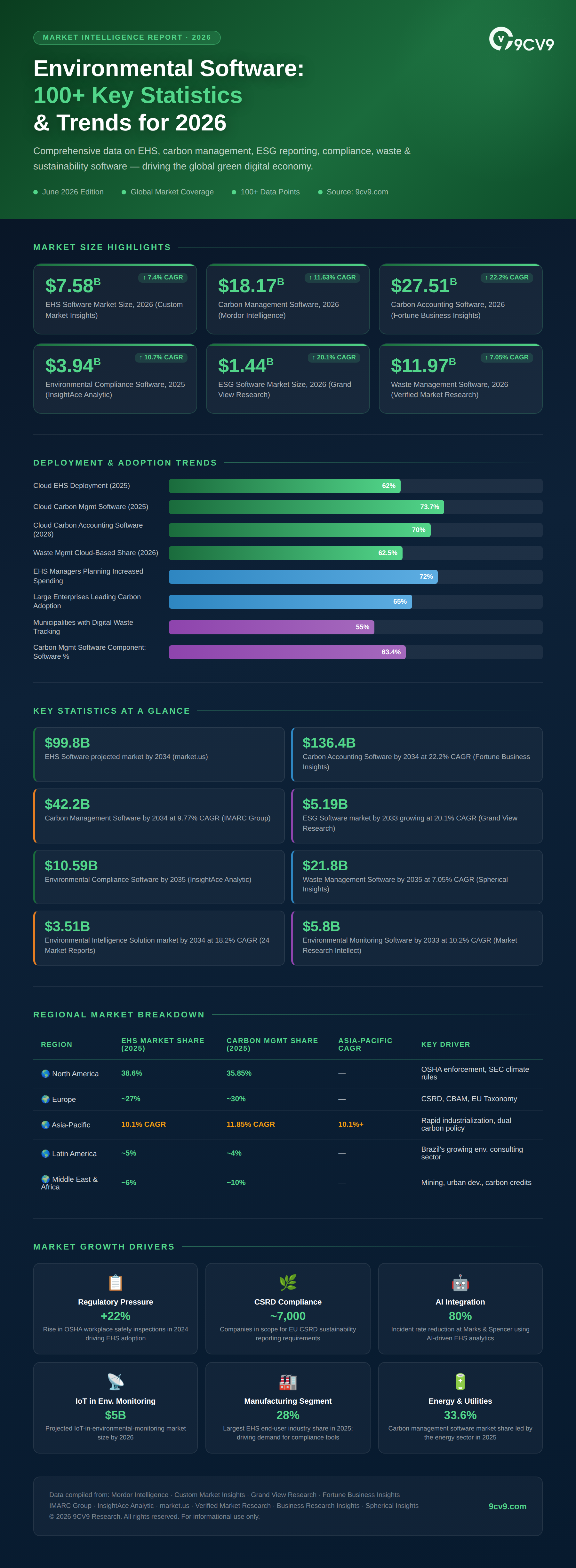
Beyond traditional compliance management, emerging technologies such as AI-powered predictive analytics, Internet of Things (IoT) sensors, digital twins, and blockchain are creating new opportunities across environmental monitoring, waste management, water treatment, and carbon footprint management. For example, the global environmental intelligence solutions market is projected to increase from USD 1.303 billion in 2026 to USD 3.508 billion by 2034, demonstrating growing demand for advanced environmental analytics and predictive decision-making capabilities.
Regional developments further illustrate the expanding global environmental software market. North America continues to lead several major environmental technology segments, while Asia-Pacific is emerging as a particularly fast-growing region. The Asia-Pacific EHS software market is forecast to expand at a CAGR of 10.1% between 2026 and 2035, supported by industrialization, evolving environmental regulations, and increasing enterprise investment in digital sustainability infrastructure.
At the same time, regulatory frameworks such as the European Union’s Corporate Sustainability Reporting Directive (CSRD), Carbon Border Adjustment Mechanism (CBAM), and European Sustainability Reporting Standards (ESRS) are influencing how organizations collect, validate, and disclose environmental information. These regulatory developments are encouraging businesses to move beyond fragmented spreadsheets and manual reporting processes toward integrated environmental compliance and sustainability management platforms.
This comprehensive guide to the Top 120 Environmental Software Statistics, Data & Trends in 2026 examines the most important market developments shaping the environmental technology industry. It covers environmental management software market size, EHS software adoption, carbon accounting platforms, ESG reporting solutions, environmental compliance technologies, waste management software, water monitoring systems, regional growth patterns, regulatory developments, and emerging AI-driven innovations.
Whether for business leaders, sustainability professionals, environmental compliance managers, software vendors, investors, or technology decision-makers, these 120 environmental software statistics provide valuable insights into industry growth, technology adoption, market opportunities, and the future of environmental management software in 2026 and beyond.
Before we venture further into this article, we would like to share who we are and what we do.
About 9cv9
9cv9 is a business tech startup based in Singapore and Asia, with a strong presence all over the world.
With over ten years of startup and business experience, and being highly involved in connecting with thousands of companies and startups, the 9cv9 team has listed some of the top and best companies/tools in this review.
If you like to get your company listed in our top B2B software reviews, check out our world-class 9cv9 Media and PR service and pricing plans here.
Top 120 Environmental Software Statistics, Data & Trends in 2026
🌐 OVERALL EHS SOFTWARE MARKET
- The global EHS software market was valued at USD 6.56 billion in 2024 and grew to USD 7.06 billion in 2025. This sustained growth reflects mounting pressure from regulatory bodies worldwide and the rising corporate mandate to embed environmental accountability into operations.
- The EHS software market is expected to reach USD 7.58 billion in 2026 and USD 14.52 billion by 2035, growing at a CAGR of 7.4%. The near-doubling of market size over a decade underscores how environmental compliance is rapidly becoming a non-negotiable enterprise investment.
- A separate forecast from Research and Markets pegs EHS software at USD 10.04 billion by 2030, at a CAGR of 7.34%. This projection reinforces the market’s resilience and consistent growth trajectory across multiple independent analyst frameworks.
- Market.us estimates the global EHS software market at USD 52.2 billion in 2024, projected to reach USD 99.8 billion by 2034 at a CAGR of 6.7%. The wide variance in market size estimates stems from differing scope definitions — broader EHS classifications that include services push valuations significantly higher.
- Precision Business Insights values the EHS software market at USD 52.6 billion in 2024, forecast to reach USD 82.2 billion by 2031 at a CAGR of 6.6%. This steady growth trajectory makes EHS one of the most reliably expanding segments of the enterprise software landscape.
- North America held 38.6% of the global EHS software market share in 2025, generating USD 20.1 billion in revenue. Decades of OSHA enforcement, advanced corporate safety programs, and early adoption of cloud-based compliance tools continue to entrench North America’s dominance.
- The North America EHS software market alone is estimated at USD 2.73 billion in 2025 and is projected to reach USD 5.21 billion by 2035, at a 5.8% CAGR. This granular figure confirms that even within the leading region, significant expansion headroom remains.
- Asia-Pacific is forecast to grow at a 10.1% CAGR in EHS software between 2026 and 2035 — the fastest of any region. Rapid industrialization, stricter national environmental policies, and cross-border regulatory harmonization are fueling this acceleration.
- Cloud-based EHS deployment commanded 62% of market share in 2025. The shift to cloud mirrors broader enterprise SaaS trends, driven by lower infrastructure overhead, automatic regulatory content updates, and seamless multinational scalability.
- 72% of EHS managers surveyed in 2025 planned to increase software spending within the next 24 months. This near-supermajority signals a structural, not cyclical, upswing in enterprise investment in environmental and safety technology.
- The manufacturing segment held the largest end-user EHS software share at 28% in 2025. High process complexity, hazardous materials exposure, and stringent occupational safety mandates make manufacturing the most natural home for comprehensive EHS platforms.
- Healthcare and life sciences is the fastest-growing EHS end-user segment, projected to expand at a 12.3% CAGR through 2030. Post-pandemic regulatory scrutiny on infection control, waste management, and workforce safety is creating powerful tailwinds for adoption in this sector.
- Energy and utilities accounted for 24% of EHS software market revenue in 2024. This segment’s dominance reflects the industry’s high regulatory accountability, continuous emissions obligations, and massive physical asset bases requiring ongoing safety monitoring.
- AI-driven analytics in EHS platforms enabled Marks & Spencer to achieve an 80% reduction in incident rates. This real-world outcome signals the dramatic operational improvements achievable when machine learning is embedded in safety management workflows.
- The chemical and petrochemical sector dominated EHS software by securing 27.3% of overall revenue in 2024. The inherent hazard profile and heavy regulatory burden of chemical operations make sophisticated EHS tools an existential operational necessity.
🏭 ENVIRONMENTAL HEALTH & SAFETY — REGIONAL & SECTOR BREAKDOWN
- Intelex and Cority recorded a 25% expansion in their customer base in 2024. This milestone growth for two of the market’s most prominent vendors reflects rising enterprise demand for integrated EHS and ESG-capable platforms.
- Enablon and Sphera reported a 30% increase in their customer base across Asia-Pacific in 2024. The Asia-Pacific surge for these global EHS leaders signals a maturation of the regional market beyond pilot deployments into enterprise-wide rollouts.
- OSHA reported a 22% rise in workplace safety inspections in the United States in 2024. Heightened regulatory scrutiny directly accelerates corporate investment in digital compliance tools capable of generating audit-ready documentation.
- The U.S. Department of Labor recorded a 15% annual increase in funding for workplace safety initiatives in 2023. Government investment in safety infrastructure creates both direct demand and a cultural mandate that drives private-sector EHS software adoption.
- India’s Ministry of Labour and Employment noted a 20% increase in workplace safety inspections in 2024. India’s tightening enforcement posture is transforming the subcontinent into a major growth frontier for EHS software vendors seeking new markets.
- Japan saw a 15% increase in funding for occupational health initiatives in 2023. Combined with Japan’s broader digital transformation policy for enterprise software, this investment surge is catalyzing demand for advanced EHS platforms among Japanese enterprises.
- ASEAN recorded a 25% rise in cross-border environmental regulations in 2024. The regionalization of environmental compliance obligations is making multi-jurisdictional EHS platforms an attractive investment for multinationals operating across Southeast Asia.
- In March 2025, Intelex Technologies launched Intelex Essentials, a simplified EHS platform for SMEs. The entry-level product targets a previously underserved segment by removing cost and complexity barriers that historically confined enterprise-grade safety management to large organizations.
- Protex AI raised USD 36 million in a Series B round in February 2025 to expand predictive-safety solutions across North America. This substantial venture investment in AI-powered safety technology reflects growing market conviction in software that predicts — rather than merely records — workplace incidents.
🌿 CARBON MANAGEMENT SOFTWARE
- The global carbon management software market was valued at USD 14.2 billion in 2025 (Global Market Insights). This places carbon management among the largest and fastest-scaling categories within the broader environmental software ecosystem.
- The carbon management software market is projected to grow from USD 15.9 billion in 2026 to USD 36.8 billion by 2035, at a CAGR of 9.8% (Global Market Insights). The accelerating arc of growth reflects intensifying regulatory mandates and corporate decarbonization commitments.
- Mordor Intelligence estimates the carbon management software market at USD 18.17 billion in 2026, expanding to USD 31.5 billion by 2031 at a CAGR of 11.63%. Mordor’s broader market definition — capturing more service revenue — highlights how carbon management platforms are evolving from point tools into full-service suites.
- IMARC Group values the carbon management software market at USD 18.3 billion in 2025, forecast to reach USD 42.2 billion by 2034 at a CAGR of 9.77%. This trajectory reflects not just regulatory push but a strategic pull from CFOs embedding decarbonization metrics into capital allocation models.
- Cloud-first deployments captured 73.7% of the carbon management software market share in 2025. Real-time API integration, reduced manual data entry, and lower total cost of ownership for mid-market adopters make cloud the overwhelming preferred deployment architecture.
- Software components accounted for 68.3% of carbon management software revenue in 2025, with services growing faster. The rising services share reflects organizations increasingly outsourcing complex Scope 3 data harmonization tasks to specialized advisory partners.
- Energy management held 27% of carbon management software demand in 2025. The energy sector’s prominence reflects its immediate cost-savings potential and the heightened regulatory obligation placed on power generators and utilities.
- The energy sector leads carbon management software with approximately 33.6% of market share in 2025 (IMARC Group). This dominance stems from the energy industry’s dual obligation to comply with emissions standards while simultaneously pursuing renewable transition pathways.
- Manufacturing accounts for approximately 27.5% of carbon management software market share in 2025. The manufacturing sector’s significant carbon emissions and energy intensity create a compelling business case for software that enables measurable decarbonization at scale.
- North America retained 35.85% of carbon management software revenue in 2025. SEC climate disclosure rules, state-level emissions mandates, and widespread corporate adoption of science-based targets keep North American enterprise budgets firmly focused on automated carbon platforms.
- Asia-Pacific is on track for the fastest carbon management software CAGR at 11.85% during the forecast horizon. China’s dual-carbon policy and India’s national transition plan are the primary catalysts driving regional deployment at unprecedented scale.
- IBM led the carbon management system market with over 11% market share in 2025. IBM’s integration of carbon tracking within its enterprise IT portfolio gives it a structural advantage over point-solution vendors competing for budget within CIO ecosystems.
- The top five carbon management system players — IBM, Microsoft, SAP, Salesforce, Schneider Electric — collectively held 45% market share in 2025. The moderate market concentration suggests substantial room for specialized vendors and new entrants to carve out viable niches.
- The March 2024 SEC climate disclosure rule triggered a 40% year-over-year surge in U.S. demand for audit-ready carbon platforms in H1 2025. This regulatory event produced the sharpest demand spike in the history of the carbon management software category.
- Early adopters embedding carbon metrics into quarterly close reports achieve 25% lower external assurance costs compared with spreadsheet-based approaches. The financial ROI of automated carbon platforms extends well beyond compliance, delivering tangible savings in third-party audit and assurance expenditures.
- Sustainability add-ons — life-cycle assessment, water and waste tracking, biodiversity impact — register the fastest CAGR of 12.15% within carbon management, driven by the EU’s 2026 digital product passport mandate. Broader environmental modules are fast becoming mandatory features rather than premium add-ons.
- In October 2025, Greenly launched EcoPilot, an AI-powered tool automating data collection and enabling Scope 3 “what-if” scenario modeling. EcoPilot’s launch exemplifies the industry’s pivot from passive data aggregation to proactive decarbonization scenario intelligence.
- More than 1,000 multinational corporations have adopted science-based targets requiring documented year-over-year emissions progress toward 1.5°C pathways. This critical mass of corporate net-zero commitments is creating sustained, non-discretionary demand for carbon management platforms.
- Cardinal Health reduced Scope 1 and Scope 2 emissions by 17% through systematic tracking enabled by a carbon management platform. Real-world outcomes like this validate the business case for carbon software investment and accelerate peer-company adoption.
- The Global Carbon Management Software market had a regional split in 2025 of North America 36%, Europe 30%, Asia-Pacific 24%, Middle East & Africa 10%. Europe’s 30% share reflects the continent’s advanced regulatory environment, led by the EU Taxonomy, CBAM, and CSRD requirements.
- Carbon management software platform deployments faced 45% data quality issues, 35% integration overhead, and 30% standardization gaps as key challenges in 2025. Despite these friction points, the business imperative to comply continues to drive adoption at an accelerating pace.
📊 CARBON ACCOUNTING SOFTWARE
- The global carbon accounting software market was valued at USD 22.51 billion in 2025 and is projected to grow to USD 27.51 billion in 2026. This rapid year-over-year increase from a large base underscores how mandatory GHG reporting is transforming carbon accounting from a niche function to a core finance discipline.
- Carbon accounting software is forecast to reach USD 136.44 billion by 2034 at a CAGR of 22.20% (Fortune Business Insights). A market growing at over 22% annually is among the most dynamic in all of enterprise software, driven by the convergence of regulatory, investor, and ESG pressures.
- North America dominates the carbon accounting software market with a 41.2% share, valued at USD 4.63 billion in 2025. Stringent federal and state environmental regulations, growing investor pressure for ESG disclosures, and widespread corporate sustainability initiatives reinforce North America’s leading position.
- The U.S. carbon accounting software market is projected to grow from USD 4.19 billion in 2025 to USD 29.69 billion by 2035, at a CAGR of 21.63%. This extraordinary growth rate reflects how the U.S. corporate sector is simultaneously responding to regulatory requirements and proactive ESG commitments.
- Software and solutions account for 78% of carbon accounting software market share, with cloud-based deployment capturing 70%. The decisive shift to cloud-first, software-dominant carbon accounting reflects a market that has matured beyond custom implementations to standardized, scalable platforms.
- Large enterprises lead carbon accounting software adoption at 65%. Their operational complexity, multi-jurisdictional reporting obligations, and higher exposure to investor and regulatory scrutiny make enterprise deployments both the largest and most valuable segment.
- Emission tracking platforms are the most popular product type in carbon accounting at 28%. Real-time emissions visibility has become the foundational capability from which all advanced carbon management functions — scenario modeling, offset management, regulatory reporting — are built.
- Cloud-based platforms form 58% of the technology type segment within carbon accounting software. The scalability, integration flexibility, and real-time analytics capabilities of cloud platforms are making them the default architecture for enterprise-grade carbon accounting.
- China held the highest carbon accounting software market share globally in 2025 at approximately 28%. China’s ambitious dual-carbon policy — carbon peak by 2030, carbon neutrality by 2060 — is creating one of the world’s largest and fastest-growing demand pools for carbon accounting technology.
- The energy and utilities sector accounts for 23.93% of carbon accounting software revenue in 2026. Power generators and utilities face the most intense emissions monitoring obligations, making this sector the natural anchor customer for carbon accounting platforms.
♻️ CARBON FOOTPRINT MANAGEMENT SOFTWARE
- The carbon footprint management software market was valued at USD 13.2 billion in 2024 and is projected to reach USD 53.2 billion by 2032, at a CAGR of 16.2%. This rapid expansion reflects how comprehensive footprint management — spanning Scope 1, 2, and 3 — is becoming a boardroom-level imperative.
- Large enterprises command a market share exceeding 70% in carbon footprint management software. The scale, regulatory exposure, and brand risk of large corporations make them both the earliest and deepest adopters of robust footprint management platforms.
- The Carbon Management Software market was valued at USD 3.67 billion in 2025, rising to USD 4.69 billion in 2026 (Global Growth Insights). Even under more conservative scope definitions, the market demonstrates double-digit percentage annual growth.
- Approximately 51% of carbon management software demand comes from corporate sustainability efforts. This majority driver signals that market growth is increasingly self-sustaining — driven by internal ESG strategies rather than external mandates alone.
- Nearly 46% of carbon management software growth is driven by regulatory requirements. Complementing voluntary sustainability commitments, regulatory compulsion remains the single most powerful external force shaping software procurement decisions.
- About 41% of carbon management software usage is linked to emissions tracking systems. Direct emissions monitoring remains the functional core from which more advanced carbon management capabilities are layered.
- Approximately 37% of carbon management software adoption comes from ESG reporting needs. As investor-grade ESG reporting becomes standard practice, platforms that bridge emissions data and audit-ready ESG disclosures command premium market positioning.
- Carbon management software adoption generates 40% faster reporting cycles, 30% improved supplier engagement, and 28% reduced manual reconciliation on average. These operational efficiency gains provide a compelling, quantifiable ROI that accelerates enterprise procurement decisions.
- The carbon management market faces up-front integration costs of USD 50,000–USD 200,000 and limited in-house expertise as the primary barriers to adoption. Modular SaaS tiers and managed implementation services are progressively lowering these barriers for mid-market buyers.
- The Indirect CO2 (Scope 2 & 3) platform segment accounted for approximately 55% of carbon platform interest in 2025. The growing corporate focus on supplier emissions disclosure and financed emissions reporting is shifting the center of gravity in carbon software toward value-chain coverage.
🌱 ESG SOFTWARE
- The global ESG software market was estimated at USD 1.24 billion in 2025 and is expected to reach USD 1.44 billion in 2026, growing at a CAGR of 20.1% through 2033 (Grand View Research). A 20%+ CAGR positions ESG software as one of the fastest-scaling enterprise SaaS categories globally.
- The ESG software market is projected to reach USD 5.19 billion by 2033. This five-fold growth from 2025 levels reflects the structural shift of ESG from a voluntary reporting exercise to a core governance and risk management function.
- North America held a 35.7% revenue share of the global ESG software market in 2025. The combination of SEC climate disclosure requirements and strong investor pressure for standardized ESG data makes North America the world’s most mature ESG software market.
- The ESG reporting and disclosure software segment held the largest revenue share at 36.6% in 2025. Disclosure remains the foundational use case, serving as the entry point from which enterprises expand into broader ESG management and strategy functions.
- Large enterprises held the largest ESG software market share by organization size in 2025. Their mandatory reporting obligations, larger budgets, and higher stakeholder visibility make large enterprises the primary revenue drivers for leading ESG platform vendors.
- The cloud segment accounted for the largest ESG software revenue share in 2025, driven by demand for scalable, cost-efficient platforms. Cloud ESG platforms enable integrated data management, regulatory compliance, and real-time performance monitoring that on-premise solutions struggle to deliver at scale.
- The China ESG software market is projected to expand significantly from 2026 to 2033, driven by regulatory momentum, AI integration, and growing green bond issuance. China’s dominance of global green bond markets is creating powerful demand for ESG platforms that can support transparent reporting to sustainability-focused investors.
- Japan’s ESG software market is poised for robust growth, with carbon management leading and resource management software emerging as the fastest-growing segment. Japanese enterprises are aligning with both global disclosure mandates and domestic sustainability standards, driving diversified ESG software adoption.
- India’s ESG software market is driven by mandatory sustainability disclosures under SEBI’s BRSR Core framework and growing participation in global supply chains requiring traceable ESG data. India’s rapid integration into global value chains is making ESG software a competitive necessity for export-oriented enterprises.
- EQS Group acquired Daato Technologies in December 2024 to enhance its ESG management and CSRD reporting capabilities. The acquisition reflects the market-wide consolidation trend as larger ESG platform vendors seek to close specific capability gaps through targeted M&A.
🌍 ENVIRONMENTAL COMPLIANCE SOFTWARE
- The environmental compliance software market was valued at USD 3.94 billion in 2025 and is predicted to reach USD 10.59 billion by 2035, at a CAGR of 10.7% (InsightAce Analytic). The near-tripling of market size over a decade is driven by expanding regulatory scope globally and the automation imperative in compliance management.
- A separate estimate values environmental compliance software at USD 1.5 billion in 2024, forecast to reach USD 3.2 billion by 2033 at a CAGR of 9.2% (Verified Market Reports). This tighter market definition focuses specifically on standalone compliance management tools rather than broader EHS suites.
- North America is expected to hold the largest environmental compliance software market share through 2033. The U.S.’s dense regulatory environment — spanning EPA mandates, state-level GHG reporting, and sector-specific environmental laws — creates a uniquely demanding compliance landscape that drives software procurement.
- Asia-Pacific is projected to be the fastest-growing region in environmental compliance software. The rapid industrialization of Asian economies, combined with increasingly stringent national environmental regulations, is creating the world’s largest incremental demand growth pool for compliance software.
- The air emissions management segment dominated the environmental compliance software market in 2025. Tightening greenhouse gas regulations and industrial air pollution controls are making automated emissions monitoring and reporting the highest-priority compliance function for large emitters.
- Cloud-based environmental compliance software held the largest deployment share in 2025 due to accessibility, affordability, and scalability. Remote accessibility and real-time regulatory updates make cloud platforms particularly attractive to multi-site operations needing consistent compliance across geographies.
- Brazil’s environmental consulting services market was valued at USD 3.00 billion in 2027 (projected at time of report), with forecasts to reach USD 6.10 billion by 2033 at 7.2% CAGR. Brazil’s active participation in global environmental initiatives and its stringent industrial environmental regulations are making it Latin America’s dominant compliance software market.
🗑️ WASTE MANAGEMENT SOFTWARE
- The global waste management software market was valued at USD 10.30 billion in 2024 and grew to USD 11.13 billion in 2025, at a CAGR of 8.9% (Research and Markets). The double-digit-adjacent growth rate confirms that digitization of waste operations is well past the early-adoption phase and entering mainstream deployment.
- The waste management software market is projected to reach USD 11.97 billion in 2026 and USD 21.80 billion by 2035, at a CAGR of 7.05% (Spherical Insights, Econ Market Research). The market’s sustained growth reflects the escalating global waste challenge — with annual municipal solid waste generation exceeding 2.24 billion metric tons.
- Cloud-based solutions dominate the waste management software market with approximately 62.5% share in 2026. Smart waste ecosystems built on cloud platforms enable real-time bin monitoring, dynamic route optimization, and automated regulatory reporting that on-premise systems cannot match.
- Over 55% of municipalities across developed economies have integrated digital waste tracking systems to optimize collection and disposal efficiency. This majority adoption milestone signals that digital waste management has crossed the tipping point from competitive advantage to operational baseline.
- Approximately 68% of waste management companies utilize route optimization software to reduce fuel consumption by 15%–25%. Route optimization delivers immediate, measurable cost savings that provide a clear financial ROI, making it the most widely adopted function in waste management software.
- IoT-enabled waste monitoring systems are deployed in more than 40% of smart cities globally, improving bin utilization rates by up to 35%. The integration of hardware sensors with software platforms is creating a new category of data-driven, demand-responsive waste collection.
- Regulatory compliance software adoption has grown by 30% in industrial waste management sectors. Tightening hazardous waste regulations and extended producer responsibility frameworks are driving enterprises to invest in digital compliance tracking at scale.
- In February 2026, Hauler Hero raised USD 16 million to expand its AI-native waste management software for SME haulers. This significant investment in AI-first waste management technology signals growing investor conviction in the SME segment as the next frontier for digital waste operations.
- In October 2025, RapidWorks acquired CRO Software, a pioneer in waste management and recycling software since 2013. This acquisition exemplifies the consolidation trend reshaping the waste management software landscape as larger operators seek to acquire proven platforms with established customer bases.
- Waste Management Inc. finalized its USD 7.2 billion acquisition of Stericycle in November 2024, delivering over USD 125 million in expected cost synergies. The merger creates a vertically integrated waste and healthcare solutions giant that will expand demand for integrated waste management software across both segments.
💧 WATER & ENVIRONMENTAL MONITORING SOFTWARE
- The water treatment management software market was valued at USD 2.51 billion in 2024 and is projected to grow to USD 2.69 billion in 2025 and USD 5.2 billion by 2035, at a CAGR of 6.9%. Water technology digitization is accelerating as utilities face tightening quality standards and aging infrastructure replacement imperatives.
- The global environmental monitoring market was valued at USD 15.48 billion in 2025 and is projected to grow to USD 16.38 billion in 2026 and USD 25.68 billion by 2034, at a CAGR of 5.78% (Fortune Business Insights). Environmental monitoring represents the broadest data-capture layer on which all downstream software analytics are built.
- The environmental monitoring software market (software-only) was estimated at USD 2.5 billion in 2024 and is projected to reach USD 5.8 billion by 2033 at a CAGR of 10.2%. The software layer is growing nearly twice as fast as the broader monitoring market, reflecting the shift from hardware-centric to analytics-centric monitoring.
- The environmental hazard monitoring software market was valued at USD 8.515 billion in 2024 and is projected to grow to USD 18.41 billion by 2035 at a CAGR of 7.26% (Market Research Future). Hazard monitoring software is increasingly driven by climate change-related risk management needs across industrial, urban, and infrastructure sectors.
- The IoT-in-environmental-monitoring market is projected to reach USD 5 billion by 2026. The explosive growth of IoT sensor networks is creating vast new streams of environmental data that software platforms must aggregate, normalize, and analyze in real time.
- The global environmental intelligence solution market was valued at USD 1.103 billion in 2025 and is projected to grow to USD 1.303 billion in 2026 and USD 3.508 billion by 2034, at a CAGR of 18.2%. Environmental intelligence — combining AI, IoT, and satellite analytics — is emerging as the next evolution beyond traditional monitoring software.
- Manufacturing leads environmental intelligence adoption with 32% market share, while agriculture shows the fastest growth at 24% CAGR. The diversity of high-growth verticals confirms that environmental intelligence is not a single-sector story but a broad-based digital transformation opportunity.
- Integration of AI and IoT with environmental monitoring is expected to drive a 45% increase in solution adoption by 2025-2026. The pairing of AI-driven analytics with real-time IoT data streams is fundamentally expanding what is possible in environmental monitoring, moving from reactive reporting to predictive management.
- Schneider Electric launched EcoStruxure Water 2.0 in March 2025, integrating AI, digital twin capabilities, and real-time analytics for industrial water treatment. This product launch signals that major automation vendors are embedding advanced analytics directly into water management infrastructure, blurring the boundary between OT and IT.
📋 REGULATORY ENVIRONMENT & ESG FRAMEWORKS
- The EU’s Corporate Sustainability Reporting Directive (CSRD) was adopted in November 2022 and entered into force on January 1, 2024. CSRD represents the most sweeping expansion of mandatory sustainability reporting in corporate history, and its implementation is a primary catalyst for environmental software adoption globally.
- Approximately 7,000 companies globally are required to comply with CSRD reporting requirements under the original scope. The breadth of companies in scope — spanning large EU entities and non-EU multinationals with EU operations — is creating unprecedented demand for digital sustainability reporting tools.
- The Omnibus I simplification package revised CSRD scope to companies with more than 1,000 employees and over €450 million in net annual turnover, potentially removing approximately 80% of originally in-scope companies. Despite the scope reduction, the remaining in-scope companies represent the largest and most complex organizations, generating substantial demand for enterprise-grade compliance software.
- The revised ESRS (European Sustainability Reporting Standards) proposes a 61% reduction in mandatory data points — from approximately 1,100 to roughly 430. While the reduction eases the reporting burden, the remaining mandatory disclosures require robust digital infrastructure to collect, validate, and report accurately.
- Wave 1 CSRD companies (formerly NFRD-scope) began reporting for fiscal year 2024, with first reports published in 2025. The commencement of actual CSRD reporting in 2025 has triggered a wave of software procurement across affected organizations and their value-chain partners.
- The EU Carbon Border Adjustment Mechanism (CBAM) went live with operational procedures confirmed for January 1, 2026, requiring product-level embedded-emissions data for imports. CBAM creates a direct financial incentive for global manufacturers to invest in carbon tracking software to quantify and document embedded emissions in exported goods.
- The EU’s CSDDD (Corporate Sustainability Due Diligence Directive) was amended by Directive (EU) 2026/470, published in the Official Journal on February 26, 2026. The continued evolution of EU sustainability law ensures that regulatory complexity — and therefore demand for compliance software — will remain elevated throughout the decade.
- CSRD mandates that businesses have a Paris Agreement-aligned emissions reduction plan to reach net zero by 2050, starting in 2025. This long-term planning obligation creates multi-year demand for carbon scenario modeling and decarbonization pathway software.
- ZF aligned its governance, risk, and compliance program with ESRS while scaling AI across operations in March 2025. This high-profile corporate action demonstrates how leading global manufacturers are treating CSRD not as a compliance burden but as an opportunity to embed sustainability intelligence into core operations.
🤖 TECHNOLOGY TRENDS
- The sustainability software market is valued at USD 0.99 billion in 2026 and is expected to rise to USD 3.5 billion by 2035, at a CAGR of 15.9% (Business Research Insights). The emergence of standalone sustainability management platforms alongside EHS and carbon tools reflects the maturation of the broader green software ecosystem.
- AI predictive analytical systems now dominate environmental software development, enabling organizations to forecast environmental impacts and manage resource allocation proactively. The transition from descriptive to predictive analytics is the defining technology shift reshaping environmental software in 2026.
- Blockchain technology is being integrated into carbon markets to create immutable audit trails for emissions data and carbon credit transactions. Blockchain’s tamper-proof ledger capabilities address the trust and verification challenges that have historically undermined confidence in voluntary carbon markets.
- The average implementation time for enterprise environmental intelligence platforms exceeds 6 months due to interoperability issues with legacy infrastructure. Integration complexity remains the most significant friction point in environmental software deployments, creating opportunities for specialist implementation partners.
- High implementation costs for comprehensive environmental intelligence platforms can exceed USD 500,000, creating barriers for SMEs. The cost gap between enterprise and SME deployments is gradually closing as modular SaaS offerings and managed service models make sophisticated capabilities accessible to smaller organizations.
- The environmental software market faces a 20% gap in qualified professionals capable of managing advanced environmental data analytics systems. The talent shortage in environmental data science represents both a growth constraint and an opportunity for training, certification, and managed service offerings.
- GE Vernova reported USD 35 billion revenue in February 2025, showcasing GridOS® software as the digital centerpiece for low-carbon grid management. The prominence of software within GE Vernova’s business narrative underscores how energy-transition technology is increasingly defined by data and analytics rather than hardware alone.
- The waste management sector’s cloud-based adoption is accelerating in 2026, with digital platforms now connecting directly to smart bins with fill-level sensors and GPS-enabled fleet systems. The convergence of hardware IoT and cloud software in waste management is creating the first truly data-driven, demand-responsive waste collection systems.
- Persefoni’s AI-driven carbon platform provides trusted carbon calculations to over 2,000 companies. Reaching this scale of enterprise adoption validates AI-powered carbon accounting as a mainstream — rather than emerging — capability within the environmental software market.
- In September 2025, SUEZ and CNRS entered a five-year strategic partnership to advance sustainable water and waste management solutions, including a pilot project to convert sludge into renewable gas by 2026. This partnership exemplifies how environmental software is increasingly embedded within broader circular economy and energy-recovery innovations.
Conclusion
The Top 120 Environmental Software Statistics, Data & Trends in 2026 highlight the growing importance of environmental technology in helping organizations achieve sustainability goals, improve regulatory compliance, reduce operational costs, and make data-driven environmental decisions. As businesses face increasing pressure to measure carbon emissions, manage environmental risks, and demonstrate corporate accountability, environmental software is evolving from a specialized compliance tool into an essential component of enterprise digital transformation.
The global environmental software market is experiencing substantial growth across multiple segments. The Environmental, Health, and Safety (EHS) software market is projected to reach USD 7.58 billion in 2026 and USD 14.52 billion by 2035, while the carbon accounting software market is forecast to expand from USD 27.51 billion in 2026 to USD 136.44 billion by 2034. These projections demonstrate the increasing investment in environmental management platforms, automated emissions tracking, sustainability reporting systems, and integrated compliance solutions.
One of the most significant environmental software trends in 2026 is the accelerating adoption of artificial intelligence, cloud computing, IoT-enabled monitoring, and predictive analytics. Cloud-based platforms are becoming increasingly prominent, accounting for approximately 62% of the EHS software market in 2025 and 73.7% of carbon management software deployments. These technologies enable organizations to automate environmental data collection, improve reporting accuracy, monitor resource consumption, and identify potential environmental risks before they escalate.
Carbon management and ESG reporting software are also emerging as major growth drivers. Organizations are increasingly investing in solutions that support Scope 1, Scope 2, and Scope 3 emissions tracking, carbon footprint calculations, sustainability performance measurement, and regulatory disclosures. Meanwhile, evolving environmental regulations, including the European Union’s CSRD, CBAM, and ESRS frameworks, continue to influence enterprise software purchasing decisions and encourage more standardized environmental reporting practices.
Regional market developments further reinforce the industry’s long-term growth potential. North America remains a leading market for environmental software adoption, supported by established regulatory frameworks and corporate sustainability initiatives. At the same time, Asia-Pacific is expected to experience some of the fastest growth, with its EHS software market projected to expand at a CAGR of 10.1% between 2026 and 2035. This regional momentum presents opportunities for environmental software providers serving manufacturing, energy, healthcare, utilities, and other highly regulated industries.
Despite these positive developments, environmental software adoption continues to face challenges, including high implementation costs, complex integration requirements, inconsistent environmental data quality, and shortages of qualified sustainability technology professionals. Businesses must therefore evaluate environmental software solutions based on their scalability, integration capabilities, regulatory coverage, reporting accuracy, automation features, and long-term return on investment.
Looking ahead, the future of environmental software will increasingly revolve around AI-powered environmental intelligence, automated carbon accounting, real-time environmental monitoring, predictive risk management, and integrated sustainability platforms. As organizations move beyond basic compliance toward measurable environmental performance improvements, software solutions that combine accurate data, intelligent automation, and actionable insights are likely to become increasingly valuable.
Ultimately, these 120 environmental software statistics for 2026 demonstrate that environmental technology is no longer solely about meeting regulatory requirements. It is becoming a strategic investment that can strengthen operational resilience, improve resource efficiency, support corporate sustainability objectives, and create long-term competitive advantages. Organizations that embrace scalable, data-driven environmental management solutions will be better positioned to navigate evolving regulations, respond to stakeholder expectations, and contribute to a more sustainable global economy.
If you find this article useful, why not share it with your hiring manager and C-level suite friends and also leave a nice comment below?
We, at the 9cv9 Research Team, strive to bring the latest and most meaningful data, guides, and statistics to your doorstep.
To get access to top-quality guides, click over to 9cv9 Blog.
To hire top talents using our modern AI-powered recruitment agency, find out more at 9cv9 Modern AI-Powered Recruitment Agency.
People Also Ask
What is environmental software?
Environmental software helps businesses monitor environmental performance, track carbon emissions, manage waste, ensure regulatory compliance, and improve sustainability. It includes EHS management, ESG reporting, carbon accounting, and environmental monitoring platforms.
How big is the global environmental software market in 2026?
The global Environmental, Health, and Safety (EHS) software market is projected to reach USD 7.58 billion in 2026. The broader environmental software industry includes carbon accounting, ESG reporting, waste management, and environmental monitoring solutions.
What is the projected growth rate of the EHS software market?
The global EHS software market is expected to grow at a compound annual growth rate (CAGR) of 7.4% between 2026 and 2035, reaching approximately USD 14.52 billion by 2035.
What are the biggest environmental software trends in 2026?
Major environmental software trends in 2026 include AI-powered predictive analytics, cloud-based sustainability platforms, automated carbon accounting, IoT environmental monitoring, real-time ESG reporting, and integrated environmental compliance management.
How much is the carbon accounting software market worth in 2026?
The global carbon accounting software market is projected to reach USD 27.51 billion in 2026, with forecasts indicating growth to USD 136.44 billion by 2034 at a CAGR of 22.20%.
What is environmental management software used for?
Environmental management software helps organizations track emissions, monitor resource consumption, manage environmental risks, automate regulatory reporting, and improve sustainability performance across business operations.
What percentage of EHS software is cloud-based?
Cloud-based EHS software accounted for approximately 62% of the global market in 2025. Businesses increasingly prefer cloud platforms for scalability, remote accessibility, automated updates, and lower infrastructure costs.
Which region dominates the environmental software market?
North America leads several environmental software segments, including EHS, carbon management, and ESG software. Its market position reflects established regulatory frameworks, corporate sustainability investments, and widespread enterprise technology adoption.
Which region has the fastest-growing EHS software market?
Asia-Pacific is projected to be the fastest-growing EHS software market, expanding at a CAGR of 10.1% between 2026 and 2035. Industrialization, environmental regulations, and digital transformation are driving regional demand.
What is the difference between EHS software and ESG software?
EHS software focuses on environmental compliance, workplace health, safety, and operational risk management. ESG software supports environmental, social, and governance performance tracking, sustainability disclosures, and corporate reporting.
How is artificial intelligence transforming environmental software?
AI improves environmental software through predictive analytics, automated emissions calculations, environmental risk detection, resource optimization, and intelligent reporting. These capabilities help businesses identify problems earlier and make better sustainability decisions.
What is the ESG software market size in 2026?
The global ESG software market is estimated to reach USD 1.44 billion in 2026. Industry forecasts project continued growth to approximately USD 5.19 billion by 2033, supported by sustainability reporting and regulatory compliance requirements.
Why is carbon management software becoming more important?
Carbon management software helps businesses measure greenhouse gas emissions, track decarbonization targets, manage Scope 1, 2, and 3 emissions, and meet sustainability reporting requirements. Demand is increasing as organizations prioritize climate accountability.
What is the carbon management software market forecast for 2035?
According to Global Market Insights estimates, the global carbon management software market is projected to reach USD 36.8 billion by 2035, growing from USD 15.9 billion in 2026 at a CAGR of 9.8%.
Which industries use environmental software the most?
Manufacturing, energy, utilities, chemicals, healthcare, and life sciences are major environmental software users. These industries face significant environmental risks, complex regulations, and growing requirements for emissions monitoring and sustainability reporting.
What is environmental compliance software?
Environmental compliance software helps organizations monitor regulatory obligations, manage environmental permits, track emissions, maintain audit records, and automate compliance reporting. It reduces administrative workloads and supports regulatory accountability.
How large is the environmental compliance software market?
The global environmental compliance software market was valued at approximately USD 3.94 billion in 2025 and is projected to reach USD 10.59 billion by 2035, representing a CAGR of 10.7%.
What is the waste management software market size in 2026?
The global waste management software market is projected to reach USD 11.97 billion in 2026 and USD 21.80 billion by 2035. Growth is supported by smart waste collection, route optimization, recycling management, and automated compliance reporting.
How does waste management software reduce operating costs?
Waste management software improves collection routes, fleet scheduling, fuel efficiency, and resource allocation. Industry estimates indicate that route optimization software can reduce fuel consumption by approximately 15% to 25%.
What role does IoT play in environmental monitoring software?
IoT technology connects environmental sensors, smart meters, monitoring equipment, and cloud platforms. It enables real-time tracking of air quality, water conditions, emissions, waste levels, and environmental risks.
How big is the environmental monitoring market in 2026?
The global environmental monitoring market is projected to reach USD 16.38 billion in 2026, increasing to USD 25.68 billion by 2034 at a CAGR of 5.78%. This broader market includes environmental monitoring technologies beyond software alone.
What is environmental intelligence software?
Environmental intelligence software combines AI, IoT, analytics, and environmental data to monitor conditions, predict risks, and support sustainability decisions. It helps organizations respond proactively to environmental challenges.
What is the environmental intelligence software market forecast?
The global environmental intelligence solutions market is projected to grow from USD 1.303 billion in 2026 to USD 3.508 billion by 2034, representing a CAGR of 18.2%.
How does environmental software support ESG reporting?
Environmental software collects, organizes, and analyzes sustainability data for ESG disclosures. It supports emissions tracking, environmental performance measurement, regulatory reporting, audit preparation, and corporate sustainability transparency.
How does the EU CSRD affect environmental software adoption?
The Corporate Sustainability Reporting Directive increases demand for software that manages sustainability disclosures, environmental data, and audit documentation. Its evolving scope encourages affected organizations to adopt structured reporting systems.
What is the role of carbon accounting software in Scope 3 emissions tracking?
Carbon accounting software helps businesses estimate and monitor indirect emissions across their value chains. It consolidates supplier data, applies emissions factors, and supports Scope 3 reporting and decarbonization planning.
What are the biggest challenges in implementing environmental software?
Major challenges include high implementation costs, complex integrations, inconsistent environmental data, limited technical expertise, and changing regulations. Enterprise environmental intelligence implementations can exceed six months.
How much does environmental software implementation cost?
Implementation costs vary by platform and business requirements. The research identifies carbon management integration costs of USD 50,000 to USD 200,000, while comprehensive enterprise environmental intelligence deployments can exceed USD 500,000.
How can businesses choose the best environmental software in 2026?
Businesses should evaluate environmental software based on regulatory coverage, carbon tracking capabilities, ESG reporting features, integration options, scalability, data accuracy, automation, implementation costs, and long-term return on investment.
What is the future of environmental software beyond 2026?
Environmental software is expected to become more intelligent, automated, and interconnected. AI-driven analytics, real-time IoT monitoring, cloud platforms, digital twins, and integrated sustainability reporting will shape the industry’s development through 2035.
Sources
Custom Market Insights
Mordor Intelligence
Research and Markets
Market.us
Precision Business Insights
InsightAce Analytic
Verified Market Reports
Grand View Research
Fortune Business Insights
IMARC Group
Global Growth Insights
Global Market Insights
Verified Market Research
Business Research Insights
24 Market Reports
Grand Research Store
Market Research Future
Market Research Intellect
Spherical Insights
Econ Market Research
The Insight Partners
WiseGuy Reports
European Commission
Normative
KPMG
Salesforce
Coolset
PwC
Cognitive Market Research
Intelmarket Research