

Key Takeaways
- Engineering CAD Software Market Growth: The global Engineering CAD software market is projected to reach USD 13 billion in 2026 and USD 26.76 billion by 2035, growing at a CAGR of 8.35%.
- Engineering CAD Software Adoption: Over 84% of engineering firms reportedly use CAD platforms, with more than 52 million active CAD professionals worldwide and 3D CAD accounting for 61% of installations.
- AI, Cloud CAD, and Emerging Technology Trends: AI-assisted design usage has grown by 33%, while 53% of CAD software vendors prioritize cloud platforms, accelerating automation, collaboration, and digital engineering innovation.
Engineering CAD software is transforming digital design, with the global market projected to reach USD 13 billion in 2026 and USD 26.76 billion by 2035, growing at an 8.35% CAGR. Explore 126 Engineering CAD software statistics covering market growth, adoption rates, AI-powered design, cloud computing, 3D modeling, and emerging industry trends.
Engineering CAD software is transforming how engineers, manufacturers, architects, and product designers develop, simulate, and optimize complex designs. As industries accelerate digital transformation, the adoption of computer-aided design (CAD) software continues to expand, driven by advancements in artificial intelligence (AI), cloud-based collaboration, 3D modeling, generative design, and automation. Understanding the latest Engineering CAD software statistics, data, and trends in 2026 is essential for businesses seeking to improve design efficiency, reduce development costs, and remain competitive in an increasingly technology-driven market.
Also, read our article on the Top 10 Engineering CAD Software To Know.


The global Engineering CAD software market is projected to reach approximately USD 13 billion in 2026, up from USD 12 billion in 2025, with an estimated compound annual growth rate (CAGR) of 8.35% through 2035. By the end of that forecast period, the market could exceed USD 26.75 billion, reflecting sustained investment in digital engineering solutions. Meanwhile, the broader CAD and Product Lifecycle Management (PLM) software market is expected to reach USD 19.11 billion in 2026, highlighting the growing importance of integrated design, engineering, and product development platforms.
Engineering CAD software adoption is also reaching new heights. Research estimates suggest that more than 84% of engineering firms worldwide use CAD platforms, while the global active CAD user base has surpassed 52 million professionals. Three-dimensional CAD software accounts for approximately 61% of installations, demonstrating the increasing preference for advanced modeling, simulation, and visualization capabilities. Leading providers such as Autodesk, Dassault Systèmes, Siemens, and PTC continue to shape the competitive landscape through investments in cloud technologies, AI-assisted design, and engineering automation.

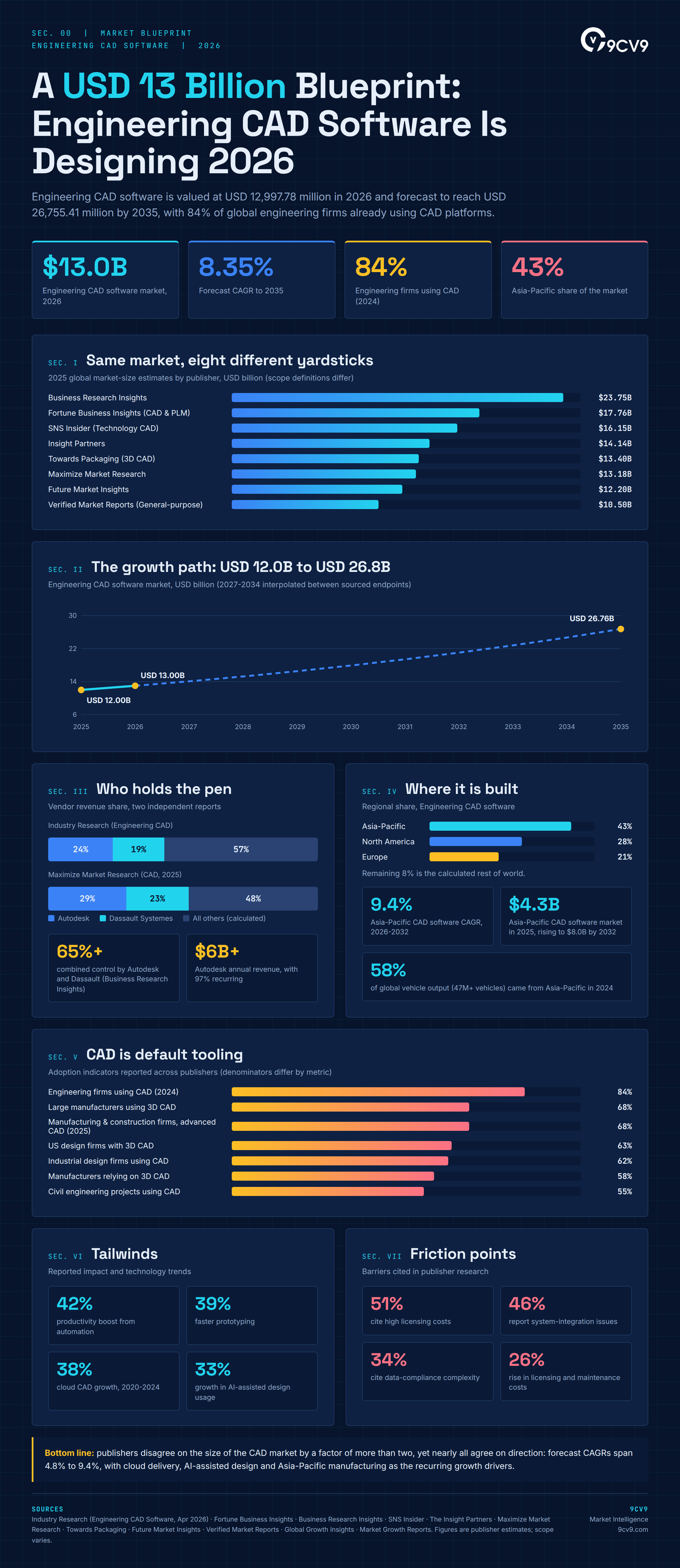
Emerging technologies are further reshaping the Engineering CAD software industry. Cloud-based CAD adoption has accelerated as organizations prioritize real-time collaboration, remote accessibility, and streamlined design workflows. AI-assisted design and generative modeling usage has reportedly increased by 33%, while 53% of CAD software vendors are focusing on cloud platforms and 45% are incorporating AI capabilities. These developments are helping engineering teams automate repetitive tasks, improve design accuracy, accelerate prototyping, and reduce product development timelines.
Despite these opportunities, Engineering CAD software vendors and users face significant challenges, including rising licensing costs, integration complexities, cybersecurity concerns, and the need for specialized technical expertise. Research indicates that 51% of firms identify high licensing costs as a major obstacle, while 46% report integration difficulties. Regional market dynamics also vary considerably, with Asia-Pacific emerging as a major growth center for engineering design technologies, supported by expanding manufacturing activities, automotive production, and industrial digitalization.
This comprehensive guide explores the Top 126 Engineering CAD Software Statistics, Data & Trends in 2026, covering global market size, revenue forecasts, industry growth rates, market share, leading CAD software companies, adoption trends, AI integration, cloud-based CAD solutions, regional developments, and emerging engineering technologies. Whether for engineering professionals, manufacturing executives, software vendors, technology investors, or business decision-makers, these statistics provide valuable insights into the current state of the Engineering CAD software market and the key trends shaping its future.
Before we venture further into this article, we would like to share who we are and what we do.
About 9cv9
9cv9 is a business tech startup based in Singapore and Asia, with a strong presence all over the world.
With over ten years of startup and business experience, and being highly involved in connecting with thousands of companies and startups, the 9cv9 team has listed some of the top and best companies/tools in this review.
If you like to get your company listed in our top B2B software reviews, check out our world-class 9cv9 Media and PR service and pricing plans here.
Top 126 Engineering CAD Software Statistics, Data & Trends in 2026
Market size and growth
- Engineering CAD software is valued at USD 12,997.78 million in 2026. This makes Engineering CAD software a roughly USD 13 billion category, though broader CAD definitions produce larger totals.
- The Engineering CAD software market is forecast to reach USD 26,755.41 million by 2035. That implies the category could roughly double in a decade, if the forecast holds.
- The Engineering CAD software market has a forecast CAGR of 8.35%. This is at the higher end of published CAD growth rates, which range from 4.8% to 9.4%.
- Engineering CAD software was valued at USD 11,996.1 million in 2025. That gives the 2026 figure a clear baseline for year-on-year comparison.
- Engineering CAD software adds about USD 1,001.68 million from 2025 to 2026 (calculated). That is an 8.35% one-year rise, matching the published CAGR.
- Engineering CAD software adds about USD 13,757.63 million between 2026 and 2035 (calculated). Most of the expansion falls in the later years of the forecast.
- The global CAD and PLM software market was USD 17.76 billion in 2025. Adding product lifecycle management widens the scope well beyond core design tools.
- CAD and PLM software is projected at USD 19.11 billion in 2026. That is about a 7.6% step up from 2025 on the publisher’s own numbers.
- CAD and PLM software is forecast to reach USD 34.39 billion by 2034, at a 7.60% CAGR. Buyers evaluating bundled design and lifecycle suites should expect this faster path.
- North America held a 31.30% share (USD 5.55 billion) of CAD and PLM software in 2025. The region remains the largest single pool of spending in this definition.
- North America’s CAD and PLM market is projected at USD 5.85 billion in 2026. Growth there is steady rather than explosive.
- Technology CAD software is estimated at USD 279.53 million in 2026. This narrow definition is far smaller than the headline CAD figures.
- Technology CAD software is forecast to reach USD 565.71 million by 2035, at an 8.13% CAGR. Despite its small base, its growth rate is close to Engineering CAD’s.
- Technology CAD represents about 37.6% of the engineering software ecosystem in 2024. Design tools therefore remain a major slice of the broader engineering stack.
- CAD adoption has surpassed 4.3 million active licenses worldwide. That figure is far lower than other user-base counts, a reminder that seat metrics are measured inconsistently.
- Over 58% of small firms plan to adopt digital design tools by 2026. Low-cost CAD platforms are a clear opportunity for vendors targeting SMEs.
- Topology optimization can reduce prototype development cycles by up to 60%. The figure is a vendor-ecosystem claim, so actual gains will vary by use case.
- Cloud-based 3D CAD improves team collaboration efficiency by 45%. Real-time editing and version control replace local-file workflows.
- Embedding simulation directly in design environments cuts downstream testing costs by 35%. Integrated tools reduce handoffs between design and analysis.
- Over 2 million 3D printers were operating globally by 2024. Additive manufacturing continues to pull CAD into production workflows.
- The CAD software market was US$14.14 billion in 2025 per The Insight Partners. This sits in the middle of the publisher range.
- CAD software is forecast to reach US$23.3 billion by 2034, at a 5.70% CAGR. That is one of the more conservative growth outlooks.
- The total addressable market for CAD software over 2026 to 2034 is about US$169.63 billion. This cumulative figure shows the lifetime revenue pool, not annual spend.
- General-purpose CAD software was valued at USD 10.5 billion in 2025. It is the smallest 2025 estimate among the publishers compared here.
- General-purpose CAD is forecast to reach USD 15.2 billion by 2034, at a 4.8% CAGR. This is the slowest published growth rate in this review.
- The computer-aided design software market was USD 23.75 billion in 2025 per Business Research Insights. It is the largest 2025 estimate found.
- The same publisher projects USD 25.27 billion in 2026. That implies about 6.4% year-on-year growth.
- The market is forecast to reach USD 44.38 billion by 2035, at a 6.4% CAGR. Differences in scope explain most of the gap versus other forecasts.
- 3D CAD software was valued at USD 13.40 billion in 2025. Three-dimensional tools make up the bulk of modern CAD spending.
- 3D CAD is forecast to reach USD 25.88 billion by 2035, at a 6.8% CAGR. Demand is supported by simulation and additive manufacturing.
- 3D CAD is estimated at USD 14.31 billion in 2026. That is about 6.8% above the 2025 estimate from the same publisher.
- Future Market Insights sizes the CAD market at USD 12.2 billion in 2025. This is the second-lowest 2025 estimate in the comparison.
- The same report forecasts USD 22.7 billion by 2035, at a 6.4% CAGR. Its growth rate matches Business Research Insights’ despite a much smaller base.
- The Business Research Company forecasts the CAD market at USD 27.35 billion by 2030, at a 5.9% CAGR. A shorter forecast window gives a more near-term view.
- Maximize Market Research sizes the CAD market at USD 13.18 billion in 2025. It lands close to the 3D CAD estimate.
- The same report forecasts USD 21.03 billion by 2032, at a 6.9% CAGR. Its forecast window ends earlier than most.
- A separate 2026 estimate puts the CAD software market at USD 6.11 billion, growing to USD 10.55 billion by 2035 at 6.2%. Narrow definitions like this produce much smaller totals.
- 3D CAD software is projected at USD 13,041.54 million in 2026, reaching USD 21,917.72 million by 2035 at 5.94%. Estimates for 3D CAD vary by about 10% for the same year.
- Technology CAD software was USD 16.15 billion in 2025E, forecast to reach USD 30.17 billion by 2033 at 8.20%. This is one of the faster-growing definitions.
- The US Technology CAD market is USD 4.24 billion in 2025E, rising to USD 7.30 billion by 2033 at 7.11%. US growth trails the global rate slightly.
Vendors and competition
- Autodesk holds about 24% of the Engineering CAD market. It leads this report’s vendor ranking.
- Dassault Systèmes holds about 19% of the Engineering CAD market. It is the clear number two in this report.
- Autodesk had a 29% CAD revenue share in 2025 per Maximize Market Research. A different scope pushes its share about 5 points higher.
- Dassault had a 23% CAD revenue share in 2025 in the same report. Its share is also higher than in the Engineering CAD report.
- Autodesk and Dassault together control over 65% of the total CAD market per Business Research Insights. Sources disagree on this concentration, with other reports showing about 43% to 52%.
- Combined Autodesk and Dassault share is 43% in the Engineering CAD report (calculated). Concentration looks lower under narrower definitions.
- Combined Autodesk and Dassault share is 52% in the Maximize report (calculated). The remaining 48% is spread across Siemens, PTC, Bentley and others.
- Autodesk leads with over 45% of CAD users in architecture, engineering and construction per government-sourced figures cited by Business Research Insights. User share and revenue share are different measures.
- Bentley Systems’ platforms are used by more than 50% of state transportation departments. Infrastructure agencies remain a specialist stronghold.
- AutoCAD holds a 38.57% share of tracked CAD software installations per 6sense. This is technographic tracking, not revenue.
- SolidWorks holds a 13.59% share in the same 6sense dataset. It ranks second behind AutoCAD.
- Over 156,007 companies are tracked as using AutoCAD in 2026. That illustrates the product’s breadth across firm sizes.
- Over 36,633 companies are tracked as using Autodesk as a CAD tool. Counts differ because 6sense treats Autodesk and AutoCAD as separate products.
- 48.90% of AutoCAD customers tracked by 6sense are in the United States. That is a heavily US-weighted install base.
- Enlyft estimates AutoCAD’s share of computer-aided design and engineering at about 29.65%. Different tracking methods yield different shares.
- Enlyft tracks 280,478 companies using AutoCAD. Its tracked-company count is almost double 6sense’s.
- Autodesk’s FY2025 subscription plan revenue was USD 5.72 billion, up 12%. This shows recurring revenue dominating its business model.
- Autodesk’s total subscriptions rose by about 516 thousand to 7.79 million. Seat growth continues despite higher prices and a maturing market.
- Autodesk’s Make revenue was USD 654 million, up 25%. Its manufacturing-focused offering is growing faster than the company overall.
- Autodesk’s GAAP operating margin was 22%, with a non-GAAP margin of 36%. Those margins reflect a mature subscription software business.
- Autodesk reports over USD 6 billion in annual revenue, with 97% recurring, per an industry profile. It is a secondary source, so treat the exact figures with care.
- Autodesk cut its workforce by 9% to about 13,650 in a 2025 restructuring. The stated aim was to shift resources toward AI and cloud.
- The Synopsys–Ansys deal is valued at USD 35 billion. It pushes CAD vendors to link electronic design automation and simulation.
- Siemens’ Design Copilot is reported to automate 80% of 2D drawing views. AI features are becoming differentiators for CAD vendors.
- PTC introduced AR-integrated CAD in 2025, improving collaboration productivity by 21%. Augmented reality is moving from demo to workflow.
- Hexagon’s 2024 real-time simulation modules accelerated design validation by 19%. Simulation is a major battleground for CAD vendors.
- Siemens Digital Industries Software expanded CAD adoption across 15 new markets in 2025. Its OEM partnerships drive geographic reach.
- Autodesk’s 2024 cloud-native CAD suite improved rendering speed by 30%. Cloud performance gains are an important sales argument.
- Dassault’s 2023 generative design tools increased modeling accuracy by 25%. These are vendor-reported figures.
- Over 500 software vendors operate globally in 3D CAD. The market is crowded below the leading few players.
- Investment in 3D CAD rose 43% between 2023 and 2025. More than 55% of funding targeted AI-driven modeling and rendering tools.
- Global funding in design digitization rose 34% between 2023 and 2024. Capital is flowing toward AI and cloud design.
Adoption and usage
- Over 84% of global engineering firms use CAD platforms (2024). CAD is now near-universal in professional engineering.
- The active CAD user base surpassed 52 million professionals, up 19% since 2021. This is the largest user count in the research set.
- 3D CAD accounts for 61% of installations, with 2D at 32%. Two-dimensional drafting still holds a sizable share.
- 14.8 million users used 3D CAD in 2023, versus 9.5 million for 2D. Legacy industrial work and basic drafting keep 2D relevant.
- Over 31 million users employed 3D CAD tools in 2024. This is a larger count than the 2023 figure, reflecting different methodologies.
- 35 million licensed professionals formed the 3D CAD user base in 2024. User counts vary widely by publisher.
- Over 70% of industrial engineers use 3D CAD daily. It is core, everyday infrastructure rather than an occasional tool.
- About 58% of manufacturing companies rely on 3D CAD tools. That leaves meaningful headroom for adoption.
- 68% of large manufacturers use 3D CAD to optimize prototyping and reduce design errors. Large firms lead on adoption.
- 68% of manufacturing and construction firms adopted advanced CAD in 2025. Adoption is high but not yet universal.
- Over 63% of US design firms use 3D CAD systems. US adoption is strong but below the global engineering-firm figure.
- 62% of industrial design firms have incorporated CAD for modeling and documentation. Automation is the main motivator.
- 68% of product developers rely on 3D CAD for simulation and prototyping. Product teams are heavy users.
- 55% of civil engineering projects use CAD for planning and design per state transportation data. Public infrastructure still has room to digitize.
- 48% of engineering and design institutions have integrated CAD into curricula. That leaves about half without formal CAD training in this sample.
- 46% of architectural firms use CAD for BIM projects. CAD and BIM workflows continue to converge.
- Over 70% of large North American commercial projects require BIM deliverables in 2025. BIM mandates reinforce demand for compatible design tools.
- About 1.2 billion design files are generated annually using 3D CAD. File volume underlines the data-management challenge.
- Over 2.5 million automotive designers use CAD from concept through assembly. The automotive sector is a heavy user base.
- Automotive accounts for about 35% of CAD usage, and shipbuilding about 20%. Transport engineering dominates usage.
- Industrial equipment manufacturers held 27.0% of the 3D CAD market in 2024. Parametric modeling underpins component interchangeability.
- Healthcare and medical devices lead 3D CAD growth at a 6.47% CAGR. Patient-specific implants and surgical guides drive demand.
- Non-paid CAD usage reached 32.5% in 2024, up from 25% in 2023. Free and freemium tools are gaining share, especially among smaller users.
Cloud, AI and technology trends
- Cloud-based CAD grew 38% between 2020 and 2024. Remote collaboration needs accelerated the move.
- 35% of CAD users accessed tools via cloud in 2023, up from 18% in 2020. That is nearly a doubling in three years.
- 48% adoption is reported for web-based CAD platforms. This is a vendor-research figure and definitions vary.
- In the US, 45% of enterprises use cloud-integrated CAD. A majority still run hybrid or local deployments.
- 54% of US 3D CAD users have cloud-enabled solutions. Cloud use is more common in the US than in many other regions.
- AI-assisted design and generative modeling usage grew 33%. AI is the fastest-growing capability category in the reports.
- 53% of vendors focus on cloud platforms, 45% add AI tools and 29% integrate VR/AR. Cloud is the most common investment priority.
- 42% of SMEs adopt SaaS-based CAD platforms. Subscription pricing is lowering the barrier for smaller firms.
- 21% of field engineering teams use mobile CAD. Anytime access is still a niche use case.
- Digital twin development projects rose 29% in 2023. Digital twins increase demand for accurate base models.
- 56% of manufacturers are integrating smart factories and Industry 4.0. CAD feeds real-time customization and simulation.
Benefits, challenges and costs
- Teams report a 42% productivity boost from automation, 33% error reduction and 39% faster prototyping. These are self-reported benefits.
- 51% of firms cite high licensing costs, 46% integration issues and 34% data-compliance complexity. Cost is the most-cited obstacle.
- Licensing and maintenance costs rose 26%, and premium 3D licenses can exceed USD 4,000 annually. Pricing pressure falls hardest on small firms.
- Cloud data breaches affecting CAD rose 19% year on year, with over 11,000 incidents in 2023. Security concerns keep defense and aerospace cautious about cloud CAD.
Regional trends
- Asia-Pacific holds 43% of the Engineering CAD market. It leads this report’s regional split.
- North America holds 28% and Europe 21% of the Engineering CAD market. The remaining 8% is rest of world (calculated).
- Another report puts North America at 38%, Europe 27%, Asia-Pacific 26% and Middle East & Africa 9%. Regional shares depend heavily on methodology.
- North America holds 36% and Asia-Pacific 29% in another CAD report. Both reports still place North America first.
- The US accounts for over 42% of global CAD usage. Mature engineering and automotive sectors drive this.
- The Asia-Pacific CAD market is USD 4.3 billion in 2025, growing to USD 8.0 billion by 2032 at 9.4%. It is among the fastest-growing regions.
- Asia-Pacific generates more than 50% of world manufacturing output, per World Bank data cited by a publisher. Design demand follows production.
- Asia-Pacific made over 47 million vehicles in 2024, 58% of global output. EV growth adds design and simulation demand.
- Asia-Pacific CAD deployments are 75% on-premises in 2025. Security and control still drive large organizations.
- China has over 820,000 active CAD and CAM users, and India’s AEC software adoption rose 18% year on year. Both are major growth engines.
- Mobile and SaaS engineering software adoption rose 33% across Asia-Pacific. Digital transformation is pulling smaller firms to cloud tools.
- Europe’s BIM adoption is reported at 68%. BIM is more mature there than in other regions.
- The US cloud CAD segment is USD 1.12 billion (28.8% share) in 2025, growing at 10.5%. Germany is USD 0.76 billion at 9.8%, and China USD 0.65 billion at 11.1%.
- On-premises CAD is USD 2.66 billion, or 40.7% of the total, in 2025. About 47% of aerospace, defense and automotive enterprises still rely on in-house CAD.
- A McKinsey-cited productivity gap of USD 1.2 trillion exists in construction. Digital project delivery and BIM are positioned as ways to narrow it.
- Digital twins are reported to deliver up to 30% fewer project delays and a 25% productivity boost. These come from early-adopter case reports.
Conclusion
The Top 126 Engineering CAD Software Statistics, Data & Trends in 2026 highlight an industry experiencing significant growth, technological innovation, and widespread adoption across engineering, manufacturing, architecture, automotive, aerospace, and industrial design. As businesses increasingly prioritize digital transformation, automation, and product development efficiency, computer-aided design (CAD) software has become an essential component of modern engineering workflows.
The global Engineering CAD software market is projected to reach approximately USD 13 billion in 2026, with forecasts indicating growth to USD 26.76 billion by 2035 at a compound annual growth rate (CAGR) of 8.35%. Meanwhile, the broader CAD and Product Lifecycle Management (PLM) software market is expected to reach USD 19.11 billion in 2026. Although market estimates vary depending on software categories and research methodologies, these projections consistently indicate sustained demand for advanced engineering design solutions.
One of the most important findings from the Engineering CAD software statistics is the industry’s extensive adoption. With more than 84% of engineering firms reportedly using CAD platforms and an estimated 52 million active CAD professionals worldwide, digital design tools have become fundamental to engineering operations. Three-dimensional CAD software continues to gain prominence, accounting for approximately 61% of installations, while demand for integrated simulation, generative design, and digital twin technologies is creating new opportunities for software providers.
Artificial intelligence and cloud computing are also reshaping the future of Engineering CAD software. AI-assisted design and generative modeling usage has reportedly increased by 33%, while 53% of CAD software vendors are prioritizing cloud platforms and 45% are incorporating AI capabilities. These technologies are enabling engineering teams to automate repetitive processes, improve design precision, strengthen collaboration, and accelerate product development cycles. As AI-powered engineering solutions become more sophisticated, their integration into CAD platforms is likely to become an increasingly important competitive differentiator.
The competitive landscape remains influenced by established industry leaders such as Autodesk, Dassault Systèmes, Siemens, PTC, and Bentley Systems. However, the growing availability of cloud-native, subscription-based, and affordable CAD solutions is creating opportunities for emerging vendors and smaller engineering businesses. Regional developments are equally important, with Asia-Pacific benefiting from expanding manufacturing capabilities, automotive production, and industrial modernization, while North America and Europe continue investing in advanced engineering technologies.
Despite strong market prospects, challenges remain. High software licensing costs, complex system integrations, cybersecurity risks, and technical skill requirements continue to influence CAD software purchasing decisions. Research indicates that 51% of firms identify licensing expenses as a major challenge, while 46% report integration difficulties. Addressing these barriers through flexible pricing, improved interoperability, stronger security, and accessible training will be important for supporting broader adoption.
Looking ahead, the future of Engineering CAD software beyond 2026 will likely be defined by AI-driven automation, cloud-based engineering collaboration, advanced 3D modeling, digital twins, integrated simulation, and closer connections between product design and manufacturing systems. Organizations that strategically invest in these capabilities may be better positioned to reduce development costs, improve engineering productivity, shorten product development cycles, and respond more effectively to changing market demands.
Ultimately, these 126 Engineering CAD software statistics, data points, and industry trends for 2026 provide valuable insights into the market’s growth potential, competitive dynamics, technological developments, and adoption challenges. For engineering professionals, manufacturers, CAD software providers, technology investors, and business leaders, understanding these developments is essential for making informed technology investments, identifying emerging opportunities, and maintaining a competitive advantage in the evolving global engineering software industry.
If you find this article useful, why not share it with your hiring manager and C-level suite friends and also leave a nice comment below?
We, at the 9cv9 Research Team, strive to bring the latest and most meaningful data, guides, and statistics to your doorstep.
To get access to top-quality guides, click over to 9cv9 Blog.
To hire top talents using our modern AI-powered recruitment agency, find out more at 9cv9 Modern AI-Powered Recruitment Agency.
People Also Ask
What is the global Engineering CAD software market size in 2026?
The global Engineering CAD software market is estimated at approximately USD 13 billion in 2026, up from USD 12 billion in 2025, reflecting growing demand for digital engineering, 3D modeling, and automated design solutions.
What is the projected growth rate of the Engineering CAD software market?
The Engineering CAD software market is projected to grow at a compound annual growth rate (CAGR) of 8.35% through 2035, reaching approximately USD 26.76 billion as engineering industries increase their investment in digital design technologies.
How big will the Engineering CAD software market be by 2035?
The global Engineering CAD software market is forecast to reach USD 26.76 billion by 2035, more than doubling its estimated 2025 value as demand for advanced modeling, simulation, automation, and cloud-based engineering solutions increases.
What is Engineering CAD software?
Engineering CAD software refers to computer-aided design applications used to create, modify, analyze, and optimize technical drawings and 3D models. Engineers use these tools for product development, mechanical design, manufacturing, architecture, and industrial engineering.
What are the major Engineering CAD software trends in 2026?
Major Engineering CAD software trends in 2026 include AI-assisted design, cloud-based collaboration, generative modeling, digital twins, integrated simulation, 3D printing compatibility, and subscription-based software platforms.
How many engineering firms use CAD software worldwide?
Research estimates indicate that more than 84% of engineering firms worldwide use CAD platforms. This widespread adoption demonstrates the importance of computer-aided design in modern engineering, manufacturing, and product development.
How many CAD software users are there globally?
The global CAD software user base reportedly exceeds 52 million active professionals, representing a 19% increase since 2021. These users work across engineering, architecture, automotive manufacturing, construction, and industrial design.
What percentage of CAD software installations are 3D CAD?
Approximately 61% of CAD software installations are 3D CAD platforms, compared with 32% for 2D CAD. This reflects increasing demand for advanced visualization, product simulation, and three-dimensional engineering design.
What is the global 3D CAD software market size in 2026?
One market estimate values the global 3D CAD software market at USD 14.31 billion in 2026, compared with USD 13.40 billion in 2025. Growth is supported by manufacturing automation, simulation, and additive manufacturing.
Who are the leading Engineering CAD software companies in 2026?
Leading Engineering CAD software companies include Autodesk, Dassault Systèmes, Siemens, PTC, and Bentley Systems. These providers offer engineering design, 3D modeling, simulation, product development, and infrastructure design solutions.
What is Autodesk’s market share in Engineering CAD software?
Autodesk holds approximately 24% of the Engineering CAD software market according to one industry estimate. Another CAD market report places its revenue share at 29%, reflecting differences in market definitions and research methodologies.
What is Dassault Systèmes’ Engineering CAD software market share?
Dassault Systèmes holds approximately 19% of the Engineering CAD software market according to one estimate. A broader CAD market report places its share at 23%, highlighting its strong position in engineering design and 3D modeling.
What is the most widely used CAD software?
AutoCAD leads one tracked CAD software installation dataset with a 38.57% market share, followed by SolidWorks at 13.59%. These figures represent tracked software installations rather than global CAD revenue.
How is artificial intelligence transforming Engineering CAD software?
Artificial intelligence is transforming Engineering CAD software through generative design, automated modeling, intelligent optimization, and faster simulation. Research reports a 33% increase in AI-assisted design and generative modeling usage.
What percentage of CAD software vendors are investing in AI?
Approximately 45% of CAD software vendors are incorporating AI capabilities into their platforms. These investments focus on automated design, generative modeling, intelligent engineering workflows, and productivity improvements.
How popular is cloud-based CAD software in 2026?
Cloud-based CAD adoption continues to expand, with 48% adoption reported for web-based CAD platforms in one research dataset. Cloud solutions support remote access, real-time collaboration, centralized storage, and design version control.
What percentage of CAD software vendors prioritize cloud platforms?
Approximately 53% of CAD software vendors focus on cloud platforms, making cloud technology a leading investment priority. Cloud-based engineering solutions support collaboration, accessibility, and scalable design workflows.
What are the benefits of cloud-based Engineering CAD software?
Cloud-based Engineering CAD software enables remote collaboration, centralized file management, real-time design updates, and flexible accessibility. One research estimate reports a 45% improvement in team collaboration efficiency.
How does Engineering CAD software improve productivity?
Engineering CAD software improves productivity through automated drafting, integrated simulation, design optimization, and faster prototyping. Research reports productivity improvements of 42%, error reductions of 33%, and prototyping acceleration of 39%.
What are the biggest challenges facing Engineering CAD software users?
Major challenges include expensive licensing, integration complexity, cybersecurity risks, and technical requirements. Research indicates that 51% of firms cite high licensing costs, while 46% report software integration difficulties.
How much does Engineering CAD software cost?
Engineering CAD software pricing varies by vendor, functionality, and licensing model. Premium 3D CAD licenses can exceed USD 4,000 annually, while research indicates that licensing and maintenance costs have increased by 26%.
Which region dominates the Engineering CAD software market?
One Engineering CAD market report identifies Asia-Pacific as the largest region with a 43% share, followed by North America at 28% and Europe at 21%. Other CAD market reports rank North America first due to different market definitions.
How fast is the Asia-Pacific CAD software market growing?
The Asia-Pacific CAD software market is projected to increase from USD 4.3 billion in 2025 to USD 8 billion by 2032, representing a 9.4% CAGR. Manufacturing expansion and industrial digitalization support regional growth.
What industries use Engineering CAD software the most?
Engineering CAD software is widely used in automotive manufacturing, aerospace, construction, architecture, industrial equipment, and product development. One dataset attributes approximately 35% of CAD usage to automotive applications.
How is Engineering CAD software used in manufacturing?
Manufacturers use Engineering CAD software for product modeling, component design, simulation, prototyping, and production planning. Research indicates that approximately 58% of manufacturing companies rely on 3D CAD tools.
What role does Engineering CAD software play in 3D printing?
Engineering CAD software creates digital 3D models used in additive manufacturing and 3D printing. It supports component customization, prototype development, and design validation before physical production.
What is the relationship between CAD software and digital twin technology?
CAD software provides detailed digital models that support digital twin development. These models can be connected with simulation and operational data to analyze equipment performance, predict issues, and optimize engineering processes.
What is the difference between 2D CAD and 3D CAD software?
2D CAD software creates flat technical drawings, while 3D CAD software produces three-dimensional models for visualization, simulation, and product development. Both remain important for engineering documentation and manufacturing workflows.
What is the future of AI-powered Engineering CAD software?
AI-powered Engineering CAD software is expected to advance through generative design, intelligent simulation, automated drafting, and predictive optimization. These capabilities may help engineering teams reduce manual work and accelerate product development.
Why are Engineering CAD software statistics important for businesses in 2026?
Engineering CAD software statistics help businesses evaluate market growth, technology adoption, vendor competition, software costs, and emerging innovations. These insights support informed purchasing decisions, digital transformation strategies, and engineering investments.
Sources
Industry Research
Fortune Business Insights
360 Research Reports
The Insight Partners
Verified Market Reports
Business Research Insights
Towards Packaging
Future Market Insights
The Business Research Company
Maximize Market Research
SNS Insider
Global Growth Insights
Mordor Intelligence
Market Growth Reports
Autodesk
6sense
Enlyft
SIG
PS Market Research
ABC Tennessee
AlterSquare
U.S. Securities and Exchange Commission (SEC)